




Abstract
This study contributes to the marriage trafficking literature by highlighting its demand, unique forms of exploitation, and conducive context through a qualitative study in China–Vietnam border areas. The findings indicate: (a) local demand for marriage constitutes a premise for the emergence and development of a marriage trafficking market, (b) three forms of exploitation distinguish marriage trafficking from other trafficking forms; (c) the local contexts conducive to the formation and facilitation of marriage trafficking also impede trafficked women's agency. In-depth interviews were conducted with marriage trafficked women who have not exited the trafficking situations, and with key local social network actors in the trafficking areas.
Introduction
Despite its prevalence, marriage trafficking remains under-researched in academic literature and governmental and nongovernmental reports and is less systematically studied than other forms of human trafficking (Quek, 2018). The theoretical and empirical literature on marriage trafficking is limited, characterized by the collection of data on trafficked women who have successfully exited their forced marriages (see, e.g., Liu et al., 2020; Stöckl et al., 2017), and by a focus on exploring the macro-level push and pull (economic, political, and legal) factors that drive the marriage trafficking market (see, e.g., Duong et al., 2007; Zhao, 2003). Although these studies are crucial in shedding light on the underlying causes and consequences of the booming marriage trafficking market, the empirical literature is still lacking in attempts to link the demand and exploitation of marriage trafficking to the institution of marriage, in data on trafficked women who do not successfully escape or who remain in the marriage, and in investigations of the context conducive to trafficking in trafficking areas. Because of these shortcomings, previous literature has not provided an adequate explanation of why marriage trafficking is so widespread in certain areas, how violence against marriage trafficked women is distinct from violence in other forms of trafficking, and what role local contexts play in marriage trafficking.
This study is a qualitative study of marriage trafficking along the China–Vietnam border, drawing data from 27 interviews, with 10 marriage trafficked women who have not exited the trafficking situations, and 17 key local actors on trafficking sites, focusing on three questions that have not been fully explored in previous studies: (a) How does the institution of marriage facilitate the occurrence of marriage trafficking and post-trafficking exploitation? (b) How do the forms of exploitation in marriage trafficking differ from the forms of exploitation in sex trafficking and forced labor? and (c) How is the context in which marriage trafficking takes place conducive to its occurrence and limits the trafficked women's agency?
Grounded in Quek's (2018) theory of marriage trafficking and Kelly's (2013) conducive context theory, this article is an attempt to support their theories with new qualitative evidence. Compared to previous studies, the data collected in this study are pioneering in two ways. First, in addition to interviewing the trafficked victims, we also collected data from key actors from the local community in the trafficking site (e.g., village chiefs, village Party branch secretaries, Village Women's Federation directors, family planning workers, local primary school teachers, and ordinary villagers 1 ), whereas these meso-level data were not collected in previous research. Second, the trafficked women interviewed in this study have neither escaped successfully from their trafficked marriages nor exited the trafficking situations through official or personal channels but have remained stranded in China–Vietnam border areas for over two decades. Previous research, in contrast, has primarily collected data from marriage trafficking survivors who voluntarily contacted the police, successfully escaped, or were detected and sheltered by protective services, so the research results may be subject to survivorship bias. Regarding the research questions, previous literature fails to examine how local marriage cultures and norms associated with marriage shape and facilitate marriage trafficking and its related exploitation, and how social networks create conducive contexts that promote and sustain marriage trafficking and its exploitation, thereby impeding trafficked women's agency. The aim of this study is to open a discourse on these issues.
Literature Review
Definition
The most commonly used definition of the term “trafficking” is that presented in the 2000 United Nations Protocol to Prevent, Suppress and Punish Trafficking in Persons, Especially Women and Children (the “Palermo Protocol”), which has three constitutive elements: act, means, and purpose. The Protocol emphasizes that trafficking involves the coercion and/or deception of individuals for the purpose of exploitation, including “sexual exploitation” and “slavery-like practices” (UN, 2000, Article 3).
The term “marriage trafficking,” however, is broadly defined, often misused, or interpreted differently in different contexts. Although marriage trafficking might be included within the term “slave-like practices,” there is still little empirical evidence and few conceptual frameworks for understanding marriage trafficking. Marriage trafficking is often conflated with an arranged marriage or is merely referred to as the “mail-order bride” business. In this study, I define marriage trafficking with reference to Love et al. (2019)'s definition of “forced marriage”: “marriages where individuals did not feel they had a real choice with regard to: (a) whether they wanted to get married, (b) who they married, or (c) when they got married, or they felt they could not express what they really wanted without negative consequences” (Love et al., 2019, p. 3).
Macro Context of Marriage Trafficking Along the China-Vietnam Border
According to the most recent data from the United Nations Office on Drugs and Crime, nearly 50,000 victims of human trafficking are identified every year. Many more victims, however, go undetected (UNODC, 2020). Females are disproportionately impacted by human trafficking; of every 10 victims, approximately five are adult women and two are girls (UNODC, 2020). Vietnam has a high prevalence of human trafficking cases, with over 6,500 victims reported by Vietnamese authorities between 2011 and 2017 (Home Office, 2020). China is the primary destination for Vietnamese trafficking victims; roughly 70% of Vietnamese trafficking victims were trafficked to China, with most cases occurring along the China–Vietnam border (Home Office, 2020). There is a dearth of reliable statistics on marriage trafficking at the international level and in the China–Vietnam border areas because the majority of reports do not distinguish marriage trafficking from “trafficking for sexual exploitation” and “sex trafficking” (see, e.g., UNODC, 2020).
Discussions of marriage trafficking along the China–Vietnam border have considered macro-level triggers and push/pull factors at length (Duong et al., 2007; Zhao, 2003). This section reviews the literature and provides the macro context of marriage trafficking on the China–Vietnam border.
Many scholars advocate treating trafficking as a part of migration, rather than as a separate movement of people, as much trafficking occurs in the context of women migrating across borders (Duong et al., 2007; Rao & Presenti, 2012; Shelley, 2010). Thus, to some extent, the context of human migration can be examined as the context of trafficking in persons.
Economically, along with the China–Vietnam border, the spatially uneven distribution of capital leads to frequent population movement. On the Vietnam side, labor is relatively abundant, but capital is scarce and wages are relatively low, while on the China side, there are more job opportunities as well as labor shortages due to the workforce migrating to coastal cities for work (Wang, 2019). As a result, a large number of Vietnamese come to China in search of better job opportunities (Liu et al., 2020). In addition, the high level of movement of people along the border is associated with reciprocal trade, mainly trade in low-cost consumer items manufactured on the Chinese side and agricultural products manufactured on the Vietnamese side (Grillot & Zhang, 2017; Gu & Womack, 2000). Due to rising demand, large border markets have been established, especially on the Chinese side, and trafficking crimes occur frequently in these border markets when Vietnamese women travel to China to sell their agricultural products (Maochun & Wen, 2014). Finally, there is an increasing feminization of migration flows all along the China–Vietnam border, with Vietnamese women crossing the border in search of better labor opportunities and livelihoods (Guangmao, 2000; Huang, 2020). In many cases, traffickers lure women across the border by promising them fictitious employment (Liang, 2018; Liu et al., 2020; Xiaoying & Bihua, 2006).
Geographically, Guangxi province on the China side has been an important destination and transit province for Vietnamese migrants to China in the past few years, owing to its proximity to Vietnam, easy access, frequent cross-border trade, and the opening of the border since the late 1990s (Gu & Womack, 2000; Wang, 2019; Womack, 1994). People on both sides of the border can easily cross the border since passports and airline tickets are often not required (Zhao, 2003). Legally, due to lax border management and corruption, the informal traversing routes have been explored, making border-crossing more convenient (Maochun & Wen, 2014). Although promoting economic exchange, the convenience also exposes migrants to new risks, including human trafficking (Duong et al., 2007; Liu et al., 2020; Xiaoying & Bihua, 2006).
Contemporary marriage trafficking is often associated with China's sex ratio imbalance (Yik-Yi Chu, 2011; Zhao, 2003). According to United Nations' projections, by 2020, China was expected to have 30–40 million more men of marriageable age (over the age of 18) than women (United Nations, 2021). In Guangxi province, where the research was performed, the sex ratio was 111.79 males per 100 females in 2015 (the study year) and never dropped below 110 from 2005 to 2015 (Guangxi Statistical Bureau, 2016). The one-child policy and the enormous number of sex-selective abortions, due to the cultural preference for male offspring, are the main contributors to China's imbalanced sex ratio (Huiying, 2016; Junhong, 2001; Poston & Glover, 2005). Sex ratios are even more skewed in those rural areas where a large number of women have migrated to the more developed coastal regions for work or better marriage prospects, while men have remained less mobile (Davin, 2005; Ebenstein & Sharygin, 2009). Research revealed that the extremely high sex ratio in rural China also has mental health implications for unmarried men, and that unmarried men attribute their failure to marry to poverty and local women’s outmigration for urban jobs and marriage (Zhou et al., 2011).
Marriage Institution and Conducive Contexts
The above literature provides a relatively comprehensive picture of the macro factors that fuel the market for marriage trafficking in China–Vietnam border areas. The following three studies refer to the impact of marriage as an institution on marriage trafficking and the context conducive to it, which, although not adequate, are highly relevant to my research question. Zhao (2003) relates the institution of marriage in traditional Chinese culture to marriage trafficking, explaining that in China, marriage is a matter of a man's family and his clan; if a man cannot find a spouse to fulfill his obligation to pass on his family name, his entire family tends to worry about him and voluntarily help him (Zhao, 2003). In this sense, the demand for marriage that is embedded in local culture sets the stage for marriage trafficking, making family members and villagers sympathetic to local unmarried men and, thus, sometimes tolerant of marriage trafficking (Zhao, 2003). Zheng (2018) also provides a cultural explanation for the rampant marriage trafficking market in China, that the buying and selling of women for marriage was a common cultural practice in Chinese history, which responded to a shortage of domestic and reproductive labor, and was associated with the culturally accepted devaluation of women. Zheng also brings to attention the moral tolerance among local villagers in the trafficking areas and expands the discussion to financial support, where family members and locals lend money to unmarried men to buy a woman (Zheng, 2018). Maochun and Wen’s (2014) study also illustrates this community-based moral tolerance toward marriage buyers and considers this to be a barrier to trafficked women's efforts to exit from trafficking situations. All three studies address the role that marriage as an institution plays in supporting marriage trafficking and highlight the role of social networks in the trafficking sites. However, they lack qualitative data from local communities to support and expand their findings. In this study, I attempted to expand this body of knowledge by collecting qualitative data on victims who have not exited the trafficking situations, and on local communities in the trafficking sites.
Current Empirical Research on Marriage Trafficking Along the China–Vietnam Border
There are not many empirical quantitative or qualitative studies on marriage trafficking in the China–Vietnam border areas. Current research on marriage trafficking along the China–Vietnam border is predominantly quantitative and focuses mostly on the experiences of survivors who have exited trafficking situations. A 2020 quantitative study reveals trafficked victims’ sociodemographic characteristics by drawing on data derived from official Chinese judicial records, analyzing conviction cases of forced marriage over a five-year period involving 536 Vietnamese women trafficked to China (Liu et al., 2020). The results show that the majority of victims were poorly educated, unemployed, or underemployed, and that most trafficking was carried out under the guise of employment opportunities (Liu et al., 2020). A 2017 quantitative study looks at 51 Vietnamese women trafficked to China to be wives and illustrates the sexual abuse, incarceration, and posttraumatic stress disorders that women experience after being trafficked, highlighting areas where legal attention is needed to understand and assist women trafficked for marriage (Stöckl et al., 2017). Although these two studies have provided valuable data and analysis about marriage trafficking along the China–Vietnam border, they are quantitative in nature and do not involve a discussion of marriage as an institution or local communities where marriage trafficking occurs. In terms of qualitative research, Duong et al. adopt a respondent-driven approach to sample 213 local women known to have been trafficked, with victims describing the process of migrating or being trafficked to China, their lives in China, and their return to Vietnam (Duong et al., 2007). Their study, however, initially includes both trafficked women and any women who had migrated to China and were married or at risk of being trafficked; thus, it lacks a perspective that focuses on women trafficked for marriage. Liang's (2018) study examines cross-border marriage and marriage trafficking along the China–Vietnam border, providing quantitative data on the economic, political, and medical conditions of victims, as well as valuable qualitative data on victims’ experiences of being trafficked and post-trafficking exploitation; however, a shortcoming is the lack of research on local community actors. The aforementioned studies are all excellent additions to the marriage trafficking literature, but they all focus exclusively on the victims and do not theorize about the exploitation involved in marriage trafficking, nor do they discuss the meso-level contexts conducive to marriage trafficking.
Theoretical Framework and Research Purpose
The most recent theoretical examination of marriage trafficking is Quek's (2018) Marriage Trafficking: Women in Forced Wedlock. Quek advocates studying the relationship between marriage as an institution and marriage trafficking, advocating incorporating feminist analysis of the institution of marriage into the analysis of marriage trafficking (Quek, 2018). Inspired by Quek's theory, this study utilizes feminist concepts associated with marriage to consider and examine the impact of the institution of marriage on marriage trafficking and subsequent exploitation. Quek argues that marriage trafficking should be understood as involving both sex trafficking and forced labor trafficking, as it involves a more complex and multilayered matrix of abuse, encompassing sexual exploitation, reproductive slavery, and forced domestic servitude (Quek, 2018). This study examines the exploitative dimensions of marriage trafficking and, like Quek's study, focuses on the variety of different forms of exploitation that victims of marriage trafficking experience—i.e., domestic violence (sexual and physical), labor servitude (agricultural and domestic), and reproductive exploitation. More importantly, the study aims to bolster the claim that, due to the long-term, personal, and private nature of the institution of marriage, marriage trafficking is more exploitative than sex trafficking or labor trafficking.
The study also draws on Liz Kelly's concept of conducive contexts, which highlights the importance of understanding the contexts conducive to trafficking and violence against trafficked women (Kelly, 2013). These contexts include macro-level economic and political conditions, as well as meso-level contexts such as families, institutions, public spaces, and communities (Kelly, 2013). Also, local gender orders create gendered and racialized structures embedded in the contexts (Kelly, 2013). This study uses Kelly's concepts to examine how local marriage culture and norms are embedded in the local social networks of marriage trafficking sites, and how this embeddedness creates a fertile ground for marriage trafficking and related exploitation.
Methodology
Research Site
This study is one part of an extensive, mixed methods study (survey and in-depth interviews), conducted from 2012 to 2016, on undocumented marriages in the China–Vietnam border areas. These research data are drawn only from interviews, as survey data do not address the issue of trafficked women in sufficient detail. The purpose of the in-depth interviews was to understand Vietnamese women's post-trafficking experiences in China–Vietnam border areas, as well as the attitudes of individuals in local social networks toward marriage trafficking and victims.
The data were collected in five Chinese counties 2 : Longzhou, Pingxiang, and Tiandeng counties in Chongzuo city, and Jingxi and Napo counties in Baise city (see location in Figure 1). Some administrative villages were randomly selected from the five counties to recruit study participants. All of the counties border Vietnam, except for Tiandeng county, which, however, is less than 20 miles from the border. The counties are located in the east, middle, and west of Guangxi province, an autonomous province in South Central China, and one of the most impoverished regions in China. The villages chosen are considered representative, as the annual per capita net income of residents and the sex ratio of these areas represent the overall situation of the Guangxi–Vietnam border area (Figure 1).
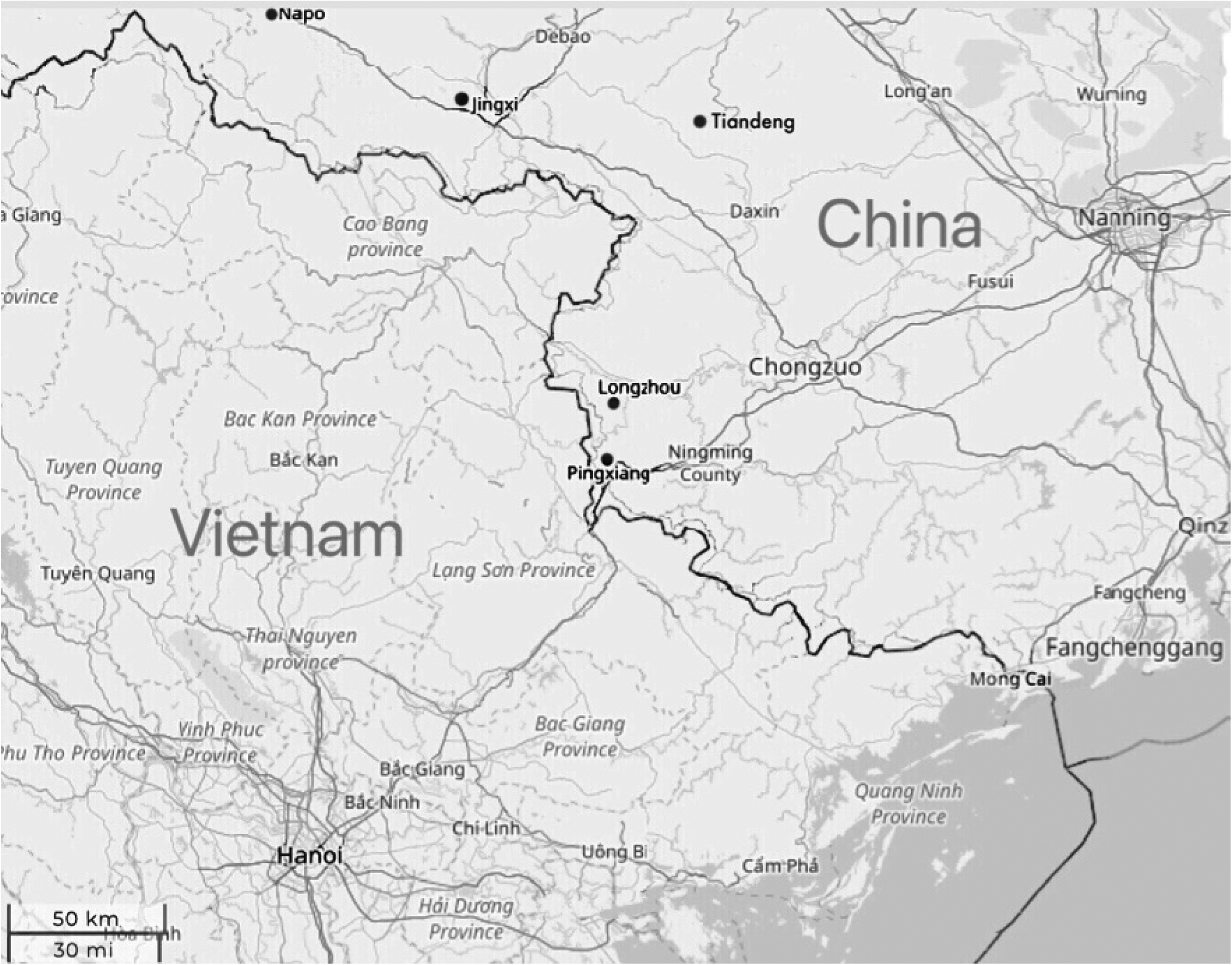
Map of Research Locations in China–Vietnam Border Areas.
Research Participants
The data comprised 27 in-depth interviews, with 10 women who were trafficked and stranded in China–Vietnam border areas and 17 local residents. Among the local residents, there were village heads, village Party branch secretaries, village directors of the Women's Federations, Family Planning staff members, local elementary school teachers, and ordinary villagers. Most of the trafficked participants were drawn from a sample of trafficked victims introduced by the director of a Women's Federation (hereafter Villager 12), who was also interviewed. All 10 trafficked women are undocumented residents in China.
Research Design
The standardized interview asked women about their trafficking experiences, life, and working conditions in China. The women also answered questions about post-trafficking experiences, including their intimate relationships with their partners, their work and life conditions, escape attempts, and returns. Interviewees were also asked about villagers’ attitudes toward marriage, marriage trafficking, and trafficked women. The interviews took place in Chinese and were later translated into English. Interviews typically ran between 90 min and 2 h. Some interviews were audio-recorded, and the interviewees were photographed; other interviews were recorded in note form. Some interviews occurred in the Village Women's Federation (VWF) office, and some in the participants’ homes. An interpreter assisted where language was an issue. 3
Procedure and Ethical Considerations
The study is supported by the Ministry of Education (MOE) of the People's Republic of China's project along with key research institutes for the humanities and social sciences at universities in China. Ethical considerations have been evaluated and the study was approved by Jinan University's ethics evaluation committee. The participants all received a consent form, which was read aloud to them, since most either could not read Chinese or were illiterate. They were informed of the general nature of the study and their right to withdraw. They were assured that their responses would remain anonymous and would be analyzed in an aggregated manner, keeping their personal information strictly confidential. The research team compensated participants for their time. The majority worked in sugarcane fields and earned 30 yuan 4 (approximately $4.5 USD) per day. They received 200 yuan (approximately $30 USD) for the interview and signed receipts.
Coding the Data
I used NVivo12 software to analyze the available interview data, and thematically coded the data to collect material on specific themes and topics. Specifically, I created different nodes and subnodes based on the research questions, and then coded similar narratives into relevant nodes. For example, many trafficked women described experiencing physical and sexual violence from their husbands (buyers) in the trafficked marriages, and I grouped these accounts under the subtheme of “domestic violence.” After completing the overall coding, I identified homogeneous nodes based on the research questions and discovered the relationships between the nodes, and grouped these nodes under broader themes. For example, I grouped “domestic violence,” “labor servitude,” and “reproductive slavery” under the broad theme of “unique forms of marriage trafficking and exploitation associated with the institution of marriage.” The subjects of the interviews (n = 27) provided many valuable narratives, from which three main themes and nine sub-themes were derived: marriage demand as the premise of marriage trafficking (biological, economic, and cultural), marriage trafficking's unique forms of exploitation associated with the institution of marriage (domestic violence, labor servitude, and reproductive slavery), and marriage trafficking's conducive contexts (middlemen's economic and emotional motivations, ordinary villagers’ moral tolerance, and passive assistance by the Women's Federation). After coding, members of the research team conducted reliability checks of the themes and coded content.
Results
Demand for Marriage: Premise of Marriage Trafficking
The first strong theme to emerge from the interviews was that, in the studied areas, the institution of marriage is a biological, cultural, economic, and social imperative rooted in patriarchy and gender inequality. Although the literature on marriage trafficking along the China–Vietnamese border explains marriage trafficking in terms of economy and migration, the interviews highlight the importance of examining local marriage demand as a precondition and stimulus for rampant marriage trafficking.
In the areas where the interviews were conducted, marriage is reported to be entered into for utilitarian reasons rather than for personal satisfaction. Few villagers cited “mutual affection” as a reason for getting married. According to the interviewees, the need for marriage is, first and foremost, a biological and cultural one, for the transmission of patrilineal family lineage, surname, and property. This traditional marriage value is still predominant in the areas where the interviews took place. Several respondents’ accounts support this statement, describing marriage as a matter of not only a man's individual interest but also of his family and clan; marrying and having a woman bear children ensures the continuation of a man's family lineage, the preservation of the family name, and the inheritance of property. The following are two examples of such a perception: A man's marriage is not only his personal affair but that of his entire family. The whole family counts on him to pass on the family name. (Villager 1, Longzhou County Kejia Village)
Without marriage, their family's line is broken. There must also be children to inherit property. (Villager 2, Napo County, Pingmeng Village)
This observation echoes previous research showing that, in many rural areas in China, marriage is a product of the traditional patrilineal, patriarchal family system (Zhao, 2003; Zheng, 2018). Traditional marriage is inextricably linked to the patriarchal family lineage and the continuation of the family name (Watson & Ebrey, 1991); it also serves as a safeguard for private property succession (Engels, 2007).
Also, villagers interviewed indicate that marriage is an economic strategy, whereby men can increase their income by acquiring available labor, and receive old age security through their wives and children. The study site is a rural area where most local inhabitants are peasants who rely heavily on agricultural harvests for their livelihood. Based on villagers’ accounts, marriage provides a way through which individuals can have children as a directly available labor force to generate additional income. Also, children in China are culturally and legally obligated to support their parents, as Article 15 of the PRC Marriage Law states clearly that children have the duty to support and assist their parents (Appendix the marriage law of the Peoples Republic of China, 1985). The inability to marry results in the loss of these economic advantages, which concerns many villagers. One villager's account is particularly illustrative of such concerns: They (unmarried men) have no children and no one to work the land for them. When they got old, they usually can’t find anyone they can depend on. A woman in the village can always be married off, even if she is blind, but she is rarely left alone. A woman may be blind, but she can bear children. But if a man wants to have a child, he must find someone to marry. Also, he has to be taken care of when he gets old. (Villager 3, Napo County, Bainan Village)
Third, the respondents regarded marriage as a social demand, a matter of conforming to social norms and receiving recognition, which is closely related to men's social status. On one hand, a man's marital status reflects his social status. As described by many interviewees, marital status symbolizes the material and social conditions (income, education, appearance) of individuals. This symbolism was reflected in the stigmatizing attitude some villagers took toward unmarried men, indicating that there are usually “problems” with men who cannot find a woman to marry. The term “problem” included being perceived as unattractive, uneducated, poor, or even physically disabled. Villagers 12 and 8 spoke to these attitudes toward unmarried men: In the villages, many of these men find it difficult to marry through traditional means such as romantic love. These men are often uneducated, powerless, poor-looking, or disabled. (Villager 12, Director of VWF)
In our village, marriage is a necessity. Those who never have the opportunity to marry usually live in low-income families or are uneducated. And in the eyes of other villagers, they may be seen as poor and wretched. (Villager 8, Jingxi County, Mengma Village)
On the other hand, men's inability to marry may aggravate their already low social standing, as unmarried men are often stigmatized. Previous studies have shown that in almost half of Chinese rural communities, unmarried men face discrimination and are often treated as if they are committing crimes to survive (Ebenstein & Sharygin, 2009; Wei & Zhang, 2015). This view is supported by many villagers’ narratives; for example, a village chief in Jingxi County Mengma Village explained how unmarried men might cause social problems for the local community: Not allowing single men in the village to marry Vietnamese women would create social problems. Many older men cannot marry, which will lead to social instability. Unmarried men don't have families, which will lead to social chaos. (Villager 7, Jingxi County, Mengma Village)
As for the men who buy their wives on the marriage trafficking market, many villagers interviewed did not see them as evil, rich, or powerful, but rather as economically and socially disadvantaged, and at the lower end of the already marginalized group of unmarried men. Villager 4 spoke to a phenomenon that men who cannot get married because of their significant social “problems” are the most motivated to buy women on the marriage market: Those who have significant social problems, like men who are poor, old, unattractive, or physically disabled, are willing to borrow money from relatives and pay high prices. (Villager 4, Napo County, Bainan Village)
Villager 16, a primary school teacher in Pingxiang County, shared a similar opinion: Only men with serious financial or physical difficulties would buy Vietnamese wives. (Villager 16, Pingxiang County, Primary school teacher)
According to the interviewees, the marriage buyers were indeed people with very low levels of income and education, and some even suffered from physical disabilities. All of the trafficked women's husbands were farmers with only average primary education, and with family incomes at the lower end of the income scale in their villages. Some had physical disabilities and depended on the State's subsistence allowance to survive. The following are two examples: I’m a little older than my husband. He is crippled, and he cannot handle large-scale farm work. He is considered an overdraft hardship case and gets relief funds from the township government. He sells pork at the market in a car designed for the disabled, which was provided to us by the civil administration and is very small. The two of us can use this vehicle to take the pigs home to kill, and then transport the meat to town to sell. It's a small business. (Trafficked woman 3)
My husband is much older than me. He was born in 1968, and I am only in my 20s. He has a congenital neurological disability so I do most of the farm work. (Trafficked woman 6)
Finally, villagers’ perceptions regarding marriage and unmarried men are based on the perception that women are both subordinate and available resources for production and reproduction. The villagers interviewed generally viewed marriage from a male-dominant perspective, believing that women were the solution to unmarried men's problems and that marriage was something from which men could directly benefit. Some illustrative accounts are given below: How can you not get married? If you don’t get a wife, who's going to carry on your legacy? Who's taking care of you when you are old? (Villager 5, Napo County, Bainan Village)
There are a lot of women in Vietnam and a lot of men here, so we can complement each other. This should solve a big social problem. (Villager 7, Jingxi County Mengma Village)
These accounts imply that even the expectation of an ordinary marriage has an embedded assumption of men's ownership of women. This echoes Quek's theory that patriarchal traditions and gender norms have shaped the traditions associated with marriage to include some of the characteristics of marriage trafficking. Moreover, the underlying premises that enable trafficking are often implicit in the perceptions or practices associated with the institution of marriage (Quek, 2018).
The demand for marriage in the study sites reflects a range of structural and cultural expectations, interpretations, and ideologies associated with marriage, and echoes two concepts: patriarchy and gender roles. Patriarchy is an institution defined by class, gender, and sexual privileges, which creates a basis of dependence for domination and rule (Walby, 1990). In traditional patriarchal systems, reproduction is a key to the functioning of the patriarchal extended family and is often associated with the source of peasants’ labor in agrarian societies (Wolf, 1966). Here, patriarchy can be understood as the biological, cultural, and economic basis for the demand for marriage in the studied areas. Gender roles refer to societal expectations of men and women's behavior, status, and function, defining the different roles that men and women play in the patriarchy, and representing a set of socially constructed gender norms (Thompson Jr. & Pleck, 1995). Men in the study area are expected to continue the paternal lineage and family name and to possess financial and social resources that are socially sanctioned. By contrast, women are expected to play a subordinate role in reproduction and caregiving. Both concepts contribute to shaping the premise of ordinary marriage and marriage trafficking.
Marriage Trafficking's Unique Forms of Exploitation Associated with Marriage
The Palermo Protocol emphasizes that trafficking's forms of exploitation can also be considered its ends. Therefore, this study treats exploitation in marriage trafficking as the purpose of marriage trafficking. Interviews show that exploitation as the purpose of marriage trafficking has three dimensions: domestic violence (sexual and physical violence), labor servitude, and reproductive exploitation.
Domestic Violence
Domestic violence is the first dimension of exploitation in marriage trafficking; for the purposes of this article, it refers primarily to the sexual and physical abuse that occurs in trafficked marriages. These forms of violence are among the most insidious for which there is hardly a binding international rule, either in itself or in relation to human trafficking. The Palermo Protocol does not include “domestic violence” as a form of exploitation in the context of trafficking, possibly because it also does not mention marriage trafficking as a separate form of trafficking. The forms of “domestic violence” are similar to, and overlap with, the “means” and “ends” of human trafficking mentioned in the Palermo Protocol. For example, both include threatening actions and sexual exploitation. There has been less research, however, on domestic violence specifically perpetrated in the context of marriage trafficking.
The trafficked women interviewed were commonly subjected to sexual exploitation, a form of exploitation that the Protocol identified as one of the main purposes of trafficking in persons (UN, 2000, Article 3a). All trafficked women described their experiences of their husbands demanding sexual services after getting married, regardless of their interests or desires. Many reported that sexual exploitation began the day they were sold to their husbands. For example: That night, I was raped by a cripple. Later, I found out that I was sold to that cripple. (Trafficked woman 4)
I was raped by my husband in his house the first night. Then I was locked up by my husband's family in a room with a big iron door. (Trafficked woman 5)
Physical violence by husbands was common among the trafficked women interviewed. Forms of physical violence, such as threats, the use of force, or coercion, are recognized by the Protocol as a means of trafficking in persons. The majority of trafficked women suffered some degree of physical violence from their husbands, usually due to their refusal of coercive sex or forced labor. Some had been subjected to physical violence until they became pregnant. For example: Trafficked woman 5: My husband often beats me, but now he beats me less because our children are grown. Trafficked woman 6: I was always beaten by my husband until I got pregnant.
The study's data reflect three characteristics that distinguish sexual and physical violence in marriage from other forms of trafficking: durability, individualization, and privacy. These characteristics resonate with Quek's theory. The durability of violence within marriage means it can last a lifetime if victims are unable to break free. In the case of sex trafficking, a woman's slavery may end after a few months or years (Fergus, 2005), while in the case of marriage trafficking, it usually lasts a lifetime or at least decades, unless the woman can escape. Trafficked woman 9 described a situation in which she was forced to choose between being sold into prostitution or into marriage, with the traffickers using the durability of violence within marriage trafficking to intimidate her: The trafficker told me that prostitution is better than being sold into marriage because if she is sold into prostitution, she can go back to Vietnam after a year. But if she married into the deep woods, she would have to have two or three children and stay with that man for the rest of her life. I was terrified by the latter, so I said I would like to be sold into prostitution. (Trafficked woman 9)
The victims interviewed have all been trapped in a forced marriage for more than two decades, and there is no doubt that the violence within trafficked marriages can be lifelong if the women's status as involuntary wives is not detected or they do not want to attempt to escape from the marriage.
The individualized nature of sexual violence in marriage trafficking means that marriage trafficked women lose the ability to choose their sex partner. In sex trafficking, the sexual exploitation of women is public and commercial (Jeffreys, 2009), whereas in marriage trafficking, the sexual exploitation of women is private in nature, often only to satisfy the sexual needs of their husbands.
The intimate nature of domestic violence means that the sexual and physical violence within marriage disappears from public view, so even if villagers are aware of or witness violence against women, they are reluctant to interfere, or even do not recognize it as exploitative. Villager 12, director of the VWF, described how almost everyone in the village knows that men in the village beat their wives (whether or not the wives are trafficked), yet the villagers refuse to intervene, let alone call the police. For many villagers, the reason for not intervening is that it is someone else's family business. The following is one example of this feeling: In the villages, not only the husbands of trafficked women but also the husbands of normally married women often beat their wives. Some people's husbands beat their wives all day long, and some women run away. Who has so much skin for you to beat? Villagers think this is not their family business. It's private, so they don’t prevent it. (Villager 6, Napo County, Guidi Village)
Some villagers made this attitude clear when asked about domestic violence. The following is one example: They can handle their own family matters by themselves. We bystanders can’t interfere. (Villager 15, Longzhou County, Shangjin Village)
In other, more common forms of trafficking, the concept of trafficking applies only to the public sphere and the commercial environment, but this general identification prevents certain forms of marital abuse from being identified by the public as exploitation.
Labor Servitude
Labor servitude is the second form of exploitation in marriage trafficking. It distinguishes marriage trafficking from sex trafficking, where women are generally not expected to provide domestic services or earn income for men, whereas, in the case of marriage trafficking, the harm to women almost always involves forced labor. Quek argues that marriage trafficking can be identified as an overlap between sex trafficking and forced domestic labor (Quek, 2018). My research supports her theory and further reveals a double burden borne by trafficked women, who are not only responsible for domestic work but also participate in agricultural labor, and sometimes even become the main labor force and source of income for the household.
The trafficked women interviewed performed two forms of forced labor: agricultural and domestic. The interviews show that victims must also help buyers and support the household as income sources. All trafficked women interviewed stated that they needed to do household and agricultural work, and to learn new agricultural skills to support their husbands and contribute to the family's resource production. For example, Trafficked woman 4 described how she did most of the agricultural work because of her husband's physical disability: My husband and I mainly work to cut sugar cane. We earn 35 yuan (about $5.25 USD) a day. He used to work a lot, but now I do most of the work, and I need to take care of the whole family. Our family receives a minimum allowance from the government, but we only get 50 yuan (about $7.5 USD) a month. This is very little.
Trafficked woman 3 commented on the Vietnamese women in the village as follows: Vietnamese women work harder than their Chinese husbands, even harder than most Chinese men. Many Chinese men are lazy. Although Vietnamese women earn more than men, they have a lower status.
In addition, some trafficked women interviewed had been forced to marry people with disabilities and to care for their husbands. They usually do agricultural work during the day and unpaid housework at night, while looking after their husbands and children. For example, Trafficked woman 5's husband suffers from rheumatic pain and is unable to work, so, in addition to the housework, she does most of the farm work. She described this double burden: Now my husband is 58 years old. He didn’t finish primary school. He consumed alcohol a lot, has gout, and cannot do farm work. So, I have to take care of him and do all the farm work and take care of the children. (Trafficked woman 5)
These forms of forced labor are similar to what is called the double burden by Hochschild and Machung in The Second Shift (Hochschild & Machung, 2012), and echoes what is called invisible work by Daniels (Daniels, 1987). The double burden refers to the unpaid domestic work that married women have to do while also working to earn money. In ordinary marriages, where both spouses have paid work, women tend to spend more time than men on domestic work and care, such as looking after children or sick family members (Hochschild & Machung, 2012). The description of women's domestic work here echoes Daniels’ term “invisible work,” which refers to women's domestic labor that is culturally and economically devalued. In the context of marriage trafficking, labor exploitation of women is exacerbated due to trafficked women's lack of economic autonomy and the invisibilization of women's domestic work (Daniels, 1987).
Their lack of economic autonomy and continued dependence upon husbands as a means of survival and production is reported to be the primary reason that women in trafficked marriages experienced worse labor exploitation. No trafficked women interviewed possessed family land or production facilities. Although this lack of economic autonomy is known to be common among women in villages, Vietnamese women who are trafficked for marriage are less independent than non-trafficked Chinese women. This is partly because trafficked women are under surveillance and imprisoned by their husbands, who do not allow them to work outside the home for fear of their escaping. Moreover, because they are far from their families, they typically have no local social support and are subject to surveillance by other villagers in the same village (described in detail in the next section).
The “invisibility” of the victim's labor in the marriage is reported as a second reason for severe labor exploitation. Work within marriage (especially domestic work) is often not seen as work, but rather as a woman's responsibility. According to villagers’ descriptions, in the studied areas’ local culture, it is customary for wives to do unpaid housework, which is considered a “wifely duty.” Some locals complained that Vietnamese women “do not do housework,” which they said was intolerable, especially when the wife had children, regardless of whether the women were trafficking victims. The following is an example: There is another Vietnamese woman. When she got married, she never did any housework and played cards all day. She never wanted to be someone's wife and have children! She even tried to run away after giving birth to three children. After she was caught, she ran away again. We haven’t seen her in two years. I will never understand why she ran away when she didn’t have to do housework. (Villager 15, Longzhou County, Luohui Village)
The account is resonant with the concept of the invisiblization of domestic work (Daniels, 1987). The important role that marriage as an institution plays is the construction, organization, and reflection of the gendered division of labor, which involves the naturalization of unpaid work done by the wife to the extent that it is no longer considered work (Comer, 1974; Delphy & Leonard, 1992; Himmelweit, 1995). In the trafficked marital relationship, the husbands consider the victims to be chattel, a source of potential profit under their control and within their jurisdiction and discretion. Moreover, the invisibility of female domestic work in marriage invisibilized the exploitation of trafficked women, making women's labor and exploitation invisible to the public.
Reproductive Slavery
The third area of exploitation resulting from marriage trafficking is reproductive slavery, an important but relatively neglected result of exploitation in the literature on trafficking and in human rights reports. As a specific form of exploitation exclusive to women, reproductive slavery and its harm have not been sufficiently discussed. International law does not explicitly identify the reproductive exploitation of women as a possible outcome of the trafficking process, nor does the Palermo Protocol consider reproductive exploitation as a form of exploitation in trafficking. Some scholars view this omission as a male bias that tends to view slavery-like practices through the lens of men's experiences, ignoring the specific ways in which women experience exploitation (Bridgewater, 2005; Jennings, 1990). This research suggests that the reproductive exploitation of women may be the most severe aspect of their experience of trafficking.
Women who are trafficked for marriage often have no control over their fertility, pregnancy, or the number of children they will have. All trafficked women interviewed had at least two children, and they often did not have the opportunity to negotiate whether to have children. For example, one trafficked woman explained that: “My husband and his parents want me to have two. I don’t want to have so many myself.” In some cases, husbands and husbands’ families would encourage victims to have children by promising to give them permission to return to Vietnam to visit their families. As Trafficked woman 5 described: I stayed in China for six years and had two children (one boy and one girl). And my husband finally agreed to allow me to return to Vietnam to visit my family, because he thinks that I will not escape after I returned to Vietnam for the sake of our children.
Villager 12 explained it this way: Usually, it is not possible to go back to Vietnam to see your parents in the first year. Because you did not give birth to your husband's family, you had to have at least two children before your husband's family would allow you to go back.
Moreover, children create emotional and moral barriers to the trafficked women's escape attempts. Numerous other factors, including a lack of understanding of the local language and surroundings, the inhospitable mountains, lack of vehicles, and lack of money, also hamper trafficked women's ability to escape their hazardous environment. However, the main obstacle preventing trafficked women from escaping is their emotional attachment to their children, which makes them hesitate to escape from the marriage trap. Trafficked woman 2 recounted an experience of her return to Vietnam, not wanting to go back to China, but afraid that by running away, she would cause her children to suffer: I’ve been back to Vietnam twice now. I think my appearance has changed a lot over the years, and maybe, because it was night, my family didn’t recognize me. They said they thought I had died somewhere. When my mother saw me, she was crying the whole time. I only went to Vietnam for two weeks because my children were still very young, so I decided to go back to China quickly. My mother told me not to go back to China, but I felt that if I ran away, my children would suffer.
Trafficked woman 5 described a similar decision she made when she returned to Vietnam to visit family: When I returned to Vietnam, I was alone without my husband and children to follow me. I stayed in Vietnam for four months and didn’t want to come back. But I eventually went back to China because I thought of my children. I couldn’t leave my children behind.
Another trafficked woman echoed that situation: When I went back to Vietnam, my sister cried to try to convince me not to go back to China. I said it was impossible. I have already had three children over here.
This emotional bond also became a moral one when villagers intervened, telling the trafficked women that they had a moral responsibility to their children. Some interviewees stated that villagers persuaded them that it was better for them to stay for the sake of their children and to fulfill their duties as mothers. For example, Trafficked woman 1 noted, The villagers here persuaded me: “Life is good here, your husband will be good to you, and you already have children. You’re a mother now, and you can’t leave your children. You now have a family that depends on you, so just relax and try to settle down here.”
Trafficked woman 2 shared a similar story of villagers who urged her to stay, saying that her children counted on her: The villagers urged me to stay. They used to say, “You don’t know the way home, and you don’t know the language the people here speak. It's hard to escape. And your children are counting on you! You’d better stay here. You can plan for your future later.”
Finally, because they are trapped in the trafficked marriage and have not exited, some trafficked women said they would choose to stay in China for the sake of their children's education or career. For example, Trafficked woman 3 described her feelings about not wanting to go back to Vietnam: I don’t want to go back to Vietnam now, mainly because that would be difficult for my children to transfer schools. And maybe wait until my children graduate first. My parents may have passed away, and I don’t know what's going on there. (Trafficked woman 3)
It is clear from the trafficked women's accounts that the harm of reproductive slavery extends far beyond the violation of their consent and will. It also involves the establishment of an emotional and moral bond between the trafficked women and their children, and the family formed by trafficking. Victims of marriage trafficking are often limited in their ability to leave a harmful environment by their concern and responsibility for their children. For that reason, some women voluntarily give up the possibility of running away, going to the police, or seeking help.
Marriage Trafficking and the Conducive Context
Finally, marriage trafficking is related to the conducive context associated with the local community. At the macro level, the improvised living environment and lax cross-border regulations underpin the basis for marriage trafficking; these factors are relatively well-documented by the previous research on the study site (e.g., Maochun & Wen, 2014). There is a dearth of literature, however, on the meso-level analysis of the conducive context for marriage trafficking. The interviews illustrate that marriage, as a social norm, is supported by social networks that include middlemen, ordinary villagers, and even the village's women's federation. These social network factors indirectly favor the emergence of marriage trafficking and constitute obstacles to escape or detection.
Middlemen Have Both Economic and Emotional Motivations
Middlemen in the same village are key actors with local links to marriage traffickers; their motives and behavior in promoting marriage trafficking reflect the local society's ideological adoption of marriage as a social norm. According to the interviewees, some local villagers, who are generally ignorant of the law, have links with traffickers and are involved in and assist traffickers in the illegal trafficking of marriage partners in border areas. These middlemen are usually residents of the buyer's village, and their role in trafficking is primarily to provide traffickers with contact information of local men in desperate need of a spouse. For example, a woman in Dingming County was known to many interviewees because her house was designated as a holding shelter for trafficked women. According to Villager 12, the director of the VWF: There was a woman in Dingming county who was involved in human trafficking for more than ten years. That woman is famous for selling trafficked Vietnamese women, she has a lot of information and resources, and she knows who needs a wife, her potential customers. Generally, those disabled single men who are really in need of a wife will come to her. The trafficked women are placed in her home.
Marriage trafficking reportedly proceeds like this: traffickers bring the trafficked women across the border and into the villages where the research sites are located; the villagers who serve as middlemen then receive and shelter them and provide the traffickers with the buyers’ contact information, for which they collect a referral fee. Villager 19, a villager in Tiandeng County, Tingluo Village, stated that he was involved in the marriage business as an intermediary: Since I can speak Cantonese, Mandarin, and Zhuang dialect, several traffickers and I drank tea or drinks at the Chinese-Vietnamese border in the 1990s and discussed how to smuggle and sell Vietnamese women. Usually, in the Ninh Minh district of China, 500 yuan (about $75 USD) was given to Vietnamese traffickers and 800 yuan (about $120 USD) to traffickers. Above all, I help the villagers to make contact with the traffickers in order to make Vietnamese women their wives. (Villager 19, Tiandeng County, Tingluo Village)
In addition to financial motives, emotional motives are also a key element. Some middlemen were reported to have great sympathy for unmarried men, stemming from the marriage culture of the local community. The villagers interviewed told us that marriage is not only the union of two people, it is also a requirement of rural society, and that not getting married risks possible exclusion from community networks and social welfare: Some villagers sympathize with unmarried men and offer them some kind of help, including lending money and introducing them to marriage traffickers. An unmarried man's entire family can get involved and help him voluntarily. (Villager 12, Director of VWF)
In some cases, middlemen act in marriage trafficking out of sympathy. For example, Villager 19 said that he had helped relatives in Ninh Minh district to make contact with traffickers of Vietnamese women out of “good will”: He (relative) couldn’t find a wife, and the whole family was very anxious. Out of kindness, I introduced him to someone I knew in Vietnam (interviewee) and lent him money to get a wife. (Villager 19, Tiandeng County, Tingluo Village)
Ordinary Villagers’ Moral Tolerance
It is important to understand the villagers’ perception of marriage trafficking, as these same villagers form the social networks and relationships of the buyers. Relationships are fundamental components of a phenomenon in which the actors and their actions are interconnected and not isolated, and networked structures set the possibilities or limits for individual actions (Wasserman & Faust, 1994).
Villagers are generally aware of the trafficking of marriage partners in their villages. In the accounts of the villagers, cross-border marriages between Chinese and Vietnamese often involve financial transactions. For example, Villager 16, a primary school teacher in Pingxiang district, explained her knowledge about the money transactions that are often involved in transnational marriages: A Vietnamese woman is usually brought here by a man in financial difficulty who cannot afford a Vietnamese wife in the area. After coming here, she may also bring other Vietnamese women over for a fee.
Villager 10, from Jingxi County, Qilong Village, said directly that he was aware of marriage trafficking in the village: “I know, there's a lot of women trafficked into becoming wives of villagers.”
However, since marriage is a socially legitimate norm, the villagers have expressed neither knowledge of, nor concern about, such marriages’ legality. When asked about marriage trafficking, the villagers were indifferent because they treated marriage as a private matter. Villager 11, a villager in Jingxi County, Erlang Village, expressed this attitude directly: “I don’t know. It's not my business. It's their household's business.” Others expressed tolerance and even encouragement, as they considered marriage (legal or not) to be a good thing. For example, Doesn’t anyone feel sorry for these Vietnamese women? No. Some people think it's a good thing that the village bachelors can find Vietnamese women to marry. Most people in the village don’t care about human trafficking, and they don’t say whether it's a good thing or a bad thing. They think it's none of their business. (Villager 12, Director of VWF)
Many people think it's a good thing that young unmarried men in the village can spend money on a wife (Villager 13, Vice Director of VWF)
Moral tolerance is also reflected by the many villagers who witness the sale of these women. Trafficked woman 5 revealed that some villagers even stood by and watched when she was sold to a man, while no one called the police or prevented the selling from happening: I was crying and fighting back the whole time. At dawn the next day, people from the village came to see me, children and adults alike. They watched me crying while no one helped.
In addition, although the villagers are aware of the marriage trafficking in which their fellow villagers are engaged, they rarely report it to the police. Villager 17, a local social scientist, told the research team that most of the detected victims of marriage trafficking were reported to the local police by the victims themselves. Ordinary villagers have reported only a few cases of marriage trafficking to the police: Some of the victims of trafficking in Dongxing and Ningming reported the crime to the police and were later rescued, but all reported to the police themselves without the villagers’ help. There are very few cases reported to the police by villagers. (Villager 17, Social Science Scholar)
The reason for indifference and the failure to report is that villagers believe that the institution of marriage involves a “private sphere,” not a public sphere, and therefore they see an affirmative duty (if a weak one) to stay out of it: Villagers are aware of marriage trafficking in the village, but they do not report it to the police because they think it is none of their business and someone else's family business. (Villager 17, Social Science Scholar)
Why do you care so much about other people's business? (Villager 10, Jingxi County, Qilong Village)
Nevertheless, villagers were not as uninvolved in the private sphere as they claimed. Although no one called the police, many villagers monitored the movements of trafficking victims and prevented their attempts to escape. In some cases, victim interviewees reported that they had tried to escape at an early stage after they had been trafficked, but all failed. In addition to the victims’ lack of money, physical strength, and knowledge of the local language, it was the villagers who prevented their escape attempts. The following is an example of one such experience: One day, I escaped from the house by catching them off guard, but I soon lost my way. When the villagers found me, they reported me to my husband and his family, who brought me back, and I was brutally whipped by my husband. After that, I tried many times to run away or sneak away, but I failed. (Trafficked woman 6)
Passive Assistance by the Women's Federation
The Women's Federation in the village is the organization with the closest relationships to trafficked women. The organization, however, is also constrained by its patriarchal understanding of the institution of “marriage,” which limits its efforts to help trafficked women leave.
Village Women's Federations (VWF) are village-level organizations under the All-China Women's Federation (ACWF). Although the ACWF is officially labeled an NGO, its long-standing relationship with the CCP means that the Party and government take an interest in the federation and its members. This relationship is supposed to give the organization the dual structure of carrying out the Party's orders and informing the government of women's interests. The trafficked women interviewed in this study were all referred by their local village women's federations.
From the interviews, it emerged that the main objective of the Women's Federation's work with trafficked women is to stabilize, pacify, assimilate, and provide economic support to them, rather than help them exit the marriage. The directors of two VWFs (Villager 12 and 13) indicated how they do their best to benefit the trafficked women said by Villager 12: We do the following jobs: first, we help families affected by trafficking to obtain marriage certificates; second, we provide financial support to families whose trafficked Vietnamese women are in financial difficulties; third, we seek legal status for children of trafficked families
5
; fourth, we bring women together to train them in the local law, the marriage law, and we gather to understand the situation of trafficked women and provide them with assistance; and finally, we reduce discrimination against villagers in relation to the trafficked women.
Villager 12 further explained her contribution in applying for funds from foreign NGOs and using those funds to provide financial support to trafficked women: We applied to an Australian NGO for a micro-credit project to recruit more than 20 Vietnamese women to the District Women's Union, and they got together and stayed up until dawn, grateful for the work of the VWF. They wanted to have status and no fines for registering their children. The project has 100,000 people in total, giving Vietnamese women loans of 2,000 to 5,000 yuan each, and they take out loans to go back and buy seedlings and ducklings to raise. Some planted sugar cane. The results are remarkable. Only the Tien Dang Women's Union has given tangible help to Vietnamese women.
According to the VWF directors, the role of the VWF is not to help trafficked women exit marriage, but to facilitate their peaceful integration into the local community. Admittedly, according to VWF members, VWF members have applied for loans from international human rights organizations and provided financial assistance to trafficked women (and the trafficked women's families), helped women obtain legal documents for their marriages and children, and assisted trafficked women in learning local languages and expanding local social networks. However, none of these actions had anything to do with rescuing women from trafficked marriages. They neither called the police nor reported the situation to higher authorities. To a certain extent, they acted as lobbyists, convincing trafficked women to integrate physically and emotionally into the local society, live their present lives, and forget that they were trafficked.
One reason for this passive assistance is the assumption that marriage trafficked women already have a “family” in the region, and “family” is, in the villagers’ perception, socially and morally legitimized. For example, when asked why they do not help trafficked women escape, the Director of a VWF (Villager 13) replied: “They have a family now, they have a home here. You shouldn’t break up people's families.”
Additionally, the VWF consists of women who have their own independent organs, but who have limited institutional power compared to those in charge in the villages. They cannot usurp the role of those in charge in their particular hierarchy. As Villager 13 said: The trafficked women's husbands are not willing to help them escape. And the village chief will not approve of us tearing families apart. All we can do is provide financial aid to the Vietnamese women here. Help them obtain legal marriage documents, help their children with household registration.
These accounts reflect the generally inferior status not only of trafficked women, but of all women (including the VWF leaders) in the area studied, who are forced to accept the patriarchal rationalization process. Since local social networks and moral systems also constrain the agency, its staff can only help victims of trafficking to adapt better to the local living environment.
The above description of the meso-level social networks of the research site suggests that marriage trafficking needs to be understood as being situated in a conducive cultural context that facilitates the development and rationalization of marriage trafficking and hinders the rescue of its victims. In addition, the actors in the social network, including middlemen, ordinary villagers, and the Village Women's Federation, form part of, and are pressured by, this environment. This pattern fits Kelly's (2013) theory of the conducive context, where she shows that the culture, beliefs, and practices in the human trafficking environment do not see women and girls as individuals with rights, but as property belonging to their family/male “protectors.” This perception, coupled with the interactions of actors in social networks, forms part of the fertile ground in which human trafficking can flourish.
Discussion and Conclusions
Despite many limitations, including the inherent shortcomings of qualitative research and the limited sample recruited, this study is one of only a few that critically explores how the symbols and practices of the institution of marriage shape the social environment conducive to marriage trafficking. This study pioneered in-depth interviews with members of social networks in marriage trafficking sites to explore the social networks that are conducive to marriage trafficking, and that impede the victim's agency. The findings support the view that there is a relationship between “marriage” as an institution and marriage trafficking; furthermore, the exploitation associated with marriage trafficking simultaneously includes domestic violence (both sexual and physical), forced labor, and reproductive slavery. The findings of this study are threefold.
First, the local demand for marriage is rooted in patriarchy and gender inequality, which constitutes a premise for the emergence and development of a marriage trafficking market. In the study sites, interviewees perceived marriage as contributing to the succession of patrilineal lineage, family names, and property; helping men obtain available agricultural labor and old-age security from their wives and children; and helping men conform to gendered social norms. Most demands for marriage are associated with married men's access to their wives’ unpaid labor supply, free family care, and childbearing within marriage. Such results echo Nicola Barker's discussion of the specific benefits that husbands derive from the unequal gender division of labor within marriages; in this sense, marriage is meaningful and beneficial to men, and these benefits are largely due to the unpaid work and reproductive services provided by wives (Barker, 2012). Interviews also show a link between men's marital and social status, with being married symbolizing the material and social power they have acquired; some men's inability to marry will worsen their already low social status. This finding resonates with Quek (2018), who emphasizes the importance of considering the practical and symbolic effects of marriage when discussing marriage trafficking, including how marriage affects an individual's material and legal status, and how it reinforces or instantiates patriarchal social norms or ideological values. The findings suggest that men who are unable to marry are perceived as deprived of the benefits to which married men are entitled, and that the demand for marriage and its impact on social status are likely to drive men to seek women in the marriage trafficking market. By considering the demand for marriage, the findings extend knowledge regarding the formation and development of the marriage trafficking market. Previous literature has argued that gender inequality, the enormous unmarried population, and skewed sex ratios all contribute to the formation of the marriage trafficking market (Zhao, 2003). Yet, there has been a lack of attention to the demand for marriage in trafficked areas and its relationship to the marriage trafficking market. This study provides relevant research data that complement the previous literature and shed light on the specific relationship between the demand for marriage and marriage trafficking, revealing that the factors supporting marriage trafficking are some of the same values and norms associated with ordinary marriage demands.
Second, the results point to the need to raise awareness of the uniqueness of the exploitative elements embedded in marriage trafficking and suggest that it makes sense to distinguish the exploitative elements of marriage trafficking from sex and labor trafficking. This is consistent with Quek's theory that marriage trafficking contains a matrix of violence that encompasses both sex and labor trafficking and includes more severe and complex forms of exploitation (Quek, 2018). Three forms of exploitation are identified from the interviews: domestic violence (sexual and physical violence), labor exploitation, and reproductive exploitation.
The results also reveal three characteristics that distinguish domestic violence (sexual and physical violence) within marriage trafficking from sex and labor trafficking: durability, individualization, and privacy. In marriage trafficking, for a woman who cannot escape, the sexual and physical violence usually lasts a lifetime or at least decades. The private nature of violence within marriage means that the sexual and physical violence in marriage occurs in a private, domestic sphere that is neglected, so that even the villagers interviewed who were aware of or witnessed the violence against women decided not to intervene, or did not perceive the violence as unacceptable. Among sex trafficking and other more common forms of trafficking, the concept of trafficking applies to the public sphere and the commercial environment, but this generalized identification is inadequate for characterizing the forms of exploitation that happen within marriage trafficking. This conclusion resonates with Quek's theory that, while marriage trafficking resembles sex trafficking in large part, marriage trafficking is a more private and potentially longer-term form of trafficking in women. It is also because of this private character that forms of violence and abuse that occur within marriage are hidden from public view or invisibalized, making it more difficult for marriage trafficked women to be detected and to exit the trafficking situation.
Moreover, the trafficked women interviewed experienced labor servitude, bearing the double burden of being responsible for both domestic and agricultural work and sometimes even becoming the main source of work and income for the family. These forms of forced labor are similar to what Hochschild and Machung refer to as the double burden that occurs in ordinary marriages (Hochschild & Machung, 2012). This double burden is exacerbated in the context of marriage trafficking, where the bondage of labor is persistent and invisible. The findings highlight the factors that make marriage trafficking similar, but in many ways different from, trafficking for forced labor. On one hand, marriage trafficking resembles labor trafficking in that its victims have no economic autonomy and are dependent on their purchasers for survival and productive resources. On the other hand, the private nature of the victim's work in marriage is distinct from trafficking for forced labor. The results show that villagers perceive household chores as “wifely duties” rather than “work” or exploitation. In this sense, trafficked women's domestic work in marriage is invisibilized and not considered to be exploitation of women. This coincides with theories that marriage as an institution plays an important role in the construction and rethinking of the gendered division of labor, including the naturalization of unpaid work done by wives (Delphy & Leonard, 1992; Pateman, 1988). These findings suggest that a number of factors may increase the likelihood that the harms from marriage trafficking are overlooked or not recognized as harm at all, compared to other forms of trafficking. Although the international community recognizes, at least to some extent, the exploitation of migrants in prostitution or the service sector, exploitation in marriage is less recognized (Quek, 2018).
Reproductive slavery, the third aspect of marriage trafficking exploitation, is a particular form of exploitation of women that is unique to marriage trafficking but is relatively less mentioned and under-researched in the literature. The findings show that women who are trafficked for marriage are often subjected to reproductive pressure by their husbands and husbands’ families, who promise them rights to which they are entitled, such as returning to Vietnam to visit family, in exchange for bearing and raising children. These children also build an emotional and moral barrier for trafficked victims, dampening their willingness to run away or seek help. Interviews reveal that trafficked women's emotional attachment to their children led to their reluctance to leave harmful situations. At the same time, villagers intervene with the victims, based on the values associated with (even involuntary) marriage, transforming the women's bond with their children from an emotional shackle to a moral one. In this sense, the harm of reproductive slavery extends far beyond violating the consent and will of the victim, as it further suppresses and diverts the victim's desire to leave the harmful situation. It was evident from the interviews that some women voluntarily gave up running away, calling the police, or seeking help, because they did not want to abandon their children. The reproductive exploitation of marriage trafficking victims resonates with the literature on reproductive slavery trafficking, which finds that women trafficked into slavery or the surrogacy industry are often unable to control their own fertility or pregnancy (Brandon & Hafez, 2008); enslaved women who are forced to bear children are less likely to attempt escape because they do not want to leave their children behind (Bridgewater, 2005). The findings of this article connect with that literature and show that reproductive exploitation is one of the most unique, yet most underestimated and under-researched, outcomes of exploitation in marriage trafficking.
Finally, based on Kelly's conducive context theory, this article's third research question explores the social conditions and social networks that open the door to marriage trafficking and prevent victims from exiting the trafficking situation. The interviews show that social networks tolerate or even support trafficked marriage, since locals perceive the institution of marriage as legitimate, private, and out of the public's control in character. Such conducive social contexts facilitate the occurrence of trafficking and create additional barriers for victims to exit a trafficking situation. This research provides a pioneering study of important, but less researched, actors in the marriage trafficking sites: middlemen, ordinary villagers, and village women's federations. Middlemen in the same village are the main actors with connections to the marriage traffickers. Their economic and emotional motivations promote their support of marriage trafficking, and the source of their emotional motivation is the recognition of the necessity of marriage and their sympathy for unmarried male villagers. Ordinary villagers are also influenced by marriage as a social norm. Although villagers have a general knowledge of the marriage trafficking taking place, they are either apathetic or morally tolerant of the crime; some do not condemn the traffickers and buyers; some even watched women being sold or lent money to the buyers to facilitate the purchase out of pity. Despite their knowledge of marriage trafficking, the villagers rarely report the crimes. Many villagers even monitor the trafficked women's actions to stop their escape attempts. One of the main reasons for the general apathy and non-reporting is the universal belief that the institution of marriage involves the private but not the public sphere; thus, there is neither the need nor the duty to intervene. Finally, the Village's Women's Federation is the organization socially closest to the victims. However, this organization is also limited by its patriarchal understanding of the institution of marriage. Its members help the victims of marriage trafficking financially and help them accept their situation, rather than report the crime to the police or assist the victims’ escape.
The limitations of this study are that, first, qualitative methods are limited, as findings cannot be extended to wider populations; they cannot be tested for statistical significance, so the probability that an outcome could have occurred by chance cannot be ascertained (Ochieng, 2009). Second, trafficked women interviewees were asked about painful events from up to 20 years earlier; some memories may have faded or been too painful to remember. Third, as the trafficked women were chosen by the director of the Women's Federation, the study may not cover all the trafficked women in the area and may be limited to women who are close to the VWF or have come to its attention. To address this limitation, future research could use quantitative methods to collect data on a broader range of trafficked women and social networks in places where marriage is trafficked, and examine more of the key institutions and actors associated with and facilitating marriage trafficking. Moreover, trafficked victims could be recruited through more random sampling methods. In addition, future research should develop policy recommendations related to the unique exploitation in marriage trafficking that takes full account of the long-term, individualized, and private nature of marriage trafficking exploitation, and of the emotional and moral ties associated with reproductive exploitation, seeking to develop policies that would help trafficked women exit the trafficking situation while meeting their emotional needs for their children. Finally, it is incumbent on international policymakers to strengthen the legislation and policies on marriage trafficking, and on scholars to systematize the theory of marriage trafficking and further distinguish it from other forms of trafficking.
Footnotes
Acknowledgments
The author would like to express my gratitude to the following individuals for their contributions and assistance with this research: Wen Chen (Jinan University's School of International Studies), Maochun Liang (Jinan University's School of International Studies), Cynthia Deitch (George Washington University), Hiroshi Fukurai (University of California, Santa Cruz), Veronica Terriquez (University of California, Santa Cruz), and the reviewers of the journal Violence Against Women for their insightful comments on the work. Most importantly, the author would like to express my gratitude to the individuals interviewed, particularly the trafficked women and villagers, without whom this study would not have been possible.
Declaration of Conflicting Interests
The author(s) declared no potential conflicts of interest with respect to the research, authorship, and/or publication of this article.
Funding
The author(s) disclosed receipt of the following financial support for the research, authorship, and/or publication of this article: This work was funded by the Ministry of Education (MOE) project with key research institutes of humanities and social sciences at universities in China—Award No. 16JJD810008. The opinions, findings, conclusions, and recommendations expressed in this document are those of the author and do not necessarily reflect those of the funders.
