




Abstract
Women routinely practise taxing safety strategies in public, such as avoiding unlit spaces after dark. To date, scholars have understood these behaviors as means by which women bolster their physical safety in public. My in-depth interviews with women in Greater Vancouver, British Columbia suggest that, much less than reliably enhancing women’s safety, safety work often exacerbates women’s fear of violent crime and unreliably mitigates their exposure to violence. I thus interrogate the protective function of gendered safekeeping and reconceptualize women’s safety work as virtue maintenance work, theorizing that women practice risk-management in public places to attain the ontological security associated with evading subjectivities of gendered imprudence.
Introduction
Once upon a time, there was a sweet little girl. Everyone who saw her liked her. [. . .] One day her mother said to her, “Come Little Red Cap. Here is a piece of cake and a bottle of wine. Take them to your grandmother. [. . .] Behave yourself on the way, and do not leave the path.” [. . .] Little Red Cap promised to obey her mother . . . [but] ran after flowers and did not continue to grandmother’s until she had gathered all that she could carry. When she arrived, she found, to her surprise, that the door was open. [. . .] Grandmother was lying in bed with her cap pulled down over her face looking very strange. [. . .] “Oh, grandmother, what big hands you have!” [said Little Red Cap]. “All the better to grab you with!” “Oh, grandmother, what a horribly big mouth you have!” [cried Little Red Cap]. “All the better to eat you with!” [shouted the Wolf]. And with that, he jumped out of bed, jumped on top of poor Little Red Cap, and ate her up.
From “Little Red Cap” by J. Grimm and W. Grimm (1812/1999) 1 .
Women routinely expend cognitive, emotional, and bodily labor in public spaces to manage their overwhelming fear of violent crime. Women’s routine safekeeping—termed “safety work” in the research literature—includes behaviors such as being vigilant and alert, avoiding activities that occur after dark, and altering facework, body language, and clothing in public spaces to deter unwanted attention from men (Kelly, 1988; Rader, 2008; Vera-Gray, 2018; Vera-Gray & Kelly, 2020). While the effects of such strategies on women’s vulnerability to violent crime and subjective perceptions of safety are unclear (Scott, 2003; Thompson, 1993), women’s safety work is linked to a number of negative outcomes, including increased anxiety in public (Maxwell et al., 2019), restricted occupational possibilities (Laniya, 2005), and remaining in dependent relationships with men because they do not feel safe navigating public spaces alone (Pain, 1991). Over the life course, safety work normalizes minimal use of public places, effectively denying women their rights of spatial mobility and full civic participation as citizens (Lefebvre, 1991).
To date, scholarly accounts of women’s safety behaviors collude with a common-sense logic of safety work as necessary because it is effective. Within this logic, safety work is cast in one of two ways: (a) women practice safety work because it tangibly mitigates gendered risks in public (see, for example, Nicholls, 2017; Vera-Gray, 2018; Vera-Gray & Kelly, 2020), or (b) women practice safety work because they perceive that it mitigates risk, and thus experience diminished fear of violent crime in public (see, for example, Fileborn, 2016; Starkweather, 2007). Yet, research exploring the relationship between safety work and fear of violent crime (Ferguson & Mindel, 2007; Haynes & Rader, 2015; Scott, 2003) and between safety work and risk mitigation (Brooks, 2011; Thompson, 1993) fails to support these contentions by documenting ambiguous effects of safekeeping on both perceived safety and objective risk.
In this article, I extend existing literature on gendered risk-management by reconsidering the function of safety work. My research is guided by two questions: (a) what is the protective function of women’s safety work in public spaces? and (b) why do women practice safety work, if their labor has an indeterminate—or even detrimental—effect on safety? I investigate these questions empirically via in-depth interviews with women residents of Greater Vancouver, British Columbia. Theoretically, my research is informed by literature on identity work (Ezzell, 2009; Schrock & Schwalbe, 2009) and by a feminist application of Giddens’ (1991) theory of existential risk. Participants’ narratives reveal how virtue maintenance work—which I define as performative identity work practiced by women in public places to signal their sexual virtue to men—enables women to establish themselves as risk-averse subjects above sexual reproach. Through embodied performances of virtue including wearing putatively modest clothing and being perpetually vigilant, women safeguard their ontological security, or sense of themselves as legitimate users of public spaces (Giddens, 1991), even as their physical security remains uncertain.
Making Sense of Fearful Femininity
Gender is one of the most stable predictors of fear of violent crime, with women consistently reporting higher levels of fear and more constrained behaviors in public places than men, despite a lower rate of violent victimization therein (Day, 1994; Gardner, 1990; May et al., 2010; Rader, 2008; Warr, 1985). Researchers explain persistent gender differences in fear of violent crime in public by illuminating the multitudinous gender-based microaggressions that women routinely experience from strangers in public spaces (see, for example, Laniya, 2005); by hypothesizing that rape operates as a “master offense,” and thus shadows women’s perceptions of risk in multiple perceptually contemporaneous contexts (see, for example, Mellgren et al., 2017); and by noting how gendered discourses of risk construct women as inherently vulnerable, yet simultaneously mandate women to ensure their own safety in public (Chan & Rigakos, 2002; Stanko, 1996). As the Grimm brothers’ (1812/1999) grisly tale of rape as a just gendered consequence for loitering in public and speaking to strangers makes clear, gendered risk-management pressures are not new: women have long been expected to behave in liminal ways in public by treading lightly, moving quickly, and limiting their time in unfamiliar spaces (Gardner, 1990; Rader, 2008; Superle, 2013).
In Canada, police forces endorse gendered crime-prevention strategies such as “hold[ing] [your keys] between your thumb and forefinger . . . as a defensive tool,” “park[ing] in well-lit areas,” “us[ing] well-lit streets,” and “avoid[ing] alleyways” (Vancouver Police Department, 2020). Such advice arguably creates a short and slippery slope from prevention to victim-blame. By positioning stranger crime as an inevitable danger that is nonetheless eminently preventable, police-endorsed crime-prevention advisories establish men’s violence as “part of the natural environment” (Griffin, 1986, p. 3), a danger that “women can only protect themselves against rather than challenge” (Pain, 1991, p. 423, my emphasis).
While the tone of police-endorsed safety strategies reflects a seemingly dated, paternalistic concern for women’s safety, myths of gendered danger rooted in assumptions of women’s innate frailty remain prevalent, albeit in the rebranded form of neoliberal risk-management. In an emergent neoliberal paradigm, risk aversion is not an exceptional condition of femininity, but a normative one: When women fail to manage risk in public, they are perceived “not only as having done something wrong but as being something wrong” (Vera-Gray, 2018, p. 83, my emphasis). These neoliberal imperatives interface with postfeminist “girl power” rhetoric (Jackson & Vares, 2011, p. 143) to instruct women that managing risk is not only necessary, but empowering: Unlike their grandmothers, women today can choose to avoid victimization.
Discourses that position risk-management as a necessary condition of respectable femininity shape portrayals of women crime victims. In popular media, women are typically represented as either (a) a credible Good Woman or (b) a blameworthy Imprudent Woman (Meyers, 1997). The Good Woman attains her credibility because she recognizes—and thus constantly attempts to mitigate—her innate vulnerability to male violence. In contrast, the Imprudent Woman—through carelessness or wilful recklessness—fails to manage risk in public spaces and is thus justifiably denied care when she encounters men’s violence (Jewkes, 2004; Madriz, 1997).
While women’s endorsement of risk-management strategies plays a pivotal role in determining their credibility as victims and worthiness as prospective recipients of care, not all women are deemed worthy of Good Womanhood (Wilcox, 2005). As intersectional theorists have noted (Collins, 2004), assessments of gendered virtue are deeply racialized. Within a racialized discourse in which “the [w]hite female body [is imagined as] the epitome of purity, cleanliness, vulnerability, virginity” (Gilchrist, 2010, p. 375), whiteness serves as something akin to a prerequisite for deserving victimhood. As Charles Perrault’s (1697/1999) moralizing appendix to the best-known version of Little Red Riding Hood explicates, it is a particular girl who is worthy of rescue from the Wolf: she is a “young lad[y],” who is “pretty,” “unassuming”, and “well-bred” (para. 29). This well-bred subject of paternalistic concern is not any girl, but a white, middle-class, gender-conforming, and heterosexual one (Gilchrist, 2010). By promoting safety strategies such as avoiding public transit, staying indoors after dark, and reporting putatively suspicious persons in public (Vancouver Police Department, 2020), contemporary safety advisories echo a classed and racialized narrative of vulnerability that addresses a very limited group of women: those with private means of transportation, the entitlement to telephone police when they feel unsafe, and the economic and social capital to stay indoors after dark. Women who exist outside this limited group may struggle to establish themselves as Good Women because apparently commonsensical safety strategies (for example, avoiding public transit) are not feasible for them and because they are frequently represented as existing outside the limited boundaries of innocent or redeemable heterosexual, upper-middle class, gender-conforming femininity (Collins, 2004; Superle, 2013; Wilcox, 2005).
As a necessary condition of respectable femininity, risk-management has implications for women’s ontological security. According to Giddens (1991), ontological security is a security of being derived from generalized trust in the world and in the people with whom one interacts. Denoting “confidence in the reliability of persons” (Giddens, 1991, p. 38), ontological security stems from the knowledge that one is recognized by other users of a given space as rightfully belonging therein. While Giddens (1991) conceptualizes ontological security in general terms that do not acknowledge gendered, classed, and racialized differences in existential risk, the processes his concept captures do not function neutrally. In the context of gendered safety work in public spaces, ontological security crucially hinges on women’s ability to evade the subjectivity of the Imprudent Woman. Given women’s statuses as members of a subordinate social stratum within masculine hegemony, evading gendered imprudence is an inherently precarious project that relies on women securing men’s acknowledgment of their credibility and worthiness as victims.
Managing Fear: Women’s Safety Work in Public Spaces
Vera-Gray (2018) presents one of the most substantive explorations of safety work to date in her study of English women’s experiences of harassment. She describes safety work as a skillful set of practices through which women routinely prevent sexual violence, asserting that “preventing sexual violence is something women do daily, often without realizing it” (2018, p. 150). While an emphasis on the risk-reductive impacts of safety work positively emphasizes women’s agency, centralizing risk-avoidance arguably renders violent men invisible and minimizes the detrimental impacts of safety work on women. Moreover, emphasizing the depletive effects of women’s safety work on street crime reinforces the notion that stranger violence is so common that it can, in fact, be “prevent[ed] . . . daily” (Vera-Gray, 2018, p. 150).
Campbell’s (2005) exploration of safety work argues that the perpetually vigilant, risk-averse female subject is reinforced through gendered crime-prevention advisories. As women internalize the disempowering rhetoric of innate gendered defenselessness, and as they engage in gendered safekeeping acts to manage risk in public spaces, they “not only regulat[e] . . . themselves to the extent that it might save them from being raped, they . . . discipline themselves to the extent that it saves the category of femininity” (Campbell, 2005, p. 133, my emphasis). Thus, for Campbell (2005), notions of femininity as equivalent to victimhood are produced through safety work. This account leaves very little room for an acknowledgment of women’s agency; while Campbell (2005) recognizes the role of discourse in informing women’s safety practices, she leaves women’s capacity to disrupt dominant discourse unexplored.
Women’s safety work has also been considered a gendered practice that enhances perceived safety. Based on research with young adults, Fileborn (2016) suggests that while her mixed-gender sample of participants reported generally feeling safe in various public venues, their safety was not naturally occurring, but was a result of safekeeping acts reflective of prevailing gender norms (for example, young women moderated their alcohol intake). Rader (2008) similarly documents that gender-based constrained behaviors (for example, women relying on men for protection in public) may enhance women’s feelings of safety, while Starkweather (2007) shows how gendered safekeeping strategies ranging from precaution to boldness enhanced college-aged women’s perceived safety in public. While existing (Campbell, 2005; Fileborn, 2016; Rader, 2008; Starkweather, 2007; Vera-Gray, 2018) explorations of safety work undoubtedly shed light on the protective function of women’s safety work, they do not—as I show in the remainder of this article—adequately explain the narratives of the women I interviewed.
Methods
I recruited participants using purposive sampling, based on two criteria: (a) age and (b) frequency of public space use. Since women aged 19 to 26 report some of the highest levels of fear of crime in Canada (Perreault, 2017), I limited my recruitment to this age cohort, and I restricted participation to women who used public spaces (which I defined in recruitment materials as “spaces other than your home”) for at least 10 hours per week. I recruited participants at two universities in Greater Vancouver, and with approval from course instructors, visited undergraduate classes and described my research to students. I gave all prospective participants a double-sided recruitment card, on which I asked women who were interested in sharing their experiences and feelings in public places to contact me to participate. All participants received an honorarium in recognition of their time participating.
In keeping with criticisms of feminist urban studies scholarship as overly focused on fear and constraint in public spaces (see, for example, Superle, 2013), I did not frame my research solely in terms of fear. In recruitment materials, I invited women to contact me to discuss their feelings of safety in public spaces, and I began interviews by asking women general questions about their public space use, such as, “Is there anything that typically brings you outside of your home?” and “Where are all the different places you go?” When I addressed women’s emotions in public spaces, I framed questions in terms of safety and its absence, asking questions such as, “Where do you feel most safe?” and “Do you ever have safety concerns about the places you visit?” With two exceptions (where participants requested to be interviewed by telephone), I interviewed participants in person. Prior to conducting interviews, I presented all participants with an informed consent form. I received ethical approval for these data collection procedures from an institutional ethics review board.
I audio-recorded interviews and, with the assistance of a third-party transcription service, created verbatim transcripts from the audio files. I analyzed transcripts using a deconstructionist approach that involves being attentive to what is not or cannot be said by participants; places where participant narratives are ambiguous, contradictory, or do not continue; and the existence of regularities, such as repeated words or phrases, both within and between participant accounts (Czarniawska, 2004).
Sample
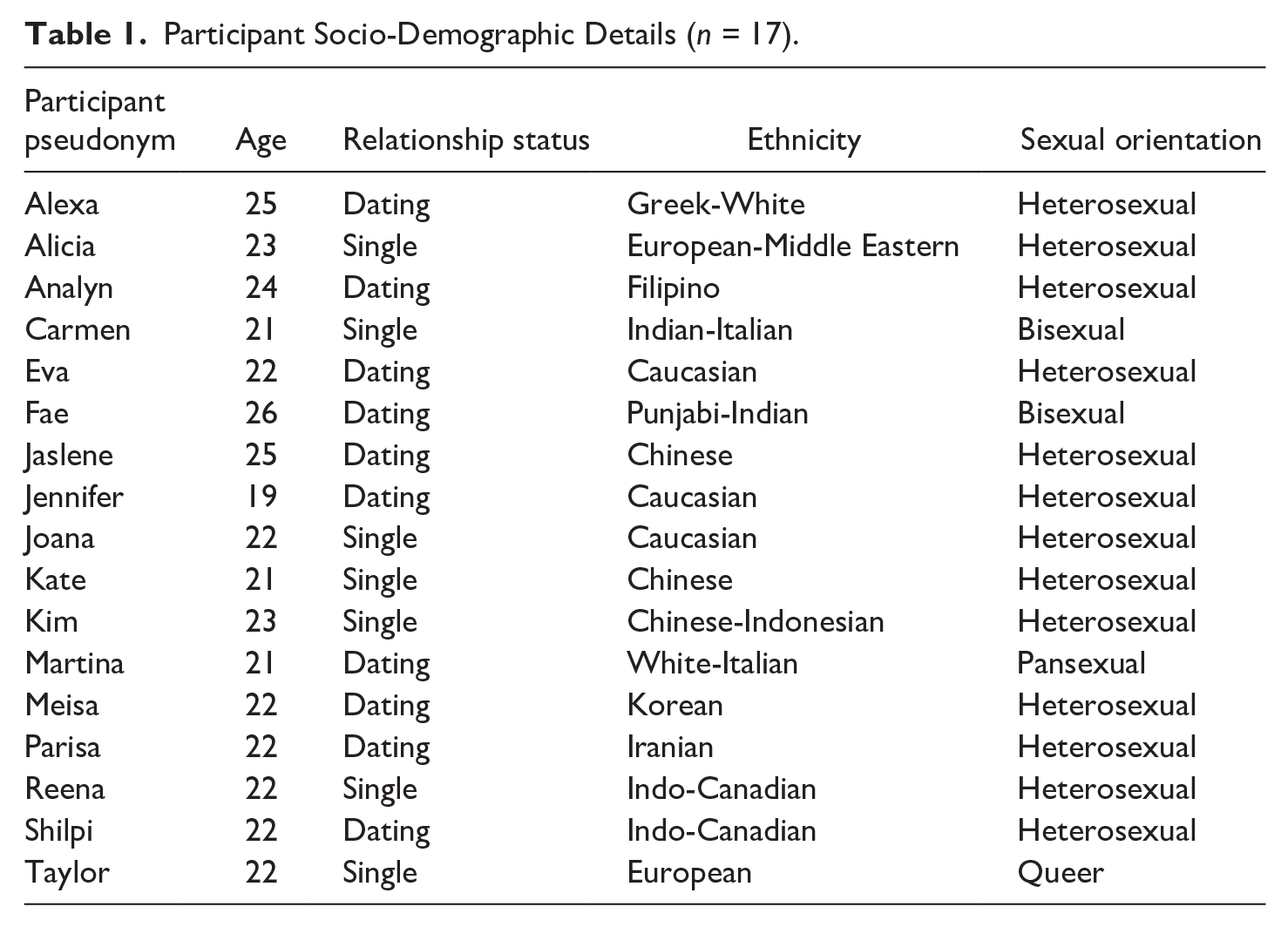
I identify all participants with pseudonyms. As shown in Table 1, participants’ ages ranged from 19 to 26. All of the women I interviewed were cis-identified, able-bodied, and had lived in Greater Vancouver for at least 2 years when I interviewed them. No participants reported a relationship status other than single or dating, and a majority (n = 13) identified as heterosexual. I asked participants to self-declare their ethnicities, and participants variously identified as Chinese (n = 3), Indian/Indo-Canadian (n = 4), Korean (n = 1), Filipino (n = 1), Iranian (n = 1), and white/Caucasian/European (n = 7). No participants mentioned financial constraints as a limitation to their mobility in public, and all had completed at least 1 semester of postsecondary education.
Participant Socio-Demographic Details (n = 17).
While the racial and ethnic diversity of participants provided me with an opportunity to attend to a critique of existing feminist urban studies scholarship as over-representative of the experiences of white women (Longhurst & Johnston, 2014), I acknowledge the sample’s lack of class diversity as a research limitation. Since experiences of gendered marginalization in public vary based on perceived social class (Kwan, 2010) among other factors (for example, sexual orientation and marital status), ample opportunities for continued work in this area emerge.
Research Setting
The place many Canadians know as Vancouver is located on the traditional unceded homelands of the Musqueam, Squamish, and Tsleil-Waututh First Nations. Built in part through the exploited labor of Chinese immigrants (Park, 2010), Vancouver’s contemporary population of approximately 650,000 is racially and ethnically diverse, with nearly half (49%) of all residents identifying as nonwhite (Statistics Canada, 2017). The Greater Vancouver Area, which comprises the City of Vancouver and neighboring census subdivisions including Surrey, Burnaby, Richmond, and Coquitlam, has a total population of approximately 2.5 million.
Vancouver is a city marked by stark income inequality, a fact that is often obscured in news reportage of the city’s opulent mansions and infamously unaffordable housing market. The city’s historic center, known as the Downtown Eastside, is located east of the central business district and comprises several distinct neighborhoods including Chinatown, Gastown, Oppenheimer, Thornton Park, Victory Square, and Strathcona. As one of North America’s poorest postal codes with a median annual resident income of CAN$13,000, the Downtown Eastside is home to 20,000 people, approximately 20% of whom are Indigenous (City of Vancouver, 2013). As Robertson and Culhane (2005, p. 19) note, the disproportionate representation of Indigenous Canadians and stark poverty marking the Downtown Eastside are results neither of “accident nor coincidence.”
In 1886, Vancouver was incorporated as an English-speaking colony by European settlers after they forcibly removed Coast Salish peoples from the urban center to reservations established through the Indian Act. This history, and the racist logics and anxieties on which it is predicated, underly racialized income inequalities and neighborhood segmentation in contemporary Vancouver. Although the Downtown Eastside is home to many—a fact made apparent by the social housing projects, schools, and playgrounds that mark the space—it is not imagined as such in mainstream Canadian news coverage (Robertson & Culhane, 2005). Instead, the Downtown Eastside is regularly figured as a space of degeneracy and waste, and even putatively humanizing representations of the area’s residents obscure the colonial history of Vancouver and seek to evoke settler pity via representations of homeless, impoverished, and drug-addicted residents through the pathologizing lens of individual failure (Dean, 2016).
As my findings demonstrate, participants’ accounts of danger and safety were inflected with the racial history and colonial settlement of Vancouver, although women strove to erase race in their accounts. Given the marked “absent presence” (Fields, 2005) of race in women’s narratives, I offer this brief contextualizing history to situate participants’ accounts within the social and discursive context in which they were articulated.
Findings
“Never Really 100% Safe”: Women’s Fear of Violent Crime
All of the women I interviewed visited public places in Greater Vancouver regularly. The largest proportion of women’s time outside their homes was spent at school or at work, and participants also spent time in cafés, libraries, galleries, gyms, shopping centers, and grocery stores. All of the women I interviewed spent at least 20 minutes and as much as 4 hours per day walking alone in open public spaces, such as parks, streets, and parking lots.
Fear of violent crime dominated women’s accounts, and many participants raised concerns about using public space before I addressed safety explicitly. While feelings of uneasiness, discomfort, and worry suffused women’s accounts, few participants used the term “fear” to describe their emotions. Instead, they discussed a generalized sense of anxiety or described the behaviors they regularly engage in to manage their anxiousness. Taylor (22, single, European, queer) reflected that she is “usually just really on-guard . . . hyper-aware of the people around me.” Other participants similarly indicated that, even when they use public spaces for leisure, they feel “guarded” (Carmen, 21, single, Indian-Italian, bisexual), or as though they must ensure their “walls are up” (Parisa, 22, dating, Iranian, heterosexual). Analyn (24, dating, Filipino, heterosexual) summarized many participants’ feelings: Close to Waterfront Station, um, and Granville, I’m pretty comfortable. Just because I’m there so often. Not, not super comfortable. [. . .] So safe-ish but . . . I’m still on guard.
By noting that even comfort is uneasily attended by feelings of guardedness, Analyn’s account highlighted the omnipresence of women’s anxiety in public places.
Women frequently articulated concerns about being “taken[n] advantage of” (Reena, 22, single, Indo-Canadian, heterosexual); a fear that being alone would lessen their ability to respond appropriately if “something ever happened” (Parisa); and generally, the feeling that “anything could happen” (Kate, 21, single, Chinese, heterosexual) to them in public space at any time. Women’s vague language reflects previous research on young women’s fear of violent crime; specifically, their reluctance to explicitly name their fears (see, for example, Nicholls, 2017). The women I interviewed both euphemized sexual violence with phrases such as “complications with men” (Jennifer, 19, dating, Caucasian, heterosexual) and explicitly disclosed experiences of sexual violence. Although participants had experienced sexual violence ranging from verbal harassment to assault, women tended to minimize the violence they experienced as a non-event.
For example, in a conversation about street harassment, Alexa (25, dating, Greek-White, heterosexual) observed, “I think I . . . had some unfortunate younger experiences, around . . . men feeling entitled to being . . . [part of my] experience.” Her language (that is, I think . . .) implies she is unsure whether her experiences qualify as sexual harassment. Similarly voicing hesitancy as to the validity of her own feelings, Martina (21, dating, White-Italian, pansexual) shared that: [At the gym] I always start off with cardio and then move over to the weights. But sometimes I don’t even get to the weights because . . . the majority of those people on the weights are men. And I feel . . . kind of unwelcome when I go into that area. I don’t know if that’s me. I don’t know if that’s actually how they’re making me feel. (my emphasis)
As instantiations of a broader experience of normalized hostility within the public spaces of masculine hegemony, Alexa’s and Martina’s experiences of violation are articulated hesitantly as invalid. These women’s accounts reflect the fact that broad-based cultural tolerance for men’s aggression renders women’s experiences of sexual violation largely unintelligible, even to women themselves (Lennox & Jurdi-Hage, 2017). Even when women cannot explicitly articulate their experiences of violence as such, men’s unwanted attention renders public spaces unwelcoming and exacerbates women’s anxiety therein.
When I asked women to identify what they feared in public spaces, participants variously identified abduction, sexual harassment, brawls, stalking, being murdered, pierced with a dirty syringe, punched, and raped as things they feared. The language participants used in further describing their fears suggested that it was male stranger violence, particularly in unfamiliar spaces and in the dark, that women most feared. Phrases such as “something bad is going to happen” (Martina), that one is obligated to “hustle and pull out a flashlight” at nighttime (Eva, 22, dating, Caucasian, heterosexual), or most explicitly, that “a guy could just be hiding in a bush or something” (Shilpi, 22, dating, Indo-Canadian, heterosexual) signaled women’s internalization of a Little Red Riding Hood-esque myth of pervasive male stranger danger. Jaslene (25, dating, Chinese, heterosexual) emphasized her fear of nighttime, stating: “I definitely feel like after a certain time in the city, I can’t go anywhere anymore, I need to be home, because danger is out there” (my emphasis). Kate similarly observed: “[Night] lock[s] up different parts of the city. You’re just like, okay, can’t go there. Just, just stay home.”
Women’s fears became clearer when they discussed features of spaces they considered safe. Analyn, for example, stated that when she used familiar areas, she felt safe because she “know[s] what to avoid.” Fae (26, dating, Punjabi-Indian, bisexual) suggested that knowing the physical features of her neighborhood made her feel safe: I’ve been in this . . . neighborhood for the last almost twelve years. [. . .] I [can] walk down there any time of the day, and I feel like, meh, this is my place. If anyone’s coming from there or there, I’m going to know it. And I know where everything is, and where I’m going to walk from, where hidden driveways are, I’m very familiar.
That an intimate knowledge of the physical features of her neighborhood made Fae feel safer suggests that, like many participants, Fae feared unpredictable male stranger violence.
Although women did not explicitly discuss their fear of violent crime in racialized terms, race was a persistent “absent presence” (Fields, 2005) in their accounts. While women went to lengths to avoid discussing race, they nonetheless located their fears on racially Othered bodies and spaces. As scholars have noted, the history of the stranger rapist is a racialized one (Onwuachi-Willig, 2018). Akin to the Wolf in Little Red Riding Hood, the stranger rapist represents Otherness and contamination, and threatens respectable femininity with his very presence (Kitzinger, 2011). Middle-class women may thus (re)produce respectable middle-class identities by avoiding spaces associated with racialized Others to (re)construct a respectable self (Fanghanel, 2016).
In this research, although very few women associated safety with a particular neighborhood, many women (n = 11) associated the Downtown Eastside with danger. While some women’s characterizations of the Downtown Eastside as a space where “the crowds aren’t the best” (Jaslene) were informed by experiences of harassment therein, most women did not identify a specific reason for their fear and many had never visited the Downtown Eastside. For example, after identifying the Downtown Eastside as a dangerous space she avoided, Reena offered this vague rationale for her fears: I feel really, like, out of place and very unsafe [in the Downtown Eastside]. [. . .] Because, like, just, stuff is always happening, like, all over the place so, like, anything could just, like, happen. So, yeah, I just felt like they don’t really pay attention to you, so I don’t really feel unwelcome but, like, I do feel, like, unsure of the place itself. (my emphasis)
In Reena’s account, who “they” were was never stated; instead, her narrative relied on free-floating action that begged her white settler audience—that is, me, as a white researcher—to save her the discomfort of rendering race visible. Eva similarly declined to discuss race explicitly: So [East Hastings] . . . do[es] get a bad rep, and I understand why, um, just because of, maybe a certain demographic affected by, certain things. I’m not going to really delve into that. But I think . . . excluding those factors it’s a really . . . comfortable place to be in.
Even as Eva sought to establish the Downtown Eastside as a comfortable space, she located her fear within the area.
As Dean (2016, p. 42) suggests, the Downtown Eastside is “rife with evidence of the ongoing-ness of settler colonialism, which helps explain why the neighborhood is so stigmatized and shunned by many settlers in particular.” In some participants’ accounts, visual evidence of the ongoing-ness of settler colonialism—and poverty in Vancouver more broadly—explained women’s fears. For example, women located their fears on “drunk people” (Analyn), “homeless people” (Alicia, 23, single, European-Middle Eastern, heterosexual), and “people on drugs” (Meisa, 22, dating, Korean, heterosexual). These references to Othered bodies reinforce women’s overarching fear of stranger violence.
Participants’ narratives were also latently informed by class biases. In contrast to dangerous spaces, which were occupied by Others, safe spaces were populated by people who “know their manners” (Alicia) or who were part of the “smaller world” (Kate) of the university. Women also referenced classed signs of respectability as factors contributing to a sense of safety, noting that they felt safer in “upscale” cafés that catered to “young businesspeople” (Analyn). Parisa observed that “when you see people walking around in, in suits, it kind of makes you feel a little better, I don’t know why.” Underlying these assessments of safety are biases that situate public spaces as most welcoming when they are visibly inhabited by bodies perceived as legitimately belonging therein. Women’s language choices (for example, “men in suits,” “upscale”) suggest that it is middle- and upper-class men whom women perceive as rightful public space users.
Virtue Maintenance Work in Public Spaces: Be(com)ing a Good Woman
Women’s accounts were saturated with details of gendered safekeeping in public. The safety strategies that women used in public spaces included walking fast or faster when they felt fearful; checking their surroundings and looking over their shoulders; and changing their transit routes to avoid certain areas of the city, people they perceived as dangerous, or to get home sooner. Women’s risk-management strategies also included walking under or near streetlights in the evening; carrying an umbrella; wearing a hood; phoning a friend; avoiding empty spaces; and letting people walk past them. In addition, participants wore small purses that did not “flop around” (Analyn) in case running became necessary; planned their errands and transit routes in advance; used flashlights after dark; took their headphones out and kept their phones put away; and used various forms of facework to deter unwanted attention. Many women described walking with male siblings and romantic partners whenever possible because men made them feel “more secure” (Kim, 23, single, Chinese-Indonesian, heterosexual). Some participants simply left spaces they perceived as unsafe.
Summarized by Jaslene as “a performance you get used to, to . . . avoid attention,” women’s safekeeping labor was nevertheless emotionally and cognitively taxing. As Taylor observed, “having to go out and having to put on that armor in case something happens can be extremely exhausting.” Despite its costliness, safety work was understood by women as normal and necessary. For example, after presenting me with an extensive list of the various risk-management strategies she regularly employed in public space, which included removing herself from situations she perceived as unsafe, looking over her shoulder “a lot,” and approaching strangers and engaging them in conversation to “make it look like . . . [she’s] not alone,” Reena summarized her strategies as “just stuff like that.” Her choice of the phrase “just stuff like that” suggests that women normalized safety work.
As I explore next, women’s accounts suggested that they did not principally employ safekeeping strategies to ensure their immediate physical safety in public places. Instead, women’s accounts cast gendered safekeeping strategies as virtue maintenance work. Drawing on identity work literature (Ezzell, 2009; Schrock & Schwalbe, 2009), I define virtue maintenance work as a performative—though largely invisible and unrecognized—form of identity work through which women signal their sexual virtue to men in public spaces. Through performances of self that embrace defenselessness, docility, and reliance on men, women secure men’s recognition of their virtue, and through this recognition, maintain their fragile hold on the material and symbolic resources that accrue to women who behaviorally conform to emphasized standards of femininity. Given women’s status as members of a subordinate social stratum, being read as respectably feminine by men is crucial for women’s ontological security, or sense of themselves as rightful users of public space (Giddens, 1991).
Paradoxically, women’s ontological security was often gained at the cost of their physical security. One of the notable textual disruptions in participants’ accounts centered on their implicit characterization of the purpose of safety work as a means of ensuring their own physical safety. While many women reported being hyper-vigilant in public spaces and even discussed the fact that they carry—or wish they could carry—(pseudo) weapons in public spaces, most participants asserted that they were inherently vulnerable as women and could never successfully fight back against a violent man. Thus, a decided tension existed between women’s ostensible readiness to physically fight attackers and their simultaneous acknowledgment that they would never undertake such a fight.
Analyn emphasized her readiness to deter physical assault, stating, “I might have . . . something that I could punch with. Um, I guess something kind of sharp if I have it. Um, I’ll have my keys in my pocket.” Shilpi regretted the fact that “it’s . . . illegal to carry pepper spray,” while Parisa “use[d] to carry dog spray.” Taylor wore “armor” and feared being “overpowered,” while Analyn assured her attire was “convenient for running.” Eva watched her back, looked over her shoulder, and peered into parked cars to ensure nothing unexpected would “pop up.” As these examples suggest, women exerted considerable efforts to be perpetually vigilant to all possibilities of harm. Despite this, the actions they would take if they were violently attacked were unclear, given that women presented themselves as incapable of self-defense. Parisa, for example, stated that based on her “size,” she “wouldn’t be able to take anybody in a fight. I look like I wouldn’t be able to defend myself.” Although Alicia carried an umbrella to “use as a weapon,” “being attacked” was her “number one fear,” since she “would not be able to fight back. It’s like I don’t have any strength. [. . .] So whatever happens would just happen” (my emphasis). Despite her apparent readiness to deter crime, Alicia’s words suggest that she understood herself as incapable of self-defense.
As Joana’s (22, single, Caucasian, heterosexual) account illuminates, women’s physical readiness to deter assault had little to do with ensuring physical safety. As she stated, “[I walk with] my hand[s] like fists. [. . .] I know nothing’s going to really happen, but [I do it] just to make me feel better” (my emphasis). Considered within the context of victim-blaming discourses on gender and risk, Joana’s desire to “feel better”—even though she knew that “nothing’s going to really happen”—signaled her desire to be read as prudent. Whether or not Joana encountered violence, her visible prudence clearly marked her as virtuous, and thus her ontological security remained intact.
Overall, participants’ physical readiness to deter violent crime in public spaces, coupled with their rejection of using physical force as self-defense, illustrates the tightrope participants walked to maintain gendered, middle-class virtue. As postfeminist and ostensibly empowered subjects, women faced pressures to be up to date on culturally endorsed strategies to manage crime, and police often endorse physical violence as self-defense (see, for example, Vancouver Police Department, 2020). Yet, women’s use of physical violence, even as self-defense, has long been associated with amorality; only bad, unvirtuous women stoop to fighting (Irwin & Umemoto, 2016; Madriz, 1997). As well-publicized contemporary cases make clear, the consequences of protecting oneself too successfully as a woman in public spaces are extreme: In using physical violence, women fall from their precarious balancing act on the tightrope of risk aversion and respectability, rapidly moving from virtue to demonization (see, for example, Peterson & Panfil, 2014 on the “killer lesbians” who successfully fought back against stranger assault).
Alicia’s account highlights the difficulties inherent in being risk averse while maintaining gendered middle-class virtue:
I think I’ve grown smarter and more mature. So I know what to be aware of. [ . . . ] [To be safe] I’ll walk where there’s lights. [. . .] Also I heard that people tend to be scared to try and grab you or harass you . . . if you have an umbrella. So I always have . . . an umbrella. [But if I was attacked] . . . I would not be able to fight back. [. . .] There’s girls who can fight, and there’s girls who are innocent. (my emphasis)
By carrying an umbrella, Alicia understood herself as risk averse, and this provided her with ontological security: As a “smart” woman who knew “what to be aware of,” she embraced contemporary gendered crime-prevention mandates, and thus rightfully existed in public. Simultaneously, Alicia acknowledged her ongoing sense of physical vulnerability, stating she “would not be able to fight back.” In acknowledging her inability to fight while creating a binary between “girls who fight” and “girls who are innocent,” Alicia maintained gendered, middle-class virtue, even as she narrated herself as risk averse.
Participants’ uses of the word “safe” further suggested that, for many women, feeling safe (that is, genuinely experiencing physical security in public) and being acknowledged as staying safe (that is, being risk averse and virtuous in public) were two very different affective and embodied experiences. As Carmen reflected about her internal sense of physical safety when she was in her own neighborhood: Even if it’s very late at night, and I’m coming home from some place at 3AM, and it’s really dark out, I still feel really safe and comfortable, even though I know that it’s better to be safe than sorry. (my emphasis)
There is a notable disjuncture in Carmen’s account. In the first half of the sentence (“I still feel really safe and comfortable”), Carmen’s use of the word “safe” is synonymous with being “really comfortable,” and thus logically denotes the absence of anxiety and stress. In the second half of the sentence (“even though I know that it’s better to be safe than sorry”), Carmen’s use of the word “safe” cannot logically imply comfort or the absence of anxiety or stress. How can Carmen feel “safe,” even though she knows it is “better to be safe than sorry”? In the latter part of Carmen’s articulation, the word “safe” seemed to reflect her implicit acknowledgment of the fact that “being safe”—that is, performing virtuous femininity through vigilance and risk-aversion—is rarely associated with genuinely feeling physically safe.
Fae similarly emphasized that attempts to be safe routinely failed to produce a sense of physical safety: I used to listen to music in those cases [where I felt unsafe], but then I realized, you’re kind of blocking off things around you. [. . .] So, I’ll put them in, and I’ll pretend I’m listening, so it looks like I’m occupied . . . but I’m constantly looking around. [. . .] If I’m waiting to be picked up, I’ll go where it’s well-lit and . . . I’ll pretend to just bop to my music, and just be very um kind of fake calm chill vibe. [. . .] Worst comes to worst, I have made calls sometimes where it does feel a bit too sketchy for me.
Fae’s gendered safekeeping occurred at multiple levels. At a cognitive level, Fae assessed whether she was merely “unsafe,” or whether a situation was decidedly “sketchy.” Emotionally, she internally experienced stress and anxiety while outwardly projecting a “fake calm chill vibe,” which included pretending to listen to music so that it appeared as though she was occupied. Alongside her emotional and cognitive labor, Fae constantly looked around, making sure she was seated in a “well-lit” area. Despite these numerous precautions, Fae was still prepared to “make a call” if things became “too sketchy.”
The labor that this routine necessitated was undoubtedly taxing and presumably did little to enhance Fae’s internal sense of physical safety. While Fae’s labor may have done little to enhance her physical security, it nonetheless served the protective function of ensuring her ontological security. As a visible, performative enactment of gendered vulnerability, Fae’s safekeeping routine left little doubt of her virtue and thus ensured her ontological security, even while her physical security remained uncertain.
As intersectional theorists note (Choo & Ferree, 2010; Collins, 2004), gendered vulnerability is not experienced independently of other axes of privilege and marginalization; rather, race, gender, and social class intersect and interlink to inform unique experiences of oppression. In this research, while the emotional, cognitive, and embodied labor necessitated by virtue maintenance work appeared to be taxing for all of the women I interviewed, it may have been particularly so for racially marginalized women who face Orientalist, anti-Black, and colonialist stereotypes about their presumed sexual amorality (Kitzinger, 2011; McCurn, 2017; Park, 2010). While stereotypes of Black, Asian, Latina, and Indigenous women are not homogeneous and stem from distinct histories of racial oppression, all such stereotypes pivot on a white supremacist imagining of white women as the embodiment of purity and virginity (Collins, 2004; Gilchrist, 2010). Given this context, racially marginalized women’s virtue maintenance work may produce fewer—or less reliable—resources than the comparable work of white women and may also require more labor, particularly since racially marginalized women experience violence in ways that are phenomenologically distinct from the experiences of women racialized as white (Crenshaw, 1991).
Jaslene spoke to the entanglement of racism and sexism in her experiences of violence. Explaining that catcalling is “a daily thing” for her, she stated: As an Asian female, it’s like, a lot of very overtly sexual catcalls. [. . .] In public [. . .] I want to be perceived as, you know, intellectually capable, but I don’t think that’s the automatic thing people think about me. They’ll be like, you know, Asian girl, submissive.
Jaslene’s anecdote highlights the complexity of her identity work; although she wants to be seen as intellectually capable, her experiences of sexualized and racialized verbal violence suggest that this is not how she is perceived. As a result, Jaslene exerted extra efforts to avoid being perceived as an unduly submissive “sexual object”: I know men, like, disregard me more, and also because I don’t want them to see me as a sexual object, I just get hostile. I’d rather be a target for their anger than, for their, for the gaze. [. . .] With men, I make a conscious effort to, to be mean.
In exerting efforts to “be mean,” Jaslene both counteracted perceptions of her “submissiveness” and attempted to rebuff unwanted attention from men. Although undoubtedly taxing, this performance was, in Jaslene’s words, “embedded in who I am.”
While virtue maintenance work did not appear to reliably enhance women’s physical safety (and often exacerbated their stress and anxiety), it may have enhanced physical safety in some scenarios. For example, strategies such as wearing headphones may have curtailed unwanted conversation/harassment. Nonetheless, participants’ overall reluctance to physically confront would-be attackers highlights the fact that safety work was not principally engaged to ensure invulnerability to physical harm. Indeed, the fact that stressful vigilance and other routine safety work behaviors do little to reliably minimize women’s fear of violent crime in public spaces has been documented elsewhere (Ferguson & Mindel, 2007). Moreover, the language women used when describing their fears (for example, “a guy could just be hiding in a bush or something” [Shilpi]) overwhelmingly suggested that women feared unpredictable stranger violence. This finding further complicates the possibility that participants’ risk-management routines tangibly mitigated their risk of experiencing the violence they most feared. As Stanko (1996) ironically notes, presuming the usefulness of safety work as a means of mitigating physical danger makes the dubious claim that “men, when they encounter us ‘duly protecting ourselves,’ will not act on impulse . . . and attack, rob, beat, or rape us” (p. 21).
Discussion
Given women’s acknowledgment that they would never fight back against an assailant in public space, and given the ambiguous effects of safekeeping strategies on participants’ physical safety, my findings suggest that the actions women took to feel physically ready to deter violent crime were not principally adopted to ensure immediate physical safety. Instead, women went through the motions of physical readiness to deter violent crime as a means of feeling respectably feminine in public spaces. Participants’ desire to embody Good Womanhood reflects their precarity within masculine hegemony. As Stanko (1997) discusses, fear of violent crime is inspired by much more than the fear of physical harm; not only do women fear physical endangerment, but they also fear the disapproval that being judged as imprudent provokes.
I extend Stanko’s (1997) argument and suggest that, given women’s existence in a system of masculine hegemony in which they are systematically denied equal access to resources, status, and power, a potential encounter with men’s violence threatens women not only with physical endangerment and short-term social judgment, but also with the possibility of lost access to crucial symbolic and material resources (for example, social networks, perceived respectability, and employment). As distinctly precarious actors within the public spaces of masculine hegemony, women thus engage in cognitively, emotionally, and physically taxing virtue maintenance work as a means of ensuring gendered and classed respectability. While being read as virtuous does not eliminate the threat of violence, it does afford women the comfort—the ontological security (Giddens, 1991)—associated with mitigating the threat of social judgment, blame, and lost access to resources that men’s violence threatens.
While women rarely discussed their fears—or the violence they encountered—in explicitly racialized terms, the historical association of sexual and gender virtue with whiteness (Collins, 2004; Fields, 2005) suggests that racially marginalized women’s virtue maintenance projects are inherently more fragile than those of white women. As my conceptualization implies, “maintenance work” presumes that women have something to maintain. For white, middle-/upper-class, gender-conforming women, virtue maintenance rests relatively securely on a foundation of white womanhood as the epitome of sexual purity. This foundation simultaneously makes racially marginalized women’s virtue maintenance projects distinctly precarious. Indeed, the narratives of the women I interviewed—which were punctuated by repetitive and oftentimes visibly stress-inducing recitations of taxing safekeeping work—suggested to me that vigilantly performing themselves as virtuous was not optional for these women; it was imperative. This finding may be a function of the racial and ethnic diversity of my research sample. As Madriz (1997) noted, racially marginalized women’s worthiness as victims often rests insecurely on labor-intensive honorary whiteness, or the presumption that a given racialized victim has provided evidence that they are a “harder working, more attractive . . . better person . . . [than] other members of their race” (p. 76).
In reconceptualizing safety work as virtue maintenance work, I seek to overcome some of the conceptual limitations of existing scholarship on gendered risk-management. First, my reconceptualization highlights the finding that, at least in this research context, women’s embodied labors in public spaces were not dominantly about individual-level physical safety. Rather, women’s safekeeping labor was a habitualized, uniquely gendered response to a normalized experience of marginality that reflected women’s subconscious awareness of their precarity in a social, economic, and political system that remains dominated by men. As such, women’s virtue maintenance work can be recognized as a dexterous and considered means of managing an inherently disempowering subject position: that of the always watchful, yet ever vulnerable virtuous woman who must tread lightly to remain above sexual reproach.
Second, in reconceptualizing women’s safety work as virtue maintenance work, I seek to intervene in a scholarly conversation that dominantly deems women’s safekeeping labor successful only when it prevents—or is consciously engaged to prevent or minimize—male violence (see, for example, Fileborn, 2016; Vera-Gray, 2018). In emphasizing that women’s safekeeping labor is fundamentally geared toward virtue maintenance, not safety, I acknowledge women’s skill and agency in navigating their vulnerability within masculine hegemony. I further seek to avoid an account of gendered safekeeping that is insidiously victim-blaming, by latently positioning women as agentic only when their safekeeping labors meet the impossible neoliberal, postfeminist ideal of routinely preventing violence.
Finally, while recognizing the constraints within which women exercise agency (for example, victim-blaming discourse), I seek to avoid a portrayal of women’s actions in public spaces that reduces women to “cultural dupes”; that is, as social actors without the capacity to resist dominant discourse (cf. Campbell, 2005). Instead, I emphasize the fact that women’s virtue maintenance work has a clear protective function, even if this function is not the common-sense one of enhancing immediate physical safety.
Beyond their theoretical implications, findings of my research have practical implications by pointing to a necessary reform in gendered crime-prevention and safety pedagogy. Given that current gendered safety pedagogy appears to exacerbate women’s fear of violent crime, future gendered safety messaging (see, for example, Vancouver Police Department, 2020) must emphasize that while safety strategies such as avoiding unlit spaces after dark may mitigate the risk of violent victimization in certain situations, crime prevention is situationally and contextually variable. Moreover, given the routinized, perpetual nature of women’s adoption of a host of diverse safety strategies across divergent situations and contexts, findings of this research suggest that women need concrete, data-informed materials elaborating when a given safety strategy is less appropriate or effective, in addition to a basic acknowledgment that violence and harassment cannot be routinely and reliably prevented.
Since my research is limited to a sample of relatively well-educated, unmarried, middle-class women in Greater Vancouver, future research with larger and more diverse research samples is needed to assess whether gendered safety work pressures are felt differently among women of varied social class backgrounds, marital statuses, education levels, and places of residence.
Conclusion
While I centralize the micro-level resources that virtue maintenance work provides, the macro-level effects of women’s self-deprecating performances of virtue cannot be ignored. Since identities are inherently relational and constituted in interaction (Ezzell, 2009), virtue maintenance ultimately does the work of institutional power by reinforcing unequal relations of gendered domination between men and women. In contemporary North America, masculinity is centrally defined by invulnerability to harm and the capacity to resist control (Schrock & Schwalbe, 2009). Conversely, “[v]ulnerability to violence is a central element of femininity . . . [one that] is constructed through routine interactions in which dominant ideas about gender are communicated, performed, and reinforced” (McCurn, 2017, p. 54, my emphasis). As a form of identity work contingent on a performance of self as in need of men’s protection, care, and affirmation, women’s virtue maintenance work backgrounds routine interactions in public spaces that accrue at a macro level to reinforce relations of domination between men and women by reifying notions of women’s innate vulnerability.
Moreover, since notions of feminine sexual virtue pivot on racist, Orientalist, and colonial stereotypes that reserve sexual purity for white women, virtue cannot be performed outside of racist logics. As the #Karen meme spotlighted in 2020, as I completed this article, white women routinely deploy stereotypes of their chastity, frailty, and vulnerability at the expense of racialized men. A recent viral video associated with #Karen—a meme that is currently associated with more than 840,000 posts on Instagram—depicts the events after Chris Cooper, a Black male resident of New York City, requested that Amy Cooper (not a family relation) leash her dog in Central Park. In response to Chris Cooper’s request, Amy Cooper—a white, middle-aged, gender-conforming woman—hysterically filed a false police report via telephone, telling police that Cooper, an “African American man,” was threatening her life. While Amy Cooper has since reportedly lost her job and been charged by New York police 2 for filing a false report, these negative sanctions on Cooper’s actions occur at a moment of widespread protest and consciousness-raising that demands institutional accountability for anti-Black violence in North America. This moment has also drawn attention to the lengthy history of white women weaponizing normalized ideals of their frailty and helplessness against racialized men, based on racist presumptions of men of color as aggressive sexual Others (Onwuachi-Willig, 2018). Given this context, and the inextricability of sexual virtue from whiteness, micro-level acts of virtue maintenance work not only strengthen unequal relations of gendered domination, but they also reinforce racist logics that underpin ongoing violence against racially marginalized women and men.
To acknowledge the macro-level effects of virtue maintenance work is not to diminish women’s agency and dexterity in navigating their suffocating fear of violent crime on a daily basis. Indeed, I do not consider women’s virtue maintenance work inconsequential. For the women I interviewed, many of whom were racialized, centralizing stranger violence and combating perceived threats in public through vigilant virtue maintenance may have been a necessary survival strategy to avoid reckoning with much more prevalent forms of gendered harm, such as intimate partner violence and acquaintance assault. Reckoning with intimate violence may be untenable for women who could encounter life-altering consequences such as severing relationships with men on whom they are financially dependent, losing extended family ties, and/or reallocating emotional and material resources.
Absent dramatic structural change and concrete tools to address gendered violence, women are tasked with creating a version of the world that is livable: a world in which they can manage the tasks of everyday life despite paralyzing insecurities and fears, and in which they can understand themselves as vulnerable to violence but not define themselves purely as victims. This task is not easily accomplished. As Fae’s description demonstrates, fear of violent crime is suffocating: If I’m the only person in a public area in the dark . . . I get very uneasy. In a way, it’s almost similar to feeling like you’re trapped. But then you’re in this open space, so how can you be trapped? But that’s the best way I can describe it. (my emphasis)
Like many fairy tales, Little Red Riding Hood is ultimately moralizing; not only does it instill a fear of strangers in young women, but it also firmly establishes the boundaries of deserving victimhood. Despite her mistakes, Little Red Riding Hood is “pretty,” “unassuming,” and “well-bred” (Perrault, 1697/1999, para. 29). And, as most visual renderings of the tale suggest, she is white. In some versions of the tale, after Little Red Riding Hood disobeys her mother and loiters in public rather than moving swiftly from one putatively safe domestic space to another, she is rescued by a huntsman who hears her distant screams and fearlessly cuts open the Wolf’s belly. Strikingly, Little Red Riding Hood’s first act as she tumbles from the belly of the Wolf is to establish herself as worthy of the huntsman’s care. Gasping for air, Little Red Riding Hood looks up into the face of the huntsman and cries, “[a]s long as I live, I will never leave the path and run off into the woods by myself if mother tells me not to!” (Grimm & Grimm, 1812/1999, para. 30).
By assiduously adhering to fundamentally restrictive ideals of femininity, the women I interviewed envisioned better endings for themselves than the grisly rape that awaited careless and disobedient Little Red Riding Hood. Leery of the likelihood of their own rescues, they performed liminal versions of themselves that ensured they existed firmly within the constraining boundaries of deserving victimhood.
Footnotes
Author’s Note
The author thanks Wendy Chan, Sheri Fabian, Travers, Hae Yeon Choo, Jessica Fields, Chris Smith, and Judith Taylor for their generous comments on a previous version of this article. Thanks to the two anonymous reviewers at Violence Against Women for their incisive comments on an earlier draft.
Declaration of Conflicting Interests
The author(s) declared no potential conflicts of interest with respect to the research, authorship, and/or publication of this article.
Funding
The author(s) disclosed receipt of the following financial support for the research, authorship, and/or publication of this article: This research was supported by the Social Sciences and Humanities Research Council of Canada and the Department of Sociology and Anthropology at Simon Fraser University.
