




Abstract
Although data show that intimate partner violence against women (IPVAW) is a concealed phenomenon that is severely underreported, studies examining willingness to report episodes of IPVAW are limited. To contribute to this field of research, a factorial survey experiment was implemented in which each respondent (N = 1,007) received a unique vignette describing a hypothetical case of IPVAW. Slightly over one in four respondents (28.1%) indicated that they would report the aggression. It was also found that willingness to report was influenced by both the characteristics of the vignettes and certain personal ones of the respondents. Practical implications are proposed that may contribute to preventing IPVAW.
Keywords
Intimate partner violence against women (IPVAW), interpreted as the violence perpetrated by males against female partners in heterosexual relationships, constitutes a serious public health problem and a violation of women's rights (World Health Organization, 2017). Global estimates indicate that almost a third of women (30%) report having experienced some form of physical and/or sexual violence by their partners during their lifetime (World Health Organization, 2017). Similarly, the National Intimate Partner and Sexual Violence Survey shows that, in the United States, slightly over one in three women (36%) have experienced contact sexual violence, physical violence, and/or stalking by an intimate partner during their lifetime (NISVS, 2015). Similar estimations are found at the European level, where the study conducted by the European Union Agency for Fundamental Rights (FRA) revealed that, among women who have or have had relationships with men, 43% have experienced some type of psychological violence (i.e., controlling behaviors, economic violence, abusive behaviors, and threats to hurt children) and 22% have suffered physical and/or sexual violence at some point in their lives. Furthermore, their findings suggest that, despite being a widespread phenomenon all across the European Union (EU), IPVAW is severely underreported (FRA, 2014). The fact that this form of violence has traditionally been conceptualized as a private matter is one of the main factors explaining why IPVAW continues to be a concealed phenomenon, seldom reported relative to its occurrence (Ferrer-Pérez & Bosch-Fiol, 2016; Palermo et al, 2014).
Although most episodes of IPVAW are not reported to the authorities, there are some indications that many of them are known to the social circle surrounding the victims (European Commission, 2016; FRA, 2014; Gracia & Herrero, 2006; Spanish Centre for Sociological Research, 2020). For instance, the Special Eurobarometer on Domestic Violence against Women showed that 25% of the respondents in the 28 EU countries indicated that they knew a victim of IPVAW in their circle of friends and family; 21% reported knowing a victim in their neighborhood; and 11% indicated that they knew someone where they worked or studied (European Commission, 2010). In Spain, the most recent Violence Against Women Macro-survey revealed that 81% of women who had suffered physical and/or sexual violence and/or fear of their partners or ex-partners had told someone close to them about their situation (Spanish Centre for Sociological Research, 2020). These findings suggest that victims mostly turn to their social circle for help (Alfredsson, 2016; León & Aizpurúa, 2018). It is, therefore, crucial to promote attitudes that reinforce mechanisms within the social circle of victimized women. After all, the willingness to intervene when a case of IPVAW comes to light reflects the level of tolerance and social acceptance of this form of violence and can contribute either to condoning and perpetuating, or reducing levels of IPVAW (Copp et al., 2016; Jewkes et al., 2015; Powell & Webster, 2018).
Willingness to Intervene in IPVAW Episodes
Witnesses and bystanders tend to respond in different ways when they are aware of an incident of IPVAW. According to the literature, these responses can be classified, broadly, into two types: mediating responses (e.g., offering help, support, and understanding; helping with decision making; talking to the couple; and reproaching the offender), and reporting responses to the authorities. Of course, silence (i.e., inaction) is also a potential response to known incidents of IPVAW (Gracia et al., 2018; Sylaska & Edwards, 2014).
Most studies show that respondents prefer mediating responses than reporting ones (Branch et al., 2013; Gracia et al., 2009; Serrano-Montilla et al., 2020). As Gracia et al. (2009) pointed out, this preference could indicate that a response such as reporting to the police is probably viewed as a last resource, only to be used for extreme cases of IPVAW, while other instances that are not considered as such would deserve mediative responses. In addition, the percentage of respondents willing to formally report IPVAW episodes varies widely across studies, from a low 12% (Taylor & Sorenson, 2005) to a high 77% (Gracia & Herrero, 2006). This variability highlights the relevance of certain factors surrounding IPVAW episodes as moderators of willingness to report them to the authorities (Flood & Pease, 2009).
Factors Associated With the Willingness to Report IPVAW Episodes
Characteristics of the IPVAW Episodes
According to the particularities surrounding the IPVAW episodes, the literature has shown that both the severity of aggressions and the type of violence, as well as certain factors related to the perpetrators (e.g., alcohol consumption), are linked to the willingness to report them. In relation to the severity of aggressions, the literature shows that the more severe the abuse is perceived to be, the greater the tendency to report it (Ermer et al., 2017; Gracia et al., 2009; Hutchinson, 2012). Research also shows that the type of violence committed by the perpetrator is associated with the willingness to formally report the incident. For instance, Taylor and Sorenson’s (2005) study showed that respondents were more likely to indicate that the victim should seek formal intervention when an episode of physical or sexual violence was described (as opposed to emotional violence).
Other factors analyzed are those related to the perpetrator. The evidence shows that, when the aggression is perceived as the result of certain circumstances related to the perpetrator (e.g., substance use), respondents tend to consider that their interventions are of limited utility (Cinquegrana et al., 2018; Taylor & Sorenson, 2005). Regarding the perpetrator's immigration status, although studies in the field of attitudes toward rape victims have shown the relevance of this variable (Sjöberg & Sarwar, 2017), most studies examining the willingness to report IPVAW scenarios have not specified the immigration status of either victims or perpetrators. To our knowledge, there is only one study that examined the effect of ethnicity in a sample of college students, finding that responses were not influenced by the ethnicity of the perpetrator (West & Wandrei, 2002).
A growing body of research points to a relationship between power imbalances and the risk of suffering intimate partner violence (IPV) (Alonso-Borrego & Carrasco, 2018; Alvira-Hammond et al., 2014; Franklin & Menaker, 2014). In this regard, some studies have found that, in heterosexual couples, women's employment and higher levels of income relative to their partners are associated with experiencing IPVAW (Kaukinen, 2004; Luke & Munshi, 2011). This finding reveals the pervasiveness of gender stereotypes in relation to IPVAW, highlighting the need to incorporate variables associated with gender roles when examining public opinion and willingness to intervene in cases of IPVAW.
The behavior of the victim is also correlated with willingness to report abusive behaviors to the police (Cinquegrana et al., 2018; Pacilli et al., 2016; Witte & Mulla, 2012). Previous research shows that perceptions of the victim's behavior as “provocative” can play an important role in the attribution of blame and, therefore, in the willingness to report IPVAW episodes. For example, Pavlou and Knowles (2001) found that perceptions of provocation (i.e., victim's verbal provocation or jealousy) influenced attributions of responsibility and victim-blaming attitudes in cases of IPVAW. Moreover, in this study, negative impressions of the victim were linked to unwillingness to report the incident to the police. Along similar lines, it has been found that victims of IPVAW who admit infidelity are viewed as less entitled to receive help (Cinquegrana et al., 2018; Pagliaro et al., 2020).
Closely related to perceived provocation, the assignment of blame to victims and perpetrators had also been identified as a central element affecting tendencies to report IPVAW incidents (Cinquegrana et al., 2018; Gracia et al., 2018). Experts have stated that, when people view victims as being responsible for their own victimization, this significantly reduces the likelihood that they will provide them with any help (Weiner, 1980). For instance, Cinquegrana et al. (2018) found that respondents’ willingness to intervene was negatively related to victim's attribution of responsibility. This result is consistent with the study carried out by Gracia et al. (2018) in which the willingness to intervene was negatively related to victim-blaming attitudes.
Characteristics of the Respondents
In relation to the individual characteristics of the respondents, the literature shows the relevance of certain variables, such as gender, age, educational level, and sexism, as correlates of the willingness to report IPVAW episodes. In addition, it has been found that the social acceptability and perceived frequency of IPVAW, as well as peoples’ own and vicarious victimization experiences, are factors that influence the willingness to call the police.
Regarding gender, most of the studies show that women are more willing to report the IPVAW scenarios when compared with men (Beeble et al., 2008; Gracia et al., 2009; Serrano-Montilla et al., 2020). However, these findings are not entirely consistent, and other studies have found that men are actually more willing to help victims than women are (Eagly & Crowley, 1986), or that gender is not a determining factor in the tendency to intervene in response to IPVAW episodes (Cinquegrana et al., 2018; Owarish-Gross, 2012).
Mixed results have also been found in relation to age. While some studies have found that willingness to intervene in IPVAW incidents increases among younger respondents (Beeble et al., 2008), others have found that it is, precisely, younger respondents who are less inclined to report episodes of IPVAW (Cinquegrana et al., 2018; Gracia et al., 2009; Signal & Taylor, 2008).
Another finding that emerges from the literature is a positive correlation between educational level and willingness to intervene in IPVAW cases. A study conducted in a Spanish city with the general population found that less educated participants indicated that the severity of the scenarios described was lesser. At the same time, respondents with higher levels of education were found to be more willing to mediate—but not to report—the episode of violence presented to them (Gracia et al., 2009).
The influence of other personal variables, such as sexism, has also been explored. Most of the studies have found an inverse relationship between sexism and willingness to intervene (Cinquegrana et al., 2018; Gracia et al., 2018). For example, Cinquegrana et al. (2018) found that, although sexism did not predict willingness to intervene in IPVAW episodes, greater support for traditional masculinity roles—an antecedent of sexism—reduced willingness to intervene in favor of victims.
In addition to these variables, findings show that both perceptions of the phenomenon (e.g., perceived frequency and tolerance toward IPVAW), as well as exposure to episodes of IPV, are related to willingness to intervene in IPVAW episodes. In terms of social perceptions, previous research shows that the perceived frequency of IPVAW is positively related to willingness to intervene (Alfredsson et al., 2014; Beeble et al., 2008). For instance, Serrano-Montilla et al. (2020) found that, in countries with greater perceived IPVAW prevalence, individuals were more likely to engage in formal helping behaviors compared with those in countries with lesser perceived prevalence. Along similar lines, research shows a negative correlation between tolerance toward IPVAW and willingness to intervene. Specifically, it has been found that individuals who show a medium and high IPVAW tolerance are less likely to report the aggression than those with a low tolerance (Gracia & Herrero, 2006).
Finally, exposure to episodes of IPV also constitutes a correlate of willingness to intervene in IPVAW incidents. In particular, it has been found that knowing victims of IPVAW is associated with a negative attitude toward reporting the aggression (Gracia & Herrero, 2006). These findings are very important because this form of violence tends to be visible much earlier to the social circle of the victims than to any formal sources (e.g., social services, health care providers, police). On the other hand, research shows a positive association between direct experiences of IPV and willingness to intervene in IPVAW episodes (Beeble et al., 2008; Goodkind et al., 2003).
Present Study
The willingness to intervene in IPVAW episodes is closely related to tolerance and social acceptance of this form of violence (Gracia & Lila, 2015). If society decides to do nothing in the face of IPVAW incidents, it is consenting to the continuation of this abuse. And, if people harbor attitudes that condone IPVAW, they will be more likely to decide not to intervene (Gracia & Herrero, 2006). Due to the relevance of this topic and the need to offer more precise explanations of the factors that influence willingness to formally report IPVAW episodes, this study has two aims. The first one is to examine respondents’ willingness to call the police if they were aware of a potential case of IPVAW. At the same time, this study examines whether the tendency to report the case varies depending on the situational characteristics of the IPVAW episodes and respondents’ personal variables. This study is expected to contribute to the literature by analyzing an extensive set of scenarios. Most previous studies have manipulated a limited number of variables (e.g., type of violence only), each with a low number of levels (e.g., physical vs. emotional violence). Hence, the findings from this study are expected to broaden our knowledge in this field of research. Likewise, the results are expected to yield helpful information on the factors that explain willingness to report IPVAW episodes. This information is essential in the carrying out of educational and awareness campaigns aimed at promoting the fight against this form of violence.
In light of previous studies, a low tendency to report IPVAW scenarios is expected. Moreover, it is anticipated that women will be more likely to call the police if they are aware of an IPVAW episode than men. In addition, the characteristics of the IPVAW incidents are expected to affect respondents’ tendency to report the case to the police. Specifically, willingness to report the episode would be higher in those scenarios where the perpetrator is considered more responsible, and those perceived as more severe. Finally, it is expected that the tendency to report the abuse will be lower in those scenarios in which a justifying cause of the abuse is described (e.g., substance use issues and jealousy) and those involving infidelities.
Method
Participants and Data Collection
The data were collected online between January 7, 2019, and January 29, 2019, using the Netquest panel in Spain. 1 Quotas for age, gender, and habitat were used to obtain a sample distribution similar to the Spanish population. The sample was composed of 1,007 individuals (51.1% women and 48.9% men; M = 45.37 years old). Overall, the questionnaire was completed by 92.3% of those panelists invited, who received non-cash incentives for participating. The questionnaire was pretested between October 10, 2018, and October 31, 2018, using expert reviews. The survey was administered in Spanish and included 51 questions about perceptions and attitudes toward IPVAW, its victims and perpetrators. The surveys took approximately 12 min to complete (M = 11.72, SD = 6.32).
Experimental Design and Measures
The study used a factorial survey design in which researchers combine varying descriptions of persons or situations (vignettes), which are judged by the respondents (Auspurg & Hinz, 2015; Rossi & Nock, 1982). Among other advantages, the factorial survey allows a respondent's opinion to be ascertained with greater precision than is possible with more general questions (Auspurg & Hinz, 2015), and minimizes social desirability bias, which contributes to measurement error (Walzenbach, 2019).
The vignettes in this study randomly vary across six dimensions: (a) the situation triggering the violence, (b) the type of violence, (c) the frequency of its occurrence, (d) the origin of the members of the couple, (e) adherence to gender roles, and (f) the possible justifications for the violence (e.g., alcoholism, jealousy). The levels assigned to each dimension are summarized in Table 1 and constitute our main independent variables.
Dimensions and Levels of the Vignettes.
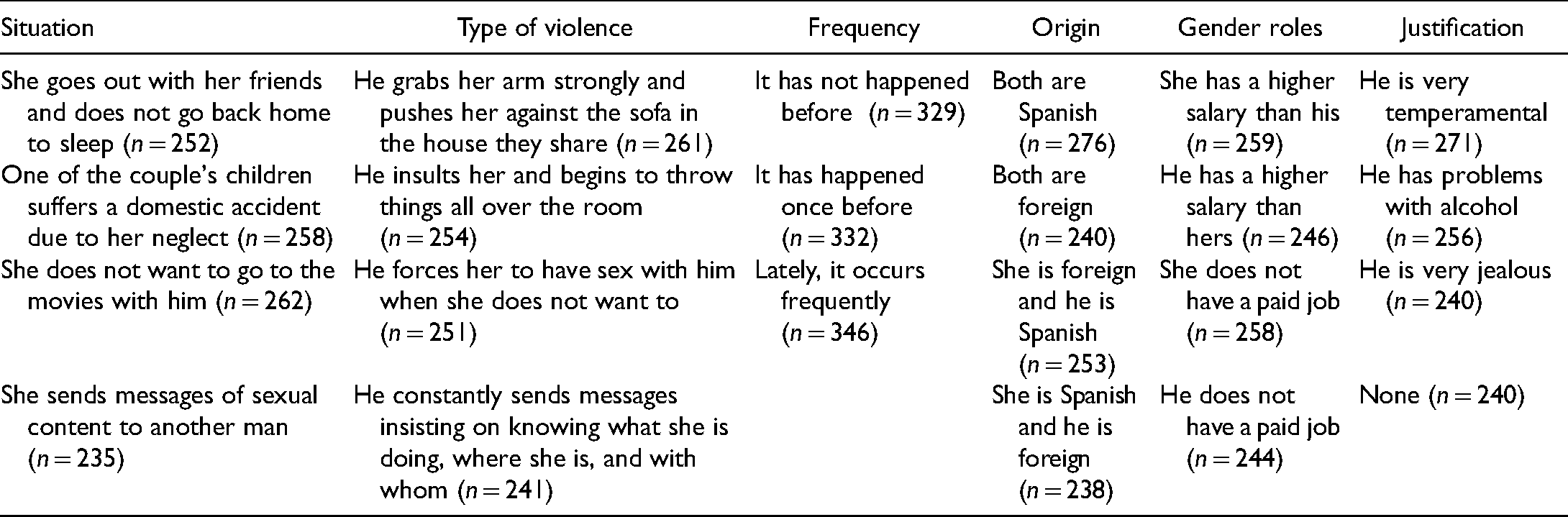
The first dimension considered was the situation triggering the violence (Sylaska & Walters, 2014; Valor-Segura et al., 2011; Witte et al., 2006). Four possible scenarios were defined: she goes out with her friends and does not go back home to sleep, one of the couple's children suffers a domestic accident due to her neglect, she does not want to go to the movies with him, and she sends messages with sexual content to another man.
The second dimension was the type of violence. Four behaviors were included, intended to represent the four main types of violence: physical (he grabs her arm strongly and pushes her against the sofa in the house they share), emotional (he insults her and begins to throw things all over the room), sexual (he forces her to have sex with him when she does not want to), and controlling behaviors (he constantly sends messages insisting on knowing what she is doing, where she is, and with whom).
The third dimension analyzed was the frequency with which episodes of violence occur. Three levels were established: it has not happened before, it has happened once before, and lately, it occurs frequently.
The fourth dimension considered was the origin of the members of the couple. This study included country of origin, instead of race, for cultural reasons. In Spain, as in other European countries, race information is not collected in a systematic way, so many of the differences are found with reference to nationality or country of birth. For this reason, four levels were defined according to the possible combinations: both are Spanish, both are foreign, she is foreign and he is Spanish, or she is Spanish and he is foreign.
The fifth dimension analyzed was adherence to gender roles. Four levels were defined: she has a higher salary than his, he has a higher salary than hers, she does not have a paid job, or he does not have a paid job.
The final dimension was the justification of the abuse. One of the categories of myths about IPVAW emphasizes certain personal characteristics of the perpetrators that supposedly spur them to violence and that, in a more or less explicit way, exonerate them of blame (e.g., perpetrators are jealous or have problems with alcohol). To examine the extent to which these justifications influence bystanders' willingness to report the cases, four situations were established: he is very temperamental and easily loses control, he has problems with alcohol and drinks frequently, he is very jealous, and a fourth scenario where none of these factors was mentioned.
A total of 3,072 unique scenarios were constructed by combining all the levels assigned to the six dimensions (4 × 4 × 4 × 4 × 4 × 3). Vignettes were randomly extracted from the universe and randomly assigned to each respondent. The vignettes were designed in Python using fsdesign 0.1.4.2 Below is one example of a vignette (manipulated variables are printed in italics):
Sara and David have been a couple for four years. They met through a mutual friend when David decided to leave his country and came to live in Spain, and since then, despite having had some differences because she does not have a paid job, they have maintained a stable relationship. Since they first met, Sara knows that David has alcohol problems and drinks frequently. However, he has always promised her that he will change. 3 A few days ago, the couple had a serious argument because Sara did not want to go to the movies with David. During the episode, David grabbed Sara by her arm and pushed her against the sofa in the house that they share. Despite the fact that David has engaged in this type of behavior frequently of late, Sara is confused by what happened and does not know how to deal with the situation.
Variables Associated with the Scenario
The purpose of the experimental design was to examine whether the characteristics of the IPVAW episode, the perceived severity of the abuse, and the responsibility attributed to the victim and the perpetrator, influence willingness to formally report IPVAW incidents. For this reason, after the vignette, respondents were asked:
Perceived severity. “How would you rate the severity of this case?” The indicator was measured on a 4-point scale ranging from 1 “not severe at all” to 4 “very severe.” Because the distribution was highly asymmetric, the responses “not severe at all” and “slightly severe” were combined.
Responsibility attributed to the victim. “To what extent do you think Sara [the victim] is responsible for David's behavior?” The question was measured on a 4-point scale ranging from 1 “not responsible at all” to 4 “very responsible.” Because the distribution was highly asymmetric, the responses “fairly responsible” and “very responsible” were combined.
Responsibility attributed to the perpetrator. “To what extent do you think David [the perpetrator] is responsible for his own reaction?” The question was measured on a 4-point scale ranging from 1 “not responsible at all” to 4 “very responsible.” Because the distribution was highly asymmetric, the responses “not responsible at all” and “slightly responsible” were combined.
Willingness to formally report the incident. “If you were aware of this situation, what would you do?” This was a mark-all-that-apply question, where the response categories were: “I would confront David”; “I would confront Sara”; “I would try to mediate between the couple”; “I would draw the attention of other people who could help”; “I would call the police”; and “I would do nothing.” The responses were randomly rotated to minimize response order effects (except “I would do nothing,” which was located at the end in all cases). In this study, only the response “I would call the police” was analyzed.
Personal Variables
Personal variables included gender (women; men); age (in ranges); education (without studies or primary studies; high school or technical school; college graduate; Master's or doctorate); political orientation, evaluated through an 11-point ideological self-identification scale (left–right); and sexual orientation (heterosexual; nonheterosexual). Similarly, respondents were asked if they knew, within their close circle, a victim of IPVAW (1 = yes, 0 = no). Four questions measuring personal experiences of intimate partner victimization were also included. Specifically, respondents were asked if they have experienced emotional, physical, and sexual violence and/or controlling behaviors during their lifetime (1 = yes, 0 = no). To avoid ambiguity, questions included examples of different forms of victimization. Two variables were created differentiating between respondents who reported emotional violence or controlling behaviors only, and those reporting physical or sexual violence. Finally, a scale measuring sexism and three indicators assessing acceptability, concern, and the perceived frequency of IPVAW in Spain were included.
Classical and Modern Sexism Scale. This instrument was developed and validated in the Scandinavian context by Ekehammar et al. (2000). 4 Sample items include “I prefer a male boss to a female boss,” or “women are better suited to look after children and old people.” Although the original scale is composed of 15 items, in the present study one of the indicators was removed because it did not load on the same factor as the other ones. The scale with the 14 items showed good internal consistency (α = .83), with factor loadings ranging between .31 and .75 (λ = 4.99). Each item was measured on a 5-point agree/disagree scale and six items were reverse coded. All the responses were averaged to create an index of sexism (range = 1–5), on which higher scores indicated greater sexist attitudes.
Acceptability. Acceptability was assessed through the question: “In your opinion, intimate partner violence against women is: (a) unacceptable in all circumstances and always punishable; (b) unacceptable in all circumstances and not always punishable; (c) acceptable in certain circumstances; and (d) acceptable in all circumstances. A dummy variable was created differentiating between respondents who indicated that IPVAW is unacceptable in all circumstances and always punishable, and those who indicated otherwise.” 5
Perceived frequency. Respondents were asked to indicate how often they would say that IPVAW occurs in Spain. Responses were evaluated on a 4-point scale ranging from 1 “not frequent at all” to 4 “very frequent.” Because the distribution was highly asymmetric, the responses “not frequent at all” and “slightly frequent” were combined.
Concern. “In general, to what extent are you concerned about intimate partner violence against women?” Responses were evaluated using a 4-point scale ranging from 1 “not at all” to 4 “very concerned.” In this case, the responses “not at all” and “slightly concerned” were combined.
Analytic Strategy
The purpose of this study was to analyze the willingness to formally report IPVAW incidents and their correlates. To do so, the proportion of respondents who selected “I would call the police” was examined. To determine whether the characteristics of the episode of IPVAW, the perceived severity of the abuse, the responsibility attributed to the victim and the perpetrator, and the personal characteristics of the respondents influence the willingness to formally report IPVAW incidents, a logistic regression model was estimated. Variance Inflation Factors fell within appropriate limits (1.02–1.85), suggesting no multicollinearity problems in the models. Because some of the variables presented missing data, multiple imputation procedures were applied. The percentage of missing data was generally low; the variables knowing victim(s) of IPVAW (11.9%), political orientation (9.1%), having experienced IPV (5.4%), and sexual orientation (2.2%), were the only ones that presented them. We used multiple imputations to create and analyze 20 multiply imputed datasets. Incomplete variables were imputed under fully conditional specification, using Stata 16. The parameters of interest were estimated in each imputed dataset separately and combined using Rubin's rules.
Results
Despcription of the Sample
Table 2 presents the distribution of all study variables. Nearly half of the respondents (46.2%) knew victims of IPVAW. In terms of personal victimization, approximately one in five respondents (22.0%) reported emotional violence or controlling behaviors during their lifetime, while one in seven (14.5%) indicated having experienced physical or sexual violence. The sexism scale revealed a certain presence of sexist beliefs among respondents (M = 2.35, on a scale from 1 to 5). Almost nine in ten participants (87.4%) indicated that IPVAW is unacceptable in all circumstances and always punishable. Around half of the respondents considered that IPVAW is a fairly frequent phenomenon in Spain (53.4%) and reported being very concerned about this form of violence (56.6%).
Descriptive Statistics of all Study Variables.
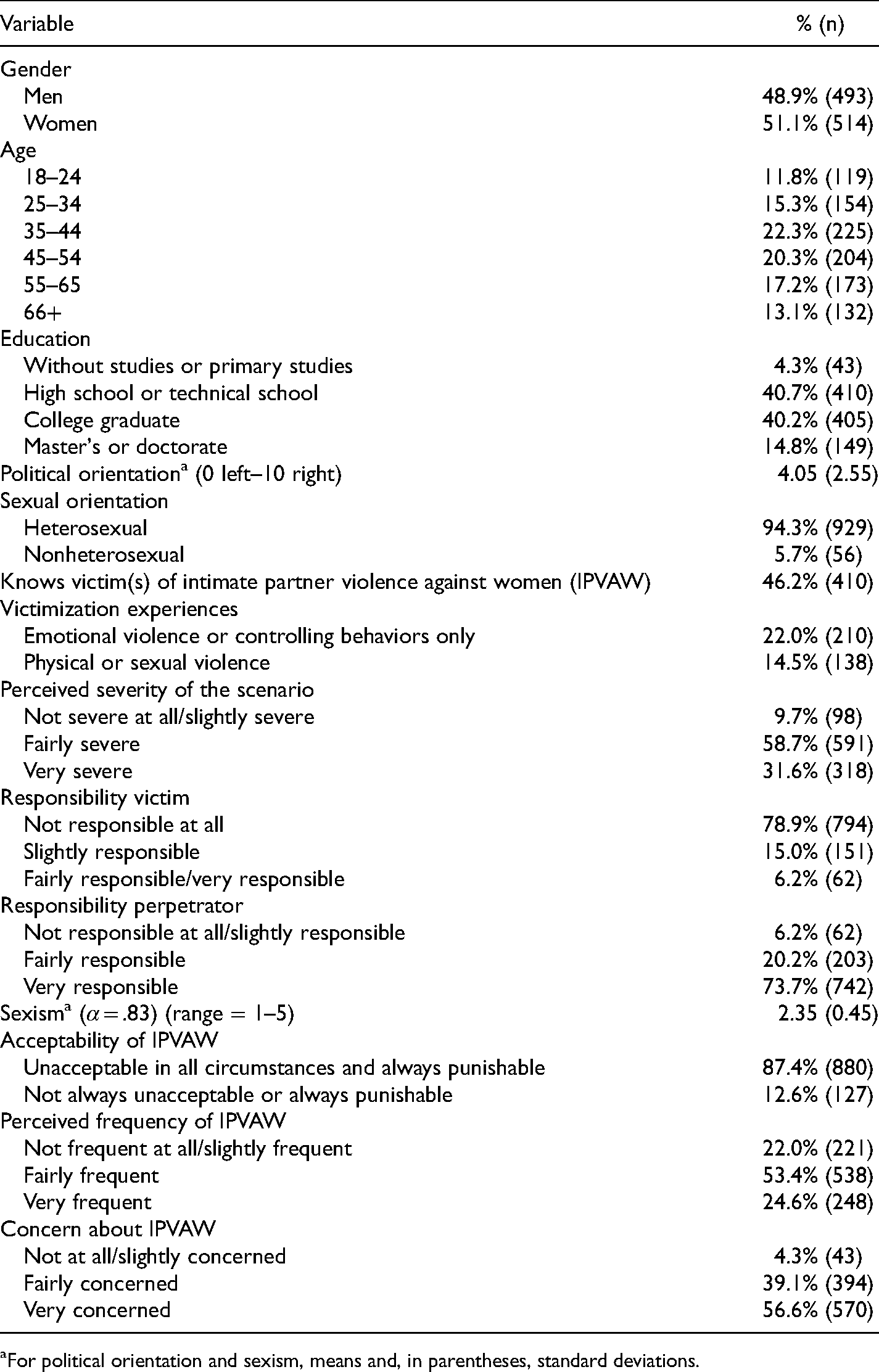
For political orientation and sexism, means and, in parentheses, standard deviations.
Willingness to Report Incidents of IPVAW and its Correlates
The results show that slightly over one in four respondents (28.1%) indicated that they would report the episode of violence to the police. Table 3 displays the estimated regression model examining the correlates of willingness to call the police. Regarding the situational characteristics of the vignettes, only two variables—the type of violence and the justifying causes of the abuse—were significant in the model. Specifically, the odds of reporting the episode of violence were greater in the scenarios that described emotional (OR = 3.53, p ≤ .001), physical (OR = 2.26, p = .001), and sexual (OR = 2.45, p ≤ .001) violence when compared with those describing controlling behaviors. In addition, the respondents’ willingness to call the police was greater in those scenarios stating that the perpetrator had problems with alcohol when compared with those who did not include a justifying cause of the abuse (OR = 1.64, p = .03). In terms of severity, the findings show that the tendency to formally report the incident was greater in those scenarios considered as “very severe” when compared with those perceived as “not severe at all/slightly severe” (OR = 4.82, p ≤ .001). The perpetrator's responsibility was significant in the model as well. That is, the tendency to call the police was greater in those scenarios where the perpetrator was considered “fairly responsible” (OR = 2.75, p = .04) or “very responsible” (OR = 2.64, p = .04) when compared with those where the perpetrator was considered “not responsible at all/slightly responsible.” Finally, related to the personal variables of the respondents, the results show that only education level was significant in terms of affecting the tendency to formally report IPVAW incidents. In this regard, the findings show that the most educated respondents—those with Master's or doctorate studies—were less likely to call the police when compared with those with primary education only (see Table 3).
Logistic Regression: Correlates of Formally Reporting Episodes of IPVAW (N = 1,007).
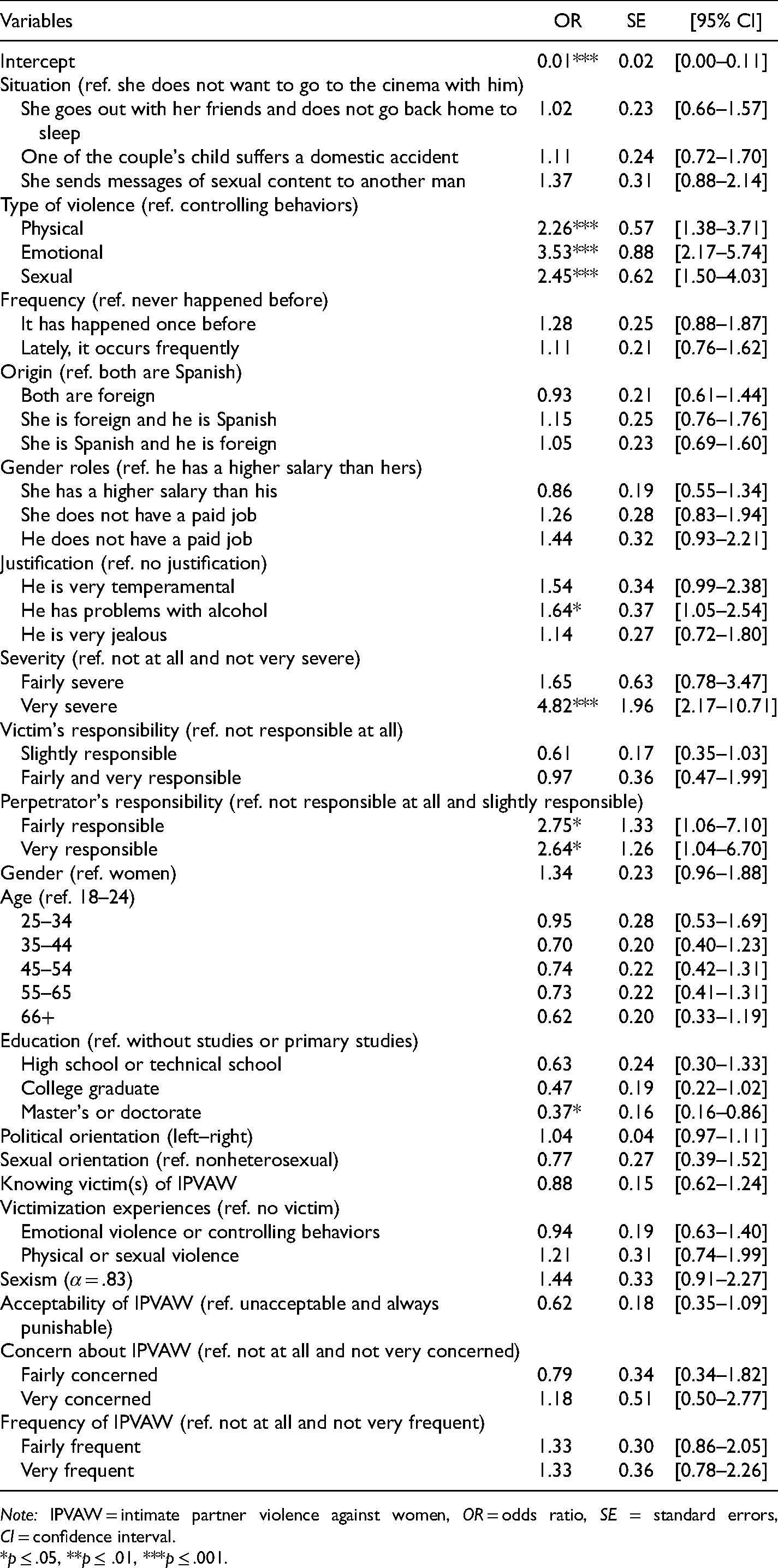
Note: IPVAW = intimate partner violence against women, OR = odds ratio, SE = standard errors, CI = confidence interval.
*p ≤ .05, **p ≤ .01, ***p ≤ .001.
Discussion
The purpose of this study was to examine willingness to report IPVAW episodes to the authorities and its correlates. Although willingness to intervene in IPVAW cases has been studied widely, previous studies feature some limitations. For instance, they have analyzed a limited number of correlates and their findings are in some cases inconclusive. Therefore, this study contributes to the literature by expanding the number of factors under study, and the number of levels within each of these manipulated factors. Certain variables that have never been analyzed before in the context of formal reporting have been included, such as the origin of the members of the couple and their adherence to traditional gender roles. At the same time, the number of levels has been extended. For example, in the study conducted by Capezza and Arriaga (2008), only physical and psychological violence were compared, while in this study, sexual violence and controlling behaviors were also considered. We believe that this study will help to better understand the processes involved in decision making leading to the reporting of IPVAW incidents. Moreover, this study has relevant implications for the prevention of this form of violence, and its findings might help inform educational and awareness-raising efforts.
The results of this study show that slightly over one in four respondents (28.1%) indicated that they would report an episode of violence to the police. This finding only provides partial support for our hypothesis, showing that a substantial proportion of respondents would call the police if they were aware of an episode of violence similar to the ones described in the vignettes. This result is important because previous research has highlighted that this preference is considered exceptional and limited to those episodes involving extreme violence (Banyard & Moynihan, 2011; Ermer et al., 2017). However, this finding may be affected by social desirability (i.e., being perceived as doing the right thing). Moreover, it cannot be assumed that the actions chosen by the respondents correspond to what their actual behavior would be in real-life (Alfredsson et al., 2014), since being a witness in real life could lead to different decisions from those imagined as intentional forms of behavior (Ajzen & Fishbein, 2005). On the whole, this finding reflects a broad social sensitivity regarding the need to intervene in these episodes of violence to prevent their occurrence. In addition, this might suggest that IPVAW is no longer a problem limited to the private sphere (Bosch-Fiol & Ferrer-Pérez, 2000). Nevertheless, it should not be forgotten that what is fundamental is not only the reporting of the episodes of violence, but also the implementation of measures that promote the safety and well-being of the victims.
Regarding the correlates influencing the willingness to report IPVAW episodes to the authorities, the results show that variables related to the episodes of violence, and respondents’ personal factors, are both associated with the propensity to report incidents of IPVAW. These findings provide support to our hypothesis and are consistent with previous research (Felson & Feld, 2009; Pagliaro et al., 2020; Serrano-Montilla et al., 2020). However, the situational characteristics of the episode of violence had a limited effect on willingness to report the abuse in the current study. In this regard, only two of the six variables manipulated in the vignettes (type of violence and perpetrators' problems with alcohol consumption) were significant in the model. Our results show that the propensity to report IPVAW episodes was higher in the scenarios that described emotional, physical, and sexual violence compared with those describing controlling behaviors. These findings might suggest that the respondents find the emotional, physical, and sexual violence described in the vignettes serious enough to report it to the authorities. This explanation would be linked to previous findings in relation to the perceived severity of IPVAW cases. This study's results show that respondents were more likely to report the incident when they perceived the abuse to be very severe. This finding bears out our hypothesis and is also supported by previous research showing that respondents are more prone to report aggressions when they are perceived as more serious (Cinquegrana et al., 2018; Sylaska & Walters, 2014). Another implication that emerges from these results is that individuals seem to consider emotional, physical, and sexual violence to be more serious than other forms of violence, such as controlling behaviors (Capezza & Arriaga, 2008; Follingstad & Rogers, 2014). In this regard, research shows that certain forms of coercive control are often normalized and may go unquestioned or unnoticed by both the general public and the survivors of such violence (De Miguel, 2015; European Commission, 2016; Gracia & Lila, 2015; Ugnė et al., 2019). This explains why these types of behaviors might not be perceived as “authentic” violence and go underestimated. Controlling behaviors, however, are a form of violence, and are associated with emotional and physical violence (Aizpurua et al., 2017).
In relation to the causes justifying the abuse, the tendency to report the case to the police was greater when the perpetrator was described as having problems with alcohol consumption. This finding runs contrary to the previous literature (Cinquegrana et al., 2018; Taylor & Sorenson, 2005), but methodological differences between studies could help explain these differences. Whereas our vignettes specified that the perpetrator had problems with alcohol consumption (referring to an ongoing situation, not necessarily impacting the situation of violence described), previous studies have analyzed the perpetrator's alcohol intoxication at the time when the aggression occurred (Cinquegrana et al., 2018; Taylor & Sorenson, 2005).
Moreover, the attribution of responsibility to the perpetrator was a significant variable in the model, providing support to our hypothesis that respondents more frequently indicated that they would call the police in those episodes in which the level of responsibility attributed to the perpetrator was greater. On the other hand, contrary to the literature (Cinquegrana et al., 2018; Gracia et al., 2018), the results of this study show that the degree of responsibility attributed to the victim was not significant. This finding is considered positive, as it suggests that the respondents’ willingness to file formal reports of aggression is not contingent upon the victim's behavior. The results show, encouragingly, that the attribution of responsibility to the victim does not impact willingness to report abuse in any significant way.
Finally, most sociodemographic variables (e.g., gender, age, political orientation, and sexual orientation) were found to have no significant association with the likelihood to formally report the episodes of IPVAW. These findings are, in general, consistent with those found by Signal and Taylor (2008). Unlike them, in the present study, the respondents’ education level was significant in the model. The fact that only this variable was significant has a twofold implication. First, the results indicate that personal characteristics are not particularly relevant when explaining willingness to report IPVAW episodes. Second, the decision to report the aggression depends, mostly, on the perceived severity of the aggression, the type of violence exerted by the perpetrator, and the responsibility attributed to him. This suggests that awareness-raising efforts concerning IPVAW are still needed, in particular, those focused on eradicating the idea that IPVAW should only be reported when the perpetrator is responsible (as if victims could be responsible for their own victimization) and the assumption that certain forms of violence are more severe than others. This issue is especially relevant because IPVAW starts with certain behaviors that may be considered less severe (e.g., controlling behaviors) but are the precursors to more serious and persistent patterns of future violence.
It is also relevant to point out that gender and sexism were found not to be significant in the model. Although most of the studies show that women are more likely to report IPVAW incidents (Beeble et al., 2008; Gracia et al., 2009; Sylaska & Walters, 2014), the role of gender in the literature is not clear, especially when the effect of other variables is controlled for. For this reason, future research should delve into the circumstances under which these variables are related to the willingness to formally report IPVAW incidents. Additionally, victimization experiences (own and vicarious) were unrelated to the propensity to formally report IPVAW incidents in this study.
Despite its contributions, this study has limitations. First, the sample came from a nonprobabilistic panel, which limits the generalizability of the findings. Despite limitations related to external validity, factorial surveys increase internal validity due to the greater control exercised by the researcher, which increases the certainty that the oberved results respond to the manipulations conducted (Auspurg & Hinz, 2015). Another limitation refers to the operationalization of IPVAW, which only involves unidirectional aggressions (male against female) occurring within the context of heterosexual couples. Future studies should analyze people's willingness to intervene in episodes of IPV involving a wider range of situations. In addition, the vignettes did not refer to the relationships between the respondents and the victim/perpetrator (Palmer et al., 2016). In fact, it is presumed that the respondents did not witness the abuse, because it occurred at the couple's home or in private. This could have affected the responses, as respondents’ reactions could be mediated by these factors (e.g., the relationship of closeness, having witnessed the aggression). Finally, it should be noted that some respondents may not have assimilated all the information presented in the scenarios due to the complexity of the vignettes, which included a large amount of information (Auspurg & Hinz, 2015).
Conclusion and Implications
This study shows a moderate propensity to report IPVAW episodes to the authorities. This is considered a positive finding, since the decision to report IPVAW incidents reflects limited tolerance and acceptance of this form of violence (Copp et al., 2016; Jewkes et al., 2015). The findings also highlight the need to promote initiatives aimed at increasing the ability to identify and report this type of abuse, especially because those forming close circles around the victims (e.g., family, friends, and neighbors) usually know about it.
Although it is crucial to increase the reporting of these episodes of violence, it is considered even more necessary that these strategies be accompanied by other measures aimed at ensuring the safety and well-being of the victims, particularly when taking into consideration that some of the factors explaining why women do not report the violence that they suffer are those related to personal circumstances (e.g., fear of retaliation, economic dependency, not having a place to go). It is essential, therefore, to implement a broad catalog of measures aimed at supporting and helping victims of IPVAW.
Finally, the results of this study show that certain circumstances related to the episode in which violence takes place are crucial to explaining the tendency to report IPVAW incidents. In this regard, the findings could be used, from an applied perspective, in the planning of initiatives since they highlight some aspects on which it is necessary to intervene to contribute to the fight against IPVAW.
Footnotes
Acknowledgments
The authors would like to thank all the experts who participated in the pre-test for their insights on the questionnaire used in this study. We also warmly thank Sophie van der Valk and Alberto Egido for their comments and feedback.
Declaration of Conflicting Interests
The authors declared no potential conflicts of interest with respect to the research, authorship, and/or publication of this article.
Funding
The authors disclosed receipt of the following financial support for the research, authorship, and/or publication of this article: This research has been funded by the Department of Public and Business Law at theUniversity of Castilla-La Mancha.
