




Abstract
This article critically explores accounts of how men attending domestic violence perpetrator programs (DVPP) used the “time out” strategy. Findings are drawn from 71 semi-structured interviews with 44 men attending DVPPs and 27 female partners or ex-partners of men in DVPPs. We describe three ways in which the technique was used: first, as intended, to interrupt potential physical violence; second, through the effective adaption of the time-out rules by victim-survivors; and finally, misappropriation by some men to continue and extend their controlling behaviors. Policy and practice lessons are drawn from the findings through connecting broader and deeper measurements of what success means when working with domestic violence perpetrators to the ways in which the time-out technique was used.
Introduction
Despite the proliferation of domestic violence perpetrator programs (DVPPs) across the world, in criminal justice and non-criminal justice settings, hardly any research has examined how men use the strategies and techniques taught within the programs or how these are experienced by their partners or ex-partners. Research has instead tended to focus on whether they, as a body of interventions, “work” or not (R. E. Dobash & Dobash, 2000; R. P. Dobash, Dobash, Cavanagh, & Lewis, 1998; Dutton, 2006; Gondolf, 1999, 2002). This neglects the more nuanced questions of program content and implementation. In this article, we critically examine one frequently used technique promoted in many programs—that of encouraging men to take “time out.” We test the application and use of “time out” from a sample of victim-survivors and perpetrators of domestic violence (defined here as physical, sexual, and non-physical forms of intimate partner and ex-partner violence and abuse including coercion and control) where the perpetrator attended a non-court-mandated DVPP. We first describe how this analysis fits within our wider program of research on British DVPPs (known as Project Mirabal), then explain what a “time out” is and how its use is taught alongside a consideration of the brief literature on “time out.” We then outline the data we draw on followed by analysis of how “time outs” were used by our sample.
There is no agreed terminology or definition of “domestic violence” across government, practice, and academia in the United Kingdom. The current government definition conflates partner and family violence and includes female genital mutilation (FGM), forced marriage, and honor-based violence and has been criticized on a number of grounds (Kelly & Westmarland, 2014). Our understanding reflects that of Evan Stark (2007), and many of the DVPPs from which data are drawn, that domestic violence is a pattern of coercive control. Here, physical violence is only one way men “entrap” women. Intimidation, isolation, and the “micromanagement” of everyday life are also routinely used to reduce women’s autonomy and independence (Stark, 2007).
Project Mirabal
Project Mirabal is a mixed-method, longitudinal, multi-site study of DVPPs in the United Kingdom. The aims of the project are to investigate the extent to which perpetrator programs reduce violence and increase safety, well-being, and freedom for women and children, the routes by which they do or do not produce effects within a consideration of the wider contribution DVPPs may make to coordinated community responses to domestic violence (see more at https://www.dur.ac.uk/criva/projectmirabal). Rather than looking at whether DVPPs “work” to decrease violence or not, Mirabal has as its starting point a broader and deeper understanding of what success means. From this perspective, success includes not only a reduction in violence and abuse, but also: for partners and ex-partners to have an expanded “space for action”; for improved relationships underpinned by respect and effective communication; safer, healthier childhoods; safe, positive and shared parenting; and an enhanced awareness of the impact of the man’s violence on himself and others (Westmarland & Kelly, 2012).
Domestic Violence Perpetrator Programs in the United Kingdom
DVPPs emerged in the United Kingdom in the late 1980s, with Change in Edinburgh, Scotland, and the Domestic Violence Intervention Programme (DVIP) in London, England. Influenced by developments in the United States, initial work was with both court-mandated and self-referred men (Scourfield & Dobash, 1999). A recent publication from Mirabal on the history of the development of DVPPs in Britain (Phillips, Kelly, & Westmarland, 2013) reveals a framework that combined knowledge of the Duluth men’s program in the United States with UK therapeutic influences. The development of DVPPs was dynamic, with the evolution of practice enhanced through a National Practitioners Network (NPN), which met every 6 months. In 1998, the NPN began the process of developing a membership organization, Respect, which formalized the NPN “Statement of Principles” in 2004 as the Respect “Statement of Principles and Minimum Standards of Practice for Domestic Violence Perpetrator Programmes and Associated Women’s Services.” A core part of Respect’s work continues to be the accreditation of member DVPPs, which tend to work with non-court mandated men, with those mandated by courts now dealt with through in-house probation and prison-based interventions (Bowen, 2011; Phillips et al., 2013). All Respect members are required to have an associated women’s support service delivering specialist proactive support to female partners or ex-partners to ensure that women’s and children’s safety sits at the heart of their work.
Despite the growth in DVPPs in the 1990s and 2000s, non-court mandated DVPPs are not widespread. Coy, Kelly, and Foord (2009) found that less than one in 10 local authority areas in Britain had a non-court-mandated program. Westmarland and Kelly (2012) link this to widespread skepticism about DVPP effectiveness.
What Is the “Time Out” Technique?
The time-out technique, as the name suggests, involves removing oneself for a period of time from a situation. It is viewed in DVPPs as a temporary interruption technique, with rules for the perpetrator on what to do and what not to do. It is variously described by DVPPs as “an emergency safety precaution—a way of hand-cuffing yourself before it is too late” (Ahimsa, n.d.), “the most basic alternative to being violent” (Respect, n.d.), “giving space for things to calm down” (Everyman Project, n.d.), or “taking a breather . . . a tool to help you avoid being violent” (The Caledonian System, n.d.).
It is recommended as a tool to enable men to manage their own behavior on occasions where they would otherwise use physical violence. As one program puts it, “you cannot hit her if you are not in her presence” (Ahimsa, n.d.). It is a short-term behavioral strategy, which aims to provide space to reflect and avoid violence. The description by Ahimsa (n.d.) also makes clear that it is intended as a transitional tool: “[time out] can help you avoid situations in which you have previously acted violently until you learn how to handle them peacefully on a regular basis.”
Program materials are fairly prescriptive as to what a time-out should and should not entail. Most suggest a length of an hour, although some are more flexible. However long it is for, all specify that understanding and use of technique must be agreed on with the partner. Program facilitators are requested to go through this in detail with the men; for example,
Discuss with the man the different stages of his individual taking a breather plan. Ensure that he understands each of the steps of the process, and has concrete examples of things he could do and places he could go during this period. . . . Concentrate on your breathing. Practice self-calming, relax, let go, think straight. Stop your angry thoughts with more realistic self-talk. Remember, your partner is not the enemy. (The Caledonian System, n.d.)
Exploring and agreeing how time-outs will be used with partners is an integral rather than an optional component.
It’s very important to talk about time-outs with your partner well ahead of when you will need to use one. Do this at a time when you’re calm and she has agreed to discuss it with you. Show her this information and give her time to read it. She may not want to talk about it with you. If this is the case, leave this information with her, when she can read it at another time if she chooses to. A time-out is a tool for you, not for your partner—you don’t need her support to use it. However, it’s essential that you let her read this information if she so chooses. (Respect, n.d.)
Just as there are rules and guidelines about what “to do,” several what “not to dos” are also emphasized. Men are advised not to drive, drink alcohol, or take drugs, alongside strong injunctions to never use a time-out “against her” in an abusive or controlling manner. Respect adds more descriptive content to inappropriate applications of the technique:
using it against her by storming out in the middle of an argument and pretending you are taking a time-out,
using it as an excuse to go to the pub or to stay out late,
telling her that she needs to take a time-out,
returning from a time-out without having calmed down/still wanting to argue,
using it to control your partner in any way. (Respect, n.d.)
What Do We Know Already About “Time Out?”
To date, very little research that has looked at the implementation of the time-out technique. In the United States, Gondolf (1987) argued it had the potential, at an early stage of involvement, to teach men how to control their behavior: “interruption methods are not only simple to implement but they also contribute to a sense of self-efficacy and accomplishment. That is, they get some results fast” (Gondolf, 2002, p. 145). In the United Kingdom, R. E. Dobash, Dobash, Cavanagh, and Lewis (2000) identified the contribution that violence avoidance strategies made to reductions in physical violence, but found no evidence that these strategies reduced emotional or sexual abuse. In Ireland, T. Debbonaire, E. Debbonaire, and Walton (2003) interviewed 24 women whose partners were in DVPPs. Some of the women interviewed had found the time-out helpful when they felt their partner was likely to be abusive, and reported improvements in physical safety, particularly in the early stages of a man’s involvement with the program. Some women also chose to use it themselves to get their own space, with one woman in the Debbonaire et al. study stating, “I’ve taken time out myself, with one of the girls – it helped me to get some space away from how he was behaving” (Debbonaire et al., 2003, p. 117).
Jennings (1990) identified systemic factors that inhibit and complicate the use of time-out, including that partners are “unaware that ‘time-out’ is an approved violence-prevention technique” (p. 46). This lack of information was also highlighted as a key concern by Debbonaire et al. (2003), including that some women had been deliberately misinformed by their partner about the technique. The Debbonaire et al. study concludes that only six of 24 women had accurate and complete information and that this enabled men to misuse time-out (see also Stith, McCollum, Rosen, Locke, & Goldberg, 2005).
Moreover, Debbonaire et al. (2003) note that even where the man is using time-out correctly, the technique can increase women’s fear and anxiety. Here, taking a time-out acts as a signal that the man is considering using violence: “prolonged use of time out indicates that the potential for abuse is still there” (Debbonaire et al., 2003, p. 120). Gondolf (1987) warns against a man viewing this newfound ability to use the interruption technique as a “cure”:
Unfortunately, the process of change—and the end of psychological abuse—is far from complete. In fact, while physical abuse may lessen, the psychological abuse may actually increase as the man verbalizes his newly discovered hurts and uses this to manipulate his wife. (p. 343)
A consensus across the little data we have is that moving beyond interruption techniques was strongly associated with lasting and deeper change in men’s understandings and behavior.
The existing knowledge base is therefore extremely thin, although what does exist seems to support the caveats that DVPPs put in place around the use of time-out—that it is a temporary strategy, of which the partner needs to be fully aware.
Research Method
NVivo was used to search the 177 Project Mirabal interviews with men on DVPPs and women partners and ex-partners. A text search was carried out to find where “time out” and “time outs” appeared in the interview. The search was set to be inclusive and to find “stemmed words,” which allowed variations of the term to be returned. In 71 of the 177 interviews (with 27 women and 44 men) the time-out technique was mentioned. Of these, 37 interviews took place near the beginning of the program and 34 near the end.
An initial surface level analysis led to the coding of examples into useful, negative, and mixed uses of the time-out technique. Further coding refined the analysis into two broad categories: successful uses that went beyond an interruption of physical violence and unsuitable uses that covered both failure to prevent violence and use as a strategy of control. Sub-categories were then developed within the broader measures of success to identify several pathways for the use of time-out.
The men in our research sample were attending “non criminal justice” DVPPs—they were referred into the program because a family court said they needed to complete it before they gained contact with their children, because they wanted to stay together with a partner and “save” a relationship, because they wanted to make changes to their behavior to benefit future relationships, and/or because they were under observation by state social services because of concerns over the safety and well-being of a child. Although many of the men had been reported to the police and/or had criminal convictions, this was not the reason why they were in the DVPP; they were not mandated to attend by a criminal justice court. The men had used a range of different forms of violence and abuse against their female partners and ex-partners. All the men were in heterosexual relationships, and the majority of the sample included White British, from a self-selecting sample from 14 DVPPs in the United Kingdom. The women were the partners or ex-partners of the men attending the programs and had all been offered, and most had received, support from an integrated proactive women’s support service.
Findings
We analyzed the data using our framework of what success means, which allowed for nuance beyond merely interrupting a potentially violent incident. This means our beneficial uses of time-out included both increased space for action for the women and more respectful communication (see Westmarland, Kelly, & Chalder-Mills, 2010), alongside the expected immediate increases in the safety of women and children. This revealed two different applications of time-out, as outlined in Figure 1. The first pathway follows the program rules, which we term instrumental. The second pathway involves more negotiation by the woman about how it should take place, which we call relational.
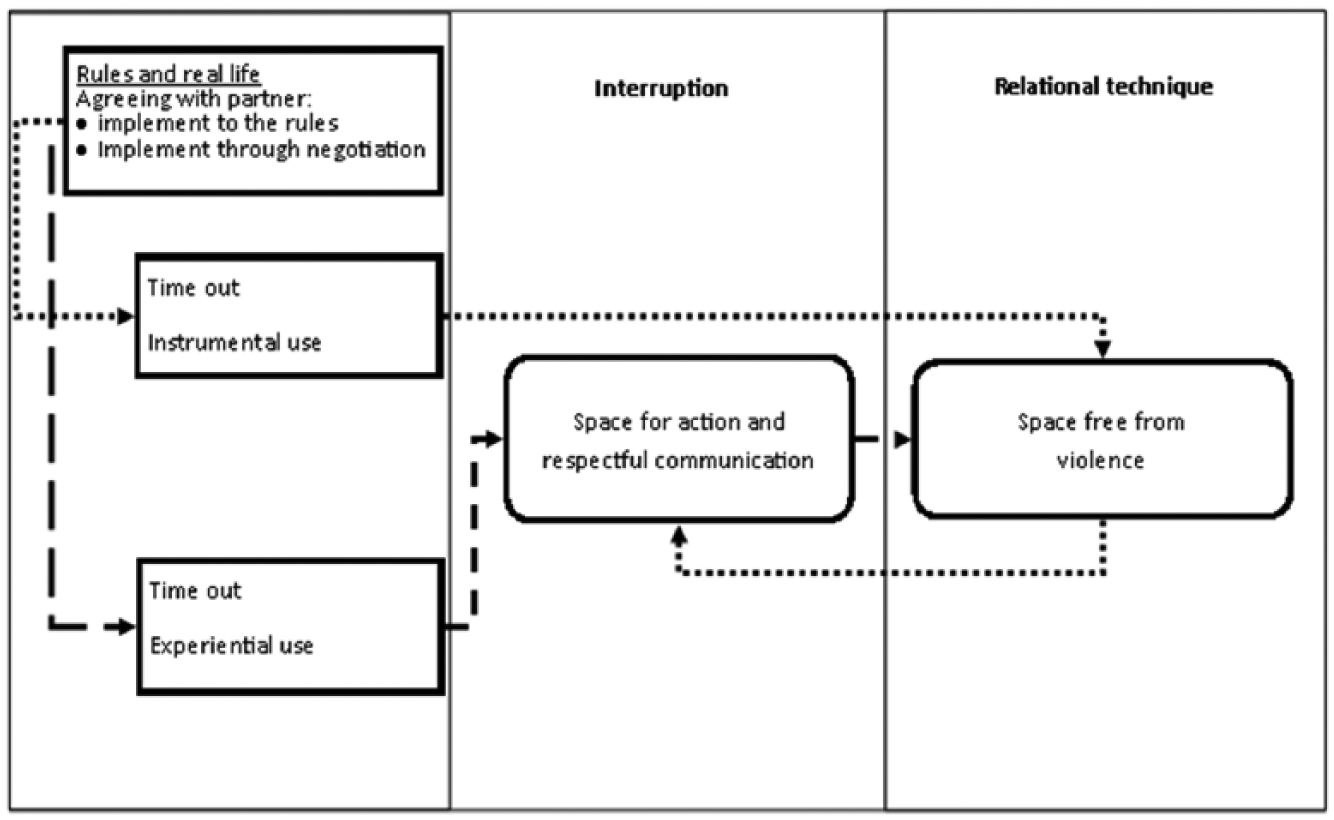
Instrumental and relational time-outs.
The first pathway (dotted line in Figure 1) traces men’s instrumental use of time-outs, following the DVPP rules, and being successful as an interruption technique. The second pathway (dashed line in Figure 1) is characterized by negotiated modifications, originating in women asserting how they wished the time-out to be implemented and the man agreeing to this. Here, respectful communication (talking about difficult issues and feeling able to express opinions where partners not only listen but also hear and understand women’s points of view) and increased space for action (women are more able to make choices and exert control) were both evident, as was the interruption of physical violence. The time-out technique therefore has the potential to contribute toward three of the six measures of success proposed by Westmarland and Kelly (2012) and outlined earlier in this article. The next section explores the two pathways in more detail.
Instrumental Time-Outs
Examples were given by both men and women about how the time-out technique functioned to prevent an individual incident of physical violence on some occasions.
It’s amazing how much tension is cleared by someone walking out. (Simone, partner near the start of the program)
Many of the men here could recount not only what they had learned but also how they had agreed to a plan for initiating the time-out in advance of using it, so that when used, their partner understood what was happening.
I could feel myself getting really annoyed, really uptight, so I went and took a Time Out. Just said like, “I’m going, I’m gonna pop out.” She said, “Yeah, go for it.”
The interviewer asked whether this use was planned in advance:
Have a set out plan that . . . you go for an hour, just basically don’t go to see anyone, just go out for a walk. Go and sit by yourself, think about it, after an hour, text your partner or phone her, say “Look is it all right to come back?” If not, or if you haven’t calmed down enough, then take another hour. (Emil, near the end of the program)
About a third of the interviewees (men and women) provided evidence of information sharing on what should happen during the time-out, with most women confirming that women’s support workers had also provided advice and clarity on how and when the time-out should be applied.
I got all the information and we sat here together going through our information book together, filling in bits together and that. So far it’s been absolutely fantastic. You’ve heard of the Time Out? . . . So, yeah, the Time Out is really, really good. And it does work for us, and, he’s got his little Time Out kit, [my partner] lives on tea so he’s got his little thermos cup ready to go at any time. (Ivy, partner near the start of the program)
Several men welcomed being told about time-out; it gave them a tool that enabled a belief that they could stop using violence.
I didn’t know what to do at the time, and I would sit there fuming and sort of running in my head how just everything was and how poorly I’d been treated and usually get more cross . . . the Time Out was exactly the tool I was ready for, and had been searching for. I couldn’t figure all this out myself, unfortunately, I couldn’t piece it all together in my own head, I needed to be sat down and told what to do. When I was told what to do, it’s great. (Peter, near the start of the program)
Both men and women tended to welcome the immediate safety benefits of a time-out.
Yeah, a lot safer cos I know he won’t reach that point now. See he does his time-outs off the course . . . it’s like he doesn’t . . . he didn’t want to cross that line now. (Eleanor, partner near the start of the program) It’s like taking your Time Outs and recognizing the signs and just getting yourself out of that situation or not even putting yourself in that situation in the first place. (Sebastian, near the end of the program)
In the latter quote, Kevin claims he has not used violence since starting the program and situated time-out within other strategies and processes through which he was choosing to no longer be violent. Instrumental, rule-based, application of time-out at an early stage was associated with “buy-in” to the content and benefits of fuller engagement with the program. Indeed, Jack also noted that successfully implementing the time-out had helped him to “turn a massive corner,” a step toward deeper change.
One thing I have learnt is to see my own triggers of when I am starting to get annoyed. They say everyone is allowed to get annoyed but by seeing the triggers I know how annoyed I am getting, how frustrated I am, whether it’s going to become abusive and I need to leave which, it then falls to timeout again. When you start getting to such a point where you are so agitated and you’re thinking “Okay, I should have left it a bit longer but I need to leave now, because I am going to do something . . . I’m going to say something that I regret or I’m going to do something that I will regret, so I’m gonna leave” and you need to say to your partner “I’m going on a time out, I’m gonna be an hour, I’ve got my phone so I will text you when it’s been an hour and can you just let me know if I am allowed to come back please? I’ll speak to you in a bit.” Straight away you’re doing a positive. (Simon, near the end of the program)
It is in “doing a positive” that we can see the germs of transition from an interruption into a relational technique. Time-out was cited alongside a number of techniques, such as counting to three, listening to a partner, and letting the argument wash over them, which could help “to take the emotion out of a situation.” When pulled together, these techniques had the potential to improve communication, especially listening to their partner and trying to understand the context from their perspective.
She’s not saying what I—what my first hearing of it is, you know. (Barry, near the end of the program)
It is here that relational techniques come more to the fore, in which women are no longer cowed by the possibility of abuse, can speak their mind, and as one woman said in our previous study, “have a normal argument” (Westmarland et al., 2010, p. 6). The importance of transitioning into relational techniques was illustrated by one man who acknowledged that the time-out was not preventing his children from becoming anxious during and after he took one. He saw his children’s continued anxiety as a product of their experiences of witnessing past incidents of violence and abuse. Such anxiety may also be linked to the time-out on its own not changing a man’s abusive attitudes and behaviors, but merely acting as a tool to interrupt these behaviors (see Debbonaire et al., 2003). That said, interruption techniques can create the space to discuss issues more respectfully on return. Interviewees identified immediate improvements on returning from the time-out in relation to “being calm” and “willing to talk.”
Relational Time-Outs
Time-outs were not always applied exactly as they had been taught, and narrow measurements of program impact may have designated these as failures of implementation. Variations here included applying time-out for a shorter than instructed duration, driving during the time-out, and staying within the property. Everyday circumstances could prove challenging in terms of the rules, for example, driving in the car together, or not able to leave the house quickly due to being unable to find keys, phone, and shoes. Closer analysis revealed communication, negotiation, and agreement on how to proceed in some cases. In fact, the very processes of doing this changed the interactions between some women and men—engagements in which women had both voice and agency. For example, a temporary time-out was agreed between a woman and man driving together: They sat next to each other until they reached their destination, at which point the man initiated the full time-out away from his partner. It is these lived experience complications that test an instrumental technique, with the time-out principles rather than the rules evident. Women also provided examples of where they determined how the time-out was to happen.
Like the Time Out the other day, we weren’t even arguing, it was something about going to a shop or something, and we were walking—coz you come out the back of here and right down the back of my garden and through there that’s Morrisons, and we use it as a cut through, and he was like “Nnn-nn-nn,” right outside Morrisons, and I’m like “Time Out,” thinking “Don’t you fucking dare shout at me in front of people—” coz to me it’s normally you don’t really do arguing in front of other people it’s a bit embarrassing, you know. (Ivy, partner near the start of the program) So, I mean this Time Out thing, that (program) one, it’s fantastic, because I just say to him now, “Time Out,” and he will go out for a walk. (Simone, partner near the start of the program)
Where time-outs were preventing and reducing violent and abusive incidents, they were also, in some instances, fostering the greater space for action and more respectful communication that programs were aiming to embed. For example, David recounted how his daughter went to her mum for chocolate after he had said no and was given some. He then reflects on the process and what happened on his return.
I saw her with it and I just lost it and started shouting. I just flipped and kicked off like I used to always do . . . then I walked out and went on my time out. [When I came back] I asked her if she had heard me telling the bairn that she couldn’t have it and she said “No,” so we sat and talked about it and then we got the bairn and explained to her that if she asks her mam for something and she says “No” then she is not to ask me or vice versa. . . . When I was having my timeout, when I was thinking . . . I knew straight away that it was my fault again because I didn’t ask [my partner] if she had heard me. I should have asked her instead of kicking off. (Will, near the end of the program)
Here, Will acknowledged that he had more work to do and that the time-out was one way in which to create the reflective space to do this. It had become a relational technique, increasing his understanding, taking responsibility and respectfully communicating with his partner and child, and beginning to explore his own sense of entitlement.
Time outs sometimes became relational when they were linked to other learnings
I could see that I needed total improving. Am I really listening to [my partner]? Are we on the same page? Am I being supportive enough? Just let her go if she’s angry, just—just let her have it out and just tell her, look, as long as it doesn’t get abusive—abusive, and if it does I’ll have a Time Out. (Owen, near the end of the program)
Both men and women provided examples of time-outs stopping “vicious cycles.” Sebastian provided an example of using time-outs when his partner started to get scared in arguments. He identified that his partner had consistently communicated that she was getting scared in arguments but that “I just didn’t hear that before.” More respectful communication led to him being able to identify when to take a time-out, providing him with the ability to see that his violence was his choice.
It was always a choice, my choice to be like that. Understanding that I suppose I always knew it wasn’t acceptable, but it’s now a greater understanding that, you know, that it’s just totally and utterly unacceptable. Nobody deserves that. Erm, and again if—it—it’s just having those strategies and procedures in place in your own mind that if you can feel it’s getting to that, then you’ve got something to do to not get to that—that next stage, you know? (Sebastian, near the end of the program)
One woman discussed how her partner used to go off and sulk, which built up resentment in the relationship. Time-out had created space for her and her partner to discuss why they were both upset with each other and to work out ways to deal with the situation.
When time-outs were used in relationships where improvements had already been made in respectful communication and space for action, they were more likely to contribute to the reinforcement of changes in men’s behavior. Conversely, prolonged use of time-out could contribute to concealing emotions that men needed to address. One man had learned through the program about “controlling that horrible little knotty sickly feeling as it rises and rises and then it disappears” and contrasted this with the time-out.
That was, I think, the biggest strategy because when I started to get them feelings my strategy at the time would have been to use time out, to walk away and my issues with [my partner] was that I did do that, I did use time out a lot but when I came back the argument carried on so then what do you do forever? What do you do when you use timeout and that person follows you, you’ve not got timeout. . . . Whereas if you can live with that feeling and talk about it . . . and I think for the first time during probably my life I had an argument and actually the argument went full circle. You start an argument, it’s not a heated argument but you’re arguing ’cause you don’t agree on something and then it ends up with someone saying, “Do you want a cup of tea, do you want a drink?” and I’ve never, ever done that in 30 year. (Brendan, near the end of the program)
This suggests that for some men, the time-out does not create a space in which they reflect and explore their feelings and actions. For example, Brendan reached relational engagement, but his prolonged instrumental use of time-out possibly delayed this transition.
Beyond Interruption
The details and vagaries of everyday life are stitched into not only experiences of domestic violence but also efforts to end it. The two pathways explored in Figure 1 show how time-out could be used in different ways that could prevent physical violence. Hence, the instrumental route was a “quick win,” which could create temporary safety. Those men who used this as a foundation for ongoing change had the potential to move beyond interruption and into increased recognition of their partner’s perspectives—a basis for more respectful relationships. The relational pathway began with negotiation and respectful communication. Unsurprisingly, data on moving beyond interruption were more likely toward the end of men’s attendance of DVPPs. Overall, men were more likely to give positive examples and women more mixed or negative. Of the 27 interviews with women who provided examples of uses of time-out, 19% were classed as positive, 37% as negative, and 44% as mixed, whereas 30% of the 44 men gave positive examples, 27% gave negative, and 43% gave mixed examples.
Misappropriation of Time-Out
Our data include accounts of time-outs being misused: routes for men to avoid taking responsibility for their actions, including women having to insist he take a time-out or absenting themselves. In the positive examples above, we saw how the modification of rules could be beneficial when respectfully negotiated. In this section, we describe a totally different approach to rule modification, with adaptions always serving the interests of the perpetrator. Where women initiated time-out, this included where she felt she had no choice but to take herself out of the situation or where she requests that the man take the time-out but he refuses. In other cases, the man “absconded”—he used time-out to hide, flee, withdraw, conceal, or evade. Examples were also given of men initiating time-outs in which they required the woman to leave, thus shifting the responsibility for preventing violence onto her.
One man recognized the need for long-term change “inside,” while admitting his inability to put the strategies he had learned, including time-out, into practice. Change was evading him.
Like things like the Time Out. Techniques, you know. Some of them are—a Time Out’s a good thing to have, obviously, it’s not a long-term strategy. So the long-term gain is to change, like inside. . . . I find myself in this situation, I’ve created this situation, I’ve slipped up, I’ve attacked [my partner] . . . have I done everything I should’ve done? Have I done everything I’ve been told to do? Have I used everything I’ve been given by the course? And the answer invariably is no I have not. (Peter, near the start of the program)
If we contrast Peter’s example with that of Brendan given earlier, in relation to addressing his feelings rather than merely initiating a time-out, both men recognized that they should change. There was some program impact, but Brendan found his own pathway to more respectful communication with his partner, whereas Peter had not. Both suggest that the techniques taught in DVPPs were appropriate and even useful, but that the men had to find the desire and commitment to change within themselves.
The misappropriation of time-out to the benefit of the perpetrator was sometimes absolutely inappropriate and, in other examples, were partially so (see Figure 2). Instances were designated partially inappropriate when some immediate improvements in safety were noted but with, nevertheless, no evidence of deeper change. In absolute inappropriate uses, time-out itself became a new control strategy and an extension of the man’s power.
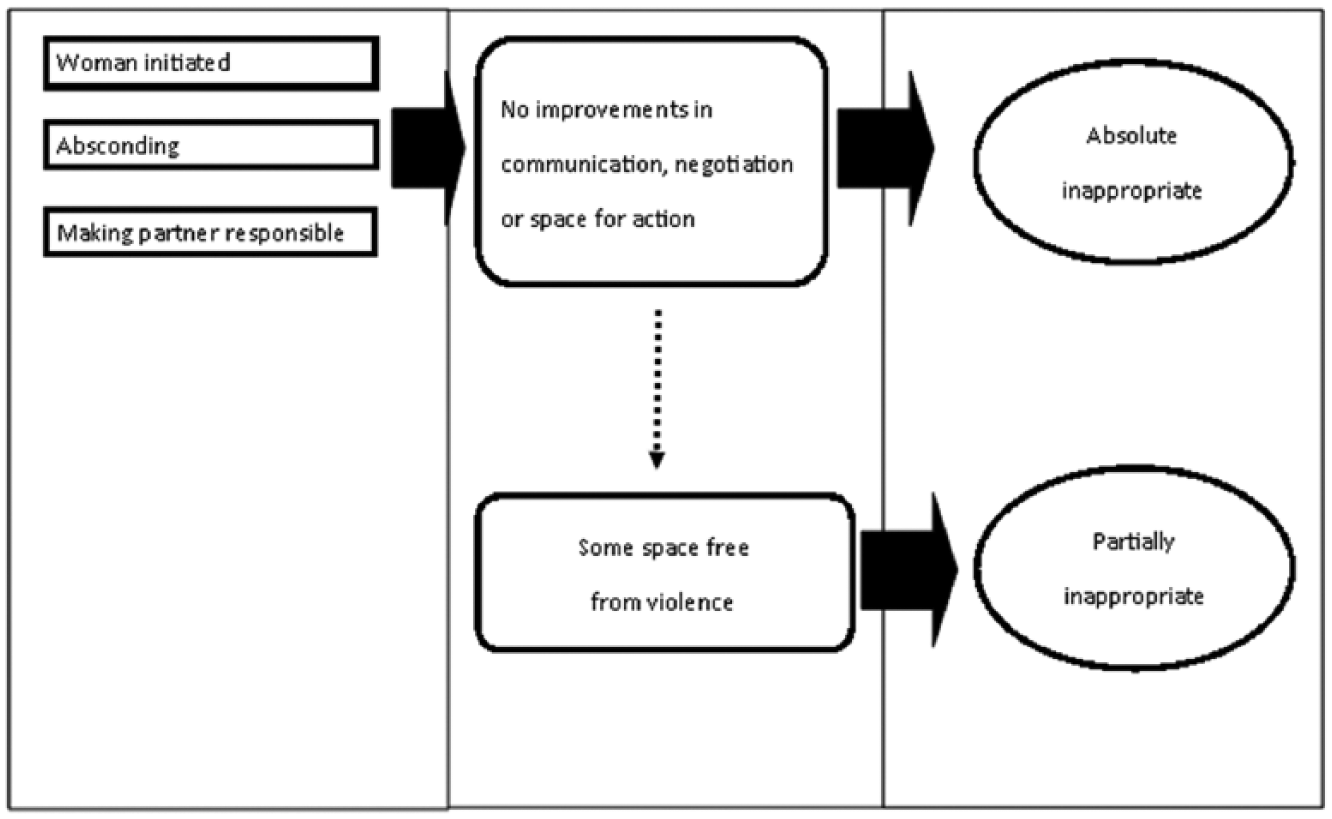
Misappropriation of time-out.
Women Initiated Time-OutsA small number of women reported that they took responsibility for either leaving the house or going somewhere else within the house. One stated that she knew more about what and when a time-out should be used than her partner. Another woman decided that her partner’s reluctance meant that she adopted the technique for herself.
And like if we’d had an argument I’d try and get out the house because it’s really hard to get him to leave. Even on his time-outs . . . he doesn’t do them properly . . . he kind of forces me to leave because I want to get away from him. (Jessica, partner near the start of the program)
A small number of men also admitted to refusing to take a time-out when their partner had asked them to, with some recognizing the consequence of this.
I shoved her out the door, I tore the phone off the—out of the socket, and pushed her towards the park. So I mean I don’t know why she doesn’t remember it. She was holding the baby, and I had my—we had my son there as well who was imploring me to calm down and behave and everything. So—it was—it was terrible, she did run away, she asked—she said, “You’ve gotta do a time out.” And I’ve—and we’d been drinking, so I mean time out’s difficult then. I mean I went to the pub and had another three pints, it was terrible. (Peter, near the start of the program)
Time-outs were themselves sources of arguments, and where this was the case, the woman would often choose to leave.
Absconding
Even where men left the situation, this was not always used for reflection; rather, some men fled the situation and their responsibility to themselves and the program, adding to tensions. Revealing illustrations of this behavior were in calling “time-out” to control arguments. When time-out was used in this context it was a deliberate withdrawal at a point when men were claiming they had “won the argument” or to ensure they had the last word. Similary this technique was used as a refusal to communicate, thus refusing women a voice and role in resolving a dispute.
All right, I haven’t helped the situation because every time there’s an argument I go “Time Out,” and I’ll disappear. (Brent, near the start of the program)
Men taking time out within the household was raised in a number of interviews, often in interviews with women, who raised concerns about their partners refusing to follow the guidelines, and thus reducing their confidence in what men were taking from the program. This was especially acute when men refused a request to leave and instead chose to take the time-out somewhere in the house that the woman and/or the children needed to be. In some instances, the outcome was a further incident of violence.
So I went downstairs. And I sat downstairs, and instead of going, “Right, here’s the Time Out now,” I just started running over the injustice of it all and like how, it’s not fair, nrrh, and wound myself up, and had to go back upstairs and have more words . . . and in this in—in that instance, yeah, I—I hit her. (Peter, near the end of the program)
Some appeared to be using time-outs without fully understanding how or their purpose, but more often, what we see is evasion of taking responsibility for violence and self-interested manipulation, which allowed the conditions for further violence to occur.
And, she didn’t know, it came out of the blue, I put my hands around her throat and she still thought I was playing a game. I don’t remember doing that, I just leant over like that. And I started like doing that, and then squeezing, and then after so many seconds, we can’t—she can’t remember, I can’t remember—I pulled away. And I looked at her, I think it’s, she mentioned she was like [makes choking sounds], that’s when I stopped. (Owen, near the start of the program)
One respondent recounted instances of aggressive behavior where the time-out had failed to work: On each occasion, he claimed to have raised the possibility of initiating a time-out, but on some occasions, his wife had prevented him from doing this. He identified the difficulties between an “in theory,” “on paper” time-out and the “in practice” examples he provided. He did fail, though, to leave the house while trying to take his time out, choosing instead a utility room. He then blamed his partner for continuing the argument with no acknowledgment of his choosing not to follow the time-out rules. It was her failure that resulted in him “pushing back,”
If you’re trying to force yourself into my utility space and I don’t want you in there because I don’t want to get violent that’s when I’m pushing you away for example, I’m not hitting you, I’m not trying to pick a fight with you, I’m just pushing you away. (Majid, towards the end of the program)
One woman at first interview (when her partner was just beginning the program) identified that a lot of his behavior had centered on withholding, withdrawing, and “going off.” In the second interview (approximately 6 months later), the time-out was being incorporated into these same patterns of behavior.
Actually that still continues, he was also encouraged to do that, he says, on the program - Time Out. I also see it that he can use it as a way of controlling. So you can look at that in two ways. That’s sort of like double-pronged really, and he will say, “This is what I’ve been taught,” and I’m thinking, “No, this is more about you wanting to have the control.” (Nadia, toward the end of the program)
In another case, a man claimed that he had to learn more about the technique before putting it into practice, while demonstrating in his account that he actually had a good understanding of the technique and that was not the reason for not using it. Near the end of the program, some men acknowledged that they had not, but should have been, using the technique. These examples suggest that DVPPs might discover resistance among men to change from exploring whether and how they are using time-outs.
Making Partner Responsible
Some men admitted to asking their partners to take time-outs, thus making them responsible for preventing or avoiding their abusive behavior. The justifications spoke to a deep sense of entitlement—they were not “in the right frame of mind” to take the time out or that they needed some space and time. One man took a time-out in another room and then accused his partner of not taking it seriously when she needed to get something from this room. Interviewed women, however, offered examples of men failing to identify when they needed to take the time-out, meaning they had to introduce this.
But we haven’t used that a great deal and it’s actually supposed to be something that [my partner] is supposed to recognize, and he never does. It’s always me that has to say “look, you should be doing the time-out” . . . And as he’s trying to leave he’s still saying stuff . . . still going on . . . and I’m still having to say “you’re still doing it . . . go away.” (Frances, partner near the start of the program)
In another example, a woman identifies the pressure her partner would put on her rather than himself initiating an effective use of the time-out technique.
Even on his time-outs - he doesn’t do them properly. He kind of forces me to leave because I want to get away from him, when I know he’s in that mood and I’m angry - I need to get away. Because otherwise I end in the same stage that he’s at and what’s that gonna result in? Two really angry people in the house that can’t back down to each other, it’s just pointless. So I end up just getting in my car and going. And I always have to take [son] with me because he won’t stay with his dad. He just senses it and he’s like “I wanna come, mummy.” So he’ll come with me if he knows if I’m upset. But I think why should I always be the one that’s doing this? He should just take it upon himself and think, you know, I need to go for a walk or something - anything - but he doesn’t. Or he’ll go and sit in the shed and see that as a time-out but to me it’s not because it’s still on the premises. (Jessica, partner near the start of the program)
The gap between the program having an impact on the men who attended and making use of the techniques they are taught is illustrated in the quote below where the responsibility for avoiding violence and abuse clearly remained with the woman.
I mean he comes home nearly every week in tears because of how hard-hitting some of the weeks have been and it lasts a couple of days and he’ll say something, and I’ll say “[Name], they learnt you this on the program the other week, you know, about taking time-outs and stuff, you’ve never taken one yet. It’s me that ends up going up into the bedroom.” (Natalie, partner near the start of the program)
Another manipulative adaptation was “sharing” time-outs, which suggested that women were at least partly responsible for change.
And the other day in the car we were about to explode and he just turned round to me, and I was like really getting angry, he just said, he said, “Time out,” he says, “you’re breaking the rules.” (Maureen, partner near the start of the program)
Having not negotiated how the time-out should be used and/or misusing the time-out had precluded respectful communication or expanded space for action, women were often held partially or wholly responsible for the failure of the technique. In the example below, the man is holding his wife accountable for not allowing him to take a time-out while failing to understand the importance of him leaving the house in this instance.
In theory the program has spoken to my wife and spoken to me and told both us that we both need to agree something called time out. It’s not a criticism for one of you or both of you, you need to allow the person to walk away and then come back and that’s how it’s done. In practice if one of you is carrying on ranting or chasing after the other person to talk or have a go at them, then it’s not working, is it? So if I go and hide in the utility and shut the door and the door is being pushed on to me and she is forcing to get in, or I go and lock myself in the toilet, for example, and the door is being banged, then you’re not being allowed to take the benefit of that timeout, are you? It takes two to agree it. It’s all well and good on paper or in text or in writing on A4 piece of paper saying, “This how it should work and this is what you should do,” but if you’re not doing that, if one of you is not doing that then there is no solution to it, do you know what I mean? (Aaqil, near the end of the program)
Conclusion
The actual use and misuse of time-out has been an under-researched area: these findings of men in DVPPs and women partners and ex-partners contribute to the knowledge base, with implications for policy and practice. The findings support and extend the findings by Debbonaire et al. (2003), documenting both positive and negative experiences of time-out and deepening this understanding by proposing a model for systematically pursuing experiences of time-out and related program interventions. Jennings (1990) also raised concerns in relation to the communication of time-out. In the Mirabal study, examples were provided of inaccuracies in how men described to their partners how the time-out was to be used. Communication between women and the programs was also sometimes lacking.
The deepest changes were evident where time-out was used as a principle-based rather than rule-based technique. It is here that the interruption of violence combined with additional indicators of success. We are arguing that the intentions within time-out, of using the space to think about, reflect on, and understand one’s actions, are more important than following a set of rules. We encourage DVPPs to review the ways time-out is written in manuals, and taught in programs and in the materials provided to men and women. The emphasis should focus on interruption as providing an opportunity for reflection and analysis with respect to men, and voice and agency for women. In addition, exploring with both men and women, in depth, how time-out is being used—is it moving to a more relational engagement or being misappropriated—could be done in both group work with men and support work with women. Further research is needed to explore the resistance of some men to using time-out and whether this represents a limited interest in change overall.
In making recommendations, we stress that the accounts of the use of the time-out technique within the Mirabal interviews occurred within semi-structured interviews that were concerned with the effectiveness of the DVPP in creating change and not directly the time-out technique. That time-out came out as such a strong issue within the research is an important finding in itself. This raises a limitation in the findings, albeit one that could be easily addressed in future research, that of centering the time-out technique as the focus of the inquiry. We recommend that future research into time-out (and other techniques provided by programs) draw on the framework we have outlined to identify experiential and instrumental uses of time-out. Further research could also assess the extent to which it is used within criminal justice-mandated DVPPs. We hope that in opening up a discussion about a technique within DVPPs, some of the attention that has previously been focused on “do DVPPs work” can be shifted to examining not only the efficacy questions but also questions of how, why, and for whom change happens. More specifically, we commend exploring whether and how the tools violent men are offered work to increase not just women’s (and children’s) safety but also their freedom to become an equal partner in the everyday negotiations that comprise relationships.
Footnotes
Declaration of Conflicting Interests
The author(s) declared no potential conflicts of interest with respect to the research, authorship, and/or publication of this article.
Funding
The author(s) disclosed receipt of the following financial support for the research, authorship, and/or publication of this article: This work was supported by the Economic and Social Research Council (Grant ES/H038086) and the Northern Rock Foundation (Grant 20080739). The data are not made available to ensure participant safety.