




Abstract
The emergence of generative artificial intelligence (GenAI) has opened up new possibilities for qualitative research. However, in methodological development, GenAI is often treated as a passive tool rather than as an active actant. This article contributes to the emerging field of GenAI in qualitative research by introducing a structured actor-network theory-driven mapping-as-method protocol designed to systematically identify the sociotechnical entanglements of AI tools before their integration into research and to evaluate their role in the research afterwards. We argue that researchers need to engage critically with the contingencies, biases, and entanglements that define contemporary AI systems.
Keywords
Introduction
“Tools exist only in relation to the interminglings they make possible or that make them possible,” wrote Deleuze and Guattari (1987/2013) in the 1980s (p. 105). This observation is strikingly relevant in relation to new artificial intelligence (AI) technologies and especially generative artificial intelligence (GenAI). Indeed, GenAI is not only a tool, but a broad and complex societally entangled apparatus, built on the interminglings of technologies and infrastructures, humans, economy, culture, politics, power, ideologies, natural resources, fuel, human labor, histories, classifications, and meaning-making (Crawford, 2021; Lindgren, 2024).
With its rapid development and promises of unprecedented efficiency, GenAI has created imaginaries of revolutionary progress in how we work, communicate, and create. Among others, academia has been fast in adopting GenAI to facilitate teaching, administration, and research (Burton et al., 2024; Perkins & Roe, 2024), including methodological possibilities for qualitative research, as articles in this special issue demonstrate. What AI ends up being technologically, politically, practically, socially, and in the context of our article, in qualitative research, is not prescribed by nature but the result of sociopolitical processes in which we participate as scholars (Lindgren, 2024).
We argue for critical reflection among scholars integrating GenAI into qualitative research designs, contending that there is a need for an approach to address the wider questions of AI’s power, politics, and technology (see also Roberts & Bassett, 2023). The legislative regulation of AI technologies is years away and risks being outpaced by the rapid development of technology. With or without such legislation, we argue that there is an urgent need for academic critical reflexivity on how GenAI is used and how it affects research. The black-boxed nature of AI tools makes it difficult, if not impossible, for a researcher to evaluate AI’s ideological underpinnings, the biases in data sets and classification, the conditions of laborers developing the systems, and the environmental footprint from the development and use of GenAI models. Since the meanings, knowledge, and prompts generated by GenAI models for qualitative research are never neutral, but “rooted in society’s existing power structures and stereotypizations” (Lindgren, 2024, p. 20), scholars need to carefully consider how they engage with these technologies, which are known to echo and sometimes strengthen harmful social dynamics.
This article contributes to ongoing discussions on GenAI in qualitative research by using actor-network theory (ANT) (Latour, 2007) to examine GenAI as an actant—a human or nonhuman entity that acts within a network—in knowledge production. We use the method development from the workshop Images of the Future as a vignette to examine methodological challenges and negotiations around using GenAI. In this workshop, young people used the text-to-image GenAI tool Wombo Dream to create visualizations of desirable futures. While critical AI and science and technology studies (STS) scholarship routinely documents the heterogeneous assemblages—collections of human and nonhuman elements that function together—that make AI possible, the use of GenAI as a qualitative method often brackets these conditions in research designs and output analysis. ANT allows us to conceptualize GenAI as an active participant and nonhuman actant in knowledge production. Through its interactions with human researchers, institutional infrastructures, and societal relations, GenAI shapes research processes by mediating meaning-making, influencing interpretative practices, and embedding its epistemic logic into research settings. In parallel, we retain the notion of AI-as-assemblage to keep that heterogeneity in view. Following Latour’s ANT (Latour, 2007) and Law’s (1992) notion of method assemblage, this dual framing enables enquiry to enact and compare the realities that AI helps compose while keeping its material-extractive underpinnings analytically present. The ANT network map on our vignette functions as a method artifact that documents institutional constraints, tool priors, and facilitation choices.
The article proceeds as follows: We start by introducing the futures workshop method. We then continue to the theoretical and methodological framework of ANT and how we apply it in this article. Our analysis is structured around three questions: What happens when GenAI mediates future-imagining exercises? What challenges arise when GenAI, as a complex and black-boxed actant, becomes part of research designs and methodologies? What is the researcher’s role and responsibility in relation to these two questions? The article ends with a discussion and conclusion on the proposed research framework and the implications of nominating AI as a research actant.
Imagining Alternative Futures With GenAI
The vignette of this article is an outcome of a research project, Imagining Sustainable Digital Futures (2022–2025), which was motivated by the growing need to develop methodological approaches to strengthen the capacity to imagine alternative futures. Grounded in the idea that imagination is central to disrupting the assumed inevitability of present societal conditions, the project aimed to respond to calls for fostering imaginative capacities and experiential ways of thinking about the future (Galafassi et al., 2018; Yusoff & Gabrys, 2011). This need is particularly pressing, given that special methods are needed to break away from the present (Ketonen-Oksi & Vigren, 2024; Markham, 2020).
Imagination was conceptualized as a collective skill that can be trained and should not be left to the few in power (Eskelinen et al., 2020; Galafassi et al., 2018; Salmenniemi et al., 2024). This highlights the importance of speculative imagination in combining ideas in unexpected and unconventional ways (Ketonen-Oksi & Vigren, 2024). In the project, alternative futures were imagined together with young people, based on the premise that their perceptions, hopes, and fears about the future matter because the future concerns them most directly. The aim was to create a space in which their voices could be heard, their imaginative capacities fostered, and perhaps seeds of hope planted. By displaying the images in a public exhibition, the project invited a wider audience to come and join a journey to the year 2050 and imagine what it would be like to live in the futures that the young people envisioned. The exhibition at Art House Turku, called Images of the Future, was part of the theme week Sustainable Digital Everyday Life, organized by the research project in May 2024 in Turku, Finland.
The workshop was inspired by the researchers’ curiosity about how GenAI could spark imagination and facilitate the narration of desirable futures (Girardin, 2015). It was developed through seven pilots conducted during the winter of 2023 to 2024, involving more than 80 participants. Building on these experiences, the main 6-hr workshop took place in May 2024, during which six young people aged 16 to 18 years participated in a series of exercises designed to help them reflect on their current feelings about the future and imagine a desirable future in 2050. The participants were recruited on a voluntary basis through advertisements in local schools and youth centers and on social media. They received no compensation for their involvement. Their motivations for participating included learning more about AI, exploring alternative futures, and contributing to an exhibition.
After warm-up activities, the participants wrote down their hopes and values by reflecting on the following questions: What matters to you? What should be different? What from 2024 would you want to preserve into 2050? For the image generation, we used the text-to-image AI app Wombo Dream, which was chosen for its ease of use and lack of major known controversies. The participants were guided to write a text prompt based on their reflections, and, if they wanted, they could use the app’s magic wand to enhance the prompt into an AI-interpreted set of two to three sentences. The participants then chose an art style for their images. If the generated image was not what the participants had in mind, we advised them to work on the prompt or try another art style. During the 45-min exercise, all participants were able to create an image they were pleased with within the context of the workshop. We then continued with a small flash fiction writing exercise in which each participant took about 15 min to write what it would feel like to live in the future of their image. Afterward, we viewed and discussed all the images, prompts used, and, if they wanted, the stories they wrote. The workshop facilitator actively asked questions about the images and invited everyone to share their impressions and interpretations. While developing the workshop, this final discussion became one of the most important moments, as it challenged us to collectively reflect on the difficulties in creating future images, concerns about the use of AI, algorithmic constraints, aesthetic preferences, and latent biases shaping what could be imagined and rendered.
Figure 1 shows how the participant MOU envisioned the desirable future. In MOU’s own words, the image depicts a moment in which current society has been abandoned, nature has been allowed to take over, and people foster collective ways of living together. In the exhibition, the image was placed inside a black box and viewed through a small aperture. Figure 2 shows the prompt history of creating the image.
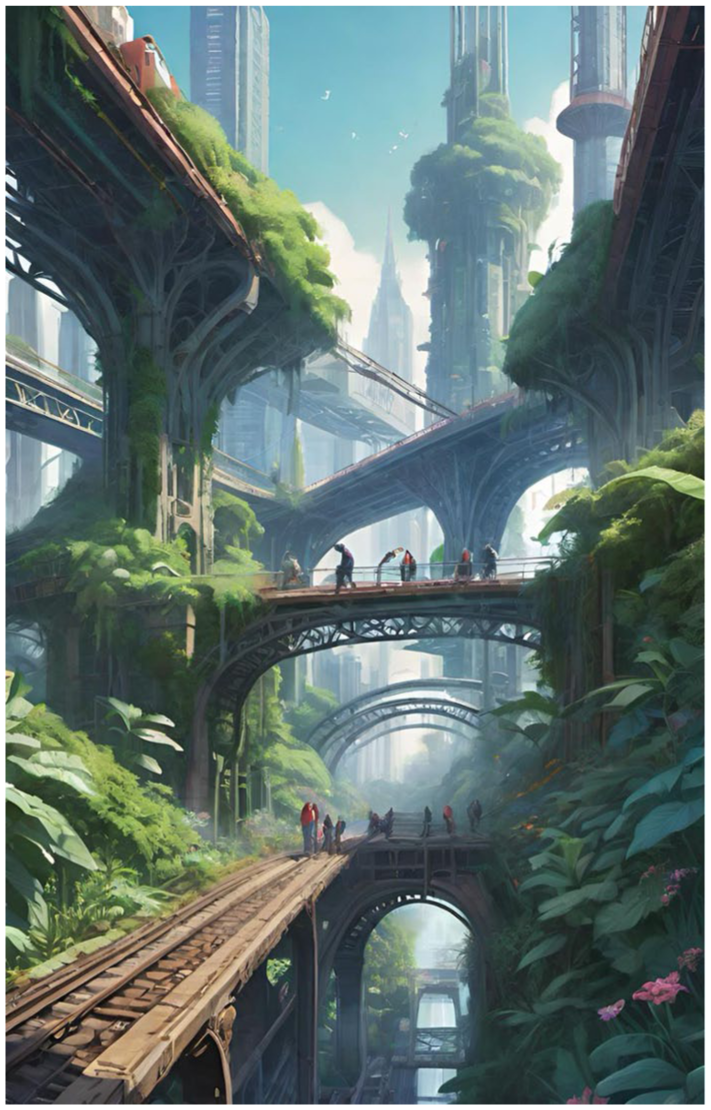
The Image Titled the Evergrowing Was Created by MOU Using the Text-to-Image AI App Wombo Dream.
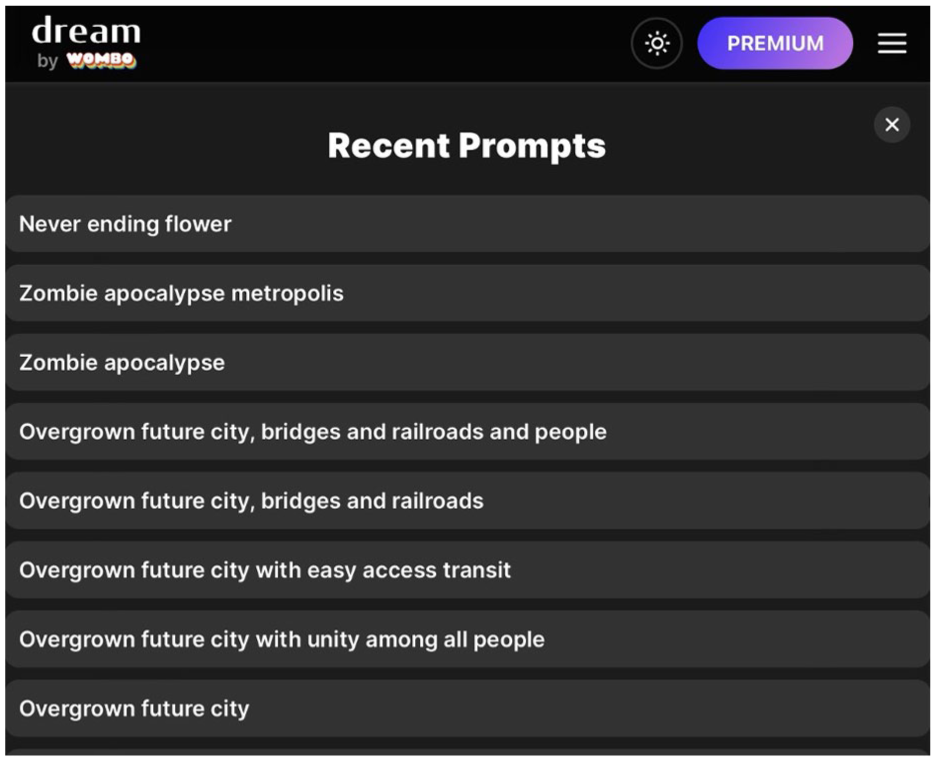
Prompt History of MOU While Creating the Image the Evergrowing, Including Additional Prompts MOU Experimented With.
MOU wrote the following flash fiction story, translated from Finnish to English, to describe what living in the future, as depicted in the image, would feel like:
It’s 2050. The harms of past societies have been overcome, and nature has taken over. Overgrown structures are sustained by collaboration and hope. Cars, planes, and almost all other vehicles have been abandoned, except for a few working trains. People get around the city by walking, climbing, and cycling. Cities are only built upwards, not to take up more land. All residents live in communities and in peace alongside other communities. Everyone looks after one another and their common living spaces. Animals, plants, and people live in perfect harmony with each other, their peace undisturbed by anything or anyone.
We use this workshop as a vignette for examining the challenges and ethical concerns of integrating GenAI into qualitative research. Our methodological reflection does not focus on researcher–participant dynamics or the envisioned futures, both of which deserve separate, in-depth treatment. Instead, this article introduces a mapping-as-method protocol designed to foster critical engagement with research involving black-boxed AI applications. The next section describes the theoretical and methodological framework of ANT and how we apply it in the mapping.
GenAI as an Actant
One of the foundational principles of ANT is the idea of the distributed nature of agency, according to which social networks are composed not only solely of human actors, as traditional sociological theories often suggest, but also of nonhuman actants (Latour, 2007). We consider ANT particularly fitting for a self-reflexive evaluation of the use of GenAI in qualitative research designs, as it moves beyond viewing these technologies as mere tools. It allows us to understand them as active actants that contribute to research outcomes through their algorithmic design, training data, classification principles, and biases, influencing the kind of data produced, the responses of human participants, and the overall findings (Desai et al., 2017; Latour, 1992, 2007; Li & Zhu, 2024; Mol, 2010). This follows the ANT idea that actants shape research processes and findings. By acknowledging the role of AI systems as nonhuman actants, we can steer clear of reductionist approaches that attribute agency and influence solely to human actors, and instead delve into the various forces that interact to produce social outcomes (Latour, 2007; Mol, 2010).
We treat GenAI as both an assemblage and an actant. Through punctualization, the complex network of heterogeneous elements (data, interfaces, compute, and labor) is treated as if it were a single, unified actor (Law, 1992); through depunctualization, we reopen the black-boxed network to reveal its constituent network (training data, ownership, and environmental costs). This “zoom-in/zoom-out” toggle organizes our method (Latour, 2007), for example, Wombo Dream in use versus critique.
Throughout this article, we distinguish between AI as a broad techno-political assemblage and GenAI as specific applications that function as actants within this larger system. In ANT terms, actants never exist in isolation but are always constituted through their network relations (Callon, 1986). Thus, analyzing Wombo Dream as an actant necessarily involves tracing its connections to the broader AI assemblage. Its training data, computational infrastructure, and corporate ownership all form part of what makes it capable of action. While we primarily employ ANT as our analytical framework, we occasionally draw on assemblage thinking (DeLanda, 2016), as it has become integrated into contemporary ANT scholarship. In current ANT practice, assemblage often functions as shorthand for heterogeneous actor-networks, emphasizing their emergent and dynamic qualities. When we refer to the AI assemblage, we mean what ANT would call a stabilized but heterogeneous actor network: a configuration of relations in the network that has achieved sufficient durability to function as a coherent entity.
Two ANT concepts are particularly relevant to our analysis. First, translation describes the process by which actants mediate interactions and transform inputs within a network (Latour, 2007). In our workshop, GenAI translates participants’ textual prompts through its training data and algorithms, producing outputs that reflect both user intentions and embedded biases. Each translation modifies what passes through it, making GenAI an active mediator rather than a passive tool.
Second, black-boxing refers to how systems become opaque, concealing their internal complexity, when functioning smoothly (Stalph, 2019). GenAI systems exemplify this; their algorithms and training data remain concealed from users, raising critical questions about hidden biases and influences. ANT encourages opening the black box to examine these internal processes. However, as Crawford (2021) notes, with AI, there is “no singular black box to open, but a multitude of interlaced systems of power” (p. 12), which we identify as the broader AI actor-network within which GenAI models are embedded.
The black box metaphor proves analytically relevant for two reasons. First, it connects ANT’s theoretical insights about network stabilization to the concrete challenges researchers face with AI tools. When Latour discusses black-boxing, he reveals how the successful elements of a system hide their construction, making them appear inevitable rather than constructed (Latour, 2009). With GenAI, this process is accelerated and multiplied: algorithmic black boxes within corporate black boxes within infrastructural black boxes.
Second, the metaphor illuminates the temporal dimension of our methodological challenge. The workshop’s future-imagining exercise served as our entry point; our primary focus is the present-tense struggle of researchers attempting to use black-boxed GenAI responsibly. The young participants’ future visions revealed how GenAI’s black-boxed biases shape imaginative possibilities. More importantly, however, this process exposed our own position as researchers unable to fully audit the tools we are embedding. This transforms the traditional ANT imperative to open black boxes: With GenAI, opening is not an achievable goal but an ongoing process that reveals the depth of entanglement between research methods and opaque technical systems.
Reimagining Methodological Frameworks: ANT and GenAI in Critical Research Design
Methodologically, ANT structured our analysis in two key ways: network mapping and translation analysis. Using Kumu, we created a visualization of the actors and relationships in the Images of the Future workshop. To operationalize ANT’s principles within the workshop, we systematically traced disruptions and translations across the network, foregrounding how GenAI’s sociotechnical entanglements actively shaped methodological outcomes (Goodwin & Kuehn, 2021; Latour, 2007; Sayes, 2014). We adopted a multifaceted strategy for gathering data to capture the complexities of interactions between humans and GenAI systems. Our network mapping draws solely on ANT’s methodological principles, treating GenAI as a heterogeneous network of human and nonhuman actors engaged in continuous translation. The mapping was created using research materials, such as field notes from the development of the workshop, observation notes, workshop materials, and audio transcripts.
The analysis is built on the three core principles of ANT. The first, symmetrical analysis, ensures that human participants and nonhuman elements are treated with equal attention. This principle guides us in examining the ways in which researchers, workshop participants, software interfaces, and GenAI systems all contribute to the outcomes. The second, network tracing, involves mapping the interactions between various actants, such as the GenAI models, participants, institutional structures, and technological systems. Finally, translation analysis focuses on how meanings and outputs are transformed as they move through this network of human and nonhuman actants. We acknowledge that the mapping is inherently limited, as there are an endless number of assemblages, “assemblages of assemblages” (DeLanda, 2016, p. 3). For the purposes of this article, we had to stop somewhere and keep the focus on what we consider most important in relation to the workshop method and the reflection on GenAI as an actant in qualitative research designs.
In addition, we understand that epistemic values reside not in individual actors but in networks themselves (Latour, 2007). Knowledge, therefore, emerges through what Latour calls circulating reference (Latour, 1999), chains of transformations in which each step translates rather than simply transmits information. However, in the context of our research, we acknowledge that GenAI also acts as a particularly powerful mediator (not merely an intermediary) that transforms participants’ textual prompts into visual outputs, actively shaping what futures become imaginable and expressible.
Our network mapping reveals why the black box metaphor remains analytically essential. Rather than seeking to fully “open” GenAI’s black box, which is an impossible task, we use the concept to trace how opacity circulates through research networks. Each node in our map represents a point where black-boxing occurs: Algorithmic decisions hidden from users, corporate strategies concealed behind public relations, and environmental costs obscured by geographical distance. The black box thus becomes not something to overcome but a condition to map, document, and work within.
Figure 3 shows the network mapping, capturing the complex interplay of human and nonhuman elements shaping the role of GenAI in research and society. Nodes are of three kinds: actors (human or nonhuman), practices (the stabilizing/performative work), and outcomes/values (futures endpoints). Connections are typed as governance/constraint, translation/material, or normative/ideational and are differentiated by direction and strength. Following ANT’s epistemological framework, we make the work explicit by representing security negotiation, app configuration, consent and storage protocol, facilitation prompts, and exhibition curation as practice nodes linked to evidence. Green nodes represent researcher and research participants, the blue node is GenAI models, and the orange GenAI as an actant. In yellow, we have the institutional actors, the university and security department, while gray nodes represent large language model (LLM) developers and machine learning (the computational process by which AI systems learn patterns from data without explicit programming). Purple nodes are, for example, political bias, environmental and ethical impact, public perception, and critical AI literacy, which were all at stake in this research workshop. The lines between the nodes describe their co-productive relations.
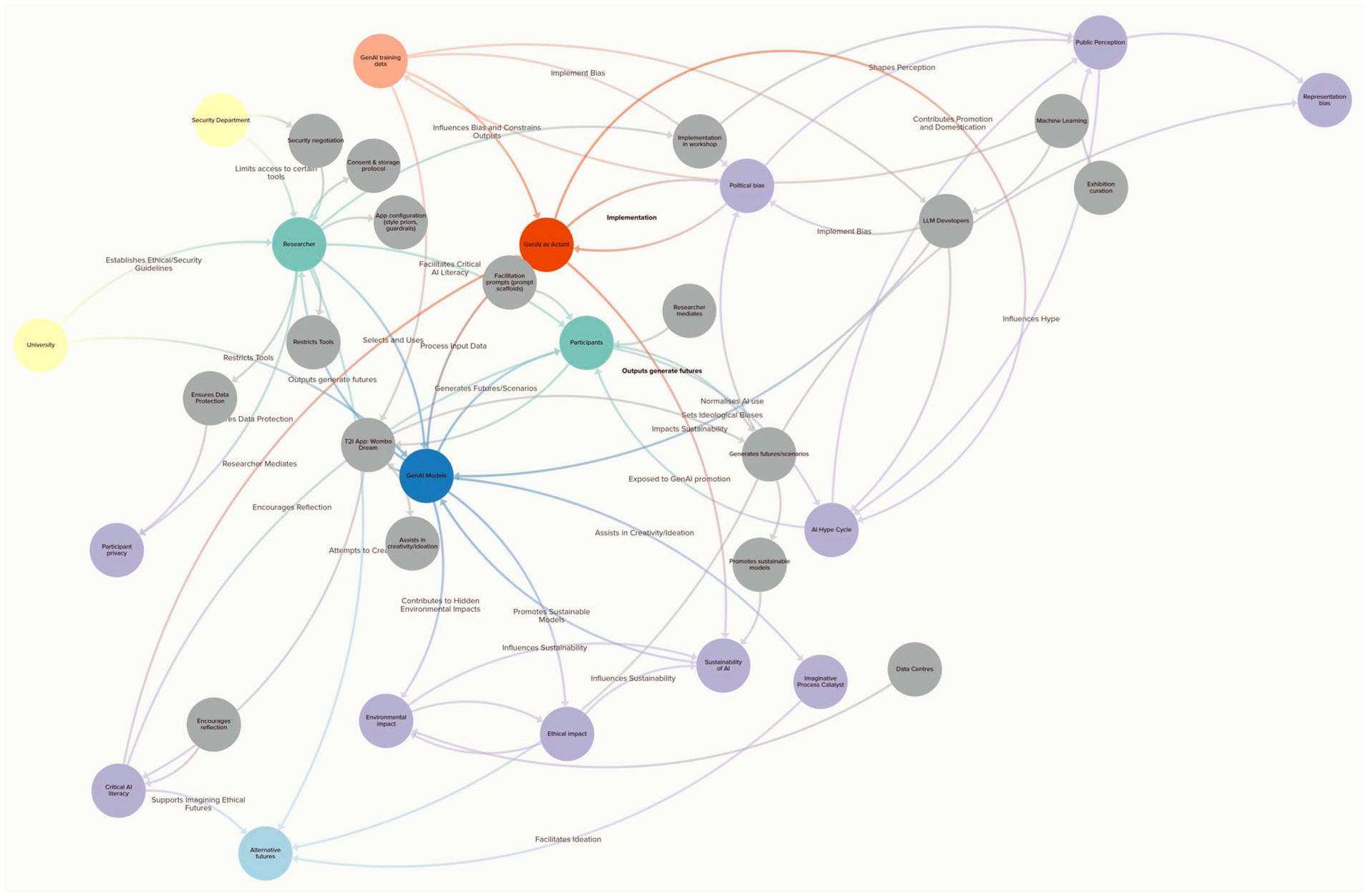
Typed Actor Network of the Images of the Future Workshop and the Infrastructure of GenAI.
Network Disruptions and Translations: A Vignette of GenAI as an Actant in Qualitative Method Development
GenAI as Actant Mediator in Future-Imagining Exercises
The node GenAI as actant underscores the shift from viewing GenAI as a passive tool to recognizing it as an active participant that shapes research processes and outputs in unexpected ways. It can facilitate ideation and encourage reflection, while the interactions with researchers reveal a dynamic relationship in which AI models influence not only the methods but also the questions being explored.
In the playful exercise of creating images of a desirable future with GenAI, most participants felt it was easier to generate the image using the tool than to start with a blank sheet of paper. GenAI facilitated ideation but revealed biases when the participants’ imaginaries conflicted with Wombo Dream’s encoded assumptions. Prompts such as “sustainable community” repeatedly produced high-rise, technologically saturated landscapes: images of greened vertical urbanism that implicitly sidelined alternative, more communitarian imaginaries. Wombo Dream operated as an epistemic filter, encoding its own assumptions about what progress or sustainability should look like. These moments of friction illustrate ANT’s assertion that networks remain stable only through ongoing negotiations between actants (Goodwin & Kuehn, 2021). When participants resisted Wombo’s imposed framings, they were better able to articulate the future they wished to see. Thus, counter-arguing the AI-generated image helped foster imaginative capacities, as the participants were prompted to refine or correct the visual output to better reflect their desirable futures.
For example, Wombo Dream interpreted the coexistence of nature and urban infrastructure by placing greenery on the outskirts, whereas the participant imagined a city where plants grew in and between the buildings. Simultaneously, it can be asked what happens to creativity as a future-imagining capacity when GenAI becomes a co-creator (Edgell, 2024). The problematic dynamic became more intricate due to the difficulties that the participants encountered when attempting to tweak their prompts and experiment with the app’s different art styles. This experience also offers a valuable opportunity to foster critical AI literacy, as further discussed in later.
AI systems embody biases through their training data and classification choices (Akter et al., 2021; Crawford, 2021). The mapping reveals how GenAI is deeply shaped by the biases embedded in its design, development, and deployment. From ideological and political leanings (sets ideological biases, political bias) to representation gaps (representation bias), these systems mirror the societal and institutional environments that influence them (Lindgren, 2024). The constraints they impose on outputs (influences bias, constrains outputs) and the ways they shape perception highlight how such biases extend beyond the technology realm, carrying broader social consequences as AI increasingly shapes public knowledge and perception (Motoki et al., 2024; Rozado, 2024). Research has documented a wide variety of biases in GenAI models, from political tendencies to representation disparities, influenced by both the initial data and the tuning adjustments made during development (Assan, 2024; Motoki et al., 2024; Rozado, 2024). The question of bias in AI models has often been framed around concerns of racial or gender-based discrimination, highlighting how these systems can reproduce and amplify harmful stereotypes (Birhane & Prabhu, 2021). Image generation models, such as Wombo Dream, have been shown to have a more conservative bias, with a notable increase in alignment with right-wing stereotypes between 2023 and 2024, causing failed attempts to overcompensate in terms of diversity, as in the case of Google’s Gemini (Assan, 2024).
The embedded biases manifest in how GenAI models negotiate social, economic, and political imaginaries. This is particularly relevant in the context of speculative futures, in which AI-generated output, whether textual or visual, does not merely reflect an open field of possible scenarios but subtly frames certain futures as desirable while marginalizing others. Importantly, this bias is not intrinsic to the architecture of LLMs or image generators themselves. Instead, it emerges as an artifact of the training and reinforcement process, in which curatorial decisions made during data set selection and model alignment actively shape AI’s epistemic commitments (Rozado, 2024). This is of particular concern in the context of the futures workshop, as the images were displayed in a public exhibition where they may have been viewed as standalone pieces, without the critical framing provided in the exhibition description.
The Black Boxes of GenAI as a Techno-Political Assemblage
Analyzing GenAI as an actant requires acknowledging its embeddedness within the broader AI assemblage, which Crawford (2021) calls the extractive system of computation. The hidden politics, biases, and environmental costs we reference are network properties that become visible when we depunctualize the actant to reveal its constitutive relations.
The nodes academia and security department were the most important institutional actors involved in the network, revealing some of the structural resistance of corporate AI to academic governance. The university hosting the research project neither recommended nor security-vetted any text-to-image AI app, nor did it assist in auditing them. For some time, it was unclear whether the university would give permission to go forward with the method development at all. After negotiations, it allowed test use in devices that were not connected to the university’s IT management system. According to the information provided by the app, Wombo Dream neither shares user data with third parties nor uses third-party services that may collect identifiable user information (Wombo, n.d.b). To ensure participant privacy, we decided to precreate user accounts and provide tablets to prevent the collection of any data that could be directly linked to individual participants.
The university’s concern was focused solely on data security rather than the broader ethical questions or the opacity of the GenAI systems that limit meaningful researcher oversight. Auditing the systems relied on the researcher, who found it a nearly impossible task. The first major issue that remained a black box concerned the nodes LLM developers and machine learning. Over the last decade, the large-scale capture of digital material for AI, often without attribution and consent from creators, has become an unquestioned practice, while training and classification schemes remain opaque and difficult for outsiders to audit (Crawford, 2021). Their lack of interoperability, even to the engineers who created them, has given these systems “an aura of being too complex to regulate and too powerful to refuse” (Crawford, 2021, p. 214). Furthermore, the data labeling required to train LLMs is often outsourced to the Global South, where workers have near-poverty wages, precarious conditions, heavy surveillance, and punishment for deviations (Hurlburt, 2023; Regilme, 2024). These so-called ghost workers (Gray & Suri, 2019) play a crucial yet obscured role in the AI actor network, rendered invisible to end users despite their centrality to its functioning.
Second, the nodes environmental impact, impacts sustainability, contributes to hidden environmental impacts, and promotes sustainable models reflect the tensions surrounding the significant environmental costs of GenAI, constituting another layer of the black-boxed complexity. The techno-solutionist rhetoric around AI posits it as a major driver of sustainability transformations, often overlooking the broader and hard-to-measure ecological consequences and their distribution across regions and communities (Crawford, 2021; Ren & Wierman, 2024). The carbon footprint of AI systems includes the energy required for model training and deployment, the ongoing use of applications, and the operation of data centers that support these processes, and in some assessments, the manufacturing of the underlying hardware infrastructure (de Vries, 2023; Strubell et al., 2019). However, carbon footprint is too narrow a measurement for the environmental costs of AI. In addition to energy consumption and CO₂ emissions, they consume large amounts of (fresh) water (Li et al., 2023; Ren & Wierman, 2024) and cause environmental harm through mineral extraction for the hardware (Crawford, 2021). They also require land and building materials for data centers that become obsolete within short timespans (Velkova, 2019) and contribute to increasing volumes of electronic waste (Baldé et al., 2024).
The Researcher as an Actor in the AI Assemblage
GenAI systems are products of the political and economic landscapes in which they are developed, simultaneously contributing to shaping these landscapes. Nodes such as public perception and AI hype cycle describe how the research use of GenAI contributes to promotion and domestication, normalizes AI use, and shapes perception, reflecting how these technologies are integrated into societal and market frameworks, often serving corporate interests. Bringing GenAI as an actant into a research design means engaging with the ideologies of AI, including both those that produce AI and those that are produced by it (Lindgren, 2024). AI tools are far from neutral and nonideological; they are shaped by broader political and economic agendas that reinforce profit-driven motives, centralize control, and serve the interests of the states, institutions, and corporations that develop and deploy them (Crawford, 2021).
The main criteria for choosing the GenAI app for the workshop were usability, suitability for the exercise, data privacy, and ethical concerns implied by legal battles. The chosen app, Wombo Dream, developed by a Canadian start-up Wombo Studios Inc, reported 60 million downloads and 1.5 billion artworks created by February 2023 (PR Newswire, 2023). On their website (Wombo, n.d.a), Wombo lists its values as building “the happiest place on the Internet” and “powering next-generation media to make people laugh and smile” using the latest AI techniques. While announcing the success of a funding round (PR Newswire, 2024: para. 10), the company promises to “keep pushing the boundaries of what’s possible, what’s probable, and what’s quirky in the world of AI.”
Their boundary-pushing style turned out to be an unpleasant surprise after the workshop. Subsequent controversies emerged around Wombo’s political content creation, particularly involving candidates in the 2024 U.S. presidential elections, as well as alleged privacy violations. For example, the Trumpify photograph frame enabled users to place their face onto the body of a Trump bodyguard in a widely circulated image captured after the assassination attempt (Figure 4). In the text for the photograph frame, Wombo declared, “We don’t choose sides–we live for the meme.” Given the growing concerns about AI and deepfakes in political campaigns (Diakopoulos & Johnson, 2021), such content was far from apolitical and effectively made Wombo an active participant in politics. Furthermore, in July 2024, a class action suit was filed, alleging that Wombo was violating an Illinois privacy law by capturing, storing, using, and sharing users’ biometric information without permission (McCrockey, 2024).

Screenshot of Wombo’s Trumpify Photograph Frame Published on Instagram on July 17, 2024, With the Caption “A Monumental Moment in American History”.
Thus, there is a need for the academic community to critically reflect on the narratives that attract us to introducing AI in our research. Concerns about the ethical challenges of AI being integrated into people’s everyday lives (Etzioni & Etzioni, 2017; Jobin et al., 2019) urge us to consider our responsibility in contributing promotion and domestication, normalizing AI use, and shaping perception. Not only do our GenAI research designs shape the common socio-material world and AI’s role within it, but they also interpellate research participants into this process.
Amid these concerns, our map highlights the importance of critical AI literacy. Although not originally intended to do so, the workshop organically and inherently became a space for fostering critical AI literacy. Nodes such as facilitates critical AI literacy and encourages reflection highlight the importance of understanding the workings of these tools and the trade-offs involved, as well as developing pedagogical approaches to address them. Acknowledging that the participants’ most immediate takeaway was likely learning to generate images with AI, we recognized that it was even more important to foster critical thinking about how AI constitutes and contributes to knowledge production and social, political, and ethical shaping of society (see also Veldhuis et al., 2025). Moreover, fostering critical AI literacy is needed to create space for reflecting whether and how to engage with these technologies, on how AI and its ethical, social, and environmental complexities are increasingly shaping the world, and ultimately on what kind of technological world we wish to inhabit.
Discussion
Our actor-network mapping demonstrates the need to attend to the deep material and human roots of AI systems, revealing the struggles researchers face in grasping this unfinished, and constantly evolving assemblage. As a theoretical and methodological framework, ANT has enabled the positioning of GenAI as a collaborative actor and coproducer of knowledge in the research process and has provided a more reflexive approach to research methodologies (Popa et al., 2015). This is especially relevant in fields like AI and GenAI, in which the design and operation of systems subtly influence everything from research data to creative outputs and the coconstruction of meaning (Escobar, 2012). Once deployed, technologies begin to interact with human users and other technologies in ways that their designers may not have anticipated (Edgerton, 2007), further complicating the distinction between human intention and technological outcomes (Sayes, 2014). The mapping protocol is thus not only a general ontology of AI but also an auditable method for situating GenAI within methodological contexts and tracing how particular interactions reveal the infrastructure behind the GenAI integration in methodological innovation.
The concept of the black box encapsulates a fundamental challenge of GenAI: its opacity. The technologies can implement bias, limit access to certain tools, and ensure data protection, creating a closed-off ecosystem that obscures their inner workings. This opacity complicates researchers’ efforts to understand and critique GenAI outputs, especially when combined with the AI hype in public and academic spaces. This presents a critical structural challenge for academia and society more broadly, as the development and adoption of more ethical and environmentally sustainable alternatives are marginalized by the dominance of corporate interests and the black-boxed infrastructural lock-in they produce. In the method development, the entangled concerns revealed a serious ethical concern and central paradox: A workshop designed to envision more sustainable digital futures ended up experimenting with GenAI, which itself is enmeshed in unsustainable and ethically fraught infrastructures.
While ANT scholars may find it unsurprising that GenAI functions as an actant in knowledge production, our contribution lies in developing a systematic protocol for making this agency analytically tractable in the method development context. First, our network mapping methodology provides researchers with a predeployment auditing framework that reveals hidden entanglements before tool integration. Second, it demonstrates how opacity operates not only as a singular barrier but also as a recursive property circulating through institutional, corporate, and infrastructural layers. Third, it shows how translation analysis can expose epistemic commitments embedded in ostensibly neutral technical processes. Finally, it offers an adaptable template for situating GenAI within method assemblages across diverse qualitative research contexts.
Here, researchers play a critical role in ensuring that GenAI is used reflexively and with an awareness of its broader societal impact. While GenAI tools offer possibilities for research, they also introduce challenges related to ethics, transparency, and human oversight. As these tools continue to evolve, vigilance is needed to ensure that AI is used responsibly, safeguarding the integrity of academic work while leveraging the benefits of these technologies (Burton et al., 2024; Perkins & Roe, 2024). The living guidelines for the use of GenAI (Bockting et al., 2023) might, in the longer term, become significant actors in the network of both researchers and institutions. In the meantime, these struggles underscore the need for the academic community to collaborate in auditing AI applications and to support the development of alternatives that afford researchers greater transparency.
These concerns point toward a multidimensional understanding of researcher responsibility that emerges from our ANT-informed analysis. By responsible integration, we refer to researcher accountability across three dimensions. Epistemic responsibility involves recognizing GenAI as an active mediator that shapes research outcomes rather than treating it as a neutral instrument. Infrastructural responsibility requires tracing the socio-material conditions that make GenAI possible, including the labor and environmental costs embedded in AI systems. Pedagogical responsibility entails fostering critical AI literacy when research involves human participants into interactions with GenAI. Taken together, these dimensions underscore that researchers who incorporate GenAI into their methods become participants in the broader sociotechnical networks through which AI operates as a political, economic, and environmental phenomenon.
Rather than attempting to resolve the methodological challenges of working with the black-boxed GenAI, we argue for an approach that actively works through them, treating GenAI’s networked complexities as a site of critical interrogation rather than as a technical problem to be solved. Recognizing GenAI as an actant in research means that its agency must be mapped, contested, and negotiated at every stage of the methodological process. This requires rethinking how research tools are selected and audited, as well as the responsibility and accountability behind these decisions. Our methodological choices reflect this accountability: Selecting a text-to-image tool foregrounded visual translation and aesthetic biases. At the same time, the workshop’s temporal constraints made prompt negotiation visible as a key site of human–AI friction, potentially obscuring dynamics that emerge over longer engagement. The exhibition framing positioned outputs as finished products, directing analytical attention toward aesthetic coherence rather than processual experimentation. These design choices enabled engagement with certain dimensions of black-boxing while bracketing others, exemplifying ANT’s insight that methods are performative practices that enact realities (Law & Singleton, 2013).
Finally, critical AI literacy should be integrated into research designs that involve GenAI applications, not only as an add-on but also as a necessary methodological intervention. This ensures that participants and researchers alike remain attuned to AI’s biases and epistemic constraints. Following Lindgren (2024), we advocate for critical AI research that questions necessity and envisions responsible technological futures. Ultimately, there is a need to reflect on the following questions: How could and should we as researchers resist the hegemonic narratives of the AI industry? How could our research interventions participate in the radical reimagining of AI’s technological development and role in society?
Conclusion
We documented struggles in responsibly integrating GenAI into qualitative research. These struggles reveal the recursive nature of AI’s black-boxing and the impossibility of full transparency. Through self-reflection and actor-network analysis of our method development, we demonstrate how the black box operates not as a singular barrier to understanding but as a recursive condition of contemporary AI systems. We argue that GenAI should not be treated merely as a shortcut to efficiency in research. Through an analysis using ANT as a framework, we demonstrate how GenAI is an actant that participates in knowledge production through algorithmic logics and embedded biases. The futures workshop, therefore, became a site for mapping how GenAI participates in knowledge production, foregrounding questions of agency, transparency, and the epistemic constraints these technologies impose. In this article, we propose that AI actor-network mapping provides a means for researchers to more fully account for the complexity of interactions in research environments. Our analysis offers a blueprint for researchers seeking to critically engage with the black box of AI systems integrated into their methodological toolkit. It demonstrates how network mapping and participatory methods can bridge theoretical critique with empirical enquiry, even when the opacity of the black box cannot be fully reduced.
We also underscore the necessity of ethical and methodological rigor in AI research, advocating for a holistic approach that critically audits GenAI tools. This includes not only their biases but also their environmental impact, governance implications, ideology and politics, and long-term epistemic consequences. This perspective encourages a reflexive approach to the use and analysis of technological systems, ensuring that their role is recognized as active and influential rather than passive, context-free, or neutral. The value of ANT in this context lies not in stabilizing networks but in making their fragilities, breakdowns, and potentials legible. This allows researchers to engage critically with the contingencies, biases, and entanglements that define contemporary AI systems and shape their integration into qualitative research.
Footnotes
Acknowledgements
The research experiment was first ideated with Katja Ollikainen. The further methodological development was done in collaboration with Elina Sutela and Taimi Mikkonen. The workshop was facilitated together with Taimi Mikkonen.
Declaration of Conflicting Interests
The authors declared no potential conflicts of interest with respect to the research, authorship, and/or publication of this article.
Funding
The authors disclosed receipt of the following financial support for the research, authorship, and publication of this article: This work was supported by the Research Council of Finland [grant number 367860].
