



Abstract
This article discusses how datawalks, a method of mobility that provides information about oneself in relation to space and others, can be used to research race through one’s embodied experience in space. Datawalks have often been used to explore experiences of minoritized rather than dominant groups and as a collaborative research-participant experience rather than a self-ethnographic endeavor. This article tackles these gaps by showing how datawalks can be used for researchers to address their positionalities within race relations. Drawing on datawalks the four authors did through parts of Rotterdam (the Netherlands), the article addresses how datawalks can (a) help researchers recognize and experience race in and through space and (b) engage with one’s positionality. This article points out the relevance of using datawalks as an in situ and in-movement method to capture the shape-shifting materiality of race in cities and to draw connections to structures of Whiteness in academia.
Introduction
In this article, we engage with scholarship about datawalks as a method of mobility and connect it to literature on race and space. The term datawalks is used here to refer to the recorded act of walking (alone or with others) and of associated activities such as talking and photographing that, combined, help gather information about oneself in relation to space and others (Bartlett et al., 2023; van Es & de Lange, 2020). Bringing together race, space, and mobility helps apprehend their mutual construction through overlapping and competing multi-scalar discursive practices embedded in the plasticity of race and trans-locality and the historicity of the urban fabric. This multi-foci approach offers a framework from which to challenge static understandings of what counts as race and instead unpack “how the fictional markers of race are summoned” in everyday settings (Nayak, 2007, p. 743). This article indeed strives to engage with the complexities and nuances that come out from the process of researching race as a bodily activity that engages researchers and their positionalities within race relations.
While Europe, including the Netherlands, tends to be (self-)represented as post-racial (Lentin, 2020; Wekker, 2016), race is an integral part of the “archite(x)ture of European space” (Goldberg, 2006, p. 340). The continuity of colonization into the present (Maldonado-Torres, 2007) via architectural styles and urban planning bears particular relevance for cities. Such material dimensions function as symbols of the historical patterns of wealth accumulated through colonization and slave trade. On top of this material dimension, additional symbolic layers related to colonization processes have also been inscribed in the urban fabric through memorials and street names (Sutherland, 2024). A wide range of literature has underlined the potential of cities as rich discursive and semiotic sites (e.g., Dumitrica, 2019; Sassen, 2012) to explore complexities and paradoxes of everyday geography of experiences with self and others (e.g., Dwyer & Bressey, 2008; Keith, 2005; Sommier, 2025). Cities therefore function as relevant venues to do (racial) positionality work by reflecting on the connections between one’s relation to space and to self and others, and on the interplay between individual experiences and structural discourses (Milner, 2007).
This article explores the affordances of datawalks through two interrelated questions:
How do datawalks help researchers recognize and experience race in and through space?
How do datawalks prompt researchers to engage with their own positionality?
We address these questions in light of our own experiences doing datawalks in pairs in Rotterdam (the Netherlands) in Spring 2024. We chose this location drawing on the premise that cities provide a relevant context to unearth racialization processes because of historical and (trans)local (dis)continuities that shape the interplay of symbolic and spatial boundaries (Georgiou, 2007; Sommier, 2022). Reflecting on these walks and our follow-up discussions, we highlight four analytical aspects (seeing/not seeing, embodied experiences, hesitations, and spaces of Whiteness) that were instrumental to how we recognized and experienced race in and through space. Our experiences also highlight datawalks as tools to mobilize our subjectivities through embodied emotional sensory experiences. This process, we argue, can serve as a steppingstone to engage with one’s positionality, particularly in relation to race relations and Whiteness in academia.
Datawalks as Tools of Research
Datawalks have been used across fields of study and in relation to a wide range of topics to uncover how individuals negotiate meanings and processes related to their everyday (im)mobilities (Warren, 2017). Datawalks are typically used to foreground and produce different forms of knowledge because of their collaborative and embodied dimensions as well as their focus on everyday practices as an entry point to reveal structures of power.
While some research designs may be more participant- or researcher-driven, datawalks often result in a collaborative endeavor between participants and researchers. Datawalks bring individuals on a shared journey that physically engages them together and with the topic under study (van Es & de Lange, 2020). The bodily connection enabled by datawalks brings together the researchers, the participants, the environments they navigate, and the topics at hand. The relational and embodied dimensions of datawalks therefore invite researchers and participants to negotiate meanings together. Moving together in space means that researchers and participants are exposed to unexpected and uncontrolled elements that feed into the data. These moments of serendipity produce conversations, feelings and memories that are essential to the type of knowledge recovered during datawalks (O’Neill & Hubbard, 2010). The act of walking together entails a wide range of activities from talking with the participants, to observing their behaviors and paying attention to the surroundings. Studies that have used datawalks in cities point to the importance of this method in capturing everyday experiences embedded in the urban fabric (Warren, 2017). As researchers and participants walk together, they are invited to talk about everyday mundane practices through which place is made and re-made (Warren, 2017). Focusing on everyday life can capture the material and discursive structures of power through the perspectives of the individuals experiencing them. However, bringing oneself and participants to notice the unnoticed is a challenge, and critically engaging with one’s everyday practices can be met with resistance. For participants to be in a familiar place under unfamiliar circumstances can help disrupt the everydayness of their experiences just enough for them to comment on it. While the in situ and unfamiliar setting of datawalks makes them a relevant tool to shed light on how the mundane and the ideological are co-constructed in and through space, it also points to the intricacies of creating spaces of critical observation and dialogue that allow one’s existing assumptions to be challenged.
The focus on (structures of) power and the relational dimension of datawalks point to why they have been widely used with minoritized groups (e.g., Hassani, 2024, about Muslims in Montreal and Copenhagen; Mainsah & Sanchez Boe, 2019 about asylum seekers in Paris; Skinner, 2019, about AfroSwedes). This line of research has been crucial to reveal the role of space in (re)producing symbolic boundaries and processes of in- and exclusion. The act of individuals from different racial or ethnic backgrounds walking together and conscious of their spatiality has shed light on negotiations made necessary by normative meanings conveyed in and through space about who gets to walk where (Bartlett et al., 2023; Moji, 2022). Datawalks also give space to engage with the negotiations of belonging that occur in the city. Looking at belonging through the context of the city allows for an understanding of the personal experience of feeling at home while also considering the power structures that mark the borders between us and them (Antonsich, 2010). Place-belongingness, Antonsich (2010) argues, challenges the dominant structures of belonging and captures the negotiations that occur in the place where people meet each other and build community. It centers the importance of locality in the way people navigate the multiplicity of their identities and the connections they have with (trans)locality (Antonsich, 2010).
However, datawalks should not be romanticized as inherently emancipatory and democratic, if only for the ableist underpinnings of this method. Negotiating roles as researchers and participants distance themselves from normative expectations and try to collaboratively produce data and knowledge is not without challenges. Assuming that walking together will automatically connect researchers with participants, and individuals with their own bodies and with space, draws on simplistic views that ignore structures and relations of power (Warren, 2017).
Datawalks as Tools of Reflexivity
While datawalks have been widely used with minoritized groups, scarce attention has been paid to how this method can serve as a tool of reflexivity for researchers studying race formations. This methodological gap prompted us to ask how datawalks can push researchers to engage with their positionality. Such a question draws on the premise that researchers’ situatedness within and across social realities shapes their ways of doing research (Jadallah, 2024). Engaging with one’s positionality therefore calls for reflexivity, that is, a conscious effort from researchers to critically engage with the shifting, complex, and personal relations they (re)create with the objects of their study (Milner, 2007). While reflexivity is “both a state of mind and set of actions” (Probst & Berenson, 2014, p. 230), literature has addressed the former much more than the latter, at times turning reflexivity into an elusive personal orientation without concrete steps to make it happen (Mauthner & Doucet, 2003). Our paper sheds some light on this gray area by unpacking how collaborative in situ movement and debriefing conversations can spur and support reflexivity. In particular, our experience points to how collaborative datawalks can make visible the “internal dialogue” (Berger, 2013, p. 215) specific to reflexivity by virtue of being in conversation with someone else.
Although positionality statements have become increasingly common in qualitative publications, these can be limited and superficial, sometimes appearing to be descriptive late adds-on rather than ongoing personal reflections intertwined with the research design or the analysis and interpretation process. This points to flawed understandings of reflexivity as having an endpoint crystallized in positionality statements used to clarify how social dimensions might have played out in the design and implementation of a study. However, as Boylorn (2011) reminds us, reflexivity is not meant to “simplify the negotiations of race in qualitative research” (p. 180) but to highlight the complications, nuances, and instabilities of (re)producing knowledge (about race) in and through everyday experiences. Positionality statements also tend to remain associated with scholars from or working with minoritized groups. As a result, White 1 researchers working with White participants tend to evade scrutiny of their own subjectivities (Phillippo & Nolan, 2024). The invisibilization of researchers as White researchers in the race-evasive European context illustrates the ideological continuity of hegemonic Whiteness in society like in academia (see Lootens & Fúnez-Flores, 2024; Pindi, 2020). Since methodological tools are pivotal to uphold Euro-Western-centric ways of knowing revolving around positivistic, measurable, dualistic, and hierarchical inquiries as scientific standards (Tamale, 2020), choosing to use creative and peripheralized methods, like datawalks, serves to challenge the erasure of race and hegemony of Whiteness within academia.
Methods and Materials: Our Datawalks
The four of us did datawalks in pairs in Rotterdam (the Netherlands) in Spring 2024. 2 The incentive to go on such a walk came from our respective (personal and academic) interests in the intricacies of capturing the fleeting materiality of race in everyday surroundings. The datawalks therefore came out of conversations the four of us had had over the years in connection to our own respective research about representations of race, racism, interculturality, and nationality. We were curious about the contribution datawalks could make (a) to help researchers recognize and experience race in and through space and (b) to engage with one’s positionality. We picked a route in Rotterdam (see Figure 1) that cuts through areas locally associated with different markers of diversity, including Central Station (Rotterdam Centraal) with (inter)national travelers coming and going, West Kruiskade locally referred to as “China Town,” Gouvernestraat with known cultural spots, and Nieuwe Binnenweg with boutiques and bars. The route we selected includes areas we were all familiar with and that, besides Rotterdam Centraal, did not constitute landmarks in the city, which allowed us to explore everyday-like urban sites.
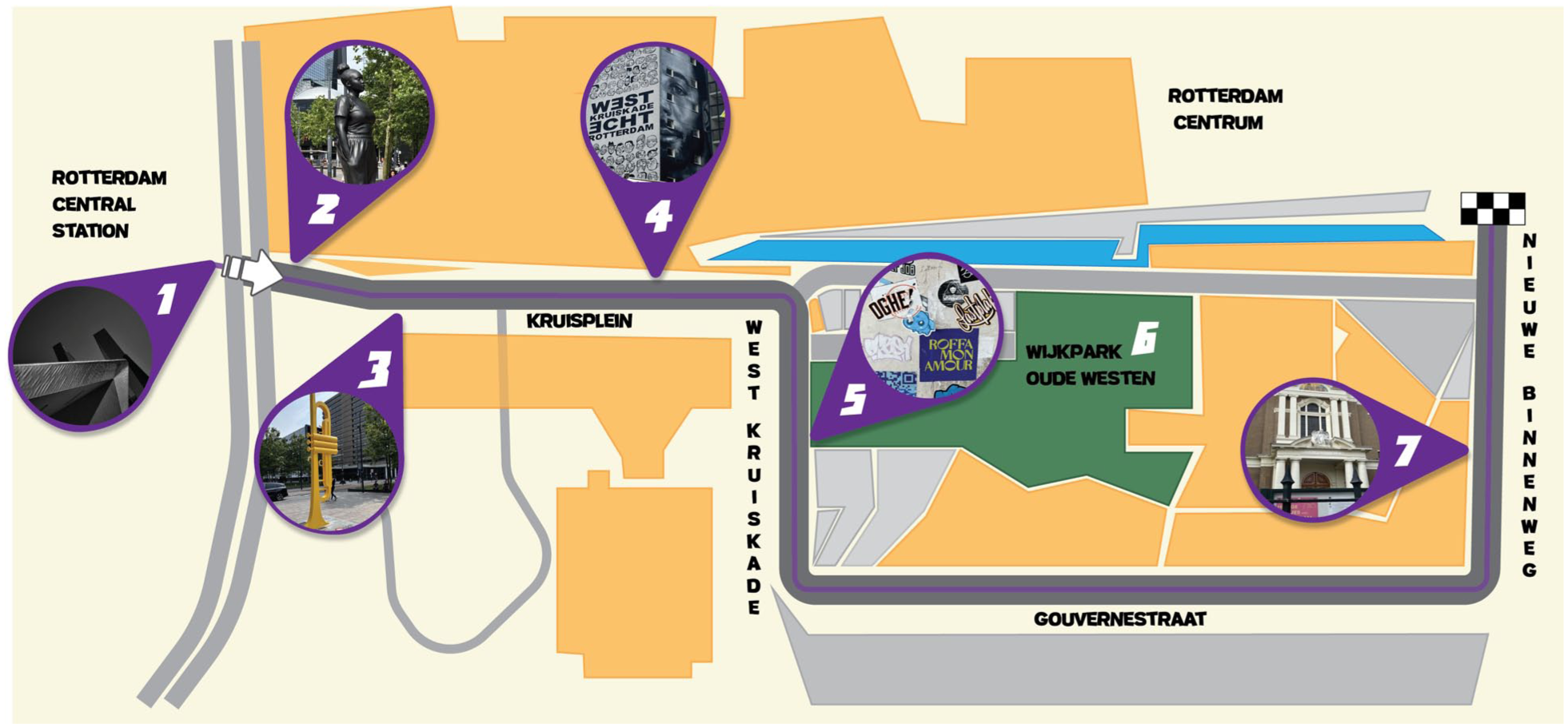
The Route of the Datawalks.
We decided to walk in pairs rather than alone or as a group of four, as it seemed the best way to enable conversations during the walks and to compare and contrast experiences afterwards. Lis and Palesa formed one duo, and Delia and Mélodine the other. This pairing happened organically based on friendship ties and provided a safe setup to be open and vulnerable when making spontaneous observations during the walks. We took pictures and recorded our conversations as we walked, then shared photographs and recordings among the four of us. We listened to each others’ recordings individually while taking notes that we used when debriefing as a team. The four of us met on several occasions after the walks to share our impressions and thoughts and to discuss similarities and differences. The process of analysis therefore started with the datawalks themselves, with each instance of seeing/not seeing race being discussed in the moment. It continued in an iterative and layered manner with each subsequent conversation we had and through which we organized, synthesized, and refined our collective interpretations in light of the walks themselves and the discussions they stirred among us, as well as considering our respective positionalities and literature. In our debriefing conversations, we discussed the different layers of mobilities that came into play when making sense of our experiences in the city. Our academic backgrounds navigating different conceptual frames, disciplinary expectations, and methodological tools were prominent topics of discussion. Similarly, we actively brought up our personal trajectories moving across urban, national, and racial discourses and associated subject positions.
Mélodine’s experiences during the datawalks pointed to her academic positioning in the fields of (Inter)Cultural Studies and Race and Ethnic Studies. Drawing on literature from these disciplines and decolonial scholarship has been instrumental for her to grapple with the ways Whiteness and Eurocentric ideologies shape her experiences in the world. The datawalks also activated her personal mobilities having lived at length in France, the Netherlands (including in Rotterdam), and Finland. Invoking these experiences through the prism of her status as a highly skilled professional White woman of French nationality, she often reflected on the importance of her administrative and symbolic privileges when moving. The datawalk thus created confronting moments when she had to reflect on the intersection between her own privileges and exclusionary practices shaping one’s experience of a place.
Lis entered the datawalk with an assumption of familiarity. As a resident of Rotterdam, the datawalk route was one that she frequented often. Furthermore, as an Afro-Caribbean woman that grew up in Curacao, some of the smells, languages, and people that were encountered on the datawalk route (particularly in areas where minoritized communities resided) connected her to a familiar yet far idea of home and community. Nevertheless, the datawalk was an opportunity to integrate this familiarity with her academic lens that is framed around Postcolonial Studies and Cultural Studies. This methodology thus created room for the process of “defamiliarizing the familiar” through moments of reflection, discussion, and connection that highlighted the multiplicity of (dis)connections that the same space can invoke in people with different experiences.
As a Black South African woman, Palesa’s lived experiences framed her account of the datawalk. As a perceived member of a marginalized social group, she considers herself to be acutely aware of race and its various manifestations within different spaces. This sensitivity around race and difference is not only informed by lived experience but is also often given a vocabulary afforded by her scholarship in critical race studies. Having lived in different countries as a racialized foreign national, Palesa is accustomed to identifying elements of belonging in spaces, and this is revealed through her reflections during and after the datawalk. As someone who is generally comfortable discussing issues around race, the datawalk exercise provided an opportunity to critically dig deeper into her positionality as a Black woman of African heritage living in a European city while also acknowledging the somewhat privileged position of interrogating race as an academic.
Delia approached the datawalks through the lens of everyday and banal nationalism, one of her main research topics. More familiar with this literature, she often experienced more inner resistance in acknowledging the Whiteness of not only her positionality but also of her work on nationalism. Originally from Romania, she had lived in various European countries as well as Canada—and the experience of such mobilities often prompted her to draw comparisons between different places during the datawalks. Yet, the datawalk also pushed her to reflect on the importance of her own socioeconomic status (highly skilled labor migrant) and nationality (being a Romanian in Europe versus Canada) in her own positive experiences of mobility. In turn, the discussions with the other co-authors made her question why, during the datawalk, she noticed nation and ethnicity much more often than race.
Findings
Seeing/Not Seeing
We started our datawalks at Rotterdam Central Station (Spot 1 in the map above), where we all saw the statue “Moments Contained” on Stationplein as an evident signifier of race (see Figure 2, Spot 2 on the map above). The 3.6-m-high bronze statue unveiled in June 2023 in front of Rotterdam Centraal Station represents a young Black woman (Sculpture International Rotterdam, 2023). Upon its installation, the statue sparked discussions in and outside of the Netherlands about the significance of building the statue of an anonymous ordinary-looking Black woman at one of the main entry points of Rotterdam. All four of us were familiar with the discourses that had circulated and the controversies the statue stirred, which prompted us to look for that statue and unequivocally connect it to race. Similar to Delia and Mélodine, Lis and Palesa also mentioned controversies around the statue during their datawalks, but quickly moved onto their personal experiences and views. The statue was not only described as a signifier of race by them but also as a beautiful art piece and, for Palesa, as a milestone on her own journey of becoming a local of Rotterdam. Palesa saw the deliberate choice of placing this statue in front of Rotterdam Central Station as affirming representations of Rotterdam as an inclusive city: “It says to me, on a personal level, yes there is space for you here in Rotterdam. (Palesa). Yes, I definitely get that. (Lis).” The example of the statue “Moments contained” illustrates how personal experiences and larger discourses are woven together to make sense of race in and through space.
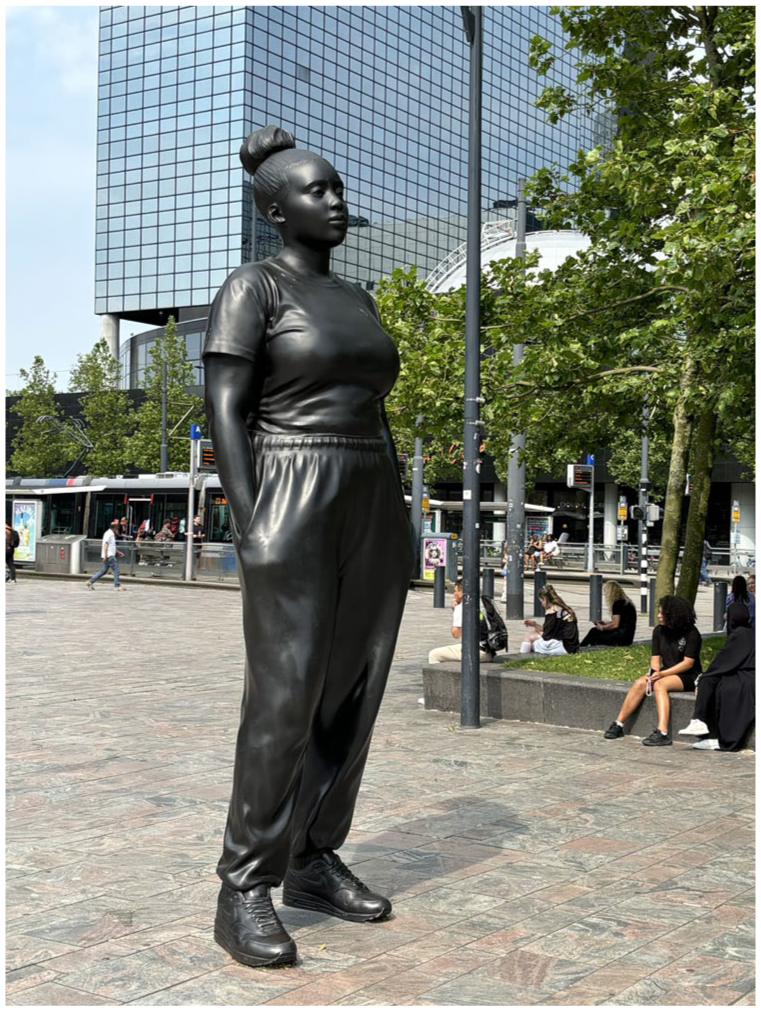
“Moments Contained” Statue at Rotterdam Central Station.
Personal connections to space translated in various ways, including the music we heard and scent we smelt, which conjured up memories transporting us to another location or to another time. Thus, even while moving within a limited perimeter as we did, our datawalks served as powerful tools to multiply our mobilities by engaging with other localities, times, and associated discourses (see Peyrefitte, 2012). A telling example occurred as we walked past the park Wijkpark Oude Westen (Spot 6 on the map included above). Only Palesa and Lis associated it with race. They drew such a connection as they recalled the park is one of the Keti Koti festival 3 venues in Rotterdam. At that event, different communities, including Black, Caribbean and West African, come together with artifacts, music, and food to commemorate the process of freedom in the Caribbean with the abolition of slavery in the Netherlands Antilles and Suriname. While the park was empty during our walks, Palesa’s and Lis’ knowledge of this park through the Keti Koti festival meant the park, even empty, stood as a signifier of race in light of their experiences. Familiarity with (trans)local history therefore revealed how, even when space changes, it still retains specific meanings for some individuals.
The diverse positionalities within our team helped reveal what we respectively saw and missed and to address these differences and similarities in our post-walk discussions. One such difference between our datawalks occurred as Palesa and Lis stopped at a temporary trumpet-shaped statue in Kruisplein (see Figure 3, Spot 3 on the map above) announcing the next edition of the North Sea Jazz Festival: “I see a trumpet, I think of jazz, [Lis talks over] I think of Blackness and soul [back to Palesa] yes exactly.” Both of them talked of jazz as deeply connected to Blackness and Black experience as they evoked the U.S. civil rights movement in the 1960s, blues and soul music, New Orleans. They associated jazz with “freedom, struggle, resistance” and addressed the parallels between improvising in jazz and breaking away from hegemonic and normative practices. In contrast, Mélodine and Delia did not see this installation about the Jazz festival. In our post-walk discussions, Delia and Mélodine both explained associating jazz and its history with Blackness, but at first glance and against competing signs in the city, it was not something they saw as a marker of race. This absence indicates what other signs they prioritized as markers of race. Their positionalities as White individuals as well as their respective academic backgrounds in interculturality and nation studies prompted them to focus on the commodified conflation of ethnicity and race, particularly in restaurants and advertisements. In our post-walk discussions, Delia and Mélodine also echoed what Lis brought up during her datawalk with Palesa about the mainstreaming of jazz that had worked to represent it as a raceless experience. Where Delia’s and Mélodine’s experiences showcased how wider discourses—and particularly hegemonic Whiteness—have cut the ties between jazz and Blackness, Palesa’s and Lis’ experiences show the reverse: how race can be actively re-claimed and how the whitening of music can be resisted. This example illustrates how space is racialized not just via institutionalized discourse and practices but also through the positionalities of those making sense of it. Seeing/not seeing race in the details of urban spaces can be simultaneously accidental and ideological, filtered through the lens of cultural identities and (trans)local knowledges and experiences. The personal is thus interwoven in the ability to recognize the association between urban features and racialization processes. Indeed, as we discuss next, these associations often emerge through the prism of embodied experiences, particularly those related to feeling at home and safe that evoke place-belongingness (see Antonsich, 2010).
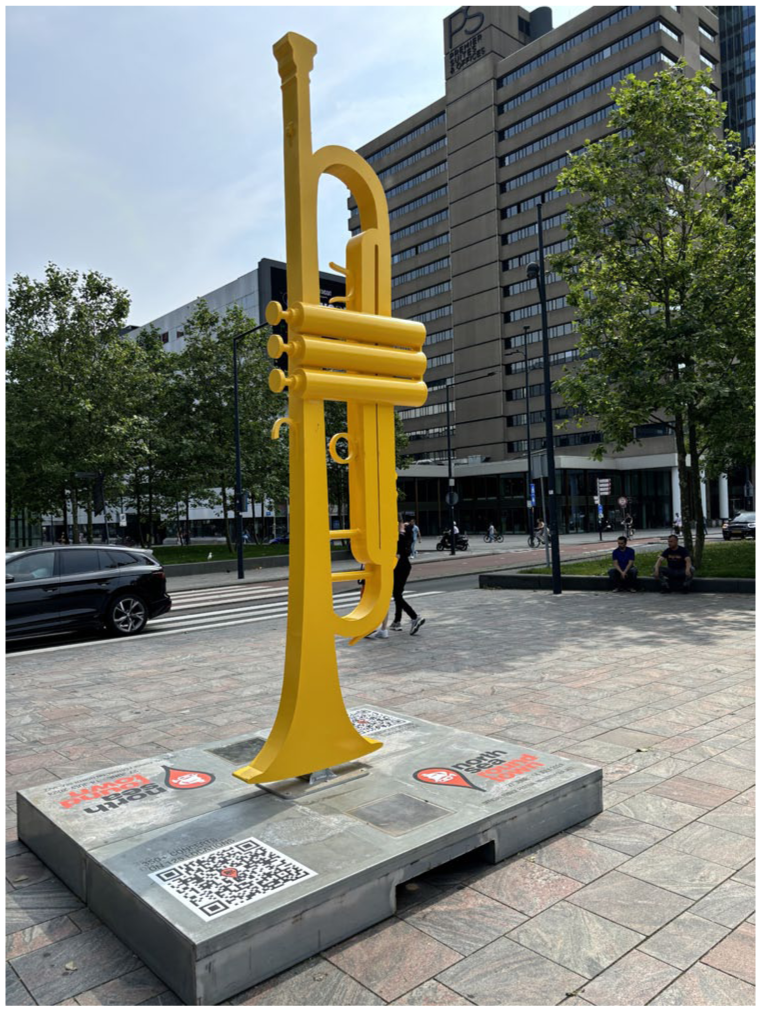
Jazz Festival Promotion Piece.
Embodied Experiences
Our datawalks revealed the scope of senses through which we perceived race as a sensory assemblage (Sekimoto & Brown, 2020). Walking down Kruisplein, Lis mentioned hearing Dominican music coming from a restaurant. The music called her attention, evoking Black Caribbeanness to her, and led Lis to perceive the restaurant in a new light: “If I look at the sign and the logo, I wouldn’t think they serve good food, but because I’ve heard the Dominican music I think this is a friendly place.” Sensory experiences surrounding food came up on several occasions during our datawalks. Walking through Gouvernestraat, Mélodine was drawn by the smell of freshly baked bread coming out of a bakery that felt deeply familiar, comforting, and appetizing. Food also came up in our post-datawalks discussion as we realized where each pair stopped to eat during the datawalks. Lis and Palesa bought some lumpia’s in West Kruiskade, and Delia and Mélodine had warm drinks at Eendrachtsplein. These impromptu decisions revealed where we felt comfortable stopping for food and what we felt enticed to drink or eat, connoting a sense of attraction and security to a space. These experiences point to the role of senses and feelings in identifying (when reflected upon) the embodiment of belonging.
The embodiment of belonging was also connected to experiences of exclusion that our datawalks brought on. Spaces that were experienced as White were directly correlated with lack of safety by Lis and Palesa. In contrast, spaces that both of them saw as the “Black side of town” were experienced as spaces where feelings of belonging arose, despite these spaces not necessarily being designed with this in mind. For groups racialized outside of Whiteness, seeing and engaging with race can be a form of resistance by enjoying symbols reminiscent of “home” and enabling the experience of translocal connections to distant places and groups. For instance, we walked through West Kruiskade, a neighborhood where predominantly marginalized communities gather to do business and reside, which can evoke feelings of belonging for Black and marginalized communities. This aligns with what Georgiou (2007) calls “locations of diversity” (p. 20), reflecting the idea that certain spaces can transcend their intended function (e.g., as sites of business and residence) and become spaces of belonging where minoritized groups and individuals can feel more at ease (Joseph, 2014).
Doing datawalks in pairs and debriefing as a team afterwards shed further light on the (absence of) personal connections we drew to space and the role these played in (not) seeing race. In our walks, Black hair salons were one example that illustrated place-making processes. For Delia and Mélodine, Black hair salons were unknown and unvisited spaces that remain limited to signifiers of race. In contrast, for Palesa, these salons evoked cherished nostalgic memories as she connected practices and relationships happening inside Black hair salons to the facades she walked by during the datawalks (see Figure 4, Spot 5 on the map above). The spatiality of race can also point to places of belonging (Hall, 1990) and associated negotiating processes. This became visible when Lis agreed and reminisced about the role of hair salons for Black women, despite not having the same experience as Palesa with these salons. Black hair salons and the stories around them form part of the collective consciousness of Black women (Banks, 2000). Choosing to highlight collective consciousness instead of individual experience illustrates how seeing race can become a pathway to emphasize commonalities and belonging within the stories told about the spaces visited in the datawalks.
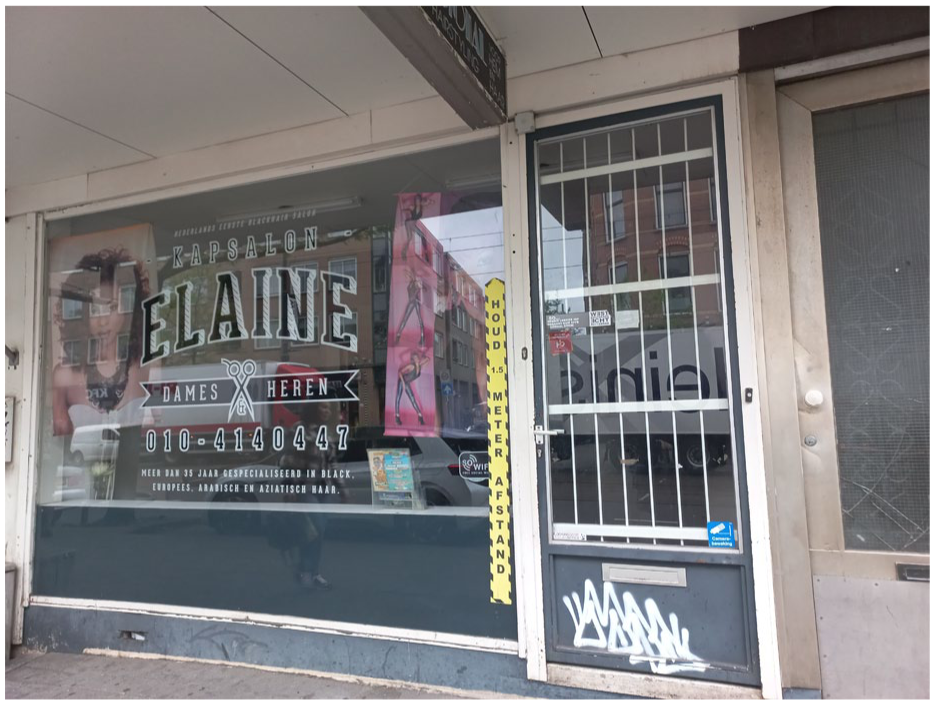
Black Hair Salon Window in West Kruiskade.
Having walked through West Kruiskade, we turned into Gouvernestraat where we all sensed a different energy. In West Kruiskade, Mélodine and Delia felt like outsiders because of the lack of personal connections to most stores and restaurants that revealed their positionalities as White individuals within Whiteness. In contrast, as they walked down Gouvernestraat and into Nieuwe Binnenweg, Mélodine and Delia both felt more comfortable in ways that revealed the alignment of these streets as White spaces with their positionalities as White individuals within Whiteness. These experiences point to the interplay between material signs, personal trajectories, and associated emotions as sources of knowledge about what individuals may recognize and experience as race when moving through cities.
Datawalks revealed experiences were specific to confined areas, and that turning the corner to another street conjured up different sensory experiences— intangible at times, yet clearly felt. Such embodied experiences recorded during the datawalks allowed us to further question the interweaving between the personal and the structural in seeing/not seeing race in the city. As an in situ method of mobility, datawalks helped us capture, first and foremost, our immediate impressions, feelings and reactions to the spaces we navigated. As we walked from one street to the other, we felt at home or at ease, and while we asked each other about features of the surrounding space that created such feelings, the debriefing provided more space for critical reflection of the importance of embodiment in relation to seeing/not seeing race. In these post-walk discussions, we questioned why we had observed certain details of the urban infrastructure while ignoring others, and why such details triggered embodied reactions. This process prompted us to consider the multiple ways in which race can be embodied, imagined and captured.
Hesitations
Where race was sometimes captured through our experiences of space, putting these experiences into words and explicitly connecting it to normative discourses about race and Whiteness was sometimes more difficult. The datawalks revealed our uncertainties in seeing/not seeing race, forcing us, physically and mentally, to pause and engage with these moments of questioning.
The four of us stopped in front of two street art murals on adjacent walls of the same building in Kruisplein (see Figure 5, Spot 4 on the map included above). One of the murals included many drawn faces arranged around the phrase “West Kruiskade Echt Rotterdam” (West Kruiskade Real Rotterdam), while the other depicted a Black man. Palesa and Lis saw both murals not only as signifiers of race but also as signifiers of Rotterdam: “different people, hairstyles, identities, combined with this mural it signifies diversity, it signifies Rotterdam.” Palesa and Lis produced a multimodal and local reading of the mural as they connected the text (“West Kruiskade Echt Rotterdam”—West Kruiskade Real Rotterdam), the drawings, and the location of both murals. In contrast, Delia and Mélodine had a more detail-oriented reading of the murals by zooming in on elements within them that would indicate race—raising many questions and leaving room for hesitations that highlighted meaning-making processes associated with the co-construction of race and space. Ambiguities of the visuals led Delia and Mélodine to fall back onto stereotypical visions of what would signify Black or White features, while also fighting back against these:
I think when you look at the faces drawn, there are suggestions of different [long pause. Delia finishes the sentence] races. [Mélodine continues] They have different body features, or well, it’s hard to say actually. [Delia continues] For me it’s very difficult because it’s a drawing and the features are exaggerated; and it makes me wonder, should I associate them with exaggerated body features that are associated with Blackness in the way that White individuals portray them, or am I reading too much into things. When am I being racist?
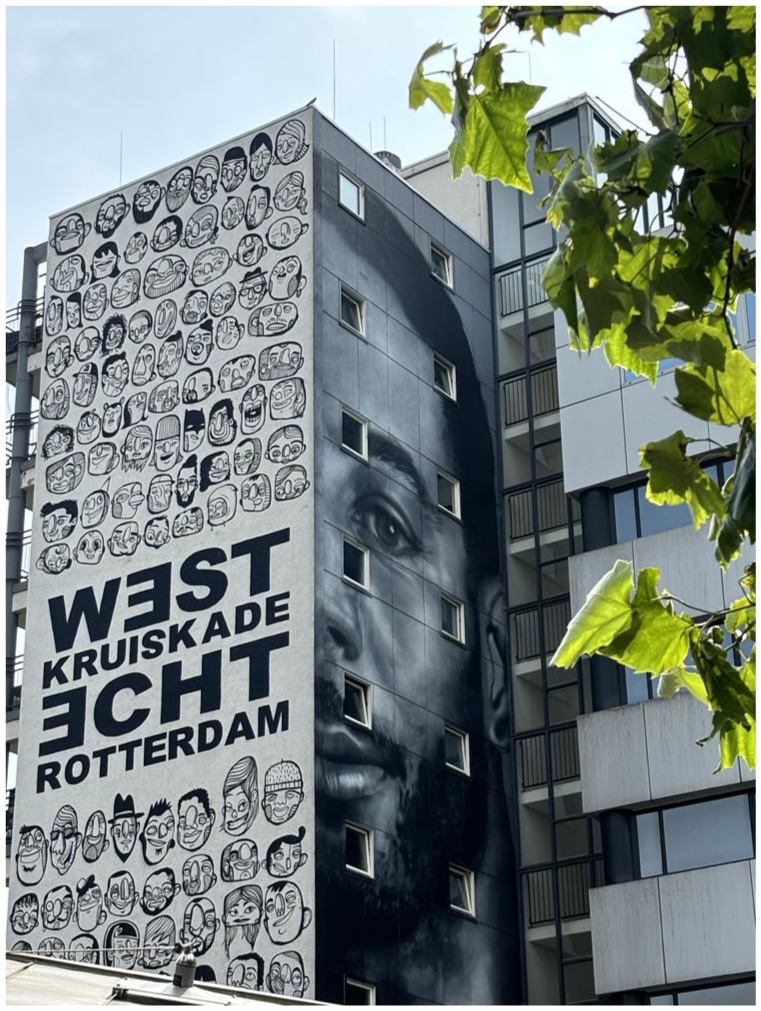
Mural West Kruiskade Echt Rotterdam.
The closer Delia and Mélodine looked at the drawing, the more hesitations came up. These revealed the challenges of seeing and naming race because of its inherent instability as well as “White anxieties in which ‘seeing’ difference is ultimately a means of making difference” (Nayak, 2007, p. 748).
For Lis and Palesa, the hesitations appeared primarily when engaging with their own perceptions of Whiteness. Putting the feeling that they were stepping into White spaces into words was difficult: “It’s hard to put these things into words. It feels White. The people, it’s a hipster vibe. [. . .] I’m for sure feeling how this is connected to Whiteness.” (Lis) The ineffability of race and Whiteness that Lis hints at points to inherent challenges of engaging with race as we try to name something that is fleeting and invisibilized. Where Delia’s experience speaks to the fear of being racist, Lis struggled with articulating her experience of racialized spaces in a way that can be recognized as both meaningful and legitimate. In other words, Lis’ experience showcases the struggle of marginalized and oppositional voices to be heard against dominant discourses of race-neutrality.
In our debriefing discussions, we questioned how our own positionalities—including our previous encounters with racism—were interwoven with our hesitations. Again, we noticed how moving through space during the datawalks exposed us to different sounds, smells, and sights that became meaningful as they (dis)appeared. As we turned a corner and the sounds or smells disappeared, our attention moved to something else, and our experience of the place shifted drastically. The politics of these (fleeting) emotions (Nayak, 2011) became visible to us only afterwards, in the debriefing moments. Such debriefing moments enabled us to question the sequencing of our feelings and embodied experiences (as discussed in the previous section) in relation to the movement of our bodies through the city.
Spaces of Whiteness
The four of us identified the latter streets we walked in (Gouvernestraat and Nieuwe Binnenweg) as spaces of Whiteness. The immediate contrast between West Kruiskade and Gouvernestraat in terms of infrastructures and displays enhanced the impression we all had: “drastic change, very quiet, suburban, rigid, no stickers and less colorful, very nice parks. Because of the drastic change, it feels like a space of Whiteness.” (Palesa). This sudden change prompted Mélodine and Delia to reflect on which understandings of race they had prioritized until now in their walk: “we took pictures of adverts with Black models, but we didn’t take pictures of adverts with White models” (Delia). Changes brought about by our physical mobilities therefore offered opportunities to evaluate and challenge what we saw as race.
Walking these latter streets also pointed to nuances within Whiteness, in particular through the intersection of race and social class. While the four of us connected Gouvernestraat to Whiteness, our conversations tempered these initial perceptions as we saw buildings that seemed poorly maintained. This prompted the four of us to think of this immediate neighborhood as relatively disadvantaged, which, in turn, challenged our perceptions of hegemonic Whiteness. Discourses of hegemonic Whiteness are associated with (upper) middle-class in contrast with precarious White groups that are negatively stereotyped and pushed to the margins of Whiteness (Spanierman et al., 2013). The shift in our perception of Whiteness pointed to our positionalities as middle-class highly educated individuals who are involved in hegemonic Whiteness (for instance, in academia) through these dimensions (to different degrees given our respective gendered, racial, and national positionalities). Overall, the materiality of space in terms of infrastructure and urban design played an important role in prompting us to address perceived wealth as a proxy of Whiteness. Further down in Nieuwe Binnenweg, other material and discursive elements were picked up by Delia and Mélodine as markers of Whiteness. These included a wider street, greened areas, and imposing historical buildings, some of which were used by institutions connected to Whiteness such as the Catholic Church (see Figure 6, Spot 7 on the map above).
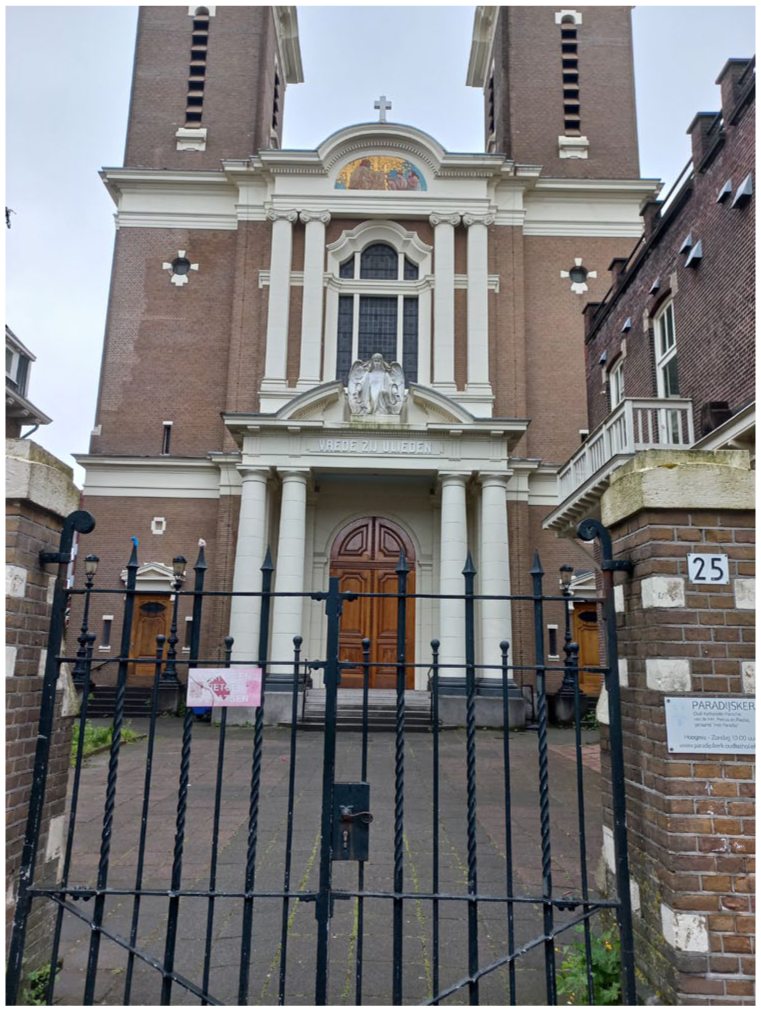
Facade of the Oud-Katholieke Paradijskerk (Old Catholic Paradise Church) in Nieuwe Binnenweg.
In their datawalks, Lis and Palesa identified the commercialization of difference as a significant aspect through which Whiteness was (re)produced, which became salient as they moved from West Kruiskade to Gouvernestraat and Nieuwe Binnenweg. In the latter streets, Lis and Palesa reflected on how difference was used as part of a commercial agenda and offered for the consumption of passer-bys. In Gouvernestraat and Nieuwe Binnenweg, the access to so-called ethnic food and drinks (e.g., Vietnamese restaurants and coffee shops selling chai lattes and bubble tea) seemed carefully curated for the palette of White people. The various ethnic stores were blended into affluent high-priced retailers, and passers-by seemed to be imagined as White and affluent, as the presentation of the difference-as-commodity seemed cleaner, neater, and more hip than on the racialized West Kruiskade. Withers (2017) discusses how Whiteness is able to remove certain practices from their racialized roots, neutralizing these practices into material objects for consumption. The commercialization of difference is connected to this practice, as it reflects a process where experiences, traditions, and cultures become products, Whitewashed, neutralized, and designed for those who are willing and able to pay for some access to the experience of the Other. In contrast, as Lis argued, “Kruiskade is not trying to be different. It is a space for people to exist outside of the White gaze.”
Walking through different streets confronted us with different shades of Whiteness and mechanisms (such as consumerism) through which Whiteness is ingrained in the urban fabric. Mobility was an essential element that brought about change and helped us compare and contrast perceptions of and feelings evoked by the streets we walked—therefore prompting us to see Whiteness when it is otherwise typically invisibilized as the norm (Dyer, 2017).
Discussion and Conclusion
Because race “has no meaning as an actual biological or physical distinction” (Lentin, 2020, p. 6), it becomes meaningful through “racializing assemblages” that bring together discourses, infrastructures, institutions, personal narratives, material artifacts, etc. (Weheliye, 2014, p. 3). Our experiences with datawalks point to the way this method can contribute to making these racializing assemblages visible by engaging with the four analytical dimensions discussed in this paper. We have presented seeing/not seeing, embodied experiences, hesitations, and spaces of Whiteness separately to elaborate on the scope and strength of each of these analytical categories. In practice, however, all four of them overlap and complement one another in sometimes indistinguishable ways. Highlighting them separately in this paper can hopefully be useful for future researchers who want to be more attuned to the details of their own “seeing/not seeing” race in and through space. In addition to the four analytical dimensions, we have described as tools to engage with one’s experiences of race in and through space, we also found datawalks to be a powerful tool to grapple with one’s positionality, particularly within academic structures of Whiteness.
Moving through the city was crucial for us to notice absences and continuities in the urban environment we navigated. These changes urged us to pay attention to various cues, both about the environment and ourselves, that could have otherwise been overlooked. As embodied experiences, datawalks pointed to our own personal journeys as signs evoked memories that connected here and now to other times and other places. Moving in space therefore led to other types of mobilities: intertemporal, translocal, and emotional. Indeed, walking through streets that were in turn familiar and foreign conjured up a wide range of feelings that pointed to the co-construction of space, race, and emotion. The palettes of emotions and senses triggered by the embodied experiences of doing datawalks revealed the significance of this method to study race. Capturing sensory experiences and re-centring feelings and emotions is central in race-evasive contexts like Europe and the Netherlands, where racism and racialization processes are often about the unsaid, the implicit, and, as a result, sensed experiences (Dibondo, 2024; Sekimoto & Brown, 2020). Doing datawalks is all the more relevant because race, as a shape-shifting construct, becomes meaningful through imaginaries drawing on politics of emotion, from moral panics and associated feelings of fear and insecurity (Nayak, 2011) to the commercialization of ethnic food and associated feelings of trust and comfort (hooks, 1992). Yet, while engaging with emotions, senses, and embodied experiences is crucial to examine race, academic knowledge tends to dismiss feelings and to prioritize tangible positivist evidence (Tamale, 2020). This is where we see one of the main benefits of using datawalks to research experiences of race in and through space. As an embodied in situ and in-movement practice that evokes and highlights sensory and emotional experiences, datawalk does not fall within traditional methodological tools and, as such, can “disrupt hegemonic ways of doing, knowing, and being” (Pindi, 2020, p. 443).
This being said, datawalks do not in and of themselves expose the workings of race. Our experience aligns with literature on walking that points to the benefits of walking together and debriefing afterwards (see Lee & Ingold, 2006; O’Neill & Hubbard, 2010). Doing the walks in pairs meant we could verbalize in the moment what we experienced and record these conversations to analyze and draw on in our post-walk discussions. Moreover, walking with a friend afforded us a certain level of comfort and safety in moving through space and describing what we experienced. The post-datawalks dialogues were extremely useful as we verbalized and analytically distinguished the interplay between, on the one hand, our personal and social identities, and, on the other hand, the normative discourses about race and space that informed what we saw/missed. We find such a dialogic in-movement approach to research essential to interpretive and reflexive work, as it urges researchers to move away from and challenge academic canons of competitive efficiency by re-claiming uncertainties, hesitations, detours, and peer-support as essential tenets of intellectual work (see Dumitrica & Gaden Jones, 2020). The collective reflexive and interpretive work we did with our datawalks also helped reveal and challenge the double scrutiny usually faced by qualitative scholars like us working on race who are (c)overtly asked on a recurrent basis to defend the validity of their research assessed against positivist and White hegemonic standards.
Doing datawalks collaboratively helped us through the active work required to connect emotions conjured up in space with our positionalities within race formations. Connecting feelings evoked by spatial mobility and one’s positionality bears particular relevance for White individuals located within Whiteness who have been socialized into thinking of themselves and their spaces of belonging as raceless. Importantly, it was when we stopped and reflected back on what we had recorded during the datawalks that our hesitations translated into questions and challenges to normative hegemonic views. Datawalks are thus particularly useful in charting one’s own changing embodied experiences when moving through space and hesitations in rationalizing them. Lessons from our datawalks therefore indicate how the sensory embodied experience of walking (enhanced as a collaborative endeavor) contributes to unveiling what one’s comfort zone consists of. As such, datawalks hold significant potential for disrupting White habitus that normalizes White’s spatial and social isolation and “affords whites the luxury of non-reflexivity” (Bonilla-Silva et al., 2006, p. 249). Furthermore, using datawalks makes it possible to do positionality work without putting the burden of educating about race onto minoritized colleagues.
Datawalks, as we have argued, hold great potential to explore the workings of race but could also be used to engage with other dimensions of difference as long as these are taken into account when selecting participants. We conclude this paper by highlighting four aspects that played a significant role in making our datawalks productive tools to examine race in space and our positionalities, and which can help replicate datawalks regardless of their focus area:
Approach datawalks as a form of slow and iterative dialogic research to walk (away from traditional methods), record, stop, ponder, etc., with the explicit analytical purpose of questioning (and thus ultimately challenging) structures and norms through which race is being seen and missed.
Undertake datawalks as collaborative endeavors with fellow researchers and participants to enhance feelings of safety when moving through space and when opening up about one’s experiences and oneself, wherever possible.
Establish trust among participating researchers prior to engaging in the datawalks by discussing upfront the diverse dimensions of difference within the team. These dimensions are crucial to contrasting and confronting each other’s experiences and perceptions.
Combine datawalks with subsequent collective discussions to address, dissect, and complexify the layers involved in embodied experiences produced by walking and experiencing the place together.
Footnotes
Declaration of Conflicting Interests
The authors declared no potential conflicts of interest with respect to the research, authorship, and/or publication of this article.
Funding
The authors disclosed receipt of the following financial support for the research, authorship, and/or publication of this article: This work was supported by the Research Council of Finland under grant number 347698.
Ethical Approval and Informed Consent Statements
The study followed all ethical requirements stipulated by the Research Council of Finland and the first author’s institution (University of Jyväskylä, Finland).
