




Abstract
Guided by community-based participatory research (CBPR) and critical race theory (CRT), this study employed a descriptive qualitative approach to explore strategies for improving engagement with Black communities in Canada. Researchers with experience conducting Black health studies across the Prairies participated in semi-structured interviews. Two main themes emerged: community-led agenda-setting and inclusive recruitment. Key strategies included Black leadership, reframing stigmatizing language, engaging trusted community gatekeepers, hiring local staff, providing incentives, and using informal outreach. Grounded in participatory and equity-oriented frameworks, the study contributes to the development of culturally responsive and socially just research practices with Black communities in Canada.
Keywords
Introduction
Canada is recognized for its racial and cultural diversity, shaped by a significant influx of Black migrants from sub-Saharan Africa and the Caribbean (Okeke-Ihejirika et al., 2020). As of 2021, the Black population in Canada had reached 1.5 million, representing 4.3% of the national population and 16.1% of the racialized demographic (Statistics Canada, 2024). Projections suggest that by 2036, Black Canadians may comprise 5.0% to 5.6% of the total population (Statistics Canada, 2023). Despite this demographic growth, Black communities continue to experience persistent social and health inequities, including limited access to quality health care, education, employment opportunities, and adequate housing (Williams & Cooper, 2019). These disparities are rooted in structured systems of power, such as systemic racism, which confer unearned advantages to dominant groups while marginalizing Black populations (Razai et al., 2021). Racism therefore remains a fundamental cause of racial health and social disparities.
The underrepresentation of Black communities in research highlights the critical need for culturally appropriate approaches, defined as research methods that are respectful of and responsive to the cultural values, histories, and lived realities of Black communities. Community-centered research refers to approaches that prioritize Black voices and leadership in decision-making across all stages of the research process. Many studies focus on Black communities but rarely involve them meaningfully, impacting the relevance, depth, and quality of outcomes (Alaazi et al., 2025; Cénat, 2022). Research conducted with active participation from Black communities provides better insights into their lived experiences and supports sustainable partnerships that can address systemic barriers and illuminate pathways to equity (Cyril et al., 2015; Wilkins et al., 2023).
Community-based participatory research (CBPR) is one collaborative approach that advances these aims by emphasizing equitable engagement, shared decision-making, and co-creation of knowledge between researchers and communities (Wallerstein et al., 2020). Internationally, CBPR has been used effectively with African American communities in the United States to improve chronic disease prevention, mental health outcomes, and youth engagement, while also fostering trust in historically marginalized populations (Bourgeois, 2025; Breland-Noble et al., 2024). A recent CBPR initiative with Black women in Texas showed how culturally grounded wellness activities fostered community connectedness and supported stress management (Bourgeois, 2025). These examples illustrate CBPR’s potential to strengthen health equity through community-led approaches. However, its systematic use with Black communities in Canada remains limited, particularly in relation to agenda-setting, recruitment strategies, and knowledge mobilization (Turin et al., 2021). In this study, CBPR principles informed collaboration with stakeholders and the framing of community priorities, although the primary methodological orientation was descriptive qualitative design.
Although research evidence can inform policies to address disparities, the pervasive effects of racism and colonialism have fostered mistrust between Black communities and researchers, particularly those affiliated with White-led institutions (Batelaan, 2022; Dryden & Nnorom, 2021). In Canada, there are no established tools, guidelines, or frameworks that prioritize culturally appropriate approaches to involve Black communities in setting research agendas, addressing recruitment challenges, and mobilizing knowledge. These gaps are especially pronounced in the Prairie region (Alberta, Saskatchewan, and Manitoba), where the specific health and social needs of Black populations remain understudied despite demographic growth and distinctive settlement patterns. Positioning this regional lens early helps frame the significance of the present study.
This paper forms part of a broader program of research. A related sister manuscript focuses on fostering culturally responsive research practices with Black communities in Western Canada, drawing on CBPR and critical race theory (CRT; Salami et al., 2025). That article highlights methodological and theoretical frameworks, whereas the current paper concentrates on practical strategies for community-led agenda-setting and participant recruitment. Together, the two manuscripts advance inclusive approaches to research with Black communities in Canada by linking conceptual guidance with actionable strategies.
The present study is guided by a descriptive qualitative framework, which remains close to participants’ accounts and emphasizes the thematic summarization of experiences (Sandelowski, 2000, 2010). This framework enables an in-depth exploration of researchers’ perspectives while recognizing systemic barriers and the need for culturally responsive strategies. Specifically, this study addresses three critical areas: (a) engaging communities in setting research agendas, (b) addressing recruitment challenges, and (c) adopting culturally appropriate recruitment strategies. By focusing on these areas, the study contributes to the development of equitable and inclusive research practices.
Theoretical Framework
This study was grounded in a descriptive qualitative design (Sandelowski, 2000, 2010) and informed by principles of CBPR and CRT. CBPR emphasizes equitable partnerships, shared decision-making, and the integration of community knowledge into research processes (Collins et al., 2018; Wallerstein & Duran, 2010). These principles shaped the co-development of the interview guide, recruitment strategies, and the collaborative orientation of data analysis. CRT provided a complementary lens for interpreting findings, recognizing racism as a fundamental driver of inequities and situating participant reflections on mistrust, stigma, and systemic barriers within broader structural contexts (Douglas et al., 2022; Ford & Airhihenbuwa, 2010a). Together, CBPR and CRT ensured that the study addressed both structural inequities and community strengths, guiding culturally responsive approaches to research with Black communities.
Method
Methodology
This study employed a descriptive qualitative design, consistent with Sandelowski’s framing of qualitative description as an approach that remains close to participants’ accounts while producing a thematic summary of experiences (Sandelowski, 2000, 2010) This approach was selected because it allows for a low-inference, data-near analysis suitable for capturing the perspectives of researchers in their own terms, while generating findings with practical utility for policy and practice. The objective of the study was to explore the perspectives of researchers who have conducted studies with Black communities in the Canadian Prairies, with the goal of identifying strategies to support culturally responsive research practices and recruitment approaches.
Research Design
This study employed a qualitative research design guided by a descriptive qualitative methodology (Sandelowski, 2000, 2010). Descriptive qualitative methodology provides a flexible, low-inference framework that captures participants’ experiences in their own words while producing a thematic summary of perspectives. It was chosen to provide a practical, data-near understanding of how researchers engage Black communities in culturally responsive research across the Canadian Prairies.
The design reflected a naturalistic orientation focused on contextual interpretation and the co-construction of meaning between participants and researchers. Data were collected through semi-structured interviews (see section “Data Collection”) to capture participants’ views on community-led research and recruitment strategies. Ethics approval for this study was obtained from the Institutional Research Ethics Board, as declared in the declaration section. All participants provided written informed consent prior to taking part.
Sampling and Recruitment
Participants were eligible if they had conducted health-related research with Black communities in western Canada including Alberta, Saskatchewan, or Manitoba. All participants self-identified as members of the Black community and had prior experience conducting or leading community-engaged studies. They were identified through a published scoping review on Black health research (Alaazi et al., 2025) and through professional networks known to the research team. Invitations were sent by email. A total of 24 researchers were contacted, and 12 agreed to participate. Non-participation resulted from a lack of response or a declined invitation. This sample size is consistent with descriptive qualitative research, which typically includes 6 to 20 participants (Sandelowski, 1995).
Data Collection
Data were collected through semi-structured interviews designed to ensure consistency across participants while allowing for in-depth exploration of individual experiences. This approach provided both structure and flexibility, supporting the descriptive qualitative methodology (Kvale & Brinkmann, 2009).
The interview guide was collaboratively developed by the research team and the Public Health Agency of Canada (PHAC), which funded and partnered in the project. It was informed by findings from the scoping review (Alaazi et al., 2025) and iteratively refined for clarity, cultural responsiveness, and contextual relevance, although it was not formally pilot tested. All interviews were conducted virtually using Zoom by the first and last authors, both full professors and Black researchers with extensive qualitative research expertise. Interviews lasted between 33 and 124 minutes and were audio-recorded with participant consent. Professional transcriptionists transcribed the recordings verbatim, and field notes and reflexive memos were used to enhance contextual understanding and methodological transparency.
Data Analysis
Data analysis was guided by Braun and Clarke’s six-step thematic analysis framework: (1) familiarization with the data, (2) generation of initial codes, (3) searching for themes, (4) reviewing themes, (5) defining and naming themes, and (6) producing the report (Braun & Clarke, 2006). Coding was conducted using NVivo 12 software. The second author and the fourth author led the coding and analysis, with a subset of transcripts independently coded by both to enhance reliability (Braun & Clarke, 2006). Discrepancies were resolved through discussion until consensus was reached. The third author contributed to the interpretation of findings and supported the writing of the full manuscript. The research team also held regular analytic meetings and maintained an audit trail to ensure reflexivity and transparency.
Results
Twelve researchers participated in the qualitative interviews. Nine had conducted research with Black populations in Alberta, one in Saskatchewan, one in both Alberta and Manitoba, and one across all three Prairie provinces. Most participants (n = 9) identified as women and three as men, with no participants identifying outside these categories. Eight participants identified as Black, and four as non-Black.
Thematic analysis of the interviews revealed two central themes: (a) Setting the Research Agenda and (b) Navigating Recruitment. Each theme included subthemes that reflected the perspectives and experiences of participants (Table 1).
Interview Themes and Subthemes.
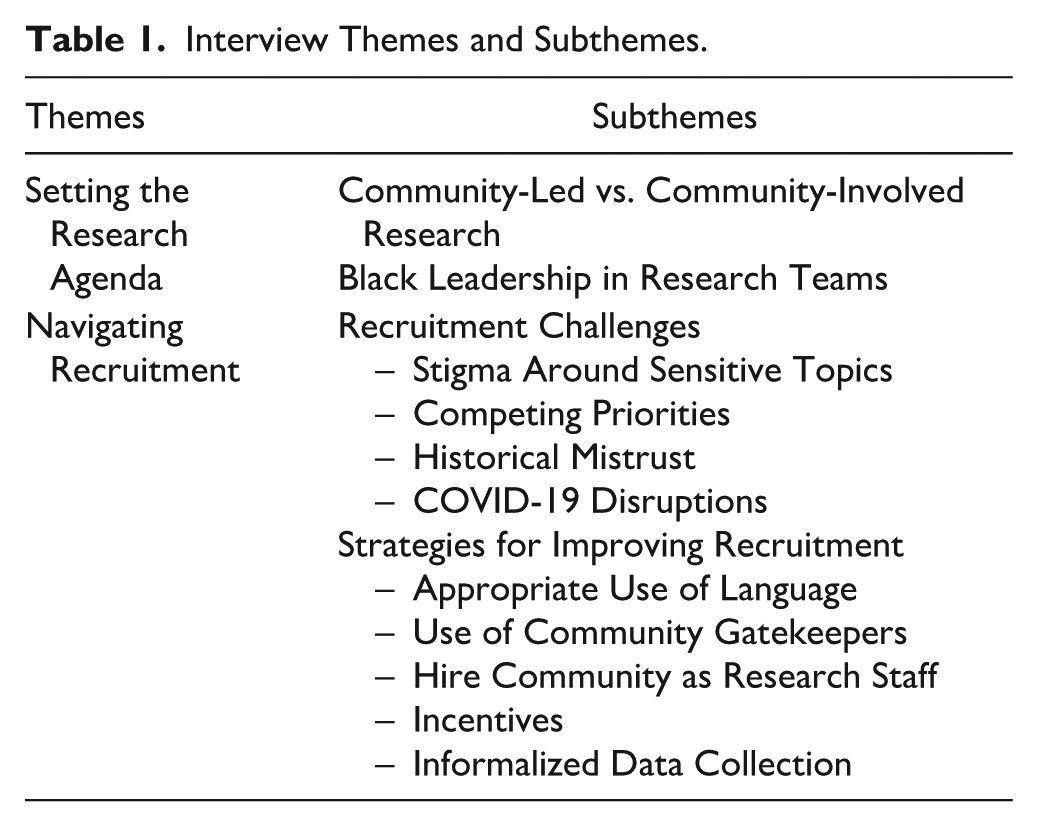
Setting the Research Agenda captured participants’ reflections on the roles of community members and Black leadership in shaping research priorities and ensuring culturally relevant outcomes.
Navigating recruitment highlighted both the challenges researchers faced when engaging Black communities and the strategies they developed to improve recruitment.
These themes reflect how researchers described the importance of power, trust, and cultural responsiveness in shaping research agendas and recruitment practices. The following sections present each theme in detail, with participant quotations illustrating their perspectives.
Setting the Research Agenda
Participants discussed how research priorities are set and who should lead this process. Two main subthemes emerged: community-led versus community-involved research and Black leadership in research teams.
Community-Led Versus Community-Involved Research
Several participants emphasized the importance of community-led research, where Black community members drive the process from design through to interpretation. One participant described:
I would say the engagement of the community members in the design, execution, and even interpretation of the data was a lot. And with the project that I specifically worked with the African community, they led it. There was no one else, you know. Like kind of leading it. So, it was more like them kind of leading the data collection. And even like the interpretation of the results. [P006]
At the same time, some participants acknowledged that collaboration with external researchers could also be beneficial. These approaches, described as community-involved, were seen as creating opportunities for shared responsibility and bridging community and institutional perspectives.
Black Leadership in Research Teams
Participants highlighted the importance of Black researchers in leadership roles. They felt that Black leadership helped foster trust, ensured cultural relevance, and signaled representation to the community. One participant explained:
I still feel like our best chance in getting more from our community is to have Black-led and [Black] research members in the team. But a good blend of that with people from another race and ethnicity I think will be very valuable. Because I think we would also respect that person as well. We would want to portray our community, our society in a good way when we see someone who is not from our community, we want to portray our society in a good way to that person. [P004]
This view also pointed to the perceived benefits of diverse research teams that include both Black and non-Black members. Such teams were seen as able to combine trust and cultural familiarity with broader perspectives and external validation.
Navigating Recruitment
Recruitment emerged as one of the most significant challenges faced by researchers working with Black communities. Participants described barriers that hinder participation, as well as strategies they developed to improve engagement. Two broad subthemes were identified: (a) recruitment challenges and (b) strategies for improving recruitment.
Recruitment Challenges
Participants described several barriers that made it difficult to recruit Black community members into health research. Four categories were consistently identified: stigma around sensitive topics, competing priorities, historical mistrust, and COVID-19 disruptions.
Stigma around Sensitive Topics
Several participants reported that issues such as mental health and HIV/AIDS carried strong stigma, discouraging individuals from participating in related studies. As one participant noted:
People don’t really want to talk about mental health. People don’t want to be stereotyped. So yes, it’s a very delicate area . . . Some people will make comments like “no woman in our congregation has depression, or no woman has anxiety.” People were very hesitant to say they knew someone they could refer the study to, or even say they were eligible [themselves] for the study. [P003]
Competing Priorities
Participants emphasized that many Black immigrants face significant pressures such as multiple jobs, retraining, or credentialing, leaving little time for research participation. One participant explained:
[Black] people prioritize a lot of other things, and just reaching out to people for research can be challenging for them to find that time to sit down and share their experiences, unless they feel like, well OK, I’ll do it for you. I’ll just do this. Or perhaps there’s an incentive. [P004]
Historical Mistrust
Several participants linked low participation to long-standing mistrust of research and negative experiences with deficit-based approaches. One participant commented:
The issue of trust is historical; what has been done to grant people historic rights, but also what researchers continue to do with them, especially when they take deficit approaches to collect data and publish things that continue to demonise them and dehumanise them and do nothing to change their circumstances. [P007]
COVID-19 Disruptions
The pandemic created additional obstacles to recruitment, including limited access to technology and reduced opportunities for in-person engagement. One participant described:
Our study with the Somali community happened during COVID and COVID just gutted that project, it prevented us from having the engagement with the youth that we needed. So, recruitment was so, so hard and we were targeting a population that was, would struggle to get online. [P010]
Together, these accounts illustrate the challenges researchers face in engaging Black communities in health research, shaped by stigma, structural pressures, mistrust, and pandemic-related disruptions.
Strategies for Improving Recruitment
Participants shared several approaches they had used or observed to improve recruitment of Black community members in research. Five main strategies were described: appropriate use of language, use of community gatekeepers, hiring community members as staff, providing incentives, and informalizing data collection.
Appropriate Use of Language
Participants emphasized the importance of framing questions and study topics in ways that reduced stigma and resonated with community understandings. For example, one participant explained how using different wording helped engage parents.
Although mental health is generally conceptualized in Western cultures as a continuum representing varying states of mental well-being, its usage can invoke notions of a psychiatric disorder among non-Westernized Black communities. However, Black communities are acutely aware of such a continuum, describing it in terms that are non-stigmatizing. A participant explained how mental health, as a continuum of states, may be explained in Black communities:
We know that there are people who will say, “Oh, he’s always drunk and he has his demons.” Or “Since his wife died, he hasn’t been himself.” So, we know that there are degrees of it (mental health) but we don’t quite equate it with the way Westerners name it. [P001]
Another participant noted:
So, in Manitoba I was reminded by other scholars not to use mental health, because mental health was seen to have a stigma in the community. . .. So, I ended up reshaping my research questions to actually relate it to mental distress in community. . .[My participants] were relating to that experience and saying, “Oh yes, when we start seeing the people in our community talking to themselves all around, then in fact, we can really go crazy.” [P007]
Similarly, the phrase “intimate partner violence” is considered stigmatizing in most Black Canadian communities, and as such could alternatively be described using such more culturally acceptable phrases such as “gender relations.” A participant advised:
People are not going to come there to be branded, “That woman who was beaten up, or that woman who came from a war zone who was raped.” They want to be seen as a woman who came from the Congo and who is studying at Grant MacEwan. You don’t come to somebody and say, “What do you know about intimate partner violence?” They’re going to run away from you. But if you say, “At our meeting today, we want to talk about gender relations, how men and women relate. What are some of the problems you see?” Eventually, that interview is going to gravitate towards intimate partner violence. [P001]
Thus, rather than the everyday, mainstream phrases (e.g., “mental health” or “intimate partner violence”) that oftentimes invoke a sense of stigma in Black communities, researchers could consider in their recruitment efforts alternative expressions that are culturally appropriate and non-stigmatizing. Also, given the communal and collective nature of most Black communities, it is additionally advisable that the gaze of research questions focuses less on individual participant experiences and more on community experiences: make it our problem, not the problem of [individual] women or men who are involved or are victims. Make it their community problem [P001].
While many pointed to a need for careful use of language when recruiting for research on sensitive topics, one participant suggested a need to normalize conversations around sensitive topics, such as HIV/AIDS and mental health. According to this view, explicit conversations around HIV/AIDS and mental health would contribute to reducing the stigma associated with these topics. He narrated:
I don’t dance around those controversial topics, for sure. I guess I am pretty open in informing participants or potential participants that this is the nature of the study, or these are the areas of investigation, whether it be HIV, mental health or any other delicate subject. And the reason why I’m open because for so long, these areas have been considered taboo areas, delicate areas. I did [a project] involving young African males and females in focus groups and got them in there [for] their views about HIV and AIDS. And I knew it was a taboo subject going into it, but by being honest, by being open, and I was amazed at how open and frank the participants were. [P008]
However, this participant appeared to have worked with a much younger demographic whose views and attitudes toward sensitive topics may represent a gradual departure from the norm of stigma and non-disclosure.
Others suggested a need to use a language that is non-judgmental and does not portray researchers as “experts” and research participants as subjects. In this regard, researchers should come across as curious investigators who are eager to learn from the experiences of Black communities, as pointed out by one participant:
I think it’s important to ensure that we’re being respectful and mindful of the individual’s lived experiences and their world views. Taking a curiosity stance is important as well so, again, making sure that we’re not coming off as experts, but just being curious and really inviting curiosity into the research process is important and be non-judgemental. [P002]
Use of Community Gatekeepers
Several participants highlighted the role of respected leaders and organizations in facilitating access to communities. One researcher described the shift after gaining a gatekeeper’s support:
If you’re talking about something like intimate partner violence, a focus group will be the place where community leaders can tell you, pastors can tell, Imams can talk about intimate partner violence, not in their own lives, but what is happening in their communities or in their congregations. [P_001]
Another participant revealed how her participant recruitment efforts were enhanced after obtaining the support and endorsement of a community leader:
When I wasn’t known and not trusted, I wasn’t even given a chance to talk to anybody. They would not show up, they would not talk to me. But I overcame that one in Manitoba, of course, almost like, being taken under the wing of someone who was really a community mobiliser and a community leader. And then getting to know people afterwards. [P_007]
Once a researcher has gained trust through a community gatekeeper, recruitment can be significantly enhanced through word-of-mouth. Our participants revealed several instances where researchers, after being introduced by gatekeepers, were contacted by community members who expressed interest in participating in their research projects. Some of our participants suggested the absence of gatekeepers probably explains why national surveys such as the Canadian Community Health Survey (CCHS) and Canadian Health Measures Survey (CHMS) tend to have fewer Black participants in their samples in comparison to other ethno-racial demographics.
In addition, community gatekeepers can be a source of information on culturally specific norms and ways of approaching and interacting with potential research participants. For example, some Black communities may want to start research meetings with religious prayers, exchange of formal greetings, or sharing of food. Behaviors demonstrating cultural awareness of gender relations, religious protocols, and respect for elders can go a long away to enhance researcher appeal and participant recruitment.
Hire Community Members as Research Staff
Employing Black students or community members as research staff was described as effective for recruitment because of their connections and trust within the community. One participant explained:
I think, involving and hiring not only Black students, but Black community members for projects, I’ve hired both. And that’s been successful, because once again, they are, and especially the community members, they’re at the grassroots, they’re well connected. They know the key people in the community. And so that has worked. [P008]
Incentives
Some participants noted that incentives were often necessary to offset competing demands on participants’ time. One researcher shared:
For me, in the past related to my projects, I’ve used incentives such as giving a fitness tracker, such as a pedometer or an accelerometer to each interview participant. And that helped. And of course providing some monetary compensation would also be helpful in incentivizing research. [P004] Some communities were not really into getting [monetary] incentive. Instead, they wanted to use the incentive to prepare food. Some communities, they wanted to prepare food themselves and then you know, like make it more like fun for the participants. Other communities, they just ordered pizza. [P006]
Non-monetary incentives, such as those affording the community an opportunity to eat and spend time together, are highly valued for their role in helping Black communities to interact, socialize, and address issues of common interest. It is therefore important that, in research with Black communities, researchers and research funders avoid the tendency to require participants to choose between meals and a monetary honorarium. Both could be provided, given the challenges of recruiting for Black health research.
Informalized Data Collection
Participants also described using informal and culturally resonant spaces, such as social gatherings, to build trust and support participation. One explained:
We know that our [Black] people like to dance. We know that they like to come to a place where they can dance, have refreshments, but that is our recruitment ground. When they come to dance, eat, that is also a platform to talk about intimate partner violence . . . I find that the less formal it is the more they are in their element to be able to have that discussion. Once you put them in some kind of formal arrangement it could shape what they think. [P001]
Another noted how tea and coffee gatherings could provide opportunities for data collection:
They mentioned that it’s not going to be just data collection. If it’s only data collection study, no one would attend. It has to be some sort of social [event]. This is what I learned. Even like now in another project, we are trying to work with Ethiopian [community] and they have some kind of tea gathering, or like coffee gathering in a park. And then do the data collection during their gathering. [P006]
Discussion
This study set out to explore how researchers working with Black communities in the Canadian Prairies have navigated agenda-setting and participant recruitment, with the aim of identifying strategies to strengthen culturally responsive practices. The findings emphasize that engagement must go beyond consultation, ensuring that Black communities exercise real influence in shaping research priorities, recruitment processes, and knowledge-sharing. Drawing from CBPR and critical race perspectives, this discussion moves beyond description to interpret how power, trust, and representation shape engagement. It highlights four interconnected contributions: the importance of meaningful research agendas and Black leadership, the need for sustainable recruitment approaches, the rebuilding of trust through authentic partnerships, and the pursuit of equitable representation in research.
Ensuring Meaningful Research Agendas
A major contribution of this study lies in showing how Black leadership in research agenda-setting enhances the cultural relevance and impact of research. When Black researchers or community leaders drive the process, questions are aligned with lived realities rather than imposed externally. This echoes Edwards et al. (2020), who argued that community involvement in protocol development is critical for increasing minority participation, and Hemphill et al. (2020), who demonstrated that aligning research agendas with community priorities fosters stronger outcomes. Similarly, Wallerstein et al. (2020) emphasized that shared governance in CBPR enhances both scientific quality and community benefit.
Our findings promoted the involvement of Black people in setting the research agenda rather than relegating them to peripheral roles, as their leadership provides richer perspectives and more meaningful research outcomes. This leadership also challenges the tokenistic inclusion often seen in institutional equity frameworks (Esparza et al., 2024; Iheduru-Anderson et al., 2022; Mugo & Puplampu, 2022) by repositioning Black voices as co-creators of knowledge rather than subjects of study. Such an approach aligns with Ford and Airhihenbuwa’s (2010b) concept of Public Health Critical Race Praxis, which argues that meaningful engagement requires the redistribution of epistemic authority.
However, participants also noted the importance of building diverse research teams that include individuals from various racial and cultural backgrounds. Such inclusivity fosters mutual respect, ethical conduct, and a broader range of perspectives, ultimately enhancing the quality and impact of the research. This finding aligns with Tuck and Yang’s (2012) argument that decolonization requires more than symbolic gestures or metaphors. It calls for the disruption of dominant power relations and the redistribution of land, knowledge, and authority. In a related vein, Tuck and Guess (2017) discuss the idea of collaborative decolonization, which emphasizes relational and contingent partnerships between Indigenous and Black scholars as a way of challenging settler colonial systems and reimagining shared futures. Within this perspective, diverse research teams can bridge institutional and community perspectives to create more reflexive and just research processes. Collectively, these insights demonstrate that Black leadership and shared governance are not simply matters of representation but are essential conditions for equitable and transformative knowledge production (Tuck and Guess, 2017; Tuck and Yang, 2012).
Advancing Sustainable Recruitment Approaches
The findings of this study emphasize the importance of addressing systemic barriers to recruiting Black participants in research through culturally sensitive and community-centered approaches. Persistent challenges such as stigma, competing priorities, and mistrust necessitate innovative strategies that prioritize relationship-building and cultural responsiveness. This reflects what Bajpai et al. (2025) described as the structural inequities and exclusionary dynamics within research and publication systems, where historical and socio-economic disadvantages systematically limit the capacity of marginalized communities to participate in and benefit from research.
Effective participant recruitment requires reframing sensitive topics in ways that align with community norms and avoid stigmatizing language. This approach can foster open conversations and reduce resistance, particularly around issues traditionally considered taboo, such as mental health and intimate partner violence (Cénat et al., 2022, 2023; Eylem et al., 2020). Our findings support prior evidence that culturally resonant communication, when used to replace deficit-oriented terminology, can increase trust and participation among African and Caribbean populations (Etowa et al., 2023; Yohani & Devereux, 2025).
In addition, the socio-economic realities faced by many Black individuals, including balancing multiple jobs and familial responsibilities, demand that research participation be made accessible through appropriate compensation and flexible engagement models (Alaazi et al., 2025; Okeke-Ihejirika et al., 2018; Public Health Agency of Canada, 2020, 2024). This is consistent with global findings that economic precarity shapes research participation, necessitating ethics frameworks that view compensation not as coercion but as equity (Millum & Garnett, 2019; Saleh et al., 2020).
Participants also highlighted the value of informal and culturally embedded recruitment approaches, such as engaging at social events or through community gatherings. Such methods echo Chilisa’s (2019) arguments for decolonial methodologies that privilege relationships and reciprocity over extractive data collection. By locating research in everyday community life, recruitment becomes not a transaction but a process of mutual recognition and respect.
Rebuilding Trust and Strengthening Partnerships
A recurring theme was the deep mistrust of research among Black communities, rooted in historical exploitation and reinforced by deficit-based approaches that have perpetuated harmful stereotypes. Participants described how Black communities are less likely to engage when research provides little tangible benefit or reproduces narratives that demonize and dehumanize them. This aligns with a substantial body of literature documenting how racialized populations have experienced research as a site of surveillance and harm (Alsan & Wanamaker, 2018; Salami, 2023; Scharff et al., 2010)
Rebuilding trust requires long-term and authentic engagement. Strategies such as working with trusted community gatekeepers, employing community members as staff, and embedding reciprocity in research processes can foster respect, accountability, and shared purpose (Alaazi et al., 2025; Cénat et al., 2023). This is consistent with Wallerstein and Duran’s (2010) emphasis on reciprocity as a principle of CBPR and the call for ethical partnerships rooted in sustained benefit to participants (Collins et al., 2018).
In addition, these practices are consistent with prior studies that highlight the importance of relationship-building and reciprocity in strengthening engagement with historically marginalized communities (Beard et al., 2022; Dryden & Nnorom, 2021). Our findings contribute by demonstrating how these principles can be operationalized through concrete strategies, such as involving local gatekeepers, co-interpreting findings, and ensuring shared ownership of outputs. Such approaches embody the notion of “critical Indigenous methodologies,” which demand relational accountability as a foundation for ethical research (Leonard, 2022).
Equitable Representation in Research
The findings also highlight the urgent need to ensure equitable representation of Black peoples in Canadian research. Equitable representation is both an ethical imperative and a matter of justice, ensuring that the knowledge produced reflects the diversity of Canadian society and responds to the priorities of historically excluded groups. As scholars argue that representation must go beyond presence to include meaningful participation in decision-making structures (Morrison & Dearden, 2013; Mugo & Puplampu, 2022).
Institutional support is required to embed equity into the structures that govern research. This includes funding mechanisms that recognize the time-intensive nature of community engagement, ethics review processes that are sensitive to culturally specific recruitment practices, and policies that validate non-traditional approaches such as community events or informalised recruitment. (Nguyen et al., 2020). Our findings reinforce calls by Israel et al. (2010) and Nguyen et al. (2020) for structural reforms that align evaluation metrics with community outcomes rather than solely academic outputs.
This is consistent with recent evidence from Ojembe et al. (2023), who used a narrative analysis approach to examine exclusion from social participation and loneliness among Black older adults in Ontario. Their study revealed that exclusionary practices and systemic neglect continue to silence Black voices within both social and research settings. They argue that authentic representation must be grounded in recognition, dignity, and belonging rather than tokenistic inclusion. Applying these insights to research practice underscores that equitable representation requires structural and relational transformation to ensure that Black participants and communities are not merely subjects of research but co-producers of knowledge.
Prior studies have similarly emphasized that systemic change is necessary to move beyond symbolic inclusion toward meaningful participation and representation (Nguyen et al., 2020). Globally, scholars such as Bibbins-Domingo and Helman (2022) have highlighted that inclusive research design enhances both scientific validity and social justice. In the Canadian context, equitable representation of Black communities in research also supports national goals of health equity and anti-racism in science policy (Public Health Agency of Canada, 2024).
Taken together, these findings suggest that equitable participation requires transformation at both the epistemic and institutional levels. Without such change, inclusion risks remaining performative rather than transformative.
Implications for Policy and Research
The findings of this study highlight the need for policy and institutional reforms that embed culturally responsive and community-led approaches within research involving Black populations in Canada. Policymakers should integrate community engagement frameworks into funding and ethics requirements, ensuring that Black communities are meaningfully involved in setting research priorities and guiding implementation. Sustained funding mechanisms are necessary to support long-term partnerships, rather than short-term projects, enabling continuity and mutual trust. Addressing systemic racism within research institutions remains a pressing priority. This involves implementing anti-racism and equity frameworks, providing cultural competence training for researchers, and recognizing informal recruitment strategies such as community events and faith-based outreach as legitimate and effective methods for engagement.
From a research standpoint, future studies should prioritize Black leadership and participation throughout all stages of the research process, from agenda-setting to knowledge dissemination. Researchers must use culturally appropriate language and practices that reduce stigma and build rapport with participants. Long-term, relationship-based engagement should replace one-off studies to ensure reciprocity and accountability. Barriers to community-based participatory approaches within academic institutions, such as rigid ethics protocols and limited funding for community involvement, should be systematically examined and addressed.
Knowledge mobilization must also be strengthened to ensure that findings are accessible and beneficial to the communities involved. Researchers should collaborate with community partners to develop participatory dissemination strategies that use formats such as community dialogues, infographics, or local media. Funding agencies and academic institutions should recognize these community-facing activities as valuable scholarly outputs that advance both impact and trust.
Recommendations
Policymakers should mandate community-led and participatory approaches in publicly funded research.
Research institutions should integrate anti-racism frameworks and cultural competence training into all levels of research governance.
Funding bodies should create dedicated streams for long-term, community-engaged research with Black populations.
Researchers should co-design studies and dissemination strategies with community members to ensure relevance and sustainability.
Conclusion
Together, the policy, research, and knowledge mobilization priorities outlined in this study provide a foundation for implementing the findings in practice, fostering equitable and community-driven research systems that meaningfully include and empower Black communities in Canada.
This study underscores the critical importance of advancing culturally appropriate and community-centered research approaches with Black populations. The findings reveal persistent barriers to engagement, including stigma surrounding sensitive topics, competing priorities, historical mistrust of research institutions, and systemic inequities that limit participation. Despite these challenges, the study identifies actionable strategies such as reframing stigmatic language, partnering with trusted community gatekeepers, employing community members as research staff, offering fair incentives, and conducting data collection in informal, culturally resonant spaces. These approaches provide tangible pathways to enhance inclusivity, trust, and ethical rigor in research practice.
The study further highlights the transformative potential of community-led research agendas and culturally responsive methodologies to ensure that research outcomes are not only relevant but also empowering for Black communities. Embedding such approaches within institutional frameworks can contribute to dismantling structural barriers, strengthening representation, and fostering long-term collaboration between researchers and communities. Sustained systemic changes, supported by policy reform and equitable funding mechanisms, are essential to institutionalize these practices and promote research that advances justice, inclusion, and meaningful participation for Black populations in Canada.
Limitation of Study
This study has some limitations that should be considered. The small sample size of 12 researchers, primarily from the Canadian Prairies, limits the generalizability of the findings to other regions and contexts. The geographic focus on Alberta, Saskatchewan, and Manitoba may not fully capture the diverse experiences of Black communities across Canada. However, several participants had conducted research in multiple provinces and brought international experience in engaging Black populations, allowing their insights to be informed by diverse regional and global contexts. This intersection of experiences strengthens the applicability of the findings beyond the Prairies and offers transferable lessons for other settings. In addition, recruitment challenges and reliance on virtual methods during the COVID-19 pandemic may have restricted participant engagement and the diversity of views. To address this, interviews were conducted flexibly via Zoom and scheduled to accommodate participants’ availability, enabling longer and more in-depth conversations. While the study centers on researchers’ perspectives rather than direct community voices, we incorporated insights derived from co-designed research with Black communities and used a scoping review (Alaazi et al., 2025) and input from community partners to inform the interview guide. These strategies enhance the trustworthiness of the findings and underscore the need for future research that broadens geographic scope, integrates community voices, and explores sustainable strategies for engagement.
Footnotes
Acknowledgements
This research was supported by the Public Health Agency of Canada (PHAC). We gratefully acknowledge their financial and institutional support in making this work possible. We also extend our sincere appreciation to all research participants whose time, insights, and lived experiences were invaluable to this study. Your contributions have enriched the research in meaningful ways and are deeply appreciated. We would additionally like to thank our colleagues and collaborators who provided guidance and support throughout various stages of this project.
Authors Contribution
B.S. conceptualized the study, conducted the majority of the interviews, and contributed to the writing and review of the manuscript. D.A. contributed to the study’s conceptualization, conducted some interviews, analyzed the data, and provided significant input based on the scoping review findings. S.Y. supported the conceptualization, provided critical review and guidance during manuscript preparation, and contributed to the development of the discussion. A.M. assisted with manuscript drafting, addressed feedback, made critical revisions to the manuscript, and coordinated the submission and publication process. M.T. conducted data analysis, wrote the “Results” section, and contributed to the interpretation of findings. All authors reviewed and approved the final manuscript.
Declaration of Conflicting Interests
The authors declared no potential conflicts of interest with respect to the research, authorship, and/or publication of this article.
Funding
The authors disclosed receipt of the following financial support for the research, authorship, and/or publication of this article: This work was supported by funding from the Public Health Agency of Canada (PHAC).
Ethics Approval and Consent to Participate
We obtained the necessary ethics approval for our study from the University of Alberta Research Ethics Board, with the reference number Pro00119278.
Consent for Publication
NA.

Data Availability Statement
The datasets and materials used and/or analyzed during the current study are available from the first author upon reasonable request.