




Abstract
This study examines the ethics of qualitative research with vulnerable populations by shifting from procedural compliance to an intersectional performativity approach that integrates intersectionality and performativity. Traditional ethical frameworks, largely shaped by Global North institutions, prioritize standardized and procedural protocols that may overlook local contexts and the fluid positionalities of researchers. Drawing on collective reflexivity from three ethnographic projects with lower-socioeconomic-status (SES) children and families in China, this study investigates two questions: (a) How do we perform as researchers in relation to the intersectional identities of ourselves and the participants? and (b) How do we as researchers navigate ethical issues in our performative acts during fieldwork? Findings show that researchers’ identities are continually enacted and negotiated within specific, context-bound interactions. Researchers often adopted a “tutor” role, simplifying language and downplaying educational credentials to minimize social distance from lower-SES children. They also engaged in culturally embedded practices of courtesy, including modest gift-giving and reciprocal favors, to establish trust and maintain research access. In addition, to navigate socioeconomic disparities, researchers consciously muted elite markers by avoiding expensive clothing or references to privileged experiences. Gendered self-monitoring further shaped fieldwork, as female researchers adjusted their behavior and attire in response to local gender norms. These performances were co-constructed, with participants sometimes subtly challenging researchers’ assumed roles. The study thus proposes an Intersectional Performativity Framework with reflective questions to help researchers examine how identities are performed, what assumptions underlie these performances, and how ethical considerations surface in research encounters.
Introduction
Research ethics in studies involving vulnerable populations have largely been shaped by institutional review boards and research ethics committees in the Global North. While these standardized frameworks purport to protect marginalized participants, they often tend to slide toward bureaucratic oversight and formalized ethical protocols. Critiques have pointed out that rigid structures often fail to account for the relational, context-dependent nature of ethical decision-making in qualitative research (see Mattingly, 2005). In some cases, they may obstruct rather than safeguard participants by delving into procedural gatekeeping in risk mitigation and formal compliance at the expense of context-specific and relational practice. Recognizing these limitations, scholars have increasingly focused on research ethics between researchers and vulnerable participants, where vulnerability is often framed through a protectionist lens. This shift has led to the development of localized ethical guidelines aimed at prioritizing participant safety in the Global South, as seen in Rwanda (Betancourt et al., 2016), Mexico (González-Duarte et al., 2019), New Zealand (Shaw et al., 2020), and Nigeria (Oyinloye, 2021). China occupies an ambivalent position in this landscape, as it is often grouped with the Global South in historical and geopolitical terms, and yet it is also a middle-income, research-intensive state that is establishing its own research ethics standards. This tension not only complicates the general application of Global North or Global South modes but also makes China a critical site for examining how ethical frameworks are adapted and contested in local contexts.
Beyond developing context-specific ethical frameworks, less attention has been given to how researchers’ positionalities shape and are shaped by their moment-to-moment interactions with participants, the field, and the macro socio-cultural environment. Ethical reflection, therefore, needs to go beyond abstract principles to recognize that researchers are not neutral observing but actively doing their roles, which continually influence the research encounter. Zhu and Wang (2024) highlight this complexity in their study of China’s hierarchical, Confucian-influenced education system, where researcher–participant dynamics are deeply embedded in social stratifications that extend beyond the formal ethical guidelines dictated by Global North institutions.
Building on the explorations on ethics between researchers and vulnerable populations, we used a collective method to revisit our fieldwork data in this article through combining the lens of intersectionality (Collins, 2019; Koh, 2024) and performativity (Ball, 2003; Butler, 1990), to examine how we negotiate ethical dilemmas when conducting research with children and families from lower socio-economic status (SES) in China. In particular, we propose “Intersectional Performativity” as a question-based, analytical framework designed to move beyond procedural compliance toward a context-sensitive and transferable approach to ethical reflection in qualitative research. Theoretically, the framework brings together identity-focused and practice-oriented understandings of ethics to account for how researchers’ and participants’ roles and relationships shape the research encounters. In practice, it offers a structured yet adaptable set of prompts (introduced in the conclusion section) that can help researchers navigate ethical dilemmas in ways that enhance both decision-making and the depth of data collected. The following two research questions guide our investigations:
Literature Review
In this article, research ethics with the perceived vulnerable populations refers to the relational ethics of navigating relationships, with a particular focus on the power dynamics between researchers and participants. We draw on Foucault’s (1982, p. 790) view of power to understand the researcher–participant relation as “a field of possibilities in which several ways of behaving, several reactions and diverse comportments may be realised.” Power, in this perspective, takes “diverse forms, diverse places, diverse circumstances or occasions” (Foucault, 1982, p. 787), so that authority cannot be assumed as fixed or inherently held by researchers over participants considered vulnerable. Thus, we see ethical reflexivity as being aware and sensitive to the ways power circulates, is contested, and may be reconfigured within research encounters, especially between researchers and participants. In this section, we examine three areas: (a) limits of procedural ethics, (b) the relational turn, and (c) the need for an intersectional-performative lens.
Limits of Procedural Ethics
Discussions on research ethics with vulnerable populations emerge from a procedural focus, with early debates tending to center on what constitutes “appropriate” ethical procedures for participants perceived as vulnerable. Here, one issue concerning “appropriateness” might be who has the authority to determine the ethical procedures for research. Historically, this authority has been concentrated in the Global North, where institutional review boards and research ethics committees are established to regulate the research process through standardized bureaucratic frameworks. However, as Mattingly (2005) critiques, such norms often fail to accommodate the context-dependent nature of ethical decision-making in Global South research, sometimes obstructing rather than safeguarding participants. Juritzen et al. (2011) further show that these Global North committees have shifted from simple oversight bodies to powerful regulators of knowledge production, shaping what is recognized as “good” research ethics. Growing critiques of the Global North’s control over ethical procedures have led to calls for creating indigenous ethical frameworks in the Global South that respond to local conditions and needs.
Building on this, another issue about the “appropriateness” of ethical procedures with vulnerable populations concerns which aspects should be prioritized, a question closely tied to how vulnerability is perceived. According to Betancourt et al. (2016), González-Duarte et al. (2019), and Shaw et al. (2020), one of the dominant perspectives is the protectionist approach, producing ethical frameworks in the Global South that highlight the specific needs of local vulnerable groups and prescribe concrete measures to meet them. One prominent need relates to how the safety of vulnerable participants can be safeguarded during the research process, including both physical and emotional dimensions. For instance, Betancourt et al. (2016) introduce a “risk of harm” protocol to protect Rwandan children affected by HIV, AIDS, poverty, and post-genocide trauma, recommending stronger informed consent procedures, fair participant selection, and customized referral systems. Another key concern is how research processes can accommodate and even encourage vulnerable participants to practice their own cultural traditions. For example, Shaw et al. (2020), in research conducted in New Zealand, incorporated culturally specific forms of dialogue (such as “talanoa,” where peripheral or personal conversations are valued as part of the research process) and local values (such as “manaakitanga,” caring for and respecting participants in ways that uphold their dignity and well-being). Finally, participants’ educational backgrounds have also been identified as an important consideration in developing context-sensitive ethical frameworks. For example, González-Duarte et al. (2019) explored in clinical research in Mexico how to support low-literacy groups wishing to participate in studies.
Overall, the move from generic Global North templates to indigenous frameworks has yielded more context-sensitive ethical guidelines situated within the Global South. Yet even in their localized form, these frameworks still operate within a procedural logic that centers rules and checklists, risks narrowing ethical work to prior safeguards, and affords limited space for decision-making in situ. More importantly, their focus on protecting participants risks positioning them as passive subjects rather than empowering them as agents to negotiate ethical complexities. Given that some participants are already perceived as vulnerable, critics (e.g., Ferdinands et al., 2022; Kaplan et al., 2020; Palmer & Udoh, 2024) argue that the prevailing protectionist principle risks reinforcing the hierarchical researcher–participant relation by emphasizing participants’ need for protection. Murano (2024) cautions that neglecting participants’ agency and engagement in shaping ethical relations undermines efforts to foster researcher–participant co-production. Considering these limits of proceduralism, we turn to relational ethics in this study.
Relational/Participatory Turn
We refer to the relational turn as a methodological shift that centers the researcher–participant relation and understands participants’ vulnerability, and its implications for that relation, as fluid and dynamic. On this view, vulnerability is not a pre-given, “objective” or fixed attribute that predestines participants to subordinate positions under researchers’ authority. Rather than a fixed deficit, what is taken as vulnerability can be mobilized as a relational resource within the researcher–participant encounter. For example, it can enable emotionally attuned communication (Pillay, 2023, who calls for integrating affective experience into ethical frameworks), reciprocity (Hugman et al., 2011, who propose a reciprocal research model with refugees), and morality-based mutual care (Oyinloye, 2021; Ratnam & Drozdzewski, 2022, who advocate virtue-ethical approaches grounded in indigenous moral traditions). To engage in relational research, according to Zhu and Wang (2024), researchers should be aware of and sensitive to the relational networks in which they and participants are situated. Within China’s complex social and interpersonal networks, they note that ethical dilemmas in school-based ethnography with vulnerable children are deeply embedded in tensions between “sameness” and “otherness” in field relationships (Holmes, 2010, cited in Zhu and Wang, 2024).
In this study, we treat guanxi in Chinese socio-cultural contexts as the relational networks within which researcher–participant relations take shape. Following mainstream scholarship, we reserve guanxi for ties that satisfy a network-cum-obligation criterion: open-ended relationships grounded in (a) durable affective bonds (i.e., ganqing, as Fei [1947/1992] discusses in account of cha-xu geju), (b) morally laden obligations of giving and return (i.e., renqing, as Yang [1994] analyzes in study of the gift economy), and (c) recognition of shared social identity and embedded position (rentong, as Bian [2018] examines in work on network embeddedness). In particular, guanxi is more than instrumental exchange. As Ruan (2019, 2021) shows in distinguishing guanxi from bribery (understood as illicit exchange), certain exchanges within a tie may constitute bribery, but bribery comes to be recognized as guanxi only when repeated over time and sustained long enough to build a durable obligation. Thus, framing research ethics through guanxi means treating the researcher–participant relation as situated within a network-cum-obligation tie. It may direct attention to how durable affective bonds, morally laden obligations, and shared social identity are entangled and enacted in specific research encounters, as shown by Zhu and Wang (2024). Moreover, given contemporary China’s position at the intersection of multiple discourses, it is important to consider how guanxi intersects with other socio-cultural, historical, economic, racial and ethnic formations to co-produce micro-level power relations in research. One example is Poole (2021), who, while practicing relational ethics in a narrative inquiry, foregrounds Chinese internationalized schools as “contested intercultural spaces” characterized by “racial, linguistic, pedagogical, and relational” dynamics (p. 114).
This study focuses especially on how the researcher–participant relationship is located amid the collision of China’s relational culture (i.e., guanxi) and Global North elite academic culture. By “Global North” we mean the United Kingdom and North America, as we received research-ethics training at elite institutions in those settings (e.g., adhering to British Educational Research Association’s [BERA, 2018] Ethical Guidelines for Educational Research; further details are provided in the “Methodology” section). Interestingly, we at times encounter a “head-on clash” between procedural ethics and relational ethics. We uphold Global North elite institutional frameworks as the boundaries of our practice; yet in working with participants in the Global South (specifically China), ethically responsive engagement might require performances that may be read as “crossing” those procedural boundaries. By reflecting on these ambiguous and subtle performances as co-produced by our positionalities and those of participants perceived as vulnerable within intersecting cultural contexts, we recognize the need for a more concrete yet flexible approach to guide our reflexivity when practicing relational ethics. The next section sets out “Intersectional Performativity” as the framework we create for this purpose in work with vulnerable populations.
Why an Intersectional-Performative Lens Is Needed
The use of intersectionality in research ethics has gained traction as a means of interrogating power dynamics between researchers and participants. Intersectionality, as a critical social theory, is often invoked to emphasize the interwoven nature of identity categories. Collins (2019) argues that identities, such as race, gender, class, and sexuality do not exist as isolated or additive categories but intersect to create complex matrices of power that shape lived experiences in fluid, context-dependent ways. In the realm of research ethics, Hamilton (2020) critiques the tendency to conceptualize power within the researcher–participant relationship as a static, pre-existing structure rather than as an ongoing process of negotiation. He contends that power is not a fixed attribute but emerges through interactions, shaped by intersecting axes of race, gender, class, and positionality (Hamilton, 2020). This suggests that a reflexive, intersectional approach must go beyond simply recognizing power imbalances; it must critically examine how these imbalances are continually re-produced, resisted, and reconfigured in the research process. Building on this, Koh (2024) introduces the concept of “intersectional ethics” as a pedagogical framework that explicitly integrates positionality, social identity categories, and systemic power asymmetries into ethical deliberation. Traditional intersectional analyses, while effective in exposing structural inequities, may overlook the micro-level performances through which these power differentials are enacted and contested in everyday research encounters.
To address this gap, we propose integrating performativity into intersectional ethics, thereby shifting the focus from who holds power to how power is actively enacted, reinforced, or disrupted in research ethics. Performativity, as theorized by Judith Butler (1990), challenges the notion that identities (such as gender) are fixed, arguing instead that they are constituted through repeated, socially regulated performances. This perspective reveals that identity is not simply held by individuals but fabricated through iterative acts that conform to and potentially subvert dominant norms. Ball (2003) extends this argument in the field of education, demonstrating how institutions craft performative representations that often obscure the messy realities of practice. This insight is particularly relevant for research ethics, as the ethical frameworks researchers operate within are similarly performative: they are neither neutral nor universally applicable but are enacted in ways that can influence existing power structures. The methodological implications of performativity in research ethics have been explored in studies, such as Beaunae et al. (2011), who argue that interviews should not be viewed as stable, neutral exchanges but as contingent performances where participants strategically push back against researcher expectations. This perspective acknowledges how participants and researchers co-construct the research encounter rather than assuming a unilateral researcher-subject dynamic. In our research, performativity is crucial to examine how normative ethical frameworks, particularly those from Global North paradigms, are enacted, negotiated, and reinterpreted within shifting power relations in local fieldwork.
Combining intersectionality and performativity, we propose intersectional performativity as a reflexive framework for research ethics in researcher–participant relationships. As previously stated, in this article, reflecting on such ethics involves examining how researchers and participants position themselves within power relations. Mikuska and Lyndon (2021) introduced an intersectional lens into qualitative research, showing how researchers and participants co-construct narratives through performative interactions that are shaped by multiple intersecting identities. Their focus, however, was on data analysis in a UK early-years context, examining how intersectional identities (e.g., gender, class, and professional role) emerge in narrative co-performance, not on rethinking the ethics governing those interactions. Our framework extends intersectionality and performativity into the realm of research ethics itself, especially for work with vulnerable populations. In other words, rather than treating intersectionality merely as an analytic tool, we position it as an ethical framework that guides researchers’ decisions in context. This means researchers must actively perform ethics in context, continually enacting informed, empathetic decisions that account for intersecting power dynamics instead of implementing one-size-fits-all research guidelines.
An intersectional performativity framework recognizes that both researcher and participants are constantly “doing” (producing and negotiating) their roles during the research encounter and that these performances are conditioned by multiple, intersecting structures of power (such as gender, race, social class, culture, poverty, and disability). First, applying an intersectional performativity framework informs concrete, day-to-day ethical decision-making. Researchers using this lens continually ask how their actions (or inactions) perform with respect to participants’ intersecting identities and power positions. Second, a critical impetus for an intersectional performativity framework is the tension between institutional ethics guidelines (often rooted in Global North paradigms) and the lived realities of vulnerable participants in Global South contexts. Rather than viewing Global South contexts as merely challenging environments for applying ethics, our framework sees them as catalysts for re-imagining ethics. Researchers remain accountable to fundamental ethical principles, but they fulfill them through intersectional awareness, ensuring that adaptations are not arbitrary but directly tied to participants’ positions. Third, researchers must therefore make those power relations visible in their practice, acknowledging and sensitively responding to potential inequalities throughout their research, which can be subtle and complex. For example, researchers like us may benefit from the authority granted by our elite educational backgrounds, leading lower-SES participants with limited education to hesitate in challenging our interpretations. However, this dynamic is not uniform; while educational privilege may create an imbalance in favor of the researcher, other factors, such as gender and age, can shift power relations in different ways. A young female researcher like us may feel physically vulnerable when interviewing older male participants, particularly in settings where the male gaze comes into play. This can manifest in various ways, such as unwarranted personal comments, interruptions, or dismissiveness, often accompanied by an implicit expectation that she should adopt a more deferential attitude. Thus, this intersectional performativity framework treats ethics as a lived, moment-to-moment practice, requiring a continuous ethic of inquiry into the researcher’s ethical performance.
Method
Our intersectional identities (DeLuca & Maddox, 2016), as female, Chinese, Mandarin–English bilinguals from high-SES backgrounds, and international students at top-ranked universities in the Global North, shape our shared research commitments and ethnographic experiences. We adopt a collective methodological approach (Pardee et al., 2018) that enables us to collaboratively reflect on ethics in working with vulnerable groups, particularly vulnerable children, such as positionality, power relations, and moral responsibilities (Aldridge, 2014; Davies, 2008; Lane et al., 2012; Punch, 2002). In this section, we will first introduce our ethnographic projects and then discuss our research methodology that enables us to explore the research questions.
Each of our doctoral projects examines different aspects of vulnerable groups’ experiences in China, yet all engage with individuals navigating inequalities within and beyond the family. Author 1 conducted an ethnographic case study with five Chinese rural migrant families (with children aged 8-17) over 6 months, investigating family members’ language ideologies and practices in relation to identity negotiation. Given the constraints of urban life, rural migrant families’ language decisions involve integrating into mainstream society, maintaining family cohesion through hometown topolects, and fostering future mobility through recognized linguistic skills. For data collection, Author 1 employed participant observation, semi-structured interviews and informal conversations, audio-recorded direct observations, and multimodal artifact collection.
Author 2’s study (Xue, 2025) examined young carers in China, referring to children who provide informal care to family members with chronic illnesses, disabilities, or mental health conditions (Becker, 2000). While young carers have been researched and recognized in Western societies, with targeted policies and social services, they remain unrecognized and unsupported in China. Between October 2022 and January 2024, fieldwork was conducted in both rural and urban areas of a southeastern city in China, involving 80 participants, including 30 young carers (aged 12-17), their family members, civil servants, social workers, non-governmental organization (NGO) staff, and school personnel. Through semi-structured interviews, participant observations, and surveys, Author 2’s research explored how children’s day-to-day caregiving experiences and their caring roles intersect with their gender, migration status, socioeconomic background, and family composition, illuminating the complexities of young carers’ and their families’ lived realities.
Author 3 explored the transition from the Anji Play model in early childhood education to the primary school’s exam-oriented system in an underdeveloped county in Yunnan Province, which was among the last counties nationwide to be officially “lifted out of poverty.” Her 6-month case study incorporated policy analysis, non-participatory classroom observations, semi-structured interviews with teachers, parents, and local government officials, and participatory methods with children, including site visits, photography, drawing, and role-play. Child participants were divided into two groups: one consisting of children in the final year of a public kindergarten (aged 5-6 years) and another comprising first-grade students in a public primary school (aged 6-7 years).
Our roles in the field varied across settings and were shaped by research context, study design, and ethical considerations. Authors 1 and 2 conducted participant observations and engaged actively with children and family members during fieldwork. Inspired by Fong (2004), who offered tutoring to gain access to families and children in China, Authors 1 and 2 also provided informal tutoring support to children during home visits. These experiences, while not formally structured as data collection activities, were recorded in fieldnotes and contributed to our understanding of relational dynamics and the emergence of the “tutoring performance” theme. Author 3 maintained a non-participant stance during all formal research activities. In classrooms, interviews, and participatory exercises with children, she did not initiate interactions or shape participants’ responses, aiming instead to observe how practices unfolded without interference. Outside formal activities, however, she occasionally responded to interactions initiated by others, such as being invited to play by children, asked for help by teachers, or contacted by parents with questions. These informal moments were not actively sought, but she remained open to natural interactions. All observations that occurred within the school setting, including unstructured encounters, were considered part of the research field and documented accordingly.
Small gift-giving (e.g., snacks, books, stationery, and vouchers) occurred across all three projects, either as tokens of appreciation or in response to participants’ invitations. While these acts were not part of formal data collection protocols, they played a role in building trust and shaping researcher–participant relationships.
While we share several intersecting socio-demographic characteristics, such as being female, Mandarin–English bilingual, overseas-educated, and from high socioeconomic backgrounds, these identities were enacted differently across our field sites. Authors 1 and 2, working in home-based and family-centered environments, were often perceived as older sisters or tutor-like figures, which shaped expectations of academic and emotional support. Author 3, by contrast, was positioned as an observer or guest within institutional school settings, where relational boundaries were more formal and her non-interventionist stance limited such enactments. Across all cases, our positionalities shaped how participants responded to us and how we navigated power, reciprocity, and care. While our individual projects address distinct research topics, they converge in their overarching concern with structural, social, and institutional inequalities affecting vulnerable populations in China.
The Collective Reflexivity
The collective method is defined as “an integrated, reflexive process that involves a diverse group of scholars studying a common phenomenon yet working on independent projects engaged in repeated theoretical and methodological discussions” (Pardee et al., 2018, p. 672). Through collective reflexivity (Holmes, 2015; Zhu & Wang, 2024), we explore how our and participants’ positionalities (DeLuca & Maddox, 2016; Weber, 2010), ethical considerations (Aldridge, 2014; Edwards & Mauthner, 2012), and the framework of intersectionality (Collins, 2019) influenced our research processes, emotions, relationships, and the knowledge we produced.
Our research methods involved three focus groups conducted between January and February 2025. Prior to these discussions, each researcher reviewed her own fieldwork data, including transcripts, fieldnotes, and diaries, but not those of others, ensuring an informed yet independent perspective before engaging in collective data collection. Each focus group was moderated by Author 1, lasting approximately 2 to 2.5 hours, consisted of three 45-minute sessions and was held online via the Chinese meeting platform Lark, as two of us were based in China during these sessions. These sessions, following semi-structured outlines, created a dialogical space where we revisited our fieldwork experiences, researcher–participant dynamics, and other ethical complexities.
In the first focus-group meeting, each researcher introduced her project, outlining the methodological approach, participant demographics, and ethical considerations. As linkages between our projects emerged, discussions became more nuanced, focusing on researcher and participant positionality, methodological transparency, intersectionality, and ethical complexities in working with vulnerable groups (Pardee et al., 2018). In this meeting, we aligned our scholarly goals and ideologies, reaffirming our commitment to conducting “rigorous and honest ethnographic research” (DeLuca & Maddox, 2016, p. 286).
In the second focus group, discussions of “performing” as ethical researchers became central, leading us to further explore the concepts of performativity and intersectionality. As we became more familiar with each other’s perspectives and recognized the fluidity of both our own and our participants’ positionalities, our interactions became more personalized. We critically reflected on our identities, including gender, urban upbringing, overseas education, and high-SES backgrounds, and how these factors shaped our research experiences. Reflexive storytelling illuminated ethical dilemmas and emotional entanglements in the field, highlighting how individual and social identities (Zhu & Wang, 2024) are perceived by ourselves and the participants, continuously navigating the power dynamics and our day-to-day research experiences, within and beyond the fieldwork. In addition, we also reflected on how the Chinese culture, participants’ parental educational aspirations and other factors may play a role in our research-participant relationships and the overall fieldwork experiences.
These discussions continued into our third focus group, where we reflected on our roles as “insiders” and “outsiders” (Dwyer & Buckle, 2009), and the experience of entering and leaving the field, particularly given that our studies required prolonged engagement (e.g., observations) and raised considerations for conducting longitudinal research. As Punch (2012, p. 86) notes, “the guilt, apprehension, fears and worries are legitimate, common and even useful experiences of fieldwork.” Indeed, throughout the three meetings, many concerns and questions were repeatedly brought up, demonstrating a certain level of emotional struggles and tensions in the field (Zhu & Wang, 2024), as well as our academic guilt, which will be elaborated in our findings.
While our individual projects varied in sample size and duration, each of us contributed equally to the collective reflexivity process. In all three focus-group discussions, we ensured balanced time allocation and critical engagement with each project. The subsequent thematic analysis weighted the contributions evenly, guided by shared theoretical and ethical considerations rather than volume of data.
All focus-group meetings were recorded and transcribed by Lark, and data were coded independently by each researcher. To protect participants’ information privacy, we ensured that no identifiable information was mentioned during the sessions, and all recordings were stored on Author 1’s personal computer rather than on the platform’s cloud drive. We used thematic analysis while integrating both inductive and deductive approaches (Tracy, 2018). Guided by our own analytical framework of intersectional performativity, this analytical process allowed us to identify patterns and key themes while maintaining empirical rigor. Ethically, we implemented stringent safeguards. No raw data, including interview transcripts or observation field notes, were shared, and participants’ confidentiality and anonymity were strictly maintained (Pardee et al., 2018). While retrospective analysis presents limitations, we argue that collective reflexivity offers critical insights into the complexities of ethnographic engagement (Zhu & Wang, 2024).
Findings and Discussions
Guided by our analytical framework of intersectional performativity, our collective reflexivity revealed three key themes in our positioning within relationships with vulnerable participants in lower-SES research contexts in China: performing tutoring, performing courtesy, and performing neutrality and amiability. We examined how these performings unfolded, the intersectional factors shaping them, and the social dynamics influencing their enactment. Our reflections considered the assumptions embedded in these performings, what changed along with these performings, and the aspects that may have remained unnoticed in the performings. Furthermore, we critically explored alternative, potentially more ethical ways of performing for researchers in specific research contexts.
Performing Tutoring
All three of us were either asked to or offered to support children with homework, specifically in the English subject. In our reflections, tutoring in fieldwork was not a neutral or incidental act, but it functioned as performing usefulness that positioned us researchers as educational supporters, mentors, and, at times, authoritative figures. While it might appear as an altruistic gesture, tutoring played a strategic role in fostering trust, securing access, and reinforcing our perceived value within our participant communities. In contexts where academic success is a central concern for families, as in China (Xie, 2016), the ability to offer educational assistance grants a form of legitimacy that sometimes extends beyond our role as observers. This dynamic was illustrated in Author 2’s reflection: I am able to observe their lives because I help their children with homework, and I teach them English. They think I am useful. Even though they have caregiving responsibilities and economic constraints, like millions of other Chinese families, their top priority is still their children’s education.
Here, our identity category as graduate students from elite universities in English-speaking countries granted us access to the field and operated as a form of social capital (Bourdieu, 1986). This performing was not limited to tutoring itself. As Author 3 noted, her perceived usefulness extended beyond academic assistance to parenting advice. Parents sought her guidance on “child-rearing matters,” further positioning her as an authority figure rather than merely a researcher. These interactions demonstrated how we as researchers were cast into identity roles that conform to (Butler, 1990) societal hierarchies of knowledge and expertise.
The performing of tutoring did not emerge in isolation but was co-constructed by both researchers and participants. In the Chinese context, where academic achievement is often framed as a pathway to social mobility, researchers’ educational backgrounds may position them as aspirational figures, particularly in the eyes of adolescents and adults. As Author 1 recounted, some families actively framed her as a role model for their children, reinforcing the idea that education is both valuable and socially transformative: “Some families would present me as a kind of ideal figure to their children. They would tell them, ‘See? This sister is so excellent,’ constructing me as a role model.” Even seemingly informal interactions were sites to perform as a role model. For instance, when Author 1 casually discussed a television show with a child, she later realized that the conversation had been framed as an educational recommendation: The following week, when I was chatting with the mother, she said casually, “My child mentioned that you recommended a TV show to them?” I felt a sudden jolt—had I overstepped in talking about that with the child? In that moment, I became aware that even small exchanges were filtered through the parents’ perspective, which also shaped my role.
This demonstrates the degree to which researchers were constantly performing through iterative acts of both researchers and participants, even in moments when they were not physically present in the field.
A key assumption underlying performing tutoring is that researchers possess valuable knowledge that can be imparted to participants, reflecting broader power structures in which expertise is not only transmitted but also legitimized through and reinforcing hierarchical relationships (Ball, 2003). The power dynamic was further enacted when participants actively sought validation from researchers, as Author 2 experienced when a child repeatedly asked her to read English passages for them: “A child messaged me, asking, ‘Can you read this in English for me? Your English must sound amazing.’ Later, they sent another passage and asked me to read it again.” In this exchange, the child’s request was not solely about improving their language skills, but also a symbolic act of recognition, affirming the researcher’s authority in linguistic and academic domains.
While performing tutoring appeared to be an act of service for participants, it simultaneously served the researcher’s interests. By offering educational support, we gained legitimacy, deepened relationships, and “eased some [ethical] discomfort” (Author 1) regarding socioeconomic disparities. Performing tutoring and expertise has thus become a strategic tool for securing access and ensuring consent from participants. In reflecting this, Author 1 noted how the process was inevitably entangled with power relations: Building rapport in research, at least in my research, is hardly based on real equal power relations. We hold bargaining power. If I had a background similar to my participants, it might actually have made it harder to gain their trust as a researcher. It’s because I have some degree of power to leverage.
This was also evident in Author 3’s framing of performing tutoring as an initial move in a larger process of rapport-building: “Education is the first card you play, and once that’s on the table, you figure out what comes next.” This metaphor suggests that tutoring is not merely an act of goodwill but also a step in managing fieldwork relationships. The reflection that education credentials were the “first card” implies that we, as researchers, were aware of our privileged position and allowed it as one form of power to structure interactions in ways that serve pragmatic goals in research.
Reflecting on performing tutoring surfaced emotional and ethical dilemmas for us researchers, as we navigated the tension between genuine care and strategic engagement. On the one hand, performing tutoring could create a sense of fulfillment, reinforcing the belief that we were “giving back” to the community. On the other hand, it raised uncomfortable questions about whether these actions are truly altruistic or primarily self-serving. Author 2 articulated this ethical ambiguity: “Are we doing this to resolve our own guilt, or are we actually helping them in any meaningful way?”
This ambivalence underscored how tutoring was entangled in researchers’ and participants’ co-constructed narratives and performativity (Mikuska & Lyndon, 2021) of being “good” researchers. Author 1 reflected on this contradiction between her idealized research performing and the reality of research dynamics: “[If I didn’t engage in these acts], it would feel like I was being an ungrateful researcher. But this contradicts the more authentic image of myself that I initially wanted to present.” If tutoring was the “first card” we played to signal usefulness, it also revealed how our identities as researchers were negotiated through acts that blurred altruism and self-interest. What happens when this card is unavailable? Could research relationships be built without performing usefulness? As such, tutoring was not simply benevolence but a site where power, reciprocity, and performativity converged, which requires a deeper understanding of the ethical and social complexities embedded even in well-intentioned practices in fieldwork.
Performing Courtesy
Guanxi, a common relational practice in Chinese society, refers to the cultivation of reciprocal social ties through mutual obligation, trust, and exchanges of favors (Xie, 2016). It is not simply social ties, but a network-based, open-ended relationship grounded in durable affective bonds (ganqing), morally laden obligations (renqing), and shared social identity (rentong; Bian, 2018; Fei, 1947/1992; Yang, 1994). While gift-giving, shared meals, or financial assistance may signal such ties, these practices are neither necessary nor sufficient to constitute guanxi; rather, they function as one medium through which long-term commitments are enacted. In our fieldwork, however, we found that many of our interactions with participants took such form of courtesy exchanges (li shang wang lai), gestures, such as paying for meals, offering small tokens of appreciation, or providing research incentives. Unlike guanxi, these acts were embedded in short-term encounters shaped by research protocols and institutional ethics requirements, which emphasize avoiding undue influence while ensuring respect and reciprocity. In our discussion, we often found ourselves negotiating the porous line between courtesy and guanxi, especially in regard to our positioning as researchers with limited time in the field and professional obligations to institutional research ethics. Such tension in performing courtesy became evident in our everyday practices of financial generosity in the field. Author 2 reflected, I’m always the one who treats people: giving gifts, taking them out for meals, bringing snacks or stationery for the kids. After every interview, I give them a 100-yuan (RMB) red envelope . . . Guanxi is really important. My way is . . . I don’t just give gifts to participants, but also to the people who introduced me, the village committee members, and so on.
In these situations, we were performing the intersectional identities of a researcher, a “friend,” and a generous guest, while continually negotiating what constituted an appropriate amount relative to local socioeconomic conditions. At the same time, because such practices resonate strongly with the relational culture of rural China, we as well situated ourselves in the social context where gift-giving carries enduring relational weight. As authors 1 and 2 joked about this, “If we were to visit each other’s family, we wouldn’t go empty-handed.” However, as we reflected, performing courtesy through material exchanges was not only fabricated through local relational cultures but also by our own institutional training. In our ethics preparation, financial exchanges were framed with caution, which can be potentially coercive if excessive, yet necessary as gestures of respect and appreciation. Author 1 noted that At least, from our (institution’s) perspective, giving a red envelope should be a form of appreciation, and we have to consider participants’ SES to ensure it doesn’t come across as coercion. We calculated how much is “appropriate” to prevent undue influence . . . The gifts and fruits I bring at each home visit, the meals I offer to pay for, bubble teas, snacks . . . In the field, I know it is needed, but sometimes I feel like I’m doing these things sneakily.
The reality of fieldwork, as we recounted, doesn’t always fit neatly into institutional ethics guidelines. Courtesy often required small but persistent expenditures, such as gifts of fruit, shared meals, and tokens for children, which went unrecorded as research expenses or procedures, but were deemed essential in our embedded performing in the field. As Author 3 reflected on these informal expenditures: “I didn’t really count those as research expenses. It felt like personal interactions. But now, after hearing from both of you, I realize that these costs are necessary but unaccounted for.” This demonstrates how performing courtesy blurred the boundary between personal and professional identity categories, being fabricated upon local expectations of reciprocity, researcher’s financial capabilities and relational considerations, and institutional ethics frameworks.
As we reflected on the assumptions underlying our practices of financial generosity, it came to us that performing courtesy was never only “for” participants. Such performing served us as researchers in helping to maintain access to the field, ease ethical discomfort, and mitigate our own sense of socioeconomic disparity. Performing courtesy and generosity positioned us as benevolent and caring, which fostered connection but also served our need to feel embedded and legitimate as we all reflected that, to some extent, “It’s really about maintaining the [research] relationship.” Similar to performing tutoring, while these financial expenditures seemed altruistic, they functioned as self-serving fabrications for us researchers.
This slippage reveals the porous line between performing courtesy and cultivating guanxi. While red envelopes, shared meals, or small gifts were intended as gestures of courtesy, they often carried an undertone of guanxi, especially when participants interpreted them as such. The tension in such performing was not only about financial expenditures but also concerns what those exchanges entailed. We did hold a desire for genuine guanxi, and yet it was coupled with the awareness that the guanxi was structured through carefully designed material acts of courtesy. As Author 2 noted, “When they trust you so much, when they share their stories, whether suffering or joy, you realize you were never truly their friend. You were a ‘performing’ friend.”
For participants, the dynamics were less easily articulated, but as well ethically contested. Financial tokens could create subtle pressures, as institutional ethical frameworks have foregrounded, to reciprocate, to share more openly, or even to sustain a tie that they might not otherwise maintain. At times, participants also appeared to be performing courtesy. For example, Author 1 recalled being invited for a large family dinner, “they (the participant family) invited me to have dinner at home with all the family members . . . in later weeks, I found that they don’t usually have dinner together . . . both parents worked overtime and had different schedules.”
Looking back across these encounters, we came to see our performing of courtesy less as straightforward rapport-building techniques than as a more complicated fabrication. What we decided in performing courtesy (e.g., red envelopes, fruit, and shared meals) was often refracted through the cultural vocabulary of guanxi, even when we researchers or participants did not yet have the capacity to promise such relational ties beyond the field. Multiple factors fabricated our performing of courtesy, including institutional ethics training that quantified appropriate levels of compensation, our own financial and relational capacities, and the tacit expectations of participants who drew on cultural relational modes.
Furthermore, it is worth noting that, in many contexts, financial generosity is associated with those in positions of authority, such as elders, hosts, sponsors, or patrons. When we enacted such gestures in the field, our roles as researchers risked reproducing similar hierarchies, positioning participants as recipients rather than equal partners in research. While on the other end between researchers and institutional frameworks, performing courtesy could be a form of resistance, challenging rigid ethics guidelines by fostering context-dependent ways of connecting. Building on these tensions, performing courtesy emerged as a negotiation of power and reciprocity in which researchers’ intentions, participants’ interpretations, and institutional guidelines collide or coerce with each other. Our challenge lies in making such performing visible and reflexive, both to ourselves and to participants where possible. Recognizing how performing courtesy and cultivating guanxi overlap in practice but differ in essence opens space for alternative ways of performing, ones attentive to the cultural modes of reciprocity and the structural inequalities that shape researcher–participant relations.
Performing Neutrality and Amiability
Neutrality in our discussion refers to the intentional concealment or downplaying of identity indexicality, such as gender, social status, or personal background, to do the role of a seemingly impartial observer in the research field. Throughout our discussions, the deliberate modifications of our self-presentation emerged as another common performing, strategically shaping our appearance and behavior to navigate fieldwork dynamics. This process, which can be understood as a form of embodied performativity (Butler, 1990), involved adjusting clothing, transportation choices, and overall demeanor to align with perceived expectations of neutrality and amiability. These adaptations reflected us doing our roles to manage power asymmetries and ensure smooth interactions with participants.
One way we attempted to appear relatable was by concealing signs of eliteness. Author 2 described this strategic adjustment as performing like “a very plain person.” Similarly, Author 3 reflected on how her initial decision to dress professionally inadvertently emphasized social distance: The first time I went, I wanted to leave a good impression on the parents, so I dressed professionally, wearing my usual clothes without intentionally “performing” a plain person. But then, when the children complimented my dress and expressed uncertainty about whether they could ever own one like it, I realized my outfit had created a visible social distance. The next time, I dressed much more plainly, and no one made such comments.”
These accounts illustrate how researchers, even unintentionally, embodied SES distinctions through material and aesthetic markers. The decision to dress down thus served as a strategic cover of privilege.
Beyond cloth choices, spatial positioning also became a critical site of performativity. Author 2 recalled deliberately parking far from research sites to obscure markers of SES: “I would park my car far away and walk for 20 minutes. I didn’t want them to see what kind of car I drove. In research training, this was suggested as a good strategy.” This account, again, demonstrates the presence of institutional ethical standards in our performing in the field. While these choices were meant to minimize power asymmetries, they also raised tensions around authenticity. Participants, particularly children, did not always act along with our performing. As Author 2 noted, “Maybe the kids knew I was performing all along.” Similarly, Author 3 recounted an instance when she offered children snacks, but the children noted her “higher SES” through the brand of the cookies. These moments reminded us that the performing of neutrality was constantly contested and sometimes unsettled by participants themselves.
On the contrary, for us as female researchers, performing neutrality intersects with gendered and professional expectations. Many of these adjustments were not only about research access but also about performing a role of being non-threatening, approachable, yet professional in fieldwork settings. An example was the deliberate avoidance of certain aesthetic choices that could mark researchers as urban, elite, or feminine. Author 2 noted, “In the summer, if you wear a sun-protective jacket or carry an umbrella, you immediately look urban, like a city person.” Similarly, Author 3 described a moment of conscious adjustment to blend in: “I didn’t use an umbrella, because when you see children playing in the sun while you stand there under shade, it just feels . . . off.” The three of us all mentioned that we “didn’t wear a dress to the field . . . to [not] look like a city girl.” The deliberate concealing of certain behaviors, whether using sun protection, wearing dresses, or adjusting posture, demonstrates how femininity itself was strategically negotiated within fieldwork, intersecting with professionalism.
Beyond appearance, gendered dynamics in the field shaped how we researchers moved through spaces and were perceived in interactions. These dynamics influenced both our sense of legitimacy and the methodological choices we made. Author 3 reflects on this tension: There’s this contradiction: on one hand, being a young female researcher makes it easier to build rapport in spaces dominated by female workers, like education. But on the other hand, I worry about not being taken seriously, about being seen as “just a girl.”
This highlights the double burden of performativity for young female scholars, balancing between approachability and professionalism. Author 1 also described additional considerations when conducting interviews with male participants: When I interviewed fathers . . . sometimes they were the only ones at home, wearing casual daily clothes like sleeveless shirts . . . After that, I always tried to pay visits when a female family member was present.
Author 2 added that, when visiting rural or suburban areas, she “had to choose daytime because there were really dark streets . . . but then you lost the wholesome observations.” Similar to Author 3’s experiences, concerns over safety forced her to limit evening interviews, compressing her data collection into weekends: If I were a man, I could schedule interviews with parents on weekday evenings. But as a woman, I felt unsafe doing that. So, I had to squeeze all my interviews into weekends, making the process far more stressful.
These experiences reflect the gendered constraints of fieldwork, where we were constantly negotiating both visibility and vulnerability. The male gaze, whether overt or subtle, acts as an omnipresent force that shapes how female researchers present themselves, engage with participants, and even structure research schedules. These constraints illustrate how intersectional identities (Collins, 2019) shape the very structure of fieldwork, determining not only who researchers can access but also how and when research can be conducted.
While performing neutrality in fieldwork seemed to be necessary for our research access and safety, we further considered critical ethical questions: To what extent should researchers alter our self-presentation, and how much agency do we and participants have in these choices? Moments when researchers failed or chose not to perform neutrality reveal important alternatives. For instance, both authors 3 and 2 shared aspects of their daily life on WeChat Moments with participants, while Author 1 engaged in a lighthearted conversation about shoe shopping after a child complimented her boots. These seemingly small disclosures demonstrated that displaying elements of identity categories, whether through anecdotes or shared experiences, may foster deeper relational engagement rather than distance. Recognizing the inevitability of embodied performances, and that performing neutrality as only one possible stance, opens space for more reflexive approaches to research that acknowledge the multiple ways relationships are built in the field.
Conclusion
This study demonstrates how researcher intersectional identities are not static attributes but fluid, performative constructions that shift across fieldwork contexts. Drawing on Collins’s (2019) concept of intersectionality, we see how culture, gender, class, and institutional privilege intersect to shape both researchers’ self-presentation and their relational dynamics with vulnerable participant groups. Building on Butler’s (1990) theory of performativity, our study reveals how researchers’ intersectional identities are iteratively enacted rather than pre-existing realities. The co-constructed performing of tutoring, the performing of courtesy through professional and personal material exchanges, the performing of neutrality through deliberate suppression of elite markers and gendered self-surveillance all reflected negotiations of intersectional power relations within the fields. As Mikuska and Lyndon (2021) argue, researcher-participant relationships are co-constructed through performative interactions, shaped by intersecting identities and socio-historical contexts. The ethical dilemmas embedded in our negotiations align with Zhu and Wang’s (2024) insights on the tensions between “sameness” and “otherness” in ethnographic research with vulnerable populations. In reflecting on our experiences, we argue that ethical dilemmas in qualitative fieldwork are not merely procedural but deeply entangled with researchers’ embodied reflexivity and positionality.
The concept of “intersectional ethics” proposed by Koh (2024) provides a critical framework for rethinking ethical responsibility in fieldwork. By explicitly integrating positionality, identity, and systemic power asymmetries into ethical deliberation, Koh urges us to move beyond a static view of power and focus on how power is enacted, reinforced, or challenged in research encounters. Our study aligns with this perspective, emphasizing that researcher intersectional performativity is not neutral ethical choices but ongoing strategic responses to power dynamics embedded in the field. Moreover, our findings reinforce that vulnerable participant groups were not simply passive recipients of research but often participated in or demonstrated an awareness of the researchers’ performing.
Through our collective reflexivity, we engaged in ethically conscious self-presentation, gradually coming to realize how our performings were iteratively constructed, involving both researchers and participants within the context. We recognize the value of ongoing reflexive and context-sensitive practices that account for researchers’ intersectional positionalities, relational dynamics, and power structures. As our discussions demonstrated, engaging in such reflections throughout the whole research process might have deepened researchers’ awareness of the negotiated nature of ethical practices. Building on this insight, we propose a question-based framework for researchers, particularly those working with vulnerable participant groups, to apply at various stages of their research, fostering more ethical and critically engaged fieldwork.
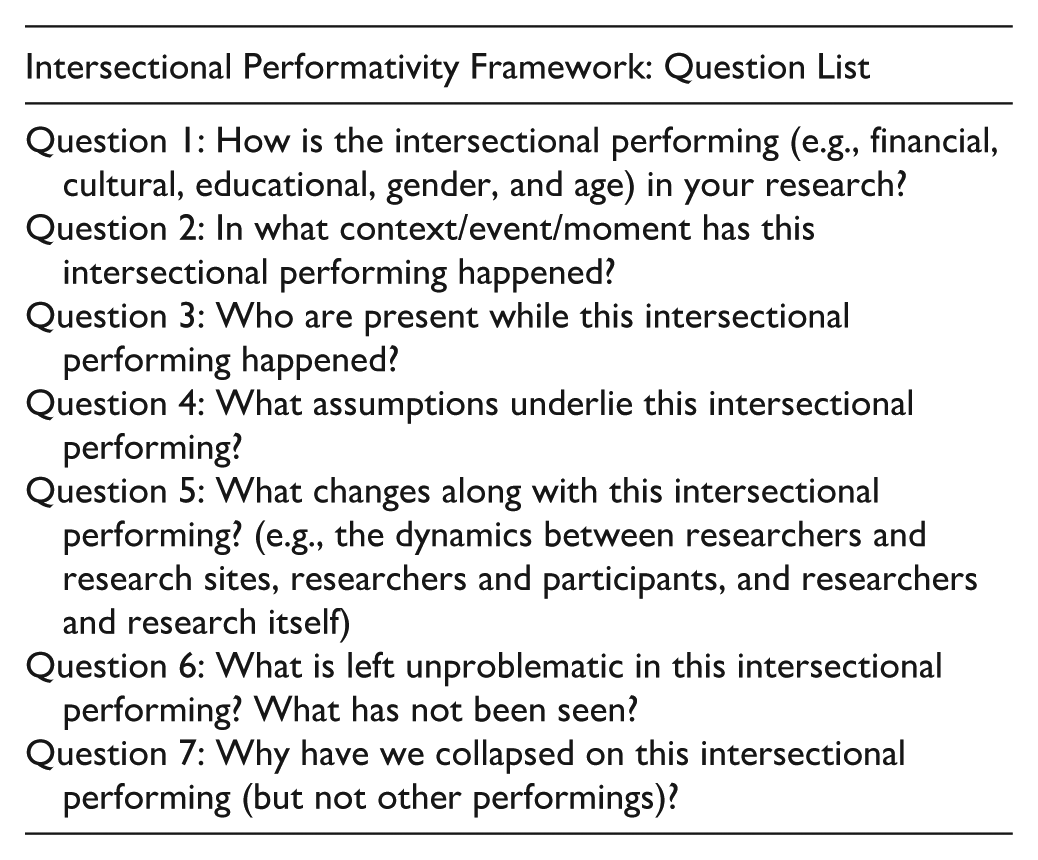
To briefly demonstrate, in the case of performing courtesy, both cultural and financial intersectional performing were involved, as maintaining relationships often involved ongoing material exchanges and reciprocal gestures (question 1). The performing occurred within the broader cultural context of relational obligation and took place, particularly during the beginning of each interaction with participants when relationship-building was being reinforced (question 2). The key actors included researchers, participants, and institutional guidelines, each subtly fabricating how courtesy was enacted and maintained (question 3). Assumptions involved cultural expectations of material reciprocity, the porous line between courtesy and guanxi, the tension between professional and personal boundaries, and an implicit positioning of participants as vulnerable recipients rather than active agents in the exchange, which we identified in the process of collective reflexivity (question 4). The power tensions changed in multiple ways: between researchers and participants (both bonding through material exchanges and reinforcing hierarchical dynamics of giver and receiver) and between researchers and institutional guidelines (question 5). In performing courtesy, our reflections revealed that we had not critically examined the extent to which participants were constantly framed as vulnerable recipients. We further reflected on moments when participants themselves engaged in performing courtesy, such as setting the terms of material exchanges, offering hospitality, or subtly navigating the giver-receiver dynamic (question 6). In performing courtesy, our attention was initially on how we, as researchers, navigated relational obligations through material exchanges. However, upon deeper reflection, we recognized the need to examine how participants actively shaped these exchanges, sometimes engaging in their own performing of courtesy that disrupted traditional giver-receiver roles (question 7).
This framework moves beyond rigid models and instead encourages critical reflexivity, intersectional performativity awareness, and context-sensitive ethical considerations. While our insights are grounded in three fieldwork cases in rural China, the questions and reflexive lens we propose can serve as a heuristic for other research contexts. By systematically interrogating how power is enacted and negotiated in different research encounters, we aim to equip researchers with a more dynamic, adaptable ethical approach, which does not seek a singular “correct” ethical stance but fosters ongoing, iterative ethical deliberation. Our findings illustrate how ethical practice emerges through situated interactions, shaped by cultural, temporal, and institutional factors.
We recognize the limitations of this study. First, due to space constraints, we were not able to fully address issues of post-fieldwork relationships, which are central to building guanxi in our research contexts. We are currently developing a separate paper to examine this dimension in greater depth. Second, our reflections were undertaken primarily after our fieldwork had been completed. While we agree that engaging with the framework iteratively throughout research design, fieldwork, and beyond would be ideal, this remains an area for future exploration. We therefore view the present analysis as a starting point that opens further possibilities for applying the framework in more sustained and longitudinal ways. In highlighting the relational, embodied, and performative dimensions of research ethics, we offer a flexible toolkit that can inspire reflexive ethical thinking in other qualitative research settings, while staying attentive to the specificities of each context. We intend to underscore the need for continuous ethical reflexivity, where researchers remain fluidly attuned to the ethical implications of our intersectional performativity and methodological choices.
Footnotes
Acknowledgements
The authors deeply appreciate their participants’ time and participation. Their sincere thanks go to Dr. Yan Zhu from the Faculty of Education and Society, University College London, for her invaluable feedback and comments, which greatly enriched this study.
Declaration of Conflicting Interests
The authors declared no potential conflicts of interest with respect to the research, authorship, and/or publication of this article.
Funding
The authors received no financial support for the research, authorship, and/or publication of this article.
Ethical Considerations
All original data used in this study by the three researchers had already received ethical approval from their respective institutions. No new data were collected.
Consent for Publication
All authors read and approved the final manuscript and consent for publication.

Data Availability Statement
The data that support the findings of this study are available from the corresponding author upon reasonable request.