




Abstract
In research about landscapes and the environment, scientific ontologies and epistemologies prevail, thus largely excluding contributions from marginalized groups, or creative expressions of what spaces mean to people. This article draws on qualitative place-based arts workshops, which used multimodal and multisensory methods with deaf children and disabled adults. The resulting co-created texts and artworks represent meaningful responses to specific local landscapes and their natural inhabitants. Considering literacies, power, and who can or cannot be an author, this article argues that such processes of creative co-production could be viewed as means of overcoming marginalization and enabling disabled people to engage with local landscapes. Inclusive literacy practices are presented as ways in to “authoring” marginalized groups’ responses to natural environments, with potentially transformative outcomes for the participants, decision-making processes, and the land itself.
Introduction
Marginalized groups, including children and young people, are seldom seriously consulted about local natural spaces and the landscapes where they live. Even though an abundance of research literature demonstrates the social, health, and educational benefits of access to natural spaces (Li et al., 2021), there are few opportunities for meaningful engagement with marginalized groups in decision-making about those spaces. This problem is exacerbated by the dominance of certain (scientific) paradigms in research (Lidskog & Sundqvist, 2018) and the use of methods which result in data which are presented by “experts” as scientific “evidence.” As Eden (1996, 1998) explains, this “scientization” and “expertization” of environmental knowledge is in part a product of a risk society in which only science can explain what has not previously been experienced, as in the case of ecological crises (Beck, 1995). This article discusses two episodes from projects 1 that challenged these traditional orientations of research about landscape, environment, and decision-making, by using arts-based methods and creating artistic outputs with a range of marginalized groups. The research overall encompassed artists and researchers working with 10 different groups, including autistic young people; college students; youth groups; medical practitioner referrals and long-term unemployed; children supported by a charity; two classes of primary school children; disabled adults; and deaf children. With a focus on the latter two groups and by considering the research and its outcomes in terms of language and literacy, this article problematises the dominance of certain forms of data and certain literacies in research and in decision-making processes about landscapes. First the article examines the notion of “marginalization,” particularly in relation to children and disability, and how marginalization is implicated in assumptions about uses of language and literacy. An analysis of two episodes “in the field” are then presented, along with reflections and implications for decision-making and research about land use.
Marginalization, Language, and Literacy
A consideration of the term “marginalised” involves noting that labeling an individual or group as “marginalised” may be a means of marginalizing them further. Marginalization must involve exclusion “from” and “by” some ideal norm of society (Messiou, 2006; Mowat, 2015). Mowat (2015) draws on Razer et al.’s (2013, p. 1152) definition of social exclusion as “a state in which individuals or groups ‘lack effective participation in key activities or benefits of the society in which they live,’” and further argues that individuals or groups need to feel marginalized to be designated as such:
To be marginalised is to have a sense that one does not belong and, in so doing, to feel that one is neither a valued member of a community and able to make a valuable contribution within that community nor able to access the range of services and/or opportunities open to others (Mowat, 2015, p. 457).
While not disagreeing with this view of marginalization, I would suggest that if individuals or groups are unaware of certain elements of social and economic life to which they could belong, they cannot feel a lack of sense of belonging. This seems to me to be the case for children and young people and adults who are excluded from making genuine contributions to decisions about the extent of the boundaries of their own lives. To be in the margins implies there is a defined space which is not being occupied. One such space is—both metaphorically and literally—the domain of access to land and decision-making about land-use.
Children and adults who are disabled or disadvantaged by socioeconomic circumstances are further marginalized by structures which dictate how they live their lives and by assumptions about their potential to change them. This includes assumptions about literacy, including what constitutes literacy and who has access to it (Ruppar, 2017). For example, as Murray (2021) points out, the U.N. Sustainable Development Goal 4 includes the target: “By 2030, ensure that all youth and a substantial proportion of adults, both men and women, achieve literacy and numeracy” (United Nations, 2015). This view of literacy as something to “achieve” is a product of literacy being seen as a specific set of skills to acquire, rather than as a range of social practices through which people make meaning for themselves and others (Barton & Hamilton, 2012; Street, 2003). Similarly, although the United Nations Convention on the Rights of the Child (UNCRC, 1989) is welcome in advocating for literacy as a universal right for children, “with a view to contributing to the elimination of ignorance and illiteracy throughout the world,” the wording here points to a limiting perception of literacy as a singular entity. In addition, linking the concepts of “ignorance and illiteracy” in this way implies causality, whereby those who do not conform to standardized measures of literacy must also be “ignorant.” Such a narrow, skills-led view of literacy and education, not only excludes the multiple modes of communication “such as gesture, gaze, movement, body positioning, words, vocalizations . . . sign, symbol” (Flewitt et al., 2009, p. 214), including those used by disabled communities (Berglund, 2023), but has also led to a form of literacy education which “is geared toward testing and economic outcomes, even while children and youth around the globe endure increasing stress, anxiety, and trauma” (United Nations Educational, Scientific and Cultural Organization [UNESCO], 2021).
To compound the problem of marginalized groups and children and young people being silenced through assumptions about literacy, traditional environmental research which is used to inform decision-making relies on scientific ontologies, epistemologies, and methods that distance their voices and perspectives. Adding further fuel to the argument for alternative approaches, Lidskog and Sundqvist (2015, 2018) point out that “this strong focus on science and the presumed linear path from science to decision-making have not delivered the expected results” (Lidskog & Sundqvist, 2018, p. 311): the climate and biodiversity crises are increasing in breadth and intensity. In response, many people choose to believe that human-made technologies will come to the rescue in the nick of time (Pierrehumbert, 2019). Such a belief in human supremacy and humans’ ability to “control” the natural world means that much research on landscape decision-making refers to the “services” that nature offers (Daily & Matson, 2008). This perspective has led to decisions about landscapes being predominantly for the benefit of people, without acknowledgment of the way in which humans are intrinsically entangled with animals, plants, and the land itself (Bertenthal, 2020; Van Dooren et al., 2016). The needs of other species which inhabit those landscapes are frequently overridden by the needs of an elite stratum of people. A specific example is the appropriation of vast swathes of land in the United Kingdom for breeding pheasant and grouse, simply for the exclusive sport of shooting them (Hayes, 2020), while globally anthropogenic land-use change is the greatest threat to nature (Davison et al., 2021). Perry (2021) appositely comments on this dissonance in relation to literacy: “It cannot simply be a coincidence that as universal functional literacy education continues to become the accepted gold standard for development and progress, our ability to sustain our planet on its current path becomes increasingly far-fetched” (p. 294).
The challenges for landscape decision-making in the research projects discussed in this article are therefore manifold: how to adapt to hearing multiple quiet voices (potentially including the more-than-human); how to include diverse perspectives in decision-making; and how to shift what aspects of land use the decisions might be about.
Context and Rationale for the Research
The rationale for addressing these challenges and their associated assumptions comprises several factors. First, it is very clear that humans have much to gain from being outdoors and connected to nature, with abundant evidence of health, cultural, educational, and social benefits (Li et al., 2021). Second, adults, children, and young people with disabilities or special educational needs potentially have the most to gain from nature (Seers et al., 2022), yet these groups are likely to face additional barriers to accessing natural environments (Hall, 2005). These barriers are not only physical difficulties in accessing outdoor spaces, but also include sociocultural discourse and perception around disabled young people as “vulnerable” and “unruly” and natural environments as “risky” for them to be in (von Benzon, 2017). Third, it is known that connecting with nature has the potential for an increased desire to protect it (Chawla, 2007; Nxumalo, 2018; Thompson et al., 2008), and therefore, opportunities for people to make such connections are likely to enhance the health and sustainability of the natural world. Fourth, children and young people are rarely directly consulted about their views on nature. For example, surveys are usually directed at adults to answer on behalf of children (Knobel et al., 2019) or to answer retrospectively in relation to their own childhood (Li et al., 2021, p. 12). And fifth, when children are involved in decision-making, for example, through participatory research to plan child-friendly public spaces, their contributions lead to more vibrant and more inclusive environments for humans and other species (Derr & Tarantini, 2016). The inclusion of a multispecies approach (Miller, 2019; Van Dooren et al., 2016) in the projects under discussion was a challenge to human dominance, designed to encourage a repositioning of perspectives to include animals and plants, and potentially rivers, rocks, and so on, as having their own stake in the natural environment.
Expanding the notions of language and literacy helps to allow us to take seriously the contributions of marginalized groups. Some literacies are privileged over others, as children soon find out as they progress through schooling. As the Reggio Emilia approach to early childhood education explains: “The child has a hundred languages (and a hundred hundred hundred more) but they steal ninety-nine” (Malaguzzi, 1994). The reduction in and funneling of means of expression available to children is part of the education system referred to by UNESCO (2021) above, which relies on the use of tests and statistics (Bradbury & Roberts-Holmes, 2017; Landri, 2018) and school days dominated by practices that can be measured and quantified. The demise of the arts in schools (research by the Fabian Society (2019) found a significant decline in both quantity and quality of arts provision according to primary school teachers in England) reflects the emphasis on one kind of data as counting more than others, and the elevation of certain kinds of language and literacy over many others which children potentially have access to. The narrowness of acceptable forms of communication is especially heightened for disabled people, including those who have access to sign language (e.g., British Sign Language) but less access to spoken or written English. Despite deaf children using “multiple languages involving different types of semiotic systems and modes (oral, signed, written, pictorial, etc.)” (Kim, 2012, p. 405), they join other disabled groups in being at a substantial disadvantage in an arena of decision-making.
The noun and verb “author” (“a person who brings anything into being; a beginner of any action or state of things” [first two meanings in Chambers Dictionary, 2014]) has the same root as “authority,” deriving from the Latin “auctor, from augere, auctum to increase, to produce” (Chambers Dictionary, 2014). Authority is defined as “legal power or right; power derived from office or character or prestige; . . . permission” (Chambers Dictionary, 2014). These projects aimed to provide a measure of that “authority” to groups who do not normally have that power or permission to contribute to decisions about landscapes. Authorship is normally denied to those without conventional, dominant literacy skills (Satchwell, 2019; Doak, 2023). Yet those individuals are the supreme authority when it comes to their own perspectives and experiences, and simply what it is like being them.
Thus, the use of arts-based methods in these projects was designed to allow a range of participants to find alternative ways of making meaning, without recourse to conventional literacy, which is “deeply and inescapably bound up with producing, reproducing and maintaining unequal arrangements of power” (Tett et al., 2012, p. 2). Art, rather than relying on reason and argument, can be seen as a different kind of language. As the painter Edward Hopper stated: “If you could say it in words there would be no need to paint” (Edward Hopper, painter, by Leavy, 2015, p. 228). The projects discussed in this article aimed to use various different artistic approaches and thereby to open up opportunities for using multiple languages and literacies to understand and incorporate perspectives of marginalized groups.
Overview of the Research Projects
The activities featuring in this article were designed to enable diverse groups of people to experience local natural environments near to where they lived and to capture their perspectives through artistic media. The focus on “multispecies storytelling” was interpreted in various ways by several artists who worked with the target groups to imagine what animals or plants (rather than humans) might want to say about the landscapes they inhabit. As with all research involving children, young people, vulnerable adults, and community partners, ethical considerations were paramount in ensuring that all activities were inclusive, safe, and of benefit to participants. University ethics boards provided rigorous ethical scrutiny and approval was granted before any research began.
The ultimate aim of the Landscape Decisions Program was to bring multiple perspectives to bear on decisions made about land. However, when we initially discussed the aims of the projects with community groups, they were bewildered by what any of this had to do with them. The concepts of “landscape” and “decision-making” were not prominent in their consciousness and had certainly not been linked together in their minds prior to this. Even though all the groups we worked with lived close to areas of outstanding natural beauty, most members of those groups had seldom, if ever, visited those areas. The first step in the project therefore was to take groups into natural areas in their neighborhood. And instead of asking them to write an argument or even to contribute to a focused discussion, we introduced them to artists who worked with them to understand something about the spaces they were in.
Rather than focusing on reasoning and argument, the approach of the artists was to let the participants feel. As one of the artists explained to the group she was working with: “Art helps us to think about things in different ways. It helps us to see what’s there in a different way. Artists think about how things make you feel” (Sue Flowers, artist).
Methods
Each of the 10 groups of participants was paired with an artist: those taking part in the project included visual artists, a sound artist, film-makers, a poet, a storyteller, a videogame creator, and woodland craftspeople. Together with “their” artist and one or two researchers, each group visited a specific site close to where they lived: a community farm; nature reserves; a wetland center; a community allotment; a coastal landscape; woodlands; a park. Over several workshops and through a varied range of activities and processes devised and led by the artists, the groups co-created artistic responses to these landscapes. The brief for the artists was to facilitate the co-creation of artistic works through experiential workshops in outdoor “natural” settings. To achieve this, activities included, for example, walking and talking together with the workshop leaders and one another as they explored different areas, stopping to look, listen, feel, taste, and imagine as they moved through the landscape. They told and listened to stories; drew pictures; whittled wood; made poems and constructed models. Toward the end of the two projects, the artist had the role of drawing together the creations and thoughts of the group into original artworks that were exhibited in a series of physical locations and as a virtual exhibition on a website (see https://fromthelandtothesky.org).
The role of the author of this article was as principal or co-investigator on the projects and as participant observer in the workshops. Broadly, the methodological approach for the researchers was ethnographic—observing, experiencing, being, and doing alongside the participants in real time. The concept of sensory ethnography (Pink, 2015) is relevant in that the experiences of the participants, including the researcher, were overtly multisensory. The artists helped participants to feel and occupy the landscapes through a range of different methods, which involved all the senses—hearing, seeing, touching, tasting, smelling, and proprioception (sensing the positioning and movement of body parts)—as well as acknowledging feelings and emotions in their making and creating activities. At the end of each session, the researcher(s) who attended wrote up fieldnotes and transcribed recordings which included informal “interviews” or snippets of conversation with participants. These included people accompanying the participants, such as teachers or disability support workers, as well as the participants themselves and the artists who worked with them.
This article focuses on just two episodes with two of these groups—deaf children and disabled adults. The title of each episode below is the title given to the final artwork co-created by the artist with the group.
Episode 1: Journey Words
A group of six deaf children, aged 9 to 11, from a primary school for deaf children and an artist who identifies as partially deaf, took two trips to a wetland center. The children were accompanied by three (and on the second occasion two) hearing teachers, who interpreted for and signed with the children and supported them throughout. The artist was at the time pursuing a level 2 British Sign Language course and presented herself to the children as a learner. Nonetheless, her use and knowledge of sign language and her insider status as a deaf person, combined with an exceptionally friendly and inclusive manner, meant that the communication was accessible and enjoyable for all participants. The children shared their own signs and made suggestions when the artist was unsure of a sign; the researchers were welcomed despite not being fluent in sign language; and the interpreters eased communication among us all.
After initial introductions to the project and one another, we all went on a walk around the reserve. Inspired by a knowledgeable and creative commentary from the artist, with arms outstretched, we imagined what it would be like to be one of the Whooper swans that had made the 900-mile journey from Iceland to arrive at the wetland where they would spend the winter. Along the way, one of the children got “stuck in the mud,” an event which featured later in his story of the journey (see Figure 1), and also featured in our collective memories of the day. We watched a pair of otters in an enclosure and learned about how the animals use and play with pebbles. The children each chose a pebble to hold and imagined how they could use it to play games or catch food as an otter.
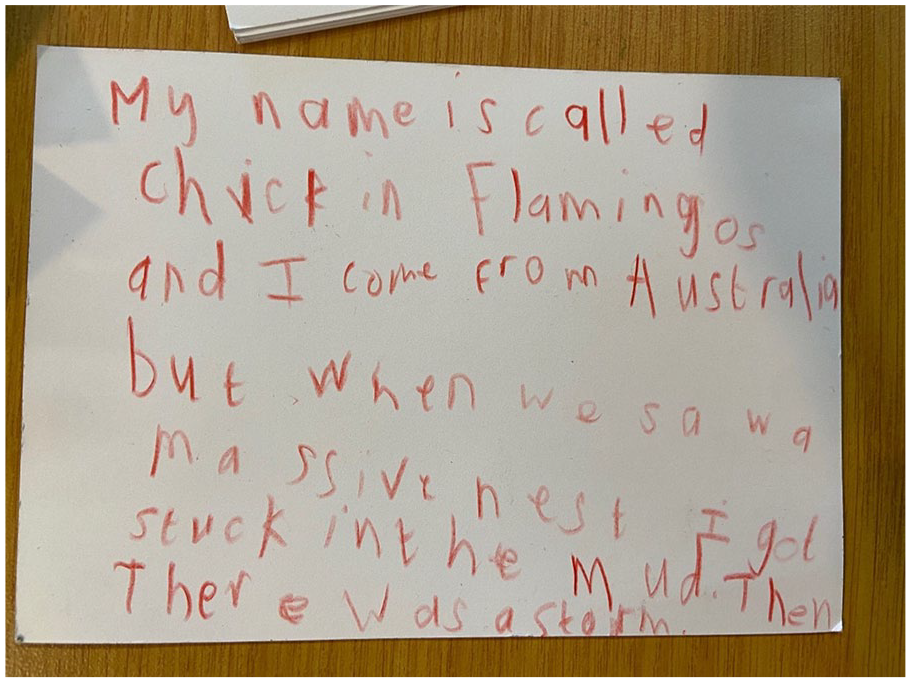
Postcard from a bird.
The children were fascinated by the flamingos. While we were watching them, one child stood on one leg in imitation, then all the children and adults followed suit (see Figure 2). No one knew a sign for “flamingo,” so together with the artist, the children devised a hand sign for “pink swan.” Moreover, by standing on one leg, they also invented a new embodied sign for something like “being a flamingo.” This added to their experiences of “being a swan” and “being an otter.” These activities were colored by a sense of excitement and discovery which was observable as smiles, hugs, and laughter.
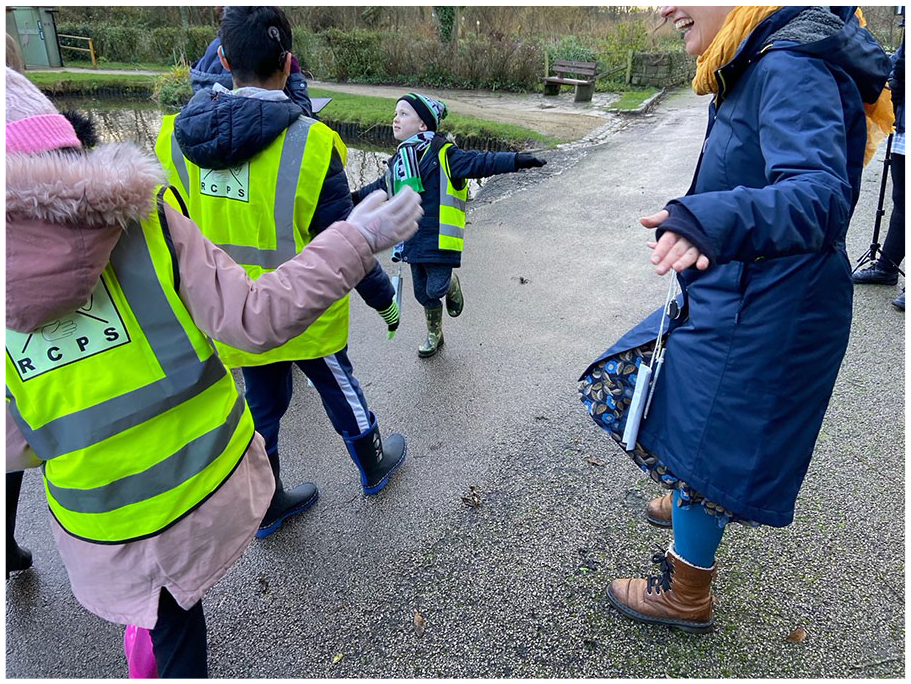
Being a flamingo.
Arriving back at the building on the nature reserve, the group drew on what they had learned through signed communication with adults and one another, what they had seen, and what they had felt during their exploration of the environment. The artist engaged them in making homes for creatures out of an assortment of tubes, string, paper, and glue; and encouraged them to draw and write stories (see Figures 1 and 3). In these ways, they were imagining what life was like for different species: what kind of home would make them feel safe if they were insects; or what “home” means for a migratory bird that spends long periods of time traveling. Through a spinning story wheel, they were each given an environmental “challenge” to deal with in their stories, such as flooding, overheating, or drought, and to think about what this might mean for their animal protagonists. While some of the children chose to write a story, several preferred to draw a sequence of pictures. One child wrote a postcard in what they called “duck code.” The multimodal literacies employed by these children—in part due to them being deaf but also simply because they were children (Kim, 2012, p. 406)—thus extended to signing, speaking, drawing, writing, and enacting or performing in response to their journey through the wetland.
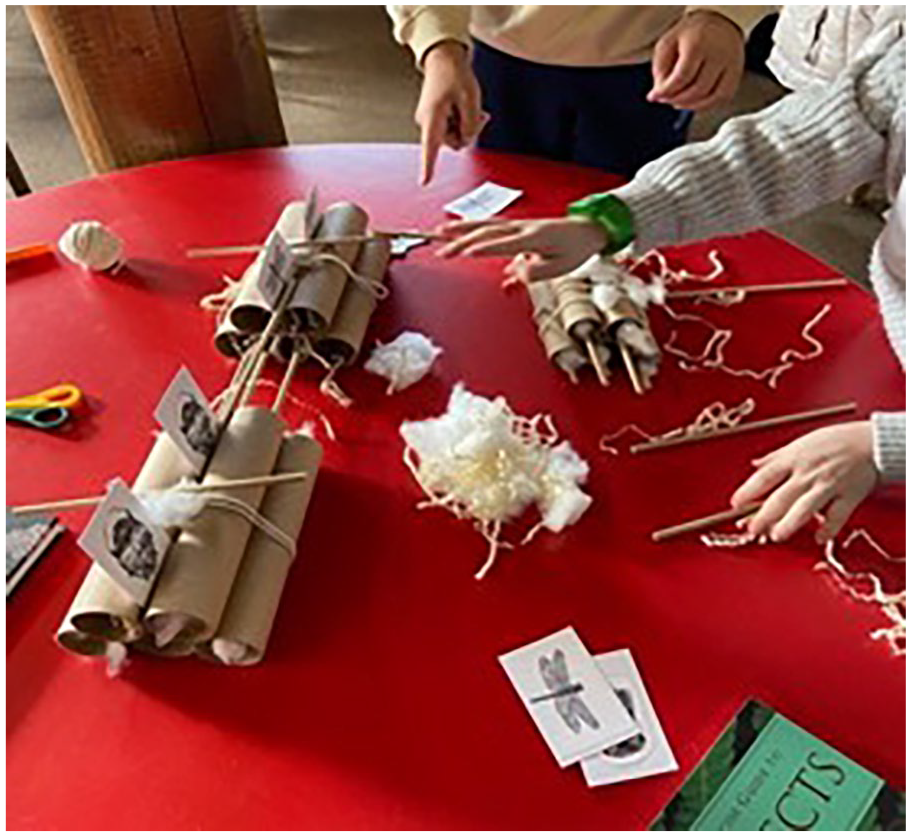
Making animal homes.
Over time, the embodied flamingo sign came to mean much more. Whenever I met with the children afterwards—for example, on the next visit to the wetlands center and then at their school some months later for a different research project—one of the children would stand on one leg and then we all stood on one leg and grinned at each other. It had become a sign that meant “remember what a great time we had at the nature reserve”—embodying the experience and the feelings that went with it. Invariably, it led to one of us also remembering when the boy got “stuck in the mud.” In semiotic terms, what was signified by the hand sign for “pink swan” was a flamingo; while the embodied sign of physically standing on one leg signified “our day out.” This understanding was highly contextual, confined to people who had been present for the original experience, and subsequently those who were told about it. A comparable incident was reported by Walker and Adelman (1975), who studied classroom interaction: pupils called out “strawberries” in response to one of them receiving a reprimand for the state of his homework. While the observer at the time could not understand the meaning, the whole class recognized that the word “strawberries” signified the longer utterance of the teacher on a previous occasion: “Your work is like strawberries. Good as far as it goes but it doesn’t last nearly long enough.” The connotative power of this single word was paralleled by the deaf children’s embodied sign, carrying not only situated meaning but also an affective dimension, conveying a sense of togetherness, mutual understanding, and remembrance.
Thus the embodied flamingo sign came to represent a narrative of the “event” of visiting the wetland site: “experience becoming an event to be told, being told and being retold until it took shape as a narrative” (Hymes, 2003, p. 116). Arguing for the value of ethnography, Hymes (2003) suggests that even if we could collect “little texts” like this in spoken or written language, “such an approach would not discover the texture of the text, the way in which it is embodied in the rhythm of continuing life” (p. 116). As a marginalized group, these deaf children’s “texts” of their “observation and reflection of life” (Hymes, 2003, p. 116) might easily be overlooked, unrecorded, and unacknowledged. The use of conventional literacies to record their experiences—or their subsequent related schoolwork—could never capture the “real” individual and collective meaning of their days at the nature reserve. The use of creative approaches could be said to have facilitated an alternative language and literacy for conveying their perspectives. While these “little texts” told a part of the story, the “texture of the text” and its embodiment “in the rhythm of continuing life” would be lost to all but those who were there at the time, and accessible in terms of research only through sustained engagement with these children. Nonetheless, there was a discernible change in the children. And, arguably, the production of art alongside the embodiment and multimodal semiotic expression was a means of harnessing the ongoing resonances of the children’s experiences.
During and after conducting the series of workshops, the artist reflected on the experience herself and developed her own artistic response in the form of a series of nine framed pictures comprising mossy twigs in different configurations. In the catalog for the exhibition which eventually showcased the work, the artist stated:
[When working with these deaf children] this tendency towards negotiation and the ease in agreeing shared signs made me wonder what it would be like if we could work with birds in a shared language that was accessible both to us and to them. (“From the land to the sky” exhibition catalogue, 2022).
The explicit expression of a desire for “a shared accessible language” can be considered to relate not only to birds and humans, but also to all people, including those who are deaf or disabled.
Episode 2: If We Were a Forest
A second example from the project involved working with a group of 10 disabled adults in a wooded nature reserve. Over several workshops, the allocated artist led activities focusing on the five senses, as well as feelings inspired by their surroundings. For example, she invited them to stand (or sit in their wheelchairs) in the woods with their eyes closed, and to imagine they were a tree. For several, this involved them raising their arms and swaying in the gentle breeze. The simple act of “being a tree” for a few moments in this way, along with touching the bark of trees, feeling foliage against their skin and listening to bird song and the sounds of the woods, was designed to help them think differently about their environment and their place within it. Later they gathered in a circle in another part of the woods, and the artist group leader worked with a sound artist to create an audio recording of the group making the sounds of birds, animals, wind, and rain. The participants engaged enthusiastically in this activity, each adopting a different sound to contribute to the soundscape. They willingly repeated parts for the recording, building layers of sounds together until the whole group was happy with the performance.
As a participant observer in this context, I noted how at ease the individual participants were in these creative expressions. As we walked through the woods in between activities, I talked to several of them. One explained that her anxiety had nearly prevented her from coming along that day; another said she had not wanted to come because she had a fear of thunderstorms. But both overcame their worries—“to be with my friends.” A woman told me about her sadness at not being able to see her family due to the recent COVID-19 restrictions and her worries about her place in sheltered housing, which was under threat. Despite these real ongoing difficulties in their lives, once in the woodland together, supported by charity workers, the artist and one another, they seemed to feel genuinely relaxed and able to experiment playfully in the landscape.
I, on the contrary, found it somewhat embarrassing to be asked to make bird noises and to pretend to be a tree. Outside of my conventional academic literacy comfort zone, I found I envied their ability to submit to a different form of expression. This again raises issues of power and value attached to different ways of being and different literacies (Perry, 2021). On returning to the “base camp” (a tarpaulin and a circle of chairs in a field) for a break and further activities, I noted that I began to feel more at ease when faced with the recognizable schooled literacy practices of drawing and writing tree-related depictions of the experience, as provoked by the group leader. While my (academic) comfort increased, the ease observed in the woods for several of the participants dwindled, as they began to revisit ingrained discourses of “I can’t spell”; “I can’t write very well”; or “mine’s a really bad drawing,” re-emphasizing the power of literacies to differentiate between groups of people. And yet, with encouragement and an emphasis on feelings rather than print literacy, the group did indeed produce drawing and poems. Perhaps the “living literacies” (Pahl & Rowsell, 2020) or “sensory literacies” (Mills et al., 2017) of the preceding activities had opened a pathway which led more easily to expressions through conventional literacy practices.
The role of the artist was to capture and distill the connections participants made with one another and with the natural environment. Using filmed sequences which the group took part in, along with their artistic impressions and poems and the soundscape that they had co-created in the woods, the artist created a beautiful composite film called “If we were a forest . . .” In the final exhibition, the film was accessible via a wooden box and a hologram effect.
Reflections on Shared Language and Empathy
I suggest that the experience of visiting these nature reserves, and the relationships between artist, participants, and researchers, allowed the group members to create a shared language which connected them both to one another and to the natural world. For the disabled adults as well as for the deaf children, this language may not have been available to them without the experience of visiting the woods or the wetland center; nor if their means of expression had been confined to more conventional school-based reading and writing. Furthermore, in line with the project’s aim of exploring the perspectives of species other than humans, the experience of “being” an animal or a tree led them to think about the environment in different ways. The resulting “animals’ homes,” pictures, poems, and stories (see examples in Figures 1 and 3) demonstrated a new engagement with and therefore a more empathetic relationship with the natural world and its inhabitants. For the deaf children, the continued use of the embodied sign allowed the child to (re-)inhabit (at least in their imagination) the world of another species long after the end of the project. The fact that the embodied sign arose from being with the birds in a natural setting gave it particular significance in light of the aims of the project: without the children’s visit to the wetland and being able to observe firsthand the stance of the flamingo, the sign would never have been invented.
The impact of the workshops was reinforced when I revisited these children at their school for a different project a few months later. The topic this time was about children identifying aspects contributing to the “quality” of local outdoor spaces (see Satchwell et al., 2022). As a part of that project, we asked children to create pictures of an imaginary outdoor space. In response, one of the deaf children created a collage which she explained to me as she made it. Her picture included a representation of a home for otters at the base of a tree, an abundance of birds in the sky, and a flamingo. It was clear that her notion of an ideal outdoor space was heavily influenced by her experience at the wetland center where we had seen all these different species. This was no doubt partly explained by my presence in both locations (the wetland center and the school classroom) provoking a shared memory; yet it also indicated a lasting sense of connection to these species and the environment where she had met them. A normal visit to the local park would not include encounters with otters or flamingos. We might argue, therefore, that the experience at the wetland center through the activities with the artist had affected this child’s understanding of nature, other species and the landscape. I suggest that the additional embodiment of the experience through the new co-created hand sign for flamingo and the more holistic sign of standing on one leg which came to represent the whole day, increased the lasting impact of the experience. As a first step toward being involved in decision-making about landscapes, a demonstrable change appeared to have taken place.
The disabled adults’ free expression through multimodal and multisensory means showed a genuine connection with the natural world. The shared experiences of the group once again contributed to closer human bonds as well as an affinity with nature, expressed in terms of their delight and enjoyment of the experience while also commenting on the peace and “opportunity to breathe” which it afforded. For example, one said: “It makes me feel more calm in myself. There’s no noise around you”; and another commented: “It’s really good for people to hear birds. It’s good for people to come.”
Overall, the experiences for the participants—not just in these two examples but in all 10 groups across the two projects—were overwhelmingly positive, with comments from participants on the social, emotional, health, and well-being benefits; and observable similar effects on the children (see Satchwell et al., 2024, for further details). The artistic approaches helped to express these connections with one another and with the natural world. The multisensory nature of the activities and the use of alternative means of expression allowed immersion in the natural world, which was possible only because we were conducting them in those spaces. There have been numerous attempts to recreate such experiences using virtual reality—but there are clear additional benefits to being physically in nature (Browning et al., 2020). Indeed, the projects under discussion here took place in part during the COVID-19 pandemic, and it was apparent from our experiences of conducting arts-led workshops online (see Satchwell, 2022 for details) that multisensory contact with the outdoor world was a critical element in the outcomes of this research.
In all of the workshops, it was possible to discern an enhanced sense of care and attention to different species and their habitats. As the participants engaged with the outdoor spaces and understood more about them through their interaction with the landscape and with the workshop leaders, there was a greater desire to protect them. For example, one of the adults said: “I’ve appreciated trees more and I look at them and think how wonderful to see them grow”; while the deaf children’s engagement with insects, otters, swans, and flamingos was reflected in their stories, models, and drawings. For some, the flowering of a multispecies awareness enabled a certain indignance to arise about the way humans treated the landscape. For example, a group of college students imagined how it might feel to have a stranger tramping around in your home, as we walked through a woodland where deer lived; and school children commented vehemently on tree-felling and left litter which interfered with the habitats of birds and animals. This in turn might be assumed to lead to a demand for change: if only the demands were listened to.
Implications for Literacy, Language, and Landscape
Observations of the workshops and the responses of the participants indicated that, given the chance, marginalized groups can engage in debates about land-use and conservation. The creative methods and artistic approaches employed facilitated multisensory and multimodal literacies, and played a part in alleviating power imbalances, both in the field of the research, and in the sense of which literacies hold most sway. The outcomes indicate a need to embrace different ways of making meaning, and “capturing a language of belonging” (Pool, 2018), which does not necessarily rely on spoken or written words. In relation to the “hundred languages” of children (Malaguzzi, 1998), Edwards et al. (1998) proposed that “children’s self-expression and communication in a variety of media (e.g., speech, drawing) should be recognised as a ‘language.’” Similarly, Clark and Moss (2011) developed the “mosaic approach” as a participatory multimethod framework for listening to “the different ‘voices’ or languages of children” (p. 7), through the many creative ways in which they choose to express themselves. Roe (2006) used an adapted mosaic approach as a way of “responding to the ‘languages’ of children” to express their views on their local landscape.
The notion of recognizing different languages is relevant in the context of my own research. Indeed, the participants could be said to have created new ways of communicating the new experiences they were encountering. For the deaf children, the embodied flamingo sign—and to a lesser extent the “pink swan” hand sign—literally represented something that they could not express in words. The multimodal semiotic sign was taken up by the children as a way of making and sharing meaning—relying not on any conventional language or literacy, but through their own invention. Drawing on their linguistic competence in using sign language(s), the children extended their “embodied multilingual repertoires” (Kusters & De Meulder, 2019), which may not have been accessible to those who do not use sign language, nor without the encounter with the flamingos. The sign—while representational of a bird—became metaphorical or allegorical in its reference to a whole experience. Having witnessed the origin and subsequent resonances of the sign in use, I suggest that this example demonstrates, as discussed by Perry (2021), “the inadequacy of the word alone to be functional in any general or universal manner,” because the gap between sign (word) and meaning is “a space of movement, interrelationality, and affect” (p. 301). Following Semetsky’s (2007) claim that “meanings are conferred not by reference to some external object but by the relational, or rhizomatic, network constituting a sign-process” (p. 200), Perry argues for the concept of “pluriversal literacies” to accommodate multiple sign systems and the need to “chip away at the inherited conceptual divide between mind and body, human and nonhuman: embodied, material, and place” (Perry, 2021, p. 301). The experiences of the disabled adults through multisensory activities similarly demonstrate the need for plural literacies which allow for “ways to incorporate a much broader understanding of relational human experience” (Perry, 2021, p. 307).
Implications for Research and Decision-Making
These examples from the two landscape projects I have been involved in are raising questions about the limitations of narrowly defined language (Hackett et al., 2020) and what counts as data in research (MacLure, 2013), and by extension what counts in decision-making. The holistic experience of the projects and their outputs indicated to me as a researcher that the outings to the natural outdoor environments had had a notable impact on the participants. Yet the significance might easily be lost through not being captured or conveyed in recognized privileged language practices, or through statistical data.
The projects were attempting to use different (artistic) means of communicating perspectives on landscapes, including feelings they invoke. In the same way that the flamingo is a sign for something that cannot easily be captured in words, an artwork can convey layers of meaning that are difficult to convey, particularly for people, including children and disabled people, who may find it difficult to express themselves in conventional language. The place of art in this project might be seen as “aesthetic intervention” (Leavy, 2015 on bell hooks (1995]) with people for whom traditional art can be a “site of exclusion” (Leavy, 2015, p. 227). But, as Leavy points out, art also has potential “transformative power” to dislodge convention and stereotypes. Our aim was certainly to challenge conventional research methods and outputs and, through the exhibitions, to allow not only the participants but the general public and decision-makers to see the world differently.
Nonetheless, an ongoing challenge is how those artworks might be translated into meaningful messages to make a difference in the decision-making forum. Exhibitions of the artworks were held in a range of physical locations and audiences were invited to view and interact with them. This was an attempt to find different ways of conveying important messages; yet because literacy is so bound up with power and policy-making, it is very difficult to disrupt the primacy of written and spoken words. Indeed, even exhibitions are mediated by words. At the opening launch, I found myself wanting to explain to visitors through linguistic means what the artworks meant and how they were constructed. The artworks might serve as a provocation for (linguistic) debate, but capturing the meaning of the artworks in decision-making processes still seems to rely on articulation through more conventional means (including this academic article). Nevertheless, through embracing different ways of making meaning we are using inclusive (Flewitt et al., 2009) or even pluriversal (Perry, 2021) literacies which could be argued to be reducing marginalization.
There was a poignancy in the fact that the deaf children were soon to move onto secondary school, where most would be expected to take part in mainstream school life in ways that fit in with the hearing community. As Kim (2012) points out: “young deaf students, like young students in general, engage in communicative practices employing a broad range of social and symbolic resources that they flexibly and purposefully use and adapt to accomplish their goals as young authors and meaning makers” (p. 406). During the workshop activities, the deaf children’s teachers repeatedly reminded them to both sign and speak whenever they could to help themselves when the demands on them would be greater—and less supported—than in a shared community where they could construct meanings together. In secondary school, with its standardized curriculum, opportunities for co-construction of shared signs, and indeed the place of creativity and collaboration, are likely to be significantly reduced.
Returning to the notion of authority and authorship, namely who can or cannot be an author, may be useful in considering the contributions of marginalized groups to decision-making. While Barthes (1967) suggested that “the author is dead,” others have pointed out that such erasure can be a form of oppression, for example, when the authors are women (Walker, 1990) or disabled young people (Satchwell, 2019; Doak, 2023). If children and marginalized individuals or groups are not acknowledged as potential authors because they do not have access to the literacies of authorship, the provision of serious alternatives is required. This is especially pressing when there are tangible health, social, and environmental benefits at stake, as is the case in increased access to outdoor spaces. As I have argued elsewhere in relation to disabled young people’s stories, “collaborative co-construction offers an opportunity for an otherwise silenced voice to be heard” (Satchwell, 2019). Furthermore, Doak (2023) argues for “distributed authorship” for learning-disabled young people, including those who do not use spoken or written language, to be recognized as authors of their own stories. In the research discussed in this article, the notion of “collaborative co-construction” or “distributed authorship” moves beyond the bounds of story-writing to the arena of creating artworks relating to landscapes. Having the authority to make a mark both about and on the land, marginalized groups can contribute their views to debates about those landscapes. In this sense, we may consider these processes as ways in to authoring the landscape for marginalized groups.
Conclusion
The benefits of being outside in natural spaces for the participants in these projects are undoubted. Similarly, important were the opportunities the projects afforded to artists and groups to collaborate and co-construct meanings in ways that captured and enhanced their experiences of the natural world. Being together in natural outdoor spaces was an important part of what made these events memorable and meaningful. However, it is an unfortunate fact that without the dedicated funding for this project, the workshops would not have taken place. The outdoor areas were largely inaccessible by public transport, and the deaf children relied substantially on their school to give them experiences of the natural world. This was noted in the deaf girl’s collage several months later, which harked back to her experience in the nature reserve. Similarly, a deaf boy in the class created a collage representing a beach and beach huts, which was inspired by a separate school trip to the seaside. The disabled adults were also constricted: “I don’t think there’s a bus that comes here. I didn’t even know it was here.” Attendance at, and smooth facilitation of, the workshops also required the support offered by the charity workers who ran the group of which they were members. So, even that first step of visiting these special environments is problematic beyond the end of the project, without dedicated funding, public transport routes, or available assistance.
Being in the environments enabled participants to experience and feel something otherwise unavailable to them and therefore in relation to which they were marginalized. The project also enabled their perspectives to be taken out of the immediate context and placed in an art gallery for the general public to view—another wholly new experience. A remaining question is how far the creation and exhibition of such artworks can have an impact on how decisions are made. Hopefully, at least, it introduces a drop of humility when the audience can see that the creative imagination and the spirit of collaborative work has a power to unlock connections between humans, and between humans and other species.
In these ways, dominant power hierarchies in the realm of land use are challenged. The empathetic responses to the plight of other species through the project helped the participants to question the assumption of the human as the most important species to which all others should bend to service. And by occupying the spaces from which they were marginalized, these groups are entering new territory—literally as they step onto new land, and metaphorically in the sense of joining a conversation about land use that is normally reserved for others. The projects discussed here might claim a tiny change, therefore, in reducing the marginalization of these specific groups in this specific sphere of life. While this research was located in the north of England, UK, disparities in other global contexts are likely to be equally or more marked, requiring urgent measures to redress them. The implications for children and disabled people, as well as nature itself, are therefore universal.
By introducing participants to landscapes that are new to them despite being in their own neighborhoods, the projects have provided them with knowledge that gives them some authority on those places. That authority is a first step toward being an author, and the new languages and literacies that become available to them through collaborative participatory artistic processes are means of marginalized voices authoring the landscape. The use of multimodal and multisensory research methods offers ways of exploring and connecting with the landscape, while also expanding the notion of inclusive literacy for the benefit of all people, and potentially the earth.
Footnotes
Declaration of Conflicting Interests
The author(s) declared no potential conflicts of interest with respect to the research, authorship, and/or publication of this article.
Funding
The author disclosed receipt of the following financial support for the research, authorship, and/or publication of this article: The author received funding from UKRI AHRC for the research underpinning this article (Project Refs: AH/T012293/1 and AH/T00634X/1).
