




Abstract
In this essay, I discuss my writing of a five-part activist poem, “Private and Confidential,” as a poetic inquiry that functions as a call to action. This poem rewrites/responds to an Iranian governmental memo detailing persecution against followers of the Bahá’í Faith in Iran. In this essay, I document my journey navigating the complex and often competing demands of poetry and politics, trialing writing techniques, and drawing on the work of Seamus Heaney and Michel Foucault. This essay contributes new knowledge to qualitative research concerning (a) the relationship between method and findings, and (b) how to achieve real-world impact.
Introduction
6 March 2021 It’s not that I have nothing to say. It’s that everything I have is too massive and too painful and too easily cut down. The memo’s words make my words feel futile . . . Institutional cruelty is so much more disabling than impassioned cruelty. I can rail against anger. But the Council’s agenda of session #128 on 16/11/69 takes the wind out of my voice. These words lay out the problem. I need them. But these words kill my words. I reject them.
In January 2021, I started work on a new poem for my doctoral research project. This poem would respond to a political issue and, if successful, function as a call to action. As a novice poet who had been warned off political poetry by more than one established poet, this was no small undertaking. Even Sartre (1949) did not require commitment of poets. And yet, the human rights issue at the heart of my work had become so personally significant to me that I needed my poetry to do more in the world than influence from the “other side of the human condition” (Sartre, 1949, p. 18). I had spent 6 years in the course of my doctoral research bringing myself (virtually) closer and closer to the situation of Bahá’ís suffering in Iran and, in the process, I had come to recognize my personal and ethical responsibility to make myself useful (however limited that use might be) to those whose persecution I was witnessing from afar.
To offer a little background, and forgive me for keeping this so brief, Bahá’ís make up the largest religious minority in Iran, with more than 300,000 members (“Bahá’í World News Service,” n.d.), and yet Article 13 of the Iranian Constitution (Constitution of the Islamic Republic of Iran, 1979) lists Zoroastrians, Jews, and Christians as “the only recognized religious minorities,” making Bahá’ís effectively stateless within their own state.
1
The reason for this is largely because Bahá’ís follow new prophets (after Muḥammad) and are therefore considered to be koffār (unbelievers) and a threat to Islam (MacEoin, 1988). An undated fatwa from Iranian Supreme Leader Ayatollah Khamenei reads: All members of the perverse Bahai sect are condemned as blasphemous and ritually unclean. Any food items or other objects that have been in contact with contagious dampness [sic] and have been touched by them should be avoided. It is incumbent upon the believers to counteract the machinations and perversity of this misguided sect. (Bahá’í International Community [BIC], 2016)
In the course of my research, I read about Bahá’ís being imprisoned or executed on the grounds of their faith (Ghahraman, 2016), and grievous criminal cases being dismissed or trivialized when it was discovered that the hurt parties were Bahá’ís. 2 I read reports of Bahá’í children being harassed at school (Bowman, 2021), and discovered that Bahá’ís are prohibited from attending university or opening their own educational institutions (US Department of State, 2020). I learnt that Iranians who associate with members of the Bahá’í Faith are liable to face charges themselves, although Sanyal (2019) has argued that some of the ulema, or religious scholars, in Iran are beginning to address “the Bahá’í question,” as it is termed by the Iranian government, despite the threat of imprisonment.
Then, in 2019, I read about a Bahá’í man, Hedi Moani, who fled persecution in Iran to travel and then open a shop in the little village suburb of Devonport in Tamaki Makarau (Auckland) in Aotearoa New Zealand. In Aotearoa, he devoted his life to peaceful race relations, organizing a rally for Human Rights Day (1997) and working to establish an ongoing race relations commemorative day (Hedi Moani Charitable Trust, n.d.). In 1998, he was tragically murdered in his home for reasons related to his faith (“Race Unity Speech Awards Marks 20 Years Since Tragic Passing,” 2018), a year before the first Aotearoa Race Unity Day that he had fought so hard to establish. I grew up in Devonport in the early 2000s, walked the streets Hedi once walked, passed by the shop he once owned, and crossed the harbor on the ferry every morning to go to school and then university. Hedi’s story brought the issue home to me. It became one of many influences guiding me to the realization that the persecution of Bahá’ís in Iran was no longer an issue at a distance to me (geographically or scholarly) but a social justice issue that had become a part of my story, too.
The deeper I went in my contextual research, the more I needed my practice-based research, my poetry, to align with my position as an engaged qualitative researcher. Political or activism-based qualitative research inquiries are not uncommon, where we have “critical arts-based inquiries,” which position the researcher as a participant or influencer in political forms of activism (Finley, 2018), and “action-based learning,” which Barrett (2007) defines as “activity driven by real-world problems or challenges in which the learner is actively engaged in finding a solution” (p. 5). I began to question the traditional positioning of poetry as purely aesthetic: why should poetry not serve a purpose? Why should poetry be considered too esoteric an art form to be touched by moral responsibilities? Like Sartre’s (1949) imagined prose writer, I was determined to produce creative writing that would act in the world, not delight only in its own creation.
As an Aotearoa New Zealand woman writing transnationally, I acknowledge the barriers of geography, culture, language, and faith that separate me from the plight of the Bahá’í people. I have written about the ethical issues raised by my position, and the means by which empathy has allowed me to reflect on and to work through some of these concerns (Geers, 2023b). In this essay, I document my 2-year journey writing a single poem, “Private and Confidential,” intended as a call to action in support of followers of the Bahá’í Faith in Iran, who suffer systemic persecution. The poem makes use of a leaked Iranian governmental memo from the early 1990s that details the planned persecution of the Bahá’í people, translated into English from the original Persian by the Iran Human Rights Documentation Center (IranHRDC, 2006, Appendix 7). In the first section of this essay, I establish the research frame and situate the writing of this poem as a poetic inquiry. In the following sections, I present trials in the writing process, drawing on the practical and philosophical considerations of Heaney (1989) and Foucault (1979, 2000) concerning issues of aesthetics and power dynamics. Throughout the essay, I offer extracts from my drafts and my creative research journal, sometimes engaging with them in the body text, and sometimes simply giving them space on the page. As a qualitative research inquiry, this essay documents the knowledges gained in the relationship between my writing process (methodology) and the final poem (result). Poetic inquiries that function as a call to action have the potential to achieve real-world impact, even if only by adding one more voice to the political response.
Poetic Inquiry
The arguments for and against poetry having a political purpose have been rehearsed for millennia. They can be found in Plato’s expulsion of the poets from his ideal republic on the grounds that their performance of mimesis and spectacle is designed to lead good, rational thinkers astray (Republic, 607b–d), and in Aristotle’s (1448b) Poetics, where the argument for imitation as a means of learning about the world also applies to poetry. Even poets who have fought long and hard against Platonic rationalism may balk at the idea of poetry-as-activism. Many such opinions are based on the misguided view that poetry, in its complexity, is too esoteric and “highbrow” an artform to dirty its hands with real-world problems. Alvarez (1968) neatly summarized this argument in his introduction to the poetry of Zbigniew Herbert: In Western Europe we take for granted that there is a fundamental split between poetry and politics. The problem is not that the twain can never meet but that they can do so only at a great cost. The complexity, tension and precision of modern poetry simply doesn’t go with the language of politics, with its vague rhetoric and dependence on clichés . . . It amounts to the belief that political poetry, as poetry, must be relatively but debilitatingly simple-minded. This means that, although it may on occasions be effective, it can’t finally be “good,” since our criteria of excellence are defined by qualities more inturned and subtly discriminating than politics leaves room for. (p. 9)
Alvarez considered Herbert the exception to the rule. This view of poetry as a purely (and valuably) aesthetic form, praised for its delicacy and ambiguity in revealing/problematizing truths about the world, has presented a barrier to poets whose work is more explicitly aimed. According to Forché (2012), her second book of poems, in response to her experiences documenting human rights abuses in El Salvador, was shelved for 2 years by “well-meaning editors who believed the poems were ‘too political’ to publish in the United States, where they wouldn’t be ‘well received’” (p. 139).
Situating poetry-writing as a research methodology offers a way around the “ancient quarrel” between poetry and political philosophy (Barfield, 2011; Webb & Brien, 2010). In the branch of qualitative research known as poetic inquiry, researchers are less concerned with whether poetry should operate in the world/as knowledge, and more concerned with how it may take such approaches—and what may be discovered when it does. Researchers in this field, coming largely from disciplines such as sociology, health science, and education, take a far more tangible, worldly, and active approach to poetry writing. While formalist poets might be scandalized by attempts to use poetry for any purpose other than its own, in collections such as Galvin and Prendergast’s (2016) Poetic Inquiry II, we find that research about the use of poetry, its “service” to the world (p. xiii), is equally important to that concerned with its nature (what is poetry?) and function (what does poetry do?; p. xiv).
In poetic inquiry, as in practice-based research, poetry functions both as process (methodology), in the way data is collected and created during the writing process, and product (result), in the final poem that is produced (Davis, 2023). There is considerable variation in the approaches poetic inquiries take. For her doctoral research project, Prendergast (2009) compiled an annotated bibliography of poetic inquiries used in more than 230 studies in social science. In her analysis of an updated version of the bibliography, Prendergast (2015) identified five (not mutually exclusive) categories of poetic inquiry: 1. Vox Theoria/Vox Poetica: Poems about self, writing and poetry as method 2. Vox Justitia: poems on equity, equality, social justice, class, freedom 3. Vox Identitatis: Poetry exploring self/participants’ gender, race, sexuality 4. Vox Custodia: Poetry of caring, nursing, caregivers’/patients’ experience 5. Vox Procreator: Poems of parenting, family, and/or religion (p. 683)
My own poetry writing might be positioned in Prendergast’s Vox Justitia category, but there are also times where I draw on personal identity, the nature of poetry writing, and the perspective of others. Prendergast (2015) found that “In all cases, the writing process itself is an act of critical theorization, reflexive, contemplative, embodied, hesitant, resistant” (p. 683). Poetry intended for explicitly political purposes is equally embraced, as we see in Faulkner and Cloud’s (2019) Poetic Inquiry as Social Justice and Political Response. As Faulkner (2019a) argued, “One reason scholars use poetry in their work is the power of poetry as a means to engage a political voice. Poetic inquiry can be an active response to social issues, a political commentary, and a call to action” (p. xi). This last is where I situated my inquiry.
As visionary as Faulkner’s (2019a) words above sound, the responsibility of living up to a political reality makes poetic inquiries that function as a call to action particularly difficult in their execution. In the following section, I begin to work through the aesthetic/politic dynamic in my writing process drawing on Heaney’s (1989) critical essays and lectures in The Government of the Tongue. In bringing poetry and activism together, I take it as given that words, poetic words, have power; that they have the capacity to effect change. The uncertainty for me in writing this poem lay not in the power of words, but in doubting the power of my words. It was one thing to commit myself to poetic activism-as-research, and quite another to put that commitment into practice and walk the boundary between political reality and aesthetic artistry.
Poetry
Black-Out Poetry
In the early 1990s, Ali Khamenei, the Supreme Leader of Iran, asked the Iranian Supreme Council of the Cultural Revolution’s advice on what they term the “Bahá’í Question”—the question of how the government should manage followers of the Bahá’í Faith in Iran (IranHRDC, 2006, pp. 48–49). A memo from Mohammad Golpaygani, Secretary of the Supreme Council, was sent to Khamenei containing the Council’s response to that question (IranHRDC, 2006, Appendix 7). This memo, along with Khamenei’s response, was subsequently leaked. According to the actions advised in the memo, and confirmed by Khamenei, Bahá’ís would be allowed to live in Iran within “reason,” that reason largely depending on them not identifying themselves as Bahá’ís. Punishment for acknowledgment of their faith would include preclusion or expulsion from schools and universities and employment rejection or dismissal, particularly concerning roles of authority, while the government would seek means to “confront and destroy their cultural roots outside the country” (IranHRDC, 2006, Appendix 7, B. 6). As repulsed as I felt when reading Golpaygani’s memo, I also felt that it needed to be, in some way, part of my poetry collection. By laying out the planned persecution of the Bahá’í people, it effectively explained the political issue. But how to respond to such a document in a way that balanced aesthetics with activism and retained enough of the original for a reader to understand the problem? 17 January 2021 I need a poem with a call to
I started by searching for a poetic technique that involved working with someone else’s writing. In 2017, I had attended the launch of Pasifika poet-scholar Selina Tusitala Marsh’s poetry collection Tightrope. In the collection, Marsh (2017) used black-out poetry as a means of reclaiming and centring Samoan women in Wendt’s (1980) Pouliuli, first published in 1977. In this technique, typically credited to U.S. writer and poet Austin Kleon (2014), a black marker is applied to a piece of printed writing. Chosen words are circled and the rest are blacked out. The result is a “treated” found poem—a source text that has been adapted in form and/or meaning (Baker et al., n.d.)—where new writing emerges out of old with the capacity to both comment on and transform that which went before. Black out poetry combines the techniques of erasure poetry, or poetry composed through the removal of words from an existing text, and open field composition, where the line breaks and spaces of the original text are retained (Marsh, 2019, pp. 77–78). Marsh (2019) has termed her style of black out poetry “upcycling” or “creative reuse of existing material to enhance its composite parts” (p. 71). For Marsh (n.d., 2019), blacking out pages of Pouliuli to reveal and to write Samoan women’s voices was a way of honoring both her former supervisor and the feminist critique of his work (n.d), maintaining and restoring the va or “relational space” between different generations of Pacific writers and readers (2019, p. 91).
Until leaked, Golpaygani’s memo was private and confidential, a mechanism of the processes of governance that had been redacted from the public and, most importantly, from the eyes of the affected people. It seemed to me that blacking it out and rewriting it (in its own words) would be one way to politically subvert that process of redaction. And I would adopt the dictum, “Private and Confidential,” as my name for the poem, playing on the fact that such words, far from turning readers away, inevitably spark interest. I printed out the memo, took up a marker and . . . froze. I knew immediately that this was not going to work.
As Kleon (2010) explained, black-out poetry is a process of surface skimming. His approach involves blacking out and discovering poems in the pages of a newspaper, which he says he must view as a “blank canvas.” Of course, the point of found poetry is that the canvas is not blank, but in Kleon’s (2014) style, unlike Marsh’s (2017), words are, on the most part, used irrespective of their original meaning. The problem for me was that Golpaygani’s memo could not be a blank canvas. If I erased everything except my poem, my readers would no longer have the information to understand the purpose of the poem. Enough people were familiar with Wendt’s (1980) Pouliuli for Marsh’s (2017) rewriting to be understood. Very few people reading my poem would know much about the lives of Bahá’ís in Iran, let alone the leaking of one particular Iranian governmental memo. Marsh also had a whole book to use as data, making it easier for her to find words that could be used. I had two pages. Black-out poetry wasn’t going to work in its traditional form. Perhaps if I adapted the technique . . .?
Coding and Rewriting
I needed to write a poem, using the words of the memo, but with the remaining words still visible. I swapped the marker for a highlighter and tried coding the memo, viewing the words as data to be analyzed. Unlike normal processes of thematic data analysis where the aim is to search for existing patterns of meaning (Clarke & Braun, 2017), I was looking for words that could be deliberately given a different meaning when taken out of context. I began by highlighting all the words (and words within words) that felt poetically strong and flexible. This meant words that conjured tangible images, like lead and country and quest in “question.” And it meant ambiguous words, words with the capacity to rewrite or subvert via alternative meanings, like concern and consider and confidence and respect. I imagined linking them all up into a form of destructive internal commentary, forcing the memo to become its own demise. In my head, this sounded wonderfully intellectual and poetic.
Following the pull of aesthetic creativity, I began color-coding the words I had highlighted to assign them groups, not according to theme, in this case, but rather poetic compatibility. I organized each group into a stanza of eight words, one to a line. I experimented with adding a word or two to various lines, choosing fresh words on the basis of their relation to the found word. I returned to the document a few days later and found a patchwork page of bright yellow blocks (Figure 1) and a word vine poem (Figure 2), both revealing, in their poetic elasticity, a complete lack of political sensitivity. The semantic gap between the word vine poem and the memo loomed large, shamefully so, and the new poem had also failed to develop new meaning relevant to the issue at hand.
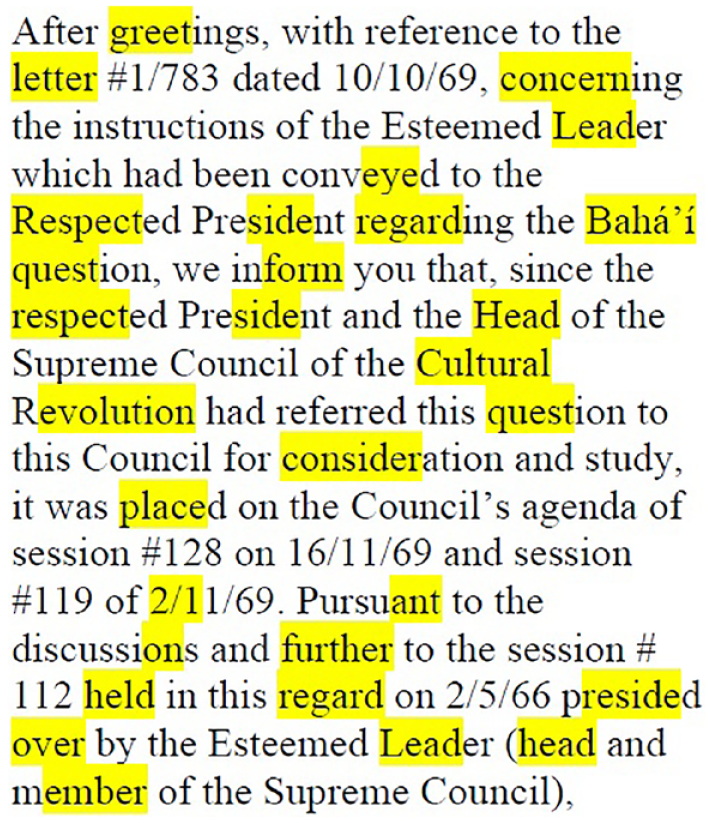
Highlighting the Memo.
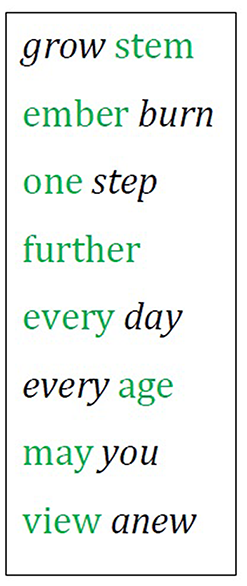
Word Vine Poem.
In The Government of the Tongue, Irish poet and critic Seamus Heaney (1989) discussed the tension between aesthetic and worldly considerations or, as he terms it, “Song and Suffering” (p. xii), in the writing of poetry. In his chapter on Sylvia Plath, he argued that the first stage for any poet is to delight in aesthetic creativity and in being able to share the new skill with an audience. Heaney (1989) likened it to playground discoveries where: one of the chief pleasures of life is when I show you the mud-pies I have made and you show me the mud-pies you have made. In this trope . . . many a poetic career begins and ends with poems which do no more than cry out in innocent primary glee, “Listen, I can do it! Look how well it turned out! And I can do it again! See?” (p. 154)
Heaney has not disparaged poems produced through creative play, and I think that my process with my memo poem does reveal the trajectory of my journey as a poet. For all I was working with a worldly object, a political document, my early processes and discoveries were entirely aesthetic. I was delighting in wordplay. The problem was that I was also convinced I was rewriting the language of persecution when in reality I was repurposing words, stripping them of their original meaning and losing the context in the process. There were already so many distances that separated me from the cause of Bahá’ís in Iran. If I allowed aesthetic distance as well, if I allowed words (such as “ember”) that appeared divorced from the political reality of their birthing document, I would be the naïve poet described by Polish poet and essayist Adam Zagajewski (2004), ignoring life to collect “pretty baubles on the world’s beaches, pebbles and shells” (p. 135). Except my position would be that much worse because of my supposed commitment to a political cause.
Heaney (1989) remembers an evening in Belfast during the Troubles where he and a singer friend had arranged to record a collection of songs and poems memorializing a joyful evening for another friend. They never made the tape. A series of explosions rocked the city, and the “disconsolate wailing of the ambulances” took over. Heaney (1989) explained, It was music against which the music of the guitar that David unpacked made little impression. So little, indeed, that the very notion of beginning to sing at that moment when others were beginning to suffer seemed like an offence against their suffering. He could not raise his voice at that cast-down moment. He packed the guitar up again and we both drove off into the destroyed evening. (p. xi)
The song of that night was the song of the ambulances; adding their own voices to such a broadcast of pain felt like an “offence” or “betrayal of suffering” (Heaney, 1989, pp. xi–xii). This calls to mind Adorno’s (1988) much-quoted line, “To write poetry after Auschwitz is barbaric” (p. 34). Heaney (1989) raised the question: “Why should the joyful affirmation of music and poetry ever constitute an affront to life?” (p. xii). Because, in his answer, art can, on occasion, be indifferent to its immediate reality. He refers to the well-known legend of Nero playing the fiddle while Rome burned to the ground. Clearly, giving myself over to the aesthetic and hoping that the political would follow was not going to work. If art is to respond to crisis, it cannot act in ignorance of crisis. I needed a different approach.
I gave myself a few days’ space and then I looked again at the memo in its original translation. Perhaps I could find the poem first in the political issue, and then work on the aesthetic. In the following section, I discuss the next stage in my writing process where I tried placing the political imperative first. Here, Foucault’s (1979, 2000) thoughts on power as a productive, as much as destructive, force help me to think through the way in which power relations can impact the aesthetic impulse.
Politics
Parenthesis and Shapes
The memo has two parts. Part 1 is three paragraphs introducing and documenting the meetings that preceded the writing of the memo. Part 2 is the “summary of results” of those meetings, including numbered lists of advice regarding (a) the treatment of Bahá’ís generally “within the country’s system,” (b) the approach to the education of Bahá’ís, and (c) the legal and social rights Bahá’ís would be allowed (IranHRDC, 2006, Appendix 7). If the words of the memo couldn’t be redacted, and the words of the poem couldn’t be lifted free, I could try weaving words in/between the language of the memo, searching for the cracks in which my poem could take hold.
I tried fishing out certain words and repeating them inside square brackets. I favored the words [respect] and [lead] and [concern], noting the way I could question the integrity of these words simply by repeating them. I imagined the brackets pushing the other words apart to make room for my voice. When I came back to “Private and Confidential” in a few days, I added a fourth bullet to section (a): “[there’s no poetry here there’s no poetry here there’s no poetry here there’s no poetry here only pain].” The rhetoric of the Iranian government was so devastatingly methodical in its casual condemnation of lives and livelihoods, I could not see past it, let alone find a poem in it: 26 January 2021 The language, the words are so . . . dampening. I find it hard to see anything else in it. It’s language I can’t get inside.
The problem with approaching my memo poem first from the side of the political reality was that I was then immediately faced with that reality. Zagajewski (2004) said that the poet will typically confine themselves to the pain of the victims of persecution, while approaching the “sources of this evil only with extreme difficulty” (p. 136). 3 Meeting the oppressive language of the Iranian government in its own space, my words crumbled around me. I was experiencing, for the first time, the fragility of poetic activism. Fragility and immateriality. My aesthetic use of brackets strikingly revealed my feelings of inadequacy: I had made my own voice parenthetical. This effect was similarly illustrated when I followed the suggestion of an advisor and tried subverting the memo through form. I put the memo and one of my poetic attempts into various shapes but it was like a Rorschach inkblot test: the shapes revealed more about how I was positioning myself in relation to Golpaygani’s memo, and the Iranian government, than anything else. As you can see in Figure 3, my voice became claustrophobically hemmed in by the surrounding pressure of governmental rhetoric.
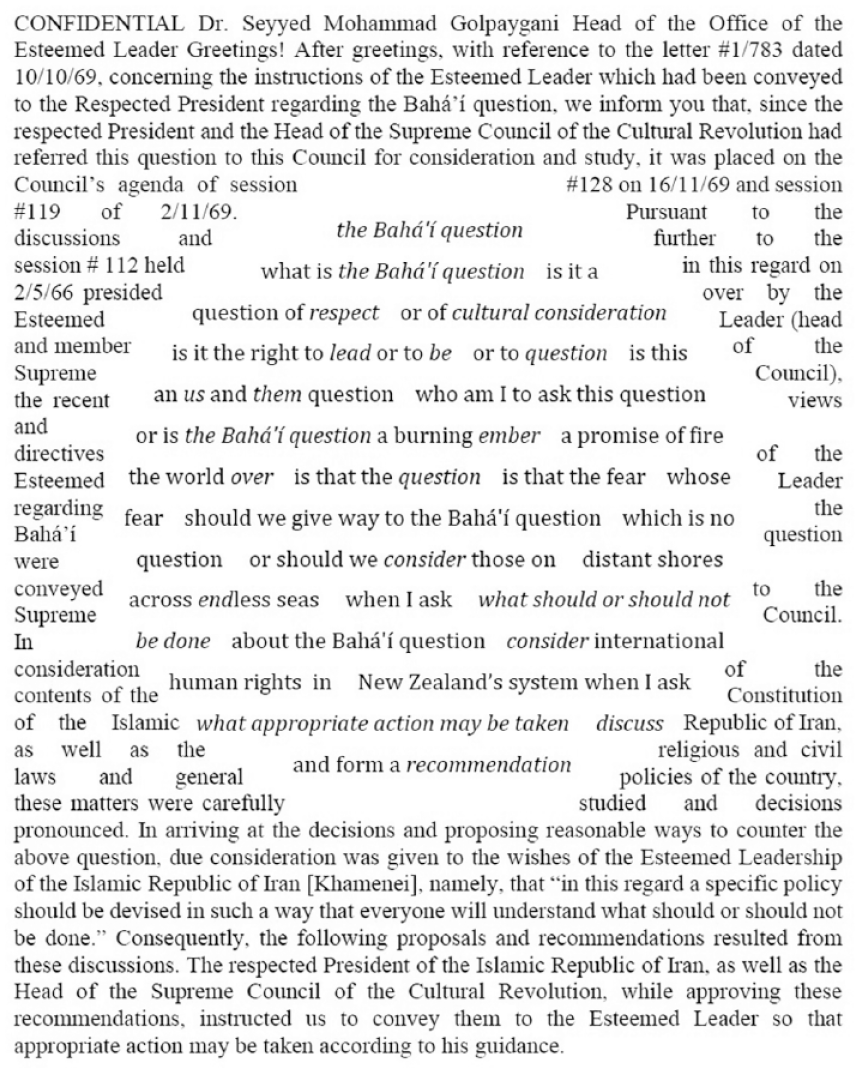
Playing with Form.
Reverse Writing
When I thought about it, I realized that it was not so much the rhetoric of government that was preventing me from writing as much as it was my awareness of the power being exercised through that rhetoric. Foucault (1998) held that discourse “can be both an instrument and an effect of power” (p. 101), that is, it can be the means by which power is established, and it can be a residual consequence of power. Foucault situated this within a discussion of the productive effects of power, which I will return to later. First, let me explain how power acted as a barrier to me in the writing of this poem.
If we consider Foucault’s (1998) first function of discourse, then we see the memo as the means by which the power of the state takes effect. I could not get past that power, so I found myself looking for ways to overcome or conceal it. In one attempt, I typed the whole memo out again, from the beginning to the end, but this time I typed every word backwards, letter-by-letter (as in Figure 4). My thinking was that in reversing the words, I could lessen their impact, free up space for poetic breath. I also made all the proper nouns lowercase and removed the punctuation, numbers, and symbols. It was a form of aesthetic manipulation. I could not find room for my poetry in, around, or between the power of the government, so I was imposing on it a poetic rhetoric instead. Once I had removed all syntactical sense from the memo, it felt . . . friendlier to me. I could see the rise and flow of a language, feel the spaces for breath, and sense the movement between strophes and across lines, without feeling the pain implied by the content.
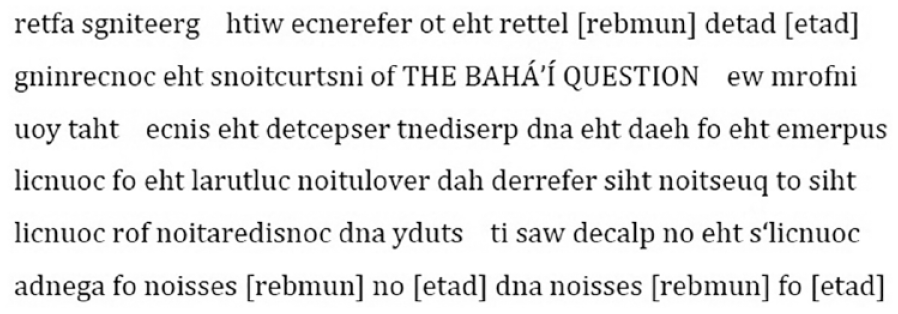
Reverse Writing.
I returned to the draft a few days later and, on impulse, I tried turning a few words back around. I started with “THE BAHÁ’Í QUESTION.” I allowed this phrase to appear out of the chaos, in all capitals, and immediately the immense pressure returned. While thinking only in the language of aesthetics, “the Bahá’í Question” felt like an empty phrase to me. What did it mean? What could it mean? How could a people be a question? And how did it work, grammatically, this statement of a question? And yet, when I looked at the phrase through a political lens, I felt the weight of state power taking effect through discourse. The rest of the memo was hardly necessary because the power relation, the us-and-them dynamic, was contained in that one phrase. The Bahá’í Question. The entire existence of a people were put into question simply by the state talking about them as if this were already the case. I wrote a new question at the bottom of my poem draft: “[noitseuq: esohw moep si siht].” Whose poem is this? It did not feel like it was mine: 6 March 2021 These words are so . . . draining of poetic impulse. They damn an entire people to lives of unacknowledged imprisonment. Invisible barriers prevent success in so many areas of life—education, employment, finances. Even the right to bury their dead and have those burial places respected. By treating Bahá’ís as Other, this governmental memo allows harassment, abuse, and even murder by Iranian citizens against fellow Iranian citizens on the basis of faith. It allows wrongful imprisonment. It allows the seizure of land and houses and livelihoods. It allows the harassment of children at school. Where is the poetry in this? How is there poetry in this? If I find poetry in this, do I make a farce of suffering? I cannot surmount these words because these words are insurmountable. I cannot reduce these words because to reduce is to deny. I cannot imagine better when the way things are is laid bare before me. . .
Golpaygani’s memo was winning what could only be described as a battle of rhetorical wills. Reversing the memo words concealed the power of the state, but it did not subvert or overcome it. How could I find myself in this poem—my voice, my agency? In the following section, I work through the power dynamic that was acting as a writing block for me and consider the position of the poet committed to a cause.
Power
The Bahá’í Question
Foucault’s (1979, 2006) work in the field of psychiatry in the 1970s marked a shift from his analysis of power as a destructive force to his focus on the way power produces, particularly the production of knowledge through power, and the production of discourse through power. For Foucault, power, and the productive consequences of power, function irrespective—and often in opposition—to the force or entity normally credited as the wielder of that power. So, on the issue of sexual repression in the 18th and 19th centuries, Foucault (2000) found that the effect of this discourse was in fact to sexualize the body in a way previously unexplored; “ ‘Sexuality’ is far more one of the positive products of power than power was ever repressive of sex” (p. 121). A similar effect can be seen in the expansion of the Bahá’í Faith. In Smith’s (2008) opinion, “persecution in Iran has probably been the single most important factor in enabling the Bahá’ís to ‘emerge from obscurity’ as a global religious movement” (p. 87). In fact, the leaking of Golpaygani’s memo in the 1990s created an entire counter-discourse around the notion of the “Bahá’í Question,” with reports documenting the Iranian state’s acts of aggression often choosing this phrase as their title.
4
As Foucault (1998) continued in his discussion of the relationship between discourse and power, a third function of discourse is to act as a hindrance [to power], a stumbling block, a point of resistance and a starting point for an opposing strategy. Discourse transmits and produces power; it reinforces it, but also undermines and exposes it, renders it fragile and makes it possible to thwart it. (p. 101)
If resistance is not a consequence of power-through-discourse, but a character of it, then all I needed to overcome my writer’s block was to reconceptualize my understanding of the effect of Golpaygani’s memo and of the nature of government. The initial function of the memo in the world was an act of power through the othering of the Bahá’í people. But the Iranian government only has so much influence on the discourse produced in response which, as it happens, includes my poem. This is perhaps why Foucault (1991) was not so interested in the mechanisms of the state in his discussions of governmentality (pp. 87–104; see also Gordon, 1991, p. 2). According to Foucault (1991), the state is either categorized as a mythical monster to be opposed, or it is reduced to the specific functions it carries out (p. 103). Yet, its power is limited and, I would add, contingent upon public perception and response. Like “the Bahá’í Question,” the power of the state depends on our belief in it.
The impact of the Iranian government’s decisions concerning the treatment of the Bahá’í people in Iran cannot be denied. But to respond, I needed to demystify myself of the notion that the state control the discourse. I set aside the memo, briefly, and wrote a new poem which I entitled “The Bahá’í Question.” In this poem, the Iranian government are not mentioned or relevant. Instead, I have reclaimed the phrase as the question I imagine Bahá’ís might ask those who turn a blind eye to religious persecution happening at a distance to themselves:
you who promise never to save us lest you make us victims of your white saviour complex never to speak for us lest in speaking you suck the words from our tongues never to answer us lest you presume to know the answer never to tell our story lest you heard the whispers wrong you with all your years of self-acknowledged privilege do you believe in universal peace?
Universal peace and the oneness of humanity make up key tenets of the Bahá’í Faith (https://www.bahai.org/beliefs/universal-peace). This poem is an aesthetic move, exploiting the syntactic ambiguity of the phrase, and a political move, replacing the pen of the state with the pen of the poet.
Parallel Texts
Writing “The Bahá’í Question” released me a little, from the power of the state, reminding me, as it did, that the discourse concerning the persecution of Bahá’ís is so much bigger than the rhetoric of the Iranian government. I returned to the memo and tried parallel texts as a new approach (see Figure 5). On the left, I placed the reversed version of the memo I had been working on, with certain words and phrases turned back around. On the right, I began writing a response poem with words drawn from various past attempts. The parallel texts structure allowed me to speak from my own space, no longer restricted by the specifics of place given in the memo. I was both witness and speaker. I could also control the closeness of the two documents, drawing them together at times by incorporating memo words into my poem, and pushing them further apart through the emphasis or meaning I ascribed the stolen words. So, a syntactic closeness and a semantic difference. A push/pull dynamic.
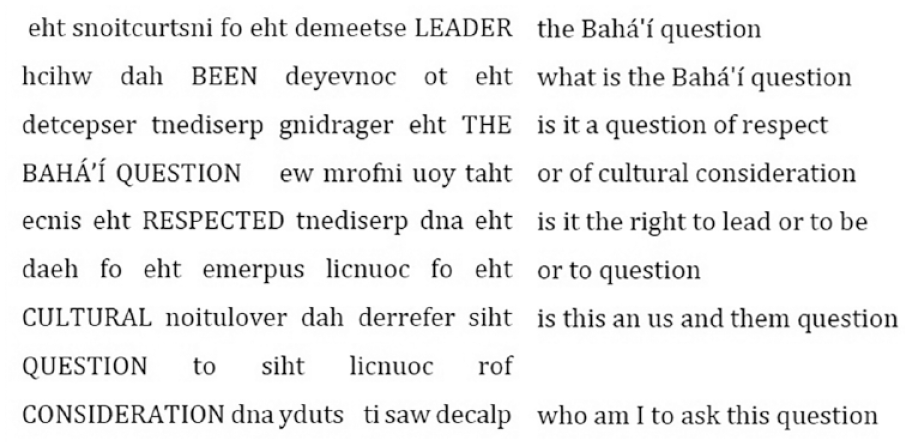
Parallel Texts.
Some of the parallel texts process was working—certainly better than my previous attempts. Yet, at the same time, allowing the two pieces of writing to appear side-by-side like that inspired a comparison, which impressed upon me that my work did not, could not, measure up to the reality of lives lost or suffering as a result of this memo. Released from the pressure of the state, I remained constricted by my own feelings of inadequacy as a poet and an activist.
Heaney (2009b) experienced a similar crisis of confidence when asked by Amnesty International to write a poem for United Nations Day in 1985. The poem would be included in a pamphlet containing the stories of prisoners of conscience. 5 His sense of duty to those who suffered left Heaney (2009b) feeling that he “could find no way to invent ‘a verbal contraption’ that would be anywhere near as strong as the record of injustice and pain in those resolutely unpoetic press releases” (p. 20). Once he wrote back to say he could not do it, the pressure was gone and he wrote “From the Republic of Conscience,” a poem that speaks so acutely to human responsibility that it has been reused by Amnesty and various other human rights groups many times (see Heaney, 2009a, 23–25). 6
My situation, of course, was different as I was not being commissioned to write a poem; the pressure was all my own. I had witnessed from afar, reading about persecution and wrongful imprisonment, and I could not forget what I had seen. Prendergast (2015) advised that poetic inquiry as research practice “invites us to engage as active witnesses within our research sites, as witnesses standing beside participants in their search for justice, recognition, healing, a better life” (p. 683). For Heaney (1989), “the poet as witness” is “any figure in whom the truth-telling urge and the compulsion to identify with the oppressed becomes necessarily integral with the act of writing itself” (p. xvi). Such writers feel the only way to overcome the tension between “song and suffering” is through “committed action” (p. xvi).
In his discussion of what he meant by “committed action,” Heaney considered writers such as Chekhov, who felt compelled to travel to the prison island of Sakhalin to justify his artistry. Once there, Chekhov was, in Heaney’s (1989) imagination, “unabashed by the suffering which surrounds him because unflinchingly responsible to it” (p. xviii). So, there is an appeal to face the suffering to which the poet has been called witness, not hide from it or obscure it with aesthetic manipulations. But, unlike Chekhov, I had not justified my poetry by traveling to the location of persecution and placing myself at the mercy of state. I wondered if such an action would function as a form of justification—or if it would, in fact, undermine my poetic activism-as-research. If I believe in the power of poetry to effect change, should I not place trust in my words?
Rushdie (1991) argued that the “real risks of any artist are taken in the work,” in what “has, or has not, [been] artistically dared” (p. 15, Rushdie’s emphasis). Faulkner (2019a), meanwhile, argued that “Poetic inquiry as political activism works because it makes the personal political” (p. xi). Faulkner (2019b) explains that the use of personal experiences, or “radical subjectivity,” in poetry offers the opportunity to engage an audience—“when the audience relates to, embodies, and/or experiences the work as if it were their own words” (p. 210). I had approached “Private and Confidential” from the perspective that my personal voice and experiences did not or could not have space in the poem, which must be about an external situation. Perhaps I needed to rethink the public/private dynamic in activism-based poetic inquiries. The next section presents how I arrived at the final poem, “Private and Confidential,” through lyric expression.
Lyric
Both Heaney and Foucault were concerned with government in their critical writings, particularly the government of the self. Foucault (2010) was interested in the way we govern ourselves to govern others, while Heaney (1989) considered how government of ourselves dictates how we relate to the world and, more specifically, how we write poetry. Heaney (1989) could not help but be swayed by the argument for poetry that responds to, and operates within, political realities, yet he was still inclined to leave the poet’s tongue ungoverned by such events, to place the “artistic event” as the primary consideration (p. 166, p. 101). In my first reading of Heaney’s (1989) collection of essays and lectures, I believed that he was, albeit hesitantly, placing aestheticism above responsibility to the world, “song” before “suffering.” On subsequent readings, however, I realized that, while not clearly expressed, there was a third poetic consideration for the conception of poetry in Heaney’s writing: that of lyric expression. Heaney (1989) described the lyric poet as typically experiencing a creative or emotional release in the act of writing, a feeling of satisfaction or even joy as thoughts flow from mind to page (p. xviii). This catharsis is felt in the moment of creation when the poet is finally liberated from social and political constraints and, “ungoverned,” becomes concentrated in their being (p. xxii). Heaney may not, himself, have separated lyric expression from aesthetic or artistic considerations, but for me lyricism offered a way between the two demands. In my opinion, while the poet may feel a responsibility to both art and world in a poem, lyricism offers a relief from both, and a way to attain both.
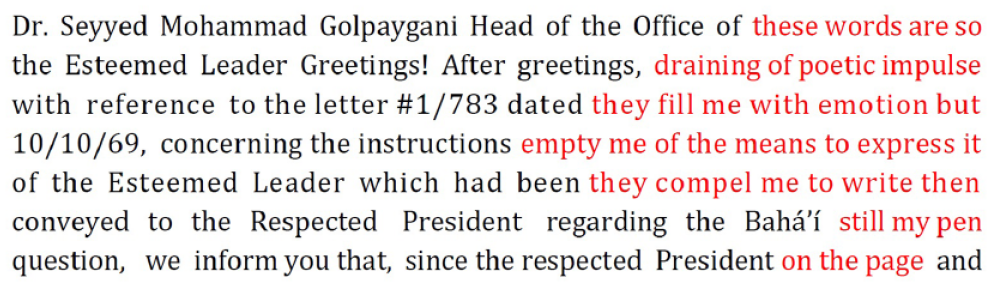
I looked back through my journal entries over the last year, the entries that described the various poetry writing tools I had employed in my attempts to transform Golpaygani’s memo into a poem, and my feelings about each failure. Suddenly, I realized that “Private and Confidential” was there. I had been writing the poem all along, I just hadn’t recognized it as such. My journal was the one space I felt safe, the one place in which I could write unconstrained by either aesthetic or political considerations, or by feelings of inadequacy. Therefore, my journal was the one place in which “Private and Confidential” could finally take shape, justifying the notion in poetic inquiry that it is the act of writing (rather than its product) that brings knowledge and, I would add, activism into being. I wrote the first two sections of “Private and Confidential” by placing segments of my journal entries into the memo.
In Section 1, I acknowledged and revealed my voice as buried, suffocated, in the opening words of the memo:
In Section 2, I reflected on the claustrophobia I felt as a poet trapped in the political rhetoric of government.
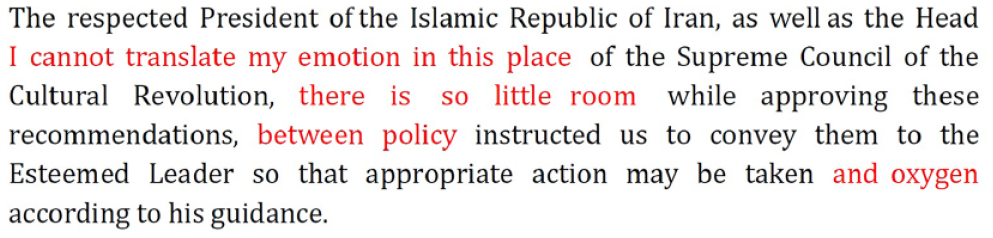
I wrote in red ink, to distinguish my words from Golpaygani’s, but still a reader might experience a moment’s initial confusion. I chose to allow that confusion because it enacted, for the reader, some of the struggle I had gone through to bring the poem into being.
That lyric expression offered a breakthrough for my activist poem is unusual in that lyricism is typically equated with introspection and thus considered to have less engagement with the world outside. Alighting largely in support of lyric expression himself, Heaney (1989) still acknowledged that the lyric poem might be especially liable to cause “embarrassment” to the poet concerned with suffering (p. xviii). In Heaney’s (1989) words, That vitality and insouciance of lyric poetry, its relish of its own inventiveness, its pleasuring strain, always comes under threat when poetry remembers its self-gratification must be perceived as a kind of affront to a world preoccupied with its own imperfections, pains and catastrophes. What right has poetry to its quarantine? (p. 100)
For the activist poet, lyric catharsis sits at odds with the confinement, suffering and pain under protest in the poem, leaving the poet in a state of cognitive dissonance. Not only do we live and breathe freely while others suffer, but in writing about that suffering, we experience freedom, too. A less-quoted conclusion of Adorno’s (1988), following on from his condemnation of poetry after Auschwitz, is that “Critical intelligence cannot be equal to this challenge as long as it confines itself to self-satisfied contemplation” (p. 34). Another poem of mine, “Of Freedom,” responded to this concern (Geers, 2023a).
It must be said that lyric poetry is not, in fact, confined to introspection. Zagajewski (2004) wrote that the lyric poem has “two wings,” the one devoted to the internal being of the poet, the other paying “courageous heed to our world’s changing face” (pp. 137–41). At a hui (gathering/workshop) I attended recently (part of a conference in which I also presented “Private and Confidential”), Davidson (2021) described lyrical writing as being able to listen inwardly while also making “a small tear for the world to get in” (n.p.). Lyric writing, both internal and external, is writing from the self. That I write about the suffering of others without having experienced that suffering myself cannot be escaped. Therefore, the only recourse for me is to write from the position I hold. My lyric distress at being unequal to the task was the poem because it was the only position I had a right to speak from, and so it was the only position from which I could speak. I could not write as one who suffered, but I could write as one concerned with the suffering of others, documenting my fears, anxieties, and poetic “embarrassment” along the way. And it is this lyric expression that granted me the freedom to write back to the Iranian government.
In Section 3 of “Private and Confidential,” my voice breaks out of the memo through sheer emotional frustration and, supposedly without realizing it, my words stand alone on the page. Free of the memo, it is as if the words suddenly become aware of their own being, and their creative control in the space of the poem:
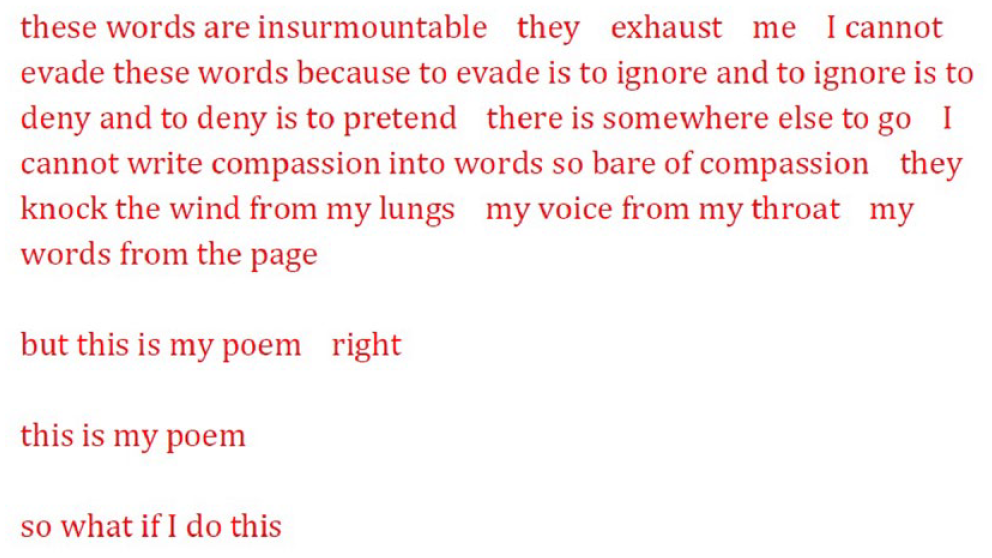
The tables turn, the power shifts, the governed becomes the governing. The rhetorical voice, my voice, which was overcome, now dictates how the memo will appear.
In Section 4, we have the first bulleted list of how Bahá’ís will be treated in Iran except now words are crossed out and rewritten.

By acknowledging my position and my internalized emotions, I released my tongue from government and, consequently, became able to exercise my own governing agency. I took up Foucault’s (2000) challenge to “make a place for myself” in a discourse I previously believed to be dominated by the state (p. 475). And it is aesthetic choices that allowed me to express this process to the reader. The political consideration, the activism of my poem and of my voice, took effect through the artistry of color changes, buried words, reversed words, and crossings out. Neither aesthetics nor activism came first but rather, by finding the body of the bird, the two wings could finally soar in tandem.
In the final section, I establish my agency and my identity in the most deliberately crass way possible. I drop “I AM WITNESS” like an anchor on the memo. The weight of moral responsibility, the weight I have struggled with for much of my writing process, now serves to fracture the words that previously held all the weight and all the power:
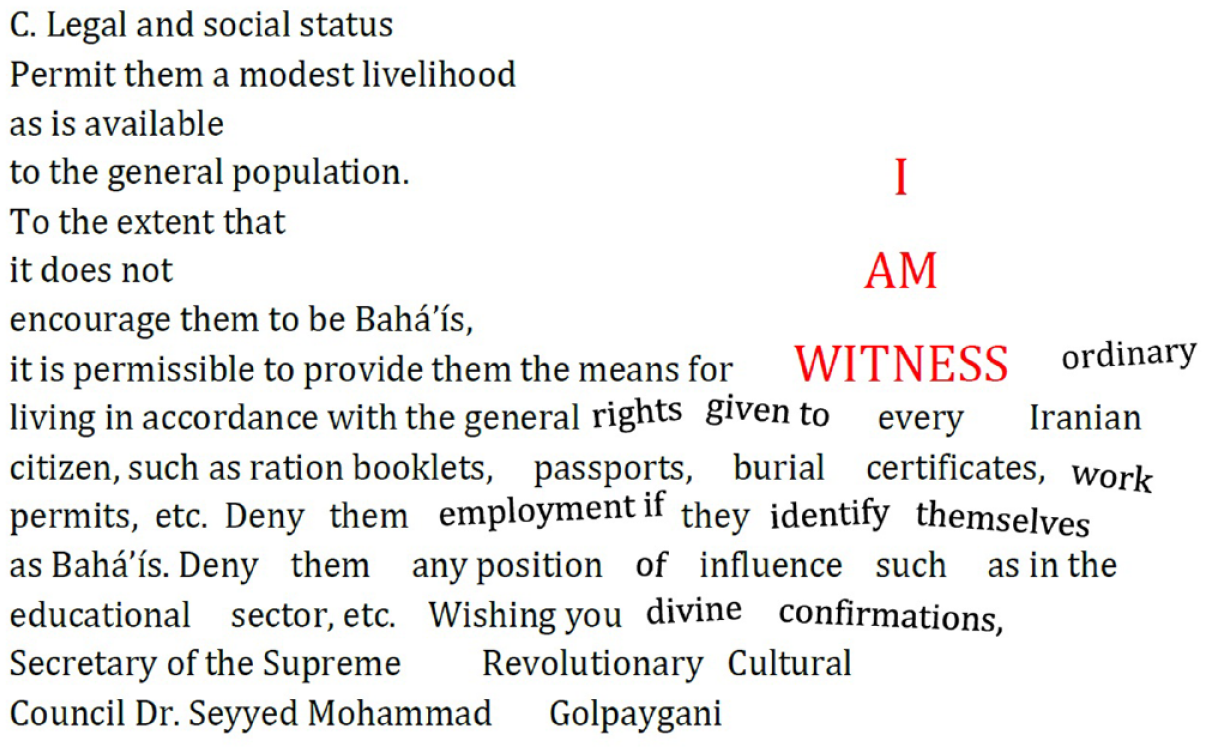
The joke is there, but so is the emotion and the acknowledgment of lives and livelihoods. Finally, I leave the poem where it belongs: in the hands of the reader.
Conclusion
As I discovered, the execution of poetic inquiries intended to function as a call to action is not straightforward. On the side of aesthetics, the pull of lyric expression is tempered by the responsibility of living up to the political reality. In writing “Private and Confidential,” I discovered that aesthetic wordplay could not produce a politically active and contextually sensitive poem. To work through this dynamic, I drew on Heaney’s (1989) critical essays and lectures in The Government of the Tongue. On the side of activism, responding to a political body generated a power relation that risked muting the aesthetic impulse. Here, Foucault’s (1979) thoughts on power as a productive, as much as destructive, force helped me to reconceptualize my position and my agency. Yet, both of these stages were a necessary part of the process that did, in the end, through lyric reflexivity and positionality, produce a poem capable of meeting the competing demands of poetry and politics.
The means by which I navigated my political/aesthetic struggle in the writing of “Private and Confidential” demonstrates the way in which poetry writing, as methodology, may function to both produce knowledge and intend political or social real-world impact. The poetic inquiry methodology produced an unexpected result for me. Where, ordinarily, there might be some distinction in a poetic inquiry between the method of data collection for the writing process and the resulting poem (Davis, 2023), process and product became one and the same in my research. The final poem (result) was found in the journalling process. This offers a contribution to knowledge in the way we conceptualize the relationship between methodology and findings in qualitative inquiries, blurring those boundaries and emphasizing the significance of reflexive practice. At the same time, the final poem, for which I am seeking publication, is intended to join activism responding to the persecution of Bahá’ís in Iran, offering a practical contribution to the social justice issue. Poetic inquiries that function as calls to action, therefore, offer a means by which to justify the research impact of politically-minded qualitative research projects.
The question of how much my activism poem may achieve remains unanswered. How do we, as researchers, take action through poetry, and how do we influence others? Responding to T. S. Eliot’s concerns regarding the apparent uselessness of poetry in the face of the world’s problems, Heaney (1989) said that “In one sense the efficacy of poetry is nil—no lyric has ever stopped a tank. In another sense, it is unlimited” (p. 107). What did he mean by this? Heaney (1989) found the “governing power” of the poem in the space it creates between poet and reader, engaging us to examine the world and ourselves through a rupture in the everyday (p. 108). In this concentrated window, the accomplished poet will see not only the self, reflected, but the faces of those who have heard the call and are ready to respond. The poet who has moved beyond the delight in wordplay is the poet who has attained a “poetry of relation, of ripple-and-wave effect upon audience” (Heaney, 1989, p. 159). There is a deep humanity in this, a shared acknowledgment of lives felt through poetry. A poem may not bring an end to violence, but by influencing the lives of others, the poem has unending power.
When my first poem concerned with the persecution of Bahá’ís in Iran, “Nasturtium Messages” (Geers, 2022), was accepted for publication in Ligeia Magazine, the poetry editor told me that, because of my poem, she was reading Saberi’s (2010) memoir concerning her experience as a political prisoner in Evin Prison in Iran. If I write a poem that encourages one more person to learn about a transnational human rights crisis, then my poetry may be said to have acted in the world. But is that enough? How can we, as poets and qualitative researchers, push our work to have greater impact in the world? Are there opportunities, perhaps, for collaborative poetic inquiries that could achieve more? I will leave these questions for future research.
Footnotes
Declaration of Conflicting Interests
The author(s) declared no potential conflicts of interest with respect to the research, authorship, and/or publication of this article.
Funding
The author(s) disclosed receipt of the following financial support for the research, authorship, and/or publication of this article: This article was published open-access with support from the Council of Australian University Librarians (CAUL).
