




Abstract
This article is a transcultural teacher’s critical autoethnography of entangled privilege and care in a university residential college. Using prose poetry as poetic inquiry, I write the entanglements of institutional privilege and love’s care in a college. I write my pedagogical subjectivity evocatively, where I am interdependent with my creative ecologies of humans and environment. In this article, I first discuss transculturality, creative ecologies, and pedagogical lived experience that inform a poetic inquiry method. I then offer a series of critical autoethnographic prose poems as inquiry into transcultural pedagogy in the college, evoking interconnected privilege and care in the college.
Keywords
Trans-Cultural Teacher/Creative Ecologies
I’m a transcultural teacher. A tutor in a residential college at an elite university in Melbourne, Australia. I live, teach, and write across cultures, where the definition of culture extends beyond the ethnic and national, to pedagogical practice and style, a trans-cultural pedagogy. I’m not nationally bounded: Singapore Malaysia China Taiwan Australia. I’m not ethnically defined: Chinese Hokkien Anglo Aussie. I’m not wedded to any one pedagogical style: teacher-centered sage on the stage, mentor-mentee guide on the side. Wherever I teach, I become entangled in my pedagogical ecologies—the collective landscape of humans, nonhumans, the milieu, and the physical environments. To become entangled with the ecologies around my teaching body is a creative practice, a caring practice of making connections with diverse and unexpected things in my pedagogical ecologies and landscapes.
I think with Daniel Harris’s (2021) theorization of creative ecologies as “[attending] to my interdependent relationships with human and non-human organisms and my physical environment” (p. 18), where a creative ecological approach “considers the collective, the milieu, the atmosphere of creativity, and all the components within” (p. 4). Pedagogical subjectivity and practice from a creative ecological approach is, therefore, always relational and connectible, extending from the teacher self into the physical and social settings where teaching and learning occur. As a globally mobile student and teacher, I encounter a range of pedagogical settings across cultures, or in another word: trans-cultures. These are my creative pedagogical ecologies. I connect and relate to them as I live, teach, and write across the sites where I am an educator: Singapore, Shanghai, and, in this article, Melbourne.
My Context and Position
This work is underpinned by my own pedagogical lived experience as a student and teacher in transcultural settings for more than 30 years. In my own schooling and teaching journey across Singapore, Shanghai, and Melbourne, I have continued to feel neither inside nor outside any culture at any given time, neither comfortably familiar nor alienatingly foreign in any setting. I have often felt my teacher subjectivity connectible to whatever humans and nonhumans, with whatever physical or social settings I find myself in, where the individual is never “isolated from his/her social, material and cultural context” (Glaveanu et al., 2019, p. 744). I am in agreement with Kelleen Toohey (2017), where notions of teacher subjectivity are “ever-shifting responses to new teaching ecologies” (p. 16). This is an orientation to pedagogy where teacher subjectivity and practice are always open to connecting with others. Writing prose poems that draw on creative ecologies and transculturality, I contend that transcultural teacher subjectivity, in-between and across cultures, affords new pedagogical practices and perspectives through being connectible with teaching ecologies in diverse settings.
This article forms the Melbourne section of my doctoral study, a creative practice PhD where I compose autoethnographic prose poems on my transcultural teacher subjectivity to inquire into lived experience across diverse pedagogical settings in Singapore, Shanghai, and Melbourne. Prose poetry is a heterogeneous form of writing not bounded by generically prosaic or poetic categories (Hetherington & Atherton, 2020). Although its form is that of prose, expected to “explain, not sing” using the “information-giving sentence” typical of prose, it is also poetry, having the capacity to “[bend] the bars of the prose cage” (Noel-Tod, 2018, p. xxi). As such, its ambivalent form captures both the prosaic narrative of pedagogical events and poetic evocativeness of transculturality. In the Melbourne site presented in this article, I inquire poetically into the entanglements of privilege and care in the residential college ecologies, in order to further understanding of transcultural pedagogical practice and subjectivity.
Transcultural Teacher, Creative Connections, and Critical Autoethnography
Researching these entangled creative ecologies of a transcultural teacher has led me back to my own feelings of being a wanderer, between stations, and being very connectible across all my pedagogical settings. As a mobile teacher subject, I am always on the move and between stations, and not defined by a fixed identity according to location, ethnicity, or language. Instead, I am characterized by continuous and often unexpected connections and relations with the interdependent agencies around me across different spaces, and in the process disrupting the geographical, social, and cultural boundaries set around me. Such a teacher is a transcultural subject where transculturation is the “fluidity of cultural relations across global contexts” (Pennycook, 2006, p. 13) where cultural relational identities around ethnicity, origins, and belonging involve diverse affiliations beyond the teacher self. These entanglements between self and the cultural enable me to posit my pedagogical practice and subjectivity as transcultural, where transculturality is defined as being connectible, relational, and globally mobile (Boey, 2013; Michaels, 2019; Pennycook, 2012; Song & Jose, 2019).
In my university residential college, I’m a Singapore-born Malaysian Chinese teacher tutoring English Literature to Aussie students. We study Bundjalung writer Evelyn Araluen’s Dropbear, her jaw dropping dismay at our mistreatment of Indigenous Australian flora and fauna, winner of the 2022 Stella Prize. We read her alongside the usual canonical writers: Shakespeare, Dickens, and T. S. Eliot. Eliot’s The Wasteland is made up of transcultural quotations across the East and the West. It is what Roland Barthes (1977) might call a “tissue of quotations drawn from the innumerable centres of culture” (p. 146). All these diverse texts speak to me. Because I’m in-between and across cultures, there’s a proliferation of cultures flowing in and across me too. With my diverse affiliations, I don’t easily belong. People get confused, wondering where I’m coming from. Some folks don’t know where to place me. Others quickly put me into boxes of their own making:
“You must know all about international students because you’re also one!”
“You’re Chinese. You wear thick glasses. You studying Commerce or Biomedicine at Uni?”
“Hey, I’d prefer a native speaker to teach me English Lit!”
“Wow, you can actually speak really good English!”
“But you’re not really Asian, are you?”
To resist these boxings and constraints, I make creative connections across cultures. I find Adam Aitken’s (2013) study of contemporary Asian Australian poets useful, where the uncertainty in self-definition among transcultural Asian poets results in creative acts out of the constraints of out-of-placeness, where the liminal poets “[modulate] their Asianness through various imaginary scenarios, and a multiplicity of Asias emerges,” and the “dilemma” of the diasporic Asian identity becomes a “subject for creative recollection, lyrical meditation, and a mode of political critique” (p. 18). Understanding the generative potential in these transcultural constraints of out-of-placeness results in more critical and creative articulations of my transcultural teacher’s subjective experiences.
To resist these boxings and constraints, I also make unexpected entanglements I feel through my body, using the “metaphor of my body as a bridge and my story as a bridge, across difference” (Boylorn, 2014, p. 313). This is my poetic solution: writing from my trans-cultural teacher body, interacting and creatively connecting with different others in my pedagogical sites; writing evocative prose poetry through interconnecting with my creative pedagogical ecologies. To critically resist the structures, categories, and generalizations that others impose on me as such, I write my prose poetry as critical autoethnography.
Phiona Stanley (2020) identifies three goals of critical autoethnographers: (a) to “tell an engaging story in which they situate the self and the lived experience”; (b) to engage with “power relations that makes autoethnography critical”; and (c) to have an “overt political agenda: [seeking] to right ethical wrongs” (pp. 10–11). In my work, writing critical autoethnographic prose poetry as poetic inquiry enables me to tell evocative and engaging stories—narratives of my particular experience with entangled cultures, seeking to reveal and right (through evocative poetry) the unfair power imbalances and structures that attempt to constrain me in bounded cultural categories of nationality, ethnicity, and more. In the following section, I introduce my use of poetic inquiry as a method for composing critical autoethnographic prose poetry in educational research.
Poetic Inquiry as Method
My use of prose poetry as research in this article is informed by Sandra Faulkner’s (2020) poetic inquiry framework, writing “poetry as research method, to represent research and the research process, and as praxis” (p. 2). It is through the act of writing these poems that I arrive at new understandings of transcultural pedagogical practice and subjectivity. The concept of “re-presenting” (Faulkner, 2020, pp. 43, 99) lived experiences goes beyond pedestrian mining and representing events and relationships as if they lie buried and intact, awaiting excavation and revelation. To re-present involves an aesthetic but still ethical take on memory (Faulkner, 2020; Leavy, 2015). I also engage with Fitzpatrick and Fitzpatrick’s (2021) study of poetry and educational research, where poetry’s “emotive and evocative” characteristic “speaks to what is at the heart of education: connections between people, places and things” (p. 9). Using poetic inquiry in educational research, I attune to events and relationships from my teaching practice in evocative, creative, and critical ways, writing prose poems that explore “multiple ways of knowing, including sensing, intuiting, the imagination and remembering” (Tracey, 2021, p. 257).
I begin my poetic inquiry on each pedagogical site in my doctoral study with a series of “first impressions” prose poems, as multiple ways of knowing that specific teaching site. In my Melbourne chapter, these introductory poems attune to and set up the various entanglements and interconnections of creative ecologies in the residential college teaching space. In these poems, I evoke the diverse components of my creative pedagogical ecologies. I bring my Chinese Christian Confucian upbringing into my English Lit classroom. I bring my Chinese majority, feminist minority, teacher-centered Singapore education ethos into teaching Shakespeare to Aussie undergrads. Bringing them into my small and caring, but privileged, ivy-clad red brick Melbourne college space.
First Impressions of Melbourne College Teaching
We meet for the first time in this prim, proper, and pretty tutorial room, named after a benefactor’s wife (Figure 1). Her gold-framed portrait hangs over us. Her regal eyes look down on us as we open our heavy, pricey, complete Shakespeare editions. We work at this large, polished mahogany table, in the middle of walls of leather-bound Classics and Fine Art books, and honor boards chronicling annual scholarship awardees in gold leaf lettering. Red and brown and gold—the colors of this red-brick, neo-Gothic style building.
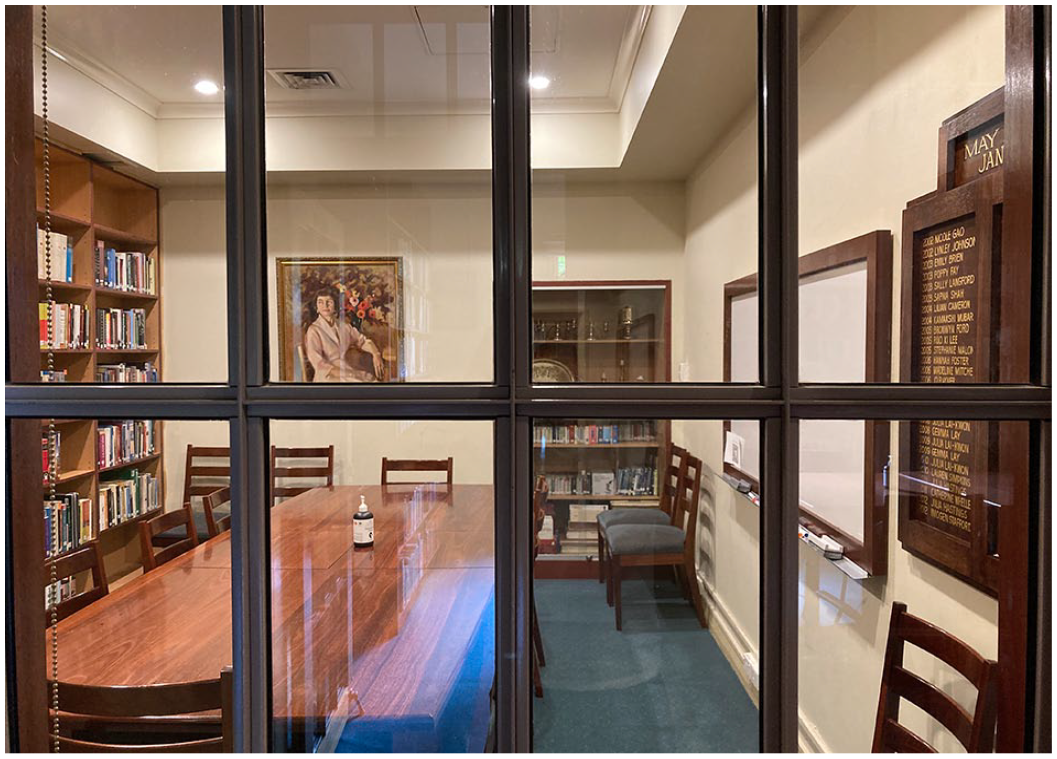
Prim, proper, and pretty tutorial room space.
When the English Lit tutorial begins, I sit down with my students around the heavy table and we talk and share. This week’s prescribed text is “Othello,” which opens in the Venetian battlefields. Things then get closer and closer, ending in Desdemona’s bedroom. Intimate. Claustrophobic. One student says she wishes to get into Desdemona’s head. “Why are Shakespearean heroines so flat on the page?” I didn’t tell her that back in Singapore, I almost wrote a play titled “Ophelia” after studying “Hamlet.” Her singsong ramblings, thinking outside the box and flowery watery grave no one in my all-boys school cared.
Somehow, I immediately warm to all my English Lit students, for their courage in taking this subject. The Federal government has made Literature and many Uni Arts subjects more expensive, to produce “job-ready graduates” in Math and Engineering. I see myself in their places, in the space of my own Year 12 classroom in Singapore, reading “Jane Eyre” with our British expatriate teacher. He spent a week unpacking Chapter 1 with us—likening classic novels to a dense fruit cake, with multiple layers to peel back and enjoy. Giving us these tools, he then rushed through the rest of the book. Lazy unpragmatic teacher? Agency-giving teacher? My classmates, destined to become lawyers and “job-ready graduates,” hated him. I was fascinated and decided to become an English Lit major.
One reason why so few Singaporean students study English Lit is because we don’t thrive on discussion and debate. The concept of a lively exchange of ideas, to persuade or be swayed, is pretty foreign to us Asian students, schooled in the Confucian ethos of respecting your elders at all costs, conducting yourself with propriety at all times. It’s wiser to keep the status quo. Don’t rock the boat. If you apply yourself to Math, keep practicing your sums, you can achieve speed and accuracy through your own merit.
It’s easier to slide into teacher-centeredness when teaching English Lit, compared with my other subject, Creative Writing, which is more facilitation. Today, I find myself apologizing for being teacher-centered with Shakespeare as I model my interpretations on the board. I always carry a niggling consciousness that though I escaped Singapore’s didactic educational rhetoric, I still carry this teacher-centeredness in my body, into my new country.
Poetic Inquiry as Multiple and Artful Ways of Knowing
In these “first impressions” poems, I write a poetic inquiry on a first Shakespeare tutorial in an elite university college, revealing creative ecologies of multiple pedagogical practices and perspectives: evoking the entangled themes of physical classroom setting affecting learning, gender stereotypes in the classroom, institutional rhetoric affecting pedagogy, educational histories and prevailing cultural attitudes toward teaching and learning, among other things.
Poetic inquiry into my pedagogical lived experience through multiple ways of knowing resonates with the numerous interconnections I make in my creative ecologies via my transcultural approach. This desire for multiple ways of understanding self and others (i.e., my creative ecologies) is my poetic approach for living, teaching, and writing. Lynn Butler-Kisber (2021), who coined the term “poetic inquiry” in 2004, describes this method of working, where there is no distinction between living life, doing research, and writing creatively, as an “artful way of being a researcher” (p. 37). This “artful way of being a researcher” includes criteria where the researcher must “[live] an ethic of care that includes sensitivity and reflexivity,” and requires “attending to people, places, events, and contexts” as well as to “share [his] processes and [support] the work of others in interest of the greater good” (Butler-Kisber, 2021, p. 37). In the next section, I explain my use of poetic inquiry with reference to my ars poetica (i.e., art of poetry), a set of principles where poets “articulate what poetry means to them, their own aesthetic and process” (Faulkner, 2020, p. 132).
Ars Poetica in Poetic Inquiry
Poet-researchers using poetic inquiry can demystify the creative writing process by articulating an “explicit discussion of the research process” (Faulkner, 2020, p. 142), as part of a creative researcher’s “ethical obligations of full disclosure of methodological choices” (Leavy, 2015). To this end, it is useful for my poetic inquiry in this paper to be articulated via my ars poetica, using it to “establish my aesthetic and epistemic commitments” (Faulkner, 2007, 2020, p. 147). I develop my ars poetica statement on my current and ongoing status as a globally mobile teacher who lives, writes, and teaches across cultures, in the process making interconnections rather than close categorizations in my teaching ecologies. As such, my ars poetica serves to cultivate and write a more connectible and collaborative pedagogical practice and subjectivity as a university residential college tutor, to understand more relational and intimate perspectives and practices of pedagogy, doing these to disrupt privilege, power, and structure in the residential college.
In seeking poetic rationales by established poets who speak similarly to the accommodating potential of poetry as research, the transcultural Polish-American writer and diplomat, Czeslaw Milosz’s poem Ars Poetica (1968), or “The art of poetry,” comes to mind. This poem, quoted in part below, resonates with my approach of using prose poetry to account for evocative, unexpected, and ongoing relationships/connections in the college, where my transcultural teacher subjectivity and pedagogical practice are always being made, re-made, and re-presented. Milosz’s poem expresses the desire not to be locked into conventions and categories, but to be open, receptive, and accommodating, in order to attune to self and others (my creative ecologies):
I have always aspired to a more spacious form
that would be free from the claims of poetry or prose
and would let us understand each other without exposing
the author or reader to sublime agonies.
. . .
The purpose of poetry is to remind us
how difficult it is to remain just one person,
for our house is open, there are no keys in the doors,
and invisible guests come in and out at will. (from Ars Poetica by Czeslaw Milosz, 1968)
In the process of writing my prose poems, I endeavor to understand and enact a more relational, intimate, and poetic pedagogical practice. In this method, and corresponding to my ars poetica statement, I am guided by the steps I devised below. From a creative practice, poetic biography perspective, I also think with Jessica Wilkinson (2019) on “how writers (of biography) are approaching lives” (p. 170)—taking my ars poetica steps as approaching a transcultural teacher’s life in prose poetry. The term “approach” not only means coming face-to-face with a life to be written, but also the steps of approach as creative method steps, chronicled below:
Identify a Critical Incident From a Lived Experience of Teaching and Learning
The initial step in deciding which event or experience to write my poetry on is based on critical incidents in pedagogy. These critical incidents in pedagogy generate “surprise” and “perplexity,” and are occasions when I become aware of my professional values (Tripp, 1993). For me, the “surprise” and “perplexity” in these critical incidents are often due to an unexpected coming together of diverse things across cultures (trans-cultures) in my pedagogical sites. An example is the parallel and resonant empathy for silent Shakespearean heroines in the poem read above, felt by my student (in an elite Melbourne tertiary college in the 2010s) and by me (in a Singapore all-boys school in the 1990s). They come together in the spirit of creative ecologies, in their “always-interconnectedness” (Harris, 2021). These are critical/creative moments comprising ecologies of students, teachers, emotions, artifacts, and practices in dynamic interconnections in the pedagogical spaces. In this article, the unexpected coming together of diverse things in my creative ecologies indicate that pedagogical subjectivity and practice may be more complexly and unexpectedly connected, and less simplistically categorized. These are the critical (creative connectible) moments I attune to and then evoke through my poetry.
The Critical Incident of Pedagogical Lived Experience is Re-Presented and Evoked in a Relational and Connectible Way
Here, I am not a bounded subject, but connectible with my ecologies (Harris, 2021). Using poetry to re-present and evoke lived experience in these connectible ways is political, opening up a space to be “attentive to multiple meanings, identity work, and accessing subjugated perspectives” (Leavy, 2015, p. 78). Writing my transcultural teacher subjectivity evocatively, attuned to the ecological elements in the classroom (i.e., physical/social settings and the teaching curriculum) is political and disruptive, critical and creative. It enables me, a transcultural teacher who does not fit easily into the dominant institutional rhetoric and directives to be connectible across a diverse range of pedagogical practices and perspectives.
I Write the Pedagogical Lived Experience Relationally, Moment by Moment, to Understand the Process of Transcultural Entanglements
I am part of a relational autoethnographic subjectivity (Gannon, 2022; Stewart, 2007) and not a bounded self (Michaels, 2019; Pennycook, 2012). Poetry is an embodied art form that “depends on discovering, moment by moment, ways of being: improvisation, not recitation” (Buckley & Merrill, 1995, p. xi). I have selected prose poetry as my creative writing form to story my transculturality because its heterogeneous form and mixed content resonate with the “entanglement, exchange, porosity and hybridisation” properties of transculturality (Abu-Er-Rub et al., 2019, p. xxvi). Thus, the prose poems in my study are used as a writing laboratory, a space for prose-like verse which stories relational transcultural processes by narrating, step by step, moment by moment, how diverse cultures become intertwined and entangled.
I Write From a Position of Transcultural Out-of-Placeness
This position is my particular circumstance and politics, where this out-of-placeness (Said, 1999) means that I am between stations as a migrant (Boey, 2009), and thus transculturally fluid and connectible. This position is familiar to transcultural subjects as we are never fully settled into one place due to our multiple connections and affiliations.
Turning Transcultural Out-of-Placeness Into Creative Agency and Critical Autoethnography
My work is an intervention into bounded notions of teacher identity and pedagogy, seeking instead creative agency —an “always-creative interconnectedness” (Harris, 2021, p. 5). I connect and collaborate with my creative ecologies, reminding myself that I am “co-constituted by my membership in these ecologies, my affective relationships and collaborative processes with them, and that my self as I understand it at this place, and time, and awareness is a co-production with them” (Harris, 2021, p. 21). By writing and re-making pedagogical lived experience into something connectible with my creative ecologies, I attend to what Alexander (2021) terms “complex lives” that are compartmentalized, made generic, “void of critical application” (p. 43), urgently needing re-thinking, re-writing, re-making through critical autoethnography.
Living, Teaching, and Writing in a College: A Poetic Inquiry
The second part of this article is a series of critical autoethnographic prose poems evoking (showing not telling) entangled privilege and care in the college. I do this through a poetic inquiry into transcultural pedagogical subjectivity, practices, and perspectives in the college. This poetic inquiry is informed by concepts of transculturality, creative ecologies and pedagogical lived experience, through the ars poetica, all discussed in the earlier part of the article. I begin this section with an “Evening in a resident tutor’s life” poem sequence across various places and times in the college. As I write and inquire poetically, I bear in mind that with a creative ecological approach, the various places I interact with co-create and co-constitute my teacher subjectivity (Harris, 2021).
Part 1: Evening in a Resident Tutor’s Life
6:30 p.m. at Formal Hall (Figure 2)
We are at Formal Hall. One of those college traditions that has existed for 500 years. Everyone wears a long and heavy academic gown, processes in and sits down over an hour-long communal meal. The principal intones a Latin grace. There are samosas and Aussie party pies on the tables. The women sports rep stands up to make an announcement. A young man from Brisbane discreetly checks the footy score under his academic gown. The student beside me says she loved Literature in school. She got accepted into Fine Arts at Uni but chose Biomedicine because it guarantees a stable job. We eat our dinners, a longer Latin grace is spoken and we shuffle out.
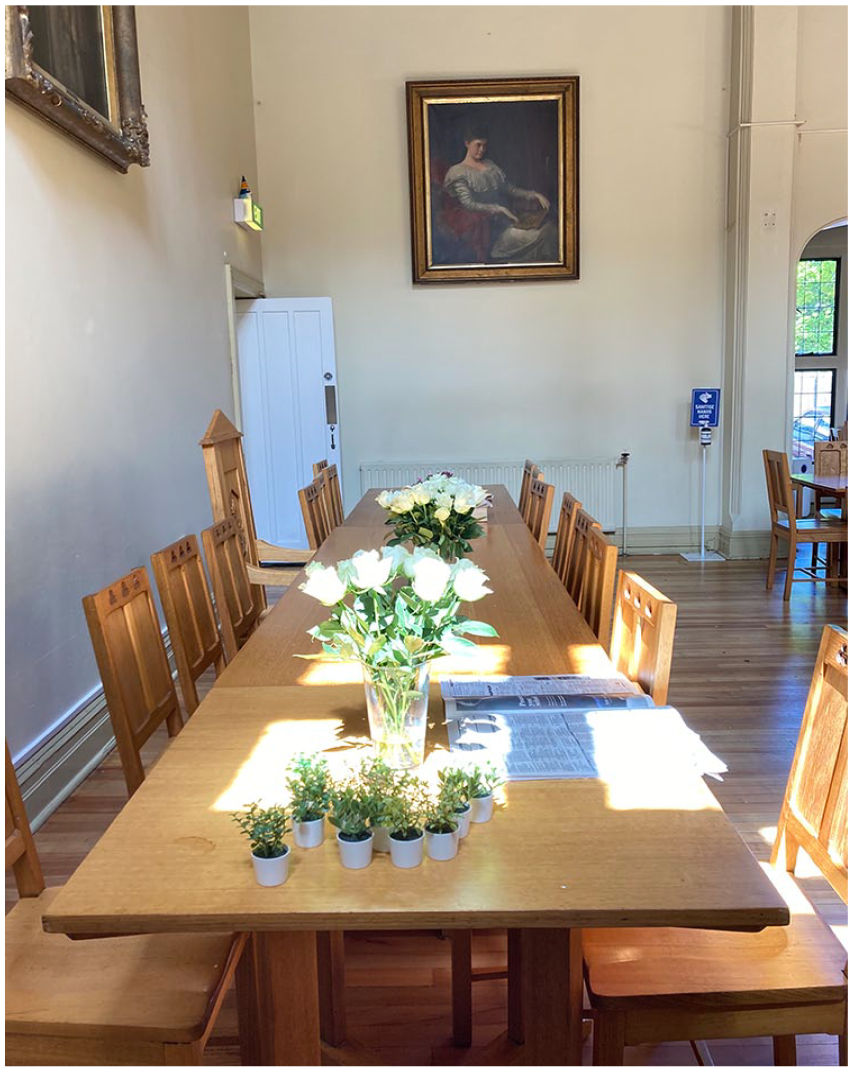
Formal Hall space.
6:45 p.m. Accompanying Our Choir (Figure 3)
I accompany our college choir on the piano in a formal hall performance. Our choir is a nonaudition ensemble. We do Disney songs and Aussie Christmas in July carols in the airy dining hall. My tutor role shifts when I play collaboratively with our students. We keep listening to each other. There’s plenty of give and take when we play together. It’s another mentor–mentee relationship. I also love how this role has got no fixed name—piano accompaniment, collaborative piano and more. There’s room and flexibility for it to be a range of things. Most of all, I enjoy sitting back a little when I accompany. A mentor once told me playing accompaniment is about making others sound good, making yourself inconspicuous.
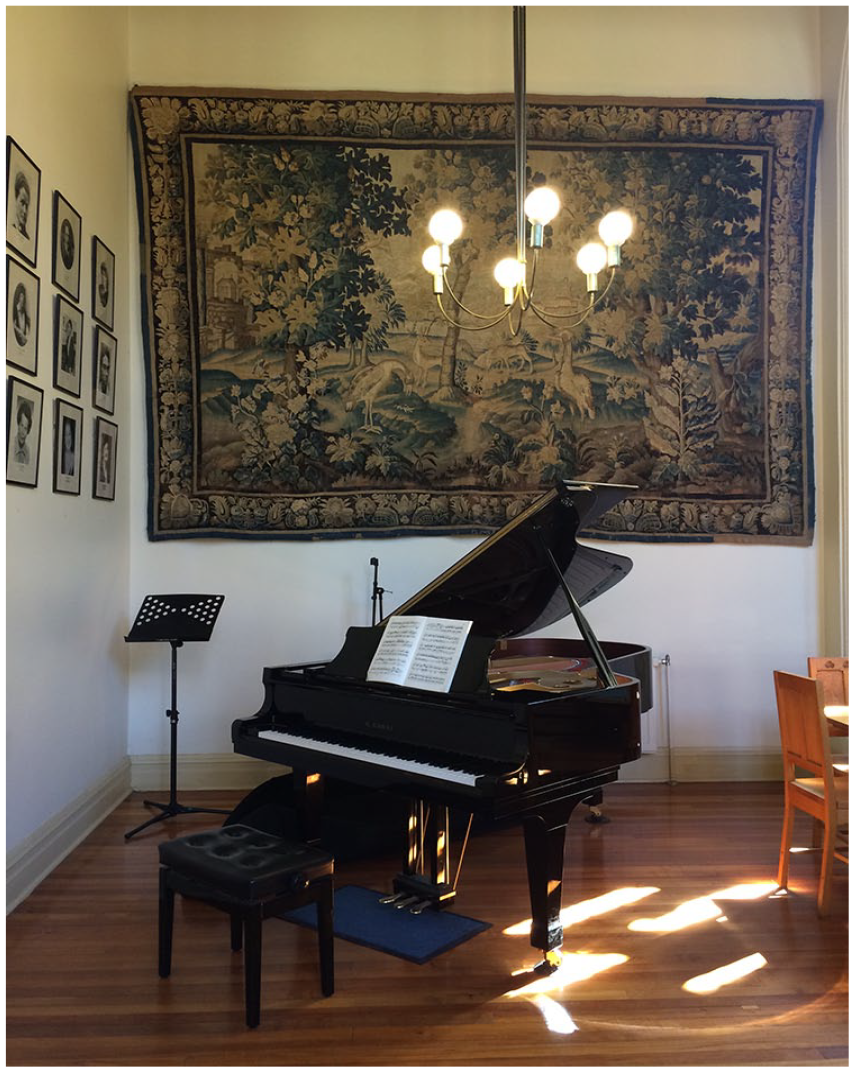
Piano accompaniment space.
7:30 p.m. A Creative Writing Tutorial (Figure 4)
After dinner, I facilitate a creative writing tutorial. I sit in a semicircle with my students becoming one of them. To an outsider, it may not seem clear who is tutor and who is student. We are all writing away. Whatever’s shared here remains here. It’s a safe space. We start our critique of each other’s work with a questioning phrase: “I wonder. . .” We don’t write another’s work for them by being prescriptive. Confucius says, “三人行,必有我师 ”: “Three persons travel together, I can always learn from another.” We keep on talking and go over time. But it’s okay. These common spaces are open 24/7, no one has anywhere to go, our chamomile tea’s brewing in the adjoining pantry, and our bedrooms are a flight of stairs up.
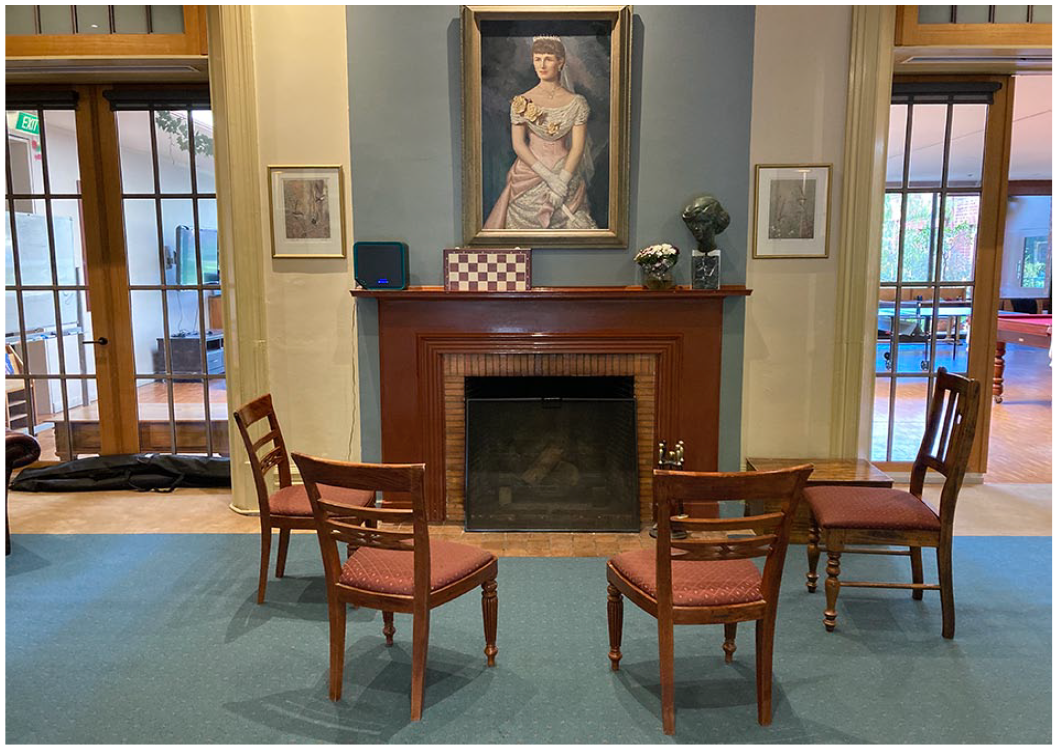
Creative Writing tutorial space.
10:00 p.m. Night Duty Tutor (Figure 5)
I’m rostered to be on the night duty shift. I’m on call from 5:00 p.m. to 9:00 a.m. the next morning. During this time, I look after students’ well-being, the good-running and security of the building. The duty phone rings. “Sorry I locked myself out of my room. Can you help me, pleeease?” The voice is sheepish. A repeat offender. I trudge my way up to the third floor with the Master key. The student is shivering outside his door, wrapped in a shower towel. After unlocking his door, I thought it my duty to say something about key etiquette. Dispensing useful advice like an older brother, a mentor, whatever. Surely everyone would appreciate advice from an elder? Did Confucius say that? My Chinese Presbyterian primary school. Moral and Civic lesson. Singapore, 1993. Still ingrained after 14 years in Melbourne. But didn’t Confucius also say “一耳进一耳出”: “Go in one ear and out the other”?
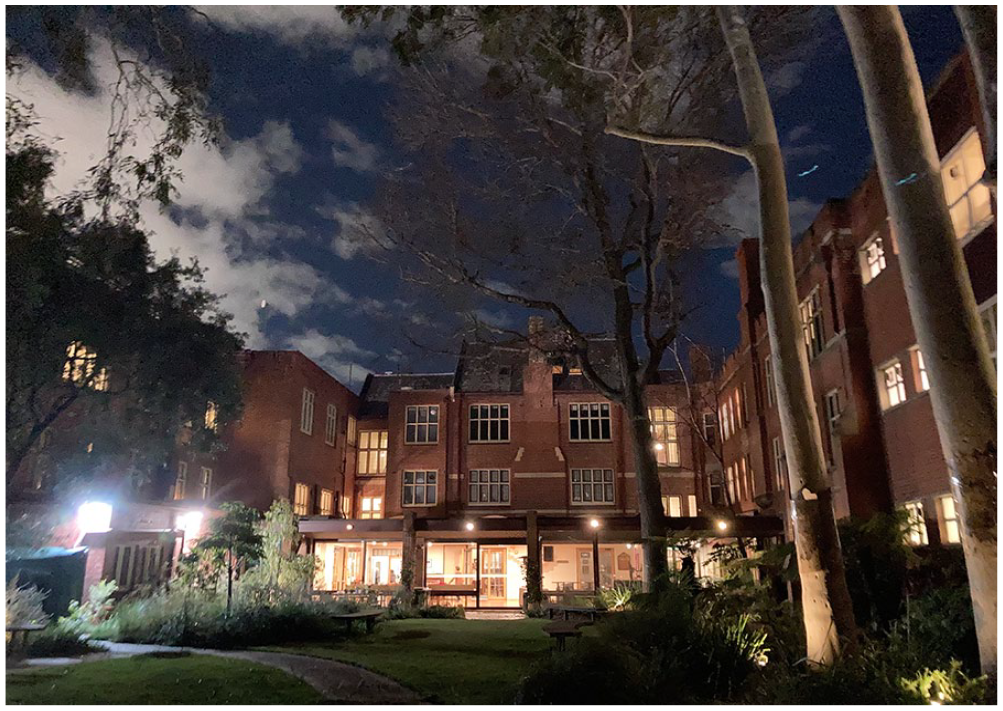
Night duty space.
In these “Evening in a resident tutor’s life” poems, my inclination for entangled transcultural relations makes me attune to connections wherever (place) and whenever (time) I can. I connect and shape-shift in relation to others in my creative ecologies as I move through the college’s rarefied spaces. Such shape-shifting lets me become a tutor, teacher, mentor, music partner, door unlocker, and conversation partner in turn, fluidly, in a single evening. I make connections by changing shape across my multifaceted tutor responsibilities, negotiating the college’s privileged spaces that both contain and sustain intimate, caring pedagogy.
These continuous shape-shifts remind me that in college, my transcultural teacher subjectivity keeps responding and connecting to new teaching ecologies I encounter (Toohey, 2017). The next section of prose poems continues this line of inquiry, but evokes more critical questions and situations on complex lives being made generic by institutions and structures, requiring rectifying and re-making through critical autoethnography (Alexander, 2021). Some of the critical questions that the following poems elicit are the following: What does it mean to be an Asian teacher/student in Australia? Why are some programs of study still privileged over others? What are more inclusive ways of teaching? How and why do we read in the academy? Does an autoethnographer connect up everything in his life when he begins to write?
Part 2: The Complex and Connectible Life of a Resident Tutor
Communal Dining (Figure 6)
Our dining hall is at the heart of college living. It’s airy and light-filled, without too much of the imposing solemnity and candle-lit formality of some of the larger, more Oxonian colleges. Hogwarts-style dining with gowns and Latin grace happens just once a week. The rest is cafeteria style. Free and easy. There are some loose guidelines to encourage intermingling: the table rule where you don’t start a new table until one’s filled. It’s making intentional community without trying too hard. You never know who you might encounter when you sit down for a meal. Fourteen years ago, I arrived here from Singapore via Shanghai, as a young tutor armed with an English Lit degree, keen to begin my postgrad research in Dickens. My first encounter with this dining hall of people was bewildering—the strange talk about a football that’s not the eleven-a-side I knew, a thick Aussie accent so foreign to the British pronunciation my postcolonial Singapore education has given me. So, I remained silent, kept listening, and began to be drawn in gradually, gradually.
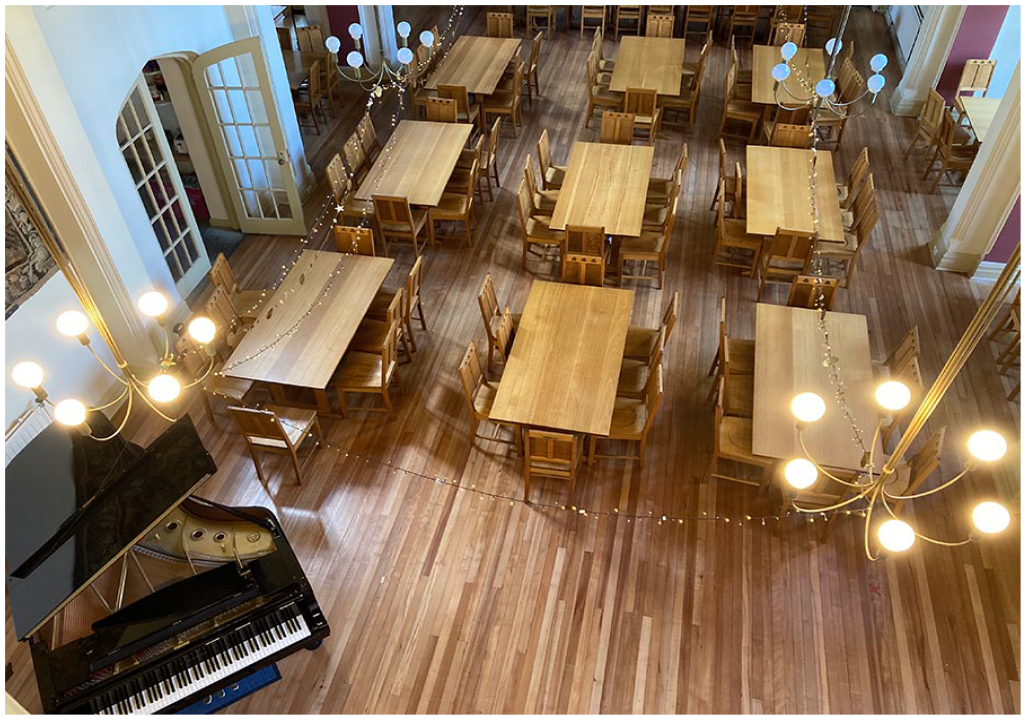
Communal dining space.
Mentoring
“You’re not very Asian,” my college supervisor, the deputy principal, tells me as she hands me my student mentoring list. We are matched to students from similar academic backgrounds. As usual, the international Asian students are Commerce and Science majors—not my mentees. Years ago, I met a young, restless undergrad from Singapore, whose “Tiger mum” back home was furious when she discovered he was enrolled in a Bachelor of Arts. She eventually relented when she discovered he was majoring in Psychology in the Arts degree. “Yes mum, I’m doing a professional degree that will make me a job-ready graduate.”
Mentoring 2
Despite me being not very Asian, students from Asian backgrounds gravitate to me. A young man from Malaysia, my father’s country, even though neither of us speaks the national language, shares his loneliness being a “banana”—yellow on the outside and white inside. Born in Malaysia and bred in Australia, he feels minoritized in our college. He supports Collingwood Aussie football club, washes down party pies with a Victoria Bitter beer together with the boys, but often finds himself at the fringes of the room, the one staying back to clean up after a party, wondering why he didn’t speak up more when everyone was together. His parents are happy for him to study whatever he chooses, as long as he always achieves his very best. He’s always been strong in both Math and the life sciences. While we converse, he’s still figuring out which one he’s more passionate about. For now, he’s aiming for graduate Medicine. His private school’s career advisor has always urged him toward it. His academically inclined friends are all heading down the same track too.
Simple Love for Transcultural Living, Reading, Writing, Teaching
One text I teach year in year out is Charlotte Brontë’s “Jane Eyre.” As mentioned, I’d studied it in a Singapore school with a British expatriate teacher who made me decide to become an English major. My association with this text goes back even further. I now remember a red and gold hardcover, gilt-edged Chinese translation displayed prominently behind glass in my childhood home. My book-loving, Taiwanese mother took us to bookstores every week, where she stood for hours reading classics like “Jane Eyre” in Chinese translation. Ginormous Singapore bookstores, air-conditioned, a haven from the stickiness and sluggishness of tropical humidity. Enterprising Singapore bookstores, which stock more assessment books and Ten-year series for tuition-obsessed Singaporean parents, than novels and poetry to be read for pleasure. “Jane Eyre” was one of the many classics kept behind glass in my childhood home. Kept away and never read, or always going to be read. Having inherited my mother’s bibliophile practice, I always sit a little uncomfortably with the thought that book buying isn’t the same as book reading. That is until I read Edward Said’s 1999 autobiography, “Out of Place.” In it, he says one of the regrets of dying is he’ll never again buy all the books he’ll never read. “Jane Eyre” is translated into Chinese phonetically: “简爱” (jian3 ai4), these golden gilt letters on the spine of my mother’s copy. Today, as I introduce the novel to my students, I calligraphed these two Chinese characters onto the white board—简爱: the two characters for “simple love” in Chinese. A classic and canonical novel about the most complex love imaginable—so interwoven into all my living, reading, writing, teaching, caring, and connecting across cultures.
Pedagogy: Facilitating, Teaching, Mentoring, Tutoring?
When I describe the pedagogy I do at college, I say I facilitate. To teach seems like a classroom-style, teacher-centered activity. To mentor is more reciprocal and intimate, almost always one-on-one. To tutor sounds transactional, like some rich kid paying good money for private tutoring, to become heads and shoulders above less well-off peers. So, I say I facilitate. I facilitate a poetry writing workshop, meaning I sit down alongside the students. Conversation becomes easier. People feel safer to offer and accept critique. Critique coming from a place of community and care. To facilitate is also to create possibilities and to enable connections. My transcultural, out-of-place Singapore-born Malaysian Chinese English Lit teacher body enabling unexpected connections in this teaching space (Figure 7). Using my body as a bridge and my story as a bridge across difference, in resonance with Robin Boylorn (2014). My unclassifiable body, background, and beliefs in my pedagogical spaces facilitating connections between my diverse students, the diverse texts we discuss, the diverse writing shared among us. A critical autoethnography of unexpected, found connections disrupting attempts at classifying who we are and what we do.
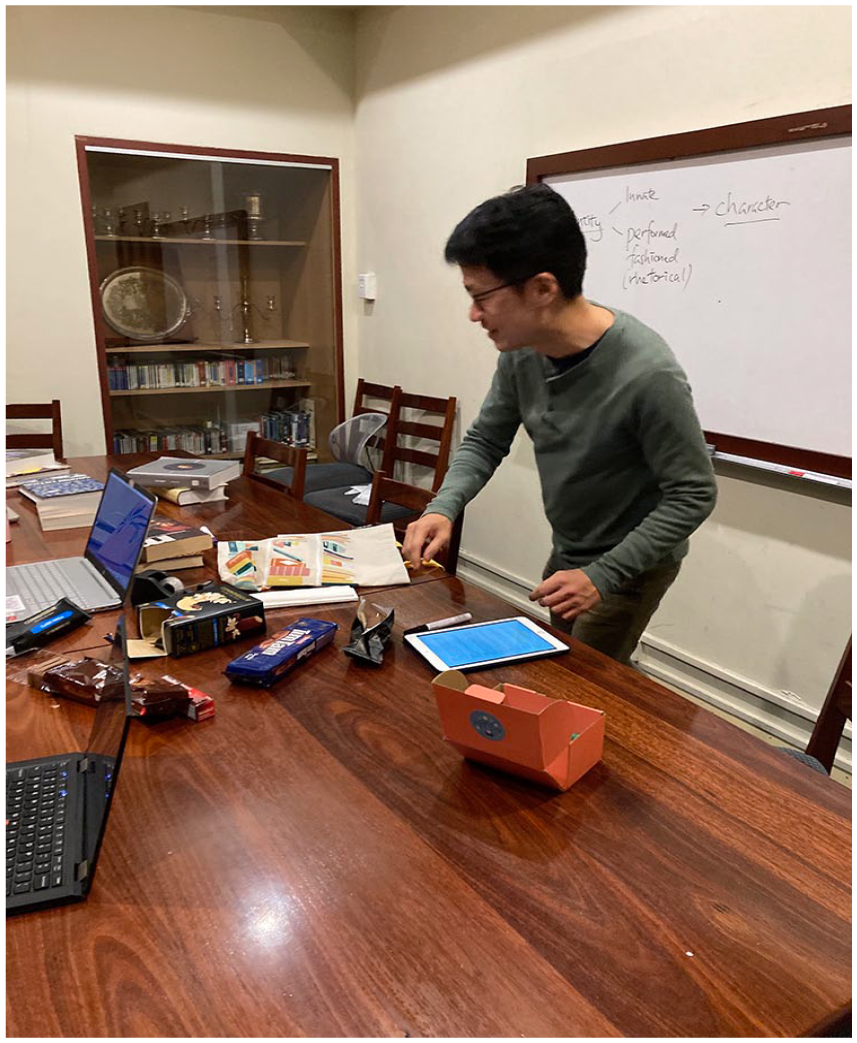
My transcultural, out-of-place teacher body facilitating connections in the prim and pretty teaching space.
Reading for Pleasure Across Cultures (Figure 8)
I now take every opportunity to read for pleasure. As a trained English teacher, I’ve seen how high-stakes and exam-oriented English as a subject can get in schools. Stressed-out teachers trying to better each other. Students drilled to beat a confession out of a poem to nail an accurate, exam-proof reading of a thorny metaphor. A recent Biomed student in college had an English teacher who cultivated in her a love for the written word she said would stay with her for life. But still, she’s decided she wants to become a doctor: that’s her safety net. Book enjoyment and reading for life: those are the embellishments. Don’t get her wrong—reading is absolutely essential to a full and meaningful life. If one becomes job-ready first.
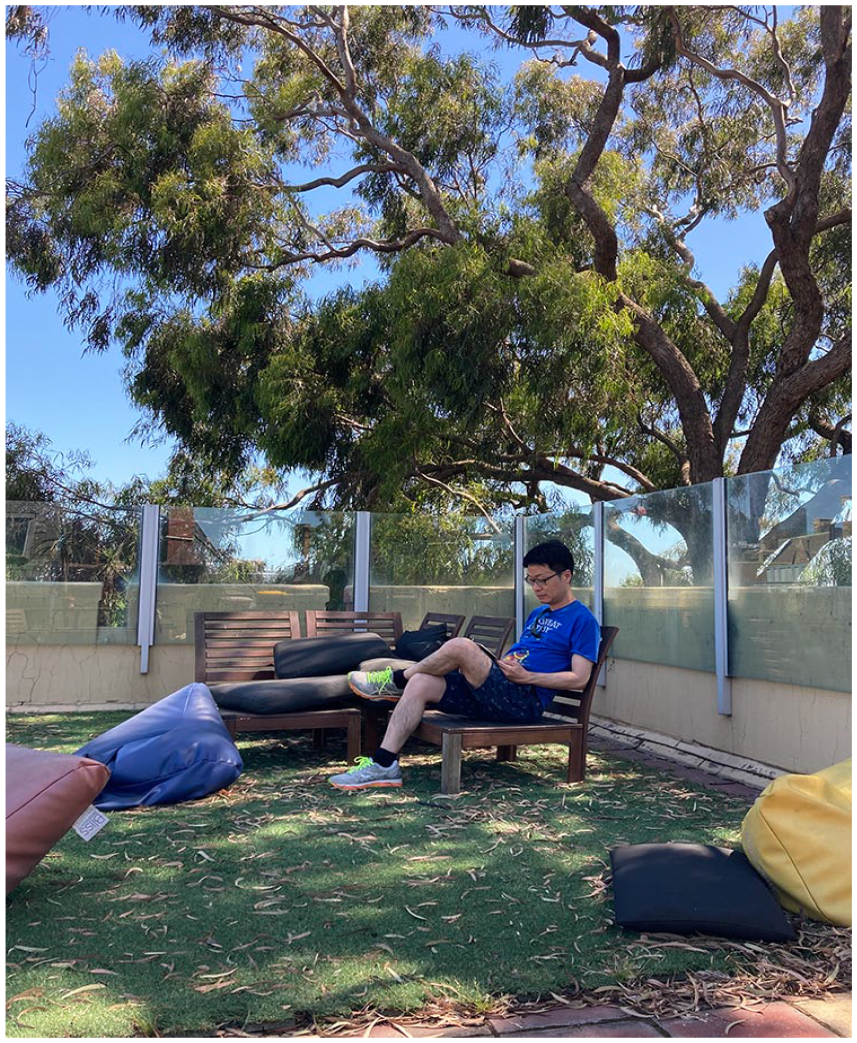
I read for pleasure across cultures in the college rooftop space.
I’m reading Edward Said’s autobiography, “Out of Place.” (Figure 9) Intellectual, emotional biography of a writer living on the border, feeling like an outsider. That’s what led me to Said’s book. Mobile writer. Home on the road. Wandering in the wilderness. We have overlapping creative ecologies even though we are cultures apart. I’m reading Said partly for enjoyment, and partly as a research text. In the creative ecologies of pedagogical spaces through which we are moving: life, research, reading, writing, and teaching are all intertwined.
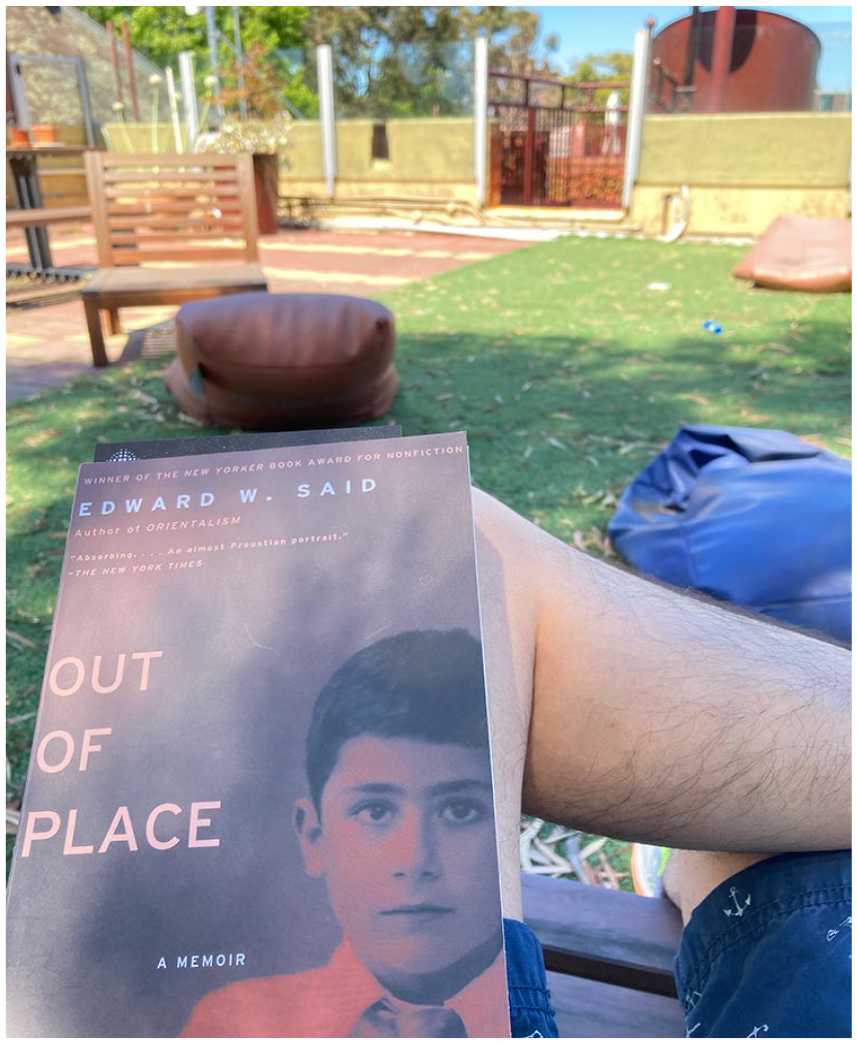
Feeling out of place, like an outsider.
Creative Agency in the College
It’s 7:30 p.m. in college, and I am pondering whether to spend a good chunk of the evening going to an in-house book group, when I really should be at my desk writing with all cylinders firing—my PhD milestone is approaching in under a month. I’ve been reading my PhD supervisor’s book on creative agency, written in the midst of Melbourne’s COVID lockdowns. So much of it resonates because it was the time when we started working together. One sentence from their book about a writer’s lived experience is speaking to me tonight, “I’m supposed to be finishing my book, but the book is about this: lived experience, natural aesthetics and creative connection. . .” (Harris, 2021, p. 17)—a passage about them taking time off writing to go on a road trip, because everything in a writer’s life is connected. For me, I’m supposed to be finishing my thesis, but the thesis is about this: lived experience, pedagogical aesthetics and creative connections. . .
Concluding Words
My residential college is an ambivalent pedagogical space. It is an educational institution traditionally associated with elitism and privilege. At the same time, it offers opportunities and spaces where continuous mentoring and educational care might soften some of that exclusivity. Adding to the college’s ambiguous situation is its geographical location, where it sits on the periphery of the inner core, which is the larger institution of the formal university. Living, teaching and writing on the site of my small and caring, privileged, ivy-clad red brick college, I feel doubly on-the-margins: both in my status as transcultural teacher and in the milieu of my peripheral college. Boylorn and Orbe (2021) assert that the “positioning of the personal and culture at the periphery makes space for autoethnographic engagement to acknowledge the various standpoints that exist within one person and to situate them culturally” (p. 5). Being “at the periphery” as a transcultural teacher in the college enables my critical questioning through continuous creative connections with different others in my pedagogical ecologies.
These creative connections would afford agency and political power to a transcultural teacher and other globally mobile teachers, who may experience injustices small or large from others too ready to put us into bounded categories, often for reductive labeling. A transcultural teacher who is able to harness his apparent disadvantage—the in-betweenness or peripheral out-of-placeness into creative agency’s “always-creative interconnectedness” (Harris, 2021, p. 5)—gains an advantage when teaching across diverse settings and connecting with diverse student populations.
In writing these critical autoethnographic prose poems on transcultural teacher subjectivity, I find myself always connecting with others in my pedagogical creative ecologies in the college. It is a careful and caring practice of attuning to diverse things and different others, sometimes unexpectedly, in my ecologies; using poetic inquiry to evoke these connections and relationships in all their ambivalences, like how life is.
Footnotes
Declaration of Conflicting Interests
The author(s) declared no potential conflicts of interest with respect to the research, authorship, and/or publication of this article.
Funding
The author(s) received no financial support for the research, authorship, and/or publication of this article.
