




Abstract
This article shares reflections from a group of academic researchers at the same University on their experience of conducting “community peer research” projects involving nonacademics in social research. We review a range of literature that has influenced the development of our practice, stressing the importance of co-production and power relations. We present six case studies that represent the breadth of our different engagements with community peer research, and then go on to reflect on the challenges and benefits of this approach. We identify a number of practical challenges, ways in which we overcame them, and in particular stress the importance of providing well-designed training for community peer researchers. We conclude with some recommendations for other researchers looking to conduct similar research.
Introduction
This article emerged from conversations between the authors at the Institute for Community Research and Development, University of Wolverhampton, on their varied engagements with “community peer research.” We came together to reflect on the challenges, rewards, and lessons that arise from the growing adoption of research methods and approaches that involve various “publics” and communities in research that are working with or alongside academic researchers and utilizing a variety of approaches including participatory methods, co-production, and peer research. This article shares our experiences, learning, and recommendations.
Through working together as colleagues separately, or with other collaborators, we converged on a model of engaged research that we term “community peer research,” an approach that involves actively recruiting and engaging nonacademics and providing them with appropriate support and training. In this article, we highlight aspects of our experiences through six different case studies. The hope is that the reflective research practices discussed in this article will enable other researchers to adopt a similar approach, while also further developing our understanding of participatory methodological approaches. We define community peer research as collaborative social research that involves nonacademics and members of communities (variously defined) in meaningful research in ways that have practical outcomes and benefit those who are impacted by the research or the intervention under consideration.
There has been a growing trend over recent years to engage citizens and communities in the design and delivery of public services, as well as the wider shaping of public policy, with citizens becoming increasingly recognized by politicians and policymakers as “experts in their own right, equipped with valuable lived experience and an inside understanding of how their communities work and what their communities need” (Yang & Dibb, 2020, p. 4). While the concept of citizen participation is not necessarily new—with, for instance, Arnstein’s (1969) Ladder of Citizen Participation first drawing attention to such engagement over 50 years ago—it is only quite recently that UK public agencies have made meaningful commitments to engage communities in their work (Institute for Community Studies, 2023).
At the same time, there has been an enhanced focus on involving communities within academic research in more meaningful and effective ways, with an emphasis on forms of “peer research,” “community research,” and “co-production” through citizen engagement being observed across a range of disciplines. These approaches are united in their commitment to engaging individuals with lived experiences of the issues being studied and their desire that the same should help to shape, inform, and conduct the research. Although there are of course disagreements and variation (for instance, social movement scholars advocate versions of research which completely disavow the researcher–researched dichotomy [Juris, 2007]), there is growing consensus around the principle of re-centering the knowledge of those with lived experience of a social issue, as well as re-balance the power relations between academics and researched communities. In addition to these broader intellectual shifts, funding bodies have increasingly prioritized research that promotes less paternalistic and more democratic and horizontal ways of engaging communities, along with co-produced outcomes.
This article presents six case studies from across multiple disciplines which used different approaches to engage communities in academic research. The demographics of the participants or the nature of their involvement differ in the case studies, but each utilizes methodologies which we term “Community Research” (CR). The short case studies describe the participants, as well as the settings and the research, and then offer reflections on the approaches adopted by the academic research teams. For instance, in Case Study 1 a peer-research method was adopted to work with young people, which emphasized the need for careful time and resource allocation. The peer-research method was also adopted for working with adult community volunteers in Case Study 2, and here highlighted the importance of data collection and data recording skills. Case Study 3 involved working with vulnerable and hard-to-reach participants. It utilized peer-research methods, and highlights the importance of recruiting organizations that support peer researchers, as well as the value of role-play in addressing the difficulties that arise with regard to peer-led data collection. In Case study 4, former service users with a history of mental health crises worked alongside the academic research team, and this case illustrates the importance of involving people with lived experiences throughout a research process. Community activism was an integral part of the community participation methods adopted in Case Study 5, and therefore provides a unique perspective among the cases explored here. Coproduction was at the core of Case Study 6 which dealt with a sensitive topic while working with young people. Taken together, these case studies provide revealing contrasts and present a picture of the benefits, challenges, and key learning from CR projects.
This article is structured as follows: first some key areas of learning from a wide range of existent literature related to community-orientated and participative research are highlighted. Thereafter, the six case studies are presented, before this article reflects on the key challenges and benefits in the discussion section. This article concludes with some recommendations and suggestions for future research practice. The importance of training and ethics in developing peer-research approaches are also noted.
Literature Review
Broader changes in society have been influencing traditional approaches to research. For example, the UN’s New Urban Agenda argues for “meaningful participation in decision-making, planning and follow-up processes for all, as well as enhanced civil engagement, co-provision and co-production” (United Nations, 2016). There is recognition that many societal challenges present “wicked” problems that demand a cross-organizational and inclusive approach to the pursuit of knowledge and the generation of learning more likely to bring about social change, recognizing “the personal, the local and the strategic, as well as specialised contributions to knowledge” (Brown et al., 2010, p. 4). These broader trends have in turn influenced practical approaches to social scientific enquiry.
For Greenaway and McDowell (2017), this “community-led or community-based research is conducted by, for and with the participation of community members as opposed to more traditional research on and to the community” (Scottish Community Development Center, 2016, cited in Greenaway and McDowell, 2017, p. 392). Notably, these approaches also sit within a broader turn toward co-production in public and voluntary sector services, culture and the arts, and other spheres (Durose et al., 2017). While this represents a challenge to traditional “researcher-led” paradigms, co-produced research may lead to improvements in the research process and the quality of resulting data; at the same time greater collaboration is thought to create multi-directional public benefit, offering “greater prospects than more conventional extractive or transactional methodologies” (Campbell & Vanderhoven, 2016, p. 6). There are multiple antecedents as well as distinct strands in the academic literature—we highlight some key ones in Table 1—and in drawing them together our aim is to contribute to developing and advancing participatory methodological approaches using reflective research practices (Arnull & Kanjilal, 2024).
Key strands within the literature that have influenced the development of community peer resear.
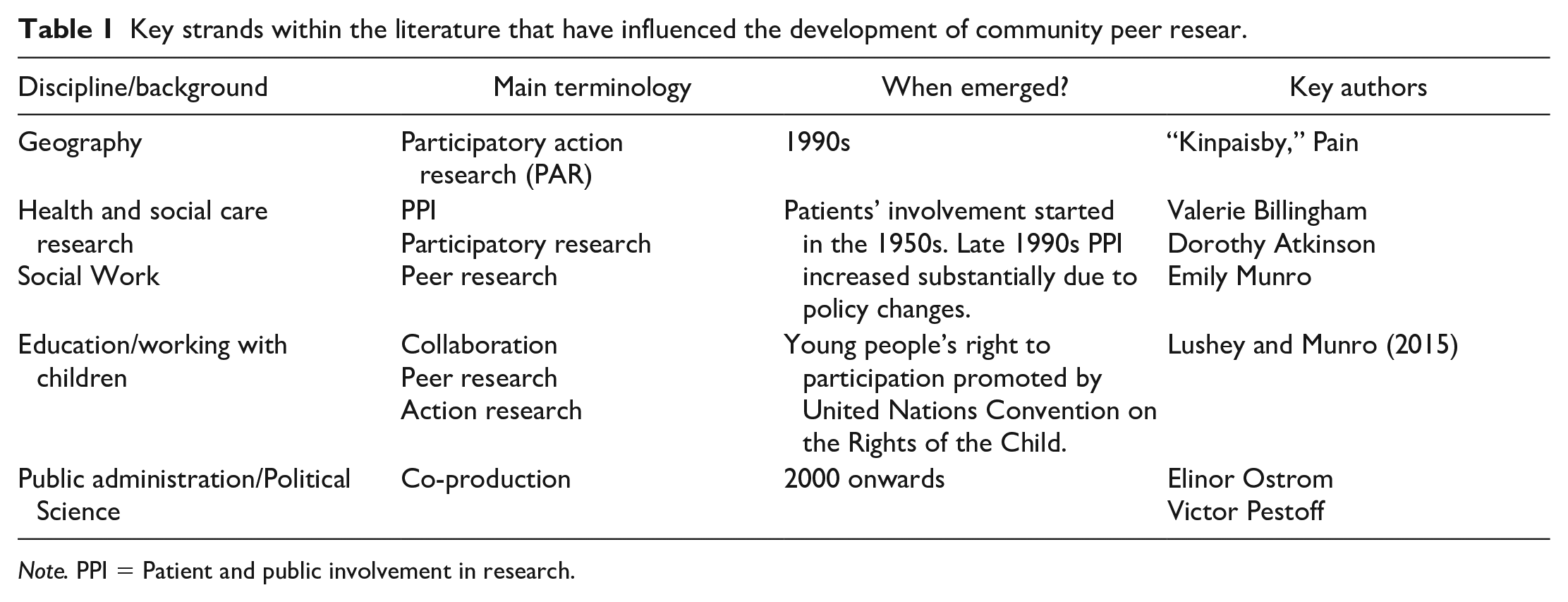
Note. PPI = Patient and public involvement in research.
In stark contrast to “traditional” positivist research paradigms, recent decades have seen the rise of feminist and poststructuralist standpoints that question how knowledge is produced, by whom, and how it is used. Feminist research has also been particularly influential in making more visible the power relations that exist between the researcher and their subjects, while also paying attention to the multiple positionalities of the researcher as well as considering the ways in which these identities may influence and shape the research encounter (Hopkins, 2007). The aim is not to somehow make research “objective” but rather to reframe the researcher as no longer necessarily an “expert” who harbors privileged access to the “truth” but is instead tasked with embracing the explicitly political nature of the research and “taking sides” (McDowell, 1992). As a result, participatory approaches have risen in popularity since the 1990s, with the key epistemological goals of such approaches being to destabilize the traditional barriers that exist between the researcher and the researched, while also producing spaces for collaboration and the co-production of knowledge.
More broadly, Participatory Action Research (PAR) is an approach that criticizes conventional research methods for their tendency to externally develop research designs and extract data from the field and disseminate results in scholarly journals which produce few positive impacts for the researched communities themselves (Kesby, 2000; Kindon, 2005). Instead, PAR seeks to affirm participants’ rights and capacities to effect change themselves. Its central tenets include the co-production and co-ownership of the research with participants; bringing “new voices” into the academy to ensure that research is “appropriate, meaningful, and relevant” to communities (Kesby et al., 2005, p. 164); and facilitating participants’ empowerment and decision-making in their own lives (Sultana, 2007). PAR is, therefore, committed to a collaborative and nonhierarchical approach that democratizes knowledge production alongside a concurrent commitment to positive change (Klocker, 2012). Despite this, the methodology has suffered from a lack of enthusiasm and cooperation from participants, with results obtained sometimes failing to effect either social or political change. This has led to an increasing recognition that participatory approaches are not inherently progressive; others have gone further and described PAR as a new form of tyranny which masks power relations and external agendas (Cooke & Kothari, 2001).
Despite these variations in approach and language, and the complex antecedents of community peer research, we find that there is an underlying commitment in such research to co-production which entails complex negotiations of persistent power relations. We now consider these aspects in more detail.
Co-Production and Community Peer Research
The concept of co-production has gained ground in policy circles following Elinor Ostrom’s exploration of how services became more efficient when their consumers were involved in their commissioning and delivery (Ostrom, 1996). Since then, there has been growing recognition of the value of including the expertise of service user communities and local citizens in the commissioning and delivery of welfare services. Advocates of co-production believe that improved citizen participation has “the potential to provide significant economic, political, and social benefits” (Pestoff, 2018, p. iv) and that experts do not hold all the answers. Beebeejaun et al. (2014) reflect, that, over recent years, there has been a proliferation of academic research that has aspired to include and involve communities in research, and that this has occurred across a wide range of disciplines. The most radical work aims to be transformative, that is to “both engage the researched at the problem definition stage and to actively alter the social conditions in which they find themselves” (Robinson & Tansey, 2006, p. 152). Yet such approaches, despite echoing the United Kingdom’s Research Excellence Framework impact agenda and other incentive structures within academia, face obstacles from research governance, particularly in relation to ethical approval processes risk framing communities as always vulnerable, inadvertently creating further distance between researchers and communities involved in research (Smith et al., 2016).
It is considered that co-production requires “negotiation, participation [and] cooperation [. . .] based on compromises and mutual understanding, and a more equitable distribution of power and resources” (Vigoda, 2015, p. 476). Co-production demands the “space and opportunity for individuals to contribute” to finding solutions to local problems where professionals and practitioners “had previously exercised full control” (Strokosch, 2013, p. 376). While the practice of co-production may be inconsistent, conflated with terms like consultation and partnership (Booth, 2019; Brandsen et al., 2018), it is viewed by many theorists as leading to more effective services and potentially empowering service user communities (Strokosch, 2013). This is because, positioned at the top of the ladder of user and carer involvement (Arnstein, 1969), co-production moves beyond simply consulting user communities toward creating a transformation in the balance of power between service providers and user communities (Keohane, 2009; Pestoff, 2018).
In essence, co-production is a response to the complexity of social issues, and recognizes that “the personal, the local and the strategic, as well as specialised contributions to knowledge” are essential to generating solutions (Brown et al., 2010, p. 4). Co-production echoes this inclusive approach, as it “not only integrates disciplinary paradigms but does so as defined by socially relevant issues [and includes]. . . participatory methods to foster co-production of knowledge and social learning among different actors” (Krueger et al., 2016, p. 370). It not only contests the privileging of academics in the research process, but also implicates the conventions around the commissioning and funding of research, as well suggesting that the boundaries between researchers and the researched need to be repositioned. Furthermore, it challenges the idea of what constitutes “pure” research, questions the privilege accorded to peer reviewed knowledge, and instead assigns more value to research that can be valued for its “social worth” (Campbell & Vanderhoven, 2016). Carrying out research that reflects the social problems identified by communities themselves, and placing an equal value on the expertise embedded within the community in questions, redresses the inequity in the research process and ensures that the communities themselves have roles in identifying and defining the problem, while also increasing the likelihood that the research will be make a difference.
The Importance of Recognizing Power and Power Relations
Cornwall and Jewkes (1995) identify issues of power and representation as being at the heart of participatory approaches to research. Consequently, the attitudes of researchers are a key factor in allowing participatory research to flourish. Researchers who remain in control of the research process allow only “shallow” participation; in contrast, participatory research is a process of facilitating “deep” participation in which researchers are involved in “relinquishing control and devolving ownership of the process to those whom it concerns” (Cornwall and Jewkes, 1995, p. 1669). Such approaches involve unique ethical dilemmas and practical problems for researchers. It is challenging for many researchers to relinquish control for both personal and structural reasons, while there are also barriers which limit participation with local communities, such as skepticism and distrust, a shortage of time or resources, and fluctuating motivations and commitment.
There is some evidence that power differentials can be modified. Lushey and Munro (2015) worked with young people and examined whether the peer-research process might empower peer researchers and improve the practice at the same time; their insider knowledge of care leavers made them eligible to become peer researchers, and they blunted power differentials by highlighting the contribution made by the peer researchers because of their unique skills and capabilities. Similarly, the United Kingdom’s National Institute for Health and Care Research (NIHR, 2021) argue that sharing power, meaning where the research is meaningfully jointly owned, and people work together to achieve a joint understanding is critical to success. They draw attention to including all perspectives and valuing the diverse knowledge of all involved in the research, the importance of reciprocity so that everybody benefits from involvement, and the need to build and maintain relationships throughout (NIHR, 2021). Not all decisions necessarily require the involvement of every participant, but reflective practice is required so that social and economic differences are recognized and “continually addressed in the ongoing relationships” (NIHR, 2021, n.p.).
There are a number of ethical issues inherent within community research. First, there are questions surrounding the given researcher’s relationships with community/peer researchers and, second, the relationships between the community/peer researchers and the communities under investigation. Greene (2013) argues the former is rarely considered and that researchers should pay more attention to the nature of their relationship with community/peer researchers. Other research has explored whether peer researchers can maintain ethical requirements when working in their own communities (Constantine, 2010; Simon & Mosavel, 2010). Yoon and Templeton (2019), argue that when working with children and young people, it is important to acknowledge that adults retain cultural power and that, as a result, young people’s voices may be overlooked in comparison with “adult conversations and actions” (Kellet, 2009, p. 241). Arnull and Kanjilal (2024) showed that it is essential to consider demographic factors when undertaking participatory research. They further argued that young people should be supported and encouraged to participate in co-produced methods of research precisely because social policy often overlooks young people’s perspectives and does not hear their voices.
We acknowledge that assumptions that co-production is an inherently worthwhile endeavor may not be shared by those who do not wish to engage in academic research due to a lack of interest, material resources, or other unseen or unknown barriers to entry. In the next section the experiences of the authors with regard to community research in practice are highlighted. This article discusses the need for researchers to be flexible, to be able to respond to diverse contexts, and to be willing able to work with a wide range of communities, and individuals and interested parties from very different standpoints.
Case Studies of Community Peer Research
Community House Research: Research With Children, Mahuya Kanjilal and Elaine Arnull
Community House Research (CHR) was a peer-research study of a social intervention within a London Borough primary school. A peer-research methodology was adopted to understand the perceptions of pupils about the use of the Community House, a place that had been developed by the school to meet parents’ social and educational needs. Ethics approval for the research was granted before recruiting, with the help of their teachers, ten young children (from Years 5 and 6 who were 10–11 years old) as peer researchers. The children attended 4 days training on basic research methodology focused on data collection. They co-designed a questionnaire and interviewed 100 other children from Years 3 to 6, in the presence of an adult researcher. Peer researchers presented the findings to the school community and at a university seminar, thereby disseminating the research to a wider audience (see Arnull & Kanjilal, 2024).
The research process helped the young peer researchers to gain research skills, such as the importance of consent, data collection tools, data analysis using Excel, and presentation skills. Improvements in individual skills were recognized by the parents and teachers of the peer researchers. One parent recognized and highlighted the academic abilities of her daughter during the presentation. While none of the family had a higher education background, the involvement of their daughter in peer research led them to value higher education, an unexpected outcome for the research team.
Working with younger children requires significant time and resources. In this research, the research team dedicated more time and resources than anticipated because the young peer researchers need more time than expected during training, for example to go through elements of the training in a lot of detail. Also, research integrity is developed through practice and experience, which the research team needed to account for given the young age of the peer researchers. Recording qualitative data in a face-to-face interview also requires experience as well as research skills and techniques which the young peer researchers did not have. The adult researchers therefore had to try to ensure that no relevant data was lost. In the event, some qualitative data was lost due to difficulties in deciphering the handwriting of the peer researchers.
From this we learnt that, in future similar studies involving young people as peer researchers, there would be a need to ensure age-specific peer-research training focusing on each stage of the research process including practical skills sessions and practice sessions. With younger peer researchers training is a worthwhile, but also time-consuming process. We also recommend that there is a need child friendly methods of data collection such as images and other types of visual methods which can increase the efficiency of data collection while working with young peer researchers and participants.
Brookside Safer Streets: Research With Adults, Mahuya Kanjilal and Elaine Arnull
This peer-research study explored the impact of a Safer Street project in a West Midlands neighborhood. Another objective was to explore whether the Safer Streets volunteers who became peer researchers could engage community members in talking about issues of safety, violence, and crime. Six adult community researchers were recruited because of their involvement in the Home Office-funded Safer Streets project and their local knowledge. One day of training was delivered on research basics, ethical implications, and data collection methods. The peer researchers co-designed the survey questions and this process began on the day and was continued through “back and forth” discussion on email facilitated by the community development worker who supported the research. The peer researchers decided on the survey schedule before conducting the survey over a 2-week period, ultimately collecting data from 31 Brookside-area residents.
Recruiting adult volunteers was time-consuming and delayed the research process. Support from a local community development worker was crucial for both recruitment and subsequent communications with the peer-research team. At the initial stage, volunteer adult researchers requested to use the term “Community researchers” instead of peer researchers because they were part of the community, while the term “peer” was perceived to be too academic. Agreeing this change helped to increase their ownership of the research process.
During the training, the adult researchers seemed confident. However on completion of the survey the research team became aware that they had been hesitant in approaching people to ask the survey questions. This had not been apparent in training and may have led to fewer people being engaged and therefore a loss of potentially useful data. Peer researchers are usually recruited based on their insider knowledge and do not necessarily have existing research skills. It is crucial therefore to take stock of community researchers’ abilities, literacy skills, and confidence, as these are likely to impact on data collection, recording, and analysis. Building an age-specific skills survey into studies is something we would now recommend as it enables research teams to create bespoke training. A skills survey would enable identification of the range of complementary skills community researchers have and which tasks they anticipate feeling comfortable undertaking. This would allow tasks/roles to be shared or for alternative arrangements to be made at an early stage. We recognize that peer researchers dedicate their time and may wish to “get on” with the research rather than undertaking too much training or a skills survey, but equally it can be a useful, transferable tool that can be applied in other areas of their lives.
Evaluations completed by the adult researchers showed that the experience had been beneficial and allowed us to further understand the challenges that the peer researchers had faced during the research process. For instance, they noted: “I was nervous but when started it, gave me confidence, I didn’t think I could do the survey before.” The community researchers identified benefits and noted improved self-confidence and a greater willingness to be involved in their local community. We would recommend using multiple-choice questionnaires and close-ended questions as they are more straightforward for those who experience writing or cognitive difficulties. The peer researchers’ evaluation was important to our understanding of the research process and should be embedded in future projects.
Changing Lives: Research With Women With Lived Experience of Sex Work, Bozena Sojka
Three former sex workers (who had previously received support from Changing Lives themselves) were recruited as peer researchers to evaluate one of the charity’s projects. They received 2 days of training that explored: the skills of everyone involved, ethical principles, the co-creation of the interview guide, and role-play to practice their interview techniques and learn how to use dictaphones. The peer researchers conducted six interviews with current sex workers and had opportunities for reflection throughout the process.
The evaluation aimed to understand the needs of the women with experience of sex work, survival sex, or sexual exploitation in Wolverhampton and Walsall; and the impacts that the Changing Lives’ Iris project has had on women who engage with the service. Changing Lives staff members attended the training session so that they could provide additional ongoing support to the peer researchers. After the peer researchers had conducted their first interview, they met with one of the researchers to reflect on both what had gone well and challenges. The ICRD researcher transcribed the interview and provided constructive feedback, for example, where additional probing questions could be used in future interviews. We had aimed to bring the group back together to sense check the data analysis, but due to the COVID-19 lockdown this was not possible.
Reflecting on the project, first, the support of staff from Changing Lives (and their involvement in the training) was crucial in facilitating recruitment and ongoing communication between the research team and the peer researchers. Recruitment was a challenge and would have been even more difficult without the input and understanding of the staff. Second, the input of the peer researchers in designing information sheets, interview guides, and the recruitment methods used to engage vulnerable with a “hard to reach group” (in this case sex workers) was invaluable. Third, the peer researchers explained how they were quite anxious about engaging in role-play during the training, but all commented as to how beneficial it had been after they had engaged in it and received feedback. Future research involving peer research should include role-playing activities in training sessions. The role-play also provided the peer researchers with an important opportunity to share their own personal experiences. Finally, the reflective process by which the peer researchers reviewed their interviews was important and valued by the peer researchers. Unfortunately, given recruitment challenges, the peer researchers were unable to put this into practice as much as we had hoped in the short interviews, where we felt additional probing questions could have been used more effectively. Important for all research, but particularly when researching with hard-to-reach groups, is that peer researchers are confident in using probing questions to ensure that as much data as possible is gained from initial interviews. Future peer research should ensure that additional support is factored in for data collection, with consideration given to conducting first interviews jointly to maximize data quality and integrity.
Mental Health Crisis: Adults With Lived Experience of Mental Health Crisis, James Rees
Adults with lived experience of mental health crises were recruited to work alongside the academic researchers. The project aimed to investigate the role of the voluntary sector in providing mental health crisis care, including through partnerships with statutory public services (Newbigging et al., 2020). It was considered important from the outset to include within the research team peer researchers with lived experiences of mental health problems. A clear benefit of this approach was the ability of peer researchers to build rapport with interviewees from vulnerable groups, and ask appropriate and nuanced questions, thereby enhancing the quality of qualitative data. At times, they also provided a critical challenge to interviewees in professional or policy-making roles. Peer researchers were able to provide different insights on data, having lived experiences of the issues they were researching. Most of the peer researchers had previous social research experience—for this reason they were not provided with a formal training program—instead they were offered specific training opportunities as need arose during the project, as well as ongoing advice and support from the academic researchers.
Some of the challenges found were practical and closely related to the fieldwork process—these included “triggering” events during interviews which could be experienced as traumatic; in addition, some of the peer researchers suffered relapses or episodes of ill health during the research and were thus unavailable for fieldwork. Once into the later phases of research, it proved difficult to keep the peer researchers closely involved in the process of data analysis (particularly using the software package NVivo), as the training they had received proved to be insufficient. In hindsight, setting clearer expectations around their degree of involvement, particularly in relation to the data analysis tasks, would have been helpful, as would have been putting in place additional pastoral and practical support. Despite these challenges, one peer researcher commented: “it’s definitely the [project] that’s made the most effort to include services users and to have it more like co-production rather than just, service users contributing to the project.” The service user, carer, and peer researcher involvement in the project was evaluated separately toward the end of the project, with one participant commenting that “I think that as a research community we need to be far more honest about the challenges of it and the messiness of it” (With-You, 2019, p. 1). The evaluation went on to observe that all involved felt that “diversity had been a key feature of the project and recognised the importance of including a range of experiences of [mental health] crisis” (p. 5).
Politically Engaged Ethnography With Anti-Cuts Activists, Josh Blamire
This research was part of a doctoral study carried out between 2014 and 2017 which explored anti-austerity politics in Liverpool. The ethnographic fieldwork drew on participatory research approaches within the discipline of Geography and took inspiration from politically engaged ethnographies practiced in social movement research which seek to co-produce knowledge through researcher engagement with participants across shared political goals (Chatterton, 2006). Notably, Juris (2007) considers how to best combine activism with research opting for collaboratively produced ethnographic methods which aim to facilitate “ongoing activist (self-) reflection regarding movement goals, tactics, strategies, and organisational forms” (p. 165).
The research involved deep politically engaged ethnographic work within the “anti-cuts” movement in Liverpool. This entailed attending meetings, participation in rallies and demonstrations, and helping to produce movement-related outputs (such as leaflets, reports, and blogs). The researcher also co-organized a local conference which brought together activists, community representatives, trade unions, the third sector, and local politicians. The researcher worked with “activist participants” as co-researchers who helped shape appropriate research questions, collect and interpret data, and forge new forms of enquiry through their unique knowledge, skills, and experiences as activists and local citizens. Ongoing informal dialogues helped to facilitate activist co-reflection on the mutual research aims, which were to build an anti-austerity movement.
This approach challenged boundaries between the researcher/researched, empowered community activists and residents to be involved in the research, and helped to build emancipatory knowledge that could be actively used. Indeed, activists enjoyed this approach to research and reported participation as having changed the ways in which they thought/acted about the issue. It also fed directly into ongoing place-based political activities rather than imposing rigid frameworks of study which were neither relevant nor useful to the communities in question.
However, this approach relies on long-term ethnographic engagement which is difficult to maintain. It also depends upon making moral, ethical, and political commitments to others which cannot always be fulfilled; for instance, over time, the researcher grew more critical of the movement’s strategies and goals. The lack of funding meant that activists were not financially compensated for their input, and the desire to problematise the researcher/researched dichotomy meant that activists did not receive any specific researcher training. Politically-engaged ethnography allows researchers deep immersion and the potential to work toward mutual political goals with activists through simply “being useful.” It follows, that it offers lessons for researchers wanting to work alongside social movements in instance where the researcher is aligned with the political motivations of the group/community.
Dying to Talk—Peer Research With Young People, Jane Booth
Dying to Talk (D2T) was a project working with young people to co-design activities and resources to engage other young people in conversations around death and dying. Young people are often left out of such conversations; negatively impacting their future mental health and wellbeing (Holland, 2001). Facilitating such conversations early in life could bolster future resilience when faced with bereavement or one’s own mortality. D2T was a collaboration between two universities, and a charity: Child Bereavement UK. The project initially used archeology to facilitate young people talking comfortably about death and dying. Twenty 14- to 19-year-olds from Bradford and Wolverhampton schools were recruited as project ambassadors to co-design project activities and resources for “Festivals of the Dead” which were taken into secondary schools.
Working co-productively required acknowledging power differentials between professionals and laypeople, and between adults and young people. To foster a co-creative and inclusive space we held “think ins” where “negotiation, participation [and] cooperation . . . based on compromises and mutual understanding, and a more equitable distribution of power” were nurtured (Vigoda, 2015, p. 476). We wanted academics and young people to be “equal partners with expertise” (Lamb, 2010, p. 3). During the first think in the ambassadors took charge of producing a “manifesto” which detailed the project’s rules of engagement. In the second think in all adults and young people produced a “This is Me” poster as an icebreaker and to get to know each other as colleagues. In subsequent think-ins, the ambassadors made the decisions about the activities and resources they wanted to design for the Festivals of the Dead and formed task groups based on individual preferences.
Project evaluations indicate that project activities and resources were well received by the Festival participants. Comments included, “It was quite enjoyable and I did have fun—I enjoyed the experience of trying to normalise death which is a topic people usually avoid.” The young ambassadors’ evaluations also reported positive changes to efficacy and confidence. One ambassador stated, “Before I didn’t like talking much about how I feel. Joining this project let me talk to people and I wouldn’t get judged by it. The staff worked hard to make sure we never felt embarrassed or scared . . .”
However, some project areas did not reflect the principles of co-production. The use of archeology was a starting point for discussion for the ambassadors and included in the festivals as this was part of the funding bid. However, the young ambassadors often did not draw on archeology when creating resources. Instead, they preferred to use technology and creative arts to engage their peers, revealing a tension between the academics’ expertise and that of the young people. In addition, the young ambassadors were sometimes hesitant to make resource-based decisions, and actively sought the academic team’s input. Nonetheless the ambassadors strongly opined that young people could, and should, be co-producers in activities that impact their lives:
I am of the age where I’m starting to understand the grown-up parts of life and it can get overwhelming sometimes but this project helped me get some weight off my shoulders through discussing death and bereavement with other young people.
Discussion: The Challenges and Benefits of Peer Research
As evidenced in the case studies, community peer research presents challenges. Others have written that representation can be an issue when those who get involved already having a sense of efficacy, while more marginalized people lack the confidence to do so (Kellet, 2009; Thomas, 2007). We found that this was not necessarily the case, and that peer research provided opportunities for involvement which might not otherwise be available. That the case studies did not present ethical challenges suggest that this may not be a high risk (Beebeejaun et al., 2015). Other authors such as Booth (2021) have suggested that, consciously or unconsciously, academic researchers may revert to paternalistic ways of working when under budgetary or time constraints. Pavarini et al. (2019) were worried that academics may reproduce power imbalances rather than reconciling disagreements when working with young people, when the latter are perceived as “unfinished adults.” Our relevant case studies did not find this but did note that such research processes take longer to do well, and that therefore peer-research projects need “flex” built into their timescales. In addition, because the language and conventions of research processes may act as barriers to community participation this form of research should be mindful of how social problems are identified and framed by academics and ensure this reflect the understandings of the communities themselves (Williamson & de Souza, 2010).
We noted that community peer research as a method was particularly useful in assessing vulnerable groups, “hard-to-reach,” or young participants. Indeed, peer research is particularly adaptable across the life course: age does not appear to be a barrier for peer-research projects. That said, our case studies demonstrate that levels of involvement can vary considerably. Co-production was an aspiration but not always fully achieved and researchers need to have an ethical commitment to the principles of CR, while being open to learning from, and refining, their practice. In addition, there was considerable variation in the style and duration of training, whereas content usually covered similar areas. In several of the cases, there was a need for more in-depth training on data analysis or a need for age-specific training.
Practical Challenges in Community Peer Research
First, and reflective of power and knowledge imbalances within the team, not fully understanding the needs of peer-research participants prior to embarking on a research project can lead to honest mistakes such as loss of data. In the Community House case, deciphering researchers’ handwriting was an unanticipated problem. This is closely linked to the challenges linked to including peer researchers meaningfully because of limits to their skills/confidence levels. In the MH Crisis project, peer researchers were asked to take part in data analysis using NVivo—but due to insufficient training, the task became unwieldy and lacked consistency. This shared analysis did not work, ultimately wasting hours of project time. This illustrates that research is a difficult job requiring a huge range of soft skills, alongside formal qualifications. Designing and providing the right level of training is not easy and is an area in which reflective practice, CR evaluation and cycles of improvement and reflection will aid future academic and professional practice. Research teams need to set realistic expectations for all team members, schedule adequate training, and build in support, honest feedback, and a culture of open communication.
Further challenges arose around a deeper issue that we label “identity work.” Peer research and co-production is a continuum and university researchers may genuinely want to be more co-productive than can be able due to time, resource, and focus. There is a risk of over-promising, and our reflections suggest that this common; as highlighted in both the political ethnography, and the D2T cases. In the former, identity work had to be done by the researcher who was asked to negotiate different identities; in the latter, tensions arose from describing individual research projects as “co-productive” when the community were not part of some important aspects of research design, analysis, and so on.
The Benefits of Community Peer Research
Despite the challenges, the authors are of the opinion that a peer research approach is mutually beneficial. Peer researchers benefit from taking part, through each stage of the research process offering skills development opportunities—of research knowledge, interviewing skills, data analysis skills, software data analysis, and presentation skills. Evidence from our case studies suggests that skills improvement is not restricted to age, gender, or a service user group; peer researchers’ postresearch evaluations evidenced enhanced interpersonal qualities, such as confidence and senses of belonging. In addition, being involved in a research project, bestowed with responsibilities and wider recognition supported confidence building and self-assurance. The development of transferrable skills may also aid future employability, while increased senses of belonging and self-confidence also contribute to a sense of community and may lead to enhanced team building capacities.
Academic research teams also benefit from the peer-research approach. Peer researchers bring a wealth of insider knowledge and access to groups often considered as difficult to engage in academic research. In addition, engagement and rapport building are crucial for participatory studies and peer researchers can help to bridge gaps, as evidenced in the Brookside Safer Streets, Changing Lives Evaluation, and Mental health projects. Shared characteristics such as common ground, same language, and insider knowledge may also make peer researchers more acceptable to participants, with the latter also more readily relating to interviewers. In the Community House research young peer researchers quickly built rapport with same-aged participants and completed 100 interviews within a short time.
Our case studies demonstrate how a peer-research approach supports co-production of resources and/or developing appropriate research tools for the researched group. For instance the insider knowledge of peer researchers played a significant role in developing age friendly questionnaires for the Community House research. The D2T project similarly evidenced the creation of appropriate group rules and resources. Peer researchers are also able to offer insightful explanations for recorded phenomena because of their lived experiences. Similarly, wider dissemination to nonacademic audiences is achievable when peer researchers are involved, creating greater impact for studies.
The Importance of Community Peer Researcher Training
Training is central to leveling relationships between academics and community researchers. The latter rarely possess formal academic or professional training in research and therefore need training to acquire research skills. This can be provided through supervision, mentoring, formal courses and experiential workshops, but requires an investment of time which may result in peers losing interest and enthusiasm. It follows, that a well thought through research design should include adequate training to facilitate rigorous community research.
Training programs should have detailed structures and defined content to help peer researchers navigate their role in the research process while highlighting what is required from them. Suggestions include involving peer researchers in all phases of research, providing training relevant to each phase, ensuring good communication, feedback, and emotional support, while also facilitating simulations (role-play) to aid practice and apply what has been learnt (Eaton, 2019). As noted, training can benefit those who participate and may increase their employability through the acquisition of transferable skills. We must also, however, be mindful of the time commitments and potential emotional impacts that peer researchers may experience throughout engaging in the process and ensure that support systems are in place throughout and where possible, beyond their involvement (Gratton & Reynolds, 2022).
Recommendations and Conclusion
Community peer research allows for more equitable engagements with research “subjects,” while working closely with those targeted by helps to improve the quality of research, ensures more effective knowledge transfer and “impact,” and can mitigate potential ethical concerns. Through this, community peer research may also provide better value for money. However, our collective experience demonstrates that community peer research is not without challenges whether practical (such as power and knowledge imbalances, adequate training, liaison and support) or pertaining to different researcher/participant identities throughout the process.
Co-productive research offers unique opportunities to transform the research process through empowering citizens and devolving power to communities of people. The challenges faced require university researchers to be critically attuned to the power dynamics inherent to research praxis, and to work proactively and pragmatically to resolve tensions. Mindful of this, a series of considerations for university researchers seeking to embark upon this type of research are proffered: In summary, we suggest,
Where possible, the communities invited to take part in a research project should be involved in the project as early as possible; ideally prior to funding bids being submitted.
Research team roles should be allocated according to skills and interests; all roles should be valued equally.
Research teams should reduce power imbalances, whether through social events or rules of engagement agreed by the whole team. “Imbalances in the number of team members from community and academia may discourage peer researchers from challenging or supplementing academics” knowledge.
Finally, peer-research demands a proactive approach. The communities we aim to work with may be “in the room” but academic researchers must ensure they are not simply reproducing paternalistic cultures of working (Booth, 2021). Taking steps to nurture conditions where knowledge sharing is reciprocal should be routine, and not just a research tool or mechanism to tick funding boxes; while peer researchers must have “reason to believe that their involvement will make a difference” (Sinclair, 2004, pp. 110–111). Knowledge is crucial to bringing about social change (Brown et al., 2010). Community research advocates that including the knowledge of those living with a social problem is more likely to elicit a deeper understanding of relevant social phenomena (Newbury-Birch, 2019). CR is more likely to be transformative, with the generation of knowledge that helps create a better future for those involved because it is a more “collaborative, iterative process of shared learning . . . [in which] research is undertaken with people rather than on people” (Campbell & Vanderhoven, 2016, p. 10).
Footnotes
Declaration of Conflicting Interests
The author(s) declared no potential conflicts of interest with respect to the research, authorship, and/or publication of this article.
Funding
The author(s) received no financial support for the research, authorship, and/or publication of this article.

Author Biographies
Professor