




Abstract
Using examples drawn from letters written by rural youth from the western Canadian province of British Columbia during the interwar period, I explore three interrelated interpretive strategies or dispositions for amplifying young peoples’ contributions to history: empathic inference, relational agency, and the axiom that children are heirs to the future. The letters are part of a larger archival collection of the province’s Elementary Correspondence School, the first of its kind in Canada, and provide historians with uniquely valuable child and youth focused perspectives on schooling, family, work, and other aspects of their lives. Supported by examples from the letters, I argue that young peoples’ contributions to historical change are most clearly legible when interpretive strategies, including the historical methods and methodological dispositions historians adopt, reject traditional conceptions of history as exclusively or mainly adult driven.
Introduction
My scholarly interest in the history of children and childhood emerged directly from my personal experience as a new mother in the late 1990s. The birth of my first child, Sophie, in 1998, introduced the urgency of her physical and emotional well-being into the very core of my life. In fact, Sophie’s care and sustenance became my life, especially in her early years, an experience that would be repeated 4 years later with the birth of my second child, Will. My preoccupation with ensuring that Sophie and Will thrived, that their small bodies grew strong and healthy, made me appreciate in new ways how and why children’s very presence in the world made a life-altering difference to those around them. Over time, my personal experience of motherhood gave rise to two key historical questions that continue to shape my scholarship: What is distinctive about the contributions children make to history? What new or modified interpretive strategies, including methodologies, enable historians to better understand, and argue for, these youthful contributions to history?
Adults are typically recognized as the primary drivers or agents of historical change and therefore primary sources produced by them—particularly by those in positions of power in the past—are routinely kept and meticulously archived. Children, however, are typically not acknowledged as agents of historical change and therefore extensive preservation of their perspectives in archival collections are relatively rare (Alexander, 2012; Maza, 2020). Despite this long-standing exclusion, young people remain central to a wide range of histories and historians find evidence of their experiences well beyond the archives. The history of colonization, war, education, social welfare, health, and medicine, to name only the most obvious topic areas, could not be comprehensively written without consideration of the contributions of young people (Alexander, 2016; Carleton, 2022; Comacchio, 2006; Gleason, 2013; Myers, 2006, 2019; Strong-Boag, 2006, 2011). From the provision of training, nourishment, affection, and discipline on the part of parents and caregivers, to the development of child-focused educational, medical, and legal professions and professionals, to governmental policy, systems, institutions, and law, the management, protection, and exploitation of the young on the part of adults has a long and varied history. Such histories tend to fall into the category of the history of childhood, with its focus on childhood as a life stage, including both ideas about children and the treatment of children by adults. The history of children, conversely, has tended to focus on the subjective experience of children as children, including centering children’s perspectives and relationships (Alexander, 2012; Gleason, 2009; Sutherland, 1997).
Children’s contributions to historical change, I argue in this article, are most clearly legible when interpretive strategies, including the historical methods and methodological dispositions scholars adopt, reject traditional conceptions of history as exclusively or mainly adult driven. When adult-centric or otherwise “top down” conceptualizations of who and what “makes history” are employed, children’s contributions are too easily overlooked or excluded (Gleason, 2023). In solidarity with other scholars who focus on those traditionally underrepresented in history, including women, Indigenous peoples, racialized people, sexual and gender minorities, and disabled people, historians of children and youth most profitably use methods crafted specifically to challenge children’s invisibility and isolation at the margins of history. 1
My discussion of interpretive strategies draws on examples from a unique collection of letters written by young people themselves and preserved in the official provincial archives of the westernmost Canadian province of British Columbia. The letters are part of the larger collection of the Elementary Correspondence School (ECS) which operated through the then named Department of Education in British Columbia between 1919 and approximately 1950 (Gleason, 2017; Toutant, 1994). The ECS offered free public school curriculum and writing materials to rural families whose school aged children were either too far from a brick-and-mortar school or whose mobility was limited due to difficult physical terrain in remote parts of the province. The ECS collection contains hundreds of family files which in turn include hundreds of letters from both parents and children to their ECS teachers and administrators. The collection is valuable not only because it is voluminous but also because the letters from young people reflect an intriguing range of illusive youthful perspectives on getting an education and growing up in isolated rural conditions over the early to late 20th century (Díaz-Díaz & Gleason, 2016; Gleason, 2016, 2023; Ronen & Gleason, 2022). As is the case with all historical sources, however, letters have their strengths and complications. Shaped by layers of contingencies, letters sometimes conceal as much as they reveal. Historians of children and youth, such as Kathryn Bridge and Daniel Cohen, point out that interpreting children’s letter writing is complicated since they “so often reflect the looming influence of elders” (Cohen, 2011, p. 223). Teasing out whether a letter reflects a child’s thinking or the demands or expectations of adults requires ongoing reflection on the part of historians. Difficult interpretive questions quickly rise to the surface: was the child coerced in writing the letter? Did the parent tell the child precisely what to write? Was the child indifferent to the letter writing task or enthusiastic? Kathryn Bridge (2012) notes that adult support and oversight, even when it is discernable to historians, does not simply eliminate children’s perspectives. Rather, she argues, “it layers them.” “The challenge,” as Bridge (2012) points out, “is to be mindful of the child’s voice and to let it rise up” (p. 34). Bridge’s advice dovetails with my use of empathic inference, discussed more fulsomely in the sections to follow, as a methodological disposition that affirms youthful perspectives.
Another consideration is the role of social norms and conventions in shaping why children wrote letters and how they crafted them. Certainly, the letters contained in the ECS collection follow familiar letter writing conventions. Young writers offer polite greetings to their teachers or school administrators and offer respectful, and occasionally affectionate, closing sentiments before signing off. Within the body of letters, students often ask for academic support, they chat about the weather, and they reveal their favorite animals, books, and hobbies. The student letters in the ECS collection also reflect the idiosyncrasies of individual lives. Given their isolated living circumstances, many ECS students reflect on their loneliness. Others share details of how much they enjoy the beauty of their natural surroundings, their adventures on the land, their gardens, pets, and news about their family members (Gleason, 2017). As I discuss in more detail here, some ECS students took the opportunity a letter written to a respected teacher provided to discuss their hopes and dreams for the future. As Rebecca Earle (1999) notes “letters display the signs of the distinct environments in which they were conceived” (p. 2). Historians, regardless of whether authors of letters are children or adults, need to be mindful of the possibilities and limitations of epistolary sources (Bland & Cross, 2003; Bridge, 2012; Earle, 1999; How, 2003; MacDonald, 2006).
In the sections to follow, I offer brief examples of interpretive strategies and dispositions, namely, the use of empathic inference, relational agency, and young peoples’ reflections on their future, that highlight children’s contributions to historical change within specific social and political contexts in the past. A constructive way that I challenge exclusionary conceptions of what and who counts in historical scholarship is to imagine the world from a young person’s perspective. This imaginative engagement with children’s perspectives, and their varying subject positions in the past, is what I have called empathic or empathetic inference (Gleason, 2016). What might any given situation or experience in the past have meant for young people? In doing so, historians explicitly endeavor to set aside adult sensibilities and priorities—however imperfectly—and imagine what young people may have experienced or how they may have interpreted and actively contributed to change over time.
In conjunction with empathic inference, I also employ the interpretive concept of relational agency to underscore the myriad and quotidian ways that children and youth build relationships with others 2 (Burkitt, 2016; Dépelteau, 2008; Raithelhuber, 2017). Both empathic inference and relational agency weave children more fully into their social contexts challenging tendencies to sideline the young as “insignificant” to historical change. These strategies resonate with feminist rejections of the quintessential socially constructed subject of Western liberalism—adult, male, white, middle class, rational, and able-bodied (Ponterotto, 2016). Influenced by feminist theorizing, I use empathic inference and relational agency to instead lean into the complexities and mutual dependencies afforded by attention to unequal relations of power, including child–adult relationships (Burman & Stacey, 2010; Gleason, 2013).
Thinking through relational agency shifts the spotlight from the actions of an individual child in the past to their integration into, and contributions to, various communities. Historians of children and youth have produced important scholarship that employs age as an overlooked category of historical analysis to uncover, highlight, and complicate children’s agency in the past (Gleason, 2013; Lassonde, 2008; Lovett, 2008; Maynes, 2008; Mintz, 2008; Paris, 2008; Thorne, 1986). These efforts echo those of feminist historians to put women and gender in the center of historical inquiry. Mary Jo Maynes (2008) draws a parallel between the efforts of historians to demonstrate women’s power and agency through their everyday activities—activities that are overlooked or disguised by a preoccupation with traditional public and masculine-focused priorities and actions—with those of historians in relation to young people. Yet, searching for examples of children’s individualized agency as an end in and of itself, as scholars have cautioned previously, can be an interpretive trap for historians of young people (Alexander, 2012; Gleason, 2016). The assumption that the relatively powerless acted agentically in public, semi-public, or even readily discernable ways risks reinforcing exclusive (and adult-centered) agendas regarding what and who legitimately propels significant historical change (Gleason, 2016, 2023). Relational agency, while not a panacea, nevertheless puts the interpretive spotlight on the cultivation of social relationships as important to historical analysis, rather than a sole focus on the actions of individual(ized) subjects.
In the second example, I move from strategies to emphasize children’s visibility and their social connectedness, to underscoring how they complicate our understanding of power relations in the past. In this regard, Nara Milanich (2020) has encouraged historians to consider more precisely how children make history: “If history may be written through many different categories—animals, say, or the body, or the environment—what is specific about history through childhood? Why are children good to think through?” (Milanich, 2020, p. 1294).
Children are particularly good to “think through,” Milanich argues, because they implicate particular “distinct modalities” of power. Milanich offers four such modalities for historians to explore: children’s temporariness (they grow up and out of childhood), their malleability to the production and reproduction of social identities, the broader social aspirations placed on them as heirs of the future, and their sentimentalization as it “confers an extraordinary potency to projects, discourses, and representations involving children” (Milanich, 2020, p. 1294). Using young people’s ECS letters to their teachers, I briefly consider Milanich’s third modality of power: children as aspirational figures, or as heirs to the future. More specifically, I amplify how children themselves thought about, and engaged with, their association with futurity within their historical context.
Empathic Inference, Relational Agency, and Responding to Futurity in the ECS Letters
The use of empathic inference as an interpretive and methodological strategy asks us to engage with sources written by and about children “against the (adult) grain” (Fetterley, 1978). Reading historical documents against the adult grain is to offer alternative interpretations that prioritize the experience of children and youth. Two brief examples from the ECS letters demonstrates the possibilities of empathic inference as a methodological disposition for bringing children’s relational agency in the past into sharper, child centered, relief. These examples come from the letters of two ECS students, Amy Racker and Stella Harrison. 3
In January 1925, ECS student Amy Racker wrote to James Hargreaves, then the Director of the ECS (Figure 1): Dear Sir, Please let me know how to work [sic] questions 17, 19, and 20. Example 23 (Drawing Book 4. A.) I have worked out question 17 and am enclosing it in this letter. If in any case it should be not correct please explain same to me, as I am not sure on it. Yours [sic] sincere pupil. Amy Racker
4
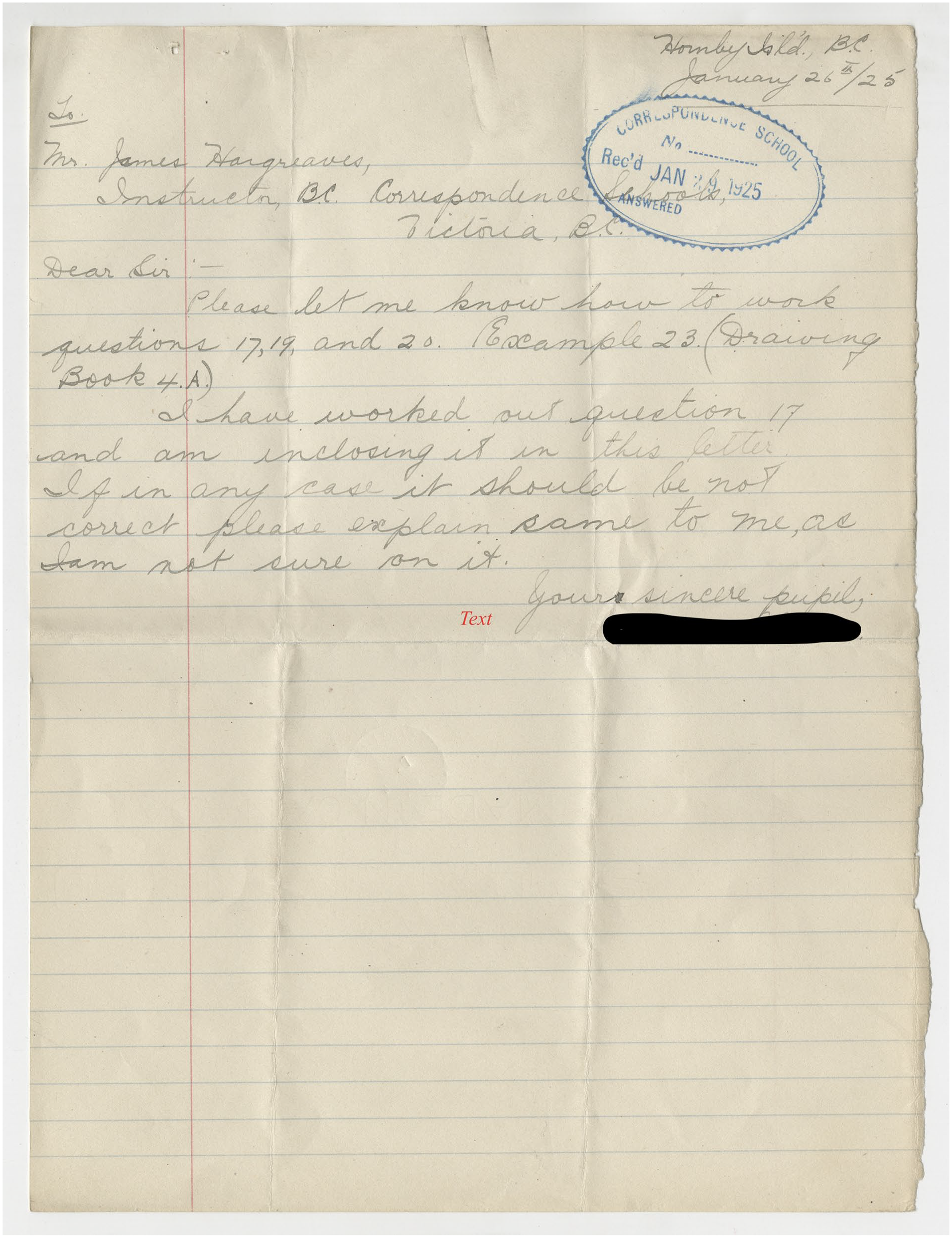
Letter From Amy Racker to James Hargreaves, January 25, 1925, GR-0470, Box 17, File 14, British Columbia Archives.
By December of the same year, Amy sent a similar request to Hargreaves (Figure 2): Dear Sir, I have just completed the 1st part of question no.3. example 23. I’m enclosing same. I cannot do the second part of this question. Please explain to me. Your sincere pupil. Amy Racker P.S. Please send me more school paper.
5
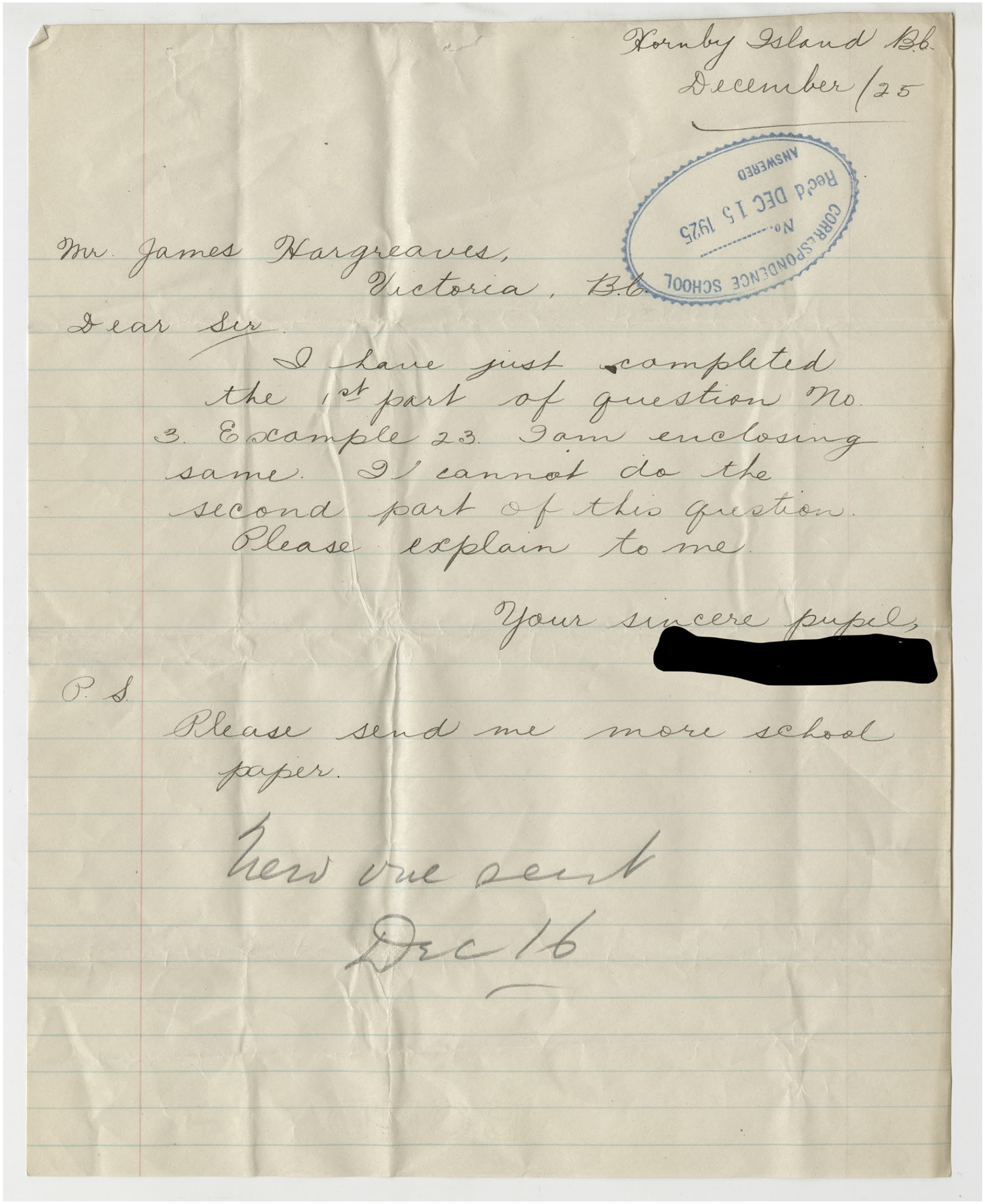
Letter From Amy Racker to James Hargreaves, Received December 15, 1925, GR-0470, Box 17, File 14, British Columbia Archives.
Apart from two letters from Ellen Racker, her mother, asking Hargreaves to send more lessons, no other letters exist in the family file from Amy, nor is her age at the time of writing revealed. The Racker family lived on Hornby Island (Ja-dai-aich), one of the two northernmost Gulf Islands located off the coast of Vancouver Island. Hornby Island is situated on the unceded territory of the K’ómoks First Nation and was inhabited first by Indigenous people, and then colonized—like the rest of the province—in the 18th and 19th centuries. The island is accessible only by boat or ferry and grew in settler population very slowly. In the interwar years, the island was home to approximately 300 residents who struggled to make viable homesteads while developing fishing, logging, and farming industries. For settler families, the interwar years were marked by the unending demands of carving out a living (Calam, 1991; Sandwell, 2016). Like other regions of Canada, BC’s interwar economy was tied largely to natural resource extraction and was therefore vulnerable to the vagrancies of market turndowns and market loss for key exports such as wheat, fish, base metals, and timber. Small economic depressions that began early in the 1920s did nothing to prepare British Columbians for the Great Depression that began in 1929. It was not until the threat of the Second World War became a reality that the provincial and federal governments supported programs to assist laboring men and women (Barman, 2007; Light & Pierson, 1990).
The apparent banality of Amy’s letters—she simply requests assistance with her lessons from her teacher—leaves her perspective vulnerable to exclusion by historians who might disregard it as unimportant. However, through an empathic inference approach that is alive to the possibility of relational agency, I pay closer attention to what the letter might reveal about Amy, about her strategies for building relationships, and about how those relationships supported her needs and interests. Amy clearly understood the importance of engaging the wisdom of Mr. Hargreaves to successfully complete her studies. She writes directly to him, despite significant power differentials, belying a degree of confidence and competency on her part. Not only does she ask for Hargreaves’ help in solving specific questions in her lessons, but she also asks that he send more paper for her to use. It was perhaps her parents who encouraged Amy to request more supplies. Given the difficult economic context in the interwar years, this request was a common one throughout the ECS family files. I might infer that Amy was committed to her studies sufficiently enough to strategize for her success in completing them. Rather than a silent and tangential figure, Amy actively engaged with her teacher and took consequential responsibility for her own learning.
When our interpretive strategies increase children’s visibility and knowledge of their social strategies in the past, we begin to appreciate more readily the unique ways young people wielded power in their own lives and in relation to others around them. In this final section, I supplement my attention to empathic inference and relational agency with attention to a unique modality of power that children implicate: the adult tendency to conceptualize them as heirs of the future (Milanich, 2020). Childhood is freighted with aspirations and expectations that reflect adult priorities and, as Peter Kraftl (2009) has argued, often with utopian overtones: “[. . .] children represent a rather widespread hope that the next stage of social development—usually in some unspecified way—will be better than the last” (p. 76). Children’s and childhood’s futurity has long motivated adults to provide edifying and healthy childhoods—at least for those children deemed worthy of such investment (Jenks, 2005; Qvortrup, 2009; Taylor, 2011). History offers many examples of adult neglect (and worse) of children whose race, class, gender, ethnicity, sexual and gender orientation, and embodiment ran counter to dominant social norms and for whom the future held no guarantees (Bernstein, 2011; Bush, 2010; Gleason, 2013). Milanich (2020) reminds historians that adult preoccupations with molding children’s behavior and attitudes to secure a bright future, nevertheless, reveals much about the “collective values and priorities of societies at large, or of specific groups within society” (p. 1294). If children and childhood served as powerful harbingers of the future in the eyes of adults, how did children themselves articulate their own versions of their future(s)? Did children imagine their futures in concert with adults or in ways that conflicted with adult visions? What do young peoples’ imagined futures reveal for our understanding of history? Stella Harrison’s letters begin to provide some insight.
The Harrison family lived on Chatham Channel (Tl’chés), part of an archipelago of islands between Vancouver Island and the mainland and part of the unceded territory of the first Songhees First Nation (Forest-Hammond, 2015). After colonization and the dispossession of Indigenous lands, the area became a busy marine passageway. Stella’s father worked for the province’s Fishery Department in the Patrol Division and had to spend considerable time away from the family. In 1930, Mrs. C. Harrison first contacted the ECS to request lessons be sent for her daughter, Stella, then 6 years old. The ECS Harrison family file contains letters from both Stella and her mother over a 12-year period, and while Stella’s letters are addressed to her teachers, the file doesn’t include copies of their responses.
By 1939, Stella was 15 years old. In a letter to her teacher, Miss Miller, written in November of that year, Stella first shared some of her concerns about her future, particularly in relation to her ability to do well in school while continuing to meet her family’s need for her labor amid economic hardship (Figure 3). It is significant to remember that Stella, like Amy, was a student of the ECS over a period that witnessed massive economic hardship, war, and, despite lingering obstacles particularly of class and race, the expansion of white/settler women’s social roles and opportunities (Strong-Boag, 1988). “I will try to finish the grade by the end of March,” Stella wrote, “but it may not be possible as I have a good deal of other work to do at present and towards spring [there] will be even more.” Stella complained that “[. . .] I have charge of the place during the summer and fall while Daddy is away and during the rest of the year [I] take the place of another man [. . .] there is always something unexpected which requires my assistance so that it is almost impossible to keep to a schedule.” 6
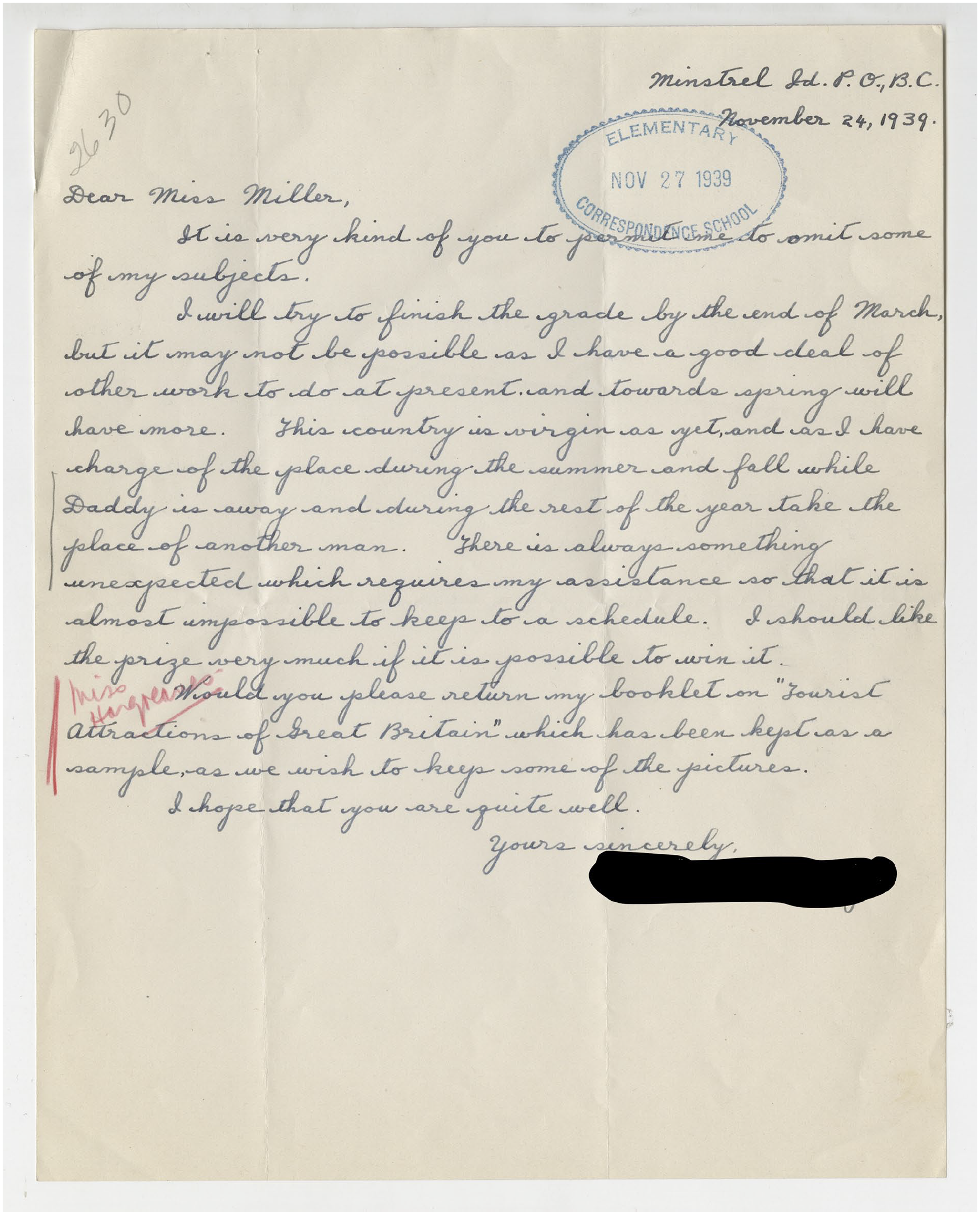
Letter From Stella Harrison to Miss Miller, November 24, 1939, GR-0470, Box 27, File 18, British Columbia Archives.
Here, Stella shares details of the difficult circumstances that enveloped many rural settler youth in the province whose lives were torn between getting an education and supporting the needs of their families during the Depression years (Gleason, 2016; Sutherland, 1997). While the tension between schooling and survival was not of her making, nor in her control, Stella was nonetheless able to articulate how it concerned her and complicated her future. We can infer from Stella’s tone that she is frustrated by the conditions that tied her to farm labor at the expense of her lessons. She also notes that the physical labor she performed would otherwise be done by a hired man. Either her family could not afford this expense, or they believed that Stella could do the work and that it ought to take priority over other concerns, including finishing ECS lessons. By confiding in her teacher, Miss Miller, Stella perhaps hoped for some form of dispensation from her lessons to allow her more time to finish her work around the family farm. It was, in any case, important to her that she shared her anxiety about her prospects for finishing her lessons with her ECS teacher.
In 1942, Stella, now 18 years old, wrote again to her ESC teacher, this time Miss Edwards, as she approached the end of Grade 8, her final year of enrollment in the ECS. She thanked Miss Edwards for her previous letter and described her summer activities, including descriptions of shooting Canada jays to keep them out of her garden.
7
Stella shares her intention to continue her education at the secondary school level with Miss Edwards and asks her advice about specializing in business education and, “if possible, French or Spanish.” “How many subjects does one have in the High School course?” she queried. “Would it be possible to have a language as well as the Business?”
8
Despite the seemingly unending need for her labor at home, Stella also noted her willingness to enlist in the war effort: I want very much to join the Services, but due to the way we are placed right now I cannot leave home. However, by the time I reach the call-up age some way may be found to free me. This being the case, I would like to be prepared for special work before that time comes; I would like to take up radio work, location, or similar specialized duties. Of course, I probably wouldn’t have enough education for such work to start with, but if I were able to devote my full time to it, I think I could learn fairly quickly. It is what I wish to do anyway.
9
Echoing her 1939 letter, Stella narrates the complex tension that framed her future—at least as she understood it. Beyond going to high school and enrolling in business and language courses, Stella also considered the opportunities for young women afforded by the exigencies of the war. Both opportunities, high school and war work, offered Stella the chance to learn new marketable skills and to experience life beyond the farm. Stella’s enthusiasm for her future possibilities, however, was tempered by the reality of her family’s situation. Her imagined future seemed very different from the version her parents held. It nevertheless remained her hope that her parents would allow her to take up work in relation to the war effort—to find some way to “free me.” It was fitting that she described her situation to her ECS teacher given the importance of education in unlocking the opportunities she hoped for. Stella clearly looked up to Miss Edwards as someone she respected, someone who might have answers to her questions, and someone who would understand and sympathize with her difficult situation.
Interpreting Stella’s letter to her ECS teacher from the vantage point of empathic inference, relational agency, and power, and specifically young people’s perspectives on their power as heirs to the future, we can begin to appreciate how youthful perspectives shift and deepen our understanding. Adults pin their social aspirations on the young while the young strive to live up to these aspirations or they invent new aspirations altogether. In the case of Stella Harrison, circumstances beyond her control and ultimately driven by her parents prevented her from seamlessly pursuing her future interests. While Stella dreamed of completing her ECS schooling, going to high school, or joining the Armed Services, the needs of her family for farm labor were much more urgent. By mindfully and explicitly inferring the perspectives of young people, such as Amy and Stella, as they build meaningful relationships with other people, historians can begin to recognize how unique modalities of power that implicate children propel historical change.
Engaging the Archived Child
What is distinctive about the contributions children make to history? What new or modified interpretive strategies, including methodologies, enable historians to better understand, and argue for, these youthful contributions to history? These are the questions that, as I noted in my opening paragraph, emerged from my own experience of motherhood and they continue to animate my own scholarship in the field. The hundreds of letters written by young people to their correspondence schoolteachers and archived in the ECS collection provide both fleeting glimpses and more detailed pictures of what it was like to grow up as settlers in rural BC between the wars. My brief engagement with the letters of Amy Racker and Stella Harrison provide, I hope, tangible examples of how historians might amplify the contributions that young people have made to historical change.
I have argued here that amplifying children’s contributions to historical change is possible when we draw upon interpretive strategies that invite and value child and youth centered perspectives and experiences. Empathic inference, relational agency, and children’s unique modalities of power provide historians with interpretive strategies that bring youthful contributions to history more clearly into focus. When paid attention to, the archived child provides perspectives on change over time that deepen and complicate adult-focused histories.
Footnotes
Declaration of Conflicting Interests
The author(s) declared no potential conflicts of interest with respect to the research, authorship, and/or publication of this article.
Funding
The author(s) disclosed receipt of the following financial support for the research, authorship, and/or publication of this article: The author acknowledges funding support for the research upon which the article is based by the Social Sciences and Humanities Research Council of Canada.
