




Abstract
This article discusses tensions of creating composite characters in ethnodramas, with particular focus on characters’ cultural identities. Six teacher characters were composed from 12 research participants for Connections, an ethnodrama that highlights the importance of cultural identity when engaging with teaching for reconciliation between First Nations and non-Indigenous Australians. This article presents the author’s ethnodrama methodology, as well as excerpts from the ethnodrama itself, before unpacking complexities related to composing characters’ cultural identities. It is suggested that composing characters protects participant anonymity but opens new possibilities and uncertainties that should be carefully considered as part of the ethnodramatic process.
Introduction
Ethnodrama, a form of research-based theater (RbT), is a way of “keeping alive the very visceral and embodied experiences of human social behaviour” (O’Toole, 2006, p. 42) by turning research findings into a dramatic script (Vachon et al., 2019). The ethnodrama discussed in this article, Connections, presents six teacher characters, composites of 12 drama teachers from Victoria, Australia. These teachers participated in a professional learning (PL) program designed to engage learners through embodied pedagogies with the supercomplexities of teaching for reconciliation (Hradsky, 2023). Like other researchers who choose to use ethnodrama and other forms of RbT, I sought thereby to create opportunities for my research to “live in the flesh” as well as on the page (Hamera, 2011, p. 327), thereby engaging more people (Kara, 2015/2020; O’Connell & Lynch, 2020), and giving back to the community from which the data were collected (Balfour & Hassall, 2023; O’Toole, 2006).
The research project was framed by a paradigm of supercomplexity (Barnett, 2000), or the belief that “reality is supercomplex and dynamic . . . the future is unknowable, [and] knowledge is contested, negotiated and constructed in the moment” (Ling, 2017, p. 39). Reconciliation between First Nations 1 and non-Indigenous Australians is a controversial concept with a complex historical legacy and an unknowable future. Ethnodramas can present research findings in ways that open possibilities, problems, and unknowns, but are nonetheless systematic, appropriately structured, and evidenced, as required by supercomplexity (Ling, 2017). Dramatic writing is increasingly being used to disrupt traditional Western academic norms (Dénommé-Welch & Montero, 2014; Denzin, 2018), and share de/colonizing and critical race/Whiteness research (Mukandi & Bond, 2019; Randolph & Weems, 2010; Rowe, 2022). Particularly relevant to this study is the hope that poiesis, or the act of creating something new, will itself help us to understand the world (Hamera, 2011). However, as has been highlighted by recent research (e.g., Balfour & Hassall, 2023; Sinclair & O’Toole, 2023; Vachon & Salvatore, 2023), RbT comes with complex ethical questions and tensions that must be negotiated by the researcher and other stakeholders.
This article explores tensions regarding creating composite ethnodramatic characters from research data, with particular focus on the characters’ cultural identities. Composite characters are relatively common in ethnodramas (e.g., Bird & Donelan, 2020; O’Connell & Lynch, 2020). Generally, ethical considerations relating to composite characters are focused on protecting participant anonymity (Piper & Sikes, 2010; Sallis, 2007), and clarifying this decision to the actors and audience (Vachon et al., 2019). I argue that it is necessary to critically reflect also on the process and outcomes of combining identities and stories. In this article, I first explain the study methodology. Next, I present a series of ethnodramatic monologues offering insight into Australian teachers’ experiences with, attitudes toward, and understandings of reconciliation. Finally, I critically reflect on creating composite ethnodramatic characters from research data, and my reasons for doing so.
Methodology
Before proceeding further, I introduce myself as a non-Indigenous Euro-Australian, living on the unceded lands of the Wurundjeri Woi Wurrung people. I designed and developed the 6-week PL program represented in Connections, and co-facilitated the program with a First Nations critical friend in October to November 2020 (Hradsky, 2023). Before (September–October 2020) and after (November–December 2020) the workshop series, I used yarning (an Australian First Nations research method that builds trusting research relationships through storytelling; Bessarab & Ng’andu, 2010) to interview each teacher–participant. Audio-visual recordings were generated from these interviews and the workshops. The workshops also generated artifacts and researcher observations. These data were analyzed using dramaturgical coding (Saldaña, 2009/2021) and ethnodramatic monologue writing, with findings presented in a five-act ethnodrama.
My choice to present my findings as an ethnodrama occurred during the study, rather than as part of my original plan. Other ethnodramatists have recorded similar mid-study decisions (e.g., O’Connell & Lynch, 2020). Research conducted within the supercomplexity paradigm may result in a wide range of data, including, as was the case in this study, performances, poems, drawings, and other artifacts. These data are then analyzed using means suggested by the forms and representations of the data (Ling, 2017): here, dramaturgical coding and ethnodramatic writing. The structure of the investigative and pedagogical process was—to my theater-shaped eyes—reminiscent of a performance that, as the researcher/educator, I was privileged to participate in as actor, director, and audience member. In this nearly 4-month “performance,” the participants became a cast of characters who were in conflict, not with each other, but with society, their institutions, colleagues, students, and most importantly, their own frames of reference (Mezirow, 2009/2018; Saldaña, 2009/2021). My and the co-facilitator’s roles were similar to Boal’s (1974/2008, p. xxi) Spect-Actor; we existed “in the scene and outside of it, in a dual reality.”
In my role of researcher-as-artist (O’Toole, 2006), I employed both artistic and research skills to transform the data into an ethnodrama. I first categorized each participant’s data using dramaturgical coding (Saldaña, 2009/2021), identifying the participants’ objectives, conflicts, tactics, attitudes, emotions, and subtexts. Once categorized, the data were coded, with some sentences and phrases requiring multiple categories (Cannon, 2012) and simultaneous coding (Saldaña, 2009/2021). For example, STAN’s 2 opening line, “I feel a bit of a fraud identifying my culture” (Hradsky, 2023, p. 177), in the original participant’s data, was categorized and simultaneously coded as a conflict (wanting to identify v. feeling fraudulent), an attitude (“bit of a fraud”), and an emotion (discomfort, fear, anxiety). In my second cycle of coding, I reviewed each participant’s changes, constancies, and patterns over time (longitudinal coding; Saldaña, 2009/2021). During the coding cycles I took numerous analytic memos, which were summarized as two ethnodramatic monologues for each participant, representing them prior to and after the PL. This extensive analysis process gave me a deep understanding of possibilities, problems, and uncertainties affecting the participants’ teaching for reconciliation, as well as key embodied experiences that affected their transformative journeys.
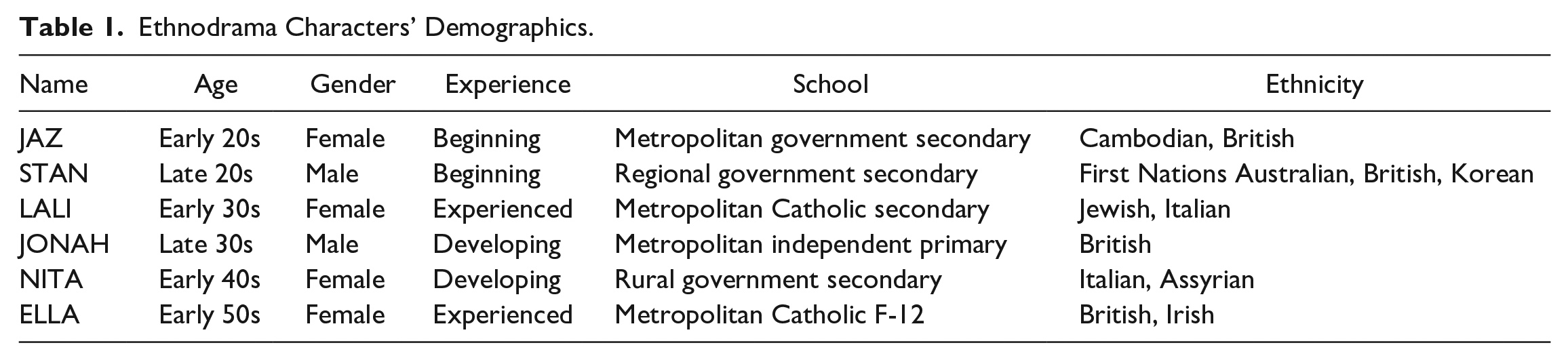
While the particularities of each participant’s experiences and journey were unique, in writing up my findings, I sought balance between depicting these particularities and conceptualizing open-ended universals (Barnett, 2017). I therefore mapped similar participant particularities onto what became six composite characters: STAN, NITA, ELLA, JONAH, LALI, and JAZ. Figure 1 shows that while each character is largely made up of two participants’ particularities, some participant traits and experiences were brought into different characters. The six characters (described in Table 1) represent the participants’ demographic diversity.
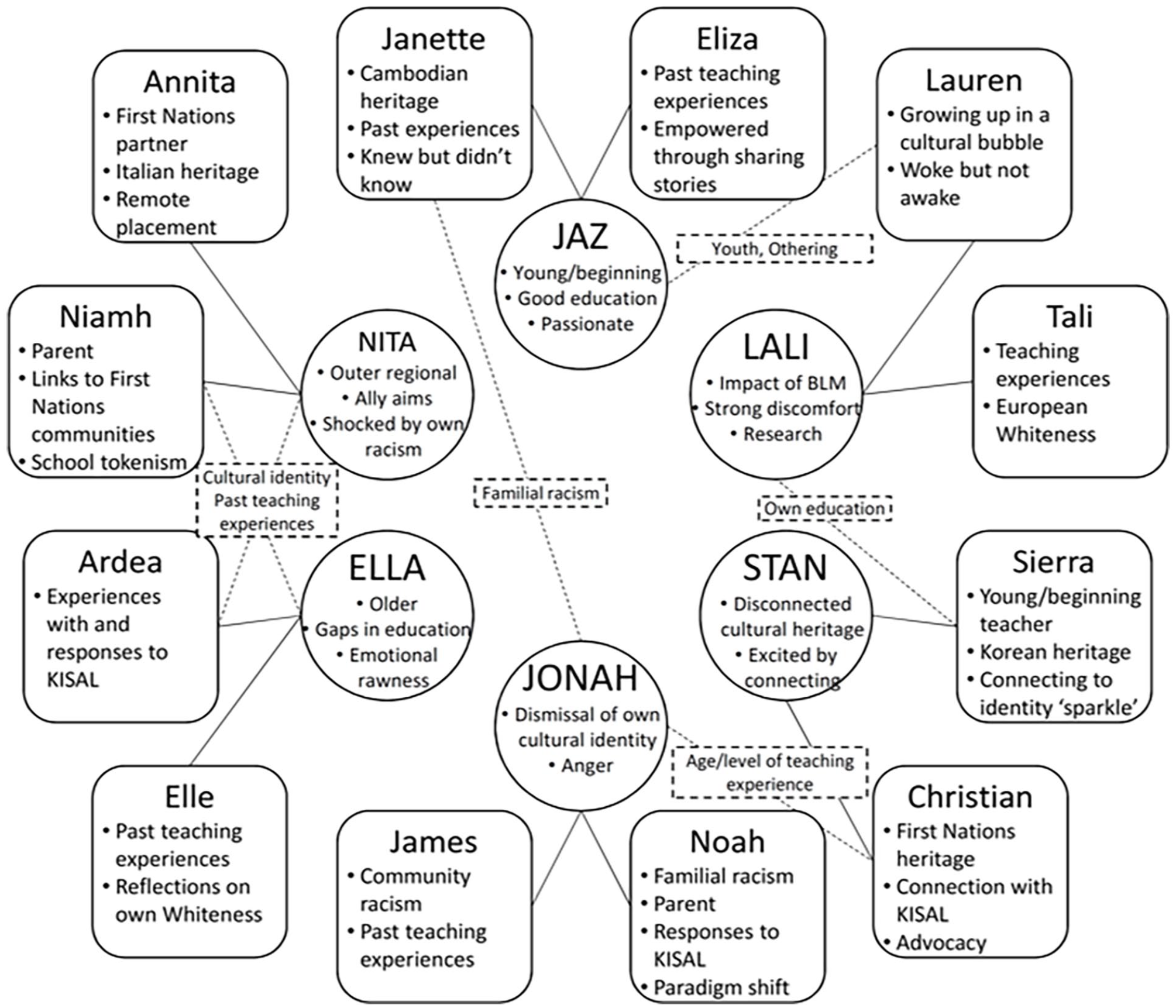
Development of Composite Characters From Study Participants
Ethnodrama Characters’ Demographics.
In the next section, the six monologues that comprise Act I of Connections are presented. These monologues are written in poetic form, specifically free verse. When developing data into an aesthetic, engaging ethnodrama, text should be drafted orally and physically as well as on the page (Kara, 2015/2020; Saldaña, 2011). During the early oral drafting process, I was struck by the “organic poems” (Smith in Saldaña, 2011, p. 72) that were present in the data through repeated phrases, unconscious rhyming, and other speech patterns. I found that deliberately heightening these patterns by arranging the text as poems rather than prose emphasized the emotional nature of these stories (Saldaña, 2011), and revealed dramatic potential (Sallis, 2007). Breaking up lines differently for different characters also helped me to maintain participants’ speech rhythms and cadences (Salvatore, 2014/2020). Last, but not least, it was liberating to playfully create “songs” out of the data, which I described in a research journal entry as “verging towards a musical” (Hradsky, 2023, p. 175). My enjoyment of the process deepened, and I became excited both to create the ethnodrama and to share it with others. Approaching research with a spirit of playfulness and joy is a form of “scholarly resistance” (Forgasz & Grimmett, 2022, p. 186), disrupting hegemonic assumptions of academia as serious and hard work. Thus, these monologues are shared with you now in a spirit of playfulness, academic transgression, and deep respect for the original participants.
Connections, Act I: Disconnected
The six PARTICIPANTS sit/stand apart on the darkened stage. As each speaks, a spotlight highlights and isolates them.
I feel a bit of a fraud identifying my culture,
I have mixed heritage—convict, Korean, and First Nations.
But I don’t identify.
I’ve got no connection.
I didn’t grow up with culture, I didn’t grow up on Country.
My Dad was adopted after the war, that’s all we know.
My Nan chose not to identify.
I didn’t grow up identifying or knowing or acknowledging that
I am an Aboriginal person.
People ask me to be the voice of Indigenous Australians—
I worry that it’s a tokenistic, box-ticking exercise.
I’m proud to acknowledge those parts of me
but I’m still coming to terms with my identity.
My head spins sometimes.
I don’t know where I sit.
I could have had a connection.
As a kid, I lived in a community
where the population of Aboriginal people is quite high.
At school my friends were the Aboriginal kids.
But I didn’t know that these were my brothers and sisters!
At school I was taught nothing about Indigenous cultures or history.
Such a missed opportunity.
I could have learnt so much.
But I didn’t know.
I’ve got no connection.
It makes me really sad.
I did placement in Arnhem Land. 3
The uni treated it like this magical place:
“It’s gonna change your life!
You’re gonna go there and be a different person,
a better person!”
But I was already quite aware,
had already gone out and sought connections,
reflected on my privilege,
done some unlearning on my Whiteness,
that wasn’t my issue.
What shocked me was the White people.
I’ve never seen more racism.
The way my mentor spoke to Elders, to children.
One principal got violent with a student.
I was angry, spoke up about it, tried to change things.
The uni didn’t know what to do.
It felt really hopeless.
It really opened my eyes.
I was teaching for love and for justice.
I didn’t understand that
teachers are disheartened,
disengaged,
not wanting to help each other,
just doing it for the money,
not actually caring.
Changing systems is scary.
People will fight to the death to keep it the way it is,
no matter how damaging,
because change is too overwhelming,
too challenging.
I do speak up.
I beat my drum.
I do the work.
If I don’t, who will?
I had a horrific moment in 2010,
with Year 11 students performing Jane Harrison’s play,
Stolen. 4
At one point, the children are asleep in a dormitory.
My students are putting pegs on the sleeping bags, doing stupid jokes about peg dicks, sniggering and laughing, absolutely humiliating themselves—
and me.
I was horrified. Brought to tears.
I’d taken such a risk producing material that was beyond their years.
It was awful.
I wanted this to be such a beautiful experience, and
I didn’t understand how to deal with it.
I tried to speak to them about how disrespectful they were being
to a culture, to themselves, to the show,
to their audience that paid to go.
But they just thought it was the funniest thing they’d ever seen.
They did it a few nights in a row.
That was the worst thing, it wasn’t just once.
I couldn’t manage it properly.
I was really ashamed.
I was mortified.
Cultural insensitivity is pretty raw.
Sometimes,
avoiding it seems easier.
I was definitely a racist as a young boy, in my thought processes.
Because of who I was raised by, I wouldn’t have considered myself racist,
it was just the way of the world.
“We’re great, and this is good. And anything that’s not this is
actually different and bad,
not just different.”
Where I grew up, there’s a very high percentage of Indigenous people.
You’d think people would be way more accepting because they’re in that area,
but it’s the opposite.
I’ve lived in the—
not the bowels of disgusting, White supremacy.
But you know, a touch of it.
I grew up, left home, changed my thought processes.
Looked around and went,
“I don’t really think that’s true.”
Taught in a school with a 25% rate of Indigenous students.
I loved it.
There was no room to be racist.
When I moved to the independent sector, I found this area much harder.
The students were more racist.
My current school, we’re not doing a bad job but we could do better.
There is a gap in the curriculum.
I honestly think that students have no idea.
We don’t have any First Nations students.
We don’t have a connection.
I want the students to be informed, but I need to know—
What don’t I know?
Where are my gaps?
Where are my blind spots?
I haven’t had connection with First Nations people.
I grew up around people like me,
in a European sort of multicultural community.
Appearance, beliefs, politics, everything was,
“This is the way we do it.”
There wasn’t an attitude towards First Nations people, because
there was no awareness.
Which is an attitude in itself, isn’t it? Laughs.
I was never taught by any people of colour.
There were no Indigenous people in my school.
Now, First Nations people are part of my local community.
I’m so close to it.
Our senior campus is named after William Barak. 5
Coranderrk 6 is part of our shire.
But like a total moron
I haven’t made those connections.
I feel so much shame, so much guilt.
This year with Black Lives Matter, it’s been like a lightbulb.
I’m worrying about all of these issues around the world,
but what’s in our own backyard?
Ignorance is not an excuse anymore.
It’s just not good enough.
I’m really lucky.
I went to a school where we worked with local Indigenous people,
had Acknowledgement of Country at every event.
It was just part of my schooling.
A lot of people talk about how there’s no exposure:
“Young people don’t experience First Nations history!”
I was at least exposed to it.
It was never denied to me.
But there were so many missing gaps.
As a person of colour, I’ve experienced some forms of racism.
But in high school, we learnt about my culture, the history, the genocides.
I felt like the teachers cared about us, knew what we’d been through.
Knowing that the teachers were trying to connect felt really nice.
My best friend was First Nations.
Their identity was never mentioned at school.
It was accepted, no-one had any problems with it, but
it wasn’t celebrated.
They were adopted into a White family—
school could have been a place for them to learn about their culture,
to connect.
But it was pushed to the side.
As a teacher, I’ve learnt that I can make a difference:
help to spread awareness,
encourage and support students to share their views,
tackle racism,
ensure that Koorie 7 students feel seen and heard and cared about too.
But being by yourself makes you an easy target.
I don’t see other drama teachers who are people of colour.
I feel like I’m the only one.
As a graduate teacher, I’m still finding my ground.
Treated differently, not taken seriously.
I need some support.
Black out.
Hradsky (2023, pp. 177–183)
Creating Composite Characters: Complexities and Ethical Tensions
Connections is an evocative text (Thom & Blades, 2014), intended to stimulate different stakeholders’ reflections and actions regarding how and why educators might engage with teaching for reconciliation. There is no one way to engage with teaching for reconciliation, nor to transform a frame of reference—although not all ways are equal. In supercomplex situations, “each apparent particular is itself a site of infinite moments and possibilities” (Barnett, 2017, p. 296). Yet, particulars may also represent universals “arising through the processes of history and enculturation” (Thom & Blades, 2014, p. 503). Creating the characters in Connections required balancing the participants’ unique particulars with open-ended universals (Barnett, 2017) evidenced across participant stories, such as disconnection from and connection to history, people, culture, and country. In creating these composite characters, my hope is that future educators and other stakeholders engaging with Connections will find stories that resonate with their own experiences. Exploring the problematics and uncertainties of these experiences may help to “generate new ways of acting and thinking and of being” (Ling, 2017, p. 37, original emphasis).
The characters in Connections represent teachers “unsure of their own authority and knowledge in this field” (Moodie & Patrick, 2017, p. 445); however, the levels of and reasons for their uncertainty differ. As the monologues in Act I illustrate, I focus in Connections on the characters’ constructed cultural identities, and what this means for their positionality and intersectionality regarding reconciliation. Positionality, or “the power inherent in [our] immediate respective social positions” (Misawa, 2010, p. 26), is fluid, multidimensional, and results from how we are framed and frame ourselves through networks of relationships. Positionality cannot be viewed only through the lens of race, and Connections addresses other socially and personally constructed locations such as gender, age, ability, and politics, as well as the intersections between these locations. Nonetheless, in this study race, ethnicity, and cultural identity emerged as dominant factors in the participants’ engagement with reconciliation.
Existing literature supports this view of cultural identity as an always-unfolding universal that should be considered by educators at the cultural interface (Proud & Morgan, 2021). Teachers often fail to acknowledge or understand their cultural self and how this impacts their practice (Bishop & Durksen, 2020). The participants in this study embodied a range of intersecting identities, offering insight into how such positionalities may affect teachers’ engagement with reconciliation. In Act II, Scene 2 of Connections, the characters explicitly introduce their cultural identities, using words and phrases drawn directly from the data:
LALI: I’m Lali. First and foremost, I consider myself to be Australian. I was born here. My heritage is Jewish-Italian. . .
NITA: I’m Nita. I identify as Italian-Assyrian. Those cultures are more part of me than being Australian. English was my second language growing up. But I think that that’s Australian too. . .
ELLA: I’m Ella. I’ve never been asked to say my cultural identity before. I’m a First Fleeter, 8 on my father’s side. On my mother’s side, I’m a first-generation Australian. My mother always called Scotland home. I’m a dual citizen of Britain and Australia. . .
STAN: I’m Stan. I’m getting more comfortable with saying, “I’m part Indigenous, part Korean, and part convict.” . . .
JAZ: I’m Jaz. I get asked this all the time. People always assume I’m international, but I identify myself first as Australian. I am of Cambodian and English descent. . .
JONAH: I’m Jonah, I’d probably say I’m Australian. That question rarely comes up for me. Culture is something I find tricky to understand. I come from two lines of colonial Australian backgrounds . . .
Hradsky (2023, pp. 185–186)
Developing composite characters enabled me to highlight certain experiences that were common to multiple participants. Composite characters also help to protect participants’ privacy, an important consideration (Kara, 2015/2020). However, complexities arose from combining individuals’ identities into composite characters. Here, I briefly discuss all of the characters’ cultural identities, and unpack complexities/ethical tensions related to creating the composite characters STAN, JAZ, and JONAH.
STAN (based mainly on participants Christian and Sierra) embodies some tensions and anxieties of First Nations educators who are teaching at the cultural interface (Hart et al., 2012). STAN’s story also touches on broader experiences of having multiple cultural identity possibilities, and how this may result in a sense of disconnection from any cultural identity (Coleman, 2021; Mahtani, 2001). STAN represents Christian’s desire to teach First Nations content and concepts, how that desire clashed with his own insecurities, and his fear of being regarded as a tokenistic “voice of Indigenous Australians” (STAN; Hradsky, 2023, p. 177). However, when STAN says in Act V, that he is not “part Korean, part convict, part First Nations” (Hradsky, 2023, pp. 220–221), but a whole of these things, he is representing a journey shared by other multiethnic (Mahtani, 2001) participants. These participants sat uncomfortably between the structural privilege of “passing” as White, and having their more complex identities and lineages erased by this privilege.
In Connections, STAN’s Indigeneity overshadows Sierra’s Korean heritage, as well as Christian’s convict ancestors. At the cultural interface between First Nations and non-Indigenous peoples, Korean-Australians are non-Indigenous, albeit positioned by society as further down the racial hierarchy than Anglo- and Euro-Australians (Walter & Butler, 2013). STAN’s First Nations identity should be (Walter & Butler, 2013) and is centered in this exploration of Australian teachers engaging with reconciliation. STAN’s story is the heart of Connections. He embodies some of colonization’s ongoing impacts: knowledge dying with individuals, appearance-based assumptions of knowing or not knowing, the overwhelming responsibilities placed on First Peoples to be “all things Indigenous” (Hart et al., 2012, p. 716), and the confusion of carrying both First Nations and settler heritages. STAN’s Act I monologue, taken almost verbatim from Christian’s preliminary yarn, expresses some of the grief of colonization and assimilation: I didn’t grow up with culture, I didn’t grow up on Country . . . My Nan chose not to identify. I didn’t grow up identifying or knowing or acknowledging that I am an Aboriginal person . . . I’ve got no connection. It makes me really sad. Hradsky (2023, pp. 177–178)
Christian’s disconnection is not the story of all First Peoples; however, others have used almost identical language to describe similar experiences: I did not grow up knowing of my Aboriginality, it had been hidden, taken from me. The right decisions at the time left me bereft and disconnected from Country, from culture, from family and from my place in the world. Coleman (2021, p. 22)
Learning about or verbally acknowledging this heritage did not end the cultural identity journey for Christian. Rather, these were powerful transformative moments that may be recognized by others on similar journeys. Likewise, Coleman (2021, p. 24) aims to “spend the rest of my life decolonising and returning to culture.”
Thus, STAN’s story is a First Nations story, with ethical ramifications for writing and performing Connections. However, Christian’s story is entwined with Sierra’s, whose “Dad was adopted after the [Korean] war, that’s all we know” (STAN; Hradsky, 2023, p. 177). For Sierra, embracing her cultural identity as whole rather than “part” was key to learning to teach for reconciliation. Sierra valued Christian’s acknowledgment of discomfort with his cultural identity. Later in Connections, STAN encapsulates some of Sierra’s experiences of embracing her potential cultural identity. STAN represents both First Nations educators who grow up disconnected from culture and Country, and the more general complexities of being multiethnic and White-passing in a society that hierarchises different races (Cowlishaw, 2004).
Simultaneously, in conflating First Nations and non-Indigenous experiences, I risk juxtaposing the White majority against the non-White Other, with First Nations peoples included as another ethnic minority (Walter & Butler, 2013). Owing to the sensitive nature of representing First Nations voices, and the personal experiences involved, I consulted with Christian and Sierra before composing STAN’s character. Their responses were positive—Christian commented that he wished he could meet STAN. Nonetheless, this dilemma was ongoing: the incommensurable nature of supporting non-Indigenous teachers to connect with First Nations concepts and experiences, when any sense of connection is inevitably based in First Nations dispossession (Moreton-Robinson, 2003; Tuck & Yang, 2012).
STAN is not the only non-White or racially Othered character. In line with other literature (e.g., Butler & Butler-Mcilwraith, 2004; Nicolacopoulos & Vassilacopoulos, 2004), I use “non-White” here, rather than “people of color,” for reasons that will be explained in this paragraph but recognize that this term problematically re-centers Whiteness. Society’s complex and fluid categorisations of race mean that the lines between “person of colour” and “White” are blurred, albeit still powerfully enforced. For example, in our preliminary yarn, Ardea, whose cultural identity is woven into NITA, noted that, “People can’t work out what I am . . . the assumption is ‘Other’ . . . [but] I wouldn’t necessarily consider myself a person of colour” (preliminary yarn; Hradsky, 2023, p. 237). NITA, LALI, and JAZ represent the cultural identities of five participants (Ardea, Annita, Lauren, Tali, and Janette) who occupied different locations with (non-)Whiteness, with consequences for their sense of belonging to Australia (Moreton-Robinson, 2003).
When discussing their cultural identities, these participants quickly asserted their right to belong to and identify as “Australian,” as illustrated in the above excerpt from Connections, Act II, Scene 2. Ardea, Annita, and Lauren variously had Italian, Assyrian, and Jewish heritages, and experienced questioning on their right to belong (Moreton-Robinson, 2003), unlike Tali, who also had Italian ancestry. NITA and LALI represent European migrants’ different generational experiences of becoming White (Perera, 1999). As a representative of the older generation, NITA has experienced more Othering than LALI, but still recognizes her own Whiteness. JAZ, partially based on Janette, represents more recent migrants, who have yet to (and may never) attain Whiteness (Walter & Butler, 2013). Unlike other participants, Janette “lack[ed] the race privilege to choose or not choose an ethnic identity” (Moreton-Robinson, 2000, p. 137). Interacting with people from different racial, ethnic, and cultural backgrounds to her own was an imperative, rather than a choice (Moreton-Robinson, 2000). Embodying this experience, JAZ states in her Act I monologue that, in the particularly White-dominated world of drama education, “I feel like I’m the only [person of colour]” (Hradsky, 2023, p. 183). JAZ’s self-identification as Australian reproduces Janette’s defiant and definite choice against society’s positioning of her as racially Other.
JAZ encompasses the stories of four graduate and one pre-service teacher participants (Janette, Eliza, Annita, Sierra, and Lauren), who expressed that, as new entrants to the teaching profession, they were “treated differently, not taken seriously” (JAZ; Hradsky, 2023, p. 183). These participants all shared similar experiences of lacking staff and leadership support; such stories are “not as unusual as we might wish” (Schuck et al., 2012, p. 134). As a teacher of color, passionate about tackling racism, Janette occupied a particular space of tension not experienced by the other graduate participants. Although different from the tensions experienced by First Nations pre-service and graduate teachers (Hart et al., 2012), Janette’s experiences were complicated by others’ location of her as racially Other (Kohli et al., 2021; Misawa, 2010). Janette’s story is particularly combined with that of Eliza, an Anglo-Australian graduate teacher also passionate about and active in antiracism and reconciliation. In Connections, I have attempted to represent some of the complications both these participants faced, but recognize that new complications have arisen through this conflation.
Partway through Connections, JAZ shares a story of supporting her students with darker skin tones to protest having ID cards that do not show their features. JAZ feels that this incident has led her to be viewed as a trouble-maker: Our kids got their ID cards, my Black students were upset. Said, “Miss, this doesn’t look like me. This is worse than it was before.” “You’re right,” I said, “That’s awful. This is shocking. How can I help?” Took it to our leadership, they said, “I don’t see a problem. Why are you involved?” Our cultural aide told me it’s been a problem for years and years. She knew it was wrong, couldn’t push back, Trapped within her fears. I said, “Let’s write a letter. Let me help you raise your voice.” Did a bunch of research, helped prep the kids, wrote a petition, got it signed. The principal said, “Stop stirring up trouble,” Wouldn’t let me in with the kids. My kids said, “Miss, we’re used to it. We’re used to being dismissed.” They were so strong, gave me the strength. Helped me to keep on fighting. But did I do enough? Connections, Act III, Scene 1 (Hradsky, 2023, p. 197)
This interaction can be read as influenced by JAZ’s position as a teacher of color, as well as her youth and gender. JAZ is potentially being positioned by the principal as an “ungrateful and angry black woman” (Moreton-Robinson, 2000, p. 115), despite not being Black. However, this incident came from Eliza’s experiences; Janette had also lacked institutional support but not directly confronted leadership. The story has taken on new meaning, unintended by either participant, as a result of my playwriting.
JAZ’s story contrasts with that of JONAH who, with ELLA, embodies the three White or Anglo-Australian positions voiced by participants Elle, Eliza, Niamh, James, and Noah. As shown in the earlier excerpt from Act II, Scene 2, these participants had a less articulated—and therefore less conscious—sense of belonging to Australia, because their right to belong had rarely been questioned (Bishop & Durksen, 2020). The first two positions, represented in ELLA’s identification as a “First Fleeter . . . [and] first-generation Australian . . . a dual citizen of Britain and Australia” (Hradsky, 2023, p. 186), move the Anglo-settler toward innocence (Tuck & Yang, 2012). Niamh emphasized her early convict descent, laying claim to a form of indigeneity (Johnson, 2011) while also distancing herself from responsibility, as her Irish ancestors lacked choice in settling Australia and were treated as racially inferior by the English (Stratton, 2004). Elle and Eliza both identified as first-generation Australians with ongoing ties to Britain, separating themselves from Australia’s history of colonization. Alternatively, James and Noah placed themselves in this history, represented by JONAH’s statement, “I come from two lines of colonial Australian background” (Hradsky, 2023, p. 186). These participants had critically engaged with their own and their communities’ racism. Nonetheless, both concluded that they “would probably say I’m Australian” (JONAH; Hradsky, 2023, p. 186). As Moreton-Robinson (2003, p. 26) suggests, the participants were troubled by Australia’s history of dispossession and colonization, but this discomfort did “not erase their sense of belonging.”
Noah and James, upon whom JONAH is largely based, grew up taking “Whiteness, and all things White . . . as the natural order of things” (Brookfield, 2014, p. 90). Noah freely acknowledged that he was “a racist as a young boy” (JONAH; Hradsky, 2023, p. 180). He described his youth as lived in “not the bowels of disgusting, White supremacy. But you know, a touch of it” (JONAH; Hradsky, 2023, p. 180). James’ hometown included a large community of First Nations people; in his preliminary yarn, he commented on the high levels of racism expressed by White people against the First Nations community: “You’d think people would be way more accepting because they’re in that area, but it’s the opposite” (JONAH; Hradsky, 2023, p. 180). James had loved his initial teaching experience of teaching in a school “with a 25% rate of Indigenous students . . . [where] there was no room to be racist” (JONAH; Hradsky, 2023, p. 181). However, later in Connections, JONAH embodies James’ story of recognizing through the PL program how racism still affected his actions at this school, and the impact of this on his students: In my first school, I taught an Indigenous kid, Year 7, made my life a living hell. He hated English. I hated English! I wasn’t trained, had no support. He stole my water bottle— I lost it. “Bring his parents in! Get him in trouble!” Maybe he deserved it, I don’t know. But when Kisal said, “That’s my son. He is a gifted learner, and you’ve destroyed education for him.” I put two and two together. I worked out, “Shit, that’s me.” I was a first-year teacher, was told, “You figure it out.” Didn’t have any PD,
9
didn’t have any Elders come in and say, “Hey, I’m here for you.” But what I’ve done in my career— I feel shit, really shit. I failed in my job. That kid should be in Year 9 or 10 now, but he’s probably finished school. He may not have. But I haven’t given him any reason to stay.
JONAH stares out into the audience. ELOISE comes to stand behind him and places her hand on his shoulder, offering not absolution, but support. After a moment, JONAH reaches up and takes her hand. The lights fade.
Connections, Act IV, Scene 3 (Hradsky, 2023, pp. 218–219)
James had understood this experience through the lens of being an unsupported first-year teacher, but a counter-narrative shared by the First Nations co-facilitator (KISAL in Connections) as part of an embodied learning activity shocked James into a more uncomfortable reality (Delgado & Stefancic, 2000/2017). In representing this moment, Connections does not offer JONAH a happy ending to his dilemma: he feels “really shit” (JONAH; Hradsky, 2023, p. 219). The facilitator character, ELOISE, offers strategic empathy (Zembylas & Papamichael, 2017), but not absolution to his guilt. James shared this story only in our final yarn; he did not feel able to share it with other participants. James has since imparted that it is draining to hear his story told, although he understands the importance of speaking openly about personal struggles with racism (Brookfield, 2014).
As with JAZ, complications arise through conflating several participants’ identities and experiences in JONAH. JONAH’s Anglo-Australian heritage represents the cultural identities of the two participants upon whom he is mostly based. This heritage also reflects the role of White teachers in perpetuating Whiteness in schools (Schulz, 2017). However, learning to recognize and challenge their families and communities’ racism was an experience shared by most participants, including those of First Nations, Cambodian, Jewish, Italian, and Assyrian descent. For example, JONAH shares some of Janette’s experiences of learning to reject and confront her family’s beliefs that “people who have darker skin tones . . . [are] not really people” (preliminary yarn; Hradsky, 2023, p. 282). The participants tended to share these stories in their preliminary yarns with attitudes of affectionate scorn or pity; unlike their families, the participants felt that they had somewhat cracked the code of being nonracist (Brookfield, 2014). The shock and disorientation of recognizing their own racism during the PL—and the importance of this process—is repeated throughout Connections. JONAH shows this disorientation most starkly, but all the participants experienced some disorientation when recognizing their own “blind spots” (JONAH; Hradsky, 2023, p. 181). These characters are inevitably less nuanced than the participants on whom they are based; it is important that I acknowledge and reflexively consider the simplifications I have made, why I made those choices, and how I may have contributed to making more of a mess (Law, 2004).
JAZ’s story of transforming is one of gaining courage, of going from feeling like “an easy target . . . [who needs] some support” (Hradsky, 2023, p. 183) to confidently handling her principal’s undermining of a NAIDOC Week lesson (described in Connections, Act V). JAZ represents the next generation of teachers who have been “at least exposed” to First Nations history, even if they still have “so many missing gaps” (Hradsky, 2023, p. 182). In making JAZ a proud person of color, I have potentially reinforced the stereotype that teachers of color should carry the burden of addressing racialized issues in schools (Kohli et al., 2021). I have erased the valuable work Eliza is doing as an ally, and perhaps indulged in a magic solution (Boal, 1992/2002). Would Janette have been able, as a young, female graduate teacher of color, to stand up so strongly to the principal? According to Eliza, the cultural aide at the school, who shared the students’ ethnicity, felt unable to “push back” (Hradsky, 2023, p. 197) against school leadership. Alternatively, JAZ shows the reality that teachers of color often are expected to take on this burden, without being given the development and support to navigate institutional change and take on leadership roles (Kohli et al., 2021). In a safe, supportive space, with diverse, like-minded colleagues who value and share the work she is doing, JAZ is able to flourish (Kohli et al., 2021). As to whether or not my solution is magic, that must be decided by the audience (Boal, 1992/2002). Perhaps embodying and unpacking more fantastical possibilities of change can help with implementing possibilities in reality (Diamond, 2004).
Alternatively, JONAH represents the bitter-sweet arc of the anti-racist who realizes that, just as you feel you are making progress in combatting your own racism, “you will say or do something that will reveal how racist ideology has its hooks into you” (Brookfield, 2014, p. 95). Before the PL, Noah and James had already experienced the disorientation of recognizing that the racist views and values they’d grown up with were not “really . . . true” (JONAH; Hradsky, 2023, p. 181). They were critical of racism and Whiteness, had professional and personal relationships with First Nations people, and reflexively considered their actions, perspectives, and emotions. Yet, both participants came to recognize the need to keep “chipping away, shifting . . . perspective” (JONAH; Hradsky, 2023, p. 224). JONAH shows that this process can make you feel “mortified” (Hradsky, 2023, p. 224), but also contain moments of joy, such as (in JONAH’s case) learning with students and considering “How much better is [my daughter’s] world going to be?” (Hradsky, 2023, p. 225). Despite the potential problems of linking JONAH’s mortification to his Anglo-Australian identity, I hope that his joy will spur others on to further inquiry and imagining of what teaching for reconciliation can be (Ling, 2017).
Conclusion
This article has discussed the process of creating composite ethnodramatic characters out of research data and explored tensions related to composing characters’ cultural identities. The characters discussed in this article come from the ethnodrama Connections, a five-act play documenting teachers’ transformative journeys of engaging with teaching for reconciliation through an embodied PL program. In creating composite characters, I sought to protect the participants’ anonymity while representing their unique particularities, and highlighting emotions, attitudes, and experiences shared between multiple participants. Simultaneously, I recognize that conflating identities and experiences has created new complexities. Reflexively considering these tensions here is intended to support other ethnodramatists navigating the complex space of representing participants’ cultural identities, particularly through composite characters.
Of course, cultural identity was not the only factor affecting the participants’ engagement with teaching for reconciliation in this study. Nor is cultural identity the only demographic conflated in these six characters. In Connections, intersections of age, gender, education, location, and relationships all influence the characters’ learning journeys. These demographics are also combinations of the participants’ statistics, and worthy of consideration. However, in this study, cultural location and resulting positionality transpired as key factors in participants’ reconciliation learning journeys. I suggest that similar key factors should be carefully considered by other researcher/artists seeking to represent participants through composite ethnodramatic characters. I share my reflections here, not to answer all questions or close down possibilities, but rather to encourage further questioning and embracing of this powerful and complex research approach.
Footnotes
Acknowledgements
The author thanks the original participants in this study for their trust, willingness to learn, and desire to create meaningful change. She acknowledges the people who were part of the embodied drafting process and 2022 production of Connections, staged at the Drama Victoria Conference at the Melbourne Graduate School of Education, Victoria, Australia. Thank you to Dr. lisahunter, Dr. Michelle Ludecke, Dr Lynette Pretorius, the Monash University Writing Buddies group, and the anonymous reviewers for feedback and helpful discussions during the preparation of this manuscript.
Declaration of Conflicting Interests
The author(s) declared no potential conflicts of interest with respect to the research, authorship, and/or publication of this article.
Funding
The author(s) disclosed receipt of the following financial support for the research, authorship, and/or publication of this article: The author’s doctoral studies were supported by the Department of Education, Skills and Employment, Australian Government (Research Training Program Stipend), and The Narodowski Investment Fund (The Sam and Nina Naradowski PhD Scholarship). The writing of this article was supported by the Monash University Postgraduate Publications Award.
