




Abstract
In this article, I outline the framework of (auto)ethnographic positioning analysis. Using the example of an unpleasant field experience, I first develop the “metainvective positioning circle,” a heuristic model that I use to address the crisis of ethnography, its consequences for methodological development, and its implications for contemporary ethnographic practice. In the further sections, I outline how (auto)ethnographic positioning analysis combines various previously established methodological procedures, how it differs from them, and how it goes beyond them. Furthermore, I highlight key features of (auto)ethnographic positioning analysis and the most promising moments in the research process for its application.
Keywords
Complicity in Contact Zones: Lessons From a Neglected Field Experience
While working on this article, I remembered some unpleasant incidents from my PhD field research in Paraguay in 2004 about the impact of the internet on migration (Greschke, 2012). Inspired by the concept of multi-sited ethnography (Marcus, 1995), I visited different locations and followed the activities of research participants online and offline, mainly in Paraguay and Argentina. Yet, when I consulted my field diary from that time, I was surprised to find that I had not noted anything about these incidents. They were apparently so awkward for me that I was ashamed to write them down. They were, however, still vividly present in my mind. In what follows, I describe one such incident and its consequences to reflect on the moral dilemmas of ethnographic fieldwork in today’s world order. For this, I draw on George Marcus’ notion of “complicity” and Marie Louise Pratt’s notion of the “contact zone:” The day after my arrival in Ciudad del Este, one of the participants, who had invited me to her home, instructed her chauffeur Enrico to show me around. She introduced me to him as a “sociologist from Germany.” He first showed me the hydroelectric power plant located a little outside of town, which he explained to me causes the flooding of a huge area (although I already knew this). I took a few photos of the power plant and of him (I don’t remember if he asked me to or if I just felt compelled to take the photos). Afterwards, we drove back into town to a multi-story building where he took me. It turned out to be the housing of the resettled people whose habitat had been destroyed by the hydroelectric plant. They were members of the Guaraní ethnic group, as Enrico explained to me. He drew my attention to the precarious living conditions, which were more than obvious, and explained to me what the people there would urgently need. I was to make a note of it, take photos and ask my organization in Germany for help. I felt extremely uncomfortable in this situation. I took the photos, but tried to avoid having people on them. I was very relieved when we finally left the building.
In the following, I approach and understand this situation as a complicit encounter in a “contact zone” (Pratt, 1991) and I intend to “get to the bottom” of what caused my unpleasant feelings in this encounter with Enrico. According to Pratt, contact zones are social spaces where cultures meet, but also clash and wrestle with each other in conflict, dissonance, competition, or incomprehension. This often happens in asymmetrical power relations, where the power to construct representations of certain realities is unequally distributed, and others’ representations of one’s self may be of greater consequence to one’s life than self-made ones.
In his renowned book “Ethnography Through Thick and Thin,” Marcus (1998) reflects on the nature and quality of ethnographic relationships in a globalized world. He proposes the concept of complicity for this purpose. Unlike the conventional, instrumental sense of the word (as it appears for example in Clifford Geertz’s cockfighting), Marcus does not want complicity to be understood as a means of building rapport and gaining an insider position. In view of globalized discourses, ways of life and production, and interdependent power relations, he argues, it is questionable whether such an insider position can exist at all, since it presupposes a clearly delineable inside and outside. Globalization processes and dynamics manifest in ethnographers’ encounters with research fields, thus blurring the boundaries between here and there, between the self and the other. Marcus sees the ethnographer’s outsiderness as a chance (yes, chance!) to gain a kind of complicity with the field. He suggests this as a promising way to bring the global interconnectedness of local cultures into view. “This version of complicity,” he notes, . . . tries to get at a form of local knowledge that is about the kind of difference that is not accessible by working out internal cultural logics. It is about difference that arises from the anxieties of knowing that one is somehow tied into what is happening elsewhere, [and the ethnographer makes this elsewhere present, H.G.] but . . . without those connections being clear or precisely articulated through available internal cultural models. (Marcus, 1998, p. 119)
For Marcus, then, complicity is the establishment of outsider–insider relationships in the research field, which subsequently express the interconnectedness of events here and there (and thus render them investigable).
When Enrico showed me around, he let me see views of the city that he thought would interest me as a sociologist. His assumptions of my presumed perspective shaped what he showed me. This included the dam project and the neighborhood for people who previously lived in the area flooded for this project. It was a look at a transnationally significant green energy project and the local social problems it was causing. He thus placed our personal encounter within a broader structurally anchored transnational web of relationships. This stood in stark contrast to the view of Paraguay I had previously experienced with “my” research participants. This left me feeling uncomfortable for several reasons. First, given the social problems Enrico confronted me with, I suddenly felt that my dissertation topic was an extremely “banal” one. I became overwhelmed with feelings of shame for receiving a PhD-fellowship to participate in the internet games of Paraguayan snobs (which is how I imagined Enrico would think about my research [participants]), while ignoring the pressing problems of marginalized populations (this “ignoring” indeed belonged to my research participants’ lifestyle). Second, I immediately felt very uncomfortable the moment I entered the homes of indigenous peoples in the building with Enrico. I did not want to see what I was being shown. I felt like an intruder. I was standing, seemingly, unannounced in their house. I entered a private room, the sight of which did not seem to be intended for foreign eyes. The people there were apparently not receiving visitors. Rather, they were being paraded, “exhibited” in all their socially precarious nakedness. But what embarrassed me most, was to be falsely addressed as a hope for help. Although I knew I would not be much help anyway, I did not dare to clarify the false positioning. This, then, was a situation in which, in Goffman’s words, “the physical structure of the encounter itself was invested with certain symbolic implications which led [me], against my will, to make assertions about myself which were false” (Goffman, 1956, p. 269). I helped to reproduce the world as a terribly unequal and unjust place. I became complicit, but in a more literally sense, then Marcus defines it: Following the Cambridge dictionary (n.d.), complicity refers to an “involvement with others in a crime or in another activity that is wrong.” It was certainly not a crime in the legal sense, but I felt that I was involved in something morally wrong. This made me feel ashamed. Following Neckel (2021), I understand “in a sense of shame” to mean that I was in a state that I “felt was unsatisfactory or undignified” (p. 40) because I did not live up to the ideal of my own self (Neckel, 2021). I was positioned as someone who must be shown the evidence of extreme poverty to judge and justify people’s need for help (and yet not help).
In this involuntary encounter, central features of the global social order became vivid. More than that, there was an appeal to me to acknowledge (and maintain) the dependency of the people presented to me as poor and powerless, pretending that, as a German sociologist, I was taking responsibility (including interpretive sovereignty) for them, “the marginalized locals”. Disappointment was inevitable in this process and certainly perpetuated common experiences with foreign sociologists, as I later learned in encounters with others.
Structure of the Argument
My feelings in this situation are an expression of what I call the invective latency of ethnographic relations. The way I describe the situation today of this previous experience is fueled by the discursive dynamics of the ongoing crisis of ethnographic representation, which I re-situate below using the model of the metainvective positioning circle (Section 3). Starting from this example, I develop the theoretical and methodological framework of (auto)ethnographic positioning analysis in this article. I briefly introduce the theoretical framework of invectivity research (Ellerbrock et al., 2017), with a particular emphasis on the notion of the “metainvective” (Scharloth, in press). Using “positioning theory” as introduced by van Langenhove and Harré (1999), I develop the metainvective positioning circle as a heuristic model.
This circle, as I argue in Section 4, is not only suitable for explaining contemporary discourse and phenomena such as the “cancel culture.”
It can be further used to gain new perspectives on the discourse dynamics of the crisis of ethnographic representation, as argued in Section 5, including its ongoing causes and effects. It helps to understand the current conditions of ethnographic fieldwork, and to explain the emergence of “new ethnographies” (e.g., evocative and analytic) and their discourse dynamics.
Section 6 finally outlines the methodology of “(auto)ethnographic positioning analysis.” It takes up some essential considerations from evocative and analytic autoethnography, and links them with positioning analysis methodology and invectivity theory.
In short, this article outlines how the approach proposed with this special issue combines various previously established methodological procedures as well as how it differs from and goes beyond them. Central to this approach is attentive self-observation and documentation of self- and other-positioning processes throughout fieldwork. In this context, feelings of discomfort hold important epistemic value that require systematic exploration. To be precise, the following considerations are not restricted to pure autoethnographic research. I rather seek to highlight and fully exploit the epistemic value of the “auto” in any ethnography (or even in any interaction-based empirical research). Therefore, I place the “auto” in brackets.
What is Invectivity (Research Good For)?
In line with sociological conflict theories (Coser, 1964; Simmel, 1992), invectivity 1 denotes an analytical perspective that examines the productive capacity of insults, vituperation, disparagement, and other communicative acts that at first glance seem destructive (Ellerbrock et al., 2017). Especially in processes of social change, invectivity is assumed to play an important role. As moments of disruption, stabilization, and dynamization, invective acts shape social orders and have the potential to form, change, or destroy communities (Ellerbrock et al., 2017). Thus, invective interaction processes are always associated with identity and/or power politics. In this context, invective acts can even simultaneously work in very different directions. They transgress norms but are also normalizing, destructive as well as productive, and exclusionary as well as inclusionary. Equally diverse are its manifestations. Invectivity can occur as explicit acts, but it also shapes social relations rather latently (Tiller, 2020), by inscribing cultural differences in skin color or communicative patterns of invective cultural comparison (Greschke & Fouad, 2021).
Disparagement simultaneously devalues someone or something while valorizing others, and supports and protects some hierarchies while questioning other ones. It also triggers and fuels conflicts. However, it does not solely depend on the intention of the offender if an act is judged as invective or produces degrading effects. To “succeed,” an invective utterance requires ratifying follow-up communication. The communication model used as the basis for invectivity research includes much more than words in the linguistic sense, and it is conceptualized as a triadic constellation. The position of the third party (the audience in public communications or the generalized other as an imagined moral authority) has a decisive influence on the (non-)realization of the invective potential of utterances. Invective actions are preceded by social patterns and ideas of order, they thus can solidify existing hierarchies. However, this order, which is enforced in the act of positioning, can come into conflict with the socially accepted order and even oppose it. Invective acts may subsequently give validity to criticism of the existing hierarchy or of the rulers. For the latter, the term “metainvective” was coined (Scharloth, in press).
The Power of the Metainvective
In contrast to the invective, which can also be an implicit and even unintended part of an utterance, we use the term “metainvective” to further refer to those communications that explicate the invective content of a preceding utterance with critical or moralizing intent. Metainvective communication thus always comes along with reflection. This is often an explicit declaration of the respective normative or moral frames of reasoning in which one positions oneself as well as the criticized act or actor whose validity one advocates. Moreover, it also enhances critical evaluations of superiority and subordination. This is because accusations of disparagement imply a social system of coordinates in which there is a (privileged or powerfully superior) above and a (inferior and vulnerable) below, the moral legitimacy of which, however, is doubtful.
Particularly in societies that are committed to inclusion and value diversity, the power of the invective lies not only in the disparagement itself, but especially in the scandalization of experiences of disparagement. This is why metainvective discourses are promising objects for studying social change, especially when combined with positioning theory (see Introduction).
Types Und Levels of Metainvective Power
The field of metainvectives encompasses a wide range and various forms of criticism. Metainvectives can aim to delegitimize a statement by judging it to be, for example, racist, sexist or ableist. They can also take the form of language policy interventions aimed at changing language practices. The creation of the “N-word” is a good example of such a measure, which not only criticizes but even condemns a linguistic practice and aims at excluding a word from the linguistic inventory of a speech community (see also Scharloth, in press). Metainvectives can also challenge speaker positions. For example, when a White, male or ableist coded person is denied the right to speak about racist, sexist or ableist experiences. Metainvective communication in general “strongly associates the speaker [who is criticized as an invective H.G.] with a social persona with highly undesirable characteristics” (Scharloth, in press, p. 8). An utterance that initiates the disparagement can thus be metainvectively ratified and at the same time rejected as illegitimate. Precisely in cases of metainvectives that aim to redistribute discourse rights justified in terms of identity politics its invective potential becomes apparent. To take away someone’s right to express themselves on identity-political grounds, a corresponding position is required, which necessarily makes use of human-differentiating categories (you as a man, a White person, etc.). This position can in turn be metainvectively rejected by the person addressed as essentializing or situationally irrelevant. In this process, the original act of positioning can be reversed: The offended person or group claims the moral interpretive authority to condemn the offending act. This is often associated with an unfavorable social positioning of the actor to whom this action is attributed. It follows that metainvective acts that criticize others for being offensive or discriminatory have the potential to be invective themselves, too.
Metainvective acts can be accepted as justified criticism by the accused who is then expected to admit the mistake, apologize and change behavior. However, a metainvective act can achieve its disparaging or exclusionary effect even when the accused is not aware of any guilt, such as when a person with representational responsibilities is forced to resign from office as a result of public metainvective scandalization. In many cases, however, the accused can successfully defend themselves against metainvective criticism by classifying and rejecting the same as unjustified criticism with invective intent. In doing so, the act of positioning is again reversed, so that the person or group accused of being or acting invectively can now portray themselves as victims of a metainvective intrigue. The linking of invective and metainvective actions then easily leads to a self-reinforcing circle, or even an escalating spiral of scandalization, in which the participants compete both for the position of the victim and for the claim to validity of their moral interpretive framework. We know this from several contexts critical of discrimination, such as feminism (see, for instance, Faludi, 1991) or antiracism. Much of the polarization between “White” and “Black America” might be conceived as the result of metainvective scandalization spirals, as exemplified by John MacWorther’s book “Woke racism. How a New Religion Has Betrayed Black America.” MacWorther not only illustrates with many examples the effectiveness of antiracist motivated metainvective scandalization. His book is likely to become itself part of this spiral when he accuses anti-racist activists of basic racist attitudes (see also Yancy, 2018).
Dynamics of Invective Positioning and Metainvective Resonance
At this point, it is important to emphasize that the power of the metainvective is initially limited to the discourse space. It refers to and potentially alters orders of “sayability,” but not necessarily the social structures/hierarchies that social relations are embedded in and simultaneously reproduce. In this respect, the metainvective creates and reinforces dissonances between cultural self-understanding of a society and its institutions on the one hand, and structures in which social action is embedded on the other. The metainvective is thus the permanent thorn in the flesh of a society that sees itself as inclusive and equal, but simultaneously rests on (global) structures of inequality. In my opinion, the spiral model of metainvective scandalization can thus be used to explain some of the discourse dynamics of contemporary society very well. Human-differentiating categories such as “gender,” “race,” or “ethnicity” are particularly susceptible to the metainvective positioning circle, because they are potentially invective in a society that sees itself as inclusive and promises equality. The choice of one category simultaneously marks other equally possible categories as irrelevant which again gives reason for metainvective criticism. In societies where social positions are not unambiguous, exclusive and unchangeable, any positioning thus becomes potentially invective. Whoever communicatively refers to him/herself or others in a classificatory way must consequently and constantly anticipate the metainvective criticism, or—depending on the discourse context and history—even outrage.
This contingency of discourse dynamics also affects the social and cultural sciences, since society entrusts them with developing and applying appropriate categories to describe individuals and groups, their functions and relations to each other. As will be argued in the following section in greater detail, the crisis of ethnographic representation is, at its core, a story of metainvective scandalization of formerly established practices of categorization. I will therefore apply the model presented here to the crisis of ethnographic representation and the subsequent developments in autoethnography. In a second step, I demonstrate the epistemic benefit the model offers.
Putting the Metainvective Positioning Circle to the Test: The Crisis of Ethnography Revisited
In what was a clear divergence from distanced research practice in Anthropology, Bronislav Malinowski elevated participant observation and therefore the researcher’s membership in the field of investigation to the maxim of ethnography (Malinowski, 1948/1973). Since then, ethnographic knowledge is assumed to be essentially based on the experiences that the researchers themselves make in the research field. At the same time, Malinowski is the one who, through his diaries, gives us dramatic insights into the moral abyss of anthropological research practice in the context of colonial history. His private notes reveal a side of his field experience that seem to contradict blatantly his own methodological postulates. The posited ethnographic immersion seems to have been anything but successful for him. He complains about social isolation and lack of acceptance by the islanders, and it becomes apparent that he was only capable of limited cultural empathy. His view of the Trobrianders, as the diary entries show, was not only full of Eurocentric prejudices, but they also acted as a projection screen for his macho sexual fantasies. In his diaries, he unloads his feelings, articulating his anger and expressing himself disparagingly toward the people whose culture he studied. All his feelings are an essential part of his research experience. Yet, they do not find a place in his scientific publications.
Dynamics of Invective Positioning and Metainvective Resonance in the Reception of Malinowski’s Diaries
As Raymond Firth states in the introduction to Malinowski’s published diaries, the later diaries provided a medium for Malinowski for “guiding and indeed rectifying his personality” (Firth, 1989, p. xviii). Firth issues a moral appeal to reader(s) not to judge Malinowski hastily based on repulsive or shocking details in the diaries, but to acknowledge his courage in being so honest. In the reception of the diaries, however, moral scandalization prevailed over recognition. Whereas Lewis (1968) still acknowledges Malinowski’s “black diaries” (Lewis, 1968, p. 349) as a “moral whetstone” (Lewis, 1968, p. 349), for Hogbin, they are the “publishing mystery of the decade” because it “consists entirely of trivia” (Hogbin, 1968, p. 575). Hogbin paints a very unflattering picture of Malinowsi as someone dripping with self-pity and at the same time full of racist disgust for his fieldwork participants. In the crisis of ethnographic representation that began somewhat later, Malinowski’s diaries finally became a central piece of “evidence” for a fundamental (self-)critique of the function and role of ethnography for European expansion and the establishment of colonial power relations. This critique, as we know, questions the relationship between ethnographic authorship and authority (Clifford & Marcus, 1986) and ultimately puts the very concept of culture to the test (Abu-Lughod, 1991). Ethnology and ethnographic methodology have been confronted with the question of how they have shaped the establishment of the modern concept of culture. The latter emphasizes difference between cultural units. Yet, it presupposes homogeneity in the internal relationship of a culture and positions cultures in an asymmetrical relationship (more or less, developed, civilized, or modern) to each other in terms of a theory of evolution.
According to Nigel Barley however, Malinowski’s diaries did nothing more than reveal the author “as a rather human and flawed vessel” (Barley, 1986, Chapter 1: The Reason Why). With his popular scientific publications, Barley “dwell[s] precisely on those aspects that the normal ethnographic monograph punctuates out as ‘not anthropology’, ‘irrelevant’, ‘unimportant’,” and opposes the “rather intolerable hypocrisy on the part of the purveyors of the art” (Barley, 1986, Chapter 1: The Reason Why) who would have preferred to leave the diaries unpublished. Encouraged by Malinowski’s diaries, Barley is committed to a more honest representation of ethnographic fieldwork, that does not conceal the feelings of discomfort, negative experiences, mistakes, irritations, or embarrassments of the researcher. Unlike Malinowski, he designs his confessions for the public in such a way that his ethnographer-self tends to appear as a pathetic idiot. This is in contrast to his author-self, which assumes an ironic distance and invites the reader to laugh at him. The figure of the “ethnographer idiot” he creates is not meant to be only entertaining. It also offers an entry point for readers to reflect critically on traditional notions of ethnographic relations. Barley thus handles the metainvective charge of ethnography in postcolonial research contexts, rhetorically by linking (self-invective) humor with (rather implicit) critique, as shown in the following example: Having finally met my Dowayos, I was at something of a loss for conversation. “You are all Dowayos?” I inquired. There was a stunned silence. I repeated the question. As one, they roared with outrage. Haughtily, they disclaimed any kinship with that debased race of sons of dogs. They, it seemed, were Dupa. It was implied that no one but an idiot could confuse the two. The Dowayos lived over the other side of the mountain. Our conversation was over. Some ten miles or so further on they disembarked at their school, still looking somewhat affronted, and thanked me politely. I soldiered on alone. (Barley, 1986, Chapter 4: Honi soit qui Malinowski)
Barley starts his account of his first contact with some persons he assumes belong to his research target group and positions them by attributing an ethnic category (“Dowayos”) combined with a possessive pronoun (“my”). By doing so, he hints to the traditional imaginary of an ethnologist being an expert for a distinct ethnic group (and in a sense its owner). This imaginary however is spoiled almost immediately. From the people’s reaction to his question, “You are all Dowayos?,” the reader learns that Barley is unable to recognize members of “his” ethnic group (while his interlocutors, on the contrary, assume that Dowayos can be clearly distinguished from other ethnic groups). What is even more harmful in this situation is what turns out to be his lack of knowledge about obvious rivalries between different ethnic groups living in the region he visits. His first blunder turns the first, long-awaited contact into a disaster. He deeply upsets the people he has approached and simultaneously reveals himself as incompetent and insensitive. His question, however, indicates another even more basic problem of ethnography, namely, the use of ethnic categories. The ethnographer in his account makes use of an already established category, which contains a given set of general knowledge about certain others. This knowledge, however, turns out to be a hindrance for getting to know his interlocutors. Barley, like the boy who was given a hammer and pounded on everything he met, identifies the people he encountered on the road as “specimens” of the “Dowayo” category. This categorization, as it were, superimposes itself on the situation and blocks his perception of what is actually happening between the participants at that moment. 2
The Power of the Metainvective for Unsettling Ethnography
The dark side of ethnography, exposed through Malinowski’s invective, accounts about the subjects he encountered in the field as well as himself, made a radical repositioning of ethnography both possible and necessary. From today’s perspective, his self-revelations read shamefully, especially because Malinowski uses racist and sexist language that is considered so invective by today’s conventions that we may no longer grant it a legitimate place either in contemporary language or in cultural memory: So new generations now seem to find the canonical work of Malinowski and Evans-Prithcard just as hard to read, while the stereotype of the “colonial ethnographer has become as familiar a figure as the caricature ‘armchair anthropologists’” invoked by Malinowski and his successors. (Spencer, 2007, p. 450)
If today we are ashamed of Malinowski’s words, our reaction indicates the power of the metainvective.
The crisis of ethnographic representation and authorship continues to unsettle ethnographic practice and subjectivity over time. Postcolonial critiques of colonial relations along with their racist distinctions, which ethnography had actively helped to produce, legitimize, and stabilize, have further unsettled ethnographic practice. At the same time, the crisis has triggered a creative surge that has led to the emergence of a whole series of “new ethnographies.” The rather humoristic popular science style of Nigel Barley is only one example. The crisis, however, is not over. Colonial legacies continue to feed into the current world social order, and in turn, the organization of ethnographic practice. Thus, any ethnographer approaching “the strange” is still confronted with the challenge of seeking an appropriate path through the research field and navigating the fine line between othering and nostrification. The latter is tightly interwoven with the fact that it is also or merely the invective latency of ethnographic relations in “our world [that] is a terribly unequal place” (Brock & Blake, 2016, para.1) which drives ethnography into a never-ending (meta)invective positioning circle. In other words, the crisis of ethnography has triggered an ongoing self-reflexive discourse, in which the ethical dilemmas of ethnographic relations in an unjust world take center stage, and ethnography advances as a political counter-project. This in turn creates tensions, insecurities, fear of (being accused of) doing something morally wrong and other awkward feelings.
As Davies (2010) points out, feelings have long been treated in empirical social and cultural research primarily as an unwanted disturbing factor that needs to be controlled and minimized. However, according to the author, “fieldwork affects the very instrument, the anthropologist, through which data is gathered and represented” (Davies, 2010, p. 80). Emotions are, according to Davies, “an untapped source of insight” (Davies, 2010, p. 80) that needs to be exploited. Autoethnography offers an excellent opportunity to do this.
The Ethnographer as Epistemic Resource: Autoethnography—Two Readings . . .
Carolyn Ellis and Arthur Bochner made emotions prominent in ethnography. Partially in response to their own training in positivist social science environments, where feelings were treated as disturbing human factors, they began working together in 1990 on what they would later call evocative autoethnography. In their own words, they wanted to “provide an ethnographic alternative by focusing on the subjectivity of the researcher and blurring the boundaries between social sciences and humanities” (Bochner & Ellis, 2016, p. 41). Feelings became central epistemic objects to position ethnographic research as a “political, socially-just and socially-conscious act” (Ellis et al., 2010, Abstract).
If the crisis of ethnography is understood as a metainvective positioning circle, evocative autoethnography confronts its colonial legacy by refusing description of and “advocacy” for others. Evocation then emerges as an attempt to minimize the ethnographer’s risk of being accused of invective misrepresentation. It allows ethnographers to deal with the invective latency of what they do and say in and about their research field and immunizes them from possible metainvective accusations. After all, it is rather difficult to criticize or accuse someone for his or her feelings. If we criticize an emotion-based research account, the author could easily reject our criticism as an encroaching gesture, placing us back again in the metainvective positioning circle. In short, while seeking a way out of the metainvective circle, evocative autoethnography not only runs the risk of further fueling the metainvective positioning circle of ethnography it also closes itself off to scientific criticism—still the essential source of scientific knowledge. So while evocative autoethnography draws important attention to feelings as an epistemic resource in the ethnographic research process, it fails to exploit fully their analytic potential. This is particularly unfortunate with respect to those uncomfortable feelings that ethnographers experience and analyze as resonances to ethically questionable relationships and positionings in the research field.
Leon Anderson (2006) proposes an alternative approach to autoethnographic research, which he calls “analytic autoethnography.” Anderson, too, sees the experiences, feelings, and encounters of researchers as worthwhile objects of analysis. However, he clearly distinguishes his approach from evocative autoethnography in that he highlights the analytic agenda as an indispensable one for research, and which should not be replaced by mere representations of the ethnographer’s self-experiences. Anderson identifies five key elements of analytic autoethnography. In distinction to the evocative approach, he postulates that the researcher should be “visible and active [. . .] in the text” (Anderson, 2006, p. 383), while emphasizing that the researcher’s self-exposure should not be an end in itself, but should add cognitive value to the research findings. He emphasizes that interest in the experiences of fellow human beings is an irreplaceable core of autoethnographic research (“dialogue with informants beyond the self,” [Anderson, 2006, p. 385]), as well as requiring a clear “commitment to theoretical analysis” (Anderson, 2006, p. 378). Particularly, Anderson’s reflections on the member status of the researcher(s), as well as his claim to analytical reflexivity, seem promising to me, although both require critical revision and methodological elaboration, which is why I look at them in more detail below.
Following Anderson, analytic ethnographers gain a complete member researcher (CMR) status in the social world under study. He distinguishes two different ways of gaining this status. Either the researcher was already a member of the respective field before starting the research, which Anderson calls “opportunistic CMR,” or (s)he initially had a “purely data-oriented research interest” (p. 379) but then converted to a full member in the research process, which he calls “convert CMR.” I see two problems with this notion of membership in ethnographic field research. First, it is questionable what complete membership can mean at all in late modern society, where individuals belong to different groups and cultures and perform multiple social roles simultaneously (see Boll, this issue), and when we acknowledge that groups and cultures are usually not homogeneous entities. Anderson cautions accordingly against the naïve belief that CMR can be used to fully understand a culture, pointing out that “group members seldom exhibit a uniform set of beliefs, values, and levels of commitment.” At the same time, however, he implicitly seems to adhere to a holistic concept of culture, as he concludes: “As a result, even complete membership confers only a partial vantage point for observation of the social world under study” (Anderson, 2006, p. 381). His warning, in my view, points to a fundamental problem with the concept of culture in ethnography that was addressed by anthropologists many years ago. As Lila Abu-Lughod (1991, p. 471) notes: Organic metaphors of wholeness and the methodology of holism that characterizes [apparently not only, H.G.] anthropology both, favor coherence, which in turn contributes to the perception of communities as bounded and discrete.
In contrast to Anderson, who merely points out the limits of cultural understanding but implicitly reproduces the ideal of (harmonic) holism, I suggest that acknowledging the heterogeneity, conflict, inequality and polysemy of cultures, their unboundedness in time (historicity) and space (globality), and in terms of epistemic modesty is not enough. Since its crisis, ethnography cannot be understood any longer as a “harmonizing” project. As noted in the introduction to this special issue, contemporary ethnographers are confronted in most research cases with the disharmonious, the frictional, and the contentious and morally questionable world orders, of which ethnographers are an inescapable part.
This leads me to the second problem with Anderson’s notion of member research status. He seems to leave the acquisition of membership to chance, rather than recognizing it as a strategically usable epistemic resource. As I have shown by way of example elsewhere (2012) and will argue in more detail below, I consider strategic membership, that is, the intentional and planned as well as carefully documented acquisition of the process of becoming member in the field under study, to be the most fruitful researcher status in ethnography. Only in this way can the process of membership, from initial contact through the problems of field access to mutual positioning offers and attempts, be fully exploited as a positioning analytic resource. This sets the stage for exploring researchers’ experiences, feelings, and encounters during the research process as exemplary for the broader social features of the field under study and its embeddedness in contact zones.
By analytic reflexivity, Anderson means a conscious and analytically profitable handling of the process of “going native” in ethnography. The ethnographer should use the mutual influence between the research field and the ethnographer for the analysis and document transparently for the reader how his or her interpretive schemes or even convictions change in the course of the research (Anderson, 2006, p. 382–383). Following from my objections above to Anderson’s simplistic understanding of member researcher status, analytic reflexivity should not be limited merely to the cultural learning process of the researcher while “going native.” Instead, the awareness of the mutual influence of ethnographer and field, and the documentation of the resulting epistemic developments in the course of the research process, should be used as positioning analytic resources. When documentation of the epistemic consequences of immersion is reflexively related to positional changes in the field, it can be a fruitful source of knowledge. In line with the Mannheim tradition of the sociology of knowledge, this documentation can even show how “social stratification ‘structures’ perception and knowledge” (Sagarin & Kelly, 1969, p. 297). It might also contribute to answering the question, “Why does man [sic! 3 ] behave differently in the framework of different social groups and class situations?” (Sagarin & Kelly, 1969, p. 294).
From this, and third, the relations of different perspectives within one field, and their claims to and struggles for validity, can be investigated. The latter of course is premised upon the assumption that social order is not harmonious and static, but conflictual and embedded in a continuous flow of time (Abbott, 2016).
In sum, while emphasizing ethnography’s ability to contribute to social theory, Anderson does not sufficiently consider the epistemic value of emotions and affects, nor does he offer a methodology for the systematic analysis of the ethnographer’s self(experience). What seems to me even more important is that he does not take into account the invective latency of ethnographic relations, its origins and its consequences for ethnographers and their moral and epistemic legitimacy—tenets central to evocative autoethnography. The challenging question, then, is how autoethnography can support a new kind of social theoretical knowledge, and one that is not grounded “in an imperial episteme” (Go, 2016, p. 5)? I am convinced that the systematic analysis of the “unvarnished” ethnographic experience is key to “exploring the imprint of empire on social theory” (Go, 2016, p. 5) and the social reality that theory aims to make comprehensible.
. . . and a Third
The remainder of this article contributes to this discussion by outlining the framework for a third reading of autoethnography. It mobilizes the demarcation between evocative and analytic autoethnography to first, further ongoing discussions about self-understanding and the epistemological utility of ethnographic introspection for the study of culture. Second, it highlights how positioning analysis may offer an important mediating methodology that draws upon the strengths of both ethnographic approaches. As a method, positioning analysis is often used in the context of conversational analysis. Yet, positioning analysis can be very well extended to non-, para-, or more-than-linguistic action and the analysis of observational data. The reconstruction of „reciprocal and advancing positioning activities” (Lucius-Hoene & Deppermann, 2004, p. 170, translation H.G.) is strongly suitable for autoethnographic data, as the subsequent contributions show empirically. In the following, I will first identify opportunities in the research process for (auto)ethnographic positioning analysis. I will then elaborate on the epistemic value of the ethnographic body in the research process and derive from it two types of reflexivity that are central to autoethnographic positioning analysis.
Getting in, Moving Through and Feeling (Un)Comfortable: Opportunities For (Auto)Ethnographic Positioning Analysis in the Research Process
To bridge positioning analysis with autoethnography, is to begin with the ethnographer’s first-order performances and examine them as “practices that allow for the construction of situated identities in specific sites” (Denzin, 2018, p. 187). The ethnographic research process provides a number of favorable opportunities for autoethnographic positioning analysis from the first contact, to gatekeepers of the targeted field of research, to the last sentence of the research report addressed to the scientific community (see Boll, this issue). Some of them are outlined in Table 1.
Opportunities for Autoethnographic Positioning Analysis in the Research Process.
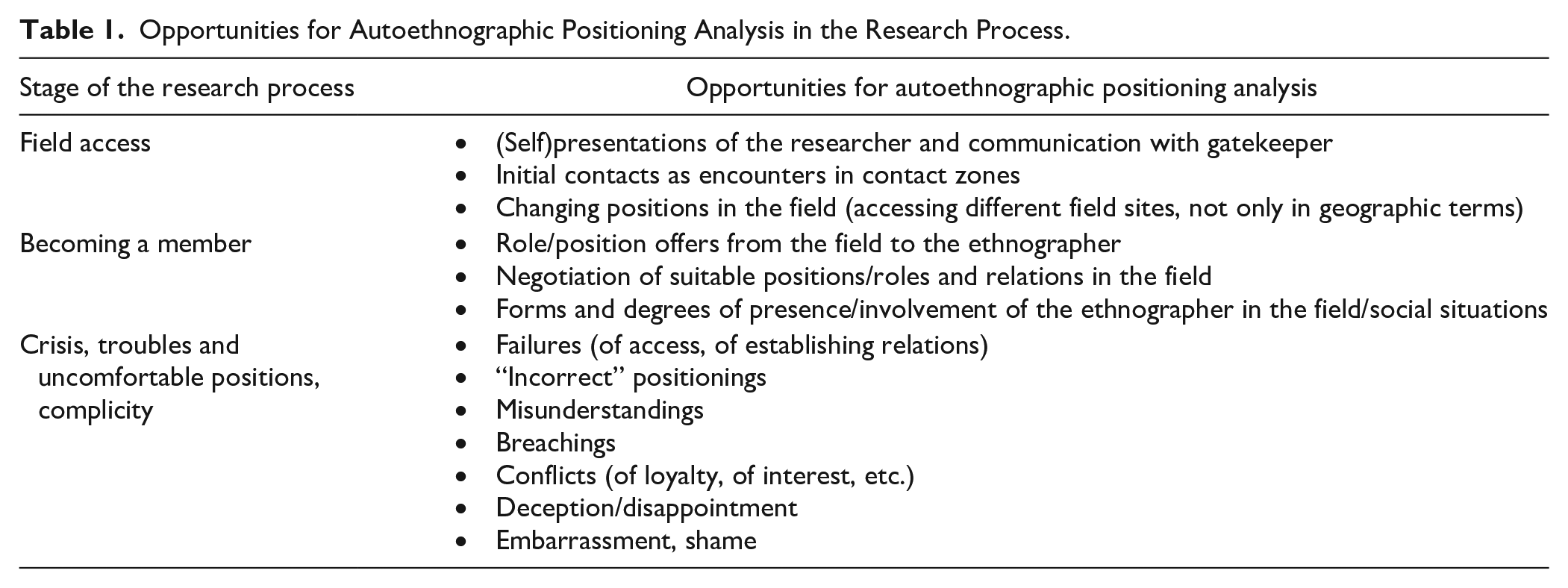
This is possible, however, only if ethnographers’ presence and interactions “in the field” are systematically explored focusing on one’s body in two ways. First, researchers must explore the body as carrier of signs and attributions (Körper) in terms of a positioning apparatus. Whereby body here includes everything that is perceivable and can be made relevant or irrelevant as information about the ethnographer in the social situation. They must observe and document carefully their encounters and movements through the field to find out how they as ethnographers and their counterparts make themselves and others socially identifiable persons, and how this reflects the social and moral (dis)orders of the studied field as well. This way of “multi-siting” (Marcus, 1995) the field through analyzing the whole process of becoming a member as a “positioning career,” takes into further account the complexity of contemporary social worlds. It might even transcend the limits of understanding culture, problematized by Anderson (2006). In this regard, it is particularly the “not nonproblematic positioning” (Anderson, 2006, p. 380), the problems of getting access, establishing “rapport,” and the tensions and role conflicts and feelings of uneasiness or uncertainty which often occur in ethnographic research, that should not be understood primarily as problems to be prevented or overcome. For autoethnographic positioning analysis, these problems are rather rich sources for understanding the social structure of the field, as they give hints to the variety of social positions and the worldviews they reflect. They are also indicative of the hierarchies and conflicts within the studied field, and eventually the here-and-elsewhere-relatedness of local culture production in contemporary social worlds.
From this follows the second meaning of the ethnographer’s body as an analytic resource. Researchers must be also attentive to their lived body as soma (Leib), not only in terms of a “recording device” (Breidenstein et al., 2015) but especially as a “resonator,” seeking to explore the epistemics of affects and emotions. Researchers must consider how somatic experience (i.e., feeling ashamed or offended in the course of a positioning act) reflects or gives hints to the social constellations and dynamics, moral dilemmas, and conflicts within the studied field. While evocative autoethnography seeks “the enactment of cultural experience” (Atkinson, 2004, p. 108) and the re-experiencing of emotions, thus declaring the ethnographer’s body to be both the primary source and limit of knowledge, analytic ethnography goes beyond this by systematically interrogating the ethnographer’s cultural experience as a reflection of social conditions and therefore constitutive of its object of study. Autoethnographic positioning analysis, meanwhile, systematically examines the ethnographer’s positioning careers in the field research process. It develops further the idea of “reflexivities of discomfort” (Pillow, 2003) by making epistemic use of the pleasant, and especially the unpleasant, feelings and affects triggered in the field not as didactic material for evocation in the first place, but as sensors for navigating through the discomfortable zones of “unbounded cultures” (Marcus, 1998). This is to explore its dissonances, frictions and conflicts that fuel the invective latency of ethnographic relations and its metainvective (self)criticism. “Yet, maybe being able to expose these discomforts can be an entry point into addressing the violence and uneven geographies in which ‘the researcher’ and the ‘researched’ move” (Wajsberg, 2020, p. 129).
In a nutshell, (auto)ethnographic positioning analysis
- aims for strategic membership, that is the intentional and planned as well as carefully documented acquisition of membership, different positions and roles in the field.
- uses the ethnographer’s body as epistemic resource in two ways. First, as lived body (soma) in terms of a recording device and a “resonator” for navigating through zones of discomfort; and second, as a carrier of signs and attributions,
- combines positioning-analytic with emotion-analytic reflexivity, as it carefully documents and systematically analysis positioning careers in the course of the research process and at the same time
- is attentive to emotions and affects, which are not treated as didactic material for evocation, but as navigator through the social structures and (dis)orders of unbounded cultures.
Conclusion
Using invectivity theory as a heuristic lens, in this article I introduced what I call the metainvective positioning circle as a model to assess the discourse dynamics of the ongoing crisis of ethnography, its causes and its impact on today’s ethnographic practice.
Doing ethnographic fieldwork inside the metainvective positioning circle, does reinforce and perpetuate uncertainty, uncomfortable feelings of exposure, and even shame for experiencing “morally wrong” positionings and feelings toward the field. While the reflexive turn of ethnography in the 1980s/1990s largely focused on the question of whether legitimate knowledge about a foreign culture can be gained from “self-made” experiences with that culture, little attention has been paid to the handling and meaning of such unpleasant situations in the field and the feelings they trigger. The implications of this oversight are manifold. One is that we leave young researchers in particular alone with feelings of shame and guilt as long as we treat the invective latency of ethnographic relationships as if it were an ethical problem to be handled individually by “responsible” ethnographers, without acknowledging how practically it can never be fully avoided. These feelings are moreover, an important source of knowledge for understanding the moral dilemmas of the current world order, that we should not neglect.
Against this backdrop, I finally presented a new approach, called (auto)ethnographic positioning analysis, which I consider suitable to acknowledge the moral dilemmas of today’s world that can manifest themselves in the relationships and experiences of ethnographers in research fields, conceived as contact zones. Using feelings and positioning careers in field work as a source of knowledge, certainly not directly contributes to making this world a better place, but it can make visible the impositions of a morally questionable world order and thus help to disrupt mechanisms of concealment even in self-proclaimed inclusive societies.
Footnotes
Declaration of Conflicting Interests
The author(s) declared no potential conflicts of interest with respect to the research, authorship, and/or publication of this article.
Funding
The author(s) disclosed receipt of the following financial support for the research, authorship, and/or publication of this article: Financial support from Deutsche Forschungsgemeinschaft for the research, authorship, and/or publication of this article.
