



Abstract
When conducting qualitative research on elites, researchers often face issues regarding time-constraints, power asymmetries, and rapport building. In this article, I outline the methodological concept of “the hustle” so that we might better understand how these issues intersect and how the difficulty to access elites for interviews alters research and researcher. The hustle is defined as the pushing or jostling of the qualitative researcher in the face of resistance to access research settings or participants. Inspired by my own hustle when researching elites who design AI recruitment technology (AI-rec-tech), I argue that the hustle has four major effects: first, it requires the researcher to act as networker; second, it influences how much data can be collected; third, it dictates research design; and fourth, it alters interview dynamics. The hustle is an important conceptual umbrella which draws together themes which have arisen in qualitative research on elites for decades.
Keywords
Introducing “The Hustle”
Qualitative interviews with elite’s present unique challenges. Not only are elites difficult to access, but researchers can encounter struggles regarding time-constraints, power asymmetries, and rapport building (Boucher, 2017; Empson, 2017; Ma et al., 2021). Researchers also often experience knowledge asymmetry and manipulation in these contexts; elites can deny access to information, perhaps because it is protected or secret knowledge intended to be possessed only by a select professional group (Mikecz, 2012).
Indeed, many scholars have pointed out that these challenges and asymmetries are characteristic of research which focuses on elites. It is these very struggles which indicate one aspect of why qualitative research on elites is important; qualitative research seeks to determine how ideas become actions (Gorman et al., 2005), an endeavor which will only become more important as business elites make crucial decisions which impact and shape our society, our technology, and our future. Not only will this become more important, but it will require more skill from researchers to encourage transparency and honesty from their research subjects. As Barabas et al. (2020) argue, following the work of anthropologists such as Nader (1972), it is crucial for us to “study up” by analyzing the world of elites who shape algorithmic systems and who currently remain under-examined in order to excavate the ways that power operates through elite institutions and positions of authority: “The political and social impacts of algorithmic systems cannot be fully understood unless they are conceptualized within large institutional contexts and systems of oppression and control” (Barabas et al., 2020, p. 168).
In social research, there have been many different definitions of elites. Some have used power asymmetry to define elites (Boucher, 2017; Empson, 2017), control and access to resources (Li, 2022), or even money, power, and status (Odendahl & Shaw, 2001). Others have focused on more tangible definitions. For example, Perera (2021) discusses academic elites, while Hertz and Imber (1995) split it into community and political elites, professional elites (such as lawyers, medics, and clergy) or business elites. This is a distinction which Ma et al. (2021) adopt by speaking of “business elites,” which they define as CEOs, managers, and/or board members. Harvey also defines elites as “those who occupy senior management and Board level positions within organizations” (Harvey, 2011, p. 433). Following a combination of Ma et al. (2021) and Harvey (2011), here, I discuss specifically business elites, defining this as business professionals who hold senior leadership positions and therefore significant decision-making power in organizations.
In this article, I specifically focus on a pocket of business elites in the technology industry to demonstrate and expand upon the methodological concept of the hustle. Here, I speak about my own hustle which occurred when studying business elites who have decision-making and influential power in companies which design AI-powered recruitment technology or software (henceforth AI-rec-tech).
Before defining and introducing my methodological concept of “the hustle,” I must note that the hustle is a term that has been used widely, both academically and non-academically. Academically, Carter (2016) has referred to “the hustle,” defining it as how influencers on social media work to make their brand visible, and Ticona (2022) has also used the term “digital hustle” to refer to strategies for how technology is used in precarious work. The term is also used within popular culture. In the 2019 film “The Hustle,” Anne Hathaway and Rebel Wilson star as two scam artists who aim to con an internet millionaire, and in the TV show “The Real Hustle,” con artists perform distraction scams and proposition bets on members of the public.
I re-coin the term “the hustle” to refer to something other than scamming, social media influencers, or precarious work. The hustle, instead, provides a conceptual umbrella for understanding how and why challenges to access participants for qualitative interview research alter not only qualitative research in terms of the data and analysis but also re-shapes the role and skills required of the researcher. Here, the hustle captures movement in methods; the pushing or jostling of the qualitative researcher in the face of resistance when it comes to accessing elite research subjects. While applied to elite research subjects in this article, it is a flexible concept which could be applied to any research subjects who are difficult to access, and additionally, while applied to interview-based research here, the hustle could be equally relevant for other types of qualitative research, such as ethnography.
Specifically, then, I define the hustle as: the struggle to access research settings or participants in the face of resistance, which requires the researcher to transform to become networker, and additionally alters research design, data collection, and interview dynamics.
Pokémon suitably helps to explain and expand upon this definition. In Pokémon, some can “hustle.” This increases the user’s attack by 50% but lowers the accuracy of the user’s physical moves by 20%. The Pokémon ability “hustle” summarizes how, in qualitative interview research with elites, while effort to access participants (“attack”) is increased in terms of how much the researcher requests access, the success (“accuracy”) is much lower than it might be in other forms of qualitative research.
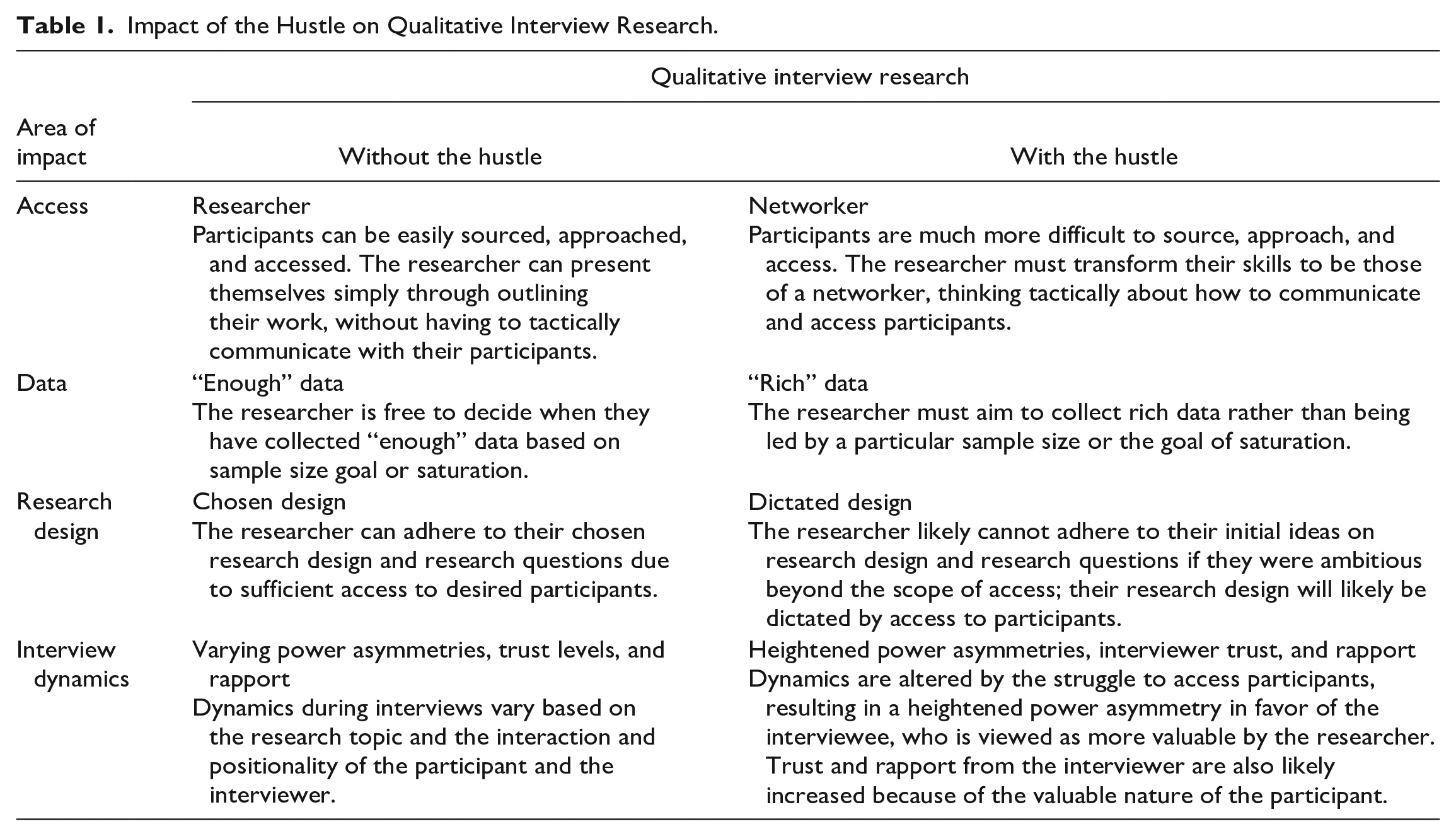
Having defined and introduced the concept of the hustle, this article proceeds in three stages. First, it outlines the case study of my own hustle when attempting to access elites to conduct qualitative interview research on AI-rec-tech companies. This will serve as a contextualization and an example to draw upon during the discussion going forward. Second, it reviews the current literature surrounding qualitative research on elite subjects. At this stage, I argue that there is a clear gap for a methodological concept like the hustle, and that, indeed, the hustle draws a conceptual umbrella above the challenges outlined in the existing literature. Third and most importantly, this article expands upon the concept of the hustle, namely, through outlining the four ways that it impacts research and the researcher, all of which are captured within the definition given above:
Access: From Researcher to Networker
Data: From Having “Enough” Data to Having “Rich” Data.
Research Design: From Chosen Design to Dictated Design.
Dynamics: From Varying to Heightened Power Asymmetries, Interviewer Trust, and Rapport.
Table 1 expands upon these four impacts, outlining the differences between qualitative interview research with or without the hustle.
Impact of the Hustle on Qualitative Interview Research.
Overall, the hustle is a useful concept which can help to frame the challenges of accessing, interviewing, data-gathering, and analysis within qualitative interview research on elite subjects. It highlights that these challenges do not make research less rigorous or meaningful, but quite the contrary; the hustle indicates research which meets resistance, and which, therefore, is likely hitting upon something worth researching.
My Own Hustle: Accessing and Interviewing AI-Rec-Tech Companies
My doctoral research focuses on how the professionals designing and selling AI-rec-tech conceptualize and operationalize gender bias in their systems. To explore this, I conducted qualitative interviews with AI-rec-tech vendor companies to explore how they defined gender bias and how the functionality of the technology sought to address it.
Over the last decade or so, the production and use of AI-rec-tech has been on the rise. It’s been estimated that 98% of Fortune 500 companies use AI or data-driven systems at some stage of hiring, for example, to screen, assess, interview, or even select candidates (Institute for the Future of Work [IFOW], 2020). These systems engage AI tools such as algorithms, automated decision-making tools, and sometimes machine learning, utilizing data collected through natural language processing, image recognition, text analysis, and speech recognition.
AI-rec-tech systems provide major affordances to HR managers; they are time- and cost-effective and can be used at scale. The COVID-19 pandemic is also likely to escalate the use of this technology even further, as companies search for ways to stay competitive in the changing economic climate (Reynolds, 2021; Seiler, 2021).
There are widespread divides in opinion concerning the existence and scale of bias in these systems. While some claim that these systems “reduce” or even “eliminate” bias altogether (Florentine, 2016; Upadhyay & Khandelwal, 2018), others argue that these systems augment bias and create unjust power asymmetries (Ajunwa & Greene, 2019; West et al., 2019). However, before we debate the existence and scale of bias in these systems, we must explore how vendors themselves define bias, a key concept in computational social science, and how they attempt to reduce it.
When attempting to access these companies to conduct my research, I met major resistance. Given the precautions of AI-rec-tech companies surrounding IP and competition, alongside the controversy concerning these companies and their systems, gaining access to companies was extremely difficult. It’s likely that a request such as mine will have had to go through multiple levels of discussion and sign off within various hierarchies throughout the organizations. This means that I didn’t just need to convince one person, but multiple senior people, that these interviews were worth their time. In addition, in some cases, lawyers for these companies will have acted as gatekeepers, given these companies fear of legal controversy (Fernández-Martínez & Fernández, 2020). Some of the companies might have felt they had a lot to lose if they participated in the research and it reflected badly on them—perhaps it would ruin their name, brand, or even lose them investment money.
Despite maximum effort, my success rate was low. I had to hustle in the face of struggling to access companies. I met resistance, and not only did this change the skills required of me as a researcher, but it altered my research design and the data which I collected.
At the beginning of my research in January 2021, I began the process of recruiting companies and participants. For 2 years, I sent emails, LinkedIn messages, used snowball sampling, sent out open calls on mailing lists, and asked professional HR contacts to post on their LinkedIn advertising my need for research participants.
By January 2023, I had reached out to 58 companies; the only ones I could find which were relevant to my study. I got eight companies to agree to interviews: 14% of the companies I approached. Within these companies, I interviewed 18 individual employees in a range of roles, from C-Suite to Data Science, and to Sales and Marketing.
While one other company agreed to participate, they requested for me to sign an NDA which would have been too restrictive upon my research, and while 12 other companies responded to me initially, they eventually rejected the request, stopped responding, or pulled out at the last minute. In some instances, this was after months of correspondence and negotiation. As Empson (2017) discusses, elites can string you along and then just stop answering emails; it has no backlash upon them or their work.
The entire process of participant recruitment was long, repetitive, frustrating, and for the most part, unrewarding. A lot of it required what I refer to as “hidden research time”; hours spent attempting to recruit companies and participants which didn’t lead to anything, and therefore isn’t reflected in my research data, results, or analysis.
It is difficult to quantify exactly how long I spent attempting to recruit participants for this research. Had I known just how much time it would be, I would have kept a timesheet. I urge anyone anticipating a hustle with their research to do so. However, if I attempt to quantify it, I find the following: looking back at my work schedule, I was spending, at the very least, half a day per week on recruitment of research participants between January 2021 and January 2023. This included emailing people for the first time, following up, arranging interviews, looking up companies or people on LinkedIn, or having introductory calls with potential interviewees. 0.5 multiplied by 104 weeks is roughly 52 days, which comes to almost 2 months of solid work trying to recruit participants.
In addition, although not a direct result of the hustle, but rather something that is a common limitation of qualitative research, I must consider that there is the possibility in the sample being skewed. This has been noted as a potential issue with qualitative research before; that those who say yes are the ones who might be giving a particular angle (O’Connor et al., 2008). Indeed, the companies which agreed to be interviewed could have been the less problematic companies or think they might be at some advantage due to the relationship.
The hustle changed me as a researcher and altered my research in four significant ways: it turned me from researcher into networker; it provided me with less data, making me question if this data was “enough”; it dictated my research design; and it altered dynamics within the interviews themselves. These four symptoms of the hustle are explored in more detail in this article, and, in the following sections, I further discuss how they related to my own hustle.
A Conceptual Umbrella: Drawing Together Existing Literature on Interviewing Elites
Currently, the literature concerning qualitative research on elite subjects tends to address issues such as access, power, and rapport. As I review the existing work on these themes, it will become clear that while existing scholarship occasionally assesses the intersections of these issues, there has not been significant focus on how all of these themes interrelate in research surrounding interviewing elites. Following this review, I demonstrate the hustle to be a conceptual umbrella which allows us to draw together these currently separate bodies of work.
Accessing elite subjects has been extensively covered in the existing literature on qualitative research concerning elites. Scholars have noted the difficulties when it comes to gaining contact with elites in the first place, and also the fact that beyond this, it’s even harder to get them to agree to be interviewed (Li, 2022). McClure and McNaughtan (2021) talk about how elites are hard to pin down because they don’t usually share their contact information publicly, and they often utilize gatekeepers, such as personal assistants or administrative staff, or even in some cases, lawyers. Mikecz (2012) discusses that gaining access to elites must be carefully negotiated; it can take longer and have higher costs because elites “purposefully erect barriers, which set them apart from the rest of society” (Mikecz, 2012, p. 483). I certainly found this in my own research. AI-rec-tech company websites tended not to list team members and, if they did, it would not give their contact information. Often, the only way to reach out to people at the company would be through a general queries email address, which would usually be met with no response, or through a LinkedIn message to people at the company, which would similarly be met with no response. As I’ve already mentioned, it’s true that my request for interviews will likely have had to go through many levels of hierarchies at these organizations, gaining sign off from multiple people, and each of those people therefore acting as a potential barrier.
These barriers to access meant I had to spend more time pursuing companies because my success rate was lower. This is what I referred to earlier as “hidden research time”: time spent doing research, which is not reflected in data or analysis output, and therefore remains hidden from the eyes of the reader or reviewer. This hidden research time is still very much part of the research output though; it shapes research design and the role of the researcher.
Of course, the reluctance of elites to be interviewed is due to several reasons. They may be wary of sharing design or trade secrets with their competition, and almost certainly anything outside of their immediate work output is low priority. Empson (2017) points out that the hours they would be using to be interviewed would be billable hours and that, if they’re not working, they could use the time to instead be with their family or catch up on sleep. It’s for this reason, she highlights, that they might string you along and then just suddenly stop answering your emails. These issues are likely exaggerated for inexperienced researchers with fewer credentials (Liu, 2018).
The struggle to access elites could also be explained by not appearing as an “insider.” Mears (2020) touches on this in her book, Very Important People, a sociological and ethnographic exploration of the party circuit for the world’s “very important people” which attempts to understand what they do with their money and how these ritualized performances reflect hierarchical systems and masculine domination. Mears notes that, as an ex-model herself, there was an element of her seeming to fit into these scenes which allowed her to research them (Mears, 2020). In addition, Cerón-Anaya (2019), in his ethnographic research study conducted in exclusive golf clubs in Mexico, draws attention to how these clubs erect firm social boundaries with the outside world, creating spaces that are invisible to the larger city, but hyper visible to the internal group. This is later followed by an example of one interviewee, Fernando, a young golf player who no longer seemed willing to provide contacts of other golfers to Cerón-Anaya for his research after it had been discovered that he did not own a car and had taken public transport to the interview. Cerón-Anaya hypothesizes that, due to the class symbol of having one’s own car in Mexico, this established him as an outsider, subsequently making access more challenging (Cerón-Anaya, 2019). Later, when focusing on how the hustle forces researcher to morph into networker, I discuss this tension between insiders and outsiders further.
Power is another prominent focus for much scholarship on qualitative research with elites (Boucher, 2017; Empson, 2017; Liu, 2018). Perera’s study of interviewing academic elites and shifting power relations, for example, argues that the interview is a space where power can be exercised by both parties. Gender, social class, level of education and professional hierarchies are just a few factors that can impact power relations, along with religion, ethnicity, language, and age (Perera, 2021). This is certainly true; power is a dynamic which is malleable in these contexts, it can shift and change during the interview, but it is largely dictated by position in society and therefore, often, the elite interviewee holds the upper hand.
Members of the business elite are typically used to being in the dominant position and visible in the public domain, and therefore they are usually well equipped for impression management, for example, through presenting a “front” (Goffman, 1967, 1971; Ma et al., 2021), and they will likely even try to dictate the conditions of the interview (Harvey, 2011). These are both signs of power, and it has been noted that they are the ones who can manipulate information and control how it’s being presented to the interviewer (Boucher, 2017; Empson, 2017), yet another indicator of power.
Morris talks about how dishonest respondents have long been an issue when interviewing elites—elites might try to present themselves in the best light or portray a particular version of events, but this doesn’t mean that what they say can be taken at face value (Morris, 2009). Their increased power might mean that they are defensive and/or opaque about the nitty-gritty inner workings of organizations, and that they manipulate or deny particular information (Empson, 2017; Ma et al., 2021).
Research has also pointed to the way in which power asymmetry between the interviewer and interviewee manifests itself in the verbal and non-verbal communication, for example, through interruptions, back channeling, or lengthy monologues (Boucher, 2017).
There has even been academic work based on how to deal with these unequal power dynamics. Li (2022), for example, says a common way to navigate power dynamics is to refer to one’s own institutional connections and professional status. Harvey (2011) and Mikecz (2012) both suggest that interviewers need to show they’ve done their homework before the interview because sometimes elites might consciously or subconsciously challenge them on their subject and its relevance, so the interviewer needs to enhance their knowledgeability on the interviewees background.
There have also been discussions on how the issue of power relates to which voices are heard in elite research. As Hertz and Imber (1995) point out, some social researchers have issues with researching elites because they believe that to understand them is also to empower them. This is a problem on which Rice (2010) focuses, arguing that the difficulty to access elites places the researcher in the position of having to maintain positive relations with those they are studying while also developing critical perspectives from the empirical material they have maintained. This unequal power dynamic might mean that existing power relations are maintained through the processes of knowledge construction and distribution which continue to concentrate the power (Rice, 2010).
However, researchers do not have to do this; they can be critical of the data they have collected and continue to highlight important issues of power disparity. As Hertz and Imber (1995) suggest, one aim of this type of research could be “to expose the reach of power in the hope of clarifying it for those who are subject to it” (p. viii), certainly an aim which I adopt in my own work.
There is also work which covers rapport when interviewing elites. Some of this research explores how to establish rapport in different settings of interviews, including online. Of course, interviewing online has become increasingly common since the COVID-19 pandemic. Elites are perhaps even more accessible this way; it is more convenient for them than an in-person meeting where they might have to spend time traveling. Some literature has reflected on whether it is possible to reach the same levels of depth and reflexivity in these online settings (Deakin & Wakefield, 2014; Kazmer & Xie, 2008). While being online enables research to be easily internationalized without the usual associated cost of travel, some argue that this does negatively impact rapport building and the ability to see visual cues online (O’Connor et al., 2008).
Other literature has focused on rapport more in terms of how difficult it is to create given the power asymmetries. Mikecz (2012) talks about how establishing rapport is hard with elites, giving tips such as having in-depth knowledge of the research topic, increased eye contact, and familiarity with the interviewees culture and norms of behavior. However, he encourages that also this rapport shouldn’t endanger the researcher’s ability to maintain a critical distance.
In the context of interviewing elite philanthropic donors, Breeze (2023) talks about how with some interviews rapport grew organically, whereas in other cases it was much harder. Again, Breeze (2023) discusses ways to establish similarities early on in the interview, for example, stressing common interests which might help to increase rapport, asking questions in ways which encourage the interviewee to be relaxed, or framing the research as a partnership.
While the topics of access, power, and rapport have been covered in existing literature on elite interviewing, they are often discussed separately rather than as interrelated concepts which create a tangled web of issues and consequences for the design and implications of the research.
The hustle provides a conceptual umbrella which highlights the intersections and interrelations of access, power dynamics, rapport, and other factors, when qualitatively interviewing elites.
This is not to say that these connections have never been made. For example, as mentioned above, the work of Breeze (2023) and Mikecz (2012) touch on the links between power and rapport, the work of Cerón-Anaya (2019) and Mears (2020) certainly link issues of power and access, and Perera also points out that, “power relations are intricately tied to access to the interview site and interaction before, during and after the interview” (Perera, 2021, p. 217). However, the hustle is a unique overarching lens through which we can study the difficulties and complexities of interviewing elites. For example, not giving contact information publicly and using gatekeepers as discussed by McClure and McNaughtan (2021), or erecting barriers to deny or manipulate information as explored by Mikecz (2012), these moves are not only about access, but they also force the role of the researcher to change to that of a networker. Simultaneously, it impacts research design because certain topics might not be able to be addressed in the research. Furthermore, issues of access such as being strung along and then dropped (Empson, 2017) are intimately tied to power dynamics.
While current scholarship on elites reflects upon the challenges we face as researchers, or even the practical ways to overcome these challenges and the philosophical reasons behind them, the hustle brings out something new; it allows us to focus on the consequences of these challenges and to reflect in greater depth upon how the nature of researching elites changes the research and the researcher.
Next, I turn to the four ways in which the hustle changes research and the researcher in the context of qualitative interviews with elites.
Access: From Researcher to Networker
The first way in which the hustle alters research and researcher is by demanding that the social skills and persona of the researcher shift to secure the success of the research endeavor: to gain access to the desired research setting, the researcher must adopt the skills of a networker.
Networking is often touted as being crucial for career success; it can help individuals to gain information, guidance, sponsorship, and social support (De Janasz & Forret, 2008; Klyver & Arenius, 2022). Business skills professionals encourage people to be active on social media, to create a personal brand, and to take advantage of networking events (Thomas, 2016). However, many people feel uncomfortable networking and therefore dread it or avoid it completely. In addition, while networking has been seen as crucial in the world of business, it has never been emphasized as being crucial to the success of academic research and data collection regarding elites. This is not to say that it has never been touched upon. For example, Empson (2017) discusses how difficulty gaining access means that the researcher must carefully consider how to make contact, create opportunities, and manage the mindset, and Harvey (2010) advocates that researchers should be polite, persistent, and opportunistic. They must think about things like when elites’ inboxes will be full and who is the best person to contact or ask to speak with, and they must put forward their credentials as it might help with access. These are all networking skills, but I wish to emphasize that they have become integral to the success of research on elites where there is perhaps no existing contact and therefore some prior understanding or relationship.
Networking was a crucial part of the success of my own research, and this was down to the hustle. Due to my struggles with accessing this research setting in the face of resistance, I had to become good at selling myself and creating a personal brand to convince people to give me their time. I had to grapple with how honest to be about my research, my positionality, and my research aims, with the knowledge that more transparency might cost me interviews. I had to argue that my research was valuable and important. I had to make connections, ask favors, and relentlessly follow up with people. Given that it was rare for me to find people’s personal email addresses online, I had to become good at emailing the general email address for the company, calling up on the phone and trying to get an email address, or attempting to connect via LinkedIn. I found this all deeply uncomfortable. It wasn’t just that I needed to practice networking tactics which I wasn’t used to, it was that I also had to self-promote using my credentials to gain access; I was aware this might help me in my endeavor. As Mears (2020) notes, one reason that the promoters allowed her to follow them through the exclusive party scene was because they were flattered by the idea that a professor, someone with a PhD who teaches at a university, was interested in learning from them.
This emphasis on my credentials to gain access also highlighted to me the privilege of my position. It made me reflect upon the fact that this necessity may indeed replicate institutional elitism. If elites are to give more time based on the institution of the researcher, this will only perpetuate a vicious cycle of the most privileged institutions getting access to research settings, a circumstance which would be to the detriment of valuable and thorough research. This is an uncomfortable truth, but one which academia and the business world must face, and one which would be aided by greater transparency from both industry and academia.
In my research journal, I wrote, “As someone for who networking makes my skin crawl, this is an actively unpleasant experience. I’ve often felt during this process as if I’m constantly asking people to do me favours, which is uncomfortable.” Naturally, networking is not something I have ever enjoyed or been good at. Perhaps this discomfort and lack of access is why some social scientists don’t want to study elites in the first place, because when researching elites, “luck and a willingness to take advantage of opportunities as they arise have proven [. . .] valuable” (Ostrander, 1993, p. 9).
This difficulty and discomfort were likely compounded by the fact that I was an “outsider.” This is something which Gupta and Harvey (2022) discuss—while an insider might be seen as someone who has more direct and relevant knowledge, and therefore might produce a more correct interpretation of opinions, an outsider might be seen to do the very opposite, and therefore it could be less likely that they are able to gain access. Being seen as an “outsider” was also almost certainly tied to my gender. Given that most of my interviewees were male and most of the people who I was contacting were male, this introduced a gendered element to accessing these research settings. I was not a “tech bro” or an insider, but a young female student. This likely exaggerated my struggles in one way or another, whether it was to do with my being perceived as an outsider by those I contacted, or to do with my own feelings of being an outsider, which might have subsequently changed the way I interacted with these companies and their employees.
This research, and the hustle that came with it, therefore changed my persona and required my skills as a researcher to transform into one of an effective networker.
Data: From Having “Enough” Data to Having “Rich” Data
The second way in which the hustle changed my research was that it reduced my ability to gather as much data as would normally be thought of as “enough” in qualitative research. Therefore, I take this opportunity to put forward an argument for prioritizing “rich” data in qualitative interview research with elites, particularly those projects which involve the hustle, instead of measuring whether data are sufficient through saturation or a certain number of interviews. I propose a different benchmark for researchers who go through the hustle: rich data are more important than sample size or saturation. Indeed, as Gorman notes, qualitative research interviews lend themselves to collecting rich data in short spaces of time (Gorman et al., 2005).
There has long been debate about when we reach “enough” data in qualitative inquiry. Often, this is spoken about by linking theoretical or thematic saturation to sample size.
Theoretical or thematic saturation is used to determine whether we have enough data, usually within grounded theory projects or thematic analysis projects, respectively. It is often argued to be a determinant to cease data collection and define sample size once no new information or themes are generated from the data (Braun & Clarke, 2021; Guest et al., 2006; Nascimento et al., 2018). In terms of theoretical saturation, some have even tried to define this in quantitative terms, using a lognormal distribution principles instead of relying “wholly on arbitrary judgement” about when to stop collecting (Rowlands et al., 2015, p. 42). Others argue for specified points where theoretical saturation can be reached. Guest et al. (2006), after analyzing one of their own research projects that involved the participation of 60 women, found that the point of no new codes being reached was after the first six participants, and so concluded that theoretical saturation mostly occurs after 12 interviews. Even when it is not prescribing an exact number, others argue similarly that we need “enough.” Small and Calarco (2022) talk about how exposure is a precondition to all good field projects—the greater the contact, the better the data. In interview data, exposure derives from the number of hours spent talking to respondents, and in-depth interviewers generally agree that more hours of interviewing leads to better data.
While recognizing saturation as a useful concept in some contexts, here, I challenge the usefulness of the idea of having “enough” data in terms of saturation, hours spent, or exact sample size in all qualitative interview research. Instead, utilizing the work of Richards (1999), I wish to consider the impact of the hustle on some research, and to re-frame methodological thought about qualitative research and sample size to be in relation to data richness.
As Braun and Clarke (2021) argue, attempting to predict the point of data saturation cannot be tied to the number of interviews in which the theme is evident “as the meaning and indeed meaningfulness of any theme derives from the dataset, and the interpretive process” (p. 210). I concur. Perhaps, for example, in the case of Guest et al. (2006) there were no new codes emerging after six people in a sample of 60, perhaps because their sample was too homogeneous, perhaps because the interviewers were asking questions in a slightly more leading style, perhaps because the researchers were looking for particular answers, or perhaps because after 60 interviewees, new insights would have started to emerge. As Low (2019) writes, there is no magic number to ensure that one will achieve saturation. People who would like to have a numerical formula for determining saturation would have it substitute for researcher conceptual insight and skill. In the end, no amount of information or data collected can ensure against poor research skills. (p. 135)
We cannot ignore the data in relation to the factors which dictate sample size. My own difficulty with accessing companies and going through the hustle cannot, and should not, be ignored. We cannot dismiss the fact that research is a “pragmatic activity” which is “shaped and constrained by the time and resources available to the researcher” (Braun & Clarke, 2021, p. 211). However, it is the job of a skilled researcher to judge whether the amount of data is sufficient to answer the research questions they have presented, and to navigate whether any limitations in place will stunt the data collection to the point of pointlessness. For example, we see an incredible rich and in-depth study of just one research subject who faked credentials and invented stories to be part of a research project, being conducted by Owens (2022). Owens use of this case, although just one case, presents us with a fascinating perspective on issues surrounding the increasing shift to online interviews in the social sciences.
The data I collected, while not a large sample size, was rich enough to answer my research questions, and therefore worth its limitations in gold. The richness of the data here, as Richards (1999) says, is not only about the data itself but about how it is handled. My own data are rich in the way that she defines “richness”: relevance (just what is needed for the problem to be studied), impact (evocative and involves the reader), complexity (carry many meanings and raise many topics), and fluidity (ideas must be richly developed together) (Richards, 1999). In some cases, rich data with a smaller sample size can even lead to more concise findings, rather than rich data in larger sample sizes, which “may make it difficult to examine data in all of their complexity, limiting ability to probe data collection, develop emergent questions, or contextualize quotes” (Roy et al., 2015, p. 250).
While the hustle might limit the researcher’s ability to reach a certain sample size or a saturation point, this does not mean that there is not “enough” data. Researchers who hustle should prioritize rich data over sample size or saturation and should discuss this openly in their findings. My own data are rich as defined by Richards (1999). It is relevant because it was sufficient to answer my own research questions; it is impactful because these technologies effect almost everyone at some point of their career; it is complex as can be seen from the multiplicity of codes and themes the data raises; and it is fluid as my data has been developed in dialogue with my ideas and the findings emerging. All this to say, those who encounter the hustle in their research should prioritize richness of their data, rather than naively and unrealistically chasing a particular sample size.
Research Design: From Chosen Design to Dictated Design
Initially, within my research, I aimed to conduct research on client companies who were purchasing and using AI-rec-tech systems as well as vendor companies who were designing, creating, and selling the systems.
When it came to sourcing client companies to interview, I found 222 companies online who had supposedly used AI-rec-tech systems for hiring. I discovered these companies through the vendor companies’ websites, on their “client” pages, or through LinkedIn posts. Overall, I managed to email or LinkedIn message HR contacts at 92 of these companies and got responses from only 10 people. Out of those 10, I managed to interview only four, and some of these participants claimed their company didn’t even use the technology.
I did not end up using this client interview data within my research; it was insufficient because it was not rich enough to answer my research questions. However, the process of trying to collect data regarding AI-rec-tech clients and failing to do so demonstrated to me that companies using this technology do not want to make this known or want to discuss it in detail. While an interesting finding in itself that there is this exceptional taboo on being known to use these systems and discussing their role in these companies’ hiring practices, this also meant that my research design was dictated instead of according to my own initially chosen research design and questions.
This is the third way in which the hustle changed my research: it altered my research design. The hustle meant that my ability to carry out the research I had intended was limited, meaning I had to narrow my scope and my research questions. Of course, changing research design is a something which can happen within any kind qualitative research, but the hustle exaggerates this phenomenon. While this was, perhaps, a good thing, because it gave me a greater ability to study these technologies from the design perspective, the hustle put my research design at the mercy of my data access.
Dynamics: From Varying to Heightened Power Asymmetries, Interviewer Trust, and Rapport
The hustle also changed the dynamics during the interviews, particular regarding power, trust, and rapport. In interviews where the hustle hasn’t occurred, you might have varying levels of power asymmetries, trust, and rapport, depending on the person and the research topic. However, when the hustle has occurred, I argue that this not only increases power asymmetries but it also heightens the interviewers trust toward and rapport with the interviewee. Before expanding upon this, it is important for me to be reflexive about my positionality.
Reflexivity is a process of continual critical self-evaluation on the researchers’ positionality, including personal characteristics, gender, race, affiliation, age, sexual orientation, and can have large knock-on effects on how we think about and frame content and how we produce and edit material (Berger, 2015). As Mason-Bish (2019) discusses, we must think about how our positionality as researchers has an effect not only on the relationship with the respondent, but on the research in general including our exchanges and findings. Gerson and Damaske (2020) talk about how researchers must attend to their positionality because our conscious and unconscious biases will affect our findings. We must take steps to minimize the influence these biases and their impact on our perceptions about the experiences of others.
Deutsch (2004) realized that she had to develop her own identity as a researcher as a woman who is white and middle class. I had to do the same by looking at myself and my identity in relation to the research. As a young woman, a millennial, a dyslexic who has always struggled with exam conditions, a tech-skeptic, and someone who has had many, many job rejections, I do come from a place of critically questioning these systems rather than welcoming them. I study them because I feel that people should be given equal opportunities in life and the chance to do what they’re passionate about, and I am uncertain about whether these technologies give people the best chance of doing that.
Therefore, in terms of my positionality, first and foremost, I must notice my significant skepticism toward AI-rec-tech and how this is linked particularly to my gender. I have many peers who have had negative experiences with recruitment technology, causing them to feel demotivated and undervalued. They feel confused about what else they can do to obtain jobs, and about what is needed in recorded video interviews. As a result, they try to perform what is needed rather than being their authentic self. As Mears (2020) notes, this can create a tension between the joy of having access to a particular world but also resisting some of it’s ongoings.
I also think it’s crucial for me to consider my positionality in terms of being a student at Oxford. I am lucky to not be currently in a position of applying for jobs and, when I do, being in a privileged position during applications. I do realize that while I am skeptical, I cannot fully understand how much these systems could negative impact the lives of individuals.
Having said all this, it was unignorable that during the interview process I found myself being swayed. While there was of course a contrast in the power between myself and the interviewee, I felt the rapport and level of trust I had with participants were generally high. I argue these dynamics can be explained, in part, by the hustle.
Power asymmetry between the interviewer and interviewee is common in interviews with elites. Given that my research occurred not only with elite interviewee subjects but also with those who were particularly hard to access, I argue that the power asymmetry was even more exaggerated in the context of the hustle. Of course, this power asymmetry is also due to the fact that, as mentioned, the interviewee possesses knowledge and influence which the interviewer often does not. As Boucher (2017) notes, “power refers to the capacity of the interviewee to make or resist certain outcomes, with regard to responses to questions” (p. 99). It was clear to me throughout my research that this power asymmetry was exaggerated in favor of the interviewee in light of the hustle; given the increased difficulty of accessing these elite participants, it made each participant more valuable and therefore, in a sense, more powerful.
While elements of power asymmetry were inevitably part of these interviews, I did feel they were accompanied by, or perhaps even led to, a higher rapport and trust with the interviewees.
Often, during interviews, I felt myself being captured by the interviewees’ vision, their pitch, and their opinion. As I mentioned earlier on, it’s likely that my request for interviews will have had to be signed off at many levels of hierarchy, and in addition it’s likely that many of my interviewees will have been equipped with which aspects of the system they want to tell me about, or what to say as answers to certain questions. As discussed above, these are people who are experienced in impression management (Goffman, 1967, 1971). But often, I felt myself agreeing. Of course, for many of these participants, it is their job to sell and promote this technology and so it is not unreasonable that they would be extremely persuasive and passionate about their systems.
I tried to stay aware of the perspective presented to me in interviews. It is true that a person can choose to present a version of themselves, a certain identity or idea, based on who is listening, and it is the job of the interviewer to be aware of this (Beitin, 2012; Holstein & Gubrium, 1995).
It is crucial for me to reflect upon how my positionality may have influenced multiple aspects of this research. As Small and Calarco (2022) discuss in their chapter on self-awareness in Qualitative Literacy, field-workers don’t just collect data, they co-create it through the transcripts and field notes and the decisions they make. Factors such as gender, extraversion, awkwardness, clothing, and vocabulary can affect not only who agrees to be studied (access) but also what they decide to say (disclosure) and how we analyze the data because each researcher will interpret statements and observations differently (interpretation). Similarly, Talmage (2012) also talks about “filtering,” which is where we pick and choose what we attend to in interviews. This can happen because of the self we bring to the interview, the ideology that we hold, what we perceive as shared experience, and filtering for relevant topics. Ironically, I have needed to be wary that the “ever-present danger of bias may be overwhelming” (Gorman et al., 2005, p. 126).
In addition, I was aware that the online setting might change the ability to have rapport with the interviewees as it might cut across the socio-emotional signals between researchers and subjects that take place in face-to-face interactions (Edwards & Holland, 2013). Some believe that nothing compares to face-to-face interviews (Gerson & Damaske, 2020). O’Connor et al. (2008) write, “[i]n the disembodied interview all the subtle visual, non-verbal cues which can help to contextualize the interviewee in a face-to-face scenario are lost” (O’Connor et al., 2008, p. 8). There certainly can be challenges with online interviews such as participants might feel embarrassed or uncomfortable being filmed as well as things like internet connection and the lack of visual cues (Hay-Gibson, 2009).
However, I didn’t find any of these things to be an issue. Internet connection was never a problem and, given the elite nature of the participants, they were usually comfortable being recorded. As Harvey (2011) notes, elites tend to prefer doing telephone or online interviews because of time saving. People were also so accustomed to doing online calls because of COVID-19. This likely mitigated some of the issues with rapport building that might have occurred pre-COVID-19 with doing video calls. As Deakin and Wakefield (2014) point out, technological advancements have normalized communicating over long distances, and rapport can therefore often be built in these settings just as well as in face-to-face settings.
During the research, I recognized that my rapport and trust was generally very high with interviewees, and upon reflection I realized how the hustle was feeding these heightened dynamics.
Given the hustle and the subsequent difficulty with accessing these companies, people offering me their time for an interview created an immediate liking toward them. In addition, the hustle exaggerated the power asymmetry between myself and the interviewee and made me feel extremely lucky to have access to their time; as noted above, these participants and their opinions were immediately more valuable. In most cases, rapport and trust were established early in the interview, particularly from my side.
However, as I became more aware of this, I realized that I wasn’t thinking critically in interviews and therefore was not getting the best material out of them. If I was going to do so, I needed to be able to reactively change my interview persona to get the data I needed to answer my research questions. Harvey (2011) talks about how “[e]ffective interviewers are those that are able to easily adjust their style and make the interviewe[e] feel as comfortable as possible” and be able to adapt their behavior, speaking voice and mannerisms accordingly (p. 434). In this case, it meant adopting a more challenging, provocative stance in some cases, and it seemed to work. For example, in my interview with one participant, when they were giving two separate answers to one question, I gently nudged them: “I’m sorry to push you on this but I am going to push you on it, because I am interested to know, if you had to pick one?.” I ended up getting a much more fruitful answer.
Gerson and Damaske (2020) talk about how probing for information in interviews is important because it delves beyond the surface and can unearth the process of constructing social accounts as well as many other kinds of information that reveals the multiple meanings participants attach to their behavior. Staying alert to and following up on incomplete, unexpected, or vague answers can give an interview depth. Part of this is about listening. Talmage refers to active listening from the interviewer—clarifying, suggesting alternative interpretations, and facilitating significant linkages in order to make sense and understand things (Talmage, 2012).
Overall, I felt this “malleable persona” resulted in better material during interviews. It was clear to me that the hustle was impacting my dynamics with interviewees by exaggerating the power asymmetry and heightening rapport and trust from my side, but this was not necessarily producing the most truthful and representative research data.
Conclusion
This article outlines a new methodological concept: the hustle. The hustle is a phenomenon which I form in relation to qualitative interview research with elite subjects when the researcher struggles to access their desired research setting. While I speak about it in relation to interviews, this conceptual umbrella could be applied to other types of qualitative research, such as ethnography. For example, Christin (2020) discusses issues of saturation, access, and positionality which are all ones which are a big part of ethnographic research, and they are all issues which are drawn together under the conceptual umbrella of the hustle. In addition, the concept might also extend beyond research with elites, for example, applying to participants who are difficult to access for reasons other than their status.
The hustle highlights important considerations for future research. Researching AI-rec-tech is difficult and requires maximum effort for access even of the most basic kind. This is not only something for researchers to consider, but it also illustrates the importance of these companies becoming more transparent with researchers in the future. Particularly in the realm of AI, it will be crucial for regulation and the study of social implications of these technologies for elites in these positions to become more transparent about their workplaces, practices, and systems. This is not only a methodological consideration, but a humanitarian one.
In addition, as this article discusses, the hustle can have multiple effects on the research, for example, on the researcher’s persona, the data quantity, the research design, and the dynamics during interviews.
The hustle is a useful and important conceptual umbrella which brings together many of the themes and issues which have arisen in qualitative research on elites for decades, and which will continue to arise, perhaps increasingly, in the decades to come. It stresses that these challenges do not make research less rigorous or meaningful, but quite the contrary; the hustle indicates research which meets resistance, and which, therefore, is likely hitting upon something interesting.
Footnotes
Declaration of Conflicting Interests
The author(s) declared no potential conflicts of interest with respect to the research, authorship, and/or publication of this article.
Funding
The author(s) disclosed receipt of the following financial support for the research, authorship, and/or publication of this article: This work was supported by the Economic and Social Research Council (grant number ES/P000649/1) and Exeter College, Oxford. For the purpose of Open Access, the author has applied a CC BY public copyright license to any Author Accepted Manuscript (AAM) version arising from this submission.
