



Abstract
This article explores seeing/drawing as a research practice and makes two key contributions to contemporary conversations on audiovisual methods. First, it reveals a problem related to the methodological silencing of more than verbal presence and efforts that occur as video data are distilled by transcription. This is significant because it illustrates how widely used methods sometimes add to the continued silencing of overlooked perspectives. Second, the article outlines a methodological experiment catalyzed by the abovementioned problem, inquiring into seeing/drawing as a research practice that allows for cultivating attention toward more than verbal presence while temporarily muting the verbal.
Oslo, Norway, April 2021
I read my university’s guidelines on recording research data through Zoom, print the documents, and reread them. I use a yellow marker to highlight the instructive parts: some concern the planning of the Zoom meeting, some the settings in the Zoom invite, and some concern how the meeting and recording must be set up to secure the participants’ ethical and juridical rights. I am doing a PhD during the COVID-19 pandemic, studying parent–teacher conferences in culturally diverse kindergartens in Norway, and going into kindergartens increases the risk of someone getting infected with the virus. Consequently, video observations have morphed into the realm of Zoom,
1
a software unknown to me until the pandemic hit.
Ten minutes before each conference is scheduled, I log in. I feel nervous and take a few breaths. From here on, it’s a matter of trust. Trust the software, trust the internet connection in two, three, or four different places, and trust that the parents and teachers will be able to enter the digital space without too much hassle—that I will be able to assist those struggling with technologic issues. With the handwritten plan on my left and a pencil and notebook on my right, I stare at the screen, waiting for notifications about participants arriving in the digital waiting room.
This article is a methodological inquiry into drawing as a research practice for engaging with more than verbal presences and efforts in video observations. The dataset consisted of 14 video observed and recorded parent–teacher conferences (PTCs) 2 between kindergarten parents and teachers 3 in three culturally diverse kindergartens across Norway. This article makes two key contributions to contemporary conversations on audiovisual methods. First, it reveals a problem linked to the selectiveness of transcription. Second, it outlines a methodological experiment catalyzed by that problem. As such, this article is also about how methodological conventions sometimes limit researchers’ abilities to pay attention to interesting topics and about the possibilities that doing research differently can offer. In other words, this work is a methodological response to the call of Brown (2022) to take those glasses off and wear a different set. With this piece, I aim to extend the ongoing conversations on drawing as a research practice and by doing so challenge and complement established ways of doing video observations.
Despite the historicity of drawing as a research method, the practices of contemporary observational drawing are underexplored (Brice, 2018). Furthermore, as Brice (2018) writes, there is a need for accounts “of what takes place in practice, at the level of actual encounters in the field” (p. 141). The current article will offer such accounts and thereby join the conversation about the ways of awareness of the arts-based research practitioner initiated by Blumenfeld-Jones (2016). My drawing practices build on insights from the artist Frederick Franck (1909-2006), in addition to contemporary scholars, such as Knight (2021) and Brice (2018), who have explored and developed drawing as a way of attuning to their phenomena of interest, thus shedding light on in situ drawing practices. This project adds to this by extending situated drawing practices into observations and re-observations of video-recorded data. In situ drawing is an ideal in the world of the arts (Franck, 1973). However, my interest in drawing as a research practice did not arise from such ideals but from a problem in my research that demanded methodological rethinking. At the outset, I must unfold that problem, as this will clarify what would turn out to be an important premise and catalyst for the experiment that follows. Next, I present the experiment. Narrative accounts of the research process, researcher-made drawings, transcripts, word counts, and more traditional academic text passages are included to help elucidate the problem and the experiment. By doing this, I aim to demonstrate that there are already several ways of seeing available to researchers, not (only) in the sense of one person seeing things different from another, but in the sense of a researcher recognizing the multiplicity of a single microevent as she turns her attention toward it in repeated yet different ways.
The Problem
It all began neatly enough. The project was planned as an interaction study—a research tradition that values detailed transcription practices, emic perspectives, and data-driven approaches to recordings of naturally occurring interactions (Sidnell, 2010). Accordingly, I observed PTCs that would have taken place, regardless of my project. In line with established practices within video-based research (see, e.g., Heath et al., 2010), I took for granted that, after recording and making overviews of the dataset, the next step would involve transcription.
As I prepared to let parents and teachers into the above-described Zoom meetings, I was curious about what aspects of the conversations would come across as important to the participants.
Mothers, fathers, and teachers enter the Zoom meetings from wherever they are at that day: their office, kitchen, living room, guest bedroom, or a room at the kindergarten. They use their phones, iPads, laptops, or stationary computers, with or without earphones, earplugs, and wires. Some use background filters. Others position themselves so that a wallpaper, a window with blossoming plants and lace curtains, or a tidy kitchen bench with a voluptuous green plant serve as background. Some enter the room with ease, some with technological struggles.
When they are ready to begin the conference, I turn off my camera and microphone. I become a black square with my full name written across it. It’s not ideal, but in this way, the microphone of my computer does not broadcast the sounds of a garbage truck squeaking as it lifts and empties our garbage cans, workers drilling somewhere nearby, the heavy rain on the roof outside my window, or my husband and children coming in for shelter. The soundscape of my home does not steal attention away from the child, who is the first-order prerequisite of, but absent from, their conversation. The black square represents my absence/presence, but my camera does not transmit the ways in which I am affected by a mother’s face. Her son will start school this fall, and now the kindergarten teacher lets her know that the staff has decided to recommend that the school put her son and his best friend in different classes. He’s bossy. It will be in the best interests of both boys. Neither does the camera record my face as I witness another mother’s face morph into a glittering smile when her son appears briefly in the teacher’s Zoom frame. No one sees the muscle contraction in my jaw as a father describes how his daughter awakes from nightmares, but the camera does record the tears of the listening teacher.
Now, they all inhabit me.
During their conversations, I was deeply affected by the parents’ presences and efforts, and as they re-occurred in PTC after PTC, repeatedly but differently, I came to think of these as care—care for a child and care for that child’s worlds. It was a feeling of witnessing something of great importance. The literature on PTCs had not prepared me for this. I did recognize themes from previous research, such as the professional interlocutors demonstrating professionalism (e.g., Simonsson & Markström, 2013), parents’ displays of being “good parents” (Pillet-Shore, 2015) while receiving unsought-for advice (e.g., Cheatham & Ostrosky, 2011; Dannesboe et al., 2018), the comprehensive assessments of a child (e.g., Markström, 2009), and the silencing and epistemic othering of parents (e.g., Hughes & Mac Naughton, 2000). The parents’ presences and efforts reminded me of the invisible labor Grue (2021) describes in his memoirs on living in a vulnerable body. Care is “the place where labor meets love,” Grue (2021, p. 89) states and somehow, that compilation of love and labor resonated with what I had witnessed. There was no going back; the toothpaste was already outside its tube, and I decided to make parents’ presences and efforts—their care for their child and for that child’s worlds—in and through PTCs the topic of my PhD project.
Certain moments in their conversations stuck with me and haunted me like “tugs on the sleeve” (Fels, 2012), and it was incomprehensible to me why so little of the literature on PTCs addressed parental care. That is, until I started to transcribe. The more I transcribed, the more “pull” the teachers’ efforts had. Reading the emerging transcripts felt surreal. Regardless of the level of detail traced, parents’ presences and efforts had somehow faded, while the presences of the teachers had magnified. Some of my most powerful memories from first witnessing the PTCs were completely lost in translation; for instance, there was a moment when a mother and a father simultaneously leaned smilingly toward their screen. I don’t remember noticing it as the conversations played out that first time, and I did not make a note of it in my notebook, yet the image of a smiling, mirror-like movement reappeared in my mind several times, as I argued I had seen care. Had it not happened? What followed was weeks of disorientation.
Curiouser and curiouser: I could have sworn that I saw their mirroring movement!
Puzzled with doubt, I stop doing what I do. I stop transcribing. I re-observe the videos. Relief. It is there.
Now what? Reorient.
I sign up for drawing classes.
I sign up for a PhD course on visual and multisensory methods.
I turn to drawing.
A search through the videos confirmed that the movement happened 2:32 minutes into the 13th PTC. So, what does the disappearance of parents’ presences and efforts tell us about the nature and function of transcriptions? Transcription involves annotating speech while aspiring to represent “very subtle nuances of intonation and breath and pacing” (Sidnell, 2010, p. 23). Transcriptions will note silences as pauses. The turns in the sequences of conversations will be designated to the talking interlocutor (Jefferson, 1988). Non-vocal presence during the other interlocutors’ turn will seldom be noted. All of these tell us that audio transcripts favor vocal presence. An excerpt from the audio transcript of the seconds in the conversation when the mirror-like movement occurred may serve as an example (Figure 1). I have chosen a medium-detailed practice of the Jefferson (2004) convention, and use arrows to indicate pitch shifts, colons to indicate prolongation of the immediately prior sound, and .hh within a word to indicate that it is said on an inbreath. In addition, brackets mark overlapping talk.
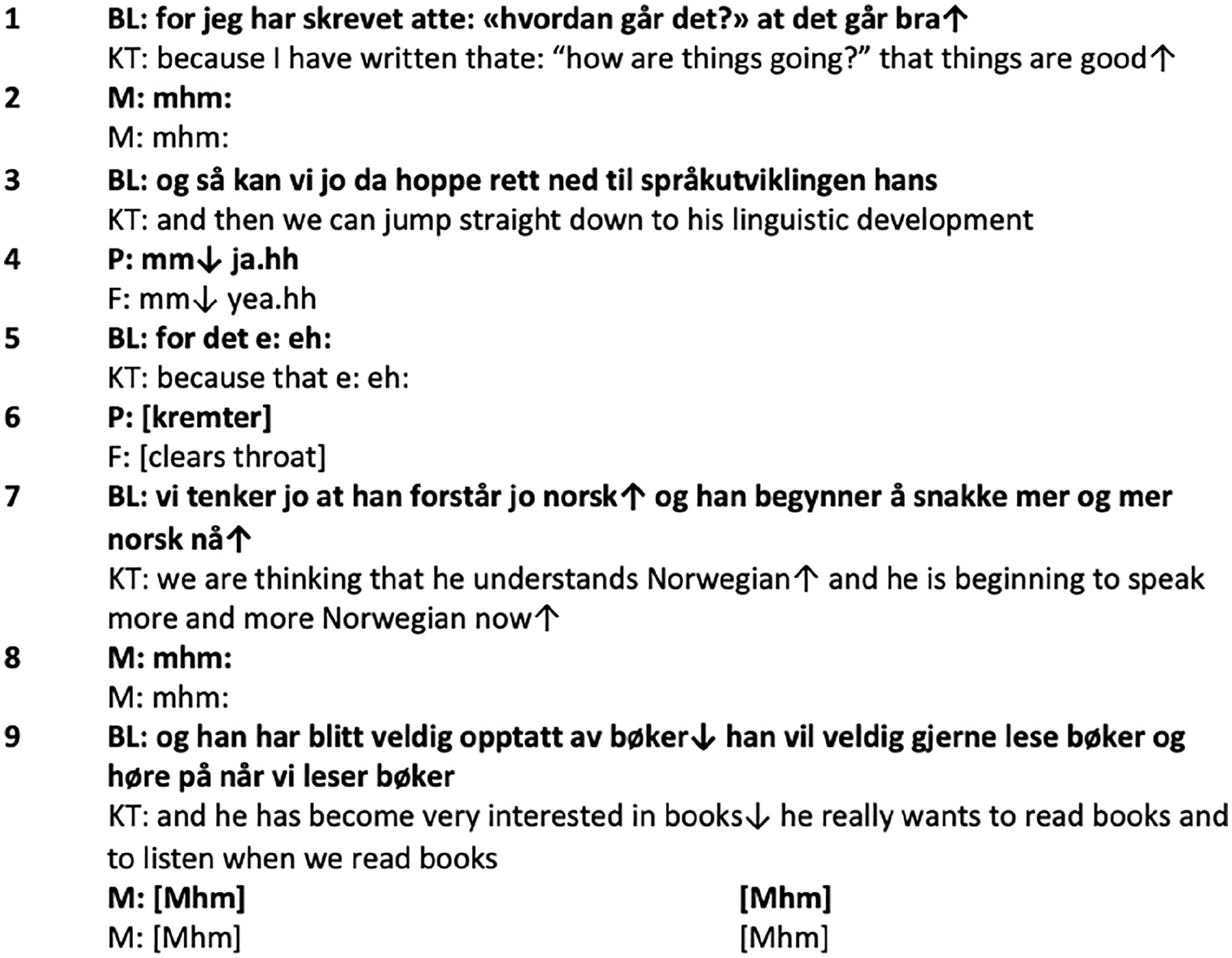
Audio Transcript of the Seconds in the PTC in Which the Mirroring Movement Occurred.
The excerpt illuminates some of what was going on vocally while the mirroring movement happened (Figure 1). In this representation, parents’ presences and efforts are limited to one throat clearing and variations of “mhm.” The mirror-like movement is not registered. Following the growth of video-based interaction studies, Mondada (2018) created a multimodal convention that expanded the one originally developed by Jefferson (2004). Hence, Mondada (2018) highlighted embodied resources for interaction and allowed for inserting verbal turns into a course of action. A Mondada-informed version of the microevent, where the horizontal arrows represent the duration of the embodied action, could look like the transcript on this page (Figure 2).
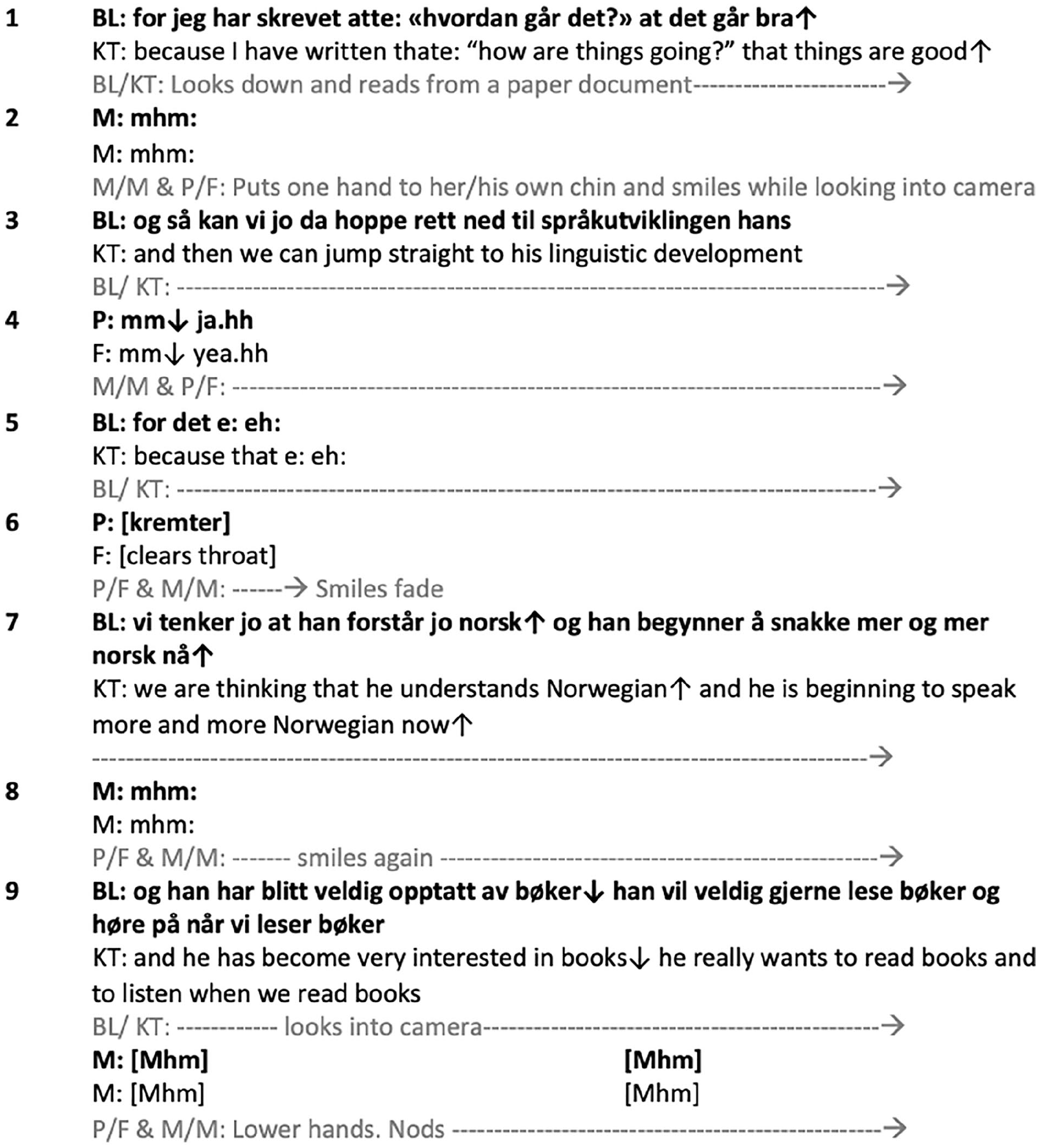
Multimodal Transcript of the Seconds in the PTC in Which the Mirroring Movement Occurred.
Adding symbols or words that describe gaze directions, gestures, and movements enriches the description. Now, it is possible to read from this transcript that the parents’ smiles and mirroring movements occur and fade. Furthermore, it is possible to read that the kindergarten teacher is unlikely to have noticed it because it occurred while she is looking at her prepared documents. In this new transcript, the parents’ presences and efforts are more visible. Nevertheless, I suggest that translating certain movements into words and symbols is still a relatively limited way of engaging with them.
What the examples illustrate is that transcription is a selective activity. Such selectiveness means that the choice of when and whether to transcribe has analytical and conceptual consequences (Mondada, 2018). This is not, however, unique to transcription. Research has always involved exercising the power of the differential—an act that, according to Manning (2016), can be thought of as violent. The process of transcription privileges the sonic facet of the data, specifically the vocal facet of this sonic dimension. Thus, transcription privileges verbally dominant interlocutors over other (human and more than human) presences. As transcription has been particularly foregrounded and developed by conversation analysis (CA), I use CA conventions and refer to CA literature here, but the problem is not limited to CA. On the contrary, methodological silencing by transcription might represent a problem for several ways of conducting audiovisual research.
The methodological silencing of the parents’ presence and efforts reminds me of how discursive post-colonialism has centered the verbal, minimizing silence to nothingness. Once, Viruru (2001) put the worlds that can live inside “silence” back into relief for me. As Viruru (2001) wrote, if something was not put into words during her childhood in India, she knew it was of great importance. Finally, it dawned on me: Was it my research and me that decentered parents’ presences and efforts by taking for granted that the next step would be transcription and not thoroughly considering the methodological consequences of possible verbal dominance in PTCs? In my eagerness to be a good PhD candidate and learn the art of conducting interaction research, I had forgotten the very baseline in my academic training: “It is the researcher who decides what research is or might be,” and “although there might be many understandings of what research is [. . . ] today’s research is different from yesterday’s” (Rhedding-Jones, 2005, p. 18). A word count of the transcribed PTCs confirmed my impression of the professional interlocutors’ verbal dominance. In my data, 12 of 134 PTCs were verbally dominated by kindergarten teachers, and in those 12 PTCs, the teachers, on average, expressed 67.35% of the words uttered (Figure 3).
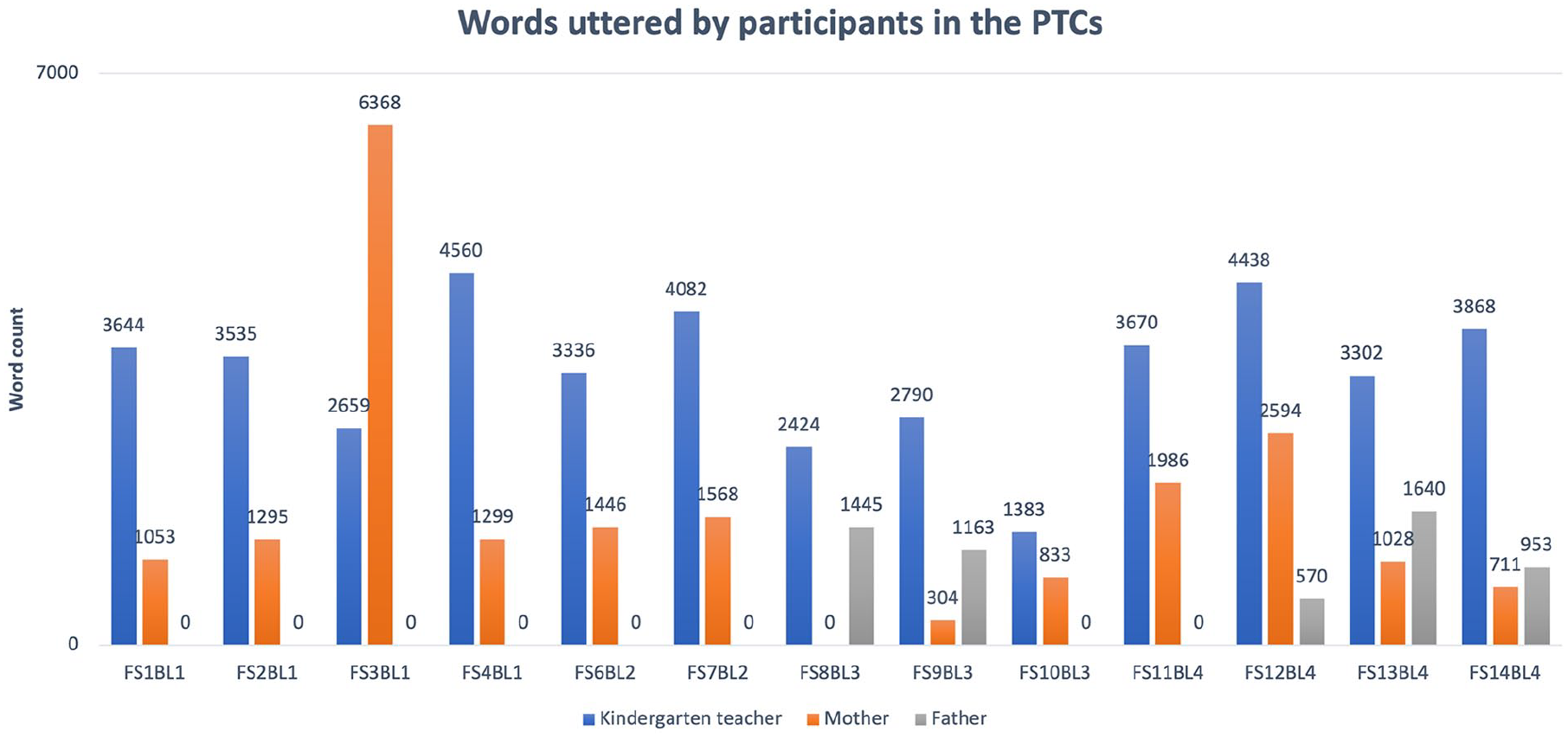
A Word Count of the Verbal Participation of the Teachers and Parents in the PTCs Illustrates That the Professional Interlocutors Verbally Dominate 12 of These 13 Conversations.
Bearing in mind that this is a small sample of PTCs, what these numbers primarily illuminate is that in this dataset, teachers dominate most PTCs. It matters whether the methods I apply amplify such dominance. Consequently, these numbers told me that a critical incident had hit my research. According to Flanagan (1954), a critical incident is when a behavior turns out to be ineffective with respect to a designated activity. In this case, transcription was counterproductive this early in the process because it selected out the very presences and efforts I was curious about. More than two decades ago, Hughes and Mac Naughton (2000) pointed out that parents are absent from much of the literature about parent involvement in early childhood education and care. In my PhD project, it seemed that distilling the audiovisual data by transcription, gave the impression of parents actually contributing less to the PTCs. However, that was not my impression as I witnessed these PTCs. If I was to shepherd attention toward parents’ presences and efforts, I had to approach video observation differently. Thus, I put on a different pair of glasses (Brown, 2022), so to speak, blew dust off a beloved hobby, and began to perform explorative work.
Turning to Drawing
Turning to drawing was not a case of leaving one method for something more “accurate.” I chose drawing because transcription selected out interesting presences and efforts. I also knew from prior experience that practicing drawing makes me more attentive and opens a wordless mode of awareness that allows for temporarily muting the verbal. Every time I re-intensify my drawing practices, I realize that I notice more, even beyond the act of drawing. For days afterwards, I take note of sensory impressions that otherwise pass me by, like the way the colors of the mountains seem to soften the farther they are from where I stand and how visual patterns of nature seem to echo one another. According to Franck (1973), such increased awareness makes up traces of the awakening of the eye. With this methodological experiment, I now hoped drawing could cultivate my attention, so that, parents’ care for their young children and their children’s worlds in and through PTCs could be noticed thoroughly.
The history of observational drawing as a primary mode of research goes back hundreds of years. One early example is the renowned work by Leonardo da Vinci (1452-1519), whose drawings demonstrate a will to scientific and technologic experiments that led him onto insights in various fields, such as anatomy, physics, and mechanics, to name a few. Another early example is the work of Maria Sibylla Merian (1647–1717), who portrayed the metamorphoses of caterpillars, worms, and maggots with the plants they lived on, with, and off (Pomeroy & Kathirithamby, 2018). No less than other methods across fields, the history of observational drawing is stained with the horrors of colonialism and orientalism (Brice, 2018; Knight, 2021). Such hauntings cannot be underestimated, yet there are still aspects of the work of pioneers like Merian that can inspire across time and place. Merian had the courage to experiment with, and thus figure out, ways to study and portray facets of life not commonly recorded by scientists and artists at the time, such as the holes from larvae feeding on leaves. In her specific context, Merian had an unusually ecologic and holistic approach to the phenomena she grew an interest for (Pomeroy & Kathirithamby, 2018). Subsequently, she was able to observe that insects laid eggs and did not spontaneously appear from mud and garbage, as most people in her context thought, partly due to Aristotle’s idea of spontaneous generation from “dead matter” (Pomeroy & Kathirithamby, 2018). Merian even invented a way of articulating these insights visually, in which she portrayed little critters’ lifecycles and ecosystems life size on a page, made printing plates, and had her artwork published as posters and books, thereby making it possible to share what she learned with a wide audience (Pomeroy & Kathirithamby, 2018).
With respect to contemporary scholars, the works of Knight (2021) and Brice (2018) are examples of research on new methods that have informed my project. As an artist and researcher in the field of early childhood education, Knight (2021) has developed what she calls “inefficient mapping,” through which she attunes to phenomena in situ, often mixing figurative and non-figurative mappings of, for example, movements, agency, and place through materials, mark-making, and layering. Inefficient mapping never claims to give a whole account of a given time-place, but to take notice of and attune to some of what is going on in a specific milieu (Knight, 2021). This is in line with the work of Brice (2018, p. 137), where she experiments with drawing “not as a system of replicable (and transferable) methods of representation, but as a particular mode of attunement” in the field of cultural geographies. Brice (2018) explores a hybrid between traditional academic writing and figurative crit sessions, highlighting the notion that the skill of observational drawing is not mainly a matter of technique, but a mode of attunement, or modes of corporeal, social, and political openness to the messiness and complexities of field encounters. My drawing practices are done as I revisit and re-observe video recordings, thereby distinguishing them from the works of Brice (2018) and Knight (2021). However, I have worked in line with their insights in the sense that the drawings are not made to be pretty or accurate but as ways to take notice of, attune to, and aspire for corporeal, social, cultural, and political openness to the specificities and complexities of parental presences and efforts in and through PTCs.
The Experiment Begins
After the critical incident hit, I turned to drawing and set the following research question: “What might happen if the practice of drawing is mobilized to allow for video observations to become sensed and embodied engagements with audiovisual data?”. The practice of drawing has led the inquiry toward an open-ended and explorative investigation of knowledge generation through drawing, similar to what Frayling (1994) calls a “practice-led approach.” Methodological protocols have been set and put to work throughout the year-long process. Setting protocols for one’s drawing practice is a common feature of artistic practices and can help “push forward a research enquiry or curiosity” (Knight, 2021, p. 12). The protocol I set for the first phase of the experiment had one strict rule: seeing/drawing only one microevent per day. The intention was to make room for slow time and hone my capacity to pay attention, explore, and respond to the microevents observed through drawing. The protocol allowed for each microevent to be drawn multiple times and the use of varied tempo, techniques, and materials. I decided to start with the visual memories that tugged my sleeve most intensively. I watched the videos, found the microevents, observed them repeatedly, and made screenshots. From those stills, I drew.
In the next section, I offer an account of what took place in “the field,” hence the office/guest-bedroom/studio-part of my home where I could revisit the PTCs through seeing/drawing with pencils, charcoal, paper sheets of different qualities, a computer, a desk, and an easel. I will begin this account by addressing the act of drawing as a way of cultivating attention before I move on to some possibilities that might grow from drawings as distributed thinking.
Ways of Seeing
I have learned that what I have not drawn I have never really seen, and that when I start drawing an ordinary thing, I realize how extraordinary it is, sheer miracle: the branching of a tree, the structure of a dandelion’s puff. (Franck, 1973, p. 6)
Drawing is visual or expressive mark-making (Reason, 2018). However, drawing is more than that. It is movement. Drawing is to take a line for a walk, as Klee (1953) writes. Drawing is mark-making, as a body moves to take a line for a walk by making the paper and charcoal rub against each other. Yet again, drawing is more than that. Drawing is seeing. Drawing can—with practice—become so entangled with seeing that Franck named it “seeing/drawing.” For Franck (1973, p. 21), this act refers to the aspiration to make the “eye-heart-hand reflex ever more sensitive, so that the hand may become ever more the willing tool of the eye.” As we draw, we touch the world with our eyes–heart–hands. In this way, drawing is a way of familiarizing ourselves with the world through the body (McGuirk, 2014), akin to what Ahmed and Stacey (2001) describes as “thinking through the skin.”
Seeing/drawing is a way of seeing and thinking through the skin. However, drawing is more than that—it is a way of seeing something. As Berger (1972/2008, p. 8) notes in his book, Ways of Seeing, “We only see what we look at. To look is an act of choice.” Here, he points our attention to the agency of seeing and the notion that photographs are not mechanical records; as Berger (1972/2008) stresses, “Every time we look at a photograph, we are aware, however slightly, of the photographer selecting that sight from an infinity of other possible sights” ( p. 10). Thus, seeing/drawing is mark-making as we see what we choose to look at; in other words, what we choose to not over-look, what wonder, and what labor we choose to notice. Yet, drawing is more than that. What drawing adds to the agency Berger identifies is steadfastness in the sense that drawing can be done as quick sketches or longitudinal studies, but drawing does necessarily take time (Brice, 2018; Reason, 2018). The agency of choosing that sight from an infinity of other possible ones must therefore be re-engaged repeatedly as our attention wanders elsewhere.
However, drawing is more than that. To slow down and pay attention with care can be considered a form of art—one that can be cultivated (Savransky & Stengers, 2018). This process of cultivating the art of paying attention echoes what Franck (1973) describes as he aligns his meditation and drawing practices. Thus, seeing/drawing is one way to make the decision to pay attention and cultivate one’s capacity to slow down, pay attention with care, and, by that, notice more about what one chooses to look at.
Yet again, drawing is more than that. It is a way of slowing down long enough to notice the extraordinary in the ordinary dandelion’s puff. To discover that there are no ordinary things (Franck, 1973). Drawing is a way to rediscover the world, “a way of getting into intimate touch with the visible worlds around us, and through it . . . with ourselves” (Franck, 1973, p. xi). As a research tool, drawing offers a way to “draw the researcher into” data (Jellema et al., 2022, p. 16) and affectively and bodily attune to events that occur in this world (Knight, 2021). But how does one do that? One does that. Someone. Drawing is also a question of who is taking what line where, how, with what, in what space, in what time, and with what agency. The agency of drawing is a question of whose voice you are presenting (Sassatelli, 2021). However, the agency of drawing is more than that. For Sassatelli (2021, p. 317), “one needs to see in order to gain knowledge; but one needs to know in order to see.” This researcher-body has worked, read, and written in the overlaps between the fields of multicultural education and early childhood education for two decades now. Questions about what ways of living, thinking, and feeling are normalized—privileging whom at what time and place—run through my veins. This researcher-body has also been a mother of kindergarten children since 2014. I interpreted the bloodstream hissing in my ears as I read a research article that highlighted mothers’ embodied experiences and emotional labor of caring for their young children (Rivedal et al., 2022) as a symptom of the power of representation. Representation is only powerful at such an early stage of struggles for social justice that the im/possibilities of certain groups’ ways of living are still somewhat hidden, invisible, minor—forgotten. These ways of forgetting are not necessarily deliberate or malicious but ways of not thinking. In their works, de Beauvoir (1949/1970) addressed it, Ahmed (2006) elaborated on the political economy attention involves, and Criado-Perez (2019) exposed the ways in which the female body and women’s care burden continue to be forgotten in the context of big data. Indeed, there is still more work to do if we are to not not think.
Drawing is performative, as it is performed by a specific and changeable researcher-body. The corporeal, partial, and entangled nature of drawing as a research practice is openly declared (Brice, 2018; Knight, 2021), while Østern et al. (2021, p. 14) argue that performative and artistic inquiry “liberates the researcher and ensures that it is acceptable, desirable and required to be embodied and affected.” As they have argued, trying to peel off sensory, embodied ways of knowing might “reduce, and even ignore, the complexity of research phenomena, possibly making the knowledge outcome narrow and unfair in relation to the complex research practices and phenomena” (Østern et al., 2021, p. 14). At the same time, drawing is a sensory, perceptual, embodied, situated way of knowing (McGuirk, 2014), as well as a knowledge-constructing process (Reason, 2018). However, and I am paraphrasing Blumenfeld-Jones (2016), who writes about dance/choreography as arts-based research, drawing is not a tool: It is a way of awareness. It is not the hammer or the nail. It is the intention to use the hammer and the nail and to envision something you are making with the hammer and the nail and the wood. This is what I mean by process. (2016, p. 326)
Drawing is a process as selective as any other approach—one that offers the affordances to sing the same key as certain facets of video data.
Seeing/Drawing the Mirroring Movement
In this project, I started most drawing sessions by doing multiple quick sketches. There are various ways of doing quick sketches, depending on whether one wants to attune to, for instance, mass, movement, placement, shape, or gest; the puffiness of a dandelion’s puff, the smilyness of a way of smiling, or the careness of a way of caring. For the sketch in Figure 4, I took a line for a walk around the contours of the mirroring movement multiple times and quite speedily, without lifting my pencil from the paper. The process allowed me to familiarize myself with certain aspects of their movement (Figure 4). I became aware of the short distance between their bodies, the distance between their bodies and the camera on the laptop they shared, and where they placed their body weights in their respective positions.
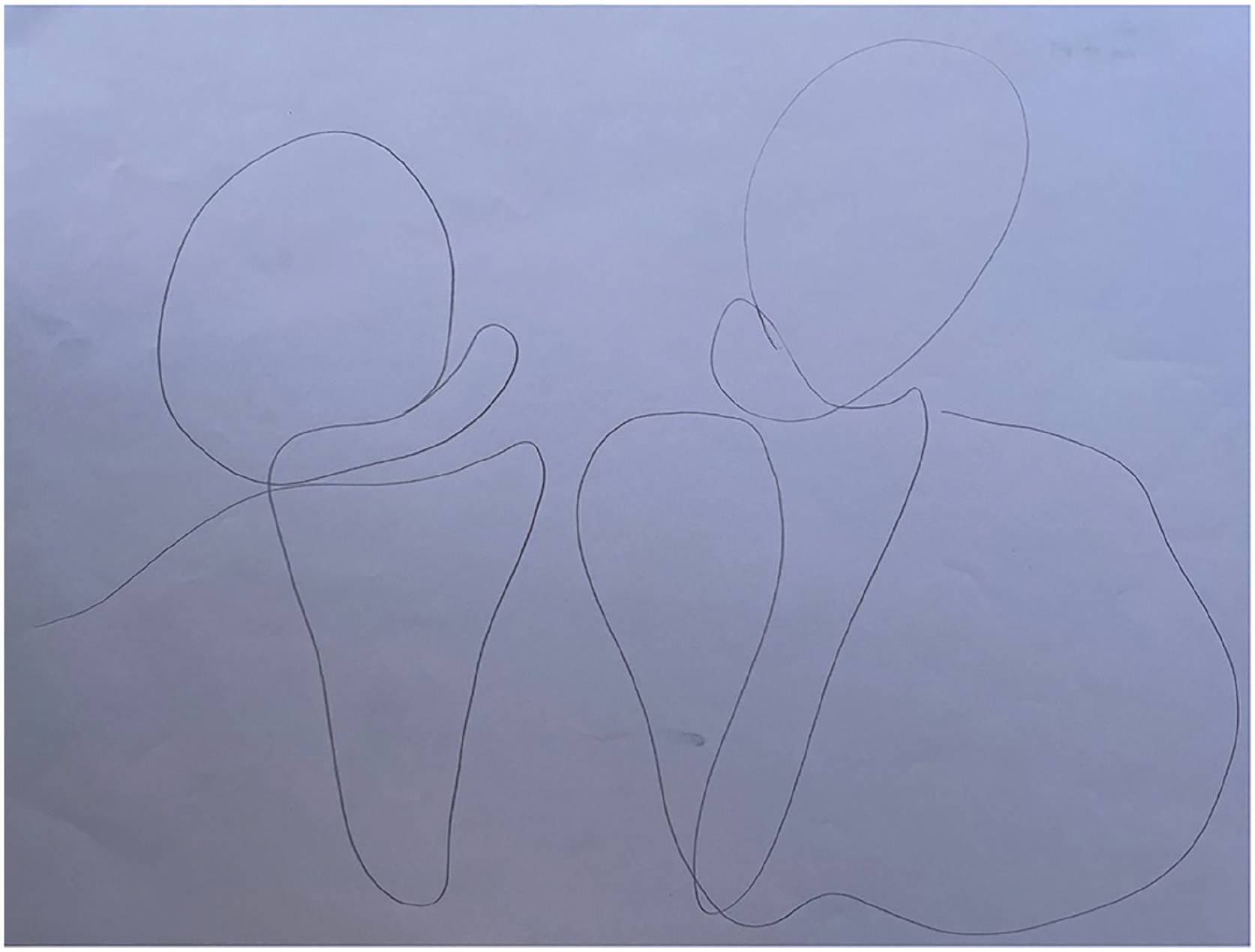
Quick Sketch of the Parents’ Mirroring Movement.
Thinking along with the idea proposed by Frers (2021), the framing of their Zoom picture pointed to the distance they considered acceptable or desirable between their bodies and the camera/screen on their computer. Sketching also awakened my eyes and prepared me for a mode of sensorial and cultural openness. Later, from the more knowing stance created by sketching processes (Croft, 2020), I conducted several sessions of seeing/drawing, building on the considerations raised by the quick sketches (Figure 5).
I make my hand follow my eyes. Slower now. My hand holds the charcoal and follows as I touch the mirroring movement with my eyeballs. I make marks on paper. I shepherd my eyes away from that paper. It is this mother now. It is this father now. Their shoulders are close, but do not touch. They lean toward their screen as they make this mirroring movement and fill their square on my screen. What shapes are the spaces in between?
Their smiles. I see-draw-see-draw-see their smiles. The shapes and tensions of their nostrils. There was no frown between their eyebrows. Light in their eyes. His eyes show little crow’s feet out to the sides when he smiles.
Holding their leaning, smiling their smiles, sparks tension in my stomach, my cheeks, and the tiny muscles and folds of skin around my eyes.
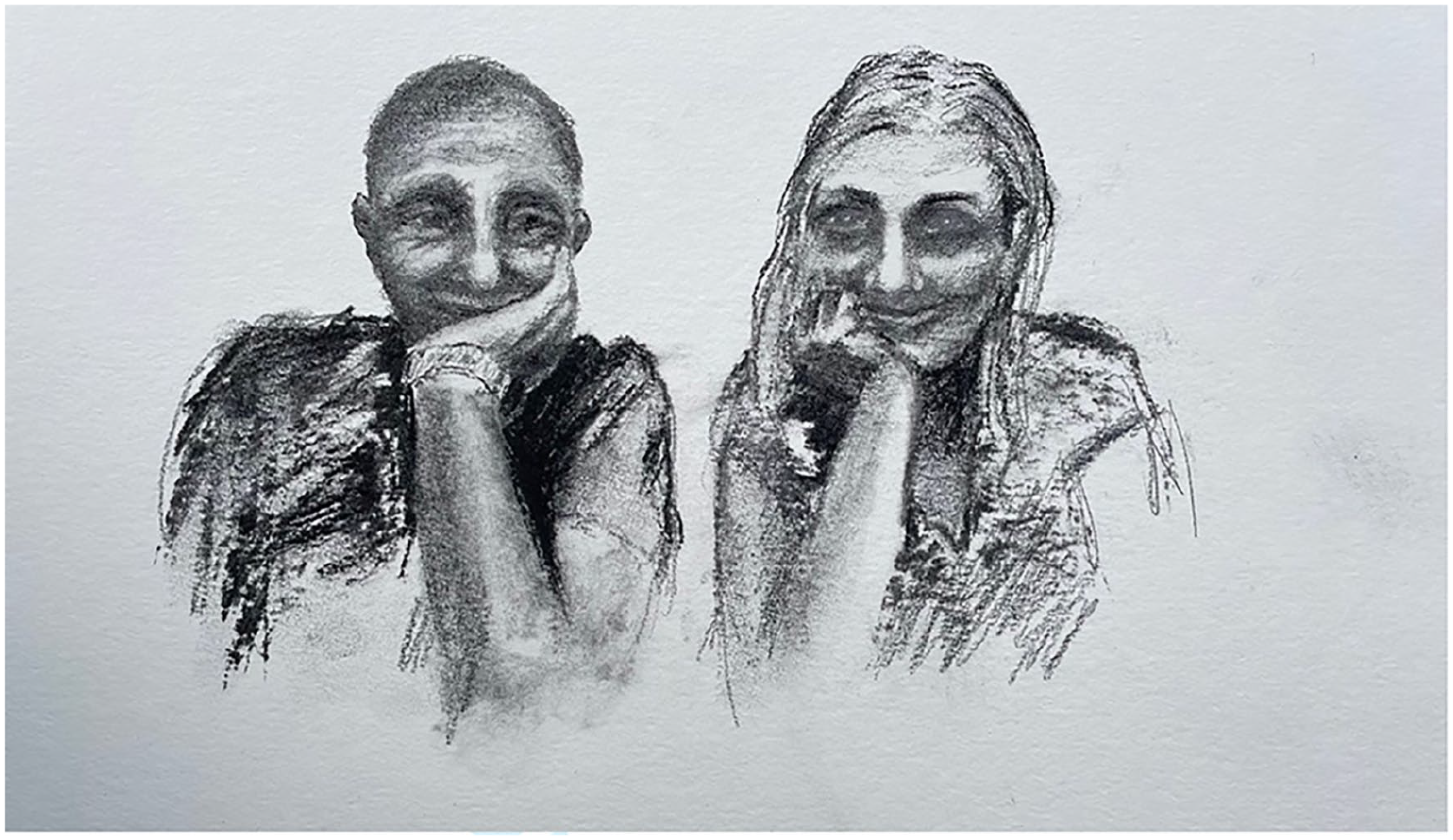
Drawing of the Parents’ Mirroring Movement.
The decision to explore drawing made room for a phase in the research process with the freedom from words afforded by communication through images (Desille & Nikielska-Sekula, 2021), but despite its wordlessness, drawing is not a quiet state for me. To me, seeing/drawing involves an ongoing battle, restraining myself from going too fast, and observing my own attention. While focusing my attention on the event I have chosen to study, I can feel my attention fixate on the subject and go into contemplation, as I gradually lose track of time. Then, without any warning, I find myself “gliding,” in which my attention has released itself from the caring labor of seeing/drawing. Thus, I shepherd it back.
Attuning to data through hours of seeing/drawing leaves corporal traces. This practice is more than asking a hand to echo what the eye “feels.” It is also the rest of the body echoing what the eyes and hands contemplate on as the subjects go on smiling their smiles, leaning their leaning, expressing (what I interpret to be) their joy. As Franck (1973) writes about resembling experiences: I have been told I smile when I draw a smiling face and frown while I draw a stern one. No wonder, for I become that face, often feel that I am looking at the man who draws through its eyes. (p. 92)
The less poetic, neuroscientific approach to describing this process is that being changed by what you witness is a consequence of “the action–perception loop,” a process wherein we experience an action and its sensory consequences (Hari & Kujala, 2009). This correspondence between individuals and our worlds is inevitable because the same brain mechanisms that support our own actions are activated when we see others move (Hari & Kujala, 2009). To receive sound, our auditory system has to be tuned to the same wavelength or approximate kHz as the sound or speech that is being produced (Hari & Kujala, 2009). To draw a face is to become that face to a certain degree. To draw a face is to tune one’s eye-heart-hand-brain-respiration reflex to its wavelength while being humble about balancing, using one’s own embodied mirrored experiences to understand others and knowing that it is never possible to know another, as Levinas (1991) has taught us.
Drawing, seeing, seeing, drawing, seeing/drawing hers and his smiling faces. She leans in first—he follows shortly thereafter. This mother’s and this father’s mirroring smiling movement toward the screen they share: I have seen this somewhere else. Haven’t I?
The question interferes, agitates, and disrupts, until the flowing mode of seeing/drawing expands like a balloon being blown up inside my skull. My eye-heart-hand-respiration-thinking is now large enough to hold the computer replaying their conversation. There it is. They are doing it again. She smiles and smiles and leans toward her camera—he follows like the next wave of breath. The mirroring movement pulsating: Heads resting in hands, smiles resting in smiles. What it must be like to live in a world where these two do these mirroring smiles when someone talks about you! “It’s just the best thing, to hear that they are happy,” your mother says. I have read about this somewhere. Haven’t I? The balloon expands. At its limit now? Remember to breathe.
There it is.
Seeing/drawing creates fertile ground for juxtaposition. Franck (1973) describes how, while drawing an old man sleeping, he notices the way his entire being is in constant motion, and that, as he notices this, the process awakens the memory of a similar moment of noticing movements as a constant. Knight (2022) accounts for resembling consequences of drawing, stating that “Ideas, theorisations, imaginings, continuously emerge as a drawing takes place.” As I observed the mirroring movement, seeing/drawing allowed me to notice it thoroughly enough to doubtfully remember that I had seen another variation of it before. The possibilities of rewinding, replaying, and re-observing lies within the affordances of video recordings. My seeing/drawing/remembering researcher-body listened as the mother said, “It’s just the best thing, to hear that they are happy.” Noticing this reminded me of something the kindergarten teacher said the first time the movement appeared: “I have written that: ‘How are things going?’ That things are good,” and I remembered reading about something similar to this before. Andenæs and her colleagues have conducted interview studies wherein parents of kindergarten children talk about how they use their contact with the staff to read signs of whether a child is cared well-enough for in kindergarten. Thinking with Andenæs and Haavind (2017, p. 1,500), parents’ presences and efforts in PTCs is one approach—among a series of presences and efforts—parents use to “keep the child’s state of mind in their own mind.” Hence, the child is absent/present. The point I am trying to make resembles the example provided by Frers (2013) about a swimmer and a lifeguard. Due to the fog, they are absent from each other’s views; however, they do not cease to exist to each other. According to Frers (2013), the swimmer is: . . . more than a memory, a mirage or a ghost. His life might be in danger, and his absence might prompt the lifeguard to cease being an observer. The lifeguard might have to dive into the waves, to attempt to retrieve the swimmer before he drowns in the waves of the North Sea, becoming absent for good. (p. 437)
Similarly, the child in PTCs is absent from one’s view, yet, as Andenæs and Haavind (2017) has shown, parents who share the duty of caring for their young child with kindergarten teachers are highly aware that “the child in kindergarten” might need her or his or their parents to act, that is, to adjust and coordinate efforts of care in different aspects of the child’s life. The absence/presence of the child in this conversation is not “the child” per se but parents’ ways of holding their child’s state of mind in their own bodies—an effort of care prepared to do another effort of care. Just like what Franck (1973) has pointed out when he writes about what he learns from drawing a rock, I learn nothing “about” parental care in general as I draw this microevent. However, the act of seeing/drawing allows the careness in parents’ presences and efforts in this microevent to be noticed, and I wake up to the wonder that there is care like this in the world at all.
Ways of Seeing Ways of Seeing Ways of Caring
Seeing/drawing is not a thing; it is an act. However, while a drawing is only what Franck (1973, p. 88) calls “a fossil of experience,” it is a fossil that “at any time can be resurrected by any eye that is sufficiently awake to follow the lines as process.” The finished drawings are secondary, but like Desille and Nikielska-Sekula (2021) note, the residues of visual methods can serve as useful testimonies of moments of the researcher’s seeing. It is possible to think of exposing researcher-made drawings as one way to strengthen the trustworthiness of research by adding to the transparency of its process. Such transparency is commonly referred to as a “quality criterium” (e.g., Tracy, 2010). In particular, including researcher-made drawings may serve as a way of opening the lid to the research engine. However, as Brice (2018, p. 143) stresses, what “is (re) produced is not an image of the ‘object,’ but an image of the process of an object being observed.” Hence, including residues from my seeing/drawing processes may catalyze more “ways of seeing ways of seeing ways of caring.”
However, drawings are much more than that. Drawings, marks, notes, and other things created by researchers as part of their research practices are also “distributed thinking through making,” as Vega (2021) argues. Distributed thinking by making accounts for “a synergistic process of knowledge creation in which thinking exhibits two main characteristics: (a) it is socially and materially constituted and (b) it is operationalized by bringing things forth into being” (Vega, 2021, p. 271). As forms of distributed thinking, drawings have potential beyond first-person practice-based insights. Drawings also make it possible to revisit situations (Jellema et al., 2022) for the researcher and for any eye that is sufficiently awake (Franck, 1973). This leads us back to Berger (1972/2008) thoughts regarding photos: When drawings are made public, the viewers’ perceptions of the drawings add to the process, because they also depend on their own ways of seeing. For that reason, drawings are not simply transmitting information but producing multiplicities of meaning as well.
The Double Vision of Drawing
In this article, I have shown how transcription as a language-centered research practice sometimes contributes to a continued ignoring of certain topics in video-based research. It is problematic if such methodological silencing adds to other forms of silencing or not thinking. In this particular project, I have dealt with that problem by temporarily muting the verbal and explore what might happen if the practice of drawing is mobilized to allow for video observations to become sensed and embodied engagements with audiovisual data. The practice of seeing/drawing has served as a way of making and maintaining the decision to pay attention to parents’ presences and efforts in the PTCs. Cultivating the art of paying attention through this practice invited me to notice more and to attune affectively, sensorially, and corporally as I observed the videos. In turn, the steadfastness of seeing/drawing created fertile ground for thinking, enabling ideas, memories, and theorizations to emerge. Seeing/drawing taught me nothing about care in general but practicing this enabled me to contemplate the way care was performed in a particular time and place. Consequently, the act of seeing/drawing awakened my attention to the wonder of parental care and the amazement that there is a kind of care like this in the world.
Through this experiment, practicing seeing/drawing has become a way for me to reorient, pay attention with care, and attune to presences and efforts that was methodologically silenced by transcription—a way to not not think. However, drawing also involves a double vision. There is drawing as an act, and there are residues of that act in the form of distributed thinking. I suggest that publishing researcher-made distributed thinking may also create possibilities for democratizing research, as they can serve as testimonies of a research process, and thus, may generate new ways of seeing with whomever sees them.
Footnotes
Declaration of Conflicting Interests
The author(s) declared no potential conflicts of interest with respect to the research, authorship, and/or publication of this article.
Funding
The author(s) received no financial support for the research, authorship, and/or publication of this article.
