




Abstract
In this encounter, I move in the middle of things, more specifically of other texts not my own for I did not bring them into being or strung them in their word order as you do. They are borrowed and yet they get and feel me. I attend to the doings of hope and not so much its what-ness or aboutness. I propose a hope inquiry that begins in the middle. Its inquiry does not ask what it really means or a getting into the bottom of things. There is no bottom, just the middle bits. Its question is an invitation to ponder and fold into at least three dance moves: (a) to attend to the not-yet-ness of things, places and possibilities; (b) to rest in presence, fully stuck in the here and now; and (c) to find returns, detours, and dead-ends with deep intent. Hope is an inward movement—a reconnection to one’s gut—our body-middle.
Introduction
Thank you for joining me in this virtual, out of time and space, gathering. This is an encounter with my own gut. The monologue or dialogue that may unfold here about an inquiry of hope begins in the middle. Its inquiry does not ask what it really means or a getting to the bottom of things. There is no bottom, just the middle bits. The “middle of things” has never been at the center or peak of things for me. Its always at the verge or the edge of the unknown or the untravelled. It is overwhelmingly full of “I don’t know’s.” The “middle” bits of this writing recall the lockdown months and social distancing that accompanied Covid-19. Over time, I found myself stuck during the Covid-19 lockdown months. I realized I am not disciplined at all. Going to work has been the only move I know to get things done and to keep going. Without it, that is, having to work from home, not by choice but by the material imposition of unseen viral moves, I am at a loss. Not physically of course, after all, I was at home and yet the home space unsettles and deprives my every day of simply coming home. I found myself stuck in the middle of things. I am lost in my mind. During the lockdown, the only thing I could keep going with were my feet—by walking. Walking for the sake of walking is a different move than when I walk to the shop or the school to pick up my grandson. This kind of walk and the many ones that followed took me inward—into my gut where I have learned eventually despite my impatience, a hope energy. From my head (intellect) to my feet and into my gut, I began, unbeknownst to me, a hope inquiry, which makes sense as “an affective potentiality in the present” (Coleman, 2017, p. 536). Its questions are more curious, open, and intimate to all senses—"Does it work? What new thoughts does it make possible to think? What new emotions does it make possible to feel? What new sensations and perceptions does it open in the body [in the gut]?” (Massumi, 1992, p. 8). Having read Coleman’s article (2017) on sensory sociology of the future which has placed hope as an affective, anticipatory project lend me to Jose Esteban Munoz (2009) in her citations on his book, Cruising Utopia. Hope as described by them has fully sensed and read how my gut has felt through my walking feet and seemingly stuck body during the lockdown months.
“First, hope is an anticipation or illumination: it is that spark or flicker that might take ‘us’ [me] somewhere else, that might indicate the possibility of another kind of world. Second, hope is therefore open or indeterminate. The adventure that it might take us on is not something that can necessarily be known in advance. Third, . . . potentiality is affective; it is intangible and yet felt” (Coleman, 2017 pp. 533-534, italics in original).
My writing about what hope has done before I read Coleman’ or Munoz’ works is this: “Hope is not here It’s always somewhere else It is not-yet It is coming”
And just like that there is a spark, a different possibility in these four lines. It connects me to queerness in Munoz’ (2009) work and futurity in Coleman’s (2017) work. Within the outlines of my own words, I anticipate and feel absent presence, distant places, the future, and an arrival. All of which are always on the move. Four lines that have walked me through an inquiry of intense and intimate potentialities. This inquiry begins “here,” where hope is seemingly absent because its making has deep silence and contemplation.
On one mundane day of going-to-work when lockdown restrictions had finally eased and going-home makes sense again. I walked out of the train station, a poster with #youwillbefound written across an image caught my eye. That hashtagged text had a force of promise and hope for me. I felt noticed, heard, and reassured. How interesting I thought because while on the train I was going through my friend’s (Caroline) poems she gave to me when I visited her in the previous summer. She had written a few and one of them was entitled “Lost.” I lingered in reading that particular one. Lost is a felt movement—of not knowing where to go, where one is currently positioned or emplaced, or where one has been or of moving aimlessly. It is never about the sensation and emotional toil of being lost in stillness or stuckedness. Aha! While, stuck here in the lockdown months, hope found me.
Is this my cabin Or a desert of scrubland? Have I sunk in a creek or skated on holes? Did I shiver with stars Or hide from the sun? Are these my people Or ships in the night? Is this my name Or am I another? This low light blinds. (by Caroline Bath)
Lost is an absence from a place, in this case, inside my head, but thinking with my feet has gifted me with a body-awakening wherein the stuckedness has compelled me inward. To lose oneself is an absence, would you not say? To keep on moving while stuck requires an inward movement—a reconnection to one’s gut. This is what being stuck during lockdown has taught me—The way out is in. These are words from Zen master, Thich Nhat Hahn, to whom I have turned to time and again to remind myself to breathe mindfully.
With the felt state of being stuck, hope is the compulsion, the natural orientation of the body to move. Surprisingly, stuckedness has allowed me to cut and break out of the academic and institutionalized mold as a way to “keep me together.” This “cutting together” is one of the important middle bits that I would like to try to put into words, not as a whole, never a whole, just fragments. Lockdown has given me the vitality to move within myself—to cut with intent and break out of the institutionalized, academic “me” and return to connect with the creative energy of myself—a hopeful me. This article is an exhalation and a release of how the moves I was needing without knowing were inward. From the gut. In the middle, hope found me while I was stuck.
In this inquiry of hope, I welcome Henry Giroux’s (1988) invitation to give authority to experience, to my experience, and how my body remembers, feels, and thinks with my feet. To make present those parts of my being—memories, family members, friends, feelings, languages, and cultures that have been exiled through received epistemologies, narratives, methodologies, and practices. I also proceed with “thinking without method,” an invitation from Alecia Youngblood Jackson (2017) who said “[t]he starting place for thinking without method is always in the middle of the unexpected, in the violence of an encounter that cannot be predicted” (p. 671). My starting place is “forced immobility” during lockdown—a stuckness in the spatial and social limitations this has imposed upon me.
If hope inquiry has a methodology, it would be Karen Barad’s (2007) diffraction, a process of ongoing different possibles and alter views of world-making and immersing oneself in the world-in-formation, separate from it but in-form with it. Here a non-representationalist and diffractive approach offers to connect with a difference, to connect differently, and to make different connections. Its invitation is to cut together/apart with tenderness, not to be hard-wired and tied-down with functional fixities and the tried and tested.
Stuckedness
While in this state of stuckedness, my academic habit or intellectual tendency or addiction was to proceed with a political or critical inquiry of stuckedness. I have engaged with the work of Ghassan Hage (2009) who conceptualized stuckedness and I was ready to get involved with how waiting also shapes inequalities and its temporal and spatial dimensions create borders in people’s lives. I was ready to unpack its constitution in relation to Covid-19 vaccine rollouts, the end of lockdown and travel restrictions, test results, not-waiting for new variants, and the irony of how distance education finally made headway not in terms of mobile learning but “lockdown learning.” But my gut says “No.” Hage had something to say that my body did tune in to. There was a different possibility that requires I attend differently, intimately, more pathically, and with feelings. I re-read Hage’s work again. I did a lot of walking and perhaps I started to make sense with my feet, I began to read Hage’s work differently. I was no longer so caught up on “waiting out the crisis” like the pandemic. I engaged more sensibly, feelingly than critically. To move is to be well. That makes total sense, so I felt. Hage’s (2009) paper spoke about the serious entanglement of well-being and movement. He elaborates by pointing out that “Keef el haal?” in Lebanese which literally means: “how is the state of your being?” is received by a common reply of “Mehsheh ‘l haal” which literally means: “the state of my being is walking.” Hage refers to this as an existential mobility, different and deeper in intent than the physical mobility of migration or tourism. In short, our sense of being is a felt movement. Now, I like the hope this offers.
Stuckedness was my line of flight in the sense Deleuze and Guattari (1988) spoke about a different kind of inquiry—a felt inquiry of hope. Before I invite you to consider the three moves of hope inquiry. I would like to, first of all, make a case of/for hope. Not so much what it is, although I would bring into the conversation its aboutness from the voices and works of other scholars who had a better sense of hope before I did, but what it does or how it moves.
I was stuck in my own mind. “If, on the other hand, we think of knowledge (or knowing) not as determined by our engagement with the present, but as emerging from our engagement with the present, then the problem goes away” (Osberg & Biesta, 2007, p. 43). There is no need to feel or be stuck in a negative space but as a possible space of the not-yet.
If knowledge/knowing has an emergent (rather than a deterministic) relationship with the world, then we must bear in mind that although what we can know is constrained or conditioned by the present that we engage with, each knowledge event—which is to say each taking place of knowledge (knowing)—is necessarily also radically new (ibid).
Vital Moves
Hope is a critical part of our sociological imagination, spiritual reckoning, and well-being. It is the compulsion, natural orientation of the body to move. This article attempts to come closely, curiously, tentatively, courageously, hesitantly, and make three “dance” moves—(a) a movement outside inwardly through, with and along with my body; (b) to be present, leaning toward the unthought, not-yet underneath of ‘common sense’—that is the less obvious, familiar solidarity of all our senses that cut us together; and (c) to find my way through re-turns.
And of course, the three moves that I intentionally prefixed with “dance” is a way to invoke the body and its vitalism. More specifically, my own body and my love of dancing. There is rhythm and flow in dancing that channels and charges the present with creative energy and force. This is the hope that I viscerally sense through my body. There is an open-endedness in dancing. Vitalism is a life energy and is committed to the belief that an organism is greater than the sum of its parts in spatiotemporal difference/deterritorialization. This is clearly captured and deeply felt with the Covid-19 virus and with those who tested positive or died because of it. Elizabeth Grosz in her article written in 1998 as if by prophecy and future-gazing has spoken of the coronavirus we have lived through: What is the status, for example of those strings of RNA which lie half-way between the organic and the inorganic, which we call viruses? Are viruses self-reproducing organisms or are they more biochemical programs? Does it literally matter whether they are enacted in carbon or silicon-based form? A virus has been regarded as a self-replicating, evolving organism, whether it is carbon or silicon-based, whether its content is chemical or informational (p. 45).
This vitalism as Grosz would put it is bound up with a particular mode or organization of matter, that becomes, that expands itself as it is impelled to the future. Vitalism, therefore, is energy of connection and difference. This energy revitalizes the (my) body, and its moves have articulated unfelt and forgotten memories that define the textures and energy of our (my) (un)becomings, later on described with an encounter with my dead father.
Not-Yet-Ness: Making a Case of/for Hope
A borrowed meaning of hope that speaks to how I feel and imagine hope and the state of hopefulness are taken from the written words of Gabriel Marcel in Homo Viator: Introduction to a Metaphysics of Hope published in 1951: Hope is only possible on the level of the us, or we might say of the agape, and that it does not exist on the level of the solitary ego, self-hypnotised and concentrating exclusively on individual aims (p. 10 cited in Jacobs, 2005, p. 754, italics in the original).
In short, hope is a collective idea, a call to love (agape). It is decidedly not individualistic. It requires a relationship of presence and communion—"the ability to imagine other that than what is” (Standish, 2019, p. 486) or what Stuart Kauffman’s (2002) calls an “adjacent possible.” Put differently or more intimately, it is the sense-ability or vitality that there are different possibles in the not-yet-ness of things. Hope nudges to contemplate how connections are made and how immanence (inward movement) rather than transcendence (outward/upward movement) can open up an inquiry in a way that brings the unthought into thought and how what is “not yet” might revitalize or reinvigorate the positive and creative. It is the “not-yet-ness” of the unthought and a strong sense of its possibility that invokes hope. It is as I have encountered in stuckedness is presence in the rhythm of the body pulsating in between its infinite impossibilities of being entirely ungraspable. I stretch the offering of the adjacent possible and its suggestions and venture into a ‘hope inquiry” that (a) attend to the not-yet-ness of things, places, and possibilities; (b) rest in presence, fully stuck in the here and now; and (c) find returns, detours, dead-ends with deep intent. Hope is an inward movement—a reconnection to one’s gut—our body-middle. All of which are easily sensed, felt, and lived as the doings of hope than my own hope-doings. The line of suggestion then (I hope) traverses between the not-yet and the yet-to-come; between anticipation and creation in presence/immanence; and between thought and the unthought. As far as hope goes, it has many “what-is”s and multiple I’s.
The nature of hope (i.e., its what-ness) has been construed in various ways: . . . an emotion, a cognitive process, an existential stance, a state of being, a disposition, a state of mind, an emotion which resembles a state of mind, an instinct, impulse or intuition, a subliminal ‘sense,’ a formed habit, a ‘sociohormone,’ some complex, multifaceted affective-cognitive-behavioural phenomenon, or, quite simply, a mystery (Webb, 2007, p. 67).
Its orientation can either be goal-directed or open-ended. Sometimes we hope for something quite concrete, a particular change or outcome in the future or we hope quite simply (Webb, 2007). The experience of an open-ended hope orients the body toward the not-yet-ness of being; toward a relationship of presence and beyond being on the “surface” of landscapes, soundscapes, but being in the atmosphere (Ingold, 2011).
In the middle of body-walks, distanced encounters with masked faces and wringing hands covered with sanitisers, hope is in the now and the not-yet, and this hope-space provides the energy to imagine what-else or what-ifs. This gut feeling led me to Stuart Kauffman and his notion of the “adjacent possible” and to Derrick de Kerckhove’s (2014) “point of being” (PoB). Before I tell you about “adjacent possible,” PoB and the lines of inquiry they help me traverse or press upon my feet, I have to acknowledge the what-else that did not sit well with me.
As I write this piece into being and find bits to include in creating something I have not really fully thought through. There are so much not-yets in this writing. In the middle, I did not sense or touch hope based on Snyder’s (2002) hope theory. I found no connection with its model somehow; maybe some other time, maybe not-yet, not-now.
I did not intend to measure the impact of change that brings hope. I just want to connect and feel the difference—to go with my gut. I did not want to think with what has been thought about, represented in scales or questionnaires. This did/does not interest me, invite me or intrigue me. I did not want the exactitude of things that matter (t)here. Instead, I wanted (still do) to dwell within the unknown, alternative state, felt and sensed not-yet thought about, spoken of, and have yet to matter/become somehow. So, I do not connect with hope theory or CR Snyder and all the connections Snyder and his theory would have given me. I remain open to its invitation. Having said this, reading about hope in academic literature and to encounter the notion of “hope studies” has made me aware of things I did not think about before. For example, it is worthwhile to have learned that hope has been appropriated or transformed through time and historical events and our relationship with it or its place with/in us has move from false illusions and wishful thinking in ancient times, to a spiritual virtual or divine gift in Judeo-Christian thought through to a secularized construct from the spiritual to the scientific or the psychological in the 20th century (Miceli & Castelfranchi, 2010). In all its moves, hope orients one’s spirit or mind to the possible. It happens with anticipation. Its invitation or inquiry is more than epistemological negotiations and analytical calculations. It starts with the body, a questioning from the gut.
‘There is anticipation here’ (Brassett 2021, p. 155). Anticipation creates a situation that pulls potential into being–an opening for the anticipator (hoping that this would be me) to actualize unrealized self-potential (Brassett, 2021). This creative ontology of the adjacent possible is hopeful here. The possible connections are its analytical units and its processes map the serendipitous encounters and provide ‘an anticipatory account of a lovely, lively … present [emerging] future’ (ibid., p. 163), full of anticipation.
Hope is Presence
I feel stuck because I was stuck in my ways and have a limited understanding of the emergent relationship I have with the world and how knowing is attended to by the world. I am stuck because the habits of my mind are too deterministic. The deterministic tendencies of expectations of “normality” even what we call “new normal” has already been predetermined by the knot of knowledge that is only possible by engaging with the world through repeats and replays of what we (I) already know. The real issue is to change perspective and not just how perspective is framed or theorized. The invitation and offering of hope is “living presence”—that is to “see more, hear more and feel more” echoing de Kerckhove’s (1995) reference to Karl-Heinz Stockhausen’s artist statement about the need to shift from perspective (point of view) to the proprioceptive (point of being). From the perspectivist frame, scientists are unable to see the future because things are hardly capable of assessing the present. This is the source of my stuckedness. “Lost in conceptual spinnings, interlocking theories and stupefying by simplistic experiments, most professional scientists are clearly void of any but the crudest perceptions” (de Kerckhove, 1995, p. 85). Hence, Stockhausen recommends that we let our senses teach us to become new people, better adjusted to the real dimensions of humankind extended beyond the reach of our “common sense” and primacy of sight or vision which has disconnected our touching-skin and body-image from what Tim Ingold (2011) calls the weather-world.
We perceive the world as a space to traverse and yet to walk with our feet according to an Algonquin guide, space is . . . something within rather than outside the body, a fluid and ever-changing medium in which one could never lose one’s way, where the only fixed point in the universe consisted of himself, and within which, although he might be putting one foot in front of the other, he never actually moved (de Kerckhove, 1995, p. 35).
This is the lesson of my own feet-touching-ground, finally, a felt movement of my body rhythmically tuned in with the cracked pavement, loose gravel, muddy footpaths, and naked hills. Instead of walking in a spatiotemporal sense, a self-presence is pathetically felt and not just cognitively processed. The present beyond sequential time is emergent than linearly fixed. I, the knower, is also emergent in how I relate to the world and how the world grounds me “here” in the now—the present moment. “. . . [T]hough it follows from what has come before, it does not follow on logically from what has come before. . . . [It] contains an addition—a supplement—which was not present in what came before.” (ibid, p. 44). To see more is to perceive the world in a total surround; to hear more is to know to find the sound behind the sound, in silence; to feel more is to sense with our touch and skin. Instead of experiencing being-in the weather-world—a see-in, hear-in, and feel-in atmosphere—we behold the world from the outside as spectators of images projected on the surface of the retina. Presence in this point of view is reduced to an ocular-centric metaphor or frontal ontology—that is, vision is frontal, fixated, and focused based on an “assertoric gaze” that is narrow, dogmatic intolerant, rigid fixed inflexible exclusionary, and unmoved. While the point of being in a full surround, a mode of vision that is based on ‘. . . “aletheic gaze” that sees from a multiplicity of standpoints and perspectives, and is multiple, pluralistic, democratic, contextual, inclusionary, horizontal and caring (Levin, 1988, p. 60 cited in de Kerckhove, 2014, p. 27). We need to develop a new flexibility to our eyes and to perceive the world not exclusively in a frontal relationship.
My own point of view has marginalized me and my own writing/research/scholarship has made my presence absent. My sense experience has no place in my teaching, institution, or research. I have to show hospitality and make present those parts of my being that have been exiled through particular epistemologies. The body must be remembered. Instead of a point of view, I move to a point of being, and hope is the interval between the two. The point of being renaturalizes our approaches by committing ourselves to the many grounds and stories that compose us. “For to be alive is to undergo a history of constitutive affections and transformations in response to encounters with other earth-beings, human and non-human" (Sharp, 2011, p. 8 cited in Jackson, 2018, p. 637). Point of being is hope-in, not hope for. It is a call to communion and to love. In my stuck state, hope invites quiet and is quieting. Silence becomes an auditory epistemology where we (I) finally encounter and meet ourselves (myself). If our ways of knowing and methods of inquiry do listen intently, closely and quietly, what would they hear? What kind of data can we create if interviews become inter-aurals? Gordon Hampton said in another podcast I listened to that “silence is an endangered species.” Most of my walks during lockdowns took place in silence. Walking instead of talking creates an incredible presence in one’s body and senses. In silence, we (I) learn to care for the (my)self with mundane objects with a scarf, a cup of coffee, and with mundane tasks (at least for me) cooking, ironing, or not-ironing, making and unmaking the bed, and so on. I could only imagine the aural portrait Coleman (2017) described, the aural portrait produced in Karikis’s Children of Unquiet project. To hear-in in silence is a communion with all sounds.
Hope Returns
It is worth recognizing the patterns and folds of the magnitude of our being—when becoming lost or when we simply keep going on and on. What do we take with us? What do we leave? What could we not let go? And all those questions that are not enough, either here or there, just sort of in the middle of things. Here I return and recall Mika Yoshimoto (2011) and her memory of her mother’s death who died of cancer 1 month before her 50th birthday. I rewrite with remembrance—“[o]n her death bed, she wrote a single word to me, 感謝 (kansha—gratitude) (p85). Years later, she wrote a haiku about her experience—a memory really of dying, writing, loving, missing, birthdays, getting older and many other things: 指震え 感謝の文字に 母すごし With trembling fingers She penned a sign—gratitude And drifted away (p. 85)
Mika further wrote that when she reached age 50, her mother’s message of kansha became her motivation to change her life. She moved to Canada. “Until that time, I had not given much thought to how her life, in the way that she had lived and ended it, had affected me. Lev Grossman (2007), in an article in Time magazine, writes that “the mind is a strange, self-referential loop—it’s a mirage” (p. 50). My mother’s death was not an ending; it was the beginning of my second life. Looking back on it now, I can see how this key event in my life is closely related to my research, and to the Zen concepts of impermanence and contradiction—mortality is my vitality” (p. 85).
In August 2017, I was in Fredericksburg, Virginia at the Digital Pedagogy Lab 2017 Summer Institute. I was in a network session and one of our facilitators is Professor Kate Bowles. I was paired with someone named George to share with each other who we brought into the “room” at that moment who understand what we value. I could not think of anyone. Well, anyone alive. The person who came to mind was my father. He died in 2003 just before Christmas. I was in Aberdeen in the first year of my PhD study. That was 14 years go and nearly two decades now. I wrote to Kate about that experience (see Figure 1). Please read:
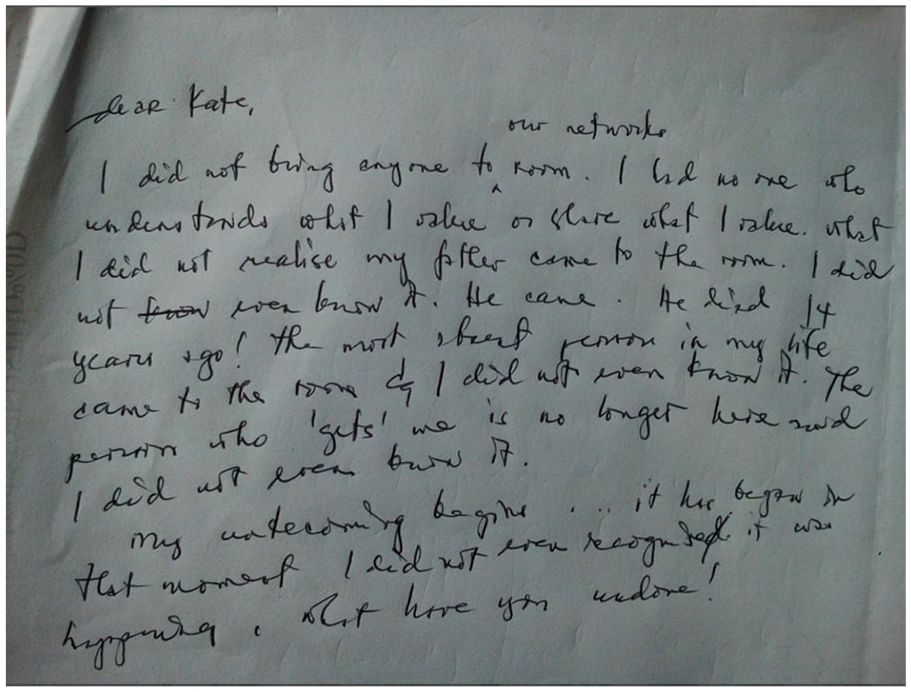
A letter to Kate.
[dear Kate,
I did not bring anyone to our network room. I had no one who understood what I value or share what I value. What I did not realise my father came to the room. I did not even know it. He came. He died 14 years ago! The most absent person in my life came to the room and I did not even know it. The person who “gets” me is no longer here and I did not even know it.
My unbecoming begins. . . it has began in that moment. I did not recognise it was happening. What have you undone!]
Returning to my father who showed up in the most unexpected place or event was deeply moving. There was nothing about Fredericksburg or the United States that would remind me of him. No scent, sound, or memento that would remind me of him. No one in the room resembles him. And yet, there he was. It was an intimate moment. It was not a memory of loss or a feeling of grief that came upon me at that time. I was pleasantly surprised and at the same time utterly puzzled. Like Mika who has carried her mother, I have done the same with my father. I am here as a living memorial in a way that is intimately entangled and infinitely attached to our father–daughter relation. Our sociomaterial relations are filled with affective processes and yet these are edited out of discussions of knowledge making (Latimer & Lopez Gomez, 2019). Drawing from Science Technology Studies (STS) scholarship which have influenced and framed my early publications on body, technology and our engagements and entanglements, I realize how various accounts of heterogenous relations do not really pay attention to the embodied, affective, and spirited dimensions of doing science and research inquiries. The received and accepted mode and modality of academic work does not recognize the emotional labor that comes with it. It is unaffected and unfeeling. It excludes a huge chunk of my sense-being. World-makings are full of feelings, people who live in us, and “. . . with moments of ‘being moved” and “moving” (p. 252). They are affective and embodied processes that connect to sociomaterial practices differently and intimately.
Hope inquiry demands alternative social imaginaries of seeing, saying, and sensing. Death is cut together with vitalism and I attend to what its presence entails. I have written about being absent presence in a book chapter (Enriquez, 2012), and yet nothing that connects me to my father, my history, memory, and being—not to my point of being, just my point of view. In that chapter, I spoke about the “bodily issues” that have been left to the natural sciences while the social sciences concentrated on cultural and social matters. I argued for a corporeal turn that extends the interest and preoccupation in the embodied nature of human experience in the repeated production and consumption of techno-rationalities and cyber-literacies to body care in terms of what used to be known as oxymorons: absent presence, public privacy, and isolated connectivity. The absent presence I spoke about then was seeing a presence despite the absence of nonlocated bodies that are able to interact at a distance. My father’s presence in Fredericksburg was a feeling of presence fully aware that he has been absent for years. I understood virtuality in terms of the digital or technological and yet Varela posits a different possible of virtual self at the cellular level of our being—as an autopoietic system. The loops of particular molecular interactions create a surface interface for the self that emerges as identifiable in contact and interaction with others, both living and nonliving. And yet, this self is virtual in its completely delocalized existence or presence. The self is always emergent and manifests in relations.
In my body, I carry the life energy of my dead father. Returning to the works of Francisco Varela and Humberto Maturana, Chilean cell biologists and philosophers (also both dead), the invitation to be bodily aware relies on the co-constructed and relational institutions of our beings. “Autopoiesis suggests an alternative mode of seeing and knowing no longer separated from being, the observer now entangled in the world observed” (Hantel, 2018, p. 68). Life and death are cut together in my body as I carry other lives, dead or alive, in me. In silent presence, I found this alterity—an opening up to sense-being, a re-turn to one’s gut.
I cut deeper. There is more to uncover and recognize here. The words of Clyde Woods (2002) were haunting. My mind would not let them go. Their truth I could not deny so I re-turn to them: Have we become academic coroners? Have the tools of theory, method, instruction, and social responsibility become so rusted that they can only be used for autopsies? (p. 63).
There is a reality of life and death, which affects us directly and is on a different level from the abstractions, mechanisations and rationalisations of the surface reality we attune our thinking. We have to abandon the enormous deadweight of the materialism of the Western tradition, and turn to a more planetary way of thinking. (Brockman, 1995 online - https://www.edge.org/3rd_culture/varela/varela_p4.html). The obstacle to be surmounted in this process is nothing less than the cognitive homeostasis of each of us, the tendency to stick with our interpretation of reality, entrenched and made stable by emotions and body patterns. To work through the veil of attachments, and to see (experience) reality without them is part of the process of unfoldment. (Varela, 1976, p. 67 cited in Hantel, 2018, p. 69).
“Hello”
In this article, I have traversed a sensory inquiry from being stuck to becoming unacademized or institutionalized with the help of the felt movement of walking and going on with my feet. This hope inquiry started a decade ago in my case. Interdisciplinary texts and scholars have spoilt me for choice. I have led the life of an academic according to what is most cited, recited and repeated across disciplinary boundaries. I have too many “stand-ins.” This article as it turns out is my unbecoming academized, a standing up to feeling lost, becoming stuck, and returning to my gut. The suspension of normal brought about by Covid-19 lockdown and restrictions has given me the opportunity to “stand up,” think with my feet, and traverse the edges of inquiry beyond perspective and orient my body with hope to approach what’s below the postqualitative, the posthumanist and to embrace hope as the language of possibility. Stuckedness is “hanging in” to learn and return to the habit of being, of listening, and of saying hello to all beings. The Irish poet and peacemaker Padraig O Tuama holds hope in all its possibles—spiritually, socially, pathically, and psychologically—with mundane objects, in the quiet:
Neither I nor the poets I love have found the keys to the kingdom of prayer and we cannot force God to stumble over us where we sit. But I know that it's a good idea to sit anyway. So every morning, I kneel, waiting, making friends with the habit of listening, hoping that I'm being listened to. There, I greet God in my own disorder. I say hello to my chaos, my unmade decisions, my unmade bed, my desire and my trouble. I say hello to distraction and privilege, I greet the day and I greet my beloved and bewildering Jesus. I recognise and greet my burdens, my luck, my controlled and uncontrollable story. I greet my untold stories, my unfolding story, my unloved body, my own body. I greet the things I think will happen and I say hello to everything I do not know about the day. I greet my own small world and I hope that I can meet the bigger world that day. I greet my story and hope that I can forget my story during the day, and hope that I can hear some stories, and greet some surprising stories during the long day ahead. I greet God, and I greet the God who is more God than the God I greet.
Hello to you all, I say, as the sun rises above
the chimneys of North Belfast [or where ever you touch the earth under your feet].
Hello.
Hello, I repeat with hope. Have a nice walk.
Lost Stand still. The trees ahead and bushes beside you Are not lost. Wherever you are is called Here, And you must treat it as a powerful stranger, Must ask permission to know it and be known. The forest breathes. Listen. It answers, I have made this place around you. If you leave it, you may come back again, saying Here. No two trees are the same to Raven. No two branches are the same to Wren. If what a tree or a bush does is lost on you, You are surely lost. Stand still. The forest knows Where you are. You must let it find you. (David Wagoner, 1999)
#youwillbefound
Footnotes
Correction (October 2024):
Article updated online to place the citations properly in the last paragraph on page 809.
Declaration of Conflicting Interests
The author declared no potential conflicts of interest with respect to the research, authorship, and/or publication of this article.
Funding
The author received no financial support for the research, authorship, and/or publication of this article.
