




Abstract
Conventional research ethics focus on avoidance of harm to individual participants through measures to ensure informed consent. In long-term ethnographic research projects involving multiple actors, however, a wider concept of harm is needed. We apply the criminological concept of social harm, which focuses on harm produced through and affecting wider social relations, to a research project that we undertook in Malawi. Through this, we show how structural economic inequalities shape the consequences of research for the differently positioned parties involved. Specifically, we focus on dilemmas around transferring resources within three social fields: our relations with a Malawian ethics committee; our interventions in a rural community; and our efforts to engage the policy community. Each of these involved multiple and differently placed individuals within broader, multi-scalar structural relations and reveals the inadequacies of conventional codes of ethics.
In this article, we reflect on the ethical challenges we confronted when conducting research in Malawi. Between 2015 and 2019, we engaged as a multinational team in several phases of ethnographic and participatory research with members of a rural community that most of us had worked with a decade earlier. The research contributed to a project that explored the impacts of social cash transfers 1 on relations of age, gender and generation within rural communities in Malawi and Lesotho.
Research on development interventions like cash transfers is positioned in relation to the economic inequalities that exist globally. But these economic inequalities also shape the context and social relations of the research process itself in ways that institutional ethics codes fail to adequately address, and as a consequence of which they may even cause harm. There are profound inequalities between the lives and access to resources of Western academics and people in impoverished rural communities, an area of tension that has been widely explored (e.g., Sikes, 2013; Walsh et al., 2016). However, research relations, particularly in larger projects, are not restricted to a binary distinction between Western academics and poor participants, but involve a range of differently positioned actors. Economic inequalities exist at all levels within the varied contexts and relations of a research project and require an ethical response.
Our starting point is the instruction we were given by a Malawian ethical review committee not to provide any form of compensation to rural people for participation in our research—a requirement they justified on the basis of the “universal” bioethical principle of informed consent. Many scholars have critiqued the notion of universal ethical principles, demonstrating how they embed Western thought and arguing for research in non-Western contexts to be informed by a situated and relational approach to ethics (e.g., Cannella & Lincoln, 2011; Tikly & Bond, 2013). Yet our largely European team of researchers were under strict instruction from a Malawian ethics committee that comprised mainly African academics to apply these pervasive principles.
The instruction not to provide compensation is rooted in a very narrow conception of ethics, focused on the capacity of individuals to make informed decisions about participation. Research in a postcolonial 2 context involves much more wide-ranging (and multi-scalar) relationships than simply those between researcher and participant. Structural inequalities and racialized expectations shape experiences of research, and research has ramifications far beyond the individual participants that need to be considered from an ethical perspective (Benatar, 2002).
In exploring the conduct of ethical research in situations of economic inequality, we make use of the critical criminological concept of “social harm.” Writing about criminology, but we would argue equally relevant to research ethics, Pemberton (2015, p. 3) observes “liberal discourses tend to restrict the focus of harms to the individual, which neglects the socially situated nature of agents, abstracting them from the relationships they are located in and through which they are constituted.” To remedy this, Pemberton and others have advanced a notion of social harm that focuses on harms beyond the individual, contextualized in a range of social relations.
We put forward three related arguments. First, we argue that the concept of social harm is helpful in moving beyond a neoliberal individualistic conception of ethics preoccupied with individual consent and agency. Second, the lens of social harm draws attention to the multiple cross-cutting relational fields in which global South research happens that are characterized by economic inequalities and cultural meanings and through which harm may be produced. And third, we argue that ethical judgments inevitably have affective and intersubjective components which are shaped by highly unequal economic circumstances: they are partly based on emotional responses within these highly unequal social fields.
We begin by introducing the concept of social harm and relating it to ongoing arguments for situated and relational ethics that take account of postcolonial power relations. We then provide some brief details of our project before considering three broad fields in which economic inequalities shaped our capacity to proceed ethically.
Ethics as Harm Avoidance
Research ethics are defined by Sieber (1993, p. 14) as the “application of a system of moral principles to prevent harming or wronging others, to promote the good, to be respectful, and to be fair.” The primary focus on harm avoidance is characteristic of most Western codes of research ethics (Hammett et al., 2022). Yet the understanding of harm tends to be a narrow one, focusing on immediate and identifiable potential harms to the individual research participant. Participation in research must be preceded by informed consent, which assumes the individual participant has agency, can be fully informed of any harm that might occur and has the capacity for choice. The opportunity to exercise informed choice is the paramount consideration and is understood to protect individuals from harm. Clearly this raises difficulties in relation to ethnographic and participatory research, where the outcomes are seldom foreseeable. In contrast to positivist approaches, inductive methods are open to all manner of possible findings. It is also noteworthy that the methods and topics of most such research are unlikely to cause predictable sorts of harm to individual participants.
Research ethics can learn from criminology about the foundational concept of harm. Harm replaced morality as the key principle driving the development of law in mid-19th century Europe (Gibney & Wyatt, 2020). In recent decades, however, many criminologists have begun to look at harm in a different way. Websdale (1994), for instance, questioned why the Oregon police were so much more attentive to individual criminal acts (particularly those committed by poor people) than to social harms such as occupational hazards and disease that were caused by the rise of lumber capitalism. Organizers of a 1999 conference coined the term “zemiology” for the study of social harm, which was elaborated by Hillyard et al (2004). Critical criminology today is less concerned with crime and criminal justice than with forms of structural violence, social harm and social justice (Beiras, 2016; Copson, 2021). For instance, Raymen and Smith (2019) explore the social harm caused by the environmental effects of commodified leisure and Short and Szolucha (2019) consider the “collective trauma” done to communities by energy extraction. Similarly, Simončič (2021) has focused on harms caused by fast fashion through inadequate protection of workers’ health and safety. Others (e.g., Canning & Tombs, 2021) have focused on the ways in which conventional criminologies serve to regulate particular groups, bolstering ideologies of control because the minor reforms they offer have expanded and strengthened states and corporations. In essence, social harm moves attention from the individual (who may not feel they personally experience harm) to the broader community that may experience harm now and in the future.
Despite the concern of research ethics with harm prevention, remarkably few scholars have used the lens of social harm to illuminate this field. Sookan et al (2020) examined social harms produced through HIV research, identifying how participation in trials can have adverse consequences for participants’ social relationships, for instance, causing increased stigma, marginalization, and discrimination to individuals known to be participating. While these harms are important and largely neglected in biomedical research, they are nonetheless individual impacts and not the more wide-ranging types of social harm that critical criminology draws our attention to.
We propose that social harm is a useful lens for highlighting how research has impacts beyond the participants themselves, disrupting social and economic relations at multiple scales. And as in criminology, we suggest that efforts to control (potential) perpetrators of harm (i.e., researchers) can have insidious outcomes. Restrictions imposed on individual research teams fail to address wider structural problems and may, as we indicate, exacerbate harms. We suggest a need to shift the discourse from a focus on individualized responsibility and individualized impacts to the ways in which research (as an institution) intervenes in social relations and may cause harm. There is thus a need to understand the social relations that frame the research and to consider how the research has impacts within these, beyond the individual.
Situated and Relational Ethics in Postcolonial Contexts
Critical writing on research ethics has drawn attention to the significance of context through calls for “situated” and “relational” ethics. These approaches may illuminate how research can cause social harms within particular structural circumstances, emphasizing in particular how supposedly “universal” ethics undermine local ways of knowing and facilitate forms of exploitation. Decolonial methodologies are advocated that are attentive to the ways in which research relations are racialized. Yet while these approaches are helpful in pointing to social harms produced through research in postcolonial contexts, relatively little attention has been paid to the effects on research ethics of economic inequality, albeit Perez (2019, p. 148) notes the importance of a contextualized approach to ethics “where there is extreme inequality between researchers and their research participants.” In this article, we deploy the ideas of situated and relational ethics but argue that these need to give attention to the ways in which economic inequalities frame research ethics.
Situated ethics reflect the long-standing recognition by ethnographic researchers that institutional ethics codes designed primarily around interventionist medical research are inappropriate. Rather than an application of principles assumed to be universally applicable, a situated ethics requires researchers to adopt a flexible and reflexive approach that is attentive to the specific characteristics of the research sites and subjects, and the interactions between researchers and participants (Ebrahim, 2010; McAreavey & Das, 2013). Ellis (2007), in explaining the concept of relational ethics, argues that researchers should act from their hearts and minds, acknowledge their interpersonal bonds to others, and take responsibility for actions and their consequences. This contrasts with the bureaucratic processes that today almost everywhere and always govern research ethics, 3 instead seeing research ethics as ongoing process of engagement which are partly guided by emotion and interpersonal relations (Ansell & van Blerk, 2005; McAreavey & Das, 2013; Tsai, 2018).
The context of all research—and perhaps particularly that conducted in non-Western settings—is shaped by the imprint of colonial and postcolonial relations. Although little explicit attention has been given to the ethics of research in contexts of economic inequality, a rich body of writing has focused on the ways in which dominant (racialized) knowledges are often reproduced and indigenous knowledges suppressed through research processes (e.g., Smith, 2021).
Because people have very different understandings of what is ethical (Bochow et al., 2017; Sikes, 2013), Western ethical codes can have unintended and sometimes problematic consequences in non-Western settings (Cannella & Lincoln, 2011). A universalist view of ethics can silence indigenous approaches to ethics (Tikly & Bond, 2013), inflicting epistemic injustices. In many settings, ethical commitments may be understood to be mainly communal rather than individual in character (Bochow et al., 2017). Thus, the focus on individuals and their entitlement to exercise free will may be of lesser concern than community values in engaging with research (Tikly & Bond, 2013).
Calls to decolonize research practices (e.g., Smith, 2021) commonly draw on non-Western concepts to frame decolonizing research ethics. Seehawer (2018), for instance, uses the southern African concept of Ubuntu which she defines “as humble togetherness and humanness including a dimension of being and of becoming human” (p.463). Research rooted in Ubuntu, she suggests, should prioritize respectful, caring relations with others, albeit Ubuntu is not an uncontested concept (Bochow et al., 2017). Similarly, in a Pacific context, Anae (2016, p. 117) argues that “in relational ethics we are called to put a’ano (flesh) on the bones of personhood, recognising our commitments to each other in the humanity of relationships [wherein the] philosophy of ‘teu le va’ [guides] reciprocal ‘acting in’ and respect for relational spaces.”
For research to be ethical, it needs to go beyond respecting local knowledges and relationships, and to recognize the “deep-seated nature of power and inequality implicit in researching in postcolonial settings” (Tikly & Bond 2013, p. 422). As Cannella and Lincoln (2011, p. 81) point out, critical research “requires a radical ethics, an ethics that is always/already concerned about power and oppression.” There is always a danger that research undertaken by Western outsiders reinforces oppression (Smith, 2021). Aveling (2013, p. 203) questions whether it is possible to do research “in ways that meet the needs of Indigenous communities and are non-exploitative, culturally appropriate and inclusive.” She concludes that this cannot be done and instead chooses to work as an ally with Indigenous researchers.
This brings in another dimension of research relations. Power and inequality do not only characterize relations between researchers and participants but also within research teams. There are challenges for researchers from Western universities and research traditions working with researchers from formerly colonized societies (Sikes, 2013), and partnerships between researchers in higher and lower income countries are faced with inequities and power imbalances that need to be addressed (Walsh et al., 2016). Sylvestre et al (2018, p. 750) point to the need to make visible “the ways in which conflicting responsibilities emerge and must be negotiated in working toward anti-colonial research relationships.”
Moreover, in line with the concept of social harm, we suggest that ethical research involving Western researchers in non-Western settings needs to take account not only of the ways in which global power relations frame the relationships between researchers and participants, or within cross-national teams, but also the wider ways in which research impacts on power relations. Molyneux and Geissler (2008) posit a need to focus both on the ethics of relationships within research and on considerations of justice toward wider populations (see also Benatar, 2002; Lairumbi et al., 2011). They note the need to be attentive to relationships operating at different scales and timescales, including those surrounding community engagement activities.
Research in postcolonial settings, then, needs to take account of a host of social relations imbued with power and potential oppression—both between researchers and research participants, within research teams and between research teams and wider society. In our discussion below, we show how these play out in a complex project, particularly in relation to economic inequalities, while seeking to avoid social harm.
The Research Setting
In this article, we reflect on a 4-year ESRC-DFID-funded research project conducted in two rural communities in Malawi and Lesotho. Our focus is primarily on the Malawi research. Our research team (and authors of this paper) comprised investigators (all racialized as white) based at institutions in northern Europe and investigators (racialized as black) based in southern Africa, at universities in Malawi and Lesotho . The two communities were already familiar to most of the team from earlier research projects. Flora, in particular, had spent four months engaged in ethnographic fieldwork in each village during 2007–2008. Our new research project involved a series of visits to each village of around a week’s duration over a 3-year period involving varying combinations of team members. All team members, aided by research assistants from the local universities, conducted follow-up interviews with young adults who had participated in the previous project, exploring events in their lives over the intervening decade. We also interviewed recipients of social cash transfers and conducted participatory workshops with many young adults.
The Malawi research took place in Nipuru 4 , a village of about 72 households in densely populated Thyolo District. Although poorly paid employment was available on local tea estates, and markets existed nearby, households had little land, very few assets and extremely low incomes. The community was very poor already in 2008, but when we returned in 2016, 58% of the households surveyed said that their life had deteriorated since last time. Only 14% had experienced an improvement, and the young people’s life stories confirmed that many had experienced difficulties that had made their lives harder.
Placing Research Ethics: A Field of Tensions
In common with many empirical research projects in Africa, our research took place in contexts of economic inequalities that characterized relations not just between the European researchers and rural African communities but also, to a lesser extent, between the European researchers and the African researchers and research assistants who were part of the team and located in differently resourced institutions. There were also stark economic inequalities between the African researchers and assistants and members of the rural communities. Importantly for this paper, global North/South inequalities also shaped the relations between the European researchers and the national officials that the team engaged with directly and indirectly—the members of the ethics committee, as well as those who participated in stakeholder meetings and policy workshops. Finally, there were significant inequalities between the national (and district level) government officials and rural community members.
Our characterization of the field in terms of four clearly differentiated groups (Figure 1) is, of course, a simplification. The African and European researchers on the team experienced many of the ethical dilemmas from a shared standpoint, although Flora had the additional dilemma of having lived in the villages for several months previously and being considered a friend of several of the research participants. Moreover, Evance was very differently located as a Malawian in the Malawi village than was Thandie who was from Lesotho and new to Malawi. We worked in the field with research assistants who were outsiders to the village and economically more privileged, but in a very different position from Evance or Thandie who were co-investigators. And of course, the rural community was itself internally differentiated by wealth and power across several visible and invisible strata.
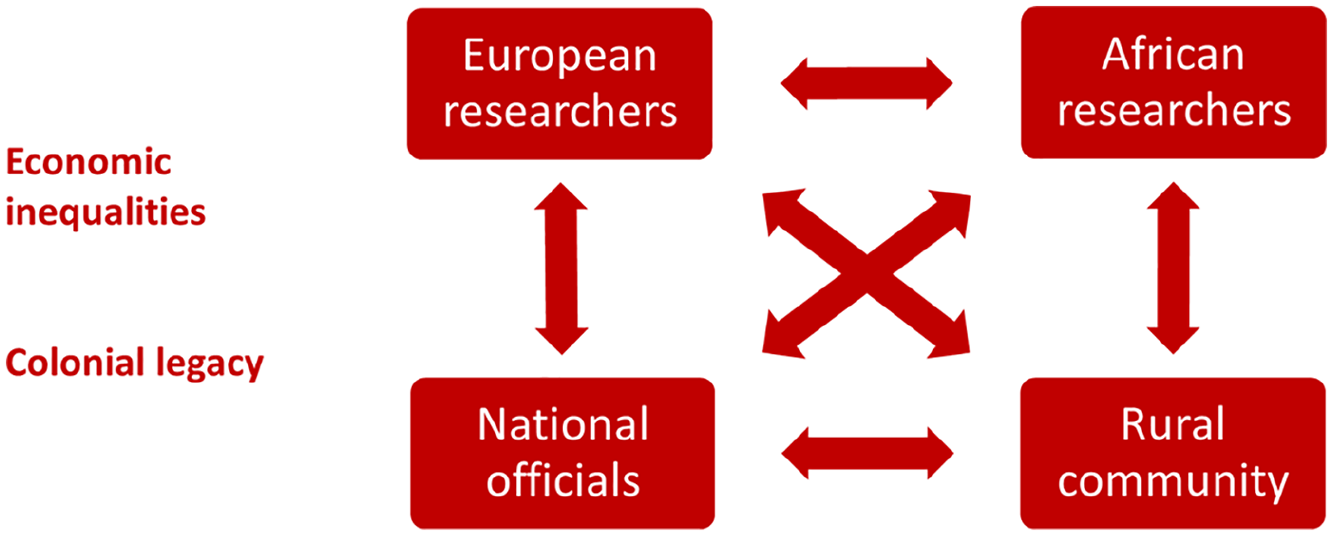
Relationships produced through and shaping the research project.
Our article attends primarily to the broad relations through which some groups were distinctly differently placed than others, in large part through access to economic resources. Also present in these research relationships—particularly those between the European researchers and the other segments of our research community—was the (racialized) legacy of colonialism, but we focus on this largely in relation to the economic relations of the research, which have received much less scholarly attention than the epistemic violence done by international research projects. Throughout our research, tensions and struggles emerged between the different groups of actors. The research was led from European research institutions funded by Western money and most of the research team were racialized white. This arguably led to a perception among those we involved in the research that it was, like western-funded development projects, a potential source of income. Our focus in the remainder of this article is on potential social harm produced in the context of these structural economic relations, which ultimately extend beyond those directly involved in the research into the wider rural communities and policy communities. We explore three specific social fields: the requirements of the Malawi ethical review committee; our interventions in community social relations; and our attempts to engage policymakers.
Encountering the Requirements of the Malawian Ethics Committee
With funding in place, the team secured ethical clearance from the lead institution in the United Kingdom with a plan that included providing small gifts to rural community members who were interviewed (for instance, candles or bars of soap) and refreshments to those involved in participatory workshops. Prior to conducting fieldwork in Malawi, we were required also to obtain permission from a national ethics committee in Malawi. 5 The seriousness attached to this process is reflected in the warning on the committee’s website that to implement research in Malawi without obtaining national ethical clearance is an offense punishable by imprisonment for three years.
Our application, which aligned with that submitted to the UK institution, met with the following objection: There is a mention of compensation of participants for their time. Payment to participants for their time or for their participation in a research study is not allowed in Malawi as it is still viewed to compromise voluntariness in consent. What is allowed is only refund for transport. Please amend accordingly. If transport refund is envisaged, please include this in the budget.
There are well rehearsed debates around compensation for participation, voluntary consent and obligations to reciprocate in contexts of wealth inequality (see Hammett & Sporton, 2012; Head, 2009; Warnock et al., 2022). Countering the various arguments against the practice are arguments in favor which include overcoming some of the power imbalance between researchers and participants and offering fair reciprocation for assistance. Our response to the committee, which we framed in relation to the committee’s argument around voluntariness, articulated a view that absence of compensation in these circumstances would compromise ability to choose to participate: Participants will be compensated for loss of earnings. They will be provided with some soap/candles in recognition that they could have been using the time for income generation. To fail to do this risks restricting the respondents to those with the leisure not to need to work, and thus would skew the results. Internationally there is growing recognition of the need to compensate research participants.
The committee reacted by stating that we needed to remove any compensation whatsoever (including refreshments) on the basis of “bioethical principles that are universal” relating to voluntary consent and required us to give a written undertaking that we would comply.
It was striking that in this postcolonial encounter between international and Malawian research communities, it was the Malawian committee that used “universal” ethical principles to enforce control over the team’s research practices. It is noteworthy that while the guidelines say little directly about harm avoidance, their outline of principles starts with the assertion that “All persons have the right to individual autonomy and self determination.” The language used—and the ethics board structure are imported from Western academia, and need to be understood in their postcolonial context. Yet it would be misleading to assume that voluntary consent—or the correct “international” position 6 —was necessarily the key ethical issue at stake. Rather, this was perhaps a pretext for other (ethical) arguments more grounded in the unequal economic relations of the research. When these inequalities are centered, other issues emerge that relate to social harm.
The national committee has a clear moral legitimacy to determine how research is conducted in Malawi, or at least to veto certain practices. The committee presents itself as protecting the research participants—Malawian nationals—from being exploited. Committee members may also understand their role to include protecting local researchers who are less well-resourced to compensate research participants. Within the context of global economic inequalities, it would be unethical for researchers with international funding to raise expectations of payment and price Malawian researchers out of being able to undertake research in their own country.
However, it is important to consider not only the inequalities between the European researchers (and research infrastructure and resourcing) and the Malawian research community but also the vast differences in lifestyle and concerns between national officials and people in rural Malawian communities. It is not unreasonable to question whether the committee truly represents the interests of the rural poor, or recognizes the ways in which they make sense of the research encounter. As we outline below, our failure to provide any compensation was perceived as a failure to behave in accordance with the cultural norms and expectations of the community concerning gift giving that might be considered unethical if our stance were guided not by “universal” principles of free choice, but rather by situated or relational ethics.
On our return to the community in 2018, a crowd had gathered outside the chief’s house, and we were greeted with singing and dancing, everyone expressing excitement to see us. Flora, in particular, was warmly welcomed back, the chief saying she was a part of the community rather than a visitor. We made it clear in meeting the community that we were not bringing them anything, that there would be no development project resulting from our study and that we were not permitted to compensate them in any way for their participation in our research project. Even as the community accepted our explanation, we felt that they did not believe it was true. They had no familiarity with research beyond our own previous project. Foreigners coming in with surveys and questions are usually linked to development projects—part of a racialized narrative of the well-endowed and benevolent white development worker. Our impression from various early encounters with villagers was that our previous research was construed as a failed development project, though some (mistakenly) attributed new bore holes and even the cash transfers to us.
Despite the warm welcome, some people quickly began to express disappointment that we had returned after a long absence and brought absolutely nothing with us. Moreover, as we asked about their lives over the previous decade, people told us how they had become worse off. This was particularly uncomfortable for Flora. One remarked “You spent all that time here and nothing has changed.” A woman whom Flora had been quite close to on her previous visit complained “I thought [Flora] was my friend.” In returning to the village with no gift, she was clearly not behaving as friends (particularly white European friends) should. Our access to resources was glaring (not least by arriving in a university vehicle with a driver and using smartphones to record interviews), and our unwillingness to share, therefore, offensive. While almost nobody had previously declined to participate in our research (at that time refreshments had been provided), a few households now did. This unwillingness to participate was expressed by those households before we even had a chance to explain the research project and was thus not a case of opting out on the basis of information, but more a rejection of our way of interacting with the community.
The prohibition on recompensing participants or even providing refreshments placed an (additional) constraint on our relationship with the community and was emotionally difficult for us because we were so clearly contravening local social codes, as well as our own understanding of what was right in this context. It felt exploitative to be benefiting from spending time in the village, and specifically benefiting from listening to their stories of the difficulties they faced. Moreover, our insistence that we could not give people anything failed to allay the suspicion that something would surely happen as a result of our presence in the village. In part, there was doubtless an implicit understanding both among the villagers, and the research team, that an international (and largely white) project should provide a source of economic benefit for the community. Like development projects, research should bring not just development but opportunities for personal gain. In Lesotho, where we were able to give small gifts to compensate for people’s participation at the time, there were no expectations of future benefit, but in Malawi we were still seen to owe people something. 7
It is noteworthy that research ethics codes generally apply their principles only to a very limited part of the research process—the researcher-participant dyad. “Participants” are viewed as vulnerable and in need of protection through universal rules. All others involved in our research received compensation for their time or some other form of reward—the researchers, local assistants, drivers, and even the ethics committee itself whose members were most likely paid some form of allowance for their work in assessing our application. Set out in the same letter that prohibited compensation based on an argument about inducement, we were reminded of the requirement to pay an application fee of US$150 plus 10% of our budget 8 to the committee, framed as a “compliance and capacity building fee.” Fees of this kind assist global South research institutions to run a secretariat to process ethics applications and pay for capacity building—for training local researchers in research and in research ethics. Although the Malawian committee required the payment from any researcher, including those based in Malawi, teams with funding from the global North are generally better resourced. Capacity building fees are a means by which some research income can be captured in places where it is otherwise hard to access. In Malawi, they are one of a growing number of measures by which government captures resources from overseas organizations including development NGOs. As in the community, research or development projects are seen by a rent-seeking government as a potentially valuable source of income. Yet these fees might also be viewed as an inducement to the committee to approve research that it otherwise would not.
In summary, providing “recompense” for research participants is not best understood simply in relation to individual agency or individual harm, but rather in terms of the wider structural relations of economic inequality framing the research process. Our actions—or non-actions—have (potential) implications for other researchers, as well as for the community in which we undertake research. Formal ethics codes that rely on rigid rules may be mobilized in ways that respond to economic inequalities but also entrench social harm.
Intervening in the Community
In working with rural communities, there are frequently encounters that do not fall within the remit of institutional ethics codes, but which call for an ethical response. As Puttick et al (2017) observe, ethnographic researchers cannot avoid intervening in research communities. Money is highly contentious within poor communities and a research team’s economic resources bestow both obligations and a capacity to disrupt social relations.
A pertinent situation occurred during the first period of fieldwork when we were already feeling uncomfortable about returning to the village empty-handed. Nicola interviewed Limnile, a 34-year-old woman, whom she had previously interviewed in 2008. At that time, Limnile was optimistic about her future. She was married and had plans to buy a dairy cow and extend her house. Since then, things had not gone well. In 2011 she gave birth to a still born baby. As a result of birth difficulties, she developed an obstetric fistula, a condition that causes fecal incontinence. Her husband immediately left her for another woman, complaining she smelt bad. She had subsequently married again, but this husband also left her when she was 8 months pregnant. The fistula had profound social and economic implications. She did not socialize and could not again remarry. Although she had a small field to cultivate, this was insufficient to adequately sustain herself and her children. She found it difficult to get casual work on other people’s fields, because her co-workers complained about her smell. She had found a factory job but was sacked because the smell of her condition made the other workers uncomfortable. She could not afford uniforms for her 14-year-old twins, so they were often sent home from school and had not progressed beyond the third year of primary school. Her daughter also had to collect firewood to generate an income for the household, as Limnile was unable to obtain such work herself.
Fistula is a condition that is easily treated through simple surgery. Limnile had been unable to get treatment at the local hospital following her diagnosis as the surgeon was not present, but had been referred to the larger regional hospital in the city of Blantyre, about an hour’s bus ride having walked to the main road. She managed to find the money to go to Blantyre, but when she arrived, she again found the specialist was absent. She had then been advised to go to Chiradzulu District Hospital, slightly more distant than Blantyre, but lacked the approximately US$10 that she would need to pay for transport.
Nicola’s immediate inclination was simply to give Limnile the money for transport. But she was conscious that she was part of a team, and this could have wider consequences, particularly given the instruction not to make gifts to research participants. She consulted with the other team members that were in the field at the time including the three Malawian research assistants. Most of the team favored giving Limnile the money, but one of the Malawian team members was concerned that this could lead to problems for the research and warned that other people in the community would find out that we had met the needs of one individual while neglecting everyone else. This would arouse jealousy toward Limnile and resentment of the research team which might compromise our fieldwork. We needed to bear in mind tensions within the community, as well as those produced through the research relations. There are persuasive reasons for not giving money to people, even in very compelling circumstances and (as our research on cash transfers revealed) selecting individuals for favor in circumstances where everyone is in need can create severe disharmony. The instruction to avoid exercising generosity exacerbated these difficulties.
We decided to follow the majority view but to proceed with caution. One of the assistants quietly gave Limnile the money and instructed her not to tell anyone. We tried calling the hospital to make an appointment but were unable to get through. On our return visit a year later Limnile told us she had had the operation, was happily remarried, and showed us her clinic book that said she was fit to work. No one else in the community raised the issue, so it seems the source of the money Limnile had obtained had remained secret, and the concerns raised within the team were not realized. Nonetheless, while we were delighted for Limnile, the situation was also deeply uncomfortable. It should not be so easy for the intervention of researchers to transform individual lives. Our unequal power working in impoverished communities is distressing, a situation exacerbated by the general prohibition on compensating for participation in the research.
While our intervention in Limnile’s life appeared to have worked out well for her and had not had the anticipated ramifications, there were other instances in which our economic power did disrupt lives and relationships. Where we favor particular individuals, we can harm both them and wider community relations. Gabriel, a young man from Nipuru, worked as one of the two interpreters on the previous project and had earned enough from his 4 months’ work to buy a secondhand sewing machine. Men in southern Malawi generally move to their wives’ villages upon marriage and are seldom viewed as fully belonging to the community, and Gabriel was already resented for being chosen as our interpreter above others who had been born in the village. He told us that after our departure in 2008 some villagers soon found an excuse to accuse him of theft and file charges with the police. He moved away to avoid being jailed and lived in exile from the village for several years before returning. Despite having one of the best houses in the village and having found a salaried job, Gabriel still asked us for financial assistance on our return, citing that he had experienced difficulties due to being associated with us.
At the end of our first visit, the feeling of inflicting social harm on our relations with the community had grown intolerable and we needed to ensure that the community felt appreciated. Bearing in mind the instruction not to compensate participants, we invited the community to a meeting at which we presented modest gifts for the whole village: a sack of infant porridge and a notebook for keeping records for the nursery school, a football and a netball for the youth. These gestures were generally welcomed but we learned subsequently that the football and netball were kept in the home of the chief and reserved for the use of the village’s football and netball teams—that is, the better players (the netball players had in fact later benefited financially by winning prize money at a competition). This was resented by others who were not part of the village teams but would have enjoyed the opportunity to play. Our attempt to show appreciation to the entire village was only partially successful.
At the very end of the project, we again sought to express our gratitude to the village. We arranged a community event to which we invited district officials to hear about the community’s experiences of cash transfers. We saw this as a positive way of engaging officials with the community, albeit there was certainly no guarantee that any material benefit would arise. We helped young people in the community to prepare dramas and songs to put across their perspectives and they were able to hear directly from the officials about how the cash transfers were supposed to work. For this event, which was no longer formally a “data collection” exercise, we provided refreshments: we paid many of the local women to cook and, after the formalities ended, we distributed snacks and soft drinks. Again, while in some respects successful, this event laid bare tensions within the community associated with economic inequalities. There was a heated public argument among two sisters, one of whom was receiving a cash transfer while the other was not and the presence of free food brought in residents of surrounding communities, who were not universally welcomed.
While it is necessary to consider local expectations of how we should behave, and we felt that a situated ethic demanded us to be generous toward the community that hosted our research, we were also uncomfortable in the situation of being in the position of benevolent, Western charitable providers and perpetuating such images and expectations. We are aware that at least the white members of the research team are liable to be viewed in this way and experience a tension between expectations placed upon us (not only from the community) and a recognition of the (ethical) problems it presents. This was exacerbated by the economic inequalities that were exposed so frequently in our interactions with the community.
When we work in rural communities, we challenge or (more often) reinforce relations of power and wealth. As customarily expected, we approach the community through, and thereby become associated with, the chief. However, not all residents align with the chief, and those who do not may feel excluded not just from the research but from any benefits it brings. Where we make efforts to stay in the village and hire local assistants to make sure locals do benefit from our presence, this is necessarily arranged through the chief and tends to privilege those who have better houses or empty rooms, and those who speak English and are better educated. Therefore, we may amplify the voices of the more articulate and more prosperous and exacerbate jealousy and division. Even in Lesotho, where tensions were much less apparent and expectations of us were lower, our Lesotho colleague (Thandie) was keen that we should be generous to the two women whose houses the team stayed in. Both were widows of miners and had among the best houses in the village (with space to accommodate our team). Their households also had more livestock than most, but their incomes were unreliable and much lower than when their husbands were alive. Moreover, one of the women spoke publicly (and pointedly) in a community meeting about needing funds to repair her house. This situation again raised the issues of how generous we should be to those who were already perceived to be better off in the community and whether we would be exacerbating inequalities. But at the same time, there are social expectations about how we as researchers should behave within a community that our (insider, local language-speaking) African team members are better able to judge and navigate, but in which they are to an extent implicated through social pressures.
We were also aware of the positioning of our African team members in these situations, where they often mediated the relationships between the European (and non-local African) researchers and the community members. Both Evance and Thandie felt that community members had specific (and ongoing) expectations from them that were not placed on the European team members to the same extent, associated with language and perceived insider status. At the same time, there was an expectation that as they were working with Europeans they had access to European resources. When the research team have left the villages, the African researchers remain more accessible to the communities, as people have their phone numbers and can easily call them and speak in their common language about difficulties they are facing. In the Malawi case, this included calls to complain when community members believed they had been excluded from social interventions (such as subsidies and public works programs) on account of having been part of our research project.
Our research project clearly had the potential to generate both exceptionally positive effects for certain individuals, as well as harms that extended beyond the individual research participants, affecting relationships across the communities. These social harms resulted from the broader relations of inequality in which the research was embedded and were exacerbated rather than avoided by not providing refreshments, or small compensation, for participants. While it is clear that a research visit to an impoverished community will raise expectations and likely have both positive and negative effects that to an extent are unavoidable, it is essential that negative effects be minimized, and positive effects enhanced if the research is to be deemed justifiable.
Engaging Stakeholders
A further area of our research in which conventional ethics codes contribute little is our engagement with national level policymakers. While the role of benevolent provider is problematic, many call for those researching issues of international development to use their findings to influence policy in support of reducing extreme poverty. We sought to establish a relationship with key policy personnel—largely civil servants and representatives of international agencies and NGOs that had a role in the cash transfer schemes—through the establishment of stakeholder groups that met on four occasions over the duration of the project.
Once again, questions of financial compensation raised ethical challenges. We were clear in our invitations to meetings that we would not pay allowances to those attending, as meetings were held close to stakeholder offices and lunch and refreshments provided. Like fees to government and community expectations of gifts, per diem allowances are a means by which people secure direct financial gain from internationally funded projects. There are strong arguments against paying them: per diems are argued to have become the key motivation for meeting attendance in some settings including Malawi, attracting people who have little interest in or influence over the relevant policy area. They also remove attendees from their usual duties, leaving important work undone, and if they are there merely to collect per diems, there is no positive social outcome (Nkamleu, 2015; Tostensen, 2018). We were aware, however, that in Malawi those organizations that no longer pay per diems to attendees, including some donor agencies, have poorly attended meetings. There was some contention within the team about the extent to which we should take a stance against per diems, some being concerned about the impact on attendance. If our meetings had few attendees, the potential for our research to impact policy would be diminished, and our promises to the community that we would convey their views to those in power would be unfulfilled, though attendees who were there only for an allowance would do little to diminish this social harm. Moreover, the Malawian research team was aware that they would be placed in a difficult position of having to explain our position to attendees who might be reluctant to believe them (or even suspect them of keeping the cash for themselves). As a compromise, our invitations to the meetings indicated that we would pay a small transport allowance to anyone who needed it; we then asked people to indicate this on the attendance sheet at the start of the meeting. By making claims transparent, we believed we were using social pressure to discourage those who clearly had no need of an allowance from asking for one.
We were very pleased when an influential parliamentarian attended one of our stakeholder meetings. At the end of the meeting, the parliamentarian approached one of the local team members to explain that his constituency was a long way from the capital and that parliament wasn’t currently sitting, so he expected the standard travel allowance claimed by parliamentarians who were required to be in the capital for meetings—around US$80. It was however clear that this person had not traveled to the capital for the purpose of our meeting and some members of our team were outraged by this: we were forbidden by the ethics committee to give a bar of soap or even provide drinks to any of our rural participants, but were expected to pay a large sum to people who already had substantial salaries for their attendance at a meeting.
While this case again highlights the iniquities of prohibiting compensation of poor rural participants, the issues around paying per diems are not entirely straightforward when considering the varied ways in which differently positioned individuals benefit economically from research funds. Universities receive overhead payments on research grants and may choose to reward researchers through career promotion (and enhanced salaries) and in some cases through incentive payments when they win grants. Most of those attending our meetings are paid much lower salaries than the European and, in some cases, the African researchers on the project team. Per diems constitute another means by which a little wealth is transferred from the West to Africa, as well as making up for low public sector wages. Moreover, from the perspective of the social relations of the encounter, it was invariably our local researchers who were approached by participants with subtle indications that they expected to be paid; local researchers are personally embedded in a culture that expects per diems to be paid by internationally funded projects to make up for low salaries and placed in an invidious situation by the requirement to refuse to pay.
Once again, an approach to research ethics that assumes that voluntary consent for participation is the key issue entirely misses the extent to which social harm may be reproduced through research, even when all protocols are closely followed. In some respects, we are all incentivised to play particular roles in the research—incentives that have some undesirable consequences but form part of the way that research operates and both causes and avoids social harm. The economic relations that frame research practice produce ethical challenges, and the repercussions extend beyond the research itself.
Conclusion: Avoiding Social Harm in Complex Fields of Social Relations
Drawing on our research experience as a multinational team working in an impoverished Malawian village, we have demonstrated the inadequacy of framing research ethics as almost entirely a matter of individual informed consent. Supposedly “universal” research ethics, even when mandated by an African ethics committee, fail to address the breadth of ethical issues that are confronted. Moreover, through the primacy given to individual agency and associated neglect of the broader relational context of the research, they can cause disruptions to social relations. This applies not only to the direct data collection encounter but also to the other relationships in which a long-term ethnographic research project is embedded and which exist at multiple scales.
Research ethics, then, need to move beyond the neoliberal focus on individual rights and well-being toward recognition of collective social harm within communities and more broadly. Research takes place within complex fields of social relations and, for research in the global South (whether by local or non-local researchers or both), economic inequalities are important elements of these. Researchers can damage their own relations with communities and upset participants; they can damage relations within communities, causing tensions and jealousies; and they can reinforce dominant and harmful power relations at multiple scales including, for instance, the per diem culture, the chief’s unequal power within a community and problematic discourses of Western charity.
Ethics committees have different agendas. Those attached to universities and other research institutions are primarily concerned with minimizing risk to the institution—both reputational risk and the risk of prosecution—if their researchers are seen to act unethically. National ethics review committees, like the Malawian committee governing our research practice are more likely to see their role as protecting participants, as well as their national capacity to carry out research. While “universal” principles are widespread, not all ethics committees adopt the same approach. Lesotho’s national committee, which oversees health-related research, seeks to balance the principle of harm avoidance with the principle of benefit to the research participants. The Uganda National Council for Science and Technology (2014) requires that “Research should aim at improving the welfare of research participants and their communities” which can be attained by providing “compensation for inconveniences and time.” Even in Malawi, at least one other institutional ethics committee requires that participants should be compensated for their time. A workshop in Dakar (ALLERT, IRESSEF, Wellcome Centre for Ethics and Humanities and Nuffield Council on Bioethics 2019) encouraged ethics committees to review their approach to compensation, advising that monetary and non-monetary forms of compensation were ethically acceptable.
While consideration of the potential for research to benefit participants would address some of the issues raised in this article, it still does not extend the purview beyond individual impacts. As our case has shown, ethical instructions that do not take a situated approach to ethics, or consider social harm, can be very unhelpful both to the researchers who are supposed to benefit from the guidance and to the communities participating in research who are supposed to be protected from harm. Navigating situations that are embedded in problematic structural relations of postcolonial power and economic inequality is indeed very difficult for researchers, but it still seems most likely that research teams would be best positioned to make complicated and context-specific decisions, such as on the appropriateness of providing refreshments or small gifts in the specific situations they encounter. To determine whether research teams should be trusted to make such decisions, it may be preferable to ensure that they have adequate training in research ethics, and are able to justify their ethical choices and reasoning, rather than stripping them of all power to make decisions.
Footnotes
Declaration of Conflicting Interests
The author(s) declared no potential conflicts of interest with respect to the research, authorship, and/or publication of this article.
Funding
The author(s) disclosed receipt of the following financial support for the research, authorship, and/or publication of this article: The research discussed here was funded through the ESRC-DFID Joint Fund for Poverty Alleviation Research, grant ES/M009076/1.
