




Abstract
This article keeps tuned to the ritual of scholarly gathering, an activity continued somewhat differently today in the online meeting. We aim to speak to current concerns about place and belonging under new climatic and digital regimes. We pose the question, “What will be the spatial logic and shape of scholarly collaboration after lockdown and ‘zoomtopia’?” The article recounts our decade-long collaboration and is structured around 10 sketches of singular meetings—intensive encounters—where we met for 3 to 5 days and developed various theories about form, space, number, affect, body and the imagination.
A Note From Special Issue Guest Co-Editors
This article is derived from a webinar series conversation titled, “Post Philosophies and the Doing of Inquiry,” co-hosted by Candace R. Kuby and Viv Bozalek. The webinar sessions ran from August 2020 to September 2021. This webinar series was made possible by a research collaborative partnership between the University of Missouri System in the United States and the University of the Western Cape (or UWC) in Cape Town, South Africa. During the webinar sessions, the panelists were asked to respond to four questions:
How does your philosophical approach influence your ways of doing inquiry?
What does this philosophical approach make thinkable or possible for inquiry? (so how does your approach relate to more traditional practices such as literature reviews, data collection, analysis, and so forth)
What are your perspectives on methodology(ies) and/or methods? How do you envision that in your approaches to doing inquiry?
What mechanisms could be put in place at universities to help supervisors and/or committees support students doing post philosophy inspired ways of inquiring?
We are grateful for James Salvo’s invitation to publish the webinar in a special issue and to Erin Price who assisted with technology, logistics, and the art for the series. To learn more information about the webinar series, please locate the guest editors’ (Kuby & Bozalek) introduction to the special issue on the website for Qualitative Inquiry. Each panelist in the webinar series suggested several readings to accompany their talk. To access the recorded webinars and suggested readings, please visit: https://www.youtube.com/channel/UC4P_GUK6QV2Wp_OAWEpw87Q. For more information about the webinar series, visit: https://education.missouri.edu/learning-teaching-curriculum/webinars/.
Introduction
Neither of us has physically attended a conference nor traveled for international congresses since 2019, when we attended the New Materialism and Deleuze Studies conferences in Cape Town, South Africa. Prior to the pandemic, we took off for distant destinations frequently throughout the year, flying over vast seas and mountain ranges, neglectful of how such jet-setting contributed to the climate crisis. These destinations were most often the designated sites of scholarly events, and our being present was often part of a larger congregation of affiliated researchers, called together in the name of various kinds of intellectual endeavor—philosophy, education, mathematics, and so on. Then suddenly the skies in our urban environments were quiet, as planes were grounded. In cities where more than 3,000 flights land every day, like New York City, the virus-induced tranquil atmosphere seemed utterly odd, absent of roaring engines and white exhaust trails. We confess to a certain longing and nostalgia for that extravagant travel, and we miss those situated events prior to our grounding, for the sense of professional association forged during meetings, the intellectual stimulation and camaraderie, and the encounter with a new place. As we look back and reflect on these collective gatherings, where we met with anticipation, where we presented our work and discussed ideas for future work, we are reminded of the power of place in collaborative knowledge-making. In these encounters, ideas were ignited and various projects took form, as we wandered about, tourists tagged with our conference badge. These mostly affluent northern cities on the conference circuit became accommodating and illusive, built for the rich, displacing the poor.
The postphilosophies international webinar, from which this article emerged, was a virtual event in which we were prompted to consider our collaboration over 10 years (2009–2019). Organizers asked us to explain from where our theory came. The questions spurred us to reconsider the ways in which our collaboration has been situated in particular cities and places. The postphilosophies webinar event occurred “on” the zoom platform, in a virtual space of transplanted scholarship, where we explained how and why we gravitated toward particular concepts and theories. In this article, we map this theoretical landscape as grounded and earthbound and linked to particular places which hosted our collaborative efforts, where so much of our speculative thinking was s/parked. This is but a minor gesture to acknowledge the grounded nature of our ideas, the thingness of our thought, and the fabrication of our cosas mentales.
By looking back at our encounters on the conference circuit, we hope to better understand how our ideas were forged then and how the digital meeting both continues and disrupts a certain brutal placelessness of scholarly exchange. The webinar drew our attention to how our academic collaboration was cultivated in transit (away from home), exercising our affluent mobility, and in response to the call to convene around a problem or an idea. Many conferences have “gone online” in the last two years, and are likely to stay “there.” During the postphilosophies webinar, “a year-long virtual space,” whose videos are hosted on YouTube, attendants announced in the “chat room” their geo-location, revealing a far more diversely situated audience than usual. In other words, the virtual collective has potential to bring together a more heterogeneous international participation. How do we make sense of the new architecture of our collective belonging, as we recollect from a new isolation? How might this postpandemic moment help us understand the nonplace of supermodernity and our desire to occupy it? This seems an apposite moment to reflect on how our scholarly collaboration was shaped in the last decade by situated encounters and landing sites.
Here in this article, we ground our intellectual trajectory in diverse cities to trace the way our ideas flourished through the conference circuit. These landing sites are sketches of singular meetings, intensive encounters, where we connected for 3 to 5 days, or perhaps longer, arriving with anticipation for the conference milieu and the themes by which we were convoked but also seeking the “elsewhere” we so desperately needed as a trigger to imagine otherwise. Each landing site is a mash-up of memory-matter. These are fabrications, tight knots of entangled thread, where the academic congress engages with the city, the force of the built environment, the memory of the minor movements that occurred. We bring with us other guests, particular theorists whose work is mobilized on-site, as though they were a surprise travel companion, sometimes a trickster all too equipped to crash the party. We frame this article—a reflection on our webinar interview—in these terms so that our conversation might speak more directly to current concerns about place and belonging, under new climatic and digital regimes.
This paper keeps tuned to the ritual of scholarly gathering—the ritual of embodied collective thinking—as a cultural practice where identity and community are partially constituted, an activity continued today in the online meeting. We aim to reckon with the economic logic of this new kind of situated scholarship, as we revisit the large conference buildings that brought us together in the past. These convention centers, with their enormous accordion walls, neutral colors, and parallel escalators perform excessive space, absence of history, and transience. And yet these buildings have governed, in part, the spatial practices of community membership and legitimate forms of subjectivity and exchange in many scholarly communities. What will be the spatial logic and shape of “zoomtopia” if “spatial practices in fact secretly structure the determining conditions of social life” (de Certeau, 1984, p. 96)?
Augé (1995) argues that there is a tradition of postmodern architecture in which buildings are meant to be places of forgetting. Resort hotels, airports, and convention centers are typical of this tradition. Convention centers are designed to be highly flexible vessels with the capacity to hold vast numbers of persons and/or objects. They can be transformed during the night into radically different arrangements of space by simply moving walls and doors and tables. Designers aim for a highly neutral décor, assuming that such neutrality will better serve diverse participant groups. These places retain no trace of those who have occupied them on previous occasions. The presence and participation of all persons is erased soon after the meeting ends. Augé refers to these as “non-places” because they aim to be highly anonymous transient locations where the personal connection to place must be de-emphasized.
Nonplaces are said to be a phenomenon of late-capitalism in which the logic of excessive information and excessive space dominate our awareness of who we are and who we hope to become. Other thinkers who have been associated with this line of postmodern critique are Michel de Certeau, Henri Lefebvre, Guy Debord, and Jean Baudrillard. These scholars intended to expose the estrangement of the postmodern subject from placeness and historicity. Unlike places encrusted with historical and social significance, the nonplace addresses the inhabitant in terms of sameness, units of exchange, and erasing the particularity of their belonging. 1 The convention center is a typical nonplace. The erasure of the personal trace is essential for the proper functioning of the convention center as a viable and mutable object in the market of large-scale meetings. 2 These buildings exemplify the principle that forgetting is central to a consumer market of infinite exchange. Forgetting is part of the pedagogy of such places. Forgetting is written into the architecture.
As a kind of supplement to Deleuze and Guattari (1987) offer a divergent lesson from our postmodern past; they demand a philosophy that rises to the perspective of the full body of the Earth, pursuing the problematic of how “to make a philosophy with the Earth.” This effort inherits postmodern concerns with placelessness, but is better prepared to engage with nonplaces as virtual points of emergence of the new, points of deterritorialization, from which a revolutionary spatial tactic can emerge. Perhaps this is precisely how one “does inquiry” in the name of “post philosophy.” After lockdown, a geo-philosophy adequate to the earth (“the only universal”) must encourage new social formations of power that don’t fall back into repressive control states; the task is to create, as Deleuze and Guattari say, “a body without organs,” a term which is linked to both the Earth itself and the important political concepts of multitude (Lambert, 2005) and écho-monde/tout-monde (Glissant, 1995). In the following landing sites of our conference circuit, we discuss the ways our theoretical commitments emerged, drawing attention to the power of place, nonplace, and journey. These commitments cluster around questions about the nature of mathematical practices, be they expert, novice, maverick, or more than human. Ten years of collaboration has involved reading widely, pursuing a pluralism and politics of form, sensation, affect, and a sustained inquiry into mathematics as a material and speculative activity.
The Conference Circuit
Vancouver: Mathematics and Philosophy
A large spinning earth-globe hangs at the Vancouver convention center, visible from the outside through the four-story glass walls (Figure 1). Painted on the globe are orange land masses, blue sea, and swirling atmospheric clouds, evoking international world making. The space where the globe hangs is cavernous and empty, enormous and uncluttered, as though large enough to house a planet. The largeness of this room, its “generous” space, conjures other historical places where people congregate, such as cathedrals and caves, historical sites where historical figures speak to historical audiences. But the excess of vertical space here is an architectural gesture toward the future of global markets, and not an attempt to magnify the historical impact of the human voice, gesture, or minor expression. The room seems to say: “I can contain whatever comes to market.” Augé argues that monstrous convention centers exhibit an “excess of space” or “spatial overabundance” which characterizes many of the buildings of “supermodernity,” a term he uses to designate the late-capitalist world of global markets.
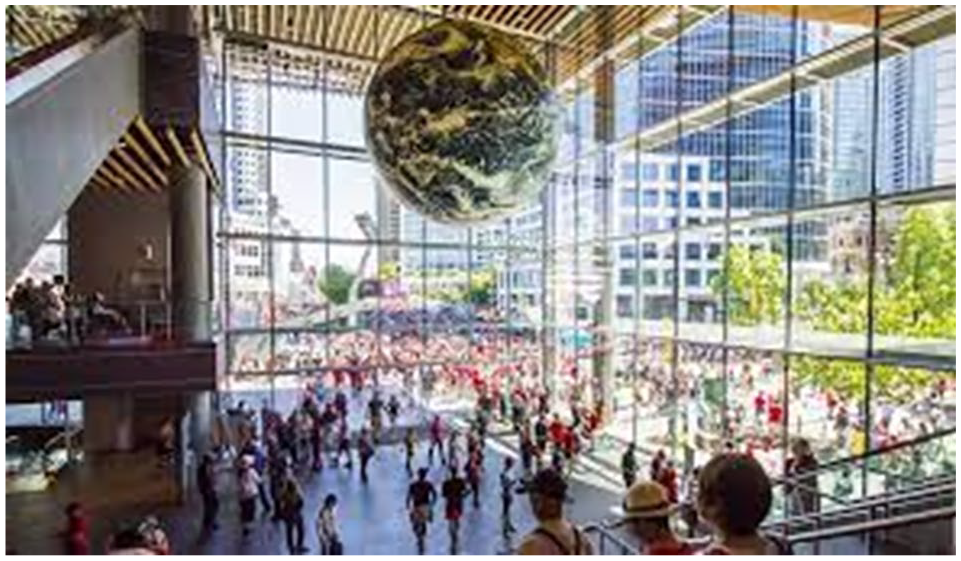
Vancouver convention center.
Vancouver is cradled between the mountains and the sea, on a small island from which juts out the glass towers that compete with the neighbouring peaks, surrounded by the Pacific Ocean and the mighty Fraser river. It’s the land of salmon and bears and ravens, a fact that has epistemological, ontological, and axiological consequences for the Coast Salish peoples on whose unceded and unsurrendered territory we (the authors) have come uninvited. For these Indigenous people, the animals as well as the land—the river, the mountains—are not seen as passive, inanimate background on which or from which knowledge is built, but instead as actively intertwined with knowing, through the stories that are told (Donald, 2009). A significant story told by the Coast Salish people is the Legend of the Salmon people, which describes not only the cycle of the salmon returning to the river from the sea but also the rituals that made that cycle possible and ensure the relationship of reciprocity among the people, the river, and the fish (Kirk, 1986). Place is responsibility.
This is a city where our somewhat parallel paths cross and intermingle, where the professional link between us begins to form, in potentiality. We both have bachelor degrees in mathematics, master’s degrees in the history of mathematics, and doctorate degrees in education. That training in mathematics and the humanities—the history of mathematics and the philosophy of science—furnishes an important foundation that continues to inform our work today. In the 1980s, we were reading Bruno Latour, Michel Serres, Donna Haraway, Evelyn Fox Keller, Sandra Harding, and other postmodern anthropologists and feminist philosophers of science. The methods and approaches of Ian Hacking and Bruno Latour figured prominently in our early intellectual history as did the work of Michel Foucault. Because of that lineage, we often situate our approach in the field of Science and Technology Studies (STS), with a focus on studying various theories of learning. We continue to follow and appreciate the work of Latour and often defend him against the critics (de Freitas, 2018). He is a pragmatist, committed to a certain kind of posthuman ethnographic practice, and we respect that. Haraway was equally important to us in the 1980s as is her more recent work on companion species and the powers of science fiction (SF) in scientific inquiry. Stengers’s writing on the nature of science, and the nature of nature, accompanies us as we talk, read and write.
Most of these people, however, never seemed to discuss mathematics in any but fleeting ways. And so the challenge, for us, has been to leverage their insights, and craft an approach to a mathematical activity that was philosophically and sociologically robust. Michel Serres’s (1982) English book, Hermes: Literature, science, philosophy, was hugely influential in this respect, because it dives deep into actual mathematics, philosophically unraveling key proofs and concepts. His work is entirely different from the analytic philosophers of mathematics, which have dominated, and perhaps still dominate, the Anglophone tradition. His writing is poetic and speculative, developing a kind of cultural–historical studies of mathematics, attending to both its embodied and state-sanctioned styles, its mythic origins, and ontology. There is a book of conversations published in the 1990s between Serres and Latour (1994) and more recent English translations of his work. We are drawn to philosophers who discuss specific histories of mathematics—like Whitehead, Deleuze, Serres—who directly and explicitly engage with mathematics. Deleuze’s theories of differenc/tiation are directly informed by mathematics, and his work carefully engages with mathematical ideas. This is rare in cultural studies or in the philosophy we are otherwise drawn to. We include some of this kind of work in our edited collection (de Freitas et al., 2017), which attempts to bring interdisciplinary perspectives together, on the question: What is a mathematical concept? It includes chapters by David Corfield, who works as a philosopher of mathematics, alongside Arkady Plotnitsky, who is a philosopher of science and literature, Reviel Netz, who is a historian of mathematics, Michael Harris and Juliette Kennedy, who are working mathematicians, as well as mathematics educators. In being interdisciplinary in our work, we sometimes fall back on the label “cultural studies of mathematics.”
Thessaloniki: Aesthetics and Politics
In the quiet early morning, the city squares are empty of people, but on the cool stones sleep the street-smart dogs, resting before their hectic day begins. These dogs understand traffic lights and occasionally board buses and boats and arrive at destinations. Later, the mid-day sun is intense, and they will hide in the shadows from which they dare not venture. In Thessaloniki, we meet for the first time face-to-face, and chat during a conference intermission, under the noon sun, about the need to do more than critique the status quo. The conference is a long-established annual meeting of an international group established in 1976. It opens with traditional Greek dancing, and includes various “excursions” where we learn about the history of Macedonia and Thessaly. The Jewish museum records the ghastly 20th-century extermination of the city’s vibrant Jewish community, established centuries earlier as an intellectual beacon for the Jewish Iberian diaspora. The conference is housed in university buildings which were erected on the site of the old Sephardic Jewish cemetery. Parched sandy grasses sprout between buildings, where we drink strong Greek coffee before heading back into the crumbly white concrete buildings, away from the impossible heat. At mid-conference, organizers convey hundreds of participants in buses to the Aegean Sea for a swim, where we don sunhats and chat about geometry.
It is a fitting place to return to axiological concerns, so often ignored by philosophers of mathematics education, who privilege epistemological questions. Plato’s interest in the relation between truth and beauty seems quaint in relation to socio-cultural theories in education that care little for the old-fashioned, elitist idea of beauty. With the work of Jacques Rancière (2004), who unpacks the links between beauty and power, exposing the political-aesthetic, we are able to think about the critical materiality associated with a “mathematical aesthetic.” This association animates our inquiry into the history of what has been available to the senses in mathematics over the centuries, and the correlated sanctioning of a “state mathematics” which is deemed to be what makes sense as/in mathematics. For example, there was a point in time when Europeans considered it advantageous to be blind in order to better access abstract mathematical ideas; there was a time when early Mediterranean mathematics was essentially oral, performed with drawings in the sand. Although Rancière does not mention mathematics, we are able to use his ideas to politicize the materiality of mathematical practices, showing how they partake in what he calls a “distribution of the sensible” which is achieved in particular kinds of bodies, habits and capacities.
This analysis in turn enables us to examine new digital technologies for how they shape what kind of mathematics can be sensed. We show how the dominance of the alphanumerical in mathematics is less a disciplinary necessity, as many teachers and learners have come to think, and more a particular distribution of the sensible that privileges certain values over others—linked to an image of mathematical concepts as static and disembodied. We follow Brian Rotman (2008) in exploring the possibility of gestural-dynamic forms of thinking and communicating mathematically. The politics of a distribution of the sensible applies also to forms of reasoning in mathematics. The history of mathematics is chock full of examples of shifts in these forms of reasoning that produce new images of what counts as mathematical proof. Then, in the alchemy of the mathematics curriculum, to use Popkewitz’s (2004) term, certain forms of reasoning become reproduced in ossified forms within learning trajectories. Tacit assumptions about the nature of mathematical reasoning are rarely interrogated. We try to do historical work, selecting examples to illustrate our points—we show how the law of the excluded middle (which is a logical principle that states every well-composed proposition or its negation is true) has shaped theories of mathematics learning, overlooking the indeterminate and generative nature of concepts, the complex relation between negation and quantity, and the speculative nature of thought (see de Freitas & Sinclair, 2014, 2018).
San Diego: Movement and the Virtual
As Canadians, we fly south to San Diego, to join about 15,000 other attendants at the annual meeting of the American Education Research Association. Pairs of escalators ferry passengers up and down to multiple mezzanine floors. Movement within the convention center relies on these perpetual motion machines which manage the flow of bodies. The escalator is a moving staircase, conveying bodies from one ballroom to another; the steps become an illusion, merging contiguously and flattening at the next floor. The stillness of those on an escalator is a strange pause, a stillness with determinate direction, and a stillness attached to an inevitable destination. We ascend or descend and glance at the others in their opposite stillness. The conveyors control the chaos of movement within the crowd. The islands of escalators are often the most monumental aspect within the otherwise empty convention center. One’s eye is drawn to the movement and to the possibility of movement. An outsider, across the street, might look toward the glass exterior of the convention center and notice nothing else but the many escalators within, ferrying passengers up and down.
Our interest in architectural imaginaries started many years previously, after reading Elizabeth’s Grosz’ (2001) book Architecture from the outside: Essays on real and virtual space, and studying Parkour practices in the city. This led to an interest in counter-movements in school buildings (de Freitas, 2011), and more recent work at the Manifold Lab (https://www.themanifoldlab.com/) where we study how young people develop spatial tactics to manage smart school buildings. Grosz continues to matter to us because of her work on Gilles Deleuze, Raymond Ruyer, and Henri Bergson and her recent concern that new materialisms fail to comprehend the significance of the “general idea” (Grosz, 2017). Deleuze’s concept of the virtual is very helpful in developing a new materialist philosophy of mathematics, and in our emphasis on the creative force of mathematical thought. We use it to help us explore the speculative nature of mathematics, the non/sense of mathematics—we have written about the relationship between mathematics and the metamorphic earth, borrowing from Deleuze’s transcendental empiricism and dabbling in other speculative materialisms (de Freitas, 2021). Ricardo Nemirovsky, who has worked extensively on embodied cognition and gesture, invited us to speak in San Diego, where we were asked to further elaborate on how children develop formal abstractions.
That San Diego talk was one where we focused on the essentially indeterminate nature of concepts—how they are trembling blocks of sensation—and that “constructing” a concept is not about internalizing the perceptual world, nor only about representing the sensed world, but entails an atmospheric re-assembling of the body as a locus of movements, not all of them governed by the child who is said to learn. This means that agency is distributed across an event, which might seem a simple enough proposal that most would welcome, and yet dominant learning theories and instructional practices are yet to fully embrace it. Rethinking the proliferation of agents across a metamorphic environment demands entirely new ways of thinking about causality. Karen Barad (2007) argues that quantum paradigms will help us ditch simplistic causal narratives about learning and develop more inclusive ways of gathering the forces at work in a learning environment. Barad is an important inspiration, and although she draws from Derrida rather than Deleuze, her work helps us formulate new ways of thinking about movement—and time/space relationality, agency, and concept.
Manchester: Postcolonialism and the Map
A conference hosted by Manchester Metropolitan University occurs in a small hotel built along the banks of a ship canal, a section of the inland waterway established centuries earlier as part of the Colonial trade of cotton and other goods. Conference attendants walk along the canals, shivering from a bitter cold wind and gray skies overhead, crossing sets of canal locks that lift small vessels and allow their passage across the city. We present our research, our first shared presentation, focusing on inventive mathematical diagramming. With Jerry Rosiek, we also discuss Karen Barad’s onto-epistemology to somewhat suspicious listeners. This conference brings together a rare breed of people interested in cultural studies, philosophy, and mathematics education under the awkward conjunction of “mathematics education and contemporary theory.” Many participants name their work as political and socio-cultural, and yet many are wary of our proposal that an “ontological” turn might perhaps be an even more radical political venture. A “critical” perspective dominates in many papers which examine the ways that mathematics education is a gate-keeping phenomenon; many White European theorists are cited, such as Bernstein, Bourdieu, Lacan, Vygotsky, and Foucault. Our work aims to shift the conversation toward posthuman and new materialist theory, mindful of the possibility that “critique has run out of steam” (Latour, 2004).
Manchester becomes an important site in our collaboration, a place of contracted energy, bursting with inspiration, and bringing us closer to United Kingdom and European scholars. Intensive reading groups at the university become essential ways to build research capacity, chances to meet regularly, a political act to read slowly and with care, focused on a hard book, ranging across a diverse set of European thinkers (Deleuze, Hegel, Lacan, Spinoza, Ruyer, Peirce, . . .) and later attending to more diverse reading lists (Glissant, Moten, Jackson, Chude-Sokei, Mbembe, Wynter, . . .). After reading three books by Édouard Glissant, we begin to “gather” postcolonial ideas about creativity, speculation, and the imagination. With Glissant, we are able to rethink the poetics of space, the creolization of language, the inventive diagram, and the alchemy of curriculum. We think with Glissant, travel with him, as we return to critically examine the way that international curriculum projects flow across global postcolonial markets (de Freitas et al., 2022), the way that participation is tied to fallacious notions of transparency (de Freitas et al., in press), and the way that epistemic imaginaries plug into an infinite differential (de Freitas, in press). Glissant helps us interrogate the spatializing logic of diagramming habits, seeking an archipelagic thought, showing the situated bias of center-periphery arrangements, in which continental land mass is the supposed center of space-meaning. In one of our most recent 2022 articles, we demonstrate, in as much detail as possible, how “minor” mathematical ideas and practices might be used to contest the imperial mathematics of the state. Building on the work of critical cartographers (such as Braidotti, 2011), as well as Deleuze and Guattari’s geo-philosophy, we use diagrammatic methods as earthbound abstractions for helping us think more creatively—to make new relations—about international curriculum projects. We find resonance with Ferreiro da Silva 3 who has talked about her research in terms of three modalities: the critical, the speculative, and the creative. She uses a diagram to describe “the speculative” as a new way of thinking that is not rooted in experience and offers counterfactual realities that are then available as new spatial imaginaries. Glissant and Ferreiro da Silva break up our whiteness with a radical black imagination, raising our awareness of the speculative power of such an imagination, and the need to stay with the violence of citation, lineage, reference, and reterritorialization. But they do so much more than this.
Berlin: Hands and Diagramming
We are in Johannesstift, a charitable institution located approximately 45 min away from Berlin, in a wooded suburb, at a 2010 conference hosted by the European group for Studies of Mathematics Education and Society. The trees are decorated with Easter eggs. We meet at a small cafe, outside of the conference room, a squat hut with few tables, all of them round and small—just barely enough room for a laptop. We come together around the playful words of the philosopher of mathematics, Gilles Châtelet (2000), who was as serious about mathematics as he was suggestive in his poetry. From him we understand that mathematical thinking is often in the hand, in gestural or scripting movements, sometimes creating drawings on blackboards, and sometimes on cocktail napkins. And as the hand-with-chalk unfolds (or stick with sand, touch with screen, or other sensing media), new mathematical gestures carve out dimensions, submit to new infinities, and peek into new dark matters. Châtelet creates a middle between the gesture and the diagram, pushing together two fields of research that had been erected independently. The hunched-down German cafe is a good place to lean into Châtelet’s ideas, allowing us to make continuities in the discrete, and spread out horizontally into monological planes. We design experiments for our own students to explore the mobility of mathematical concepts, to grasp after the point at infinity, to invert and unravel a mathematical knot, and other topo-philosophical ways of doing mathematics.
We continue to study the hand-gesture nexus, specifically in relation to new media. Through studies of young children engaged in multitouch applications such as TouchCounts (Jackiw & Sinclair, 2014), we point to how digital technology is changing the conceptual field of particular mathematical concepts, as well as long-standing developmental assumptions. For example, rather than restricting kindergarten children to the 1 to 10 span of numbers, we try to show how they can meaningfully feel, see and say things about 34 and 79, and even 1,045. Rather than assume a developmental progression that goes from concrete, to iconic to symbolic, we find evidence that they can experience number as touch, sounds, image and symbol all at once. When mathematics becomes such a multi-sensory experience, new ways of analyzing become available, as we show in our Deleuze-inspired study of the dislocation of hand from eye in children’s inventive use of TouchCounts (Sinclair & de Freitas, 2014). This study enables us to bridge the linguistically informed, communicative conceptualization of gesture—prevalent in mathematics education research—with a more materially coupled, affective understanding of gesture that scholars such as Jurgen Streeck (2009) pursue. In other words, we see these sense-changing technologies less as tools to make mathematics learning better (than pencil-and-paper approaches) and more as ways to analyze the emergence of new mathematical affects. We continue thinking with Rancière here, about the manual labor involved in mathematics; the hands evoke virtual spaces and imaginary worlds through gesture, and this gestural-manual work creates value. Mathematicians like Giuseppe Longo (2015, 2019) show this well, taking up as he does the ecological and earthbound nature of mathematics, to better argue for the materiality of mathematical practices (de Freitas, 2021).
We leave Berlin that week, via the Tegel Berlin airport, which has since been decommissioned during the Covid-19 pandemic so that all traffic is now “redirected” to the new Brandenburg airport. The old Tegel location is to be redeveloped into a new city quarter dedicated to industrial research, called Urban Tech Republic. We wonder how much global data will be pulled and processed there. Prior to 2008, flights still landed in the much older Tempelhof airport, one of the three most famous pre–World War II airports in Europe, created by the Reich Ministry of Transport in 1923. The new airports are segmented into zones, separated by automated gates, and face-recognition software. A user of a nonplace is recognized only upon entry or exit, where a stamp or a badge grants free passage, and hence forth they are nothing more than a passenger or customer—a fixed identity bracketing off momentum and magic. As mathematicians, we see the discrete at work.
Torino: Method and Queering Time
Torino is the capital of Piedmont, in Italy, the epicenter of the slow food movement—and also the place where hazelnuts and chocolate were first mixed together to create what is now well-known as Nutella. This kind of delicious mixing is what drew us to Karen Barad, whose reading of the physicist Niels Bohr with the philosopher Jacques Derrida lead her into the new onto-epistemological territory, queering quantum ideas. She helps us think matter as indeterminate, as mathematical, as imbricated with discursive practices. With Barad, we can rethink the nature of mathematical concepts, reclaim them from their epistemological confinement, and reengage with the idea of “embodied cognition” in alternative ways, different from the socio-cultural theories of discourse that dominated in recent decades. Just as Barad stays always close to physics, respecting its disciplinary rigor—while challenging common interpretations of its results—we stay close to mathematics.
Our meetings in Torino are convoked by Francesca Ferrara, at the University of Torino, in the Giuseppe Peano building, named after a mathematician who worked in analysis, developing a set of axioms for arithmetic, and who was renowned for his capacity to generate counter-examples. Over the centuries, Torino has been home to many famous mathematicians, including Lagrange in the 18th century. The building retains that history, in its foot-polished marble staircase, and drafty offices; one can feel the full weight of the history of European mathematics, lurking in the dark corners of the corridors. Perhaps it is this weight that steered us toward thinking of the new, of the possibility of inventiveness in agential cuts that we find studying young children as they move in new ways in response to dynamic images of lines and shapes (Sinclair et al., 2013). We were inspired by Barad, for whom the indeterminacy of matter is so significant, and for whom matter “feels, converses, suffers, desires, yearns and remembers” (Barad, quoted in Dolphijn & van der Tuin, 2012).
In Mathematics and the Body, our experimentations depend on a broad idea of agency, following Latour’s work, as well as Pickering’s (1995), distributing it beyond the knowing mathematician or learning child, but we don’t do justice to the gendered politics of mathematical embodiment. Our earlier work with Barad’s agential realism did not take up directly her spacetime mattering or her invitation to queer time. We now try to interrogate the temporal fabric of method, to show how method and temporality are linked and that every method of inquiry carries with it a certain rhythm and temporal sensibility (de Freitas, 2017). Kara Keeling (2019) talks about poetry and the arts and the creative ways in which temporality can be queered, through freedom projects that involve the imagination. If Barad helps reconsider how to spread causality, then Keeling demands we understand agonistic agencies.
Working with the queerness endogenous to time is one of our methods. Keeling (2019) suggests that time is a trickster, a way of problematizing place. Like all speculative methods, there is risk—Keeling notes that risk-seeking and creative entrepreneurial adventurists have always profited from “the queerness that is endogenous to time” (p. 20). From Keeling, we learn how to think about the essential power of poetics and speculative thought, and yet also the dangers of a creative impulse that fuels financialization. She shows how the modern system of speculative finance developed by stretching its tentacles across the Atlantic, in European slave ships, when the imaginary value of “mobile capital” came to dominate economics. The imagination is never innocent, neither are speculative gestures that claim to be free of method. We are not against method, since we believe method is a part of good practice, including experimental practice. We tend to see method as a genuine mode of care—here, we think with Bergson’s “intuitive method” or Mbembe’s “transverse method” and even Spinoza’s geometric method. We think much can be gained by the rigor and the passion and the ritual of methods of inquiry—new methods can gather speed and liberate, or escape through slowness, and some remain extremely powerful (montage for instance) in resisting an ossified proceduralism.
New Orleans: Gestures and Bodies
New Orleans is hit by Hurricane Katrina. The storm is deadly and costly. The city tries to open up to business not long after, desperately needing tourist dollars to flow back in, by hosting conferences and other events. Many of the buildings show the mark of the water levels, the trace of the floods, the smell, and the disarray of the disaster. But we see nothing of the lasting damage to districts further out, where communities have been devastated, and instead we stay near the convention center. We present on a panel about gestures and micro-ethnographic traces of abstract ideas. We meet our hero Brian Rotman and discuss the advantages of afternoon dope before launching diagram experiments. He stresses the two-way traffic between mathematics and machines, ideas and apparatus. This spurs us to read the work of the philosopher Gilbert Simondon, who was a huge influence on Deleuze and Guattari. We begin thinking with Simondon about the alienated technical being and essential technicity of objects, imbricated with a milieu. Perhaps our work has overlooked this more radical approach to milieu alienation.
It feels odd to be talking about minor mathematical gestures, without examining the technology of place, without dwelling on the trouble and toil of place. Ballroom A is a large hotel conference meeting room. The distant paneled ceiling seems excessively high, high enough to house sailboats and camper vans. The bland scuff-free carpet wraps the expansive floor from wall to wall. A maddening pattern of wallpaper stretches up from the floor to the dizzying height of the ceiling. There are no windows in the ballroom, no doors that beckon in or out, and no sense of opening onto otherness. There are neither gaps nor holes in this container. Each corner is pasted shut with the same textile one finds in all adjoining ballrooms. The room is a complete enclosure. We are enclosed. We are shut in. All voices absorbed in the many soft surfaces that seal it shut.
The nonplace deals only with individual bodies—the architecture refuses to grant power to the collective. “The space of non-place creates neither singular identity nor relations; only solitude, and similitude” (Augé, 1995, p. 103). If the nonplace is never a site of political rally or revolution, according to the postmodern critique, is there a way in which the new zoom rooms offer revolutionary spatial tactics? Or are these network bubbles the continuance of the nonplace? If zoom rooms are constructed so as to address the solitary individual within the collective, and to address the solitude within the individual, are we becoming a landscape of little bubbles, little buildings which continue to refuse to recognize the collective as a force to be reckoned with? We are reminded now of the flooded landscape of Louisiana, the contested political borders, the reclaimed regions protected by dams, and the movement of hurricanes across the shallow gulf.
Hamburg: Number and Ordinality
So much of our work is about trying to think about the pluralism of mathematical activity or to imagine an alien mathematics, a posthuman metric, a cosmic interval. What makes this doable is refusing the temptation to amalgamate and collapse what presents as the incommensurable and yet also imagining connections where there are as yet none visible. We often find that critiques of mathematics curriculum and pedagogy aim to reveal that “mathematics” is an inaccurate rendering or representation of the real. We value this critique of current school mathematics and its classifying, marginalizing tendencies, but such critique is just the beginning. Our project is to take mathematics itself to be a moving, changing, living practice, one that is, as Serres (1993) writes, both objective and subjective, abstract and concrete, collective and singular. So we look for temporality in mathematics, for the more than human, the ontological. Our work around number, for example, is to excavate its temporality, which we found, for example, in its ordinal manifestations (de Freitas & Sinclair, 2016). This allows us to study new possibilities for becoming mathematical.
In Hamburg, we attend another one of those insanely large conferences, where the convention center makes one feel small and inconsequential. At the time Hamburg has more millionaires than any other place in Germany. We float by their many mansions on a harbor sail, seated at a large table on the deck of a rented boat, eating the buffet dinner supplied by the conference. Earlier that day, we had spoken about brain research and neuroeducational studies of mathematical behavior, attempting to adapt Marx’s notion of alienation. In the midst of millionaires, in a city with growing political extremism, we attend our “international congress” and raise alarms about the ways in which biomedical research assesses the cognitive labor of learning. Our research on the body has taken us to the brain, to neurocognitive studies of number sense, defined in terms of the activation of “neuronal populations.”
We attend a panel on dyscalculia where researchers announce that a certain percentage of the human population has a condition called dyscalculia. The presentation occurs in a massive room that contains about 1,200 chairs arranged in a rectangular array. The audience trickles in one by one, some deliberating over the choice of chair, others apparently indifferent. A conference assistant in uniform ensures that the microphone is working and that the keynote speaker has the requisite water. When we ask for the evidence that dyscalculia is as widespread as they say, they have little to offer. Our own work is suspicious of these kinds of clinical packages that pathologize differently abled bodies. In a much smaller room at the same conference, with much smaller audiences, and as part of the group focused on social and political dimensions of mathematics education, we discuss current research on dyscalculia, critical dis/ability studies, and inclusive materialism. In de Freitas and Sinclair (2016), we show how neurocognitive research operates with very narrow images of number (and number sense), stressing the cardinality rather than the ordinality of number, ignoring the temporal situated nature of number sense. An emphasis on cardinality effectively reduces the time-value of students’ cognitive labor, produces new kinds of dis/abled bodies, and recruits new kinds of value from those bodies. Rather than reject their research tout court, we try to open up the conversation, and ultimately reclaim the organic and eco-biological dimensions of mathematical behavior. Alienated from the labor of calculation, we reflect on the manual and mundane nature of calculating. In Hamburg, we begin to see how the convention center manages timeliness and atemporality, increasingly aware of how the annual meeting determines who can speak and who can be heard.
Utrecht: Affect and the Unreliable Narrator
In the early morning, one hears the sounds of bicycle wheels on cobblestones, circling canals and meandering Medieval streets, and the sudden clash of church bells from a steeple above. We are here on various occasions, to collaborate with colleagues in new materialism, critical feminism, and cultural and behavioral studies of mathematics. In all its smallness, its dark brooding narrow passages, Utrecht is a place of gigantic inspiration. We try to bridge the distance between the posthumanities scholarship that draws us to this place and the cognitive science tradition within which our mathematical work is often taken up, by grappling with affect, a term that is dear to both traditions. The “affect turn” in the humanities, in the work of Patricia Clough, Brian Massumi and Erin Manning, among many others, was simply not on the radar of those working on emotion and affect in the learning sciences, where design experiments and embodied cognition theories tend to package affect in different ways. So we look for diplomatic ways to bring the two together, like the philosopher and phenomenologist Maxine Sheets-Johnston (2009) tries to do, exploring the corporeal concepts associated with a movement of thought, broadly conceived. She avoids the complexity of emotion (named feelings) and stays close to the molecular mobility of material-conceptual mixtures. We try to work with her ideas, to help study inter-intra-action in classrooms, as a kind of behavioral analysis of mathematical meaning-making (de Freitas et al., 2019). Similarly, but with more political punch, we find in Massumi a way of tracking the flow of molecular affect, a way of studying the political at micro-ethnographic scales, in museums and schools (de Freitas, 2016, 2017).
Invited to Utrecht to give a talk on “mathematical ability,” hosted by the Freudenthal Institute for Science and Mathematics Education, we speak about Spinoza and his exceptional insights into the power and limits of the body–mind conjunction. Spinoza attends with philosophical nuance to the question of affect, as a way of countering Cartesian rationalism. The audience are logicians, cognitive scientists, and learning scientists, and they are not entirely surprised to hear talk of Spinoza, in the Netherlands. If we do not even know what a body can do, as Spinoza suggests, it is partially because we treat the body as a mere building to house the mind. Instead, and insofar as bodies have particular capacities, we want them seen as charged with an indeterminate amount of potentiality, rather than determinate attributes. We write about the different approaches to the body found in Deleuze-Spinoza and Massumi, regarding the power of affect, in a world of digital platforms and viral stupidity (de Freitas & Rousell, 2021), where Spinoza’s form of intellectual rigor is so needed. We return to Whitehead for his generative notions, like prehensions and superjects, which help guard against reifying psychologism, and make us aware of the movements of bodies before they curl up into signs. We return to Utrecht to speak on this topic (Sinclair & Ferrara, 2021) to a group of humanities scholars (many of whom are involved in dance) whose attunement to the concept of prehension is inspiring.
All of this helps frame our approach to research methodology. Attending to the flow of affect across an event demands a new kind of telling or documenting. One of the papers shared at the postphilosophies webinar concerned the power of science fiction to help us imagine new empiricisms (de Freitas & Truman, 2020, 2021). That paper is part of a larger effort to rethink the way that we might develop a posthuman ethnography, a way of continuing to study material-cultural practices through narrative devices, recognizing that ethnography has a long and problematic history (see also de Freitas et al., in press). The paper argues that STS methodologies pursue a kind of ethnography that attends to controversy and diverse agentic power stretched across a complex environment. We reference work by Mira Hird and Kathryn Yusoff (2019), as well as a work of fiction by Jeff Vandermeer (2014) called Annihilation. The latter tells the story of a biologist who is enlisted to study the transitory alien ecology of what might be a posthazard waste site. We argue that the biologist’s method is notable for how she tries to understand a radically alien environment, without the certitude that her methods are suitable, but with a disposition that allows her to sense in new ways. Her disciplinary knowledge, unlike the other scientists who join her, undergoes a transformation in area X, which is the name given to the toxic “transitional environment” which they explore. As a work of fiction, the novel speaks directly to the many challenges we have today, as we consider, along with Isabelle Stengers (2018), what kind of science is called for in the Anthropocene. In Annihilation, the biologist embodies an utterly unreliable narrator, which is a literary device used to make readers take more responsibility for the meaning they produce as they read.
Cape Town: Quantum Habits and Trust
From our Cape Town hotel, on the balconies of our adjacent rooms, we can see Table Mountain. The townships took shape around this mountain, a beacon, and a divider, rising up above the sea. In the morning, we work at the breakfast table, ordering fresh juice and cappuccinos, waiting for the prearranged conference taxis that take us to the University of the Western Cape, many miles away, only to be trapped later in traffic, as a rolling power outage disrupts travel. We arrive at the university, which played a significant role in the 1970s and 1980s anti-Apartheid movement, to the opening keynote by Rosi Braidotti, a powerful speaker, rallying us to think critically and creatively. Her presence, however, is conveyed by recorded video—unable to attend, she convokes nonetheless. These mixed-reality meetings of streamed keynotes are becoming normal; enthrall by her impassioned pleas, we feel only a tad disappointed. The conference organizers will later take all participants to the infamous District six, where tens of thousands of people were forcibly removed in the 1970s so that the city might rezone the area as “Whites only.” We walk through the largely undeveloped land, once a vibrant multicultural community, and we climb steps and pass through the few remaining gates from that period.
We present at the conference, on the topic of science distrust, pursuing quantum derangements of classical science. This conference occurs just prior to the announcement of the pandemic, and what is on our minds is climate science denialism, rampant in the United States. We are wary of a theoretical project bent only on dismantling the authority of science, at this particular moment, and we discuss data on conspiracy theorists and science denialists, and their alignment with white supremacy. The heat triggering quantum habits of summertime vacation mode kick in during the afternoon, zigzagging our thinking, as we enjoy the surrealist experiments of South African artist William Kentridge at a gallery. It is this mixed bag of odd attachments that populates our week here, as we advocate for alternative logics and alternative quantum ways of conceptualizing the mathematics of chance. If speculative futures have any hope, they will have to arrive through an affirmation of all of chance, as Deleuze says, rather than through the controlling hand of predictive analytics.
We come across Alexander Wendt’s (2015) book on quantum social science several years after having worked with Barad’s ideas. While we had focused already on mathematical concepts and several quantum ideas such as entanglement and nonlocality, Wendt’s book draws our attention to the current developments in quantum decision theory, quantum cognition, quantum economics, and so on, where the mathematics of quantum physics is being used to create new kinds of measures of complex human phenomena. The fundamentally noncommutative nature of quantum measurement (i.e., that measuring one aspect of a phenomenon and then another will produce different results when the order of measuring is reversed) can be formalized so that “quantum probability” becomes significantly different from classical probability. We publish on this (de Freitas & Sinclair, 2018) and find Wendt’s insights, as well as his later Quantum Social Science Boot Camp event, very generative in our thinking about measurement in general and, in particular, in educational contexts involving decision-making and problem-solving. This work draws us into the history of measurement. It helped us see how measurement is thoroughly mixed with matter, not simply as a cross-cultural expression of human mathematical behavior, but something that stretches into posthuman notions of intra-action. We write about the history of measurement, for both a journal special issue and a chapter for a book edited by anthropologist Tim Ingold (de Freitas & Sinclair, 2020, 2022). We are trying to show how measurement is a complex and diversely explored relational process, linked to embodiment but also stretching beyond body/environment dualisms. As always, we try to use historical methods, to make our arguments. We show how archeological records and historical accounts demand a more sophisticated understanding of measurement activity, taking up various forms of mathematical measure that have emerged since the 18th century. We think this has relevance for both educators and social scientists more generally: We have a responsibility to understand measurement practices as situated, material, historical—but also need to study and repurpose measure as a speculative method of resistance (Fuller & Weizman, 2021).
Concluding Comments
Giving an account of ourselves, this article tells also of buildings, places, and journeys. Our collaborative efforts have been partially preserved in various writing projects, and yet so little of past encounters is relayed and relived in any recounting. We’ve selected some of the cities where we met and collaborated, where others before us came, congregated, and were celebrated, and still others were passed over, ignored, or vigorously excluded. Over the years, our projects have surfaced across an archipelagic scattering of landing sites, enabled and constrained by nonplace architecture. There is a certain pleasure in being the stranger in airports, a risky estrangement perhaps, for the making of place-feeling. When we think back two years, to our trip to South Africa, we are reminded of the distinctive feel of the airports at Johannesburg and Cape Town, after the long night flight across the Atlantic. The place was just waking, the sun warm and bright, the coffee shop bustling with noisy activity, and already everywhere lines of people with large bags, themselves flowing through various African networks. As Glissant (1991/1997) reminds us, movement in place evokes a vertiginous variance, a vertigo in postcolonial networks.
Augé claims that the postmodern built environment is evidence that the West has suffered a crisis in alterity—having lost the means to recognize and respect the radical differences that define a unique history—and that the convention center addresses its inhabitants through this erasure. But one might critique Augé for a longing to memorialize, to turn sites into ossified tributes to a past that never existed (Buchanan, 2005). Perhaps there is too much nostalgia in the critique of nonplaces. We surely do not want to return to master narratives or coercive mythologies of a symbolic realm that might have, in the past, supported a place of worship with meaning, and assigned value to certain events through revelation. That road seems highly problematic, if it plays on our fear of unknown futures, and fails to reckon with the new digital spatial tactics that are currently reshaping social structure and sparking alternative geo-politics. Deleuze and Guattari (1987) help us understand the de/re/territorializing habits that condition the cavernous, closed space of Ballroom A, not simply in terms of historical materialism and the ravages of capitalism, but in terms of a geo-philosophy, an intensive understanding of space which must include these kinds of nonplaces.
We must pass through the nonplace and remember the nonplace as a historical footprint on the earth. We need to understand our capacity for becoming imperceptible as part of this nonplace method of deterritorialization. In the nonplace, everything proceeds as if nothing existed prior to the last 48 hr, as though the visitor occupied the present moment in perpetuity. Everything proceeds in the spirit of an anonymous “here and now” that is meant to free up desire. There is an intensive opening in such gestures.
In 1971, the science fiction writer Stanislaw Lem wrote a novel entitled The Futurological Congress, a comic and cruel depiction of an academic conference, with the theme of world overpopulation, held in a towering Hilton hotel, situated in war-torn Costa Rica, rising up from streets filled with rioters. The satirical account of conference events and “bomb free rooms” becomes increasingly hallucinatory when the main character succumbs to the drugs that circulate in the hotel water. This work of speculative fiction reminds us of how little we attend to the real of place, to the ground of our ideas, to the ways in which they are fabricated during encounters. It also underscores the delirium at the heart of thought, how ideas are always in tension with place, and yet place is the very condition of their emergence. Theory walks, swims and flies, earthbound and sensual, and yet utterly dreamy in imagining otherwise. The futurological congress also reminds us, as we work together now in Zoom rooms and over email, that the future does not need to be an either/or choice between the in-person, place-based, earth-conscious collaboration or the virtual, nonplace, earth-oblivious one. With Colebrook (2017), we aim to make possible futures of inclusive conjunctions, where the unexpected charm of the clunky convention center is realized, the value of digital intellectual labor recuperated, and the seeming abstraction of current online environments is well navigated.
Footnotes
Declaration of Conflicting Interests
The author(s) declared no potential conflicts of interest with respect to the research, authorship, and/or publication of this article.
Funding
The author(s) received no financial support for the research, authorship, and/or publication of this article.
