



Abstract
In this article, we describe our Métis-guided community-based participatory research exploring health protective factors for mental health and addiction within the Métis Nation of Alberta (MNA)—Region 3. There is much research regarding the detrimental effects of colonialism but a lack of Métis-guided research contributing to understanding of individual, family, and community well-being. The primary aim of our study was to explore health protective factors for mental health and addiction challenges. Our study was informed by Indigenous ways of knowing, focusing on the connectedness of all things, and participatory action research, a philosophy and method focused on inclusion and community incorporation of local knowledge. Participants described the need to foster respect, trust, courage, wisdom, humility, truth, humor, esteem, honesty, acceptance, identity, and love, emphasizing well-being through connection with Creator. All authors but the first are members of the MNA—Region 3.
Introduction
There are three groups of Indigenous peoples in Canada, First Nations, Métis, and Inuit (FNMI). Our research took place in Calgary, Alberta which is located in the traditional territories of the Treaty 7 region including the Blackfoot Confederacy (Siksika, Piikani, and Kainai First Nations), the Tsuut’ina First Nation, the Stoney Nakoda (Chiniki, Bearspaw, and Wesley First Nations), and is the home of the Métis Nation of Alberta (MNA)—Region 3. Métis people are typically of French, English, Scottish, and/or Euro-Canadian, and Cree, Dene, Blackfoot, and/or Iroquois heritage, and due to ongoing effects of colonization, have experienced marginalization and decreased well-being for varying reasons, including questioning of Indigenous identity, changes to traditional ways of life, and a lack of legal rights (Macdougall, 2017). Métis people have a history of extensive kinship networks, interacting with the natural and spiritual world, with a worldview of shared responsibility for the common good, including families and communities (Macdougall, 2017). Historically, Métis people were travelers, beginning with the fur trade routes, then forming distinct communities and keeping close ties with families and fictive kin who lived across a vast region (Podruchny & Thistle, 2016).
Métis leader Louis Riel negotiated Manitoba’s entrance into Canadian confederation in 1870, together with Gabriel Dumont (a Métis leader who spoke Cree, Ojibwa, Sioux, and Blackfoot fluently), attempted peaceful negotiations for Métis people in Saskatchewan to obtain titles for their land (Teillet, 2019). Peaceful negotiations failed, and in 1885, 5,000 Canadian soldiers fought 400 Métis and Cree at Batoche, Saskatchewan, slaughtering women and children, burning and looting communities; Métis families were scattered and forced into hiding (Podruchny & Thistle, 2016). Riel surrendered, was given an unfair trial, and was hung on November 16, 1885, in Regina, Saskatchewan (Teillet, 2019). Throughout his writings and poetry, Riel celebrated his Indigenous ancestry along with his Catholic faith:
Indian Blood throbs in me: And I praise my ancestors Who in the sweetest tone Taught me the Huron Carol (Scofield, 2011, p. 13).
For Métis people, intergenerational trauma (caused by physical, social, and cultural violence) began in the 1869/1870 resistance to colonization in the Red River settlement in Manitoba (Podruchny & Thistle, 2016). Further intergenerational trauma occurred with the advent of residential schools, where it is estimated that approximately 9% of the children were Métis and treated as second-class students, as churches were unable to find sponsorships for Métis children (Chartrand et al., 2006). At times Métis children were at times considered part of the dangerous classes, needing to be civilized and assimilated in residential schools; at other times, Métis children were removed from schools when policies changed, and the education and assimilation processes were deemed within provincial and territorial governments (Truth and Reconciliation Commission of Canada [TRC], 2015a). Métis children in residential schools experienced limited diets, crowded unsanitary housing, harsh discipline, neglect and abuse, heavy workloads, and high death rates (TRC, 2015a). Effects of residential school on former attendees and successive generations include poorer physical health, increased chronic and infectious disease, mental distress, depression, addiction, substance misuse, increased stress, and suicidal behavior (Hackett et al., 2016; Wilk et al., 2017).
Much research regarding the detrimental effects of colonialism exists but there is a lack of Métis-guided decolonizing, participatory research contributing to understanding of individual, family, and community well-being (Kumar et al., 2012). The TRC Calls to Action (TRC, 2015b) indicate research arising from within FNMI communities can promote equity and justice. Building on results of our previous study (Ginn et al., 2021), the primary aim of this Métis-guided community-based participatory research was to explore health protective factors for mental health and addiction challenges. Secondary aims included increasing community research capacity, fostering collaboration, promoting equity and justice, and contributing to individual, family, and community well-being within the MNA—Region 3. Although the first author is not Métis, her spouse of 39 years, children, and grandchildren are members of the MNA—Region 3. These relationships, along with welcoming attitudes from MNA—Region 3 community members, informal and elected leaders, and Elder, have contributed immeasurably to the research process.
Background
In our recent study (Ginn et al., 2021), a working group of members, informal and elected leaders, and an Elder, co-developed a qualitative structured survey exploring health, spirituality, and well-being. Together we distributed surveys at community social events (mixers), analyzed survey data in focus groups, and disseminated results at community mixers. Connection was the overarching theme emerging from the data: connection to Métis identity/ancestry, connection to community, connection to land, and connection to spirituality (Ginn et al., 2021). Relationships among intergenerational trauma, mental health, addiction, and spirituality were noted in our research findings. With these ideas in mind, we engaged with our previous study working group and other research participant volunteers in exploring health protective factors for mental health and addiction challenges.
Method
The primary aims of this study included increasing community research capacity, fostering collaboration, promoting equity and justice, and contributing to individual, family, and community well-being within the MNA—Region 3. Our research questions were:
Two philosophical perspectives guided our research: (a) Indigenous ways of knowing (Bastien, 2004; Hungry Wolf, 1980), a belief in the connectedness of all things with transmission from generation to generation, including health, well-being, community, and family; and (b) PAR, a philosophy as well as a method, influenced by Lewin (1946), who questioned the permanence of social change without community involvement, emphasizing the harmful effects of colonization. PAR was founded by Freire (1970/1993), whose work in Brazil placed those being researched at the center of knowledge translation, and Borda (1979), encompassing radical social transformation in Columbia through assisting grassroots groups with incorporation of local knowledge into power for change.
Study Design
Alberta has the largest Métis population in Canada, where >114,375 people live within six Regions, in addition to >5,000 people living on eight Métis Settlements, Canada’s only designated Métis land bases, comprising more than 1.25 million acres of land (Government of Alberta, 2019). There are 12 communities in the MNA—Region 3, our research occurred in the largest of the 12 communities (Calgary, Alberta). Guided by our previous study working group, we engaged in purposive sampling, inviting MNA—Region 3 members to participate in focus groups through email and word of mouth. Throughout the research processes, we have been mindful that experiences of being Métis for MNA—Region 3 members living in a large urban center will not necessarily represent the lived experience of other Métis people living in more smaller communities or more remote regions. Due to pandemic restrictions, focus groups for data collection and analysis were completed using Zoom, which was accessed through a password-protected University of Calgary account. We engaged in data collection throughout May 2021, holding three focus groups, with a total of 13 participants. We followed a semi-structured focus group guide (see Appendix) and audio-recorded each focus group using Zoom. Data were de-identified, transcribed into MS-word documents, and analyzed during three additional focus groups with 12 of the 13 participants who had engaged in data collection volunteering to analyze the data. We originally planned on data analysis to occur during two focus groups, but the participants requested a third focus group. Data analysis focus groups took place over the month of June 2021, where we engaged in participatory coding and theme development (Bartlett et al., 2007) as in our previous study (Ginn et al., 2021), and the PA’s previous community-based participatory research (Ginn & Kulig, 2015). We had planned to lay out data on large tables on separate pieces of paper, where focus group participants would be provided opportunity to identify statements holding the most meaning for them, discuss why, and place them in piles to develop themes. Due to pandemic restrictions, we were unable to complete data analysis in person, however, we continued in a participatory manner through Zoom. Utilizing the preceding technology, participants shared ideas and stories about which topics and/or themes were most important and why.
Approval for this research was obtained from MNA—Region 3 formal leaders and the MNA—Region 3 Elder. In addition, ethical approval was obtained from the Conjoint Health Research Ethics Board (CHREB) University of Calgary (REB20-0139). Three sets of ethical principles provided a framework for our proposed research.
Findings
Co-influences among intergenerational trauma, mental health, addiction, and spirituality were evident throughout our findings. One participant stated, “Addiction is a maladaptive method to self-regulate and manage the pain” (C – 12); another said, “If you didn’t grow up spiritual, or you don’t have that connection, it’s easy to disconnect where you’ll look at different substances to fill that void” (C – 03).
Mental health is related to addiction. If your mind starts with improper thinking is where the addiction starts . . . Even an addiction of a different way of thinking, thinking negatively of yourself. Or even if you have a negative situation, you can think positively about it. But if you choose to think negative about it, and this can kinda spiral until like a downward depression, and once people are depressed, they don’t make very good decisions. And hence the reason if they get lonely, they want to try and reach out somehow and they don’t know how to do that. So, their coping method sometimes can be drugs and that’s how the addiction starts. (C – 11)
Another participant stated, “I believe mental health is connected with, starts with low self-esteem, racism, and ‘Who do I think I am, who am I being?’” (C – 05). Participants talked about the complexities of addiction, not differentiating between substances.
There is no difference between alcohol and drugs . . . but if we’re using a drug that’s called alcohol, what is it fixing for us? It’s not fixing anything. It’s putting ourselves into a deeper space that takes our spirit, that’s our inner self, away from our higher self with our connection with Creator. (C – 10)
Another participant noted, At some level, everyone has an addiction, whether or not they act on it, depending on spheres of self and spirituality. Depending on who you are and how confident you are, whether or not you’ll act on it. (C – 08)
Including the Seven Sacred Teachings [the_seven_sacred_teachings_.pdf (btgwinnipeg.ca)] and illustrating study findings in a meaningful manner using a Métis Red River Cart and flag [Red River Cart (metismuseum.ca)] was recommended. Participants described how connection with the Creator fostered respect, trust, courage, wisdom, humility, truth, humor, esteem, honesty, acceptance, identity, and love. See Figure 1.
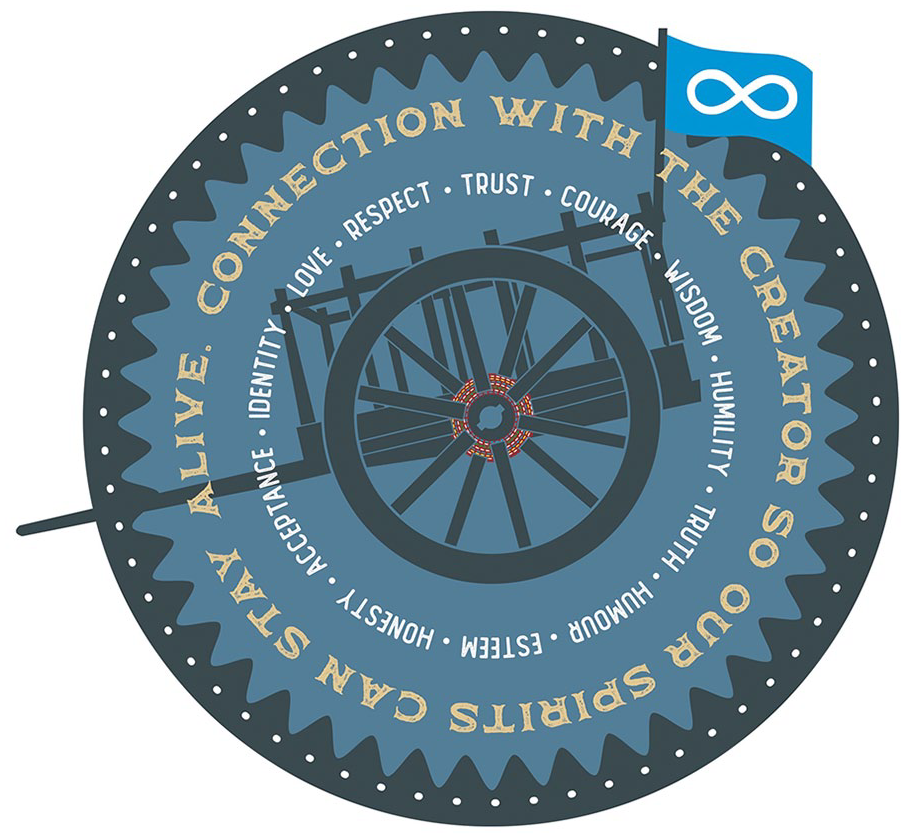
Connection with the creator so our spirits can stay alive.
Connection With the Creator So Our Spirits Can Stay Alive
Throughout the focus groups, the necessity of connection with the Creator was evident.
It’s important that we need to have the connection with the Creator so our spirits can stay alive. And hence, we learn to listen to our spirits and go through life different than always just trying to get this material stuff. It’s very important what we choose to focus on. And sometimes we’re focusing on the wrong things. (C – 11)
One participant stated, “Mental health and spirituality are connected with our higher power” (C – 05).
I felt very disconnected for a very long time . . . I think it was really overwhelming at times because I never had that culture or that background in my life growing up. And then coming into it, it was overwhelming . . . there was a part of me that wasn’t always whole. And once you start connecting with those, with your background, the trauma, once you start accepting all of these things, you start accepting who you are, then you can start healing. But if you don’t want to accept that’s part of your life. And for a really long time, I pushed the Métis side of my heritage out, pushed it aside pretty hard and I didn’t want to accept it. But once I did, I actually felt more connected and I felt there was, I was, more who I am. (C – 03)
Another participant clarified, “Spirituality is that feeling you have with your connection with your Creator, with your God, with your higher power and being” (C – 10).
We’re human beings but we’re just having this human experience. We’re human beings, you know, and we’re earth beings, like the connection to earth and the slowing down, and the finding the quiet and the creativity and the art. And allowing just a softness and an acceptance. Mindfulness practices and connectedness. Connectedness is huge, I know that was the theme in our last research, connectedness to others, to earth, to ourselves. (C – 12)
Fostering Respect
One participant recalled her experiences of being Métis.
Well, I think it goes back to our culture, our Métis culture and what we’ve been through. Because our culture was never good enough, our language was never good enough, and we were never good enough. Even when we went to school. You know, there was those judgments and opinions of people about our culture and who we are. So definitely it drags us all down and pretty soon we don’t know who we are. And we’ve been hiding in plain sight for 150 years. And not really being human, not really accepting ourselves and who we are. Because there was always that judgment out there, always that fear of somebody attacking you because you’re Indigenous or Métis or different or anything, it really drags a person down. And that’s when you have to connect with your spirituality to bring you back up, to build you back up. Because my mom’s words were, “You’re good enough. Don’t let anyone ever tell you you’re not good enough or that they’re better than you are..” . . with all this not being good enough, it’s gone onto our youth. They pick this up and they don’t know about our culture. So this is where I am today and I want to teach the youth how to teach our Métis culture so that they can be proud of it, and proud of who they are. (C – 05)
Another participant described the place of respect in the context of self-esteem and inferiority.
If you have a lack of respect for yourself, for one, you have a lack of respect sometimes for others. Because you do things. You become a liar, you become a cheat, you become a thief in some cases because you’re trying to build yourself. And if you don’t have confidence, you’ve got low self-esteem and high inferiority. You end up seeking that attention at times and you’re not even aware of it . . . when you recognize the problem, then you can start to work on those things of yourself. And we’re not talking about working with and helping somebody else when you haven’t started inside. I am speaking from self-experience, from knowing what I used to be like and what I do and what I don’t do nowadays. When you have medicine given to you, then when you are called upon by others to use it, you have to learn to forget about yourself. You have to be in the service of others as opposed to yourself, and it really changes your outlook on life when you have to do things for other people rather than for yourself. (C – 10)
Fostering Trust
The essential place of trust in healing was brought to the forefront.
And we have to have that idea of understanding who is involved so that we can have that matter of trust. And if you want to use the word faith, then okay, that too, but we need to be able to trust whom we are going to, to find the answers that we’re looking for. Whether it is for writing a journal, whether it is for actual physical healing, or whether it is for mental, emotional, spiritual healing. If we cannot trust who we’re really looking at and the system that is usually outside of our own parameters of understanding, such as Métis culture, First Nations culture, Indigenous culture, then we will have just as much trouble defining what the problem is, let alone finding a way to help heal that problem. (C – 10)
Fostering trust includes consideration of the ongoing effects of intergenerational trauma.
You meet people where they’re at, you know, and there’s no judgment. And I think that’s what’s really beautiful about the trauma-informed based approach to healing and therapy, and its huge success is that there is no judgment, there’s awareness of the layers and what’s caused it and part of it, a huge part of it is, is separation. Our modern culture separates us as individuals. It separates us from the planet. It separates us from our culture. It separates us from so many things and builds false ideologies around, how we should learn how to live. And we’re pillaging cultures and especially traditional Indigenous peoples all over the world, not just Canada, we’re pillaging the earth. (C – 12)
Fostering Courage
One participant noted, “courage is not the absence of fear, but the overcoming of fear” (C – 10).
Good mental health starts with mental awareness rather than just shrugging it off, like everybody’s doing okay when they’re really not. Having the courage to speak your own problems and not caring what other people think, you know, say what you need to say or reaching out to help that person when they’re really down. I mean, you don’t know how far your kind actions can go. I think it’s important even just if you feel like you need to say something then say what you need to say. (C – 11)
Another participant described the importance of sharing with others about mental health and addiction challenges.
I don’t think there’s any real way of preventing mental health and addiction, I think some of it is inherited as an addiction, I think it’s in our genes . . . the mental health is part of it though too, because you turn to drinking at first and you like what it does for you. It changes you, you can be anything you want to be when you’re drinking or drugging, it takes you out of yourself. And pretty soon you don’t even realize that you’re overdoing the drinking or the drugging. And that’s the mental issue that you try covering. And then it’s covered so well, you don’t even think that you have a problem and you just keep on doing what you’re doing . . . usually we get drunk, or we do drugs because we’re hurt, and we don’t want to face that hurt inside. So we stuff that, and then we keep covering it and covering it. And it just keeps hurting and hurting and pretty soon some people go violent, and some don’t. And mental health right now is a really big issue. A lot of people are committing suicide and they’re doing it by overdosing. They’re doing it by whatever it takes because they can’t face what’s happening right now and that is a big problem . . . they don’t think anybody is there to help, but if they reached to talk to somebody or even mentioned it, I bet you there would be a lot of people there to help them. (C – 07)
Fostering Wisdom
Various approaches to fostering wisdom were evident throughout the findings.
Learning to say no or even just not saying no but, “Let me think about that. Let me get back to you,” and then formulating a reason or telling them why. But no, I think it’s the most powerful thing we can do for our own mental health. (C – 08)
Assisting and nurturing each other was outlined as an essential yet neglected part of healing.
We’ve got lots of programs set up . . . when we’ve got a person that’s got a problem. Why do we build a new centre . . . in the past we had the most important thing that helped us and that was family. That is the biggest aspect that we have. We all have mothers and fathers, brothers and sisters, aunts, uncles, nieces, nephews. In the old days, if I as an individual had a problem, I went to my parents or I went to my family and they created a circle around us . . . to feel their pain, to feel what they’re going through, and to acknowledge what it is. Even if you’ve maybe never felt that. But you intuitively, internally in your heart, before your mind, you feel in your heart what they’re going through . . . I think that’s the main thing we need to come back to is nurturing . . . we need to start going back to our roots. I’m not saying we don’t need our doctors and we don’t need our medicines. But you know, among ourselves, within the Métis community and within the Indigenous cultures, we have had these means, every plant of the field given to us by Creator and put here for us to use . . . with the whole sum of all the herbs and all the things put together. (C – 10)
Fostering Humility
The concept of humility emerged throughout the data.
Relinquishing our control, being able to understand that we really aren’t in control, as much as we like to think that we’re in control of everything . . . an understanding that we need to submit that authority to our Creator, to our higher power that actually is the one that’s in control. You know what, that’s going to help. That’s helped me in the past, because if I’m trying to control everything it’s bound to fail. (C – 11)
Once participant advised, “There’ll always be greater and lesser, do not compare yourselves. (C – 12).”
I think if everybody looked at it that way, just served everybody rather than expecting other people to serve them, that in itself would change our whole society. Everybody thinks everybody should be serving. “Oh, I should get served,” and, and so we lose, we lose the part of the Spirit where the Spirit is giving, it’s giving out. It’s not to hold in for ourselves, it’s to give out to other people and to serve other people. That’s what we’re really here for is to help other people, rather than just always helping ourselves. (C – 07)
Humility included developing relatability with others.
I think that goes back to what our Elder has said she wasn’t telling us about something that’s out there, out in the world. She was telling us about family, her brother, the circumstances right there. And one of the aspects of an Elder and a healer is being a storyteller. Now, she is telling us true stories that have happened within the family so that every one of us can relate to something that way. And that’s, that is the point I think you are making, coming back and saying rather than saying, “Here’s the pamphlet, I have a story I need to tell you.” I hope you can relate to this. And as an Elder who is the storyteller, that’s the way we heal. We begin to touch the heart. And if we don’t touch the heart, instead of going for the mind all the time, if we don’t touch the heart, we’re going to miss that opportunity and they will pull away. We have to find that thing, that story between ourselves and what Creator puts into our head, puts into our heart that we need to come forth with and let others hear. Pain, sorrow, agony, distress. The same as what they’re going through because they can relate to that. And if they can relate to it, then they can listen to what we are saying. But if they don’t have that trust and they don’t want to listen to us, they’re going to continue on their merry way. And nobody’s the better for it. (C – 10)
Fostering Truth
Varying ideas surrounding truth were evident.
The belief that we have with Creator I think is what heals us, that helps cure us in the long run. But how often do we go back to our Elders? How often do we go back to our wise ones who know the herbs of the field; we don’t always follow that which we have. I’m not saying that mental illness is incurable, but I’m not saying it’s necessarily always going to be cured. I doubt that there is any one aspect that we have in our lives that is the cure-all for everything. But if we use the best of the different means and aspects that we have, I believe in many ways we can help heal ourselves. And I think it comes from our heart first, the desire, the want, to come back to Creator and in turn, our minds then start to work to do it. And too often we are, as one of my teachers said, “Stop thinking with your head so much, and start thinking with your heart.” (C – 10)
A participant described how sharing lived experiences with others would contribute to truth.
I think the most important thing is to decrease this damn stigma we have about mental health and addiction. Everybody is touched by it, whether you have it personally or a loved one, or a friend. Everybody is touched yet it’s such an “ooooh” topic. Nobody wants to discuss it, nobody wants to acknowledge they have any issues. Everybody is so walking in shame that carries it. We need to dump that. In order for all of us to face this and look at these issues, we need to look at it like just like food. It’s something that we all need to deal with. We all need to work on everybody. Everybody carries crap in our lives and we go through our lives trying to get rid of the crap that we carry and that we go through. There’s nothing wrong with it. And to change that perception will help all of us so much. So we have to start looking at it just like we’re going to eat a meal, just like we’re going to go for a walk, we have to normalize this. (C – 04)
Fostering Humor
Throughout the focus groups participants shared stories and emphasized the importance of humor in relation to healing and well-being.
We don’t need cupcakes and more sugar added to it. You know, we don’t need Mary Poppins, another spoonful of sugar and that’s going to make it all go away. They don’t work, we’re already addicted to sugar and most of us have diabetes one way or another. That isn’t going to work, that’s not what we want. We want something inside that touches our soul our spirit our heart, that says, “I care, I love you as an individual.” (C – 10)
One participant said, “that’s what I miss with COVID is our laughter, and our music, and our dance, teaching and teasing each other and having a good time” (C – 05), another remarked, “yeah, the best medicine” (C – 02).
I just have to share about someone’s grandson who was five years old. He said to his mom, she was complaining about something and he said, “Mom, your pants are bigger than your problems.” And I thought, is that ever wise. It shows you how inward we go with our problems and our thinking. But I thought that was just excellent. (C – 05)
One participant noted the place of “being able to quickly defuse a situation and use humour. If we don’t diffuse things, all of a sudden, things are very awkward. Things are tense, things are strained” (C – 10).
Fostering Esteem
Esteem was an essential part of community well-being.
A lot of times people, the way that they’re feeling they try to make other people feel. So hurt people hurt people, we’ve all heard that saying. And usually if someone’s mad they try to make other people mad. But it also goes the same way, you get that charismatic person, they make other people happy. You know, so it can go, it can go one of two ways, but also with somebody who is strong spiritually. (C – 11)
One participant described remembering maintaining self-esteem through connecting mind, body, and heart.
My mother always said, ‘remember, you are good enough. And don’t you let anybody tell you any different.’ And they taught us how to work with our head, our hands, and our heart. Once the three are connected, just look at the creativity that comes out of that. And it’s such a blessing because it really, when you’re working on a project, doesn’t matter what it is, a craft or whatever, it just brings you so much peace. And that’s what they told us. Work with your head, your hands, and your heart, and connect them all. (C – 05)
Moving through mental health and addiction challenges involves looking back and understanding where you started.
When an individual is dealing with either mental health issues or concerns or addictions, it’s extremely important for them to understand how they got to that point and acknowledge that they were at that point. And understand that it’s okay. And moving forward, they’re going to be in a better place, understanding what those triggers are or were, and trying to conquer them. And again, making certain that the individual knows that they’re on the road to recovery or they’re on the road to bettering themselves. And that was them at that point. And this is them now. And moving forward, they’re able to allow themselves to say, you know, I’m sorry to myself. And accept it and move forward because that’s a very difficult thing to do. (C – 13)
Fostering Honesty
One participant noted, “the more we share about ourselves and about our spirit or our feelings about our mental health, the better we will be (C – 05).”
Acceptance, awareness, and surrender. Like surrendered to God or Mother Nature, you know, whether your spiritual path is an amalgamation of many, like the Buddha that you encompass or incorporate, but also really the idea of not striving to be perfect. You know, that came to me a few years ago and I was like, whoa, yeah, we’re humans, and even the social media extravaganza and the likes and everything. It’s all about being that external locus of being your own rockstar. (C – 12)
Another participant described the life change when sobriety occurred.
[Elder] at the very beginning you mentioned how a person changes. Like when my husband became sober, he not only changed, but the whole family changed. And it was just like being married to a different man in that, our whole life changed and that was 50 years ago. And here’s my son, the final product of that. (C – 01)
Another participant outlined how the current COVID – 19 pandemic has affected mental and physical health.
Since the pandemic, I’ve noticed personally that I’ve been meditating a lot more, doing a lot more research on different types of meditations . . . make myself pay a lot more attention to the things that are going on around me and really put things into perspective on what’s important in my life and my family’s life. Cause it can be a snowball effect, if you go for so long, you forget the true value of what you’re actually trying to do, what you’re trying to accomplish. And if you don’t have that positive mental health support, starting with yourself, I’ve found that I can’t help anybody else. If I’m not helping myself first. And if I don’t know how to help myself first, then I’m not going anywhere . . . addiction is so broad, you can have food addictions, reading addictions, television addictions, you know, I noticed that I was watching a lot of television, so much so that I started watching stuff that really there’s no reason why I was watching . . . . I found myself really trying to figure out the direction that I needed to go personally and getting get myself grounded again. And I found that it worked really, really well. You know, if you can’t start by helping yourself, you’re no good to anybody. (C – 13)
Fostering Acceptance
Creating environments of positive support contributed to increased well-being.
I hear you using the word love a lot, and when I hear the word love, I keep coming back to a positive support. Positive supports were accepting, and that sense of belonging, which I know we’ve talked about as a Métis community and Elders. Those seem to sort of tie in with that idea of love and that idea of then being able to move from survival mode, to thriving mode. We all know survival mode, but then how do we move past and how do we foster thriving in others? I think the word love, positive support, some of those life skills, and with that understanding of self-awareness. And where does that understanding of self-awareness come from? I think from positive support. Like this big circle with a plus sign in the center. (C – 11)
One participant shared the place of storytelling, which included hearing about and relating with an aspect of other’s experiences.
Having an Elder who is a storyteller, that’s the way we heal. We begin to touch the heart. And if we don’t touch the heart, instead of going for the mind all the time, if we don’t touch the heart, we’re going to miss that opportunity and they will pull away. We have to find that thing, that story between ourselves and what Creator puts into our head, puts into our heart that we need to come forth with and let others hear. Pain, sorrow, agony, distress. The same as what they’re going through because they can relate to that. And if they can relate to it, then they can listen to what we are saying. But if they don’t have that trust and they don’t want to listen to us, they’re going to continue on their merry way. And nobody’s the better for it. In that regard (C – 10)
Another participant described the place of self-acceptance in reconnecting, understanding, and being loved.
If we can support people in that sort of sense of reconnection and understanding and unconditional love, it begins with self-acceptance, that’s all great. But when you’re relying on others to validate that, not so much. And then also with the acceptance, just saying yes; sometimes when I find myself being tough on myself or maybe I’m about to make a choice that I know I’m maybe going to regret or just physically, it’s not going to feel so great the next day, I literally ask myself “How do you want to feel tomorrow?” You know, I have a lot of food intolerances. Or if I want to have a couple of drinks, “How are you going to feel tomorrow?” And I’ve been practicing this for years now, treating yourself like your own best friend. (C – 12)
Fostering Identity
The strong place of identity was highlighted throughout the data.
Once you accept who you are and your family and your ancestors, it’s just like coming home, and you are where you belong when you get to that point. It’s just very strong, it’s a very strong feeling. My parents have always been spiritual, and I always say, “I was raised with seven sacred teachings in a willow stick.” Well, they were pretty strict and when you did something wrong, you knew, and they kept us in line, and kept us together. (C – 05)
One participant emphasized being different, a spiritual being.
We are spiritual entities having a human experience, not humans having a spiritual experience. It’s hard to find spirit in this world that we’re in with the way it is. But it’s the spirit that controls the body, not the body controlling the spirit. But if we love the spirit to give into the body, then the body takes over to control the spirit, which basically tells us that difference of right from wrong or what we can or can’t do within ourselves. When our Elder was speaking the word different, we were always made to feel different, we have to realize different goes in two ways. We can be better than somebody else or we’re better than we are different than the rest of everyone around us. Doesn’t mean we’re lower than them. We might even be higher than them, but they see us as different. And so they tried to bring us down to their level. (C – 10)
Another participant noted how identity could be distorted particularly through avenues of social media.
Facebook and Instagram are huge addictions for people now. And it causes them to be addicted, like they’re addicted to Instagram, to Facebook, to the dopamine rush. And then they get depressed and feel like their life isn’t as good as other people’s lives, when it’s actually just as good with those people just showing the good moments. And then they feel like they need to get into debt to go out and buy this or buy that or go on the vacation and do all these things. And it’s all because we’re addicted to seeing what everyone else is doing in their life and wanting it too. (C – 09)
Fostering Love
Love and grief were described as coinciding and essential to living.
If you don’t really love you don’t really grieve. Having grief and grieving, the grieving process is proof that you actually did love that person . . . my good friend decided it was time to check out. There’s lots of unknowns, and I think that’s kind of what’s hard to deal with. But you can bounce so many things around in your brain, thinking of what if’s, should’ve, could’ve and would’ve, and all these different things you can eat yourself alive with. But at the end of the day, people make their decisions and, you know, you’re still gonna grieve the person because they’re gone. And does it affect like your health if you are totally focusing on the negative? Yes, always magnifying the fact that you miss the person, then it’s going to create a negative in your life. But if you can change that in the forefront of your mind and understand that the way you think is going to change how you act. So even though you miss this person and you’re grieving, you can let their life be a positive for you, even though that they’re gone now you can still choose to view the positive things. So even though sometimes I may, for example, about 90 or 85 percent of the time the memories that I have my friend are good. Then the other percent of the time, it’s like negative thoughts about, you know, why would you do this or why would you do that? So anytime that I have a negative thought in my mind I have to consciously stop that thought and not let it go rampant in your mind and say, “okay, look, I’m going to replace that with two positive thoughts about this person that I remember.” And just build it up with. Just build it up with the positive thought process instead of magnifying the negativity in your life, because there’s so much of that too. (C – 11)
Love was described as a strong medicine.
Love is the strongest medicine of all medicines out there. Knowing that someone else cares and someone else respects you for who you are, not for necessarily what you may become or where you’ve come from or who they are, that you feel trusted that they will tell you something. It’s a matter of, they need to feel that love. If they feel the love they come to have balance in the body. For them, the balance of the mind and the balance of the body. The true, the physical and the spiritual within the one entity come together as one. The hand in the glove. But the glove can never operate by itself if the hand isn’t in it. And so that love that we give, that we express, that we help someone with is the greatest gift and helping that we can give another person. (C – 10)
Participant recommendations included ongoing cognizance of co-influences among intergenerational trauma, mental health, addiction, and spirituality.
Connecting internally and externally with self and community.
If I had to narrow it down to four words. I would say love, acceptance, resiliency, and connection. And that’s from an internal point of view and also a worldview. And it encompasses the struggles within mental health and addiction and also the recovery within the cycle of recovery. (C – 12)
Belonging to a community and caring for each other.
There are people willing to help and there are people who need the help. How do we make the connection? That’s an important thing to think about. And teaching balance, peace, and love. Making someone feel like they belong. Making them feel that warmth inside. When they realize that they can do something. Learn to listen with your heart, not just your ears. (C – 02)
Balancing and strengthening spiritual connections.
I grew up Catholic . . . but am I more on the First Nation side or am I on the other side of spirituality? Because I used to volunteer at sweat lodges and all those things too. But I always think that there’s always a place for both, for me. And sometimes if you go really die-hard Catholic, you certainly look down on other sorts of places of worship. And it’s certainly written in the Bible and emphasized a number of times too. And how do you relay that as a human being living on the earth, knowing that you carry, I have two eagle feathers at home that I carry. And I’m very careful on combining the two, at least. I have a table set up here, and I kinda keep them separate as much as possible because I’m always just a little uncomfortable about what sort of spirits are out there and how they’re looking at me. A little bit different. And I’m very grateful that I do carry those eagle feathers because they were ceremoniously given to me. And I do protect them as much as possible. But how do you combine both, being a Métis person growing up? How do you really balance the two spiritualities? Do I keep them separate or do I combine them both? Gets really uncertain most of the time, but I do make attempts to kind of keep them separate right now until I find that answer. But that’s how I look at it as relatable to mental health and addictions. I think over this COVID pandemic year, I started reading the Bible. I read about four verses a day and it’s keeping me grounded a lot more, I think, amongst all this. And I’m very grateful for that. And even purchasing a new Bible and rosary this year and so, but it’s unfortunate that I can’t go to the church that’s available to me here because of all this pandemic, even though it is open I’m just a little bit leery about going in there. So that’s the only thing that I don’t really have. But in a native spirituality piece, I can smudge every day, I can take the medicines. I can do those things without having an assembly, it keeps me grounded. (C – 06)
Connecting with nature.
When I go hunting, I usually have my boots on. But in the morning before I go, I’ll take my boots and take my socks off and I’ll just walk on the land, appreciate nature. And I just thought I’d share that because it’s weird, it’s like making that connection because it’s a primitive state. But I like it, you know, even if it’s snowy ground, I wish I could, but I just stand in my bare feet for a little bit, not run through the bush like a madman with bare feet. But I think it’s important just to get the connection back with that primitive state, with nature. (C – 11)
Discussion and Conclusion
Evident throughout our study were ongoing effects of intergenerational trauma on individual, family, and community health. Managing intergenerational trauma, resultant health disparities, and ongoing structural violence requires protective buffers including: (a) decolonizing strategies such as self-determination and self-governance; (b) identity formation such as cultural engagement, healing practices, and spiritual ceremonies; and (c) culturally adapted interventions such as incorporating information on acculturation, colonization, and historical trauma (Nutton & Fast, 2015). Current challenges for Métis people include reconnecting with Métis identity, culture, and tradition (Kirmayer et al., 2012). Participants in our study described the importance speaking up about mental health and addiction challenges, and about pursuing individual and community well-being. At a 2018 federal government emergency meeting regarding the high number of Indigenous children in care, 7% of children in Canada are Indigenous and comprise 52% of children <age 14 in care (Government of Canada, 2018), David Chartrand (President of the Manitoba Métis Federation) spoke about the Sixties Scoop, where hundreds of thousands of Métis children were taken into foster care. Chartrand emphasized upholding hope and faith, and the place of healing in Métis families and communities to prevent it happening again (Government of Canada, 2018). Chartrand identified the importance of Canadians knowing who Métis people are; one key cause of high rates of Métis children in care was identified as ignorance among child welfare authorities about Métis people (Government of Canada, 2018). Immediate actions and reforms for decreasing the disproportionate numbers of Métis children in care included establishing Métis protocols (such as family or kin placement); increased preventive services; teaching Métis children and youth about their history, culture, and language; and providing education about Métis people for child welfare workers, policy-makers, and politicians (Government of Canada, 2018). On June 27, 2019, the MNA signed the first self-government agreement between a Métis Nation and the Government of Canada with a clearly defined process to implement Métis jurisdiction in core areas of self-government (Métis Nation of Alberta, 2019).
Currently, there is much health literature on the negative effects of colonization, loss, marginalization, and decreased access to services; more research is required regarding building community, developing social support, and engaging in processes for healing and health (Browne et al., 2009). In addition, there is an urgent need for research contributing to the development of policies to increase health equity for FNMI people in Canada (McNally & Martin, 2017). Our Métis-guided, community-based research explored mental health and addiction challenges within the local community, identified preventive health factors and recommendations contributing to development of strong environments for individual, family, and community well-being.
Métis people have experienced marginalization and decreased well-being for a variety of reasons including questioning of identity as Indigenous, changes in traditional ways of life, and a lack of legal rights. Much research regarding the detrimental effects of colonialism exists, but there is little Métis-guided research contributing to understanding of individual, family, and community well-being. Our community-based participatory research built on findings of our previous study, in which we explored links between health, spirituality, and well-being within the MNA—Region 3. The primary aim of this community-based participatory research was to explore health protective factors for mental health and addiction challenges within the MNA—Region 3. Our findings revealed multiple health protective factors for mental health and addiction challenges, with potential to contribute to increased well-being within the MNA—Region 3. In addition, our research provides a model for expanding similar research across the five remaining MNA Regions and other provincial bodies in the Métis Nation in Canada.
Footnotes
Appendix
Acknowledgements
Thank you to the Elders, leaders, and community members who participated in survey development, data collection, and analysis. Ruby decided she did not want to be acknowledged as she felt she did not contribute in a major way to the manuscript and wanted to leave it to MNA - Region 3 members. Thank you to Dave McCann for expertly designing Figure 1 ( ).
).
Declaration of Conflicting Interests
The author(s) declared no potential conflicts of interest with respect to the research, authorship, and/or publication of this article.
Funding
The author(s) disclosed receipt of the following financial support for the research, authorship, and/or publication of this article: We want to acknowledge the Faculty of Nursing University of Calgary for a Faculty of Nursing Endowment Fund (Project ID 10027764), making the research possible.