



Abstract
Blending academic and theatrical worlds in research-based theater (RbT) requires balancing academic demands of institutionalized research and aesthetic demands of theater. This duality becomes particularly significant regarding ethics. With so much possibility, it becomes imperative for practitioners to share, and learn from, vulnerable and challenging ethical experiences. This creates landscapes of ethical possibilities for RbT and guideposts for navigating them, established by the field, highlighting well-worn paths, pointing out pitfalls, and noting where few have yet to trod. Contributing to this cartography, we consider ethical questions encountered during development and production of three RbT projects involving family members who have passed: Homa Bay Memories, Brothers, and Unload. In doing so, we question which stories might be best left untold and the evolution of relationships throughout the research. Exploring these together helps to develop a landscape of ethical possibilities and establish guideposts to help illuminate challenges for future RbT projects.
Keywords
Over the past several decades, the impulse to interrogate the social world using theater has increasingly been taken up in academic contexts through various methodological approaches, including research-based theater (RbT; Belliveau & Lea, 2016). In doing so, practitioners integrate theater practices with qualitative and arts-based research to engage in data generation, analysis, and dissemination. Similar to other arts-based research methodologies, RbT seeks to draw on the strengths of both artistic/aesthetic and conventional academic ways of being, knowing, and seeing the world to generate three-dimensional (re)presentations of research that offer “an empathetic power and dimension often lacking in standard qualitative research narratives” (Mienczakowski & Moore, 2008, p. 451).
Drawing together the worlds of theater and academic research allows researchers and practitioners to build on the strengths of each approach to seek ways of understanding complex issues. However, doing so requires navigating challenges encountered in each genre, in particular, issues of ethics. In this article, we propose landscapes and guideposts as metaphors for conceptualizing ethical considerations encountered when developing RbT. We then use these metaphors to examine ethical questions we encountered when developing pieces that investigate relationships with family members who have passed.
Colliding Tensions
The mixing of academic and artistic approaches inherent in RbT requires balancing the academic demands of institutionalized research and the aesthetic affordances of theater as an art form (Salvatore, 2018). Thus, as Belliveau (2014) notes, RbT is a dual enterprise with responsibilities to create something that is artistically compelling and simultaneously suitable for peer-reviewed publication. This results in what Leavy (2015) describes as a “messy terrain” (p. 268). This terrain becomes particularly complex, when considering issues of ethics, as researchers and practitioners must navigate the institutional ethical responsibilities of the researcher to participants and data in addition to the artistic responsibilities of the theater artist to audience and art form.
Navigating this complex space can create difficult moments during the development and performance of RbT projects. One particularly striking example of this duality comes from our 1 work on the RbT production Contact!Unload (Belliveau & Lea, 2020). The play was developed at the University of British Columbia in 2015 when researchers, counselors, community artists, and military veterans came together to use theater development approaches to explore the experiences of veterans transitioning to civilian life while living with stress injuries. Graham was lead playwright and stage manager, while George was director and actor. The script was developed with a core team of veterans who participated in theater activities to explore their narratives of transition. Once the script was written, the team’s focus shifted to theatrical production. In the hours leading up to the dress rehearsal with an invited audience, George asked the cast to do an Italian run. In this common rehearsal activity, performers go through the script as quickly as possible with no staging or emotion. The intent is to help actors remember their lines and pick up their cues (when they speak after another character).
George was drawing from his experience as a theater artist with an ethic of responsibility to the audience, script, and fellow performers to ensure the performance went as smoothly as possible. An unintended consequence of the Italian run was that one of the veteran participant/performers became very activated. He later shared how the rapid-paced and emotionless retelling of his narrative was triggering as it disregarded the impact of his trauma and experiences (Prendergast & Belliveau, 2018). As part of the project design, which was approved by the University of British Columbia research ethics board, counselors and psychologists were present at all rehearsals and performances. When the veteran became activated, the Italian run was suspended and the counseling team helped the veteran reregulate. After recovering, the veteran chose to continue, and the performance was able to proceed. In this example, George’s focus on an ethic of responsibility to the audience and theatrical form had, in the moment, unintentionally and unknowingly taken precedence. Fortunately, the project design included the psychological supports that allowed the veteran to understand his reaction and express it to the company. As the counseling team worked with the veteran, the theater team, including George and Graham, prepared to cancel the dress rehearsal and possibly the three performances, knowing that their responsibility to the research participants outweighed their responsibility to the theatrical form and audience.
Procedural and Practical Ethics
The example from Contact!Unload highlights the two dimensions of ethics identified by Guillemin and Gillam (2004): procedural/macro and “ethics in practice”/micro. Procedural ethics refers to the formal seeking of ethical approval from the appropriate institutional research ethics body. In Contact!Unload, this included, among other things, processes for recruiting veteran participant/performers, ensuring counseling and psychological support at all development sessions, rehearsals, and performances, and ensuring that veteran participant/performers always had the opportunity to withdraw. However, Denzin (2018) suggests that such “rules protect institutions and not persons. . . . They create the impression that if proper IRB [Institutional Review Board] procedures are followed then one’s ethical house is in order” (p. 248). But, as Ellis (2007) notes, researchers often “encounter ethical situations that do not fit strictly under the procedures specified by IRBs” (p. 5).
Guillemin and Gillam (2004) identify such situations as requiring an “ethics in practice, . . . the everyday ethical issues that arise in the doing of research” (p. 263). They “are not usually addressed in research ethics committee applications, nor are they events that are often anticipated when applying for approval” (p. 264). When George introduced the Italian run, academic and aesthetic ethics intersected, resulting in a situation that was not able to be anticipated in the IRB application process but created an “ethics in practice” challenge for the entire team. Aside from the procedural ethical imperative to ensure the safety of the participant, practical ethical issues arose, including whether we should cancel the dress rehearsal. This was not without ethical consequence as the other veterans in the project participated with the expectation of sharing their stories with others, including family, friends, and colleagues, providing insights into their experience that they had been unable to do in person. Canceling the dress rehearsal would mean this would not happen and would call into question a part of their rationale for participating in the project.
Landscapes of Ethical Possibilities
As theatrical and research ethics collided during Contact!Unload, procedural and practical ethics were brought to the forefront, highlighting the entanglement of ethical considerations in RbT projects. This is further complicated in RbT as each project is unique in its structure, intentions, and the form(s) of theater it incorporates (Beck et al., 2011). This diversity and possibility inherent in RbT means that each project will likely encounter unique and challenging points of ethics in practice tensions. Ellis (2007) reminds that, whereas there are prescribed approaches and responses to procedural ethical issues for ethics in practice, “there are not definitive rules or universal principals that can tell you what to do in every situation or relationship you may encounter, other than the vague and generic ‘do no harm’” (p. 5). Rather than engaging in the Sisyphean task of attempting to create a codified set of rules, she suggests the accumulation of “stories of research experiences that can help us think through our options” (p. 5). Sharing such stories in RbT may help map out the “messy terrain” inherent when investigating ethical issues in RbT. In doing so, the field generates landscapes of ethical possibilities in RbT. These landscapes follow the topographies of engaging in ethical practice in RbT projects such as the well-worn paths of procedural ethics that, while sometimes challenging, are relatively well mapped out. However, while walking along this path, a project can very quickly find itself in situations where the confluence of theatrical and research ethics creates significant ethics in practice challenges, making the landscape quickly unfamiliar.
Using the metaphor of landscapes of ethical possibilities, we examine moments of ethical tension that we frame as ethical guideposts, illuminating landscapes of three RbT projects. These three projects all involve family members who have passed on. The close and intertwined connections inherent in such research create complex ethical questions around the relationships between researcher(s) and their families. Through the examples, we ruminate on ethical challenges we encountered, not as prescriptive solutions but to describe our approach to considering the challenges as an invitation for RbT practitioners to consider these and other guideposts, and to model approaches to thinking through them as they navigate their own complex ethical issues.
Ethical Guideposts
Building on our work on RbT assessment touchstones (Prendergast & Belliveau, 2013) and guideposts (Lea, 2018), we frame particular stories as ethical guideposts. Guideposts are not markers pointing out direction for future projects, nor are they rules in disguise or prescriptive decisions. Rather, we propose that they serve two functions:
Drawing attention to features of the landscapes, the topography that practitioners may need to pay careful attention to as they navigate the landscape: where particular challenges may emerge.
Shedding light on how the landscape has been navigated by others and the considerations that influenced their decision-making.
Guideposts illuminate the ethical landscapes instead of setting out specific paths. They are intended to be descriptive rather than prescriptive, shedding light on the tree root hiding beneath the well-worn path and the quagmire waiting to bog down those traveling less familiar terrains. Guideposts are not benchmarks against which other projects are to be compared, rather, they highlight possible paths and pitfalls, sharing experiences that may or may not be helpful as others consider similar projects. While some guideposts may function independently, each highlighting a separate part of the landscape, others may work together shedding light onto the larger landscape of a project.
Landscape: Staging the Lives of Those Who Have Passed
In this article, we focus our attention on a specific landscape with which we both have familiarity, creating RbT productions that share stories, memories, and experiences of family members who have passed on. Both Graham and George have engaged in RbT development and production in academia to examine their family narratives and notions of identity; we use these to explore and illuminate this particular landscape of ethical challenges. Graham’s Homa Bay Memories (Lea, 2013) is a full-length theater piece written as part of his doctoral dissertation. The play examines the experiences of his mother teaching in Kenya from 1966 to 1970 and compares them with his own in the same country as an international student teacher in 2004. George’s Brothers (Belliveau, 2015) and Unload (Cook, Belliveau, & the UBC RbT Collaborative, unpublished) interrogate the memories he has of his brother and how they shaped and continue to shape his identity. All three productions were developed within academic institutions and bound by research ethics boards.
Homa Bay Memories
In 1966, Graham’s mother June moved from her home in rural Prince Edward Island, Canada to the small town of Homa Bay on the shores of Lake Victoria in Western Kenya. There she worked as a volunteer teacher for Canadian University Service Overseas (CUSO) until 1970 when she returned to Canada. Graham grew up hearing stories and seeing slides from his mother’s time in Kenya as a young woman. These stories were exciting and influential (Goodall, 2005; Leggo, 2004); however, they were scant: stories of experiences but not about them and what they meant, of who she was and was becoming a young woman at the time.
Graham was in his early 20s, had just completed his first degree, and was still living at home when his mother succumbed to cancer. Graham never had opportunities to hear her Kenyan and young adult experiences adult-to-adult; he never had a chance to talk about her fears and insecurities, her hopes and desires, and how she coped with them. In Homa Bay Memories Graham uses the medium of theater to reconnect with his mother through time, place, and mortality to engage in these conversations.
Brothers and Unload
In 1995, George’s brother Don died at the age of 27 in a tragic mountain climbing accident in the Columbia Icefields in Alberta, Canada. Despite a search team’s effort that George was part of, they never found his brother’s body. Less than two years separated the brothers who grew up in a rural French Acadian village in New Brunswick, Canada. As young boys and adolescents, they had different passions, although their pathways and experiences gradually intersected as they began university. The monologue Brothers explores the childhood and adolescent resonances between the brothers using memory and RbT approaches.
Unload builds on Contact!Unload by tracing the life of a military veteran post-deployment and placing it into conversation with George’s challenge of saying goodbye to his deceased brother. George had not written or publicly talked about his brother since he spoke at his memorial service two decades prior to developing these two pieces.
Guideposts
Guidepost: Verbatim
As Graham developed the script for Homa Bay Memories, he had to consider whether it would be structured as a verbatim play and, if not, what ethical challenges he might experience while adapting the letters. Relying on verbatim text to provide “authenticity” (Wilkinson, 2010, p. 123) to a piece of RbT suggests a transfer of meaning making from the space between author and addressee back to the words of the participants. Even practitioners such as Wilkinson, who position their work as verbatim, may adapt and change the language of their participants and add theatrical elements, removing some meanings and adding or altering others. As she found as she continued her project, “the characters were composites; they spoke the original data with new meanings” (p. 142).
While reading a collection of letters between June and her mother Phyllis that were the largest component of the data that became Homa Bay Memories, Graham found himself quite struck by the power and beauty of the language, one he knew he could not replicate. To capitalize upon, and honor, this language, he decided to build Homa Bay Memories using as much verbatim text as possible. However, this choice was not without drawbacks. In particular, the language used in the letters, while striking in the genre of letter writing, imposed constraints on the scriptwriting. For example, the letters were often written in past tense, recounting events that happened. They tell of events rather than show them, the opposite of what Saldaña (2008) suggests as the power of the ethnodramatic form. This created an ethical tension as Graham developed the script: should he use a verbatim approach to try to reflect as closely as possible the letters or should he allow himself freedom to dramatically (re)create an essence of the data?
Graham worried that restricting himself to cuts and edits might result in a “talking heads” (Saldaña, 2011, p. 35) script that told about, rather than showed, experience, betraying the ethical responsibility to the theatrical form. Inspired by Sallis (2010) and Wilkinson (2010), he found creative freedom to move beyond arranging the letters, to adapt them, break them apart, and reassemble them in a fictional framework to allow the letter writers to speak together and bring others including himself, into the work. In doing so, he moved the script from telling about an experience to one using the data to show a (re)creation of an essence of experience.
In the first version of the script, the text written for GRAHAM 2 was strictly invented, based on Graham’s memories and journals he maintained while he was in Kenya. However, the script contained no verbatim extracts of his in situ writing from this time. Inspired by his decision to use as much verbatim text as possible from the letters in later versions of the script, he returned to his journal to incorporate verbatim text from his experience as well.
The following excerpt provides an example of how he built the script out of two sources, his mother June’s letter of September 5 to 9, 1966 (see Figure 1) and his travel journal entry of March 6, 2004 (see Figure 2). In both figures, blue lines indicate verbatim quotations incorporated into the script, black lines indicate portions that were adapted, and red lines indicate portions used as stage directions.
GRAHAM The others are anxious about the two weeks of travel . . . costs, practicality, . . . I’ve dreamt about this my whole life. I want it all. I want to see the country: Maasai Mara, Amboseli, Mombasa. There may have to be some concessions. One of those concessions will JUNE North Africa is VOICE-OVER Ladies and gentlemen, in preparation for our final descent into Nairobi, please ensure your seatbelts are fastened, your seats are in their upright position, and tray tables are in their upright and locked position. GRAHAM (Takes out a black leather notebook and begins writing.) I don’t know what to think. I will be in Africa in minutes. I can’t believe it. I have dreamt about this all my life and now it’s just minutes from happening. I am on what will most likely be the biggest adventure of my life and I am relatively calm. VOICE-OVER (Sounds of plane landing) Ladies and gentlemen, welcome to Nairobi. Thank-you for flying British Airways. GRAHAM (Almost in tears looks out the plane window) The trees look very different here. Even by the airport, it looks like pictures I have of the savannah. (Lea, 2013, pp. 100–101)
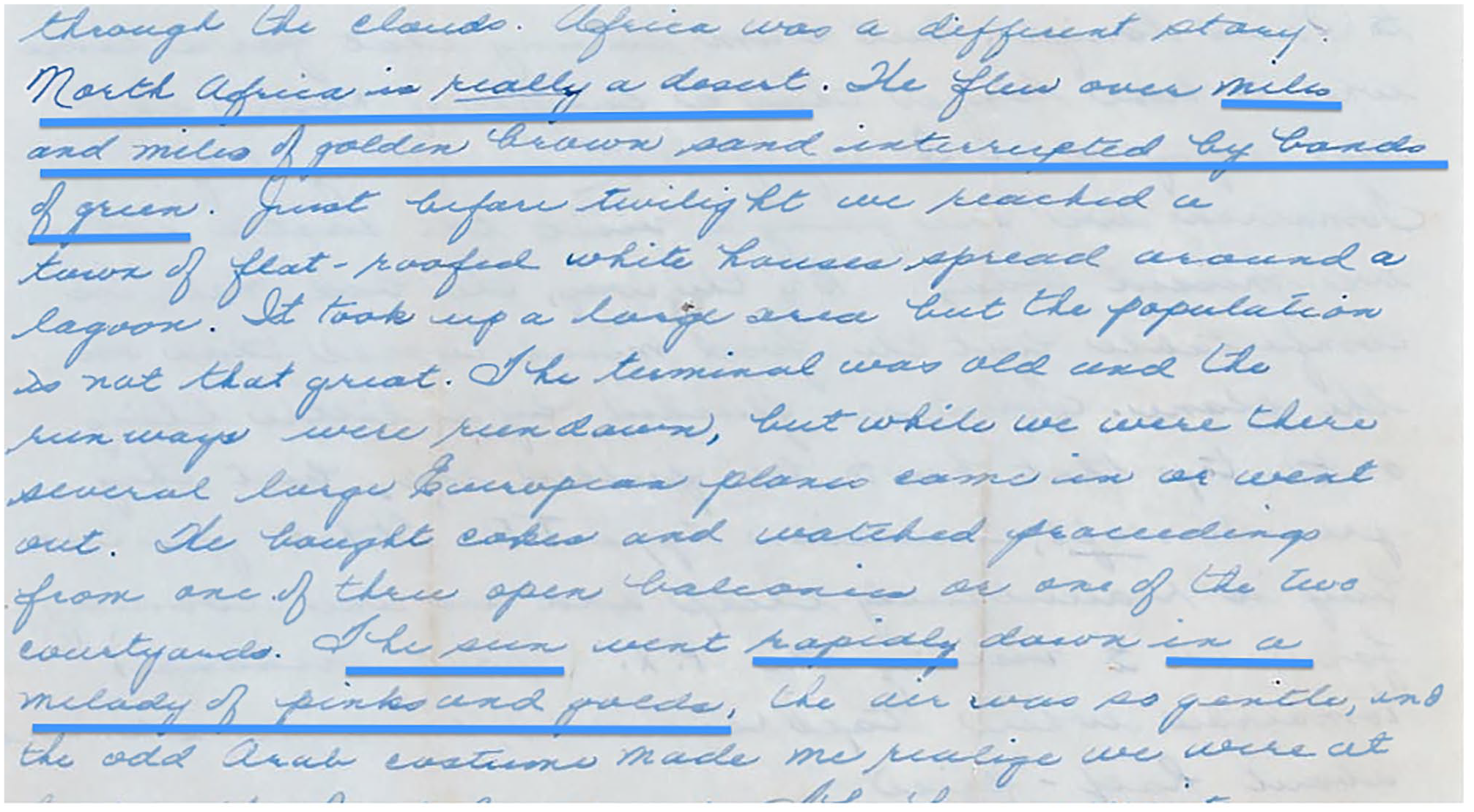
Excerpt from June Dingwell’s letter written in transit.
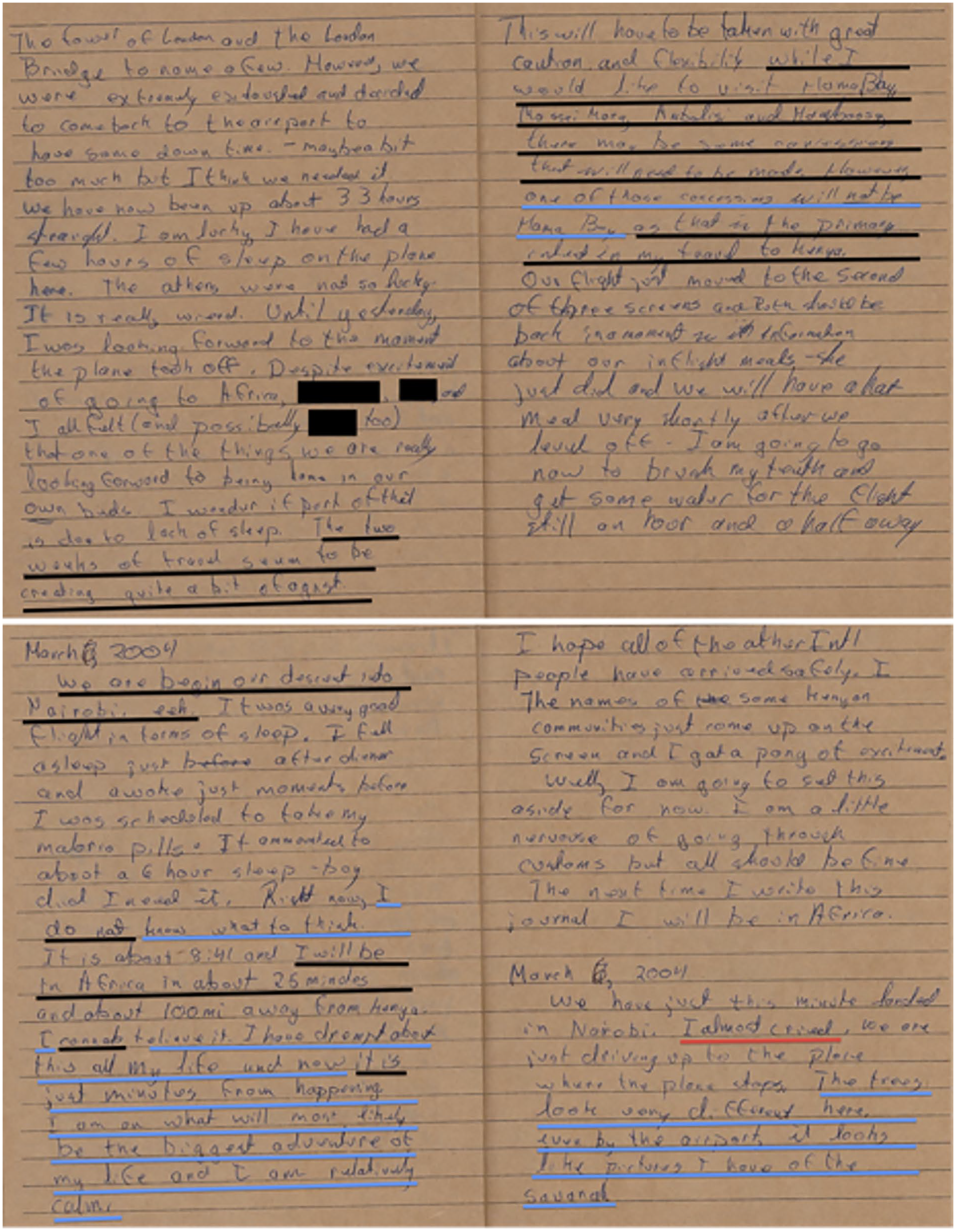
Excerpt from Graham’s journal upon arriving in Kenya.
These examples highlight an ethical tension inherent in crossing genres, in theatricalizing words never intended for the stage. June has a unique, beautiful, and powerful use of language to describe events and experiences that Graham, having never experienced them, cannot recreate. Even his own in situ writing would be impossible to replicate. However, this power and beauty may be lessened when transferred directly from the genre of letter writing to that of theater. The descriptive rather than active style that works well in letter writing may lead to a boring script. Graham attempted to address this ethical concern by rearranging and interweaving text from various letters and adapting verb tenses while trying to keep as much of the original text as possible.
Ethical decisions around verbatim text extend beyond balancing between an adherence to words of the participants and theatrical impact. In RbT productions, based largely on memory, there may not be conventional verbatim data such as written or audio recorded messages. In Unload, George revisits a recorded message from his answering machine left by his brother Don nearly on the night before his final climbing excursion. George came home too late that Friday evening to return his call, so he planned to call his brother on Sunday once he was back from climbing. He never had the chance to return the call.
Might want to think of changing that message on your machine brother! Hey, anyway, just seeing if you were in. Call me back if you can. Heading to the mountains early tomorrow morning. Dave and Rick bailed on me, so going solo. Hey, did you get that part you auditioned for a couple of weeks ago? Talk soon. Hi to Sue. Good-bye. (Cook, Belliveau, & the UBC RbT Collaborative, unpublished)
As the recording itself is now lost to time, George incorporated it in the script as a verbatim memory. This raises ethical questions around recreating the voices of others, particularly those who are unable to provide feedback on the words placed into their mouths; there is no opportunity to provide any sort of member checking of their words and the intents behind them. The familial relationship between George and his brother provided George a knowledge of his brother much deeper than would be accessible to another researcher or performer (Ellis, 2007). This led George to consider whether the closeness of his relationship to his brother provided him more permission to reimagine and recreate the words of his brother, or should these family secrets remain hidden?
In Unload, George not only stages this audio recording, but he also creates an opportunity to return to that Friday night, to make the phone call, to complete the conversation. This affords him an opportunity to release a tension/regret he has held onto ever since the accident. Poulos (2008) suggests that “the power of story trumps the power of the secret and that the ethical move for the researcher of human social life is to tell the story in ways that will move us toward healing” (p. 53). Building on the remembered verbatim text, an imagined version of Don is created through a theatrical therapeutic enactment (Westwood & Wilensky, 2005), creating a space for potential healing. George is able to theatrically talk to Don, completing a conversation he wasn’t able to undertake in life. The (re)creation of Don’s words, provided an opportunity for George to forgive himself for not calling back the Friday evening when his brother reached out. This imagined conversation supports George’s own healing, as well as offers insights for others into possibilities for similar forgiveness and releasing some held trauma.
Guidepost: Staging
Homa Bay Memories was largely written from the letters between Graham’s mother, June, and her mother, Phyllis, which were not written with the genre of the stage in mind. They were richly and vividly descriptive, focusing on telling about, rather than showing events. This led Graham to question how he might share the experiences described in the letters and their poetic language while maintaining an ethic of responsibility to the theatrical form and audience, creating a script and stage design that draws on the affordances of theater to share the experiences but does not strive to recreate them with an air of visual verisimilitude that was not present in the data.
To address this challenge, Graham conceptualized a common area center stage for Homa Bay Memories in which action could take place. The set design was intended to replicate June and Phyllis’s physical realities on the sides of the stage. The set would then dissolve into the common area: a neutral space, one that characters inhabit, shape, and mold to help tell their stories; a place where characters explicitly and visually “construct events through narrative rather than simply refer to events” (Chase, 2005, p. 656). The neutrality suggests spacelessness and timelessness, allowing the common area to (re)present rather than describe events in the letters. It is a space in which borders collapse, where characters can physically interact despite the “real world” borders of time, place, and mortality.
The common area was influenced by Bakhtin’s (1986) notion of chains of utterances. An utterance, “a unit of speech communication . . . determined by a change of speaking subjects” (p. 71), is not formed as a series of discrete events. Instead, Bakhtin posits that each utterance exists within a chain—not only in response to previous utterances, but also shaped by the anticipated response of their intended addressee. This addressee is not an inactive recipient but an active participant in the creation of meaning in the utterance.
The letters and other data used to develop Homa Bay Memories may be considered primary Bakhtinian (1986) utterances. Each is written as part of a chain of utterances of the author but meaning is created only in the space between the author and addressee. The common area becomes a symbolic re-creation of this space of meaning making. The neutrality of the common area is intended to reinforce this notion that events displayed on stage are not an ethnographic restaging of events but a co-creation between author, addressee, playwright, and audience members. In doing so, the staging choices reflects the theoretical underpinnings of the research, echoing Fenske’s (2004) argument that “forms of aesthetic representation (written or otherwise) have an ethical imperative to demonstrate through their form the investments of their construction” (p. 15).
It is in this space of neutrality that the narratives from the letters are transformed from the epistolary into the theatrical. This staging that does not attempt to recreate the worlds and people of the data—which might be considered an unethical ethnographic deception in projects such as this that are situated within scholarly research. Instead, the staging is an ethical decision to emphasize that, as the letters were written for an intended addressee, the descriptions shared within them would be similarly constructed. They, similar to the common space, are explicitly constructions. Homa Bay Memories is not a recreation of people and places; it is a fluid and unfinalized (Fenske, 2004) (re)presentation of them emphasized by the stage design.
Guidepost: Performing
George’s monologue Brothers began as a quest to explore his identity as a French Acadian; however, during writing and workshopping, the presence of his brother Don kept surfacing. Through the development, George was able to come closer to his brother, embody his mannerisms and voice, and, in doing so, theatrically see the horizons Don witnessed, as seen in this short excerpt.
DON (in awe) Just look at the sun creep over the mountains, filling in the valleys. I’ve never seen a dawn like this. Am I awake, dreaming? [. . .] Once in your life, George, you have to see the sunrise in the mountains. It’s absolutely beautiful. (Belliveau, 2015, p. 9)
The monologue explores George’s personal loss through a reflection on his memories of Don’s experiences as a mountain climber and his own experiences as an actor. Don often shared stories of his adventurous climbs with George and, always in these cases, George was the listener. In performing Don’s story, he became the teller, a task that was both beautiful and daunting. Beautiful in that he could relive Don’s incredible journeys and passion in the safety of theater, but daunting, nonetheless, to be faithful to his memories of Don and his story in the performance. Characters on stage have a tendency to be bigger than life, and the space between representing and (re)presenting and honoring and performing becomes messy. In no way did George want to gratuitously dishonor his brother and the rest of his family through an “over-the-top” theatricalization.
An ethics of practice dilemma surfaced during a particular conference performance of Brothers. Frequently, RbT performances at conferences are shared in non-theater spaces such as classrooms. However, this session was held in a fully equipped black box theater that included raked audience seating, theater lighting, curtains, and good acoustics; a space of familiarly for George, a trained actor who has performed on many similar stages. This comfort with the theater space enabled the creative work to grow and expand. The reception during the performance, and the feeling immediately after, left George with a sense of having reached the theatrical and emotional potential of the monologue. Following a rich conversation with a conference attendee who spoke of the power of theater to blur fact and fiction, George reflected on his performance. He questioned whether or not the performance took on its own life. The theatrical affordances of performing in the space moved George’s performance of his brother further from the data, potentially creating an over-the-top characterization of George’s memories of his brother and his story.
With Don not able to provide feedback on George’s performance, there is a risk that such exaggerated versions begin to displace George’s memories of his brother. Haubrich and Nader (2018) suggest that “as opposed to a stable, fixed entity, memory is dynamic and susceptible to modifications when recalled” (p. 152). Through this process of memory reconsolidation, “new experience can interweave with the memory it triggers and modify future recollections” (Lee et al., 2017, p. 531). As George recalls his memories of Don through performance, there is then a risk that an overly theatricalized version might reshape George’s memories of Don. Unlike a written sharing of these experiences, a piece of RbT changes with each performance. As a result, each time a piece is performed, it is influenced not just by the original narratives but also by previous performances of those narratives.
In elevating the “performing” of an RbT work too high, of making “theater” for audiences rather than telling a story, there may be a risk of confounding the narrative and even recreating the memories of family members who have passed. This suggests that an ethic of aesthetic and narrative must be constantly and continuously considered even in the immediacy of performance. Don lived largely as he climbed some of the highest mountain peaks in the world. While this larger-than-life persona is conducive to a dramatic theatricalization, George realized that his ethical responsibility in Brothers is to “climb alongside” and tell his brother’s story in a contained manner that honors rather than (over)performs the story.
Guidepost: Stories Best Left Untold?
Narrative privilege, as described by Adams (2008), asks who has “the ability to tell or listen to a story” (p. 180) or “who has the time, energy, ability, and opportunity to share their stories” (p. 186). After her death, Graham’s mother no longer had a narrative privilege. In inheriting her diaries, letters, audio recordings, and artifacts, Graham held narrative privilege of the stories. But this came with ethical questions around how he could appropriately exercise that privilege. As he began to develop Homa Bay Memories, he felt that to theatrically share the stories ethically, he needed a mechanism to determine which ones were appropriate to share and which were best left untold.
Conventionally, research participants give informed consent to participate in a study, which, in part, details how the research will use the data generated. Given this information, participants are aware of the research and its purpose, which, as Haggerty (2004) notes, may “color” (p. 404) the research, influencing their responses. As discussed earlier, Bakhtin (1986) posits that any utterance is not an isolated entity but is shaped both by previous utterances and by the intended addressee. From this perspective, informed consent provides participants an opportunity to filter and shape their responses to a particular addressee, a researcher, and with the knowledge of how the responses will be used. Graham’s mother did not have such an opportunity. Without a researcher as part of the intended audience of her diaries, letters, and audio recordings, June’s utterances were not shaped with awareness that they would be integrated into a research project. Thus, this could not have been taken into account as they were created. This led Graham to question whether it was appropriate, and how he might exercise narrative privilege, to use these utterances generated outside the research project.
Aligning with Bakhtin’s notion that intended addressees shape utterances, Middleton (2012) cautions that “the same writers might project different ‘selves’ in letters intended for officials or newspaper editors: anticipated readers, then, are in a sense co-authors” (p. 305). The letters June wrote home were written with a particular intended addressee, her family. As links in a chain of utterances, they were shaped by their addressees. June alludes to this in a letter to her sister from November 18, 1969: Many times I have wanted to say “tell me what is really happening” but you can’t be told; you have to be there to see and know.
Here June seems to recognize that the letters written to her do not contain an experience, rather they are representations, ones created with her in mind, which necessarily shapes the letters and the experiences described in them.
Unlike the letters that were clearly addressed to particular people, the diaries June maintained while in Kenya do not have an immediately apparent intended addressee and Graham initially thought they might be a way to get closer to her Kenyan experience, as unfiltered glimpses into what was really happening. However, as June realizes with the letters, Graham realized that even through the diaries he could not be told about her Kenyan experiences. As he delved into Bakhtin’s work and came to understand that any utterance was a co-construction of author and intended addressees, Graham began looking for the addressees in June’s diaries. Some diary entries were clearly written to herself as an addressee. Others were written to what Bakhtin (1986) refers to as a superaddressee “whose absolutely just responsive understanding is presumed, either in some metaphysical distance or in distant historical time” (p. 126). The diaries were still written for an intended addressee, which, in a dialogic sense, shaped their meanings. Thus, they provide not a closer but a different representation of “what was really happening.”
As researcher, son, family member, and steward of this collection of data, Graham had a particular ethical responsibility: to act as a proxy for his mother. In deciding which data he would include in the research, he had to ask himself “what would she want?” The staging of research in theatrical form is to share it in a very public forum. The letters were written for externally intended addressees, whereas the addressees for the diaries were internal, not generated with the knowledge that they would be shared with people beyond herself. Differentiating between an internal and external addressee provided a mechanism to consider what June might want. Transforming the internally intended utterances of the diaries into a theatrical presentation to be shared externally with others crosses a threshold that may not be respectful of June’s intention to keep those utterances internal. In light of this, Graham used those letters shared with external addressees to develop the script but used the diaries solely to clarify other sources of data, a form of postmortem member checking and triangulation, rather than integrating them into the script.
Guidepost: The Unfinish
The preceding guideposts function relatively independently; they may be considered in isolation, shedding light on a portion of the landscape without impacting the view of others. However, not all guideposts are so self-contained and how they are considered may illuminate large portions of an ethical landscape. Such is the case with how characters based on those who are no longer alive are positioned in the RbT production. Ellis (2007) suggests that “sometimes our stories about people who have died serve as memorials that keep our loved ones alive in our memories” (p. 14). This notion of memorialization suggests a fixation of the identity of those who have passed. Yet the experiences of Homa Bay Memories, Brothers, and Unload suggest that the possibilities of using theater to (re)present the lives of those who have passed may go beyond a memorialization. This creates an ethical tension in the development of RbT with family members who have passed: should their identity be considered static, remaining fixed as a constant that ceases to evolve after death or does the research explicitly position their identities as something that continues to evolve?
One of the implications of Bakhtin’s dialogism is that neither the self nor the other are single discrete entities, rather they exist in a continuous interrelationship; the self is dependent upon the other for its construction. Holquist (2002) describes Bakhtin using dialogue as a metaphor for existence. In this dialogic interrelationship, our identity is shaped not just by ourselves but also by others.
Bakhtin (1990) illustrates this by using sight as a metaphor in what he refers to as an “excess of seeing” (p. 23) or what Holquist (2002) calls a “surplus of seeing” (p. 36). This may be thought of as “what I see of you that you cannot and what you see of me that I cannot.” With the death of a parent or sibling, their surplus of seeing is snuffed out and with it a part of the identities of those they leave behind. In hindsight, Graham and George’s RbT works were in part an attempt to engage with a component of their family’s surplus of seeing. The works do not attempt to bring their family members back to life on stage but seek to use this staging to expand their understandings of themselves and to resee themselves in an effort to find out who they are.
In Graham’s case, despite being based on the experiences and in situ writings of Phyllis, June, and himself, Homa Bay Memories “oversteps the real world which it incorporates” (Iser, 1998, para. 3). From this perspective, Homa Bay Memories creates a space to stage “what is withheld” (para. 31), a continued and evolving relationship with deceased family members.
Graham’s process of researching his mother’s experiences and writing Homa Bay Memories created what Fenske (2004) refers to as a “finalization (form-bestowing activity) [which] does not close down possibilities as much as produce a space of encounter with life/living” (p. 10). This finalization is a breath, a pause, in which Graham has an opportunity to engage with his mother’s surplus of seeing and use this to see new reflections of himself. Through this space, he turns her “‘mere potential’ into a space that is open to the living event” (Morson & Emerson, 1990, p. 76). This living event does not bring his mother back to life, nor does it create a fixed memorialization of her: It provides a space in which Graham can connect to her both in the story of the research and within his life.
As Graham takes advantage of this finalization to resee his mother, he in turn resees himself. With this new sight, he again resees his mother, creating a cyclical, recursive process that may continue ad infinitum. Thus, finalization is not a closing down but it is a point of change, a temporary fixation, it is, and forever will remain, in a state of “unfinish” (Fenske, 2004, p. 15), and it will continue to be made and unmade. Through engaging with his mother’s stories, Graham creates a place of fluid finalization, of unfinished eternal possibility in which he can reconnect with his mother across time, space, and mortality and, in doing so, better connect with himself.
Invitation
When situated within the realm of academic research, RbT projects must strike a balance between responsibilities to the theatrical art form and the requirements of institutional research ethics. Whereas procedural/macro ethics are more clearly delineated, “ethics in practice”/micro ethics can be harder to anticipate and distill into a set of formalized guidelines or benchmarks. Sharing stories of vulnerable and challenging micro ethical experiences encountered during the development of RbT allows researchers and practitioners to build and refine ethical landscapes and provide guideposts to illuminate them. Of course, no story of an ethical challenge is generalizable and cannot be directly mapped onto another, but the learnings encountered may be transferable. Thus, neither landscapes nor guideposts are, or can be, complete, codified, or compelled upon other projects. They constantly evolve, rather than being frozen in time. Therefore, even what may appear to be a well-worn path with limited complications at the outset may become more complex as a project evolves.
Through this article, we ruminate on a landscape of ethics with family members who have passed. We share significant moments in which ethics intersect around our data, research, family members, ourselves, and theater. In doing so, we highlight murky areas we encountered and the decision-making process we used to navigate them, so that others who follow may use this light to illuminate their own landscapes of ethics. We invite others to consider the metaphors of landscapes and guideposts as ways of conceptualizing and navigating the complex space of RbT. Given that the ethics of theater and academic research often collide in this work, we propose the sharing of stories of ethical considerations—to leave guideposts rather than answers in order that others may follow similar paths or lay down new ones to further illuminate landscapes of ethics in RbT.
Footnotes
Declaration of Conflicting Interests
The author(s) declared no potential conflicts of interest with respect to the research, authorship, and/or publication of this article.
Funding
The author(s) received no financial support for the research, authorship, and/or publication of this article.
