




Abstract
Research shows the benefits quality friendships have throughout humans’ lives. Recent scientific literature focuses on social impact. However, the social impact of reading and dialoguing about a book about friendship is not explored. This study aims to analyze the impact of “Creative Friendships” in the lives of participants and their surroundings. Using communicative methodology, based on dialogical co-creation from the start, it includes 30 participants from diverse backgrounds and ages through individual interviews, a focus group and the observation of two dialogic seminars. Results show how reading and discussing the book impacted participants’ views of beauty, goodness, truth, and freedom.
State of the art
There is a wide and rich scientific literature about friendship and its benefits for diverse dimensions of the human being. In recent years, there is also an increasing number of scientific publications about social impact. An unexplored theme is the social impact of the reading and dialogue about books on friendship.
Scientific research has proven that the quality of an individual’s closest relationships is key to live a happy life, more than money or fame. The Harvard Study of Adult Development, one of the world’s longest studies, revealed that quality relationships are associated with a longer and happier life (Waldinger, n.d.). Long-term happiness is linked to the friendships individuals can rely on (Lyubomirsky et al., 2005).
Since young ages, relationships based on friendship have proven to foster supportive environments (Khalfaoui et al., 2021) and prosocial behavior (Padilla-Walker et al., 2015). Scientific literature has emphasized that not only the quantity, but the quality of the friendships is especially important for the adjustment of early adolescents (Waldrip et al., 2008). The protective factor friendship has against bullying has been widely studied (Canales et al., 2018; Duque et al., 2021; Roca-Campos et al., 2021). Friendship has also proven to be a source of achieving meaning in life among young people (O’Rourke et al., 2019). Relationships based on friendship foster supportive and defending behaviors, as well as preventing others from acting in a violent way (León-Jiménez et al., 2020).
The benefits of friendship for the individual human being and for society depends upon its quality, mainly if it is based on instrumental objectives or on solidarity sentiments. Parsons (1991) wrote about instrumental friendships, based on specific interests and goals of subjects above collective relationships, which are detrimental for the social system. Instead, friendships based on solidarity and dialogue foster better health (Ríos-González et al., 2021). Research by Telzer et al. (2015) also pointed out that those adolescents who have high-quality friendships and a solid support network tend to get involved in less risky behaviors compared with those who do not have them. Friendship is also key and influences the types of sexual-affective relationships adolescents will have, sometimes being relationships based on peer pressure associated with coerced sexual-affective relationships (Racionero-Plaza et al., 2021).
Most studies have focused on friendship during childhood and adolescence and less research has investigated friendship throughout life. In fact, scientific research has not often taken into account the quality of friendships of older people (Panchadhyayi, 2021). Nevertheless, it is an especially relevant topic to take into account. According to Erikson (Erikson & Erikson, 1998), the last stage of life is characterized by the conflict of integrity versus desperation. This way, individuals make a review of their lives and assess whether they have accomplished their goals. When the answer is yes, integrity is achieved; if it is negative, individuals fall into desperation. Literature on friendship has already stressed the importance of friendship in preventing depression and loneliness among older individuals (Mullins & Dugan, 1990).
Differently to friendship, most of the scientific literature about social impact is very recent. Social impact has been defined as the effect research has on society (Reale et al., 2018). Society is increasingly demanding that research impacts positively on their lives (Flecha, 2020). Thus, social impact is used as an indicator of evaluating research and research projects (Redondo-Sama et al., 2020). The social impact of research is achieved when research contributes to fulfill an agreed societal goal like the sustainable development goals (Aiello et al., 2021). In fact, social impact and co-creation are two of the main criteria in Horizon Europe and other research programs.
The social impact, the fulfilling of the sustainable development goals, is done not only by research, but also by the diverse human actions. In fact, one of the most important tasks for scientific research to have relevant social impact is to study about the social impact of successful human actions in diverse fields because the research on them contributes to their replicability, improving the results in different contexts. In doing so, the social impact is the result of both the initial successful human action and the research that makes it possible to replicate it.
In relation to the social impact of reading, previous research has shown how reading and discussing some books has an effect on future vital decisions of individuals (Racionero-Plaza et al., 2020). In fact, neuroscience has already demonstrated how our brain’s biology changes even with the reading of a book (Kandel, 2007; Pascual-Leone et al., 2019). There is an increasing number of research themes analyzing both the social impact of reading and the social impact of friendship, but the work we present in this article is the first research worldwide on the social impact of reading a book about successful friendships.
Materials and methods
In applying the two key priorities of the European scientific research program Horizon Europe, social impact and co-creation, the concretion of the communicative methodology used in this study has been co-constructed from the beginning in dialogue between the researchers and the researched (Redondo-Sama et al., 2020). The initial, foundational agreement, the starting point for the dialogue was the research question:
What impact does reading and dialoguing about the book “Creative Friendships” have in the lives of the interviewees and their environments?
To make co-creation effective from the outset, the dialogue was, first of all, designed to agree on the reference categories for analyzing the overall improvements of the participants in relation to the objectives they value as most important for their lives. This first dialogic process included individual interviews and a discussion group with seven research participants, belonging to different profiles. Subsequently, the researchers involved in the analysis took into account the revision of these categories to see if they responded to what the persons analyzed were telling us. These dialogic processes of co-creation resulted in four main categories: beauty, goodness, truth, and freedom. Some of the people interviewed highlighted how the first three categories bring together the aspirations that humanity has had for a long time and that have been built from very different places, cultures, and people, while the category of freedom has been consolidated especially in the last two centuries.
In this dialogic process, one of the main debates was about if friendship should be a fifth category of the analysis or if it is a transversal dimension of the four categories. Several evidence and arguments led the dialogic co-creation to choose the second option. The main argument was that the research question is not about the impact of the book in the creation of friendship, but on the lives of the interviewees and their surroundings. The creation of quality friendships as an impact of this story promotes beauty, goodness, truth, and freedom in the lives of the readers, it is not a separate category and it is neither a part of only one of them. The research question is not about the impact of quality friendship in the lives of readers, but the impact on them from the reading and dialoguing about “Creative Friendships”.
Following a growing practice both in Horizon Europe and in scientific publications, the concretion of the communicative methodology has been oriented to analyze the replicability of the results in different contexts. What is relevant for this option is not the comparison between subjects or groups that develop the analyzed practice with those who do not develop it. In this methodological option, the key is the comparison in two dynamics: a temporal dynamic and a spatio-temporal dynamic. In the temporal dynamics, we analyze the social impact of the subjects and groups analyzed that have occurred with the reading and commentary of the book and that had not occurred before it. In the spatio-temporal dynamics, it compares the result of the social impact obtained in the first subjects and groups with others in different contexts where the practice under study has been carried out afterward.
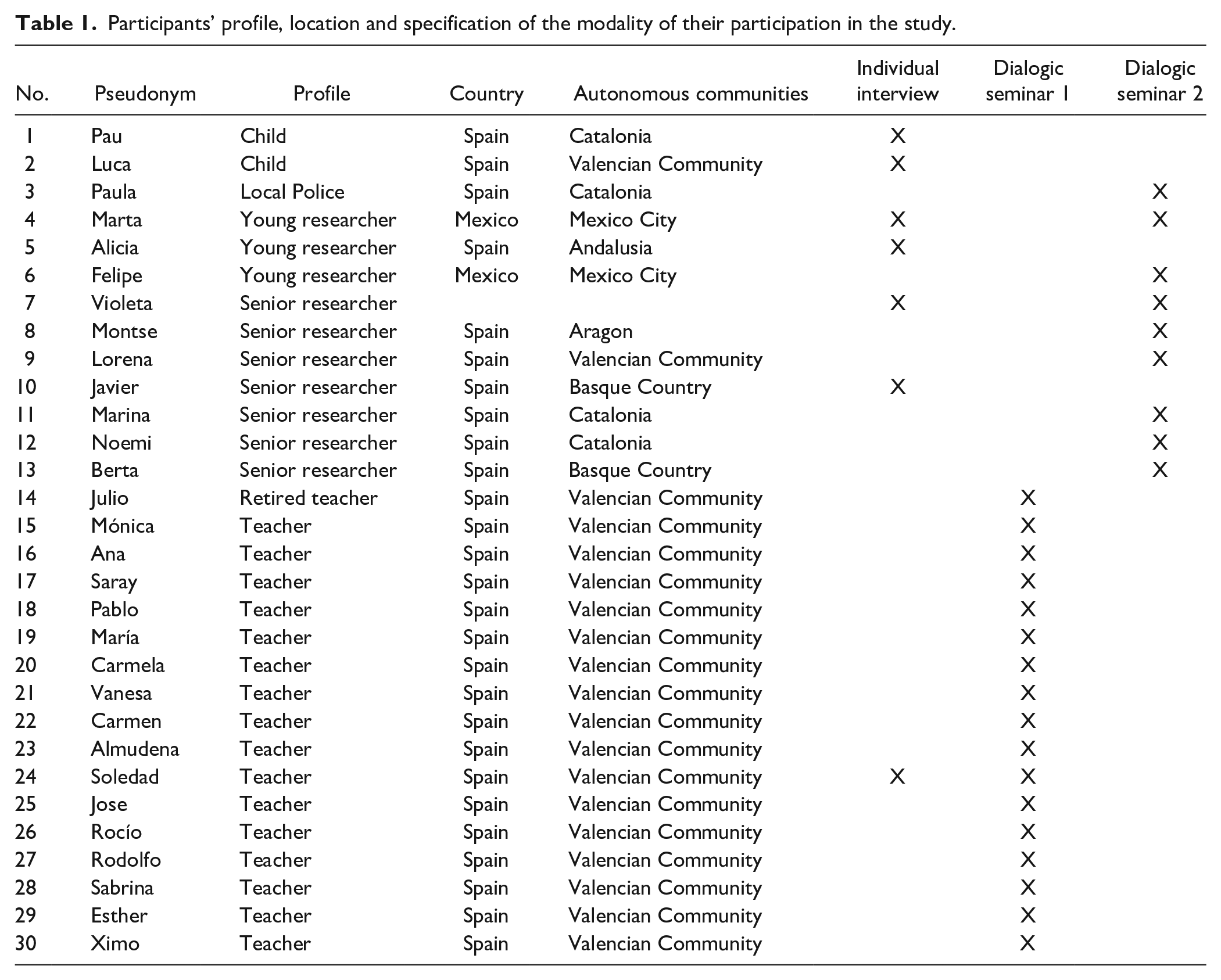
The reading and commentary of this book has been initially spread throughout different places in Spain among people with different profiles. The statements of 30 of these people, made in seven individual interviews and in three sessions of two dialogic seminars that lasted two hours each, from five different Spanish autonomous communities, have been analyzed. Among these people, there are 17 teachers, two children of 8 and 13 years of age, one local police officer, seven senior researchers, and three junior researchers. Since a reading seminar has recently been initiated in Latin America, we have analyzed the dialogue among their participants.
The Ethics Committee of the Community of Researchers on Excellence for All fully approved the research. Participants were informed of the purpose and objectives of the study and voluntarily signed a consent form through which they were also informed that they could cancel at any time. They also agreed to the publication and dissemination of the research results and the verbatim use of their own words in the narrative interviews. Caution has been taken to protect participants’ privacy in this study, and all names have been anonymized accordingly. The study received the ethical approval of the Ethical Committee of the Community of Research on Excellence for All (CREA) with reference number 20211230b.
Participants’ profile, location and specification of the modality of their participation in the study.
Data analysis
Due to the pandemic, the interviews were not done face-to-face. Some were done through videoconference, others by e-mail, and others by WhatsApp. The interviews through videoconference were recorded and transcribed for the analysis. On the other hand, two dialogic seminars were observed, where participants read and discussed the book. The first one was a seminar held face-to-face in 2018, and fieldnotes were taken to transcribe what participants were saying. The second one was a similar seminar carried out in two sessions through videoconference in 2021, which was recorded and transcribed for the analysis.
First, a researcher organized the data according to the categories co-created with participants of the study. Then, all researchers read and discussed the categorization, and engaged in a dialogue to discuss whether all agreed or not. Simultaneously, the categories chosen were discussed with participants. The first category, beauty, refers to the testimonies about how the reading and debate of the book changed or increased their conception of beauty, finding it and creating it in their everyday relationships. The second one, goodness, englobes the extracts talking about the impact of the book on participants’ and their surroundings’ values. The third category, truth, gathers the testimonies referring to the changes in participants seeking the truth after reading and discussing the book. Finally, the fourth one is freedom, which refers to the defense participants of the study make of both their liberty and that of the ones surrounding them.
Results
Beauty
When we asked Carmen about the general impression of reading and commenting on the book, she answered us with the impact it has caused on her, on her conception and experience of beauty, and what she valued it was also going to cause to the people to whom she was sending it: I have at home one of the paintings that I love the most, the Birth of Venus by Botticelli, a great pictorial art. Now I am finishing reading the book “Creative Friendships”, I see and feel clearly that the social art contained in this book is neither less difficult to create nor less beautiful than that painting. [Carmen_Teacher]
In her interview, Soledad describes the impact on her 11-year-old son and, in particular, on his attraction to reading: “Mom, this book is really cool. It’s a book that is not just read and that’s it, it gives you something to think about, to reflect on. I want it in a real book (not online).” So I gave it to him for his birthday and he was thrilled. My son has a special place for his favorite books, and there is the “Creative Friendships” book. [Soledad_Teacher]
All the people analyzed, from the most diverse contexts and conditions, speak not so much of the greater or lesser beauty of the book itself, but of the increased motivation and capacity of those who read and comment on it to create beauty in their environments and relationships. By the time they reach Chapter 9, entitled “Social Artist,” they believe they are able to put into words what until then they felt but did not know how to formulate: that if it is full of beauty, it is a work of art, a work of social art. They emphasize how that beauty has an impact on their lives and on the lives of the people they relate to. Reading and commenting on it fosters their motivation to create beauty in every instant, in each of their relationships, rejecting ugliness in all of them. Nuria transmits us the words of her son Luca, an 8-year-old: “What do you think if I leave Romeo and Juliet for a while, until I finish the book of “Creative Friendships”? I’m really interested in this. And then I’ll go on with Romeo and Juliet.” “yes, but tomorrow and with a shirt on.” [Luca_Child] In the same vein, when asked if he would like to be interviewed for the investigation, he answers: The soccer thing, yes the soccer thing, it reminded me of how I play soccer, that I’m not showing off and kicking, I play fair, I play just like Ramón. Interviewer: Did you like reading it? Yes, because few of these books talk about soccer. [Luca_Child]
Various testimonies say that they are very attracted to decorate their home with beauty, including original pictures or reproductions of famous paintings, but they are still much more attracted to have this book in their living room library or at the head of their bed, to live and relive how it is improving the beauty of their relationships with its reading and commentary. Researcher Alicia states, I have mixed feelings. I want tonight to come so I can enjoy “Creative Friendships” but I don’t want the night to be over . . . ✨✨[Alicia_Young Researcher]
Javier (senior researcher) and Paula (local police officer) highlight the impact of the book from the moment they opened it: As soon as I opened it, I could not stop until I finished it, I left other matters for another day, but the book . . . It had me captivated, impressed, excited, touched inside. [Javier_Senior Researcher] I said, let’s see if I can find time to read; and I opened the book, started reading and couldn’t stop. I was delighted to discover it. [Paula_Local police officer]
This impact fulfills one of the objectives of Horizon Europe and other scientific research programs: replicability in very different contexts, obtaining the same results. On the other side of the Atlantic, from the testimonies so far included here, the young researcher Marta tells us the following: We are reading the book of “Creative Friendships” and it is being a super revolution for this seminar in which more than 40 people participated . . . Today the diversity of voices were saying, ( . . . ) “how I want to be Ramón’s friend,” “I want to be a friend like Ramón is” ( . . . ). It creates a lot of emotion and transformation. This book is changing lives, I say that for sure. [Marta_Young researcher]
There are many testimonies about the replicability: This book is the root of everything ( . . . ) how to spread those best sentiments of humanity and that we can make more people make more transformations and generate those changes ( . . . ) this book is the root that makes us grow and analyze better those transformations and be part of them. [Noemí_Senior researcher] Another teacher in the framework of covid told me: I have been very lonely and very depressed. Thanks to the fact that I joined the seminar and there I met a person who has been working for many years and has become a very good friend of mine and I have never seen her in person but thanks to her I have felt very accompanied and very happy and she explained to me that it was a very important friendship for her. And I thought how many cases there are like that thanks to this beautiful project where we have made very deep friendships, some of them we have never seen in person but you know, they are people who will never let you down. [Felipe_Junior researcher]
The beauty that people find in this book, which they consider a work of social art, is not centered on the materiality of its pages or the design of its cover or the style of its writing; what stands out is its impact on the lives and relationships of those who read and comment on them, feeling with great satisfaction that they embellish them with beauty. The people interviewed point out that, for this impact on the creation of beauty, the coherence between the ideals promoted by this book and those practiced in reality by its protagonists and the two authors who wrote it is very relevant. They say that it provokes disenchantment to discover that writers famous for writing love poems had raped women or that artists who painted beautiful pictures lived lives full of ugliness. They say that is not the case in this work of social art. Pablo, teacher, explains: To fight double standards, it takes courage, attractiveness and strength, and Ramón was clear that this was his strength. [Pablo_Teacher]
The coherence conveyed by this book has an impact on what is later disseminated to children in schools, as Ana, Saray and Berta relate.
In Schools as Learning Communities we create links in order to show that solidarity and friendship in the classroom have a great transforming power, and we see that there is still a lot to do. [Ana_Teacher] I question if solidarity and friendship relationships are explained to the students. I think that we need to make it known, because that generates a lot of enthusiasm and the importance of abandoning the complaining, the fact of asking ourselves what we devote our energies to, and ask ourselves why we do what we do. [Saray_Teacher] Taking it to the schools and living that and living it through the brightness in the eyes of other people when we have shared this book makes it have that multiplying effect with that sense and that friendship amassed with dreams gives us the gift that we can continue cultivating it and making it grow in other spaces. [Berta_Senior researcher]
Esther, a teacher, comments on how the impact of the book generates new friendships and transforms old ones, providing them with a beauty that generates charm and leads to creating beauty in their lives as well.
I love the changes that it has meant for me, which are friendships, friendships that I already had that are now different and new friendships. [Esther_Teacher]
Goodness
Several people interviewed consider that the impact of the goodness that this work exudes is to motivate people to practice goodness in their own lives and especially to give security to people who are already good. They emphasize that this impact is due to characteristics such as the courage and security with which these behaviors and attitudes are held and their prolongation throughout life in the book’s protagonist. Javier, senior researcher, gives an emotional account of the coherence he has seen between the book’s story and the trajectory of its main character, whom he has known closely for years: Ramón is great, for me, above all, for his personal value (he knows how to make you feel important even if you are a poor teacher), his coherence in life (he has made a commitment to have clean relationships based on the deepest love), the quality of the teams he has been creating (which, without a doubt, improve the world) and also for his defense of the victims (even though this can bring him many problems and personal attacks). I have known him for years and every day I reaffirm more and more all these values . . . And to top it all, he is a world top in research, social impact and recognition by the best researchers and universities in the world. [Javier_Senior Researcher]
One of the most profound impacts is linked to the passage in which Ramón’s mother says that he defended her from a very young age, while others did not. Several interviewees refer to that moment, for example, Carmela, Soledad, and Saray. Carmela stresses the importance of zero tolerance for violence and a sense of justice: Ramón always had it clear from a very young age, in the family part and in the public part. [Carmela_Teacher]
Soledad remarks, The importance of dialoguing in school if you don’t have it innate like Ramón, because that way we will get another society. [Soledad_Teacher]
The teacher Saray contrasts the courage and decision of this young child in comparison with the resistance and difficulties she encounters in addressing this issue in people who are already education professionals: Teachers have barriers because it is also a very personal issue, because there is a great difficulty to be able to assume with honesty and coherence the issues that we have to change . . . That is why it is important to deal with these aspects delicately, to be able to take into account what is at the bottom of each one of us. [Saray_Teacher]
The positions taken in favor of the feelings and values that almost everyone claims to defend are very clear in the book, impacting in motivating to defend them more in the very lives of the people who read and comment on it. The work points out how taking a stand did not depend on whether the victims or the aggressor had more or less power or belonged to one ideology or another. Julio comments, Ramón’s political positions were also positioned against that progressivism that was becoming part of the power structures. [Julio_Retired teacher]
Carmen’s statements point out that the book’s egalitarian approach encourages the promotion of relationships between young people that are not based on power: The egalitarian look towards other human beings, for what they can contribute and what you can contribute to them. For the fact of having human relationships that go beyond positions and power relations. If we seek and create these relationships, young people can make a real transformation in the future. [Carmen_Teacher]
Interviewees comment to what extent they discover that friendship is a frequent invisible base of the best improvements of individual and collective human beings: It has made me think a lot about how in the lessons they explain the history of war and at most someone says that women are not included and then a warrior woman is included, minorities are not included and then someone includes a warrior minority, but few of these friendship relationships come out ( . . . ) how to explain the stories based on friendship relationships . . . [Marina_Senior researcher]
Truth
The main character of the book needed answers to problems that he did not find in his environment since he was a child. This gave rise to a great motivation to read and learn about all dimensions of the human being. Far from dedicating himself to articulate knowledge only for himself, he soon developed a motivation and an unlimited capacity to share it with all people of any idea or condition, including those who needed it the most. This eagerness to know and to share what he knows generates an intense impact on the people who read and comment on this book, which is very well reflected in the testimonies. Soledad emphasizes the importance of the many different types of books he devoured: He always saw in books a possibility to find answers, to learn . . . he also tried to make that enthusiasm reach those around him. [Soledad_Teacher]
But he did not look for answers only in essays, he found the necessary answers to his deepest human problems in literature; the senior researcher Lorena tells us, He searched in literature for the questions that were important and wanted the knowledge to reach everyone (family, friends, shacks . . . ). [Lorena_Senior researcher]
The search for truth and the sharing of it did not yield to any pressure, censorship, or submission. Some of the most commented and admired passages refer to how in all contexts he eliminated the law of silence and was always the first to speak out against child abuse, sexual harassment, and all types of gender violence, also pointing out the actions to be taken to achieve success in overcoming them. The comments on those parts of the book generate an impact in that those who read it feel more determined and stronger to do the same. Soledad comments, It is important that there are people like him, who always have the courage to respond and give support. It seems very transforming to have read this book. It gives me more strength. [Soledad_Teacher]
He was not only telling the truth about the things that were happening around him, but also about the deceptions about the people who were taken as referents. María stands out: The courage to denounce, to take a stand, I did not know the cases of Sartre and Beauvoir, and from here I draw the importance of knowing what the people who are referents have done in their personal lives. [Maria_Teacher]
These truths have an impact on readers, motivating them to seek the truth. Teacher Ximo also tells us that he highlights: The transcendence that our referents have, the importance of talking and reflecting on who they are and why. [Ximo_Teacher]
Telling the truth but not imposing it, accepting its refutation is an attitude that makes an impact when reading and commenting on the book. It is pointed out how this attitude of seeking one’s own truths and dialoguing them is encouraged even by the youngest readers. Luca, an 8-year-old boy, says to his mother, I’ll tell you things from the book but also things I’ve thought . . . I mean . . . that while reading the book I have also thought many things of my own, you know? Things that are not in the book, that the book has made me remember and think, things of mine . . . But that have to do with the book . . . Do you understand? [Luca_Child]
Felipe comments on a passage in the book stating that one result of quality education and its search for truth, invisible to statistics, is the creation of true friendships: A teacher told me: Look, one time I went to a meeting, I didn’t know anyone there, ( . . . ) we both took a stand to say how it was right, we didn’t want it to go astray and then we started talking to each other and we became very good friends. [Felipe_Junior researcher]
Freedom
Awareness, motivation, and the ability to live in full freedom, the defense of individual freedom against any type of coercion or power relationship is one of the most pointed out and valued impacts of the book: The importance of being able to respect freedom and to be able to choose the relationships they have from an early age. [Vanesa_teacher] How children can develop going countercurrent without being the odd one out, but keeping that atypical personality without being the odd one out but on the contrary, being the attractive and respectable one. [Marina_Senior researcher] A person who is a New Alternative Masculinities, who does not find it difficult to go against the current, who is not going to enter into all the clichés and what teenagers get carried away with ( . . . ) is a very good example for teenage boys and is very attractive . . . the language of ethics is very good but it is very attractive and this is very transforming for teenagers, for our sons and daughters, contexts. [Montse_Senior researcher] All these ideas led me to think that I could share it in a more personal way with my son and this happened this summer and reading this first chapter he told me: “I really like this book because it’s not just any book, it gives you something to think about . . . ” [Soledad_Teacher]
This impact received by teachers and relatives of minors is immediately and profoundly transferred to their work and personal contexts. Sabrina points out the importance of transmitting this favorable attitude toward freedom to our lives: Freedom and social justice for people because we are free and we can choose how to live our lives and on the other hand because we have to make it reach our students, so that they can decide how they want to live their lives and that they decide. [Sabrina_Teacher]
The statements of the people interviewed describe this impact among those who are minors. The teacher and mother Soledad tells us about her 11-year-old son: The book is helping us share and understand situations he lives through, conversations he hears and he identifies himself very much . . . Not to go into the pressures he already lives, in some groups, and in which he feels insecure, and then we refer to the book . . . “Do you remember when this happened to Ramón, and what did he do, how did he react?” It helps me a lot as a mother . . . To be able to deal with this type of situation so that he feels safe and does not give in to pressures in the peer group. It is like a gift that I have as a mother, to have this reading that allows me to dare to deal with some issues with my son. It is an inspiration, for us and for the children as well. [Soledad_Teacher]
In the same vein, there is the story of Lorena, mother of two little boys: As a mother it has touched me a lot because when they talk to me they do it to look for answers for themselves, but with these contributions I see it more as looking for and finding answers for themselves and for the other person. It would be like saying, not to free the other, to take the pressure of the moment. [Lorena_Teacher]
José, as a teacher, clarifies the importance of the knowledge that families acquire through this reading. The 8-year-old Luca also agrees on this aspect: It is vital that families know this, it is urgent to know what is better, more effective, more economically sustainable . . . [Jose_Teacher] Interviewer: I asked you about the children, but what about the mothers, the fathers, do you think it is important for them to read it? Yes, because maybe they can have an opinion with their children and they can have eh . . . eh . . . how do I explain it . . . they can have other ideas for the new life of their children and give them other kinds of . . . , let’s see . . . , health, you can teach them more things, so that your children will be smarter, more intelligent when they grow up. [Luca_Child_face-to-face interview]
Pau, a 13-year-old boy, highlights the relevance of learning to make decisions from the earliest possible age: Ramón since he was a child learned to decide well, looking for the reasons for things, that means that he has spent more years than the rest knowing how to decide . . . [Pau_Child]
Rodolfo asks the group where Ramón gets this freedom from to decide for himself his vision and position. Several people answer him with quotes from the book, some of them referring to the role of friendship. For example, Rocío, a teacher, responds, The contribution of friends, because if there is positioning there is friendship. [Rocío_Teacher]
Almudena, a teacher, points out how one can freely decide one’s friendships and own transformation: Sometimes, experiences like the ones in the book help to continue with personal transformation, for example, to go back to friendships that in the past have been very transforming, with a lot of sense and solidarity and that, nowadays, we can go back to continue building spaces of solidarity and transformation. [Almudena_Teacher]
Discussion
These results represent an important advance with respect to the state of the art of social impact. In the first place, this publication is the first one in the world on the social impact of reading and talking about a book dedicated to friendship. The findings are highly relevant for the lives of the people who participated in the study and for the people with whom they have a personal or professional relationship. In turn, the potential social impact of this publication anticipates the increased replicability of the effects found to new and more diverse contexts worldwide. The potential scientific impact will be determined by new research carried out by teams from different places that will analyze whether or not the same results occur in their contexts. In fact, until now, the research has been made mainly in Spain and in a seminar of 40 people in Mexico.
In relation to friendship, the results have no relevance at all on the impact of friendship in the lives of people. It makes no concrete new contribution to the benefits that the scientific literature has found about what quality friendships provide: happiness throughout the life (Lyubomirsky et al., 2005; Waldinger, n.d.); bullying prevention (Canales et al., 2018; Duque et al., 2021; Roca-Campos et al., 2021), achieving meaning of the life (O’Rourke et al., 2019), better adjustment (Waldrip et al., 2008) and lesser risk behaviors (Telzer et al., 2015) among young people; better health among adults (Ríos-González et al., 2021); and prevention of loneliness and depression between older individuals (Mullins & Dugan, 1990).
In contrast, the results are very relevant for the analysis of one unexplored theme in the studies on friendship: the impact of reading a book about friendship in the lives of people. In that sense, the results clarify some of the contributions of this reading and dialogue to an increase of beauty, goodness, truth, and freedom in the lives of human beings of diverse ages. The empirical qualitative analysis has outlined how people experience a feeling of beauty about the reading, the dialogue with others and their own reflections, emotions and sentiments; the similarities they make with diverse arts are significant. They relate the impact on goodness not mainly with values, but with the courage to practice those values when the power relations of the context make it very difficult. To seek and tell the truth is another of the impacts stressed and linked not only to the courage, but to the intensive intellectual activity and the generosity to share it with people of all conditions. The impact on freedom is related by interviewees to the importance of taking one’s own decisions since the early ages overcoming the pressures.
Both the methodology, based on dialogical co-creation from the beginning, and the categorization resulting from this process have been very pertinent to the question of this research and all the participants are very satisfied with it. The option to use temporal and spatio-temporal comparisons has been also very positive for this research in the views of the researched and researchers. New uses of these methodological options by other researches, authors, and in other contexts will find out whether this is the most appropriate classification for this type of study or whether it can be improved with partial or total reforms of it. In any case, its use in this study and its publication will contribute modestly to the beginning of this process. Besides, this research includes only interviews to adults who had participated in dialogic seminars due to the research question being not only about the impact of reading, but also about the reading and dialogue about the book; the only interviewees that had not participated in those dialogic seminars are the children. New studies will come about the impact of only the reading and about the impact of the reading and dialogue among children participating in new dialogic seminars.
Footnotes
Declaration of Conflicting Interests
The author(s) declared no potential conflicts of interest with respect to the research, authorship, and/or publication of this article.
Funding
The author(s) received no financial support for the research, authorship, and/or publication of this article.
