



Abstract
This is an autoethnography of World War II (WW2) survival and trauma based on a recovered family archive and a reflexive engagement with my own childhood memories. Driven by subjective imperatives to bear witness to forgotten war experiences, and to explore family mental health problems, I delve into not just personal memories but forgotten voices found in the archive whose stories have never been told thus offering a perspective of multiple subjects. My grandmother’s witness testimony of concentration camp survival recorded in 1946 compels me to research and reflect on life in the state of exception and the long-term and intergenerational impact on survivors. This autoethnographic work helps me examine the character of survival of war trauma as a form of exclusion from community and often an incomplete return from bare life to polis. Through engaging with the archive, I find some partial answers to questions about my family members, and reconstruct my family memory narrative.
That a return to an almost normal life after one had become a ruin and a ghost is possible, is not such a terrible thing. It is a natural human self-preservation instinct; the physical self-renewal capacity shows that human beings are adapted to overcome adversity, only weakened through the over-reliance on comforts of civilisation. It is much harder for those who do not want to return to life, who have survived and have been, by the judgement of God, condemned to live.
Introduction. The Ripples of Trauma
This article is part of a project about my maternal grandmother’s ambivalent experience of survival of the horrors of Ravensbrück concentration camp, which I only begun to understand a few years ago after finding a forgotten family archive. I have redrafted this piece many times; but it is only since engaging with the literature on autoethnography that I have been able to give shape to the ideas and emotions. For Denzin (2013), autoethnography begins with the biography of the writer and moves outward to culture, discourse, history and ideology. [. . .] It allows the researcher to take up each person’s life in its immediate particularity and to ground the life in its historical moment. (p. 124)
Mine begins with a memory of childhood lived in a small family touched by palpable inherited anguish (Giorgio, 2013) which I, as a child, felt but could not make sense of, other than connect it to a handful of war stories which were shared with me. For autoethnography, memory is crucial.
As autoethnographers, we use memory for much of our data; through memory we ground our analyses; our memories inform our epistemologies and methodologies [. . .] bearing witness to life’s experiences—our losses, sufferings and sacrifices; our conflicts, healings and transformations. (Giorgio, 2013, p. 405)
But what if all we have is fragments and echoes of the “past”? I carried such incomplete memories for years when trying to make sense of the ever-evolving present; knowing, or assuming, that those incomplete memories and untold stories hold the key to understanding and making sense of what is and what is likely to be.
The irony of the lost and absent memories of my own family war trauma is that I was growing up in Poland where the prevailing narratives of national suffering and war-related martyrdom defined and dominated Poland’s post-1945 historiography. Yet as a child, I knew just the few bare facts of my own family war experiences which my mother shared with me. Both of my maternal grandparents were arrested by the Nazis at the beginning of the war for resistance activities. My grandfather was killed, but my grandmother survived Ravensbrück, a women’s slave labor concentration camp in Germany. After being liberated by the Swedish Red Cross, she spent some time in Sweden recovering from the ordeal before returning to Poland. She died when I was still very young. I knew my mother was deeply affected by the loss of her father, whose body was never found. Yet, this personal trauma was not talked about beyond a few facts, its reality embodied and thus felt through emotions and the body, seen in and communicated by the loved ones, often outside any cultural representation. It is that experience of personal pain without a coherent story that has led me to this project. 1
Growing up in communist Poland in the 1960s and 1970s, I was surrounded by vibrating echoes of the war; the city of Warsaw still wounded with patches of ruins, bullet holes, one-legged men on crutches, words such as “Germans,” “Hitlerites,” or “concentration camps”; an organic, collective, living memory. Since then, the physical fabric of life’s infrastructure has been patched up, the last remaining bomb sites cleared, urban cavities filled with socialist realist concrete. My mother, an independent, highly intelligent, charismatic, fierce, and fun-loving woman, seemed emotionally fragile to me. Without ever articulating this thought, I grew up sensing my mother was a war victim; a person who had clearly not healed from her past experiences, who could not sleep at night, for whom the war never ended. After her premature death in 1994, I was too traumatized to sort through the paper-trail of the troubled past. Not knowing what was in her papers, I packed them all and posted them to myself, already living in London.
At some point, I began to wonder if my maternal grandmother’s story held the key to my own auto/biography, 2 as I could see that her life was touched by trauma and I could feel that in our tiny family, the war did not end. Not only was my mum troubled; her fragile person had succumbed to an undiagnosed mental illness which she could not acknowledge; she spent the last few years in isolation and anguish, refusing help or support.
In the last decade or so, as my own aging has helped me realize how recent 1945 was, I have become very interested in what really happened to family members during the war. What did these words actually mean: “arrested by the Germans,” “been to a concentration camp,” “lived through the Warsaw uprising” . . . ? How did these experiences affect my grandmother, my mother, and indirectly, on myself? Having forgotten about the parcels I had sent in 1994, I tried talking to elderly relatives who might have known the war stories. Very little was added to the anecdotes already told to me by my mother. Today, there is no one left to ask; there are no witnesses left to my family’s story anymore. But one day, I remembered the parcels and opened them.
Survival as Moral Courage
Inside the boxes I found letters written during and after the war, documents, unfinished diaries, scraps of paper with notes, poems written or copied in the camp, even letters sent to and from the camp. The most revealing were the letters written between January and August 1946 between my grandmother Aldona, who was recovering and working in Sweden, and the three women she left behind in Poland: her mother, her older sister Wanda, and my mother, a small child. In her letters home, my grandmother shared her experiences, reflecting on her survival and, to a small extent, on her time in Sweden. What follows is an attempt to uncover some aspects of her war experiences from the correspondence between 1942 and 1946 (Figure 1).
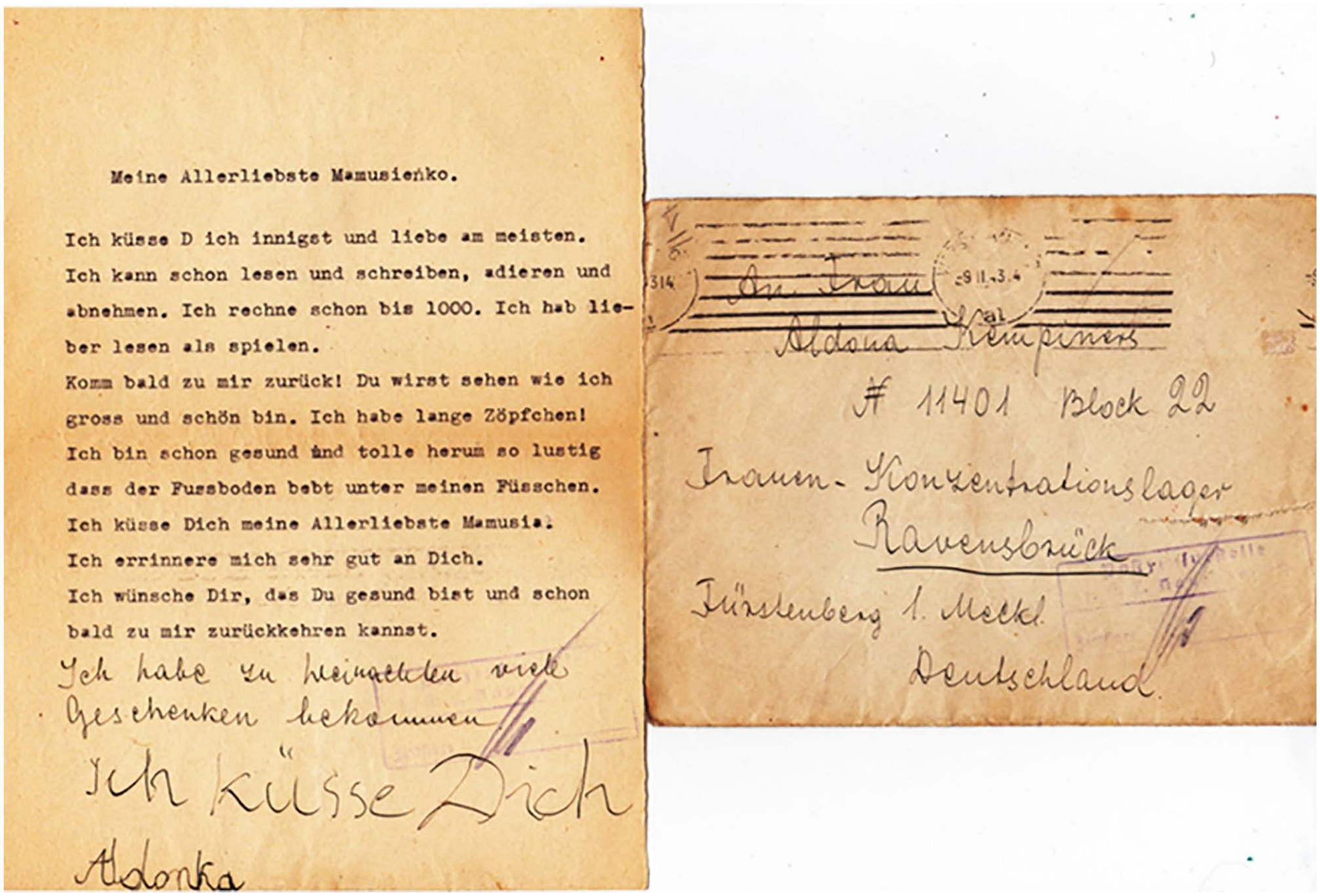
A letter from young daughter and envelope addressed to Aldona K., an inmate of Ravensbrück.
Among the most moving in the archive were the letters to my grandmother in Ravensbrück written on behalf of my mother, then aged just five. They were clearly dictated by her to whoever was able to translate her words from Polish into German. It says, My dearest Mummy. I kiss you most deeply and love you most. I can already read and write, add, and take away. I can already count to 1000. I prefer reading to playing. Come back to me soon. You will see how I’ve grown big and pretty. I have long pigtails. I am really healthy and romp around so merrily that the floor quakes under my little feet. I kiss you my dearest Mummy. I remember you very well. I hope you are well and can come back to me soon. I got lots of presents for Christmas.
This, and another similar letter, dated 1942, shows my mother’s first ever attempts at writing, signing off the letter with the words “I kiss you, Aldonka” in her childlike handwriting in German, the language of the aggressor and the occupier. Whether conscious of it or not, the reassuring pronouncements about her five-year-old daughter’s achievements spoke of resistance to the official Nazi educational policy in relation to Polish citizens as outlined by Himmler: For the non-German population of the East there can be no type of school above the four-grade rudimentary school. The job of these schools should be confined to the teaching of counting (no higher than up to 500), the writing of one’s name, and the teaching that God’s commandment means obedience to the Germans, honesty, industry and politeness. Reading I do not consider essential. (Himmler, 1940, in Gumkowski & Leszczynski, 2012)
Who was it that translated these letters into German, was it my great aunt, or my great grandmother? Did they have to pay someone? Which of them was typing? Writing in German, for the convenience of the camp censors and not exceeding a specified length, depending on the type of prisoner were some of the rules regulating camp correspondence (Morrison, 2000).
The envelope, one of many found in the archive, shows my grandmother’s name, her prisoner number, and the block number. According to Morrison (2000), in early 1940, Block 22 was occupied by Gypsy women but by 1942–1943, that population was deported to Auschwitz-Birkenau. By then, Polish prisoners were the largest national group there. Yet, the block number is different on different envelopes, which tells the story of frequent relocation around the camp during the three years (1942–1945) of her incarceration there. Helm (2015) confirms that splitting groups of friends and sending women to different barracks was common. What was it like to have to part with familiar faces, leave the fragile sense of security, and then move in with new prisoners and start all over again in overcrowded bunks?
While in Ravensbrück, she could not truthfully describe living and working camp conditions in her letters home, as for doing so she would have been punished by losing the once-a-month letter writing privilege (Helm, 2015). 3 The contents—both from and to prisoners were strictly limited to “good” news and neutral information; but it was still invaluable for letting loved ones know the prisoners were alive.
Here is a translated letter (from the German original) to my grandmother from her sister and mother in Warsaw looking after her little daughter (my mother) dated September 15, 1942: We have [received] your letter from August as well as the one from 11 September. Thank you very much. We have no news from Fred. Your child is healthy. We feel good. We have received 2 packages of your belongings from the patronage. Are you healthy? Do you have work and what kind of work? Which carpets do you write about in your letter? We don’t understand. We have a lot of work. Inflation is terrible. The apartment is fine. Our family lives and [sends] greetings, also to Sophie. It is very sad and difficult for us to live, so far from you. When will this end? The little one develops quite normally, she is 8 cm higher for her age, she is 111cm tall. She is under good care of her doctor. We take care of her as it is only [possible]. She feels very good. She continues to thank [think of?] you. The worst thing is that we won’t be able to send you food and money. Can’t you get a permit? We kiss you warmly—soon we will write again.
This short letter, signed again by all three of them by hand, including my mother, stamped, and signed by the camp censor testifies to so much of the family’s traumatic war conditions. It is written 18 months after my grandmother’s arrest when her daughter was only three-and-a-half years old. The reassurance that her child is well looked after, is growing and even tall for her age is intended, and probably received as comforting. Their home is intact—It has not been destroyed. But in such brief guarded sentences, worries are also communicated: They are desperately worried about her, there is no news of her husband Fred, 4 costs of living are soaring, and so her sister is working very hard to make ends meet.
It was only after her liberation by the Swedish Red Cross, while living in Sweden until October 1946 that my family were free to speak freely about the war ordeal. Most of the story is revealed through the letters written in those months before they were re-united. Below is my grandmother’s explanation why correspondence between them was suddenly stopped in early summer 1944.
I received your last letter of 1944 in May that year. In that letter there was one careless phrase used for which I was punished by not being allowed correspondence from you anymore. Whether you received my letters after that, I do not know. [. . .] In cases of such punishment, the prisoner would not be officially informed, instead, the miserable inmate waited for her mail hopelessly suspecting the worst possible misfortune back at home. (Aldona K., February 14, 1946)
The uncensored post-war correspondence from Sweden reveals the true, terrible conditions in the camp, and the overwhelming threat and presence of death to the extent that surviving was the prisoners’ key priority.
Writing about his experience of surviving death camps as a Jew, Primo Levi (2013) notes “here the struggle to survive is without respite, because everyone is desperately and ferociously alone [. . .] he will find no one extend a helping hand; on the contrary, someone will knock him aside” (p. 98). Unsurprisingly, the survivor guilt has been recognized as part of the trauma. In Ravensbrück, the slave labor concentration camp, chances of survival depended on many things, including lighter work, not falling ill, understanding, and following the rules. Yet, in most of her 1946 letters, my grandmother expressed her deep ambivalence toward survival. She writes that she did not really try to survive, and instead, she put her faith in God, and tried to maintain her moral principles, to ready herself for death. That determination made her feel both mentally and physically stronger. In that resolve, she also seems alienated from other prisoners who, she perceived, wanted to survive “at any cost.” In a letter to a relative in 1946, she writes, I did not struggle for life at all; on the contrary, since 2 March 1942 [the day her husband was killed] I have not wanted to live anymore. The core of my life was broken. Life has lost its meaning. I died. Only the moral side has remained. When three months later I was taken to the camp, and after the quarantine I was to start work, the struggle among people started: for survival, for “better” work, for this terrible survival at all costs. Human and national solidarity disappeared, and moral consideration ended. What began was moral disintegration. My position was thus: [. . .] “Don’t volunteer to do anything, don’t [show to] be capable of doing anything that [would benefit] them but be prepared to do anything in case of necessity.” Faithful to this principle and because of my attitude to living, or maybe led by instinct, when the necessity came, I threw myself into the hardest and most dangerous jobs but work as far away from the war industry as possible. I wanted to lose myself physically, I wanted to not be in order not to go mad. This was outdoor work, in the fields, ground works, and heavy lifting, mending railway tracks and replacing railway sleepers (a sideline which led to a huge military sanatorium, where the sight of living carcases could be born with much spiritual effort). (Aldona K., 1946)
This sentiment is repeated in many of her letters. She does not try to survive if it means competing with others for better food rations taken from someone else. Equally, she rejects a chance to get “lighter,” indoor work directly supporting the Nazi war industry, opting for heavy physical outdoor work; the least-preferred option of other women. Demanding manual work brings her some comforts: This hard work protected me from madness because I could avoid three lethal camp elements: noise, smell and overcrowding. [. . .] I worked to lose myself—for myself and for other Polish women in conditions I cannot now write about here. I’ll tell you just one thing: in the Autumn our clothing would not get dry on us for a fortnight. (Aldona K., May 30, 1946)
She also reports that despite physical hardship, she has become fitter.
Instead of dying, I gained muscles, became healthier than ever and stronger—all this was gradual as I did get sick there, too. [. . .] I did not struggle to survive. Among the general moral decay caused by the idea to “survive at all costs” I put it the other way: “I will not give up my moral principles for any price.” They would not buy me. This [attitude] meant death. It was important [to me] to die well, to prepare internally for any evil dealt by the enemy. . . [I wanted] to make my soul immune not to be shocked by anything, not to give the enemy any satisfaction—even by death—and this way to remain beyond reach of the enemy. Thus armed, I was never afraid, I sabotaged my work, I was immune to hunger, pain, cold, to notorious sleep deprivation, I could lift the heaviest loads—and despite all this, against myself, I survived. This was clearly the Will of the Highest Justice of the Loving God who chose for me the road harder than death: life. Faithful to His Will I have taken up and now bear this burden of life, my heavy Cross. (Aldona K., 1946)
Despite her physical suffering, she does not express her “pain” however, but prefers to talk, in much detail, of how she protected herself spiritually from the hell in which she had to function.
This is what happened to most people imprisoned in the camps: the miserable survivors constituted a mix of various nationalities, cultures, mental abilities—from the most primitive the majority up to distinguished intellectuals of different characters, personalities, in this dreadful vegetation which was our fate, in contempt of human dignity, through the hard work beyond normal endurance, always starving, sleep-deprived, always cold human beings, which broke the strongest individuals . . . It was the moral breakdown which was more [devastating] than the physical breakdown . . . Thus, in those conditions in which it was immeasurably difficult to remain oneself—a human—there those sufferers lost their God . . . Strange thing: the same factors which made most people lose their God, have revealed God to me. (Aldona K., 1946)
My grandmother’s reliance on her religious beliefs is both a form of spiritual and political resistance against the force which is trying to crush her; it is also a source of strength helping her survive even though, as she says, she did not try to. Her priority was to be spiritually ready for death. Hence the importance of her values; she writes that she never stole from inmates, never tried to get “better” jobs, she sabotaged the tasks assigned to her, and she helped others, and she maintained her religious faith. This clearly helps her dealing with the very fact of survival. Her physical and moral resilience both seem stronger due to her faith. “As far as my moral strength is concerned—I draw it from such a rich Source that it will never run out for me.”
Aside from the purely religious theme is the moral theme of in/dignity in survival; she repeats that life was not worth living unless dignity was kept. The idea that there is a problem of indignity in the desire to survive at all costs is visible in my grandmother’s observations of the spiritual and moral collapse in the camp. “People lost their morals partly or completely en masse. The hardest thing was to last over time; the biggest enemy of human [virtue] is time.”
This is also expressed by Levi (2013) who writes that “precisely because the Lager was a great machine to reduce us to beasts, we must not become beasts” (p. 449) and remain dignified to be able to later bear witness. In her letters, A.K. shows she is grateful for having remained morally intact, yet she clearly paid the price for the very fact of survival: “God has protected me, I did not lose myself morally, or spiritually, as unfortunately did very many victims—but my soul has been marked by my mistrust of people.” The price is her loss of faith in humanity and in people around her. That was her price of survival that she carried with her to the end of her life. In her determination to stay faithful, she seems herself more and more distant from those who are around her; she is clearly estranged from other inmates, who, as she emphasizes, “fight for survival at all costs.” Yet, her integrity intact, is a deep source of pride when she writes about herself: To survive with integrity in such horror, when every day, every hour lasted eternity, so to last there four long years and not to lose myself morally, not for one moment; to remain oneself, and to stay faithful to all my principles, and to carry my humanity, dignity and honour out of that hell, that, I think, is something. (Aldona K., 1946)
This single sentence speaks of my grandmother’s victory and a deep sense of pride, one I was not aware of until finding and reading the archive. To witness my grandmother’s survival for me is to speak of her moral courage.
Subjective Imperatives
The main theme in the 1946 letters from Poland to Sweden is the longing and the desire for A.K. to return to Poland. The letters tell of their struggle to preserve their own humanity and the bonds with the loved ones, through unimaginable hardship. Reading the archive, I found myself going back to a place that no longer existed except in those dusty handwritten pages; a place that could not be more real, more stretched in time, more life-transforming. As I swam upstream, going in the wrong direction, I discovered a community of shared and then forgotten suffering. In four parcels, covered in so much dust it made me ill, the archive revealed itself to me as an ethical and political obligation, an imperative to keep researching my family’s hidden history. I felt summoned into “being-with-the-dead” (Ruin, 2015), an obligation to reconstruct a hidden or absent memory (Giorgio, 2013).
Being-With the Ancestors
The idea of being-with-the-dead involves enabling the ethical and political relation to them and recognizing the reality, for us, of the space which, following Derrida and Heidegger, Ruin (2015) calls the “ancestral.” Here, memory and historical consciousness become an obligation: “being summoned by the past, rather than holding it in our hand and under our gaze” (Ruin, 2015, p. 62). At this point, I found myself in a space between a messy family archive, World War II (WW2) historiography, and memory studies; but from my original auto/biographical curiosity or more appropriately, concern, I was pushed into the realm of ethnography of civilian life in WW2. It was about an emotional and ethical investment, driven by my own subjective imperative.
The imperative was that of care, in the Heideggerian sense, part of the structure of Dasein; as being-in-the-world in its finitude, between birth and death (Ruin, 2015). I needed to read all the handwritten pages to find out what happened to those relatives, just so that they could tell their stories. Despite the finitude of human life, our dead others still speak to us, and we still care deeply about being true to them. In that way, the dead others assume, as Ruin (2015) names it after Derrida, the spectral existence. “The dead—as the having-been-there—are the source of the meaning of the historical, precisely by not being simply past, but by somehow lingering on that ghostlike region of perfective being [. . .], the ancestral” (Ruin, 2015, p. 67). Before the archive, the dead were excluded, yet “the ghosts and the spectres [. . .] rely on us to remember them [otherwise they] come back to haunt us when we believe that we have laid them to rest” (Ruin, 2015, p. 70). That imperative to know, to be able to care, and to position myself toward the ancestors as those whose lives and stories need to be told and taken into account, to give them their voice in the world of today, is the labor of autoethnography which is about “being in the world, being with others” (Spry, 2018, p. 631). The imperative is to properly constitute the dead as ancestors; not just to treat them as the numbers of the dead but rather to let them speak, to give them voice in and through autoethnographic co-presence (Spry, 2018) and relational ethics of care (Ellis, 2007, 2017).
Bearing Witness
I began to put together pieces of the past and recover the experiences of my grandmother imprisoned by the Nazis, my grandfather I never met, those other family members who were killed, and my mother and the two women who looked after her during the war in Warsaw. I read their letters to each other and saw them all as war victims and refugees. I learnt about family members I had not known existed. The previously forgotten, childless dead of the war now had names and personalities, and only me to speak for them. I felt called to be a witness. Yet, I found myself caught up in a dilemma. Writing about the Holocaust, Agamben (1999) argues after Levi (1989) that the survivor cannot be a true witness. Primo Levi (1989) who had gone through the horror of Auschwitz, wrote, “We survivors are not the true witnesses. [. . .] we are those who by their prevarications or abilities or good luck did not touch the bottom” (p. 64). Thus, there is the philosophical problem of who is to speak for those who have suffered the greatest injustice. This obviously puts me in a difficult position and raises the question of my right to speak on the subject; I am not even a survivor. Holocaust literature cautions us against presuming to understand the experience of the horror of death camps. However, Levi (2013) remembers a three-year-old boy in Auschwitz whose only uttered words before his death were incomprehensible and yet remain the only testimony of his existence. This articulated memory of the child speaks of the human need, to be known and remembered; it also answers the “logical paradox” of the problem of who is to speak about the injustice. To give victims a voice is to be prepared, when called upon, to speak on their behalf, to “bear witness to the lives and struggles of those who came before us” Giorgio (2013, p. 406). The complex epistemological problematic of representing the “Other” is examined in depth by Kitzinger and Wilkinson (1996). While acknowledging the danger of othering the oppressed through academic representation, they show ways in which othering can be disrupted as well as warning of the danger inherent in not representing thus leaving the “Other” out, silencing and making them invisible (Kitzinger & Wilkinson, 1996). While the epistemological problematic might never be resolved satisfactorily, the ethical imperative of involvement is to “creat[e] conditions under which it is possible to hear the voices of Others ‘talk back’” (Kitzinger & Wilkinson, 1996, p. 17).
My autoethnographic work, then, is to enter the world of the dead others, and recover their stories of being-toward-death, of living during the war to reconstruct the account of the war from the experience of those oppressed—now dead. The significance of their stories is not their death but in gaining insight into the way they and countless others lived amid the terror of the war. To witness the civilian fate during brutal war is to bear testimony to the trauma of endurance, horror, pain, courage, and strength. Before they became the war dead, they were survivors, and indeed, witnesses. In my imperative to understand my grandmother’s ordeal, in the next section, I contextualize my grandmother’s accounts of life as a slave laborer in the literature on concentration camps.
Concentration Camps: (Bare) Life and Death in the State of Exception
The Nazi concentration camps were a “central pillar of the Third Reich” (Caplan & Wachsmann, 2010) and were built and run from 1933 to protect and cleanse Nazi Germany and later also the occupied territories from “racial and social outsiders” (Wachsmann, 2010). Purpose-built, envisaged as modern “cities of terror,” the camps were situated away from populated areas in Germany, and were the site of SS total control. Behind the barbed wire, ordinary jurisdiction ended: Inmates were stripped of any rights, and brutal discipline and terror ruled (Wachsmann, 2010). The legal basis for setting up spaces and temporalities outside of the legal framework is the modern state instrument of the “state of emergency,” or “state of exception” (Agamben, 2005) to protect the state from a named threat.
Originally envisaged to be financed from the state budget, the concentration camps system expanded during the 1930s and quickly became overcrowded and economically unsustainable. Once the war started, their purpose evolved into providing slave labor (Caplan & Wachsmann, 2010) and by 1942, the camps became a fully integrated part of the Nazi war economy (Wagner, 2010). Out of approximately 15,000 of various types of concentration, labor, and holding camps set up by the Nazis in Germany and the occupied countries (Gilbert, 1993), eight were extermination camps. Ravensbrück, first opened in May 1939, was a forced labor concentration camp for women situated north of Berlin (Helm, 2015; Morrison, 2000). That is where my grandmother and her sister-in-law were sent.
“Bare Life”
The Holocaust is often imagined thought the horrific black-and-white photographic imagery depicting dehumanized dead Nazi victims. But the focus on death alone is incomplete; by the time the photograph was taken, the suffering had ended. To avoid objectifying people as bodies, the images must be allowed to speak to us not so much of death itself but of agony of suffering prior to death; while in the state of slow, tortuous degrading not-living.
In one of her letters from Sweden, my grandmother remembers [t]he sight of the piles of cadaverous, lice-ridden, blackened corpses screaming of their spent torturous suffering of vegetation and of their slow dying; the sight of the dirty, skeleton-like identical bodies, fantastically twisted by the convulsions of pain which were brutally and cynically thrown by the German women guards and piled up willy-nilly by swinging them up high . . . (Aldona K., 1946)
In that gruesome image, my grandmother, as a witness, did not just see the dead. She saw people, who had gone through agony, persons stripped of dignity. In that fragment, she refers to “skeleton-like identical bodies,” suggesting the final stages of living in that condition of severe malnutrition in which a person would no longer be able to function fully, where responses would begin to slow and shut down, and the figure resembles a ghost. Concentration camp prisoners referred to those immediately between life and death as the Muselmänner, as resembling Muslims bent in prayer (Levi, 2013; Sofsky, 1997; Stratton, 2011). Originated in Auschwitz, the term spread to other camps. “Like the pile of corpses, the Muselmänner document to the total triumph of power over the human being. Although still nominally alive, they are nameless hulks” (Sofsky, 1997, p. 294).
Although the term Muselmänner refers to people close to death, the experience of still functioning in the camp is often described by the inmates as that of “vegetation,” endurance or survival. My grandmother Aldona used the word “vegetation” in the above quote to describe the nature of existence in the camp as “barely living”; experienced as being in limbo, in-between, in a state of being alive yet not being alive in the ordinary sense; of permanent deprivation, hunger, pain, threat of death, fear of brutality. The concept which captures the quality of such existence is Agamben’s “bare life” (Agamben, 1998). Bare life denotes a reduction of the political subject with their political agency, bios, a citizen, to their physical and biological form, zoe, through a suspension of the normal rule of law. It is the consequence of being located within the state of exception, outside of the protection of the law through the state, in which human being can be treated as “animals in nature without political freedom” (Owens, 2010, p. 567). 5
For some inmates, this state, including their pain, ends in death; those who do not die, but live on, we call survivors. Survivor accounts, though they do not witness the impossible (one’s own death), document the character of surviving, and the state of life in the camp.
While being sent to a labor concentration camp was not equivalent to a certain death sentence, camp organization aimed to terrorize and exercise violence (although claiming to have specific aims such as punishment, “re-education,” or extracting economic value from prisoners). However, the food rations were set at a level in which death was “factored in” and so could not sustain this same economic purpose, as witnessed and testified by the survivor Pilecki (1943). Order, tidiness, and cleanliness in barracks were demanded yet often without soap or often enough water provided, and in conditions of increasing overcrowding, it was difficult to maintain (Helm, 2015). Thus, the camps served a number of contradictory purposes, and their character shifted gradually between 1933 and 1945. Sofsky suggests the seeming irrationality of starving the slave workforce can be understood as a desire to exercise brutal power through domination for as long as the prisoner’s endurance allowed as “power abrogates itself in the act of killing. The death of the other puts an end to the social relationships but by starving the other, it gains time.” (Sofsky, 1997, p. 294).
The Holocaust literature often describes the organization of the camp system, particularly the death camps as instrumentally rational, industrial, and modern (Bauman, 1991). Interestingly, writing from Sweden on April 14, 1946, Aldona uses similar language without ever having read anything about the Holocaust herself, describing “the hellish conditions and atmosphere of the marvellous and precise direction of the Gestapo commando,” and how They tormented us with such sadistic sophistication, they aimed with such skill at one’s deepest self, they abused our human dignity so horribly, they extinguished any sign of human virtue, or movement of the soul. They freed up the worst, the most despicable instincts—the human beast- with such unheard-of expertise [. . .]; they did that so systematically and with such artistry [. . .]! (Aldona K., 1946)
In her use of the terms “precision,” “sophistication,” and “perfection,” Aldona evokes the modern and the rational character of the organization and social machinery intent on inflicting as much pain and suffering as possible. And yet, the mechanical, the modern, the calculating, the rational, and the cold are inept as metaphors, because they do not explain the dual character of the Nazi killing industry and its machine: both instrumentally rational and built upon complex emotional needs of the Nazi authoritarian personality (Fromm, 2001). Most importantly, those metaphors and descriptors do not convey the experience of the victims.
My grandmother’s letters are my only insight into her unique perspective on these experiences, and my imperative is giving her a voice to include her in the community of the war witnesses. Her letters, writings, and accounts, as well as research into the Holocaust literature help me fill the gaps in her story.
Humiliation
Survivor literature testifies to the use of sadism, violence, deprivation of dignity and humiliation in camps through numerous and pointless routines. Helm (2015) cites accounts of young Polish friends arriving in Ravensbrück in 1941, less than a year before my grandmother. Having just had her hair shaved, Wanda observed about other inmates, all wearing the same camp clothes: “They don’t seem to have faces.” Her friend Krysia said, “They all look exactly alike” (in Helm, 2015, p. 165). Stripping the person of all ownership—possessions, freedom, hair, identity, right to privacy, modesty, and life—were all expressions of the desire to exercise violence, to inflict pain, to rule over the other. Levi cites the ritual use of nudity by the Nazis as a form of violence.
One entered the Lager naked: indeed more than naked, deprived not only of clothing and shoes (which were confiscated) but of the hair on one’s head [. . .] Anyone who does not have clothes no longer perceives himself as a human being, but rather as a worm: naked, slow ignoble, prone on the ground. He knows he can be crushed at any moment. (Levi, 1989, p. 90)
Another Polish survivor of Ravensbrück testified to the Swedish Red Cross about the arrival ritual in which prisoners stood naked for hours before and after showers. A similar ritual was performed for “medical reasons” which she described as carried in a very cold room in which, the women were made to strip naked and wait. “The waiting lasted at least an hour. Then we marched around the doctor, who was sitting on the table. One nurse looked in our mouths, another in our eyes and that was all there was to the examination” (Interview 449, May 1945).
Preventing Inmate Solidarity
Everyday life in the camp was organized around a complex system of hierarchy involving prisoners disciplining others thus preventing inmate solidarity from developing. Pingel (2010) characterizes concentration camps as spaces of linguistic paralysis in which communication is reduced to transmission of orders and commands, excluding the rituals of greetings, politeness, or engagement. For new arrivals in a collapsed tower of Babel where languages were all mixed up, understanding what was going on was a matter of life and death; survival depended on learning camp communication rules quickly (Levi, 2013). Pingel (2010) argues that these linguistic demands were especially difficult for new middle-class inmates before they understood the unwritten rules. “In many situations it was extremely dangerous to indulge in dialogue because the SS would invariably interpret this as a form of resistance. Most prisoners shunned any kind of linguistic solidarity with their fellow inmates” (Pingel, 2010, p. 71).
The camp, then, was a space designed to undermine a development of inmate solidarity. Yet survivor literature and witness accounts often testify to strong bonds and mutual help that developed between prisoners and were clearly key to survival. In a moving account, Gerda Klein (1957) shows her survival was helped by a deep friendship with another young female inmate in the camps. However, much literature also shows that tensions, arguments, and conflicts among inmates were common. It follows that many inmates suffered their indignity, pain, and suffering in isolation. By design, then, the concentration camp is a space in which inmates are excluded from the world outside, from each other, and from their humanity. In my grandmother’s letters and documents, there is little evidence that she developed any friendships or if she did, she did not see them significant enough to mention. At first, she was there together with her sister-in-law, Zofia, who at some point was sent on to Auschwitz. There is, however, much evidence of Aldona’s self-reliance and even a sense of alienation from other inmates.
Living With Survival
Following the liberation of the camp by the Swedish Red Cross with the Count Bernadotte’s “White Buses” (Persson, 2002) at the very end of April 1945, and after the initial quarantine, Aldona was brought into a refugee camp in southern Sweden where she stayed till November 1945. I have no insight into her experiences there, as she hardly comments on that period. All I know is that it was a place of convalescence for the concentration camp victims and that she was keen to leave the institutional life she had endured for the four previous years. In November 1945, she managed to leave the refugee camp, renting a room in a family apartment, and started working ten-hour shifts in a textile factory. Having lost all contact with her sister months before then, she did not know whether she still had anyone left alive. But on December 18, 1945, she managed to re-establish contact with her sister, mother, and daughter, who had been expelled from Warsaw and changed their address. By then, the repatriation transports had stopped for the winter, so she could not return immediately. From that time, she began frequent correspondence with her family in which she shared so much about her ordeal. With the money she earned, she bought tinned food, chocolate, coffee, secondhand clothes, towels, and shoes and regularly sent parcels home. Making contact with her loved ones gave her a new purpose to keep going. She continued to work and in the evening after her long shifts, she went shopping for the parcels, wrote letters, mended clothes, and when possible, did little odd jobs to earn extra money. Apart from working to support her family, Aldona was also corresponding with various institutions attempting to establish what exactly had happened to her husband and whether there was a chance he’d survived; she was also trying to get a sense of the political situation in Poland, by corresponding with other Polish people in the West.
Overall, her time in Sweden seemed totally devoted to trying to help her family. She seems not to have developed friendships or bonds with anyone. Meanwhile, her elderly mother, sister, and daughter were struggling with desperate living conditions in the ruins of Warsaw, where they returned soon after the war ended, and awaited her return eagerly.
As months went on, Aldona seemed impatient with the country which despite strict rationing appeared to be so much less affected by the war, Sweden had not touched rock-bottom. Her letters are long, but rarely does she allow herself to talk about mundane things. Her life in Sweden seems solitary and isolated. No mention of socializing of any kind; in fact, she writes in March 1946, I am really completely alone here! I am not drawn to people at all. I devote myself only to work, the purpose of which is you, my darlings. My relationships with people are limited only to meeting needs: mine or theirs. I am sad and serious, and these characteristics are not attractive for socialising with people. Especially here. People’s sympathy towards me—I see as something serving purely their own interests. I see it in such stark colours, I know, I’m not hurt by this, it does not matter to me. You matter to me, and your understanding of me matters to me.
She seems to want to communicate that her prolonged stay in Sweden is not for her own benefit but for theirs. This could be her way of answering some of her sister’s recurrent questions as to the real reasons why Aldona was delaying return. That delay is indeed difficult to make sense of. My grandmother was arrested in March 1941 and came home in September 1946. She left a three-and-a-half-year-old toddler behind and came back to be greeted by a nine-year-old girl who could not recognize her. As a mother of two children, I find it difficult to understand her decision. What stopped her from rushing home to hold her daughter in her arms, to be close to her mother and sister? What inner doubt or anguish kept her away for 17 months after liberation?
In response to recurrent pleas for her return, Aldona continued to send letters home full of religious overtones, not only in reference to her war survival but now as her outlook on life, and in calling for her loved ones, to draw strength and meaning from the same religious source. There is almost a sense of preaching to her sister and mother, advising them to bear their own crosses by anchoring their own destiny to their Christian faith. The letters between them, although full of love and devotion to each other, also show different priorities: as sister, mother, and daughter write to her in Sweden, begging her to return as soon as possible, and to take good care of herself, to return alive, Aldona replies in quite a philosophical tone sharing her religious insights, in the voice of a martyr, and seemingly distant to the real people who miss her. Her trust in God’s grand design seems to prevent her from acknowledging her own, and others’, pain of separation. The Christian rhetoric is very strong in her letters, even to the point of sounding alienating particularly, when in reply to her daughter’s childlike letters she urges her very young, still seven-year-old daughter (my mother) to trust in God, to love and stay obedient to her aunt, and pray for her (now dead) daddy.
After Aldona’s return to Poland in September 1946, the letters stop. There are notes, messages, and longer letters written later on, but these were dealing with something new. There is reference to a rift, a conflict over something, something not quite spoken about yet seemingly important. Wanda feels accused of something, seems hurt, misunderstood, and thinks her heroic effort to save her sister’s child is not appreciated. The story of Wanda looking after her niece and her elderly mother during the war is another untold story of civilians paying the price of war. The tension between the sisters lasted for years after the war, and in 1950, Wanda wrote to Aldona telling her of her ordeal following the start of the Warsaw Uprising in August 1944, to prove a point in a disagreement that arose out of their war experiences. She wrote, If life during the previous five years since September 1939 was a time of terrible struggle for us—the two months of the [Warsaw] Uprising [August–October 1944] was an unbearable horror. Such dreadful things were going on, such awful things we witnessed. At least we were constantly with the insurgents. We saw a first German only after two months, when he came to expel us from our ruins. . . [. . .] Every day, and every night for two months we were bombed. For two months we were squeezed into dark cellars, without water, food, together with wounded people, people going mad. In dirty, airless, cellars full of smoke, extremely anxious for the uprising, anxious for those fighting, anxious about our beloved city and all our loved ones. I thought I’d go mad. Our mother was in a terrible state; she was insane, we could barely stand it. I was saved only by my care for the child. I kept myself going so as not to frighten her, as she only looked to me. But then the house collapsed over our cellar, and we were buried. Then we queued for water from a well, and were under grenade attacks, the fire, and the hunger, the diseases . . . the pen is shaking, I cannot describe it all, you need to experience it . . . And this terrible fear for the little child whom I wanted to save so much . . . for my sister. (Wanda K., 1950)
Wanda’s letter then goes on to describe the horrors of the forced evacuation into a holding camp in Pruszkow, and later a 36-hour train journey in open cattle trucks into the south of Poland during which Wanda’s mother was having a breakdown, and people were trying to throw her out of the carriage while Wanda was protecting her niece from men who amid the mayhem were trying to rape her. Later that winter, they nearly starved to death and Wanda tells of her shame when she, unable to earn any money, had to beg to get food for the child who was by then sick. “God, God, how awful that was! I struggled all by myself,” she wrote.
The letter later reveals Wanda’s pain at a seeming accusation by Aldona that her daughter had not been sufficiently cared-for during the war. It seeks to show her care and sacrifice, and her pain at the suggestion that she did not fulfill her duty. The rift between the sisters seems very painful, and perhaps also affected my mother’s relationship with her own mother.
There is no way of knowing from the archive what exactly had caused the conflict between the sisters. Yet, as Bochner and Ellis (2016) argue, autoethnography is about embracing uncertainty, and Denzin reminds us, there is no objective space outside the text’ (Denzin, 2013, p. 126). While taking on the ethical responsibility for this meaning making, this project is about a new version of the past, a new history (Denzin, 2013).
Survival as Exclusion
It seems almost unbelievable from today’s perspective that these stories were not shared more after with family members. There was little talk about the war at home. Beyond a handful of anecdotes, and being shown a piece of shrapnel, carefully wrapped in paper tissue, that had nearly killed my mum as a girl, I heard little of their war experiences. Perhaps not talking about suffering was a way of “dealing” with the pain of memories and as a way of protecting the younger generation (Seidler, 2000). For Jewish survivors of the Holocaust, children were to be protected, life was about the future, and childhood had to be happy (Seidler, 2000). Yet, in our family, the war seems to have ripped the bonds of the handful of survivors. Indeed, Helm (2015) reports that “many in the second generation had been damaged, perhaps by years of separation when mothers were in the camp or disturbed in later years by what their mothers had suffered and could not discuss” (p. 647).
While the war trauma was not talked about, it still sat inside living human memory and ate away at people’s sleep, love, trust, marriages, families, and peace. In our flat, there were still remnants of my grandmother’s parcels from Sweden: pretty wooden spools of cotton reel, nice ladies’ shoes, and some dresses which I enjoyed trying on, and there were a few bags of coffee beans, still unused, kept, in perpetuity for the “rainy day.” Until discovering the archive, I could not have imagined the enormity of my grandmother’s physical and mental resilience: From being a slave laborer, a concentration camp victim, this exhausted, bereaved middle-aged woman found strength to stay away from her loved ones for additional 17 months to be an economic migrant and work 10-hour shifts in a Swedish factory work to support her family back home. Or was it, rather, that she carried survivor’s guilt (Levi, 1989)? Did she feel too damaged to be able to face going back to life?
Having felt those ripples or war trauma in my childhood and seeing the difficult family relationships that followed my grandmother’s return from the war, I now see some war survivors as permanently excluded from their communities. Surviving “bare life” has no ready linguistic references evolved within and around community’s routines; “our language lacks words to express this offence, the demolition of a man” (Levi, 2013, p. 28). By the nature of their rare occurrence, extreme circumstances, chaos and war cannot be talked about without some thick description (Geertz, 2017). Each survivor has their own, possibly unique narrative; each refers to a unique and solitary journey, a wandering. Some survivors have a need to tell their stories as an attempt to reconstitute their own shattered lives, but others find it difficult because “traumatic experiences can produce a genuine and perhaps enduring crisis in the organisation of biographical remembering” (Cubitt, 2007, p. 110). Others, found upon return that other people do not want to know about their experiences (Helm, 2015). Whatever the memories which linger, haunt, and disturb their peace once suffering is over, they could be locked in, un-shareable interior of memories, something that the survivor might struggle to be able to articulate.
It is [. . .] the brutal disruption of the social settings on which memory concentrates—the impossibility, in the case of Holocaust memories, of building viable mnemonic bridges between the world of pre-Holocaust experiences, now completely demolished, and the post-war world in which the survivor now lives, in which his or her relationships are with people who have no links of their own either to the survivor’s pre-war social circle or to the social conditions of the Holocaust experience itself. (Cubitt, 2007, p. 111)
For many, sharing stories felt impossible. Writing specifically about Ravensbrück survivors, Helm (2015) reports that many did not talk about their experiences because they felt others could not understand them. In addition, under some communist regimes, ex-prisoners were silenced by a fear of their Stalinist governments. Survival then can be seen as a form of exclusion from the community first by the incarceration and then by rendering the survivor as someone whose experiences are unshared-able, someone altered, someone unable to return to the community, if that community still exists. It is an invisible exclusion; the survivor returns “home” (whatever that means) and is physically integrated in the community yet may remain estranged through the weight of their experiences. Those, although ended, continue to bear down, internally on the survivors who suffer their memories alone for to be able to share the culture would have to have had the language ready with vocabulary of emotional experience. The survivor, like an outcast, is spoiled; carries a stigma (Goffman, 1963) and so, is rendered different.
Survival, for my grandmother who lived with the burden of memories, and guilt, was not a lucky escape. Survival, for those who have “gone through” such experiences, is about having endured immersion in extreme life threatening, brutal conditions for long enough to have altered them permanently. “Anyone who has been tortured remains tortured. . . Anyone who has suffered torture never again will be able to be at ease in the world, the abomination of the annihilation is never extinguished” (Amery in Levi, 1989, p. 12). The ethical response to such an exclusion for me is to bear witness to that process, even posthumously so that the past or present suffering can be shared. Thus, our remembering is about returning the survivors to our community by making their experiences understandable.
In Place of Conclusion: Reflections
In this article, I have engaged with my family archive and literature witnessing “bare life” to fulfill my own subjective imperative to find out what happened and make sense of the memory of a cloud of anguish hanging over my own mother that was palpable in my childhood. In my autoethnographic work, I aimed to become a witness to my grandmother’ survival by reconstructing her survival through “working from insider knowledge” (Holman Jones et al., 2013, p. 33) and to give voice to my grandmother who wanted her survival to be understood. The hermeneutic work of uncovering the context of “living” for concentration camp inmates is to give voice to those whose stories did not get to be told, and to offer a thick description (Geertz, 2017) of some of their experiences. By giving the voice to our ancestors, we include them again, in our community, and we allow them to warn us of the danger of treating them as the other (Ruin, 2015). In the case of my own family members, deeply affected by the war, their return to the community is by rendering their war time ordeal known and comprehensible.
Those voices and absent memories which thus came to light have affected me. Getting to know those ancestors, all now long dead has raised new questions: Who am I with them, who are “we” in this story? My subjective imperative then also involves relational reflexivity; needing to ask about the “we” with my “dead others” through the autoethnographic co-presence in the light of the encounter with their stories. This is not to suggest that the work of autoethnography is about the self but rather, that it involves reflexivity which does not take the “self” as fixed or given but one that undergoes change through the research process as well responding to the wider social and political contexts. Spry (2018) argues that it involves a “reflexive labour on autoethnographic relations with the Other as we do the self” (p. 630). Spry (2018) observes that “[c]ritical reflection upon constructions of self is not enough. Autoethnography that attends to reflexivity in relations with ‘Others’ is a self-less methodology offering us further materialization of utopia” (Spry, 2018, p. 631). The subjective imperative urging me to pursue the autoethnographic research into my dead others’ survival stories is to reflect on the character of the we, in which I re-think myself in a new relationship with them, and with the world I inhabit without them, but which needs me to make myself “intelligible to ourselves and to others” (Butler, 2005, p. 21).
As to finding answers to questions which began the project, about the causes of my mother’s vulnerability and her difficult relationship with my grandmother, having studied the archive and researched the Holocaust literature, I now have partial answers. I know what happened to my grandmother and her loved ones between 1939 and 1946. I have insight into her strength, her values, and her struggle. I also know a lot about her sister Wanda, whose ordeal and her sense of responsibility is equally enormous: She saved my mother and thus saved me. Finally, my own mother’s fragility is much clearer, as caused not just by the brutality of war experiences but also by her traumatic separation from both parents at a time of extreme vulnerability.
What remains unclear is the cause of the rift between the sisters; the references to which I see in many post-war letters and notes, and still do not completely understand what had caused my grandmother to keep away from my mother and myself when I was a young child.
However incomplete the story, the memories can now be reconstructed into a narrative which offers a new closure. My reformulation of the self into a “we” with my ancestors, renders me also a survivor; both “lucky” and burdened with traces of exclusion in the way in which intergenerational trauma remains palpable in my own life and even in the lives of my nearly adult children. My own story did not begin with my birth and my childhood; it was already shaped by my grandmother’s experience and survival of “bare life” and the impact of intergenerational trauma. Equally, having re-worked the memories through the autoethnographic reflection, I no longer see my surviving grandmother, great aunt, and mother as vulnerable, frail, and not coping but on the contrary. Having endured what they did to keep going, build again, and invest in the future, however different from the stereotypes that judged them at the time, was a sign of strength, coping, and resilience. The key insight from this autoethnography of survival is that the horror and the tragedy of the war do not reside in the numbers or images of the dead. It is about the pain, the fear, and the agony experienced by the still living persons—those who suffer but do not survive, those who do survive, and attempt to return to full lives and recover their bios, and those who mourn their dead, and feel estranged from the damaged. To know about war is to know the stories rather than statistics because “survivors think names are more important than numbers” (Helm, 2015, p. 651).
Postscript
As I put finishing touches to this article during the Covid-19 crisis, the term survival has acquired a new sense of relevance and urgency. Already a metaphor for life in a continuous state of insecurity caused by environmental concerns and neoliberal regimes demanding privatized response to capitalist inequalities (Hocker, 2020, p. 115), survival has now also become a pressing source of anxiety for many and a political demand in our risk-dominated society (Beck, 1992). Some are already drawing attention to the similarity between the state of exception introduced as part of WW2 and the special measures of response to Covid-19 (Agamben, 2020; Ahmad, 2020; Hocker, 2020). But surviving a pandemic is not the same as surviving a cataclysmic world war without shelter in place, public safety measures, or government income support. The latter does not guarantee survivors getting their lives back; for my grandmother, and countless others, survival was both a gift and a burden. Even though, as one of the Polish survivors of Ravensbruck explained, “survival was in the blood of every Polish woman passed on from mother to daughter” (Helm, 2015, p. 657), concentration camp survival was not a return to normal, or to use Agamben’s term, a recovery from bare life in the state of exception back into polis.
Footnotes
Acknowledgements
I would like to thank Professor Gayle Letherby and Judith Milburn for their invaluable help with early versions of this paper and Dr Mary Clare Martin who encouraged me to delve into the past.
Declaration of Conflicting Interests
The author(s) declared no potential conflicts of interest with respect to the research, authorship, and/or publication of this article.
Funding
The author(s) received no financial support for the research, authorship, and/or publication of this article.
