




Abstract
This article explores the affordances, challenges, and imperfections of researching “post”humanizing creativity, by offering two exemplars, sharing how we walk the talk, so to speak, as well as how we have been rewarded and challenged. This is all within the larger umbrella of exploring how a posthumanizing creative approach can expand pedagogical and methodological possibilities for educators, facilitators, environments, and other actants, and ultimately to see how this can disrupt established cultural and educational practice and research to address the challenges of the Anthropocene.
In this article, I explore the affordances, challenges, and imperfections of researching “post”humanizing creativity through two exemplars of my thinking and experimentation with others, articulating what can be learned from these experiences. Before sharing these exemplars, I will detail what I mean by posthumanizing creativity, and how I have traveled through/within a posthumanizing approach to researching creativity. In my 2018 chapter I explain posthumanizing creativity as embodied material dialogues which feed new, ethically driven journeys of becoming (Chappell, 2018). I see these dialogues as the core of the creative process. Mikhail Bakhtin’s (1981) work leads me to frame dialogues with others as creating new knowledge, where question leads to answers leads to questions to generate newness. The others in these dialogues are not just human, but also texts, movements, artifacts, and ideas, to name a few. I then couple this with Rosi Braidotti’s (2013) argument that humans are fundamentally enmeshed with these others (objects, materials, environments, etc.), and Karen Barad’s (2003) stress on our differential becomings as vital to the constant reconfiguring of all our subjectivities. In Barad’s understanding, phenomena (and their agency) emerge from the intra-action of embodied and material humans and other-than-humans. Intra-action contends that individuals only exist through their materializing relations. By combining these three theories, posthumanizing creativity works to decenter the human within the creative process. This shifts attention from questions about “who” creates to “how” all actants create and generate new ideas, actions, and phenomena.
I establish one of posthumanizing creativity’s core purposes as addressing Anthropocene challenges such as climate-based problems (Leichenko & O’Brien, 2020), the “slouching beast” of neoliberalization in education (Ball, 2016), and technological threats to democracy (Piccone, 2018). There are also other challenges from political violence (Khalili, 2013) and extremism brought about by, for example, persecution, inequality, and lack of educational access. Since 2018, we have also experienced the bulldozing of our “life-as-normal” assumptions through the microscopic Covid-19 virus, fuelled to some extent by international overpopulation and species over-proximity (Grange et al., 2021). I argue that there is no alternative but to find new and different responses, if “we”—humans and other-than-humans—are all to thrive. Posthumanizing creativity has the capacity to be part of the conversation that addresses these issues because it works to decenter humans, some of whom are seemingly blind to their impacts, and thus expands possibilities and shifts attention to the other options which might emerge through intra-action. How humans and other-than-humans respond to these challenges is likely to lead to disruption of cultural and educational practices.
This is, however, no mean feat and, indeed, it is an imperfect process—and I use this term here pro-actively. This article will focus on these imperfect processes, affordances, and challenges of researching posthumanizing creativity, alongside working to become “unstuck” from humanism. This is grounded in the notion that this research emerges from an understanding/practice of combined ethico-onto-epistemologies. Barad (2007) uses this term to contend that because humans are part of the world they cannot place themselves outside the phenomena that they research. So, ontology (assumptions about the form and nature of “reality”) and epistemology (how we come to know “reality”) are not separate, as per Barad’s account of intra-action. She sees our entanglement through intra-action as creating an immediate indebtedness to the others that are intra-acted with, “entanglements are relations of obligation” (Barad, 2010, p. 265) and “hence our ethical debt towards the Other is interwoven into the fabric of the world” (Geerts, 2016). It is therefore impossible to sit separately, assessing and evaluating the world, framing these investigations with a set of humanly defined ethical standards, when humans are enmeshed with it, and co-indebted to it through those intra-actions. When researching posthumanizing creativity, I am grounding this work in these principles. It is also important to note that for both the Global Science Opera (GSO) and SciCulture exemplars below, there is no easy separation between pedagogy and research methodology. On both projects colleagues are facilitators and researchers simultaneously, a result of the ethico-onto-epistemological approach we are taking (Barad, 2010).
So, how have I gone about this posthumanizing approach to understanding and researching creativity? Writers like Jasmine Ulmer (2017) and Carol Taylor (2017) have been invaluable as I tread this path away from traditional qualitative research; as have conversations, writing and “doings” with colleagues (Lindsay Hetherington, Katie Natanel, Heather Wren, Oded Ben-Horin, Sharon Witt) to explore what researching posthumanizing creativity means in practice.
Ulmer (2017) reminds us that, because it is a more-than-human endeavor, posthumanizing investigation can cut across issues of education, justice, and environment, issues to which education in Western nations urgently needs to start paying attention (climate change, technological threats, and political violence), rather than remaining with its head in the sand of an industrial model (Robinson & Aronica, 2011). Ulmer is clear that “where posthumanism departs from interpretivism . . . is the equivalent emphasis that it places upon bodies of nonhuman matter” (p. 837). She encourages fellow researchers to prioritize “creative experimentation over the delivery of definitive answers” (p. 837). I have built my understanding/practice of this drawing on Taylor’s work (2017). She discusses how postqualitative methodological scholars have “recast” how qualitative work is done to produce different knowledges and outcomes. Taylor argues that if agency is refashioned as a material entanglement and realism is seen not as a representation of a separate reality, but as “the real consequences, interventions, creative possibilities, and responsibilities of intra-acting within and as part of the world” (Barad, 2007, p. 37, in Taylor, 2017, p. 319), then researchers can open up to new ways of knowing and researching. Through my own “recasting,” I am able to offer suggestions in this article of what might be done when researching posthumanizing creativity to generate these new ways.
I also contend, along with other posthuman scholars (e.g., Haraway, 2016; Hunter, 2021), that we are indebted to do ethics differently. For Barad (2007) this debt functions through taking “respons-ability” (a relational attitude rather than a humanly-focused moral responsibility for others) because of and through our entanglement with all kinds of others, including the other-than-human. As Katie Strom et al. (2019) point out, this means judging posthumanist research quality ethically, not through whether it is “right,” but through its capacity to intensify the point in hand for the reader/experiencer and even to agitate them to action. Similarly, Donna Haraway (2016) argues that to respond to current political and environmental turmoil, there is a need to make trouble and respond potently. Vicky Hunter (2021) argues that this requires staying present and trying not to predict or create safe futures. Haraway sees “care” as vital and she defines it in terms of curiosity: “caring means becoming subject to the unsettling obligation of curiosity, which requires knowing more at the end of the day than at the beginning” (2008, p. 36). Ethically this is, then, a cyclical process of curious care and response—another habit of postqualitative research that I endeavor to work with.
Practicing equivalence and experimentation (Ulmer, 2017), recasting new ways of knowing and researching (Taylor, 2017), doing ethics differently through respons-ability (Barad, 2007), and troubling with curious care (Haraway, 2008) are all integral to how I have taken a posthumanizing approach to understanding and researching creativity. So, what are the “doings” of these four integral elements? In what follows, I attempt to exemplify the vitality and difficulty in my own posthumanizing creativity research encounters, explaining the application of the four elements where appropriate, and offering examples of the methodological and pedagogical expansions, shifts, and disruptions they afford. I hope to immerse those engaging with this article in my/our thinking and practices of posthumanizing creativity research. Ultimately, the article aims to offer insight into how these experiences have changed mine and my collaborators’ understanding of both the pedagogical doings of posthumanizing creativity and the doings of related creativity education research.
Beginning the Process
The first exemplar I am offering is within my current work with the GSO team. Although this project is only in its early stages, it makes a contribution to the larger posthumanizing project in education by demonstrating how a posthumanizing approach to creativity makes us explore ethics in a less rights-based way to take a more obligations-based approach. This then leads to seeing and attending differently and beyond the word. It raises our awareness of a different kind of involvement which is tapped into through touch, presence, and attendance to light and temperature, and through stepping back. This in turn cyclically changes the way creativity is thought about, researched, and taught: It promotes consideration of the shape of the creative process and questions the separability of the arboreal and rhizomatic, moving to a more entangled understanding of their relationship as a metaphor for future explorations; it stretches pedagogy to include materiality; and it encourages a side-stepping of static education systems and energizes the alternatives.
Within GSO, I am in the privileged position of having been asked to join this project specifically to offer my posthuman understanding/research of creativity, providing an opportunity to recast new ways of knowing and researching (Taylor, 2017), to see what emerges. So, what I recount here really is about the beginnings of the relational process between thinking and doing. GSO 1 is the first opera initiative to envision, produce, and perform operas as a global community. It works via a network of scientists and art institutions, schools, universities, and projects from all the inhabited continents. It aims to produce annual GSOs during which the “community will explore interwoven science, art and technology within a creative and democratic inquiry process” (GSO website). The operas aim to create a flat hierarchy in which pupils can interact with professors, composers can interact with physicists, science teachers with opera educators, and all participants can freely learn from, and explore, together. The project is supported by and embedded in multiple European Union (EU)-funded projects and has growing international reach, physically, and digitally, alongside a teacher training program “GSO4Schools” and intention to reach rural educational settings.
As we experiment with understanding GSO using posthumanizing creativity, questions are arising around how intra-actions between technology (e.g., live streaming and AR), natural environments, sounds, teachers, movements, sciences, arts, children, studios, instruments, and so on, enmesh together in the creative process to produce GSOs, and their related ideas, subjectivities, learnings, and impacts. In response, we are experimenting with Ulmer’s (2017) ideas of “thinking without,” “thinking with,” and “thinking differently.” Thinking without means stepping away from traditional methods, to think with the other-than-humans and with theory. To do this, she suggests Tim Ingold’s (2006) practice of reconnecting with wonder, astonishment, and curiosity through animating other-than-human lifeworlds. Ingold offers examples of thinking with swarms and slime molds, where research has been informed by the precognitive behaviors of the mold, which makes decisions as it grows.
Oded Ben-Horin and I are starting to think differently in GSO. The current opera, Thrive, explores ecosystem restoration, so we are experimenting with ideas like thinking with trees. The opera practice itself already “moves with trees.” Please see this film 2 from 1 minute 14: and the screenshot of the dancers meshed with the trees (Figure 1).
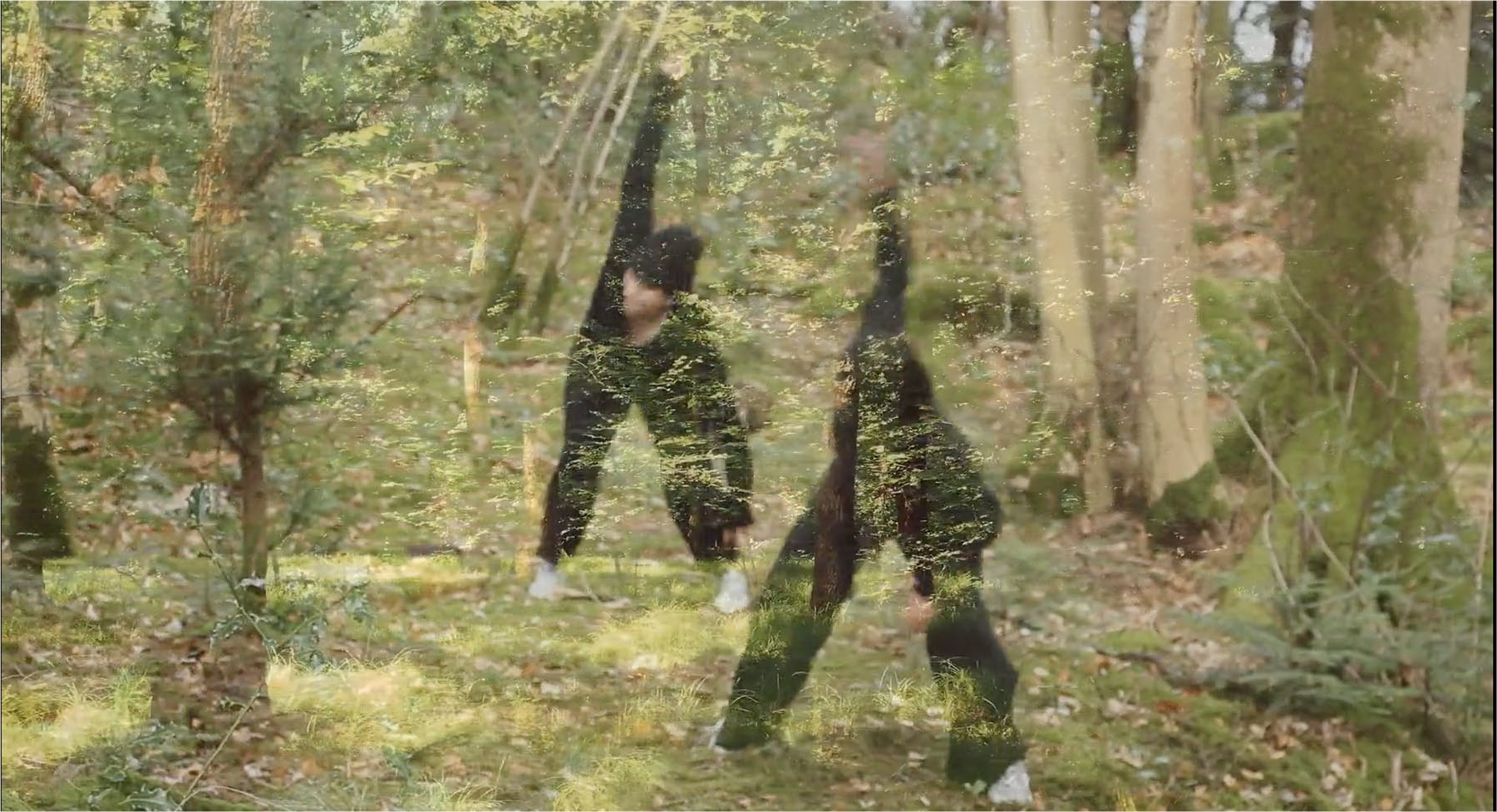
Dancers meshed with trees.
GSO dance professionals move within a forest, with the trees, the height of their elongated rhythmic movements reflecting the trees’ stature. But with a posthuman understanding of the accompanying research, this moving and “thinking with” can be taken further, so that the forest trees’ growing and behaviors influence the research. For example, we now know that some forests like the Pando, or Quaking Aspen, share a root system, and even where this is not physically the case, forests work symbiotically with mychorrhizal soil fungi to create communication systems. Researchers have likened these to neurons, which can enable trees to recognize their kin growing nearby and inform each other of threats (Wohlleben, 2017). If we think and move with ideas, humans, and other-than-humans in this kind of networked, underground way as we research, it opens up the possibility of doing ethics differently (Barad, 2007). It should not compel us to offer “human”-style protectionist rights to trees, but to explore our obligation to the trees’ ways of becoming.
This has begun through Oded interviewing trees in Sunnhordland, Western Norway, spending time in their presence, listening, touching, intra-acting with them, adopting Haraway’s (2008) curiously care-ful approach. Not only did this bring him into a place of calm but it alerted him to the interconnectedness of the trees and his materiality, light, shadow, temperature, reflections on water, and more. So, we are going beyond words to better understand how the trees’ materiality informs their becomings, and how we in turn are involved, almost unaware until we attend differently. If trees can communicate threats like this and can offer experiences which change relationships and raise awareness of complexity, it can help those humans involved in GSO to more appropriately respond to Anthropocene challenges such as trees’ role in slowing climate change. Rather than seek cause and effect solutions which experimentally and ethically isolate component parts, we can explore ways to respons-ably act, stepping back to give trees the time and space to keep becoming and complexly responding with fungi and other actants to the issues. This resonates with Patricia MacCormack’s ethical call to teach humans to graciously step back to “liberate nonhuman life from anthropocentric perception,” while simultaneously trying to “unthink the self to open up the thought of the world” 2013, (p. 13).
So, by employing a posthumanizing creativity research approach, Oded and my understanding of how to do creativity research has radically altered, as has what we take from it, theoretically and pedagogically. It is playing back into understanding of posthumanizing creativity itself. As it should in research with an ethico-onto-epistemological bent. Oded and I are discussing how the shape or feeling of the creative process might emerge differently in different operas because of the other-than-humans with which we are intra-acting. So, the shape of the Thrive opera’s creative and research process may have an underground, networked feeling emergent from our recent intra-actions with trees’ complexity. For me, this resonates back to Deleuze and Guattari’s (1991/1994) distinction between an arboreal metaphor seen as hierarchical and static, and their rhizomatic metaphor representing unpredictability and multiplicity. Peter Wohlleben (2017) has shown that the arboreal and mycorrhizomatic becomings are not distinct and perhaps cannot be characterized so separately as hierarchical/static and unpredictable/multiplicitous. As we move on we are likely to return to Deleuze and Guittari’s theory, to critique and diffract into the next steps of the journey.
As I then reflect on how all of this might expand possibilities for educators, facilitators, environments, and other actants, to disrupt established cultural and educational practice and research, to contribute to addressing the challenges of the Anthropocene, I am reminded of, and very actively turn to Tara Page’s (2018) work on teaching and learning with matter. In her provocative call to arms, Page pushes for raised pedagogical awareness of matter, urging educators and facilitators to attend to what matter can and cannot bring to creative conversations, how different kinds of materiality work, and what learning to recognize and play/work with these differences can creatively offer. It is exactly this process of raising pedagogical awareness in which we hope to engage GSO participants, professionals, and other-than-humans (such as the trees, but also, for example, the new virtual reality global classroom prototype which aims to bring children globally into an innovative co-creation space).
But this will not be without its challenges. It will require a fundamental decentering of the human, and yet most GSO participants are learning within education systems which are heavily influenced by individualized, psychological approaches to attainment and league tables, which, as Stephen Ball (2016) argues, are feeding the “slouching neo-liberal beast.” Oded is already quite rightly asking whether educators, scientists, arts directors, he and I, are ready to give up our place at the “top of the food chain” for the sake of other species or the planet? Outside of the philosophical argument, which to us makes sense on the page, what are the pedagogical advantages of putting ourselves to one side, when GSO could be judged as lacking for its posthumanizing approach, within a measurement and humanly driven education system? Oded has identified through our conversations that the answer perhaps lies in the fact that GSO has no human or institutional center, so the shift may not be as difficult as we think. In order for GSO to be evaluated as “successful” all kinds of partners have to be working in a pedagogically networked way. This has already disrupted cultural and educational practices and what we are suggesting means being confident to leverage further disruption by decentering and actively working with materiality, be it natural or digital. GSO with posthumanizing creativity might then be able to tip pedagogy and research into contributing to changing the balance of social justice in education, and perhaps in small ways for the planet. This is certainly an aspiration of both GSO and posthumanizing creativity, so it is important to have identified the potential means for this through these “beginning the process” thinkings.
This is fledgling work, but we are hoping to both change how creativity is methodologically researched and in turn conceptualized, as well as provoking more emancipatory pedagogies which help educators and facilitators to attend to issues of ethics, equality, and justice. Similar to the likes of Ball (2016) and Chris Turner and Emese Hall (2021), this will involve arguing for/enacting the disruption of dominant discourses such as attainment agendas and siloed disciplinary curriculum structures. This is difficult work in the face of neoliberal education systems that steadfastly refuse to change, even with creativity included in so many national curricula. But it is perhaps about putting more energy into new educational alternatives that complement the fluid, enmeshed, dialogic nature of creativity being argued for here. GSO and its accompanying virtual global classroom provides one such alternative which can work within formal schooling or could indeed offer a complete alternative to it given time.
Assemblages, Diffractions [and Befriending Digitizations?]
The second exemplar is ongoing within the SciCulture 3 project. It builds on the first exemplar’s contributions to the larger posthumanizing project by demonstrating how a posthumanizing approach to creativity actively draws not only matter but also spatiality into pedagogy and research practice to change both. Pedagogy is altered through attention to body-worlding, spatial atmospheres, and storying potentials, challenging transmission-based HE trends, as well as through working with ethics, repositioning human–other relations to offer participants learning space for more emergent futures. Methodological practice is made new through digital co-researchers centering digital connectivity, asynchronous and synchronous intra-action, and emergent sharing options. The exemplar also demonstrates the tensions in complementing “hands-on” and digital assemblaging techniques.
To set the context, SciCulture designs and facilitates one-week immersive intensives for higher education students and staff working in diverse teams from across the arts, sciences, and business. This is with the aim of responding to a societal challenge in whatever way emerges as appropriate for the particular team. I was part of the planning group for the initiative, so the courses are already using a posthumanizing creative pedagogy forefronting embodied material dialogue (for a full explanation see Chappell et al., 2019). This is structurally integrated with seven other creative pedagogies from my University of Exeter team’s prior research (https://sciartsedu.co.uk/creations-features/): transdisciplinarity; individual, collaborative, and communal activities for change; balance and navigation; empowerment and agency; risk, immersion, and play; possibilities; ethics and trusteeship. Design Thinking principles provide the week’s overall “double diamond” structure, facilitating the teams through the discover, define, develop, deliver flow (Drew, 2019), while remaining cognisant of Design Thinking’s posthuman turn, which seeks to decenter humans and disrupt a neat approach to flow (Forlano, 2017). As an overarching principle, SciCulture works with different types of knowledge as part of the process in envisioning healthy, equitable futures. The project also forefronts activism, social justice, and making change happen through alumni running their own versions of the intensives to provoke and trouble practice. At the time of writing three out of four courses have run, two face to face (one in a hotel and one in a University Fine Arts department) and one entirely online due to Covid-19. The first two courses’ theme was the future of education systems by 2050 to make them fit for the 21st century, and for the third course it was critiquing the well-being of cities, encouraging a posthuman turn to consider how other-than-humans can be part of the change-making conversation.
Applying Ulmer’s (2017) notion of practicing equivalence, that is working to emphasize bodies of nonhuman matter, a question began troubling us as we exited the second course: How do different materialities and spatialities matter within innovative HE practice, and how do they shape and create responses, subjectivities, and learning for all involved? This had grown out of the first two intensives being situated and shaped by teaching and learning collaborations including in fine arts studio performance/gallery spaces, around swimming pools and in hotels, through movement work, theater practice, science experiments, and entrepreneurial challenges. The question continued to trouble us when, in 2021, we went entirely online for the third course. I especially could hear Page’s call to raise our pedagogical awareness of matter. If, as a team (including human and other-than-human participants such as Teams and the cities whose well-being we were concerned with), we could better attend to, understand, and work with what matter, material, and space can bring to the creative conversation; then we could expand the possibilities open to us as educator/researchers and use them to more productively disrupt practices. These can exist within an assumption that transdisciplinarity is a useful add-on rather than a central practice. So, disciplines continue to be taught separately, with a reliance on lecture and seminar delivery, learners meeting in regularly timed set groups in front-facing teaching rooms (Jones & O’Shea, 2004).
Allowing this question to “trouble” us to disrupt established practices clearly shows Haraway’s (2016) influence. And as Elizabeth St Pierre (2019) instructs, we should read and read harder to allow this to help us to do things differently and to reorient thought. Haraway (2016) recommends engaging with complexly intertwined relations, events, networks, alliances that make up a “thick present.” Advice from Haraway that I have found particularly compelling is to stay with this trouble, to stay present and not to try to make a “safe” future or a completed answer. So, since it emerged, we have stayed with this trouble. In the first instance, to maintain engagement with a thick present we focused on artifacts, images, processual activities, and human reflections. Prior experience (Chappell et al., 2019; Chappell et al., 2021) had taught me the power of working with assemblages and accompanying theoretical diffractions, and this has been a key way of recasting new ways of working (Taylor, 2017). Barad (2007) argues for building assemblages diffractively to disrupt and splay the object of study in productive ways, cutting theory through data (Mazzei, 2014), as well as data through other data to challenge anthropocentric viewpoints (Taguchi, 2016). In other research, our team had created assemblages diffractively, and I used the same technique here to respond to the troubling pedagogic quandary of spatiality and materiality.
I had previously done this with colleagues face to face—literally engaging with data’s materiality. Covid-19 necessitated this becoming a digital practice. We (Lindsay Hetherington, Heather Wren, and Sharon Witt) decided that Sharon, who had joined the team after Courses 1 and 2, should look at the information first and use Maggie MacLure’s (2013) glow moments approach to start to assemble these into digital spaces, in order that she take a fresh look at the “trouble.” First, PowerPoint was used to assemble glow moments but it proved unsatisfactory compared with the spatiality granted by a hands-on table top. Either glow moments were crowded together on a single slide or spread across slides and thoroughly dis-assembled. As we learned about more digital tools to support our Covid-19 lockdown practices, I became aware of Mural—a digital workspace for visual collaboration (www.mural.co). We therefore decided to recast our ways of working again and explore how Mural’s potentials, visually, spatially, and materially might support the force-ably digitized assemblage process. I will first offer a guided tour of this Mural 4 to provide context for sharing insights into how this other-than-human collaborator influenced our thinking and methodological practices.
. . . Please engage with the Mural starting at hexagon A. This shows my beginnings with Haraway’s call to stay with the trouble, which Mural’s flexible spatial approach allowed me to position there—initially this was all that was in the Mural, much as you might place a post-it note on a table . . . . . . Please go to hexagon B: my next addition was the first glow moment that had shone for me in Sharon’s selection—the found poem . . . . . . placed over the image of the poem’s author entangled with other bodies, materials, plants and light . . . (Figure 2) . . . Through this, in the “B theoretical cut” yellow square I cut Erin Manning’s (2013) notion that Movement is one with the world, not body/world but body worlding. We move not to populate space, not to extend it or to embody it, but to create it. Our pre-acceleration already colours space, vibrates it. Movement quantifies it, qualitatively. Space is duration with a difference. (p. 13) . . . In the “B explanation” green square I explain how this changed my view, by making me consider how we create space with our movement as much as vice versa. This extended my pedagogical possibilities to incorporate what a space might offer us, but also to challenge that and see how it can be re-shaped e.g. not seeing teaching movement on a hotel roof or a fine art studio, or, indeed, within digitally connected home-spaces because of Covid-19, as a constraint, but as a two way creative possibility . . . . . . Please go to hexagon C: here I added three further images (Figure 3), which glowed because of their spatiality—bodies made shadow, over-ridden by colourful mitochondrial connectors; a building corner, a tree, the sea, four bodies constituting a shared educational phenomena; narrow concrete corridor and doorways holding in unrolled paper, drawing in four bodies . . .
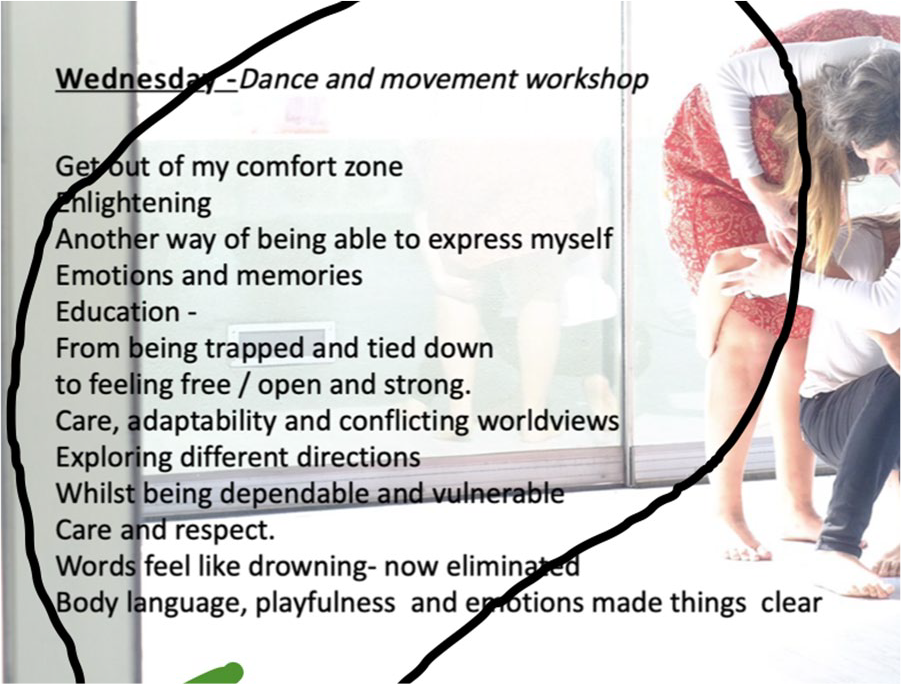
The first glow moment.
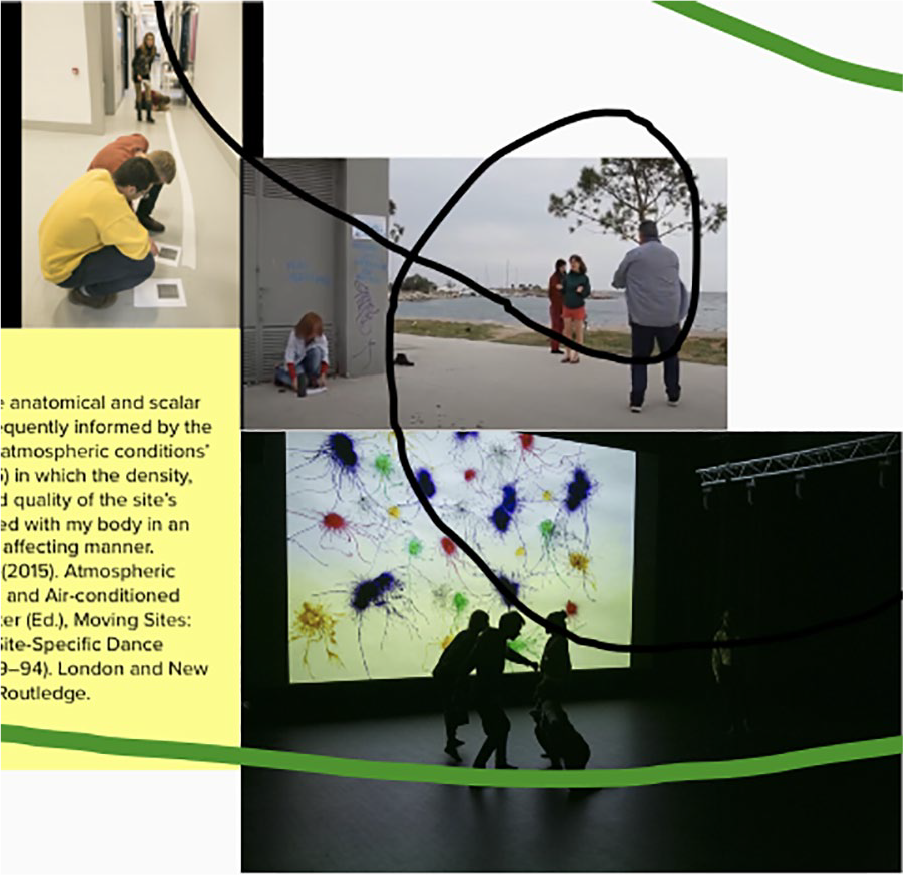
Images spatially glowing.
. . . Please see the “C theoretical cut” yellow square for Hunter’s (2021) quote which was cut through those images. The “C explanation” green square articulates how her consideration of a space’s qualities and atmospheric conditions led me to recognise that it matters what spaces and atmospheres SciCulture occurs within and that practice can be disrupted by actively engaging with this . . . . . . Please go to hexagon D: I added two further images (Figure 4) which had materially glowed. Please see the “D theoretical cut” yellow square for the cut through of Doreen Massey’s (2005, p. 9) ideas that we engage with space as a “simultaneity of stories-so-far,” making places a collection of those stories, and, in turn encouraging us to think of our relations to spaces and places as becomings between ourselves and all of these stories.
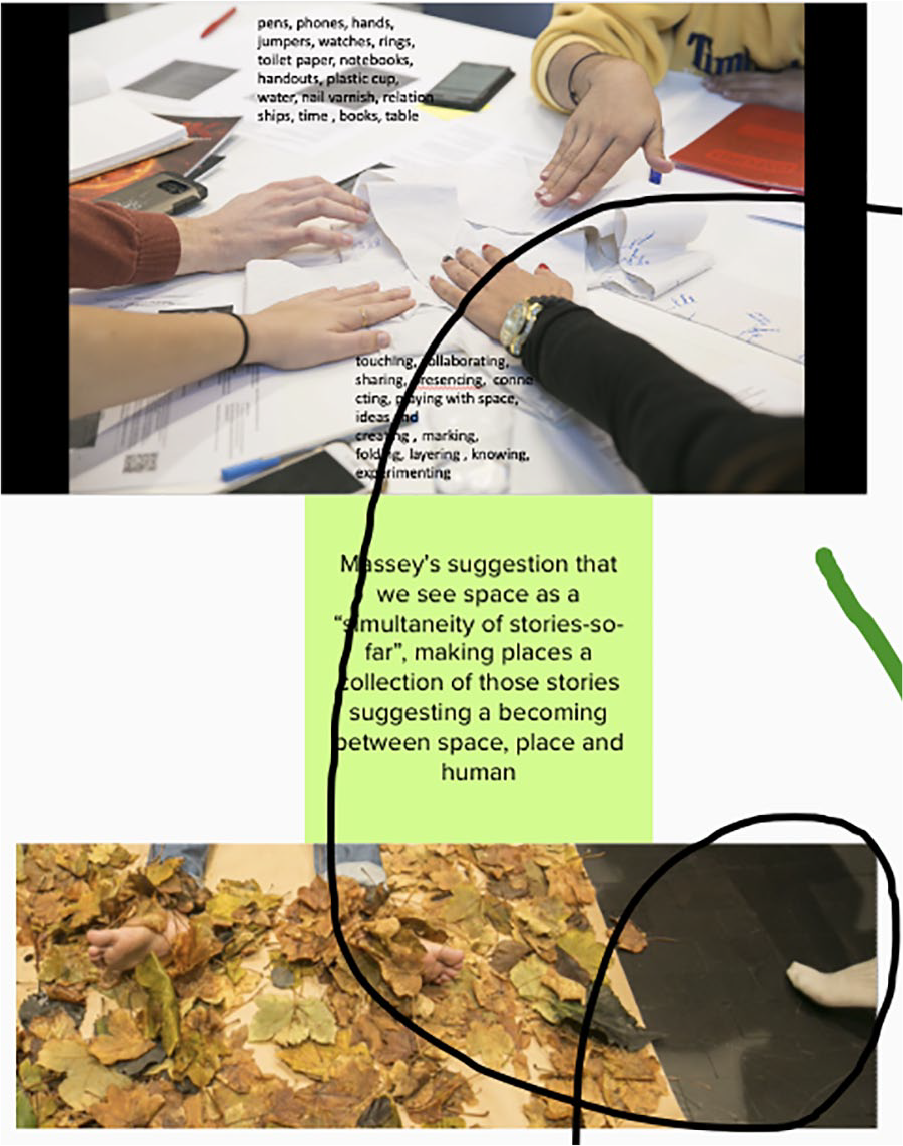
Images materially glowing.
. . . The “D explanation” green square articulates how using this notion of spaces’ narratives builds further on working with their atmospheres; it assisted us to discuss how we could have, and might in the future, disrupt student choice by highlighting the atmospheres and stories of possible spaces, which hold different but certainly no-less potential. . . . Please go to hexagon E: here the image is through the lens of another camera, also being viewed and discussed by two SciCulture participants and a tutor (Figure 5).
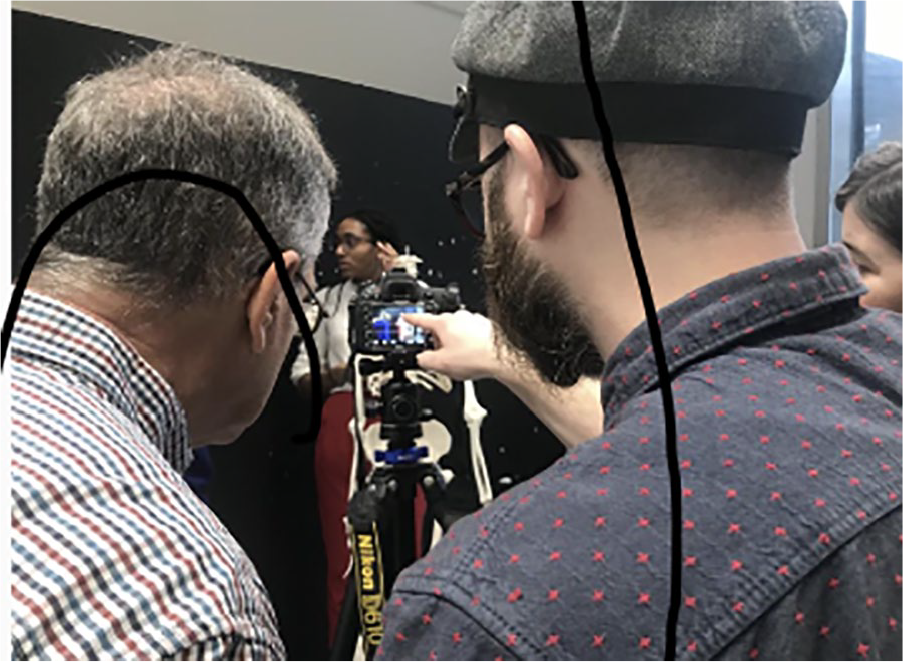
Cameras watching cameras glowing
Through the camera lens and around the sides, we can also see in the image another SciCulture participant with a human skeleton against a black backdrop: cameras watching cameras . . . . . . Please see the “E theoretical cut” yellow square for Catherine Adams and Terrie Lynn Thompson’s (2016) theory which was cut through those images. The “E explanation” green square articulates how their process of interviewing NVivo and an Ipad, encouraged us to acknowledge the co-constitutive nature of research decision-making with cameras, OneDrive and Teams, as well as this Mural. This thinking then began to feed into how we set up the next SciCulture course considering how devices as co-participants and co-researchers, could be more pro-actively planned into pedagogy and research.
So, having completed the Mural guided tour, I hope this demonstrates my conflicts, explorations, and thinking as they grow from the PowerPoints to within the Mural assemblage. I also hope it demonstrates how this posthumanizing creativity approach has allowed us to disruptively expand possibilities for SciCulture. We are able to more confidently and productively challenge HE’s knowledge-transmission-based trend. By decentering ourselves and preconceived neoliberalized approaches, we can pro-actively use understanding of body-worlding, spatial atmospheres, and storying potentials to design and feed creative conversations differently in future courses. Particularly where we are looking to critique the well-being of cities, re-centering these spatial/material elements and having them feed the course design process will better disrupt the idea of humans “in charge.”
This Mural journey has also influenced our methodological practices. As a co-researcher, Mural contributes to creating a very different thinking and moving research space to a room with a table or floor space. It also mediates how and what I communicate in this article as part of our “apparatus of knowing” (Barad, 2003). Sara Sintonen (2020) has used posthuman theory to compare making art on paper and making it in digital spaces, and described the former as more experimental and the latter as more playful. My experience of the shift from analogue to digital for assemblaging partially reflects this—Mural feels as though it has more playful potential than post-its and pieces of wool. It has more potential to connect me and link to other digital resources, to live web happenings, to be saved for posterity, returned to and re-worked, shaping my thinking, and doing as it does so. Going beyond table-based assemblages, digital assemblaging does not just decenter the human and centralize digital software as object, it re-centers digital connectivity, and facilitates asynchronous and synchronous intra-action. This shapes researcher thinking differently because the Mural can always be becoming unlike a static photographed assemblage or a fixed publication; it emphasizes research as process rather than finalized product, a more emergent sharing of ideas. So, in this article I can point you to access the Mural, the core of which is there at point of publication, but around which further assemblaging can continue. This published article therefore contains emergent potential beyond its point of publication rather than delivering static ideas.
But you will also notice, at hexagon G, the red star, containing my railing against the Mural’s digital nature. There is a presence, an active doing, an enmeshing with materials that I personally will never experience through keyboards and mouse-based digital intra-action, which can create a layer of detachment between me and the material I want to work with. While I appreciate that this digital posthumanizing creative research practice brings new possibilities of asynchronous/synchronous access, process emphasis, and emergent sharing, I am also critically aware of what I lose through these intra-actions. A key challenge to acknowledge moving forward is how to complement “hands-on” and digital posthumanizing methodological practices.
Finally, in terms of unpacking this second exemplar, please see hexagon F. A turquoise box connects together green threads from across the assemblage, where I indicate my next reading focusing on, among others, the work of Debra Shaw (2018). She sees large cities as places which fuel inequalities through their coloniality, and as a result she advocates de-colonizing cities through repurposing, subversion, and activism. This brings me back to the last of the four integral elements that I articulated at the beginning of the article—respons-ability, particularly in relation to SciCulture pedagogy. Shaw’s work is grounded in new understandings of materiality emerging from models of bio-organic processes as well as Barad’s articulation of phenomena emerging through intra-action. She urges readers to consider cities differently, and, in terms of ethics, not to abdicate to particular groups of powerful humans taking responsibility for developing and shaping cities. She encourages working through an ethic of care-ful repurposing and playful reconfiguring of cities via the encounters of different bodies. This particular theoretical cut leading out of the Mural assemblage has changed how we position cities in our SciCulture pedagogy, to facilitate participants to have the confidence to work in a less controlling, more emergent relationship with cities as others collaborating for new futures. Going forward, cutting through Shaw and others too will keep disrupting our pedagogy and expanding the possibilities for our posthumanizing creativity research.
Expanding . . . Shifting . . . Disrupting
I have now brought to life my posthumanizing creativity research practice, articulating how I have enacted the four integral elements (practicing equivalence and experimentation, recasting new ways of knowing and researching, doing ethics differently through respons-ability, and troubling with curious care), within two exemplars. This has been carried out with the intention of offering insight into how these experiences have changed mine and my collaborators’ understanding of both the pedagogical doings of posthumanizing creativity and the doings of related creativity education research.
Our understanding of facilitating posthumanizing creativity and researching it through a posthuman lens has expanded, shifted, and been disrupting in a number of ways. For example, working with ethics differently makes us attend to new foci, engage through elements such as temperature, but more importantly it has made us step back from overly attending and intervening to try to graciously give space to the thoughts of the world both pedagogically and methodologically. This means altering, for example, classic elements of opera practice but also questioning the separability of classic research metaphors such as the arboreal and rhizomatic, seeking a more entangled practice between the two. Our teams have been disrupted into spatial-material dialogues with other-than-humans to engage in two-way body-worlding as opposed to just seeing environment as mediating engagement. We have also expanded our understanding and practicing of research assemblaging into digital connectivity which changes the functionality of conversations and publications, while heightening our concerns around the tensions between hands-on and digital posthumanizing research techniques.
In all of these practices, I feel I am personally “unsticking” myself from my previous neat humanist, qualitative research categorizations. Although, the stickiness of humanism can still prevail—it is still me who has written this article, dominantly from my perspective. As a dance artist, the mover/intra-actor in me could tell this story in an embodied material way, engaging others’ materiality too and tapping into physical practices and associated seminal writings which already make deep connections between humans and nature/environment (e.g., Satyasangananda, 1984). Although the possibility for peer-reviewed film-based articles does now exist, 5 these are formats which this journal does not accommodate. Going forward I am keen to explore how live, immersive human-other becomings can be “captured” for educational academic sharing and critique. Also, mechanisms like this have huge pedagogic and research potential—but they can also be dangerous to projects which are being judged within neoliberal funding and systems. There is much more to do here, to continue to develop new practices, but remaining alert to how they are perceived and judged from the outside.
If I move beyond these two exemplars, I can sense further ripples of expansion and disruption. Doing ethics differently challenges and changes university ethical permissions systems to accommodate emergent posthuman methodologies which include other-than-humans, which do not offer linear accounts or ethical checklists, and which need to be judged on their own terms. Combined pedagogical and methodological shifts certainly give me confidence to actually look to side-step static education systems and energize the alternatives. GSO and SciCulture were both established outside of formal school and HE curricula and are successful there. But the teams are now both gaining confidence to actively spiral tendrils from the projects into institutionalized practices; to change them from within (e.g., new accredited SciCulture-derived HE modules).
My next experimentations include engaging with the work of colleagues like Vanessa Andreotti (2018) and Arathi Sriprakash et al. (2020). They expose the institutional erasures of racism, colonialism, gender, political violence, and more. While posthumanism might be critiqued for diverting attention away from pressing intra-human issues such as racism, sexism, colonization, and more (Mendible, 2017), I believe that there is a way to deal with both these very humanly generated issues, and find a way out of our anthropocentric trap. My next steps involve exploring how this might be done pedagogically and methodologically via posthumanizing creativity in education, through decentring, and trying to enact the ethics of being and becoming between humans, and between humans and other-than-humans, together.
Footnotes
Acknowledgements
The author is grateful to colleagues at Western Norway University of Applied Sciences for collaborations and conversations which have contributed to this article, particularly those working on the Global Science Opera Initiative. Thanks are also due to all participants and colleagues in the SciCulture project, especially colleagues at University of Exeter, who have either kindly given their time to provide data, or who have contributed to data collection and analysis, which has laid the ground for a selection of the ideas within this article.
Declaration of Conflicting Interests
The author(s) declared no potential conflicts of interest with respect to the research, authorship, and/or publication of this article.
Funding
The author(s) disclosed receipt of the following financial support for the research, authorship, and/or publication of this article: This research was supported by Erasmus Plus EUPA: 2018-1-MT01-KA203-038486 for the SciCulture project detailed in the article.
