




Abstract
Scaffolding poetry, drawing, and narrative fragments from lived experience, I offer mishritata (mixedness) as a way to make meaning of multiply minoritized identity through the “doing” of dissertation research with one’s communities. Conceptualized as an orientation, mishritata is an indigenized embodied borderlands positionality that recognizes and celebrates the mixedness of the Queer Desi/South Asian experiences: an interplay of histories and contexts, of people and places, and of structures and systems that organize them across borders, both real and imagined.
Keywords
That time when . . . I learned to hate my name because most people I went to school with would butcher it and call me “Dirt” or “Duck”
That time when . . . I tried to “man” up because I kept being called a pansy, sissy or chakka for my less than masculine mannerisms
That time when . . . I realized I was attracted to other young boys and men, and cried in shame
That time when . . . I was taught to live in fear that this secret would somehow write itself on my face and body and I would let it slip
That time when . . . I was told that I would never be able to study abroad because my family would never be able to afford it
That time when . . . I moved countries in five days to live a life that I could be proud of
That time when . . . I landed in a country where I knew no one and became very afraid of being alone
That time when . . . I recognized that my accent would give me social currency because my English didn’t sound “FOB” (read as “broken”)
That time when . . . I bought a $2,700 ticket at the airport and boarded a flight to India to say goodbye to my very sick father
That time when . . . the two planes hit the two towers, and my Brownness started to show
That time when . . . I realized that my name would only give me cover until I opened my mouth to speak
That time when . . . I intentionally stayed silent so that I wouldn’t speak
That time when . . . I had my heart broken for the first time; he told me it was over
That time when . . . I was afraid of being seen as a terrorist and dressed in a suit to travel
That time when . . . I told people that I was from Boston instead of Mumbai because I didn’t want them to tokenize me, pity me, feel sorry for me, or put me in a box
That time when . . . I was taught (and I had learned) to hate my body and my hair
That time when . . . I was misidentified for Latino, Brazilian, Spanish or Portuguese and I laughed it off; politely smiled; did not deny it
That time when . . . I identified as bisexual because I was afraid to admit I was gay
That time when . . . I used Bombay instead of Mumbai to preserve a nostalgic, fraying tie to the motherland
That time when . . . I identified as biracial or bicultural because I desired white people to see me as “not” the same kind of Brown as the “others”
That time when . . . I was asked to provide my United States passport when I had none
That time when . . . I told potential Racialized partners that I was only interested in white people because they “got” me
That time when . . . I gave up eating with my hands because I didn’t want to be seen as “backward”
That time when . . . I walked into a new college as a mature student, and caught myself begging God to save me from being picked on (again)
That time when . . . I walked in my first Pride Parade
That time when . . . I put the spoon and fork aside and instinctively began eating with my hands without a care in the world
That time when . . . I identified as Desi for the first time publicly
That time when . . . I wept for days when I finally learned how to release and forgive those closest to me from their choices of trying to make me be somebody I was not
That time when . . . I recognized my position as a racialized settler, conditioned by anti-Blackness, and perfected by empire
That time when . . . I continued to weep when I learned to still give gratitude for the choices that have enabled me to be who I want to be
That time when . . . I chose to live.
On Having to Choose
It is caucus day at the Social Justice Training Institute (SJTI) 1 in Springfield, Massachusetts, an immersive educational experience for postsecondary educators and one that I have come to regard as a watershed moment in my understanding of my multiple minoritization as a Queer Brown/Desi/South Asian man. Caucus day refers to the experience of sitting and learning with participants who share your race—an opportunity for “deep reflection, engaged dialogue, and personal healing” (Obear, 2012, p. 37). I am mortified and not ready emotionally to be vulnerable in this way. Upon arrival into the space, I had quickly determined by sight that I was the only Brown one of my kind within this group of well-intentioned justice-oriented educators. I was also fairly confident that my kind of Brown was different than any stereotype that they held, which further marked me as “Other.”
As someone who spent the first 20 years of his life in Mumbai, India, race and racism as social constructs with material realities were not really in my worldview 2 at the time. However, I still reaped the benefits of Whiteness even though I could neither recognize nor name it for myself. As a “postcolonial” subject, the forms of colonization around me had evolved and my family and I were directly implicated and, in part, even complicit.
I have not always identified as I do so strongly now as Desi or even Queer. My ancestry, while from the southern part of India, marked me differently because of religion. I am eighth generation Mangalorean Catholic on both sides of my family with origins in the Pancha Gauda Saraswat Brahmin lineage prior to religious conversation (Prabhu, 1999). My Savarna caste ancestry notwithstanding, this religion assigned shortly after birth afforded me a culture that placed me squarely within a Western-framed upbringing. This has complicated my relationship with my ethnoracial cultural identity from a very early age. Attempting to make meaning of which aspects of my culture were ethnic and which were religious and how I could and should enter and exit were anxiety-provoking during those early years. I either acted out or shut down; there was no in-between. Most times, it was the latter. Furthermore, I was teased and bullied growing up for what was perceived as feminine expressions of my gender (“pansy” and “chakka” were routinely hurled in my direction). I internalized these incidents as synonymous with all Brown people as unaccepting. I wanted to run away, and, in a way, I did. I moved to the United States when I was 20 years old for school.
Coming into my Queerness during my 20s exacerbated these complications. I distanced myself from family and friends I had known. I believed that to be Queer was to be White and that was what would make me happy. My relationships with White men always left me feeling misunderstood, misrecognized, and incomplete, but I kept returning to them with the internalized false hope that each time would somehow be different. It took me a while to feel confident in myself as both Brown and Queer. I neither had possibility models nor the cultural capital to move myself through these transitions. The relative paucity of ethnic consciousness and my fixation with the rigid categories to which I was conditioned impacted my ability to persevere and navigate the often-colliding worlds around me (Kanagala et al., 2016). 3 Now in my 30s, and having worked through some of my contradictions, caucus day at SJTI brought these complications to the surface.
In the Springfield Sheraton Hotel event space, I knew I was not White or Black, and Brown constituted an experience different enough for my Latinx colleagues to make me feel uncomfortable for staking any claim to the term. Furthermore, my six years in Boston had taught me what it felt like to constantly be grouped with those that broadly identified as “Asian” and have my experiences be rendered more invisible. An Asian colleague in Boston once casually remarked without any care, “South Asian is more South than Asian”—a subtle reference that consistently found its way back to me—an ongoing reminder that we Desis were “darker,” “dirtier,” and did belong or “fit” with the larger category of “Asian.” As a result, my anxiety was palpable at the structure of broad racial categories being called forth and the impending public choice I would have to make. How would I be seen or heard as Asian? Was this choice a “forever” commitment? What if I wanted to change? How do I know this group is where I need to be? Bursting with questions amid the dissonance, I decide at the very last second to join the biracial and multiracial group that had just one other person. Gloria Anzaldúa (1987) writes about what it means to live on and cross physical and sociocultural borders: “. . .a tradition of long walks” (p. 11). As I settle down to speak to the only one other person in this group, I feel both guilt and relief. However, while offering some respite from engaging in our respective borderland experiences, one thing is clear: Even in this “safe” (higher education) space, I am not yet “home.”
On Feeling Enough
I stare blankly at the wall in front of me. I am numb. I just received the second draft of my attempt at my comprehensive examination—a requirement for my doctoral program that awards candidacy. Attempted as a major research paper—a prospectus of sorts rather than a thesis proposal that comes next, it outlines an area of study with potential research questions, their relevance to the discipline, and ideas about suitable methodologies to carry out the project. I return to my computer screen and the email in front of me, my eyes welling up and the tears starting to flow. I have been here before like many racialized Queer doctoral students and scholars before (see Atay, 2017, for a beautiful questioning of an academic home). The email rightly tells me that I have gotten it very wrong: The argument lacks focus, my questions are dated and irrelevant, and the literature review reads as one without a map. I just did not want to believe it. This revised draft, focused on examining youth engagement, was 6 months in the making—6 months and still incoherent? Simply put, it lacked heart, and at the time, I was completely defeated.
I once again argued with the bhooths 4 in my head having returned to torment me. They had begun the moment I arrived at the University of Toronto. During my application, I had expressed an interest in working with Queer People of Color, specifically Queer Desis/South Asians—my people. And back then, the bhooths said, “No!” Their focus was always largely around my dissertation topic and their way of working was to have me doubt the future that would lie ahead, making it appear to be a false equivalency. “It’s too niche of a dissertation topic to have you hired!” “Why would you want to do South Asian work anyway? It’s not ‘current!’” “Nobody cares about Brown people!” The fact was that I really did not care about student engagement as a topic either. Yet, in my defeat one thing seemed clear: Now two drafts in, what I had produced on engagement was (still) neither intellectually stimulating nor did it move my soul. I know I needed to fix this, but I did not know what to do or how. I did not feel enough. I did not feel like I belonged in academe. I had no purpose. Above all, I had lost so much time. The tears were uncontrollable; my body crumbled. “Why???” I screamed, “Why can’t I just do what I want to do? This work is not who I am. It is not who I am meant to be. I just want to go home!”
And I did. I finally came home to work with my people and for this homecoming, I am particularly indebted to the labor of Women of Color feminists, and particularly Black feminist scholars, many of whom were also Queers of Color. Seeking out their writing offered me a sobering reminder that there have been many of my people who have labored as well, but whose works have never been recognized or valued by academic gatekeepers. In 2015, Leah Lakshmi Piepzna-Samarasinha (2015), a Queer, Disabled, femme writer, community organizer, and artist of Tamil and Irish/Roma ascent, released her third book of poems, Bodymap, inspired by the disability justice movement. In it is a piece titled, “What kind of ancestor do you want to be?” This simple yet profound question opened up a space where possibilities could converge with pride, previously unfathomable. Collectively, these scholars model vulnerability and allow me to recognize, name, and take up space for myself and my people. They also remind me of my relational responsibilities and to never lose sight of the histories and complicities that afford privilege to me, a non-disabled, Queer, Desi/Brown, Western-named, cisgender man, across real and imagined borders.
Ultimately, my doctoral dissertation examined the experiences of Queer Desis/South Asians in Toronto and used a mix of traditional mixed methods anchored by applied drama activities and mobilized Desi ontoepistemologies. It converged everything that was important to me and I am proudly implicated in and through it. Looking back, the email I received was permission-giving. It relieved me of the myth that pursuing such a personal transnational “Desi” or even “Queer” project would not offer me the currency that so many are conditioned to believe is critical to “success” as an emerging scholar in academe. I had talked myself out of doing work with my communities and nobody stopped me.
On Being Willing to Heal
Before my participants and I gathered together for the first day of applied drama activities, I had instructed them to bring a significant personal object with them. The purpose of this activity would be to stir the memories through a variety of senses—visual, hearing, feeling, touching, and smell. After a series of warm-up games had concluded, I asked participants to bring their objects forward. Presenting an object, having people hear its story, and respond to it became a powerful experience because participants re-encountered their own memories through these objects. Some of the stories that emerged included a difficult relationship with parents (Rekha), a relationship with Desh/the homeland through religion (Lestat), a pashmina shawl that belonged to a relative whose life was tragically cut short (Hashim), and a compact disk (CD) that became a source of comfort and survival (Adem). In witnessing these stories, two observations struck me. First, not only were these objects sources of immense comfort to these individuals, but they were intrinsically a part of who they were. The objects “became concrete symbols and signifiers of [their] identity” (Hashim, personal communication, activity debrief, December 10, 2016). Second, the significance of these objects was rooted in the relational—relationships with people and places and to time. As I readied my own object for sharing, I wondered how it would be received. Would it be Indian enough? Would it adequately convey my “authenticity” as Desi? I hold on to my item tightly wondering if I should share it at all with the group. Did I bring the right one? Suddenly, a voice—“What do you have to share?”—asks Tushar.
What I want to reveal are the hospital ties that bound my mother to her ICU (intensive care unit) bed the day she died. As she was removed from life support, took her last breaths, and the room around me wept, I had carefully undone the tie from her hand and the hospital bed and placed it in my pocket. It was the closest thing I could take with me that reminded her of the way she was tied to the institution of medicine, its doctors and nurses, its exorbitant cost and lack of quality insurance programs—the pain and pressure that a battle with cancer placed on any family in Mumbai in the 1990s. It is this item that helped shape my fierce sense of independence in my early years in the United States. As I wrestled with my Queerness, I bore that stress alone; as I yielded to Whiteness, I bore that emptiness alone; as I rediscovered my Queer Brownness, I raged alone.
In this moment, instead of allowing my body to respond to what I had witnessed, I allowed my rational mind to take over and remove emotion from the research. “I must remain distanced,” I thought. As the researcher, I should refrain from injecting emotion into this process. That decision to not offer my object left me feeling cheated. I had cheated my participants out of the same opportunity to receive my story as each of them afforded me. I felt cheated with myself. That I, the researcher, overruled myself as a participant. It left me thinking whether I was the right person to be facilitating this research; am I once again enough?
Mess or Mixedness: The Case for Mishritata
Gloria Anzaldúa (1987) introduced the idea of the borderlands in her seminal work, Borderlands/La Frontera, in which she argues for recognition of the borderlands—“where cultures, ideas, norms, selves are remade, reconfigured, where pain mingles with uncertainty, fear, anxiety, creativity and new possibilities” (Ortega, 2016, p. 17). In Light in the Dark (Luz en lo Oscuro), Gloria Anzaldúa extends her many writings, such as “El Mundo Zurdo,” “the new mestiza,” and “nepantla/nepantleras,” and weaves them into “conocimiento”—a word that literally translates into knowledge (Keating, 2015, p. xxvii). For Anzaldúa, knowledge-making converges both ways of knowing and ways of being from both the lived and the imagined. This sort of relational ontoepistemology requires that we turn toward the interconnectedness and interlocking nature of space and place, events, people, institutions, structures, while drawing from our own de/colonial knowledge languages to make meaning of it all.
In reading Anzaldúa’s (1987, 2009, 2015) writing, I find myself recognizing a cultural language that metaphorically resonates with my own experiences as a Queer, Desi/Brown emerging scholar. It helps me understand the many fragmentations of my being. Anzaldúa’s ability to write through the simultaneity of pain and possibility has deeply inspired me to think through my research in new ways—to reckon with choices, enough-ness, making/taking up space, and being able, ready, and willing to heal. Moving beyond binaries of all or nothing has necessarily included returning “home” to the borders—both visible and invisible and exploring the ways in which the telling of my research story may more effectively reflect my de/colonial 5 journey as a racialized diasporic.
Mishritata means mixedness in Hindi—a composite, made up of various parts and elements, and for me, is my borderlands positionality. While it may describe the messiness that emerges from the convergence of everyday lived experiences of ethnic, racial, gendered, Queered, and Other cultural identities (Rocha, 2011), I am more interested in the potential and possibilities for this mixedness rather than its messiness, which is often viewed as negative, as deficit. Mishritata is a strengths-based framing for the ways in which I may approach the negotiation of my identities—both ascribed and prescribed, and their experiences. I conceptualize it as an orientation—an indigenized embodied borderlands positionality that recognizes and celebrates the mixedness of the Queer Desi/South Asian experience. For Queer Desis/South Asians, there is a delicate yet layered negotiation of Self and O/other, especially when issues of caste collide with color, religion with sexuality, gender identity, gender expression, socioeconomic class with neocolonial notions of respectability, and so on. Mishritata, then, constitutes a turning toward the interplay of histories and contexts, of people and places, and the structures and systems that organized them. I offer four key characteristics of mishritata as an embodied orientation.
An important aspect of mishritata is recognizing those structures that, through their lack of visible impact in our lives, cultivate an unconscious and perhaps unintended consequence of exclusion. An example of this is the lack of consciousness around Indigeneity and Indigenous histories as we contemplate our kathās and where we go from here. How do we in our multiple marginality understand and practice solidarities with those who face their own histories and contemporary experiences of marginalization and erasure? Tending to the structures of anti-Black and anti-Indigenous racism becomes critical for a mishritata orientation.
In some circles, such tactics may be described as “code-switching”—intentional or unintentional actions taken by the body to adapt to a particular phenomenon. However, in the mishritata orientation, I feel that the term is reductive. Mishritata invokes dunya-paar—a deep emotional journeying between these worlds without seeing our lives and the tactics we may mobilize for our safety or wellness, as either solely here or there. Dunya-paar invites us to go behind the tactics and cultivate a curiosity for understanding and even forgiving why a particular “code” is switched. Such a deepened stance invites a constant (un/re)mapping of the emotional, spiritual, cultural, and physical circuits of migration and encourages those who are multiply minoritized to go beyond simply expanding a worldview (which prioritizes only sight) and instead grow their worldsense—which encompasses an embodied way of journeying across time and space (Oyewumi, 1997).
In my experience, I have the arts, and particularly applied theater as useful way to journey back as well as imagine alternative ways forward. It has been particularly instructive to integrate it into my reflections around my Queer Brown/Desi identities, especially as I account for the privileged identities, such as my gender (cisgendered man), ability (non-disabled), and education (postgraduate degrees) that often go unnamed because their dominance is normalized.
For emerging scholars like me, who are minoritized through their social identities, the very work we choose to call our dissertation can become a place within which that work may begin. The choice is fraught with risk and to be sure one must constantly and consciously (re)assess their level of safety and support through the process, but my decision to move in that direction gave me a new sense of purpose. It allowed me to feel hope that possibilities exist, even as I was engulfed by impossibilities.
In her call for an epistemology of the Brown body, Cindy Cruz (2001) centers the Brown body as a site of knowledge creation in an ongoing practice of negotiation in which multiple, often oppositional, ideas and ways of being are explored, engaged with, and examined. She rightfully notes that the specific physicality of the body is absent in so much of feminist theory and, I would argue, in much of Queer theory as well. As educational researchers, we are often trained in Cartesian dichotomies of public/private and theory/experience and seduced by the normalization of “sets of sanctioned attitudes and behaviors in the social sciences that emphasize the mind over the body, such as the values of the rational, autonomous, independent, isolated researcher” (p. 659). In the process, corporeal approaches that validate the lived experience of the body are minimized or erased. As emerging scholars, who have the potential to shift the way higher education intervenes in the lives of young people, do we listen to our bodies? How will we re/orient ourselves toward our bodies and our mixedness—our mishritata?
Feeling–Knowing–Thinking: An Affective Borderland for Mishritata
During my data collection, I had a key informant (Bilal) deliver an activity to the group and I chose to participate. The arts-based practice was called River Story and the basic premise of the exercise was that you were prompted to think through important memories/events from different points in your life and you had to find a way to express that memory. Perhaps you free-write, draw, connect a poem or song that you associate with that memory, and then you had to put that expression down on paper. The important aspect was that all memories had to be expressed in some clear way and their expressed forms had to stay on that single piece of paper. The prompts usually began with your earliest memory and then you moved through life events that brought you to today. At the end of the exercise, you drew a river through them that connects them all.
As I look back on my river story (see Figure 1), I am struck by two things. How much the body, and by extension emotion, is present in my expression of significant events in my life. For example, I reference the sad euphoria at having an unspoken conversation with my dying mother about “not knowing who I am,” and her response simply but firmly being, “I just want you to be happy!,” or my made-up lyrics to the John Denver song that captures the beginning of a journey across oceans toward a new life, or the pain engulfing my body at the first breakup with a boyfriend, or the strength amid abject despair that empowered me to stand up to infidelity. Feeling matters and for my body—for my river—it was a lifeline.
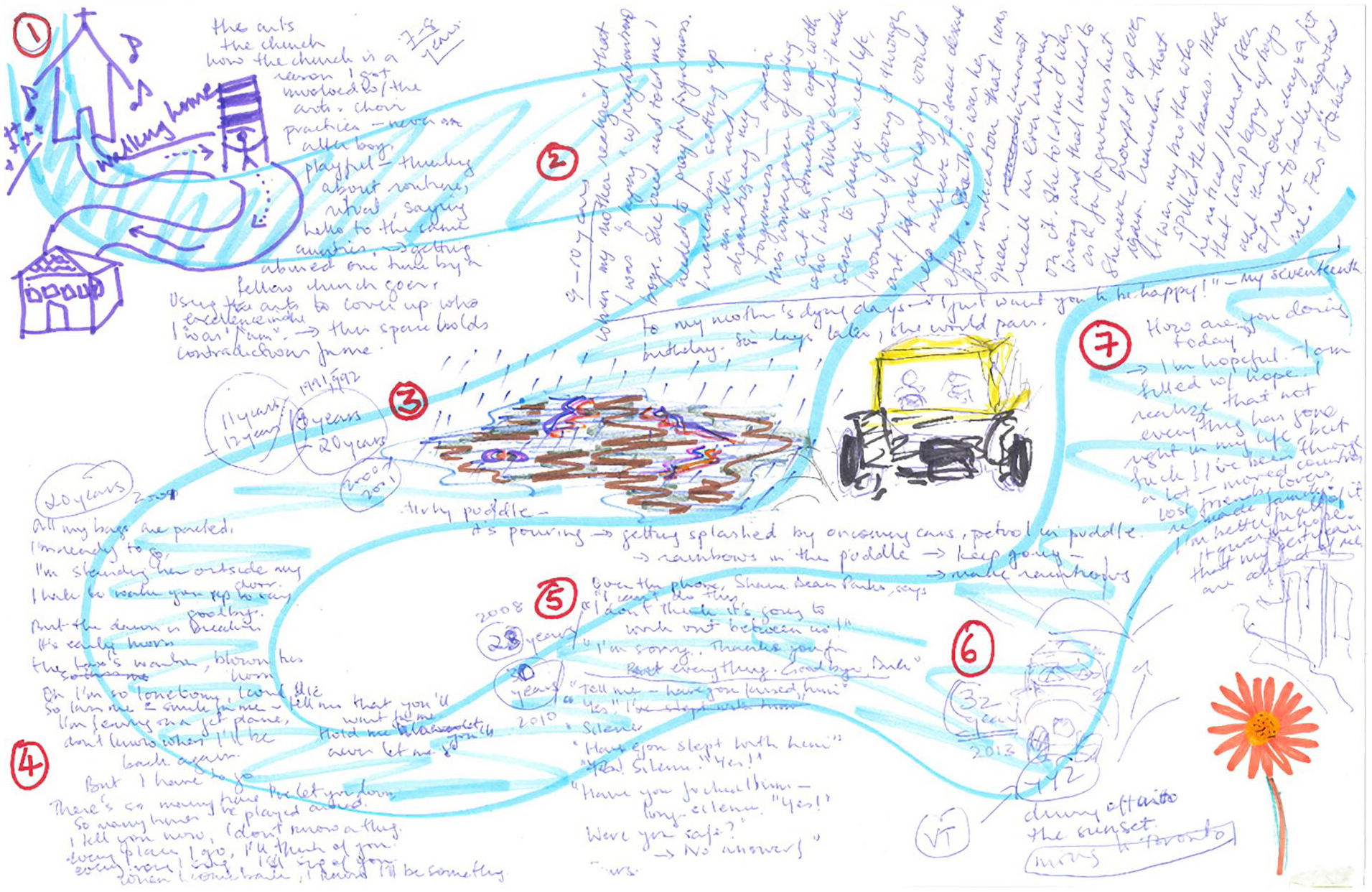
My river story.
But feeling is not enough. There is a knowing—a Desi way of being—through its contradictions and complicities, needs to be recognized and celebrated. My river story is not perfect. It is littered with errors, lapses in judgment, and tons of white-mess. But the dunya-paar has allowed me to recognize, name, and understand these missteps as points of possibility in reinvesting in the relational responsibilities with those close to me and the communities beyond.
Finally, when I began my dissertation project, I wanted to focus on the experiences of Queer Desis/South Asians who self-identified as being “out” in any way that they felt they were. At the time, this was important because of my desire to break the tyranny of “coming-out” for Queer People of Color that has for too long been “understood as a conclusion to the linear teleology of the modernist, rational subject [that] emerg[es] unrepressed and therefore as empowered as any white Queer” (Puar, 1998, p. 414, emphasis added). My rational mind—my “thinking” mode—inadvertently (self-)censored ideas and experiences of the body and perhaps especially of sex and sexual expression in a study on Queer Brownness. Using the arts as a different method allowed the pain to move alongside the pride and possibility.
Sara Ahmed (2004) writes in The Cultural Politics of Emotion that “emotions are the very ‘flesh’ of time” and it is through them that “the past persists on the surface of bodies” (p. 202). Such a feeling–knowing–thinking approach evokes the thunn-munn aesthetic that centers the body and celebrates it as a site of many different, and often contradictory, experiences. I carry these contradictions in/on/through my body. They shape how I see myself and wish to be seen by my communities and beyond. As an emerging scholar committed to working with my communities, they shape the work I do and the stories I tell. It is important to note that the journeying afforded by these applied performance practices did not and do not promise liberation or transformation from incidents of trauma. However, for me, they offered me a different way to reflect on these incidents and give myself permission to step out of the shadows and, as I am doing in this article, write about them. Ahmed (2004) continues, Emotions show us how histories stay alive, even when they are not consciously remembered; how histories of colonialism, slavery, and violence shape lives and worlds in the present. The time of emotion is not always about the past, and how it sticks. Emotions also open up futures, in the ways they involve different orientations to others. (p. 202)
Hauntings of Home: Concluding Through the Mixedness
I have been asked the “home” question (when are you going home?) periodically for twenty years now. Leaving aside the subtly racist implications of the question (go home, you don’t belong), I am still not satisfied with my response. What is home? The place I was born? Where I grew up? Where I locate my community, my people? Who are “my people”? Is home a geographical space, a historical space, an emotional, sensory space? (Mohanty, 2004, p. 126)
How does the Queer Desi body know that it is home? I am still haunted by this seemingly simple question for a while now. As I reflect, I realize that our complex identities demand complex answers. For me, higher education is not home but it has provided me with a critical container within which I can experiment, question, challenge; where I can laugh, cry, smile, and scream. Negotiating this “both/and”—the affective inheritance that higher education can be both toxic and yet holds liberatory possibilities demands time, patience, and multiple intelligences. Thinking through mishritata as an orientation, which emerged through my dissertation, is only the beginning of some deep reflexive “feeling–knowing–thinking” and healing.
My dissertation research became a labor of love that allowed me to deepen the relationship I have with myself and with my communities. It took the stories of others to help me better understand my own stories. Individually and collectively, the relationships cultivated afforded us some respite—a “state of movement and unsettling, with temporary moments of belonging, being understood, and being seen without being marginalized” (Bhattacharya, 2018, p. 15). As I sort through the almost 22 hr of kathās, 6 the 20 hr of socially embodied arts practices used in my work, and the almost 16 hr of time-pass 7 with these seven brave and brilliant humans who were part of my project, it becomes difficult to express what it meant to be inside of and alongside them as we journeyed to make meaning of our multiple minoritization, what was shared between us and to “with-ness” what was unique to each of us. Just like I began, I conclude with a poem—a raw response—something I typed instinctively as an analytical memo (Gibbs, 2002) at the end of the second day of my creative data collection. While it does not specifically respond to the question, I think it provokes me into thinking more clearly about the affect of what it means to embrace a strengths-based approach for the multiply minoritized body.
to be in a state of mixedness
is to be mishritata
it is to occupy a mishrit body
***
to be mishritata
is to be at a borderlands
where my shade of brown
is searching for its place.
cast by color
colored by caste
where color(ism) is suspended
somewhere between black red white
taught to fear the darkness
ignore the redness
embrace the white(mess).
to be a queer desi
is to be mishritata.
to be unrecognizable
invisible
to straight brown skin.
to be unlovable
untouchable
to queer white kin.
to be mishritata
mixedness
a queer desi
is to be gender-caged
a pressure-cooker.
toxic masculinity
twice-whitened femininity
omnipotent heteropatriarchy.
queer desi mishritata
is to be in a space
where Colonization—
my 300-year old “friend”
looks over my shoulder
even as he walks besides me.
it is to arrive on stolen land
by boat road air
and not recognize
the red that still bleeds
through the flag
and in the soil.
queer desi mishritata
is to be in a space
where brownness and queerness
become currency
used as trade-in
culture for (self)respect
a capitalist winless war for legitimacy.
to be mishritata
to be at a borderlands
is to recognize.
know my story
and the stories
that have made me
shaped me
come before me
sacrificed for me
so that I may live this life
and to learn these stories if I must.
to be queer desi
it is to be mishritata
it is to occupy a mishrit body
—Excerpt from field notes (January 14, 2017)
8
Footnotes
Declaration of Conflicting Interests
The author(s) declared no potential conflicts of interest with respect to the research, authorship, and/or publication of this article.
Funding
The author(s) received no financial support for the research, authorship, and/or publication of this article.
Notes
Author Biography
 ), a designated ‘[Research] Cluster of Scholarly Prominence’ at the University of Toronto Scarborough.