




Abstract
Walking as a methodological approach has developed within anthropological, literary, sociological, and ethnographic research, and more recently in ethno-biographic studies, but has not greatly crossed into history or art history. In this article, using the metaphor of the “constellation,” we offer a transdisciplinary methodology to complicate Euro-western renaissance humanism, in our exploration of the gendered, temporal, spatial, and cultural aspects of renaissance Florence, through a walk in the “Boboli gardens” in the footsteps of Poliphilo. Walking helps us to form a sense of our past, present, and future, and in walking, we gain ground in the “art of paying attention” (Ingold). In our walk, key emerging themes are the gardens as a metaphor for visual culture; the phenomenological, temporal, and spatial transgression of gender norms and their demarcated thresholds; gardens as stimulating cognition and the sensorial; and the developing art of garden aesthetics and the architectonic.
Introduction
This article emerges from our separate and yet connected research interests in walking as a means for conducting transdisciplinary research (sociology and literary/art history). Maggie invited James to walk with her as part of her Leverhulme research fellowship on Walking Borders, Risk and Belonging 1 and he in turn invited her to walk with him through the Boboli gardens in Florence, as part of his research into the gardens of the Hypnerotomachia Poliphili (HP). The intention in walking together in a renaissance garden was to facilitate space for reflection on Renaissance humanism, on border places and spaces as well as advance innovations in walking/biographical methods by walking borders and listening to and reflecting on the experience of the walking in place.
Thus, this collaborative article reflects upon the use of walking as a “non-procedural” (Springgay & Truman, 2017) constellational method (M. O’Neill, 2016), through a walk we did together in the Boboli gardens in the footsteps of Poliphilo in the HP. The HP is one of the most important texts of the renaissance. It was originally printed by the Aldine Press in 1499, Venice, and published fully, for the first time in English, on its 500-year anniversary in 1999 by Joscelyn Godwin. Research on the HP has developed significantly since the mid-20th century with Pozzi and Ciapponi’s 1946 commentary and expanded further with numerous studies in the 1990s and further developed in the 21st century. 2 The novel tells the story of Poliphilo, wandering through a three-fold dream and through three realms filled with gardens and architectural creations, to the island of Venus—a garden island, where his initiation into love, and union with Polia is accomplished.
The practice of walking and subsequent reflection on our walk suggests that walking can be a way of doing transdisciplinary research at the intersections of the arts, history, and sociology. 3 Walking, we suggest, can be a constellational method that is helpful to both work through the past and tell and analyze the history in the present. Our walk can be understood via the metaphor of the constellation in “its emergence and articulation, but not as an object in itself” (Heberle, 2006, p. 7). Our walk in the Boboli gardens facilitates (through constellational thinking) a sensory engagement with the novel and an alternative interpretation of the epistemological history of early Quattrocento Venice, gender norms, 4 and Renaissance sensibility.
In section one, we outline the methodological importance of constellational thinking while walking in the Boboli gardens for enacting nonprocedural research methods and troubling the gender conceptualization while also acknowledging gender performativity (Butler, 1990, 1993) and identity construction within the narrative framework of the HP. In particular, we account for the importance of walking in gardens as Poliphilo’s means of undertaking and understanding his journey, through three dream visions, from the dark wood to the island of Venus, as a process of self-transformation where walking performs a cognitive, embodied, and sensory process of development and is intimately connected to the construction of identity and nonidentity thinking in relation to place—the renaissance garden.
In section two, we apply this method by walking together in the Boboli renaissance garden (an art historian and sociologist), in and through place, to walk our way into a better, experimental, and embodied way of engaging with the novel, through body and image, space. We propose that our transdisciplinary approach may more effectively tackle the multifaceted nature of the narrative and the importance of working through the past to trouble and unsettle dominant hegemonic historical narratives that are so often tied to place.
In the final section, we discuss the key emergent themes of our walk: gardens as a metaphor for renaissance culture and visual culture; for the process and practice of conceptualizing identity construction, nonidentity thinking about gendered agency through mobility; as a place for stimulating reflection on the nonidentical 5 traces of utopian possibility, on border places and spaces; and an arena for the stimulation of the senses. Ultimately, we argue that walking, and working through the past, in a renaissance garden facilitated constellational thinking and analysis that offers a nonprocedural, transdisciplinary, and constellational/mobile method.
Walking as a Research Method/ology Across a Transdisciplinary Terrain
Walking has a long history in the arts and social sciences. In arts practice, it is a method for epistemological and creative activity, a means of thinking and making (Billinghurst et al., 2020; Heddon & Turner, 2010; Hind & Qualmann, 2015; Ingold, 2007; Morris, 2020). Walking as a method is becoming increasingly popular in the social sciences, and the humanities. The “turn to walking” is part of a wider concern with mobilities research, with lives in movement (M. O’Neill & Roberts, 2019; Springgay & Truman, 2018; Urry, 2007) what Simmel calls “sociation”—the social forms or “patterns” in which people interact, the “socio-spatial patterns of mobility” (Urry, 2007, p. 21), and the ways we attach to, or make place (Springgay & Truman, 2017; Szakolczai & Horvath, 2017; Urry, 2007). For M. O’Neill & Roberts (2019), the walking interview as biographical method (WIBM) enables researchers to do biographical research connected to place, time, and the sensory aspects of lived lives. An important aspect of biographical research is to work through the past and walking as a biographical method might serve to unsettle in collaborative and co-productive ways, the nonidentical or the dominant hegemonic tendencies behind appearances, and by thinking against the grain preserve independent thinking—the critical oppositional.
Walking in the Boboli gardens (a renaissance garden in Florence), in Poliphilo’s footsteps, enabled us to think through the layers of history in the present, and the articulation of the historical and cultural conjunctures that helped James to read/interpret the narrative, at a particular point in time (the renaissance) and in place. As Doreen Massey (2005) has said, place is a space that has been given meaning in and through human experience and there are intimate connections between stories, space, and time. As a biographical researcher, Maggie pays attention to and listens to the lives of others as part of human understanding, both material and immaterial experiences. Walking opens a space for dialogue, where embodied knowledge, experience, and memories can be shared.
James reflected that the landscape design and materiality of the gardens in the HP are testament to a profound shift in cultural sensibility and developing renaissance aesthetic, and it is through walking that the novel and the gardens are understood and experienced, where the protagonist is developed, and how a new perspective on Renaissance sensibility regarding gender 6 and identity construction can be approached, through the constellational thinking.
Poliphilo moves through three different realms in the narrative with two large gardens that take up a great deal of the narrative, with two female guides, Logistica and Thelemia (representing logic and will/feeling). In moving through the gardens, there is an emphasis on reflection and conceptualization as means to an understanding of the world and his place within it. Yet, the space offers as much introspective reflection as perception: Logistica states, when taking Poliphilo up a metaphorical spiral staircase in the garden, where a purely mental image of the soul’s process through life is seen (through the allegory of people journeying through a colossal water labyrinth), “it was not enough for our curious Poliphilo simply to see, but I had to give him information about that which matter cannot penetrate, so that at least he could know it by hearing my interpretation” (HP, 2003, p. 127). His ontological growth in the garden-walks suggests to the reader a relationship between the construction of identity (which develops throughout the narrative) and the garden as a framing-place to this process (most likely echoing the Neoplatonic notion of reflecting inner beauty through external form). Here, Logistica, within the garden, says, As soon as the divine poem was over, the god-beloved Logistica took me by the hand and led me out of there, saying “Poliphilo, I want you to know that things perceived give more enjoyment to the intellect than to the senses alone. For this reason, let us go into this place so as to satisfy both modes of perception.” (HP, 2003, p. 128)
The garden is a locus of intellectual, sensorial, and cultural constructs: Through the combination of walking, reflecting, conceptualizing, and experiencing, within a hierarchy of intellect over pleasure, it emphasizes design and order in a natural rationalism leading to self-cultivation. The garden walk is a space of ontological ascensions, where higher percept of the soul’s journey through life can be perceived in the mind’s eye.
The means of this ontological process is the act of garden walking, where, for example in Eleuterylida, the observation of an idea of the self and its position in the world, reflection on this percept, and subsequent conceptualization of theory, is enacted. For example, The two companions took me gaily with unceremonious speed . . . through the same curtains and doorways . . . [to] the area enclosed by the hedges of orange trees . . . then she led me into a gorgeous orchard on the left hand side of the . . . palace . . . the [glass] beds were filled with a marvellous imitation of simples . . . finished and decorated with subtle lineaments. (HP, 1999, pp. 123–124)
Because the gardens are allegorical spaces representing certain ideas or themes, such as, in the glass garden, the vainglory of man through the fragile material of the glass, the walk expresses an existential locus on Poliphilo’s position, as he is led from space to space. The walk itself physically maps his interior process of self-cultivation, regarding questions of place in universal processes, existential purpose, and gender performativity agency, in a peripatetic fashion, connecting identity, ontology, and place.
Key concepts that guide the walking interview are embodiment, memory, time, mobility, rhythm, and the senses. There are a number of ways to interpret walking conversations such as thematic, discursive, narrative, and grounded theory approaches (M. O’Neill & Roberts, 2019). However, thinking nonprocedurally, we use the figure of the “constellation” (M. O’Neill, 2016) and sought to see, feel, and experience history in the present and gain a richer understanding of the sensibility of the Italian renaissance, on foot. Related modes of analysis are assemblage, montage, mapping, multimodel, and valency.
Our conversation in the gardens (see section two) did not advance in a linear fashion but rather using the metaphor of the “constellation” (a concept Adorno borrowed from Benjamin), constellational thinking involves a “theoretical thought” that “circles the concept it would like to unseal”—a relational method emerges, involving an assemblage of sensory as well as cognitive thinking, that criss-crosses binary thinking, and helped us to access the sedimented layers of society, of history, residing in the gardens. In the footsteps of Poliphilo and engaging with the novel, another way of describing constellational thinking as a “non-procedural method” in and through our experience is to think of it as a “force field,” a “relational interplay” of forces that “constitutes the dynamic, transmutational structure of complex phenomenon” (Jay, 1984, p. 14).
A constellation is a term/concept in astronomy that describes a celestial form or pattern of stars. Shierry Nicholsen describes constellational thinking as “exact imagination” and puts it this way: “exact imagination is confined by scholarship and science yet goes beyond the material by reconfiguring the material at hand” (Nicholsen, 1997, p. 38). Constellational thinking and analysis involves the relational understanding of experience and the complex circumstances of its articulation, emergence, interpretation, and analysis (M. O’Neill, 2016; M. O’Neill & Roberts, 2019).
Garden-Walking in the HP
The novel influenced generations of garden designers in Italy and France, and also inspired numerous paintings and sculptures of the Baroque. For the early humanists, landscape art represented the ideal of a civilized world and “man’s power” of creating and surrounding “himself” by the beautified form (not just a dominance and ownership of nature but a union with it, to dwell within it; Gasparotto, 2017). Gardens are part of the creativity of disegno; they are sensory, stimulating suspended temporal spaces, created through developments in contemporary humanist aesthetic and bear architectonic relationships. In Poliphilo studies, garden historians demonstrate how the Renaissance garden was designed for the experience of visual pleasure in geometric patterns, compartmentalized to create different sensory experiences (Attlee, 2012; Hunt, 2013; Hunt & Leslie, 1998; J. O’Neill, 2020). Social and art historians demonstrate how the outdoor space was utilized for musical, theatrical, and political purposes, whereas scientific historians have observed how the proliferation of written and oral communication on Venetian streets are socially charged as places of gossip and knowledge, accessed through mobility (J. O’Neill, 2020; Tessicini, 2016). But the relationship between walking, belonging, gardens, and gender requires further attention in renaissance history and Poliphilo studies.
A biographical explanation for the strong interest in walking in the HP may be found in the (possible) author’s profession as a Dominican Priest, a sect of Christianity that necessitated mobility and travel as a fundamental of preaching, as opposed to remaining within church walls (Casella & Pozzi, 1959). From a practical perspective walking in the HP gardens enables Poliphilo to describe the color, design, and dimensions with a plethora of details, combining realism with philosophy, and thus commenting on the contemporary humanist sociophilosophic and performative use of gardens, in contrast to the medieval, practical, more stationary usage.
J. O’Neill (2020) examines how the gardens frame Poliphilo’s self-transformation as architectonic places of interior metamorphosis and epistemological conceptualization and ontological experiences. First, in Eleuterylida (Figure 1) (the second realm), the symbolic form of the garden corresponds to the narrative themes linked to earthly and celestial knowledge, developed through the process of Poliphilo walking and understanding philosophic principles narrated by his guides (Logistica and Thelemia). Second, in the gardens of Cytherea (the third realm), James describes how Poliphilo examines the symbolic form of the garden in relation to self-transformation on the level of the experiential, and how Poliphilo’s ontological progression is assisted through the process of walking, and the symbolic use of botanical items in the gardens; and finally, in the Garden of Adonis, the mystagogic initiation is completed through his union with Polia, demonstrating the synchronicity of the narrative sequences within garden spaces in the novel, creating a conceptual locus that troubles the dominant renaissance hegemony relating to gender, knowledge and identity.
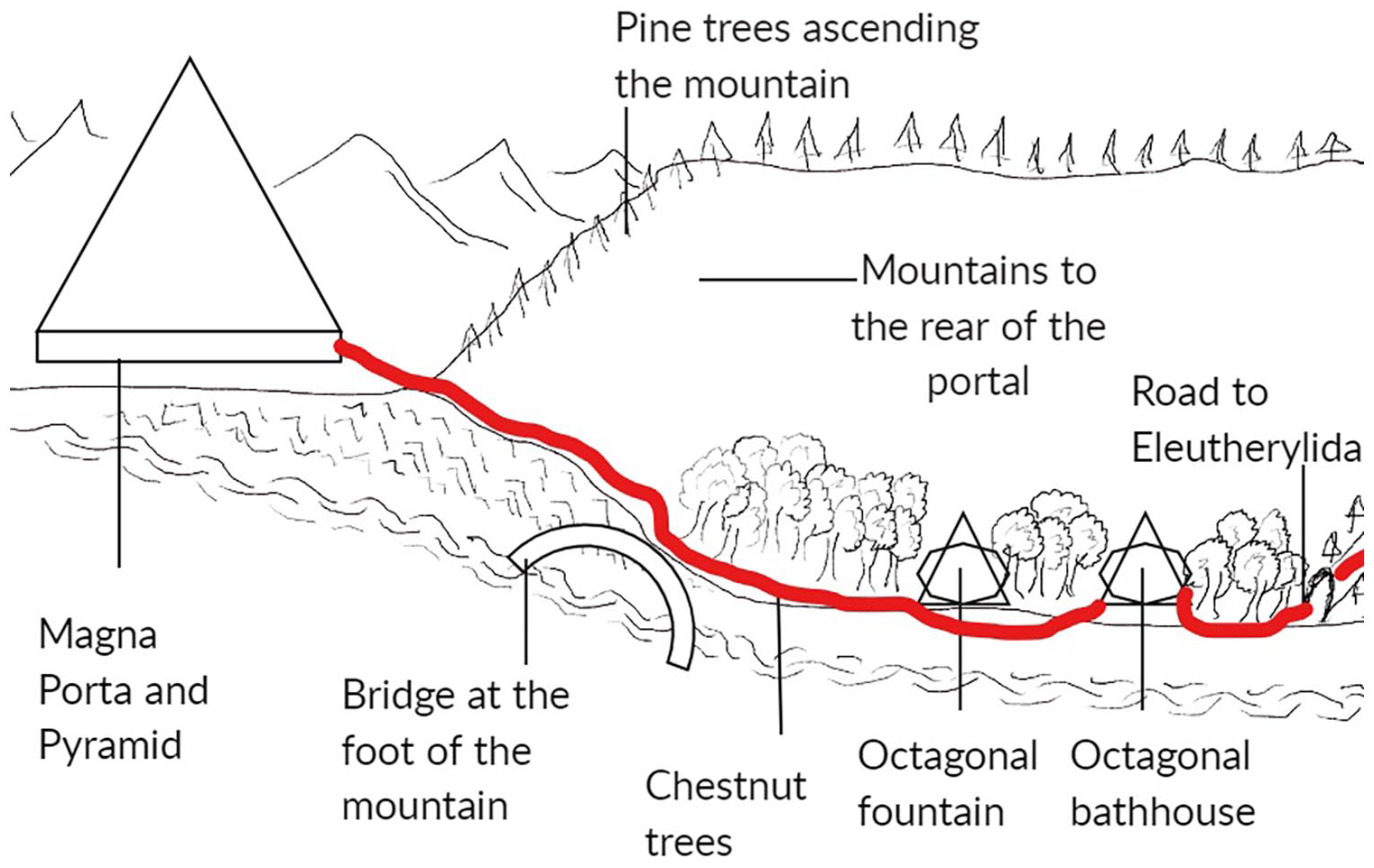
Route of Poliphilo’s walk from the hill of Eleuterylida to the palace of Eleuterylida by James O’Neill (2020).
The HP expresses an obvious nonidentical relationship to normative gender identity renaissance culture (in medieval and renaissance times, strict gender codes were the norm), where Poliphilo, unable to progress in his journey without the assistance of his various guides, all of whom are female, slowly progresses forward before being initiated into the mysteries by a female hierophant, before finally ascending into the hierarchies before Venus herself. Not only is he unable to progress on his journey without the assistance of his female guides but they also do not permit him to progress unless he has sufficiently achieved, understood, or experienced something, placing personal growth as the hermeneutic key in the pedestrian and peripatetic journey of self-transformation. In this way, and uncharacteristically of Renaissance societal norms, which differentiated public and private spaces as masculine and feminine, in both domestic and civic places, Poliphilo is directed, guided, and influenced by powerful female guides (Brown & Davis, 2014).
Throughout the HP, there is a portrayal of women characters that perform the roles that men would occupy in renaissance culture, such as guarding gates and doorways to important spaces; educating, or unveiling, secrets and general forms of knowledge; and physically leading from place to place as autonomous agents of mobility. This portrayal of women is observed by Juliana Schiesari as an element also in the fiction of Boccaccio, besides the later works of Aristio and Tasso, displaying a literary tradition of “masculine” women that infers a virtuous persona through the characterized masculine demeanor. This is echoed in Tinagli’s sociocultural observation of that “young women were considered by society to be pliable and inherently weak; hence they needed constant moral guidance” (Tinagli, 2000, p. 23). Indeed, Lauro Querini praised Isotta Negarola for overcoming her biological nature, saying, “For that true virtue, which is essentially male, you have sought with singular zeal . . . such that befits the whole and perfect virtue that men attain” (Schiesari, 1989, p. 68). This is also characterized by Polia as an embodiment of honestum, through her position as dream-vision guide, priestess, and through the descriptions of her demeanor as a paragon of Ciceronian virtue. 7
In the HP, there is also a feminization of the male protagonist. This is demonstrated through his lack of social mobility and who requires total assistance from female guides to progress. There is a purposeful role reversal in which Poliphilo’s gendered agency is inherently feminized, while his female guides perform a male persona. Indeed, the urban and topographical places outside the home, historically male locales, are wholly feminine-dominated spaces in the narrative, emphasizing a transgression of contemporary culture and gender politic (Romano, 1989). Furthermore, when we observe how certain families, such as the Barbaro family, subscribed to the popular patriarchal principle of Roman law, characterized by the patria potestas, we may understand how different Poliphilo’s experience was for his contemporary readers (Chojnacki, 2019). 8
In this sense, we argue for the importance of constellational thinking as a nonprocedural walking/peripatetic method for accessing, experiencing, and approaching the historical mediations that we can glimpse in the sedimented stuff of history, of society, emerging in the gardens, the land, in place, connected to the novel.
Walking Conversations in an Italian Renaissance Garden in the Footsteps of Poliphilo
We undertook our walk in the Boboli gardens in August in Florence. Approaching the entrance to the garden, we climbed high and had the most amazing view over the city (Figure 2).
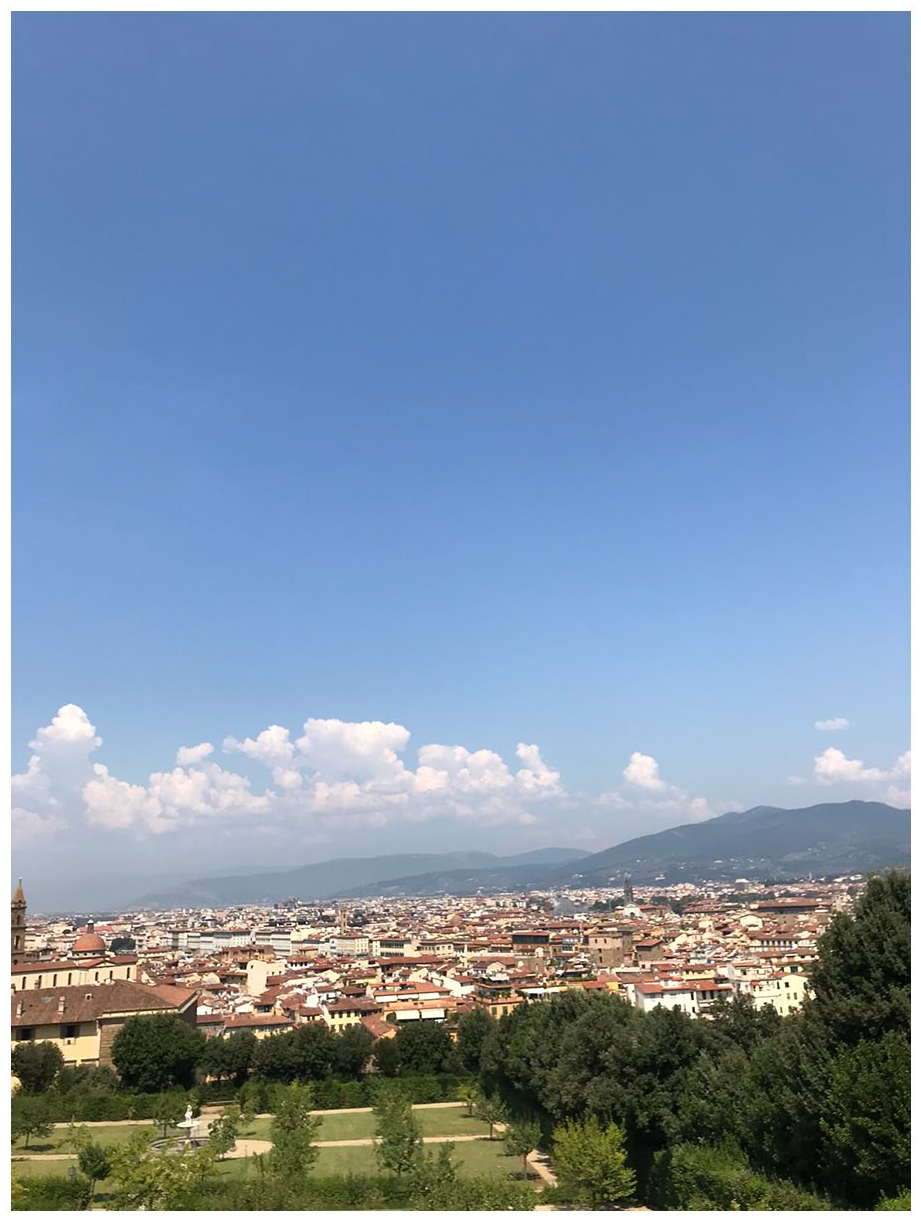
Walking to the Boboli Garden Florence.
While entering the gardens James spoke about the structure, formation, and the meaning of the gardens in the HP. The historical lineage of the renaissance garden, from the small, enclosed, medieval gardens, to the large, compartmentalized design of the architectonic, Renaissance garden, that is described in the narrative of the HP. The garden was an important cultural space, where private artistic exhibitions and theatrical events would take place for the wealthy (merchants and aristocracy). The Renaissance gardens were places to relax in, explore, and excite both conversation and self-reflection, as observed in the garden at Villa Quaracchi described in Giovanni Rucellai’s Zibaldone. 9
Introspective Cognition
Our conversation and walk in the garden connected with the HP through the geometric structure, the exercise of walking and thinking, and the experience of walking through sprawling geometric, compartmentalized spaces. In the HP, gardens provide topographical thresholds between realms and between ontological states of being, epistemological states of knowing, and gender empowered thresholds, where Poliphilo’s progression is permitted only by his female guides. The different garden spaces represent not only Poliphilo’s realization of different concepts that form his sense of identity and philosophical considerations, but also sexually charged spaces of his affective connection and desire toward aesthetic structures, and for Polia, for and to whom he travels:
James: Italian Villas would have been geometrically designed in the renaissance of differing sizes. The Boboli gardens were created by the Medici on a much bigger scale than standard gardens, reflecting their political power in Florence. A century previously the garden at Villa Quaracchi described in Giovanni Rucellai’s Zibaldone present a similarly geometric design divided into sections, with a water fountain in the center and a view from the house to the bottom of the garden with avenues of trees creating differentiating spaces, prompting sensory alteration, as well as a differentiation in cognitive stimulus meaning that the process of thinking may alter from space to space in the garden as a place for introspection and spaces for external observation.
Maggie: This line of trees, is lovely, very tranquil.
James: That’s one of the features in renaissance gardens, the shaded pathways (Figure 3) and you find in the Hypnerotomachia gardens, particular flowers and trees, to emphasize a sensory, aesthetic experience, that changes as the walker progresses.
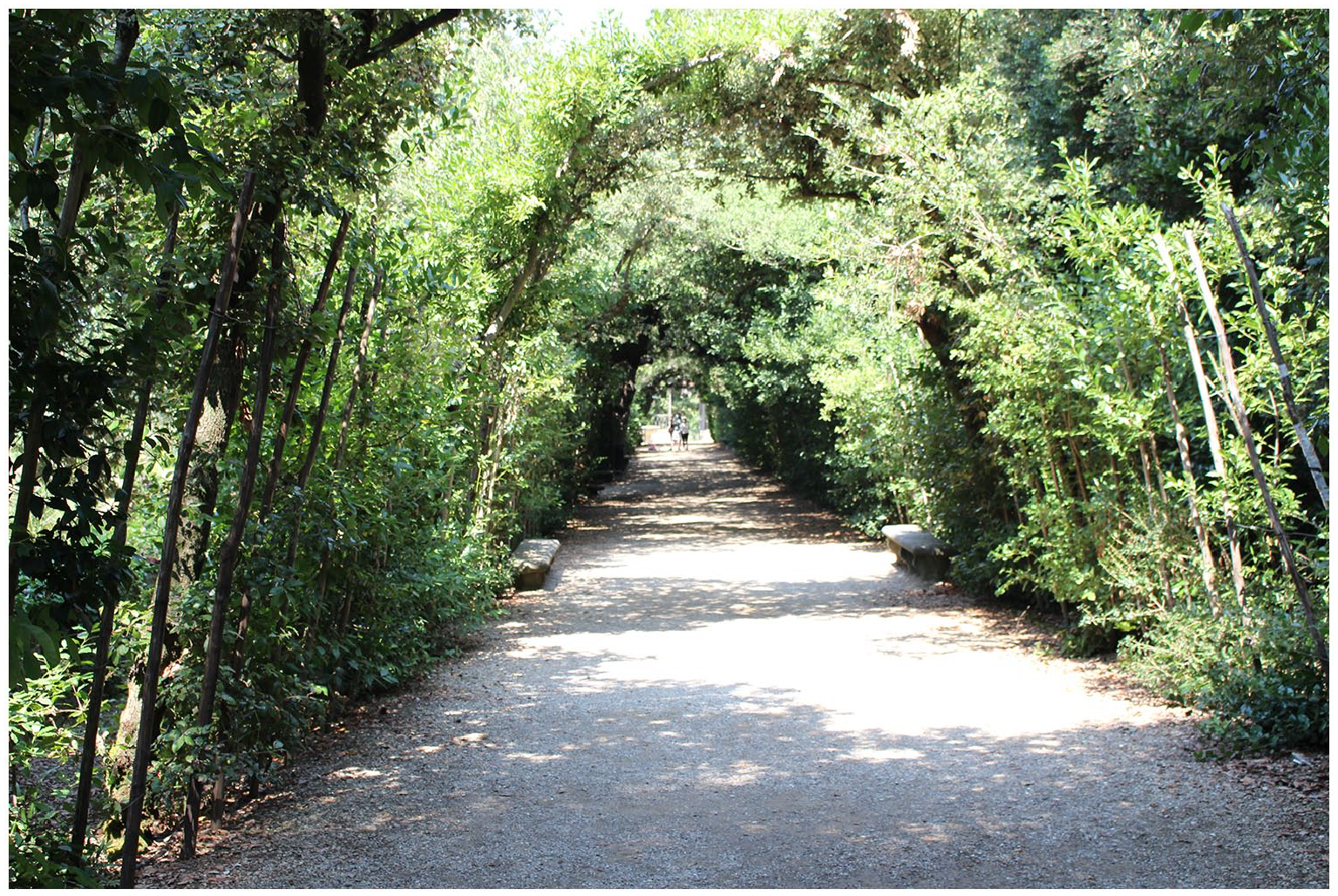
Tranquil avenue of trees.
Sensory Aesthetics
Maggie: There is also an element of surprise that is equally a feature of thinking in constellational forms, in the layering of the past in the present and what we are doing now, reaching toward the sedimented history in the topography, choice of botanics, the aesthetic delight and sensory shifts as we walk across various thresholds, related to the novel. It feels like a configuration of phenomena, linking art history, sociology, embodied and affective experience, and also an imaginary domain!
James: Often the gardens were separated into geometric squares, and as you walk through, you might spy into another space perhaps with a small fountain or flowerbeds; everything was designed to be accessible to make you want to walk from place to place in architectonic fashion.
Maggie: What do you mean by architectonic?
Architectonic/Garden Design
James: Something which has been created architecturally but which isn’t the medium of architectural material. You can have architectonic music, when you’re using architectural principles to design music. The renaissance garden aesthetic emanated from Tuscany, or in the North, Padua, close to where the Hypnerotomachia was published. Padua had famous botanical gardens, housing different botanics used for the way they look or smelled in the renaissance gardens that were created beside the homes of wealthy merchants and aristocrats. Because of Venice’s size, it was difficult to have more than small, or rooftop, gardens, and in the Hypnerotomachia, there’s an interesting kind of dichotomy between the older walled gardens which are Medieval in style, called the hortus conclusus, which is an isolated garden, and expanding them through the wall, into an open space between the house and a large area of land to accommodate the pleasure gardens.
Maggie: and this garden?
James: The Boboli Gardens were owned by the Medici, but certain wealthy male merchants would also have had a grand house and large garden, perhaps with a fountain (Figure 4), and which is reflected in the Hypnerotomachia. You have in the Gardens of Eleuterylida a Renaissance type of garden with many open spaces and a large palace, whereas, later on, at the end of the first book, you have a Medieval hortus conclusus or a small garden dedicated to Adonis where the narrative is concluded, and similar perhaps to what you would see in Venice. So, there’s a couple of influences going into the gardens of the Hypnerotomachia, one of which being the emerging Renaissance type and one being the older medieval type which was more familiar in Venice.
Maggie: I suppose what is striking about this area is also the format, the formality, I’m not sure whether those are orange trees lining the entrance to the fountain itself.
James: Poliphilo often narrates the details of his walking route, for example, an avenue of pine trees leading onto a grove of Cypress and orange. The author is clearly familiar with a great breadth of botanics which are used in the novel for their aesthetic appearance.
Maggie: The other thing that struck me on the walk is that there are so many thresholds.
James: Yes, every geometric space will have its own separate threshold between one area of the garden and another, creating a threshold experience, walking from one space to the next. But also, Poliphilo’s walking experience is “policed” by his guides, making the crossing of those thresholds significant, and commenting upon notions of conceptual, ontological being and the construction of gendered agency.
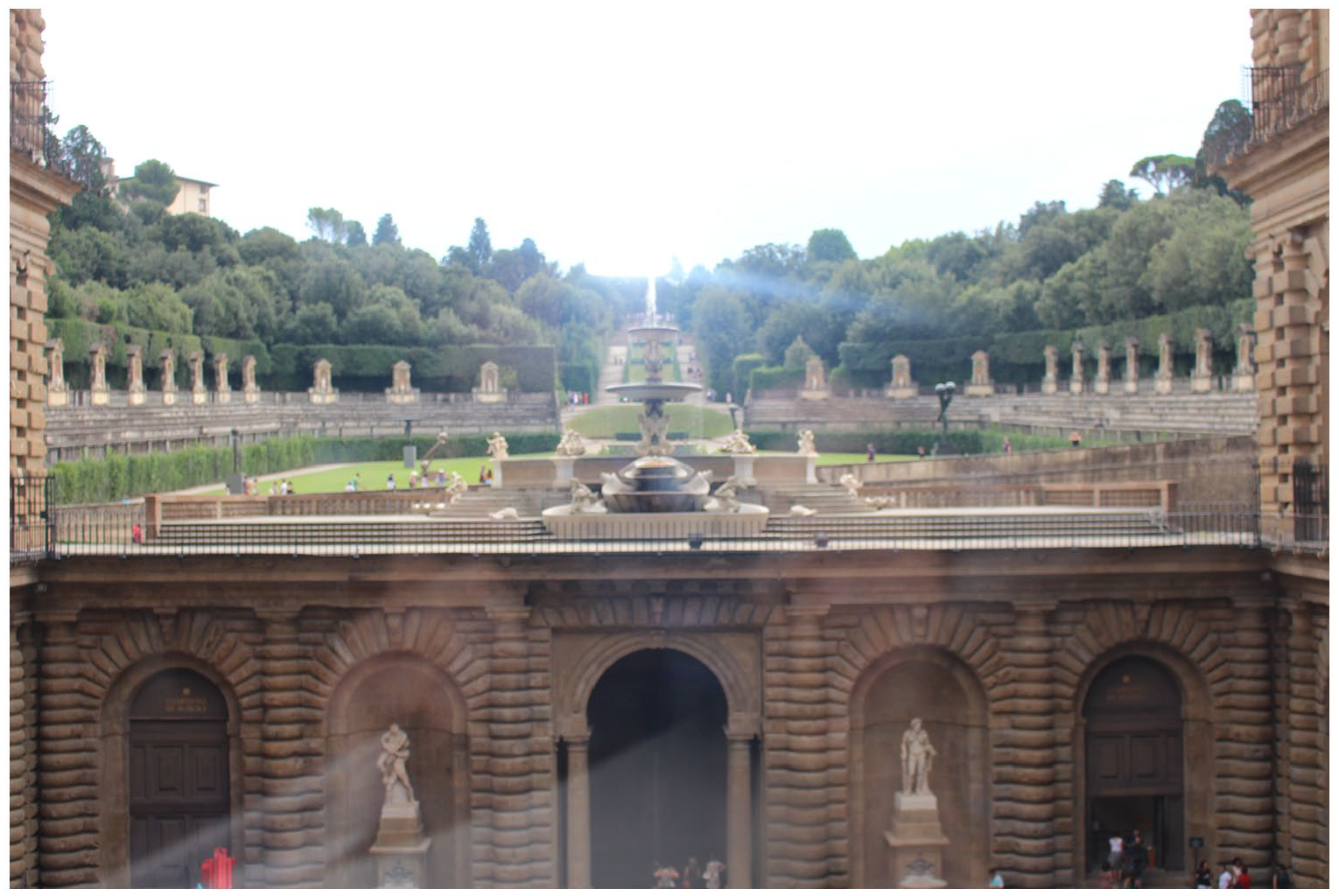
Architectonic Garden design.
Gender and Agency
Maggie: And then we come into this cooler, wider avenue with statues marking the end and beginning of different spaces.
James: There’s different crafted spaces of experiences though fountains, change of trees, their planting designs creating different visual and sensory aesthetics (Figure 5). These would be male spaces in as much as they were created by and for the domestic pleasure of men, yet it is curious in the HP that Poliphilo does not share this gender-based agency but is permitted only by his female guides, inverting the contemporary social practices of the day. However, it is a more complex issue, for as Claudia Lazzaro, observing the proliferation of female sculpture in Renaissance gardens and the identification of nature with femininity, wrote that gender played an unambiguous and important role in understanding both gardens and the natural world (Lazzaro & Bruno, 1990). Consequently, while cultural mobility is a sociohistorically male activity, and although the gardens are designed for the male mobility of its owner, the garden is a culturally defined feminine space.
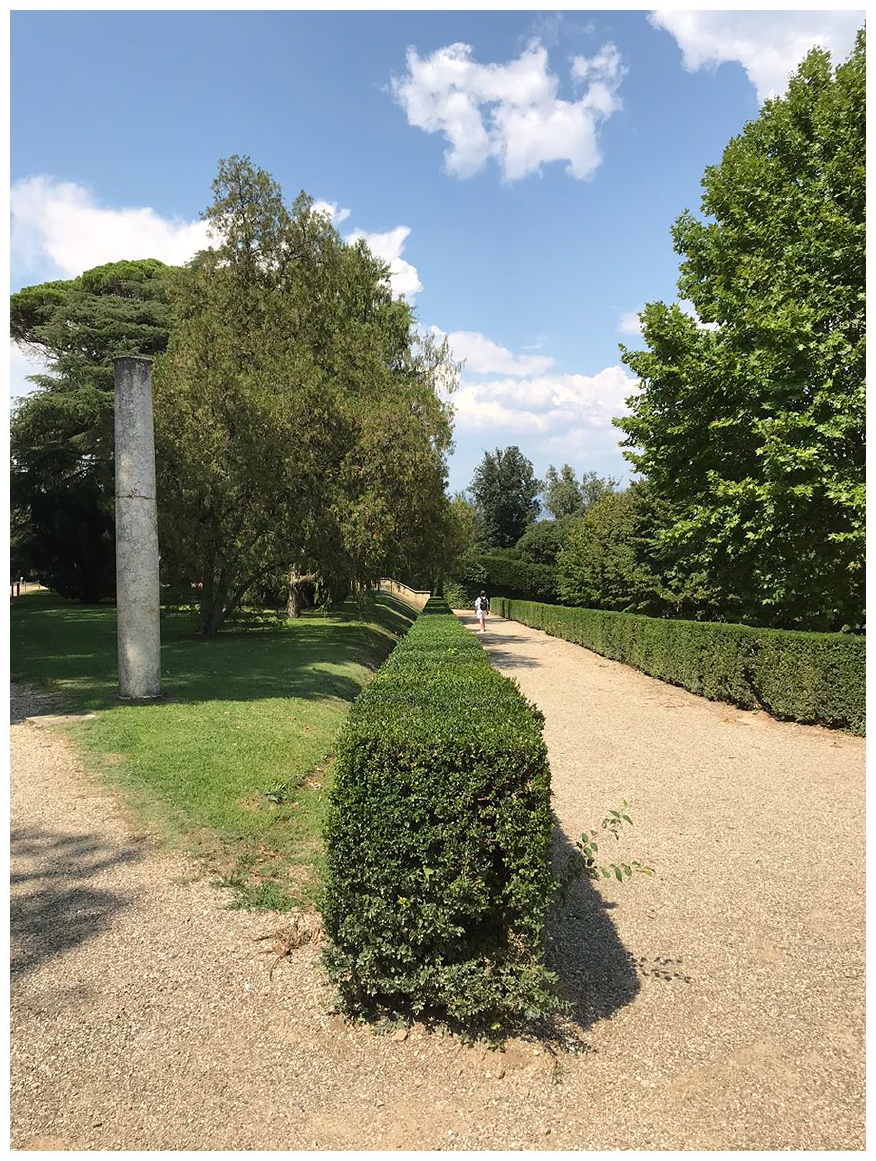
Crafted sensory spaces.
Atmosphere
Maggie: Regarding the threshold, we’ve just walked through narrow Cypress lined trees arched, into a little bit of a wider tree-lined route walking down to the Neptune Fountain, into an enclosed space with the fountain and tall trees where the atmospheric conditions are really different. The atmosphere, in that sense, is shaped through the use of botany to create spaces of specific sensory effect.
James: That’s very interesting, and regarding the relationship with the garden as a constellational form, walking is inherently linked to reflection. Thinking is enacted through the circuitous journey in the narrative. But how do the atmospheric alterations and differentiations assist the relationship between constellational theory and garden walking?
Maggie: The immersion in the sensory, materiality of the gardens, the experience of being in and walking in the gardens, is both the medium and the means by which constellational analysis takes place; it is the mediation of equivalent elements, through constellational thinking in the gardens, about topography, threshold, senses, and the text.
Visual/Culture
Maggie: What would you say are the defining aspects of the cultural use of the renaissance garden?
James: Walking is a key component because so many gardens have compartmentalized spaces, different plants, trees, hedges, labyrinths, and different uses for their spaces; it’s not one, big open space where people relax; it is rather a space that has been subdivided into smaller gardens, necessitating walking. There is a prerequisite of movement and stimulation, and this is certainly reflected in the Hypnerotomachia where key philosophical themes are carried out in gardens and indeed the features of the gardens prompt the philosophical questions and narration. The gardens are places of symbolic meaning to talk about the artistic creations positioned there. It’s a place to incorporate numerous elements of the outside world, a mentally stimulating space, a place where you’d also have possibly theatrical stagings, music, and sculpture: locus of each type of artistry.
Maggie: And did this happen to Poliphilo on his journey, music and sculpture and performance?
James: There are sculptures, manmade artistry, and he does meet many kinds of beautifully crafted things, as well as meaningful sculptures that represent certain ideas that he reflects upon during his garden walk. The gardens, consequently, represent a material and interior, symbolic space in the Hypnerotomachia, where everything prompts narratologically important existential questions, often set in gardens.
Efthymia Priki observes how Poliphilo embraces his emotional suffering of love for Polia, stating “what is acquired with hardship is more precious, and is held so, than that which is obtained conveniently” [D5r] which she attributes to the rules of courtly love, noted in Andreas Capellanus’s Honeste Amandi (Priki, 2016, p. 234). Building on this notion, Poliphilo’s feminine experience within the narrative expands beyond and in some ways contradicts the standards in courtly literature and posits an alternative Renaissance identity with regard to love and gender. Related to Stewering’s (2000, p. 9) Aristotelian observation of the male “mind” and female “matter” duality, the novel represents Poliphilo’s Aristotelian “male” characteristics of thinking in the garden-framings beside his physical act of motion dependant on feminine agency, suggesting a creative and highly complex gendered space, but one that still operates in binary form. In this sense, the constellational reflection on our walk elicits a new way of thinking about the Renaissance humanism that troubles the dominant narrative and is constitutive in revealing what is hidden and brings us in touch with gender-based norms in ways that demand critical reflection and that remain unappropriated.
HP Aesthetics of Place and Space and Desire
James: The historic alterations and development of the renaissance garden prior to the composition of the HP reflect the cultural shift between medieval and humanist cultures. The molding of nature, such as the trimming of boxwood into topiary along paths (noted in the HP, and possibly taken from Alberti, or Pliny the elder) in compartmentalized, geometric garden sections, and the planting of botanical specimens in different sections to excite the senses, displays both the interest in physical stimulation not particularly present in medieval culture, and an affirmation of the platonic notion that external beauty reflects the internal. The garden, therefore, is a locus on which converges a reappropriation of the physical, introspective, and constructs identity, out of the reapplication of classical ideas and developing humanist sensibilities.
It reinforces the reflective element that walking can offer and the ability to form concepts, draw connections in constellational ways that aid reflection and understanding. It reinforces parts of Poliphilo’s garden-walking, and suggesting that the author may have walked and enjoyed one particular area that formed a part of the Hypnerotomachia.
Thinking of the relationship between place, space, and desire, Liane Lefaivre (2005) observes how Poliphilo demonstrates a re-cognizing of the human body in relation to his contemporary society. She observes a revaluation of the body and the senses, placing touch on par with sight and hearing, raising it from something contemptable to something good in the medieval hierarchy of the senses, subverting preconceived notions and making the experiences of the human body and its senses, in the context of the narrative, as praiseworthy. In examining culture and visual culture, the constellational method enables us to see, feel, reflect on the subtle relationships between these points—historical, natural, material, and sensory without privileging one element over another, leading to a “dialectical model of negation that simultaneously constructed and deconstructed patterns of fluid reality”(Jay, 1984, p. 15) as we walk, feel, think, and talk (Figure 6).
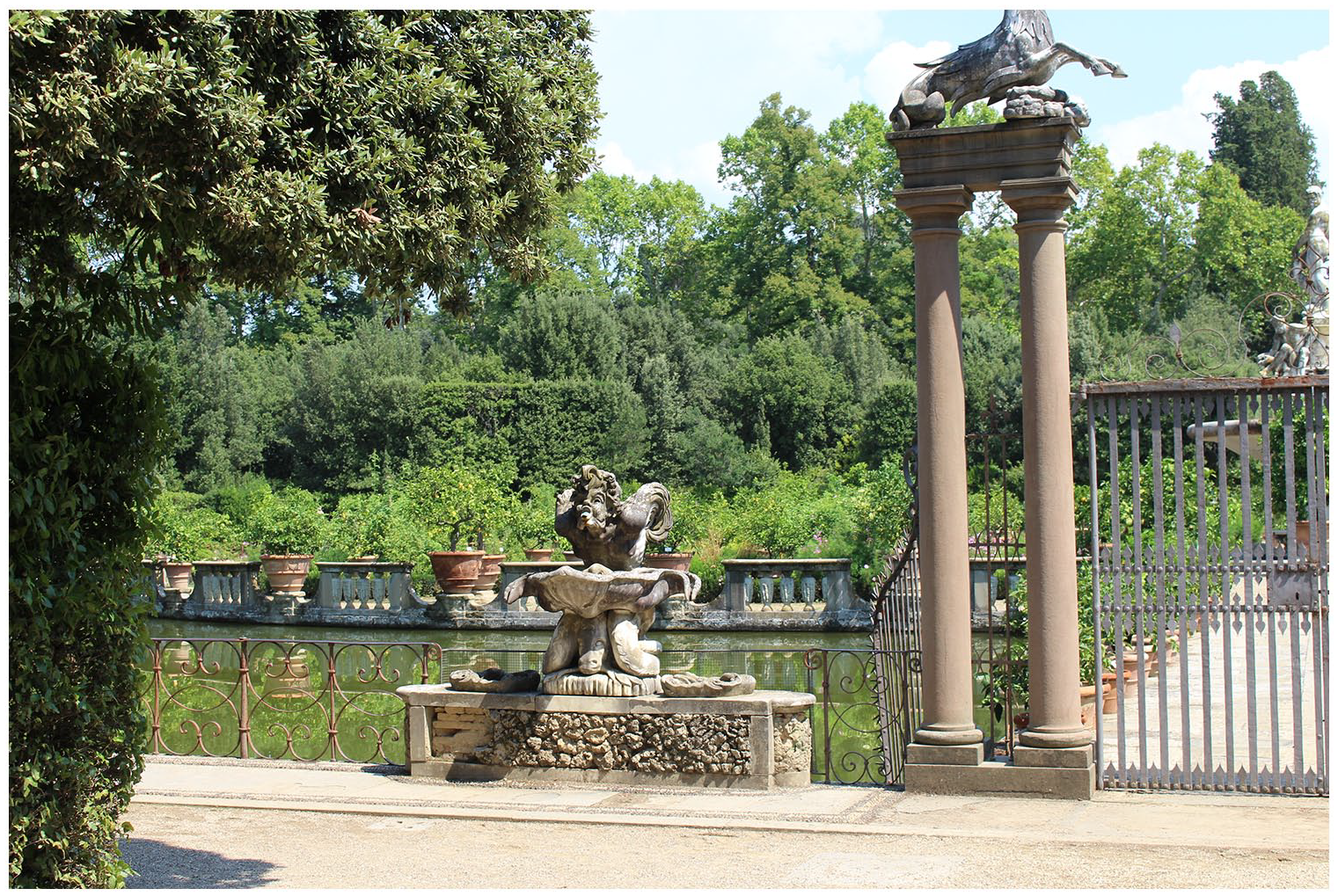
Sensory thresholds.
The locus of this revaluation of the body focuses on Poliphilo’s sexuality and his sexual attraction for Polia which Lefaivre observes as the root of all desire in the text. For Lefaivre, Poliphilo loves the architectural body, and by extension the architectonic formulation and aesthetics of the garden (see Figure 3), and “one after the other the buildings described in the book become objects of desire, as flesh, metaphors for Polia’s ‘solid body’”(Lefaivre, 2005, p. 239). Consequently, desire forms a correspondence with all forms of beauty, making gardens not only a locus of identity, gender, and ontology, but also the spaces and places where sexuality and desire become manifest as agents of ontology and the means of narrative progression. In this sense, we may read Poliphilo’s garden descriptions as sensuous, interactions between botany and the immediate botanical environment, and the senses. This serves to complicate Renaissance humanism, especially when we consider botany and nature as being inherently perceived as characteristically feminine in Renaissance thought, and the archetypical feminine being Venus in the narrative of the HP, creating a link between the visual garden aesthetics on one hand and amorous love on the other, emphasizing the sensual in the sensorial and primarily visual experience of the HP gardens.
Garden Spaces of Creativity and Desire
Regarding place, desire, and metaphysics, Alberto Pèrez-Gòmez (1998) identifies the place of Eros in Poliphilo’s journey and meaning with the term chora used in Plato’s Timaeus to name the third element of reality, distinct from ideas (being) and things (becoming) while grounding their relationship, a realm identified with both cultural space (the matrix of becoming) and the primordial material of the craftsman (the prima materia of the demiurge) as distinct from natural place (topos; Pèrez-Gòmez, 1998). Poliphilo’s experience of the garden walk therefore describes a space for creativity and aesthetic improvement within Humanist notions but where the source of this creativity stems from desire. For Gomez, the architectonic “originates in the erotic impulse itself” (Pèrez-Gòmez, 1998, p. 92). The concept of becoming, as that which disturbs ordering, is deeply related to temporality, as we found in our walk. In the space for creativity and aesthetic improvement, charged with desire, we must also consider the relationship to time and space, in our walk in the Boboli gardens.
Time and Space
Maggie: One of the striking things in this garden, connecting with about the notion of aesthetics, the sensory dimension and the scale, space, and architectonics, is temporality—we are wandering on a large scale and I have lost track of time entirely.
James: Temporality is certainly connected to motion and the suspense of the temporal.
Maggie: and this happens also in the novel?
James: This is also a very long journey that occurs in the course of one night’s dream in the narrative of the HP; so there’s a complete suspension of temporality, insomniac unable to sleep and very late in the night he falls asleep, and has a dream before awaking the following day; and he has a long journey which would have taken more than one night-time to experience. So, there’s a temporal suspense beside the fact that it took the author approximately 50 years to fully write the book comprising a lifetime’s worth of research into architecture, botanical knowledge, beside creating tremendously inventive, original, and greatly symbolic artistry, where wholly original structures and objects correspond to important ideas within the narrative (See Figure 7). So, the actual act of researching or writing the HP is a huge endeavor and yet the book itself occurs simply over one night’s dream. It displays, despite the narrated real-time that we often experience in the text, a complete temporal suspense. Thus, there is a suspense of many things, of the gender binary system, and time, in a dreamscape where anything can happen within the circadian form of the narrative.
Maggie: And finally, just returning to constellational theory, there is a relationship there too, as the suspension of the temporal assists in constellational thinking in the sense that we learn from experience, from the emergent qualities of walking in place and the particular way that the Boboli gardens, as social, historical, ecological, topographical place mediates our constellational thinking.
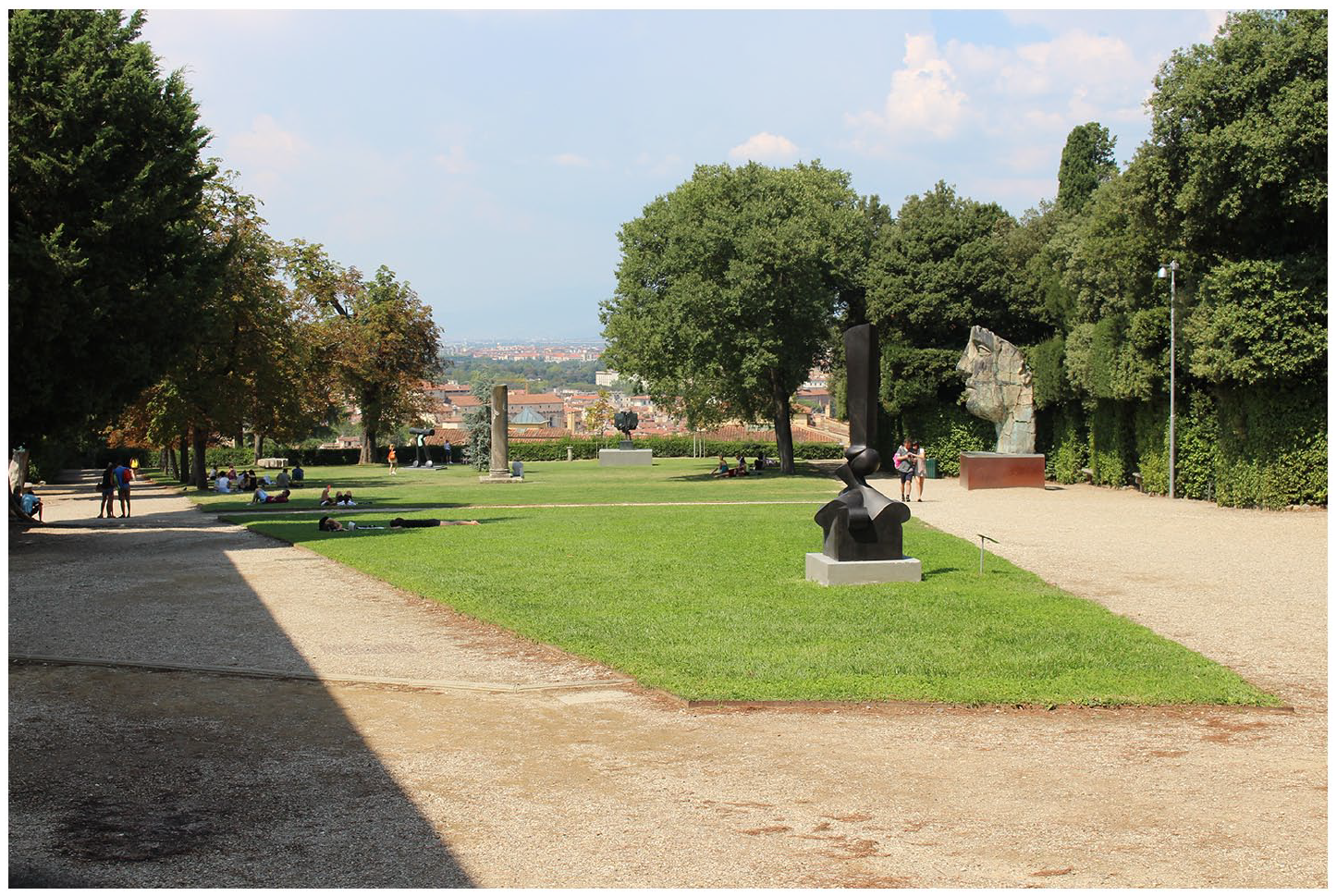
Sculptural symbolic symbols.
As our walk draws to its conclusion, Maggie asked, “Has our walk brought anything new or has it reinforced anything for you?”
Discussion
First, for James, the walking conversation reinforced the Boboli gardens as a place and metaphor for renaissance culture—gardens as stimulating reflection, learning, and constructing notions of Poliphilo’s identity. The garden is also a place for pleasure, exciting a multifarious sensorial experience, and has highlighted the transgressive meaning of the novel in terms of troubling binary gender norms at that time. The garden walk was, in the narrative of the HP, a space to complicate gender and agency, granting the male protagonist, with which the male-centric readership would sympathize with, a feminine experience of walking and experiencing, thus reconfiguring the space and our cultural and sensory experience of it (see HP, 2003). The garden-walks in the HP map spaces in which gender autonomy is transgressed beyond dominant hegemonic and historic practices.
Poliphilo is not the agent of mobility in the gardens; this is granted to his female guides that require him to understand their perspective and grant him mobility upon completion of their demands. This places greater emphasis on the sensory experiences in the gardens and the act of walking as a gendered, conditional activity on one hand, and on the other challenges gender expectations of the time, philosophy, and art. Walking, in the HP, becomes a transgressive methodology and offers a relational interplay of complex, historical, social, and phenomenological experiences (HP, 2003, p. 123).
Second, for both of us, the practice of walking as a nonprocedural, constellational method to understand history in the present is evidenced especially in the garden discussions, on the topics of earthly, heavenly knowledge, but also of introspection, and narratives that unlock the performativity of gender and troubling of gender-based agency. Moreover, our experience of walking in the gardens, as a means to phenomenological experience, reinforced the meaning of walking in the HP for James, and for Maggie facilitated an understanding of the novel, of Poliphilo’s self-transformation in a peripatetic fashion and the importance of gardens and thresholds in renaissance culture.
The social, material, cultural, affective, and historical dimensions of place we experienced in the Boboli gardens unfold in constellational ways in walking together in the footsteps of Poliphilo. Methodologically, walking is a sensory and affective method of and in place par excellence; through walking, we become attuned to and are also “responsive to place” (Springgay & Truman, 2017, p. 4) and we are also encouraged, walking in the footsteps of Poliphilo, to think about experience differently, the combination or the entanglement of a fictive story from which unfolds the sedimented stuff of society at the time—a narrative that provides the symbolic and profound materiality of the renaissance and walking in the garden as an transdisciplinary 10 site of material, visual, cultural, and epistemological understanding. The sensory is an important aspect of the HP, and Poliphilo gives lengthy descriptions of the way things look, smell, and, in the banquet in Eleuterylida, taste. Walking through the gardens of Cytherea for instance (a wholly Renaissance style of garden) presents to the reader a broad variety of color, form, smell, design, and topography, allowing the reader to experience the Renaissance form of garden and its contrasting areas, stimulating the olfactory, auditory, and visual senses differently within each compartmentalized, geometric garden space that the Renaissance garden offered.
Third, the garden is also a place of visible cultural shifts in thinking, a locus for personal development, and a place that reflects societal notions of beauty, self, perfectionism, nature, and the human body. Our walking conversation in the Boboli garden was vital to appreciate the architectonic form of the renaissance garden that was created for walking in. Walking is a means for Poliphilo to undertake the journey to enhanced civilization, personal growth, and transformation through his odyssey into ethics, epistemology, and ontological experiences and understanding toward to love. Our journey in place and the journey Poliphilo takes through the gardens provide rich embodied knowledge and understanding about the renaissance period at this point in time, which goes far beyond cognitive understanding and simply reading the novel.
Fourth, the importance of storytelling in place is a key finding for us, in sensory and phenomenological ways—the story of Poliphilo’s journey to Polia and the story that Polia tells at the end of the narrative of her experiences reinforce the centrality of storytelling in understanding culture and society. Moreover, a fragment of a story can tell us so much more than 100 pages of information, and narrative storytelling is a sensory/sensuous experience; it is “auratic” “coordinating soul, hand and eye” (Benjamin, 1992, p. 107). Intrinsically related to the narrative agency of walking in developing Poliphilo’s interiority, alongside the progression of narrative, is the literary device of storytelling. The author presents storytelling as a means to describe an important idea to the reader. The situation of the story is also dependent upon the idea involved, for instance, the renaissance concept of self-perfectionism presented by Poliphilo’s own self (logic and feeling) in the gardens of Eleuterylida, relate place with theoretic subject matter, presented through individual narrative. The garden is a place for a narrative of the self to unfold and be explored in a temporally suspended place.
Finally, the importance of transdisciplinarity (history and sociology) in undertaking the work together (methodologically but also in terms of understanding the sensory, aesthetic, visual, historical, and the narrative configurations of the novel) connects the phenomenological in embodied ways with our narratives and journey to a Medici renaissance garden in Florence. Through the combination of literary and art-historical analysis with a sociological methodology, a rare experience of empathizing with the fictional Poliphilo while walking in the gardens is made possible, and the process the author took in creating Poliphilo’s narrative sequences could be reexperienced and therefore more greatly understood.
Through our walking engagement, we were able to observe walking as a central theme in the creative process of composing the novel, and within the novel itself. Walking is a constellational methodology bridging physical and mental, body-politic with the limbs and thoughts of the walker, and fictive and historic moments, together. It is also the means in our ongoing work to reexamine gender norms and social practices, notions of identity, and place, besides philosophical interpretations of transgressional thresholds, of cultural norms, and Renaissance notions of metaphysical processes. Walking offers a physical route or pathway to nonphysical, immaterial experience and is complex, transdisciplinary, and necessitates dynamic constellational analysis that can also theorize certain conjunctures in time and space—a theme we take forward into our next walk.
Footnotes
Acknowledgements
Thank you to the editors and anonymous peer reviewers for helpful advice and input.
Declaration of Conflicting Interests
The author(s) declared no potential conflicts of interest with respect to the research, authorship, and/or publication of this article.
Funding
The author(s) disclosed receipt of the following financial supportfor the research, authorship, and/or publication of this article: Thanks to the Leverhulme Trust for funding the fellowship that enabled Maggie to conduct a walking conversation with James.
