




Abstract
In the middle of the COVID-19 pandemic, I came to think about the role of my identity in my scholarship. Drawing on liminality as a conceptual apparatus, this autoethnography displays multiple layers of the self, that is, thresholding, passing, and daydreaming. Moving everyday encounters into parts of discourses, I consider how the self is always in full of uncertainty, wandering, rather than being fixed. I end with reflecting on the writing process: autoethnographic writing has been continual process to capture multiple liminal moments into a patchwork; it becomes possible by distancing the observing-self from the observed-self, however temporal those are.
Entering the Writing Project
What does it mean to live as an Asian in the United States today? In the midst of the COVID-19 pandemic, I fully sense who I am, most strongly ever in my life. As an Asian, as a mom of two little kids, I feel the fear. In May 2020, as wrapping up my first year as a faculty member, I begin to ask, where is myself in my research? Why do I feel so hard to engage “I” in my scholarship? What does this mean?
I entered the “Massive and Microscopic Sensemaking” 1 project to experiment on/with myself—for the first time in my academic writing. With the life burdens that should have never happened but actually happened during this project, I paused writing. I was not able to reflect on my life in that hard moment; I just managed to live. It took a while to resume writing. It was only through a retrospective, reflective, and objectifying mode that I was able to write about my life.
This photo-assisted autoethnography is a patchwork 2 about “now, as a liminal space,” which is multiple, thresholding, and moving. 3 In each “now,” I live, but I also do not live. This transitioning and barely perceiving sense of the self has become graspable through the process of autoethnographic writing. The photographs in this essay are originally taken in my everyday life, not created for the research, per se (Ownby, 2013). By revisiting my photos and by re/mapping them with the written texts altogether, this essay presents the multiple sense of the self and its liminality. As I write, I also do not write; as I present who I am, I also silence who I am (not); as I visualize, I also daydream of the not.
Covering, Seeing the Color Line
I began to wear a face-covering mask from early February, much earlier than the lockdown started in the United States. It was only me and my family who were covering the faces by that time. When we walked down the street wearing a mask, the neighbors detoured so as not to pass too close to us. When I and my daughter visited the clinic for a regular checkup, the staff at the front desk glimpsed at us and quickly put on the mask which she didn’t do when talking with other patients.
People whom I encountered didn’t do anything harmful or insulting; they just distanced themselves from me. However, when I got home, I cried. I still felt the gazes upon me, saying “you are different.” Maybe, I felt heartbroken when being seen as “dangerous.”
I hear and watch the hate-inspired crimes and violence targeting Asians in the United States and worldwide (Asian Pacific Policy & Planning Council, 2020). The media representation is about me, my family, and my friends. It painfully hurts me.
More than a century ago, W. E. B. Du Bois (1903) stated, the problem of the Twentieth Century is the problem of color line. (p. 19)
If I paraphrase it today, the problem of the Twenty-First Century is, still, the problem of color line.
As a “real and efficient cause of misery” (Du Bois, 1952/2004), the color line still exists, and I float beyond the color lines. I become the “White” when I present myself as a university professor, as a model minority 4 ; I also become the “Black” as a victim of the institutionalized racism (Wu, 2002); yet, I never belong to either. As an immigrant, as an alien worker, and as a stigmatized victim of “new racism” (Centers for Disease Control and Prevention, 2020), I find no place to belong to.
Now, wearing face-coverings is becoming (new) normal. Under the covering, my skin color is most clearly visualized while permanently moving in a color spectrum. Always located in-between the material and phantasmatic sense of who I am and who I should be, I come to see my bodily being by feeling Others’ gaze on me. 5 As “only when there is an Other can you know who you are” (Hall, 1991, p. 16), I see myself only when I am able to see Others. Being aware of the “hyphen” between the self and the other, however, is to resist 6 ; by understanding my feeling of being excluded as part of the discourse, I strive for the path to deconstruct the stigmatized ways of seeing the self today.
The Fear, Living
I began to feel the pandemic, not from the impact of the germs. The feeling of fear started by watching empty grocery shelves. In mid-March 2020, when I visited a grocery store to purchase rice, this sign was waiting for customers: More rice coming on Tuesday March 17th. There is no need to hoard more than you consume (Figure 1).
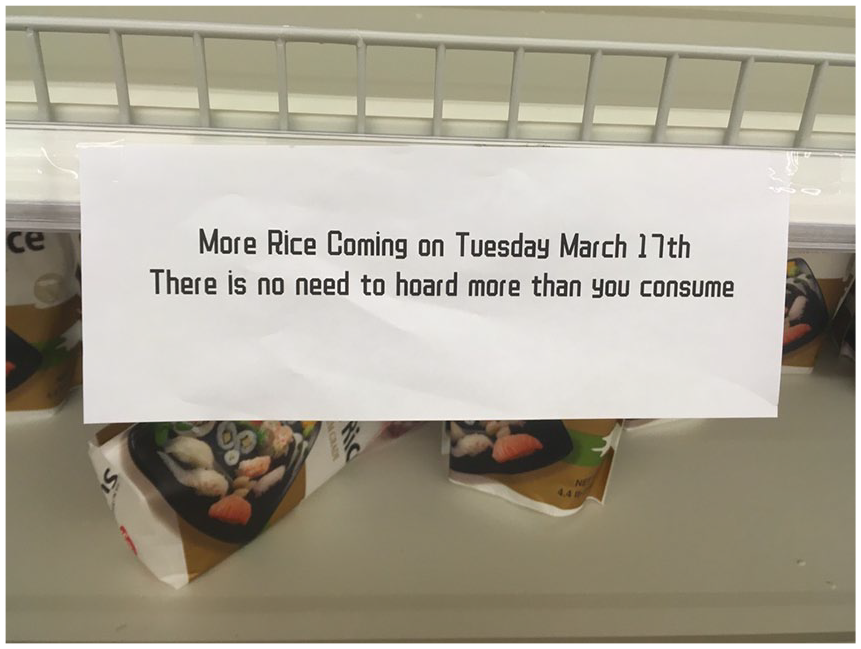
There is no need to hoard more than you consume.
The “panic buying,” either as psychological anxiety (Taylor, 2019) or as rational human behavior (Savage & Torgler, 2020), has confirmed the reality that we’re living in crisis.
This is, however, not a universal phenomenon. My family experiences a world in crisis very differently in ordinary daily lives. In South Korea, where my parents live, panic buying never happens with the COVID-19 outbreak.
7
One day, my mother said that we don’t feel the need to stock foods at home. I never see empty grocery shelves here.
8
My mother’s “not feeling” of the need to stock foods is something very unique from an outsider’s perspective. Oftentimes, in many countries, panic buying is explained by “individualism,” in opposition to having “community-oriented mindset” during this hard time. 9 Here, the “community-oriented mindset” is to lend a hand, for example, by helping neighbors when seeing a Facebook post that someone needs Clorox wipes or dog walking (Becker, 2020). This is not what is happening in South Korea. Koreans care about their individual’s health by approaching the COVID-19 pandemic as “our” issue. They do this by following the suggested preventive measures and procedures with less doubt. The presence and absence of panic buying are hard to explain through the binary between “individualism” and “community-oriented mindset,” and there are other ways to describe why this happens or not.
Living in the United States, I also stocked up the pantry. I did this after watching others doing it and feeling afraid that I might lose out. While filling up the shopping carts, I was thinking that this is not the right way; there are other ways to be alive under the pandemic.
Nevertheless, why, here in the United States, am I entrapped by the fear about the potential shortage, which the officials keep saying that it’s never going to happen (U.S. Department of Agriculture, 2020)? Why do I feel more isolated, divided, in the time that needs to be more united?
The Desire, Wandering
As a mom, I’ve been watching how my three-year-old daughter learns the ways to interact with others during the lockdown. With school closure, my daughter’s everyday life is surrounded by screens, like other kids today (UNICEF, 2020). In April, her teacher organized several Zoom meetings, which excited kids. For the first meeting, my daughter dressed up with her favorite dress, hairstyle, and bracelet. She kept asking me “when is 11 am?”—the time to meet. During the meeting, my daughter behaved like being in the face-to-face classroom: sang songs together, listened to stories, and took turns to say hello (Figure 2).
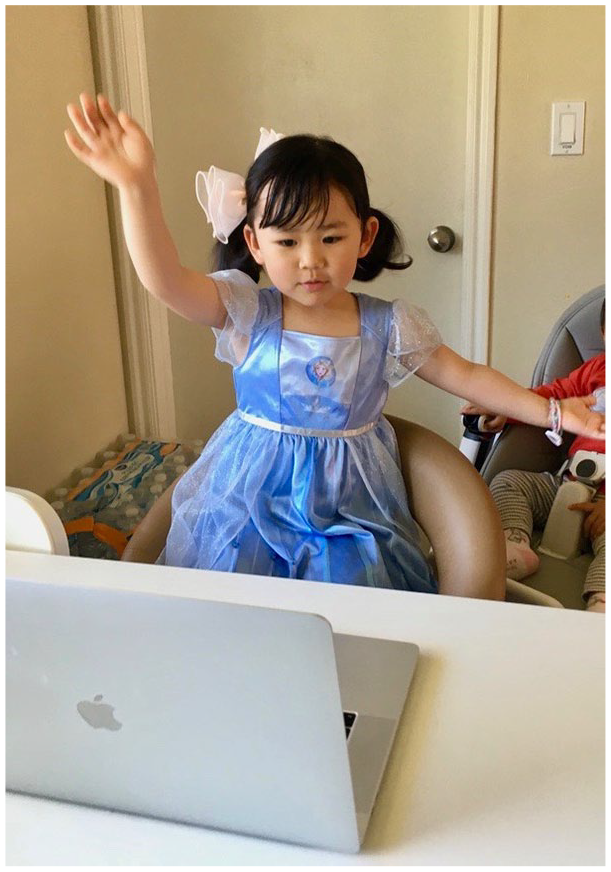
Seeing through, singing together.
However, my daughter’s excitement didn’t last long. Recognizing that everything—teachers and friends—is on the screen and interaction with them through the screen is not the same as in the real classroom, she quickly lost interest in virtual meetings.
As a child of an immigrant family, my daughter’s interaction with others through the screen is not new with the outbreak of the COVID-19. Having all grandparents and relatives in South Korea, she has been video-chatting with extended families (through parents’ smartphones) almost every day. From these experiences, she has learned that the video-chat is not the same as the face-to-face meeting and interaction. She has quickly grasped its similarities with the Zoom meetings.
What my daughter, and we as a family, wanted to do was to cross the line that is screenifying everyday life. Quarantine becomes a moving space that our family stays isolated from others—by finding less-crowded park trails, applying hand sanitizer, wearing face-coverings when getting close to others (Figure 3).
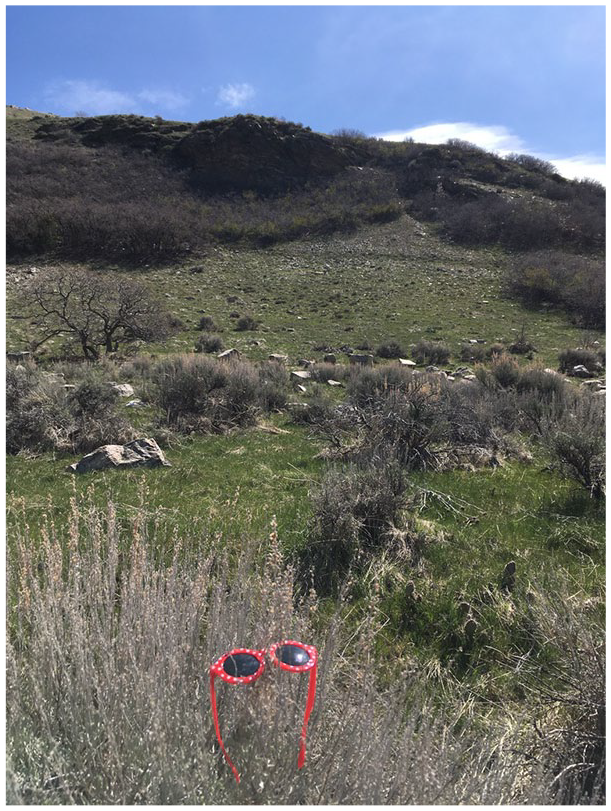
Quarantine, nature, and desire.
Although it was not easy to explain why playgrounds are wrapped with yellow caution tapes (The Associated Press, 2020; Martin, 2020), my daughter learned to stay behind the lines, not to play in the playgrounds.
Now, playgrounds are open. My daughter excitedly says that “I can play because nobody is there!” She has learned not to stay close to others. She has learned that it is healthy to keep away from others.
Several days ago, I received a survey from my daughter’s preschool, asking whether I want my child to “still be attending” the school this year and how I “feel” about children wearing a mask throughout the day at school. I feel so hard to make a decision; should I let my kid learn how to interact through plexiglass shields at school, or should I isolate my kid from the buzzing world at home? In the strains of making life (and death) as a new center of the school curriculum, this soon-to-be-answered question is still roaming in my mind.
(New) Normal, Autoethnographic Writing
As a patchwork, this essay is both about who I am and who I am not. In every moment of my living, I live and I also do not live. While I am doing, at the same time, I am also dreaming about what I am not doing.
Looking back on my initially submitted abstract to the “Massive and Microscopic Sensemaking” project, I was eager to examine my ethnic identity as an Asian that is also related to my legal, immigrant status to live in the United States. This interest was fueled by the feeling of fear as I witnessed new racism related to the COVID-19 outbreak. While the project’s 21-day writing prompts didn’t necessarily ask participants to reflect on the identity, it has led me to see who I am (and not) through experimental writing. As the project progressed and my writings were accumulated, I found that my identity is difficult to explain in a fixed sense, and it becomes visible when I encounter others and struggles—that is, at the tensions and ruptures that lead me to see the differences of myself from others (Miranda, 2013; Windsor, 2015).
Sensing the self becomes possible at the edges of things, when encountering new challenges. Moving in-between as an insider and as an outsider (Barad, 2007; Kusow, 2003; O’Connor, 2004), writing an autoethnography has been continual process of distancing the observing-self (or, the writing-self) from the observed-self (or the written-self), however temporal those are. This temporal, reflective, and ongoing process is not to fix the constitution of the self; by mapping out, visualizing, and lettering who I am (and not), the self keeps moving in a fluid.
Footnotes
Declaration of Conflicting Interests
The author(s) declared no potential conflicts of interest with respect to the research, authorship, and/or publication of this article.
Funding
The author(s) received no financial support for the research, authorship, and/or publication of this article.
