




Abstract
This reflective autoethnography uses writing, photos, and audio recordings to present my 14-day quarantine in times of COVID-19 from arriving in China, meeting my handler, developing relationships through online chats, to helping others out in a Chinese hotel. This article serves as a reference for people in quarantine to fight against the fear, frustration, and depression that can arise from being isolated. Experiencing friendliness during these struggles, especially some of the self-inspiration and encouragement that can be stimulated by friendliness, will support us to change the way we think, live, and deal with difficulties, not just now but in future.
Introduction and Background
The COVID-19 global pandemic has brought profound challenges to the world community with ramifications that extend well beyond public health and individual well-being. As a nation that first identified the virus in December 2019, China has been a pivotal player during the outbreak of COVID-19. However, not everyone agrees that the Chinese government has done a good job of protecting its citizens. The quarantine in China was criticized as “arbitrary and potentially discriminatory” by international organizations like Human Rights Watch (2020). As a researcher who is now working in the United Kingdom but who needed to conduct frequent fieldwork in China this year (2020), I had to travel internationally during the pandemic time. Because of the severity of the pandemic, when I returned back from the United Kingdom to China in March 2020, I was required to be quarantined for 2 weeks (14 days) in a hotel, which has been officially compulsory in China for public health and personal well-being.
As a part of the Massive::Microscopic sensemaking project facilitated by Annette Markham and Anne Harris (2020), I felt it was important to record my personal narratives (with photos/audio) to reveal what I saw as the real situation of China’s quarantine based on my own experience and reflections, combined with voices from others who were also in quarantine in the same hotel and with a significant Chinese official. This isolation period has become a valuable source for my autoethnography, which allows me to unveil the relationship between self and families, self and strangers, individuals and community, and human and non-human. As Holman Jones (2011, p. 333) writes, “experience tells and makes it into something you can use, something yours.” I present this narrative pastiche of my 14-day experience to provide a possible reference for other people in quarantine who also struggle to overcome the isolation and loneliness by being with others, feeling kindness from others, and sharing personal friendliness.
Prologue
March 20, 2020, Shanghai, China.
I landed on Shanghai Pudong International Airport after almost 30-hr flight but had to wait in the cabin for 6 hr to be tested due to COVID-19. Exhausted, I was not prepared to experience such a long delay in China. Complaints, sighs, and other small sounds of dissatisfaction filled the small cabin. When all the passengers were allowed to leave the cabin, I was shocked to witness so many staff in the airport to serve passengers from all over the world. I could not see their faces because of facial masks and protection suits, while they were busy in guiding passengers, taking passengers’ temperature, and showing them what to do for the next step. It was already 2 a.m., but the staff were still there working with the 30-m-long queue of passengers.
After a brief temperature check, I was guided to the coach parking area where the government-allocated coaches were prepared to transport passengers to different destinations. I was sent to my destination, Ningbo. 1 On my way to Ningbo, a Chinese official (hereafter “Official W”) from Ningbo added me on WeChat 2 and explained what to do next. She seemed not to sleep that night: I started my coach journey at 3 a.m. and after that she was always online until I got off from the coach, which made me feel sorry because she seemed to be working endlessly to help me, at the cost of sacrificing her sleep.
It was 5 o’clock in the morning when I arrived in Ningbo. Official W directed a police officer to pick me up at the coach station, after waiting with me for 2 hr. Official W also called me 5 times on my way from Shanghai to Ningbo to confirm my status and location. I was taken by an assigned patrol wagon to the quarantine hotel. This is the first time I have been in a patrol wagon and it made me a bit nervous. In my mind, the police were dealing with suspected criminals while this time a police officer was driving an ordinary citizen! When I arrived at the final destination (the quarantine hotel), dazed and tired, I still didn’t quite believe what was happening.
Chapter 1
March 21, 2020, Ningbo, China
When I entered the hotel, a receptionist handed me a pack of snacks, which included bread, instant noodles, sausages, milk, cookies, instant coffee, and some fruits (apples and pears) (see Figure 1).
“我们收到通知,特地准备一些食物给你。”
3
(We have received a notification to prepare some food for you.)
I was surprised and touched, indeed, without any words to express my gratitude but “thanks.” After a long journey of almost 40 hr, I was able to relax and have something to eat, provided by a stranger. The meal was actually ordered by Official W who was also in charge of this hotel’s quarantine. I thanked them and the other “invisible” staff who helped me to return back successfully. One of the on-site doctors who lived in the hotel during the global pandemic came downstairs to take my temperature and check my identity, his eyes still fogged with sleep.
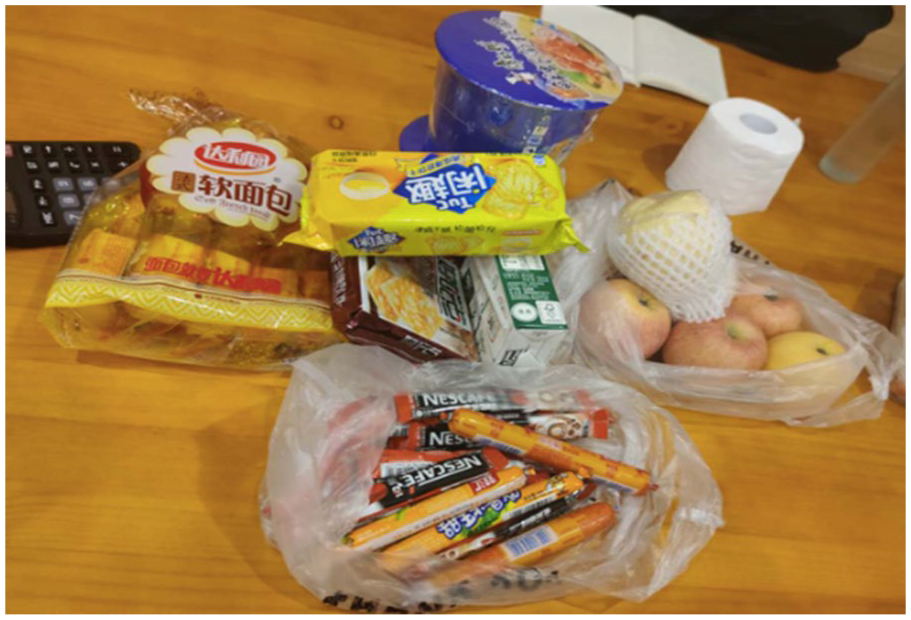
Food supplied by the hotel on arrival.
Chapter 2
March 21, 2020, Ningbo
The room was clean and tidy, at first glance. In fact, the good condition of the room was beyond my expectations. Finally, I was able to fall asleep. Because of the concern about being infected with coronavirus, I had not dared to let down my guard to take a nap on the plane. The first sleep in the hotel seemed deliciously long; I did not realize how long it was until someone knocked at my door.
The on-site doctor who knocked at my door told me it was already the afternoon (March 21, 2020), noting: “现在是测量体温的时间了,一天两次。”(in English: It’s time to check your temperature, two times a day.) (see Figure 2). On-site doctors were considerate in skipping the morning temperature check that day because of the long journey I just had experienced.
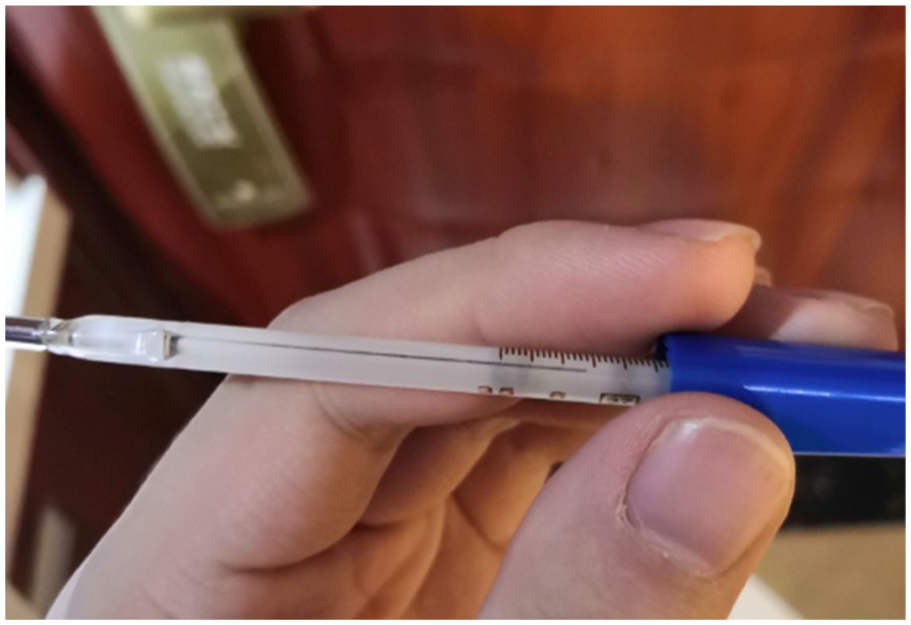
Temperature check.
I finally looked around the room in detail (see Figure 3). A kettle, shampoo, brush tooth, shower gel, slippers, towels, everything I needed had been prepared. The bedding was softer and more comfortable than mine, honestly. I appreciated all the details that put people first.
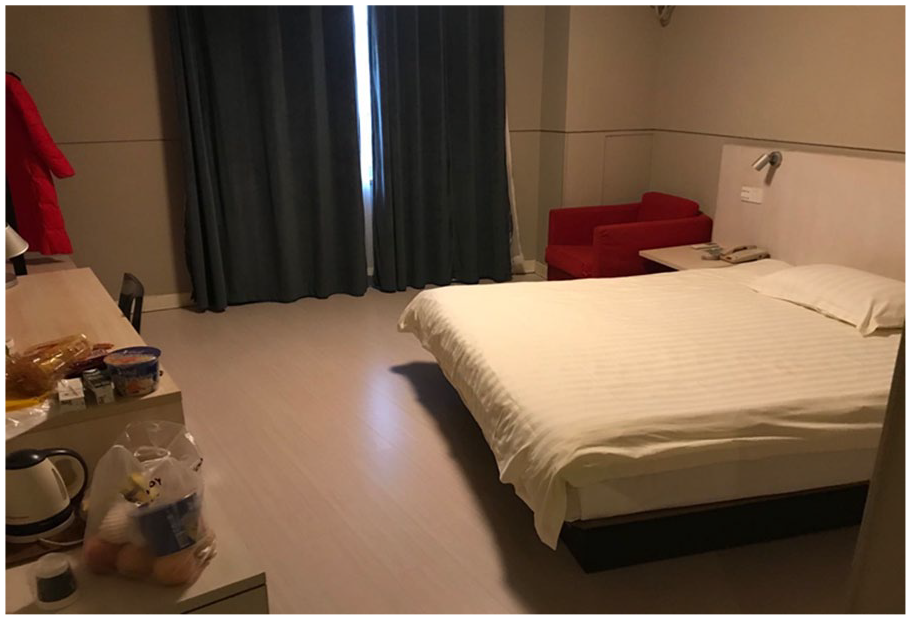
My quarantine room.
When I tried to open the window, I noticed another detail: all windows could only be open to a maximum of 10 cm (see Figure 4).
“这个窗户是特地设计的,目的就是为了防止在隔离期间被检测出新冠病毒阳性的住客有跳窗自杀的可能。” ––W官员 (This was deliberately designed in case anyone who tested positive with COVID-19 in quarantine time tried to commit suicide by jumping out of the windows.—Official W)
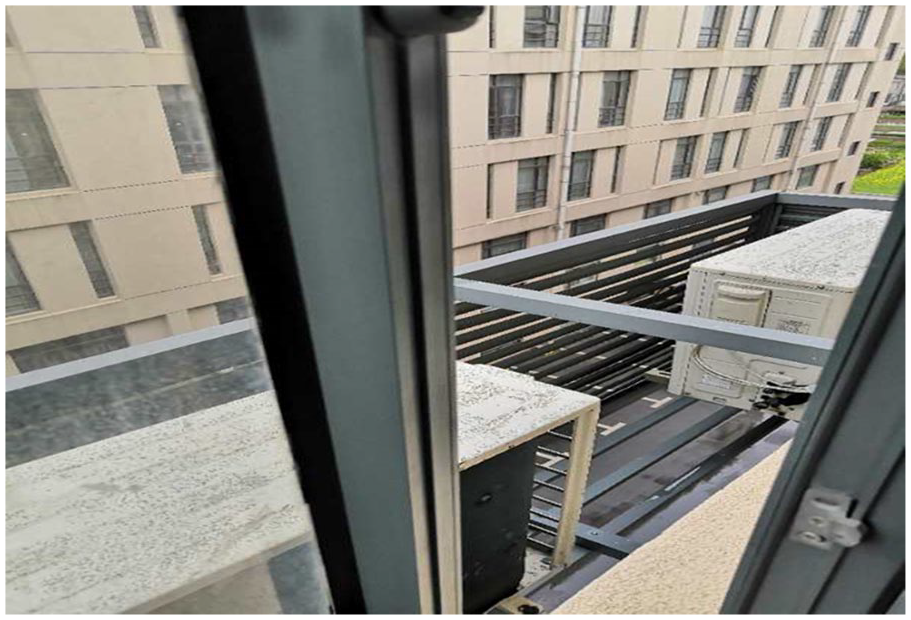
The window of my room.
When I unlocked my cell phone, I was notified about messages from a new WeChat group consisting of all the guests quarantined in this hotel and all the staff that served the guests, including on-site doctors, Official W and her colleagues, hotel managers and receptionists, handymen, and catering providers. There were more than 80 people in that group with the group title of Family in Quarantine of XXX Hotel. I was surprised to see this group set up by Official W. My hotel was one of many hotels in Ningbo for accommodating travelers from overseas and other provinces to handle the severe situation of COVID-19. I wondered:
How many groups do they have if all officials set up WeChat groups for quarantine people? How many responses do they need to get back to so many WeChat groups?
I could not imagine. The only word I could use to comment on their work performance was GREAT.
Chapter 3
March 21–24, 2020, Ningbo
From March 21 onward, I was daily reminded by the WeChat group about meals delivery, temperature checks, sanitation supplies, and facilities repairs. On the first day (March 21), the high-quality food amazed me (see Figure 5). Chicken wings, king prawns, celery, Chinese cabbages, soup, and one apple. I wondered if this was because they were aware that I did not eat well after a long journey. However, the next day’s dinner was also fancy (see Figure 6). After this second meal, I realized this was what people generally ate in their quarantine time in my hotel: rich meals on trays with different kinds of food for balanced nutrition (seafood, meat, vegetables, and fruits for every meal), at a cost of only 75 RMB
4
/day. The price was lower than what I had generally spent for one day’s food while the quality seemed much better. What was more, guests could even ask for the food to be made more to their taste. For example, one international traveler complained about the food taste in the WeChat group one day: “这些食物太辣了,能不能让食品供应商做得少辣或者不辣呢?” (The food seems too spicy for me. Could the (catering) supplier make it no/less spicy?)
The next day, our food became less spicy. Official W explained to me why the taste of food was difficult to balance: “让每个人都对口感满意太难了。两周前,从武汉前来隔离的旅客喜欢吃辣的食物。现在从国外回来的人喜欢吃清淡的。我们只能让食品供应商相应调整。” (It is difficult to make everyone satisfied with the taste. Two weeks ago, travelers from Wuhan
5
quarantined in this hotel loved chili food. Now people from overseas like light food. We need to let our food provider adjust accordingly.)
Even so, the taste was adjusted quickly after guests’ complaints. I personally highly appreciated the staff’s work efficiency. An old Chinese saying goes, 众口难调 (in English: it is difficult to cater for all tastes). However, Official W and other staff tried their best to enable us to eat well.
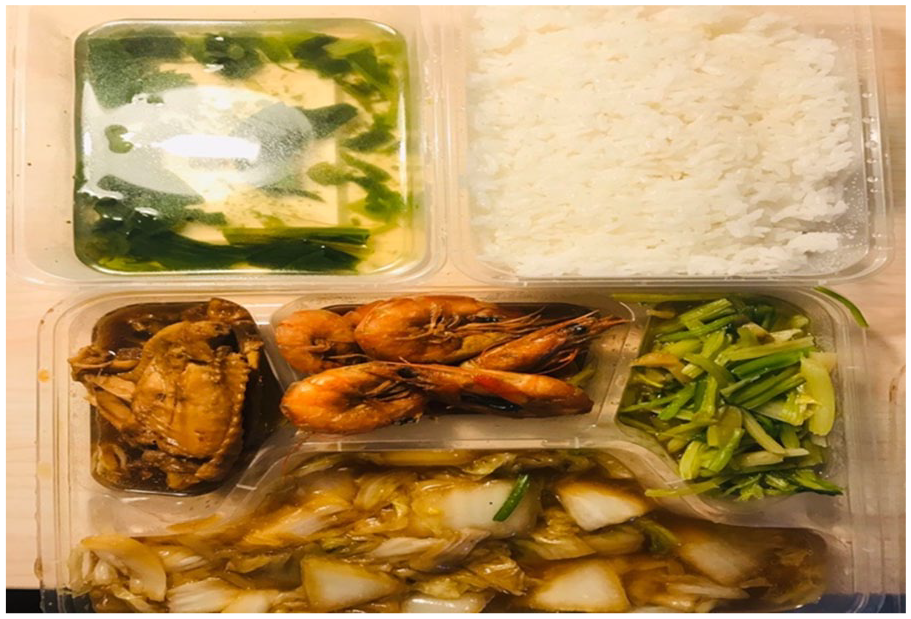
First meal in the hotel.
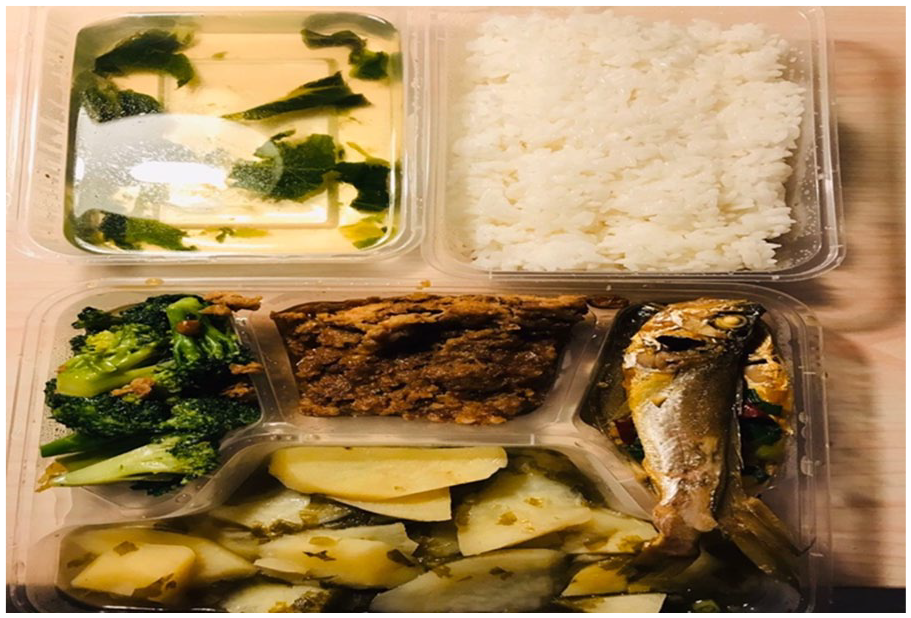
Second meal in the hotel.
Chapter 4
March 25–30, 2020, Ningbo
After several days’ quarantine, people started to become more aggressive due to loneliness and depression in a small space (room). Their voices popped up in the WeChat group: “我们什么时候能离开?”
(When can we leave?)
“这个隔离多久是个头?”
(How long a quarantine is enough?)
“我不能再忍受这样的生活了!”
(I cannot bear this lifestyle!)
“我必须马上出去工作。”
(I have to go out for work immediately.)
“我没有任何新冠症状,我必须要马上出去!” (I do not have any symptom of COVID-19 and I must go out now!)
More and more people were complaining about the stress and depression of their quarantine in the hotel. We all felt isolated because we were not allowed to get out of our rooms. Official W patiently and repetitively comforted those people who were voicing their complaints on the WeChat group with encouraging statements like: “加油!14天并不长。你可以在微信群里分享任何不满意的事,我们会帮着来解决你的焦虑。” (Come on! 14 days is not long. You can share any discontent in the WeChat group and we would help to relieve your anxiety.)
While many group members had utilized the group to make complaints, Official W’s constant encouragement gave me the idea to send a different sort of message. I started to send messages to help others; to understand and comfort others’ difficulties, anxiety, and discouragement. Later on, more and more people became active and volunteered to support each other. It didn’t take long for a lot of kindness to emerge from strangers in the group.
“你能做到的,你还剩4天了!”
(You can do it! You have only 4 days left!)
“亲爱的,你的家人在等你出去呢,加油!”
(Dear, your family is waiting for you to be released. Come on!)
“兄弟,你的商业分享真有趣啊,等我们都从这个酒店出去了,我能不能加入你?”
(Bro, your sharing of your business is so interesting! Can I join you when we both get out of the hotel?)
I was surprised and touched to see many people who never knew each other giving a hand to others in need. This was not common among strangers, in my experience. What made people get closer and connected, or even to become friends or potential business partners? It was how people—and maybe governments—reacted to each other and the situation. We should be grateful for COVID-19 to let us experience the kindness from strangers—the similar experience in quarantine and the specialty of COVID-19 motivated our empathy toward others.
Epilogue
April 5, 2020, Ningbo
Over the 14 days, I felt the care and love from different parties. My father, a man of patriarchal authority who had seldom contacted me actively, made three consecutive calls in such a short period (14 days) to express his concern about my long international journey and the quarantine situation under the global pandemic. I realized, for the first time in my life, he was not as serious or distant a person as I had supposed. Although the three calls could not be simpler—similar words, repetitive content, one or two sentences of greeting—they conveyed his deep concern, love, and care.
“How are you?”
“Do take care of yourself.”
In my mind, he altered his profile from an authoritative parent to an affable father by these calls. Along with the voice from my father, the 14 days also offered me the valuable opportunities to listen to the sounds I would normally disregard from nature. Birds’ singing, strong wind, heavy rain, and even stillness, all made beautiful melodies. I had never had a chance to sit down and listen to the “whistle” of nature while this time I could. I creatively recorded and integrated my fathers’ calls with the sounds and stillness from nature to make an audio pastiche (click icon for audio). Thanks to COVID-19, I was able to hit the pause button and pick up the serendipity neglected from my previous daily life—that is the care from families, strangers, and even nature.

The pastiche of calls, nature sound, and stillness.
Conclusion
I started this Massive::Micro autoethnography thinking: How can I manage the isolation of 14 days in quarantine by myself? When I got out of the hotel, the answer was evident in my heart. “Autoethnography creates a space for a turn, a change, a reconsideration of how we think, how we do research and relationships, and how we live” (Jones et al., 2013, p. 21). This autoethnography allows me to reflect upon how we strangers used WeChat to talk with each other, to comfort others’ anxiety, and to share ways to make time pass fast in quarantine. By this virtual communication—even without meeting each other—people collaboratively dealt with the isolating period as well as offering deep understanding and kindness. With patient explanation from different parties such as Official W, on-site doctors, and hotel receptionists, misunderstanding and complaints became understanding, comfort, and goodwill. In the self-narrative writing (Chang, 2016), I explored how a young woman, an international traveler and a quarantined person, opened her eyes to China’s quarantine under the global pandemic, rethought about the relationship from self to others, self to community/society, and self to nature.
The 14 days’ autoethnography also taught me to turn away from an individual (myself) to a community (quarantined people)—I was only one of many people affected by the pandemic. By the time I was writing this article, more than 21 million people had been infected across the globe; more than 761,000 have died and lockdowns have been ordered in numerous counties (World Health Organization, 2020). 6 A large number of people have been impacted by this pandemic with day-to-day life at a standstill, and anxieties around the disease and the future have been heightened (Dartnell, 2020; Torres, 2020). Professional researchers and correspondents (e.g., Dartnell, 2020; Kleinman et al., 2020; Ringel, 2020; Torres, 2020) have also reported a diversity of ways that life has been changed by COVID-19, from individual behavior (e.g., greetings and traveling, public gatherings) to daily hygiene/health (e.g., clothing/masks), to psychology (e.g., fears and anxieties), to public domains (e.g., closed schools and offices), and to political affairs (e.g., international relations). Thanks to the Massive::Microscopic Sensemaking Project, my 14-day quarantine in China was evocative rather than being silent: it reminded me of the universal meaning of others’ kindness for more people involved in quarantine. My autoethnographic reflections triggered thoughts at a macrolevel about how people can utilize (self) quarantine time to manage their own suffering in this global crisis. Although it is a personal narrative, it has cast a larger image of social and cultural phenomenon (Ellis, 2004; Goodall, 2000; Jones et al., 2013) about people’s survivance in the time of COVID-19.
This photo- and audio-assisted autoethnography serves as a reference to inspire people to fight against fear, frustration, and depression that can arise from being isolated. Experiencing friendliness during these struggles, especially some of the self-inspiration and encouragement that can be stimulated by friendliness, will support us to change the way we think, live, and deal with difficulties, not just now but in future.
Take care and keep walking,
for all people in (self)quarantine.
Footnotes
Acknowledgements
I extend my sincere thanks to three reviewers for their detailed comments.
Declaration of Conflicting Interests
The author(s) declared no potential conflicts of interest with respect to the research, authorship, and/or publication of this article.
Funding
The author(s) received no financial support for the research, authorship, and/or publication of this article.
