




Abstract
This article discusses how different forms of autoethnographic production prompted by diverse forms of academic self-expression can lead to different types of knowing. Utilizing five examples from the Massive_Microscopic project, where participants responded to 21 different prompts inviting autoethnographic reflections about COVID-19 global pandemic, the article explores the responses from the perspective of alternative ways of knowing, reflecting on questions of motherhood, self-care, and performance in academia. Whether visual, rhythmic, or text produced from the perspective of things, the different modalities of the prompts allowed unexpected knowledge to emerge and supported deeper and more colorful reflections. Exploring the personal experience with the pandemic is expanded by the qualitative inquiry supported by different (self-)expression formats.
Keywords
Introduction
The SARS-CoV-2 virus caused the first global pandemic in the internet era bringing disruption to economies, social structures, and political orders, in addition to its impact on public health (United Nations, n.d.). By holding up the health crisis as a mirror to our society (Lupton, 2020), we can raise new questions, generate new knowledge, and re-evaluate our existing ways of knowing. The Massive_Microscopic Sensemaking Project (Markham et al., 2020) is one such endeavor. Over 21 days, I and 150 other participants responded to 21 prompts set by Anne Harris and Annette Markham. The prompts varied in style and depth but invited individual and collective autoethnographic multi-modal explorations: written text in different genres, images, bodily acts, and multimedia collaboration. While they invited, they did not prescribe specific formats or content. The common focus on pandemic experience, exploring microscopic and macroscopic sensemaking, planetary, and mechanical and human concerns meant that, in my case, the reactions varied to quite a large degree in terms of topics and themes, but my initial focus on questions around fear and control became intertwined with reflections on the theme of personal knowing.
As I embraced the turn to the unexpected, I was prompted by these diverse forms of expression to critically examine the way academia (of which I am an established and privileged member) has thought about and produced knowledge. My job as a professor in media and communication includes knowing subject-specific things and knowing how to express these in discipline-appropriate manner. Writing and speaking academese (Badley, 2020; Pinker, 2014) as the primary modes of communicating academic knowledge, as well as the pressure to publish-or-perish in the limited outlet of academic dissemination, have formalized the ways of presenting as well as generating knowledge. In contrast, Patricia Leavy (2015) advocates for arts-based research as it makes knowledge more accessible, but also “can connect us with those who are similar and dissimilar, open up new ways of seeing and experiencing, and illuminate that which otherwise remains in darkness” (p. ix). Exploring my experiences with coronavirus raised underlying concerns and ideas that I initially had not intended to discuss, but which emerged as themes in my autoethnographic explorations, such as self-expectations, normativity, and motherhood. I explore the unexpectedness through my responses to two prompts that required visual sense making, “How can one frame feel like the whole world” (#8) and “Victorian allegorical maps of COVID-19” (#11); to two rhythmic-oriented prompts, “Changing rituals, COVID Interruptions: An exercise in Dance” (#14) and “Timbre, rhythm, musicality” (#19); and to one prompt wherein I explored a story told by things (#2) (Markham & Harris, 2020). I use these responses as illustrations and occasions to analyze different ways of knowing as the responses raised many other questions for me and my taken-for-granted sense making practices and ways of doing “academia.”
Alternative Ways of Knowing the Pandemic
My knowing is rooted in the sociopolitical context of coronavirus, the unprecedented situation of a global pandemic, the relatively relaxed conditions of Sweden, and the privileged position of permanent employment as a professor at Malmö University. Like several other authors in this special issue, my reflections touch upon academic motherhood (Bolander & Smith, 2020; Lee, 2020 Sarkar, 2020; Torres, 2020; Tosca, 2020) at the crossroads of normativity governing academic work and being a mother to three children (Tsouroufli, 2020). As with many other parents, the constant online presence enforced by coronavirus responses made it difficult to compartmentalize work and home (CohenMiller, 2020). Similar to Sreberny (2020) and Sarkar (2020), I explored the questions of the inherent normativity and competing obligations of self-case and care for others, which were highlighted by the different modalities of expression in the prompts, self-care, and care for others.
Barbara Carper’s (1978) “alternative ways of knowing,” as well as White’s (1995) expansion of Carper’s ideas in nursing, have helped me to understand how the three modalities of the prompts—musical, visual, and thing-focused narrative—constellate with the empirical, ethical, personal, aesthetic, and sociopolitical patterns of knowing (White, 1995). My reflections on the above-listed prompts have allowed me to step outside and reflexively interrogate, as Markham (2013) puts it, my own forms of generating empirical knowledge, and supported other ways of knowing. At the same time, the expression of these ways of knowing in an established academic journal relates some empirical knowledge from the individual experience. In line with Tracy’s (2010) criteria for the value of qualitative inquiry, this reflexive process has resonated at a deep level and has brought a new level of sincerity to my own reflections.
Prompt # 8: How Can One Frame Feel Like the Whole World?
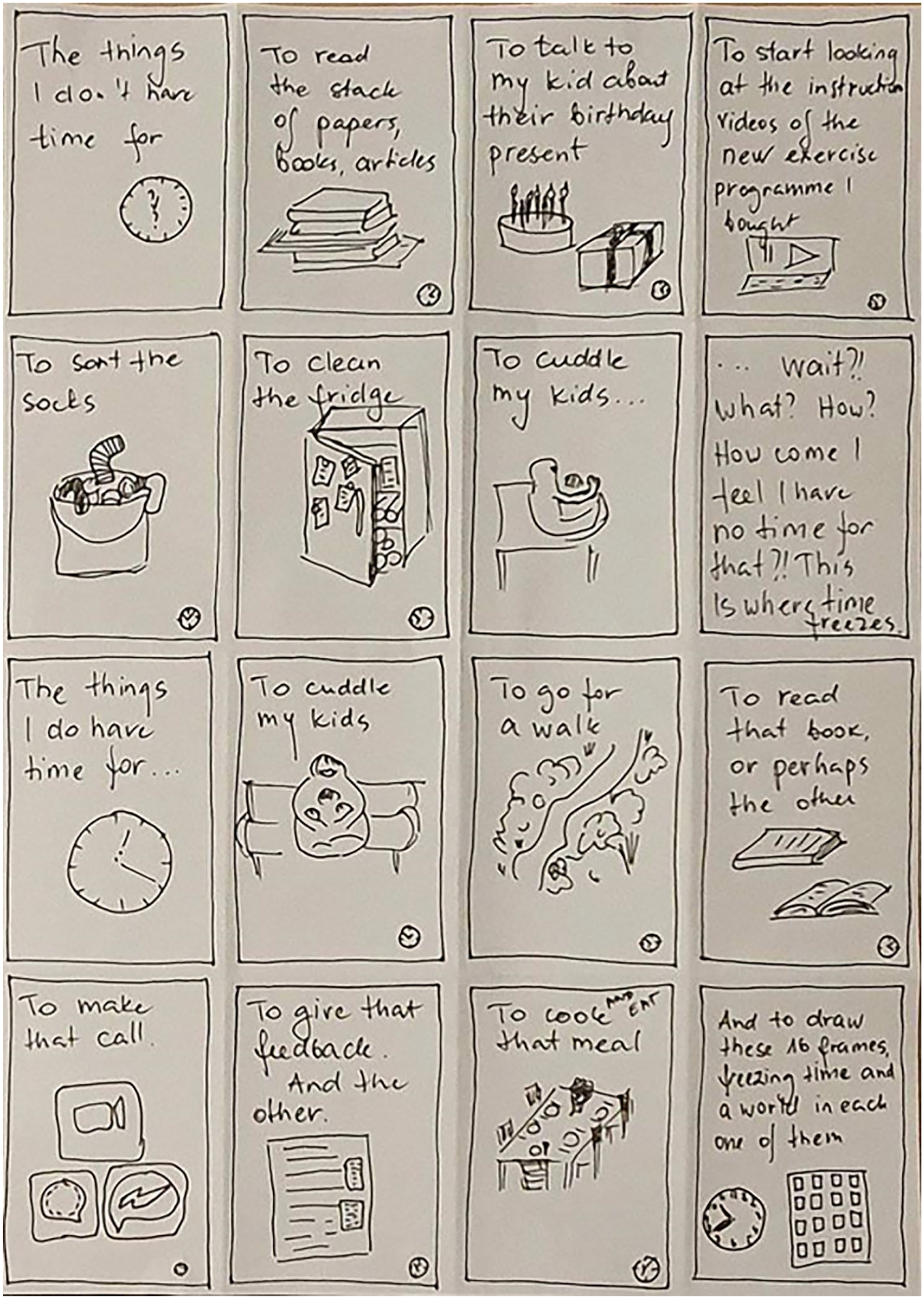
Figure 1 shows the 16 frames I drew, inspired by the prompt asking us to fit the world into frames. The prompt was itself inspired by Lynda Barry’s work (2014, p. 99) asking: “How is one comic frame like the whole world? How can one frozen frame be all of time? How do you live in both at the same time?” (Markham & Harris, 2020). In my 16-frame comic, I responded to the question of time and taking time, following Barry’s recommended meditative practice of drawing the lines to focus on taking time for reflection. Unexpectedly, the meditation added a strong normative component and brought to light what Carper (1978, p. 20) calls an ethical pattern of knowing. The pattern blends together questions of ethicality and morality and focuses on the matters of obligation, stressing the importance of the situational and relational in making choices. Social isolation and working from home during the COVID-19 pandemic made me confront my own choices, especially with the focus of familial relationships, self-care, and academia. Meditating about time, I fell into normative self-talk about what one is doing and what one should be doing. The 16 frames reflect my frustration with my time budget in the time of COVID-19, where isolation and not commuting gave seemingly abundant days filled with procrastination, yet pressured me to make consequential choices about how I spend that time.
Response to the prompt #8, How can one frame feel like the whole world?, drawing by the author.
The situational and relational factors influencing choices about how I use my time is reflected in the drawing, and it collides with the (in my case partially self-inflicted) normativity about motherhood and academia. Both the choices of what I don’t feel I have time for in the first half of the frames and the choices I discipline myself to take time for (the lower eight images) are a balancing act. Like many other women in academia (see for instance Ward & Wolf-Wendel, 2012), I too struggle to balance the ideals of a dedicated worker and perfect mother, as well as being competent in self-care.
Sarkar (2020) suggests that during coronavirus lockdowns, we experience a suspension of normative time. In my case, as external normativity related to commutes or being present is suspended, other normativity emerges from inside me. I find myself reflecting on my self-expectations of how to be an excellent academic and how to be a good mother. Even though children under 16 continued to attend school and daycare in Sweden, my “second shift” (family care and house care) blended with the “first shift” (work time). The university lockdown meant that I was working within the reach for the tyrannical pull of the housework from kitchen and washing machine in addition to demands from my desk and had to negotiate the “demands” of both laundry and research. In my response to prompt #8, my own worrisome relationship with self-care becomes visible. For me, the issue has been long-standing part of the internal voice—I have to look after myself to be able to look after the others, and thus, self-care becomes a nagging normative issue, another goal to be met.
Prompt #11: Victorian Allegorical Maps of COVID-19
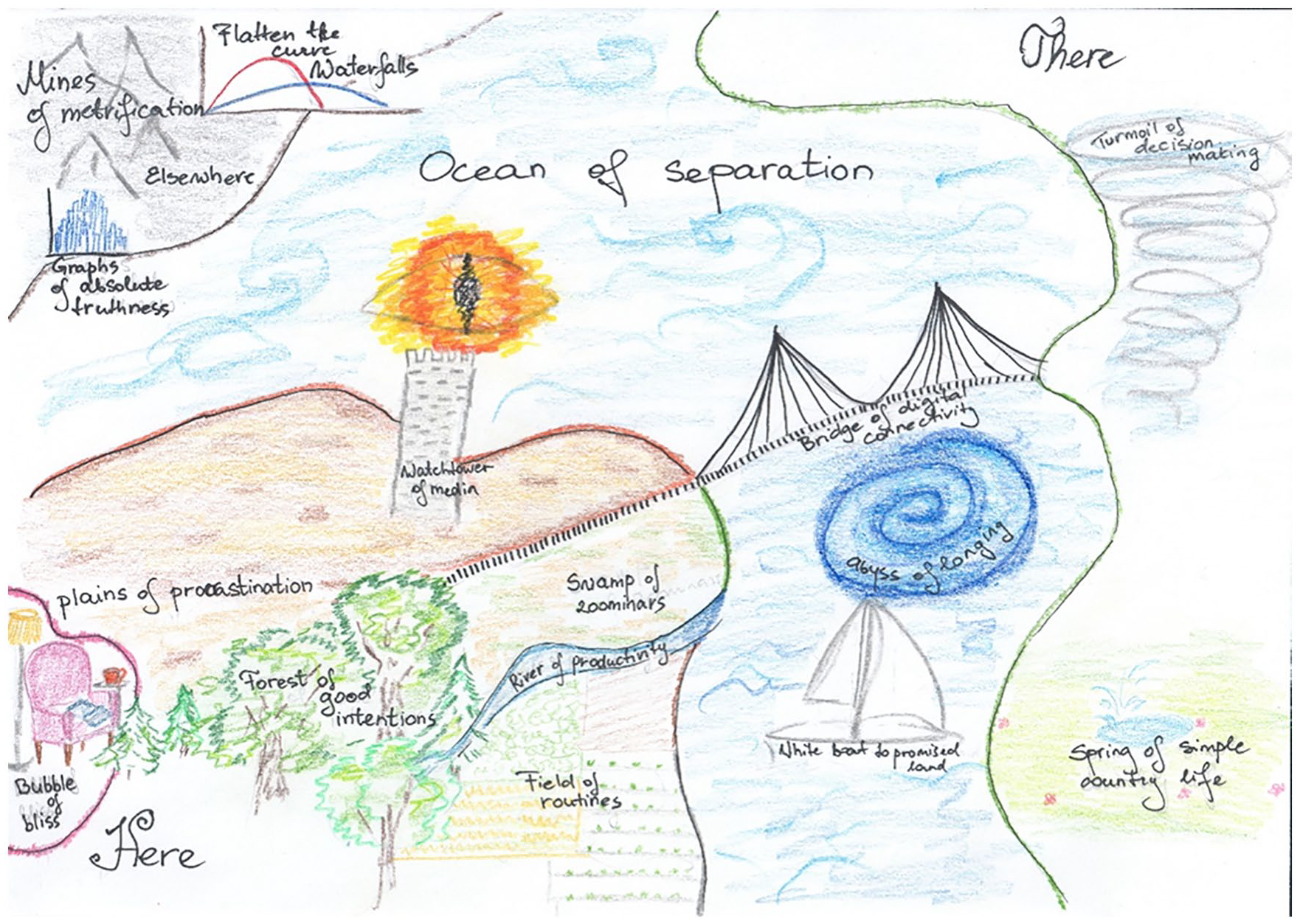
Figure 2 shows the mapping exercise, where the idea of cartography of the emotional landscape was in focus (Markham & Harris, 2020). When the previously discussed prompt used the drawing of the frames to invite a focus on the task and reflection, thus producing the reflection in one intensive burst of time, the map was the product of a series of iterations where the aesthetic thinking was negotiating with the core idea. The map went through different versions, and the coloring in the penciled lines became an additional layer of reflexive process. Carper (1978) has an idea she calls the “personal pattern of knowing,” which is about actualizing the concrete individual, and in autoethnography, we encounter and actualize ourselves, instead of another. As White (1995, p. 80) expands it, transfer of personal knowledge may be enhanced through the use of art, poetry, literature and storytelling, or other forms of creative expression (drawing, dancing). The map embodies what Chapman and Sawchuk (2015) call creation-as-research as it is a result of a prolonged and detailed self-exploration as well as researching about allegorical maps in artistic form.
Response to the prompt #11, Victorian Allegorical maps of COVID, drawing by the author.
The map becomes the summary of my feelings about the period of coronavirus restrictions spent as a migrant. My motherland, Estonia, is another EU-member country in a reasonable distance. Previously, my almost monthly visits to Estonia have enabled me to avoid reflecting too much about my status as a migrant. Coronavirus inspired travel bans and the suspension of flights and ferries forced me to encounter my two homelands in an unexpected way, which had a distinct impact on what I needed to draw on the map. The placement of “Here” in the bottom-left corner and “There” in the top-right, divided by the “Ocean of separation,” is among other things a reflection on the possibility of moving from Sweden (west) to Estonia (east) across the Baltic Sea. The map tells a story about my sense of being divided: between the detailed left hand of work and self-care and the distant yearning for my parents and extended family; between one home “here” and the summer cottage “there” where spring was blooming and summer was just out of reach at the time of creating the map (end of May 2020).
The crowded left side of the map also reflects my struggle to balance the proper use of time, where the “river of productivity” starts in the “forest of good intentions,” flowing away from the barren “plains of procrastination.” The “watchtower of media” draws on the cultural reference of Sauron’s Eye in the movie version of the Lord of the Rings trilogy, referring to the new verb of doomscrolling 1 as well as my reaction to the media’s practice of purposefully creating, fueling, and encouraging of unsettlement (Lupinacci, 2020, p. 2). The “bubble of bliss” is an indication of self-care and is yet another reminder to myself to seek a balance between work and myself.
Prompt #14: Changing Rituals, COVID Interruptions: An Exercise in Dance
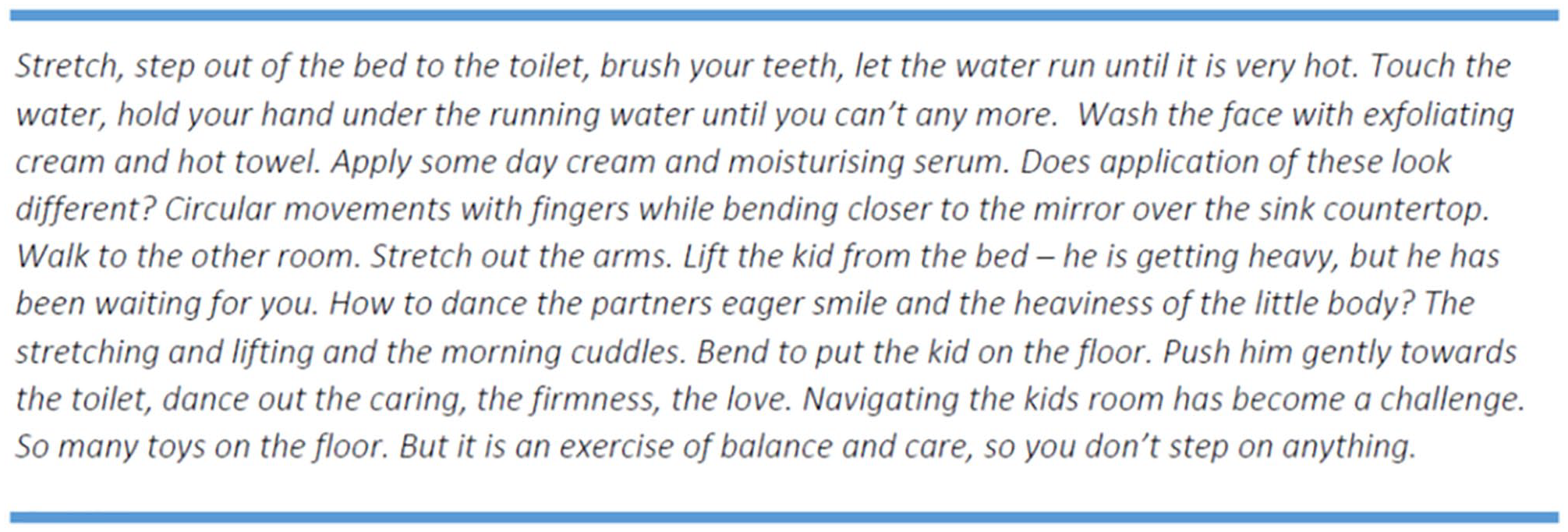
Figure 3 illustrates a short excerpt from the prompt exploring ritual through dance. The prompt asked, How have your morning rituals/writing rituals changed in the last two-three months? /. . ./ Take ten minutes to dance out your former rituals. /. . ./. As an aside: this is not about dance, but a nice review of the discussions around the irresolvable challenges of transforming movement to text, or lived bodily experiences and written descriptions about these experiences. (Markham & Harris, 2020)
This prompt showcases the challenge that artistic practice, combining all patterns of knowing in its aesthetic form (White, 1995, p. 82), presents to the empirical pattern of knowing, which, being verbal, dominates academic expression. White (1995, p. 82) quotes Jacobs-Kramer and Chinn (1988, pp. 137–138), Like personal knowledge, the expression of esthetic knowledge is not in language. We can unfold our art and retrospectively recollect and write about its features, and we can record it using electronic media, but the knowledge form itself is not what we write or record. The knowledge form is the art-act.
In my writing, the dance is struggling against the text, as the art-practice way of knowing struggles with the empirical description of the experience. The bodily movements of stretching, bending, picking up, or lifting often take second place to the purpose of these actions. My writing about the meaning rushes ahead of writing about the practice. The section from Figure 3 cannot be danced without a set of interpretations—someone has to explain what movements happen in between, as the meaning I attribute to the activity tends to overshadow the actual movements.
Response to prompt #14, an excerpt from the changing rituals, COVID interruptions: An exercise in Dance.
In the ritual dancing moment, the reflection is less about work and more about balancing my self-care with the needs of my children. As described here, typical morning moments have less focus on academic ambition, and self-care is routinized rather than judged.
Prompt #19: Timbre, Rhythm, Musicality
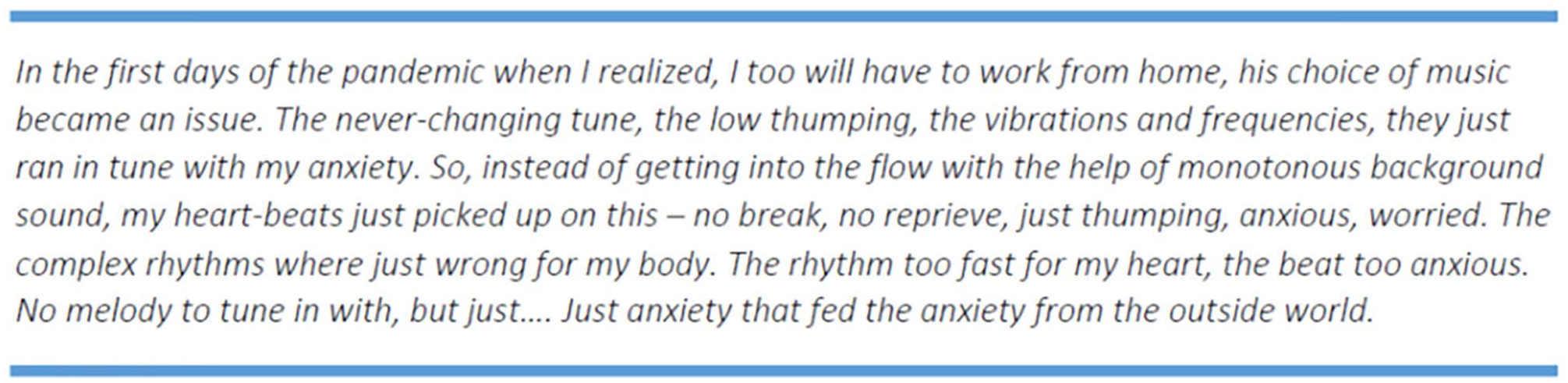
Prompt #19 asks: “Take any moment in the past eight weeks and consider it through the lens of a musical genre or type of musical instrument” (Markham & Harris, 2020). Focusing on the music and rhythm pushed the focus onto the personal way of knowing and allowed me to encounter myself in a new way (Figure 4). Leavy (2015, p. 127) discusses making music as exposing, challenging, and dismantling the mind–body dichotomy. And while my exploration was not about making music, describing the act of listening put the focus on the embodied experience.
Response to prompt #19, an excerpt from the Timbre, rhythm, musicality.
The prompt invited us to consider how: “writing forces us to confront the challenges of translating the nonverbal, affective, rhythmic, to the verbal” (Markham & Harris, 2020). Working from home made me share “office” with my husband, who has in the past 5 years worked remotely from the home office. His choice of background music—progressive trance from HBR1.com online radio station—challenged my mind-body dichotomy in the above-described way. Trying to verbalize my confrontation with the pandemic by describing the thumping, monotonous tones of the genre of progressive trance music, I found myself attempting to express the personal as well as aesthetic way of knowing. Even when reading my own writing or reflecting about it, my hands get sweaty, and my heart starts thumping.
At the intersection of the global pandemic and the personal pressures of being a wife and academic, the base thump characteristic to the progressive trance music style lead to anxiety and worry as the music resonates with the thumping of my heart. My response addresses the negotiations between work and self-care, with needing to share my home office with my husband. He has had to work from home during the past 5 years of our migration. Linking back to the previous prompt, the reflections about the “Here” (Sweden) and “There” (Estonia) still sometimes ignite a sense of guilt over displacing my family in the pursuit of my career.
Prompt #2: The Perspective of a Thing
Prompt #2 was a comfortable combination of text and visuals: “Take photos of 3 most intimate/familiar objects in your lockdown. /. . ./ write a couple of paragraphs each from the perspective of each object” (Markham & Harris, 2020). The intimate objects were portrayed through photography as well as from the perspective of narrators of the coronavirus experience (Figure 5). It invited a personal way of knowing about an intimate thing. Thus, the idea of storytelling from the personal perspective (White, 1995) invited exploration of the thing as an equal other.
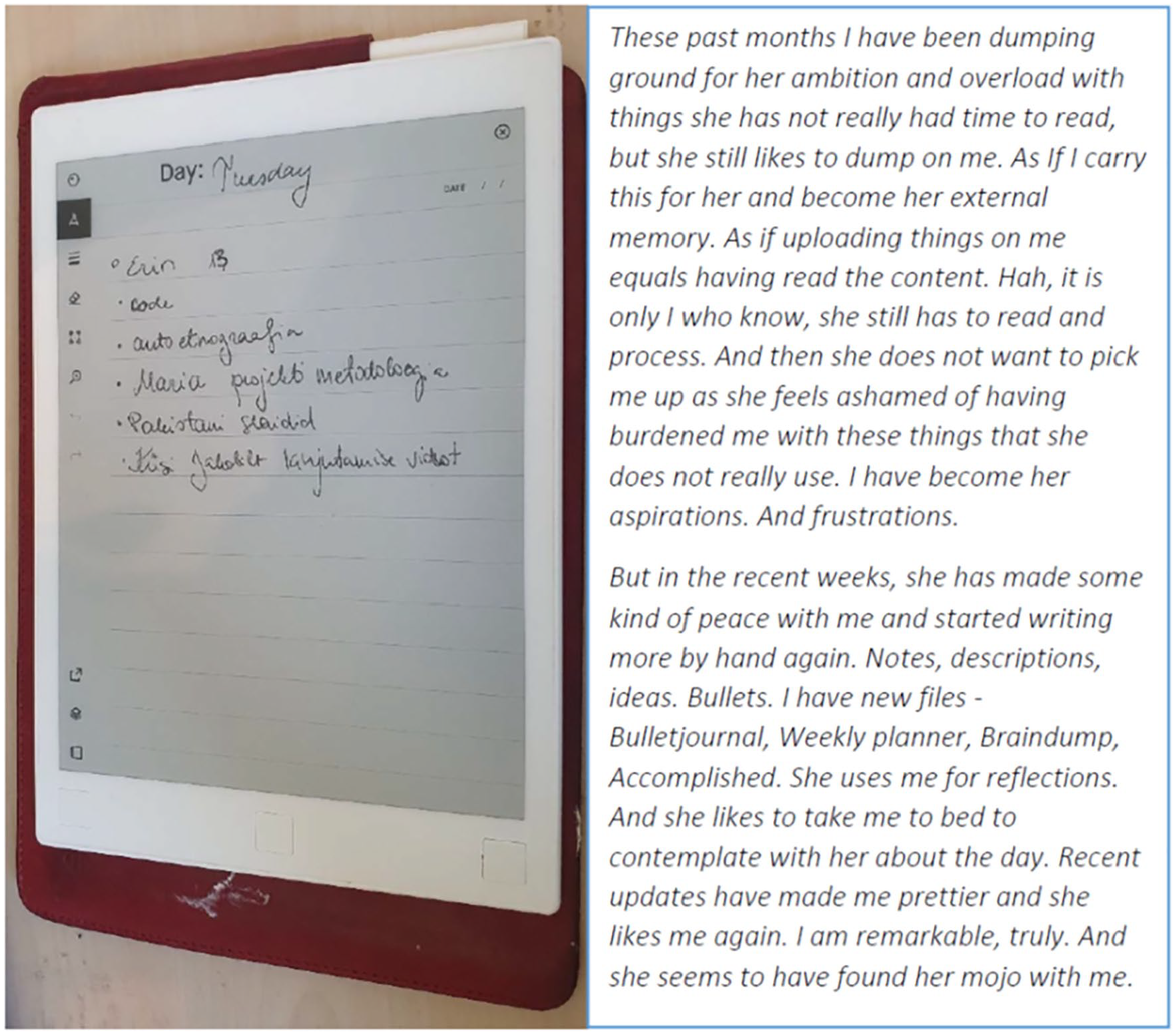
Response to prompt #2, excerpt from the photos of the three intimate objects, first person narratives.
Later in the experiment, when a prompt (#14, Markham & Harris, 2020) asked about matters of concern and linked to the text by Bruno Latour (2004), the link between the materiality and personality of the intimate objects pointed to the idea of assemblages. Through intimate connection to me, the mass-produced objects became things, assemblages of knowledge and caring. As with “thing ethnography” (Giaccardi et al., 2016), the thing’s perspective of knowing became a tool for exploring the relationships between global and local, specific and generic.
In writing in the voice of the objects, my style and tone differed, attributing personality to the items linked to the role they have in my life. My earphones were whiny about not being able to travel, my eInk writing tablet had proud and arrogant voice, and my IKEA hack/room divider speaks in loving and measured tones about the secluded space. The autoethnographic reflections written in the voice of these things generated a personal perspective on the knowledge that would otherwise be undiscovered. It is clear that as we are the people giving voice to the objects or agency to non-human objects (Bogost, 2012; Hayles, 2008), we will inevitably articulate points that we know, but shifting the position of the authorship shifts the perspective, puts us in the shoes of the other, invites relationality with the things we care for. My thing-stories speak about coronavirus from the standpoint of anxieties and worries that have little to do with being infected with the virus and being vulnerable to death. Instead, they showcase another angle on my grappling for control, being inside and outside, traveling the world or staying in one place, and yet again the need to balance academic performance with self-care.
Conclusion
While all the responses were written in a 3-week frame, my engagement and exploration through these different prompts brought my normative ways of knowing to the surface and showed what possibilities can be found in alternative expressions. Discipline-specific academic knowledge takes a second place to the much more intimate, personal, ethical, embodied, and artistic patterns of knowing. Shifting perspectives have allowed me to encounter myself through the eyes of others, through the lens of art and learn about myself in the context of a global pandemic. The prompts opened microscopic and macroscopic sensemaking and gave me professionally sanctioned opportunity to consider questions of care for self and the others, for family and work at the time of pandemic. The reflections provided a productive way to confront my self-expectations, even if sometimes, the look in the mirror was not the most favorable one.
Footnotes
Author’s Note
The author is grateful to the editors of the special issue Annette Markham, Anne Harris, and M.E. Luka for prompts, organization, support, and guidance.
Declaration of Conflicting Interests
The author(s) declared no potential conflicts of interest with respect to the research, authorship, and/or publication of this article.
Funding
The author(s) disclosed receipt of the following financial support for the research, authorship, and/or publication of this article: The work was funded by Data Society research program.
