



Abstract
Sport reporters strive for objectivity to legitimize their work, yet acknowledge their subjectivity in creating entertaining narratives. This objectivity–subjectivity tension has importance consequences for sports journalism, and in turn sporting organizations’ cultural and commercial success. This study examines Australian Rules Football reporting about home-team rivals Adelaide and Port Adelaide by South Australia’s only major newspaper, The Advertiser. We identify bias toward Adelaide across three levels of analysis and argue this bias is caused by commercial and ideological subjectivity. These findings are discussed in relation to the broader implications of structural bias in journalism and its political, economic, and societal consequences.
South Australia’s most popular spectator sport is Australian Rules Football, which is played professionally in the national Australian Football League (AFL). In this small state, fans are divided between cross-town rivals: the Adelaide Football Club (Crows) and Port Adelaide Football Club (Port). Crows and Port fans have only one major South Australian newspaper source reporting about these two clubs: The Advertiser. This newspaper reports on every aspect of AFL football, from analysis of draft picks to preseason form, to game-day build up, match reports, player performance, community outreach activities, and ongoing discussions of on-field events. This reporting is an important form of publicity for the clubs, impacting their public perception and, in turn, their cultural and commercial success. With two home teams reliant on the journalism produced by one major newspaper, this raises the question of how equitably the clubs benefit from The Advertiser’s media attention. Through this case analysis, this article contributes methodological and theoretical insights into imbalance and bias in sports reporting, and in journalism practice more broadly.
Sports reporting is an important part of the news industry. Recent research has found that among global news consumers, 39% of males named sports news as important, narrowly behind 42% of males who were interested in political news (Newman et al., 2024). Despite this importance, emphasizing sports reporting’s commercial value to news organizations, journalism scholarship has traditionally viewed sports reporting as a form of entertainment reporting that is less prestigious, serious, and professional than topics such as political reporting (Boyle & Haynes, 2009; English et al., 2023; Oates & Pauly, 2007; Perreault & Bell, 2022; Rowe, 2007; Weedon & Wilson, 2020).
One reason sports reporting tends not to be taken seriously by journalism scholarship is because of the close, symbiotic relationship between sports reporters and the sporting organizations they regularly report about, relationships that compromise independence, disincentivize critical coverage, and can even lead to collusion (Sugden & Tomlinson, 2007). Another reason sports reporting is not taken as seriously as other topics of journalism is because sports reporting is considered to challenge traditional journalistic values since sports reporters do not report facts dispassionately, tending rather to weave them into an enthralling narrative (Boyle & Haynes, 2009; Oates & Pauly, 2007; Schultz, 2005). The reporting of sporting facts is also often blurred with opinion through “excessive commentary, emotion, and opinion” (Horky & Stelzner, 2013, p. 124).
Yet, despite the inherent subjectivities of sports reporting, analysis of university sports reporting textbooks demonstrate that aspiring sports reporters are taught about the importance of objectivity (Weedon & Wilson, 2020). Objectivity and the related values of balance, independence, and neutrality are important to professional journalism because they define journalists’ professional ideology and legitimize their work (Deuze, 2005; Schudson & Anderson, 2008). By striving for objectivity, sports reporters also legitimize their reporting, particularly by differentiating themselves from “fans” (Weedon & Wilson, 2020). The tension between expectations that sports journalists provide an objective, authoritative report about “what actually happened” in a sporting contest, and the inherent subjectivities of reporting sport-based narratives, makes sports journalism an interesting object of study. Of particular interest in this research are three questions raised by the subjectivities of sports reporting: (a) can the subjectivities or the biases of sports reporting be measured against standards of balance; (b) if imbalance is identified in sports reporting, what is its cause; and, (c) what consequence does this imbalance have?
This article argues that whether sports reporting is perceived as merely entertainment or as serious journalism, its subjectivities and in turn its imbalance are important. Fair and consistent sports representation in the media matters to millions of players and fans globally, with some sports playing an important role in national and local cultures, as well as having significant business and economic impacts (Bernstein & Blain, 2002; Boyle & Haynes, 2009). Equitable sports reporting also has moral implications because it offers the audience “cultural narratives that frame and shape their understandings of the group identities and relations of democratic society” (Oates & Pauly, 2007, p. 336). These moral and indeed ideological implications are emphasized by Weedon and Wilson’s (2020, p. 1,380) suggestion that decades of sports media scholarship has found sports reporting perpetuates inequality “along intersecting axes of gender, race, nationality, sexuality and dis(ability).” Where such research is interested in how sports reporting perpetuates existing structural inequalities in society, this research is similarly interested in how imbalanced treatment of two clubs playing the same sport in the same league in the same city has material commercial and cultural consequences for those clubs and their supporters, consequences which cannot be separated from broader social, political, economic, and democratic concerns.
To explore the presence and implications of imbalanced sports reporting, this study evaluates The Advertiser’s AFL coverage of the Crows and Port across three levels of analysis: space, advocacy, and contextualized tone of coverage. As South Australia’s only major newspaper, The Advertiser, a tabloid-style daily printed and online newspaper owned by Rupert Murdoch’s News Corp Australia, is the main source of South Australian football news and thus the main source of sporting facts, narratives, and publicity. This case study allows for the exploration of different methodological and theoretical ways of evaluating imbalance in sports journalism and contributes to broader questions about the potential causes and implications of imbalance in journalism. Through this analysis, we advance understanding of how media inequities perpetuate inequity in wider society.
Objectivity, Balance, and Bias in Journalism
This study draws on literature interested in defining objectivity and, in turn, balance, bias, and the potential causes of bias. Objectivity, an inherently ambiguous term, is defined as “the reporting of reality, of facts, as nearly as they can be obtained without the injection of prejudice and personal opinion” (Maras, 2013, p. 7). Objectivity is considered an important factor in the professionalization of journalism because it gives journalists a powerful cultural authority through their claims of using superior methods to “seek truth” (Schudson & Anderson, 2009, p. 76). Some scholars also suggest that objectivity is a commercial imperative; by historically eschewing partisan bias and including multiple viewpoints, newspapers increased the size of their consumer and advertising markets (Maras, 2013; Schudson, 2005).
Despite its importance, there are debates about how achievable objectivity is in practice (Mindich, 1998; Schudson, 2005). These debates lead some scholars to emphasize balance, truth, detachment, and nonpartisanship, another way of characterizing “independence” (Mindich, 1998). Journalistic balance is described as “the absence of bias,” suggesting that to present a balanced account, a journalist must be impartial (Starkey, 2006, p. xvi). Although balance may seem easier to measure than objectivity, scholarship on climate change reporting demonstrates that the equal inclusion of climate scientists and climate deniers represents a false balance or “balance as bias,” because it gives the false impression both sides are equally legitimate (Boykoff & Boykoff, 2004). Rather than view balance and truth as an “equilibrium” between binary voices in news reporting, Boudana (2016) suggests “fairness” through consistency and justification are better values to identify truth. This argument is also related to calls for journalists to balance sources based on the weight of the evidence they present (Ward, 2010). Synthetizing these ideas, a balanced representation of sports reporting should fairly contextualize sporting facts while striving for objectivity and impartiality, and precluding prejudice, subjective opinion, favoritism, and bias.
Just as objectivity and balance are contested concepts, balance is also difficult to measure because “one person’s ‘balance’ may be another person’s ‘bias’” (Hopmann et al., 2011; Starkey, 2006, pp. xvi–xvii). Bias can also be difficult to identify because of the challenge of determining whether negative or positive coverage of a politician, for example, results from ideological bias or the context in which reporting occurs (Donsbach & Patterson, 2004). However, this difficulty has not stopped scholars from developing methodologies for measuring balance and bias. Many of these studies measure balance in political reporting, particularly election campaigns, because journalists notionally play an important role in fairly representing competing ideas during democratic contests (Hopmann et al., 2011). Hopmann et al. (2011) suggest that there are three common ways researchers operationalize measurement of political balance and bias: by analyzing how often political actors are mentioned, that is, how much space they are given; how favorable coverage of political actors is; and, how often issues on a politician’s agenda are mentioned. In arguing for more conceptual clarity for studies of political balance, scholars are encouraged to benchmark what balance looks like, for instance, whether it is shared between two major political contenders or between a multiparty system with different shares of votes (Hopmann et al., 2011). They also urge scholars to consider “competing explanations” for differences in media content across time and space, such as different contexts explaining why some actors are receiving favorable coverage and others are not (Hopmann et al., 2011). As such, Hopmann et al. (2011) emphasize two important measures for bias or balance; the space provided to different interests, and how favorably those interests are represented—the tone of the coverage—in relation to the context of the facts being reported.
Political reporting studies have used various methods to evaluate balance and bias in relation to both space and tone. One example analyzed balance in relation to US broadcast outlets’ coverage of presidential approval polls about President Clinton and President Bush, finding that ABC, CBS, and NBC favored Clinton’s good news polls, while Fox favored Bush’s (Groeling, 2008). In the Australian context, Fielding et al. (2025) analyzed the space and tone used to report about the 2023 Voice to Parliament referendum in 1,613 News Corp Australia news pieces. They found that 68% of words that contained an argument for or against the Voice advisory body were arguments against the constitutional change. This study proposed that this imbalance was more than bias; it constituted conservative advocacy, where News Corp’s media outlets advocated against the Voice. Fielding (2025) also measured the balance between union and employer narratives in 6 weeks of Australian media coverage of a 2016 politicized industrial dispute, finding 86.62% of the media narrative aligned with the employer’s story, and that News Corp advocated for the employer and against the union. The possibility of news outlets advocating for some interests ahead of others introduces another element of potential bias alongside space and tone which can be measured in news content; what interests a news outlet advocates for, and how often they do so.
Potential Causes of Imbalance in News Reporting
The causes of political imbalance or bias, which can also be understood as subjectivities that undermine objectivity, can be explored using Shoemaker and Reese’s (1996) sociological “hierarchy of influences” model. This model categorizes complex factors influencing news media as individual journalists, media routines, organizational influences, outside influences, and the influence of ideology (Shoemaker & Reese, 1996).
In relation to individual journalists, Patterson and Donsbagh (1996) surveyed journalists in the United States, the United Kingdom, Germany, Italy, and Sweden and found that personal beliefs influence their news decisions. However, demonstrating how difficult it is to separate Shoemaker and Reese’s (1996) hierarchical influences at the organizational level, Gitlin (2003, pp. 259–260) suggests editors excert “social control” over their newsroom, which means that even when journalists hold a particular perspective, they tend to report using the same “core hegemonic assumptions” as their managers and their major sources.
At the organizational level, the commercial nature of the news industry is theorized to bias news reporting. One such view is Herman and Chomsky’s (1988) argument that newspaper reporting is influenced by news organization’s desire to grow “quality”—that is, affluent—audiences for advertisers, and to avoid upsetting advertisers through negative coverage. They argue that bias results from editors’ and journalists’ “internalization” of factors such as framing and definitions of newsworthiness that conform to the organization and institution’s priorities (Herman & Chomsky, 1988, p. xi). Similarly, Iggers (2018) describes how corporate culture has meant that newsrooms are less autonomous and have moved closer to the business function, where the needs of advertisers are placed ahead of the needs of readers.
At the organizational level of influence, media ownership is also considered a factor in partisan bias. For instance, studies of Murdoch’s conservative news organizations tend to assume they are biased toward right wing political ideology as a strategy to capture right wing audiences for commerical reasons (Benkler et al., 2018) and to gain favor with right wing politicians (Shoemaker & Reese, 1996). However, McKnight (2010) argues that Murdoch is just as motivated by promoting right-wing political beliefs as he is by making money, suggesting ideological bias is at play alongside commercial bias.
Among sources of bias outside of the newsroom, the work journalists’ sources do to “manage” the media agenda is suggested to influence news reporting (Shoemaker & Reese, 1996). This idea is reinforced by Esser et al.’s (2012) finding that journalists believe that the availability of a good press release is a more important consideration for newsworthiness than the importance of an event to the public. Strategic communicators use increasingly sophisticated methods to influence their representation in the media to the extent that studies have found that journalists sometimes plagiarize from materials such as press releases, a practice viewed as compromising news media’s independence (Jackson & Moloney, 2016).
Shoemaker and Reese’s (1996) final level of influence—ideology—is difficult to account for in studies of news reporting balance or bias, and is also inherently intertwined with other hierarchical influences. This might explain why, as suggested by van Dijk (2009) scholars rarely investigate ideological influences on news representation. However, as argued by Iggers (2018), since the media is a site of struggle over who and what is included, exluded and legitimized in society, identifying ideological influences is vital to understanding media power.
One study which did identify ideological influences on news media is Fielding’s (2025), who found that Australian media outlets were collectively biased against the union’s perspective in reporting a politicized industrial dispute. Fielding (2025) argues that this media inequality was caused by the news institution’s repetition and reinforcement of the employer’s hegemonic perspective. She describes how reporting of the dispute aligned with dominant cultural and ideological master narratives that frame unionism as an inherently illegitimate sectional interest, where employers’ interests are inherently legitimiate because they are assumed to align with the national interest (Fielding, 2025). This default assumption of employer legitimacy led journalists to frame the industrial dispute through the eyes of the employer by repeating and reinforcing the story that the union were acting illegitimately (Fielding, 2025). Fielding (2025) concluded that individual journalists, media routines, organizational influences, and outside influences were not the root cause of bias against unions, but rather that ideological and class-based structural bias was responsible for media inequality in industrial dispute reporting.
Balance and Bias in Sports Reporting
Analysis of bias and balance in journalism tends to be situated in political contexts, with the literature revealing bias can be identified in regards to space, the tone of coverage, and which interests news outlets advocate for. If these types of bias and imbalance are important in political reporting, it follows they are also worthy of analysis in sports reporting. The relationship between sports and the media has long been recognized as mutually reinforcing, with media coverage playing a crucial role in shaping the way audiences perceive sporting events, teams, and athletes (Bernstein & Blain, 2002). Sports reporting is characterized in much scholarship as a fusion of facts with dramatic storylines, a practice that can blur facts and opinions through the use of commentary and emotions (Boyle & Haynes, 2009; Horky & Stelzner, 2013; Oates & Pauly, 2007). These ideas suggest that the facts of sporting contests tend to be contextualized by sports reporters in a subjective way. These sports narratives not only bring meaning and color to sports reporting but also present cultural and collective narratives that influence community identity and expression (Oates & Pauly, 2007).
While accepting the subjective narrative structures inherent in sports reporting, scholars also acknowledge that perceptions of professionalism and legitimacy in sports reporting are related to traditional media routines important to all journalism practice, including independence, objectivity, balance, and a lack-of-bias. This idea is reinforced by Salwen and Garrison (1998), who found that sports journalists ranked professionalism and ethics as their largest concerns in their profession. One reporter interviewed exemplified this finding, explaining that audiences “think we’re all on the take,” saying he was worried sports reporters were perceived as not objective but as “hacks” who “engage in cheerleader-type journalism for the home team” (Salwen & Garrison, 1998, p. 94). More recently, UK sports journalists have been found to view online sports journalism as less legitimate and professional than traditional reporting because of the perception of the relative absence of professional media routines of objectivity, independence, verification, and access in online reporting (McEnnis, 2020). The connection between sports journalism’s professionalism and indepedence in a changing media ecosystem is emphasized by Mirer’s (2019) finding that in-house sports reporters working for sporting teams continue to seek to meet journalism’s traditional ethical and normative standards so that they are not perceived to be doing public relations for their sporting organizations. Similarly, Scovel and Niedling (2026) found that even when using athletes’ digital content in their reporting, sports journalists carefully consider their professional norms and ethics to ensure the content enhances the newstory in order to differentiate their journalism from content creation. Perreault and Bell (2022) also found that changing technology has led digital sports journalists to accept “team media” into the journalistic field, while continuing to assert journalism’s normative ideal of independence.
Due to the subjectivities involved in reporting about sports, some studies have analyzed the differential treatment of sporting teams in relation to the tone of their coverage. For instance, Hawkins et al. (2015) discussed why some teams are consistently overrated or underrated by sports journalists, suggesting journalists often rely on “conventional wisdom” and the opinions of peers, leading to “pack mentality” that results in shared biased assessments. They suggest that some of the causes of this bias include establishment bias (journalists tend to overrate historically successful teams), recency bias (teams with more recent success are favored), star bias (journalists overrate the potential impact of high-profile recruits), and institutional factors (such as home team bias) (Hawkins et al., 2015).
Subjectivities that bias sports reporting are also often characterized as ethical conflicts of interest which can influence how favorably a team or player is reported about and potentially advocated for. These conflicts occur when a media outlet has “some sort of interest or stake” in the team or sport they are covering (Oates & Pauly, 2007; Schultz, 2005, p. 214). Such potential conflicts are described by Schultz (2005) as: media ownership, when a media congolomerate owns the sporting team they are reporting about; boosterism, where reporting can be biased toward the local team, particularly since a winning local team sells more papers, has more “media friendly” players as sources, and is “more fun and pretigious” to report about; close relationships between sporting clubs, coaches, and players and the journalists who rely on them as sources; perks provided to journalists who cover sport, such as food and drink, and merchandise; “homers” who are reporters employed by sporting organizations exclusively to report about that club or team; and advertising, sponsorships, and product endorsements which when weaved into sports coverage are seen as challenging the impartiality and neutrality of sports journalists (Schultz, 2005, p. 215). Such conflicts of interest have led to concerns that sports journalists have “turned from critical eyewitnesses into entertainment vendors, often lack distance, and behave more like fans than neutral observers” (Horky & Stelzner, 2013, p. 123).
Other studies have also found a bias toward “home team” reporting influences the tone of coverage. For example, English (2017) interviewed Indian and Australian cricket journalists and analyzed 1,265 articles about the 2014 to 2015 Australia–India Test series. He found that despite the majority of journalists professing to be critical reporters, perceiving themselves to uphold journalistic standands such as objectivity, analysis of news reports found significant evidence of “cheerleading” for the “home team,” revealing a mismatch between journalists’ self-perception and their work. An analysis of reporting about allegations of doping with performance-enhancing drugs similarly found that Australian media tends to report on Australian athletes more favorably than international athletes, suggesting a nationality bias, as well as potentially a racial bias (Travan et al., 2023). In examining the levels of “fandom” among sports journalists, Reed (2018) found younger journalists working at smaller outlets were more likely to feel vicarious achievement when observing sport—enjoying when their team wins, than more experienced journalists working at larger outlets, and that the role conflict between this fandom and journalists’ “watchdog responsibilities” was a fruitful area for future research (Reed, 2018).
The different sources of bias and subjectivities regarding space, tone, and advocacy that influence sports’ journalists’ ability to be objective, balanced, impartial, and independent are often found in studies interested in other fields of reporting. This includes issues of partisanship and advocacy in political reporting, the mutually beneficial relationship between journalists and sources, the blurring of facts with opinions and commentary, the relationship between critical reporting and advertising, the views of individual reporters, and the powerful influence of ideology on news representation. Therefore, although sports reporting scholarship tends to appreciate the tensions between subjectivity and objectivity in sports reporting (Weedon & Wilson, 2020), journalism scholarship more broadly can benefit from understanding how to measure imbalance in The Advertiser’s coverage of South Australia’s two AFL home teams, and can gain insights into why this imbalance matters. As such, this study triangulates three measures of balance or bias in The Advertiser’s reporting of the two South Australian AFL home teams in regards to space, the tone of coverage, and which clubs the newspaper advocates for.
Case Study
As the only major print and online news provider for South Australian news, The Advertiser is the dominant media outlet offering comprehensive news coverage about the Crows and Port. This dominance is exemplified by The Advertiser (2024) reaching a combined print and online audience of 1.7 million readers across their digital and print platforms in a state with a population of 1.89 million people (ABS, 2025). The Advertiser also publishes football news and analysis across their social media platforms. As such, although South Australians can access AFL news from national news outlets with some local reporting, particularly AFL broadcast rights holders Fox News (also Murdoch owned) and the Seven Network, and from the AFL’s and clubs’ own media platforms, The Advertiser is the only major, local South Australian traditional news outlet providing what could be understood as comprehensive “home team” analysis of the Crows and Port. Since sports reporting is an important publicity platform for sporting teams (Bernstein & Blain, 2002; Boyle & Haynes, 2009), The Advertiser’s coverage of Port and the Crows is proposed to have a powerful influence on public attitudes and support for South Australia’s two home teams, and in turn their cultural and commercial success.
The history of the formation of South Australia’s two AFL clubs explains their bitter home-state rivalries. The Port Adelaide Football Club was established as an amateur South Australian National Football League (SANFL) club in 1870 in working-class Port Adelaide and went on to win 34 premierships by the 1990s, making them the most successful SANFL and Australian Rules Football club (Shilbury & Hooper, 1999). Seeking to build a national league that would eventually become the professional AFL, in 1990 the Victorian Football League approached SANFL clubs Norwood and Port Adelaide to encourage them to enter the national competition, with Port Adelaide signing an agreement to pursue this opportunity (Shilbury & Hooper, 1999). In response, the SANFL was outraged at Port’s perceived defection to the national league. The South Australian press—particularly The Advertiser—branded Port “traitors and deserters” (Shilbury & Hooper, 1999, p. 94). Other SANFL clubs went to court to stop Port negotiating with the AFL, and at the same time, negotiated with the AFL to form the Adelaide Crows, a composite South Australian side made up of all the other nine teams in the SANFL excluding Port, who entered the AFL competition in 1991 (Shilbury & Hooper, 1999, p. 94). This outcome left a “bitterness” about the Crows among Port supporters, who had to wait five more years for their club to gain the second South Australian AFL license, with Port Adelaide “Power” playing their first AFL season in 1997 (Shilbury & Hooper, 1999, p. 94). Since the Crows drew on the supporter base of 9 existing SANFL clubs, and Port drew on 1, the Crows from their establishment had the larger supporter and membership base. The acrimony resulting from this history is still present between the clubs.
To provide further context for this case study analysis, across the previous decade, from 2015 to 2024, Port played 228 games and won 60% of them, and Crows played 223 games and won 48%. The top 8 AFL teams at the end of the 18 team competition play in the final series. Port made the finals in 5 of the 10 seasons and Crows in 3 seasons. Of these finals, Port played 10, won 3, and lost 7. Crows played in 7 finals, won 4, and lost 3, including the Grand Final in 2017. Prior to this decade, Port won 1 premiership in 2004 and lost 1 in 2007, while the Crows won 2 premierships in 1997 and 1998.
Method
This study measures bias in news content by triangulating three measures of balance or bias in The Advertiser’s reporting about the Crows and Port: space, advocacy, and the contextual tone of the coverage. Where other scholars may seek to identify subjectivities in news reporting through exploring the reporting processes of journalists using interviews or surveys, we argue that the decision-making process and journalistic judgments made by a collective of journalists and editors at a single outlet across a 10-year period can be interpreted through the content they produce. As such, content analysis is proposed to be an appropriate methodology for measuring the presence and extent of subjectivities in news reporting and, where present, to theorize about its potential causes. As per Hopmann et al.’s (2011) suggestion of benchmarking the type of balance being measured, we propose that, considering the context of the case study, there is no reason that The Advertiser should not cover South Australia’s two home teams in a balanced, equal, consistent, and fair way. Drawing on Boudana’s (2016) concept of “fairness” through consistency and justification in reporting and Ward’s (2010) weight of evidence concept, we characterize balance in coverage of the Crows and Port across three levels of analysis as: equal space, equal advocacy in editorials, and fair and consistent tone of reporting and placement of match reports reflecting the contextual significance of wins and losses. Thus, this case presents a useful way to overcome the usual problem of measuring bias and balance, particularly in the political realm, where competing explanations, such as parties of government versus parties of opposition, can be found to explain differential coverage (Hopmann et al., 2011); each club is a home team, each plays the same number of home and away games, and each has well-resourced media teams.
The three-layered qualitative and quantitative method triangulates different measurements of balance to overcome the problem that “one person’s ‘balance’ may be another person’s ‘bias’” (Starkey, 2006, pp. xvi–xvii). The first method of quantitative content analysis measures how much space each club is given in The Advertiser by quantifying the share of articles, and the number of words, among 100 articles written in each month of March from 2015 to 2024 about either the Adelaide Crows or Port Adelaide, or mentioning both. The yearly sample of 100 articles was sourced using the NewsBank database search of The Advertiser and the Sunday edition The Sunday Mail’s coverage using keywords “Port” or “Adelaide” or “Crows” or “Power,” with the authors checking each article’s relevance and club inclusion manually. 1 The total corpus of articles was thus 1,000; 100 per year for 10 years. The month of March over a longitudinal 10-year period was selected because it is the month when the AFL competition begins. This month was chosen for analysis because during the pre-season and opening games, as per Hopmann et al.’s (2011) suggestion, there is reduced likelihood that differential space can be attributed to the teams’ form as the season unfolds, such as only one of the teams making the finals.
The second method of analysis consists of a quantitative and qualitative analysis of advocacy for the Crows, Port or both clubs within editorials, including how often each club is advocated for, and the topic of that advocacy. Advocacy in editorials is measured using Fielding’s (2023) definition of advocacy journalism where journalists take a subjective position in advocating for a particular outcome in parallel to particular interests; in this case, advocating for or on behalf of one or both of South Australia’s AFL clubs. Editorials were sourced from NewsBank using a search for “Editorial” along with “Port” or “Adelaide” or “Crows” or “Power.”
The third level of measurement of bias consisted of analysis of the match reports for each of the 22 rounds of the 2022 AFL season for each club. Mixed quantitative and qualitative analysis was used to identify and quantify the tone of match reports in the context of the facts of the matches played, taking into account both the sentiment of the match reports, and how fairly and consistently the teams were presented in the context of match success or failure, as well as their comparative form across the season. The 2022 season was chosen because NewsBank’s digital images of newspaper reports, including not just text but headlines and photographs, were only available for the previous 5 years. During this period, 2022 was the season in which the clubs won a similar number of games, with Port winning 10 and Crows winning 8. Major match-report headlines, images, and articles were sourced by downloading records from The Advertiser and The Sunday Mail from NewsBank on dates after each club’s 22 matches throughout the season. The position of these 60 match reports was noted to identify their placement in the article, particularly on the front page or the back page, which is the front of the sports section. This quantitative analysis was combined with qualitative evaluation to identify the contextualized tone of each report, including how positive, negative, or neutral the headlines, image/s, and reports were, and the stories they told about the club’s performance, accepting other scholars’ suggestions that sports reporting invokes narratives to contextualize the results of games (Boyle & Haynes, 2009; Oates & Pauly, 2007; Schultz, 2005). This analysis considered the context of the team’s form and success at that point in the season, the score, and the end-of-season ladder position of the team they played; that is, whether the win or loss was against a tough competitor, a matched-competition, or an easy-beat.
This triangulated three-phase method measuring space, advocacy, and tone in context of sporting facts is proposed to have validly, reliably, and longitudinally overcome the problems inherent in a single method to accurately measure The Advertiser’s balanced or biased coverage of South Australia’s AFL teams.
Results
This study finds that The Advertiser does not consistently and fairly balance their coverage of the Crows and Port, but rather are biased toward the Crows with regard to space, editorial advocacy, and the contextual tone of match reporting.
Space: The Crows are Written About More Often than Port
Our first level of analysis of space in The Advertiser found that the Crows are written about more regularly than Port. As per Figure 1, 47% of the total words among 1,000 articles (100 each year across 10 years) in the month of March from 2015 to 2024 were about the Crows. Articles about Port comprised 37% of words, and 16% were about or mentioned both clubs. These percentages are close to the percentage of articles: Crows had 48% of articles, 38% were about Port, and 15% were about both.
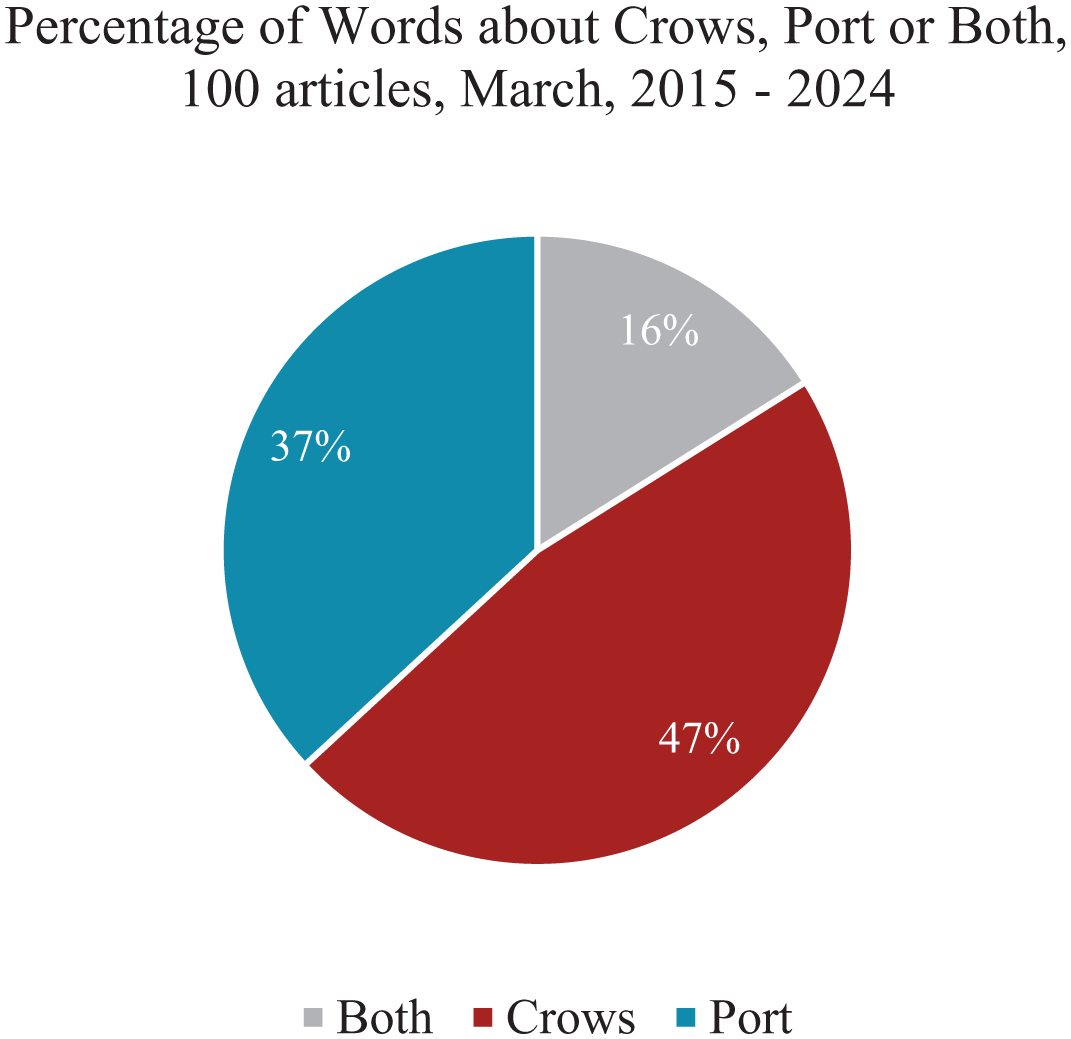
Percentage of The Advertiser’s words in 100 sports reports about Adelaide, Port Adelaide or both, March, 2015 to 2024.
Advocacy: The Crows are Advocated for More Regularly than Port
For the second phase of analysis, the number of editorials advocating for the Crows, Port or both were found to favor the Crows even more than the content of March articles. As shown in Figure 2, of the 213 editorials analyzed between 2015 to 2024, 44% were about the Crows, 33% mentioned both, and 23% were about Port.
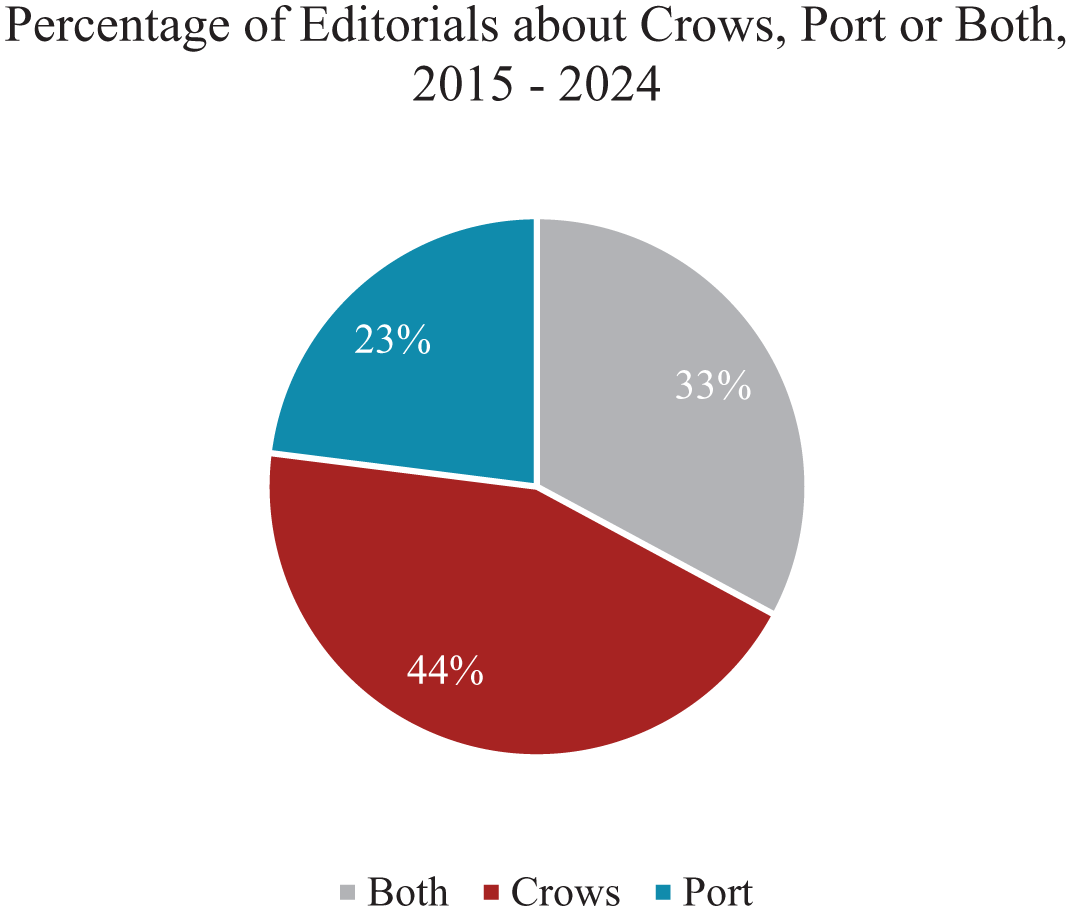
Percentage of The Advertiser’s Editorial articles about Crows, Port and Both, 2015 to 2024.
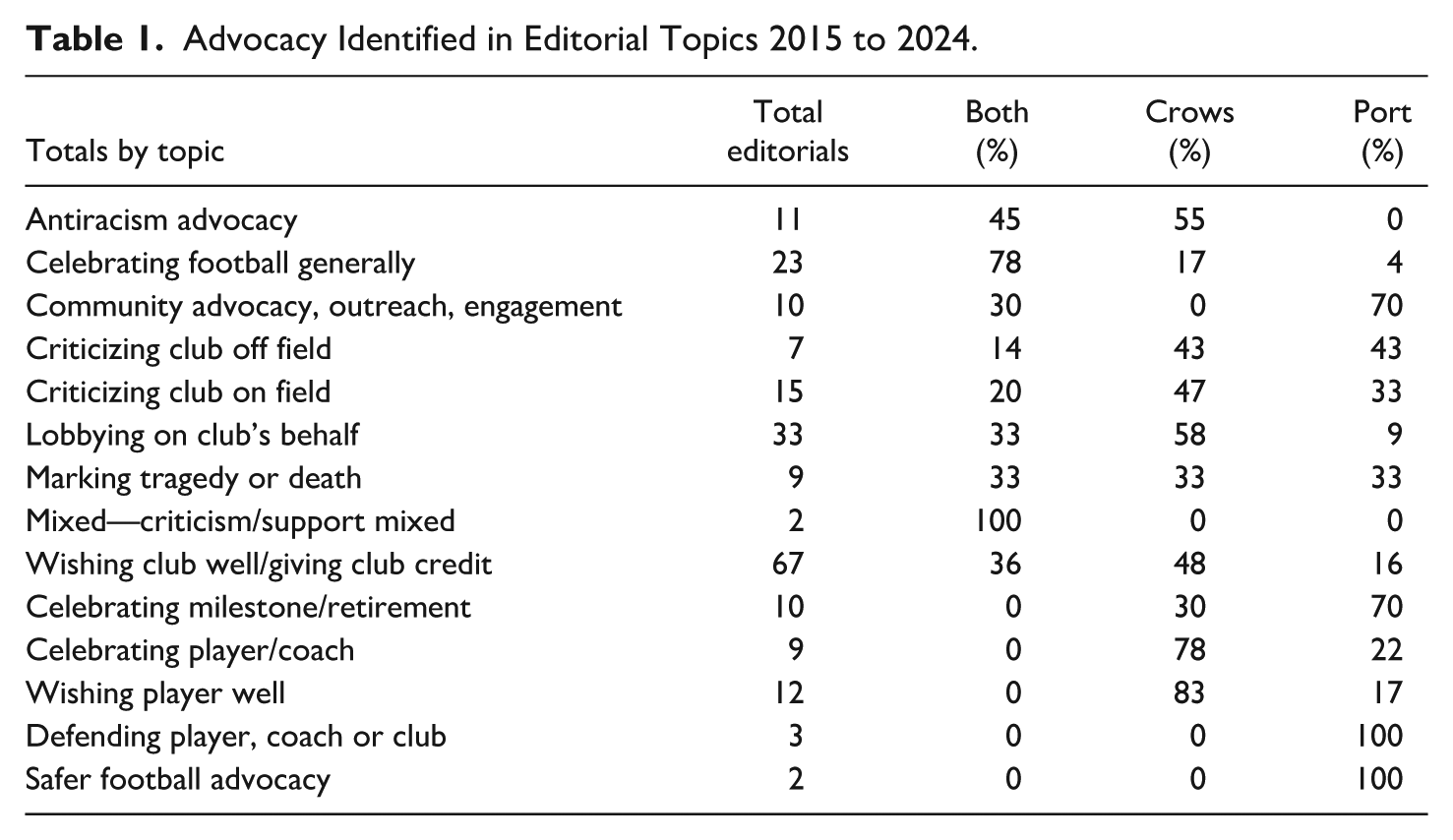
As per Figure 2, quantitative and qualitative coding of editorials found that the most common topic for advocacy on behalf of the clubs was wishing the clubs well and giving them credit for good performances (n = 67), such as cheering them when they play a final. The Crows received 48% of the editorials wishing the club well, whereas Port received only 16%. Both were wished well in 36%. The second most common topic was lobbying on a club’s behalf (n = 33). The Crows were beneficiaries of such lobbying in 58% of these editorials, particularly advocating for the club to secure a new clubroom location. Port were beneficiaries in 9%, and both clubs in 33%, particularly lobbying the AFL over match scheduling decisions (Table 1).
Advocacy Identified in Editorial Topics 2015 to 2024.
Qualitative analysis of advocacy in editorials on behalf of the two clubs informed our finding that the Crows are viewed by The Advertiser as the primary South Australian home team, whereas Port is seen as the “other” home team, whose success and failings are not as important to the newspaper, and in turn, the state. This one-sided advocacy, showing how invested The Advertiser is in the Crows’ success, is evident in an editorial published in August 2023 which passionately lobbied, or in the editor’s words “atoned,” the AFL over a perceived umpiring error: The farcical end to Saturday’s Crows-Swans clash will live forever in the memories of Adelaide fans. . .The goal umpire’s failure to call for a review of Ben Keays’ magnificent left-foot set shot snap.. not only robbed the Crows of victory. It robbed them of the chance to play finals. . .What really rubs salt into the wound is that it was the second time this season the Crows received a post-game apology from the AFL for umpiring mistakes that cost them wins (Editorial, 2023).
No such advocacy was found calling for better treatment for Port. This bias is also evident in an editorial published in March 2024, where the author writes that the Crows have “a huge supporter base and had a historical head start in the AFL that makes them, to this day, the ‘big brother’ to Port Adelaide in a footy-mad, two team town” (Editorial, 2024b). This comment suggests that the newspaper views Port, a club established in 1870, as less important than the apparently more established Crows.
The implied greater importance of the Crows was also evident in another editorial from 2024, which argues that before the Crows’ first game in 1991, in a state suffering “economic recession” and in need of “some hope and uplifting news,” 50,000 fans turned out to the Crows’ first pre-season trial game (Editorial, 2024a). Furthermore, in the same editorial which laments the recent form of the team which had seen the Crows miss the finals for the 8 seasons after they lost the 2017 grand final, it can be argued that The Advertiser’s editorial speaks on behalf of Crows supporters in writing “The Crows are no longer the pride of South Australia—many supporters are baying for changes on and off the field” (Editorial, 2024a). This finding fits with Mirer’s (2019, p. 80) suggestion that in-house sports reporters see themselves as “representative of the fans in the locker room,” requiring them to find out what went wrong when a team loses, and potentially being critical of players and people in doing so. This editorial example is reminiscent of such in-house reporting behavior because The Advertiser is not only advocating on behalf of Crows supporters in wanting their club to perform better, but also presents the newspaper itself as a representative and part of that supporter base.
Contextual Tone: Match Reports About the Crows are Sympathetic and Supportive
Quantitative and qualitative analysis of the match reports from the 2022 season revealed that the Crows featured on 4 front pages and 14 back pages (18 in total) in The Advertiser and Sunday Mail, where Port had 5 front page articles and 12 back pages (17 in total). As Figure 3 shows, the tone of these match reports in regards to sentiment (i.e. positive/supportive, negative/critical, or neutral) varied noticeably between the clubs; the Crows had twice as many positive or supportive front page articles written about them compared to Port and almost double the positive or supportive back page articles. This result was replicated with the back page sentiments, with Crows receiving half as many negative articles as Port. Crows had no neutral front or back-page articles, while Port had one neutral and one negative.
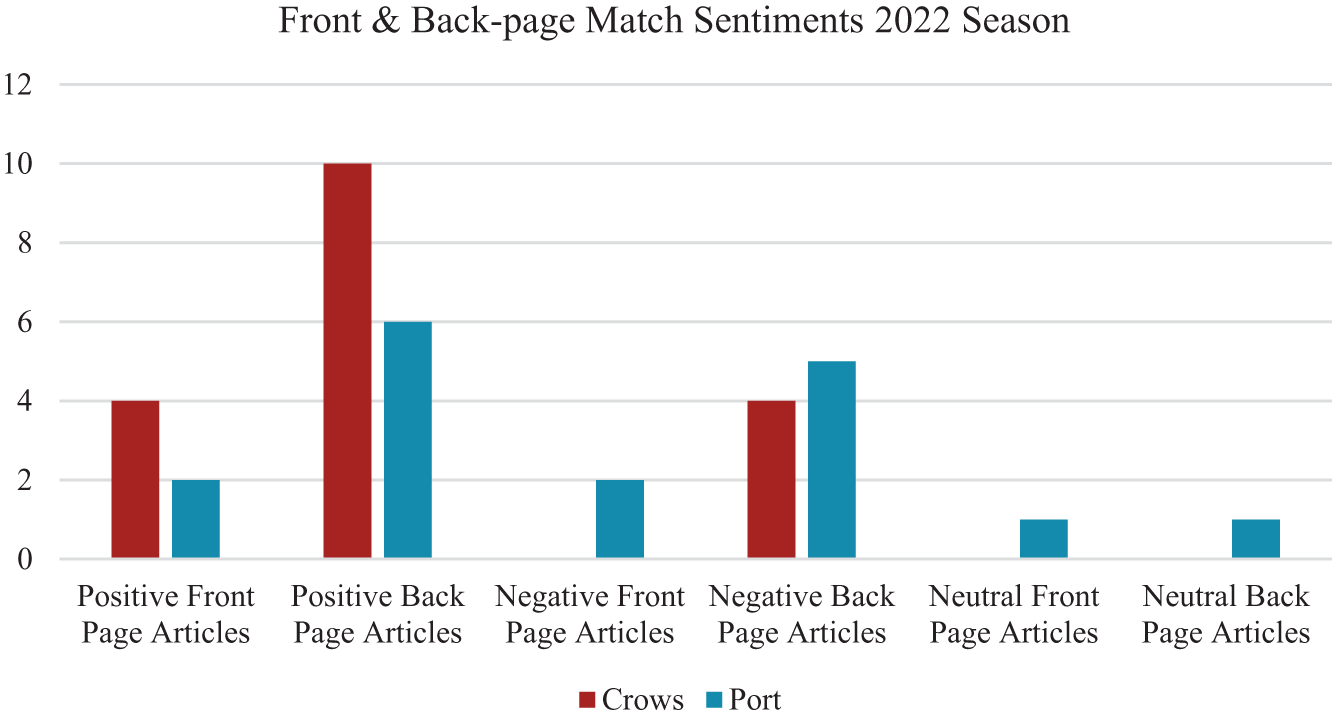
Front- and back-page sentiments relative to Crows and Port during the 2022 season.
Further qualitative analysis of the contextual tone and resulting narratives of the 2022 match reports, including the headline, text, and photographs, also found The Advertiser is biased toward the Crows. Despite winning only 8 games in the season, mostly against lowly ranked teams, when the Crows won, the Advertiser’s headlines were jubilant. An example of this is when, after beating the West Coast Eagles (ranked 17 out of 18 teams at the time) by a moderate margin of 29 points, The Advertiser’s back page headline was “Bring on the Showdown” (the game between Crows and Port). No such enthusiasm was found for Port during the lead up to the Showdown. In contrast, Port was featured on the front page only twice: once in a negative context and once in a positive context. This positive front-page story was when Port beat the Crows in the Showdown. This positive story, however, did not directly address the Crows’ significant loss (Port scored 111 to Crows 55), but rather highlighted the retirement of a star Port player.
Regarding negative match reports, where reporting about Port’s losses was found to be overtly negative, The Advertiser was consistently less critical of Crows losses and instead adopted a more sympathetic tone. This Crows narrative implied hope that there were better games ahead, using tropes like “Still a work in progress” and “There’s still lots to do.” This sympathetic and at times hopeful narrative for the Crows is evident in headings such as “Crows go down fighting in first tough thriller”; “Brave Crows left to stew”; and, “Nicks proud of fight in Crows’ bruising defeat.”
A much different narrative was presented regarding the negative aspects of Port’s season, despite them winning 2 more games than the Crows, and their wins often coming against teams high on the ladder. Regardless of their superior performance, The Advertiser treated Port’s losses with overtly negative headlines of disappointment and even despair. Notable examples were “How has it gone so wrong for Power?” and “Torpedoed: Port spirals after Cameron long bomb sparks Cats” as early as round 3 in the season.
This negativity continued throughout 2022, as Port’s finals chances were regularly called into question, with mid-season losses inspiring The Advertiser to run with front-page headlines like “Fade to black”, and “It’s a knockout. . .Power’s September dream in tatters.” Port’s negative front page came after Port lost in round 18 to the eventual second-placed Melbourne Demons (Dees) by 14 points, ending Port’s chance to play finals. The imagery of devastated Port players at the game end was coupled with the negative and unsympathetic headline: “Power’s Finals Dee-Saster.”
Overall, we found that 2022 match reports were more jubilant and glowing for the Crows when they won, more sympathetic and less critical when they lost, where Port’s victories received more muted praise and more critical commentary when they lost, particularly when they missed out on the finals. This is despite the Crows also missing out on finals and winning two fewer games than Port.
Discussion
This study offers a productive methodology for the measurement of balance or bias in sports reporting, or any other topic of journalism. Having set the benchmark for measurement of balance as equal space, equal advocacy in editorials, and fair and consistent contextual tone in the reporting of match reports in relation to the facts of the season, systematic bias is evident across the three measures. Bias was found regarding space, with the Crows receiving 47% of words in articles about either club, whereas Port received 37%, and both clubs were mentioned in 16% over a 10-year period. This bias is also evident in advocacy in editorials over 10 years; the Crows received the largest number of editorials supporting their position, with 44% pro-Crows, 33% advocating for both clubs, and 23% pro-Port. Qualitative analysis of advocacy in editorials found The Advertiser positioned itself as a supporter of the Crows and invested in their success, where no such support was found for Port. Additionally, over the 2022 season, despite Port winning more games, match reports were found to be more supportive and enthusiastic about Crows winning than Port, and less critical when the Crows lost. The synthesis of our findings demonstrate that The Advertiser did not deliver equality of coverage, but rather the newspaper is found to be systematically imbalanced or biased toward the Crows and against Port.
Having established The Advertiser lacks balance and is systematically biased in their representation of Crows ahead of Port in regard to space, advocacy, and contextual tone, the potential causes and consequences of this bias are theorized. This discussion draws on the work of Shoemaker and Reese (1996), who propose that media content is shaped by hierarchical levels of influence: individual, media routines, organizational including commercial concerns, and ideological influences. While acknowledging these influences are inter-related, we argue that individual, media routines, and organizational influences do not account for this bias; instead, ideological bias is the most convincing explanation. This ideological bias is proposed to stem from The Advertiser viewing the Crows as the more legitimate South Australian home team, where Port, despite being a more established and successful club, is characterized as not as important or newsworthy as the Crows. We further argue that this ideological bias toward the Crows in the state’s only major newspaper has the consequence of positioning the Crows in the South Australian community as the more important and legitimate club. Thus, the inequitable news representation of the Crows reinforces the Crows’ inequitable cultural and commercial advantage.
In assessing the causes of this bias, we acknowledge Hopmann et al.’s (2011) suggestion to take account of “competing explanations” for bias in media content across time and space, as well as Boudana’s (2016) proposal of “fairness” through consistent and justified reporting, and Ward’s (2010) weight of evidence approach. One competing explanation for our results could be that the Crows earned more coverage than Port over this 10-year period; that is, the bias was justified by the team’s successes. However, unlike Hawkins et al.’s (2015) suggestion that the recent performance of a team might account for bias toward them, Port was the more successful club over the 10-year period. Furthermore, although scholars suggest that institutional factors such as location could account for a home team bias (English, 2017; Hawkins et al., 2015; Horky & Stelzner, 2013; Schultz, 2005), location does not explain the greater bias toward Crows in comparison with Port.
Another potential bias is the role of individual journalists’ subjectivity. Journalists’ personal views have been found to color their reporting (Patterson & Donsbagh, 1996), suggesting that individual journalists may favor one of the clubs. Sports journalists have also been found to feel vicarious achievement when observing their own team, which is suggested to influence their independence (Reed, 2018). Yet, considering approximately 200 individual journalists reported about the clubs, and 6 editors authored editorials over 10 years, we can rule out individual bias.
Another possible source of influence on news reporting is media routines (Shoemaker & Reese, 1996). Media routines in sports reporting can be related to the inherent conflicts of interest that occur when reporters form regular and close relationships with their sources, which are also related to home team bias (English, 2017; Horky & Stelzner, 2013; Schultz, 2005). However, if media routines are a primary driver of imbalance or bias, such as the reliance on prepackaged content or ease of access to sources (Jackson & Moloney, 2016), then it should follow that there would be balanced treatment of both clubs. Both are professional AFL clubs that use the same stadium, have comparable internal media operations, and form strong home-team source–journalist relationships.
Another potential source of bias is organizational bias, which includes commercial considerations (Shoemaker & Reese, 1996). It could be argued that The Advertiser’s bias toward the Crows arises from commercial motives because, due to the Crows’ history as a composite club, they have more supporters than Port. A 2024 survey of AFL fans found that Crows have 651,000 fans and Port have 301,000 (Whitfield-Baker, 2024). This source of bias aligns with the suggestion that newspapers are interested in building readerships that can be sold to advertisers (Herman & Chomsky, 1988; Iggers, 2018). It follows that The Advertiser may consciously or unconsciously bias its football reporting to benefit the Crows ahead of Port, because Crows supporters are a bigger market for newspaper consumers and advertisers. The implications of such potential bias are troubling, considering the ramifications for sports reporting and journalism more broadly. Many scholars suggest that sports journalism has significant business and economic impacts because news reporting is a key site of sports publicity (Bernstein & Blain, 2002; Boyle & Haynes, 2009). As such, if The Advertiser does give preferential treatment to the Crows because they are the club with the larger supporter base, this bias gives the Crows an unfair commercial advantage ahead of Port.
Furthermore, the idea that The Advertiser has a commercial imperative for privileging the Crows ahead of Port is challenged by the fact that, despite having a smaller fan base, Port is not substantially smaller than the Crows when it comes to the number of club memberships (a form of season ticket). In 2024, the Crows were ranked eighth in the AFL for memberships with 75,477 and Port ranked tenth with 66,015 (Australian Football League, 2024). Port supporters are also loyal and engaged; Port are the number one club in the AFL for converting supporters to members, with 21.3% of Port fans holding club memberships (Whitfield-Baker, 2024). Thus, if The Advertiser’s football coverage is driven by commercial imperatives, it would make more commercial sense not to alienate Port supporters by favoring the Crows. In doing so, The Advertiser is theoretically selling fewer papers and earning less advertising revenue, particularly considering that sports reporting is one of the major topics male readers are particularly interested in (Newman et al., 2024). In the same way that the rise of objectivity as an important value in journalism is often characterized as driven by newspaper owners’ commercial motives to grow their readership beyond niche partisan audiences (Maras, 2013). The Advertiser’s commercial interests are better served by appealing to the parochial interests of all South Australian football fans, not just the Crows, through balanced and fair coverage of both teams.
Where commercial bias goes some way to explain The Advertiser’s Crows bias, we argue that ideological bias is the more likely explanation. Ideological bias, also characterized as structural bias, we propose results from The Advertiser aligning their interests with the Crows as the “establishment” club in South Australia, where working class Port is seen as the “alternative,” less important club. This is despite Port being the older and more established club, having a similar number of members to the Crows, and more success throughout their AFL history. An insight into The Advertisers’ ideologically biased treatment of Port as lesser than the Crows is evident in the newspaper’s aggressive opposition to Port gaining the first AFL license when it was offered to them in 1990 (Shilbury & Hooper, 1999), yet enthusiastically backing other teams collectively opposing Port’s entry and creating a composite club. Since the genesis of the Crows, and Port’s subsequent entry into the AFL, The Advertiser’s bias we argue can be explained as a structural, ideological bias where Port—the working-class club—is viewed as representing a sub-group in the community, where the Crows are viewed as representing the interests of the whole South Australian community.
This finding of ideological bias in The Advertiser’s AFL reporting helps to explain not only why sports reporting has a home country or hometown bias (English, 2017; Reed, 2018; Travan et al., 2023), but also why one home team is preferred ahead of another in regard to space, advocacy, and the tone of match reports. In the same way as McKnight (2010) argues that Murdoch’s News Corp is biased toward right-wing politics not for commercial reasons, but for the promotion of right-wing ideology, the ideological bias of News Corp’s The Advertiser is just as evident in their sports reporting as it is their political reporting. Indeed, this bias occurs even when it may be detrimental to the newspapers’ commercial market.
The source of structural or ideological bias in The Advertiser’s AFL coverage is theorized to result from a mixture of both concious and unconscious class-based bias toward the Crows and against Port. Concious bias can be understood as a form of advocacy journalism, fitting Fielding’s (2023) argument that News Corp advocated for the employer and against a union in an industrial dispute, and for the No campaign during the Indigenous Voice referendum (Fielding et al., 2025). This advocacy is particularly evident in biased editorial stances, where numerous editors over a 10 year period advocated on behalf of the Crows more enthusiastically and regularly than they advocated for Port.
Unconscious ideological bias is also suggested to explain why The Advertiser is systematically biased toward the Crows. In her study of media inequality in the reporting of industrial contestation, Fielding (2025) not only found that News Corp subjectively advocated for the employers’ position in industrial reporting but also found that the rest of the media, including left-leaning The Guardian and supposedly neutral public broadcaster, the ABC, were also biased toward the employer’s perspective. This bias was argued to result from a hegemonic, unconscious class-based bias, where journalists implicitly judged the employer as more legitimate than workers and their unions, where workers and unions were assumed to be illegitimate (Fielding, 2025). Crucially, this illegitimacy is argued to result from workers and unions being viewed as sectional interests, where the employers’ interest is assumed to align with the national interest—a clearly ideological assumption (Fielding, 2025).
Drawing on these ideas, we suggest that The Advertiser’s AFL coverage is skewed by ideological bias of both a concious and unconcious nature. Despite all other elements of reporting being equal, the one thing that sets the clubs apart is their cultural and ideological position in South Australian society and thus this difference—this inequality—is argued to be the cause of The Advertiser’s inequitable treatment of the club. This study is rare in identifying ideological influences on news framing (van Dijk, 2009), and in doing so adds to understanding about how subjectivities in media representation are an important form of media power (Iggers, 2018).
Conclusion
Despite sports reporting being seen as a less important topic in journalism scholarship due to its inherent subjectivities and its symbiotic relationship with sport (Boyle & Haynes, 2009; English et al., 2023; Oates & Pauly, 2007; Rowe, 2007; Weedon & Wilson, 2020), we argue that since The Advertiser’s advantaging of the Crows ahead of Port impacts on Port’s business and cultural success (Bernstein & Blain, 2002; Boyle & Haynes, 2009), the systematic bias we have identified across three levels of analysis—this clear case of media inequality—deserves scrutiny. Fielding (2025) suggests that media inequality in the reporting of industrial disputes, where employers are systematically framed as more legitimate than workers and unions, reinforces a hegemonic view in society that bolsters the power of employers and undermines the power of workers. The same source of media inequality, when applied to The Advertiser’s AFL coverage, can be argued to result in the Crows consistently being represented in the state’s only major newspaper as the more legitimate and important club, where despite their success, Port is not represented to the public as the “pride of South Australia.” Just as Weedon and Wilson (2020) argue that sports media scholarship has found for decades that sports reporting perpetuates gendered, racial, nationality, sexuality and dis(ability) inequality, this study similarly argues The Advertiser’s differential reporting of the Crows advantages this club economically and culturally, and in turn, disadvantages and reinforces Port’s inequality.
This disadvantage—this inequality—might seem trivial when compared to other topics of reporting, but it matters to Port supporters, a club made up of mostly working-class supporters who are not “lesser” than Crows supporters, yet are implicitly represented this way in the state’s only major newspaper. The findings of this single case also raise important questions for journalism more broadly regarding the causes of imbalanced reporting and its consequences. Journalistic imbalance should matter to those interested in the influence of journalism on society, including cultural, economic, and democratic outcomes.
Having shown that bias and imbalance can be measured, and that their causes can be explained through ideological and structural forces, the implications of biased journalism—not just sports journalism, but all journalism—can be further explored. Ideological bias in journalism is argued to distort reality—such as the reality of Port and the Crows both equally representing South Australia’s AFL home teams. This systematic distortion is proposed to benefit its beneficiaries while undermining those it disadvantages. When applied to other fields of reporting, including the political, business, and cultural realms, this bias has troubling implications for society. For example, when one political party is systematically advantaged ahead of another, democracy is undermined. Where a particular business is advantaged ahead of its competitors, the economic markets are less fair. Where more powerful cultural groups are advantaged, such as men ahead of women, white people ahead of non-white people, dominant races ahead of minority races, straight people ahead of LGBTIQ+ people, and upper- and middle-class people ahead of working-class people, those with power are made more legitimate by their representation in media than those with lesser power. Crucially, this imbalance in news reporting is argued to be self-reinforcing. That is, imbalanced news reporting perpetuates imbalance in society.
The idea that journalists objectively represent truthful and fair reality to audiences in a balanced way has given news institutions a powerful cultural authority (Schudson & Anderson, 2009). Sports reporting is a field of journalism which has long acknowledged its subjectivities, while still striving for objectivity to legitimize their work. This study demonstrates that the subjectivities—the imbalance—of sports journalism, and all journalism, can be measured, and that this bias matters. Whether this media inequality is conscious or unconscious, the results are the same. By presenting the Crows as more important and newsworthy than Port, The Advertiser creates an imbalance between South Australia’s two home-team AFL clubs, creating and reinforcing unfair cultural and commercial advantage for the Crows, while disadvantaging Port.
The Advertiser’s lack of independence in reporting about the Crows also raises questions about how effectively professional sports journalists are differentiating themselves from other actors in the sports media field, including team media, inhouse reporters, bloggers, and content creators, including athletes themselves (Mirer, 2019; Perreault & Bell, 2022; Scovel & Niedling, 2026). Future research should thus continue to interrogate how effectively sports journalists assert their independence from the athletes and teams they report about because this question is central to their professional identity, an identity that not only affords news media cultural authority, but in turn, economic capital (Rojas-Torrijos & Nölleke, 2023). If news outlets want to maintain their important cultural and economic authority in representing reality to news audiences, they should work harder to ensure that their coverage is objective, balanced, and fair, including that it is consistent, justified, and reflects the weight of evidence (Boudana, 2016; Ward, 2010), not the ideological subjectivities of collective journalists and editors. This effort should include interrogating the potential systematic sources of biased representations. In the same way as sports journalists have worked to differentiate themselves from “fans” (Weedon & Wilson, 2020), news organizations should consider how well they exemplify consistency, fairness, independence, neutrality, impartiality and objectivity to ensure their journalism serves a fair society, rather than undermining it.
Footnotes
Author Contributions
Dr Victoria Fielding and Dr Matt Hart were involved in all aspects of this article including the conception and design, analysis and interpretation of the data, and drafting and final approval of the paper. Both authors agree to be accountable for all aspects of the work.
Declaration of Conflicting Interests
The authors declared no potential conflicts of interest with respect to the research, authorship, and/or publication of this article.
Funding
The authors received no financial support for the research, authorship, and/or publication of this article.
