




Abstract
Journalistic work is shaped not only by institutional and news values but also by journalists’ broader personal value orientations. This study examines how Austrian journalists interpret, negotiate, and prioritize universal values in practice. Drawing on Schwartz’s Theory of basic human values and Negotiative Theory, it combines qualitative interviews with Q-methodology to explore value patterns and how journalists navigate tensions between personal and institutional values. The analysis reveals differentiated value hierarchies and reflective strategies used to manage external pressures. The study deepens understanding of journalistic identity, decision-making, and the evolving role of values in contemporary journalism.
When journalists reflect on the values guiding their work, they frequently reference established news values such as relevance, magnitude, negativity, immediacy, drama, and conflict (Harcup & O’Neill, 2017), alongside core institutional values like accuracy and objectivity (Holton et al., 2013). These values shape both individual decision-making and collective norms around what constitutes “good journalism” (Kovach & Rosenstiel, 2001), informing professional identity, ethical journalistic decisions, and societal expectations (Hanitzsch & Vos, 2018). In an evolving media landscape marked by political, technological, and economic challenges and pressures (Zelizer, 2019), understanding how journalists interpret and negotiate their values is increasingly important.
Research has long examined journalistic motivation as a synthesis of institutional values and personal ideals, with Western journalists often emphasizing their democratic role (Riedl, 2019). This collective ideology has been analyzed through roles, identity, boundaries, and professionalism (Cancela & Dubied, 2022; Koljonen, 2013; Smeenk et al., 2023). These inquiries have traditionally focused on news and institutional values to explain how values shape identity and practice (Deuze, 2005; Hanitzsch & Vos, 2017; Harcup & O’Neill, 2017). However, more recently, scholars have also acknowledged the importance of broader personal or universal values for journalistic practice (Belair-Gagnon et al., 2024; Frey et al., 2017; Monzer & Dimitrova, 2025). These values, understood as relatively stable motivational goals, complement institutional values by reflecting journalists’ belief systems and influencing their professional decisions (Belair-Gagnon et al., 2024). Some studies have begun to examine the relationship between universal values and journalistic roles, but findings are still inconclusive (Hanitzsch et al., 2019). Hence, the integration of universal values remains relatively underexplored, despite their well-established role as predictors of behavior and narrative framing in other fields (Lee et al., 2019; Sagiv & Schwartz, 2022).
Focusing on universal values offers important insights into the ways journalists construct professional identity, justify decisions, and navigate tensions between personal ideals and institutional expectations (Belair-Gagnon et al 2024; Frey et al., 2017). While institutional values are collective and externally defined, universal values function as internalized guiding principles that shape how journalists respond to professional standards and organizational constraints (Sagiv & Roccas, 2021). For example, individuals who prioritize benevolence may gravitate toward storytelling that promotes social harmony and well-being (Sagiv & Roccas, 2021; Sagiv & Schwartz, 2022). By examining these values, we gain a better understanding of the psychological underpinnings of journalists’ professional choices and responses to external pressures.
Applying universal value theory to journalism thus opens a new perspective on how journalists perceive and integrate potentially competing value systems into daily work. Although journalists in similar contexts often share core values (Koljonen, 2013), significant individual variation exists (Hanitzsch & Vos, 2017), shaped by demographic, cultural, and organizational factors (Hanitzsch & Mellado, 2011; Plaisance & Skewes, 2003). Personal values are dynamic; they are embedded in relational and hierarchical structures (Schwartz, 2012) and subject to negotiation in response to institutional values and external pressures (Hanitzsch & Mellado, 2011).
This study explores how Austrian journalists interpret and negotiate universal values within their professional environments, offering new insights into the lived dimensions of journalistic identity and the discursive nature of decision-making. While previous research often employs quantitative methodologies to examine journalistic cultures or value orientations (Hall et al., 2017), fewer have addressed the situated, discursive negotiation of values from a qualitative perspective (Marchuk et al., 2022; Raemy et al., 2024). Value orientations are often treated as fixed, overlooking how journalists reflectively navigate tensions between ideals and practice in specific situations (Hafez, 2011). By contrast, literature on journalistic roles increasingly recognizes the contested and negotiated nature of journalism (Raemy et al., 2024), though this has rarely been linked to universal values (Carlson & Lewis, 2018; Raemy & Vos, 2021).
To address these gaps, this study integrates Schwartz’s Theory of basic values (Schwartz, 1994) with Negotiative Theory (Raemy & Vos, 2021). Schwartz provides a cross-culturally validated framework of value orientations grounded in social psychology (Schwartz, 2012), while Negotiative Theory adds an interpretive lens focused on how journalists manage normative ambiguity through discourse and identity work (Raemy et al., 2024). Together, these frameworks link the relative stability of individual value systems with the fluidity of journalistic sense-making.
Drawing on qualitative interviews and Q-methodology, this study investigates how universal values are hierarchically organized and how they intersect with institutional norms and external constraints (Hanitzsch et al., 2019). Ultimately, the findings contribute to broader debates about journalistic identity and the evolving role of values in journalistic work.
Institutional and Universal Values in Journalism
Values constitute a fundamental concept within the social sciences and humanities, encompassing both universal goals and domain-specific norms that shape individual behavior and collective practices (Belic et al., 2022). In the context of journalism, values can be understood on at least two levels: as institutional values, including objectivity, autonomy, and impartiality, that regulate occupational conduct, and as universal values—trans-situational goals that guide personal decision-making across contexts (Plaisance & Skewes, 2003; Schwartz, 1994).
A robust body of scholarship has examined journalistic values from a normative and institutional perspective. Deuze (2005), for instance, conceptualizes journalism as governed by a shared occupational ideology, a relatively stable set of institutional values that legitimizes the profession’s social role. These values include public service, autonomy, immediacy, objectivity, and ethical responsibility and are frequently reiterated in foundational literature (Kovach & Rosenstiel, 2001). Reese (2001) further emphasizes that such institutional values shape not only journalistic practices but also the symbolic messages embedded in media content, thereby reflecting broader societal power structures.
However, while institutional values have been extensively theorized, the personal value orientations that journalists bring to their work, and how these relate to institutional values, remain underexplored. This study addresses this gap by focusing on universal values as conceptualized by Schwartz (2012). Schwartz defines these values as relatively stable, trans-situational motivational goals. They operate at the psychological level, guiding individuals’ attitudes, decisions, and behaviors across domains (Schwartz, 2012). To apply value theory effectively, it is important to distinguish between the levels at which different value frameworks operate. For instance, whereas frameworks such as Hofstede’s (2011) cultural dimensions theory operate at the societal level and offer insight into broader value climates (e.g., a country’s leanings toward uncertainty avoidance), the analysis of this study is grounded in Schwartz’s individual-level approach. This is because Schwartz’s (1994) model allows for the systematic investigation of how journalists personally construct and rank values.
Schwartz (1994) identifies 10 universal value types, organized along dimensions of self-transcendence versus self-enhancement and openness to change versus conservation. Universalism involves understanding, appreciation, and protection for the welfare of all people and nature, while benevolence emphasizes care for the well-being of close others. Tradition refers to respect for and commitment to cultural or religious customs, and conformity entails adherence to social norms and the avoidance of actions that may disrupt others. Security is concerned with safety, stability, and harmony, whereas power centers on control, dominance, and the pursuit of social status. Achievement involves striving for personal success through socially recognized competence, and hedonism is the pursuit of pleasure and self-gratification. Stimulation captures the desire for excitement and novelty, and self-direction reflects a preference for autonomy, creativity, and independent decision-making (Schwartz, 1994). These value types are relevant for journalism as they resonate with core journalistic concerns. For example, security has been linked to employment precarity (Springer & Rick, 2025), while stimulation aligns with journalists’ pursuit of emotional fulfillment in newsroom cultures (Belair-Gagnon et al., 2024).
Complementing Schwartz’s model, Rokeach’s (1973) distinction between terminal and instrumental values adds conceptual nuance. Terminal values refer to desirable end-states (e.g., “freedom,” “a sense of accomplishment”), while instrumental values denote preferred behaviors (e.g., “honesty,” “responsibility”) that facilitate their attainment. This conceptual differentiation is particularly pertinent to the study of journalistic value orientations, as it underscores how certain values may be perceived as non-negotiable principles, whereas others are considered contextually relevant and contingent upon their capacity to support those overarching ends (Rokeach, 1973).
To distinguish conceptual levels, this study further differentiates between universal values and professional norms and journalistic roles. While norms emerge from institutional routines and professional ideologies (Hanitzsch & Vos, 2017), values are affective, psychological drivers of individual behavior. As Hitlin and Piliavin (2004) note, although values and norms are conceptually distinct, they often intersect in practice: professional norms may reflect or institutionalize certain values, and tensions may arise when personal values diverge from professional imperatives. Moreover, professional ideologies tend to be stable, while role orientations are more fluid and internalized through ongoing negotiation of institutional demands, and situational pressures (Hanitzsch & Vos, 2017; Raemy et al., 2024). This process is central to professional identity construction and ethical decision-making (Raemy & Vos, 2021). This study focuses on universal values, while acknowledging that these also intersect with norms, and journalistic roles. Universal values serve as personal motivational foundations (Schwartz, 2012), journalistic norms function as socially codified expectations (Deuze, 2005), and role orientations reflect individually internalized professional identities (Hanitzsch & Vos, 2017). This framework enables a more nuanced understanding of the complex interplay between individual value systems and institutional structures in contemporary journalism.
Adapting Negotiative Theory to Values
The Negotiative Theory of Journalistic Roles (Raemy & Vos, 2021) offers a compelling framework for analyzing how journalists reconcile discrepancies between their idealized self-conceptions and everyday demands. At its core, the theory conceptualizes role negotiation as a dynamic, ongoing process involving cognitive, emotional, and discursive work. Journalists engage in this negotiation both internally and in response to external pressures, seeking to align their role and beliefs with situational and institutional demands.
Drawing on Hochschild’s (2012) Theory of Feeling Rules and focusing on “role work,” they outline a set of negotiation strategies that journalists employ in navigating role-related conflicts. These include surface acting (performing roles without internal conviction), deep acting (internalizing the role to align with personal values), reformulation (adapting the role to resonate with core beliefs), formulating conditions (establishing prerequisites for role performance), and role rejection (resisting roles perceived as incompatible with core values).
This study argues that Negotiative Theory serves as a valuable framework not only for analyzing negotiations in journalistic roles but also for exploring the prioritization and interrelation of values in journalistic practice. Like roles, values are not static or context-free but are subject to reinterpretation, compromise, and reinforcement in response to professional and institutional contexts (Belic et al., 2022). A negotiation-centered perspective illuminates the mechanisms by which journalists prioritize certain values over others, manage conflicting institutional values, and adapt their professional behavior in ways that reflect both personal convictions and structural expectations (Hanitzsch & Mellado, 2011; Raemy & Vos, 2021).
While most of the literature on journalistic negotiation focuses on role enactment, growing evidence suggests that value negotiation is equally integral to journalistic identity and decision-making (Frey et al., 2017). These negotiations are not only driven by external pressures, such as commercial imperatives, audience demands, or institutional policies, but also by internal tensions between personal and institutional values. For instance, Bhalla and Kang (2020) demonstrate how journalists from religious minority backgrounds in India navigate conflicts between their personal beliefs and the professional expectation of neutrality. They identify strategies such as boundary work, self-censorship, and emotional compartmentalization, revealing negotiation as a core component of identity work. Similarly, Schmidt et al. (2023) demonstrate how journalists face value conflicts between principles that are equally legitimate, such as truth versus harm minimization, or freedom versus responsibility. These findings underscore journalism’s value-pluralistic nature and reinforce the need to conceptualize negotiation not just as a response to external limits, but as a means of managing internal dilemmas.
Negotiation also functions as a coping mechanism in the face of psychological and structural demands of journalistic work. Drawing on stress and coping theory (Folkman, 2012), Springer and Rick (2025) conceptualize journalists’ strategies as either problem-focused, such as seeking additional training or income sources, or emotion-focused, such as introspection, seeking collegial support, or mentally entertaining the idea of leaving the profession. They note that problem-focused coping plays a limited role in journalism due to macro-level constraints, making emotion-focused strategies, and especially social support, critical to professional resilience (Obermaier et al., 2023). These findings complement Negotiation Theory by framing value-related conflicts not only as normative dilemmas but also as psychological stressors.
Empirical research confirms the prevalence of such tensions in contemporary journalism. Journalists regularly face the challenge of balancing institutional values such as objectivity, accuracy, and autonomy with commercial pressures, audience expectations, and political influences (Hanitzsch & Mellado, 2011). They employ a variety of strategies to manage these demands, including selective adherence to professional norms, strategic framing of narratives, and the discretionary application of ethical guidelines (Vos & Craft, 2017). For example, research on journalism reveals that reporters often negotiate between maintaining impartiality and responding to editorial and institutional biases (Bhalla & Kang, 2020). Similarly, studies on digital journalism highlight the challenges of balancing speed and accuracy, particularly in the context of breaking news and social media reporting (Lewis & Molyneux, 2018). These findings illustrate the central role of negotiation in journalistic practice.
Yet, despite this, value negotiation remains underexplored. Most scholarship treats values as fixed reference points or external norms, rather than as dynamically constructed through practice. However, understanding how journalists make sense of conflicting value commitments is crucial to capturing the interpretive, adaptive nature of their work (Frey et al., 2017; Raemy et al., 2024; Sagiv & Roccas, 2021). Investigating this process is essential for understanding how journalists integrate personal identities with professional responsibilities (Raemy & Vos, 2021).
This study addresses this gap by investigating how journalists negotiate value conflicts in their daily practice. It examines how values are prioritized, reinterpreted, and integrated in the face of competing demands from personal belief systems, organizational cultures, and professional norms. In doing so, it treats values, like roles, as fluid elements shaped through negotiation.
Accordingly, this study is guided by the following research questions:
Methodology
To answer the research questions, 35 in-depth interviews were conducted in Austria, a “paradigmatic case” (Aharoni et al., 2023, p. 1652), to explore how journalists’ perceive, interpret, and negotiate values. Austria offers a relevant context due to its combination of democratic media traditions and rising political and economic pressures (Riedl, 2019), while its media system is typical of Central and Western Europe (Hallin & Mancini, 2004), allowing for insights with potential relevance beyond the national setting.
A purposeful sampling strategy captured a broad range of perspectives. The sample included journalists aged 24 to 70 years (⌀ 43.85), with 17 men and 18 women, and varied in professional seniority (0.75–48 years; ⌀ 14.68) and working hours (30–63 hr; ⌀ 34.9). Educational backgrounds ranged from high school to doctoral degrees. All participants held editorial responsibility for the content they produced and included journalists, chief editors, program directors, and broadcast managers. Participants represented 19 media outlets, including private (3) and public broadcasters (7), news agencies (2), daily (9) and weekly newspapers (3), and magazines (7), with four freelancers included in the sample.
Semi-structured interviews allowed for individualized reflections while maintaining comparability across responses. The development of the guide was informed by a review of prior research on institutional values, such as autonomy, public service, and impartiality, and drew conceptually on Schwartz’s (1994) Theory of Basic Human Values, particularly the tensions and trade-offs between competing value orientations. Rather than imposing predefined categories, the guide encouraged a think-aloud approach, prompting participants to articulate the values they consider important and explain their relevance. Follow-up questions explored connections to professional norms and institutional expectations. Additional prompts addressed how values are reflected upon, challenged, or constrained in daily journalism, offering nuanced, context-sensitive insights.
To enrich the qualitative insights and uncover implicit value hierarchies, Q-methodology was integrated into the interviews. The Q-method, which bridges qualitative and quantitative research, employs a sorting technique to examine subjective perceptions through statistical analysis and qualitative interviews (Stenner et al., 2017). Rooted in a psychological-constructivist perspective, it is particularly well suited to identify shared orientations and nuanced distinctions in individual viewpoints (McKeown & Thomas, 2013). In this study, the sorting task, combined with qualitative interviews, enabled the exploration of value categorization, contextual manifestations, emotional responses, and professional integration (McKeown & Thomas, 2013). This approach provided insights into implicit value orientations and mental categorization strategies (Stenner et al., 2017). Accordingly, the use of Q-sort methodology is valuable in examining journalists’ individual and diverging value orientations, as it allows for a systematic and structured exploration of subjective perspectives (Stenner et al., 2017). By enabling participants to rank and reflect on values in a comparative way, the Q-sort method uncovers implicit patterns, underlying motivations, and nuanced distinctions not always accessible through interviews alone, thereby enhancing our understanding of value negotiation in journalistic decision-making.
Participants completed a Q-sort ranking task early in the interview. Journalists were asked to rank 10 values derived from Schwartz’s (1994) framework, representing a condensed version of the original 57-item Schwartz Value Survey. These values include universalism, benevolence, tradition, conformity, security, power, achievement, hedonism, stimulation, and self-direction. Cards were presented in German to align with the interview language. The shortened scale has shown strong reliability and validity in empirical studies (Sagiv & Schwartz, 2022).
Before the Q-sort, participants received a brief task overview, including an explanation of its purpose, value description, and instructions on ranking values by personal importance using a forced grid. It was emphasized that there were no right or wrong answers to reduce pressure to conform to perceived expectations and encourage honest, individualized responses.
Participants then completed a forced Q-sort, ranking values hierarchically from “important” to “unimportant,” rather than using the typical pyramid structure. During the task, participants were encouraged to think aloud, verbalizing their reasoning and associations as they arranged the cards. The interviewer intervened minimally and only after participants finished speaking, typically to ask clarifying questions. For instance, about the connection between personal values and professional journalistic norms. This concurrent think-aloud protocol was recorded and later transcribed for qualitative analysis. Upon completion of the Q-Sort, qualitative interviews served to investigate the rationale behind the value classifications and to explore the personal and professional contexts in which these value negotiations took place.
Figure 1 illustrates an example of a Q-sort with the cards used.
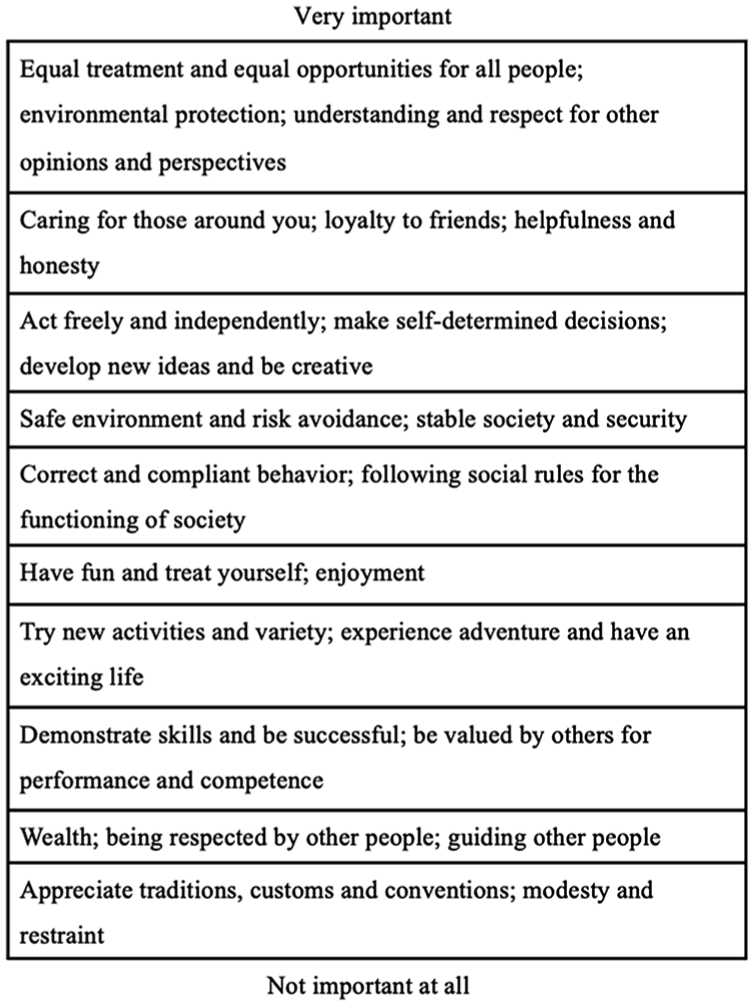
Example of Q-Sort (Translated to English).
Interviews were conducted either in person or via Zoom, using Google Jamboard to facilitate the Q-sort when online. Interview durations ranged from 42 to 103 min (⌀ 69 min). Interviews took place between April and October 2024. Data saturation was reached after 29 interviews (Edwards & Holland, 2013), but six more were conducted due to prior scheduling. To ensure anonymity, participants were assigned codes based on gender (F or M) and a sequential number.
Thematic analysis of interview transcripts was conducted using MAXQDA. Both deductive categories, informed by Raemy and Vos’s (2021) Negotiative theory, and inductive categories based on interviewee responses, were established to guide the analysis. For instance, the categories encompassed: Value combinations and interconnections, values and journalistic roles, deep acting strategy, surface acting strategy, formulation of conditions strategy, reformulation strategy, and practical realization of values.
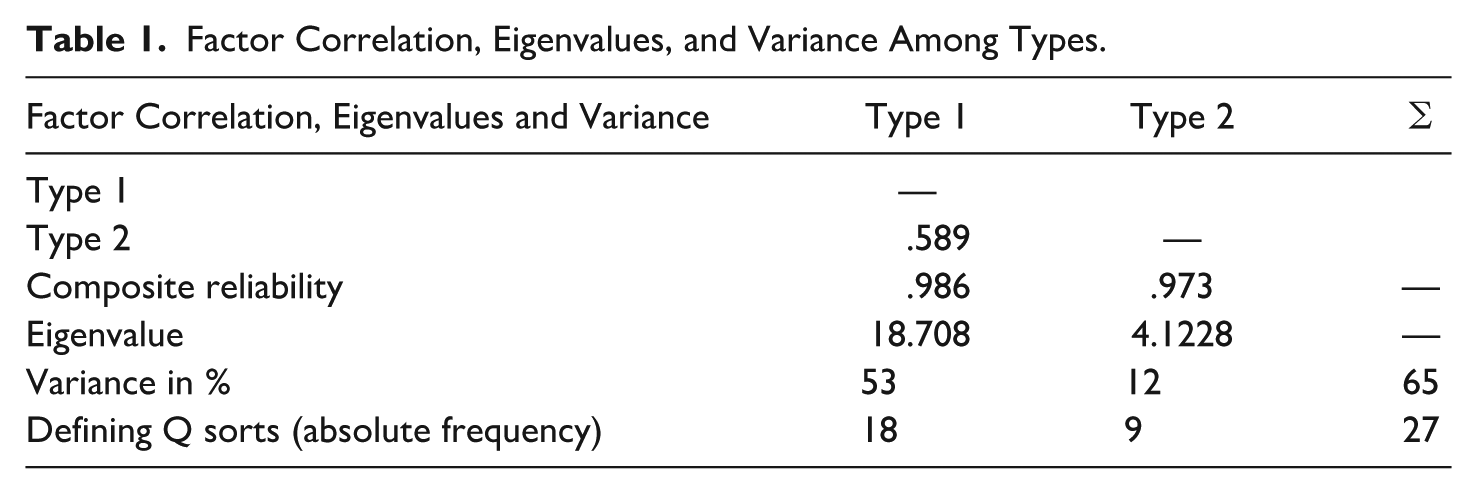
Quantitative analysis of the Q-sorts involved converting each participant’s ranking into numerical scores corresponding to the position of each value within the grid. These scores were then analyzed using centroid factor analysis followed by varimax rotation, conducted in KADE software. This procedure identified clusters of shared value orientations across participants. A two-factor solution proved to be most meaningful, with an accounted explained variance of 65% (Table 1). These results were integrated with the qualitative data to contextualize value orientations and uncover underlying rationales.
Factor Correlation, Eigenvalues, and Variance Among Types.
The study was approved by the institutional review board (IRB, #1066), and all participants were informed about the purpose and aims of the study prior to the interviews.
Results
This section begins by presenting the results of the Q-sort analysis, which reveal characteristic value patterns of Austrian journalists. It then introduces negotiation strategies, identified through thematic analysis, organized according to the distinction between terminal and instrumental values, reflecting their differing modes of negotiation (Rokeach, 1973). The strategies were identified through thematic analysis of interview data, emphasizing criteria such as prevalence, contextual stability, and thematic coherence (Naeem et al., 2023). This approach facilitates a nuanced understanding of how journalists actively engage with and reconcile their values as part of professional identity construction.
The term “strategies” is applied not because these responses are always consciously or formally planned, but because journalists describe them as adaptive approaches to perceived value conflicts (Springer & Rick, 2025). While some negotiation strategies are applied deliberately, others function as post-hoc rationalizations for navigating complex situations (Springer & Rick, 2025). In all cases, they serve to manage tensions, preserve professional integrity, and adapt to institutional demands.
Austrian Journalists’ Value Patterns
The Q-sort analysis revealed two distinct clusters of journalists based on their value prioritizations. The first group, referred to as “universalist-security-oriented journalists,” assigns particular importance to the values of security, conformity, and universalism, while considering stimulation, achievement, and power as less significant. This group represents journalists who prioritize universal and security-oriented values, emphasizing equality, and social responsibility. They favor stability over power and individual ambition.
The second group, themed “achievement and stimulation-oriented journalists,” prioritizes stimulation, achievement, and universalism while placing less emphasis on power, security, and conformity. This group is characterized by an openness to change, a strong orientation toward achievement, and a willingness to experiment. They value innovation and success, but tend to reject traditional structures and a security-focused mindset. Thus, while the first group is defined by a preference for stability, collectivism, and social responsibility, the second group is more change-oriented, individualistic, and receptive to new experiences and success.
Table 2 provides a more detailed summary of the Q-sort results.
Distinguishing Statements.
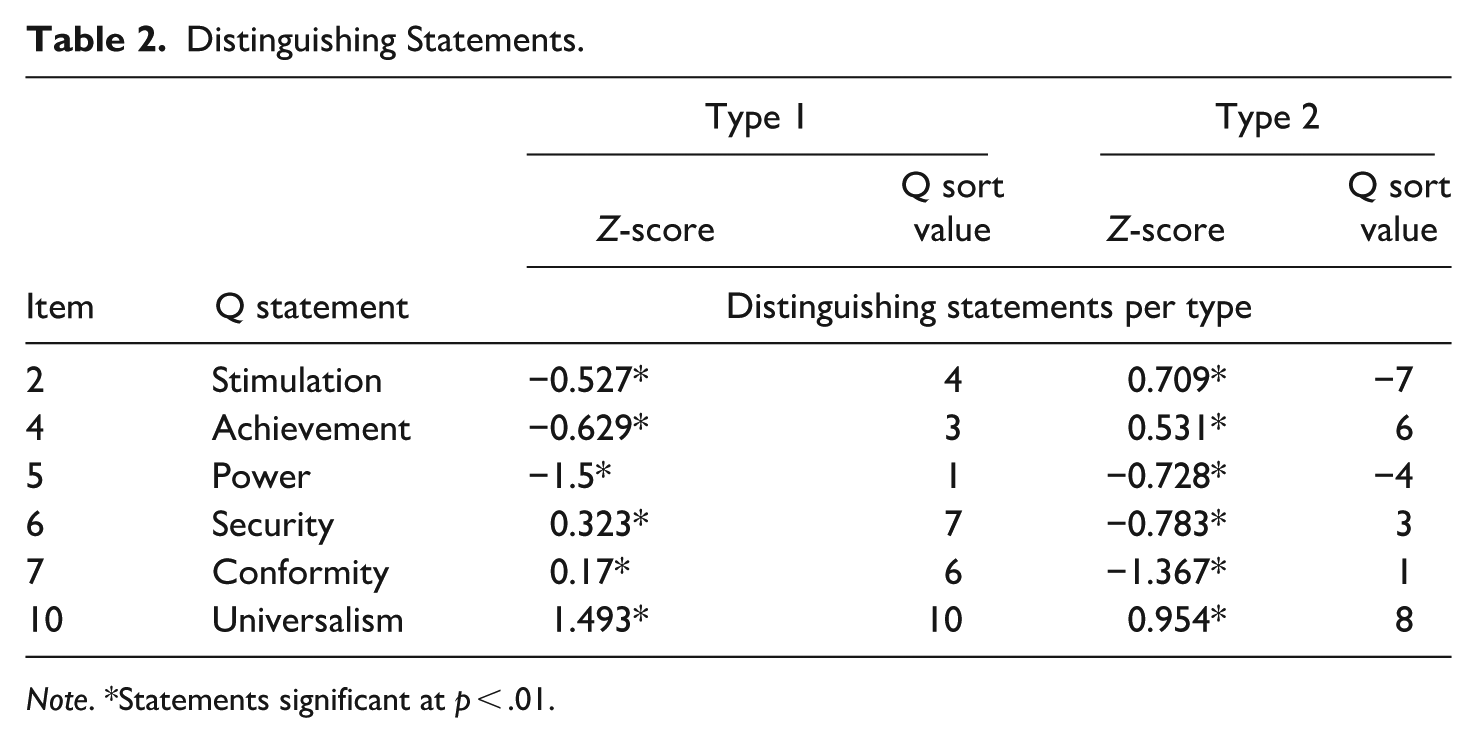
Note. *Statements significant at p < .01.
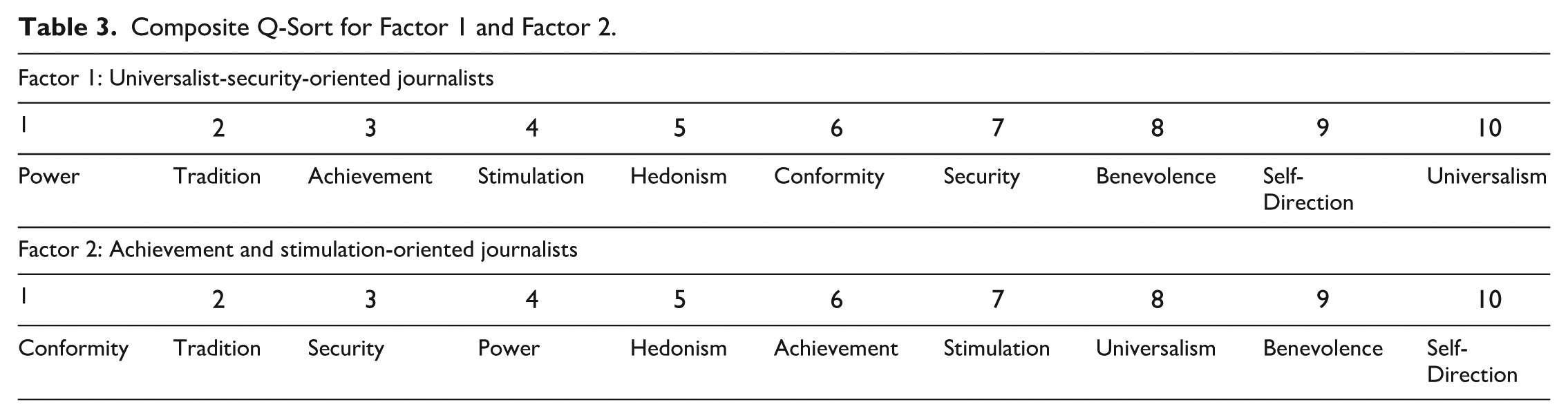
Despite their differences, the Q-sort revealed significant commonalities across the two groups. Journalists consistently ranked benevolence, universalism, and self-direction as highly relevant. Hedonism was assigned moderate importance, while tradition was generally regarded as unimportant. These shared tendencies suggest a professional culture grounded in social responsibility, moral concern for others, and openness. While journalists did not strongly endorse hedonism, they acknowledged it as a legitimate aspect of life. Their shared stance on tradition further indicates that traditional values are not endorsed.
The visualization of the composite Q-sort for the two factors, as presented in Table 3, further illustrates the presence of shared value orientations among the journalists.
Composite Q-Sort for Factor 1 and Factor 2.
The findings partially align with previous studies on value patterns in Austria. Journalists in this study demonstrated a strong social orientation, emphasizing values like universalism and benevolence, typically associated with collectivist societies (Somaraju, 2023). However, self-direction, another value deemed significant in this study, is commonly linked to individualistic Western societies (Schwartz, 2012). Notably, security was not a salient value for most participants, contrasting with broader Austrian societal trends, where it is typically prominent (ESS, 2021; Leite et al., 2021). In this study, only the “universalist-security-oriented group” considered security as important. This discrepancy could be attributed to the perceived instability of the journalistic profession itself (Ruggiero et al., 2022). The challenges of maintaining job security in an era of digital disruption, layoffs, and freelance work may make traditional security values less relevant for journalists, who prioritize flexibility and adaptability (Edstrom & Ladendorf, 2015; Springer & Rick, 2025). This indicates that occupational demands can mediate or override broader societal value patterns, underscoring the profession-specific expression of values. While certain patterns identified here resonate with general Austrian value orientations, the way these values are framed and prioritized in journalistic contexts appears to reflect distinct professional logics. Given methodological differences between our Q-sort approach and previous survey-based studies (ESS, 2021), direct comparisons are, however, limited.
The moderate endorsement of hedonism across both groups is also noteworthy. Although not a primary value, it was not dismissed, suggesting an underlying recognition of personal well-being and enjoyment as legitimate, albeit secondary, components of journalistic life. This reflects broader societal trends toward individualism and self-actualization (Inglehart, 1997).
The widespread rejection of tradition across both groups suggests evolving professional self-understandings, though this pattern is open to multiple interpretations. Traditional values such as respect for established hierarchies, routines, and practices are increasingly viewed with ambivalence or rejection, which could reflect broader transformations in journalistic practice and identity (Deuze, 2017). However, this pattern may also be shaped by the discursive valorization of innovation and change in contemporary newsrooms, where being adaptive has become a professional norm or even necessity (Perreault et al., 2025). This aligns with the growing rejection of traditional structures in many contemporary professions, as individuals seek more flexible and innovative work environments (Edstrom & Ladendorf, 2015). The increasing number of freelancers and independent journalists reflects this trend, with professionals who are more likely to prioritize innovation and change over security and tradition (Edstrom & Ladendorf, 2015).
In conclusion, the results of the Q-sort results suggest that journalists’ value orientations are shaped by a combination of personal preferences, occupational demands, and societal trends. While both groups share common values such as benevolence, self-direction, and universalism, the differences in their prioritization of values such as security, stimulation, and achievement underscore the tension between stability and change within the journalistic profession. Rather than illustrating a binary opposition, these variations reflect how journalists negotiate between institutional expectations and individual values in their orientation (Deuze, 2005). Both groups still operate within a shared professional culture that values autonomy and responsibility, even if they differ in how they realize these in practice.
Terminal Values as Long-Term Ideals
In the process of analyzing the value-sorting results, the focus will now shift toward the values that all journalists in this study identified as relevant (universalism, benevolence, and self-direction). These shared values serve as core ethical anchors and motivational drivers in journalistic work. This was confirmed in both the Q-sort and interviews, with interviewees emphasizing their lasting significance, offering two main justifications.
First, they regard these values as universal, enduring, and foundational to personal identity. For many journalists, these values are not confined to professional life, but are deeply embedded in their overall self-concept. This personal relevance minimizes the perceived tension between private values and institutional norms: “I sorted them [high] because I think they are the cornerstones of society and ideal values to always strive for” (m2). Thus, the significance of these values is rooted in their central relevance for both society and journalism: “I think every journalist would consider the values important because they simply form the basis for everything else. I would find it shocking if someone didn’t consider them important” (m14).
When asked whether he would sort the values differently for his professional life than for his private life, one journalist, for example, replied: “No, probably not. You can’t separate the two” (m8). Another journalist states: “Respecting other opinions and points of view is something that is actually a guiding principle of my work, but also of my general behavior” (f10).
This identity-level integration illustrates how personal values serve as stable anchors that inform both personal conduct and professional practice, thereby reducing potential conflict between these domains. For instance, values like self-direction are often tied to broader ideas of civic freedom: “For me, acting freely means that I can choose who I want, which is certainly different in other societies” (m1).
Second, journalists perceive these values as aligning with core institutional values and relate them to each other. For example, self-direction is equated with journalistic autonomy, which is viewed as essential to the journalistic profession: “It is important for journalism in general that you remain autonomous and independent of politics and business, because that is the basic requirement for journalism” (f5). Similarly, universalism is associated with objectivity, emphasizing equality and fairness: “For me, universalism is also a value that reminds me of objectivity, because it means that you report objectively, and that balance ensures equal opportunities” (m12). Benevolence, in turn, is described as guiding ethical responsibility toward audiences: “I see being benevolent as part of my duty, not just neutral reporting but caring about the impact on people” (m8).
These three core values can be understood as terminal values, desirable end states (Rokeach, 1973). Rather than functioning separately from professional ethics, they form the foundation upon which institutional values, such as objectivity, autonomy, and neutrality, are built. This relationship can be described as consecutive rather than dualistic, with personal values influencing the interpretation of institutional values. This integration reflects a broader pattern across interviews, where journalists describe their personal and institutional values as deeply intertwined: “My ability to choose and shape my work freely is essential. It’s where my personal values meet professional autonomy” (m1). Another noted the implicit acceptance of personal values within professional settings: “I don’t think it’s a problem to include them because I think everyone thinks they’re important anyway, so who would want to limit you in that respect?” (f14).
It is also important to acknowledge that the professional framing of the interview may have shaped how participants expressed their values. Many spoke primarily as journalists, which may have amplified the perceived overlap between universal and institutional values. Still, there was notable variation: most reflected strictly from a professional standpoint, while some openly blurred personal and professional boundaries. This variability mirrors the current realities of journalism, especially in precarious or hybrid work conditions (Springer & Rick, 2025), where identity and occupation are closely intertwined.
These patterns point to a journalistic culture in Austria where democratic values are seen not only as ideals but as shared norms (Hanitzsch & Vos, 2018; Riedl, 2019). This legitimizes the integration of personal values into professional life and fosters a sense of belonging. The findings align with previous studies suggesting that journalists in similar contexts adhere to shared ideals (Deuze, 2005; Koljonen, 2013). Ultimately, the analysis suggests that universal and institutional values are mutually reinforcing, complementing rather than competing with one another. Thereby, journalists draw on core personal values to give meaning to institutional values and professional standards.
Core Value Alignment as Negotiation: Deep Acting and Reinterpretation
In this section, it is analyzed how journalists negotiate values in their work. The journalists used two key strategies, deep acting and reformulation, to reconcile potential tensions between institutional expectations and personal terminal values.
Deep Acting: Emotional Alignment With Institutional Values
The first negotiation strategy, deep acting, involves consciously evoking emotions consistent with one’s self-image (Hochschild, 2012). This allows journalists to resolve the tension between professional objectivity and emotional investment, especially around values such as universalism and benevolence. Journalists who practice deep acting internalize values and experience their work as a genuine extension of their identity: “I feel that I can bring myself fully into the work and that it reflects me 100%. I always find myself in the texts, and that’s why I love the work so much” (f15). Here, universalism is not a detached norm but an affective guide, deeply integrated into the journalist’s sense of self. At the same time, these expressions of deep acting suggest that individual values may not inherently conflict with institutional expectations but can become aligned through emotional internalization. In such cases, the professional environment can affirm personal commitments, creating a sense of coherence between individual identity and journalistic practice (Koljonen, 2013).
Another example further shows how deep acting can mediate the tension between journalistic neutrality and benevolence, using emotional honesty as an intentional strategy for engagement:
When I report on social issues, it’s not just about facts or objectivity. I feel a real responsibility to convey the human impact, immerse myself in the story, and let empathy guide my coverage to inspire meaningful action. (m9)
Here, the journalist actively bridges the gap between institutional values, like objectivity and neutrality, and personal values, including benevolence, reframing professional standards through a subjective lens. This suggests that value alignment can emerge through interpretive flexibility, where individuals reinterpret institutional demands in ways that resonate with their personal value compass (Raemy et al., 2024).
Journalists noted that this emotional and value-based alignment contributes significantly to job satisfaction and long-term professional engagement: “I think it’s important that you can also contribute and do things that are important to you. If I couldn’t do that, I would have left the job long ago” (f5). This quote also highlights how sustained alignment between institutional values and individual motivations plays a crucial role in professional retention and identity formation. When institutions provide space for emotional alignment, deep acting becomes not only a coping strategy but a foundation for meaningful, value-congruent work (Raemy & Vos, 2021).
Reformulation: Reframing Institutional Expectations
The second negotiation strategy is reformulation, in which journalists reinterpret institutional expectations to align with their core values. This helps resolve tensions between professional roles and personal values. One journalist explains: “I see myself as a watchdog, but it’s not just about exposing wrongdoing. It’s also about making complex issues understandable so people can think critically” (m12). This illustrates how the traditional watchdog role is reframed as educational and transparent communication. The journalist transforms a potentially narrow institutional role into a broader, value-consistent function. Another journalist reformulates the expectation for objectivity to include normative commitments, thus integrating institutional values with personal convictions: “You are also expected to report responsibly, and that also means not only remaining neutral and objective but taking into account values such as benevolence and universalism” (m14).
These examples illustrate how journalists actively navigate the space between institutional mandates and personal commitments by strategically reinterpreting institutional values and norms. Rather than rejecting institutional expectations, they reshape them in ways that allow for value alignment, revealing a dynamic process of negotiation and adaptation.
This strategy underscores the mutual constitution of personal and institutional values: institutional roles provide the framework within which personal values are expressed (Deuze, 2005; Holton et al., 2013), while journalists’ value orientations, in turn, influence how these roles are understood. This highlights that journalists interpret professional roles through their personal values, sometimes redefining conventional expectations (Hanitzsch & Vos, 2017), highlighting the mutual influence between personal belief systems and professional conduct.
These terminal universal values motivate journalists and reflect a collective professional ideology, where journalism is understood not only as a job but as a moral and civic vocation (Hanitzsch & Vos, 2017). In this context, journalists employ negotiation strategies, such as deep acting and reformulation, not just as coping mechanisms but as ways of preserving identity coherence. The findings support the view that value negotiation is not purely reactive but an integral part of journalistic identity work (Bhalla & Kang, 2020; Raemy et al., 2024; Smeenk et al., 2023).
Instrumental, Dynamic Values
While there was consensus on certain values, particularly the three terminal values discussed in the previous chapter, greater variation emerges in the prioritization of other values, as previously indicated in the context of the Q-sorting. These values, such as stimulation, power, conformity, and tradition, were described as context-dependent and fluid and can be conceptualized as instrumental values. Rather than irrelevant, these values were framed as means to uphold terminal values (Rokeach, 1973).
In journalism, where personal beliefs often intersect with institutional demands (Belair-Gagnon et al., 2024), instrumental values function as adaptive mechanisms, enabling journalists to maintain alignment with core commitments in shifting environments. Based on interview data, three primary strategies emerged for managing value tensions: surface acting, formulating conditions, and interpersonal communication. These strategies reflect pragmatic reasoning to negotiate value conflicts while remaining aligned with overarching institutional values. In this way, instrumental values are not marginal, but integral to how journalists navigate the complex demands of their work.
Each of these strategies that will be discussed in the following chapters addresses specific value tensions and reflects varying levels of agency and adaptability.
Surface Acting: Navigating Professional Expectations Versus Personal Disinterest
The strategy of surface acting emerged when journalists performed alignment with certain values without genuinely internalizing them. This strategy is most often described retrospectively by the interviewees, often to meet editorial expectations or audience demand. It reflects a tension between personal disinterest and professional obligation, often framed as a conflict between neutrality and authenticity: “Reporting on assigned topics is part of the job. I’ve covered religion, even though I’m not religious or personally interested, because it matters to our regional audience” (F1). Here, religion is not treated as a personally meaningful value, but as a performative responsibility to fulfill institutional values of relevance and inclusiveness.
Similarly, another journalist described the need to embody stimulation despite a preference for stability and depth: “I prefer in-depth research and don’t feel the need to constantly engage with new issues. However, it’s part of the business to always be working on new topics” (M11).
In both examples, journalists sometimes adopt surface acting as a strategy to navigate value misalignments where institutional demands diverge from personal convictions. This reflects pragmatic accommodation to organizational routines and audience expectations, where personal authenticity is temporarily set aside to uphold professional obligations. While this may lead to emotional dissonance or reduced job satisfaction, it maintains organizational coherence and audience relevance.
Recent research further contextualizes these tensions by showing that journalists do not maintain a uniform relationship with a singular audience (Loosen et al., 2025). Instead, they navigate multiple sub-relationships with different audience segments, each varying in emotional intensity, communicative engagement, and normative framing. Some are rooted in professional detachment, others in affective labor and interaction (Loosen et al., 2025). This insight complements the findings of this study by highlighting surface acting as a relational strategy, one that enables journalists to manage conflicting audience expectations across diverse contexts. The emotional dissonance described by interviewees thus reflects not only value misalignment, but also the challenges of navigating a repertoire of audience sub-relationships, each with its implicit demands.
While surface acting often reflects internal compromises, the following strategy involves a more conscious and conditional approach to value alignment.
Formulating Conditions: Reconciling Universal Commitments With Contextual Relevance
Journalists face a tension between their core terminal values and the instrumental values that often shape professional and organizational demands. To navigate this tension, they reflectively employ a strategy of formulating conditions, selectively accepting instrumental values only when these values align with or support their terminal commitments. This conditional acceptance allows them to uphold their core principles while pragmatically engaging with situational constraints.
One journalist, for instance, selectively emphasizes the aspect of humility in the value of tradition, an interpretation that aligns it also with universalism: “Modesty is a virtue and also somehow ensures tolerance and equality if you take a step back, but I cannot relate to customs and traditions” (M9).
Other interviewees show conditional acceptance: “Following social rules is important for society, but it depends on what the rules are and who establishes them. These rules should be scrutinized regularly, especially if they restrict freedoms” (M4). Another journalists says, “Normally, I don’t attribute great significance to power per se, but in my role as a manager, I have come to recognize its advantage in promoting topics I consider important, like social issues” (F14). These statements reflect a protective stance, where instrumental values are filtered through terminal commitments. The value of power, in particular, becomes instrumentalized for benevolent ends, suggesting a managerial redefinition of authority not as domination but as facilitation of prosocial goals. Conformity is tolerated only if it does not threaten the institutional value of autonomy.
These findings underscore the complex interplay between personal values and institutional frameworks: journalists actively negotiate their personal commitments in relation to organizational norms, shaping context-dependent value alignments that allow for professional functionality. Moreover, these examples highlight the dual aim of this strategy: avoiding personal value compromise while fulfilling institutional responsibilities. This may point to a broader trend of discursive innovation in newsrooms, though more data would be needed to substantiate this. Compared to the more reflective stance of formulating conditions, the next strategy focuses on collaboration and relational negotiation.
Interpersonal Communication: Balancing Autonomy and Organizational Flexibility
The third strategy employed by journalists is interpersonal communication, wherein discussions with colleagues and editors serve as a medium for integrating values into journalistic work. Compared to surface acting, this approach is more often described as deliberate and proactive, emphasizing autonomy and relational agency. This strategy is used when institutional expectations clash with personal values, but the organizational culture allows for collaborative problem-solving. The central tension here is between individual autonomy and institutional routines, moderated by workplace relationships:
I talk to my editor to find a balance between reporting on critical issues and working on pieces that I find creatively fulfilling. Enjoying my work is essential to staying motivated, allowing me to balance fun with professional responsibility. (F2)
These interactions allow journalists to align personal values with professional expectations. In some cases, this takes the form of delegation: “I can’t relate to religious topics. I sometimes prefer to leave that to a colleague because she is also very involved with the church privately and is just better at it” (M6). This can be read as an instance of value misalignment, specifically a lack of identification with traditional or religious topics, which the journalist does not perceive as meaningful or personally relevant. Here, delegation serves both personal distancing and quality assurance, framed as a practical, team-based solution to value misalignment: “I have the privilege of being able to communicate such matters because we have a supportive team dynamic. However, not everyone can make such a claim” (F6).
Importantly, this strategy illustrates how interpersonal communication acts as a critical mechanism through which individual and institutional values are reconciled in practice. The organizational environment’s flexibility or rigidity shapes the extent to which journalists can assert personal values while meeting professional expectations, highlighting that value negotiation is not solely an individual endeavor but is deeply embedded in structural contexts.
Where such communication is not viable, journalists resort to more individualized strategies: “Sometimes negotiation is simply not possible, and one must accept the guidelines and fulfill assigned responsibilities” (M16). This illustrates how interpersonal communication is contingent on structural affordances. When absent, more passive strategies like surface acting become necessary.
Overall, instrumental values emerge as situational and flexible, subject to negotiation based on contextual relevance. Journalists acknowledge that integrating these values into their work is an occupational necessity rather than a personal commitment. As one journalist expressed, “It is simply part of the job to cover topics that may not be personally fulfilling” (F18). This observation underscores that journalists generally regard instrumental values as less significant for active integration into their work and instead approach them as negotiable elements that mediate the intersection between professional obligations and personal values (Hanitzsch & Vos, 2017).
These findings reveal a nuanced understanding of how journalists negotiate conflicting institutional and personal values, particularly in emotionally complex reporting contexts. While previous research has identified the existence of such conflicts (Hanitzsch & Vos, 2017; Raemy & Vos, 2021; Springer & Rick, 2025), this study reveals the practical strategies journalists use to navigate them. Surface acting represents retrospective adaptation when professional duties override personal identification. Formulating conditions blends reflective distancing with value reframing, often to preserve ethical consistency. Interpersonal communication emerges as the most proactive strategy, enabling journalists to balance autonomy with collaboration (Koljonen, 2013; Raemy & Vos, 2021). Furthermore, the way these strategies are employed varies with professional role. For example, editors reframe power as a moral resource, suggesting that value flexibility is shaped not only individually, but also by newsroom hierarchies, job functions, and accumulated experience (Raemy et al., 2024).
This strategic use of values raises important normative questions. Particularly, the risk that value flexibility could slide into relativism if not critically examined (Raemy et al., 2024). At the same time, it appears essential for maintaining emotional resilience and professional adaptability in complex reporting environments. These findings underline the importance of organizational cultures that legitimize open reflection and value pluralism within journalistic work (Hochschild, 2012; Waisbord, 2013).
Conclusion
This study aimed to attain a deeper understanding of the value systems of Austrian journalists, and how these values are interpreted and negotiated. Using Q-methodology and in-depth interviews, two distinct value orientations emerged: one favoring stability, collectivism, and social responsibility, and another leaning toward change, individualism, and openness. Despite these differences, both groups share a commitment to values like universalism, self-direction, and benevolence, which were closely linked to their personal identity and professional ethos. These terminal values function as enduring ideals, justifying the relevance of core institutional values like autonomy and objectivity.
Instrumental values, in contrast, were more fluid, serving to support overarching ideals rather than acting as fixed standards. Journalists described a variety of negotiation strategies to reconcile institutional expectations with personal values, including deep acting, surface acting, interpersonal communication, and formulating conditions (Hochschild, 2012; Raemy & Vos, 2021). These strategies reflect deliberate efforts by journalists to align their professional conduct with internalized values, often navigating tensions between authenticity, institutional demands, and role expectations (Bhalla & Kang, 2020).
While these strategies align with Raemy and Vos’ (2021) framework, this study adds specificity by distinguishing the nature of formulating conditions. In particular, the differentiation between selective emphasis and conditional acceptance reflects nuanced strategies for reconciling personal and professional values. Previous research (Raemy & Vos, 2021; Thomson, 2021) identified surface acting in other settings; this study confirms its role in aligning instrumental with terminal values, highlighting journalists’ thoughtful engagement with their professional ethos.
Ultimately, this research underscores that journalists actively interpret and internalize personal and professional values, rather than adopting them passively. The analysis of value patterns and negotiation practices offers a comprehensive understanding of how Austrian journalists prioritize and balance these values in real-world contexts. This study thereby facilitates the categorization of fundamental values that shape journalistic identities and culture in Austria (Raemy et al., 2024).
By showing how universal values such as self-direction and benevolence guide decision-making, depending on their personal significance and the professional context, the findings offer insight into the discrepancy between normative journalistic ideals and actual practices (Raemy & Vos, 2021). Rather than applying values rigidly, journalists navigate them fluidly in response to institutional pressures, editorial expectations, and personal convictions. While this study did not explicitly examine journalistic roles, the observed value negotiations support existing research showing that journalistic conduct is shaped by context-sensitive, flexible value hierarchies rather than fixed norms (Raemy & Vos, 2021; Raemy et al., 2024). This reinforces the idea that journalistic roles are not rigidly applied but are interpreted and adapted based on situational demands. From a social psychological perspective, the findings further highlight how values function as dynamic resources in professional decision-making, used flexibly to justify actions rather than followed as static principles. This underscores the importance of studying values in situations where competing demands reveal their practical, negotiated character (Frey et al., 2017). By integrating Schwartz’s value theory with Q-methodology and qualitative interviews, this study demonstrates how social psychological approaches can uncover underlying value hierarchies and conflicts that traditional survey methods may overlook (Schwartz, 2012). This interdisciplinary design enriches both journalism studies and broader research on professional values (Bhalla & Kang, 2020; Deuze, 2005).
This study also faced several limitations. First, adapting Schwartz’s (1994) 56-item framework (Schultz et al., 2005) to a 10-value Q-sort enabled depth of discussion but limited the range of values explored. This trade-off prioritized subjective meaning-making over quantitative comparability. Second, while efforts were made to ensure participant diversity, the findings cannot be generalized to the broader population of Austrian journalists. The goal, however, was interpretive depth, not statistical generalizability. Future research should examine these value patterns and negotiation strategies on a larger scale to enable a more systematic understanding of the subject. Third, although the study illuminated how journalists negotiate values under external constraints, it did not examine intra-value tensions in depth. While participants acknowledged the importance of the values discussed, their prioritization reflected individual value systems rather than direct value conflicts. As such, detailed analysis of internal value contradictions remains a task for future research.
Footnotes
Acknowledgements
I would like to thank Bernadette Uth (University of Vienna) for her constructive feedback on an earlier version of this manuscript and her helpful suggestions that contributed to the improvement of this paper.
Ethical Approval
The ethical and data protection aspects of the study were reviewed in advance by the institutional Research Board (IRB) of the University of Vienna.
Declaration of Conflicting Interests
The author declared no potential conflicts of interest with respect to the research, authorship, and/or publication of this article.
Funding
The author received no financial support for the research, authorship, and/or publication of this article.
