




Abstract
The emergence of authoritarian attitudes within contemporary democracy puzzles researchers. Under what circumstances do people develop authoritarian attitudes? Research suggests that circumstances of social disturbance have strong impact. There is evidence that predispositions for authoritarianism are activated under such circumstances. In this research, the role of the news media is generally ignored. This article contributes by presenting a theoretically grounded experimental study addressing hypotheses of news framing effects on authoritarian attitudes. Two panel experiments, on news about disturbance in school and public libraries, provide evidence of main effects of amplified framings of social disturbance, as well as an activation mechanism.
The emergence of authoritarianism within contemporary Western democracies puzzles researchers and worries those who trust the values of liberal democracy (Norris & Inglehart, 2019). Across Europe and the United States, far-right authoritarian political actors have successfully transformed the political landscape and received strong support in the electorate (Mudde, 2017, 2019). This has spurred extensive journalism research, basically aimed at explaining the roles of news journalism in this general development (Carlson et al., 2021; De Jonge, 2019; Hameleers et al., 2019). However, a critical question has so far been largely neglected: What is the impact of the news media on citizens’ propensity to hold authoritarian attitudes on social and political issues? In this study, we fill this gap by presenting two experimental studies of news framing effects on authoritarian attitudes.
The relations between far-right authoritarian politics and news journalism have been studied focusing on several aspects. This includes the diverse approaches to, and framing of, authoritarian populist parties in the news reporting (Akkerman, 2011; Araújo & Prior, 2021; De Jonge, 2019); how news media contributes to the dissemination and normalization of authoritarian politics (Ekström et al., 2020; Ellinas, 2018); how political provocations and media savvy strategies of far right actors challenge the roles and legitimacy of journalism (Carlson et al., 2021; Hafez, 2019; Van Dalen, 2019; Wodak et al., 2021); how populist discourses are invoked by the media, in the practices of journalism and the framing of news, also referred to as media populism (Esser et al., 2016; Hameleers et al., 2019; Krämer, 2014; Thornborrow et al., 2021).
Yet, this research leaves a central question unanswered: What causes people to adopt authoritarian attitudes, and ultimately being prepared to support authoritarian policies and parties? Given the theory and empirical evidence from two established research fields—the political psychology on authoritarianism and the research on news framing effects—we can assume a significant role of news journalism in this context.
A general argument in the long-standing and vigorous literature in political (social) psychology suggests that circumstances of social disturbance, instability, and crisis (also defined as social threat) have a strong impact on authoritarian attitudes (Duckitt, 2015; Feldman, 2020; Feldman & Stenner, 1997; Fromm, 1973/1990; Glassen & McLaren, 2021; Jost et al., 2003; Jugert & Duckitt, 2009; Stenner, 2005). As Duckitt (2013, p. 2) notes, there is substantial evidence that situations of social threat “cause individuals to adopt higher levels of authoritarian attitudes” (a main effects model), and that such situations tend to activate people’s varying predispositions for authoritarianism, in the form of deep-rooted values (an activation model; Feldman, 2003; Stenner, 2005). In this research, identifying social disturbance as a critical factor, the role of the media is however generally overlooked. We believe this is a significant limitation. The importance of news media in the framing of social disturbance, crisis, and threat is well established (Altheide, 2002; Kopytowska & Chilton, 2018; Kovar, 2020; Patrona, 2018), as is the tendency of the news to prioritize and amplify crisis-related, negative, and extraordinary events, assuming that such news events are particularly newsworthy (Bednarek & Caple, 2014; Hase et al., 2020). Moreover, research on news framing effects demonstrates the importance of news media in shaping people’s attitudes on social and political issues (Lecheler & De Vreese, 2018; McCombs, 2014). We study the effects of amplified framings of social disturbance, referring to news in which disturbances are represented as alarming and indications of a general development threatening the social and normative order in areas of society (more details below).
This study has two aims. First, in bringing together the political psychology on authoritarianism and the theory on news framing effects (as far as we know for the first time), the aim is to propose a new research agenda in the study of news journalism and the dynamics of authoritarianism. Our second aim is to test hypotheses of the impact of amplified news framing of social disturbance on authoritarian attitudes, addressing both main effects and the activation mechanism identified in the literature (Duckitt, 2013; Feldman, 2003; Stenner, 2005).
The empirical study, conducted in Sweden, is designed as a survey experiment with random assignments into treatment and control groups. The stimuli consist of news produced by a professional journalist. The study includes two experiments focusing on news on social disturbance in (a) primary school and (b) public libraries.
Theoretical Approach and Related Previous Research
The Concept of Authoritarianism and the Distinction Between Enduring Values and Attitudes
Theories of authoritarianism have been used to explain social and political attitudes in extensive research dating back to the seminal study of Adorno et al. (1950/2019) on the authoritarian personality and further developed in contemporary political and social psychology. Scholars have largely agreed on the core components of authoritarianism, although the theoretical foundations have been debated. The idea of an authoritarian personality has been criticized, arguing that authoritarianism is more properly conceptualized as enduring values or beliefs (Duckitt, 2015; Feldman, 2003, 2020). A core of authoritarianism is the belief in a strictly morally ordered society and commitments to uniform norms, traditions, and authorities. More specifically, three components of authoritarianism are identified: Conformism, authoritarian submission, and authoritarian aggression (Duckitt, 2015; Feldman, 2003; Norris & Inglehart, 2019, p. 7). Conformism refers to a belief in a rigid adherence to socio-cultural norms and conventions and a related intolerance of difference (progressive identities and lifestyles) and resistance to radical change. Submission refers to the belief in loyalty, obedience, and respect for authority. Social cohesion and moral order in society is assumed to be dependent on submission and determination of authorities (parents, teachers, political leaders). Finally, authoritarian aggression refers to the belief in harsh measures and punishment as treatment of those who disobey. Forceful action is a primary way to teach individuals to follow the rules and laws and to prevent disturbance and insecurity in society. The three components form the basis of Altemeyer’s (1981) influential conceptualization and operationalization of the Right-Wing Authoritarian (RWA) scale, which has since been frequently used, even in slightly revised forms (Bizumic & Duckitt, 2018; Duckitt, 2015; Onraet et al., 2014; Richey, 2012).
Following a well-established conceptualization (Arikan & Sekercioglu, 2019; Feldman, 2003; Stenner, 2005), we understand these values as authoritarian predispositions that tend to influence people’s interpretations of events and attitudes on various social and political issues. Research shows that authoritarianism tends to predict a range of attitudes and opinions: intolerance of ethnic minorities, negative attitudes toward gay rights and abortion rights, and opinions in support for tougher punishment and strict social control (Bizumic & Duckitt, 2018; Feldman & Stenner, 1997; Jost et al., 2003; Richey, 2012; Stenner, 2005). These are attitudes that can be defined as authoritarian attitudes. We thus refer to authoritarian predispositions, in the form of values, and authoritarian attitudes as different entities. Values are enduring priorities that guide individuals’ evaluations of, and attitudes toward, various events, topics, and issues. Attitudes and opinions are more easily shifting and connected to the specific objects (Norris & Inglehart, 2019, p. 35; Schwartz, 2012). Notably, this distinction was implied in the attempt by Adorno and colleagues (1950/2019) to explain political opinions in fascism with reference to pre-political personality traits, as well as in the seminal study by Fromm (1941/2011) of the authoritarian character.
When testing hypotheses about causal relationships between predispositions and attitudes, it is of course decisive to maintain this conceptual distinction in empirical indicators. Flaws on this point constitute a major criticism of Adorno and colleagues’ F-scale. As Feldman and Stenner (1997, p. 747) note, the F-scale measures include “items that are often uncomfortably close to the consequences of authoritarianism that we are interested in explaining.” In this study, we avoid conflations by measuring predispositions using three established scales on the central conformity/autonomy dimension on authoritarian/liberal values (Feldman, 2003; Feldman and Stenner, 1997; Schwartz, 2012; Stenner, 2005). We draw on previous research providing substantial evidence of authoritarianism as a dimension on human values, in contrast to liberal values (Feldman, 2020; Norris & Inglehart, 2019). The values of conformity and related submission are in contrast to personal autonomy and social cultural diversity. Distinct from values, we define and measure authoritarian attitudes as attitudes of intolerance and support for harsher punishments in concrete social and political issues (see the section on method).
Authoritarian Attitudes in Response to Social Disturbance and Social Threat
Extensive literature suggests that circumstances of social disturbance, instability, insecurity, and crisis have a particular power to evoke and increase authoritarian attitudes and opinions in society (Duckitt, 2013; Feldman & Stenner, 1997; Jost et al., 2003; Jugert & Duckitt, 2009). In the work by Adorno et al (1950/2019) and Fromm (1941/2011, 1973/1990), authoritarianism was theorized as a response and defense mechanism to social insecurity and an “uncertain world” (Feldman & Stenner, 1997, p. 741). Recent studies recognize the impact of various circumstances of threat—threat to social norms and authorities, financial distress, threat to safety and security—related to particular events (such as terror attacks), as well as long-term societal changes in rising crime rates, terrorism, political turmoil, economic crisis, and immigration (Arikan & Sekercioglu, 2019; Feldman & Stenner, 1997; Hetherington & Suhay, 2011; Onraet et al., 2014; Richey, 2012; Stenner, 2005).
As Duckitt (2013, p. 2) summarizes, “it is now widely accepted that authoritarian attitudes and behaviors seem to be powerfully influenced by threat.” Notably, threat here primarily refers to external social factors, conceptualized as social threat (see also the study by Duckitt, 2015, p. 1). However, as indicated earlier, social threat may imply different realities. While the overall theory holds that social threat increases authoritarian attitudes, the analyses of actual mechanisms require us to specify the type of social threat assumed to matter (Duckitt 2013, p. 2; Stenner, 2005).
In this study, we focus on social disturbance, and we define this type of social threat in two dimensions. First, social disturbance here refers to situations where individuals or groups seriously disrupt the order in social and public settings by misbehaving, disobeying, and violating social rules and norms—distinct from threats of violent crime, terrorism, and other dramatic events (Bonanno & Jost, 2006; Hetherington & Suhay, 2011). The study is thus designed to examine effects of news framing of more ordinary forms of social disturbances (see the section on the news events below), suggesting that the activation of authoritarianism is not restricted to peoples’ responses to extraordinary threatening events (such as terrorism) or the issues typically associated with the agenda of far-right authoritarian politics (such as immigration and crime). Second, we define social disturbance as actual forms of threat to rules and norms in society. In the research on authoritarianism, perceived threat is frequently used as an indicator of external threat. Perceived threat includes, for example, individuals’ general experiences of the social world and changes in society, as well as worries about concrete threats in everyday life (Jost et al., 2003; Onraet et al., 2014). We however consider these concepts as referring to different realities, suggesting that authoritarian attitudes can be triggered (independently) by people’s information about actual situations of social disturbance, as well as people’s perceptions of general threats or concrete worries. Given the theory of the dynamics of authoritarianism (Feldman, 2020; Stenner, 2005), further described in the next section, we argue that authoritarian responses to information about social disturbance and the related violation of norms and disobedience in society is a mechanism quite different from an authoritarian “flight into security” (Oesterreich, 2005) in responses to worries about a dangerous world or threats to one’s personal security.
The Dynamics of Authoritarianism: Activation of Predispositions
Theories suggest that authoritarian attitudes are most powerfully explained by reference to interactions between people’s predispositions and social circumstances (Adorno et al., 1950/2019; Duckitt, 2013). More precisely, activation is recognized as a key mechanism referring to how authoritarian predispositions are triggered and brought to the fore in people’s opinions in circumstances of social disturbance. The theory of activation is most explicitly formulated by Stenner (2005) and Feldman (2003, 2020); see also the study by Feldman & Stenner (1997). Stenner (2005, p. 8) describes the dynamic of authoritarianism as a “general mechanism” where particular predispositions respond to changing social conditions. This dynamic, Stenner argues, accounts for a significant part of the variation in people’s attitudes regarding, for example, intolerance of ethnic and sexual minorities. Stenner (2005, p. 17) presents the concept of “normative threat” to explain how disruptions of traditional norms and values, and questionings of authorities in society, constitute a threat to group values, threat to us and “who ‘we’ are and what ‘we’ believe in,” of particular importance to people with authoritarian predispositions (beliefs in conformism, obedience, and respect for authorities). Referring to several empirical studies, Stenner (2005, p. 31) concludes that such normative threat (rather than personal threat regarding, e.g., financial difficulties) has a potential to “dramatically magnify the impact of predispositions” on manifested attitudes. Correspondingly, Feldman (2020) argues that people with an authoritarian predisposition, who value conformity rather than autonomy, are likely to become intolerant to situations of social disturbance and to people who deviate from social and cultural conventions or challenge traditional values in society.
Following these theories, we understand social disturbance as a catalyst potentially activating enduring predispositions for authoritarian attitudes. More precisely, we suggest that situations of disturbance in society trigger authoritarian responses particularly among people who value conformity, obedience, and submission to authorities. However, while these theories in political psychology essentially conceptualize the social circumstances as non-mediated (exogenous) factors, we argue that the framing of issues in the news media is critical to the constructions and the public information of social disturbance with implications for the activation of authoritarianism. In the next section, we develop this theoretical argument.
News Framing Effects on Authoritarian Attitudes
This study applies framing theory to account for the role of news media in reporting on social disturbances with potential impact on peoples’ authoritarian attitudes. The theoretical approach identifies the news media’s construction of an issue—what the issue is basically about, the seriousness of problems, causes, and moral responsibilities—as critical to how citizens interpret an issue and the attitudes they adopt. This constructivist approach thus challenge the understanding of social disturbance as entirely exogenous realities, that exist independently of their representations in the media. This is, of course, not to suggest that the social circumstances do not exist outside the media. However, the social disturbances accounted for in theories of authoritarianism are socially constituted phenomena, framed and disseminated not least in the news media. While previous research has explained authoritarian attitudes with references to actual changes in society over time or variations in individuals’ perceptions of threats (e.g., Hetherington & Suhay, 2011; Onraet et al., 2014; Stenner, 2005), this theory thus adds an explanation of attitudes by variations in news framing of social circumstances. More precisely, we suggest that amplifications of social disturbance (definition below) in the framing of news events on various disruptive behaviors and violation of norms in society make people (audiences) more prone to adopt and hold authoritarian attitudes. We thereby consider the fact that people’s knowledge of such events, and in particular those events of which they have no direct experiences, is essentially dependent on information produced and disseminated in the media.
The theory of news framing effects relies on a combination of a constructivist approach on news and the psychological mechanisms that operate during news exposure (Chong & Druckman, 2007; Entman, 1993; Lecheler & De Vreese, 2018; Van Gorp, 2007). In the framing of news, journalists select a particular way of representing and understanding an issue, available in the “cultural stock of frames” (Van Gorp, 2007, p. 62). Frames are part of a culture of meanings: interpretations and explanations (more or less) available to journalists as well as their audiences in a given society. Frames promoted in news stories are supposed to provide guidance for readers on how a particular issue should be thought about (Lecheler & De Vreese, 2018; Van Gorp, 2007).
Framing effects theory further suggests consideration applicability as a critical psychological mechanism (Chong & Druckman, 2007; Nelson et al., 1997; Scheufele & Tewksbury, 2007). The theory is highly relevant to the study of activation of authoritarianism as it serves to explain how framing effects are conditioned by authoritarian predispositions. Hence, framing effects are most likely generated when considerations are not only available among news consumers but also considered applicable to a given situation—which is a matter of resonance (or match) between a news frame and individuals’ predispositions. People are thus more or less susceptible to specific news frames based on their predispositions in terms of already available beliefs and values (Chong & Druckman, 2007). In essence, the integration of the theories on authoritarianism and framing effects suggests the following mechanism: Authoritarian predispositions (values) are activated when people are exposed to amplified news framing of social disturbance, rendering authoritarian considerations and attitudes of intolerance and support for harsh measures and punishments applicable.
The News Events: Examples of Social Disturbance
We study news framing effects on authoritarian attitudes focusing on the framing of social disturbance in the context of two current news events in Sweden: (a) disturbance in primary schools related to reports on unruly students and disturbance during lessons and (b) disturbance in public libraries and reports on experiences of social anxiety in public libraries and the introduction of a new law allowing libraries to ban visitors from entering. Taking the theories on authoritarianism into consideration (Duckitt, 2013; Feldman, 2003, 2020; Stenner, 2005), the two are selected to represent examples of social circumstances where social orders are disrupted in violation of rules and norms and due to resistance to authorities. In the two survey experiments conducted, we investigate the effects of exposure to amplified versus mitigated framings of the social disturbance in the two news issues (for definitions, see sections on methods and stimuli below).
The study is designed to investigate effects of news reporting. While the very few previous experimental studies relating authoritarianism to news have constructed completely fictious news stories as stimuli (Stenner, 2005, p. 45), we therefore use authentic news stories. Respondents were exposed to news, in web radio (audio) format, produced by a professional journalist and with real news as a template (see the section of stimuli and Appendix). To increase external validity and realism, the amplified and mitigated framings of social disturbance in the stimuli are constructed in ways that are likely to be applied in news journalism, making the study relevant to journalistic practices as well. Hence, we selected the news events on circumstances in school and public libraries to meet a basic requirement; the diversity of amplified and mitigated framings of social disturbance should manifest in actual news reporting on the issues.
Hypotheses
A fundamental question in research on authoritarianism concerns the circumstances under which individuals develop authoritarian attitudes. Drawing on extensive research arguing for the importance of circumstances of social disturbance, instability, and insecurity (also referred to as social threat), this study applies a news-framing effects approach and investigates the impact of amplified news framings of social disturbance on peoples’ propensity to hold authoritarian attitudes. As Duckitt (2013, p. 2) concludes, two issues remain to be explored with respect to the nature of the well-established relationship between the circumstance of social threat and authoritarianism. One issue concerns what types of social threat are involved in shaping authoritarian attitudes. We contribute by focusing on the news framing of rather ordinary forms of social disturbance and violation of norms in social and public settings.
The second issue concerns how such social circumstances generate authoritarian attitudes. Duckitt (2013) notes two main approaches to this question (see also our overview above): a main effects model (e.g., Onraet et al., 2014) and an activation model (developed primarily by Feldman and Stenner, 1997; Feldman, 2003; Stenner, 2005). Our hypotheses are divided into two main parts to address these two models. First, we investigate the main effects of news framing of social disturbance on authoritarian attitudes (H1). Second, following the theory of the authoritarian dynamic, we perform a critical test of the amplified news framing as an activator of authoritarian predispositions (H2 and H3).
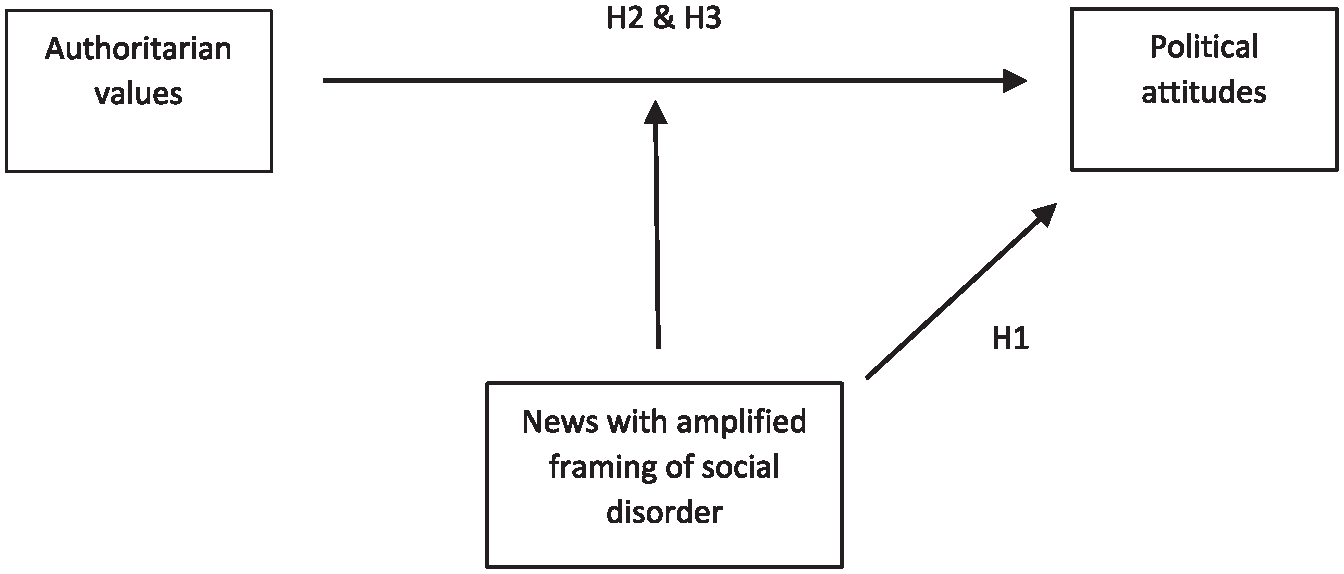
Hypotheses.
Extensive research indicates that circumstances of social disturbance, disruption of norms, and instability in society significantly effect individuals’ propensity to hold authoritarian attitudes (Arikan & Sekercioglu, 2019; Feldman, 2003; Feldman & Stenner, 1997; Onraet et al., 2014; Stenner, 2005). Given what we know about news framing effects (Chong & Druckman, 2007; Lecheler & De Vreese, 2018), we assume that exposure to news with an amplified framing has a main effect on authoritarian attitudes.
To make the test of the hypothesis more robust, we conducted two equally designed experiments, focusing on two news issues on social disturbance (the school issue and the public library issue). We study the effects on typically authoritarian attitudes (cf. Hetherington & Suhay, 2011) related to the two news issues (see the section on measures), including support for tougher punishments, control, monitoring, and extended authority for staff in schools and public libraries to take action against troublemakers.
A general theoretical argument in the literature on authoritarianism suggests that authoritarian attitudes are most powerfully explained as the outcome of a dynamic interaction between predisposition and circumstances of social disturbance (Feldman and Stenner, 1997; Feldman, 2003; Stenner, 2005). By relating to the general theoretical idea of authoritarian predispositions being activated in responses to social disturbance, and consideration applicability as a mechanism identified in news framing theory, we hypothesize a significant impact of news framings of social disturbance on the activation of authoritarian predispositions. Before testing the activation hypothesis, we investigate the general impact of predispositions (authoritarian values) on authoritarian attitudes on the two issues (school and library).
In previous research, individuals’ perceptions of threat are investigated as a predictor of authoritarian attitudes (Duckitt, 2013, 2015; Feldman, 2003, 2020; Feldman & Stenner, 1997). Our focus in this study is on the impact of the actual framing of social disturbance in the news that individuals are exposed to. In the theoretical section above, we have argued that authoritarian responses to a public discourse of amplified social disturbance, violations of norms, and disobedience are not necessarily related to perceptions of a general threat or feelings of insecurity and danger. Hence, our theoretical argument suggests that the news framing has an independent effect on attitudes, not reducible to such perceptions of threat. To address this argument, we ask a more open explorative question (RQ1) about the extent to which the relations investigated in our main hypotheses are conditioned by a perceived threat. More precisely, we investigate the perceived threat to social cohesion, a concept and measure developed by Feldman (2003) to account for individuals’ perceptions of a general development in society toward disruptions of norms and values, a development that individuals who value conformity are assumed to be sensitive to and react on in authoritarian opinions.
Method
Design
To address our hypotheses, we conducted two experimental studies in Sweden during 2022. Both studies were based on an identical research design: Study 1 focusing on the school issue (N = 2,180), and Study 2 on the library issue (N = 2,222). Study 1 was conducted between April and May 2022, while Study 2 was conducted between October and December 2022. For both issues, a between-subjects design with two experimental and one control group was used (i.e., a total of three groups per issue). To clearly distinguish measurement of authoritarian values from attitudes, experiments were conducted in two steps. In the first step (T1), participants were invited to the study and asked questions about their background characteristics and, most importantly, authoritarian values. In the second step, about 6 weeks later (T2), participants were randomly assigned to read a news story either (1) with or (2) without an amplified frame about the social disturbance in school and public libraries, respectively, or (3) no news story at all. The dependent variable—political attitudes—was measured immediately afterwards, before participants were debriefed about the study.
Procedure and Participants
The two studies were conducted in collaboration with the Laboratory of Opinion Research (LORE) at the University of Gothenburg. LORE hosts a standing online panel of more than 75,000 participants. For Study 1, a subsample of 5,483 respondents aged 18–85 years, stratified on sex, age, and education, was invited to take part in the study at T1 (net subsample size = 5,182). In total, 2,716 participants completed the T1 survey. Forty-eight percent were women, with a slight over-representation of older respondents (younger than 30 = 8%; 30–39 = 14%; 40–49 = 19%; 50–59 = 19%; 60–69 = 18%, and 70 or older = 22%), and highly educated (“university” = 49%). For the second part (T2) of the experiment, participants were randomly assigned into experimental and control groups. Two groups read a news story about the school issue, either with or without an amplified frame (see below). The third group received no news story but responded only to survey measures on political attitudes. In total, 2,180 respondents participated in Study 1.
Study 2 relied on an identical design, sample, and procedure. A total of 4,500 respondents aged 18–85 years, stratified on sex, age, and education, were initially invited at T1 (net subsample size = 4,405). The samples for the two sub-studies are separate, and no one participates in both. In total, 2,797 participants completed the T1 survey. Forty-eight percent were women, with a similar age (younger than 30 = 9%; 30–39 = 16%; 40–49 = 18%; 50–59 = 21%; 60–69 = 19%, and 70 or older = 18%) and education distribution (“university” = 49%) as in Study 1. Approximately 6 weeks later, Step 2 of the experiment was fielded with random assignment into three groups, treatments with news stories about the library issue, and a post-measure of political attitudes. Taken together, 2,222 respondents participated in Study 2. Information from the survey shows that almost everyone could hear the news stories (97% in both experiments).
Measures
Two concepts are key for the current studies: authoritarian values and authoritarian attitudes. Descriptive statistics for all survey items and indexes are provided in Table A1 in the Appendix.
Authoritarian values (measured at T1): To enable powerful and comprehensive analyses of authoritarian predispositions, we rely on three complementary scales all proven to be reliable measures in contemporary research on authoritarianism, focusing on the social conformity/personal autonomy dimension widely recognized as fundamental to the definition of authoritarianism (Feldman, 2020; Glassen & McLaren, 2021; Stenner, 2005). First, we used the measure of basic values developed by Schwartz, and more precisely, the 10 items that reflect authoritarian versus liberal values (2012, see also the work by Feldman, 2003; Arikan & Sekercioglu, 2019; Norris & Inglehart, 2019, p. 104). Based on a principal components analysis (PCA), five survey items loading on a single authoritarian dimension were combined into an index (see Table A1 for Cronbach’s alpha). Items include, for example, “It is important for her to always behave correctly. She wants to avoid doing anything that people would say is wrong” (see Appendix). Second, the social conformity-autonomy scale (Feldman, 2003) was included. Based on six survey items, three were selected constituting the conformity dimension based on findings from PCA (Cronbach’s alpha in Table A1). Items include, for example, “It’s best for everyone if people try to fit in instead of doing things their own way” (Appendix). Third, we measured child-rearing values (Feldman & Stenner, 1997; Feldman, 2003; Stenner, 2005). The survey battery included six items, out of which three loaded on a single dimension in a PCA. These were combined into an index measuring conformism (Cronbach’s alpha in Table A1). Items include, for example, “Children should learn to do what is right even though they may not always feel like it” (Appendix). Higher values on all three scales represent stronger authoritarian values.
Authoritarian attitudes (measured at T2): Following the literature (Hetherington & Suhay, 2011; Stenner, 2005), we identify the support of harsh measures, control, and punishment in response to disturbance and violation of norms as typical authoritarian attitudes (though, not the only ones). To measure such attitudes, we rely on a number of items tapping attitudes toward policy proposals related to the school issue (eight items) and library issue (nine items), respectively. These are proposals that have been discussed in the public debate. Based on a PCA, four items that loaded on a single dimension were selected to tap attitudes on harsh measures, control, and punishment in extended authority for staff in the school issues, for example, “Strengthen teachers’ powers to take physical action against disruptive students.” For the library issue, all nine policy proposals loaded on the same dimension and were selected to tap authoritarian attitudes on control and punishment, for example, “People who disrupt order at libraries should be banned from access.” Therefore, some of the items are reverse coded in the library case, to measure authoritarian attitudes, for example, “Threatful youths in public spaces should be met with dialogue and support” (see Appendix and Table A1 for Cronbach’s alpha for these scales).
To answer the RQ, added to the hypotheses, we also measured perceived threat (measured at T2): We rely on the perceived threat to social cohesion scale developed by Feldman (2003). The scale is based on eight survey items, for example, “the increased diversity of values threatens the cohesion in Sweden,” with higher values representing higher levels of perceived threat (Cronbach’s alpha in Table A1).
Control variables (measured at T2): For some of our analyses, we make additional use of control variables, including gender, age, education, and political ideology.
Stimuli
To achieve the goal of using stimuli reflecting an actual diversity of framings in the news media, the stimuli (in web radio format) were created by a professional journalist based on a review of news published in the mainstream media during the year preceding each experiment. The review on the school issue shows how disturbances in primary school classrooms, that negatively affect teaching and learning, have been frequently reported as a major problem in Sweden. The characteristic of many news items is that rowdy and disobedient students are foregrounded, and the limited authority and powers of the teachers to take action are highlighted as a main problem. However, there is also news that provide a more nuanced and less amplified view of the problem, not blaming the students and discussing different requirements to recreate order and a good environment for the students in the classrooms. Similar differences were identified in the reporting of disturbances in public libraries. While some news reported a trend toward increasingly widespread problems with groups of young people deliberately disrupting order, threatening staff, and creating social anxiety, prompting calls for tougher action, other news reports rather suggest that this is by no means a new or particularly extensive problem, and responsible librarians question the ideas of introducing repressive measures such as banning visitors. Notably, these contrasting frames appear as pronounced in some news and more blended in other news.
Based on this, we extrapolated a contrastive amplified versus mitigated framing of social disturbance to be manifested in the stimuli in the two experiments (school and library). Amplified here refers to framing with the following characteristic components: (a) The actual disturbances are indicated to be extensive and alarming; (b) the actors who disturb the order are foregrounded, blamed, and indicated to be the main problem; (c) the concrete events reported in the news are framed as examples of a development toward increased disruptions of the social and normative order in society. What we describe as a mitigated frame is a framing that is basically more nuanced on these aspects: (a) Social disturbances are represented as a problem but less serious and not alarming; (b) several possible reasons for the problems are mentioned; (c) the narrative of ever-increasing problems is nuanced or omitted.
The amplified and mitigated stimuli are designed so that they basically present the same news event (see Appendix). Basic information and wordings are exactly the same. The different frames are manifested in wordings in headlines, introductory text, and the reporters’ voice-over and quotes from interviewees including the sound bites ending the news item (the coda). Hence, for the stimuli to represent actual news production, the contrastive frames are constructed through characteristic framing devices in the news genre; in lexical choices, exemplars, global meaning of the topics, and representation of actors manifest in the elements of a web radio news report, such as the headline, voice-over, and quotes from interviews (Ekström, 2023; Van Gorp, 2007).
Participants assessed the news articles in terms of credibility, relevance, comprehensibility, and balance on a five-point agree-disagree scale. The aim of constructing authentic stimuli based on real news stories on this topic appears successful in the sense that an overwhelming majority considered the stories credible (school: 88%; library: 78%), relevant (S: 89%; L: 74%), comprehensible (S: 92%; L: 89%), and balanced (S: 71%; L: 60%). At the same time, across both experiments, the amplified story was considered more credible (school: b = 0.11, p < .01; library: b = 0.15, p < .01;), relevant (S: b = 0.08, p < .01; L: b = 0.24, p < .001), and comprehensible (S: b = 0.11, p < .01; L: b = 0.11, p < .05) than the mitigated story—but there were no significant differences in terms of balance (S: b = 0.6, p > .05; L: b = 0.01, p > .05). These differences partly reflect the amplification frame as emphasizing the seriousness of the problem covered in the news story, while downplaying nuance and complexity—patterns that are consistent across both experiments.
Results
Figure 1 presents findings speaking to H1 relating to the main effect of amplified news framing on authoritarian attitudes, for both issues, respectively. The effect sizes are based on OLS regression models using the control group as reference. For the school issue, amplified framing has a positive and statistically significant effect on attitudes (b = 0.13, p < .01), while mitigated framing does not (b = −0.00, p = .949). A similar pattern is present for the library issue, with amplified framing having a positive effect on authoritarian attitudes (b = 0.22, p < .001). Mitigated framing even displays a statistically significant negative effect on authoritarian attitudes (−0.10, p < .05). While these effects are statistically significant, the sizes are not necessarily large in substantive terms. Amplified framing increases authoritarian attitudes by approximately 0.13 units on the school issue, and by 0.22 units on the library issue—both measured on 1–5 point scales. Overall, however, H1 is supported for both issues (Figures A1 and A2 in the Appendix present similar analyses for each attitude item separately). In addition, we also addressed H1 by testing the effect of amplified framing against mitigated framing (reference category), to determine whether it is exposure to the frame or the issue itself that drives the effects. The main effects in Figure 1 hold here as well, for both the school (b = 0.13, p < .01) and library (b = 0.32, p < .001) issues.

Effects of Amplified and Mitigated Framing on Authoritarian Attitudes.
Turning to H2 and H3 on the relationship between authoritarian values (predispositions) and attitudes, Figure 2 presents findings from several regression models for the school and library issue, respectively. By including an interaction term between values and treatment, these models provide estimates of the basic relationship between values and attitudes in the control group, as well as among those who received an amplified news frame (see Table A2 for full output from these regression models). According to H2, we expect a positive relationship between values and attitudes: The more authoritarian one’s values are, the more likely one is to adopt authoritarian attitudes. This expectation is strongly supported for both issues, regardless of which operationalization of authoritarian values is used: the Schwarz scale, the Conformism scale, or the Child-rearing scale. Higher values on those scales (x-axes) are related to higher values on the attitudes scales (y-axes).
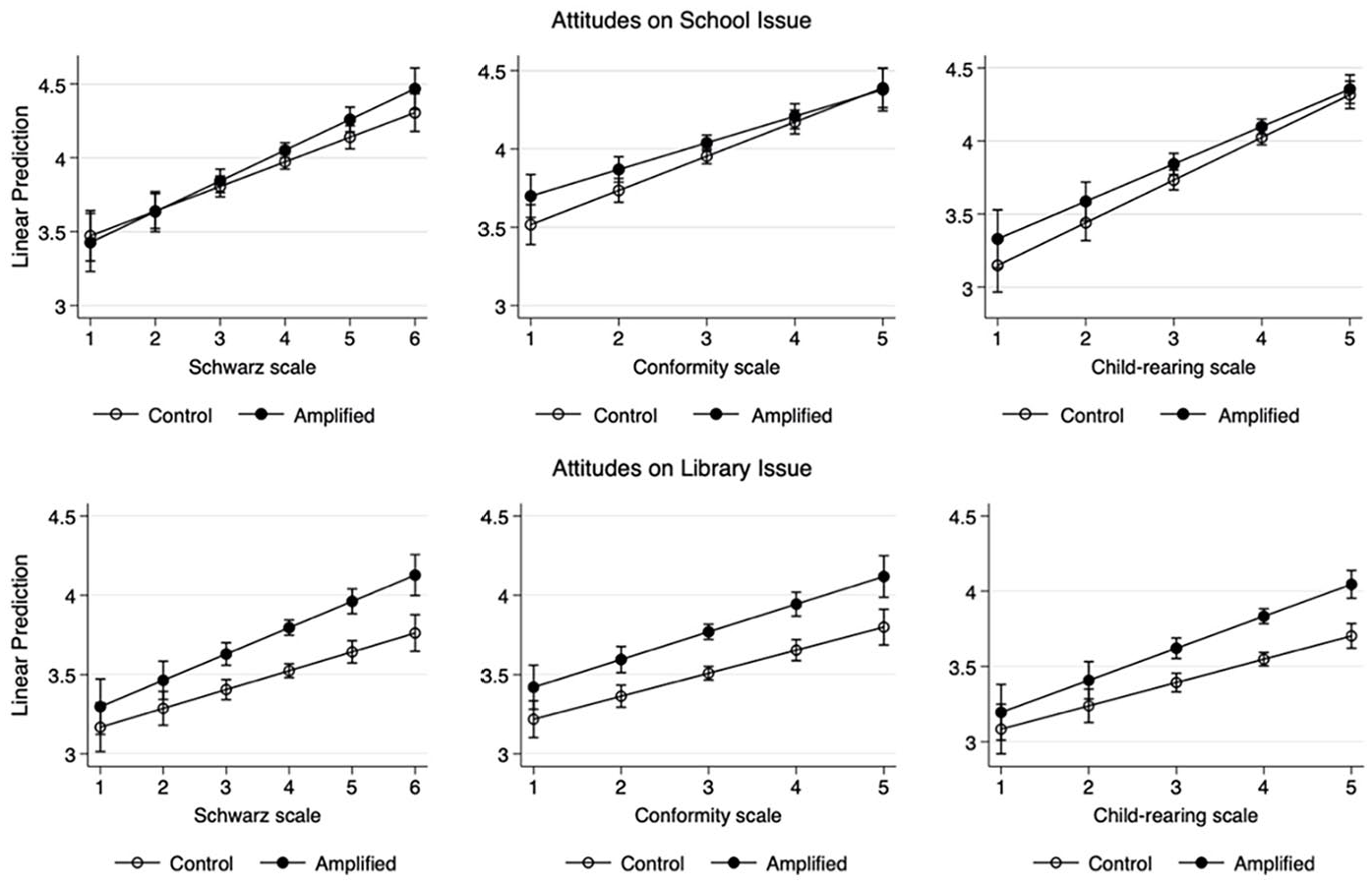
The Conditional Relationship Between Authoritarian Values and Attitudes.
The activation mechanism (H3) is addressed based on the interaction term between treatment and values. We are interested in the conditional effect of news frames among people with different authoritarian predispositions. Since the statistical significance of the interaction term itself is irrelevant for addressing this (Brambor et al., 2006), we present findings in two ways. First, Figure 2 displays the conditional effect based on predicted attitudes across different levels of predispositions. Here, we see issue-differences with respect to the activation mechanism. For the library issue, the basic relationship between authoritarian values and attitudes is stronger among respondents exposed to an amplified news frame. This is particularly evident for the Schwarz and Child-rearing scales, where the prediction line is steeper among those exposed to an amplified news frame than the control group. But the main finding is replicated across each value scale: For respondents scoring low(er) on authoritarian predispositions, there is no difference in attitudes between the amplified framing and the control group (confidence intervals overlap). Among respondents scoring high(er) on authoritarian predispositions, however, the differences in attitudes are statistically significant (confidence intervals do not overlap). This pattern is however not visible for the school issue. Second, Figures A3 and A4 in the Appendix illustrate these findings in an alternative way, focusing on the conditional marginal effect of amplified news frames on attitudes (Brambor et al., 2006). Again, for the library issue, Figure A4 shows that the effect of the amplified news frame is statistically significant only among people with stronger authoritarian values (predispositions). Thus, the news frame has a stronger influence among respondents who are predisposed for the amplified frame. In terms of effect sizes, the effect of amplified framing is on average approximately 0.28 (p < .001) among respondents scoring 5 on the 1–6 Schwarz scale, but only 0.13 (p > .05) among those scoring 2. The conditional effect differences are similar for the two other dimensions of values—which is a pattern not evident for the school issue, as seen both in Figure 2 and the conditional marginal effects plot of Figure A3. At the same time, we also tested the activation mechanism by comparing amplified frame exposure to mitigated frame exposure (see Figure A5–A8 in the Appendix). These findings reveal additional nuance and complexity to the main findings presented here, which is discussed more thoroughly in the concluding section.
Thus far, we have seen that news framing matter for authoritarian attitudes on both issues (H1), that there is a strong relationship between authoritarian values and attitudes (H2), but that the activation mechanism is found only for the library issue (H3). Our final research question (RQ1) focuses on the potentially moderating influence of perceived threat to social cohesion on news framing effects and the activation mechanism. This is addressed in two ways. First, Figure 3 displays the conditional marginal effects of amplified news frames on authoritarian attitudes, across levels of perceived threats to social cohesion. While there are some indications that effects are primarily present among low-threat respondents, the overall findings point toward a relatively universal effect—as illustrated also in Figure 1 above. This is most clear for the library issue, where amplified news framing increases authoritarian attitudes across the board.

The Marginal Effect of Amplified News Frames Across Values of Threat Perceptions.
Second, we also tested whether the activation mechanism is conditioned by threat perceptions. This was done by replicating the analyses presented in Figure 2, comparing the relationship between authoritarian values and attitudes across respondents scoring low and high on the threat perceptions scale (splitting the sample into two equally sized groups). The findings reveal no indication that threat perceptions condition the activation mechanism. As illustrated in Figures A9 and A10 in the Appendix, the overall pattern already presented in Figure 2 is very similar regardless of threat perceptions. Although respondents scoring higher on threat perceptions also display higher levels of authoritarian attitudes, the basic relationships between values and attitudes—as well as the activation mechanism—are very similar. Finally, this conditional effect was also tested formally in a statistical model including three-way interaction terms between news frame, values, and threat perceptions. These findings are presented in Figures A11 and A12 in the Appendix and corroborate the overall pattern of similarity in conditional effects across threat levels.
Conclusion and Discussion
In this study, we have investigated the impact of amplified news framing of social disturbance on peoples’ propensity to hold authoritarian attitudes. Based on the integration of established theories on authoritarian responses to social disturbance and social threat and theories of news framing effects, we have tested hypotheses about main effects of news framing on authoritarian attitudes and the activation mechanism, suggesting that circumstances of social disturbance tend to activate authoritarian predispositions (referring to pre-political values). By examining the effects of amplified news framing of issues related to disruptive behaviors and violation of norms in society, the study presents a novel contribution to an important research agenda, where the role of the news media has so far been remarkably neglected. While scholars have noted the possible implications of a news media culture biased toward sensational and amplified coverage of social threat (Hetherington & Suhay, 2011, p. 557), the actual effects of news framing have not been investigated.
We designed this study to present a robust test of the hypotheses. (a) The survey experiments provide an opportunity to analyze causal relationships and contribute to research on authoritarianism that has often relied on cross-sectional survey data (Glassen & McLaren, 2021, p. 679). (b) The hypotheses were tested in two similarly designed experiments on two different news topics related to social disturbance, and stimuli were created by a professional journalist using authentic news as a template, thus aiming to reflect generic frames in news reporting. The participants’ assessment of the news clearly indicates that the stimuli were perceived as credible and realistic by the vast majority. The amplified news was perceived as even more credible, relevant, and comprehensible, than the mitigated news, which confirms that the amplification is understood as an authentic feature of news reports. (c) The activation mechanism was tested in parallel using three different scales of predispositions (values), each of which is theoretically well-grounded and frequently used in previous research.
The study provides clear support for the hypothesis of main effects (H1). The impact of amplified news framing of social disturbance on authoritarian attitudes was verified in both experiments (on disturbance in school and public libraries). Notably, the results of the two experiments also indicate differences in the patterns of impact between the news topics. In the news about social disturbances and anxiety in public libraries, the framing appears to have stronger differentiating effects on attitudes than the school issue. It is hardly surprising that the actual news topic matters for the effects of news framing, and we will return to this in the discussion below.
The study also presents support for the theory of activation and, more precisely, the theoretical argument, suggesting that authoritarian predispositions are activated when people are exposed to news frames making authoritarian considerations applicable. The results show a clear positive relationship between authoritarian values and authoritarian attitudes in the two experiments (H2), and this baseline relationship was stronger for respondents exposed to amplified news, supporting the activation hypothesis (H3). However, this activation mechanism is only found in the experiment on the library issue. Notably, these results are consistent across the three established scales that we used to measure predispositions.
Finally, we included individuals’ perceived threat to social cohesion to investigate the extent to which the main effects (H1) and the activation mechanisms (H3) are conditioned by such perceptions of threat emphasized in previous research. The results basically show that the effects and mechanism are universal and not conditioned by threat perceptions. Certainly, respondents’ perception of threat has an impact on authoritarian attitudes, but the observed basic relationships remain.
In what follows, we clarify and discuss our contribution, which also raises important questions for future research.
First, in this study, we have investigated the mechanisms promoting authoritarian attitudes in the exposure to individual news stories. The experiments present evidence of significant short-term effects of exposure to the amplified news framings of social disorders. Notably, exposure to individual news stories displays significant effects despite the fact that participants likely possess previous knowledge and attitudes on these rather salient issues in the public debate. In reality, however, people are seldom exposed to single news stories and frames, but rather to a continuous flow of news coverage. If immediate short-term effects cumulate over time, through repeated exposure to similar news stories and frames, the long-term effects may be more important (Lecheler et al., 2015; Shehata et al., 2021). In such cases of long-term exposure and effect dynamics, news reporting may potentially affect not only attitudes but also more stable values (such as liberal/authoritarian predispositions). It essentially remains to explore such long-term effect dynamics.
Second, the activation hypothesis tested in this study assumes that people scoring high on authoritarian values are most likely to be affected in their attitudes when exposed to amplified news about social disturbances. The hypothesis was supported in one of the two experiments (see Figures 2 and 3). However, when testing the activation mechanism by contrasting amplified framing against mitigated framing (rather than control group), findings were more nuanced, lending mixed support to H3. For instance, some indications suggested that people scoring low on authoritarian values (predispositions) were more likely to be affected, and adopt more authoritarian attitudes, when exposed to amplified social disturbance (see Figures A7 and A8). The question of who is most susceptible of being affected in an authoritarian direction, toward increased intolerance and support for tougher measures, when exposed to social disturbance and insecurity, is discussed in the literature. Two alternative mechanisms are proposed (Glassen & McLaren, 2021, p. 679; Hetherington & Suhay, 2011, p. 547). Exposure either “galvanizes” those who already have strong authoritarian predispositions or “mobilizes” those who are less, or perhaps not at all, authoritarian in their values, and thereby reduces the gaps between people with different predispositions for authoritarianism. Galvanize seems most in line with the theories we draw on in this study: the activation mechanism theorized by Stenner (2005) and Feldman (2003, 2020) and the mechanism of consideration applicability in framing effects theory (Scheufele & Tewksbury, 2007). This is also what our empirical study provides clear support for, although, as noted, there are some nuances that may speak to the other mechanism. Hetherington and Suhay (2011, p. 547) present a study indicating that it is rather the least authoritarian who are susceptible to threat of terrorism and insecurity, in changing their attitudes toward increased support for aggressive restrictive policies. A reasonable explanation presented is that the most authoritarian are already inclined to hold authoritarian attitudes and do not have much room to change their attitudes when threatening events occur. Notably, these mechanisms are not mutually exclusive but may well operate in parallel and increase authoritarian attitudes across groups with different dispositions. This is a subject for further research.
Third, we have intentionally studied the impact of amplified news framing of rather ordinary social disturbances and violation of norms in society. Drawing on theories of the dynamics of authoritarianism, we argue that the mechanisms triggering authoritarian attitudes are not exclusively related to extraordinary threatening circumstances (such as terrorism, crime, economic crisis), or the constructions of social threat in the profile issues of far-right politics. On the contrary, authoritarian response to the amplification of social disturbances is a more general mechanism potentially activated across various social issues. Theories suggest that this is a pre-political mechanism (Feldman, 2003, 2020, Stenner, 2005); a response to social circumstances conditioned by authoritarian predisposition such as the strong beliefs in conformism. Of course, such responses are also politically infused and appealed to in political contexts. The news topics in our experiments were, however, selected to represent issues on social disturbances where the partisan political dividing lines were less developed and articulated in the public debate.
There is a need for more research on news framing effects on authoritarianism focusing on topics related to different circumstances of social disturbance, instability, and crisis, and with different positions in the socio-political landscape. The news-framing effects are certainly context dependent. This is indicated by our results. A plausible explanation for the non-significant activation effect in the experiment on the school issue is that the relationship between values and attitudes on this issue was already firmly established among the respondents and therefore did not allow for the additional impact of exposure to an amplified news framing. Compared to the issue on social disturbance in public libraries, the disturbance in school has been more prominent in Swedish news media and public discourse. It has been discussed for a long time, and moreover, the political debate in recent years demonstrates a high degree of consensus on the disturbance in school as a major problem. Such aspects related to both the prominence of issues and their position in the political landscape likely explain the partly different results from the experiments. Future research would benefit from studying the framing effects of news on other forms of social threat, also including crime and terrorism, as well as news on other issues central to the liberal/authoritarian value conflicts such as immigration, sexual minority rights, and climate change.
This experimental study was conducted in Sweden. We should be careful in empirical generalizations, as we can expect news framing effects on authoritarian attitudes being partly dependent on how the issues investigated are positioned and politicized in the socio-cultural and political landscape. To account for the implications of such factors, we need more research in other countries and political contexts. However, this study has developed a theoretical framework by integrating well-established theories and identified mechanisms which also received empirical support in an experimental study that presents a robust test of the hypotheses. We believe this makes the study important and relevant beyond the one-country context.
Finally, this study contributes to our understanding of the crucial, critical, and challenging role of news journalists in contemporary liberal democracies. The news reporting on far-right authoritarian political actors has been subject to extensive research (Carlson et al., 2021; De Jonge, 2019; Ekström & Patrona, 2024; Ellinas, 2018). This research shows how mainstream news journalism tends to contribute to the normalization of extreme authoritarian opinions and discourses (Krzyżanowski & Ekström, 2022) and provide favorable contexts for authoritarian populist actors and their media-savvy strategies (Ekström et al., 2022; Krämer, 2014). A dilemma for journalism is that established news values (sensationalism and conflict) and news framing (framing of disturbance, crisis, and threat) often seem to facilitate the propagation of authoritarian populism. This study demonstrates the importance of journalism (and journalism studies) also considering the impact of news journalism—the practices of reporting and the framing of news—on the attitudes in society that authoritarian politics appeals to and draw support from. We consider this study as a contribution to a research agenda that mainly remains to be developed.
Footnotes
Appendix
Declaration of Conflicting Interests
The author(s) declared no potential conflicts of interest with respect to the research, authorship, and/or publication of this article.
Funding
The author(s) disclosed receipt of the following financial support for the research, authorship, and/or publication of this article: This work was supported by the Swedish Research Council under Grant 2020-01915.
Ethical Approval
The study is approved by the Swedish Ethical Review Authority (Dnr 2021-03190)