




Abstract
Across Europe, Public Service Media (PSM) are increasingly subject to bias accusations in public debates. Excluding academic attention for actual bias in news content, research into the nature of bias accusations is limited. This article studies bias accusations against Dutch PSM in online discourse. Through a qualitative content analysis of tweets and blogs (2017–2022), our analysis develops a novel typology of bias accusations—positional, information, and framing bias—going beyond academic definitions. Bias accusations are diverse in nature, reflect strong perceived intentionality, and refer to heterogeneous social, political groups, yet are easily merged into singular political ideological divides.
Public Service Media (PSM) have a unique role in democratic societies by creating a shared public space (Cushion, 2012; Habermas, 1987; Schweizer & Puppis, 2018). They perform a dual task: presenting factual news and offering a balanced representation of multiple perspectives on topical and societal issues (Bos et al., 2016; Cushion, 2012; Schweizer & Puppis, 2018; Van Aelst & De Swert, 2009). This dual task of information provision and pluralism in news reporting is reflected in both academic research and policy-making. As such, Cushion (2012) underscored how the value of PSM news resides in its “informative quality,” and how this in turn “empowers” citizens by providing them with the necessary information to participate in democracy and hold governments to account (Cushion, 2012; Harrison, 2013, p. 383).
However, there are challenges that hinder PSM from fulfilling these ideals, and hence threaten their democratic function. In both Europe and the United States, mainstream and public media are increasingly politicized, particularly by populist radical right-wing parties and politicians (Egelhofer et al., 2021; Fawzi, 2019; Liminga & Strömbäck, 2023; Roberts & Wahl-Jorgensen, 2020), but also by non-populist politicians (Solis & Sagarzazu, 2020). This politicization often comes in the form of bias accusations claiming that mainstream and public media would not be neutral, but biased in favor of certain political groups or ideologies (Domke et al., 1999; Holtz-Bacha, 2021; Roberts & Wahl-Jorgensen, 2020; Sehl et al., 2022). Such bias accusations negatively affect journalists by undermining their credibility and inducing violence against them (Panievsky, 2021) and may lead citizens to perceive any news broadcast by PSM as biased, regardless of actual content (Gunther et al., 2012; Kim & Grabe, 2022; Perloff, 2015; Vallone et al., 1985). Ultimately, bias accusations against PSM can undermine their legitimacy (Brosius et al., 2022; Egelhofer et al., 2021; Fawzi & Krämer, 2021).
It is important to understand the nature and scope of such bias accusations. Systematic research is, however, scarce. Pioneering articles give examples of an increasing number of bias accusations toward public media in European countries (Holtz-Bacha, 2021; Sehl et al., 2022), and a single study systematically maps online media criticism voiced by Austrian and German partisan actors (Egelhofer et al., 2021). No study, however, directly addresses bias accusations as a concept, and we thus lack insight into how bias accusations are constructed in political elite discourse. Existing research has defined and measured actual bias in media content (see, for example, Groeling, 2013; Hopmann et al., 2012; Rietdijk & Archer, 2021; van Hoof et al., 2014). Importantly, however, bias accusations by no means need to reflect academic definitions of media bias. With this in mind, we understand bias accusations as subjective perceptions that media content or news production (intentionally or unintentionally) favors certain political viewpoints or political and social groups over others. Such perceptions may reflect actual biases and the extent to which PSM live up to the expectations of objectivity and pluralism that society and politics hold toward them, but they may also be voiced strategically by political actors to delegitimize certain media or journalists (e.g., see Egelhofer et al., 2021; Hameleers & Minihold, 2022; Holtz-Bacha, 2021).
The article is guided by the overarching research question: How are bias accusations toward PSM constructed in online discourse among politicians and opinion leaders? We focus on the case of the Dutch public service broadcaster Nederlandse Omroep Stichting (NOS). The NOS has a strong position in Dutch society, reaching people from diverse social and political backgrounds (Bos et al., 2016). At the same time, the NOS is increasingly subject to allegations of bias (NOS, 2020). We employ a qualitative Grounded Theory approach (Charmaz, 2014), to analyze a sample of 130 tweets and 56 blogposts by politicians and opinion leaders over a 6-year period (2017–2022). We preregistered our study on the Open Science Framework prior to data collection. 1
Three main findings emerge from the analysis. First, bias accusations tend to refer to three types of bias: positional, framing, and information bias. This typology is distinct from how academic research has defined and measured actual bias in media content. Second, bias accusations toward PSM tend to be charged with a perceived intentionality. Third, bias accusations tend to originate from both the political left and right, referring not only to a bias against one’s respective in-group, but also more broadly against a variety of groups to which people feel ideological affinity. Our findings provide important insights into the political gravity of bias debates surrounding PSM and give reason to further investigate the impact of bias accusations on citizens’ perceptions of bias in—and legitimacy of—PSM.
Constructing Bias Accusations
Bias accusations rest on subjective perceptions, which may exist independently of actual media bias. Research on perceived media bias, and the hostile media effect (HME) in particular, has consistently shown how such perceptions can exist independently of content (see Perloff, 2015, for an overview). Perceptions of bias may also be a function of the perceiver’s identity and viewpoints, and may interact with source cues (e.g., preconceptions about a source’s political position; Feldman, 2011; Kim & Grabe, 2022; Lee, 2005). Moreover, bias accusations may be driven by strategic considerations on the part of the accuser, rather than by concerns with actual bias (Egelhofer et al., 2021). Therefore, we approach bias accusations as a separate phenomenon and pursue an inductive analytical strategy. Yet, the literature on actual media bias carries important considerations for our study, which we outline here.
First, as outlined in their comprehensive literature overview, Valenzuela et al. (2023) demonstrated that the study of news bias has a well-established legacy in political communication and aligns with the field’s predominant quantitative methodological approach (p. 817). Scholars have defined bias as a matter of degree, distinguishing between individual instances of slant and more consistent patterns of content bias (Entman, 2007, p. 166). In a similar vein, scholars have distinguished partisan versus structural bias (Strömbäck & Shehata, 2007; Van Dalen, 2012). The former appears to be milder and can be detectable in news content, whereas the latter would be—as the name suggests—much more structural in nature as an indicator of government dominance over the media agenda, which varies across different journalistic cultures (Van Dalen, 2012). In relation to bias accusations, these distinctions suggest that perceived bias could be defined by different levels of severity, ranging from pointing out one news item or a single aspect of news production that may have an unwelcomed slant or a slight partisan bias in the eye of the accuser on one end of the scale, to condemning the whole range of news products, the complete production process, and in fact news institutions as a whole as biased at the other extreme.
Second, researchers have observed the role of exogenous standards and normative expectations in defining what media bias is. Hopmann et al. (2012), for example, argued that political balance in news reporting is weighted against the nature of the political system: “[. . .] one only can speak of a partisan bias if news content is not in line with a party system or media routine perspective” (Hopmann et al., 2012, p. 249). This perspective puts a focus on representation and suggests that there are exogenous standards by which one can assess whether media bias is present or not (Green-Pedersen et al., 2017). For bias accusations, this would mean that they could indeed be shaped by normative expectations. For example, departing from PSM ideals of ensuring pluralism, objectivity, and balance (Bos et al., 2016; Cushion, 2012), an accusation could point out that a certain political perspective has received too much or too little attention in the accuser’s eyes.
Finally, and most relevant to our analysis, several studies on actual media bias have sought to define and measure bias in news content, arriving at a threefold typology: bias in the visibility of political actors (coverage bias); bias in the attention for specific political issues, often “owned” by certain political parties (agenda bias); and bias in the tone and favorability toward politicians within media coverage (statement bias) (Brandenburg, 2005; D’Alessio & Allen, 2000; Eberl et al., 2017a, 2017b; Hopmann et al., 2012). Applying this typology to bias accusations, we would derive that accusations of a coverage bias would be voiced in relation to a subjective perception that certain political actors are under- or overrepresented in political news reporting. If an accusation would highlight an agenda bias, the accuser would criticize that certain political issues are either disregarded or receive too much attention. An accusation of statement bias would point out that an actor or issue is discussed more positively (or negatively) in media coverage.
However, just because scholars have derived such a typology, this does not mean that bias accusations made by political and public actors neatly fit into one type or another. First, scholars measuring actual content bias are also steered by pragmatic considerations (what can we reliably measure in media content)—yet such considerations do of course not constrain the diverse types of bias that are publicly discussed. Second, as argued above, bias accusations rest on subjective perceptions of the accuser, which are shaped by both context and accuser characteristics—that is, a right-wing politician might more easily perceive a left-wing bias, and vice versa. Third, bias accusations are likely to be voiced strategically (Egelhofer et al., 2021), with the purpose of delegitimizing certain news coverage or even PSM in general. A systematic exploration of bias accusations should therefore not restrict itself to academic definitions of bias, but also be open to dimensions of bias as they emerge from the debate. Therefore, we ask:
While research on bias accusations is scarce, research on media criticism has a long tradition. Two main types of media criticism emerge from this literature: constructive versus delegitimizing. Constructive forms of media criticism can serve a democratic function. First of all, calling out unbalanced and partisan news coverage contributes to the quality of news coverage and hence toward a proper information provision for citizens (Carlson, 2009; Wyatt, 2007). Second, media criticism can hold journalism accountable, by indicating when journalistic violations have been committed (Carlson, 2009), and identifies when journalistic practice deviates from established journalistic norms (Figenschou & Ihlebæk, 2019). Third, the voicing of media criticism ensures controlling the media to a certain extent, without it being an attempt at either censorship or regulation, to enhance and improve journalism as a practice (Wyatt, 2007). Wright (2021) distinguished constructive media criticism as a meta-journalistic discourse pointed toward journalists. Such criticism can be recognized by fostering a constructive debate about news media’s practices, roles, and democratic function, thereby strengthening media legitimacy.
However, delegitimizing forms of media criticism do pose a challenge to democracy. While evidence-based and civil arguments about the quality of media and journalistic practice are considered beneficial for deliberative and democratic purposes, the presence of incivility and lack of argumentation is considered ineffective in fostering a debate (Egelhofer et al., 2021, pp. 655–656). Wright (2021) distinguished a second type of media criticism, directed at a public audience, aimed at subverting evaluations of, trust in and legitimacy of the media (p. 721), which we understand as strategic media criticism. In the United States, strategically voiced accusations by conservative elites have been shown to increase the public’s perception of liberal media bias (Watts et al., 1999, p. 166). In the European context, Brosius et al. (2022), too, found that exposure to debates that dispute the quality of media, that include bias accusations, or that voice “fake news” attacks negatively affects attitudes toward media, especially for younger generations (pp. 660–662). Even though we cannot derive the lack or presence of either constructive or strategic motivations within the minds of the accusers themselves, given their potentially very different implications, we should be attentive to the distinction between, on one hand, critical and evidenced complaints that are constructive in tone about particular instances of disbalance or misinformation in the news, and, on the other hand, unfounded or abstract attacks with an undermining tone, potentially aiming to subvert the legitimacy of journalists or PSM at large.
In addition, while existing definitions of media bias relate to the amount and tone of coverage, media criticism increasingly focuses on the veracity of news content. In recent years, “fake news” has become a buzzword in political and public debates. Researchers have studied the instrumentalization of fake news and disinformation in political and public debates (Egelhofer & Lecheler, 2019; Ross & Rivers, 2018; Tong et al., 2020), as well as other types of “untruthfulness” such as misinformation (Hameleers, 2020; Hameleers & Minihold, 2022). While pre-2016, the term “fake news” was used in a more politically satirical manner (Ross & Rivers, 2018), contemporary usage (stemming from the Trump era) of the terms is meant to accuse journalists or media of (the intentional spread of) complete falsehoods (Ross & Rivers, 2018, p. 2), and fosters an environment in which “facts are debatable” (Egelhofer et al., 2021, p. 2).
Importantly, for our study, accusations of spreading disinformation can be closely linked to bias accusations. PSM can be criticized for unintentionally spreading incorrect information (as misinformation). Yet, the spreading of such information can also be perceived as a deliberate attempt to promote certain political interests (as disinformation). Accusations of disinformation thus by definition assume a bias, while accusations of misinformation might or might not imply that news is biased. Studying public perceptions of “fake news,” Tong et al. (2020, pp. 764–765) indeed find that the conceptual understanding of fake news varies, ranging from the majority of nonpolitical definitions such as “stories that aren’t true” or “bad information,” to the smaller share of more politically charged statements such as “disinformation” or “lies told to promote a particular agenda,” where some regarded fake news as “biased information attempted to sway the people.” This might suggest that perceptions of bias and disinformation are likely intertwined.
Concluding, in answering
Method and Data
To answer the aforementioned research questions, we explore the nature of the discourse around bias accusations toward PSM in the Netherlands. The Dutch public broadcaster NOS operates under the institutional umbrella of the Nederlandse Politieke Omroep (NPO), which has an explicit democratic and societal role, evident from their function decree:
As an integral part of the public broadcaster, the NOS aims to be the primary source of information in the field of news, sports and events, so that Dutch citizens are better able to judge developments in the world, and are better able to determine their behavior. The NOS applies the highest journalistic requirements of carefulness, reliability, unboundedness, pluralism and objectivity. The NOS strives to make this information accessible through all available media and for all sections of society. (NOS, 2024, translated)
The Dutch media system is characterized by a strong public broadcaster that takes its social task of being independent and professional seriously, and commercial influence is considered low (Van Es & Poell, 2020). The NPO and its public broadcaster NOS serve as a significant unifying factor in the fragmented Dutch media landscape (Bos et al., 2016, p. 10). The NPO is characterized by political consensus. Political actors and other stakeholders are involved in the administrative structure, with the aim of guaranteeing pluralism and independence (NOS, 2024). According to Hallin and Mancini’s (2004) typology of media systems, the Netherlands represents a democratic-corporatist system, which is arguably the one with the least political influence in news broadcasting. Yet, the Netherlands also witness an increase in politicization of the public broadcaster and heated debates about its objectivity and neutrality (NOS, 2020), hence making it an appropriate case to study the nature of such bias accusations in public debates.
This article conducts a qualitative, in-depth content analysis, following the principles of Grounded Theory (Charmaz, 2014). This approach involves two key aspects: first, a flexible and iterative coding process that enables the identification of new categories and subthemes while analyzing the data. Second, a reflexive stance that considers the researcher’s own positionality and assumptions. Taking a Grounded Theory approach facilitates an open examination of the discourse, exposing the meaning and patterns behind words, and is suitable for theory building. As quantitative studies remain dominant in the field of political communication, as highlighted in a literature review by Valenzuela et al. (2023), there remains a significant gap in qualitative research that can offer deeper insights and contribute to robust theory building. A qualitative approach fits our central aim of inductively developing a typology of bias accusations toward PSM and thereby contributing to the formation of theory on such accusations, which have received little attention before. Also, the approach is ideal for covering such uncharted terrain, as it allows for an iterative coding process and multiple coding rounds enable in-depth theoretical understanding and a gradual refining of theoretical categories. Thus, we are able to go beyond a simple account of the presence and frequency of the bias accusations being voiced.
The analysis focuses on a recent timeframe (2017–2022). These times are characterized by an increasingly polarized tone of debates about PSM (see Haller & Holt, 2019; Krämer, 2018 on “die Lügenpresse”). We start sampling in the beginning of 2017, right before the Dutch national parliamentary election. This election produced the new far-right party Forum for Democracy, known to be highly critical of the NOS/NPO. Moreover, it followed the election of Donald Trump in 2016, known for his anti-media rhetoric and his use of “fake news” labels to ridicule and undermine mainstream media (Ross & Rivers, 2018), ushering in a time period where “facts are debatable” (Egelhofer et al., 2021, p. 2) and where the political climate toward media is harsh and delegitimizing.
Our study was approved by the Ethics Review Board of the Amsterdam School of Communication Research prior to the data collection. 2 The latter was driven by the theoretical construct of interest: bias accusations and other types of media criticism directed toward NOS and NPO that are voiced on Twitter (now X) and online blogs. These are likely places where opinion leaders and politicians voice opinions, including accusations toward PSM (see Farhall et al., 2019). Indeed, the emergence of social and digital media have facilitated that political and public actors voice accusations (Engesser et al., 2017; Liminga & Strömbäck, 2023), including media criticism and hate toward journalists (Cheruiyot, 2018; Wyatt, 2019), outside of traditional media contexts. Moreover, bias accusations are probably less likely to be voiced within more established media outlets such as newspapers, as these are intrinsically nested in the mainstream media system (Cushion, 2019, pp. 26–27).
Our initial sample was guided by the following search strings on Twitter and Google: NOS, bias, nepnieuws/fake news, vooroordeel, partijdigheid, NOS links, NOS rechts, Mainstream Media (MSM), Publieke Omroep, NPO. 3 The goal of the sampling strategy was to grasp the variety and richness of the discourse. This meant that we strove to include voices across the political spectrum. We sought to avoid search terms that closely mirror populist radical right-wing discourse, and rather selected more general and relatively neutral terms in our search strings. In addition, it was crucial that the accusations were specifically targeted at Dutch PSM, and not at the media in general.
Second, for this study we were interested in influential voices in public debate, focusing on politicians and opinion leaders. Their messages likely have farther reach in public debates than those by less prominent members of society since we, for example, know that politicians’ visibility on social media can influence their visibility in traditional media (e.g., Kruikemeier et al., 2018). Similarly, the main selection criterion for tweets was salience. We selected tweets with a minimum amount of engagement (500 likes), and subsequently evaluated the professional role of each accuser included in the sample frame, selecting only publicly relevant professions (e.g., journalists, TV presenters). Finally, this resulted in a total of 182 tweets. Regarding online weblogs, we searched manually for the different search strings, and we included 64 weblogs. All blogs appeared in popular outlets (e.g., GeenStijl.nl, bnnvara.nl, dedagelijkstestandaard.nl), which are considered influential in the public debate (see Hagen & Jokubauskaité, 2020, p. 212; Hameleers & Yekta, 2023; Peeters & Rogers, 2020, p. 87).
The coding process was carried out by two coders to enhance validity and reliability. One coder was responsible for all of the coding; the second one co-coded a substantial share of the tweets and blogs in early stages of the coding process to help refine the final coding scheme (see the appendix). Both coders coded individually and later compared their codes as part of a thorough, iterative process. In addition, throughout the coding process, we were constantly attentive whether accusations toward the NOS were actually about bias or not (e.g., some accusations were about the quality of TV shows, but not about bias), or whether the sampled accuser was in fact deemed an influential voice within the debate. Therefore, after careful consideration of each accusation, we coded some accusations as NA (not applicable), and excluded them from the analysis. For the tweets, this means that we excluded 52 tweets from the sample frame throughout the coding process (N = 130). For blogs, this resulted in the exclusion of eight blogs (N = 56).
The final sample includes accusations by 32 different politicians or party accounts and 72 opinion leaders on Twitter, and by 13 identifiable (12 opinion leaders and one politician) and 18 unidentifiable authors on blogs. 4 The politicians included in the sample were either in national office (party leaders, member of parliament) or held functions at the municipal and regional level. It also comprises former politicians or those who were running for office at the time of the tweeting (n = 32). The opinion leaders in our sample were selected based on holding a profession related to engagement with public opinion, and resulted in predominantly figures in the media and cultural sector, such as journalists, TV presenters, writers, pollsters, and columnists at prominent newspapers (n = 72).
We started the inductive coding process by an open coding round. Open coding is crucial in Grounded Theory. By approaching the data with an open mind, immersing oneself with the data, and being attentive to details at the lowest level of analysis, one allows new, unknown categories to emerge from the data (Charmaz, 2014). A coding guide is subsequently used to facilitate a systematic analysis of the discourse (see the appendix). It outlines the specific aspects of each bias accusation that should (at least) be coded, which are the accusation’s source (including the accuser’s ideological affiliation), object, type, and the direction and topic of bias. Under “type of accusation,” the coding guide includes a list of sensitizing concepts that follow from the literature, which inspire—but do not restrict—the coding process.
Results: Three Types of Bias Accusations
Three distinct dimensions of bias accusations emerge from the inductive analysis, which relate to position, information, and framing. In what follows, we illustrate this novel typology of bias accusations, demonstrating its substance through examples from the discourse, and explain how this novel typology is related to yet distinct from the existing academic definitions of media bias. 5
First, a common accusation concerns the political position of the NOS and NPO as institutions, and how they position themselves politically in news reporting and the coverage of day-to-day news. Such accusations are charged with the assumption that PSM are pursuing a specific agenda or narrative, to promote specific ideologies or norms, or to benefit the interests of specific political or social groups, institutions, or even countries. Hence, this positional bias referred to in accusations is distinct from the agenda bias commonly measured in media content, in that it goes beyond the mere presence of political issues in news content. Accusations of positional bias go beyond this, by arguing that the NOS has an overt political disposition, evident in news reporting in various ways. Table 2 gives an overview of the different types of accusations related to positional bias.
As the examples in Table 1 show, the NOS is accused of promoting specific ideologies (“progressive-liberal virtue monopoly”) and norms, advantaging specific political parties (“a velvet glove”) or social groups (Black people over White people), or siding with the forces behind international institutions such as the World Economic Forum. These accusations of positional bias point in many directions. For example, accusers tend to point at the NPO and/or NOS having a positional bias toward or against specific entities. For example, some accusations point at ideological positions in news (such as coverage serving a left- or right-wing agenda) or normative ideas (pushing norms onto people, such as “what is acceptable or not”). Also, accusers perceive the NPO or NOS deliberately (dis)favoring political parties, political issues, or politicians. A share of accusations point at the pursuing of commercial interests (e.g., how PSM are driven by market forces rather than PSM objectives). A substantial share of the accusations refer to how PSM favor certain social groups over others, such as ethnic groups but also farmers and climate activists. Finally, accusations also mention how PSM are favoring systems and institutions (such as the state) in their news reporting.
Positional Biases in Bias Accusations. Translations by Author.
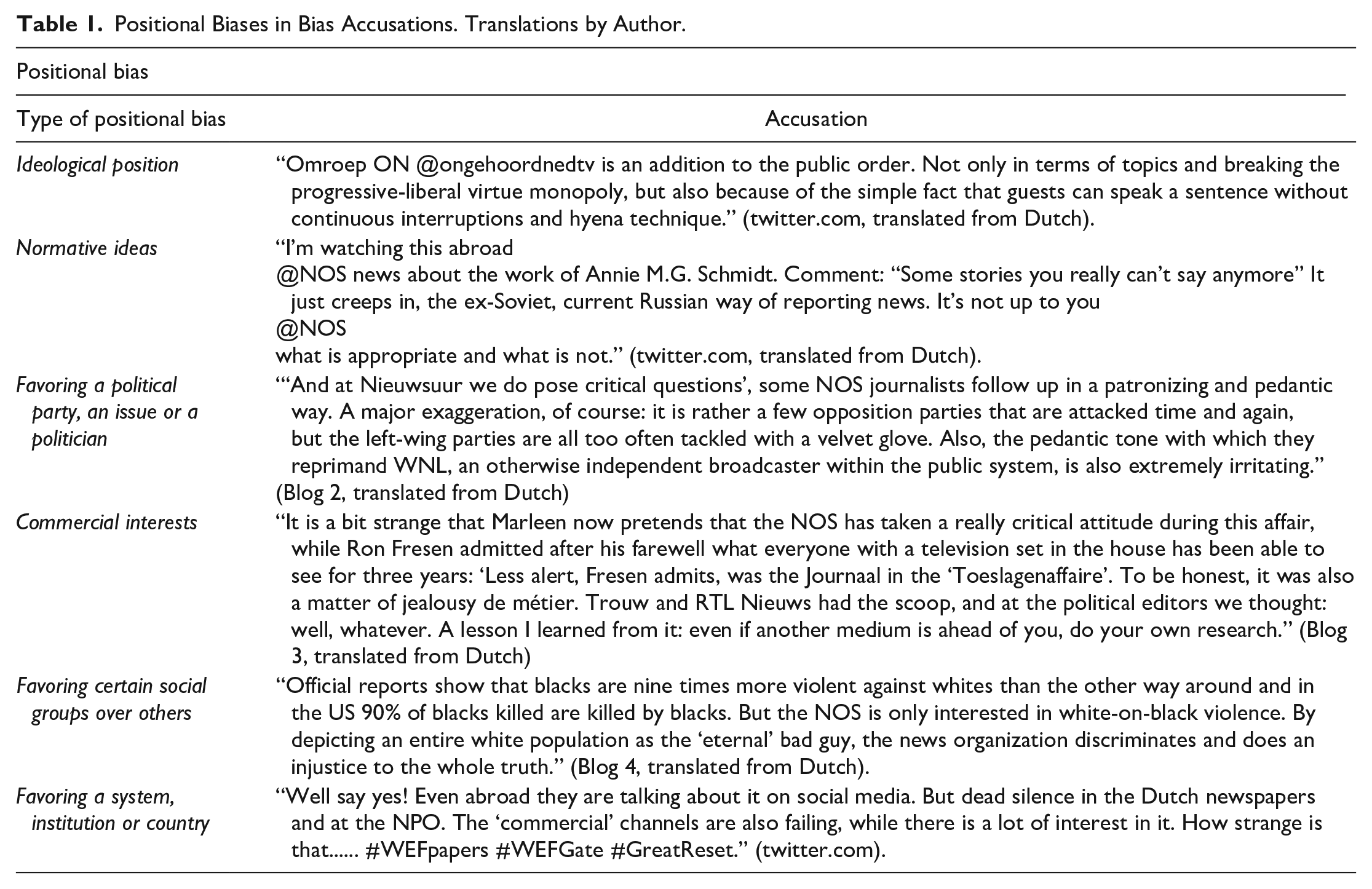
For example, the following tweeter seems to perceive the NPO to have a positional bias toward the leader of the extreme-right party Forum for Democracy, Thierry Baudet:
Anyone who listened to @NPORadio1 this morning heard a group of journalists who could only cope with their sadness (result #PS2019) by comparing @thierrybaudet to the Nazis from the 1930s. A little pluralism would help @nposit. #electionresult. (Twitter.com, translated from Dutch)
Some accusations of positional bias also include perceived bias toward or against certain countries. The following example additionally accuses NOS to be favorably biased toward the Dutch state:
The trend of the broadcast was clear and it will come as no surprise that the finger was again pointed extensively at Russia and a channel like RT News was labeled as a state-paid fake news channel. Who pays for the NOS? Indeed, the state. Although a bit obscured by the name task broadcaster, but simply paid for with public money and managed with special orders from the government. (Blog 1, translated from Dutch)
An important observation is that these positional bias accusations seem to not be exclusively concerned with how such bias is manifest in news content, but are also directed at the NOS or NPO as institutions, portraying these as abstract and powerful entities. It underscores how bias in the eyes of the accusers is a politically charged and deeply ingrained phenomenon, more than is reflected in studies analyzing and measuring actual bias in news.
A second type of bias accusation is concerned with the framing of news. Academically understood, framing concerns how the selection and emphasis of certain aspects of stories or information make these aspects more salient to the audience that is exposed to them, and thereby influence public opinion (Entman, 2004). Hence, accusations of framing bias might signify the perceived influence of PSM on public opinion, even though Entman (2004) underscored that framing does not necessarily have to be driven by bad intentions, as it can also be done unconsciously (e.g., through editors’ routines). Within the accusations, however, we see that framing bias is perceived to be driven by the intention to steer opinion, as we interpreted from the following accusation:
But framing opponents is standard procedure at the NOS, as is also the experience of Brexit pacesetter and British politician Nigel Farage. He was described by nos.nl on May 10, 2019 as follows: “Many in Great Britain really hate him, especially those who want the British to remain in the EU. He oversimplifies the complexity of Brexit and regularly plays with the truth.” (Blog 5, 2019, translated from Dutch)
Many accusations tend to reflect a perception that information is presented in a selective way that conveys a particular opinion or perspective. Accusations are concerned not only with the portrayal of political actors, but also with a wide range of entities and dimensions, such as world- and day-to-day national events, social groups, political and policy issues. As Table 2 outlines, framing bias can have different manifestations, one of which is related to a positive or negative tone as illustrated in the following accusation:
American President Donald Trump is the prototype of what they hate in the NOS editorial staff: white, Christian, male, right-wing and pro-Israel. And unlike Muslim extremists or dictators, he does not murder editors. So pissing him off is harmless. When Trump comes to England for a state visit, NOS makes a big splash. The anti-Trump sentiment is proceeding step by step. (Blog 5, translated from Dutch)
Framing Biases in Bias Accusations. Translations by Author.
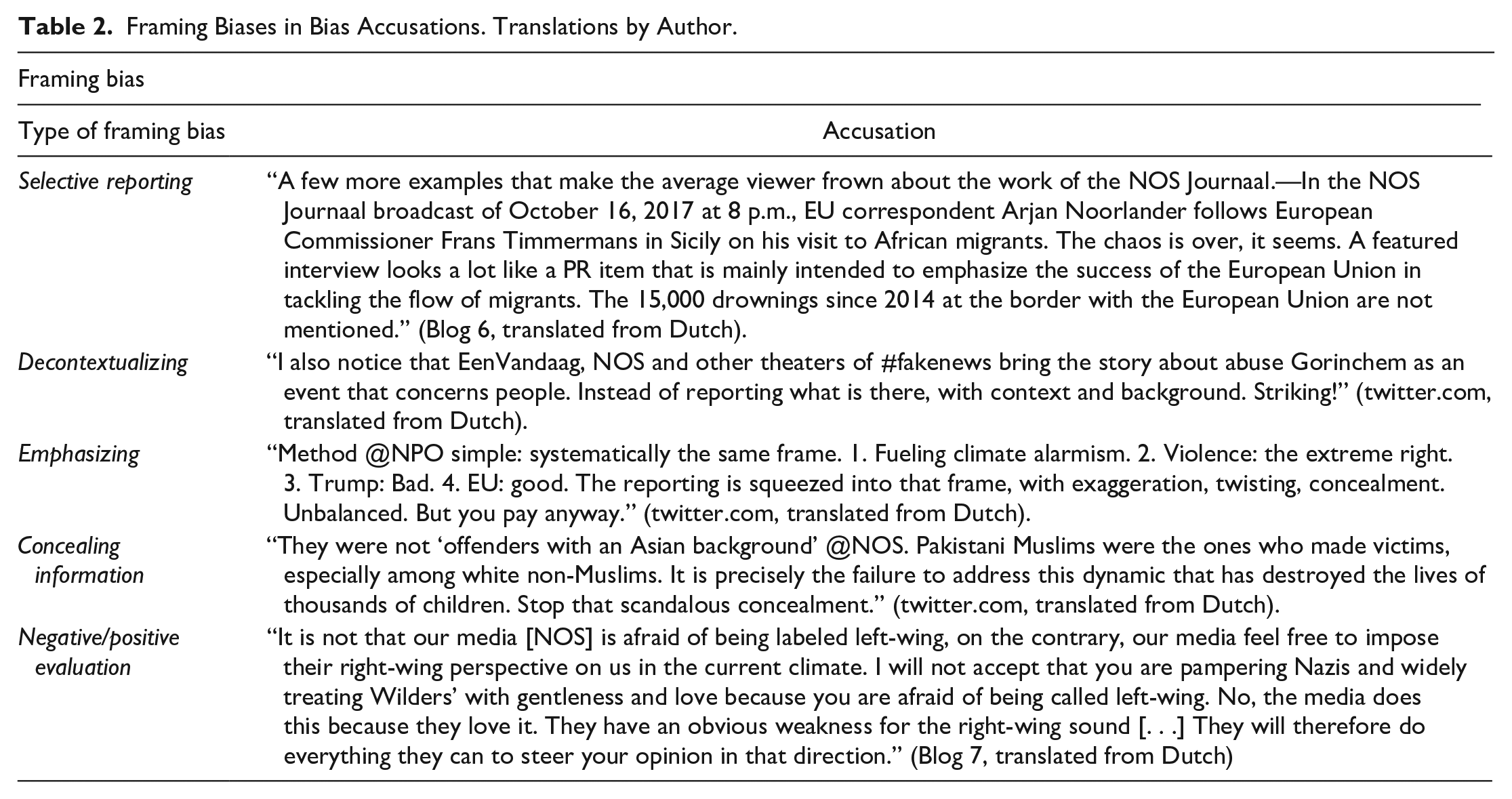
This latter accusation relates to “statement bias” as defined in the academic literature, which refers to specific political actors receiving a more positively or negatively toned media coverage (Brandenburg, 2005). As we derive from our analysis, accusations of framing bias are much broader: they relate to a perceived processes of selective reporting (based on journalists’ choice what to report on), emphasis (what elements in reporting are emphasized), concealment of information and decontextualization, often perceived through the use (or lack of use) of certain language and images. We find that many accusations directly refer to the actions that lead up to distorted news reporting, executed by the NOS, NPO, and journalists working there.
Finally, a third category of bias accusations focuses on information. Accusers highlight the perception of inaccurate information, particularly in the reporting of specific events or phenomena, as a form of bias. Related to but unlike framing bias, which involves the acts of deliberately altering, concealing, and spreading (dis)information, accusations of information bias focus on identifying incorrect information, manipulated facts, and withheld information in the content of news stories. This type of perceived bias pertains to substantive informational attributes as a type of bias. We argue this distinction is key, as it illustrates that although bias accusations regularly revolve around information, they are directed at different objects: both actual news content and the actors involved in news production. For example, in the following accusations it appears that the author refers to the presence of inaccurate information in news content, rather than directing their accusations directly toward the broadcaster or specific journalists:
The title of the piece at the RIVM and therefore also the NOS, does not cover the content in any way and is criminally misleading. An unsuspecting observer could easily think that a study has been conducted showing that the HPV vaccine is safe. That is not true at all, because no such research has even been conducted. (Blog 8, translated from Dutch)
Table 3 demonstrates the diverse manifestations of information bias we derived from our analysis, including instances of hidden information or facts in reporting (such as omitted skin color of perpetrators), manipulated facts and information in news reports (such as altered facts about a politically charged topics like a pro-Gaza demonstration), or outright falsehoods (such as made-up stories about Trump). Accusers argue that the presence of these deviations from presenting information in a correct way result in a distorted representation of events or individuals, ultimately harming their in-group (or groups to which they feel politically or socially close).
Information Biases in Bias Accusations. Translations by Author.
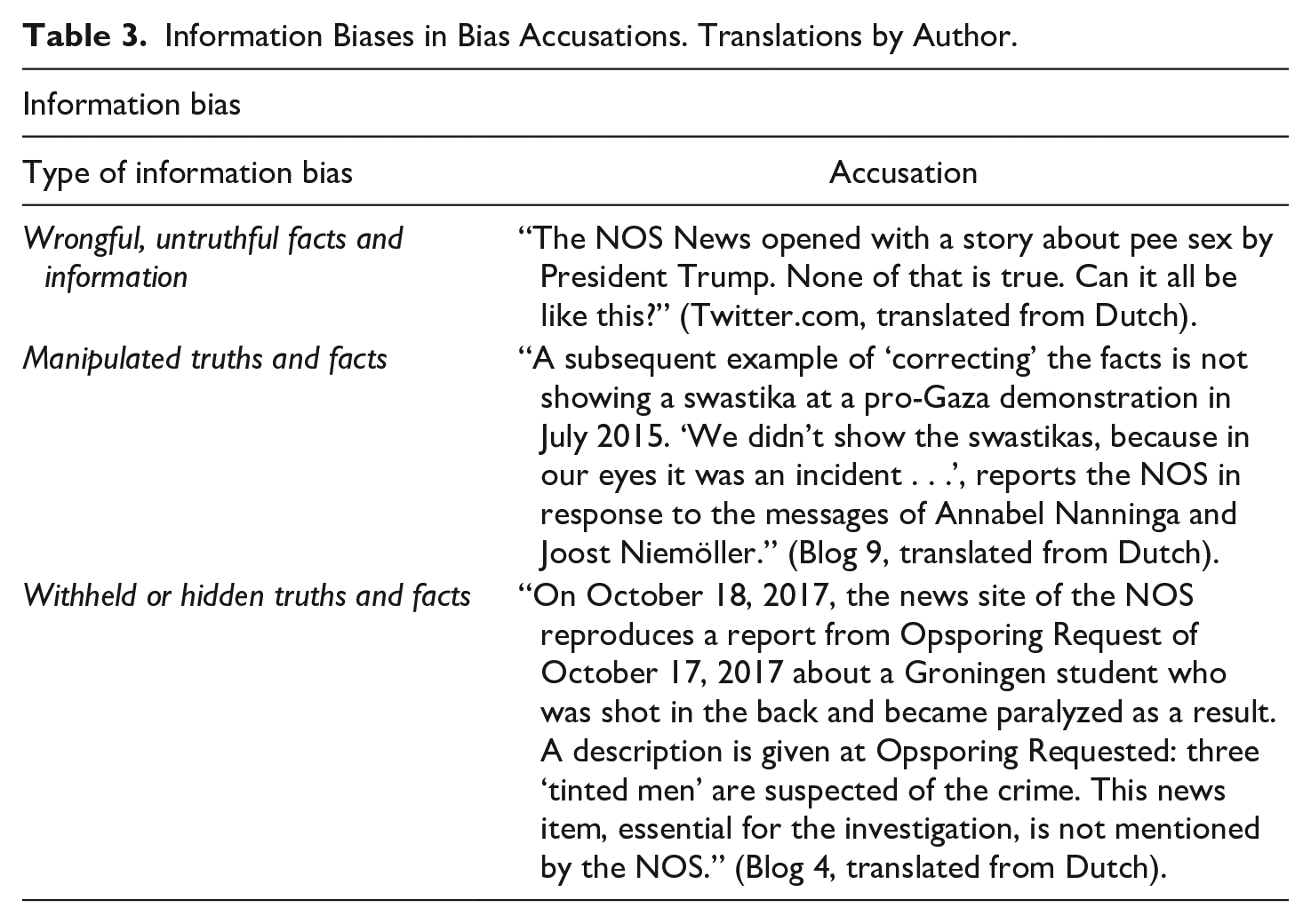
Our analysis thus reveals three dominant types of bias accusations, related to positional, framing, and information bias.
6
These types of accusations may co-occur, but are distinct as they refer to different aspects of a statement. Positional bias focuses on the perceived position of the NOS (e.g., NOS is associated with a certain political or social group), framing bias focuses on the way in which information is presented (e.g., NOS is accused of selectively presenting information, or using specific words that convey a certain outlook), and information bias focuses on the veracity of the information that is presented. In some cases, statements reflect multiple dimensions at once, as, for instance, in the following accusation:
Hilarious! NPO will now moralize for an hour about Russia and Russia Today that “distort reality.” Of course, the media cartel would NEVER do something so terrible to us. After all, that obviously always proclaims the one, absolute and infallible truth. (Twitter.com, translated from Dutch)
In the statement, the accuser mocks the NPO for proclaiming to hold “the one infallible truth.” Through this mockery, the accuser rejects what they perceive as the NPO’s arrogance in claiming to possess the “only truth.” They counter the assertion that Russia supposedly distorts reality by implying that the NPO itself exhibits framing and information bias. In addition, the accusation holds an implicit allegation of the NPO “moralizing” against Russia, hence having a positional bias against Russia, and signifying group-division between us, “The West,” and “them,” Russia.
This finding that dimensions of bias often co-occur is illustrative of a more general point: only a minority of bias accusations is a specific criticism on one specific instance or dimension of news coverage. We found little evidence of constructive discussions about specific instances of bias. Rather, accusations are charged with a perceived intentionality of the institutions or actors involved in the production process. Such accusations are part of a politicized perception where institutions themselves (NOS, NPO, and their journalists) are placed on one side of a political or social divide. The way in which PSM are associated with particular divides, and how this relates to the position of the accuser, is discussed in the next section.
Bias: In the Eye of the Beholder
To be able to provide a comprehensive answer to the overarching question of how bias accusations toward PSM are constructed in online discourse, we were attentive to the source of the accusations (the “accuser”), and how these sources perceived the direction of the bias(es). We find that bias accusations are voiced by actors from across the political spectrum, as sources can be classified as left-wing/progressive, right-wing populist, and politically centrist or “neutral.” This section maps out distinct features of bias accusations for these ideological affiliations, and explores how the debate about bias is situated within the political landscape.
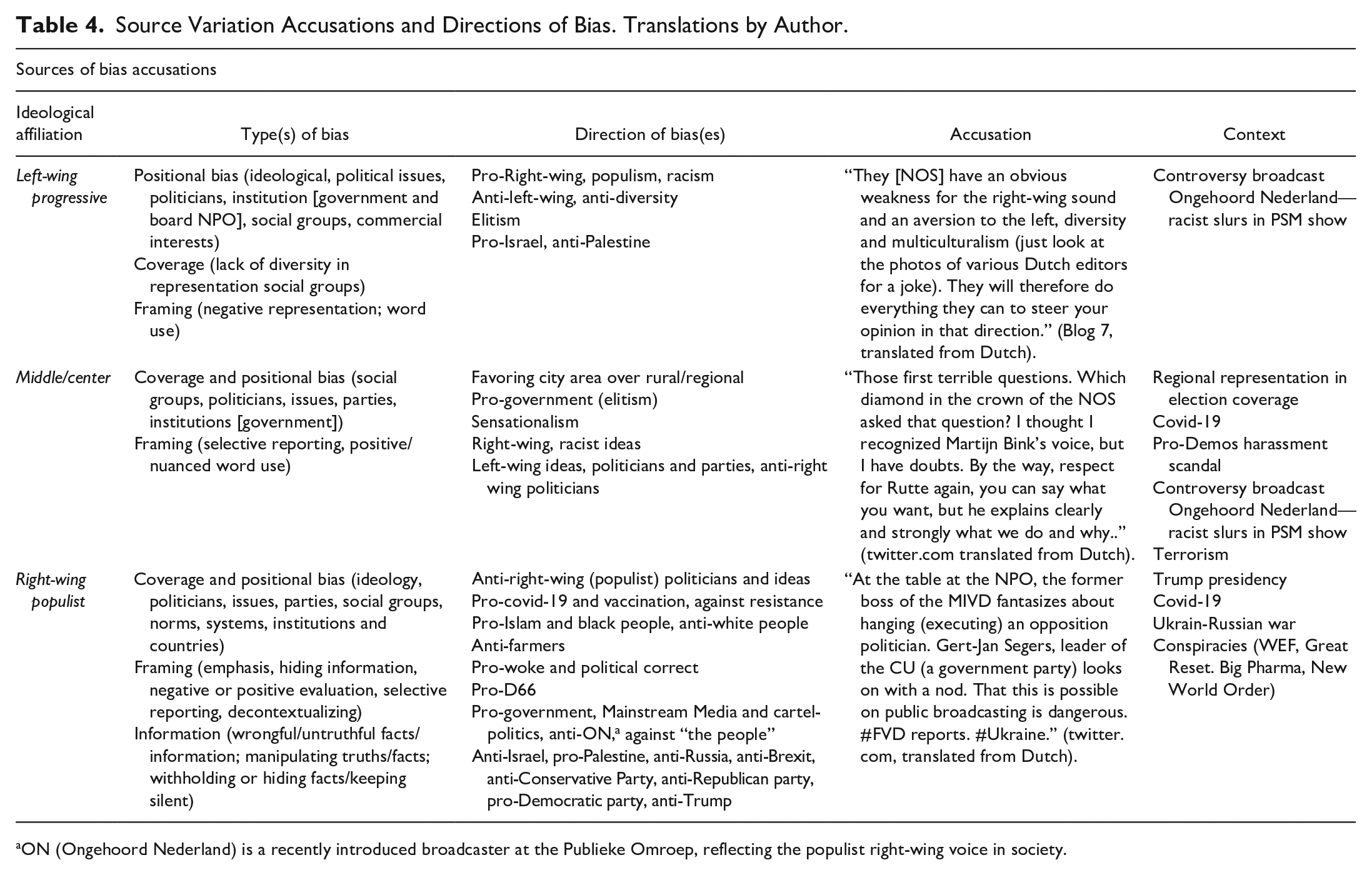
Accusations voiced by left-wing or progressive actors signal a bias of the NOS toward right-wing (populist) politicians and ideas, as well as a bias perception in how the NOS and NPO accommodate the broadcasting of racist ideas and slurs. As presented in Table 4, left-wing/progressive accusations focus on smaller day-to-day incidents as well as foreign conflict and world politics. An example is when new broadcaster Ongehoord Nederland (as part of NPO) showed controversial videos perpetuating harmful stereotypes and discriminatory images of Black people. Accusers from the left/progressive side of the spectrum accused the NOS and NPO of facilitating or excusing racism, as is apparent from the following tweet: “What do you mean with these quotes? @NOS? What needs to happen before you call racist behavior racist?” (Twitter, 2022, translated from Dutch).
Source Variation Accusations and Directions of Bias. Translations by Author.
ON (Ongehoord Nederland) is a recently introduced broadcaster at the Publieke Omroep, reflecting the populist right-wing voice in society.
Other accusations include perceptions of the NOS taking a pro-Israel and anti-Palestine position, such as in the following example:
Or take Israel’s illegal occupation of Palestine. The NOS makes no secret of the fact that it has no interest in the fate of the occupied victims. On the contrary, she expresses the Israeli voice again and again, quotes Israeli sources when they once again cause a massacre with bombs and grenades and, last but not least, the NOS almost always refers to this as “retaliation for” or “defense against terrorism” from the Palestinian side. (Blog 7, translated from Dutch)
More generally, left-wing/progressive accusations point to anti-pluralist and anti-progressive bias (hindering progressive and left-wing voices to be visible), as well as favorable bias toward elites (particularly toward the cabinet). In sum, among accusers from the left, dominant accusations focus on positional bias, and claim there is unbalanced representation in coverage, as well as a framing bias through use of negative language in news reporting.
Accusations coming from the (populist) right are by far the largest discourse, comprising various accusations. This discourse tends to be directed toward more abstract entities, such as power structures and institutions, portraying the news media as pursuing political agendas and being part of an evil elite complex, in line with what many have distinguished as typical for a populist right-wing discourse toward media (Egelhofer et al., 2021; Mudde, 2004). For example, in the following accusation, the NOS is perceived to promote the agenda of Dutch liberal-progressive party D66:
If the public broadcaster uses public money to make a pro-D66 documentary shortly before the elections, then the elections have been unlawfully influenced and that is all the more reason to call new House of Representatives elections! #kaaggate #witch party #D66 #elections. (twitter.com, 2021, translated from Dutch)
Accusations extend to different dimensions of positional bias (ideological, politicians, political issues and parties, social groups, norms, systems, institutions, and countries) and are found in different directions (bias against right-wing politicians, Russia, and Trump; or bias in favor of Covid-19/vaccination policies, and in favor of “woke”/progressive ideas, such as climate change and the Black Lives Matter movement, and the social-liberal party D66). Apparent is also a perception of how the NPO and NOS are intrinsically anti-White and pro-immigration:
Muslim attacks Westerners. NPO/MSM: “Islam is peaceful. Let’s not let all Muslims . . .” Nazi attacks on Muslims. NPO/MSM: “WIERD DUK THIERRY BAUDET GEERT WILDERS DONALD TRUMP BREXIT RACISM WHITE PEOPLE EXTREME RIGHT HATE SPELLERS.” (twitter.com, 2019, translated from Dutch)
Right-wing populist accusers tend to perceive various intentional framing- and information biases, and provide examples as “evidence” to support these claims. Notably, accusations of information bias were exclusively found in right-wing populist accusations.
Directions of accusations coming from actors at the center tend to be less politically constrained. We see no clear pattern in the perceived directionality of bias here. These accusations overall appear to be less politically charged, and rather focus on, for instance, poor journalistic quality or a lack of diversity. These accusations mostly relate to salient topics, such as integrity scandals, the farmers protests, and Covid-19. Overall, we see that these accusations often revolve around a sentiment of the NOS lacking a critical appraisal of government functions, for example, in cases of mismanagement, scandals, or malpractices.
Two general findings stand out when considering the directionality of bias accusations in combination with source characteristics. On one hand, bias accusations tend to be heterogeneous in the social and political groups and objects they refer to. On the other hand, it is remarkable how easily multiple societal divisions seem to be merged into a singular political ideological divide. For example, radical right accusers tend to perceive a bias against right-wing politicians and ideology, while perceiving the NOS and its news content to be biased in favor of a “woke”-culture, the incumbent government, and the social-liberal party D66. Similarly, left-wing accusers perceive a pro-right-wing ideological bias in combination with racist and anti-diversity biases as well as stances in internationally politicized conflicts (Israel–Palestine war). Hence, perceiving bias in PSM is not just limited to disfavoring one’s immediate in-group (for instance, Black people perceiving bias against Black people), but it also extends toward perceiving bias against other societal groups that appear to be associated with one’s political alignment.
Conclusion and Discussion
Debates surrounding PSM can be heated in contemporary democracies. The purpose of this article was to understand how bias accusations against PSM are constructed. To this end, we conducted a qualitative content analysis of politicians’ and opinion leaders’ tweets and opinion blogs containing accusations against Dutch PSM between 2017 and 2022. We discuss here the main findings and implications of our study, as well as suggestions for further research.
First, bias accusations toward PSM are a phenomenon of their own. Our analysis demonstrated that bias accusations are centered around information (information and framing bias) and representation (positional bias). The former concerns the veracity of news content, and relatedly, information-distorting actions by actors involved in the news production process. The latter relates to the amount of attention to viewpoints, ideologies, actors, issues, and social groups in news content in combination with a perceived political position of PSM in news reporting. While these dimensions contain elements of academic definitions of media bias (especially agenda and statement bias), our analysis makes clear that these existing definitions do not suffice to fully understand and describe bias accusations.
First of all, positional bias accusations point to the presence of political agendas and narratives that deliberately shape the direction of news content in ways that go beyond simply overrepresenting certain topics (as in the original definition of “agenda bias”). Second, accusations of a negative or positive tone of news content (“statement bias” in studies of actual media bias) represent only one aspect of framing bias, which more broadly refers to processes of selective reporting, emphasis, concealment of information, and decontextualization, often perceived through the use of certain language and images. Third, accusations of information bias directly focus on the presence of disinformation in news content. This is distinct from accusations of framing bias, which focus on actions and processes leading to a distortion of reality in the news. Both framing and information bias are connected to the larger literature on accusations involving disinformation (Egelhofer & Lecheler, 2019) as well as to literature on quality criteria of journalism and media (McNair, 2012). While both information and framing bias are related to the importance of accuracy of information as a quality criterion for both journalism and traditional media (McNair, 2012, p. 84), we argue that this quality criterion of information accuracy in news does not grasp the perceived intentionality that is present in information and framing bias accusations. Rather than a simple concern with the veracity of information, accusations of framing and information bias appear driven by perceptions of an intentionality regarding information distortion practices as well as the presence of disinformation in news.
Relatedly, this perceived intentionality in bias accusations is the second takeaway of our study. Specifically, we found that across our sample, bias accusations were not constructive in nature at all. The idea that PSM consciously and deliberately (dis)favor groups in society comes back in framing, information, and positional bias accusations, and refers to both actual news content and (people working in) PSM institutions. This suggests that accusers identify clear responsibilities for the alleged bias. While our study highlights the delegitimizing components of bias accusations that likely contribute to undermining trust in media, it is equally important to consider that collectively bias accusations may also have a democratic function that is more similar to the constructive form of media criticism. For example, sometimes journalists as members of society may inadvertently provide means to events from a perspective that has long been dominant politics and society (see Bennett et al., 2006, pp. 468–469). In such cases, calling out bias serves to give voice to minorities and challenge potentially discriminating views. Bias accusations can therefore contribute to upholding liberal democratic values in a society.
Our analysis further suggests that bias accusations come from various ideological sources and refer to a variety of social and political divisions. Specifically, perceived biases go beyond immediate in-groups, and extend to biases against other societal groups that appear to be aligned with one’s political orientation. It shows the deeply political and unspecific nature of bias accusations, as accusers tie together various biases and group divides into one larger criticism of a biased PSM. Our finding that bias accusations against PSM reflect perceptions of underrepresentation in news content of various social and political groups aligns with research on the HME, which has consistently found that political identities drive perceptions of media bias, particularly in terms of partisanship (Feldman, 2011; Perloff, 2015) in the U.S. bi-partisan context, and for more politically branded outlets (Kim & Grabe, 2022). Our finding that group divides seemingly shape perceptions of bias in PSM calls for further research on hostile media perceptions in the context of PSM. Recent research suggests that hostile bias perceptions extend to other public institutions (Yair, 2021), and accusations toward PSM seem exemplary of this development. There is a puzzling tension between, on one hand, the neutral and pluralist functions of PSM in a democratic society—which would suggest that hostile media effects should be minimal—and the here found bias accusations, on the other, which align with a broader criticism toward mainstream media (Egelhofer et al., 2021; Hameleers, 2020; Hameleers & Minihold, 2022).
These findings are remarkable against the backdrop of PSM’s dual function in democratic societies (Bos et al., 2016; Cushion, 2012). As PSM aim at establishing a shared public space and presenting factual news along with balanced representations of various perspectives on societal issues (Cushion, 2012), strong perceptions of an intentional tendency to present a one-sided view is worrisome. Also, disinformation accusations challenge the notion that PSM are expected to provide democratic citizens with accurate information. Similarly, accusations that PSM intentionally disfavor certain groups in society puts the normative expectation of pluralism and ensuring balance in news reporting under pressure (Cushion, 2012). Clashing normative expectations and perceptions of the functioning of these institutions might result in declining legitimacy of PSM, and contribute to increasing polarization, as institutions that shape democratic society’s common ground become part of partisan divides.
These challenges faced by PSM cannot be viewed independently of the digital environment in which they operate. While social media provide opportunities for PSM to reach more and varying audiences (Donders, 2019), online environments such as partisan websites and social media platforms also enable the spread of disinformation and more extremist views (Van Aelst et al., 2017). These are often in line with an antagonistic populist worldview toward established democratic institutions (Sehl et al., 2022, pp. 16–18; Van Aelst et al., 2017), and generally enjoy less trust among citizens (Horowitz et al., 2022, p. 846). In this respect, our findings show that the digital sphere provides a beneficial environment for voicing bias accusations. As shown by earlier studies (e.g., Sehl et al., 2022), bias accusations toward PSM are on the rise in countries such as Austria, Germany and Sweden. To better understand these dynamics in the digital public sphere, future research should distinguish bias accusations voiced by different actors (politicians vs. opinion leaders) and on different platforms (social media vs. online blogs). This is particularly important as politicians can be held politically accountable for their communicative behavior, while online bloggers may not be subject to (much) public scrutiny as long as they communicate in a civil and lawful manner. Likewise, social media platforms must adhere to the European Union’s Code of Conduct on Countering Illegal Hate Speech Online and are therefore closely monitored in Europe (European Commission, 2019), while online blogs may go unnoticed by regulatory bodies. These differences may also show in the variety of types of bias accusations by these different actors.
This study provides a preliminary exploration of bias accusations toward public media in the public debate, aimed at developing a theoretical categorization of bias accusations. We recommend using this typology to analyze the variety and presence of accusations quantitatively to further differentiate actors, to map changes over time, and to understand factors contributing to bias accusations by comparing different contexts and countries. While we focused on the Netherlands, similar types of bias accusations likely exist across Europe. Many countries, such as the United Kingdom and Germany, have comparable public broadcasters that are also increasingly subject to public criticism and bias accusations (e.g., Holtz-Bacha, 2021; Kleis Nielsen et al., 2023). In Slovakia, we have even seen the abolishment of the public broadcaster by the current populist government (BBC, 2024), further underscoring how PSM across Europe are currently under pressure. More systematic cross-national comparisons could assess the contextual factors explaining the prevalence and type of bias accusations in the public debate. We hope that our insights provide researchers with a valuable theoretical foundation in this respect.
Indeed, the nature of bias accusations as uncovered by our study points to several potential contextual explanations. First, the presence and amount of populist actors may be positively associated with more numerous and harsher accusations. In the Dutch context, we find strong conspiratorial, deceptive, and disinformation perceptions among the more populist radical right-wing sources. Scholars have often established the paradoxical relationship that populists have with established media: they depend on media attention to reach their audience, yet simultaneously undermine these outlets by accusing them of bias across multiple European countries (Holtz-Bacha, 2021, p. 223). Second, levels of polarization are likely to play a role; we find that bias accusations reflect in-group/out-group dynamics, which may mirror higher levels of political and societal polarization (Iyengar et al., 2012).
An investigation into possible antecedents and conditions would help researchers to devise recommendations to public broadcasters, and journalists in particular, to counteract bias accusations. With regard to information and framing bias, ensuring transparency of the news making process can potentially contribute to increased trust in journalists and outlets, and enhanced engagement with news, which could mitigate misinformation perceptions (Curry & Stroud, 2021). Positional bias accusations, on the other hand, address a more complex issue, namely the difficult and subjective question of what balanced news exactly entails, as it touches upon who gets represented and to what degree (Entman, 1989; Rietdijk & Archer, 2021). To address such perceptions of positional bias in the future, we recommend shifting the focus from stakeholder accusations to citizen perceptions. Earlier studies have shown that bias accusations increase perceptions of media bias (Watts et al., 1999) and negatively affect attitudes toward media (Brosius et al., 2022). Experimental studies could thus assess how different types of bias accusations influence citizen perceptions and attitudes toward PSM.
PSM can play a crucial role by securing accurate information provision in an age of informational disarray (Horowitz et al., 2022, p. 844). To play that role, legitimacy of PSM in the eyes of citizens is a necessary precondition. The variety of accusations we uncovered suggests a potentially broad appeal of bias accusations among the public. Further research is needed to assess the impact of bias accusations on public perceptions of bias in media content, and ultimately on the legitimacy of PSM as public institutions.
Footnotes
Appendix
Coding Guide for Analyzing Bias Accusations.
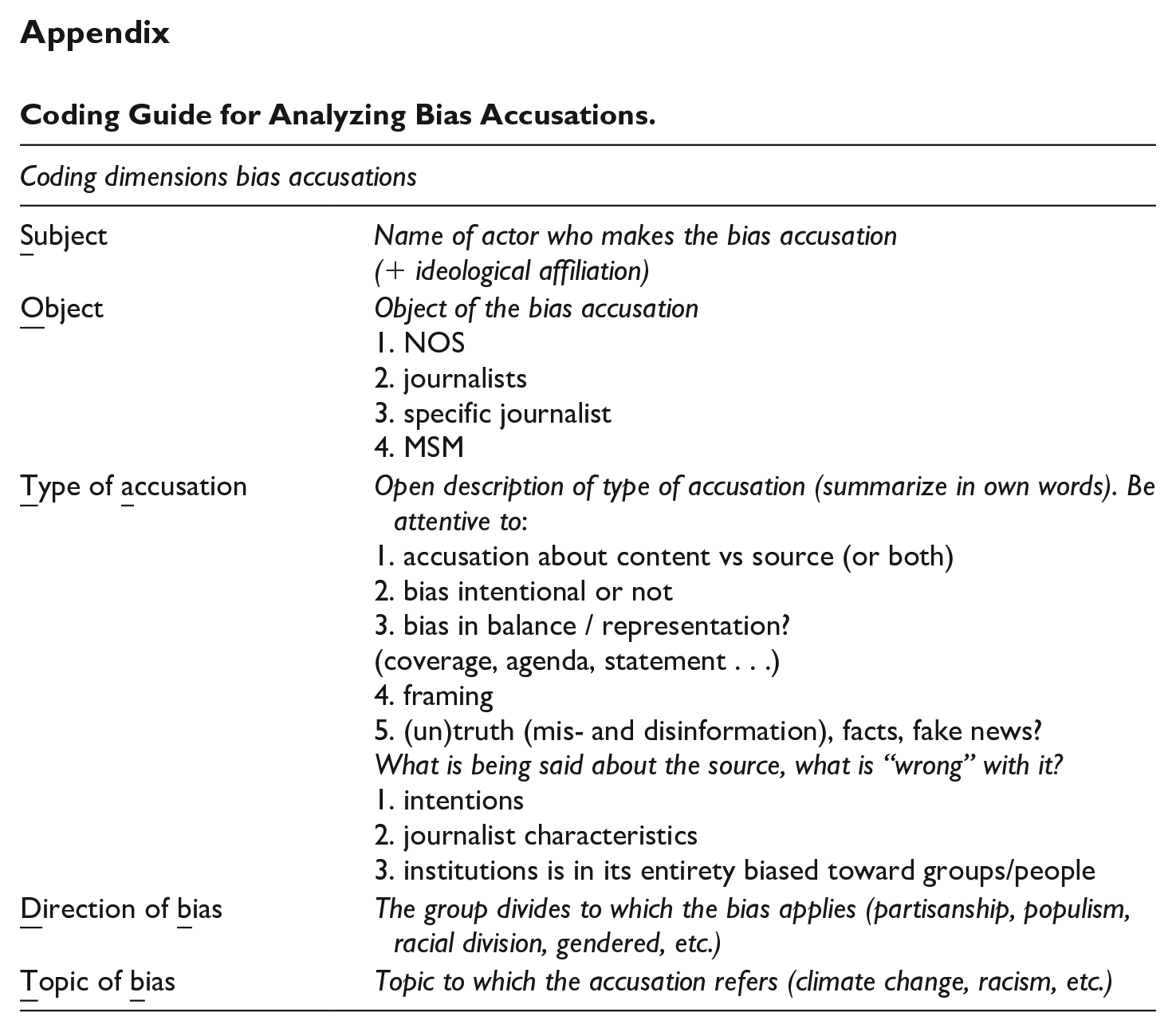
| Coding dimensions bias accusations | |
|---|---|
|
Name of actor who makes the bias accusation
(+ ideological affiliation) |
|
| Object of the bias accusation
1. NOS 2. journalists 3. specific journalist 4. MSM |
|
| Open description of type of accusation (summarize in own words). Be attentive to: 1. accusation about content vs source (or both) 2. bias intentional or not 3. bias in balance / representation? (coverage, agenda, statement . . .) 4. framing 5. (un)truth (mis- and disinformation), facts, fake news? What is being said about the source, what is “wrong” with it? 1. intentions 2. journalist characteristics 3. institutions is in its entirety biased toward groups/people |
|
| The group divides to which the bias applies (partisanship, populism, racial division, gendered, etc.) | |
| Topic to which the accusation refers (climate change, racism, etc.) | |
Declaration of Conflicting Interests
The author(s) declared no potential conflicts of interest with respect to the research, authorship, and/or publication of this article.
Funding
The author(s) received no financial support for the research, authorship, and/or publication of this article.