



Abstract
This study tracks the affective agendas in the media’s portrayals of the nonverbal behavior of the 2016 presidential candidates, and then shows how these media portrayals are related to voters’ emotional valence. It also gauges the relationship of disgust to voting intention, comparing it with anger, fear, hope, and pride, as well as other established demographic predictors and party affiliation. Findings show that valence-based emotions as conveyed via candidates’ nonverbal behaviors are associated with viewers’ emotional valence; that is, emotional-affective agenda setting has occurred. It also demonstrates that disgust predicts vote choice as well or better than anger and fear.
The study of emotion in politics has produced a stream of research fruitful for understanding why people make the election choices they do. In the decades since rational voter models were largely set aside in recognition that emotions and cognitions intersect to affect political decisions (Marcus, 2000), much research has explored discrete emotions, with anger, fear, hope, and pride being particularly prominent (Marcus, 2000). Linking emotions with the way people learn about politics is media agenda-setting theory, specifically, its affective level (McCombs & Valenzuela, 2021). When the media’s affective agenda is transferred to the public, leading people to feel the same way about the candidates and issues as the media have portrayed them, affective agenda setting occurs (Coleman & Wu, 2010; Miller, 2007). Most of what we know about agenda setting and affect is based on verbal rather than nonverbal messages, which is the primary way emotions are conveyed and affective agendas transmitted. This study addresses that gap.
The purpose of this study is to synthesize and integrate agenda-setting theory and affective intelligence theory (AIT) into one cohesive model, which we then test. This study proposes a theoretical model where the nonverbal behaviors of candidates as portrayed in the media influence people’s emotions, which, in turn, leads to people voting in line with those feelings. We test how emotional-affective agenda setting can influence voting behavior through the processes of affective intelligence in a sequential way. We further show how one understudied discrete emotion—disgust—can be more influential than the emotions currently studied in AIT.
The need to understand emotion in politics has increased since 2016, with more voters experiencing emotions (Valentino et al., 2018) that were infrequently reported in previous elections. One discrete emotion was unusually prevalent in 2016—disgust. Polls showed voters reported feeling disgusted with both candidates (Bunton, 2016), especially Donald Trump as many aspects of his campaign keyed on disgust-invoking themes, for example, his references to Hillary Clinton’s bathroom break, challenger Marco Rubio’s sweat, blood coming out of female TV commentators, and calling others filthy, disgusting, and nasty (Hurst, 2015). Given the renewed importance of disgust since 2016, a more comprehensive account that includes this emotion is needed to explain the influence on voting intention.
This study is situated at the intersection of two theories: affective agenda setting, which explains how the media transfer affective attributes to the public (McCombs & Valenzuela, 2021), and AIT, which focuses on how emotions shape the public’s political thinking and behavior (Marcus et al., 2000). In this study, we connect affective agendas, emotional valence, and voting decisions. This study employs two research methods to first track the affective agendas in the media’s portrayals of the nonverbal behavior of the candidates via a content analysis, and then uses a survey to connect how these media portrayals are related to voters’ emotional valence and voting. It then drills down from emotional valence into discrete emotions to explore the emotion of disgust and gauge its relationship to voting intention via the survey. 1 It compares the importance of disgust on voting choice to anger, fear, hope, and pride, as well as other established demographic predictors and party affiliation.
This study builds on existing literature showing emotional valence is a form of affective agenda that is distinct from candidate evaluations (Coleman & Wu, 2010). Kiousis and McCombs (2004) demonstrated that affect exerts a more powerful agenda-setting effect than cognition and character trait assessments. Coleman and Wu (2010) showed the media can transfer affective agendas to the public via candidates’ nonverbal behavior—defined as facial expression, gesture, and body language that transmit messages without words (Ambady & Rosenthal, 1993). Thus, nonverbal behavior is considered an attribute of candidates and an evaluative component on the affective dimension. Facial expressions are a “key component of political communication” (Stewart et al., 2011, p. 166), which people use in voting decisions (Olivola & Todorov, 2010).
This study contributes to theory by demonstrating whether the media have a valenced emotional-affective agenda that is conveyed nonverbally, then seeing whether that agenda transfers to viewers, and finally, how it predicts voting. It expands our understanding of emotions by including the potentially relevant discrete emotion of disgust (Choi et al., 2021), and comparing it with four other emotions prominent in AIT.
Literature Review
Agenda Setting
Media agenda setting is the theoretical proposition that the news media display certain objects more frequently and prominently than others, which results in audiences perceiving those as more important. While the first level of agenda setting focuses on issues, the second level, also known as affective agenda setting, focuses on the qualities and characteristics, or attributes, of people and issues (McCombs & Valenzuela, 2021). This typically includes tone—positive, negative, or neutral—and, in the case of people, their character traits. For example, candidates may be portrayed as competent, caring, or honest. Much research has shown that the media cover some candidates more positively than others and this affective agenda is transferred to the public, which adopts it and assesses candidates in line with the way media portray them (Hyun & Moon, 2016). This level of agenda setting’s theoretical mechanism differs from the issue level in that it influences people’s perceptions in ways that are not just cognitive, but also affective (Kiousis et al., 1999).
Research has expanded agenda setting’s definition of affect beyond tone and character traits to include the concept of valenced emotional-affective agendas, defined as the positivity or negativity of feelings audiences have about people in the news that correspond to the nonverbal displays of the people portrayed (Coleman & Wu, 2010). Rather than relying solely on verbal information to form evaluations about candidates, voters also determine their affective impressions of them by using their visceral feelings. Gestures and facial expressions of people in the news fit the definition of attributes in that they are properties, aspects, or characteristics of an “object,” in this case, a person (McCombs & Evatt, 1995). When a media outlet has an “agenda” in that it displays some attributes more frequently and prominently than others, these become salient in audiences’ minds and influence their attitudes. People derive these feelings through the candidates’ nonverbal displays as conveyed by the media as well as through written and spoken content (Shah & Hanna, 2016). Affective agenda setting should occur when the way the media portray candidates’ emotional valence is transferred to viewers. For example, if a news channel consistently portrays Trump’s negative expressions and gestures that arouse negative emotions in its viewers, then emotional-affective agenda setting has occurred. This theoretical addition captures one of the main conceptual dimensions of the affective level, which includes emotional valence via attributes such as candidate appearance (McCombs et al., 1997), resulting in a more complete understanding of affective agenda setting. As this is the least understood component of the theory, it is the focus of this study.
Nonverbal Behavior
Most research that incorporates the affective agenda has been conducted with verbal information. However, research on the media’s valenced emotional-affective agenda has found that the mechanism for this effect is visual information, specifically, affect-laden nonverbal communication (Coleman & Wu, 2010). Nonverbal communication is the most effective way of conveying emotions (Ekman, 1982). Viewers experience a range of emotions in response to politicians’ nonverbal displays in the media, even when they are subtle and last less than a second or are processed subconsciously (Stewart, Waller, & Schubert, 2009). Furthermore, nonverbal behavior has a stronger effect on viewers’ emotions than words or text (Stewart, Salter, & Mehu, 2009), and voters’ emotional reactions are more directly connected to political judgments when conveyed in visual compared with verbal form (González-Bailón et al., 2012).
We do not assert that emotional valence is conveyed solely by nonverbal means in the news; rather, words and visuals work in tandem along with people’s preexisting understandings of the world (Domke et al., 2002). For example, Trump’s remarks about Clinton’s bathroom break, “I know where she went; it’s disgusting,” accompanied by his facial expressions reinforce disgust in both visual and verbal modes. Yet, research has also shown that visuals are better than text alone at triggering considerations that spread to other evaluations, and that feelings are especially implicated (Domke et al., 2002). In addition, visuals are important primarily because of their ability to engender emotional reactions due to images being processed separately and prior to reasoning (Barry, 1997). For these reasons, this study focuses on emotional valence in the nonverbal behavior of the candidates as conveyed in television visuals. It follows previous research that operationalizes emotions as valence-based nonverbal behavior (Bucy, 2000).
With studies showing that even straight news shows—not just commentary and opinion—do indeed have agendas (Hehman et al., 2012), the nonverbal behavior of candidates can be a rich source for these valenced emotional-affective agendas. By portraying the nonverbal behavior of some candidates significantly different from others, the media transfer salient valenced emotional-affective agendas to viewers, thus generating agenda-setting effects (Coleman & Wu, 2010). As partisan media can lean left or right, this should be true of their visuals as well as text. The most applicable study to this one used computer vision techniques to study the 2016 presidential candidate’s visual attributes, including facial expressions (Peng, 2018). It found liberal news shows on MSNBC and CNN portrayed Clinton more favorably, conservative shows on Fox favored Trump, while NBC’s news show was neutral, showing each candidate about the same. This is in line with research on news visuals in other U.S. presidential elections (Coleman & Wu, 2015). Given this evidence, we believe news shows will portray the candidates’ valenced emotions in line with the news outlet’s ideological leaning. We use a content analysis to establish the fundamental process of agenda setting, which is that the media present a valenced emotional agenda conveyed by nonverbal behavior of the candidates. While this could be considered an assumption because so much research has confirmed that media have ideological agendas, in this case, less is known about visual agendas than verbal ones, and even less about the valenced emotional level than the issue and affective levels. In this nascent stage, it is important to establish whether media do indeed have valenced emotional-affective agendas in visual coverage. The hypotheses for Study 1, a content analysis, are as follows:
Study 1
Method
TV news content was gathered between September 2015 and Election Day 2016. We used four constructed weeks—four Mondays, four Tuesday, and so on—because of the longer time span (Riffe et al., 1993). Dates were randomly sampled. In 2016, 57% of Americans got their news from television (Mitchell et al., 2016).
We included four news shows, Fox’s Special Report with Bret Baier, CNN’s The Situation Room with Wolf Blitzer, MSNBC Live, and NBC Nightly News. This last show was used to represent all three networks because of high redundancy (Hyun & Moon, 2016). These were the same shows that we asked respondents about their use of. The unit of analysis was a single shot, defined as a visual fragment that contains no editing cuts (Giannetti, 1982). Shots that lasted four or more seconds were coded to increase accuracy (Rosenthal et al., 1979). We coded all the shots of each candidate that appeared on the dates that were randomly sampled.
Nonverbal behaviors are defined as posture, gestures, and facial expressions (Englis, 1994). Previously studied nonverbal behaviors that convey emotion and have been shown to be objective, valid, and reliable were coded—activity, posture, arms, hands, and eyes. To increase reliability and validity as discussed above, coders did not determine which discrete emotion the candidate showed; instead, they distinguished specific movements that were later rated positive or negative based on past research (Coleman & Banning, 2006; Moriarty & Garramone, 1986; Moriarty & Popovich, 1991; Stewart et al., 2009; Stewart & Ford Dowe, 2013; Sullivan & Masters, 1988). The movements were the following:
Activity
Dynamic behavior such as being animated, speaking, shaking hands, etc. (positive); or if subdued, listening, reading, writing, dozing (negative).
Posture
Standing tall, upright, or sitting straight (positive); bowed, slumped, leaning on something (negative).
Eyes
Candidate was looking up (positive), looking indirectly down, or away (negative); directly into the camera or at someone (positive).
Arms
Held up at shoulder height or higher (positive), held at the side, resting, or folded (negative).
Hands
Gesturing or doing something (positive); at side or at rest (negative) (see coding sheet in Online Appendix).
Additive indexes were created; all positive nonverbal behaviors formed one index and all negative nonverbal behaviors formed another. We calculated nonverbal means for each candidate on each program, which were later linked with media use in the survey (Table 1).
Nonverbal Mean Scores (SD) for Trump and Clinton for Four News Programs.
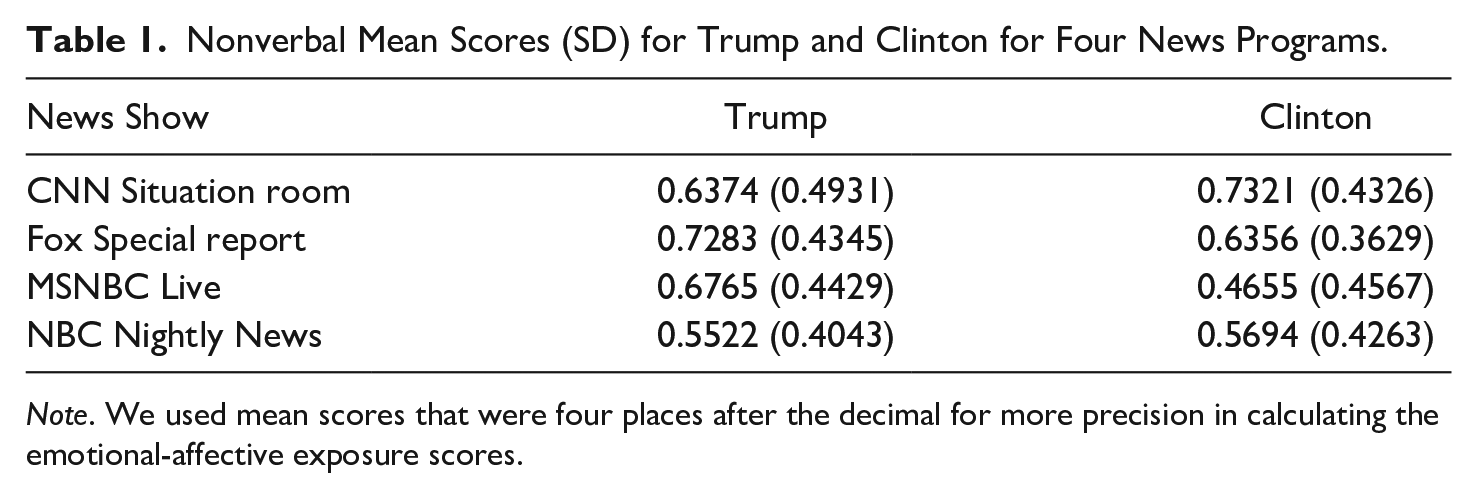
Note. We used mean scores that were four places after the decimal for more precision in calculating the emotional-affective exposure scores.
Two independent coders were trained for about 40 hr over 3 weeks on data not used in the analysis. Reliabilities on 20% of the shots using Krippendorff’s alpha were as follows: Activity = .780; Posture = .877; Arms = .848; Hands = .909; and Eyes = .808.
Results
The newscast sample generated 1,343 shots, with Trump receiving 64%, which was not a statistically significant difference (t = .077, df = 1,343, p = .939).
For the first hypotheses that news shows will portray the candidates in line with their ideological leanings,
Discussion
These findings show that TV news programs can have distinct visual agendas derived from the nonverbal behavior of candidates. Broadcasters at specific news programs are selecting video shots of candidates that show them at their best or worst, and the valence mostly aligns with the outlet’s partisan leanings. The only news show of four that did not align with our predictions was MSNBC Live. We can only speculate why the show’s visuals went against perceptions of the outlet as liberal, showing Trump positively. This could be a bend-over-backwards attempt at balance, like when Dan Rather, noted for his liberal views, made more positive facial expressions for Republicans in three presidential elections (Miller et al., 2007). Alternatively, it may point to a shift in MSNBC trending moderate (Blake, 2014) and even skewing right (Rosenberg, 2018). It illustrates why it is important to test assumptions when made in new contexts; in this case, news outlets that reliably skew according to their ideology in verbal content may not always do so with visuals.
Whether this bias in selecting visuals that favor the candidate aligned with a new outlet’s ideology is intentional or not, it represents a more subtle form of agenda than is typically studied. It is not plausible that one candidate was making more negative or positive expressions than the other. If that were the case, all the shows should be running more negative shots for the candidate making more negative expressions, and the candidate making more positive expressions should have more positive shots on all shows. Instead, some shows ran significantly more positive expressions for one candidate, while others ran significantly more negative expressions for that same candidate. This held true for both candidates. At the same time, one show ran neutral expressions for both candidates. Clearly, both candidates were making enough positive, negative, and neutral expressions for broadcasters to select the ones they wanted.
Next, we report on the second phase of this study—a public opinion survey—and link it to the content from Study 1 using the nonverbal means calculated for each candidate on each program in the content analysis.
Study 2
The second part of emotional-affective agenda setting is that the agendas conveyed in the news shows are transferred to the audience, resulting in viewers experiencing corresponding valence-based emotions. The way emotions flow in political communication is that “positive moods induce more positive judgments and negative moods induce more negative judgements” (Marcus, 2000, p. 230). Specifically, negative emotions result in avoidance because they are interpreted as threatening, while positive emotions stimulate approach behavior because they are rewarding. We predict
To test this, we conducted a public opinion survey to link the valenced portrayal of the candidates on TV as captured in the nonverbal means for each candidate in the content analysis, with voter’s media use.
Method
A custom survey recruited participants from Survey Sampling International’s panel of nationwide respondents, which allowed for a stratified sample representative of the U.S. population. It was conducted from October 24 to November 8, 2016, and resulted in 1,323 participants for a response rate of 68.9%. Items are as follows:
Media Use
How many days in the past week (0–7) respondents used each of the specific news programs (Fishbein & Hornik, 2008).
Emotional-Affective Exposure Score
We created a weighted variable of respondents’ exposure to the media’s valenced portrayals of candidate nonverbal behaviors as captured in the content analysis called an emotional-affective exposure score. We multiplied each respondent’s amount of use of the programs by the mean score of each candidate’s nonverbal behavior from each program. If a respondent watched more than one program, we added the scores and divided by the number of programs. This yielded scores for each respondent’s exposure to positive Trump content, negative Trump content, positive Clinton content, and negative Clinton content. For example, if a person reported watching CNN 1 day a week, their exposure score is weighted less than someone who watches 5 days a week. This also allowed for watching more than one news show, for example, if someone watched both CNN and NBC. By capturing the exact news program each respondent used and how many days in a week they used each program, the measure accounts for the effects of watching partisan channels.
Feeling Toward Candidates
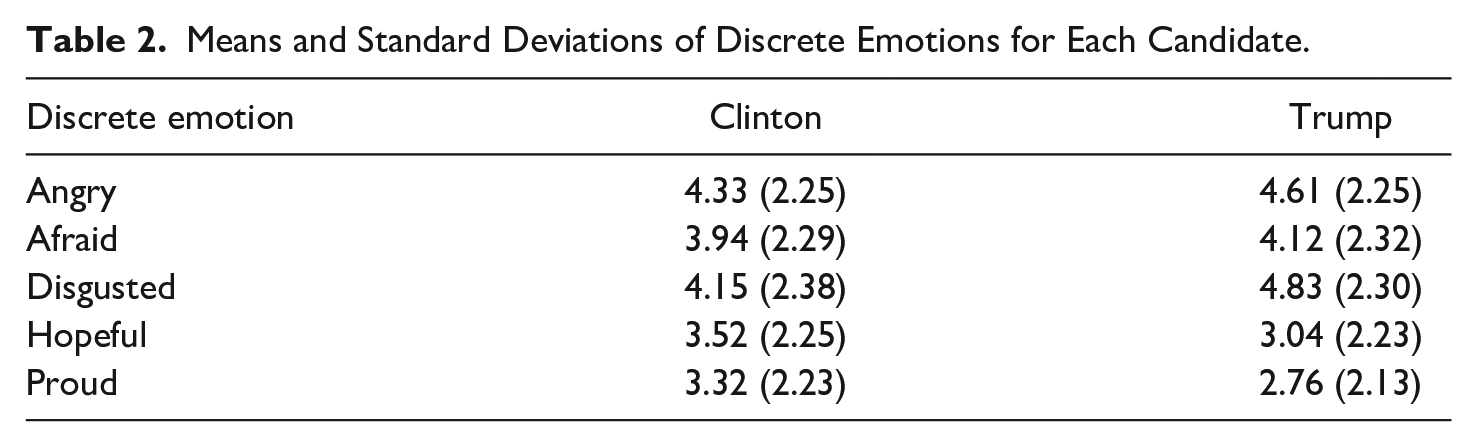
A question for each candidate, worded “How often has (candidate) made you feel?” followed by angry, afraid, disgusted, hopeful, and proud, measured on 7-point Likert-type scales (1 = never, 7 = extremely often). We combined these into positive and negative scales (Choi et al., 2021; Hoffmann, 2018; Matthes & Beyer, 2017; Negative: Trump α = .914, Clinton α = .936; Positive: Trump α = .959, Clinton α = .965; Table 2).
Means and Standard Deviations of Discrete Emotions for Each Candidate.
People’s affective impressions are a combination of processes (Marcus, 2000). Thus, any examination of emotions involved in voting decisions would be incomplete without other traditional predictors. In the above hypotheses, we control for party identification, age, gender, race, and education, to see the effects of the valenced emotional-affective agenda more clearly.
Results
Of the 1,323 survey respondents, 54% were female; 46% were 18 to 35 years old, 33% were 36 to 53 years old, and 21% were 54 or older; 65% were Caucasian, 12% African American, 8% Hispanic or Latino, .5% Native American, 4% Asian American, and 10.5% “other.” As to education, 2.6% had less than a high school diploma, 18.8% had a high school degree, 34.4% had some college, 28.4% had bachelor’s degree, and 15.8% had master’s or professional degrees. Republicans made up 29.6%, Democrats 42.6%, and Independents 27.8%.
Regressions of Emotional-Affective Agenda and Demographics on Valenced Emotions for Each Candidate.
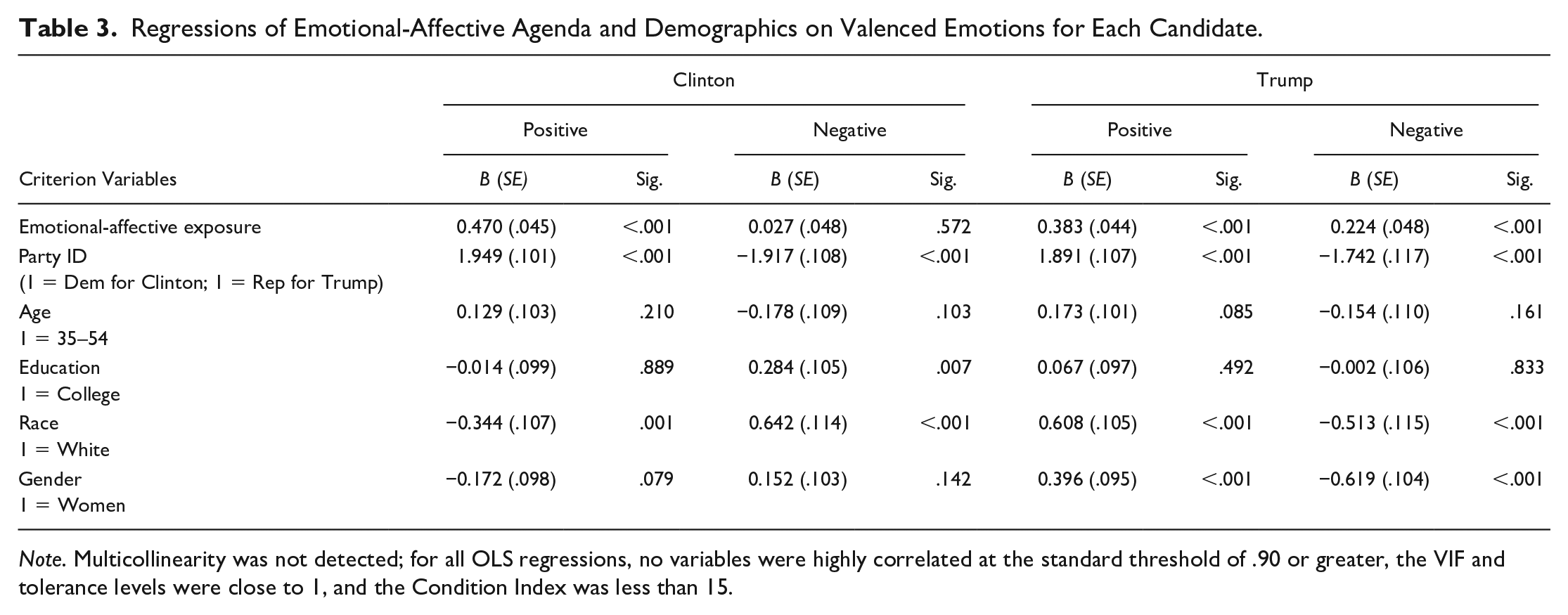
Note. Multicollinearity was not detected; for all OLS regressions, no variables were highly correlated at the standard threshold of .90 or greater, the VIF and tolerance levels were close to 1, and the Condition Index was less than 15.
Viewers who watched more news of Trump making positive nonverbal behaviors said he made them feel significantly more positive (B = 0.383, p < .001). This was also true when viewers watched more news of him making negative nonverbal behaviors; it made them feel significantly more negative (B = 0.224, p < .001). Republicans, Whites, and women (all p < .001) were significant covariates for both.
Discussion
The second contribution of this study to agenda-setting theory is that it shows the emotional valence candidates express via their nonverbal behavior mediated by TV visuals are transmitted to viewers; in other words, the transfer of salience from the media to the public occurs with valenced emotions displayed in nonverbal behavior as well as other candidate attributes displayed in the media. While affective agenda setting has been studied extensively with attributes such as character traits, it has not been studied with valenced emotions, especially through candidates’ nonverbal behavior. This research provides a much-needed addition to the theoretical propositions of affective agenda setting.
This is consequential as this study shows viewers do pick up on the positivity or negativity of emotions that the candidates display and that is related to their feelings toward them. When viewers watched news that showed Trump in a significantly negative light by virtue of the show’s selection of his nonverbal behaviors, they felt significantly more negative emotions toward him—saying he made them feel angry, afraid, and disgusted. This held true for positive portrayals of both Trump and Clinton predicting viewers’ feelings of hope and pride. These findings held even after controlling for party ID.
Only news that showed Clinton making significantly more negative nonverbal expressions was not predictive of viewers’ experiencing more negative emotions toward her. We have no evidence to explain this. Perhaps voters are not as affected by the ubiquitously negative coverage of women candidates (Falk, 2010) as they are by negative coverage of men, or that negative portrayals are considered appropriate (Bucy, 2000) for women.
Linking Agenda Setting and Affective Intelligence
In the above analyses, we note that our outcome variable was not voting intention, but feelings toward the candidate. It is possible to not feel particularly positive about a candidate but vote for him or her anyway. Thus, we use the survey described above to link agenda setting with AIT, showing that media agendas conveyed by nonverbal emotional portrayals are transferred to viewers and influence voting intention. For both Trump and Clinton, exposure to emotional-affective agendas in the news was a significant predictor of voting intention (Clinton B = 0.045, SE = .017, p = .010; Trump B = −0.075, SE = .018, p < .001), controlling for party ID, education, age, gender, and race (see Table A1 in Online Appendix for complete regression results).
Because AIT is also concerned with discrete emotions, we now drill down into these, comparing AIT’s anger, fear, hope, and pride with disgust. This section examines the question of which of these discrete emotions are most relevant to voting while controlling for other established predictors. Emotions are instrumental in voting because negative emotions determine whether people will rely on habit, that is, partisanship, or search for more information and become more deliberative. Positive emotions are what motivate people to actually vote. Anxiety causes people to pay attention and learn more, which results in deeper processing, while anger or aversion causes people to become defensive and refuse to reconsider their preexisting beliefs (Mackuen et al., 2010). AIT has not studied disgust for the way it affects voting. Voters’ experience of disgust has continued since 2016, occurring in the 2020 election (Conniff, 2021), with both parties (Scott & McDonald, 2022), and even in local politics (McCoy, 2022). A USA Today poll found voters saying they were “too disgusted” to vote in 2024 (Lawrence, 2023, para. 6). Other politicians have picked up on the disgust theme, making it likely to be a salient emotion in future elections (e.g., Pengelly, 2023). One weakness our study draws attention to is that polls do not routinely ask about disgust, even though it is a repeated theme in news stories and opinion pieces about the upcoming election and elections in general (e.g., Adams, 2023; Page & Tran, 2023).
It is important to study disgust because it has been shown to have distinct effects in other arenas (Huddy, 2007). Sometimes in voting behavior, disgust aligns closely with both anger and fear (Marcus & MacKuen, 1993). At other times, it is related only to fear (Marcus et al., 2019). And at others, it is related only to anger (Marcus et al., 2000). In one of the few studies of disgust and voting behavior, Marcus et al. (2000) found disgust was part of a third factor that formed a distinct emotional reaction to Bill Clinton. We argue that, as Huddy (2007) says, it is “important to distinguish among different negative emotions in order to understand their distinct effects” (p. 204), and these “different emotions need to be contrasted simultaneously because responses (to them) are related but distinct, making it difficult to isolate their specific political effects” (p. 204). We agree and believe it is time to begin to understand disgust in relation to anger and fear and its association with voting choice.
This study does not attempt to uncover how this emotion operates, but to lay theoretical groundwork by determining whether disgust predicts voting decisions at all, and to compare its influence with other discrete emotions studied in AIT.
Early research on the political effects of emotions led to the formulation of AIT, which posits that emotions are crucial in getting people to pay attention to political messages. Unlike conventional thinking that emotions cloud rationality, AIT proposes that emotions enhance it. The core proposition is that emotions are heuristic devices, with negative emotions leading people to search for more and better information, whereas positive emotions reinforce preexisting political choices (Marcus et al., 2000). The theory is based on a dual-process model: the disposition system where safe and familiar situations result in positive emotions that lead to less careful information processing, and the surveillance system, where threats and uncertainty lead to more careful processing (Marcus et al., 2000).
Because AIT also uses discrete emotions, where unique emotional states are identified, it is used in this phase of this study. 2 Having now linked agenda setting with AIT using overarching valenced emotion—showing that valenced emotional agendas in the news media predict both how voters feel about the candidates and their likelihood of voting for them—in this phase of the study we unpack the valenced positive/negative emotions in the survey to specifically examine the discrete emotion of disgust and compare it with the other discrete emotions of anger, fear, hope, and pride.
Disgust was originally included in the AIT conceptualization of anxiety along with fear, anger, and unease, as one cluster (Marcus & MacKuen, 1993). Eventually, anger and fear were separated and studied individually and sometimes termed “anxiety” for fear and “aversion” for anger (Neuman et al., 2018). Anger and fear were seen as the most theoretically predictive, so research concentrated there, with disgust fading from the picture.
While there has been extensive research on disgust in social behavior more broadly (e.g., Tybur et al., 2018) or as it relates to specific political issues and orientations (Shook & Oosterhoff, 2020), little has been done linking disgust to vote choice (Choi et al., 2021) or how media portrayal influences viewers’ feelings toward candidates (for an exception, see Bakker et al., 2020). Disgust has only been asked by ANES once since 1952. 3 As a great many studies are based on ANES data sets, this may help explain the dissipation of disgust from AIT research.
Disgust is the feeling of being repulsed, experienced when encountering things that are rotten or spoiled, literally and figuratively (Rozin et al., 1993). Disgust leads to reactions that range from avoidance to lashing out (Izard, 1993), and triggers withdrawal (Haidt, 2003). Disgust sometimes equates to anger and fear but has been shown to elicit distinct facial expressions (Ekman, 1982) and different information-processing patterns, suggesting that people do distinguish between them (Calder & Gruder, 1988). Specifically, disgust is different from anger and fear in that it is designed to protect us from the threat of pathogens. Disgust motivates people to avoid the food, objects, and people that make them feel disgusted (Aarøe et al., 2017). This is theoretically distinct from anger motivating people to become defensive, and fear motivating them to seek more information and rely less on habit.
Because of this and the disgust-evoking issues, comments, and nonverbal behaviors of the 2016 candidates, disgust is examined separately in this study. Trump’s speeches used disgust-evoking language more than Clinton’s (Hoffmann, 2018). Algorithms sensed more disgust among Trump supporters and recommended videos with disgust themes (Hilbert et al., 2018). Trump also performed disgust with his jerky movements and facial contortions, and people were disgusted at him as well as with him (Richardson, 2017). There was also disgust toward Clinton for her nontraditional femininity (Richardson, 2017). Some argue that evoking disgust is one of the main reasons for Trump’s success, capitalizing on conservatives’ greater sensitivity to disgust than liberals (Inbar et al., 2012). This is driven by attitudes about sexual issues (Inbar et al., 2012), immigration (Aarøe et al., 2017), and pathogen avoidance (Shook & Oosterhoff, 2020). The evolutionary explanation is that disgust helps us avoid disease by preventing encountering or ingesting toxic substances (Oaten et al., 2009). Trump is an admitted germophobe who often makes a typical disgust face (Jardina et al., 2021). Sexual disgust is theorized to be about avoidance of disease as well as moral purity (Tybur et al., 2015). Disgust helps us avoid situations and others who may be a source of disease, linking to attitudes about outgroups such as immigrants (Aarøe et al., 2017).
We believe that because it works outside of conscious awareness, disgust may be triggered by political candidates who make people feel threatened either because of their appearance, behavior, or in response to the emotions the candidates display—a look of disgust on the candidate’s face makes people feel that same disgust. We extrapolate findings about disgust in other domains to posit that in the realm of political behavior, feelings of disgust should motivate voting against the source creating the feeling. We theorize that subconscious avoidance of pathogen threat, which leads to feelings of disgust, also motivates people to voting behavior aimed at protecting against threat, that is, voting against the candidate they feel disgust toward:
Also, based on the evidence reviewed above on disgust related to Trump and Clinton, we make the following predictions:
Finally, we contrast disgust with the other discrete emotions central to AIT—anger, fear, hope, and pride. While evidence suggests that disgust will predict voting, we have no evidence to say how it will perform in comparison with the other discrete emotions. Thus, we ask a final research question:
This study uses the survey in Study 2 to drill down into specific discrete emotions of respondents. To test whether disgust was predictive of a dichotomous vote choice, and how it compared with the other discrete emotions, we used logistic regressions of respondents’ assessments of how the candidates made them feel on the discrete emotions and regressed them on voting intentions, controlling for demographics.
Voting Intention
Respondents who were registered to vote were asked for whom they would vote if the election were held today (Lee et al., 2016). Choices of candidates were transformed into a dummy variable for Trump (i.e., 1 for Trump vs. 0 others) and another for Clinton.
Discrete Emotions
Questions for each candidate were worded as follows: “How often has (candidate) made you feel?” followed by angry, afraid, disgusted, hopeful, and proud measured on 7-point Likert-type scales (1 = never, 7 = extremely often).
Results
The emotion respondents said Trump made them feel most was disgust (M = 4.83, SD = 2.30), followed by anger (M = 4.61, SD = 2.25), and fear (M = 4.12, SD = 2.32). Clinton made respondents feel anger the most (M = 4.23, SD = 2.25), followed by disgust (M = 4.15, SD = 2.38) and fear (M = 3.94, SD = 2.29). Hope and pride were reported as the fourth and fifth most-experienced emotions for both candidates.
To test whether disgust predicts voting, we used logistic regression on the binary dependent variables—voting for Clinton or someone else and voting for Trump or someone else. Disgust significantly predicted voting choice for both candidates.
For Trump, the model with the five emotions and covariates explained 72.9% of the variation in voting for him (Nagelkerke R2 = .729), and correctly predicted vote choice for 87.8% of the respondents. All five emotion variables significantly predicted Trump voting (anger: p = .008; fear: p = .001; disgust, hope, pride: p < .001). For each unit increase in disgust, there was a decrease of .309 in the odds of voting for Trump; for fear, each unit increase decreased the odds of voting for him by .224; for anger, the odds decreased by .242. For each unit increase in hope, the odds of voting for Trump increased by .561; for pride, it was .275. Whites (p = .011) were significantly more likely to vote for him, as were the college educated (p = .037).
For Clinton, the model with all five emotions and covariates explained 65.6% of the variation in voting (Nagelkerke R2 = .655) and correctly predicted vote choice for 83.8% of the respondents. Disgust, fear, hope, and pride significantly predicted Clinton voting in the directions predicted (pride p = .006, all others p < .001), but not anger (p = .317). For each unit increase in disgust, there was a decrease of .262 in the odds of voting for Clinton. For each unit increase in fear, there was a decrease of .293 in the odds of voting for her. For each unit increase in hope, there was an increase of .545 in the odds of voting for her, and for pride it was .191. No covariates were significant.
To determine which candidate was more affected by viewers’ feelings, we ran logistic regressions with each emotion separately to see how predictive it was without other variables in the model. We compared the odds ratios and Nagelkerke R2 for each emotion across the candidates; the further the odds ratio (Beta) is from 1.0, the stronger the association. The Nagelkerke R2 explains the degree to which each emotion accounts for the variation in voting; if both are larger for one candidate than the other on a particular emotion, it paints a clearer picture.
For the hypothesis that disgust will be more predictive of voting against Trump than Clinton, we ran logistic regressions with only disgust and the covariates to see how predictive it was without other emotions in the model.
To address
Logistic Regressions Comparing Emotions Predicting Vote Choice.
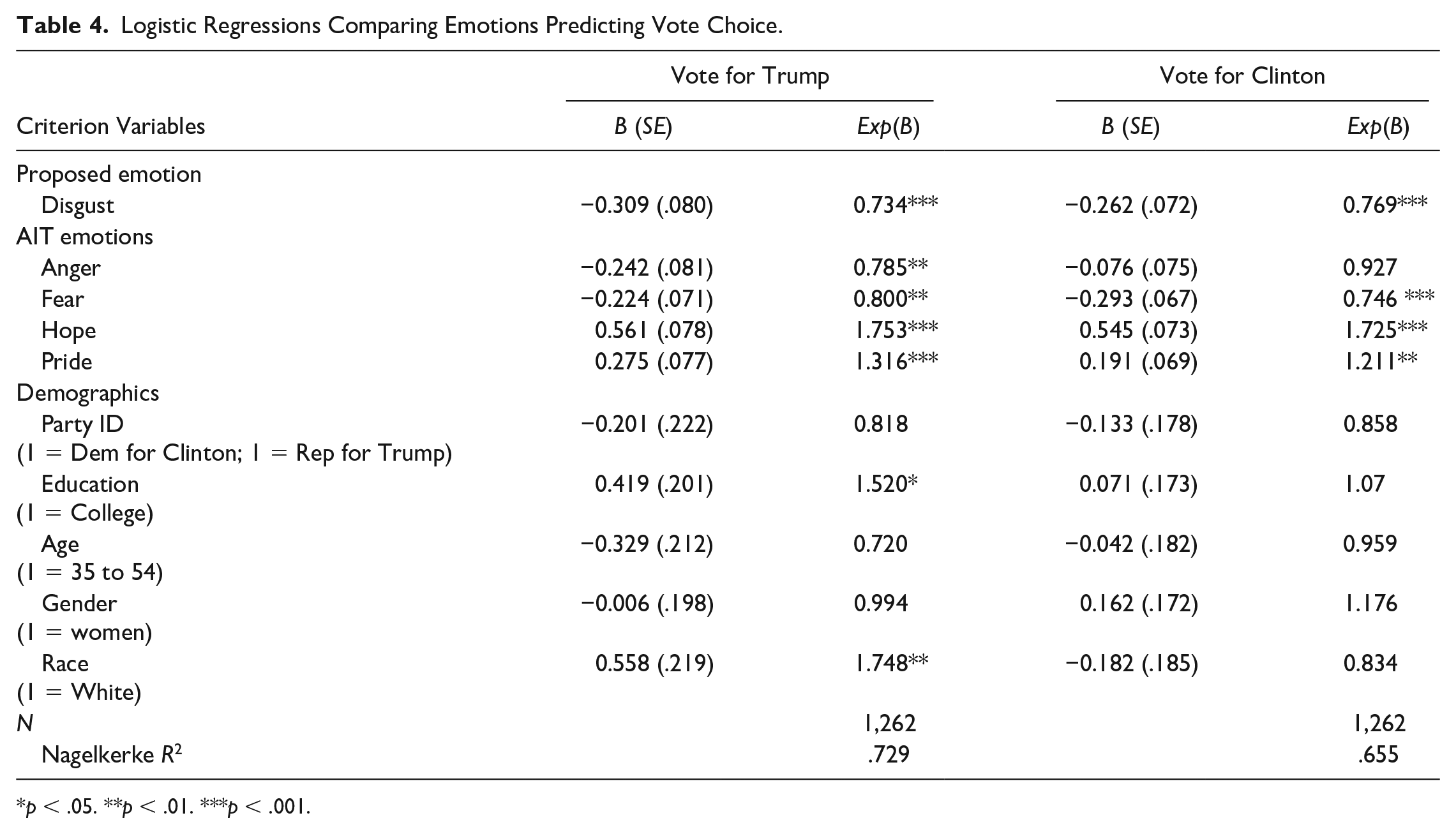
p < .05. **p < .01. ***p < .001.
The final contribution this study makes is understanding disgust and comparing it with anger, fear, hope, and pride—the primary emotions studied in AIT. Disgust was as good a predictor of vote choice in this election as fear and was significantly better than anger. The more disgust voters felt, the less likely they were to vote for the candidate who made them feel disgusted. This was the case even controlling for covariates including party ID.
We find it enlightening that disgust was reported more frequently for Trump than either of the other negative emotions of anger and fear, and that it was second-most reported for Clinton, occurring more often than fear. In addition to the finding that disgust was significantly predictive of voting for Trump even after anger, fear, hope, pride, party ID, and race were controlled, these lend support for our proposal that disgust played a strong role in the 2016 election and should be included in future studies of emotion in political communication.
Conclusion
This study has shown that the way most people got their political information in 2016—from broadcast news media—is associated with them feeling about the candidates the same way the media portray the candidates’ valenced emotions via their selection of video shots of the candidates’ nonverbal behavior. It shows valence-based emotions as conveyed via candidates’ nonverbal behaviors are associated with viewers’ emotional valence; that is, emotional-affective agenda setting has occurred. It then demonstrates that disgust predicts vote choice as well or better than anger and fear. This fact, and that disgust was the first and second most often-reported emotion that respondents experienced in response to the candidates, justifies its inclusion in studying emotion in voting decisions. As suspected, the traditionally studied emotions have not captured the full range of affect that voters harbor toward candidates.
Disgust, triggered by the unconventional 2016 campaign, is likely to stay since it has been introduced into the political milieu. Trump was again disgusting in 2020 and, as of this writing, is running to be the Republican nominee in 2024. Emotions such as disgust are likewise present in state and local elections, which no doubt have their own “characters” who make nonverbal expressions of disgust, which transfers to viewers. The implications of this study also traverse the globe, especially to countries where the kind of populism Trump introduced in the United States has been prevalent for decades. These results may be generalizable and should be studied in other contexts.
Limitations of every study should be acknowledged; thus, we allow this one does not permit us to infer causality, nor was it intended to. It does allow us to determine the significance of the association and infer whether valenced emotions can be used as indicators of political attitudes. Many experiments have already shown that valenced emotions in viewers are caused by the nonverbal expressions of others, not just associated with them, and that the media’s agenda precedes the public’s agenda. Now that this study has identified disgust as especially relevant, studies that measure emotion in content using methods such as the Facial Action Coding System (Ekman, 1982) would be manageable. In addition, future studies should examine these questions using both text and visuals in the same study. Few researchers do this, with text-only studies being most common; however, multimodal studies of the same content allow even greater predictive abilities.
This study’s strength is its use of original data, collected expressly for the purpose of studying these variables, and its individual analysis down to the granular level of the news program, allowing us to match content of specific programs directly with valenced emotions and voting choices of viewers. Another strength is its ecological validity as the findings were derived from the major broadcast outlets across the entire campaign season, not from just a single debate or 10 min of news. It also includes a large sample of adults, representative of the population.
That the media’s valenced emotional-affective agendas are predictive of voting is supported. Nonverbal behavior of candidates can be one of the sources of the affective agenda of the media, which transfer not only issues and character traits, but also valenced emotions. These visually conveyed cues could be pivotal in close elections.
More importantly, this study has integrated agenda setting with AIT. It proposes and tests a theoretical model, where voting is influenced by the media’s emotional-affective agenda—including through the emotion of disgust—that is conveyed not by what the candidates and newscasters say, but by the nonverbal behaviors that the candidates make, and broadcasters select.
While 2016 was admittedly an unusual election, the main purpose of theory development is to test ideas in novel contexts. This research shows that some important variables have been omitted and provides empirical evidence for refining existing theory. It has made explicit theoretical linkages between visual information and affective attitudes via valenced emotions. It has also expanded the indicators associated with agenda setting. Showing how the media present politicians to the public, especially in subtle ways via nonverbal behavior, and then how it relates to viewer perceptions, is critical to understanding the influence media have.
Supplemental Material
sj-docx-1-jmq-10.1177_10776990241262345 – Supplemental material for “There Was Blood Coming Out of Her Eyes . . .”: Emotional-Affective Agenda Setting and Disgust in the 2016 U.S. Presidential Election
Supplemental material, sj-docx-1-jmq-10.1177_10776990241262345 for “There Was Blood Coming Out of Her Eyes . . .”: Emotional-Affective Agenda Setting and Disgust in the 2016 U.S. Presidential Election by Renita Coleman and H. Denis Wu in Journalism & Mass Communication Quarterly
Footnotes
Declaration of Conflicting Interests
The author(s) declared no potential conflicts of interest with respect to the research, authorship, and/or publication of this article.
Funding
The author(s) disclosed receipt of the following financial support for the research, authorship, and/or publication of this article: Funding for this study was provided by a Senior Scholars Grant from the Mass Communication & Society division of AEJMC.

Supplemental Material
Supplemental material for this article is available online.
Notes
Author Biographies
References
Supplementary Material
Please find the following supplemental material available below.
For Open Access articles published under a Creative Commons License, all supplemental material carries the same license as the article it is associated with.
For non-Open Access articles published, all supplemental material carries a non-exclusive license, and permission requests for re-use of supplemental material or any part of supplemental material shall be sent directly to the copyright owner as specified in the copyright notice associated with the article.
