



Abstract
This article evaluates the extent of social media policing in fact-checking (as opposed to verifying public figures’ statements) and the thematic convergence across eight countries in Europe and Latin America. Based on audience reach, we collected links from various organizations (independent outlets, legacy media, or global news agencies). A representative stratified sample of 25% resulted in 3,154 articles. Among the findings, the trend of social media policing prevails across countries and organizations, except for most European legacy media. Independent news-born fact-checking organizations follow a convergent path, sharing more similarities with their global counterparts than their national media peers.
Owing to escalating apprehension surrounding disinformation disorder (Wardle & Derakhshan, 2017; Wasserman & Madrid-Morales, 2021) and disrupted public spheres (Bennett & Pfetsch, 2018; Bimber & Gil de Zúñiga, 2020; Chambers, 2021) since 2016, fact-checking organizations have been increasingly prioritizing the verification of online rumor often spread by anonymous actors in the online environment. This trend has come at the expense of fact-checking more “conventional” political claims. While this trend toward social media policing has been identified in various studies (Bélair-Gagnon et al., 2023; Cazzamatta & Santos, 2023; Graves et al., 2023), there remains a limited understanding of its prevalence and intensity across distinct media systems and within different types of fact-checking organizations. Unlike the United States and its comparatively long tradition of fact-checking political claims (Amazeen, 2013), in several countries of the Global South, many organizations were already born within this “social media policing” shift after 2016.
This turn is closely associated with increasing collaborations between fact-checkers and technology platforms like Meta. These partnerships provide financial support and opportunities for disseminating verified content and equip these organizations with advanced technological tools (Bélair-Gagnon et al., 2023; Full Fact, 2020; Westlund et al., 2022). By offering crucial funding, these alliances extend support to fact-checkers on a global scale and facilitate the establishment of new fact-checking initiatives, particularly in regions of the Global South (Bélair-Gagnon et al., 2023). In Europe, the European Commission’s “Strengthened Code of Practice on Disinformation 2022” expects platforms to empower the fact-checking community (European Commission, 2022). An examination of the trade-offs resulting from these partnerships, as conducted by Bélair-Gagnon and colleagues primarily through qualitative interviews involving European and U.S.-American stakeholders, revealed that corporations with more resources and organizational support may experience fewer and less significant operational challenges in their daily activities due to their reduced reliance on platform-based business models. Conversely, the impact on smaller organizations, which depend more on tech-platform resources, was more pronounced. These pivotal and pioneer studies have demonstrated how these partnerships may standardize organizational and professional practices (Bélair-Gagnon et al., 2023).
Within this backdrop, to quantitatively assess and compare the degree and intensity of the content homogenization of fact-checking articles across countries prompted by platform partnerships, this article proposes a comprehensive content analysis (3,154 verification articles) among eight countries (Germany, the United Kingdom, Spain, Portugal, Brazil, Argentina, Chile, and Venezuela), involving more than 20 fact-checking organizations (independent ones and those operating within legacy media and international news agencies). The analysis aims to quantitatively assess the extent of the discussed homogenization by observing convergence within verification formats (social media policing × verification of public figures’ statements) and content of social media examined topics. First, we will delve into the platformization of the public sphere, exploring the rise of the transnational fact-checking movement and examining macro-exogenous and meso-organizational variables that influence their working practices. Finally, we will provide a methodological overview of the comparative, transnational content analysis and present the primary findings.
This article significantly contributes to the field of fact-checking and journalism by providing quantitative data from a comparative study, enriching an analysis that primarily relies on observational methods and interviews (Bélair-Gagnon et al., 2023; Graves et al., 2023). Moreover, the research incorporates countries from Latin America and explores the polarized pluralist (Mediterranean) and democratic corporatist models (Hallin & Mancini, 2004), expanding beyond the extensively studied U.K. and U.S. liberal contexts (Badr et al., 2020; Chakravartty et al., 2018; Chakravartty & Roy, 2013; Waisbord & Mellado, 2014; Willems, 2014). Finally, it represents a less-common effort to establish interpretative connections between misinformation/fact-checking and media system studies despite the challenges and critiques (Hardy, 2021).
Public Sphere Platformization
The increased influence of digital platforms in acquiring information, including news, producing and disseminating political content, and consequently shaping public discourse, has been termed the platformization of the public sphere (Smyrnaios & Baisnée, 2023). Platforms are data infrastructures that generate and concentrate income, shaping the interplay between end-users and content/service providers. In this vein, platformization from an institutional approach is defined as “the evolution of platform markets, infrastructures, and governance frameworks” (Poell et al., 2022, p. 5). The impact of this “establishment of social media platforms as an infrastructure for public communication” (Schneiders et al., 2023, p. 122) has been discussed by several scholars (Fischer & Jarren, 2023). Among the effects, one observes the media and journalistic orientation toward platforms’ logic and the interplay between publishers and platforms (Hartley et al., 2023; Nielsen & Ganter, 2022; Tandoc, 2014; Tandoc & Maitra, 2018), apart from escalated levels of tabloidization, emotionalization (Wahl-Jorgensen, 2020), audience fragmentation, and news shunning (Magin et al., 2022; Mancini, 2013; Schneiders et al., 2023). The platformization phenomenon has even been comprehended by scholars as a “new” structural transformation of the public sphere (Eisenegger, 2021; Habermas, 2021; Seeliger & Sevignani, 2022), comparable to the development of the mass media in the 19th century.
From the stance of the participatory paradigm of democracy (Della Porta, 2013; Fischer & Jarren, 2023), the platformization of the public sphere can be deemed promising since it has permitted a broader access to the public arena and democratized it to a certain extent. On the other hand, pathologies resulting from this enlarged participation without journalistic filters (Heinderyckx, 2017; Neuberger et al., 2023) have been causing concerns related to the rationality of public discourse (Bennett & Pfetsch, 2018; Chambers, 2021; Van Dyk, 2022).
Metamorphoses in the way public opinion is constituted have been accompanied by an escalation of far-right authoritarian and nationalist forces capable of massive disinformation campaigns on social media (Hameleers, 2020; Hameleers & Minihold, 2022; Santini et al., 2021). Worldwide instances were noted, including Trump’s 2016 election, the Brexit referendum in the same year, Bolsonaro’s spreading of disinformation messages via WhatsApp during the 2018 Brazilian presidential election, and more recently, Milei’s social media campaign in the 2023 Argentinian elections (Keller et al., 2020; Howard & Kollanyi, 2016; Santini et al., 2021; Swire et al., 2017).
Types of Fact-Checking Organizations, Platforms Partnerships, and the “Debunking” Turn
In response to this “information disorder” (Wardle & Derakhshan, 2017), fact-checking organizations have globally expanded, from just 11 sites in 2008 to a significant increase of 424 in 2022 (Stencel & Ryan, 2022). They play a vital role in the post-truth media landscape, and their methods, practices, and effectiveness have been discussed in various contexts (for a comprehensive overview, see Ognyanova, 2024).
Fact-checking organizations can take on an independent character through an non-governmental organization (NGO) model or be integrated within media organizations (in-house). Independent entities, often found in Eastern Europe and Latin America, operate as non-profit organizations, functioning autonomously without editorial or corporate constraints (Graves & Cherubini, 2016). While they receive support through grants from foundations dedicated to advancing democratic institutions (Usher, 2019), they encounter challenges securing resources and expanding audience reach. Generally, they play a more engaging role driven by a substantial public interest, pushing the boundaries of traditional journalism (Baack, 2018). In this context, they align with the characteristics of hybrid organizations, fostering citizen activism to enhance well-informed decision-making rooted in civic, public-oriented values, all while managing financial sustainability imperatives (Kim & Buzzelli, 2022).
On the other hand, in-house fact-checkers are specialized teams working within established media outlets, primarily in the United States and Western Europe (Graves & Cherubini, 2016). Although they benefit from comprehensive infrastructure capacity and reach through their media parents, they are limited by the editorial policies of the corporations in which they operate. Due to the ongoing demands of daily news production, established media outlets produce a relatively smaller quantity of fact-checking articles (Graves & Cherubini, 2016; Luengo & García-Marín, 2020; Palau-Sampio, 2018). However, there are exceptions within global news agencies that have substantially embraced the genre, producing a huge number of verification articles and even engaging in the development of artificial intelligence (AI)-supported verification tools, such as in the case of AFP with the Vera.ai and WeVerify projects 1 (AFP, 2024). These organizations have great resources and the capability to employ programmers or journalists with a more significant technologist role within the newsroom (Lewis & Usher, 2014). While media units see fact-checking as a complement to journalism, independent organizations understand the practice as an alternative to traditional journalism (Vinhas & Bastos, 2022).
Despite this diversity in objectives, structures, funding, and affiliations (Cheruiyot & Ferrer-Conill, 2018; Graves, 2018; Lauer, 2021; Liu & Zhou, 2022; Moreno-Gil et al., 2021), a noticeable trend is the growing professionalization and standardization of fact-checking (Graves & Lauer, 2020; Lowrey, 2017). This development revolves around the International Fact-Checking Network (IFCN), often called “the institutional home of fact-checkers” (Graves et al., 2023), due to its efforts to establish common standards and promote professionalization. In 2016, IFCN introduced the Fact-Checkers Code of Principles (Orsek & Ozsoy, 2020), which now has over 105 active signatories. Fact-checkers have also developed significant collaborative strategies to counter disinformation across various regions, such as the LatamChequea alliance, which targets COVID-related falsehoods (Martínez-García & Ferrer, 2023).
The fact-checking movement initially began in the United States, heavily influenced by its professional political reporting culture, primarily to hold public figures accountable, and it has been considered a “democratic building tool” (Amazeen, 2020). It mainly concentrated on “traditional” political fact-checking. Unlike conventional journalism that verifies information before publication, these organizations scrutinize political statements, news reports, or social media posts after they have already reached the public sphere (Neuberger et al., 2023). This reactive refutation strategy, whether applied to social media rumors or political claims, is commonly referred to as debunking in a significant body of literature within the fields of misinformation psychology and communication (Amazeen & Krishna, 2024; Cook & Lewandowsky, 2012; Ecker et al., 2022; Lewandowsky et al., 2020). While debunking is a reactive measure, pre-bunking refers to a preemptive intervention based on the principles of inoculation theory (Amazeen & Krishna, 2024) to foster resistance to specific deception strategies and stay ahead of disinformation campaigns. Several fact-checking organizations also adopt pre-bunking and media literacy measures 2 (Butcher & Neidhardt, 2021; Çömlekçi, 2022).
In recent years, however, the literature on fact-checking and journalism has begun to distinguish the targets of the aforementioned debunking interventions. Refutation messages aimed at false information circulating on social media networks, typically disseminated by bots or anonymous sources, are commonly termed “debunking.” Meanwhile, the scrutiny of rhetoric and claims made by political actors and other public figures within the public sphere is identified as “fact-checking” (Bélair-Gagnon et al., 2023; Cazzamatta & Santos, 2023; Graves et al., 2023; Luengo & García-Marín, 2020; Palau-Sampio, 2018). It is crucial to note that both terms—debunking and fact-checking—encompass reactive refutation strategies, as established by the literature on the psychology of misinformation. This more recent differentiation of debunking targets has accompanied a second wave of fact-checking that emerged after 2016, driven by global concerns about disinformation. Within this second wave of the fact-checking movement, studies have identified a general shift from refuting public figures’ statements to verifying social media falsehoods (Bélair-Gagnon et al., 2023; Graves et al., 2023).
This trend is primarily (but not only) driven by platform partnerships (Bélair-Gagnon et al., 2023; Full Fact, 2020; Graves et al., 2023). Platforms initiated fact-checking collaborations in response to the extensive spread of misinformation during the 2016 U.S. presidential election (Cotter et al., 2022). Meta’s Third-Party Fact-Checking Program (3PFC) is the most significant example, involving 90 organizations in over 60 languages. Its primary aim is to evaluate and rate the accuracy of online information, curb the spread of false content, label falsehoods, and inform users (Cotter et al., 2022; Facebook, 2020). Apart from financial support (organizations receive compensation per verified article within a specific monthly limit), the platforms provide them with AI tools to monitor the online environment (Bélair-Gagnon et al., 2023; Full Fact, 2020; Graves et al., 2023). A prerequisite for participation in Meta’s 3PFC is that organizations must be signatories of the IFCN fact-checking code of practices, adhering to principles such as non-partisanship, fairness, transparency in sources and methods, disclosure of funding, and an open and honest correction policy. This collaboration has become a crucial financial resource for fact-checkers and has fostered the growth of numerous units, especially in the Global South. Research indicates that underfunded and emerging independent media outlets rely more on platform resources.
Organizational and professional practices may become standardized due to this unequal, mutually dependent relationship (Bélair-Gagnon et al., 2023). Another study based on interviews with fact-checkers from 27 countries outside the Western world concludes that organizations give more importance to verifying content that goes viral, and Meta’s 3PFC initiative hinders them from holding local politicians accountable (Vinhas & Bastos, 2023). Generally, fact-checkers welcome these collaborations, as they provide valuable AI tools for monitoring the online environment and securing funding. However, they also criticize the platform approach, particularly the omission of verifying political ads and the concentration solely on falsehoods spread by users (Full Fact, 2020). Although this “debunking turn” is understood and interpreted differently among organizations, one argument suggests that paid debunking practices could potentially subsidize political fact-checking (Graves et al., 2023).
Although the platformization of news (Hartley et al., 2023; Nielsen & Fletcher, 2023) and the relationship between publishers and platforms (Nielsen & Ganter, 2022) have been widely discussed, there is scarce research on the homogenizing effects of platform partnership on the verification content produced by fact-checkers (Bélair-Gagnon et al., 2023). Despite acknowledging the shift toward social media policing (Bélair-Gagnon et al., 2023; Cazzamatta & Santos, 2023; Graves et al., 2023), little is known about its intensity and impact across countries and types of organizations. There is also a scarcity of systematic studies observing the convergence of debunking topics as a possible outcome of these collaborations.
Media Systems and the Consolidation of Digital Platforms
Scholars have noted that the platformization of news and its potential homogenizing effects on fact-checking is not a “uniform process with a single outcome” (Hartley et al., 2023, p. 1384). Despite global platform operations, organizational autonomy can vary depending on journalistic culture (Hanitzsch et al., 2019), media, and political systems. Hallin’s and Mancini’s (2004) influential work proposed three media system typologies (liberal, democratic corporatist, and polarized pluralist) based on four indicators: press market development, political parallelism, journalistic professionalism, and the role of the state (see Table 1).
Main Media System Traits According to Hallin and Mancini.
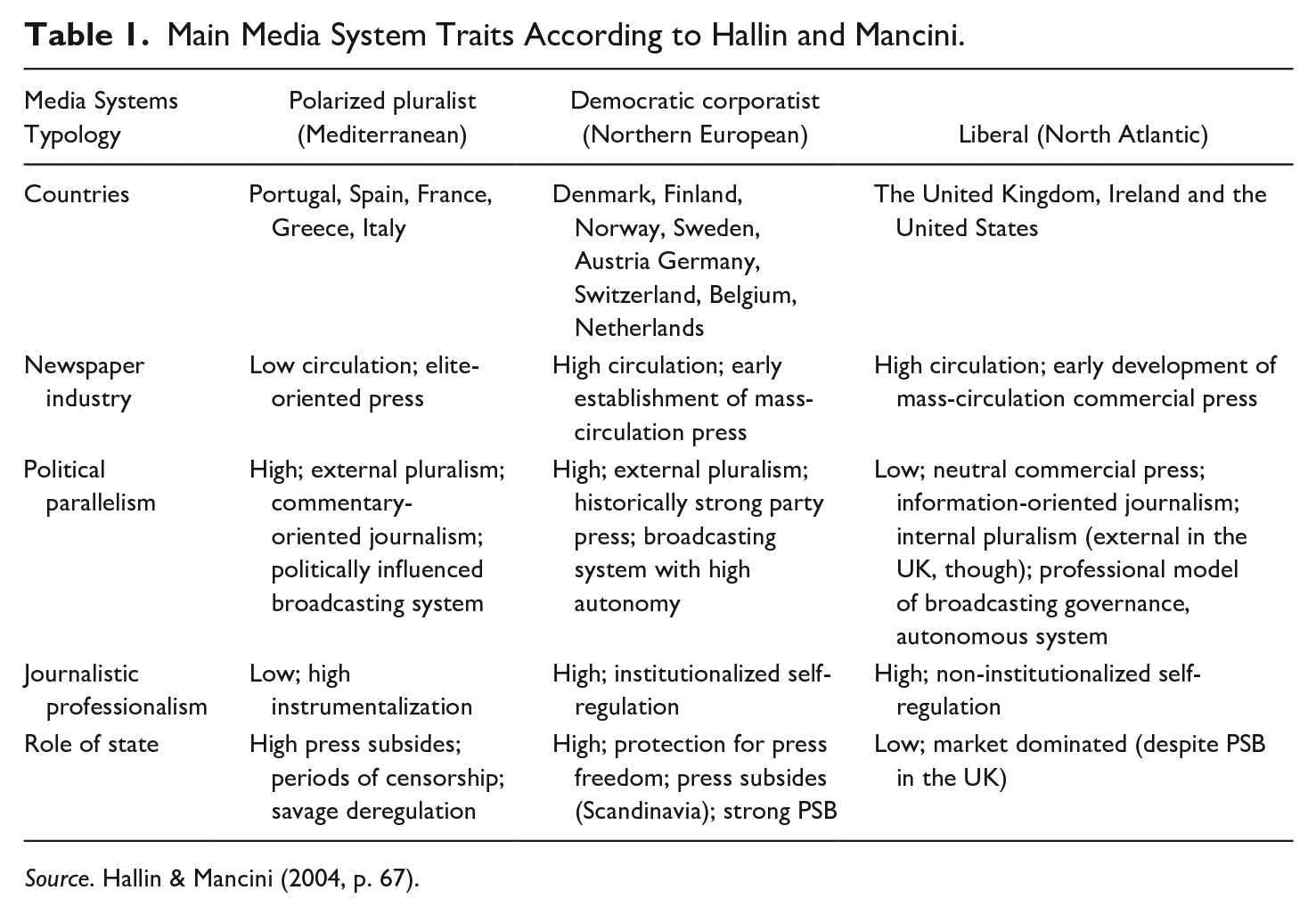
Source. Hallin & Mancini (2004, p. 67).
Brüggemann and colleagues (2014) proposed a quantitative operationalization of Hallin and Mancini’s models. They disaggregated the variable “role of the state” into three categories: public service broadcasting (PSB), press subsidies, and media ownership regulation. The authors identified four distinct Western media typologies, which deviated from the initial three proposed by Hallin and Mancini. These types include the Northern and Central (akin to the democratic corporatist), Western (similar to the liberal), and Southern (corresponding to the polarized pluralist) models.
The Northern model is characterized by highly professional journalism, an inclusive press market, substantial PSB, abundant press subsidies, and the lowest levels of ownership regulation and political parallelism. Scandinavian countries are examples of the Northern case. The Central model is marked by strong PSB, rigorous ownership regulation, and low press subsidies. Germany is a classic integrant of this group. The Western model, in which the United States is the primary representative, shows low PSB and press subsidies. Finally, the Southern model, in which countries such as Spain and Greece are integrated, exhibits high political parallelism combined with the lowest levels of professional journalism and press market inclusiveness.
In Brüggemann and colleagues’ (2014) operationalization, Portugal, marked by a comparatively lower degree of political parallelism, deviates from the Southern model and is instead grouped with the Western model alongside the United States, Belgium, and the Netherlands. The United Kingdom, distinguished by strong PSB and ideologically polarized press, is separated from the Western group and categorized within the Central model alongside Austria, Germany, and Switzerland.
Scholars have endeavored to adapt Hallin and Mancini’s typology beyond the Western world. Latin American countries were initially compared to the Mediterranean model (Hallin & Papathanassopoulos, 2002) due to clientelist structures and later classified as “liberal captured” (Guerrero, 2014) because of its core characteristics—aggressive deregulation, the dominance of regulatory spaces by prominent media conglomerates, high market concentration, regulatory inefficiencies, limited professionalization, arbitrary public spending on advertising, infiltration of media structures by political figures, and the transition of politicians into media entrepreneurs (Guerrero, 2014). Despite attempts, classifying Latin American media systems proves difficult due to variations in journalistic professionalism even within a single country, internal disparities mirroring both liberal and polarized pluralist models, and increased instability marked by frequent shifts between media and political systems when compared to Europe or the United States (Echeverria et al., 2022; Hallin, 2020).
These previous studies, vital for comparative analyses, often overlook the influence of digital media ecosystems on the fact-checking movement. More than just a classical media system theory is needed to address the challenges of digitalization and hybrid media systems (Chadwick et al., 2017). Thus, there is a growing consensus on the necessity to adapt, reconceptualize, and integrate new variables related to information and communication technologies into the analytical framework (Hallin, 2020; Humprecht et al., 2020; Mancini, 2020; Mattoni & Ceccobelli, 2018). Amazeen (2020), for instance, demonstrates that two crucial factors correlate with the emergence of fact-checkers within a country: democratic governance and internet accessibility. Technology companies wield significant influence in shaping media structures through platform control over digital content curation (Hallin, 2020). In an attempt to link media system theory with the platformization of news, Nielsen and Fletcher (2023) discovered that although platformization may be widespread at a general population level, its impact on specific cultural segments, such as news, can vary significantly. They noted a positive correlation between a history of high newspaper circulation and direct online news consumption, reducing reliance on news accessed through social media channels.
A valuable framework for assessing resilience to disinformation, crucial for fact-checking, was introduced by Humprecht and colleagues (2020). Drawing from international relations literature, they identified seven indicators to measure resilience in countries: societal polarization, populist communication (political dimension), low trust in the news, weak PSB, fragmented audiences (media variables), the size of the digital advertising market, and high social media use (market dimension). Rodríguez-Pérez and García-Vargas (2021) replicate the study within the Latam countries (Brazil, Argentina, Chile, and Mexico) and conclude unsurprisingly that Latin American states are much less resilient than their colleagues in the Global North. For instance, in Latin America, the utilization of social media for news consumption has surpassed television, unlike in Europe, resulting in the unregulated spread of misinformation (Fletcher et al., 2022).
Hallin and Mancini (2017) explored potential developments in the relationship between internet-based media and the pre-existing disparities among media systems a decade after their initial work. They identified three potential outcomes. The first one involves a “convergence path” driven by new technological, global economic, or cultural paradigms, potentially eroding the established distinctions among nations. The second scenario, a “continuity” route, suggests that variations among systems continue to be shaped by existing structures, as demonstrated in the study by Nielsen and Fletcher (2023) mentioned earlier. Finally, the third possibility, a “discontinuity” trend, envisions divergent developments among countries that do not align with the expectations set by their typology, owing to unique digital media ecosystems.
However, not only macro-exogenous environmental factors but also Meso-level organizational factors impact the organization’s content. Studies based on population ecology perspectives (Lowrey, 2017) show that fact-checking websites imitate one another in striving for legitimacy. The institutionalization of the movement also prompts tendencies to diminish external environmental pressures (Lowrey, 2017). Fact-checking has been defined as hybrid endeavors that are likely influenced by various logics but may exhibit indications of standardization (Kim & Buzzelli, 2022). Thus, based on the interplay of meso-organizational and macro-systemic variables, we expect to discern how fact-checking organizations resemble one another globally more than other units within their national media system due to platform partnerships.
Previous Comparative Studies on Fact-Checking Content
Past comparative studies, marked by substantial methodological diversity and variations in analyzed categories, fail to account for the influence of platforms in shaping debunked topics. In addition, there needs to be a more precise differentiation between the verification processes for social media rumors and statements made by public figures. When examining the correction of climate-related misinformation across four countries (Germany, the United Kingdom, the United States, and Australia), Vu and colleagues observed notable variations in the thematic frames of climate change within their respective media systems (Vu et al., 2023). In a study focused exclusively on fact-checking organizations operating within legacy media in the United States, Yousuf (2023) found that the most frequently verified topics were terrorism, national security, healthcare, and the economy. Ferracioli and collaborators (2022) conducted a comparative analysis of the watchdog role performed by independent fact-checkers in the United States, Italy, Germany, and Brazil, measuring the targets of corrective messages. Their findings indicated that the German independent organization Correctiv seldom focused on statements made by political figures, while those conducted by FactCheck.org prioritized fact-checking statements made by former President Trump (Ferracioli et al., 2022). One of the few studies that take into account different media systems (Austria, Germany, the United Kingdom, and the United States) and types of organizations (independent and editorials) at the same time is a content analysis by Humprecht (2018), which included topics and sources of online disinformation selected by fact-checkers. The author concluded that the selected topics mirror national news agendas. Furthermore, political figures in the United Kingdom and the United States are more frequently identified as sources of online disinformation (verification of public figures’ statements). Conversely, online rumors are more prevalent in German-speaking countries, a finding aligned with Ferracioli’s analysis.
Research Questions and Assumptions
Based on this previous theoretical discussion and literature review, to improve our empirical understanding of fact-checking organizations and the possible impact of platform collaborations, we ask:
Considering that Meta’s 3PFC is a vital financial support for (independent) fact-checkers, contributing to the expansion of numerous units, particularly in regions such as the Global South, studies suggest that underfinanced and emerging independent media entities lean heavily on platform resources. This imbalanced and interdependent association can potentially homogenize organizational and professional approaches (Bélair-Gagnon et al., 2023). Thus we ask,
Method
Sampling
Journalistic and political cultures vary across nations; ergo, fact-checkers’ work has a strong context-bound component (Hanitzsch et al., 2019; Mellado et al., 2017). Common traits and contrasts are at the heart of every comparative research, and the objects of comparison “must be neither identical nor completely lacking of common features” (Kleinsteuber, 2004). Therefore, employing a “most different system design” approach (Rössler, 2011) guided in a first step by media system traits, we have chosen four European countries with varying levels of journalistic professionalism and political parallelism, as illustrated earlier (Hallin & Mancini, 2004). The United Kingdom represents the liberal model, Germany the democratic corporatist, and Portugal and Spain the polarized pluralist. Regarding the “polarized pluralist” model of Southern European states, Portugal and Spain were favored due to their historical connections with Latin America.
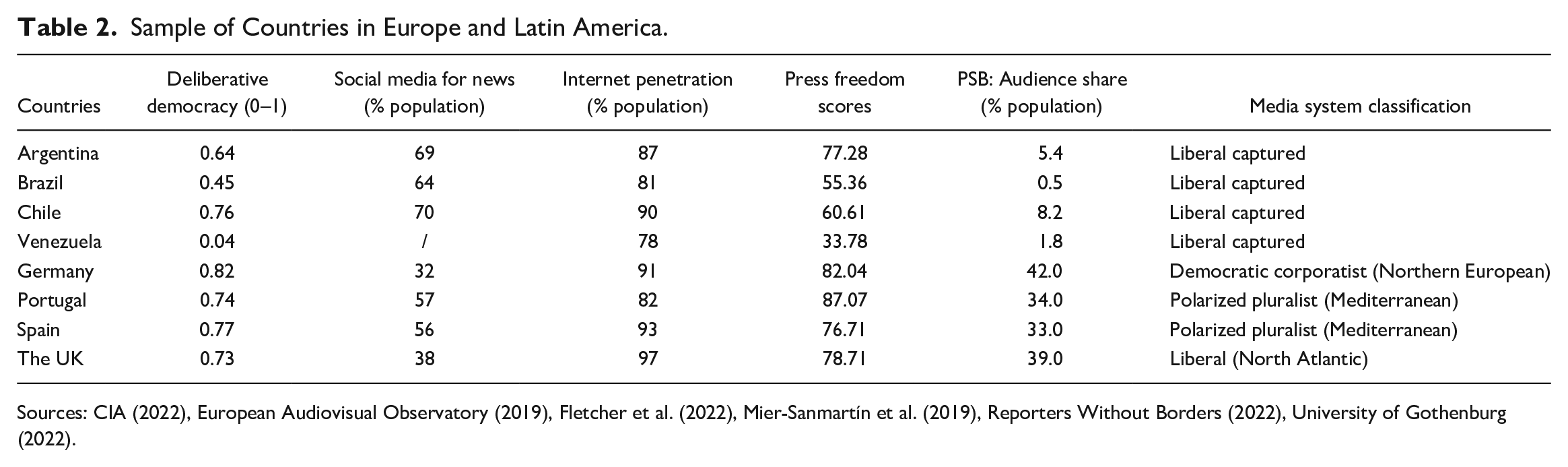
In contrast to Europe, Latin America exhibits a less-developed press system, with its broadcasting sector primarily evolving along commercial lines, akin to the United States. While the continent shares certain similarities with the Mediterranean model, particularly in terms of clientelism (Hallin & Papathanassopoulos, 2002), scholars broadly categorize the Latin American media system as “liberal captured” (Guerrero, 2014). Nonetheless, because this label is a broad generalization that applies to several countries in the region, the sample was also oriented on disinformation-resilience indicators (Humprecht et al., 2020), such as levels of deliberative democracy, press freedom, social media use for news, and PSB audience share as Table 2 indicates. Argentina and Brazil (flawed democracies), Chile (full democracy), and Venezuela (autocracy) comprise the Latin American sampling. Finally, for practical reasons, the language in these countries was also a factor to consider, as only native speakers with regional knowledge and a background in media and communication participated in the coding process.
Sample of Countries in Europe and Latin America.
To address variations within the meso-organizational level, we also considered different types of organizations within the nations—editorial units of legacy newsrooms, independent entities, and those affiliated with global news agencies, as shown in Table 3. Sample equivalency, a common challenge in various media system designs (Rössler, 2011), must be considered when interpreting the data because not all countries have all three types of fact-checking organizations. We chose the most prominent organizations from each group. In cases with multiple independent organizations, we selected the one with a higher reach assessed based on social media interaction using Crowd-Tangle.
Sample of Countries and Organizations.

These organizations are not part of the Meta Third-Party Fact-Checking Program or IFCN signatories.
Unit of Analysis
To address the disparity in the number of articles published by the chosen organizations, we implemented a stratified representative sampling method for articles published in 2022. Initially, we collected all links published from January 1st to December 31st using the Feeder Extension, a web-based platform allowing users to track website updates (Feeder, 2024). Following data cleaning to eliminate duplicates and errors, we selected every fourth article chronologically, creating a 25% sample for each organization (N = 3,154). Our analysis was focused solely on verification articles, which included social media rumors or statements from public figures. Other content types without verdicts, such as contextualization, explanation, meta-discussion, and investigative journalism, were excluded from the study.
Analyzed Categories and Reliability Levels
Eight mother tongue research assistants coded the data over 3 to 6 months. 3 Before evaluating reliability, they underwent 40 hours of training. After the tests, they spent over 20 hours discussing problematic categories and re-coding until acceptable reliability levels were attained. The tests were conducted within language-specific groups (English, German, Spanish, and Portuguese) to confirm that any misunderstandings were due to codebook issues rather than language comprehension. The following Krippendorff’s alpha coefficients and category descriptions are provided below.
To evaluate how pronounced the social media policing trend is across countries and organizations (RQ1), we measured the verification format (α from 0.8 to 1.0). In addition to the verification genre, to answer RQ2, we assessed the degree of homogenization of debunked topics on social media (α from 0.93 to 0.97). The codebook is provided within the Supplemental Material.
Both formats of verification do not overlap. Suppose a politician or public figure makes a statement on Twitter or other social networks. In that case, it still counts as “fact-checking,” that is, verification of claims made by political figures and public personalities. This category does not apprehend circulation channels but the target of verifications, whom fact-checkers have scrutinized, and what has been scrutinized. Pre-emptive articles without adjudication and verdicts, such as pre-bunking, exploratory pieces, meta-discussions, and so on, were excluded due to their different formats.
In cases where doubts arose during the topic assessment, coders were instructed to prioritize the false aspect of the message, irrespective of context or target. For example, let us consider an allegation on social media about the Brazilian presidential candidate Lula (target of falsehoods) removing the name of Jesus from the Bible if elected. The topic selected in this case should be “society & zeitgeist” due to its religious component rather than “domestic politics” because of its electoral context. It is crucial not to conflate context with the topic of false information; the coding decision should decisively focus on the false part of the information.
Data Analysis
We utilize correspondence analyses to examine similarities within the debunked topics and evaluate trends among types of organizations. This statistical technique condenses patterns within a table into a visual representation based on the discrepancies between observed and expected values. It arranges labels with similar discrepancies nearby, facilitating the identification of similarities and differences in the data. The closer any variable (in this case, organizations and debunked topics) is to the center of the map, the less distinctive they are. The proximity between row labels (topics/topics) or column labels (organizations/organizations) primarily indicates their similarity, provided proper normalization. However, the relationship between row (topics) and column (organizations) labels should be evaluated using two indicators: (a) the distance between the column and row from the origin of the graphic and (b) the angle formed between the two lines. A greater distance from the origin and smaller angles imply a stronger connection between the variables. It is essential to note that the image does not reveal which rows or labels have the highest numerical values, but rather numerically depicts their relative discrepancies (residuals). The first dimension (horizontal axis) and the second dimension (vertical axis) of the biplot capture the maximum amount of variation in the data (Beh & Lombardo, 2014). In our analysis, the first map (Figure 1) explains 96% of the variance within the data set. The second plot (Figure 2) accounts for 72% of the variance, and the third (figure 3) accounts for 90%. Please refer to the works of Beh and Lombardo (2014) and Greenacre (2017) for a more comprehensive analysis. All residual tables on which the correspondence analyses are based are available in the Supplemental Materials.
Findings
The Extent of the Social Media Policing Trend According to Countries and Organizations (RQ1)
Table 4 presents a cross-sectional analysis comparing countries and formats of verification (debunking/social media policing or fact-checking/verification of public figures’ statements) to evaluate the extent of the social media policing trend. The Chi-square test reveals a statistically significant but small association between these variables (p-value < .001; Cramér’s V = .18 4 ). The prevalence of social media policing is notable in all the countries analyzed, with over 75% of the published verification articles (RQ1) focusing on debunking social media rumors.
Ratio of Articles Targeting Social Media Rumors and Public Figures’ Statements.
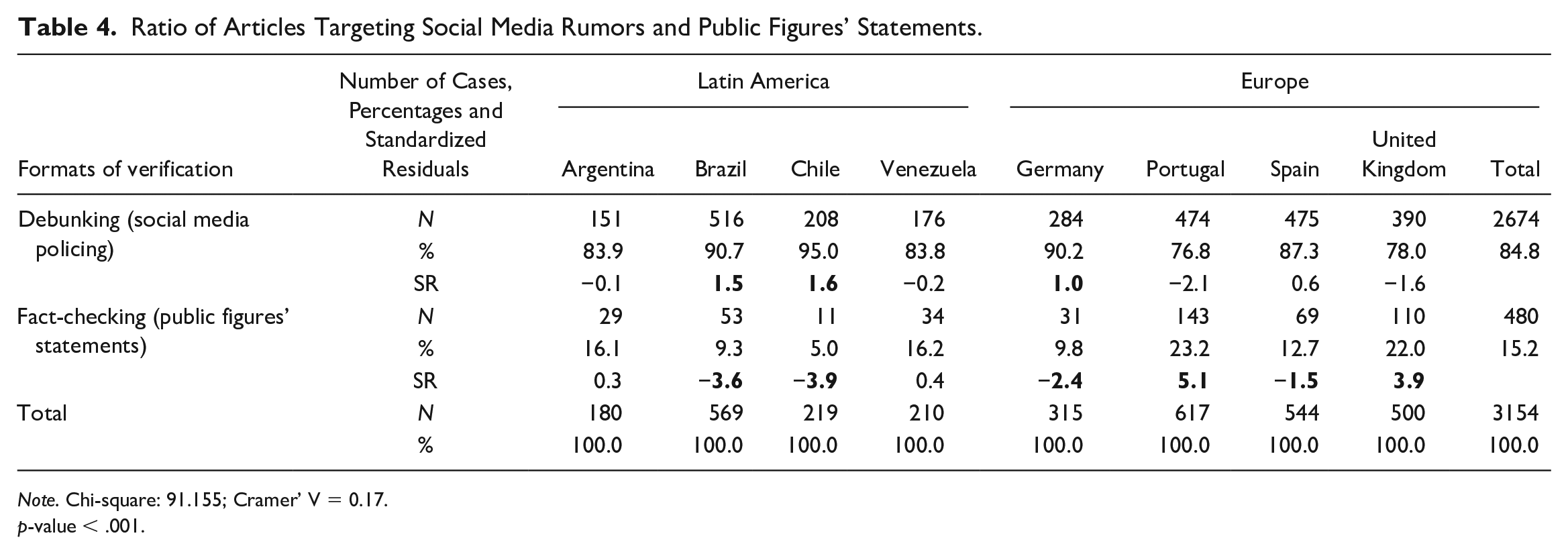
Note. Chi-square: 91.155; Cramer’ V = 0.17.
p-value < .001.
While social media policing prevails across countries, with rates ranging from 83% to 95% in Latin America and 77% to 90% in Europe, minimizing substantial national distinctions, slight variations persist (RQ1). Standardized residuals (SR) indicate that Portugal (SR = 5.1) and the United Kingdom (SR = 3.9), countries with some of the highest press freedom scores in the sample (Table 2), verified considerably more claims made by public figures and political actors. Surprisingly, they are followed by Venezuela (SR = 0.4) and Argentina (SR = 0.3), contradicting our initial assumption that Latin American countries would consistently publish more social media rumors. An interesting factor in the cases of Venezuela and Argentina is that they have only independent organizations operating within their borders (see below). This organizational structure could potentially explain this result. Clientelist ties and a quid-pro-quo between Latin American media and politics (political parallelism) make independent organizations more inclined to challenge public figures than legacy media units. Chile (SR = −3.9) and Brazil (SR = −3.6) focus much less on verifying public figures’ statements than expected (Table 4), possibly indicating a stronger emphasis on social media content monitoring. On the one hand, Chile and Brazil have fact-checking units operating within their legacy media (e.g., La Tercera and Estadão in our sampling), which traditionally, due to high political parallelism and clientelism, are not inclined to challenge the political and business elites in the same way as independent media do. On the other hand, this choice could make sense, considering that these two nations have the highest social media use for news within our sample (Table 2), where disinformation is spiraling out of control.
In Europe, Germany presents an interesting exception among the European countries. Despite having one of the highest press freedom scores (0.82) and relatively low social media use for news 5 (32%; Table 2), the country also concentrates on social media policing, confronting politicians and public figures much less than expected. This result aligns with previous studies (Ferracioli et al., 2022; Humprecht, 2018). Germany shows a high level of rational-legal authority 6 (Mancini, 2012), that is, adherence to formal rules and procedures, which may explain the lowest mean value (2.79) of the watchdog role among its journalists (Worlds of Journalism, 2022) to hold politicians accountable. Furthermore, it is plausible that the “Querdenken” movement and its online activities have motivated German organizations to monitor social media closely. Since the onset of the COVID outbreak, this movement, comprised of disgruntled citizens, far-right extremists, conspiracy theorists, and individuals with esoteric beliefs, has been active on the internet, expressing distrust in the government, media, and conventional medicine. Initially established as a protest platform against government restrictions aimed at controlling the COVID-19 pandemic, it has rapidly evolved into a widespread movement receptive to conspiracy theories and right-wing extremism (Heinke, 2022; Zehring & Domahidi, 2023).
Given the low strength of association between countries and verification format (Cramér’s V = .18), we decided to closely observe differences related to the types of organizations operating within the analyzed countries that might be responsible for these initial results. Fact-checking is a highly diverse global movement, and explaining and interpreting all results based solely on exogenous variables might be challenging.
Differences Within Organizations’ Types
All global news agencies, without exception, highly focus on social media policing—Reuters (88%), EFE Verifica and the Deutsche Presse-Agentur (DPA) (both 94%), and AFP (ranging from 98% to 100% according to the countries of operation—see Table 5). They have all joined the Meta 3PFC project to verify falsehoods on Meta platforms. This preference for social media policing aligns with their less-engaged journalistic role, guided by a more orthodox understanding of journalistic procedural objectivity (Maras, 2013; Tuchman, 1972).
Ratio of Articles Targeting Social Media Rumors or Public Figures’ Statements Within Global News Agencies in Europe and Latin America.

Note. Chi-square: 28.113; Cramer’ V = 0.181.
p < .001.
On the other hand, established legacy media, especially the European ones, publish more articles verifying public figures’ statements (fact-checking), as Table 6 demonstrates. Again, in this case, the Chi-square analysis shows a statistically significant relation (enabling the rejection of the null hypothesis), and the strength of the relationship is much higher (Cramer’s V = 0.625).
European public service broadcasters (Tagesschau’s Faktenfinder and BBC Reality Check) and the Portuguese print newspaper “O Público” consistently publish notably fewer verification articles, irrespective of the type (social media policing or public figures’ statements). However, when they do, they tend to focus more on public figures’ statements, possibly influenced by their media parents’ infrastructural apparatus and journalistic expertise. This trend applies neither to Latin American established newspapers such as the Brazilian “Estadão Verifica” and the Chilean “La Tercera” nor to the Portuguese digital newspaper “Fact Checks do Observador.” Within the traditional media outlets, only the digital “Fact Checks do Observador” (PT) and “Estadão Verifica” (BR-print) belong to the Meta 3PFC program, which explains their focus on social media policing. La Tercera does not belong to Meta since it is not an IFCN member and still publishes mostly articles scrutinizing online rumors. However, it is essential to highlight that most Chilean organizations were founded in 2019 during the political unrest in the country within a highly polarized environment. One can assume that the established corporate media in Latin America embrace the fact-checking genre as a business strategy. Due to old clientelist patterns of media and politics in Latin America (Harlow, 2023; Waisbord, 2000), it is not surprising that legacy media would focus more on online rumors and avoiding problems with their respective political elites.
Ratio of Articles Targeting Social Media Rumors or Public Figures’ Statements Within Established Legacy Media in Europe and Latin America.

Note. Chi-square: 181.871; Cramer’ V = 0.625.
p < .001.
When we delve into the independent units of each country (Table 7), it becomes evident that, despite the prevailing trend of social media policing, European organizations continue to produce a slightly higher number of articles scrutinizing public figures’ statements, except for Correctiv! in Germany (SR = -1.6). The cross-sectional analysis in this context also yields statistically significant results (Chi-square: 147.033, p < .001), with an associated strength of 0.28.
Ratio of Articles Targeting Social Media Rumors or Public Figures’ Statements Within Independent Organizations.

Note. Chi-square: 147.033; Cramer’ V = 0.284.
p < .001.
Prominent independent organizations like Full Fact in the United Kingdom (SR = 4.2), Newtral in Spain (SR = 4.2), and Polígrafo in Portugal (SR = 3.7) focus more on the verification of public figures’ statements than expected, even though at least 70% of their output emphasizes monitoring social media content. While the argument that resources from Meta could potentially enhance their capacity for political fact-checking (Bélair-Gagnon et al., 2023; Graves et al., 2023) may partially apply to these leading organizations, it is still insufficient to equalize the production of both formats.
In Latin America, the proportion of articles inspecting public figure’s statements is slightly smaller, even within leading organizations. Argentina’s Chequeado (SR = 1.1) and Venezuela’s Cotejo (SR = 1.1) place slightly more emphasis on scrutinizing statements by politicians than their counterparts: Brazil’s Lupa (SR = −1.8) and Chile’s FastCheck (SR = −3.0), despite all of them being part of the Meta 3PFC program.
Venezuela is an interesting case with solely independent fact-checking websites. The media landscape is highly polarized and characterized by a stark division between channels aligned with the government, which are either owned or influenced to varying degrees by the state and media outlets that maintain a critical stance toward the government but are not necessarily aligned with opposition parties (Calderón & Herrero, 2022). Interestingly, the only organization associated with Meta, Cotejo (SR = 1.1), is the one that produced the most verifications of public figures’ statements (23%) despite the prevailing trend of social media policing. It seems in this case that Meta’s resources have the potential to strengthen their ability to do political fact-checking (verification of public figures’ statements) despite difficulties faced by local fact-checkers. For instance, official statistics on businesses, consumers, and media usage can prove challenging. These statistics often originate from non-governmental sources, such as civil institutions, professional organizations, and NGOs, and may sometimes conflict with public institutions’ data (Calderón & Herrero, 2022). That is a general problem in Latin America that hinders fact-checking practices—within varying degrees across countries—but extreme in the Venezuelan case.
Degree of Topic Convergence (RQ2)
Another critical aspect of assessing platform collaboration’s impact is the standardization of debunked topics on social media. When analyzing the debunking agenda 7 among legacy media, Figure 1 reveals strong similarities between British and German public service broadcasters—BBC Reality Check and Faktenfinder (both are not Meta partners). Observing their standardized residuals, the topic distribution among both outlets is quite similar, with a higher focus on foreign affairs and health misinformation. This path continuity, that is, variations persist in being influenced by pre-existing structures (Hallin & Mancini, 2017), is notable, especially considering Brüggemann and colleagues’ (2014) classification of Germany and the United Kingdom within the central media systems cluster. Interestingly, the Portuguese established newspapers—one digital and 3PFC member (“Observador”) and the print daily “o Público”—also cluster together. Both outlets feature a higher number of debunked topics related to science (SR = 1.2 and 1.5, respectively), human interest (SR = 3.0 and 0.4), and foreign affairs (SR = 5.8 and 0.5) and a lower number related to domestic politics than expected (SR = −5.8 and −1.2). Despite the Portuguese legislative election on January 30, 2022, political falsehoods did not seem to spread so intensely on social media.
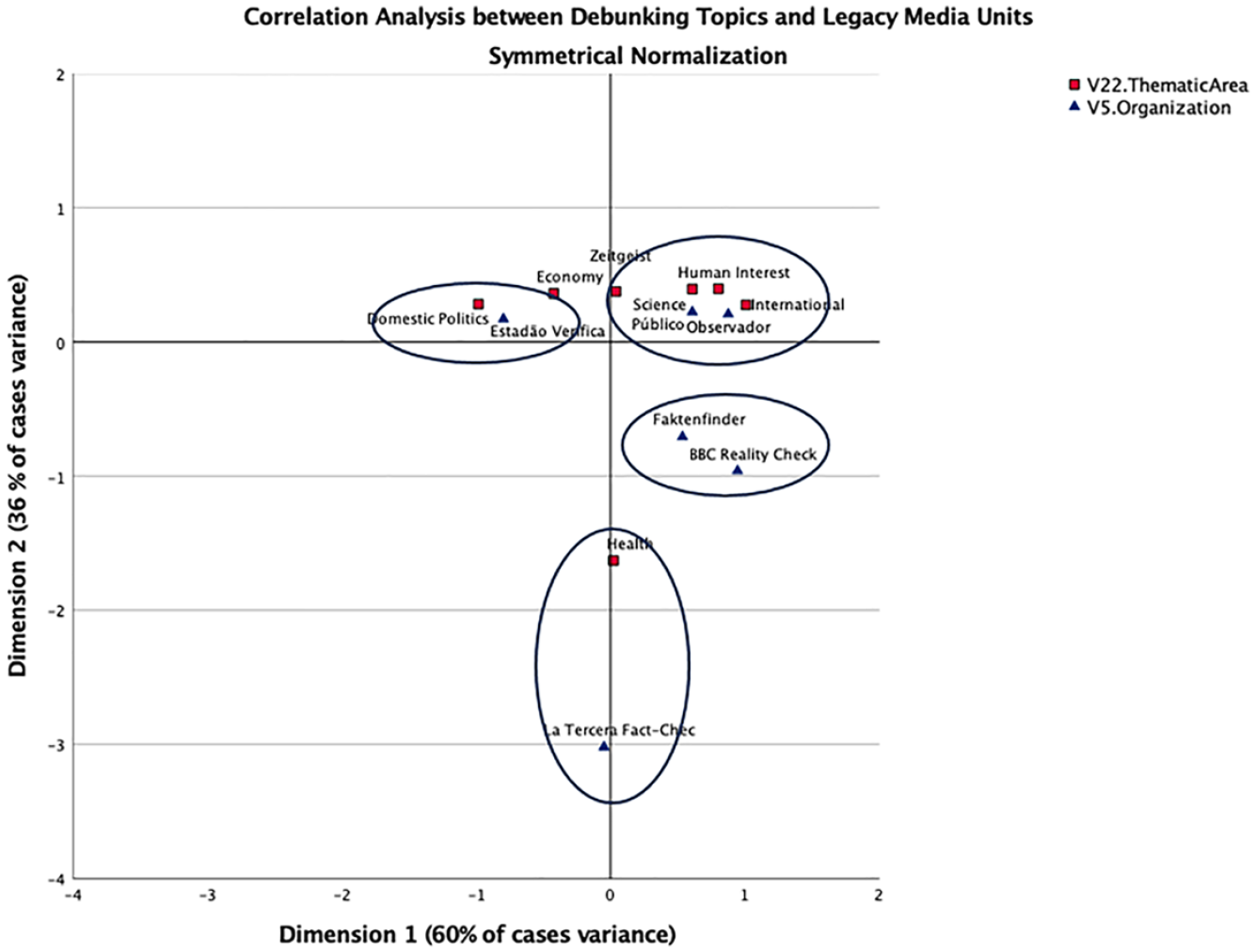
Correspondence Analysis Between Debunked Topics and Legacy Media Fact-Checking Units.
Finally, the Brazilian established newspaper “Estadão” debunked many domestic political falsehoods (SR = 6.6) due to the year’s highly polarized Brazilian presidential elections. Coordinated inauthentic behaviors (Keller et al., 2020) were extensively employed in Brazil to bolster narratives alleging electoral fraud supporting Bolsonaro (Ozawa et al., 2023; Santini et al., 2021). In the case of Chilean “La Tercera,” the traditional daily mainly focuses on health misinformation (94.70% of all debunked topics). Chile conducted a constitutional referendum on September 4, 2022, to approve the drafted text of a new Political Constitution of the Republic formulated by the constitutional convention and expected to replace the Pinochet-era text. This vote was frequently labeled the “exit plebiscite” (Nolte, 2022). “La Tercera,” historically linked to the political right (Navia & Osorio, 2015), intriguingly debunks mainly health misinformation to sidestep political controversies, showcasing a continuation of the traditional pattern of political parallelism observed in Chilean legacy media behavior.
When observing patterns of debunked falsehoods in legacy media, existing structures and practices explain trends in a “continuous system determinism” (Hallin & Mancini, 2017). However, this influence is less pronounced for digital news-born fact-checking organizations, where topic convergence seems more pronounced. Figure 2 shows that “Lupa,” “FastCheck,” and “Polígrafo” have the most distinct profiles. The Brazilian and Chilean organizations debunked more falsehoods regarding domestic politics than expected (SR = 8.2 and 6.0, respectively), while the Portuguese focused more on economic issues (SR = 8.5).
As mentioned earlier, several studies have described the use of coordinated inauthentic behaviors to amplify the “rechazo” campaign in Chile against the constitutional reform referendum 8 (Bell, 2022; Osborn, 2023) or allegations of electoral fraud by Bolsonaro (Ozawa et al., 2023; Santini et al., 2021). In the Portuguese case, it is essential to note that a general election was called after Antonio Costa’s socialist minority government lost a crucial budget vote to determine how to allocate European Union (EU) aid for recovering from the Covid crisis. Against this backdrop, it makes sense that the independent “Polígrafo” debunked falsehoods related to economic issues. The German fact-checking organization “Correctiv!” follows a similar trend of political debunking, although to a lesser extent (SR = 0.8), possibly influenced by regional elections in Schleswig-Holstein, Saarland, and North-Rhine Westphalia.
However, apart from the above-described distinctions, all other independent organizations cluster in the upper right quadrant, indicating a homogenizing trend in debunked falsehoods about health, foreign affairs, and human interest misinformation.
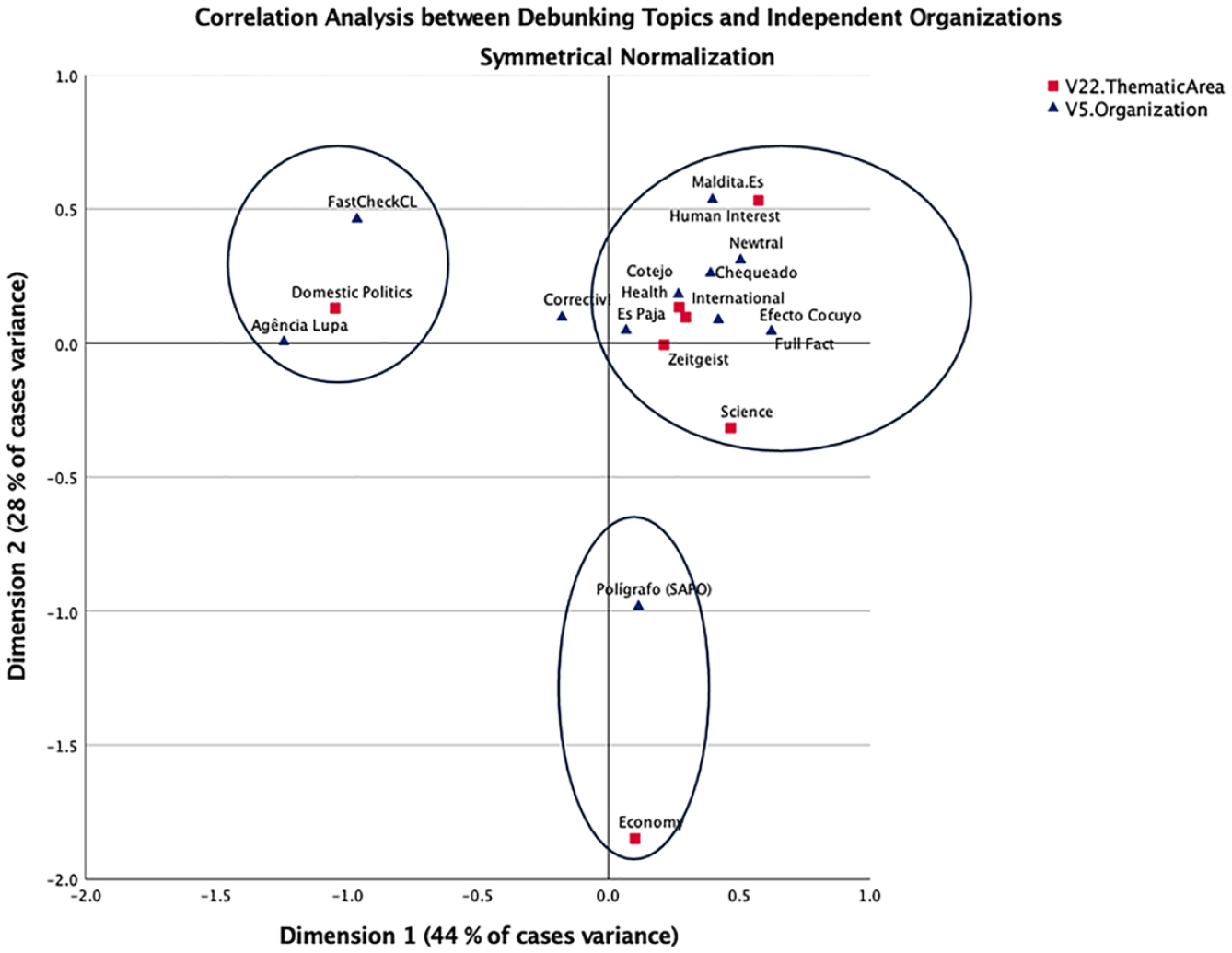
Correspondence Analysis Between Debunked Misinformation Topics and Independent Fact-Checking Organizations.
On the other hand, a significant variation of debunked topics is found across global news agencies, as shown in Figure 3. Reuters and EFE are distinct for their focus on debunking falsehoods related to international affairs (SR = 3.3 and 1.9, respectively) and, to a lesser extent, zeitgeist issues (SR = 2.4 and 0.2). 9 The German DPA debunks foreign affairs to a lesser extent (SR = −0.5 or 35.80% from the debunked articles) and has a well-distributed selection of topics. It differentiates itself for its human interest coverage (SR = 3.3). Finally, the AFP varies according to the office of operation. AFP in Brazil and Chile prioritized political falsehoods (SR = 8.1 and 3.2, respectively), while the unit in Argentina focuses more on health (SR = 1.9) and science (SR = 6). While all examined global news agencies are part of the 3PFC network, their choice of topics to debunk appears to converge to a lesser extent. This finding is consistent with prior research, indicating that smaller organizations, like many independent ones, might be more influenced by the Meta partnership than influential organizations such as international agencies.
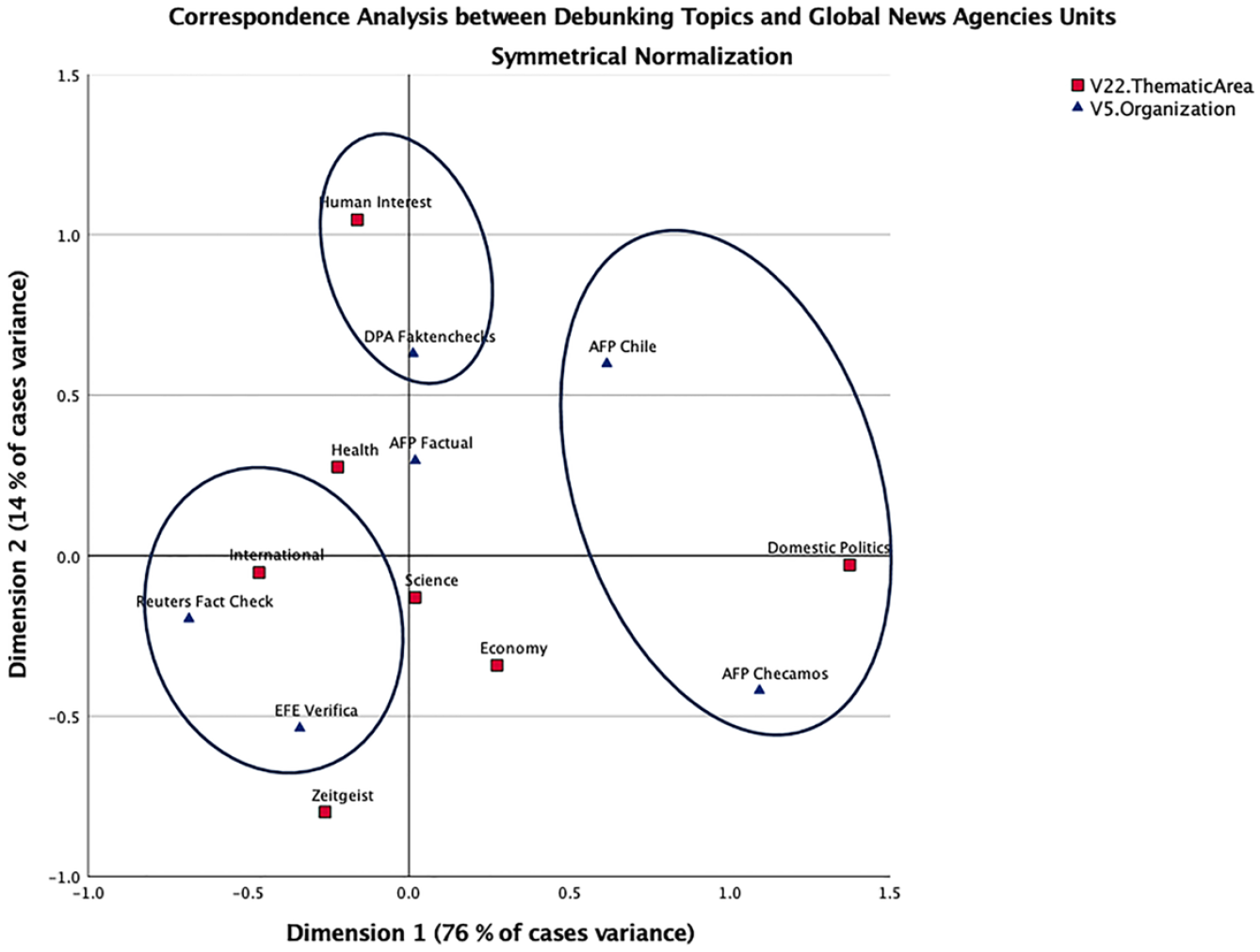
Correspondence Analysis Between Debunked Topics and Global News Agencies Fact-Checking Units.
Concluding Discussion
This study empirically demonstrates the “debunking turn,” that is, the social media policing trend, in fact-checking journalism (Bélair-Gagnon et al., 2023; Graves et al., 2023). Based on quantitative content analysis, it examines verification formats (verification of social media rumors or public figures’ statements) and topic convergence across 8 countries and 23 organizations in Europe and Latin America. We expand the analysis beyond English-speaking liberal countries, including representatives of polarized pluralist (SP and PT) and democratic corporatist models (DE), alongside Latin American democracies outside Western Europe and the United States. As fact-checking projects embody hybrid efforts and are influenced by diverse logics (Kim & Buzzelli, 2022), this study explores macro media systems and meso-organizational indicators to investigate variations in data.
The dominant social media policing trend (RQ1) prevails in all analyzed countries, ranging from 76% to 95%, irrespective of their continent. This trend results from global concerns about disinformation, with platforms partnering with fact-checking organizations. These partnerships allegedly homogenize fact-checking practices, erasing national distinctions (Bélair-Gagnon et al., 2023). However, differences between European and Latin American legacy media are more noticeable, shaped by existing political and media systems structures, that is, path dependency (Hallin & Mancini, 2017). European traditional media pay relatively more attention to statements made by public figures. In contrast, Latin American media tend to be more cautious in pointing fingers at public figures, influenced by a lack of data accessibility (Lauer, 2021), concerns about online harassment (Funke, 2018), and political relationships (Harlow, 2023; Waisbord, 2000). Strictly speaking, all these problems are intrinsically related to factors described by media systems theory: high political parallelism, clientelism, weaker rational-legal authority, and lower journalistic professionalism. Notably, differences between independent digital native fact-checking websites in these regions are less pronounced, indicating a homogenization path (Hallin & Mancini, 2017) that diminishes the distinction between nations. Emerging technologies, global economic forces, or cultural paradigms influence this trend. Therefore, H1, positing a greater emphasis on social media monitoring in Latin America than in Europe, is only partially supported. Solely European legacy media significantly publish more articles targeting public figures’ statements than their Latin American counterparts.
In the unique Latin American context, defined by clientelist connections between media and politics (political parallelism and weaker rational-legal authority), a lack of reliable data, online harassment of journalists, and widespread social media news consumption for news (Fletcher et al., 2022), prioritizing debunking could be the most practical approach. Although we have empirically confirmed the shift toward social media policing with minor contextual differences, it is crucial to highlight that understanding this transition requires more than just the argument of platform collaboration.
There is a high likelihood of encountering misinformation or disinformation in countries with high social media news consumption and less-developed press systems. In such cases, it may be justifiable for fact-checking organizations to prioritize monitoring social media, even if some fact-checkers view debunking online rumors as less significant and a distraction from more pressing tasks (Graves et al., 2023, p. 16), such as holding politicians accountable. The various instances of coordinated inauthentic behaviors, such as political troll farmers and AstroTurf (Keller et al., 2020), serve to obscure the origins of false information, thereby intensifying the issue of disinformation through the creation of artificial audiences (Delwiche, 2019). Research indicates the employment of these strategies to amplify narratives against COVID-19 vaccination (Murero, 2023), the “rechazo” campaign during Chile’s constitutional reform referendum (Bell, 2022; Osborn, 2023), and narratives of electoral fraud associated with Bolsonaro (Ozawa et al., 2023; Santini et al., 2021). It is crucial to note that disinformation campaigns also encourage the active participation of individuals who willingly contribute to the dissemination and amplification of hatred and falsehoods, a phenomenon termed “participatory propaganda” (Wanless & Berk, 2019). In this context, the social media policing shift represents a response addressing such phenomena.
Given the far-right “fake news” machinery and mostly anonymous coordinated online disinformation campaigns (Berti & Loner, 2023; Engesser et al., 2017; Gerbaudo, 2018; Hameleers & Minihold, 2022; Rivas-de-Roca et al., 2023), which have, in extreme cases, influenced election outcomes, such as Bolsonaro in 2018 or Milei in 2023, closely monitoring these online environments is even more essential for fact-checkers. This attention is particularly relevant in Latin America, where social media has surpassed television as the primary news source (Newman et al., 2023), as shown in Table 2. In such contexts, the convergence of formats, as seen in this social media policing shift, should not be alone a cause for significant concern.
Another crucial factor in assessing the impact of platform collaboration lies mainly in the standardization of topics that have been debunked (RQ2). Many of these organizations rely heavily on Meta AI tools, which primarily excel in an English and U.S. context. The confirmation of H2, suggesting significant topic variations across organizations, is only partial. A more noticeable convergence of topics was observed in independent organizations than in those affiliated with established European media or global news agencies. This result supports the notion that the impact of platformization may be more significant for smaller organizations (Bélair-Gagnon et al., 2023).
When we analyze thematic patterns within legacy media fact-checking units, we can observe a significant influence stemming from established structures and practices, aligning with Hallin and Mancini’s (2017) concept of “continuous system determinism.” Significant variations emerge in the types of topics debunked by legacy media, which align with the structures of their respective media systems. For instance, European PSB Channels, characterized by high journalistic professionalism and the state’s regulatory role (Hallin & Mancini, 2004), prioritize debunking foreign affairs and health-related false claims over political falsehoods. This choice may be influenced by their role as public service broadcasters, as engaging in political verdicts could potentially impact their image of objectivity (Maras, 2013; Tuchman, 1972). In contrast to other journalistic styles, fact-checking involves delivering truth assessments, challenging the conventional understanding of objectivity often associated with impartial, passive, and disengaged reporting obligations.
Meanwhile, in Latin America, characterized by lower journalistic professionalism, political parallelism, and market capture (Guerrero, 2014; Waisbord, 2000), a conservative right-leaning Chilean newspaper prioritized debunking health misinformation during a year with a constitutional reform referendum led by a left-wing administration. This choice may be aimed at avoiding potential implications for the right-leaning political establishment that could benefit from online political falsehoods. These performances of legacy media in Europe and Latin America align with expectations based on the distinction of media systems (Guerrero, 2014; Hallin & Mancini, 2004; Navia & Osorio, 2015), showing a certain path continuity.
Conversely, greater convergence in debunked topics is notable among independent organizations. The influence of the platforms is more evident in digital news-born fact-checking entities, highlighting the trend toward topic convergence (less domestic politics, more health, foreign affairs, and human interest, with a few exceptions). Independent fact-checking organizations follow a distinctive logic shaped by transnational technological structures (Hallin & Mancini, 2017), including their collaboration with Meta and the monitoring tools provided by social platforms. Overall, independent organizations globally resemble each other more than other legacy media fact-checking units in their respective national media systems.
Our study holds several implications. In the field of fact-checking, we empirically substantiate the widely discussed trend toward social media policing (Bélair-Gagnon et al., 2023; Cazzamatta & Santos, 2023; Graves et al., 2023) through quantitative content analysis across eight countries, specifically by observing the performance of fact-checkers regarding formats of verification and selected topics. This shift is crucial in navigating a digital media environment heavily influenced by social media platforms. The opportunities and challenges of this adaptation in fact-checking practices require a thorough analysis, especially outside the Western world. In countries where social media networks predominantly influence elections (Mello, 2020; OAS, 2018; Santini et al., 2021), with limited public service media and high reliance on social media for news, the verification of online content becomes paramount so that platforms can reduce its visibility. In this context, fact-checking remains a crucial democratic building tool (Amazeen, 2020).
Further exploration is needed regarding collaboration with other platforms concerning funding, financial viability, their impact on content, and the development of automated tools for online content monitoring. Notably, in partnership with Poynter’s IFCN, Google and YouTube are providing a $13.2 million grant to support the global fact-checking community until 2025 (Dyakon, 2022). For platform and disinformation studies, on the other hand, questions persist about the motivation of major technology companies supporting the fact-checking community, given their significant contributions to the economic upheaval in the journalism industry (Fischer & Jarren, 2023; Usher, 2019) and the proliferation of disinformation. Finally, in studies grounded in media system theory in the digital age, we illustrate that although still influential, classic dimensions prove inadequate in isolation to elucidate the dynamics of this transnational professional field. Independent fact-checking start-ups exhibit more significant global similarities among themselves than with their home countries’ established media counterparts.
An important limitation of this study is its descriptive, exploratory character that does not permit direct causal inferences, such as the one presented by Amazeen (2020), which predicts the number of fact-checkers within a state based on indicators such as press freedom, internet penetration, and socio-political context (operationalized through indices of democracy). Our study uses media system traits and additional digital indicators to explain variations in the content of fact-checking among countries and organizations. Further studies should attempt to predict the degree of shift toward social media policing and topic convergence based on such indicators, even though these data are not always available for countries outside the Western world. In this sense, our conclusions are contingent upon these limitations. Additional analyses or investigations are required to delve more comprehensively into causal relationships.
Supplemental Material
sj-docx-1-jmq-10.1177_10776990241261725 – Supplemental material for The Content Homogenization of Fact-Checking Through Platform Partnerships: A Comparison Between Eight Countries
Supplemental material, sj-docx-1-jmq-10.1177_10776990241261725 for The Content Homogenization of Fact-Checking Through Platform Partnerships: A Comparison Between Eight Countries by Regina Cazzamatta in Journalism & Mass Communication Quarterly
Footnotes
Declaration of Conflicting Interests
The author(s) declared no potential conflicts of interest with respect to the research, authorship, and/or publication of this article.
Funding
The author(s) disclosed receipt of the following financial support for the research, authorship, and/or publication of this article: The author is grateful for the financial support of the German Research Council (DFG CA 2840/1-1). The author is also indebted to the student assistants involved in the coding process. Finally, the author would like to thank all three reviewers for their meticulous analysis of the previous version of this manuscript and their valuable comments.

Supplemental Material
Supplemental material for this article is available online.
Notes
Author Biography
References
Supplementary Material
Please find the following supplemental material available below.
For Open Access articles published under a Creative Commons License, all supplemental material carries the same license as the article it is associated with.
For non-Open Access articles published, all supplemental material carries a non-exclusive license, and permission requests for re-use of supplemental material or any part of supplemental material shall be sent directly to the copyright owner as specified in the copyright notice associated with the article.
