



Abstract
Considering the claims for “de-Westernizing” Communication and Media studies, we examine the publication trends of BRICS-based researchers between 2012 and 2021. The article compares SciVal and SJR data concerning 7,938 articles to understand the circulation of such academic communities in top-ranked outlets. The results reveal a remarkable productivity growth in all BRICS countries, striking differences within the group in the number of research articles, the emergence of China as the bloc’s leading hub, and the lack of cooperation among such five countries. We also discuss and criticize how the “de-Westernization” agenda may eventually become another category domesticated by the Global North.
Keywords
Introduction
Despite the growing calls to de-Westernize Communication research (Dutta & Pal, 2020; Goyanes & Demeter, 2020; Mitchelstein & Boczkowski, 2021; Mohammed, 2022; Waisbord & Mellado, 2014), the scholarly literature holds that only a few authors based in Global South countries have been successful in publishing in high-impact international journals (Albuquerque, 2021; Demeter, 2019b; Ekdale et al., 2022). Among the explanatory factors behind this phenomenon are limitations in English language proficiency (Livingstone, 2007; Suzina, 2021), the hegemony of academics working for American and European institutions on editorial boards (Albuquerque et al., 2020), and scarce funding available in developing countries (Oliveira et al., 2021). If geographic diversity is crucial to fostering a true sense of international academic community (Ganter & Ortega, 2019; Waisbord, 2022), what has been done to dismantle the Western canon in Communication and Media studies (Mohammed, 2022)?
In this article, we aim to understand how scholars based in a set of countries claiming to challenge the centrality of Europe and the United States circulate in “elite” journals. More specifically, we examine the publication trends of BRICS researchers to compare if the bloc’s increasing economic and geopolitical prominence has been reflected in the publication patterns characterizing our field (Ai & Masood, 2021; Albuquerque, 2023; De Jesus, 2013; Finardi, 2015). To date, the contributions of Brazil, Russia, India, China, and South Africa to knowledge production in Communication remains uncharted—and investigating the “mediating” role of these semi-periphery countries (Bennett, 2014; Monteiro & Hirano, 2020) can bring more plural perspectives to the mainstream debate and inform us about how far the “de-Westernization” agenda can go.
Accordingly, among the bloc’s ambitions is expanding academic plurality beyond the West (Albuquerque, 2023). To this end, BRICS partners have established science and technology cooperation agreements (Kahn, 2015; Schneegans et al., 2021; Thussu & Nordenstreng, 2020). Nevertheless, we do not know how such policies translate into concrete South-South partnerships (Albuquerque & Lycarião, 2018; Thakur, 2014).
Stemming from data gathered from the SciVal and SCImago Journal & Country Rank platforms, we examine BRICS-based researchers’ publication of journal articles over 10 years (2012–2021) to understand (a) the productivity indicators of these five academic communities, (b) the quartile ranking of the journals publishing works by such scholars, and (c) the frequency of collaboration among scientists in the bloc. In addition, we discuss (d) to what extent the circulation of BRICS-based researchers is due to publications in SJR-listed journals edited in their own countries. To allow for a more thorough investigation, we illustrate our findings by (e) comparing BRICS scholars’ performance with their peers based in the five Western countries leading the publication of articles in Communication—the United States, the United Kingdom, Spain, Australia, and Germany.
Our study is relevant for tackling specific shortcomings of prior scholarship. First, mapping the circulation of BRICS researchers in top-ranked journals allows us to scrutinize how the demands for de-Westernization have been implemented in terms of geographical diversity. Therefore, the article explores publishing trends that might inform us about the strategies these semi-peripheral countries have used to broaden their international influence. Second, we propose an original approach by integrating data from two internationally recognized databases—SciVal and SJR. Despite the limitations of such metrics (Albuquerque et al., 2020), measuring the presence of key Global South players in elite publications illustrates how communities historically excluded from mainstream theoretical and epistemological debates struggle for voice and visibility. Third, our investigation delves into what can be seen as a limited version of internationalization—when researchers based outside the Western world publish in journals from their own country, leading to a “ghettoization” of research produced by scholars in the Global South (Ang et al., 2019; Ekdale et al., 2022). Fourth, we offer a longitudinal study that is able to seize the pace of the changes in our area, providing new suggestions to foster a truly global knowledge network.
The article is divided into five more sections in addition to this introduction. The literature review addresses two topics: studies about the de-Westernization of Communication and Media Research and the BRICS as a bloc striving to promote greater South-South integration. We then detail the methodological procedures. After presenting the results, we discuss the research findings grounded on the literature.
The results indicate a significant upsurge in publications from all BRICS countries between 2012 and 2021. However, this increase has been quite uneven. Brazil shows the highest amount of work published in absolute numbers, but at the same time, this country has grown less in percentage terms than its partners. China stands out for the high number of texts published in Q1 journals but exemplifies the intra-BRICS collaboration’s scarcity.
The Calls for “De-Westernizing” Communication and Media Studies
We distinguish Global North (or Western) and Global South countries following the classification developed by Demeter (2020). According to the author, the South comprises regions geopolitically dependent or historically exploited by other nations—such as Latin America, Africa, the Middle East, Eastern Europe, and part of Asia. The Global North, in turn, includes the United States, the United Kingdom, Western Europe and Scandinavia, Canada, Australia, New Zealand, Israel, Japan, Taiwan, Hong Kong, Singapore, and South Korea.
Dependency theory is particularly useful here, highlighting the political and economic emphasis usually embedded in the divide between the Global North and the South (Demeter, 2019a, 2019b; Lauf, 2005). In this vein, creating mechanisms for attributing intellectual prestige has recurrently disregarded the particularities of peripheral and semi-peripheral countries—reinforcing a dependency that demands Global South researchers meet an agenda sponsored by scholars and editors based in North. As a result, studies from developed regions may gain more visibility not from the merit of the research per se but due to hegemonic self-feeding circuits that become influential to the detriment of peripheral knowledge communities (Albuquerque, 2021; Albuquerque et al., 2020; Ekdale et al., 2022; Goyanes & Demeter, 2020; Paasi, 2005). To illustrate, the field of Communication remains heavily influenced by American administrative research (Smythe & Van Dinh, 1983; Wiedemann & Meyen, 2016), on top of theoretical and epistemological traditions rooted in the Western European media environment (Ganter & Ortega, 2019; Hanusch & Vos, 2020; Waisbord & Mellado, 2014).
These dominant perspectives are seldom concerned with justifying the applicability of their theoretical constructions beyond their immediate realities, neglecting sound divergences from the viewpoint of Global South societies (Albuquerque et al., 2020; Demeter, 2019a, 2020; Lauf, 2005). In other words, professedly universal definitions are sometimes unsuitable for explaining contexts as diverse as Latin America, Africa, the Middle East, or Southeast Asia (Cheruiyot & Ferrer-Conill, 2021; Ekdale et al., 2022; Mitchelstein & Boczkowski, 2021). Rather than acknowledging the heuristic limitations of their categories, researchers from the Global North often resort to the simplistic notion that “peripheral” contexts would be unstable, hybrid, or deviant (Alatas, 2000; Mutsvairo et al., 2021; Voltmer, 2011; Waisbord & Mellado, 2014).
Among the challenges faced by Global South scholars to publish and question such logic of domination are the predominance of American and European researchers on the editorial boards of top-ranked journals (Albuquerque et al., 2020; Goyanes & Demeter, 2020), the need to master the English language to access prestigious intellectual environments (Ganter & Ortega, 2019; Suzina, 2021), the commercial nature of the repositories where “mainstream” knowledge circulates (Oliveira et al., 2021; Paasi, 2005), and the creation of a convenient system that classifies the impact of academic journals according to standards set by rich countries (Amsler & Bolsman, 2012). That is, “colonialism” (Chakrabarty, 2000) and “intellectual imperialism” (Alatas, 2000) underpin the authority of gatekeepers who dictate what is considered “interesting” and “valid” knowledge, intensifying asymmetries in Communication research (Goyanes, 2020).
Accordingly, in Communication and Media Studies, developed countries’ epistemological and methodological strength results from historical factors, such as the pioneering spirit of university teaching at American, German, and French institutions since the early 20th century (Albuquerque, 2021; Demeter, 2019b). It was also in the United States that Communication became institutionalized as an academic field associated with functionalist approaches (Ai & Masood, 2021; Rogers, 2001). At the same time, events such as authoritarian regimes hindered Communication research development throughout the Global South (Demeter, 2019b).
More recently, academic associations have discussed the modest presence of developing countries’ researchers in international circuits. The International Communication Association’s past president, Sonia Livingstone (2007), mentioned “the gap between the aspirations for a global community of shared ideas” (p. 276). In turn, Ganter and Ortega (2019) sustain that a cosmopolitan approach to science must involve three dimensions: institutional, devoted to promoting exchanges among different regions; academic, oriented toward avoiding labeling as “uninteresting” works focused on locations distant from hegemonic research centers; and educational, aimed at encouraging students to become acquainted with contexts not immediately familiar to them.
In short, the notion of de-Westernization constitutes a movement aimed at recognizing traditions that have been systematically neglected in mainstream literature (Cheruiyot & Ferrer-Conill, 2021; Mitchelstein & Boczkowski, 2021) besides reflecting on the conditions to criticize the so-called intellectual ethnocentrism (Mutsvairo et al., 2021). Dialoguing only with specific Western groups limits the potential of new advancements as it dismisses production routines, phenomena, and references that constitute our diversity of knowledge (Ekdale et al., 2022; Waisbord, 2022).
The BRICS and the Challenge of Academic Integration
To deepen cooperation among emerging economies, Brazil, Russia, India, and China (later joined by South Africa) formalized, in 2009, the creation of the BRICS bloc. One of the reasons behind this initiative was the claim for greater independence from “central” countries (Albuquerque & Lycarião, 2018; De Jesus, 2013; Mostafa & Mahmood, 2015) regarding trade partnerships and infrastructure projects. Today, BRICS countries comprise 3.2 billion people (40% of the global population) and account for 26% of global trade. 1 In addition, the nations within the bloc also aim to bolster academic ties (Kahn, 2015; Thussu & Nordenstreng, 2020) to build alternative settings for promoting the knowledge produced by Global South researchers (Demeter, 2019b; Oliveira et al., 2021).
Nonetheless, Brazil, Russia, India, China, and South Africa do not necessarily face the same challenges as poorer countries in the Global South. Even though they do not perform as well as academic world powers, all BRICS countries are regional centers with significant leadership (Altbach, 2013; David & Motala, 2017). Therefore, when it comes to academic and technological matters, maybe these nations should be taken in a semi-peripheral position (Bennett, 2014)—countries that have not yet achieved the status of significant knowledge producers but that rely on better conditions than poorer Global South intellectual communities (Monteiro & Hirano, 2020). According to Demeter (2020, p. 96), “they produce both systemic acts whereby they tend to move along with the center, and anti-systemic counter-movements through which they try to resist central influence.” More precisely, it is about recognizing nuances in the case of countries with more significant potential to reshape global processes (Robinson, 2015), including in knowledge production (Albuquerque, 2021).
As for integrating academic policies within the bloc, the BRICS Network University, the BRICS Universities League, and the BRICS Summer Program of Fudan University stand out. However, these initiatives have prioritized the “hard sciences,” focusing on issues like manufacturing technologies and robotics, renewable energy sources, and climate change (Schneegans et al., 2021; Yuyun, 2018). Thus, despite promising experiences (Dwyer & Arifon, 2019), scholars in BRICS countries struggle to establish intellectual alliances regarding the Humanities and Social Sciences (BRICS Think Tanks Council [BTTC], 2015; Finardi, 2015).
In his work addressing 79 journals indexed in the Web of Science, Demeter (2019b) investigated the leading publishing communities in Communication and Media studies. Data for the period between 2013 and 2017 showed the United States at the forefront, with 55% (3,091) of the documents in the sample. Among the 50 countries with the highest number of publications, BRICS nations showed a modest performance. China registered 250 texts published over the period. South Africa (61 articles), India (28), and Brazil (18) also appeared on the list. Russia, however, did not rank among the 50 countries with the most publications.
Data from the UNESCO Science Report (Schneegans et al., 2021) help us make sense of these nations’ science investments in relation to their GDP—suggesting why some of them are lagging. Comparing 2014 and 2018, only China surpassed 2% of GDP in research and development investments (2.03% in 2014, with an increase to 2.19% in 2018). Brazil remained practically stable, with 1.27% in 2014 and 1.26% in 2018. Russia registered 1.07% (2014) and 0.99% (2018), while India decreased from 0.70% to 0.65%. South Africa went from 0.77% to 0.83%. Meanwhile, the indexes regarding the United States were 2.72% in 2014 and 2.84% in 2018. The report indicates yet another disparity: while investment in science increased by 19% worldwide between 2014 and 2018, China was responsible for 44% of this surge—which denotes the country’s determination to expand its academic influence.
To overcome such difficulties, BRICS countries have adopted an array of different strategies (Monteiro & Hirano, 2020). China has promoted academic mobility and improved university structure (Demeter, 2020), besides sponsoring collaboration with mainstream countries to increase the impact of its publications in Human and Social Sciences (Demeter et al., 2023). India has also invested in higher education, unlike Russia—which is still marked by low mobility and scarce availability of financial resources (Asheulova & Dushina, 2014). As for Brazil, Demeter (2020) highlights the country’s own journal system as an alternative space to foster regional visibility—notwithstanding, these journals are recurrently ignored or viewed as insufficiently scientific by Global North scholars (Ekdale et al., 2022). Finally, South Africa-based researchers signed most of their texts with authors from the same continent to increase their contribution’s circulation (Demeter, 2020).
Our article poses four research questions in light of this investigation’s objectives. The RQs below consider the data available on the SciVal and SJR platforms for the articles published between 2012 and 2021, thus allowing us to evaluate the progress of de-Westernization initiatives in our field.
Method
We offer three explanations before detailing the analysis. First, this study does not consider the authors’ nationality or birth country but rather the country of their institutional affiliation at the time of publication. This option is in line with the argument of Demeter (2019a), Ai and Masood (2021), and Goyanes and De-Marcos (2020) that academic capital generally lies in the university sponsoring the researcher and not her birthplace or passport issuer.
Second, although the “de-Westernization” agenda also involves discussing phenomena taking place in the Global South, we specifically address the visibility, productivity, and presence of researchers associated with a group of semi-peripheral countries. In this vein, a limitation of this article is the focus on the advances and setbacks regarding production indicators and not matters encompassing the characteristics of these media settings.
Third, during the development of this research, six new countries were admitted to the BRICS group: Argentina, Egypt, Iran, Ethiopia, Saudi Arabia, and the United Arab Emirates. 2 The announcement took place at the BRICS Summit held in August 2023. However, the effective participation of such partners will only come into effect from January 1, 2024. In addition, according to SciVal data (2012–2021), none of the group’s new members outperforms Brazil, Russia, India, China, or South Africa in the number of research articles in Communication. Therefore, such a change does not jeopardize the present analysis.
Our investigation collected data on the articles published by authors based in BRICS countries between 2012 and 2021. Using the SciVal platform (Elsevier), we built a database containing an array of information for each article: paper title, name of the journal in which the manuscript was published, year of publication, number of authors, institutional affiliations, and universities involved in the publication (as well as their respective countries). SciVal is one of the most relevant platforms to map academic production, encompassing metadata of works published in Scopus-indexed journals. 3 For the present study, we considered specifically the production of research articles since journals remain the space par excellence for circulating results and obtaining social capital in the field of Communication (Demeter, 2019a; Schatto-Eckrodt & Quandt, 2023). More precisely, our study did not take into account data related to editors’ notes or book reviews. Even though BRICS intellectual production consists not only of academic articles but also includes monographs, video products, and other formats, there is no database cataloging such material—adding another limitation to our findings. After applying the automated filters available on SciVal, we identified 8,618 articles published between 2012 and 2021 with the contribution of at least one author based in one of the five BRICS nations.
The research used a second database—the SCImago Journal & Country Rank (SJR)—to determine the classification of journals in which BRICS-based researchers published. This platform “is a publicly available portal that includes the journals and country scientific indicators developed from the information contained in the Scopus database,” 4 pointing out the indexed journals’ region of origin. The academic community recognizes this ranking as a barometer of the quality of academic production (González-Pereira et al., 2010), besides considering it more “inclusive” if compared to the Journal Citation Report (Goyanes & De-Marcos, 2020).
In 2021, the SJR compiled a list of 447 Communication journals classified according to their repercussion on the academic community (even though only 439 were categorized at the time). Journals are divided into four quartiles (Q1, Q2, Q3, and Q4), with Q1 being the highest impact level. 5 Since the position for each journal may vary over time, we considered the 2021 classification as the base year for this study. To sum up, even though the SJR classification has limitations as it only includes journals meeting specific criteria—sometimes creating barriers to publications from Global South countries (Albuquerque et al., 2020)—we cannot disregard the influence of this ranking on the distribution of academic prestige, even in countries beyond the Western world (Demeter et al., 2022; Goyanes, 2023; Goyanes et al., 2022).
We excluded from our sample journals no longer listed in the SJR ranking in 2021, as well as journals not yet allocated in a quartile as they were only recently added to the SJR database. After these adjustments, our research corpus consisted of 7,938 articles. We then carried out cross-data analyses to identify the quartiles of each journal in which researchers then working in Brazil, Russia, India, China, and South Africa published between 2012 and 2021.
We took an extra step to compare the articles’ production in BRICS versus the five Global North countries that have most published in Communication top-ranked journals throughout the decade—the United States, the United Kingdom, Spain, Australia, and Germany registered 52,044 papers on SciVal. Although this article does not aim to compare the performance of the two groups in detail, we intend to offer a more informed perspective regarding the main forces in our field of studies.
In addition to detailing the production indicators divided by country and journal classification quartiles, the following topic reveals the characteristics of publication partnerships among BRICS-based researchers. The results section also explores the SJR ranking of journals edited in the five countries at stake. Due to space limitations, additional information (such as data regarding international partnerships) can be found in the Supplemental Appendix. 6
Findings
General Data on the Production of Journal Articles
According to Table 1, Brazil stands out in absolute numbers, with 2,667 papers—corresponding to 33.6% of the group’s total. China comes in second with 2,297 (28.9%) papers—over twice as many as South Africa (1,106 articles, or 13.9% of the corpus) and India (1,015 or 12.8% of the total analyzed). Russia is the country with the lowest publication rates, with 853 records, or 10.7% of the sample.
Total Number of Articles Authored by Scholars From Each Country.
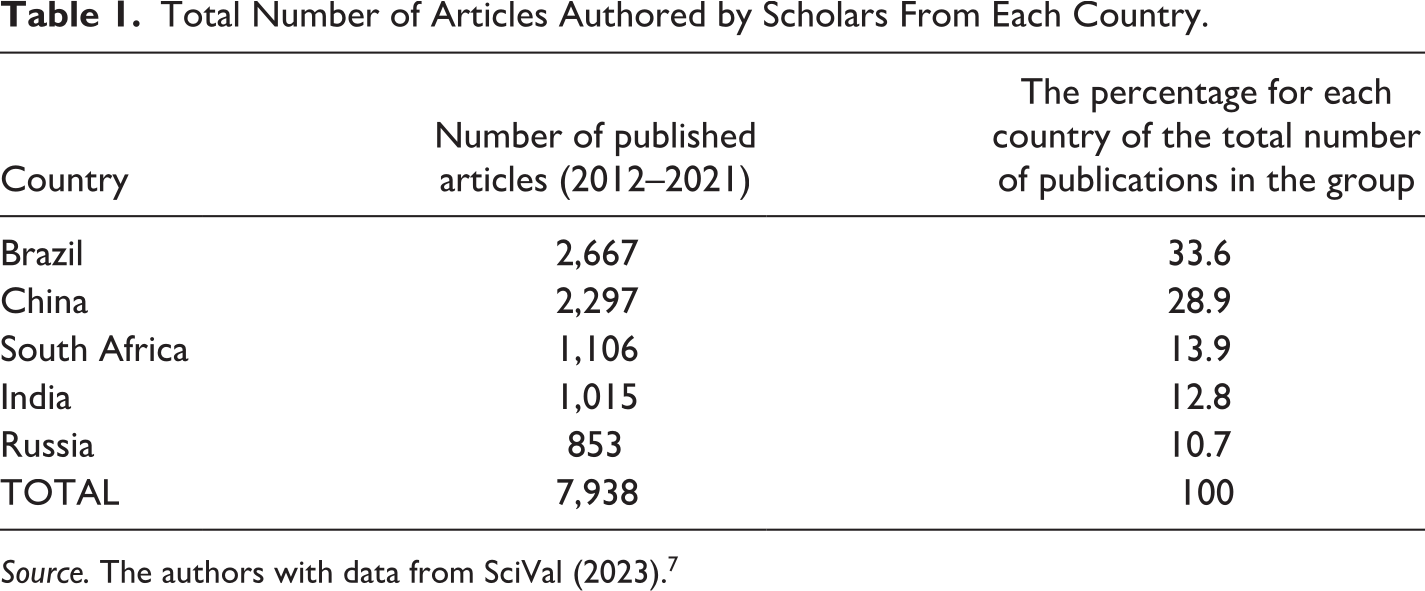
Source. The authors with data from SciVal (2023). 7
As for the five Western countries that most published in SJR-ranked Communication journals, we have the United States (29,738 articles), the United Kingdom (8,218 papers), Spain (6,318), and Australia (4,331). Germany holds the last position in such a group (3,439 research articles), some hundred more than Brazil-based researchers published between 2012 and 2021. Overall, these five Western countries published six times more than BRICS.
Figure 1 details the number of articles per country per year in the case of BRICS. We found significant growth between 2012 and 2021. Brazil expanded its production by 89.6% throughout the decade. While behind Brazil concerning the total sum within the period, China experienced a noteworthy improvement in recent years. In fact, on top of being the first country in BRICS to surpass 400 articles published in SJR-ranked journals, China-based publications surged 280.5% between the first and last years of the series.
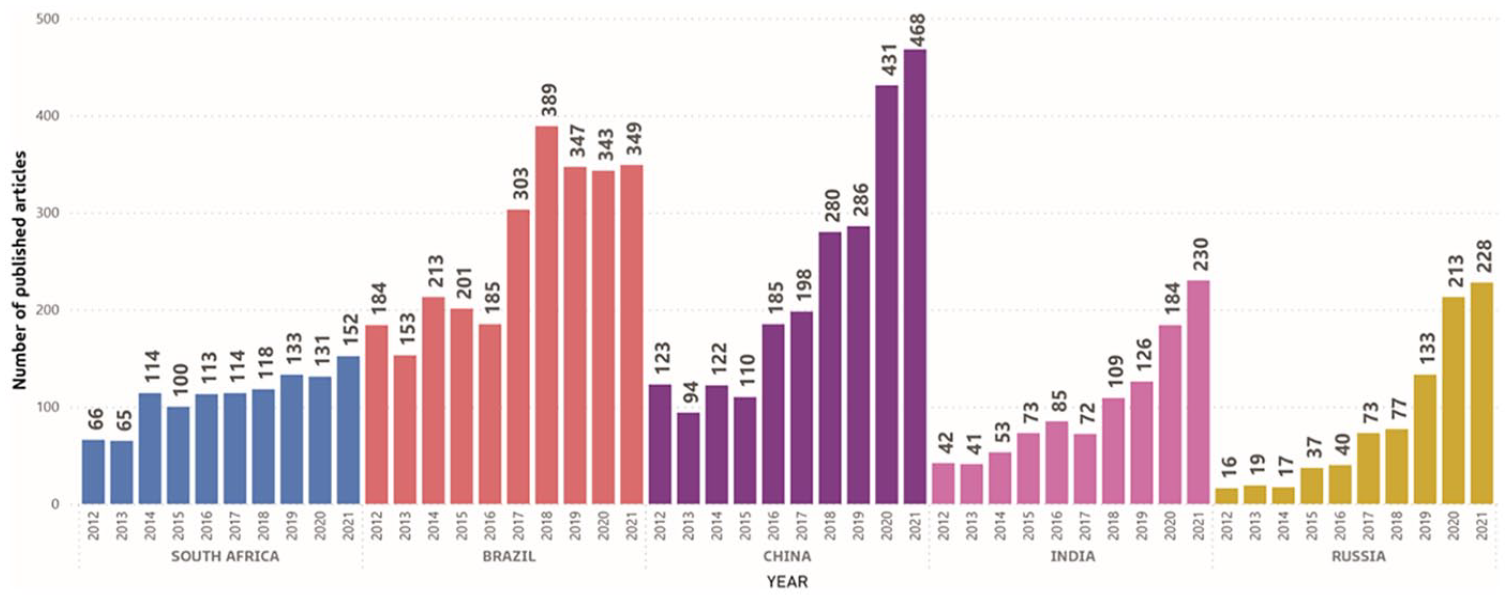
Papers Published by Country and by Year (2012–2021).
Russia, which had only 16 published papers at the beginning of our time series, reached 228 publications in 2021, registering a 1,325% growth in 10 years. India, in turn, climbed from 42 to 230 articles, an increase of 447.6%. South Africa went from 66 to 152 papers, with a more modest expansion of 130.3%. To summarize, while Russia has recently overtaken South Africa and approached India, it remains in last place considering the total of works published in the decade.
The growing trend in the number of publications is also evident among the five most productive countries in the Global North. Given the traditional frequent circulation of authors based in the United States and the United Kingdom in top journals, both countries had a more modest relative growth between 2012 and 2021—64.7% and 71.2%, respectively. Germany (242.4% increase), Spain (173.7%), and Australia (94.7%) presented superior proportional performances.
Although researchers from Western Europe and the United States continue to lead the most prestigious academic spaces, some scholars from BRICS have managed to reach the highest strata of the SJR. Figure 2 shows China is the group’s leader, with 1,374 papers in Q1 outlets (circa 59.8% of the country’s total works). That is, not only has China consistently increased its production, but the researchers based in such a country have figured in the most coveted journals (see Figures 1a to 5a in the Supplemental Appendix to understand the distribution of publications by year and quartiles for the five countries).
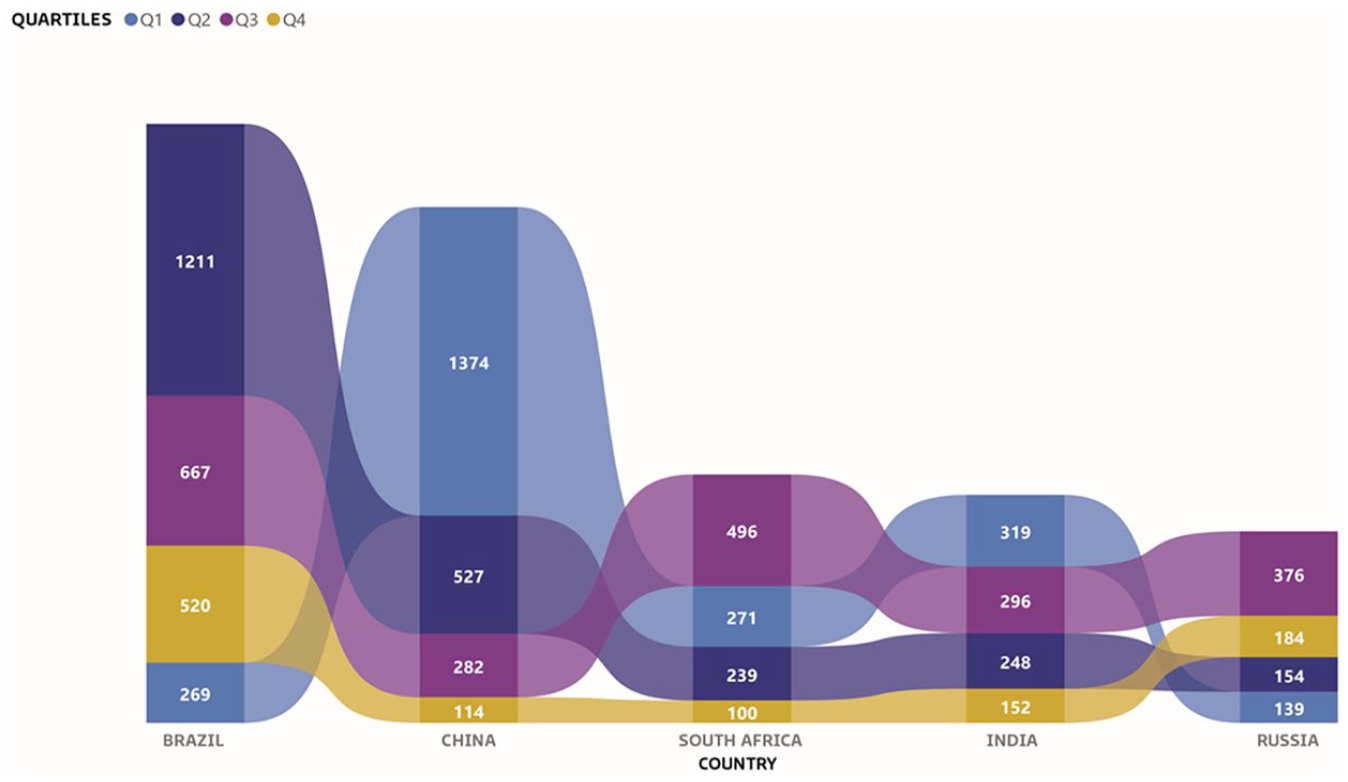
Country Publications Per Quartile (2012–2021).
Brazil represents an exciting case. Despite leading the total number of articles published between 2012 and 2021, scholars in Brazilian institutions are behind their peers in China (N = 1,374), India (N = 319), and South Africa (N = 271) when considering only articles in Q1 journals. Indeed, Brazil-based authors published 269 works in the most prestigious journals over 10 years (or about 10% of their total), ahead in absolute numbers only of Russia, which reached 139 articles (or 16.2% of the total for this respective country). Researchers in Brazilian universities predominantly published in Q2 journals (N = 1,211 or 45.4%, a considerably higher rate at this level compared to other countries). Furthermore, we found a gradual growth in publications by Brazil-based scholars in Q4 journals, rising from 11.9% in 2015 to 27.1% in 2020 (Supplemental Appendix, Figure 3a).
Figure 2 also indicates that China and India are the only BRICS countries with a higher proportion of publications in Q1 journals than in other quartiles. In fact, 319 of 1,015 India’s articles were published in journals in the highest stratum, corresponding to 31.4% of the country’s total. It should be noted, however, that the performance of India-based authors varies depending on the year (Supplemental Appendix, Figure 2a). To illustrate, their publications in first-quartile journals reached 43.4% in 2014 but dropped to 24.6% in 2019.
On the other hand, most of the publications from South Africa and Russia were concentrated in Q3 journals, albeit with significant differences regarding their respective performances in other quartiles. Between 2012 and 2021, 271 (or 24.5%) of the 1,106 publications of South Africa-based researchers were in Q1 journals, against 239 (21.6%) in Q2 journals. Another 496 articles were published in Q3 journals (44.8%), while 100 pieces appeared in Q4 periodicals (9%). South Africa has recently increased its share in top-ranked journals (Supplemental Appendix, Figure 4a). While in 2017, the proportional distribution for this country was 21% in Q1 and 19.3% in Q2, there was an important increase in Q1 (28.2%) and Q2 (27.6%) journals in 2021.
Russia has the lowest overall number of publications during the period under review (853), with the following distribution: 139 papers (16.3%) in Q1 journals, 154 texts (18%) in Q2 outlets, 376 articles (44%) in Q3 publications, and 184 (21.5%) in Q4 journals. However, starting in 2017, we found an escalating number of publications in Q1 and Q2 journals for this country (Supplemental Appendix, Figure 5a).
Participating in higher strata provides another way to compare the BRICS and the prominent Western countries in the area. Four of the five most productive academic communities in Communication published more than half of their articles in Q1 journals. Germany is the country with the highest percentage of articles published in Q1 journals, with 60.9%. The United States registered 59.5% of its papers in the highest stratum between 2012 and 2021, while Australia (58.6%) and the United Kingdom (51.9%) also achieved impressive performances. The exception in this group is Spain, which had more publications in Q2 journals (41.5%) than in Q1 (29.7%). Therefore, China is the only BRICS member whose presence in the most prestigious journals rivals—in percentage terms—that of Western countries. In absolute numbers, however, China-based scholars still need to considerably improve their performance to keep pace with the United States and the United Kingdom.
BRICS Researchers and International Partnerships
For this topic, the number of publications associated with each country might differ from the number of authors, as researchers from several nations might contribute to a single article. Therefore, the article will count as a single publication if an India-based researcher is the coauthor of scholars in French or Chinese institutions.
Our data show relevant differences when it comes to the international partnerships established by BRICS-based researchers. Table 2 displays a significant discrepancy in the percentage of collaborations involving scholars based in Brazil, China, South Africa, India, and Russia.
Distribution of Articles With and Without International Partnerships.
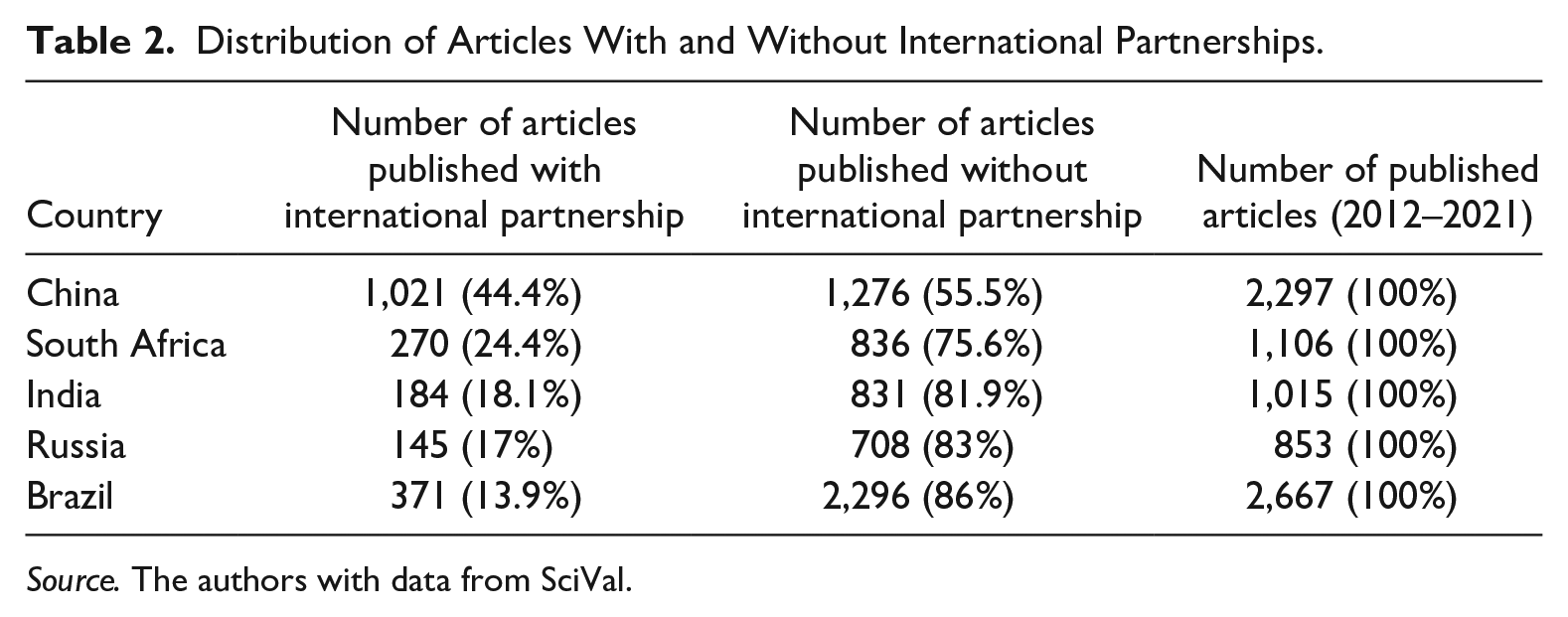
Source. The authors with data from SciVal.
Brazil registered the lowest rate of articles published in co-authorship with overseas researchers. Of the 2,667 works published over 10 years, only 371 texts (13.9%) were written with peers based in any other country. In terms of percentage, authors in Russian institutions performed slightly better, as 145 of their 853 texts (or 17%) resulted from international partnerships. India operated similarly to Russia: 184 (18.1%) of 1,015 publications between 2012 and 2021 emerged as collaboration with foreign colleagues. The results for South Africa reveal a more consistent integration with the international community. Scholars linked to South African universities authored 1,106 articles, of which 270 (24.4%) had some foreign collaboration. China stands out again: 1,021 (44.4%) of 2,297 papers were coauthored with scholars from other countries.
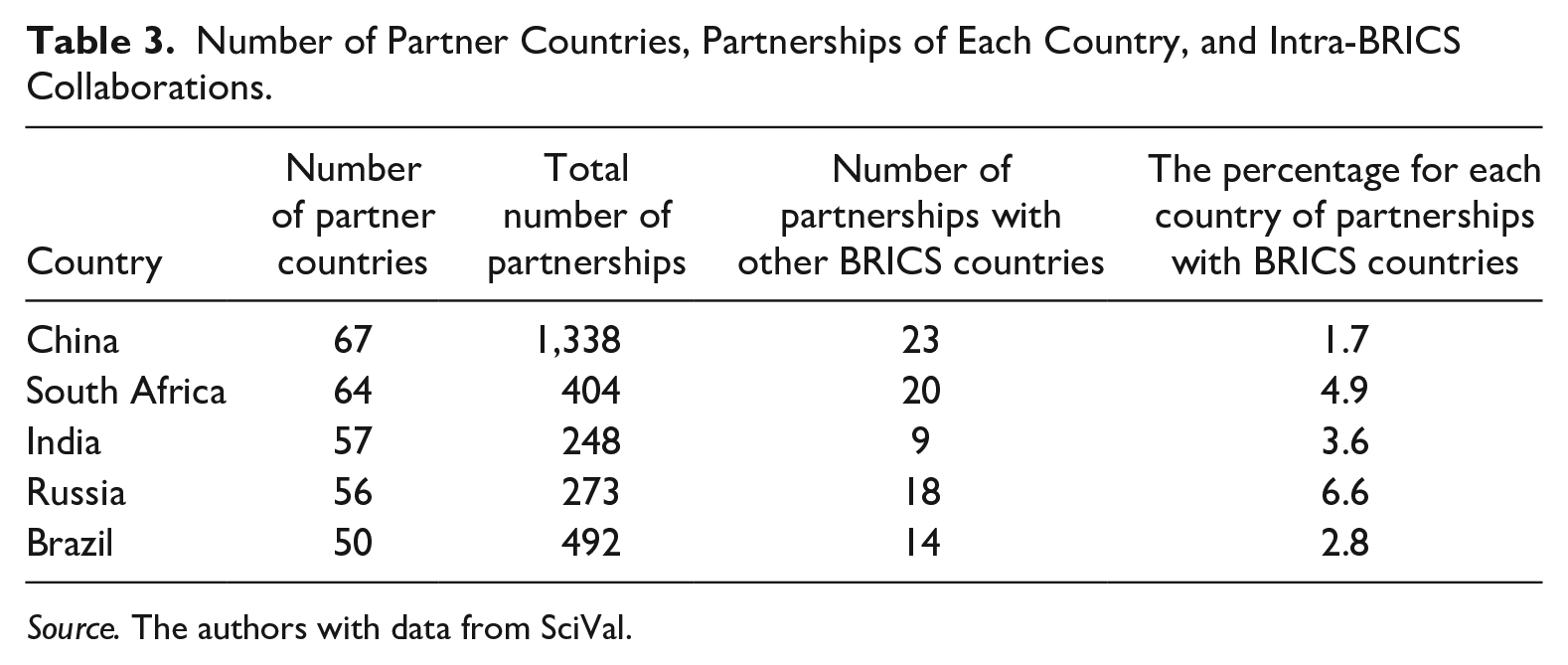
The results also reveal that Brazil-based scholars partnered with colleagues from 50 other countries (Supplemental Appendix, Table 1a), mostly with researchers from Spain (N = 93). Portugal comes next (N = 72), followed by the United States (N = 56), the United Kingdom (N = 44), and, in fifth place, France and Canada—tied with 23 coauthored productions. In other words, all leading partners of Brazil-based scholars are linked to countries in the Global North. Regarding co-authorships with researchers of BRICS universities (Table 3), Brazil-based investigators established 14 partnerships with colleagues in the group—7 with colleagues working in South Africa, 5 with Russia, 1 with China, and 1 with India.
Number of Partner Countries, Partnerships of Each Country, and Intra-BRICS Collaborations.
Source. The authors with data from SciVal.
Data on Russia indicate partnerships with 56 countries (Supplemental Appendix, Table 2a)—partially replicating the co-authorship preference for colleagues working in the Global North. Russia-based authors published more recurrently with U.S. university peers (N = 40), followed by the United Kingdom (N = 23), Germany (N = 17), Poland (N = 16), and Spain (N = 13). As for its 18 intra-BRICS partnerships, researchers in Russian institutions worked nine times in collaboration with China, five with Brazil, and three times with scholars from South Africa. There was only one collaboration with India over the decade.
India-based scientists, in turn, published alongside colleagues working in 57 other nations (Supplemental Appendix, Table 3a). There is a unique fact in the Indian case: while scholars working in the United States (N = 76) and the United Kingdom (N = 29) lead as the country’s coauthors, Singapore (N = 9) appears in third place, ahead of Australia (N = 8) and Germany and Canada (both with seven articles). When it comes to collaborations with BRICS partners, India registered the worst performance: five publications with China-based scholars, two with South Africa, one with Brazil, and one with Russia.
South Africa has established partnerships with a broader range of countries compared to Brazil, Russia, and India. In total, researchers linked to South African universities wrote with peers from 64 nations (Supplemental Appendix, Table 5a), partnering more frequently with the United States (N = 45), the United Kingdom (N = 39), and Australia (N = 30). We found two singularities in the list of preferred coauthors in the case of South Africa: Holland (N = 24) and Zimbabwe (N = 19)—a country outside the dominant research axis in Communication—stand out. Regarding joint publications with authors based in the BRICS group, South Africa collaborated on eight occasions with China, seven with Brazil, three with Russia, and two with India.
Once again, China is prominent regarding the number of collaborating countries (N = 67) and the 23 articles coauthored alongside BRICS-based colleagues (nine with Russia, eight with South Africa, five with India, and one with Brazil). Notwithstanding, Table 3 shows that China registered the lowest percentage of intragroup partnerships. Only 1.7% of the 1,338 collaborations that China established between 2012 and 2021 involved peers based in BRICS countries. The main coauthors of China-based scholars work in the United States (455 articles in cooperation), Hong Kong (166 papers), the United Kingdom (100), Australia (84 works), and Singapore (57) (Supplemental Appendix, Table 4a). That is, researchers in Chinese universities also publish more frequently with colleagues from the Global North.
Figure 3 displays the main partnership networks of researchers based in each of the BRICS countries. Two factors might help to explain the predominance of collaborations with authors working in the Global North. First, co-authorships may emerge from connections established when today’s BRICS-based researchers studied abroad—for example, Chinese nationals enrolled in graduate programs in the United States (Kim et al., 2018). Second, the predilection for peers based in countries such as the United States may stem from the strategy of reaching prime outlets by partnering with “hegemonic” communities. In other words, signing co-authorships with influential researchers may eventually facilitate circulating in top-ranked journals, reinforcing dependence relationships among academic communities.
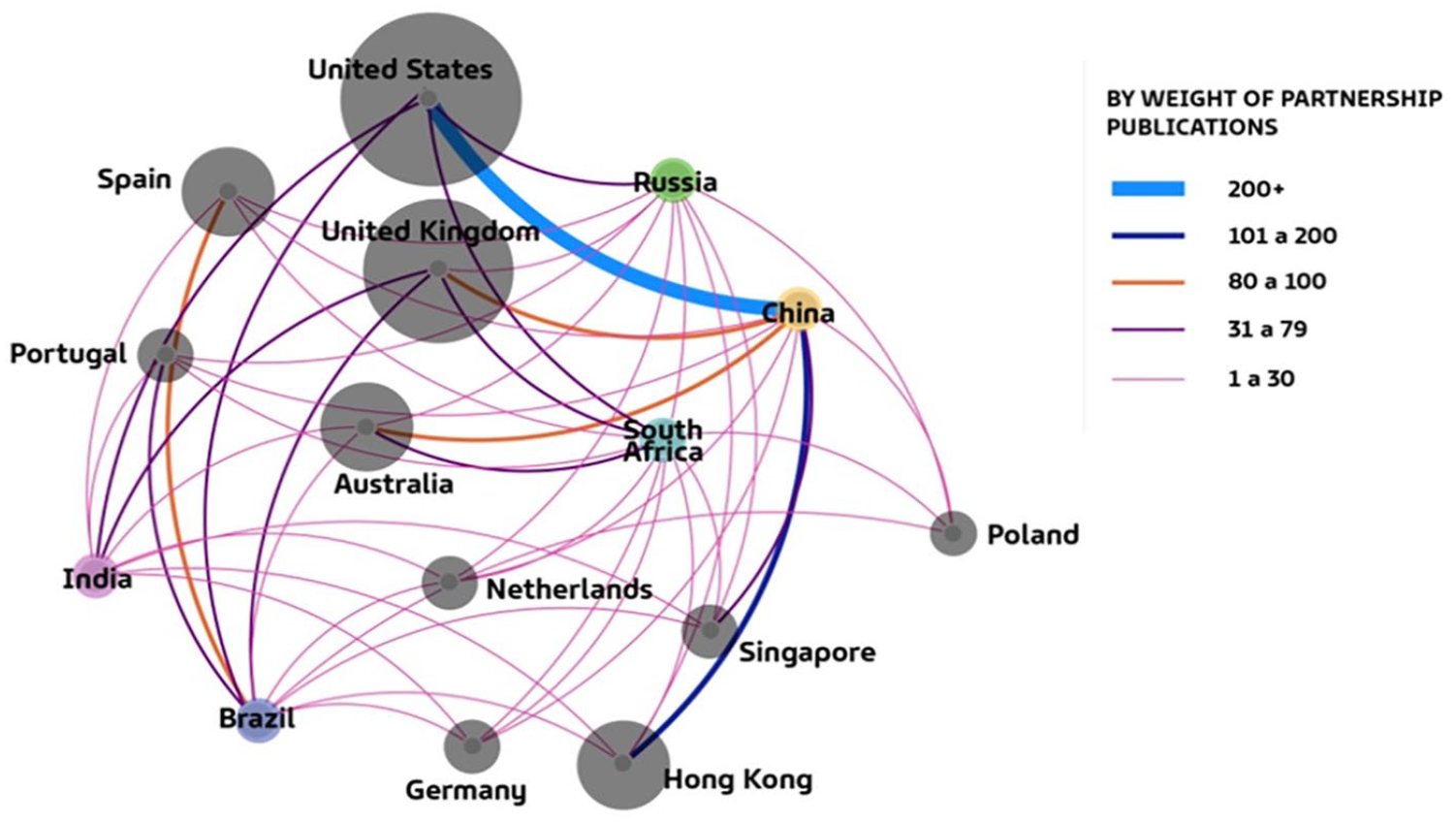
Partnership Networks of BRICS Countries.
National Journals as a Proxy for Internationalization
Of the 439 Communication journals classified in the SJR, only 21 are based in one of the BRICS countries (Supplemental Appendix, Table 6a). Brazil has the highest number of outlets listed, with ten journals—two in the Q2 stratum, four in Q3, and four in Q4. Russia has six journals—four rated Q3 and two in the Q4 stratum. The ranking also includes two journals edited in India (both in Q3) and two in South Africa—one in Q2 and one in Q4. While China hosts only one journal registered in the SJR, it is the single BRICS country with a Q1 periodical, the Digital Communications and Networks.
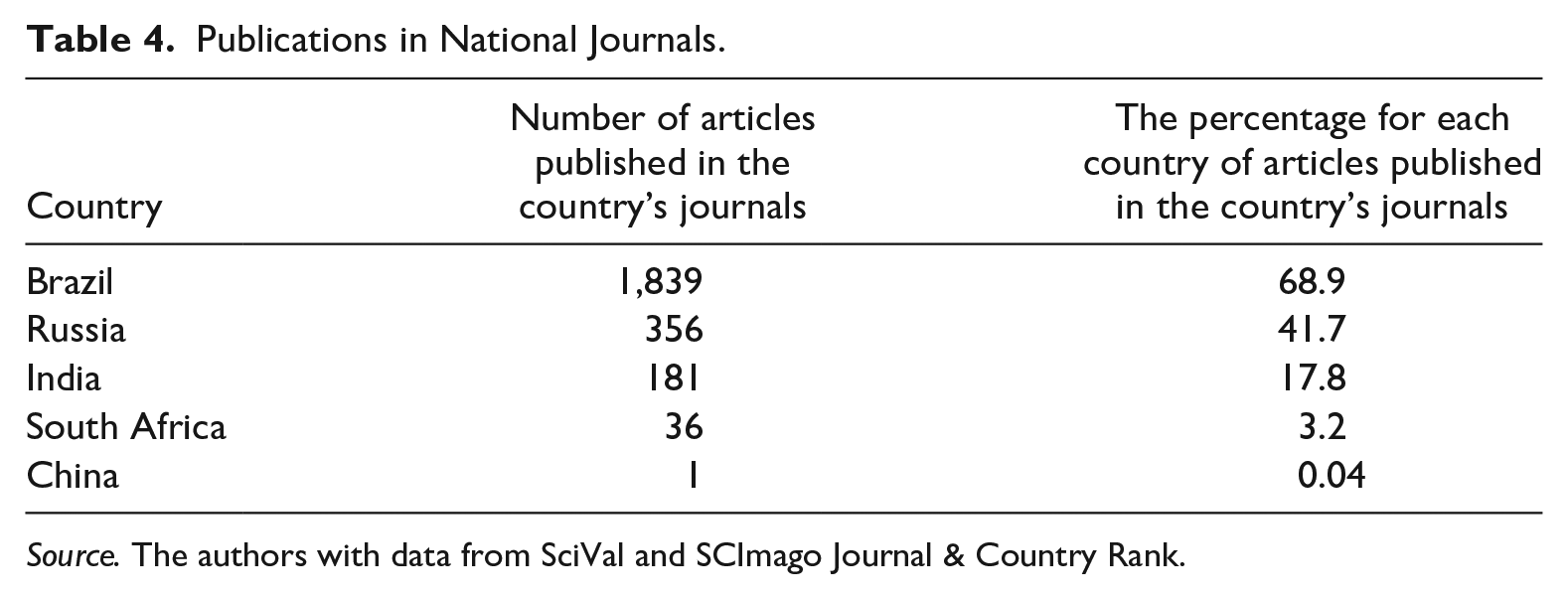
According to Table 4, almost 70% of the articles written by Brazil-based researchers in SJR-ranked journals were published in Brazilian periodicals. The journal Interface—Communication, Health, Education (Supplemental Appendix, Table 6a) published 1,002 papers by scholars working in Brazilian institutions—a single outlet conveyed 37.5% of the country’s total publications between 2012 and 2021. It must be noted that Interface is an interdisciplinary journal focusing beyond the specific field of Communication studies.
Publications in National Journals.
Source. The authors with data from SciVal and SCImago Journal & Country Rank.
Russia is the second country with the highest number of articles published in nationally edited journals, with 356 works, or 41.7% of its papers. Besides, 161 of these 356 documents were specifically published in the journal Voprosy Onomastiki (Supplemental Appendix, Table 6a), which specialized in onomastics—a tangential subject to media studies. Publications by India in national-based journals were also concentrated in a single publication: 163 articles in the Journal of Content, Community, and Communication (Supplemental Appendix, Table 6a). As for South Africa, all 36 publications in journals edited in the country were published in Communitas, while the South African Journal of Communication Disorder did not register a single publication by scholars in the country’s universities. Finally, China’s case points to another singularity: only one article authored by a scholar based in the country at stake was published in a nationally edited journal.
Discussion and Conclusion
This work examined the academic production of Communication researchers based in BRICS countries. Investigating data extracted from the SciVal and SJR platforms allowed us to understand and compare the performance of these five academic communities between 2012 and 2021. The overall results draw our attention to five crucial aspects: (a) the remarkable productivity growth observed in all BRICS countries; (b) the differences among the countries in the group, both in number of research articles and in terms of the outlets’ SJR quartiles; (c) the emergence of China as the leading knowledge hub within the bloc; (d) the relevance of international partnerships with countries in the Global North to reach high-impact journals; and (e) the lack of cooperation among BRICS countries.
Our
Overall, the countries standing out in co-authorships with the BRICS group are the United States and the United Kingdom. Thus, our results reinforce the findings by Demeter (2019a), who points out the case of the United States as a vital hub of international connections, even for researchers based in Global South nations. Two factors might explain this phenomenon. First, the difference among most BRICS countries regarding their official languages makes integration problematic. The “Englishization of academia” (Monteiro & Hirano, 2020) jeopardizes the use of native languages and curbs partnerships, while Chile, Colombia, and Argentina are part of a Latin hub through the Spanish language (Demeter, 2020). Second, such results are connected to the adoption of markedly diverse academic policies—even among countries outside the mainstream research axis. To illustrate, China has tried to attract international talent and offer additional bonuses for publications in high-impact journals (Asheulova & Dushina, 2014). Indeed, most Chinese universities reward publications in the most prestigious journals—which led Nature (2017) to publish an editorial criticizing the strategy after a group of scholars from the Sichuan Agricultural University received about US$ 2 million for a publication in the journal Cell.
In tandem with Finardi’s (2015) conclusions, we sustain that Communication studies have not experienced a “BRICS effect” when it comes to collaboration. Partnerships with other BRICS countries accounted for 6.6% of Russia’s total collaborations—the highest rate verified in this study. Conversely, China had the lowest co-authorship rate with Brazil-, Russia-, India-, or South Africa-based peers, with only 1.7% of its production associated with one of these nations in the Global South. To sum up, the sparse intra-BRICS connections hinder the development of an agenda interested in de-Westernizing Communication studies (Ganter & Ortega, 2019). Public authorities working to strengthen innovation must provide access to funding, up-to-date research facilities, and library privileges to foster their scholars’ dialogue with the international community (Lauf, 2005).
Finally,
Interestingly, 68.9% of Brazil-authored publications were conveyed in nationally based journals. Accordingly, this country has its own journal evaluation and reputation system—and it does not necessarily observe metrics such as impact factor or H-index (Packer, 2014). On one hand, national publications emphasize issues relevant to the country. On the other, artificially raising the ranking of Brazilian journals discourages those struggling to reach international circuits. While Brazil’s performance corroborates the idea that “publications by scholars from the Global South are more likely to appear in lower-tier and regional journals” (Ekdale et al., 2022, p. 2519), China-based scientists published only one paper in their country’s journal. This finding corroborates Demeter’s (2020) argument that scholars working in Chinese universities seem more interested in competing for space with hegemonic academic communities than turning to South–South interactions.
Albuquerque (2023) defends actions to counter the “system” dominated by the Global North, suggesting the BRICS bloc as the basis for initiatives such as reinforcing local universities as alternative places for building international scholarly perspectives and strengthening ties between non-Western scholars and institutions. Nevertheless, while economic alliances have delivered relevant results for the five countries within the bloc, the intention of the BRICS to establish an alternative to a Global North–centered knowledge network (Albuquerque & Lycarião, 2018) is still modest in the field of Communication. In this regard, our findings reinforce the importance of discussing policies to encourage South-South partnerships since, without proposing and adopting autonomous strategies, the very construction of the concept of “de-Westernization” might turn into another category domesticated by the academic agenda of the Global North. As Ekdale et al. (2022, p. 2502) sustain, “scholars in the Global North writing about the Global South often garner more attention than Global South scholars publishing research about their home contexts in journals that are lower ranked or missing from popular journal indexers.”
We then reinforce the idea that neoliberal globalization and the logic of academic capitalism—with rankings that recurrently grant merit only to research approaches valued in the Global North—constitute sources of asymmetry in academic research (Albuquerque et al., 2020). The low participation of dissenting voices in the international landscape of Communication studies affects not only researchers from semi-peripheral or Global South countries but the entire international academic community—which misses more diverse critical perspectives. Promoting a higher balance in the international community is essential to attain greater theoretical and methodological cosmopolitanism (Ganter & Ortega, 2019). This is not only an epistemological problem but also a political and sociological one. The fact that most articles published by mainstream academic communities do not involve researchers from peripheral and semi-peripheral countries reveals that the de-Westernization of Communication research remains a goal far from being achieved (Demeter, 2020).
Our results are not without limitations. First, even though we address the cases of five powerful semi-peripheral nations, we contend that this approach expands our understanding of the recent achievements and remaining barriers to Global South scholars’ circulation in top-ranked outlets. Second, when we consider each researcher’s country of academic affiliation as a reference, we acknowledge that some nuances regarding the globalization of communication studies and national identities could not be captured (Ai & Masood, 2021; Goyanes & De-Marcos, 2020). Third, our investigation did not cover the research topics emphasized by BRICS-based researchers—which may lead to a hierarchy of visibility when it comes to the subjects that matter to peripheral regions (Chakravartty et al., 2018). Fourth, this article did not investigate publications by BRICS researchers in outlets not indexed in the SJR. In fact, journals not included in the ranking may also publish relevant research, regardless of language barriers (Ganter & Ortega, 2019) and lack of funding (Waisbord, 2022).
Future research must promote qualitative analyses (interviews with researchers, editors, and members of editorial boards) to enable us to understand the structures shaping academic production in each region. For example, these interviews can identify the several meanings the term “de-Westernization” has acquired in Global South countries, helping elucidate specific insertion strategies in “elite” academic environments.
Supplemental Material
sj-docx-1-jmq-10.1177_10776990231217466 – Supplemental material for Academic Production and Collaboration Among BRICS-Based Researchers: How Far Can the “De-Westernization” of Communication and Media Studies Go?
Supplemental material, sj-docx-1-jmq-10.1177_10776990231217466 for Academic Production and Collaboration Among BRICS-Based Researchers: How Far Can the “De-Westernization” of Communication and Media Studies Go? by Naiza Comel, Chirlei Kohls, Maíra Orso, Luiz Otavio Prendin Costa and Francisco Paulo Jamil Marques in Journalism & Mass Communication Quarterly
Footnotes
Acknowledgements
Dr. Marques expresses his deepest gratitude to the Michigan State University’s School of Journalism, especially Dr. Tim P. Vos. He also acknowledges the English teachers working for the VETP (MSU) and the Friendship House: Larry Woods, JoAnn Woods, Mary Hennessey, Karen Carpenter, Steven Stowe, Tom Almer, Dan Winter, Jen Garmon, Tim Miank, Paul Schleusener, and Marion Schleusener.
Declaration of Conflicting Interests
The author(s) declared no potential conflicts of interest with respect to the research, authorship, and/or publication of this article.
Funding
The author(s) disclosed receipt of the following financial support for the research, authorship, and/or publication of this article: This research was funded by the Brazilian National Scientific Council (CNPq) (310724/2020-1 and 406504/2022-9) and by the Brazilian Coordination for the Improvement of Higher Education Personnel (CAPES) (001 and 88887.478242/2020-00).

Supplemental Material
Supplemental material for this article is available online.
Notes
Author Biographies
References
Supplementary Material
Please find the following supplemental material available below.
For Open Access articles published under a Creative Commons License, all supplemental material carries the same license as the article it is associated with.
For non-Open Access articles published, all supplemental material carries a non-exclusive license, and permission requests for re-use of supplemental material or any part of supplemental material shall be sent directly to the copyright owner as specified in the copyright notice associated with the article.
