



Abstract
Studies suggest that, at the routine level, news beats function as unique “micro-cultures.” Exploring this “particularist” approach in news content, we compare how the interventionist, watchdog, loyal, service, infotainment, and civic roles materialize across 11 thematic news beats and analyze the moderating effect of platforms, ownership, and levels of political freedom on journalistic role performance in hard and soft news. Based on the second wave of the Journalistic Role Performance (JRP) project, this article reports the findings of a content analysis of 148,474 news items from 37 countries. Our results reveal the transversality of interventionism, the strong associations of some topics and roles, and the limited reach of news beat particularism in the face of moderating variables.
Introduction
Historically, news beats have structured news production around unique events, sources, routines, and thematic specialization (Gans, 1979; Magin & Maurer, 2019). From a routine perspective, they are a “major venue for specialization in journalism, an organizing principle behind modern newsrooms, and as ‘trading zones’ for information and news materials” (Reich et al., 2021, 1199). The assumption is that news beats are specialized fields of knowledge or “particularist” “micro-cultures” (Ericson et al., 1989; Reich, 2012), but this particularism can be at risk due to commercialism, digitalization, newsroom cutbacks, and labor precarity (Martin & McCrain, 2019; Van Leuven et al., 2021).
Newsrooms face increasing challenges to afford the expert division of labor that news beats entail (Robbins & Wheatley, 2021), but the thematic differentiation still allows for the organization and presentation of news content across subjects, either thematically or geographically (Gans, 1979; Magin & Maurer, 2019), differentiated by their topic, focus, and style (Lehman-Wilzig & Seletzky, 2010).
News beats can therefore be recognized in the expert subject knowledge and routines of journalists; or in the thematic content that journalists and media outlets produce. We use the latter categorization—what we call thematic beats—where news topics are considered a proxy of news beats (Gans, 1979; Reich, 2012). Both approaches assume thematic differentiation in news content, although with some nuances. The journalist-based approach indicates that even when some practices are similar, there can be “particular” routines, processes and journalists’ perceived roles that are unique to specific beats (Reich, 2012; Robbins & Wheatley, 2021). The content-based approach offers mixed evidence, as different contextual, societal, economic, and organizational factors can clearly shape the coverage of political (Albæk et al., 2014), financial (Boukes & Vliegenthart, 2020) or cultural affairs (Verboord & Janssen, 2015).
The literature above yields at least three areas of opportunity for scholarly development. First, the extent to which thematic beats other than politics or hard news can remain particularist across different geographical and organizational environments remains understudied and inconclusive. Second, research shows that an essential ingredient of news beat particularism is their strong connection with journalistic roles (Albæk et al., 2014; English, 2017; Hanusch, 2019; Hovden & Kristensen, 2021; Skovsgaard & Van Dalen, 2013). However, this connection is not always straightforward. Sometimes news beats can bear more influence than platforms on journalistic roles (Mellado et al., 2017) while other times platforms can be unique “manufacturing houses of news” (Reich, 2016, 14). At the same time, commercial pressures, differences in ownership, audience orientations (Aalberg et al., 2013; Boukes & Vliegenthart, 2020), media system factors (Albæk et al., 2014; Umbricht & Esser, 2016), and press freedom levels (Márquez-Ramírez et al., 2020) can also impact the relationship between journalistic roles and thematic beats. Hence, there is a need to establish the type of institutional and social context that triggers or inhibits news beat particularism. Third, some roles, beats, and countries have received more scholarly attention than others, with most studies conducted in a single national context or comparing Western democracies only. There is therefore opportunity to fill the empirical and theoretical gap in relation to non-Western newsrooms and how roles are manifest through thematic news content.
To address such issues and based on a news content analysis of 148,474 news items in 365 news outlets from 37 countries during 2020, this study adopts a journalistic role performance framework (Mellado, 2015, 2021) and a news content approach to thematic news beats (Gans, 1979; Reich, 2012), to pursue two goals. First, to strengthen role systematization and comparison by exploring the presence and variation of six journalistic roles—interventionist, watchdog, loyal facilitator, civic, service, and infotainment—across 11 thematic news beats: politics, economics, social affairs, court, crime, health, science and technology, sports, celebrity and entertainment, accidents and natural disasters, and lifestyle. Second, to measure and compare the influence of four different platforms (radio, TV, print, and online), five media ownership orientations (private, publicly traded, public service, civic-oriented, and state-run), and political freedom in the relation between hard and soft news and journalistic role performance.
Journalistic Roles Across Different News Beats
Professional roles are one of the key topics in journalism research. The roles journalists prioritize above others can enlighten us about how they conceive their relationship with society (Donsbach, 2012; Hanitzsch & Vos, 2018). Mellado, Hellmueller, and Donsbach (2017) distinguished four different concepts within the construct of professional roles in journalism: role conception (what journalists want to do), role perception (what journalists think they ought to do), perceived role enactment (what journalists think they do), and role performance (what they do). The first three concepts—primarily explored through survey research from different countries—suggest that journalists in different cultural settings to a large extent still prioritize traditional journalistic roles like the monitorial role (Hanitzsch et al., 2019; Weaver & Willnat, 2012). However, the constraints and influences to which journalists are constantly exposed (Shoemaker & Reese, 2014) limit the possibility of living up to their normative standards, primarily resulting in a large gap between rhetoric and practice (Mellado & Van Dalen, 2014; Tandoc et al., 2013). Following from this concern, Mellado (2015) has defined role performance as the manifestation of professional roles in both news decisions and the news outcome that reaches the public, which is typically measured through content analysis.
Drawing from earlier theoretical and empirical work on role typologies and areas in which journalism can be analyzed (Donsbach, 2012; Eide & Knight, 1999; Hanitzsch, 2007), the Journalistic Role Performance cross-national study has advanced and validated standardized measures (Mellado, 2015, 2021) to account for six roles and their respective indicators that, along three domains—journalistic voice, power and audience—can materialize in news content. The “journalistic voice” domain deals with the presence of the journalists’ voice in the news, involving the role of the journalist as interventionist vis-à-vis disseminator. The “power relations” domain concerns the relationship that journalists establish with societal powers, either through a watchdog role (holding power to account) or the loyal-facilitator role (cooperating with those in power and/ or emphasizing national triumphs and prestige). Finally, the “audience approach” domain deals with the way in which journalists address the audience. Journalism can address audiences as citizens to be heard and made visible (civic role), consumers to be advised and counseled (service role), or spectators to be entertained and thrilled (infotainment role).
Existing research offers a mixed picture of the relation between roles and thematic beats in news content. Hard news beats such as politics and to a lesser extent, economy, and social affairs, are closely bound to normative conceptions of journalism within democratic systems that place high expectations on their performance of certain roles (e.g., watchdog, civic, service) that we might expect to be prominent in political, social, and economic journalists (Skovsgaard & Van Dalen, 2013). Citizen voices are more likely to be covered in political and social affairs news compared to other topics (Kleemans et al., 2017), and that the inclusion of citizen reactions and demands are likely to be found in social affairs news and to a lesser extent, politics (Mellado et al., 2017; Reich, 2016). Comparative studies have found increasing levels of interventionism (such as journalistic interpretation and opinion) in politics and current affairs across established democracies, but this can depend on national and organizational factors (De Vreese et al., 2017; Esser, 2008; Esser & Umbricht, 2014; Kavanagh et al., 2019).
In addition, there is a whole body of work devoted to debates around the influence of infotainment on hard news. Aside from the hotly contested normative implications of infotainment (e.g., Brants, 1998), empirical studies in advanced democracies have demonstrated an overall rise of this role in political reporting and in financial news, albeit with either national (Albæk et al., 2014; Umbricht & Esser, 2016) or organizational differences (Boukes & Vliegenthart, 2020). While in non-Western contexts the evidence is less conclusive (Mellado et al., 2017), countries with restricted political freedoms can overturn market incentives when covering conflict affairs (Baum & Zhukov, 2019).
Despite its rise in political news, infotainment has more historical connections with news beats such as sports, lifestyle, celebrity, and crime. Typically described as soft news beats (Reinemann et al., 2012), they often draw heavily on dramatic, human interest and personalization news angles; and are therefore considered as synonymous with infotainment (Patterson, 2000). Historically, these subfields of journalism have “become denigrated, relativized, and reduced in value alongside aspirations for something better” (Zelizer, 2011, p. 9). In relation to power, for example, sports journalists have been variously described as cheerleaders, hero worshippers, fans, and sycophants (English, 2017; Hardin, 2005). On this evidence, we might expect sports news to demonstrate high levels of loyal-facilitation, interventionism, and lower levels of the watchdog role. Similarly, surveys of lifestyle journalists suggest that they see themselves as fulfilling service-oriented roles (Fürsich, 2012; Hanusch, 2019). On these grounds, we would expect such soft news topics to be strongly associated with the service, interventionist, and infotainment roles, even if watchdog roles are not entirely absent (Usher, 2012).
Previous literature (e.g., Van Aelst & de Swert, 2009) also link “sensational news” with topics such as accidents, disasters, and crime coverage. While they have received less empirical attention than hard news topics, studies find that crime (Humanes & Roses, 2018; Mellado & Lagos, 2014), accidents, and disasters (T.-L. Wang, 2012) are typically covered through a sensationalist lens aligned with infotainment. Furthermore, studies of accidents and disaster coverage suggest that journalists adopt the role of information disseminator over interventionism and may cooperate with the government to communicate during and in the immediate aftermath of a crisis rather than perform the watchdog role (Okumura et al., 2021). Most likely related to their coverage of wrongdoing, studies have also found that police, crime, and court stories often have watchdog elements (Márquez-Ramírez et al., 2020).
Concerning health and science news, existent research finds both beats to have a strong service ethos, connected to their role in helping citizens navigate various risks (Klemm et al., 2019). However, in the context of a pandemic, studies show how several other journalistic roles can come to the fore. For instance, the alarmist nature of health crises can push journalists toward sensationalist discourses high in infotainment (Bomlitz & Brezis, 2008). Within the power relations domain, journalists have been found to follow both a consensual role involving the cooperation with authorities to educate the public and watchdog roles when a crisis becomes politicized (Cornia et al., 2016).
Toward a Homogeneity of News Beats?
Most of the literature discussed in the previous section would suggest that journalistic roles can cement news beats’ particularism and unique ethos, such as with sports and infotainment, lifestyle and service, or politics and the watchdog role. This particularist approach would view beats as specific subfields of specialized journalism akin to “subuniverses” (Marchetti, 2005) or “micro-cultures” (Ericson et al., 1989; Reich, 2012). An opposing, homogenist view would contend that news beats, at the routine level, can be blurred and affected by practices that are similar and consistent across all content fields (Reich, 2012), and in news content, by the characteristics of media systems, journalistic cultures, and organizational orientations (Albæk et al., 2014; Esser & Umbricht, 2014; Umbricht & Esser, 2016). This homogenization can result from market orientations (Skovsgaard, 2014); commercial pressures (Aalberg et al., 2013; Skovsgaard & Van Dalen, 2013) and neoliberalization (Van Leuven et al., 2021), reflected in the tabloidization of news, or the fact that the characteristics of popular media are increasingly integrated in news content, both in hard and soft news beats (Otto et al., 2017). Indeed, previous evidence suggests that the infotainment role is performed at a relatively high level in all news topics in newspapers beyond established democracies (Mellado, 2021).
Moreover, the homogenization of content can result from cost-cutting newsroom measures such as the replacement of specialist reporters with generalists, especially in beats ranked lower in the professional hierarchy (Reich, 2012; Van Leuven et al., 2021). Another consequence is the increased outsourcing of news production to news agencies and the use of freelancers who often produce news content for multiple news outlets, again leading to a loss of specificity and more homogeneous news content (Mathisen, 2017; Van Leuven et al., 2021).
As the literature presents competing hypotheses relating to the homogenization and particularist theses, we pose the following research questions:
The Influence of the Political and Organizational Context
News beats can be “particularistic” due to their strong associations with certain roles, but whether this relation is sustained at any institutional or societal context remains unclear at a global level. News beat stability should take place when this relation remains stable across geographical, sociopolitical, or organizational contexts (Mellado et al., 2021). Thus, stability would corroborate the particularistic approach to news beats. In contrast, news beat fluidity would occur when the relation between news beats and roles are impacted by sociopolitical and organizational logics.
Plenty of evidence suggests the sociopolitical context plays an important role in explaining news beat fluidity (de Vreese et al., 2017; Umbricht & Esser, 2016; Albæk et al., 2014), at least when it comes to the political beat and hard news in general. Although a particularist approach would assume that the watchdog role is performed extensively overall (or from a normative point of view “should be performed extensively”), studies show that it can vary dramatically based on the freedom journalists enjoy in a particular societal context (e.g., Márquez-Ramírez et al., 2020; Van Dalen et al., 2012). Conversely, the loyal-facilitator role—though far less studied—can be expected to be prominent in political news, largely in non-democratic countries (Mellado et al., 2017). For other news beats and journalistic roles, the evidence is less conclusive. The social affairs beat tends to be more associated with the civic role than other news beats in most countries, whereas the service role tends to remain more stable regardless of the sociopolitical context (Mellado et al., 2021). Organizational factors may also impact news beat fluidity, as it observed a different performance of infotainment in elite versus popular newspapers in economic and hard news overall (Boukes & Vliegenthart, 2020). In hard and financial news in advanced (Kalogeropoulos et al., 2015) and transitional (Mellado & Lagos, 2014) democracies, infotainment is more prominent in popular news media who target a broad audience than in so-called elite news media or niche media.
As for the influence of platforms, there are insufficient insights into whether the reported relation between beats and journalistic roles that is typical for newspapers (Mellado et al., 2021) would remain stable across other platforms. A study by Reich (2016) comparing journalists across online, print, radio, and TV news showed that media organizations stood out as “unique manufacturing houses of news” (p. 14), but not whether news beats would remain unique across each platform. In single democracies like the United States, hard news in general appears more affected by elements of interventionism and infotainment in online and cable TV (Kavanagh et al., 2019). Moreover, newsrooms are transitioning from single-platform to cross-platform newsrooms characterized by cross-media content production (Reich, 2016; Singer, 2008). Resultantly, journalists are no longer expected to produce news for one platform, but be multi-skilled and provide pieces for different platforms simultaneously. This may contribute to news beat stability across platforms, but only empirical research can substantiate this.
Ownership can also impact the relationship between news beat and role performance. One key scholarly concern is that news organizations in private ownership tend to exhibit more prominent elements of the infotainment role in hard beats than news organizations in public or state ownership (Aalberg & Curran, 2012), since they are more dependent on audience and advertising revenue (Skovsgaard, 2014), and across different types of private ownership (Baum & Zhukov, 2019). Meanwhile, state-owned media in authoritarian societies perform low in the civic role (H. Wang et al., 2017), while publicly funded news media in advanced democracies perform high (Aalberg & Curran, 2012). Beyond these two roles (infotainment and civic), we know little about the impact of ownership on the stability of more specific news beats in other journalistic roles and in the more traditional soft beats. Considering these contrasting results and gaps in knowledge, we thus formulate the following research question:
Method
This study is based on the second wave of the Journalistic Role Performance (JRP) project (www.journalisticperformance.org). Specifically, we conducted a large-scale manual content analysis of news published in 365 news media outlets in 37 countries. Our research uses a most-different systems design based on a comparative study of advanced, transitional, and non-democratic countries. To obtain an intentionally heterogeneous sample, we selected countries representing a variety of political regimes and media systems from North America, Latin America, Western Europe, Eastern Europe, East Asia, Sub-Saharan Africa, the Middle East, and Oceania. 1
Sampling
National teams selected between two and four news media outlets per platform (radio, TV, online, and print). Given that the structure and format of media systems differ across countries in size, audience orientation, ownership, political leaning, and the presence of more than one language in a territory, researchers selected outlets to represent the diversity of each country’s media system.
We used a constructed week method to select a 2-week stratified-systematic sample that yielded 14 identical dates for all outlets and countries between January 2 and December 31, 2020. To account for daily and monthly variation, we divided the year into two semesters: January–June and July–December. For each semester, we created a constructed week, randomly selecting starting dates on a Monday in January and a Monday in July. Then, using 3-to-5-week skip intervals, we selected each of the subsequent 6 days in the following months. This procedure enabled the inclusion of seven different days per semester, for a total of 14 sampled days, covering all 12 months.
Each national team determined the specific sampling unit for the selected outlets, based on the following criteria: for television: the most watched newscast within each selected channel; for radio: the news program with the greatest audience in the selected channels; for newspapers: the full issue; and for online news: the entire homepage of the selected websites (including links contained therein).
The unit of analysis was the news item. All news about the following topics were coded: politics, economy and business, police and crime, court, health, accidents and natural disasters, social affairs, sports, science and technology, lifestyle, and entertainment and celebrities. Not included in the study were editorials, opinion columns, weather forecasts, horoscopes, movie (or other cultural) reviews, puzzles, social pages, supplements/magazines/special features, and similar content on radio and TV. We also excluded content that was not produced by the staff of the respective newsrooms (e.g., wire service stories). In the end, our sample consisted of 148,474 news stories (see Supplemental Table A with news stories and outlets by country in the Supplementary File).
Measures
The coding was based on the operationalization proposed by Mellado (2015) and validated in previous studies (Mellado, 2021) to measure professional roles in news content. The codebook included detailed operational definitions for each indicator of the watchdog, interventionist, loyal-facilitator, service, infotainment, and civic roles. Each role is characterized by measures of professional practices, reporting styles, and narrative schemes.
The operationalization of the original indicators, which were designed for the analysis of print media (Mellado, 2015, 2021), were adjusted based on the special modalities of radio, television, and online media, including the audio-visual devices of these media platforms, such as sound manipulation, non-verbal expressions, video motion, image frames, and editing (Mellado & Vos, 2017). Five indicators were used to measure the presence of the “interventionist” role, nine indicators measured the “watchdog” role, eight indicators measured the “loyal-facilitator” role, five indicators measured the “service” role, five indicators measured the “infotainment” role, and nine indicators measured the “civic” role. Measures were treated as non-mutually exclusive, meaning that multiple indicators could be found in individual news stories. Each indicator was measured on a presence or absence basis.
Prior to conducting our main analyses, we completed confirmatory factor analyses (CFAs) to test whether news stories reflected a latent role manifested through concurrent indicators. CFA results showed a satisfactory fit with the data. For all roles, we identified each solution as providing a better account of the data than competing solutions.
Based on the CFA results, the individual dichotomic indicators comprising each dimension were combined into a continuous scale ranging from 0 (representing the absence of all indicators) to 1 (representing the presence of all indicators comprising a role). For descriptive purposes, we calculated raw scores, based on the total points divided by the number of indicators in each role. A higher score expressed a higher presence of each journalistic role in the news, and vice versa. Meanwhile, we used factor scores to test for differences in the performance of the roles analyzed. Since each role represents a latent variable, the factor score is technically considered a better measurement due to the weighting of its constituent indicators according to each item’s contribution to that latent variable (DiStefano et al., 2009). 2
To account for the influence of organizational and societal-level factors in the relationship between professional roles and news beats we included three measures: (a) For political freedom, we used Freedom House Global Freedom Score: A comparative assessment of political rights and civil liberties across the globe. (b) Platforms were categorized into television, print, online, and radio. (c) Ownership structure was classified into five variables: publicly traded corporation, private ownership, state ownership, public service media, and civic society.
Data Collection
Native speakers in each country conducted the news monitoring and extraction on the selected dates, and the coding processes of news stories. The corpus of news items in each country was randomly divided among coders to reduce bias and avoid a situation in which one coder would code an entire outlet. The fieldwork for the content analysis, and the compilation of organizational and societal-level data was carried out between 2020 and 2021.
Since several concepts are inevitably culturally bound, we followed a three-step strategy to test for intercoder reliability between and within countries. First, we conducted a pre-test among principal investigators across countries to ensure that they had a shared understanding of the codebook. Second, each national team ran pilot tests based on news items not included in the actual sample until coders attained acceptable intercoder reliability coefficients. Coders were also monitored at monthly intervals during the coding process.
Once the coding was completed, a post-test was conducted in each country, based on 100 items, to measure intercoder reliability. Based on Krippendorff’s alpha (Ka), the final global overall intercoder reliability was .79. The variation in intercoder reliability across roles ranged from .76 to .86, while the variation across countries ranged from .72 to .91. 3
Analytical Strategy
To assess RQ1, we performed multiple analyses of variance, calculating the effect size per each role across news beats. To address RQ1b, we conducted multilevel analyses, one per journalistic role. Each model contained three levels, with 148,474 news stories nested in 365 news media organizations that, in turn, are nested in 37 countries. Each analysis began with an intercept-only model to account for the fact that role performance characteristics are unequally distributed across the three levels. Hence, the intercept-only models help to detect whether individual, organizational, and country differences occur before additional predictors are considered. Subsequently, our story-level predictors –the thematic news beats— were hierarchically included as fixed effects.
Finally, to answer RQ2 and account for broader patterns on the influence of platforms, ownership orientations, and political freedom in the relationship between role performance and news beats, we compressed all 11 news beats into two general clusters, in line with Reinemann et al.’s (2012) conceptualization: hard news –where we included politics, social affairs (e.g., protests, education, human rights, housing, migration, and labor issues), economics, health, and court news beats– and soft news, which comprises news on sports, lifestyle, celebrity, entertainment, and crime. We excluded accidents and natural disasters and science and technology, as they fall less clearly into either hard or soft news clusters according to previous literature. We then created a dichotomic variable of soft (0) and hard (1) news beats.
Thereafter, we analyzed and compared the influence of each variable—four platforms, five types of ownership and levels of political freedom—against each other. To do that we recalculated our MLM model per each group (TV, radio, online, print, publicly traded, private, and so on), extracting the coefficients of the fixed effects of soft versus hard news beat on each of the six roles, separately calculated for each platform and ownership type. For the case of political freedom—a metric variable—we calculated direct cross-level interaction of soft versus hard news beat and political freedom for each role. We also ran descriptive mean differences of the relationship between roles and thematic beats across the three organizational and societal factors included in this study, resulting in graphic visualizations of their interactions to account for news beat stability.
In using this type of analysis in addition to the visualization of mean differences, we can illustrate three types of information: how similar or not are hard and soft news in the performance of a role in each platform, ownership type, and political freedom level; what platform or ownership type scored the highest and lowest performance of a single role in each cluster; and which of the two clusters—soft or hard—is more likely to be “stable” in the performance of a role across platforms, ownership and levels of freedom. If the relationship between a role and a thematic beat barely varies across all categories, it can be considered more stable, thus supporting the particularistic thesis. In contrast, if the relationship between roles and beats is dissimilar across groups, it can be considered more fluid, indicating that platform affordances, organizational logics or sociopolitical factors disrupt thematic beat particularism.
Results
General Findings
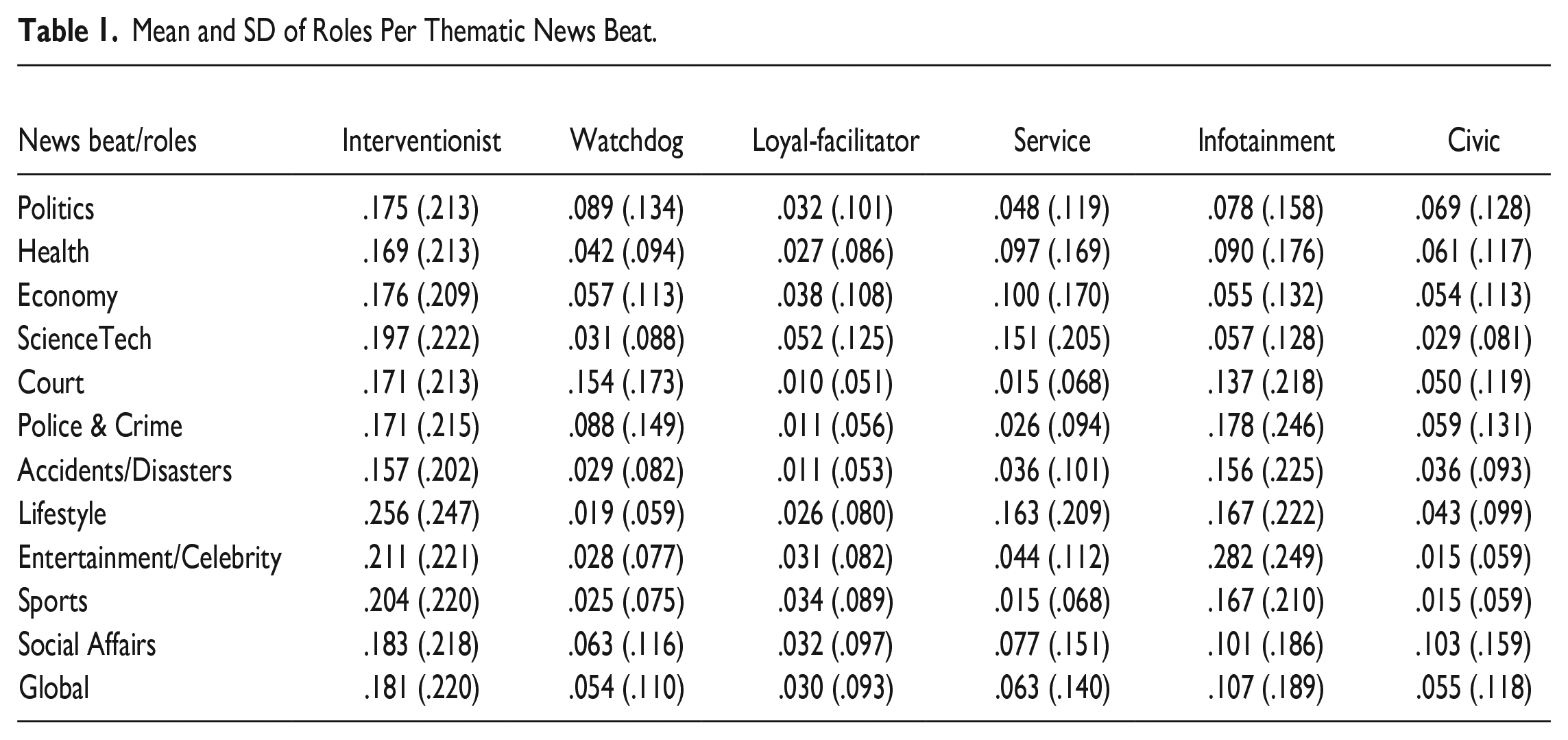
Overall, our data show that the performance of journalistic roles significantly differs among news beats (RQ1a). Comparatively speaking, the performance of public influence-oriented roles (interventionist and loyal-facilitator) tends to be more similar across beats—as indicated by smaller effects of news beat on role performance for both roles—than the performance of audience oriented (service and infotainment) and public service-oriented roles (watchdog and civic)—as reflected in larger effects of news beat on role performance for these roles. Indeed, while the effect size of news beats is substantial for the watchdog (η2 = .090) and civic (η2 = .096), and also for the service (η2 = .113) and infotainment (η2 = .105), it is only modest for the loyal-facilitator (η2 = .027) and especially for the interventionist (η2 = .014) roles.
Specifically, while the performance of the interventionist role is transversal—with most of the beats scoring higher on that role—political news tends to be higher in the performance of both the watchdog (t = 157.294; df = 57400, p < .001; Cohen’s d = .134) and infotainment roles (t = 116.433; df = 57400, p < .001; Cohen’s d = .158), while news on economy (t = 91.714; df = 24487, p < .001; Cohen’s d = .172), and science and technology news (t = 51.049; df = 5386, p < .001; Cohen’s d = .206) are significantly higher in the service role. Along with the service role, health (t = 100.956; df = 41818, p < .001; Cohen’s d = .170) and lifestyle news (t = 67.501; df = 8947, p < .001; Cohen’s d = .218) tends to be higher on infotainment, while social affairs news coverage tends to score higher in both infotainment (t = 108.089; df = 41528, p < .001; Cohen’s d = .184) and civic roles (t = 136.000; df = 41528, p < .001; Cohen’s d = .161). Finally, police and crime (t = 96.934; df = 18003, p < .001; Cohen’s d = .246), accidents (t = 54.083; df = 6506, p < .001; Cohen’s d = .220), as well as news on entertainment (t = 109.828; df = 10160, p < .001; Cohen’s d = .246) and sports (t = 94.840; df = 15865, p < .001; Cohen’s d = .206) tend to include more elements of infotainment (see Table 1).
Mean and SD of Roles Per Thematic News Beat.
News Beats as Predictors of Journalistic Roles
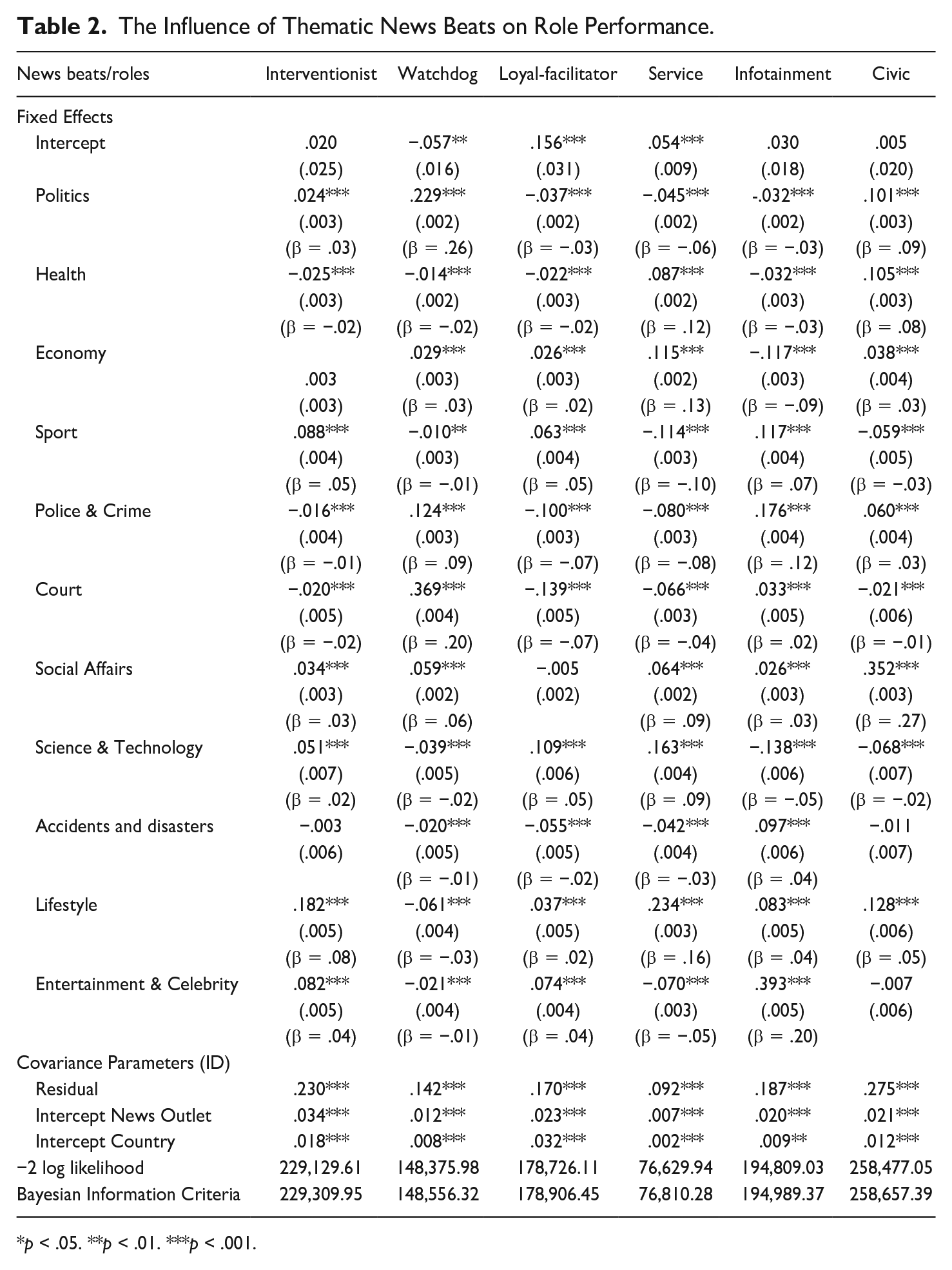
After controlling for different story, organizational and societal-level predictors, 4 our data show that the news beats most associated with the performance of the interventionist role are lifestyle (b = .182, p = .001, β = .08), followed by sports (b = .088, p = .001, β = .05), and entertainment and celebrities (b = .082, p = .001, β = .04). In turn, the economic beat (b = .003, p = .358), as well as news on accidents and disasters (b = −.003, p = .652), do not show a significant association with the performance of this role (see Table 2).
The Influence of Thematic News Beats on Role Performance.
p < .05. **p < .01. ***p < .001.
Within the power relations domain, while all news beats have a significant association with the performance of the watchdog role, this function is especially relevant for the political (b = .229, p < .001, β = .26) and court news beats (b = .369, p < .001, β = .20). The loyal role is also significantly associated with the police and crime (b = -.100, p < .001, β = -.07), and court news (b = -.139, p < .001, β = -.07), but in a negative way, while it is positively associated with science and technology (b = .109, p < .001, β = .05) and sports beats (b = .063, p < .001, β = .05), with news from both fields showing more levels of loyalism.
Meanwhile, lifestyle (b = .234, p < .001, β = .16) and economy (b = .115, p < .001, β = .13) show a bigger and positive association with the performance of the service role; entertainment/celebrity (b = .393, p < .001, β = .20) and police and crime (b = .176, p < .001, β = .12) show a positive association with the performance of the infotainment role; while the civic role shows a strong and significant association with social affairs news (b = .352, p < .001, β = .27).
Role Performance and Thematic Beats Across Platforms, Ownerships, and Levels of Political Freedom
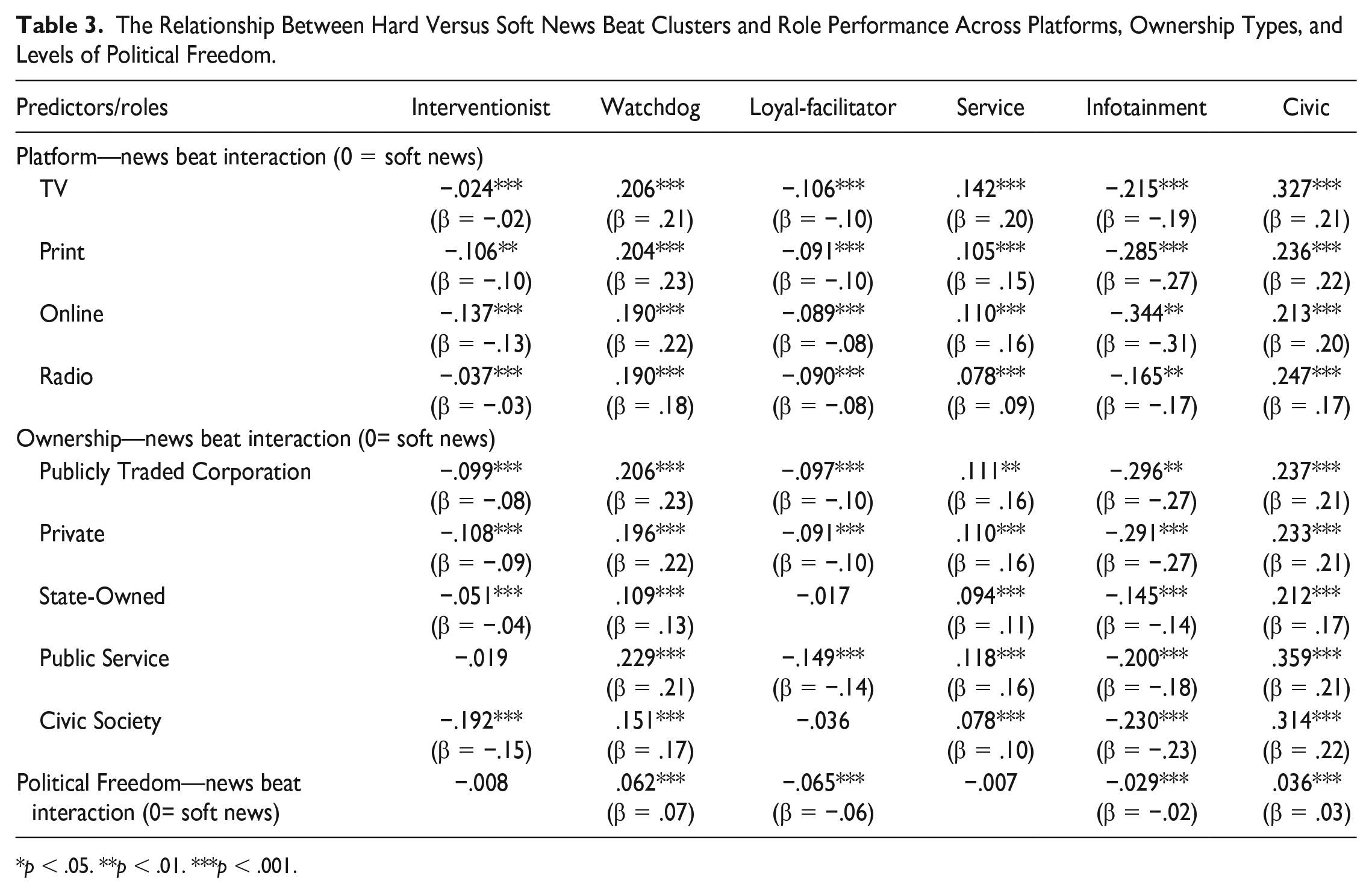
Based on multilevel models per each group of platforms, ownership orientations, and levels of political freedom, Table 3 shows the resulting individual coefficients of the interaction between each of the independent variables and hard and soft news beat clusters. More specifically, every column represents the relationship between one role and our moderating variable in relation to hard news as opposed to soft news (the baseline category). For example, in the first column concerning the interventionist role, the coefficients of fixed effects of hard news across all platforms have a negative sign, suggesting the presence of interventionism is lower in hard news than in soft news beats, but the impact is bigger in online platforms, meaning that in online platforms, both soft and hard news differ the most in relation to that role.
The Relationship Between Hard Versus Soft News Beat Clusters and Role Performance Across Platforms, Ownership Types, and Levels of Political Freedom.
p < .05. **p < .01. ***p < .001.
Overall, fixed effect coefficients reveal a significantly greater presence of the interventionist, loyal-facilitator, and infotainment roles in soft news; and significantly higher levels of watchdog, service, and civic roles in hard news, in consonance with results reported in RQ1. But as the visualization of mean differences shows (Figures 1–3), these vary once external variables are introduced, with hard and soft news tending to be more fluid than stable overall. While stability is only found across smaller groups of organizations or platforms, in comparative terms, soft news presents a higher stability than hard news, which appears more vulnerable to organizational and contextual influences. Nevertheless, the impact of external variables is nuanced, and is unpacked below.
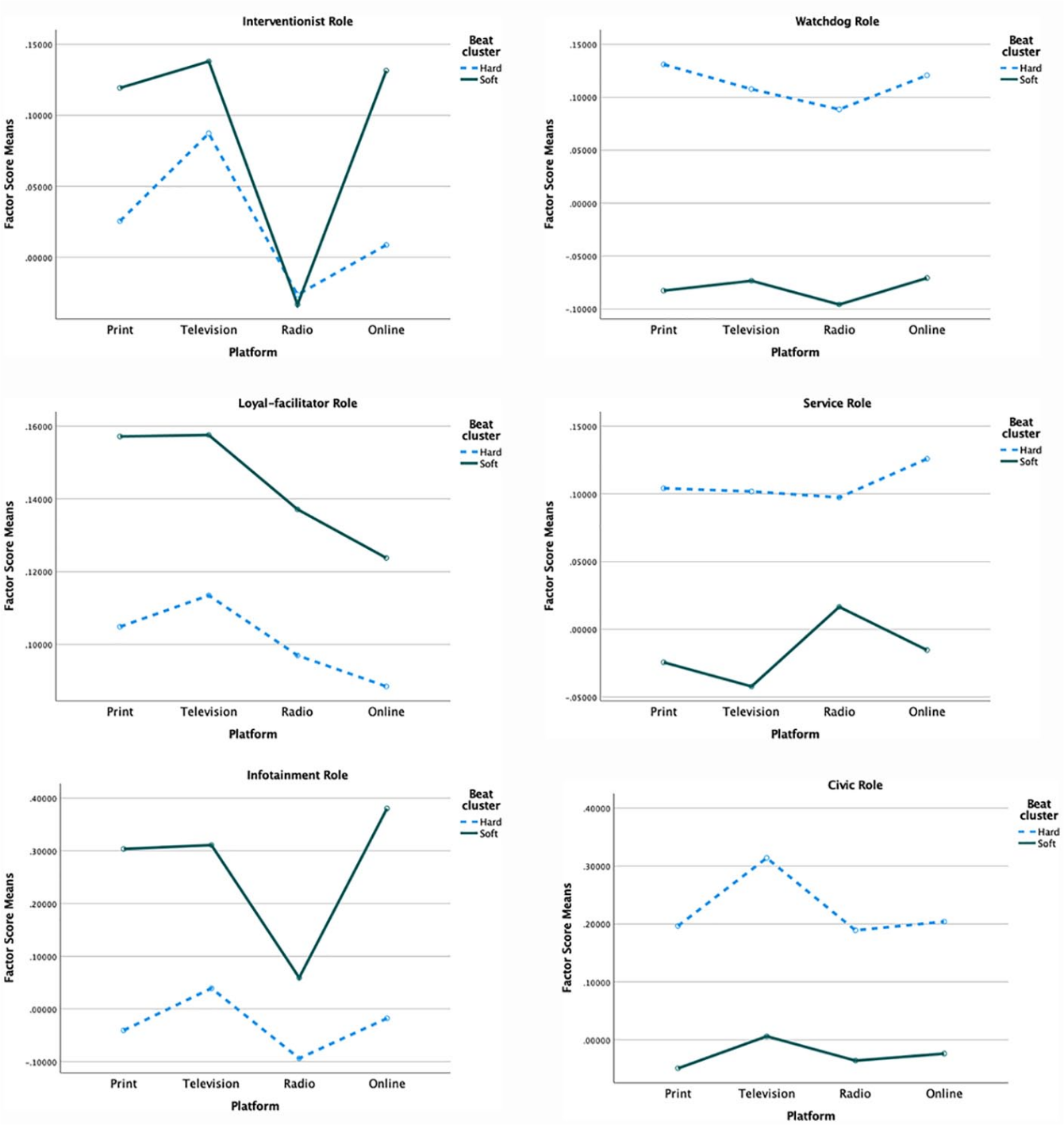
Media Platform and Journalistic Role Performance in Hard and Soft News Beat Clusters.
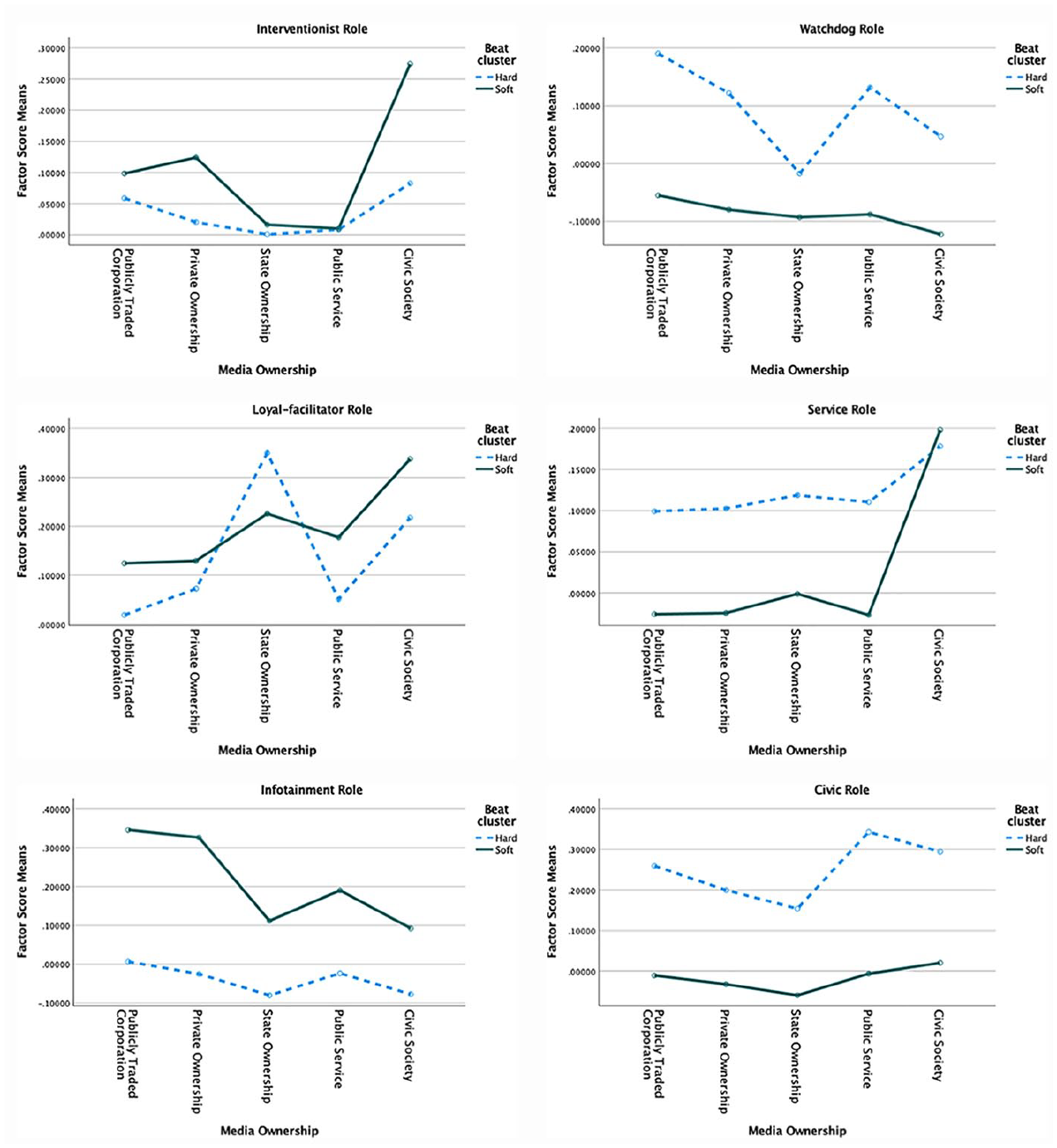
Media Ownership and Journalistic Role Performance in Hard and Soft News Beat Clusters.
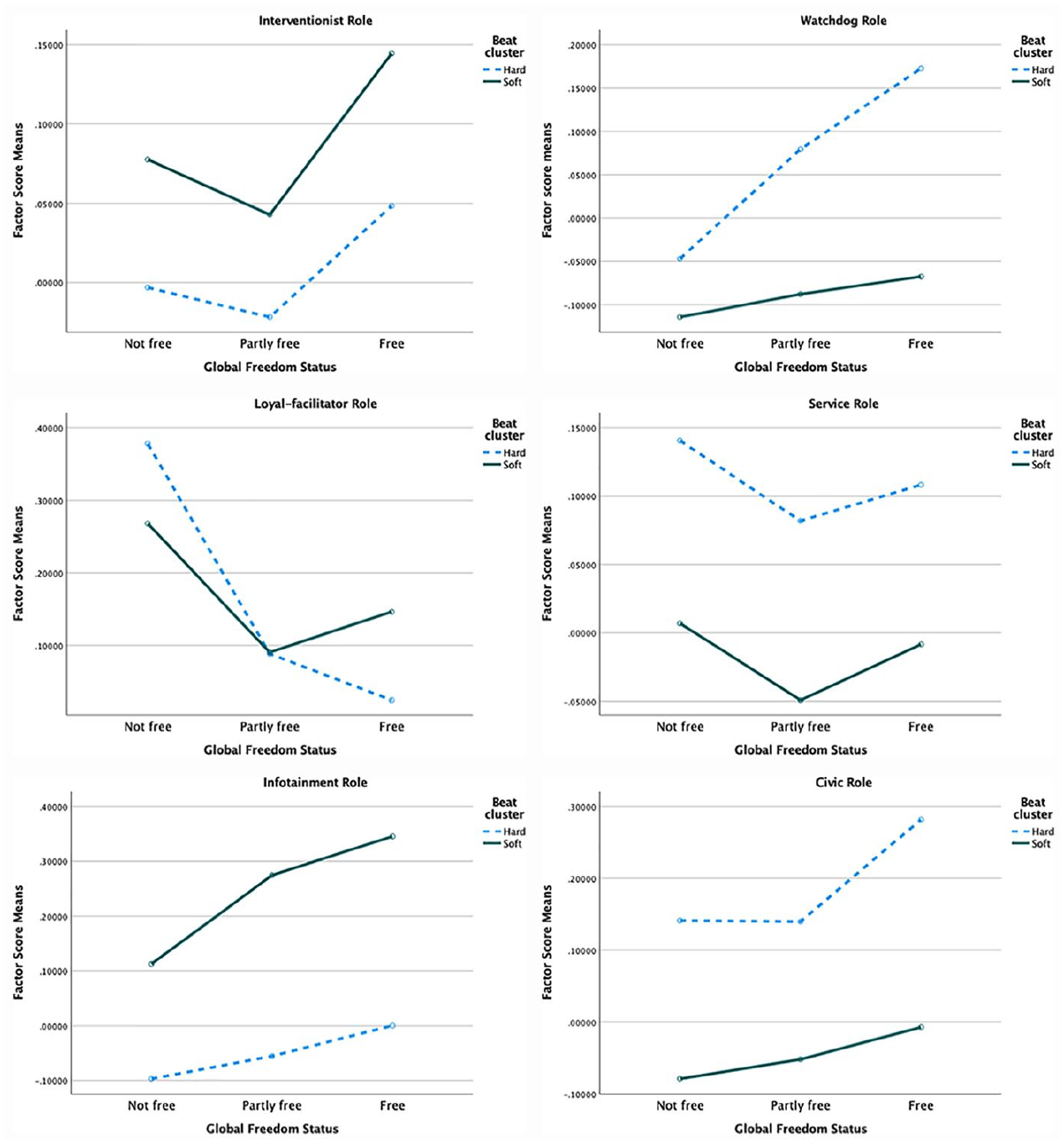
Political Freedoms and Journalistic Role Performance in Hard and Soft News Beat Clusters.
Platforms
The differences between hard and soft news in the performance of the six journalistic roles are statistically significant for all platforms, although the relationship plays out differently depending on each role (see Table 3). For interventionism, the biggest differences between the two clusters are manifested in online and print platforms. Descriptive visualizations suggest that soft news can be more stable than hard news due to more similar levels of high interventionism in TV, online and print platforms, whereas the hard news cluster is more fluid. However, in both clusters, the highest interventionism is found on TV and the lowest in radio (Figure 1A). Concerning the watchdog role, differences between both clusters are nearly similar in TV and print outlets, and in online and radio news, although print media score the most watchdog performance overall (Figure 1B). In contrast, in the loyal-facilitator role, soft news tends to be more stable, presenting similar loyalism in print and TV, whereas hard news is more fluid across platforms. Still, in both clusters, loyalism is higher in TV outlets (Figure 1C). The service role presents the strongest differences between clusters in TV. Hard news is more stable in the service role across all platforms except online, which score comparatively higher. Soft news, instead, is more fluid across platforms, with radio displaying the most service news overall (Figure 1D). For infotainment, the biggest differences between both clusters are in online news. The soft news beat cluster is stable across print and TV, while displaying the most and the least infotainment in online and radio outlets, respectively. The hard cluster tends to be more fluid across platforms, presenting more infotainment in TV outlets (Figure 1E). Finally, for the civic role, while TV outlets display the highest levels in both clusters, the role stands out more in hard news. Still, both clusters can be relatively stable in the performance of this role across all other platforms (Figure 1F).
Media Ownership
Ownership orientation also impacts the relationship between hard news and soft news in role performance, in most, but not all categories. Hard news beats show the strongest differences of interventionism in civic society-owned media (Table 3). In comparative terms, soft news is more fluid than hard news for this relationship, and civic society-owned media display the most interventionism in both clusters. Public service and state-owned media, in turn, show the lowest differences in the performance of interventionism between soft and hard news beats, scoring the lowest overall. The watchdog role shows more pronounced differences in public service and publicly traded media, the latter displaying the highest watchdog journalism in both clusters. For this role, hard news tends to be more fluid, though, across ownership types (Figure 2B). The loyal-facilitator role is overall lower in hard news than in soft news, but only statistically significant in both for-profit types of ownership and in public service media, where the differences are bigger between both clusters. In hard news, loyalism peaks in state-owned media and shows some stability in private and public service media; whereas in soft news, the loyal role is higher in civic society media, but can be stable across both for-profit ownership types (Figure 2C). Both hard and soft news can remain relatively stable in the performance of the service role across most types of ownership, except in civic society-owned media where the role scored the highest in both clusters (Figure 2D). Infotainment is lower in hard news than in soft news, with the biggest differences in private-oriented and publicly traded media. For-profit media bears the most influence in the materialization of infotainment, especially in soft news, which tends to be more fluid across ownership orientations (Figure 2E). Finally, for the civic role the biggest differences between both clusters are in public-service media. Hard news can be more fluid across ownership orientations (Figure 2F), whereas soft news remains more stable in its low levels of civic orientation. In addition, public service media leads in the performance of this role in hard news, whereas civic society-owned outlets are comparatively higher in the civic role in soft news.
Political Freedom
Finally, political freedom yielded statistically significant differences between hard and soft news in the watchdog, loyal, infotainment and civic roles, bearing no significant influence for the case of interventionism or service. The watchdog and civic roles appear to be more pronounced in hard news in countries with higher levels of political freedom, while the infotainment is more often present in soft news in politically free countries. For all these roles, hard news beats tend to be much more fluid across levels of political freedom than soft news clusters (Figure 3B, 3E, and 3F).
The loyal role, instead, presents more heterogeneous results: it is higher in hard news than in soft news in autocratic contexts, and it is higher in soft news than in hard news in free countries (Figure 3C). For this role, the levels of fluidity are similar in both clusters across levels of political freedom.
Discussion
The primary aim of this article was to shed light on the ongoing debates about news beat particularism in relation to journalistic roles, as manifested in thematic content, across multiple settings. Our results add nuance to these debates first by bringing attention to the performance of journalistic roles in relation to a range of thematic beats, and second, by interrogating to what extent the unique (or particular) relation between news beats and roles, performance is impacted by contextual factors, specifically political freedoms, platforms, and ownership structures.
Addressing the variation of six roles across 11 thematic beats (RQ1), we found some support to the particularism thesis, as there are significant differences where almost all news beats behave as micro-cultures to some extent. We corroborate the literature that suggest some elements of interventionism are highly associated with soft beats (Hanusch, 2019; Kristensen & Riegert, 2021), whereas court and political news are associated with the watchdog role (Márquez-Ramírez et al., 2020). Further, the service role is more associated with economic and lifestyle news (Fürsich, 2012), the infotainment role is more present in celebrity and sport stories (Hanusch, 2019), while social affairs news is deeply connected to the civic role (Mellado et al., 2017). In addition, according to these first set of results, the performance of the interventionist and loyal facilitator roles explained less variation across thematic beats than the rest of the roles. Low levels of loyalism across thematic beats may indicate that this a role not so much engrained in news beat ethos, but in organization and political milieus. Meanwhile, the transversality of interventionism may represent a different tendency associated with neoliberalization, that is, a shift from fact-centered/neutral journalism toward more opinionated journalism which has been documented in several countries including the United States (see, for example, Esser & Umbricht, 2014). Still, these findings would partially support the particularist, micro-cultures thesis (Ericson et al., 1989), offering reassurance to those who are concerned about the rise and homogenizing consequences of neoliberal pressures in news production (Van Leuven et al., 2021).
However, this is not the end of the story. When we introduce organizational and political factors to the equation, focusing on the differences between soft and hard news, we find more limited reach of the particularistic thesis, as particularism is only possible in smaller enclaves of platforms or organizations. We found interventionism, infotainment, and loyalism more associated with soft news, whereas watchdog, service, and civic roles more associated with hard news. Still, in comparative terms, soft news can be more stable than hard news, which are more vulnerable to platform logic and political systems. An important finding, in line with some previous literature (Aalberg et al., 2013) is that two variables still shield the democratic functions of journalism (watchdog, service, and civic) in hard news: television and public service ownership of the media. Both exert the strongest moderating power for their materialization, while at the same time inhibit loyalism. Civic society ownership moderates the presence of interventionism in hard news and is also the type of media to display more service news in general. We can also corroborate the power of online platforms to trigger more interventionism and infotainment in soft news (Kavanagh et al., 2019), and the for-profit logics of both private and publicly traded corporations to prompt more infotainment (Baum & Zhukov, 2019) in the same group of beats. With respect to infotainment, our study can offer some reassurance that, at least at a global level, soft and hard news are still not blurring, and infotainment is still comparatively more prominent in soft news. Finally, as expected, political liberties systematically protect the watchdog and civic functions in hard news, whereas they also decrease the presence of loyalism and infotainment.
These findings have several implications for journalism studies research. Our study underlines the importance of a comprehensive, comparative approach when studying the particularities or similarities of news beats across organizational and sociopolitical contexts beyond established democracies. In addition, the implications for news beats research lie in comparing and including a wider number of news beats that are frequently studied in isolation, both individually and along the soft and hard news divide. Moreover, we explicitly corroborate the strong link between journalistic roles and thematic news beats at the news content level, but only as long as they are insulated from other external influences such as platform, ownership and political freedom, and therein the limits of the micro-culture argument. Thematic news beats can retain their unique ethos in some contexts with respect to certain roles, but completely vary in the wake of others.
While this work significantly contributes to the study of news beat cultures in comparative perspective, our findings should be considered alongside their limitations. A strength but at the same time a limitation of this study is that we took the content approach to thematic beats. Thus, we take the end-product as presented to the audience as our point of departure in understanding journalistic practices and routines. While beats can be particularistic with respect to journalistic functions at the news-content level, this particularism cannot be considered as fixed or categorical, as roles are fluid and contextual (Mellado et al., 2021). A diversity of local news events at stake might trigger role performance: pandemics, elections, scandals, sports mega-events, and so on, hence more longitudinal analyses is needed. Likewise, we build on a rather traditional view of journalism where journalists are assigned to one beat whereas today, newsrooms are increasingly inhabited by generalists, and news is more often outsourced to news agencies or freelancers who produce this content (Mathisen, 2017; Van Leuven et al., 2021). In that sense, we need more ethnographic research to study how the performance of roles in the news is impacted by different journalistic and non-journalistic actors, as well as their levels of specialization and expertise. Still, the focus on news topics in media content helps illuminate the limitation of the particularism approach because topical content tends to be produced by generalist journalists and results from several gatekeeping filters, so more comprehensively reflects the complex processes of collective news making.
Moreover, more fine-grained research could address why in certain platforms, ownership structures, and countries with similar levels of political freedoms, the relation between beats and role performance is similarly low, high, or medium. Comparative analysis of beat reporting through newsgathering routines, storytelling and sourcing patterns across different platforms and societies should also shed more light on the matter.
Supplemental Material
sj-docx-1-jmq-10.1177_10776990231173890 – Supplemental material for Comparing Journalistic Role Performance Across Thematic Beats: A 37-Country Study
Supplemental material, sj-docx-1-jmq-10.1177_10776990231173890 for Comparing Journalistic Role Performance Across Thematic Beats: A 37-Country Study by Claudia Mellado, Mireya Márquez-Ramírez, Sarah Van Leuven, Daniel Jackson, Cornelia Mothes, Carlos Arcila-Calderón, Jérome Berthaut, Nicole Blanchett, Sandrine Boudana, Katherine Y. N. Chen, Sergey Davydov, Mariana De Maio, Nagwa Fahmy, Martina Ferrero, Miguel Garcés, Lutz Hagen, Daniel C. Hallin, María Luisa Humanes, Marju Himma-Kadakas, Guido Keel, Claudia Kozman, Aleksandra Krstić, Sophie Lecheler, Misook Lee, Christi I-Hsuan Lin, Marco Mazzoni, Kieran McGuinness, Karen McIntyre, Jacques Mick, Cristina Navarro, Dasniel Olivera, Marcela Pizarro, Henry Silke, Terje Skjerdal, Agnieszka Stępińska, Gabriella Szabó and Diana Viveros Aguilar in Journalism & Mass Communication Quarterly
Footnotes
Declaration of Conflicting Interests
The author(s) declared no potential conflicts of interest with respect to the research, authorship, and/or publication of this article.
Funding
The author(s) disclosed receipt of the following financial support for the research, authorship, and/or publication of this article: This study has been funded in Chile by the Pontificia Universidad Católica de Valparaíso; in Switzerland by the Institute of Applied Media Studies (IAM) at the Zurich University of Applied Studies (ZHAW); in Spain by the Spanish Ministry of Economy, Industry, and Competitiveness. Project “Journalism models in the multiplatform context” ref. CSO2017-82816-P; in Mexico by the Division of Research and Postgraduate Studies, Universidad Iberoamericana Mexico City, Excepcional Standard Grant 2019–2022; in Brazil by the National Council for Scientific and Technological Development/Conselho Nacional de Desenvolvimento Científico e Tecnológico (CNPq); in Qatar by Northwestern University in Qatar; in Hungary by the National Research, Development and Innovation Office under the grant agreement no. NKFIA FK 131990; in Rwanda by the VCU College of Humanities and Sciences SEED Award, and in Canada by Mitacs, Centre d’études sur les médias, The Journalism Research Centre at Toronto Metropolitan University, The Creative School at Toronto Metropolitan University, and Toronto Metropolitan University.
Supplemental Material
Supplemental material for this article is available online.
Notes
Author Biographies
 ).
).
References
Supplementary Material
Please find the following supplemental material available below.
For Open Access articles published under a Creative Commons License, all supplemental material carries the same license as the article it is associated with.
For non-Open Access articles published, all supplemental material carries a non-exclusive license, and permission requests for re-use of supplemental material or any part of supplemental material shall be sent directly to the copyright owner as specified in the copyright notice associated with the article.
