




Abstract
The article enriches the understanding of trust in news at a time when mass and interpersonal communication have merged in the digital sphere. We propose disentangling individual-level patterns of trust allocation (i.e., trust figurations) across journalistic media, social media, and peers to reflect the multiplicity among modern news audiences. A latent class analysis of a representative survey among German young adults revealed four figurations: traditionalists, indifferentials, optimists, and cynics. Political characteristics and education corresponded with substantial heterogeneity in individuals’ trust in news sources, their inclination to differentiate between sources, and the ways of integrating trust in journalistic and non-journalistic sources.
Keywords
Trust is a core mechanism for coping with complexity. No individual has sufficient cognitive resources or time to elaborate on each piece of news encountered in modern everyday life. Therefore, people must rely on trust or distrust in the sources providing them with information on current events. Beyond increases in the volume and diversity of news, digitalization has fostered an unprecedented intermingling of mass and interpersonal communication (Quandt, 2012; Schäfer & Taddicken, 2015; Van Aelst et al., 2017). This calls for consolidating our conceptual and analytical approaches to trust in news because the changing information ecology corresponds to a diversification in the ways that individuals perceive and evaluate journalistic media and other news sources (Hasebrink & Domeyer, 2012; Mangold et al., 2017; Thorson & Wells, 2016).
Communication scholars have approached trust in news from various angles, which include investigations of trust in journalistic media as a whole (Prochazka & Schweiger, 2019), inquiries of trust in single types of journalistic media (e.g., the press; Ariely, 2015), and comparisons of trust in different types of news sources like journalistic media, social media, and peers (e.g., Himelboim et al., 2012; Mitchell et al., 2016; Newman et al., 2020). 1 However, previous research that has looked beyond single source types followed a source-centric perspective. The core question was whether some sources are more trusted than others by the overall audience—without considering how individuals combine trust in different sources. To fill this gap, we introduce a trust figuration approach, which puts the individual audience members at the center of the analysis. We define trust figurations as the varied ways in which individuals allocate their trust across different types of news sources.
This is a useful endeavor in three main respects. First, we extend source-centric work by identifying whether distinctions between types of news sources (e.g., journalistic media vs. social media) are made by the whole audience or only by some audience members. Second, a figuration approach allows us to empirically explore theoretical core notions (e.g., media cynicism and skepticism) that have remained largely unaddressed with previously used conceptual and analytical instruments. Third, studying figurations adds to the literature on the associations of trust in news with demographic and political characteristics.
We begin by defining trust in a changing news ecology and discussing previous research on the topic, after which we establish the trust figuration approach. Then, we empirically demonstrate the approach by using representative data on the trust allocations of German young adults (18–35 years; N = 1,014). The discussion contextualizes the empirical results with traditional and contemporary notions regarding trust in news.
Informational Trust in a Changing News Ecology
Although there is no universally accepted definition, many scholars understand trust as “a psychological state comprising the intention to accept vulnerability” (Rousseau et al., 1998, p. 395) or, more briefly, a “willingness to take risk” (Mayer et al., 1995, p. 712). Trust means delegating responsibility for decisions to other actors (Luhmann, 2017). This mechanism is oriented toward the future because the consequences of delegating responsibility are unknown to the trustor and pose a risk (Simmel, 2009). As applied to journalistic media and other providers of news, trust can be understood as “the willingness of the audience to be vulnerable to news content” (Hanitzsch et al., 2018, p. 5). It manifests in considering the content when forming political views or making other decisions (Van Dalen, 2020). 2 Against this background, communication scholars have investigated trust in news from a variety of theoretical and empirical perspectives (for reviews, see Fawzi et al., 2021; Strömbäck et al., 2020).
One research emphasis has traditionally been on trust in journalistic media as institutions in society. It revolved around citizens’ expectations that journalism fulfills its democratic functions as, among others, a watchdog vis-à-vis political institutions (Van Dalen, 2020). Another emphasis that was at least implicitly contained in most research on trust in journalistic media has been on informational trust. By referring to trust that people put into sources for the provision of information on current events, this emphasis reflects that accepting the veracity of the information is the risk people take when they consume news. When people act upon this information in their daily lives . . . they risk taking the wrong decision, and this risk is the most central element in the definition of trust. (Strömbäck et al., 2020, p. 11)
More generally, recent studies have investigated informational trust not only in different types of journalistic news sources but also in social media and peers (Himelboim et al., 2012; Mitchell et al., 2016; Newman et al., 2020; Williams, 2012). The concept of “informational trust” has been shown to fit today’s individualized news environments, in which journalistic media, social media, and peers constitute related yet distinct components (Thorson & Wells, 2016). Notably, informational trust in peers is related to yet distinct from generalized interpersonal trust. Generalized interpersonal trust, as the more generic concept, refers to trust in people in general and regarding unspecified matters. It is commonly conceptualized as a personality trait that is either innate or formed early in life. In contrast, informational trust in peers refers to trust in the news provision by people who are known personally. It is more of an evaluation of one’s social surrounding based on specific experiences of trustworthiness in past interactions (Freitag & Traunmüller, 2009; Himelboim et al., 2012; Newton & Zmerli, 2011; Robbins, 2016).
Studies have overwhelmingly investigated trust in journalistic media in isolation from people’s (informational) trust in their peers (a recent exception is Mitchell et al., 2016). This research focus might have been less problematic in the mass media era, in which mass and interpersonal communication could still be clearly separated. However, it neglects what people encounter today under conditions of collaborative social selection, filtering, and annotation of news content (Thorson & Wells, 2016): an unprecedented mixture of journalistic content with personal opinions and impressions from friends and social acquaintances, in which sources are often difficult to differentiate. An analysis of journalistic media in this context has to consider the intermediary layer of peer networks through which news increasingly finds its recipients (Gil de Zúñiga & Diehl, 2019). The elevated role of social endorsements in the digital sphere has made trust in friends and social acquaintances (as the more proximate disseminators of news) an increasingly important backdrop of trust in journalistic media (as the more distal original disseminators of news) (Messing & Westwood, 2014; Strömbäck et al., 2020; Turcotte et al., 2015).
Contextualizing trust in journalistic media with that in peers is not only crucial to acknowledging the latter’s growing significance as relays and sources of news. It also aids in reconciling prior conceptualizations of trust in social media. Social media are often discussed as non-traditional gateways to news (Fletcher & Park, 2017; Stier et al., 2022). This has put them to the forefront of recent public discourses about the threats to democracy by the (putative) spread of misinformation (Guess et al., 2019). A sociostructural perspective on social media is well established in the literature but largely missing from this debate. Social media can be understood as outer-circle counterparts to more classic close-knit networks of friends and relatives, where people’s most trusted peers prototypically reside (Mangold & Schenk, 2018; Newton & Zmerli, 2011; Schäfer & Taddicken, 2015). The evaluation of the trustworthiness of news sources in an individual’s daily life may be substantially different from that of political and journalistic commentators (Knudsen et al., 2021).
Another issue, which we address in this article, concerns the consistency of trust across different (types of) news sources. The more traditional assumption is that people have a general sense of trust or distrust across news sources. They are inclined to either trust or distrust “the media” as a whole. Some recent scholarship has argued that despite, or precisely because of, the complex digital news ecology, trust in news remains generalized (Prochazka & Schweiger, 2019; Swart & Broersma, 2022; Van Dalen, 2020). Other studies have found trust differences between news sources. Journalistic media were typically trusted more than social media (rather than peers). The variation between different types of journalistic sources was commonly smaller (and sometimes considered hardly substantial; for example, Johnson & Kaye, 2010, 2014; Matsa et al., 2018; Mitchell et al., 2016; Newman et al., 2020). However, these perspectives do not necessarily contradict each other. They may reflect heterogeneity that has gone unnoticed with source-centric conceptual and analytical instruments. While some individuals’ trust allocations may be more or less consistent across sources, others may differentiate more strongly between them.
Overall, we argue that a modern perspective on trust in news should complement the traditional emphasis on journalistic media with a broader focus on informational trust in the digital news ecology, where peers and social media are also important news sources. A more thorough understanding of modern news audiences requires closer accounts of the varied ways in which individuals perceive and evaluate journalistic media and other sources in conjunction. As this cannot be achieved using the prior source-centric conceptual and analytical models, we propose a trust figuration approach.
A Figuration Approach to Trust Allocations
The term “figuration” has a history in various social sciences. Its principal use revolves around the notion that studying the components of an entity in isolation is often not meaningful because their interrelations are at least as critical as the parts (Bauman, 1979). Likewise, people do not evaluate news sources in isolation but in relation to each other (Hasebrink & Domeyer, 2012). Therefore, a figuration approach to trust builds upon research that has studied trust across news sources (Brewer & Ley, 2013; Kiousis, 2001) by replacing the traditional source-centric focus with one on the individual audience members. The focal question is no longer whether some sources are particularly trusted or distrusted in the aggregate of the audience. Instead, we define trust figurations as the varied ways in which individuals allocate their trust across different types of news sources. This shifts the focus to the question of how generic principles of trust allocation manifest in distinct combinations of trust levels in journalistic media and non-journalistic news sources.
Considering trust allocations from a figuration perspective means taking population heterogeneity in account. This is crucial because with the diversification of audiences, traditional inferences from aggregate-level audience metrics on individual audience members are increasingly problematic. To illustrate how source-centric work may obscure a more nuanced perspective, Figure 1 depicts prototypical individual-level trust figurations (solid lines). The corresponding aggregate-level patterns in the sources’ mean trust scores (dashed lines) represent the core results of prior source-centric investigations (e.g., Flanagin & Metzger, 2000; Johnson & Kaye, 2010, 2014; Matsa et al., 2018). For illustrative purposes, each panel comprises only two trust figurations. Some figurations may be characterized by consistently high or low levels of trust in all sources (Figure 1a), while others may distinguish more sharply between different sources (Figure 1b–1d). In Figure 1b, the figurations differentiate among sources in opposite ways. The sources that are relatively more trusted by some individuals are relatively less trusted by others. Trust is allocated in a profoundly different way as compared with Figure 1a. Meanwhile, this difference would go entirely unnoticed with a source-centric approach because the aggregate-level pattern is the same. Similarly, aggregate-level mean differences may come to exist for profoundly different reasons, such that individuals may uniformly trust some sources over others (Figure 1c) or the differentiation among sources may be restricted to some individuals who strongly consider the sources’ varied characteristics (Figure 1d). A figuration approach allows to disentangle these distinct trust allocation principles.
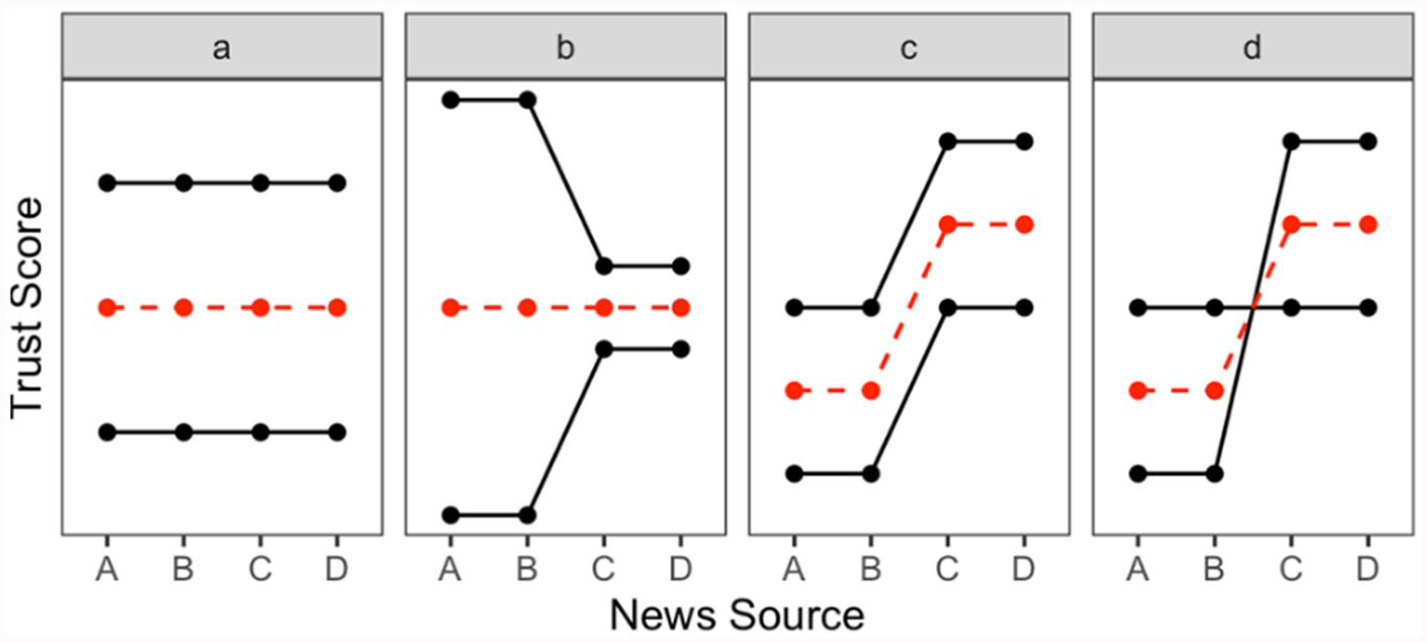
Prototypical architectures of trust figurations.
Architectures of the Trust Figurations
The rationale of our figuration framework and the preceding theoretical reflection raise the following overarching question: How do individual audience members allocate their informational trust across journalistic media, social media, and peers?
Our initial expectation is that—in line with the idealized patterns in Figure 1a—many people’s trust figurations will be characterized by similar levels of informational trust in all sources. This holds for different types of journalistic media as well as for the comparison of journalistic media and peers. The expectation follows from the general assumption that informational trust in journalistic media and peers often goes hand in hand. 3 This corresponds with two characteristics of digital media environments. First, the digital news ecology has become ever more complex, making it harder to develop a sophisticated evaluation of its actors. At the same time, growing parts of the audience have become more reluctant to make the necessary effort to closely consolidate and examine news (Swart & Broersma, 2022; Thorson & Wells, 2016; Van Aelst et al., 2017). Second, because news is increasingly received via online social recommendations, the trustworthiness of peers has gained significance as a cue to trust in journalistic media. The reliance on social endorsements in discovering and evaluating news leads many people to not even be aware of the original journalistic sources, making a differentiated trust in these sources unlikely (Kalogeropoulos, Fletcher, et al., 2019; Messing & Westwood, 2014; Möller et al., 2020; Turcotte et al., 2015). Thus, our first hypothesis is as follows:
One key distinction in the previous literature has been that between media skepticism and cynicism (Cappella & Jamieson, 1997). While “democracy greatly benefits from the public’s critical attitude and a healthy sense of skepticism” (Hanitzsch et al., 2018, p. 19), media cynicism is normatively worrisome. Skepticism mirrors a more performance-based evaluation. By resting on close examination and careful consolidation, skepticism invokes a sensitivity to varying degrees of news professionalism. It rules out outright trust and distrust, as it is similarly immature to assume that all news is reliable or unreliable. In contrast, cynicism unequivocally implies media distrust based on hearsay or presumptions (Hanitzsch et al., 2018; Mishler & Rose, 2001; Strömbäck et al., 2020). Journalistic media are depreciated for belonging to the “mainstream” rather than for actual violations of professional standards. They are seen as part of the “corrupt” elite and highlighted as a main obstacle to a well-informed people (Cappella & Jamieson, 1997; Fawzi, 2019; Hameleers et al., 2017; Markov & Min, 2021). This invokes a trust figuration similar to the idealized pattern at the bottom of Figure 1b: Low trust in all types of journalistic media should be combined with relatively higher trust in other news sources. Crucially, this should integrate higher trust in peers, such as friends and relatives. If people feel threatened by the elites and the current state of society, they may withdraw themselves into their network of trusted peers (Rose, 1995). 4 Consequently, our second hypothesis is as follows:
While some communication scholars have conceptualized social media in relation to peer networks, others have positioned social media in relation to journalistic media. Considering the audience overall, studies have found that social media are less trusted than journalistic media (e.g., Johnson & Kaye, 2014; Newman et al., 2020). However, prior source-centric work has left unclear whether all audience members trust journalistic media over social media (as in the idealized pattern in Figure 1c) or whether such a trust allocation is restricted to an audience fraction that sharply distinguishes between these source types (as in Figure 1d). On theoretical grounds, we suspect the latter. The idea that people value journalistic media, whose professional standards aim to safeguard thorough, independent, and fact-checked news, resonates with the conceptualization of trust as the product of specific journalistic quality perceptions (Prochazka & Schweiger, 2019; Van Dalen, 2020). It seems unlikely that all audience members are able or willing to put so much effort and cognitive resources into their trust evaluations. As we elaborate in the next section, such systematic judgments are more likely for higher educated individuals who encounter the digital sphere with a pro-democratic but more traditionalist mind-set (Bennett, 2012; Flew, 2021). In addition, a trust allocation that puts great value on the adherence to news professionalism should also be sensitive to variations in quality standards between different types of journalistic media (Mishler & Rose, 2001). To shed more empirical light on these premises, we propose the following hypothesis:
While some people likely trust journalistic media over social media, recent literature has also suggested the opposite trust allocation. Cynics, who treat journalistic media as a single entity and encounter them with outright distrust, perceive a state of mainstream hegemony (Fawzi, 2019; Knudsen et al., 2021; Markov & Min, 2021). From their perspective, social media cannot completely escape this hegemony. Most news circulating on social media originally stem from the established media (Guess et al., 2019). Still, social media may be a more appealing news source to cynics because it provides alternative voices with opportunities to challenge journalistic presentations of reality (Kalogeropoulos, Suiter, et al., 2019). Therefore, our last hypothesis is as follows:
In conjunction, recent literature has implied that people with outright informational distrust in journalistic media have more informational trust in social media (
Demographic and Political Correlates of Trust Figurations
A figuration approach is a useful endeavor not only because it allows to disentangle more nuanced trust patterns but also promises to contribute to our understanding of the correlates of trust in news. Standard correlation and regression work is inherently grounded in a source-centric perspective. It is by design restricted to the question of whether some people put more trust in single source types than others. The figuration approach additionally captures associations of personal characteristics with overarching trust patterns, not just with trust in single sources.
Research has traditionally struggled “to find consistent effects of demographic and political factors on audience trust in media” (Tsfati & Ariely, 2014, p. 764). However, recent research has made important progress. Perhaps most notably, people who are satisfied with politics and feel a strong bond with societal institutions also tend to trust journalistic media (Fawzi, 2019; Hanitzsch et al., 2018). U.S. research has argued that elite discourse about liberal news bias specifically leads conservatives to distrust journalistic news (Mourão et al., 2018). Research from other countries has identified ideological extremity as a related factor (Hanitzsch et al., 2018; Tsfati & Ariely, 2014), such that media cynicism seems to be more widespread among people at the extreme left and right (Jackob et al., 2019), possibly because both views are usually not represented in centrist media.
Recent research has suggested growing educational trust gaps in democratic societies (Flew, 2021; Knudsen et al., 2021). Accordingly, we expect a link between high education and a trust figuration that prioritizes journalistic media over social media (see
Method
Country Case Selection
The German news ecology, which is similar to that of other Central and Northern European countries, presented an excellent opportunity to study trust figurations. The German news audience seems to be, on average, relatively trustful of journalistic media without putting blind faith in them (e.g., Hanitzsch et al., 2018; Matsa et al., 2018; Newman et al., 2017; Prochazka, 2020). Trust levels vary substantially between sources and in parallel with scholarly assessments of the news professionalism of different types of journalistic media. The elevated role of public broadcasters in Germany is also reflected in their placement at the top of media trust rankings. The major commercial broadcasters, which are more focused on entertainment, are typically regarded as less trustworthy news sources. Both the regional and national press are traditionally well-established news sources but have come under economic pressures with the increased competition in the digital media ecology. A lack of resources and a stronger focus on short-term audience metrics have led, in part, to a reduction of news professionalism and somewhat damaged the image of the press as a solid, trustworthy foundation of the news environment (Gscheidle & Geese, 2017; Neuberger, 2018). The use of social media for news has become increasingly popular among younger generations. While somewhat less than half of the Germans under 35 reported to do so when the data used herein were collected, trust in social media remained substantially lower compared with journalistic media (Newman et al., 2017). At the same time, scholars have voiced concern about a growing fragility and divergence of trust in news. Germany’s long-term status as a populism laggard also seemingly erodes. The rise of populist movements which pursued an anti-mainstream media rhetoric was accompanied by dropping media trust among some population segments and a polarization of media trust overall (Fawzi, 2019; Jackob et al., 2019).
Sample
We performed a secondary analysis of data collected as part of a larger online survey conducted by the research institute mindline and commissioned by Gruner + Jahr, a European media publisher. 5 The population were Germans aged 18 to 35 (21.9% of the German general population). We focused on younger generations because they developed their media habits and trust allocation principles in the digital age. In contrast, older generations may distrust digital and social media relative to legacy media just because the former are new and unfamiliar to them. Therefore, their trust allocations may mainly reflect differences in familiarity and would not speak to the differentiations of interest in this study. Respondents were sampled from the online access panel of the market research institute respondi using census representative quotas for gender, age, education, and region. Respondents received a small monetary incentive (€2.50) for completing the questionnaire. The sample comprised 1,014 respondents. Field time was March 2017, and the internet penetration rate in the population was 100%. Table S1 in the Online Appendix shows that the sample is indeed by and large representative of young adults in Germany; 45% of the survey participants reported to use social media for news, which is in line with other contemporary studies (Newman et al., 2017).
Measures
Informational trust
There is no standard approach to measuring trust (in news). One research stream has operationalized trust as a multidimensional concept that is measured using multi-item scales (Kiousis, 2001; Tsfati, 2010). Another research stream has relied on generic single-question measures (Brewer & Ley, 2013; Himelboim et al., 2012; Möller et al., 2020; Tsfati & Ariely, 2014; Williams, 2012). We acknowledge the potential multidimensionality of trust but follow the generic approach. The main argument in favor of generic one-question measures was pragmatic. With the contemporary news ecology, it is necessary to ask for trust in a variety of source types, which amounted to nine questions in our case. It is hardly conceivable to ask the respondents to answer a multi-item scale nine times without seriously decreasing data quality. Moreover, generic measures do not inevitably map the result of a rational assessment of journalistic quality (that some multidimensional approaches assume) but also integrate more affective and subconscious aspects of trust formations including trust based on hearsay (Prochazka & Schweiger, 2019).
Informational trust was measured as part of a larger set of questions concerning news, which generally referred to both journalistic media, social media, and peers. Respondents were instructed to think of “information on current events in Germany and around the world” and subsequently asked: “To what extent do you trust information from the following sources?” Respondents indicated their trust into nine types of sources on a 5-point scale, ranging from 1 (not at all) to 5 (a great deal): local and regional press (M = 3.3, SD = 1.0), national press (M = 3.3, SD = 1.0), public broadcaster news (M = 3.5, SD = 1.1), commercial broadcaster news (M = 3.1, SD = 1.1), blogs (M = 2.6, SD = 1.0), social networking sites (M = 2.6, SD = 1.0), coworkers (M = 3.1, SD = 0.9), relatives (M = 3.3, SD = 1.0), and friends (M = 3.4, SD = 0.9). 6 In light of the main source categories of interest, we averaged the trust scores for blogs and social networking sites into a single social media score (M = 2.6, SD = 0.9). We also summarized the trust scores for relatives and friends into a single score for close peers (M = 3.4, SD = 0.9). This distinction allowed for a more direct assessment of trust in information from close (friends and relatives) and weak (coworkers) ties (Himelboim et al., 2012). More generally, most prior work has operated with its own categories of news sources. Our categorization is undoubtedly neither perfectly inclusive nor fine-grained. However, it captured relevant characteristics of the German news environment regarding different levels of news professionalism and associated gradings in trust among the general audience (see also the section “Country Case Selection”). Its main advantage is the combination of measures of informational trust in journalistic media with compatible measures of informational trust in not only social media but also peers.
Demographics and political characteristics
Demographics included gender (females coded as 1; 52%), age (in years; M = 27.1, SD = 5.0), education (coded into five categories reflecting the German educational system: 1 = primary and lower secondary, 2 = intermediate secondary, 3 = upper secondary: vocational, 4 = upper secondary: academic, 5 = tertiary; M = 3.0, SD = 1.4), and unemployment status (not including respondents who did not work for other reasons, such as attending school or university, coded as 1; 7.1%). Place of residence was recoded into East (14.5%) and West (85.5%) Germany.
Political ideology was operationalized with a 5-point scale from 1 (left) to 5 (right) (M = 2.8, SD = 0.7). An additional measure of ideology strength was calculated as the distance from the political ideology scale’s midpoint, such that respondents choosing the center position received a score of 0 (i.e., low extremity), 2 and 4 were recoded to 1, and 1 and 5 to 2 (i.e., high extremity) (M = 0.4, SD = 0.6). Political satisfaction was measured with three items (e.g., “German politics does a good job solving current problems”; “My interests are adequately represented in German politics”) that were averaged into an index ranging from 1 (weak) to 5 (strong) (α = .82; M = 2.6, SD = 0.9). We calculated a complementary index of confidence in democracy ranging from 1 (weak) to 4 (strong) (α = .71; M = 2.6, SD = 0.8) based on three items (e.g., “Our democracy is the best existing political system”; “We are living in a democracy where the people’s will matters”). Respondents indicated on a 5-point scale (1 = perfectly disagree to 5 = perfectly agree) whether they felt that their vote can make a difference in German elections (M = 3.2, SD = 1.2). Two measures of offline and online political participation were created from a list of actions. Respondents were asked to indicate which actions they had taken at least once to “raise their voice and influence political decisions.” The online participation variable (M = 0.4, SD = 0.6) summed up four actions (e.g., speaking out about an issue on Twitter; signing an online petition); the offline participation variable (M = 0.6, SD = 1.0) included five actions (e.g., attending a political party meeting; signing a petition). Political characteristics were weakly to modestly correlated with each other, r ≤ .45.
Statistical Analysis
We identified the trust figurations using latent class analysis (LCA). LCA allows for meaningful and parsimonious results by statistically implementing the figuration perspective in line with the general principles of contemporary latent variable modeling techniques (Collins & Lanza, 2010). Contrary to other classification techniques, LCA “recovers hidden groups from observed data” (Oberski, 2016, p. 275) and “fits a model to the data rather than providing an ad hoc classification of the data” (Van de Pol et al., 2014, p. 402). Specifically, LCA estimates a categorical latent variable whose categories (classes) represent the trust figurations. The latent variable can signify both quantitative principles (e.g., low vs. high trust) and qualitative principles (e.g., trust in journalistic vs. social media) that organize the underlying figurations. All models were estimated with maximum likelihood method in Mplus 7.31. Detailed analyses showed an LCA model with four trust figurations to be the most suitable. The procedure for identifying the final LCA model is documented in the Online Appendix.
Results
The results presentation proceeds as follows. We first present differences in trust from the conventional source-centric perspective. Second, we establish the trust figurations. Finally, we relate the trust figurations, as mirrored in the respondents’ latent class membership, to demographics and political characteristics.
Source-Centric Perspective on Trust Differences
Table 1 reports the mean trust scores of the seven main source categories. Young German adults had the most informational trust in public broadcasters and least in social media. Both the national press and the local and regional press were trusted over commercial broadcasters. This pattern matched the expectations based on the source types’ news professionalism and the results of prior studies on the general audience. The peer sources were perceived as similarly trustworthy as the press, with close ties (friends and relatives) scoring somewhat higher than coworkers. Overall, the mean trust scores for all source types were within about 1 point of the scale’s center, implying neither blind trust nor a complete absence of trust.
Mean Trust Scores of the News Sources.
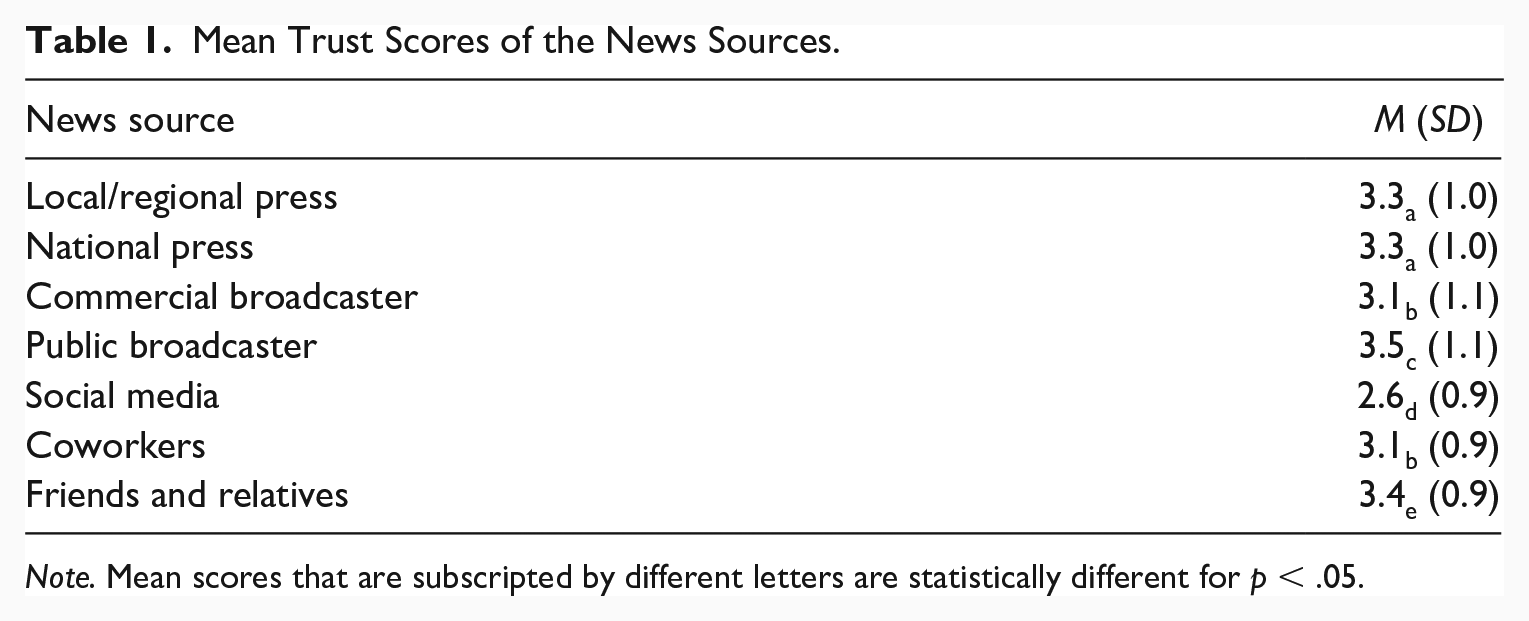
Note. Mean scores that are subscripted by different letters are statistically different for p < .05.
Establishing the Trust Figurations
Figure 2 summarizes the main results of the LCA. All four figurations had one pattern in common: Informational trust in friends and relatives was significantly stronger than informational trust in social media (z ≥ 2.66, p < .01). 7 Beyond that, major differences existed regarding the figurations’ prevalence, the levels and consistency of their trust, and the overarching trust patterns.
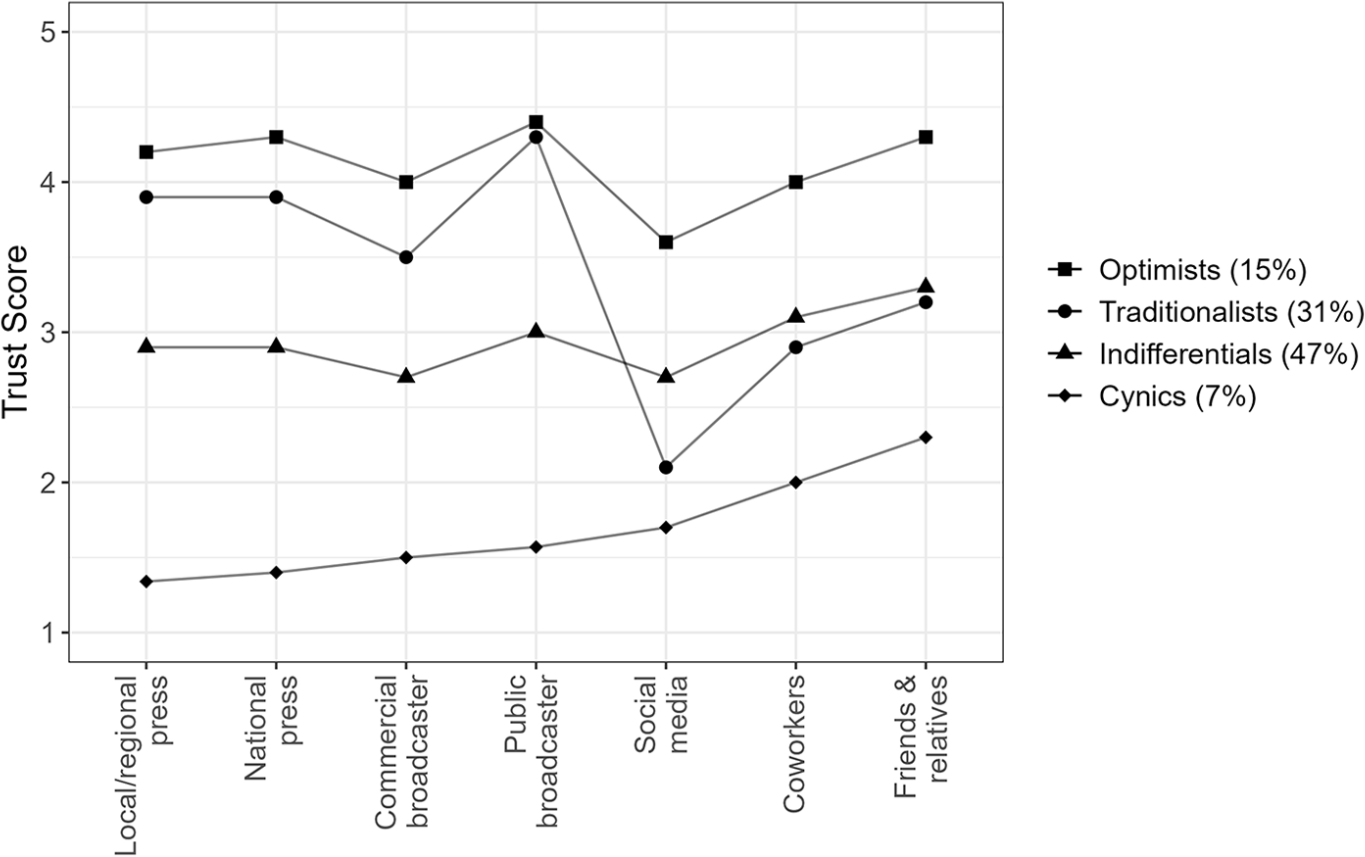
Trust scores of the news sources in the four figurations.
The indifferentials constituted the largest class (47% of young adults). While the trust figuration comprised somewhat higher informational trust in friends and relatives than in social media (z = 27.14, p < .01) and, to a lesser extent, in journalistic media (z = 6.37, p < .01), it showed a high degree of consistency across sources. Indifferentials neither particularly trusted nor distrusted any news source, but put modest informational trust into journalistic media, social media, and peers.
The second largest class (32% of young adults) was called traditionalists, as they distinctively prioritized the traditional core of the news ecology: journalistic media. Their trust levels varied notably, such that the figuration combined (modestly) high informational trust in journalistic media with lower trust scores for peers (z ≥ 6.27, p < .01) and yet lower trust in social media (z ≥ 8.05, p < .01). Individuals with this figuration also differentiated most strongly among journalistic media by trusting public broadcasters over commercial broadcasters (z = 10.46, p < .01).
The third class was smaller (13% of young adults) and called optimists. Their defining characteristic was high informational trust across all source types. Like indifferentials, the figuration showed a high degree of consistency. Optimists trusted coworkers (z = 2.45, p < .05) and even more so friends and relatives (z = 0.63, p = .53) largely by the same degree as journalistic media. Social media scored somewhat lower than journalistic media within the optimist trust figuration (z = 2.47, p < .05), but the difference was much less pronounced than within the traditionalist figuration (z = 4.21, p < .01).
Finally, the cynics formed the smallest class (8% of young adults). They distrusted all news sources and, in particular, journalistic media. While the absolute trust levels of friends and relatives were low compared with the other figurations, they scored considerably higher than journalistic media within the figuration (z = 4.14, p < .01). Social media also scored significantly higher than journalistic media within the figuration (z = 2.07, p < .05), though only slightly.
Overall, we were able to identify four trust figurations whose architectures matched our hypotheses. Indifferentials and optimists who trusted journalistic media and peers largely alike also differentiated only little among journalistic media (
Associating Trust Figurations With Demographics and Political Characteristics
Regarding
Multinomial Logistic Regression of the Trust Figurations on Demographics, Political Dispositions, and Political Participation.
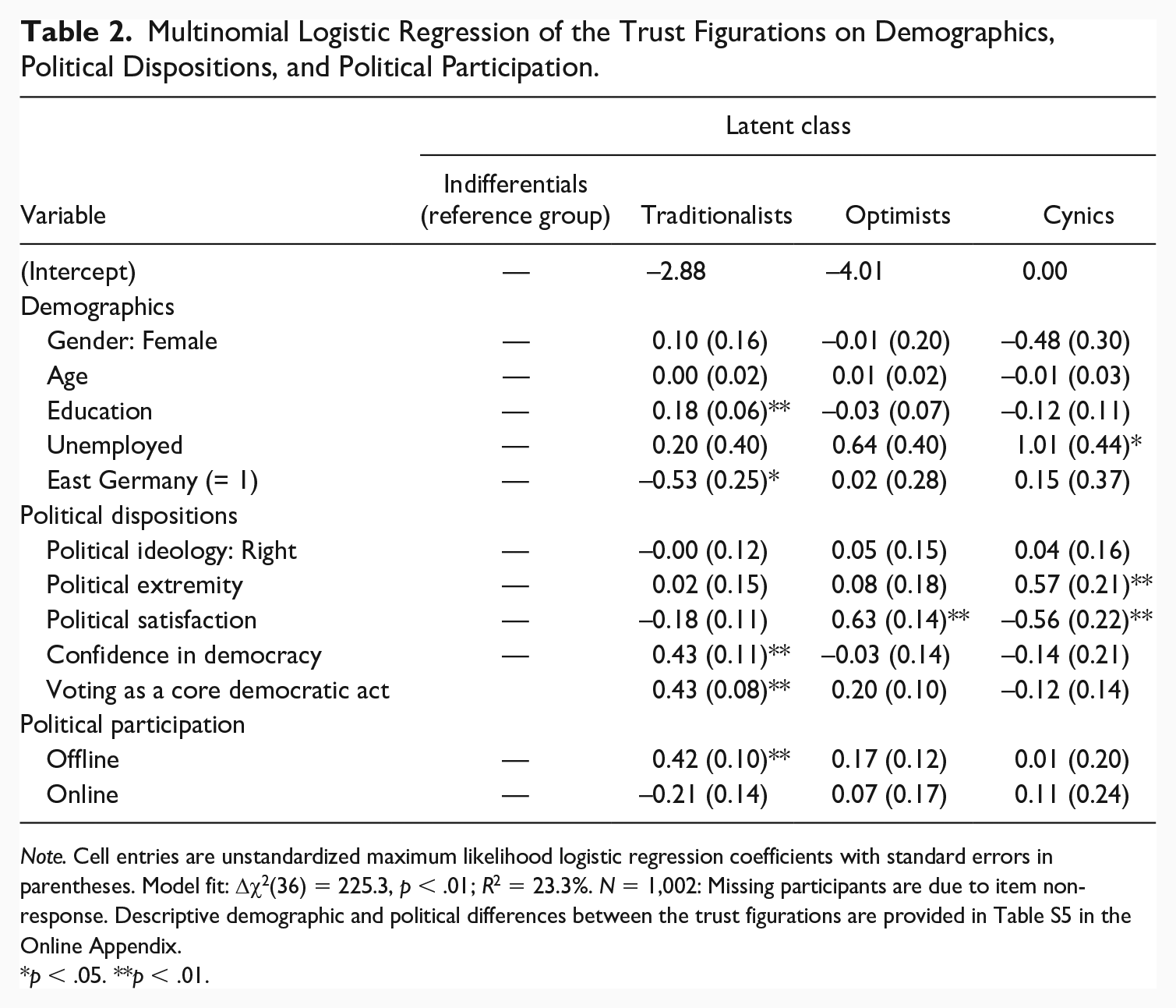
Note. Cell entries are unstandardized maximum likelihood logistic regression coefficients with standard errors in parentheses. Model fit: Δχ2(36) = 225.3, p < .01; R2 = 23.3%. N = 1,002: Missing participants are due to item non-response. Descriptive demographic and political differences between the trust figurations are provided in Table S5 in the Online Appendix.
p < .05. **p < .01.
Discussion
In this article, we argued that a trust figuration approach aids a better understanding of modern audiences’ trust in news sources. Empirically, we analyzed data from a representative survey of young Germans. Seen from the traditional source-centric perspective, young German adults encountered no news source with outright trust or distrust and substantially differentiated between sources. Specifically, they placed more informational trust in both journalistic media and peers than social media. Subsequently, we provided a closer look at the individual audience members’ trust allocations to disentangle four figurations: indifferentials, traditionalists, optimists, and cynics. As the figurations integrated informational trust in journalistic media, social media, and peers in qualitatively different ways, their architectures revealed substantial heterogeneity behind the initial source-centric results. The only trust allocation principle that applied across all figurations was higher informational trust in close peers than in social media. Beyond that, each of the figurations diverged in important ways from the profile of the source-centric analysis: Some figurations showed a lack of critical distance from news sources, either quite generally (optimists) or, as we further argue below, from at least some journalistic sources (traditionalists); some figurations made little to virtually no difference between journalistic media, social media, and peers (optimists and, in particular, indifferentials); and some individuals were specifically distrustful of journalistic media instead of social media (cynics).
The figuration approach revealed previously hidden heterogeneity among news audiences. People differed in not only their informational trust levels but also their inclination to distinguish between news sources. For one, many respondents’ trust figurations showed a high degree of consistency across journalistic media, social media, and peers. This result connected the traditional assumption that trust in news is a more or less general judgment (Prochazka & Schweiger, 2019; Van Dalen, 2020) with the inherently social nature of digital media use (Gil de Zúñiga & Diehl, 2019; Messing & Westwood, 2014). For the other, we identified the figuration of traditionalists. The figuration clearly differentiated among news sources in line with their degree of news professionalism. Some individuals continued to reward journalistic performance with trust in the digital age. However, given the distinct demographic and political profile of traditionalists, this seems to be confined to audience segments with higher formal education and strong traditional bonds with democracy and public institutions (Bennett, 2012; Knudsen et al., 2021).
Traditionalists’ unique demographic and political profile would have gone unnoticed with source-centric approaches because they shared high informational trust in journalistic sources with optimists, low informational trust in social media with cynics, and intermediate informational trust in peers with indifferentials. At the same time, the classic unidimensional distinction of high versus low trust in journalistic media only partially accounted for the differences between indifferentials, optimists, and cynics. While indifferentials and optimists trusted journalistic media and their peers alike, cynics trusted their peers over journalistic media. The latter aligns with the interpretation that distrust in journalistic media is predicated on an antagonistic understanding of mainstream media’s relation with the people (Fawzi, 2019). Notably, cynics shared an inclination to trust friends and relatives over social media with the other audience segments and only somewhat trusted social media over journalistic media. This finding did not come as a perfect surprise, as it reconciled conceptualizations of social media as an extension of peer networks with recent evidence that most news content on social media originally stems from established mainstream media (Guess et al., 2019).
The lowest political satisfaction and a more extreme ideological stance further indicated that the cynical trust figuration resides in an anti-establishment mind-set (Fawzi, 2019; Jackob et al., 2019; Markov & Min, 2021). More broadly, our findings confirm that political satisfaction is a meaningful correlate of trust in news. It specifically separated between different levels of generalized trust in journalistic media. Education and other political characteristics had theoretically coherent but more complex connections with trust figurations. By aligning with the cynical figuration, political extremity corresponded with the inclination to see all types of journalistic sources as untrustworthy without differentiation. This stood in sharpest contrast to the traditionalist figuration’s alignment with the highest levels of education, confidence in democracy and voting, and offline (rather than online) political participation. These characteristics inclined individuals to differentiate between journalistic sources but still conceive them overall as most trustworthy.
Overall, our study established by means of a figuration approach that demographic and political characteristics correspond to profound heterogeneity in the ways in which individuals combine trust in journalistic and non-journalistic news sources into overarching patterns. Our results augment the bigger picture of prior media trust research in several ways. While most recent academic and popular debate has revolved around concerns about distrust in news media and its democratic impact, scholars have cautioned that high trust may also be worrisome (Hanitzsch et al., 2018). Our findings contextualized and refined this argument. Specifically, the highest levels of trust in journalistic media were part of two profoundly different figurations. One trust figuration, the optimists, discounted the fact that not all information is reliable. All news sources, regardless of their adherence to journalistic standards, were highly trusted. This result contextualized high trust as the kind of “blind trust” and naivety that inhibits people from being free and self-governing. This makes them overly susceptible to influences from the media and opinion leaders in their social networks.
Another figuration, the traditionalists, exhibited a sensitivity to varying degrees of news professionalism by integrating high trust in journalistic media and, in particular, public broadcasters with lower trust in other news sources, most notably social media. Still, the figuration deviated from classic ideals of mindful skepticism. A truly empowered citizen should acknowledge the comparatively high-quality coverage of German public broadcasters yet maintain a critical distance from all news sources (Cappella & Jamieson, 1997). Naturally, the frame of reference for trust ratings is no longer just journalistic sources but also social media. One may argue that relative to unvetted news coming from social media, all journalistic sources should be trusted. Yet, because the share of misinformation on social media is actually much lower than often portrayed in mainstream discourse (Guess et al., 2019), there is also reason to believe that the traditionalists’ distrust in social media does not necessarily stem from close consolidation and reflective examination. They might also be susceptible to stereotypical warnings about social media’s threats to democracy perpetuated by their trusted journalistic sources.
As taking part in the broader societal discourse requires a minimum of trust in its legitimacy, distrust in the established news media is particularly worrisome if it aligns with disdain for politics rather than actual violations of professional journalistic standards (Fawzi, 2019). The non-trivial prevalence of young German adults with a cynical trust figuration clearly echoed this concern. It is exceedingly difficult to keep people with a profile like the one of cynics from forming their worldview based on “alternative” information, regardless of whether they are still exposed to the established news media. For a healthy public sphere, it is not only critical that citizens use news but also that they trust in news (Hanitzsch et al., 2018; Strömbäck et al., 2020).
Finally, our findings connected research on trust in news with research on communication in the digital news ecology. Digitalization has catalyzed an unprecedented blurring of the lines between mass and interpersonal communication (Gil de Zúñiga & Diehl, 2019; Schäfer & Taddicken, 2015). Likewise, most German young adults had an indifferential trust figuration. They made little to no difference between journalistic media, social media, and peers, but deemed them largely interchangeable. The result aligns with recent reservations about the more traditional idea that people purposefully combine specific journalistic quality perceptions into trust evaluations (Prochazka & Schweiger, 2019; Van Dalen, 2020). Indifferentials seemingly considered the distinction between journalistic and non-journalistic sources as irrelevant in terms of allocating trust or were even unaware of the distinction. While we cannot rule out that indifferentials’ trust decisions reflected a critical distance from all sources, this seems rather unlikely because they hardly distinguished among a diverse range of sources. A closer examination of the reasons as to why they do not differentiate between news sources is indispensable. To this end, qualitative studies also promise a valuable contribution to our knowledge of the mechanisms underlying the trust patterns quantitatively established herein.
Limitations and Directions for Future Research
In accordance with the general premises of recent online news research (Thorson & Wells, 2016), the distinction of journalistic media, social media, and peers captured a level of analysis on which the trust allocations of young adults differed profoundly. This enabled us to establish meaningful trust figurations in a broader context of informational trust beyond the traditional focus on journalistic media. However, the figuration approach is not limited to this level of abstraction. Trust figurations may also be studied in relation to various other media-related objects that are discussed in the literature (e.g., individual journalists, news brands). Measuring trust in such objects would allow for more granular representations of certain parts of the media ecology. It will be interesting to see whether the abstract principles behind the figurations presented herein will replicate with such data. The question of how different levels of analysis conceptually and operationally relate to each other is an ambiguous one in its own right (Daniller et al., 2017; Fawzi et al., 2021). From this angle, a more methodologically oriented application of the figuration perspective may also clarify which specific trust objects respondents are referring to when answering survey questions that generically ask about their trust in “media” or “news.”
Future studies should look beyond the German case to establish whether the trust of individuals with a traditionalist mind-set similarly prioritizes journalistic media in countries where professional norms and quality standards have eroded more strongly. The close adherence of our results to main tenets of contemporary research on trust in news and news audience research more broadly can provide us with some confidence in the cross-national generalizability of the trust figurations. This seems particularly true considering recent evidence that digitalization can have a universalizing effect on media systems that have traditionally been portrayed as rather distinct (Fletcher & Nielsen, 2018; Mangold et al., 2021; Valeriani & Vaccari, 2016). Still, optimists and cynics should form larger audience segments in countries where comparative studies have found trust in news to be higher and lower than in Germany, respectively (Fletcher & Park, 2017; Hanitzsch et al., 2018). The prevalence of indifferentials should be more sensitive to cross-national differences in digital and social media use for news. An application of the figuration approach to other countries would of course require an adaptation of the source type measures to the respective media systems.
Our reliance on secondary data from a cross-sectional survey prohibited claims about the causality behind the development of trust figurations. Yet, given the long-term stability commonly attributed to trust relations, conventional short-term panel studies and even developmental cohort studies may not necessarily fare better (Slater, 2007). Therefore, readers should take our study as what it is: rigorous evidence that informational trust forms distinct patterns and that these patterns are meaningfully associated with demographic and political characteristics. While these characteristics coherently contextualized the trust figurations, additional measures of, for instance, anti-elite sentiments, news-finds-me perceptions, or political and generalized interpersonal trust would have enabled us to address some points more directly.
Finally, it should be acknowledged that the one-question trust measures put natural limits on our knowledge of respondents’ trust in single source types (Prochazka & Schweiger, 2019). This includes the question of what people were specifically referring to when answering questions about their informational trust in social media and peers. Future studies might add more nuanced measures to explore whether and to what extent people distinguish between original information on current events, news alerts (i.e., what is worth paying attention to), and endorsements and opinions (i.e., how to make sense of the news) when evaluating the trustworthiness of these sources (e.g., Gil de Zúñiga & Diehl, 2019; Thorson & Wells, 2016). A better understanding of different frames of reference for trust evaluations would enable a richer contextualization of the differences between the trust figurations. For now, considering our primary research goals, we accepted the limitations of the general one-item measures for the benefit of access to representative secondary data from a population of young adults collected at a time when digitalization has gained momentum.
Supplemental Material
sj-docx-1-jmq-10.1177_10776990221100515 – Supplemental material for How News Audiences Allocate Trust in the Digital Age: A Figuration Perspective
Supplemental material, sj-docx-1-jmq-10.1177_10776990221100515 for How News Audiences Allocate Trust in the Digital Age: A Figuration Perspective by Frank Mangold, Marko Bachl and Fabian Prochazka in Journalism & Mass Communication Quarterly
Footnotes
Acknowledgements
We thank two reviewers and the editor for helpful comments. We are grateful to mindline and Gruner + Jahr for the opportunity to use the otherwise proprietary data set.
Declaration of Conflicting Interests
The author(s) declared no potential conflicts of interest with respect to the research, authorship, and/or publication of this article.
Funding
The author(s) received no financial support for the research, authorship, and/or publication of this article.
Data Availability
A replication data set can be obtained from the corresponding author upon request.
Disclosure Statement
The authors obtained permission to use the otherwise proprietary data set by mindline and Gruner + Jahr. The data use agreement gives full intellectual property rights to the authors.

Supplemental Material
Supplemental material for this article is available online.
Notes
Author Biographies
References
Supplementary Material
Please find the following supplemental material available below.
For Open Access articles published under a Creative Commons License, all supplemental material carries the same license as the article it is associated with.
For non-Open Access articles published, all supplemental material carries a non-exclusive license, and permission requests for re-use of supplemental material or any part of supplemental material shall be sent directly to the copyright owner as specified in the copyright notice associated with the article.
