



Abstract
Framing research has predominantly revealed detrimental effects of episodic news frames, including individualist blame attributions and political cynicism. However, such frames may also discourage group biases and impede motivated reasoning regarding identity politics. In two experiments (N = 815; N = 1,019), we test the effect of episodic frames on group-consonant attitudes through identity-motivated reasoning. The two studies produce mixed results. Episodic frames might decrease gender-motivated reasoning for women with weaker gender identities when news threatens their identity, but not for men or for women with stronger gender identities. The implications for journalism and democracy are discussed.
Politics in Western democracies is increasingly focused on group identities. Large-scale identity politics campaigns, such as the #BlackLivesMatter movement, have garnered substantial attention in the news (Mourão et al., 2021), and right-wing populists regularly address national and ethnic identities in election campaigns (Mudde, 2007). News that touches on citizens’ group identities can lead to motivated reasoning and issue polarization between groups (Mackie et al., 1992). This effect has been found for various social groups, including citizens’ political parties (Bolsen et al., 2014), race (Feldman & Huddy, 2018), and religion (Landrum et al., 2017), and hinders societal consensus about social issues.
The extent to which identity-laden news causes polarization depends on the news’ content and the news consumer (Levendusky, 2017, 2018), but also on the news’ form. This means that the journalistic frame chosen to cover a political event likely matters. News framing describes recurring patterns through which journalists highlight certain aspects of an issue over others (Entman, 1993). Here, we focus on a prominent example of news framing: episodic and thematic framing. As a counterpart to thematic framing—news stories in their societal context and in terms of (statistical) evidence—episodic framing isolates single events or individuals and offers an engaging narrative (Iyengar, 1991). Episodic frames are often classified as “soft news” by scholars (Reinemann et al., 2012) and journalists (Glogger & Otto, 2019). Such frames have been shown to conceal the societal factors of black-on-white crime (Holt & Major, 2010), stigmatize mental health issues (Zhang et al., 2015), and induce political cynicism (Boukes & Boomgaarden, 2015). These findings suggest that episodic frames can “undermine the potential policy relevance of news stories” (Ostfeld & Mutz, 2014: p. 54).
However, isolating a certain individual could also limit the salience of group identities (e.g., Price et al., 1997) and negative stereotypes (e.g., Iyengar et al., 2013) as well as elicit empathetic feelings (e.g., Gross, 2008). Moreover, narratives impede counterarguing through psychological absorption (e.g., Slater & Rouner, 2002). Episodic frames might therefore reduce identity-motivated reasoning and thus avoid intergroup polarization, thereby serving an important function for democracy. Using two experiments conducted in Austria, we investigate this unexplored advantage of episodic framing. In this way, we offer a novel view on episodic frames in democracy, emphasizing their potential to prevent citizens from cognitively defending their social group.
Identity-Motivated Reasoning Divides Citizens
Scholars have long found that citizens are not easily persuaded, but rather tend to hold onto their beliefs despite counterevidence (Kunda, 1990). The consequences of this phenomenon for society are far-reaching: if citizens systematically resist threatening information but believe congenial information, societal cleavages grow. This process is called motivated reasoning. Citizens tend to have a confirmation bias, “such that when free to choose what information they will expose themselves to people will seek out confirming over disconfirming arguments” (Taber & Lodge, 2006, p. 757). When citizens are exposed to news, they often have a disconfirmation bias, such that they are more critical of information that contradicts their prior beliefs (Taber & Lodge, 2006) or that threatens their group identity (e.g., Mackie et al., 1992). Citizens faced with identity-threatening news rate its arguments as weaker (Taber & Lodge, 2006) and its credibility as lower (Feldman & Huddy, 2018), and they spend more cognitive energy counterarguing it (Jain & Maheswaran, 2000), compared with being faced with identity-bolstering news. Consequently, citizens’ attitudes become more congruent with their group interests, dividing them along group lines.
The evidence for this phenomenon is most thoroughly developed for partisan identification (e.g., Bolsen et al., 2014; Leeper & Slothuus, 2014; Slothuus & De Vreese, 2010); however, political issues do not only address partisan identities. Large-scale identity politics campaigns, such as the #BlackLivesMatter and #MeToo movements, generate public debates that relate to racial and gender identities (De Benedictis et al., 2019; Mourão et al., 2021). Meanwhile, increasingly popular right-wing populist parties and candidates (Rooduijn et al., 2019) address national or ethnic identities to garner electoral support (Mudde, 2007). Likewise, citizens are not just voters: they construct their identities from many different perceived group memberships, like their profession, favorite football team, or gender (Tajfel & Turner, 1986). Accordingly, news containing different group cues can increase group identification concerning citizens’ age, ethnicity, social class, or ideology (Boyer & Lecheler, 2018).
Even though motivated reasoning is not the only mechanism driving group polarization (Han & Federico, 2018), many group identities have been found to motivate citizens’ reasoning. Scholars have found identity-motivated biases in the adoption of attitudes toward welfare reform (Cohen, 2003), climate change (Kahan et al., 2012; Landrum et al., 2017), gun risks, abortion (Kahan et al., 2007), and standards for competence (Shoda et al., 2014). The group identities that motivate reasoning in these studies comprise race, gender, religion, and cultural groups. Such studies generally find that, similar to partisan identification, citizens treat news that is unfavorable to their group with more scrutiny than news that is favorable. Consequently, citizens’ attitudes change in the direction that is more favorable to their group: their attitudes become more group-consonant. This inevitably leads to issue polarization between opposing groups in the news, such as left-wing and right-wing citizens, native-born residents and residents with an immigration background, or men and women.
Can Episodic News Frames Prevent Identity-Motivated Reasoning?
Are public debates about social issues thus doomed to drive us apart? Not necessarily. Previous research shows that content emphasizing a superordinate identity (Levendusky, 2017) and psychological states of partisan ambivalence (Levendusky, 2018) may reduce polarization for certain citizens. While these are important insights, it is imperative to investigate polarization within a societal context. Citizens primarily consume political messages through the news, which is to some extent constructed by journalists (Lecheler & De Vreese, 2019). Therefore, news frames—the recurring patterns that journalists actively use to highlight certain aspects of an issue over others (Entman, 1993)—can play an important role in the way citizens interpret political issues.
One popular type of generic news frame seems promising for inhibiting identity-motivated reasoning: the episodic frame. Iyengar (1991) distinguishes thematic frames, which offer societal context and provide statistical evidence, from episodic frames, which isolate a narrative about a single individual or event. In cases where episodic frames deal with an individual, they differ from thematic frames in two ways: first, they offer an isolated narrative rather than broad contextual evidence; and second, they focus on an individual rather than statistics or averages concerning groups of people. These are two different aspects, as narratives can also feature groups and broad evidence can concern an individual. Although the arguments used in episodic and thematic frames can be the same, the individualization and the narrative change the meaning of the arguments. Thus, episodic frames (compared with thematic frames) are a type of generic emphasis frame (De Vreese, 2002). The two frames are often combined within the same news message (Wouters, 2015).
Communication scholars often argue that episodic news frames “undermine the potential policy relevance of news stories” (Ostfeld & Mutz, 2014, p. 54). Both scholars (Reinemann et al., 2012) and journalists (Glogger & Otto, 2019) consider episodic frames to be part of “soft news.” Moreover, these frames have certain detrimental effects. For instance, episodic frames in crime reporting could contribute to violent stereotypes of African Americans (Holt & Major, 2010), and episodic frames in the coverage of mental health could reinforce its stigmatization (Zhang et al., 2015). Moreover, individualized news frames decrease support for welfare policies (Price et al., 1997), and episodic frames specifically decrease support for retirement planning policies (Springer & Harwood, 2015) and even cause political cynicism (Boukes & Boomgaarden, 2015).
Nevertheless, in the context of identity politics, episodic frames may have a unique ability to inhibit identity-motivated reasoning, because they might impede both the motivation for in-group bias and the ability to counterargue identity-threatening messages. This may stem from two characteristics: individualization and narrative.
By definition, episodic frames put more emphasis on individuals instead of groups than do thematic frames (Iyengar, 1991). Following self-categorization theory (Turner et al., 1987), we argue that such individualization should lead to less “salience” of these groups in citizens’ minds (Turner et al., 1994). Indeed, individualized news frames seem to promote individualized thoughts (Price et al., 1997). On one hand, ignoring relevant groups might sustain existing stereotypes; for instance, the overrepresentation of working-age black men in episodic coverage of poverty reinforces negative stereotypes about black men (Gilens, 1996). On the other hand, reduced group salience might also reduce perceived intergroup differences and in-group favoritism (Turner et al., 1994); thus, episodic frames could lead to less identity-motivated reasoning in the processing of news about identity politics.
Relatedly, citizens tend to be more positive about an individual member of a group than the group itself. This person-positivity bias has been found for college professors (Sears, 1983) and several immigrant groups (Iyengar et al., 2013). One explanation is that the most accessible attributes of groups that are stored in the mind are often negative, while encounters with individuals are mostly positive, leading to positive evaluations of the latter until proven otherwise. In addition, exposure to individuated information leads to less reliance on stereotypes and more focus on individual attributes (Iyengar et al., 2013). Therefore, the individualized nature of episodic frames could lead to more positive views of an outgroup (member) and in this manner reduce identity-motivated reasoning.
Moreover, episodic frames are found to elicit empathetic emotions toward the subject of the narrative. Gross (2008) finds that episodic frames can be effective in persuading news consumers because they elicit feelings of pity and sympathy for the victims in the news story. When the victim in an episodic frame is a member of the outgroup, we expect that episodic frames can lead to more empathic feelings toward members of the outgroup than thematic frames. This should, in turn, lead to less resistance against the message, given the greater understanding for outgroup members and, therefore, less motivation for outgroup derogation.
Finally, we expect episodic frames to inhibit the ability to counterargue news messages. Episodic frames feature a narrative: a story about a character, with a chronological order. Narratives lead to psychological absorption, which impairs arguing against the arguments in them (e.g., Green & Brock, 2000; Niederdeppe et al., 2011; Slater & Rouner, 2002; Springer & Harwood, 2015). While evidence invites scrutiny, narratives invite “suspended disbelief,” in which a story feels true until it is over (Slater & Rouner, 2002); this impairs counterarguing and leads to persuasion. Applying this concept to intergroup relations, Wojcieszak and Kim (2016) find that empathetic narratives (as opposed to objective narratives and evidence) can shift attitudes about disliked groups, even after counter-attitudinal exposure. This finding is in line with research showing that episodic frames are more persuasive than thematic frames when news consumers experience strong emotions (Aarøe, 2011). Thus, episodic frames should impair identity-motivated reasoning.
In sum, two important characteristics of episodic frames—individualization and narrative—may decrease both the motivation and the ability to scrutinize news with a bias toward citizens’ in-group. Consequently, identity-motivated reasoning should be less prominent in response to episodic frames than thematic frames, leading to attitudes that are less group-consonant. As depicted in Figure 1, this leads to our main hypothesis.

Hypothetical effect model.
Study 1
Design and Stimulus Material
In an online 2 (frame) × 2 (article valence) between-subjects experiment, we randomly exposed a sample of 815 Austrian participants to a news article about a new gender quota in Austria. 1 The bill was introduced in January 2018 and forms a real-world context in which to test our hypothesis. Gender identification is an appropriate case with which to show this effect because gender, as a social construct, socializes citizens into specific roles and expectations from birth onward and is one of the most influential group identities in our lives (Burns & Kinder, 2012). The data were collected in October 2018 by the panel agency MarketAgent on behalf of the Austrian Platform for Surveys, Methods and Empirical Analyses (PUMA).
The stimulus material consisted of two opposing opinionated news articles about the gender quota. 2 Following Feldman and Huddy (2018), we view acknowledgment and denunciation of in-group discrimination as identity-bolstering and acknowledgment of the in-group’s societal advantage as identity-threatening. Therefore, the article that supported the quota was regarded as identity-bolstering to women and identity-threatening to men, and vice versa for the article that opposed it. For the sake of comparability, the articles were composed by the researchers; however, to ensure external validity, the arguments were based on published articles in legacy media. The articles were comparable in length (400 ± 40 words) and layout and were pretested for credibility and argument strength.
Each article had a thematic and an episodic version. The thematic articles discussed the gender quota in terms of “its intended and unintended consequences for society.” The arguments were made in terms of men and women in general and the consequences for Austria’s corporations. In addition, the thematic frame was supported by a statistical graph of the increasing number of women on supervisory boards. In contrast, the episodic frame introduced an exemplar man and woman who experienced the consequences of the quota. The arguments were identical to the thematic frame but were isolated from any context, as they described a specific case. As news is rarely purely episodic, the first and final paragraphs of the article referenced the consequences of the gender quota for Austria. The episodic frame was supported by a picture of a businessman and a businesswoman.
In a manipulation check, we asked participants to rate on a 9-point scale the extent to which the article they read was positive or negative toward men, positive or negative toward women, and discussed men and women in general or one man and one woman in particular. 3 As expected, participants identified the pro-quota article as more positive to women, t (813) = 9.99, p < .001, and less positive to men, t (813) = −5.24, p < .001, than the anti-quota article. Moreover, they recognized that the thematic frame considered men and women in general more than the episodic frame did, t (813) = 4.63, p < .001, and that the episodic frame considered one man and one woman more than the thematic frame did, t (813) = −9.34, p < .001.
Measures
Identity-motivated reasoning
Identity-motivated reasoning is defined as reasoning against identity-threatening information or along with identity-bolstering information. Therefore, in this study, it is dependent on participants’ gender and the article they were exposed to, and it was measured after exposure to the article. Motivated reasoning entails at least three dimensions (Taber & Lodge, 2006) and was therefore operationalized here by three indicators: one directly indicating derogation of the arguments, one directly indicating derogation of the source, and one open-ended exercise in which participants were free to list any thoughts on the article.
In line with Taber and Lodge (2006), argument derogation was measured using a single item, in which respondents rated the strength of argumentation of the article on a scale from 1 (very weak) to 9 (very strong). The scale was recoded so that a higher score meant less perceived argument strength (more argument derogation) in an identity-threatening article but more argument strength (less argument derogation) in an identity-bolstering article; in other words, a high score always meant more identity-motivated reasoning. Finally, the item was standardized to be comparable to the other indicators. To measure source derogation, perceived article credibility was measured using eight items on a 9-point scale, in which participants rated the article in terms of being understandable, biased, telling the whole story, believable, correct, trustworthy, fair, and timely (Cronbach’s α = .89). Again, the scales were recoded for participants who were exposed to an identity-threatening article, so that higher scores always meant more identity-motivated reasoning; additionally, the items were standardized.
Finally, again in line with Taber and Lodge (2006), respondents received a score for their answers in a thought-listing exercise. Immediately after being exposed to the article, respondents listed up to 10 thoughts that they had while reading the article. An average of 2.35 thoughts (SD = 2.00) was listed per participant, amounting to a total of 1915 thoughts. These were coded by two coders as arguing with or against (part of) the article or as being neutral/unrelated (Krippendorff’s α = .62). 4 The score on the thought-listing exercise was calculated by subtracting the number of affirming thoughts from the number of counterargument thoughts, for a scale from − 10 to + 10 in which a higher score meant more counterarguing for those exposed to an identity-threatening article. The score was reversed for those who were exposed to an identity-bolstering article, such that higher scores indicated more identity-motivated reasoning. Finally, the scale was standardized.
Group-consonant attitudes
Group-consonant attitudes were also measured post-treatment. Participants rated the gender quota policy on seven items, using a 9-point Likert-type scale. 5 The scale included such items as “In general, it is good that the gender quota has been implemented,” “The gender quota improves the quality of supervisory boards in Austria,” and “The gender quota can force companies to hire suboptimal candidates.” To create a measure of group-consonant attitudes, each item was re-coded, so that more group-consonant attitudes were more positive about the quota for women and more negative about the quota for men. The final score for group-consonant attitudes was the average of the seven items (M = 4.85, SD = 1.48, Cronbach’s α = .78).
Results
To test whether there was a main effect of news frames on group-consonant attitudes, we regressed group-consonant attitudes on the frame condition, controlling for the omitted factor in the design: the valence of the article. We do not find a direct effect of framing on group-consonant attitudes, b = .06, SE = .09, p = .511; however, because we were interested in the way that episodic framing impacts the mechanism of identity-motivated reasoning, rather than the overall polarization result, we had not hypothesized a direct effect of episodic frames on group-consonant attitudes. Indeed, episodic framing might have other effects, working through other mechanisms. Therefore, a main effect is not a necessity for a valid indirect effect (Hayes, 2009), and we continued to test the main hypothesis using bootstrapped mediation modeling.
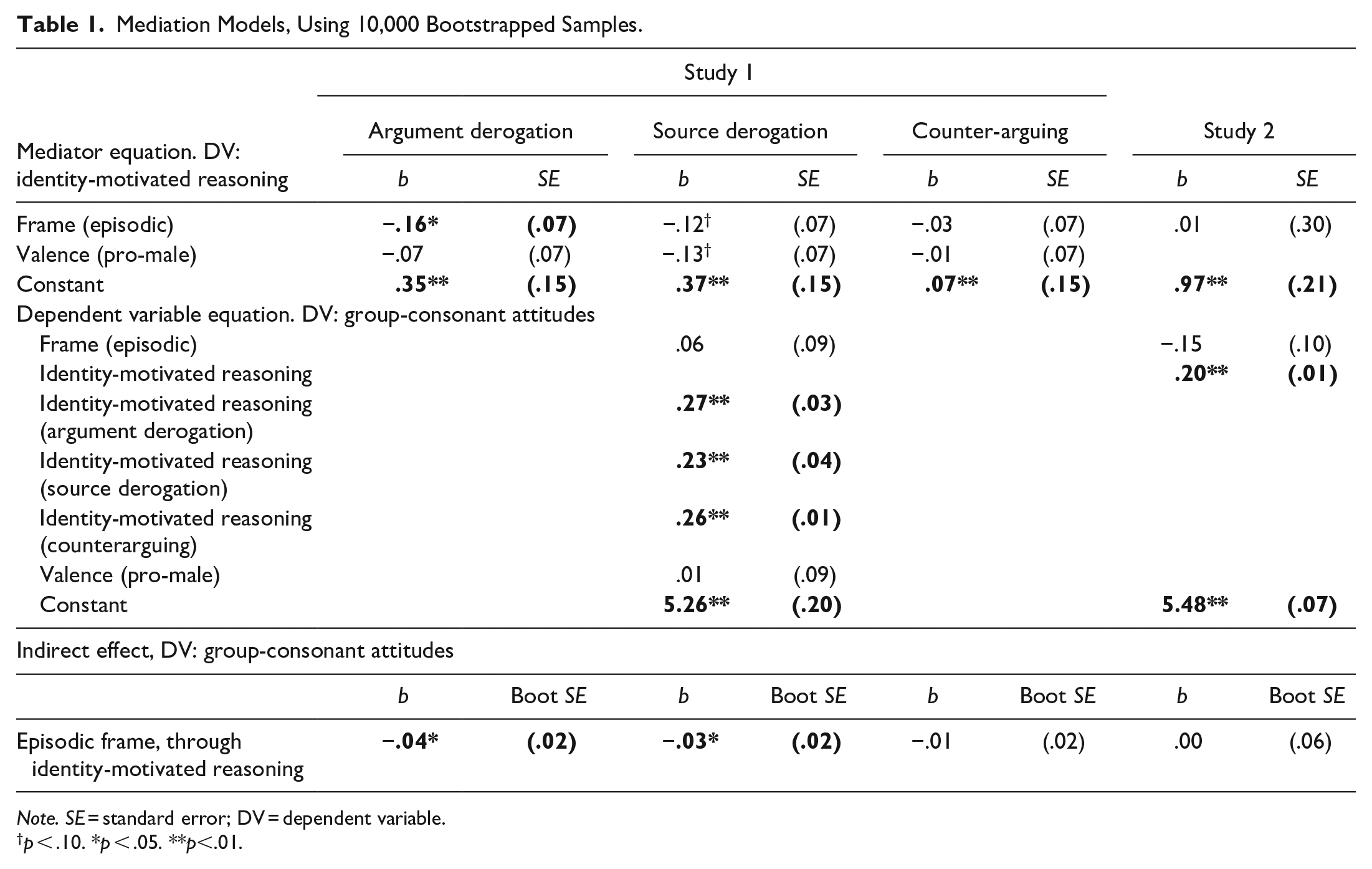
The main hypothesis—episodically framed news leads to less group-consonant attitudes through less identity-motivated reasoning—was tested using model 4 of Hayes’ (2013) PROCESS macro in SPSS 26, with 10,000 bootstrapped samples, using the three indicators of identity-motivated reasoning as three parallel mediators. In the reporting of the indirect effects and model indices of this mediation model, we use bootstrapped standard errors and 95% confidence intervals. For Study 1, we controlled for the valence of the article, as it is not relevant to the hypothesis but was an experimental factor in the design (see Table 1). As hypothesized, the mediator equation shows that the episodic frame elicited significantly less identity-motivated reasoning through argument derogation than did the thematic frame, b = −.16, SE = .07, p = .023 (Table 1, Study 1); a similar trend is visible for source derogation, b = −.12, SE = .07, p = .087. However, there was no effect of the news frame on identity-motivated reasoning through counterarguing, b = −.03, SE = .07, p = .645.
Mediation Models, Using 10,000 Bootstrapped Samples.
Note. SE = standard error; DV = dependent variable.
p < .10. *p < .05. **p<.01.
The dependent variable equation indicates a strong correlation between group-consonant attitudes and motivated reasoning through the indicators of argument derogation, b = .27, SE = .06, p < .001, source derogation, b = .23, SE = .06, p = .001, and counterarguing, b = .26, SE = .05, p < .001. Most importantly, there is a significant negative indirect effect of episodic framing on group-consonant attitudes through argument derogation, b = −.04, SE = .02, CI [−.10, −.01], as well as a significant negative indirect effect through source derogation b = −.03, SE = .02, CI [−.07, .00]. The indirect effect through counterarguing runs in the same direction but is not significant, b = −.01, SE = .02, CI [−.05, .03]. As depicted in Figure 2, Study 1 largely supports the hypothesis that episodic framing leads to less identity-motivated reasoning and, therefore, to less group-consonant attitudes than thematic framing does.
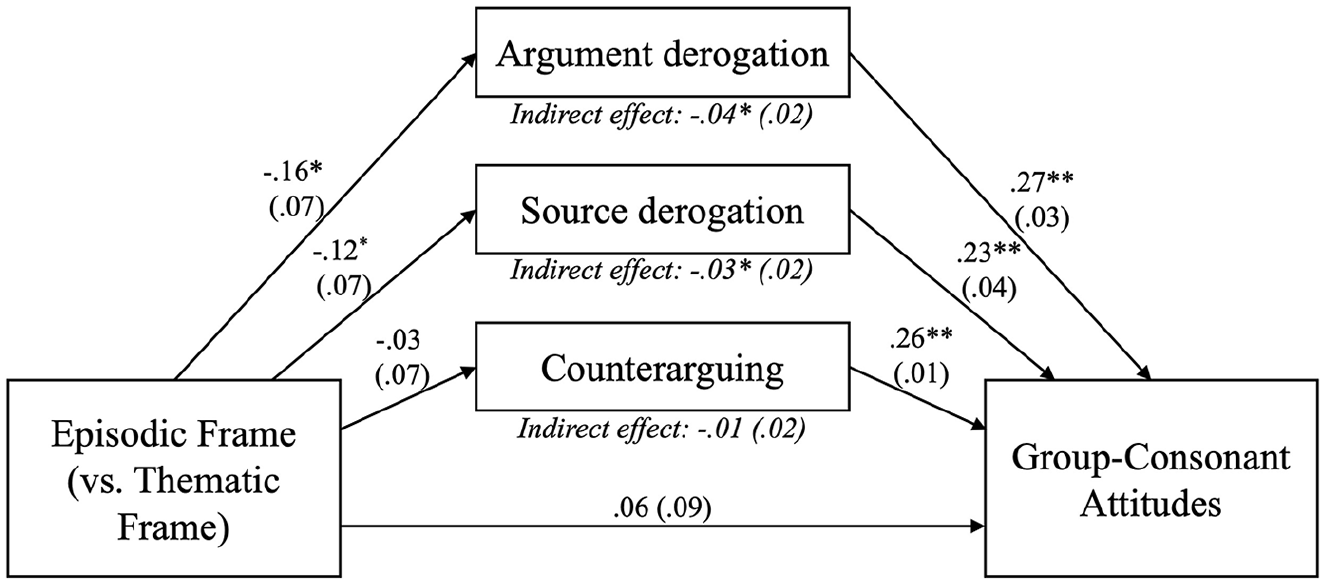
Results of Study 1; unstandardized effects with (bootstrapped) standard errors in brackets.
Study 2
Design and Stimulus Material
Even though the results of Study 1 indicated that episodic framing can lead to less identity-motivated reasoning, replication is needed to build confidence that this effect is transferable to other situations, groups, or messages. Therefore, to validate the findings from Study 1, we conducted a second, preregistered online experiment with a multi-message design.
In Study 2, we exposed 1,019 Austrian participants to four news articles about gender discrimination in the workplace. 6 The data were collected by panel agency Dynata in September 2020. Each respondent read two articles that were identity-bolstering to men and identity-threatening to women, and two articles that were identity-bolstering to women and identity-threatening to men, in random order. Each of these four articles had a thematic frame version and an episodic frame version, with the frame of the article being the only between-subject manipulation in this two-condition experiment. In the thematic frame condition, all four articles included the context of Austrian corporate culture or law, described trends in society, and used statistics to support their claims. The articles included a graph depicting statistics about the issue. In the episodic frame condition, the articles isolated a single case that exemplified the issue and showed anecdotal evidence described by an exemplar, whose personal narrative was the focus of the article. These articles were accompanied by a picture of the protagonist. As in Study 1, while the frame differed between the conditions, the arguments did not.
The four articles per condition differed in their specific topics, in addition to whether they were identity-bolstering to women or men. Article 1 discussed how women in leadership positions are demoted after returning from maternity leave, and Article 2 discussed how criteria for promotions are often based on stereotypically male traits and can therefore be biased against women. Article 3 discussed how the abundance of programs to support women in science pushes men out of the field, and Article 4 discussed how the gender quota for supervisory boards is discriminatory against men. Articles 1 and 2 were considered identity-bolstering to women and identity-threatening to men, and Articles 3 and 4 were considered identity-bolstering to men and identity-threatening to women. The articles were equally long (280 ± 60 words; max. 25 words difference between episodic and thematic frame) and had the same layout.
In a manipulation check, participants used a 9-point scale to rate the extent to which the articles they read (a) discussed structures in Austrian society, (b) used statistics to make their case, (c) embedded the news in a broad societal context, (d) described the experiences of a specific man or woman, (e) used a narrative to tell the news, and (f) isolated a specific case. 7 As expected, participants recognized that the thematic framed articles discussed structures in Austrian society, t (1,017) = 2.06, p = .020, used statistics, t (1,017) = 12.54, p < .001, and embedded the news in a broad societal context, t (1,017) = 2.74, p = .003, more than the episodic frames did. Conversely, participants recognized that the episodic frames described the experiences of a specific man or woman, t (1,017) = 9.59, p < .001, and isolated a specific case, t (1,017) = 7.93, p < .001, more than the thematic frames did; however, they did not perceive a difference in the use of a narrative between the two frames, t (1,017) = .08, p = .470.
Measures
Identity-motivated reasoning
Identity-motivated reasoning was again defined as reasoning against identity-threatening information or along with identity-bolstering information. Here, participants rated the credibility of the information in the four articles immediately after reading each one, on a scale from 1 (not at all credible) to 9 (very credible). Note that, similar to Feldman and Huddy (2018), participants rated the credibility of the information in the article, in contrast to the composite scale for source credibility in Study 1. Following Feldman and Huddy (2018), we subtracted the credibility ratings of the identity-threatening articles from those of the identity-bolstering articles, which led to a scale where higher scores meant more identity-motivated reasoning (M = .98, SD = 4.85).
Group-consonant attitudes
After reading all the articles and rating their credibility, participants rated five statements about gender equality in the workplace in Austria. Items in this scale included “Gender equality in the workplace, i.e., the equal treatment of women and men, has come far enough” and “We need more laws in Austria to ensure gender equality in the workplace.” Each item was recoded so that higher scores for women indicated attitudes that gender equality in the workplace can still improve, while for men they indicated the opposite. The measure of group-consonant attitudes was the mean of these five items (M = 5.60, SD = 1.88, Cronbach’s α = .87).
Results
Conforming to the preregistration, we analyzed the data of Study 2 similar to Study 1 (see Table 1, Study 2). However, we did not control for the valence of the article, as it was not an experimental factor in the design. Similar to Study 1, we found no direct effect of the frame on group-consonant attitudes, b = −.14, SE = .12, p = .219. In the test of the main hypothesis, the mediator equation indicated no differences in identity-motivated reasoning between the thematic and episodic frames, b = .01, SE = .30, p = .964. The dependent variable equation showed a significant correlation between identity-motivated reasoning and group-consonant attitudes, b = .20, SE = .01, p < .001, and no direct effect of episodic framing on group-consonant attitudes, b = −.15, SE = .10, p = .147. There was no indirect effect of episodic framing on group-consonant attitudes through identity-motivated reasoning, b = .00, SE = .10, CI [−.11, .12]. While we found the hypothesized inhibitory effect of episodic framing on identity-motivated reasoning and group-consonant attitudes in Study 1, we found no differences between the episodic and thematic frames in Study 2.
Exploratory Analyses
The results of the two experiments show that episodic framing can lead to reduced identity-motivated reasoning, but this is not a universal effect. Therefore, we performed a series of exploratory analyses to make sense of these contradictory findings. Because research has shown that framing effects are dependent on individual differences and contextual factors (Valkenburg & Peter, 2013a), we included both in these analyses. Indeed, identity-motivated reasoning likely depends on the status of one’s group—that is, the relative societal position of one social group compared with another (Tajfel & Turner, 1986)—and on the strength of the relevant group identity—that is, the importance of the group identity to the self (Turner et al., 1987). Group identity strength does not delineate whether or not someone identifies as part of this group, but rather how important this group identity is to their self-image. Low-status group identities are more easily activated by media priming than high-status groups (Boyer & Lecheler, 2018), and many political processes rely on group identity strength (Huddy, 2001). Therefore, both group status and group identity strength are crucial factors in identity-motivated reasoning and are likely to influence the inhibitory effect of episodic framing.
Finally, extant research has shown that media effects depend on the political context in which they are consumed (Valkenburg & Peter, 2013a). For instance, framing effects rely heavily on the political information environment around the issue at hand (Lecheler et al., 2009). Even the specific effects of episodic framing have been shown to be context-dependent and to vary across issues (Ciuk & Rottman, 2021). In sum, much is still unknown about how identity-based individual differences and contextual variables interact to inhibit or exacerbate framing effects on in-group biases. Therefore, in these exploratory analyses, we investigated the extent to which the inhibitory effect of episodic frames on identity-motivated reasoning is influenced by citizens’ group status, their identity strength, and the news topic. To do so, we explored the hypothesized effect for each article that participants were exposed to in both experiments, as moderated by both gender and gender identity strength.
Additional Measures
Gender and gender identity strength were measured as part of the pre-treatment questionnaire in both studies. Participants were asked the gender group with which they most identified (S1: 50.7% female; S2: 46.9% female). The measure for gender identity strength consisted of the four items of Luhtanen and Crocker’s (1992) Importance to Identity subscale, rated on a 9-point Likert-type scale (S1: M = 4.15, SD = 1.46, Cronbach’s α = .62; S2: M = 4.98, SD = 1.58, Cronbach’s α = .61). 8 With items like “Being a man/woman is an important reflection of who I am,” this is a common measure for identity strength.
For Study 1, identity-motivated reasoning was measured identically to the formal hypothesis test. For Study 2, we separated the credibility scores for each article, rather than forming a composite scale of all four. In these measures, the original credibility score was used for identity-bolstering articles while the reversed score was used for identity-threatening articles. This led to a scale for each of the four articles, where higher scores meant more identity-motivated reasoning (M1 = 5.21, SD1 = 2.13; M2 = 5.29, SD2 = 2.05; M3 = 5.26, SD3 = 2.17; M4 = 5.22, SD4 = 2.17).
Results
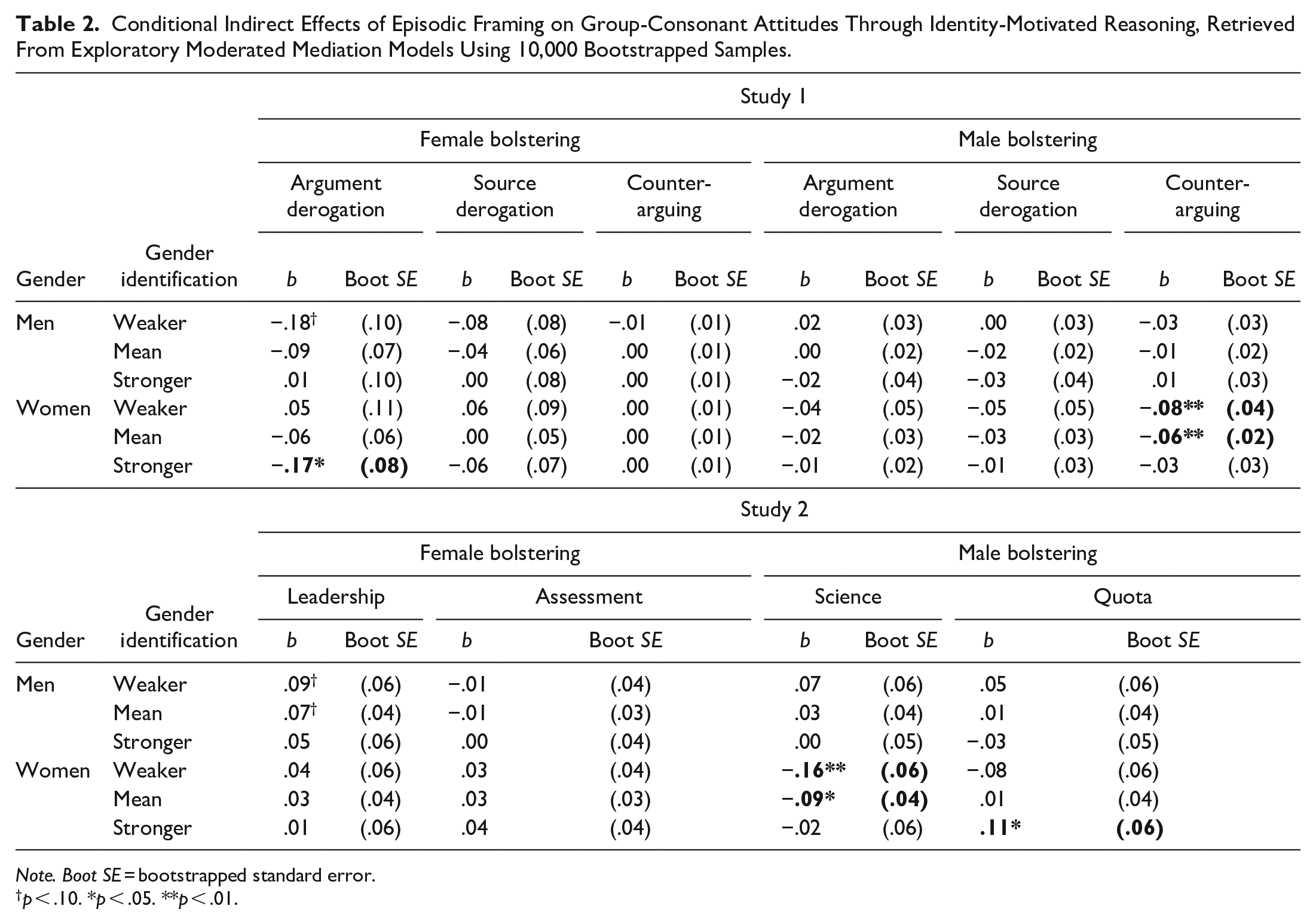
In these exploratory analyses, we again depended on Hayes’ (2013) PROCESS macro with 10,000 bootstrapped samples, performing mediation analyses with two moderators (model 11). The full moderated mediation models of Study 1 and Study 2 are described in Online Appendix G; here, we will limit our discussion to the hypothesized indirect effect of episodic framing on group-consonant attitudes, through identity-motivated reasoning, for the different subgroups and news articles (see Table 2).
Conditional Indirect Effects of Episodic Framing on Group-Consonant Attitudes Through Identity-Motivated Reasoning, Retrieved From Exploratory Moderated Mediation Models Using 10,000 Bootstrapped Samples.
Note. Boot SE = bootstrapped standard error.
p < .10. *p < .05. **p < .01.
As Study 1 included female-bolstering and male-bolstering articles as a between-subjects factor, we analyzed the two articles separately; therefore, we dropped the valence of the article as a control variable. The first noticeable effect can be seen in the male-bolstering condition, where there is a significant negative indirect effect through counterarguing for women whose gender identity strength is average, b = −.06, SE = .02, CI [−.11, −.02] (Table 2, Study 1), and for women whose gender identity strength is weaker than average, b = −.08, SE = .04, CI [−.17, −.03] (Table 2, Study 1). Women with average or weaker gender identities engaged in less identity-motivated reasoning and formed less group-consonant attitudes in response to the episodic frame than to the thematic frame. In the female-bolstering condition, we found an opposite effect: a significant negative indirect effect for women with a stronger gender identity strength, b = −.17, SE = .08, CI [−.36, −.03] (Table 2, Study 1). No significant indirect effects were found for men at all.
Because all participants were exposed to all four articles in Study 2, we ran the moderated mediation analysis for the four articles in parallel (see Table 2, Study 2). For the indirect effects of episodic framing on group-consonant attitudes through identity-motivated reasoning for the female-bolstering articles, there are no significant effects; for the two male-bolstering articles, however, there are significant effects that seem related to those in Study 1. For the science article, there are no indirect effects for any men; however, there are significant negative indirect effects for women with weaker gender identities, b = −.16, SE = .07, CI [−.30, −.06], and for women with average gender identities, b = −.09, SE = .04, CI [−.18, −.02]. There is no indirect effect for women with stronger gender identities, b = −.02, SE = .05, CI [−.15, .09]. For the gender quota article, there are no significant effects for women with weaker or average gender identities, although the direction is similar to the previous model. However, women with stronger gender identities significantly increased their group-consonant attitudes through motivated reasoning, b = .11, SE = .06, CI [.00, .23]. While there was no overall indirect effect of episodic frames on identity-motivated reasoning and group-consonant attitudes in Study 2, this hypothesized effect was visible for women with weaker gender identities in response to an identity-threatening news article.
In summary, in two different studies we find that episodic framing can reduce identity-motivated reasoning and group-consonant attitudes for women with average or weaker gender identities who are exposed to identity-threatening news. Sometimes, though, women with stronger gender identities who are exposed to identity-bolstering news might reduce their identity-motivated reasoning, and women with stronger gender identities who are exposed to identity-threatening news might sometimes even their increase identity-motivated reasoning. In contrast, men did not respond to the framing manipulation at all.
Discussion
This article used two online experiments about gender issues to explore how citizens process news relating to identity politics. Specifically, the aim was to explore the role of episodic framing in the extent to which news consumers cognitively defend their social group. The two experiments produced mixed findings. In the first experiment, using a nationally representative sample and three measures for identity-motivated reasoning, we found that episodic frames can indeed reduce identity-motivated reasoning and, therefore, group-consonant attitudes; in other words, gender-based cognitive asymmetries and polarization between men and women were reduced when news was presented in an episodic frame instead of a thematic frame. However, in the second experiment, using a multiple-message design, we did not replicate this finding.
How can we explain the different findings in these two experiments? The most obvious explanation lies in the studies’ different research designs. Study 1 used a single exposure design, which is relatively vulnerable to the specific effects of the selected issue or argument. However, the same issue was included in Study 2, which had different results. Therefore, if the topic is not the issue, perhaps the measures are. Study 1 used three indicators of identity-motivated reasoning, taking into account various reasoning strategies to undermine identity-threatening news. In contrast, Study 2 used single-item measures for each article and may therefore have missed the reasoning strategy that most participants employed.
However, the differences in the findings might also be very real. The societal contexts in which the two experiments were conducted were highly dissimilar. In contrast to Study 1, Study 2 was conducted during the COVID-19 pandemic; this crisis might have suppressed the importance that citizens attach to other issues, such as identity politics, and the identity-motivated cognitive asymmetries that accompany it. Even without the pandemic, different political contexts might affect the potential of episodic frames to inhibit identity-motivated reasoning. Thus, we must conclude that any potential effect of episodic frames is not universal.
This conclusion is supported by the exploratory analyses, in which we took into account individual differences in identity strength as well as contextual differences between the articles from both experiments. It seems that a possible inhibiting effect of episodic framing on identity-motivated reasoning could be limited to women—that is, low-status group members—with weaker relevant identity strength who are exposed to identity-threatening news rather than identity-bolstering news. This is in line with research showing that interventions to decrease partisan polarization are only effective for moderate partisans (Levendusky, 2018). However, more research is needed to confirm and validate these exploratory findings. Moreover, future work is needed to establish whether these findings are specific to gender or whether they can be generalized to other social groups and other contexts of identity politics.
Until this has been elucidated, our findings have important consequences for the merit of episodic frames for democracy. Episodic frames have most often been linked to negative effects (Boukes & Boomgaarden, 2015; Holt & Major, 2010; Ostfeld & Mutz, 2014; Springer & Harwood, 2015; Zhang et al., 2015); in our view, however, these frames might still have an important potential for democracy. Whether because of their focus on individuals (Iyengar, 1991), empathetic feelings (Gross, 2008), reliance on person-positivity bias (Iyengar et al., 2013), or psychological absorption (Slater & Rouner, 2002), episodic frames might sometimes be able to prevent certain citizens from cognitively protecting their group interests. As such, episodic frames do not serve to teach citizens about political issues; instead, they serve the important function of helping citizens understand the experiences of individuals of another social group. Even if our findings only apply to certain subgroups of the population, it is important that we expand our understanding of the functions that news frames may have.
In addition, as put forth by an invited forum in this journal (D’Angelo et al., 2019), our findings show that studying news frames in a framework of journalistic routines, norms, and agency remains important to understanding media effects in a societal context. This is not the first study to find that narratives impede counterarguing (Green & Brock, 2000) or impact attitudes toward outgroups (Wojcieszak & Kim, 2016), and it is not the first to show how individualization affects group-based cognition (Iyengar et al., 2013). However, journalists don’t use narrative or individualization in isolation; instead, they combine them in routinized ways of storytelling—that is, news framing (Chong & Druckman, 2007). Such emphasis frames can combine various characteristics to have a certain effect: episodic frames combine individualization and narrative to obstruct identity-motivated reasoning.
While calls to narrow the framing concept to equivalency frames have been increasing (Cacciatore et al., 2016), it seems crucial to investigate news frames in the manner that journalists create them. While we acknowledge the incoherence of issue-specific news frames, we are of the opinion that generic news frames—frames that journalists use across a wide range of issues—require the sustained attention of communication scholars if we are to understand the role that journalists play in democracy (Lecheler & De Vreese, 2019). Because such frames are used repeatedly in multiple contexts, they are less vulnerable to the arbitrary use of the term “framing” and all the more important to investigate.
Relatedly, this study shows that the communication field needs a stronger integration of two levels of analysis. It is no longer sufficient to show that journalistic products do (or, most often, do not) cause effects (Valkenburg & Peter, 2013b); instead, it is imperative to integrate psychological theories that can explain why certain media products have effects, for which products and on which people they have their effects, and in which contexts the effects are strongest. Conversely, isolating psychological mechanisms without considering the journalistic products that trigger them leads to findings that do not translate to reality and offer minimal value beyond the field of psychology. Integrating journalists’ perspective and decision-making with the psychological mechanisms that media can trigger is what leads to knowledge that is essential to the field of communication.
Of course, this study has its limitations. First, even though this article includes two experiments and six news articles, it still investigates only one group identity: gender. Like most experimental research, more studies are necessary to be able to generalize the results to other social groups, such as those based on race, sexuality, or disability. Second, like other studies in the motivated reasoning field, our experiment only manipulated the first step in the mediation model. Therefore, although we found a correlation between identity-motivated reasoning and group-consonant attitudes, we cannot unequivocally state that there is also a causal mechanism. In other words, while we theoretically expect that motivated reasoning would influence the formation of attitudes, the direction of causality might be reversed. Future experimental research might manipulate the possibility to counterargue information by limiting participants’ time or manipulating the circumstances of news consumption to determine the causal link. Relatedly, as no significant main effect was found in Study 1, it is possible that the indirect effect is driven by an unobserved variable that causes the correlation between identity-motivated reasoning and group-consonant attitudes. Consequently, more research is needed to validate the mediation model.
Finally, some of the measures in this study show low reliability. Most importantly, the coding of the open-ended thought-listing exercise did not reach the rule-of-thumb benchmark of intercoder reliability. However, the reliability was only marginally below this benchmark, and the conclusions that we draw are not determined by the inclusion of this measure. Moreover, we argue that the measure of identity-motivated reasoning benefits from including multiple reasoning strategies; therefore, in our opinion, the benefit of including this indicator exceeds the risk of drawing invalid conclusions from it. In addition, because the original measure of gender identity strength lacked reliability, we chose to use the validated Importance to Identity scale to measure gender identity strength (Luhtanen & Crocker, 1992), but, strangely, the validated German translation (Bohner & Sturm, 1997) shows suboptimal reliability as well.
Nevertheless, this article offers some methodological strengths. The studies employed relatively large samples and used real-world cases of identity politics, offering external validity. Furthermore, the different indicators of counterarguing showed similar results in Study 1, and the moderation analyses showed similarities between the two experiments. The effect sizes of the indirect effects in this study signal a 1% to 2% difference in group-consonant attitudes between women with a weaker gender identity exposed to a thematic or an episodic frame. While this may not seem like much, these effects are attributed to a single exposure to a single article, and they may accumulate over time (Koch & Arendt, 2017). Thus, we conclude that the process of identity-motivated reasoning is likely able to shape the political attitudes of certain citizens and that, by impeding this effect, episodic news frames might have the potential to contribute to a society in which groups are less polarized over social issues.
Supplemental Material
sj-docx-1-jmq-10.1177_10776990221097057 – Supplemental material for Don’t Throw the Frame Out With the Bathwater: How Episodic News Frames Can Prevent Identity-Motivated Reasoning
Supplemental material, sj-docx-1-jmq-10.1177_10776990221097057 for Don’t Throw the Frame Out With the Bathwater: How Episodic News Frames Can Prevent Identity-Motivated Reasoning by Ming M. Boyer, Sophie Lecheler and Loes Aaldering in Journalism & Mass Communication Quarterly
Footnotes
Declaration of Conflicting Interests
The author(s) declared no potential conflicts of interest with respect to the research, authorship, and/or publication of this article.
Funding
The author(s) disclosed receipt of the following financial support for the research, authorship, and/or publication of this article: This study was partially funded by the Austrian Platform for Surveys, Methods and Empirical Analyses (PUMA).

Supplemental Material
Supplemental material for this article is available online.
Notes
Author Biographies
References
Supplementary Material
Please find the following supplemental material available below.
For Open Access articles published under a Creative Commons License, all supplemental material carries the same license as the article it is associated with.
For non-Open Access articles published, all supplemental material carries a non-exclusive license, and permission requests for re-use of supplemental material or any part of supplemental material shall be sent directly to the copyright owner as specified in the copyright notice associated with the article.
