



Abstract
Through a comparative analysis of Spanish newspaper coverage of the 1918 flu and COVID-19 pandemics, this article explores the parallels between them, their roles in reflecting and facilitating public perceptions of infectious diseases, the national dialogues they incite, and the search for solutions in a global health crisis. I use qualitative analysis to interpret media themes of contagion as they shift from societal complacency to panic as disaster unfolds. In weaving together Philip Strong’s model for epidemic psychology and Jim A. Kuypers’s rhetorical approach to news framing, I analyze how newspapers communicate changing assumptions about epidemiologic risks during pandemics.
Keywords
“Spain did not create or import the virus,” said the Portuguese Prime Minister in March 2020 in response to Dutch officials’ allegations that Spain should be criminally investigated for its role in accelerating the COVID-19 outbreak (L. Taylor, 2020). This is not the first time Spain has received misplaced blame for the global spread of disease. As one of the only European countries to maintain neutrality in World War I, Spain did not impose wartime censorship on the press, allowing Spanish newspapers to report without penalty on the emergence of an old illness with a new face: influenza. Although 100 years apart, the news coverage of the 1918 flu and 2020 coronavirus pandemics reveals striking similarities in the public perceptions of major outbreaks. Indeed, current reporting frequently recalls the former for deliberate comparison and analysis (Bádia, 2020; Escudero, 2020).
Pandemics, so named for their global impact and expansive threat to public health, trigger alarm when announced, especially as contagion becomes difficult to suppress in large populations. To maintain order, governments endeavor to project an appearance of confidence and expertise as they take action to navigate crises. These actions are naturally investigated by newspapers. One common government tactic is to attribute the disease to a foreign entity to deflect accountability. In the case of COVID-19, Spain and Italy, as early epicenters of the outbreak, became marked as the main European culprits (“Europe now epicentre,” 2020; Minder, 2020; Tremlett, 2020). Consequently, Spanish news coverage of both pandemics—the 1918 flu and COVID-19—was and is characterized by a defensive tone. In 1918, Spanish periodicals insisted that despite the moniker “Spanish flu,” there was nothing inherently Spanish about it, and in turn faulted Russian Bolsheviks and Portuguese migrants for its escalation. In 2020, Spanish newspapers have repeatedly emphasized the novel coronavirus’ origin in Wuhan, China, and its spread to Europe through commercial travel, especially to northern Italy, culminating in the mass import of cases from the Atalanta–Valencia soccer match in Lombardy in February (“Atalanta-Valencia,” 2020).
The role of health communication is not merely about communicating risk but also about assessing and influencing the public perception of that risk. Unsurprisingly, studies have shown that when a crisis is perceived not to have direct personal impact, individuals are less likely to alter their routines or behaviors (quarantine, wear masks, practice social distancing, etc.; Vaughan, 2011). This becomes especially challenging, as Elaine Vaughan (2011) pointed out, in the case of emerging infectious diseases that develop rapidly and require collective action at early stages before experts have all the facts. This puts newspapers in a precarious position as they are required to report on matters in a way that does not downplay the danger so much that it is ignored nor to overhype it and thereby cause unnecessary panic. The media is commonly accused of promoting alarmist views, yet it is also the first to receive harsh criticism in the case of minimizing crucial health risks. Moreover, when errors—even minor—are printed, newspapers can be discredited in future coverage. Reporters must walk a fine line between addressing concerns and warning of potential threats while also doing so accurately, effectively, and quickly (Okunade & Willis, 1997).
It has been well documented that “once people perceive a potential risk, it becomes difficult to change the initial perception,” thus intensifying the pressures under which journalists are driven to publish and investigate (Hillier, 2006, p. 109). Such “high-stakes” coverage, also shaped by economic and political interests, inevitably influences the public’s perception of issues because the media serves as the primary outlet with which the public engages information on health and safety. “It is reasonable to assume,” therefore, “that the depictions of these stories have either a direct or indirect effect on the public’s behavior concerning these perceived threats” (Okunade & Willis, 1997, p. 8). In addition, major health crises can spur or exacerbate political upheavals and social divides, and alter the behavior of threatened communities.
Through a comparative analysis of the Spanish news coverage of the 1918 influenza pandemic and the 2020 coronavirus pandemic, this article explores their roles in reflecting and facilitating evolving public perceptions of infectious diseases, the national dialogues they incite, and the desperate search for solutions to a global health crisis as fatalities spiked and federal resources became overwhelmed in Spain and abroad. Numerous scholars in recent years have answered the call for a psychosocial study of pandemic histories. Dale L. Hutchinson (2019) observed that “Disease, the actual outcome of infection, is only a small part of the story . . . Diseases are processes, not things, and they exist within an ecological and social context” (p. xviii). Stephen Taylor (2019) also described pandemics as “events in which the population’s psychological reactions to infection play an essential role in both the spreading and containment of the disease, and influence the extent to which widespread emotional distress and social disorder occur” (p. 2).
To this end, I examine and interpret media themes of contagion in the face of emerging pandemics as they shift from societal complacency to panic as disaster unfolds. In weaving together Philip Strong’s model for epidemic psychology and Jim A. Kuypers’s analysis of news framing from a rhetorical perspective, I consider the role of news media in communicating popular assumptions about epidemiological risks and how those change over the course of pandemics. As Kuypers (2006) stated,
Framing is a process whereby communicators, consciously or unconsciously, act to construct a point of view that encourages the facts of a given situation to be interpreted by others in a particular manner. Frames operate in four key ways: they define problems, diagnose causes, make moral judgments, and suggest remedies. Frames are often found within a narrative account of an issue or event, and are generally the central organizing idea. (p. 8)
This article poses the following research questions via a side-by-side comparison of Spanish news coverage of 1918 influenza and 2020 Coronavirus: (a) What were the primary themes framed by contemporary newspapers as they reported on two of the deadliest epidemics of the past 100 years? (b) How do national reactions to pandemics change as contagion spreads and intensifies? and (c) What can news frames reveal about the constantly evolving relationship between public perceptions of contagion and social (in)action, inevitably affecting the course of infection in a globalized world? My study thus identifies five themes actively framed in the Spanish news coverage: (a) virus origin, (b) virus symptoms and transmission, (c) prophylaxis, (d) victim profiles, and (e) virus treatments and vaccines. Together, they form an attempt to manage national crises by emphasizing the “foreignness” of the disease, warning readers about the dangers of infection, providing information for diagnosis, and encouraging government initiatives to control the outbreak.
Method
My analysis uses qualitative methods to identify dominant themes in the Spanish news coverage of the 1918 flu and COVID-19 pandemics. Kuypers (2010) has argued that news framing analysis can (and should) be viewed from a rhetorical perspective, as news writers use rhetoric in the construction of frames. I support this view, utilizing his approach that “begins inductively by looking for themes that reside within news narratives across time and then determining how those themes are framed” (Kuypers, 2010, p. 298). In this way, I consulted widely read Spanish periodicals printed during the first 7 months of both outbreaks in 1918 and 2020, respectively, focusing on a total of 442 articles. Popular publications of national distribution in 1918 Spain included ABC (n = 46), La Vanguardia (n = 50), El Liberal (n = 52), El Sol (n = 48), and La Veu de Catalunya (n = 40), whereas those of 2020 included ABC (n = 35), La Vanguardia (n = 37), El País (n = 37), El Mundo (n = 36), El Confidencial (n = 30), and La Voz de Galicia (n = 31). For Spanish flu coverage, I examined daily news publications from May 22 to December 31, 1918, for articles containing references to the “gripe/grippe” (both spellings were common), “influenza,” “epidemia,” “pandemia,” “contagio,” “enfermedad reinante,” “atacados,” and “invasiones” (in Catalan, this was expanded to include “passa,” “malalts,” and “malaltia” in addition to “grip,” “epidèmia,” “pandèmia,” “contagi,” “atacats,” and “invasions”). I excluded articles referring only to other epidemics (i.e., cholera, typhus, dysentery) and those for which “invasiones/atacados” described World War I. I conducted my searches in the digital archives provided by each newspaper (archives of now-defunct newspapers are preserved through the National Libraries of Madrid and Barcelona). For novel coronavirus coverage, I searched articles from January 15 to August 31, 2020, for the terms “virus,” “coronavirus,” “nuevo coronavirus,” “COVID-19,” “SARS-coV-2,” “epidemia,” “pandemia,” “contagiosos,” and “infecciosos.” The analysis accounted for the gendered, plural, and singular forms of the Spanish- and Catalan-language terms selected, effectively encompassing all relevant variations.
In investigating articles containing these key words, I was able to identify common themes present in pandemic news narratives that include origin, prognosis, diagnosis/transmission, prevention, and treatment. Spanish newspapers consistently framed these themes as central to the global health crises they reported, diagnosing problems, pushing government accountability, and proposing solutions to guide readers through chaotic events. As Kuypers (2009, p. 185) and Entman (1991, p. 7) have observed, frames “are composed of key words, metaphors, concepts, symbols, visual images . . . These elements will consistently appear within a narrative and ‘convey thematically consonant meanings across . . . time.’” Because “framing makes some ideas more salient than others, while making some ideas virtually invisible to an audience,” the best way to detect frames is to examine multiple news stories over time and space, as this study has done. The resulting analysis traces the emergence and development of pandemic news framing across eras, demonstrating shared experiences of mortality and infectious diseases occurring over a century apart.
It should be noted that research into 1918 news coverage required the reading of daily publications in their entirety due to nonexistence of OCR (Optical Character Recognition) and word-searchable features. Moreover, as El Liberal, El Sol, and La Veu de Catalunya did not survive the Spanish Civil War (1936–1939), their archives consist of PDFs scanned from surviving copies, many of which are worn or damaged and searchable only by date. To maintain consistency between eras, I applied this same approach of close-reading to pandemic news coverage in 2020, evaluating publications not through computerized word searches, but through manual analysis of relevant articles. This research employs a rhetorical approach to the daily framing of pandemic news coverage and its maturation, from misleading early assessments to the open admission of escalating public health crises. The following sections analyze the themes framed in contemporary reporting on the 1918 influenza and COVID-19 pandemics by relating the original sources directly to their cultural and sociopolitical contexts. Such methods, in line with a rhetorical perspective on news framing, emphasize the changing contexts in which news discourses are received and produced, thereby demonstrating the fundamental connections between social psychology and news coverage over the course of infection.
Virus Origins: From Epidemic to Pandemic
In 1918, Spanish newspapers reported on the emergence of an abnormally lethal strain of flu. The epidemic was thereby dubbed the “Spanish flu,” giving rise to the false impression that Spain somehow lay at the heart of its origin and dissemination, when in fact, the disease had already become prevalent worldwide. “We must protest above all this title of Spanish flu, as some nations are calling this illness,” wrote Barcelona’s La Vanguardia on October 23, 1918, “which does not know its exact origin or birthplace.” Furthermore, it repeatedly characterized the flu as “una verdadera pandemia” [a true pandemic], signaling awareness of outbreaks in other countries (“Higiene Pública,” 1918). Attention turned to Spain for news of the pandemic as wartime censorship suppressed its coverage throughout Europe and North America. Spanish newspapers observed that even eruptions of cholera and dysentery were stifled in the French newspapers, only receiving coverage when the situation turned dire in the capital (“La epidemia gripal,” 1918; “La salud pública,” 1918a). Subsequently, Spanish newspapers took center-stage in the documentation of the first and early second waves of infection, captivating world audiences with tales of the King’s illness and recovery as medical researchers attempted to isolate the pathogen responsible, unable to reach a consensus on its precise cause or identity. World War I continued to dominate headlines, but news of influenza’s pernicious “invasiones” [invasions] of Spanish towns and villages contributed to the country’s reputation as the pandemic’s epicenter, a charge the newspapers vehemently rejected.
Before recognizing its significance, newspapers presented it as a seasonal flu or even the common cold, referring vaguely to a series of cases in Madrid. Much like initial coverage of the novel coronavirus, early reports of the “Spanish flu” downplayed its severity, noting its “carácter leve” [mild character] and low mortality rate. On May 22, 1918 (“Resumen de notícias,” 1918), Madrid-based ABC even reported that “Doctors have discovered in Madrid the existence of a flu-type epidemic that is very widespread, but fortunately, of a mild character.” This is likely the result of several factors, including the undercounting of cases in the early period of its circulation; the popular assumption that influenza, excepting for the sick and elderly, was not life-threatening; and the desire not to incite public anxiety as the virus advanced unchecked. By late September, however, in what is now classified as the second wave, it was no longer reputed to be harmless as deaths mounted and the number of “atacados” [attacked] and “invadidos” (invaded; the preferred terms for infected) rose rapidly throughout the country.
It was at this point that newspapers began to reflect a sense of deep concern about the disease’s origin. Theories cropped up that it originated in France and was brought to Spain by Portuguese migrant laborers traveling home, giving rise to anti-Portuguese protests. Fear of contracting the sickness led to outbursts of xenophobia that targeted immigrants and called for border closures, leading to a government response reproduced in ABC (“La salud pública: La gripe,” 1918) “to dispel the unfounded alarm about the way Portuguese workers are being transported from France back to their country.” They went on to list the official procedures intended to block the import of the disease, including assurances that the Portuguese were not allowed to cross the border without a certificate of health signed by a doctor, that none of them were permitted to disembark on any platform en-route, and that all trains were disinfected thoroughly before returning to Spain. ABC expressed distrust of government announcements, citing the observations of an unnamed informant, who claimed that “the disinfection of train cars used by the Portuguese in Medina is scant or non-existent.” Moreover, the informant, held to be a doctor “aware of the course of the epidemic,” had “confirmed” that the transport of Portuguese workers coincided with upticks in the proliferation of the disease in neighboring districts, which suffered shortages of doctors and other medical staff. Emboldened by this information, ABC issued demands to the director general of health to ensure dictated protocols were properly executed. The article closed with a warning to civilians and government officials alike: “. . . In the meantime, trains stuffed with Portuguese continue to circulate. And the towns whose leader is sick will remain without medical assistance” (“La salud pública: La gripe,” 1918). It should be noted that Spanish workers were taking these same routes, yet it was their Portuguese counterparts who were framed as the sinister carriers of disease.
Newspapers subsequently used their platform not only to transmit messages from the government to the public but also to pressure the government itself. By directly questioning the efficacy of official initiatives, they promoted the need for an organized response to contagion as readers registered alarm amid a growing epidemic and viewed themselves as increasingly vulnerable to infection. Despite initial characterizations of influenza as nonthreatening, the dramatic escalation of cases affected the public perception of the threat, moving readers to reprioritize the epidemic as an immediate danger. As Strong (1990, p. 249–251) observed, because “societies are caught up in an extraordinary emotional maelstrom which seems, at least for a time, to be beyond anyone’s immediate control,” the reaction to the epidemic can present “an immediate threat, actual or potential, to public order” and can also “powerfully influence the size, timing, and shape of the social and political response” in affected areas. Such disruptions constitute an “assault” on public order and are compounded by threats posed to personal and economic welfare (Strong, 1990, p. 255). Strong writes that epidemic psychology involves three types of psychosocial epidemics: the epidemic of fear, the epidemic of explanation and moralization, and the epidemic of action (actual or proposed). Epidemics of disease are therefore accompanied by epidemics of social psychology, which feed off one another but are also distinct from one another, or as Strong (1990) dictated, “the social psychology of epidemics has its own epidemic nature, quite separate from the epidemic of disease” (p. 251).
By October 11, 1918 (“La salud pública: La epidemia,” 1918), Spain had announced border closures with Portugal and France to stem the effects of the disease, prompting international criticism. Ricardo Jorge, Portugal’s director of health, referred to “Spain’s Wall of China” as a policy that treated “the Portuguese like infected and leprous animals. Where has one seen such actions since the Middle Ages? What times are these in which we live?” His condemnation, printed just before the conclusion of World War I, held Spain’s “pro-Germanic press” responsible “for exploiting public panic about the epidemic to harm the Allied countries” (Jorge, 1918, as cited in Fátima Nunes, 2014, p. 64). This last charge, although not entirely inaccurate, does not fully explain the public’s growing fear of contagion from the foreign “other,” however, as the Spanish Press was notably divided in its sympathies during the war effort. Although some major newspapers (like Barcelona’s La Vanguardia) had suggested pro-Germanic sympathies, most favored the Allied powers.
In the case of COVID-19, the matter of origin was an issue from the start as authorities declared it to have “pandemic potential.” Spanish news media closely followed China’s devastating outbreak in January and faulted the country’s officials for suppressing news of its emergence in November. Newspapers emphasized its Chinese origin with an abundance of phrases and headlines along the following: “The coronavirus from Wuhan,” (Vidal Liy, 2020a), “The virus from Wuhan spreads to Europe” (Vidal Liy, 2020b), “the new Chinese pneumonia sparks fears of another pandemic like SARS” (Díez, 2020), “Coronavirus from China: How do I protect myself to avoid contagion” (“Coronavirus de China: Cómo me protejo,” 2020), and “The Chinese doctor who warned about the outbreak and was punished for it, dies of coronavirus” (Arana, 2020). As disease jumped to Europe, anti-Chinese sentiments increased, with special attention paid to the arrival of the Wuhan soccer team in Cádiz, prompting government announcements that Chinese nationals entering the country were healthy and monitored: “the Chinese that are here are healthy, they have passed controls” (Moguer, 2020; Sánchez et al., 2020). Despite the non-Spanish origin of the virus, Spanish newspapers responded to international criticism that Spain was responsible for other COVID-19 outbreaks in the European Union. This frame in the news coverage engages what Strong (1990, p. 253) termed the epidemic of fear, “also an epidemic of suspicion,” in which everything and everyone becomes a potential source of contagion. This leads to discrimination against perceived carriers, who serve as the scapegoats of societal inability to maintain order. In the case of both Spanish flu and COVID-19, this resulted in the stigmatization of immigrants and other “foreign” (i.e., non-Spanish) bodies.
The influenza pandemic, commonly believed to have originated in a Kansas military camp in March of 1918 (though some researchers suggest it may have emerged over a year earlier in Europe or Asia), came to Spain’s attention in May. The first and second waves of infection, denoting the periods between March and mid-July and September and December, respectively, hit Madrid before concentrating in other more rural areas that had been mostly spared in the early part of the outbreak. This also occurred during the first wave of the COVID-19 pandemic that tore through Madrid in March through April of 2020 before accelerating in smaller cities throughout La Mancha and Andalusia, regions that had previously reported few cases (“Mapa de la Covid-19,” 2020). In highlighting the foreign origin of the virus, newspapers framed a narrative of invasion, in which the infected were characterized as “attacked” or “invaded” by an outside enemy, thereby rejecting national accountability for a global catastrophe. In addition to diverting attention from a delayed national response, Spanish newspapers of both eras simultaneously rallied a discursive defense against European critics blaming Spain for the deadly pandemic to deflect accountability from their same inability to contain outbreaks in their native countries.
Virus Symptoms and Transmission: From Minor to Major Threat
Similar to contemporary coverage of COVID-19, Spanish newspapers of 1918 puzzled over the ever-widening range of reported symptoms as it became apparent that the flu varied substantially from person to person. Most experienced fever, giving rise to the name “fiebre de los tres días” (3-day fever), but nonfebrile cases were also documented, as well as cases of gastrointestinal distress, meningitis, encephalitis, bronchopneumonia, hemorrhaging, appendicitis, paralysis, jaundice, nausea, neuralgia, pleuritis, and other “fenómenos variadísimos” (extremely varied phenomena; Coroleu, 1918; La fiebre de los tres días,” 1918; “La Grippe,” 1918). The incredible diversity of symptoms listed by doctors, which could include simple headache or fatigue, became a topic of amusement for some periodicals. ABC, for example, published a famous cartoon titled “Instructions on how to fight the flu” of a man reading the paper and visibly shaken by the overwhelming possibilities (from madness to meningitis) literally jumping out of the page at him (Sileno, 1918). Although cartoons are not intended to be read as news stories, differing in both purpose and style, they can reflect common attitudes surrounding major events such as epidemics and often relate directly to the headlines they accompany. On another occasion, El Liberal referred to the epidemic as the “disease of the day,” poking fun at the perceived hysteria over an all-too-common illness (Huertas, 1918). As the epidemic intensified, newspapers attempted to alert readers to the extreme diversity of symptoms so that the public could recognize it in its many forms, especially considering a few recent outbreaks had been mistakenly attributed to other deadly epidemics like cholera, typhoid fever, and pneumonic plague: “the flu is now known to manifest in diverse forms, or rather to appear as diverse illnesses” (Coroleu, 1918). La Veu de Catalunya, more emotionally, exclaimed, “What the hell is this microbe going around everywhere . . . causing such different effects?” (Hildebrand, 1918). Even cases of suicide and insanity came to be associated with the flu, which doctors linked to the bouts of delirium and depression it sometimes caused (“El estado sanitario: Los estragos de la epidemia,” 1918; “La Grippe,” 1918; “La salud pública en España,” 1918b).
One of the biggest obstacles to acknowledging the risks posed by influenza early on was its mere familiarity, as “the flu is an illness known since ancient times, though by different names” (“La Grippe,” 1918). On another occasion, La Vanguardia wrote, “This infectious disease is actually one of the oldest and most frequent causes of epidemics . . . Today we are witnessing an invasion of a similar type, though ultimately there is not a perfect likeness” (Coroleu, 1918). El Liberal (“La salud pública en España: La epidemia,” 1918) perhaps stated it best: “True, it is only the flu. But the name doesn’t make the thing.” This has also been the case with COVID-19 that was initially downplayed by politicians and the public as a relative of the common cold, or at its worst, “a little flu” (Samon Ros, 2020). An illness with annual recurrence, most people catch the flu at some point in their lifetime without developing serious complications. But as one doctor noted, not all flus are created equal and some strains prove more deadly than others, citing the pandemic of 1889–1892 as example (common reference was made to this previous pandemic, also called the “Russian flu,” much in the same way that reference has been made to the “Spanish flu” during the 2020 novel coronavirus pandemic) (“Higiene Pública,” 1918; Pittaluga, 1918). La Vanguardia published in late October, “Long and painful is the history of this epidemic [the flu], while some come and go, this one, on the contrary, preserves its characteristic diffusion” (“Higiene Pública,” 1918). The same may be said of coronaviruses that are responsible for an array of illnesses, from mild colds to severe acute respiratory syndrome (SARS) and Middle Eastern respiratory syndrome (MERS). Over the past year, COVID-19 has accounted for a variety of infections, ranging from asymptomatic and mild cases to critical, prolonged, and sometimes fatal outcomes (Ramírez de Castro, 2020a).
As with COVID-19, flu cases ranged from minor to severe, with some individuals hardly realizing they were sick. The issue of curbing its spread thus became paramount as doctors advised anyone with potential symptoms, “no matter how mild,” to take illness seriously: “the most important thing in a flu epidemic is to take the utmost care with any indisposition, especially with the semblance a cold, mild though it may be, as if treating a serious illness” (“La Gripe,” 1918). As La Vanguardia pointed out to readers on October 23, 1918 (“Higiene Pública”), “every case, no matter how mild, is a source of infection.” From the beginning, doctors recognized the disease as highly contagious, using newspaper bulletins, announcements, and editorials to explain that it spread primarily through airborne droplets that can be transmitted by sneezing, coughing, or even “al hablar” [by talking]:
When coughing, sneezing, and even talking, the person infected with influenza emits droplets of various sizes containing mucous fragments which contain infectious germs . . . the tiniest remain suspended in the air. Merging with the atmosphere, they are inhaled by the healthy, infecting them and spreading the infection.
This phenomenon, called “aerosolization,” and the handling of contaminated objects were described as the most common forms of transmission. Because influenza could mimic other illnesses (now recognized as a common trait of RNA viruses as they replicate throughout the body and trigger varied systemic responses), it took time for it to be definitively identified as opposed to being labeled bouts of cholera, typhus, dysentery, or plague (“La enfermedad reinante,” 1918; “La gripe y el tifus,” 1918). The theory of the day held that if the specific agent could be isolated, then a cure could be derived, but microscopes were not yet advanced enough to identify such tiny viruses, complicating this initiative (Evans et al., 1919).
COVID-19 has also been documented to proliferate through aerosolization and interaction with infected persons. As late as June 2020, however, numerous health experts, including Spain’s emergency health chief, Fernando Simón, held that “The virus is not transmitted through aerosols, little droplets that are inhaled because they remain in the air. It is transmitted through direct contact with thicker droplets that fall rapidly.” Newspapers such as El País (Salas, 2020) echoed the lack of consensus within the medical community in questioning this assertion: “Is coronavirus airborne? The scientific community is divided on this means of contagion.” In so doing, Spanish newspapers framed Spanish flu and COVID-19 in terms of near-inevitable contagion, directly questioning existing authorities and promoting both public caution and skepticism in avoiding infection.
In this way, the theme of virus symptoms and transmission performs several rhetorical functions. First, it provides a tool-kit for readers to diagnose themselves and take necessary action. Second, it engages the social psychology involved in Strong’s epidemic of explanation and moralization, arming readers with important information about the nature of the virus while also reassuring them with a sense of agency in an otherwise chaotic situation. According to Kuypers (2010), rhetoric engages its intended audience on a personal and public level as “it involves the sharing of information, and both active and passive attempts at persuasion” (p. 289). Framing, therefore, is the means by which particular themes are presented to communicate meaning, imbuing them with specific tones, attitudes, and ideas. As the pandemic worsened, Spanish newspapers came to frame themes of contagion as threatening rather than trivial, and growing public concern as sensible rather than hysterical, as reflected in the shift from dismissal of a mild flu to detailed reporting on its spread. Moreover, this theme highlights one of the greatest challenges posed by epidemics, namely, the struggle to report on a changing, uncertain, and unstable event in real time before the development of a comprehensive consensus among medical and policy experts. As the primary intermediary between governments and researchers on one hand and the reading public on the other hand, newspapers inevitably print fast-paced, list-like, sometimes contradictory reports of virus progression, identification, and transmission.
Prophylaxis: From Inaction to Action
The positive outlook of the era following major breakthroughs in the identification and prevention of diseases by bacteriologists such as Lister rapidly turned bleak as the medical community experienced a sense of helplessness in their inability to treat or contain the influenza outbreak (“La enfermedad reinante,” 1918; Opisso, 1918). Doctors, confident in the achievements of modern science, initially expressed optimism in facing the virus, which they believed to be caused by a bacterial agent called Pfeiffer’s bacillus, but their optimism gave way to national panic when they failed to produce effective drugs or vaccines (“Higiene Pública,” 1918; Opisso, 1918). Subsequently, despite early resistance, the more traditional methods of sanitation and quarantine won out as the primary lines of defense against infection, methods not dissimilar to those applied during the plague in previous centuries. La Veu de Catalunya, a popular Catalan-language newspaper in Barcelona, echoed this shift to pessimism regarding “la qüestió sanitària” [the health issue] when it reported,
In the course of 24 hours doctors have relayed pessimistic impressions. The flu has decisively invaded the city and has lost the benign character it once presented, deteriorating easily into bronco-pneumonia for which science has not yet found a cure. (“Govern civil,” 1918, October 9)
La Vanguardia (“Crónica telegráfica,” 1918) similarly wrote, “the reigning epidemic has worsened in this city, taking on alarming characteristics.” This tone marks a dramatic change from public indifference to concern not only in the acknowledgment of its extreme morbidity but also in the open declaration of a nonexistent cure for its most feared complications.
Hygiene, both “colectiva y personal” [collective and personal], was considered to be the most effective means of avoiding contagion. La Vanguardia solemnly reported in late September (“La enfermedad reinante,” 1918): “there is no greater prevention against the disease than a hygienic lifestyle and a healthy diet.” Readers were instructed to wash their hands, to disinfect living spaces regularly, to eat a balanced diet, to prioritize rest, to isolate from infected persons, and to avoid crowded areas with poor ventilation, especially bars and cafes (Coroleu, 1918; “Higiene Pública,” 1918; “La Grippe,” 1918). Small doses of quinine, an antimalarial drug, were recommended as treatment and local governments carried out a series of urban cleaning projects. Experts also held that fresh air and exposure to sunlight reduced bacteria. Although there was no national quarantine equivalent to that enacted by the Spanish government in March 2020, medical experts did relay a series of formal recommendations to the public through newspapers. Regulations resulted in the postponement of festivals, theater performances, university courses, and examinations as reports documented the flu’s most common symptoms: fever, fatigue, shortness of breath, muscle pain, congestion, and cough. Although Spain in 1918 did not forcibly close businesses in a uniform way, local mayors and councils suspended services for public sanitation purposes, restricted commercial hours and locations, and passed ordinances intended to limit the movement and gathering of people in urban centers (“La cuestión sanitaria,” 1918a; “La qüestió sanitària,” 1918; “La salud pública,” 1918a; “Per la salut pública,” 1918). Spain, at the time, lacked a nationally cohesive department of health to manage affairs in the case of a pandemic, a matter which prompted criticism from newspapers across the board (“La gripe: La salud pública,” 1918; “La salud pública en España,” 1918a).
The responses recommended by medical experts and government officials varied somewhat in the beginning as the emerging health risk was considered unimportant in the larger context of Spain’s political and economic crises (“Nota política,” 1918). Subsequently, despite recent memory of the Russian flu pandemic that claimed over one million lives globally, early warning signs went ignored until the outbreak was too rampant to deny. Indeed, by October it had become a subject of coverage even in countries affected by wartime censorship, with headlines across Britain and the United States sounding the alarm on the “Spanish flu” (“The influenza epidemic,” 1918; “Spanish Flu Close By,” 1918; “Spanish Influenza,” 1918; “Theatres, Churches, Schools of Utah Close on Account of ‘Flu,’” 1918). Spain today faces a potential parliamentary crisis not unlike that of 1918, with the leftist parties of Podemos and PSOE (Spanish Socialist Workers’ Party) having consolidated a fragile coalition at the time of the outbreak after multiple inconclusive elections (Merino & Vallín, 2020).
As the coronavirus pandemic rose to prominence in 2020, the Spanish government similarly emphasized hygiene practices and initiated campaigns to disinfect crowded spaces, such as buses, trains, and airports (“Desinfección diaria,” 2020; Pérez Giménez, 2020). Once lockdown was declared in March, newspapers circulated photos of deserted streets and plazas while supporting stay-at-home ordinances and social distancing measures. Regulations banned the crossing of state or regional borders except in exigent circumstances. In a semi-coordinated effort, the European Union (EU) also restricted travel among member states to contain outbreaks with little advanced notice, disrupting international transport and communications. Festivals and mass-gatherings were either postponed or canceled, including Valencia’s famous Fallas celebrations (Andrés Durà, 2020; Caparrós, 2020). The nation-wide quarantine was actively enforced by state and national police units in addition to the civil guard who levied heavy penalties for alleged breaches (Del Riego, 2020; Romero, 2020; Viñas et al., 2020). Before entering supermarkets, customers (limited to one member per household) were supplied with hand sanitizer and plastic gloves to ensure sanitation and reduce occupancy. As infection rates decreased in summertime, nonessential businesses were permitted to reopen so long as they maintained proper hygiene and disinfection practices, enforced mask-wearing and social distancing measures, and restricted capacity with the stated “key” to reducing contagion to avoid the overcrowding of enclosed spaces (Sáez, 2020). The national state of emergency prohibited residents from going outside unless purchasing groceries, seeking medical assistance, or caring for dependents (unlike other European countries, Spain did not allow for solitary exercise or outdoor leisure). The central government in 2020 thus effectively implemented a uniform response to the initial pandemic surge throughout the country unlike the splintered response to pandemic influenza in 1918 (“El Gobierno asume el mando,” 2020).
Much like responses to initial surges of coronavirus in 2020, Spanish news coverage of the first wave of the 1918 flu sometimes belittled the epidemic as “la enfermedad de moda” (the disease in fashion), whereas the seriousness of the second wave quickly transformed it into the more dramatic “la epidemia reinante” (the reigning epidemic; “El estado sanitario: La epidemia reinante,” 1918b). Reports changed from registering “no deaths” to documenting the thousands of cases throughout the country (“Epidemia benigna,” 1918; “La salud pública,” 1918a). Within a month, El Sol was reporting on “the enormous panic” growing among the population from the daily death tolls of priests, doctors, and civilians in every city and province: “the victims are everyday more numerous” (“El estado sanitario: Los estragos de la epidemia,” 1918; “La salud en España,” 1918). It noted that some regions experienced more dangerous versions of flu than others, alternatively exacting mild and deadly components, with certain towns “exhibiting extraordinarily serious symptoms.” El Liberal (“La salud pública en España: La epidemia,” 1918) decried “government carelessness” as it followed new developments, observing that “the flu epidemic continues claiming victims . . . 8,000 cases in Burgos, 20,000 in San Sebastián, 100,000 in Barcelona . . . macabre details of defenseless populations, doctor shortages, multiplying deaths.” It was only once the pandemic had become too extensive to ignore that the media shifted approaches, becoming more candid in their tone and coverage to push authorities to take action. Honigsbaum (2013) noted a similar phenomenon in Britain, citing media collaboration with the government war ministry to downplay the pandemic’s significance until fall of 1918 when its urgency could no longer be denied.
The sudden spike in deaths from the flu in 1918 resulted in the introduction of quarantines, commercial closures, and disinfectant measures (“La salud pública,” 1918a; “Notícias de la epidemia en Madrid,” 1918). Schools were closed, university rectors granted the authority to postpone the academic year without consulting the government, festivals canceled, emigration suspended, hospital visits prohibited, and, in Madrid, virtually all venues dedicated to public leisure were threatened with disciplinary action if found noncompliant with health sanctions (although ABC apparently criticized the capital for not properly enforcing said measures; “La epidemia reinante,” 1918; “La salud pública en España: Los estragos,” 1918; “Medida sanitaria,” 1918). This process was repeated on March 14, 2020, when Spain enacted a national shutdown, overriding regional autonomy statutes in an emergency declaration, which Prime Minister Pedro Sánchez repeatedly extended by 2-week increments in efforts to “flatten the curve” (Romero & Garea, 2020). Only food stores, pharmacies, and essential services were permitted to remain open while hospitals restricted access exclusively to medical staff and patients requiring emergency aid, deeming all other visits a public health risk (“España se encierra,” 2020; “Vall d’Hebron prohíbe las visitas,” 2020). Schools were forced to close temporarily and isolation mandated for individuals experiencing virus symptoms or with confirmed exposure to the contagion. Likewise, in October of 1918, by which point the whole world was forced to acknowledge the pandemic’s resurgence, La Vanguardia (“Higiene Pública,” 1918) outlined for readers the projected rise and fall of epidemic influenza based upon historical cases, citing its tendency to “follow a curve that rises rapidly and then falls in brief intervals of two or three months.” Upon emerging, “it attacks up to 50% of the population and even more, though mortality does not surpass 4.5%.” This compares with most seasonal strains of influenza that document mortality rates of 0.01% (Centers for Disease Control and Prevention [CDC], 2020).
In 2020, COVID-19 fatalities have been calculated between 1% and 12%, depending upon the country, the age group, coexisting morbidities, and the methodology for counting cases, and have proved overwhelming for health care systems globally (“Mortality Analyses,” 2020; “Spain Coronavirus Map,” 2020). Although the statistics similarly vary regarding the mortality of Spanish flu, the mass shortages of doctors, medications, and hospital beds were well documented in 1918, especially as Spanish doctors suffered high infection rates while receiving inadequate pay and compensation for their posts (“La epidemia gripal,” 1918; “Notícias de la epidemia en Madrid,” 1918; “Zaragoza,” 1918). By October 10, 1918, Barcelona was already reporting on the inability to treat all the infected, instructing hospitals to admit only those identified as “seriously ill” in order “to avoid overcrowding which would make it impossible to attend to those most in need” (“La cuestión sanitaria,” 1918b). Despite covering this emergency, not everyone was convinced of the need to adopt stricter prophylaxis measures, with even La Vanguardia claiming that same day that city disinfection protocols had proved “completely illusory” and “completely useless” in stopping the epidemic (“La cuestión sanitaria,” 1918b).
Spanish newspapers in 1918 framed the theme of prophylaxis in somewhat contradictory terms, with some supporting government measures and others questioning their efficacy in stemming the outbreak, whereas in 2020, they tended to agree upon the strict enforcement of quarantines and health protocols for the greater good of society. This theme demonstrates what Strong (1990, p. 251) classified as the psychosocial “epidemic of action, or proposed action,” during which the public experiences a “collective disorientation” due to the perceived lack of a visibly effectual plan to “cure” the situation. In other words, “the furore and hubbub of intellectual and moral controversy may, in turn, be dramatically increased by the huge rash of control measures now proposed to contain the disease,” resulting in the disruption of travel and commerce, privacy, and personal freedom (Strong, 1990, p. 254). The hesitance in halting everyday life to control outbreaks of infectious diseases reflects the construction of a binary in which economic strength and popular health are held to be oppositional forces. Prophylaxis comes to be framed as the enemy of economic welfare, positioned as a choice between one or the other, but not both. Governments in 1918 resisted quarantine measures out of concern for disruptions to international trade. In the Galician border town of Tui, for example, businesses went so far as to protest against “the difficulties caused by the imposition of health measures” (“Valencia y Galicia,” 1918). Similar arguments have continuously been made in the COVID-19 pandemic, whereby politicians have disputed the necessity of confinement. In Spain, such attitudes are opposed by criticism of government officials for not having taken precautions sooner as the epidemic exploded nation-wide with disastrous economic consequences.
Spanish newspapers have promoted state-proposed prophylaxis measures in response to COVID-19 as “everyone’s responsibility,” which have consisted primarily of quarantine, social distancing, disinfection, and face-mask regulations, their stated objectives being to “protect the vulnerable,” to “avoid the saturation of national health services,” and to “flatten the curve of contagion” (“És responsabilitat de tothom,” 2020; Juan, 2020). The government and mainstream news media justified the imposition of strict measures by citing emerging statistics of hospitals overwhelmed with patients, intensive care units (ICUs) running at overcapacity, and staff suffering from alarming shortages of medications and protective materials (Sevillano, 2020; Valdés, 2020). Spanish health care workers reported, for a time, the highest infection rate in the EU (20%) as elected officials received heavy criticism for inadequate personal protective equipment (PPE) supplies and diagnostic tests (Güell, 2020). At the height of the first wave, even the severely-ill could not necessarily secure admission, as newspapers published the troubling accounts of elderly patients turned away at the doors and left to die in their own homes for lack of hospital beds and medical personnel, an incident also covered in the international press (Minder & Peltier, 2020; Nanan-Sen, 2020; Peinado, 2020). Although the rapidity and uniformity of government responses to unfolding pandemics may have differed between 1918 and 2020, the strategies for battling disease remained similar as news reporting focused on hygiene, disinfection, and isolation practices.
Victim Profiles
The massive death toll from the 1918 flu and the need for coffins resulted in a nation-wide shortage of wood, so that multiple victims were buried together (“El estado sanitario,” 1918; “La salud pública,” 1918b). The public was so terrified that city councils ordered the bodies to be buried at night and forbade the constant ringing of church bells “to avoid community alarm” (“El estado sanitario: Los estragos de la epidemia,” 1918; “La salud en España,” 1918). The COVID-19 pandemic similarly caused a coffin shortage, but a greater issue was the lack of space in morgues to dispose safely of the bodies in a timely manner. This crisis led to the construction of make-shift morgues throughout the country to store the dead, the largest and most famous of which was the “Palacio de Hielo” (Ice-Palace) in Madrid. The agreement, established between the city of Madrid and the Military, was intended to address “the progressive rise in the number of deceased and the impossibility of funeral homes to bury them” (“El Palacio de Hielo de Madrid actuará,” 2020). Located in a commercial shopping complex, the Ice-Palace is popular for its Olympic-size skating-rink and family attractions, but the escalation of fatalities from COVID-19 led to its conversion into a temporary morgue at the peak of the first wave. “The saturation of funeral homes in Madrid has reached such an extreme,” wrote El Confidencial on March 24, 2020, “that the deceased from coronavirus will be placed in the Ice-Palace until the appropriate services can take charge of them” (“El Palacio de Hielo de Madrid se transforma,” 2020). El Mundo (“El Palacio de Hielo,” 2020) designated the event “the picture of the pandemic,” a solemn scene that captured the “death, devastation, and radical societal transformation” of the worsening crisis.
As previously noted, one major difference between the Spanish flu and COVID-19 pandemics is the victim profiles they presented. Like novel coronavirus, statements in 1918 initially listed those most at risk of developing complications as infants, the elderly, and individuals suffering from chronic health conditions such as diabetes, heart disease, asthma, and tuberculosis (“La Grippe,” 1918; “La Grippe o Influenza,” 1918). Unlike previous recorded influenza outbreaks, however, it soon became apparent (especially in the second wave) that the Spanish flu targeted young, otherwise healthy adults, with the 20 to 40 age demographic most severely affected. Expectant mothers and newborns were also found to be particularly vulnerable. The mortality rate for all age groups was higher than normal, but still “lower-than-expected” for those over the age of 50. Various theories have attempted to explain this phenomenon, including the possibility of a H1N1 strain in 1847 that may have lent a degree of immunity, as well as the discovery of cytokine storm, a potentially fatal syndrome in which stronger immune systems overcompensate to combat infection (Morens et al., 2008). The precise trigger remains poorly understood, but it has also been observed in the COVID-19 pandemic (“El objetivo,” 2020; Pérez & Hernández, 2020; Villareal, 2020).
The Spanish military was particularly hard-hit by flu as thousands of soldiers living in close quarters infected one another, at one point accounting for more than 900 clinical cases in Valencia alone (“La gripe y el tifus,” 1918). With finances stretched and notoriously deplorable conditions in the barracks, military doctors found the regular sanitation and isolation of patients an impossible task (“La aplicación de reformas militares,” 1918; “La Higiene en el Ejército,” 1918). To combat its spread within their ranks, units discharged as many men as possible, although this ultimately did little more than contribute to a surge in cases among the civilian population as the sick returned home to their families (Lafora, 1918; Valderrama, 1918). This contrasts significantly with COVID-19, which has thus far recorded the highest death rates among the elderly, notably in nursing homes and assisted-living facilities, thus prompting younger segments of the population to disregard its significance despite their role in its dissemination (C. López, 2020b). It must be noted here that as the COVID-19 pandemic is ongoing at the time of writing, the data are incomplete and recent statistics indicate that children and young adults may be more susceptible to complications than previously recognized (Plenge, 2020; van der Made et al., 2020; Viner & Whittaker, 2020).
Spanish newspapers in 1918 repeatedly warned that the elderly and people with preexisting conditions were among the most susceptible to infection even as the mortality rates in young people increased throughout the year (“La Grippe o Influenza,” 1918). While Spanish newspapers never revised statements to challenge the original prognosis, they did document the serious outbreaks in the military, registering the high number of deaths and hospitalizations of Spanish soldiers (“La enfermedad reinante,” 1918; “La salud pública,” 1918a). The W-shaped age mortality curve of the Spanish flu produced panic for deviating from the expected demographics. By pushing readers to recognize the dangers of infection, despite the flu’s reputation as a benign illness, newspapers framed this theme of victimhood as a public health crisis to all it infected (as La Veu de Catalunya lamented, “this shameful microbe that respects no one”; “Reportatge d’un dia,” 1918). In response to the COVID-19 pandemic, Spanish newspapers have also communicated the potential severity of health risks from contracting novel coronavirus, regularly citing cases of individuals placed in intensive care with no known underlying conditions. In 2020, newspaper coverage has centered around protecting the most vulnerable among us, notably infants, the elderly, and the immunocompromised, producing a narrative of the mildly affected healthy versus the severely affected sick. This framing of victim profiles as collective protection has intensified in the reporting of “corona parties” (gatherings intended to spread COVID-19 to stimulate herd immunity) and controversial demonstrations against mask-wearing initiatives. Newspapers have framed individual action as consequential to the whole, citing the spiking number of “contagiosos” [contagious] and “infecciosos” [infectious] in recent weeks as Spain has attempted a cautious transition back to normality since relaxing emergency lockdown measures in May 2020. The rise in cases may be the result of Spain’s enthusiastic promotion of tourism to aid its ailing economy and the public’s increasing disregard for social distancing requirements.
Virus Treatments and Vaccines: The Race for a Cure
The inability to produce effective medications or vaccines to alleviate the flu’s most fatal complications unnerved the population (“Higiene Pública,” 1918). Moreover, the 1918 flu appears to have had an extraordinarily high incidence of aggressive secondary infections (i.e., tonsillitis, pneumonia, and streptococcus) before the availability of antibiotics (“La Grippe o Influenza,” 1918). “We don’t know what to attribute the disease to,” newspapers quoted Spain’s Minister of War, “Many cases degenerate into fevers and typhoid, and naturally, there are quite a lot of deaths” (“La enfermedad reinante,” 1918). Certain conditions progressed so rapidly that patients succumbed within hours of manifesting symptoms (“La salud pública,” 1918b). Doctors noted that some ripped off their clothes in distress as they suffocated, their corpses turning a dark purplish hue from cyanosis. Postmortem dissections revealed a striking resemblance with virulent pneumonia outbreaks in northern France the previous year, which found the bronchial tubes clogged with a “thick yellowish puss” that destroyed the airways and converted the lung into a heavy, liver-like mass (such accounts have led some scholars to theorize that this was, in fact, the first attack of Spanish flu; Hammond et al., 1917, p. 44). COVID-19 has also seen a surge of patients with respiratory failure, renewing debates on ventilation mechanics, positioning, and the optimal management of the condition with limited success. Of course, an additional difference between 1918 and 2020 is Spain’s national health infrastructure, which now offers coverage to all Spanish citizens. As some studies have pointed out, the mortality rate would likely be higher were it not for public access to health care (Javelle & Raoult, 2020; Legido-Quigley et al., 2020; Lovelace, 2020).
Interestingly, there is a significant overlap in the medications advertised over the course of both pandemics, especially antimalarial drugs and antipyretics. Although the use of quinine has since been found ineffective in the treatment of influenza, the use of chloroquine and hydroxychloroquine in COVID-19-associated cases and prevention remains a matter of controversy. Most medical professionals have cautioned against the drugs, citing potentially adverse effects while causing shortages for conditions requiring their treatment, but some continue to recommend their benefits (“Los riesgos cardiacos,” 2020; Prodromos & Rumschlag, 2020; Self et al., 2020). Unable to formulate a vaccine that would inoculate against the pandemic in 1918, doctors praised “heroic quinine” as minimizing the progression of the virus. According to “one medical opinion” printed in Barcelona, it was responsible for “avoiding complications in all benign cases, and curing the majority of serious cases,” apparently resolving everything from “simple congestion” to the “gravest bronchopneumonia” (Tort y Pozo, 1918). Disinfectants and antipyretics flew off the shelves at the suggestion of medical experts (found to have been prescribed at toxic doses) and shortages spurred Spain to outlaw their export at the height of the pandemic. Price-gouging ensued, which newspapers criticized for unfairly driving up the price of quinine by 940% (Ceballos, 1918; “El estado sanitario: La epidemia reinante,” 1918a). A similar event occurred in March, 2020 when Spain ran out of paracetamol (acetaminophen), the antipyretic recommended as treatment for early coronavirus symptoms, along with disinfectants like hand sanitizer, so that the military had to step in to manage the drug’s production and ensure availability (Ramírez de Castro, 2020b).
One notable distinction between the “Spanish flu” and COVID-19 can be found in the disparate scientific knowledge and technologies of both eras, but gaps in medical understanding of virus progression and transmission remain as evident today as 100 years ago. Held to be a “microbial infection” in 1918, Spanish newspapers filled their pages with advertisements for assorted antiseptic mouth washes, nasal sprays, and powders to battle the flu. Because nervousness and other psychological conditions were thought to increase susceptibility, readers were instructed not to panic, as the “majority of cases are not serious” (“El estado sanitario: La epidemia reinante,” 1918). Without a vaccine to target Spanish flu, specifically, doctors encouraged Spaniards to receive diphtheria vaccinations to stimulate the body’s defense systems generally (Anales, 1918, p. 424). Such practices resemble medical advice in 2020 proposing that flu shots could boost the immune system against SARS-CoV-2 and reduce the probability of severe illness (research into their effectiveness is still underway; Domínguez, 2020). Unable to identify, in 1918, the pathogen responsible and unwilling to admit the possibility that influenza was not a bacterial infection, vaccine attempts continued to fail (McCoy et al., 1918). Newspapers repeatedly espoused the public’s pessimistic impressions of there being no known cure for the virus, focusing instead on publishing information on prophylactic measures as the best means of protection (“Higiene Pública,” 1918). Medical professionals and government officials, meanwhile, sought to deflect responsibility by emphasizing their keen theoretical understanding of modern science. Spanish media outlets subsequently framed themes of treatment as essentially preventive rather than curative. Once infected, they still highlighted treatments intended to keep symptoms from deteriorating, primarily through bed rest and healthy diet, unable to prescribe a universal cure.
In 2020, Spanish newspapers widely publicized the international race to discovering a COVID-19 vaccine, closely following the progress of projects in Russia, China, the United States, and the United Kingdom. On August 28, ABC (López Sánchez, 2020) announced the commencement of the first clinical trials on human subjects in Madrid with the stated aim of having “more than 1,000,000 doses ready by 2021.” Such notices came as welcome news in a country facing a resurgence of infections and, not surprisingly, contrast with earlier coverage of the pandemic that offered little solace in the way of medications or remedies. Spanish newspaper coverage of novel coronavirus has subsequently focused on forthcoming solutions, although some have acknowledged the World Health Organization’s solemn statement that “there is no silver bullet at this time . . . there may never be” (“La OMS advierte,” 2020). Other treatments outlined by the press have included antipyretics, hydroxychloroquine, and plasma. To this end, Spanish newspapers have continued to frame “the cure” in futuristic terms as they publicize clinical trials for new vaccines and medications intended to reduce the incidence of complications associated with the virus. Such coverage redirects readers’ attention from the current societal inability to cope with the raging pandemic to global efforts combating its spread in the form of expectant medical advances and government directives.
Conclusion: Communicating Pandemics
Analysis of a total of 442 articles across 11 Spanish newspapers illuminated five consistent themes framing and reframing health risks, societal inability to cope with outbreaks, and failure to cure serious infections. Popular newspapers of 1918 and 2020 addressed similar national and international concerns in their reporting, including emphasis on foreign origins of epidemics to reject Spanish accountability for global dissemination and spiking mortality rates; speculation on morbidity based upon age, sex, and general health; shifts from minimizing risk of infection to maximizing prophylaxis practices; and focus on forthcoming treatments for fatal complications (see Table 1). Newspaper frames are marked by the evolving relationships among journalists, medical experts, politicians, and their audiences, responding to the same cultural and sociopolitical contexts that produced them in the attempt to influence (as well as to inform) public opinion and behavior. This study builds upon the notion that frames operate as themes that engage collective responses to crises as anxiety intensifies. As such, it contributes to a growing corpus of literature on the events and impacts of the Spanish flu, centering on contemporary news discourses as read by Spaniards, and relating them back to the current coronavirus pandemic. A comparative analysis of 1918 and 2020 yields the emergence of analogous frames across eras, suggesting commonalities in the articulation of human mortality unchanged in 100 years of progress in medical science.
Summary of Findings.
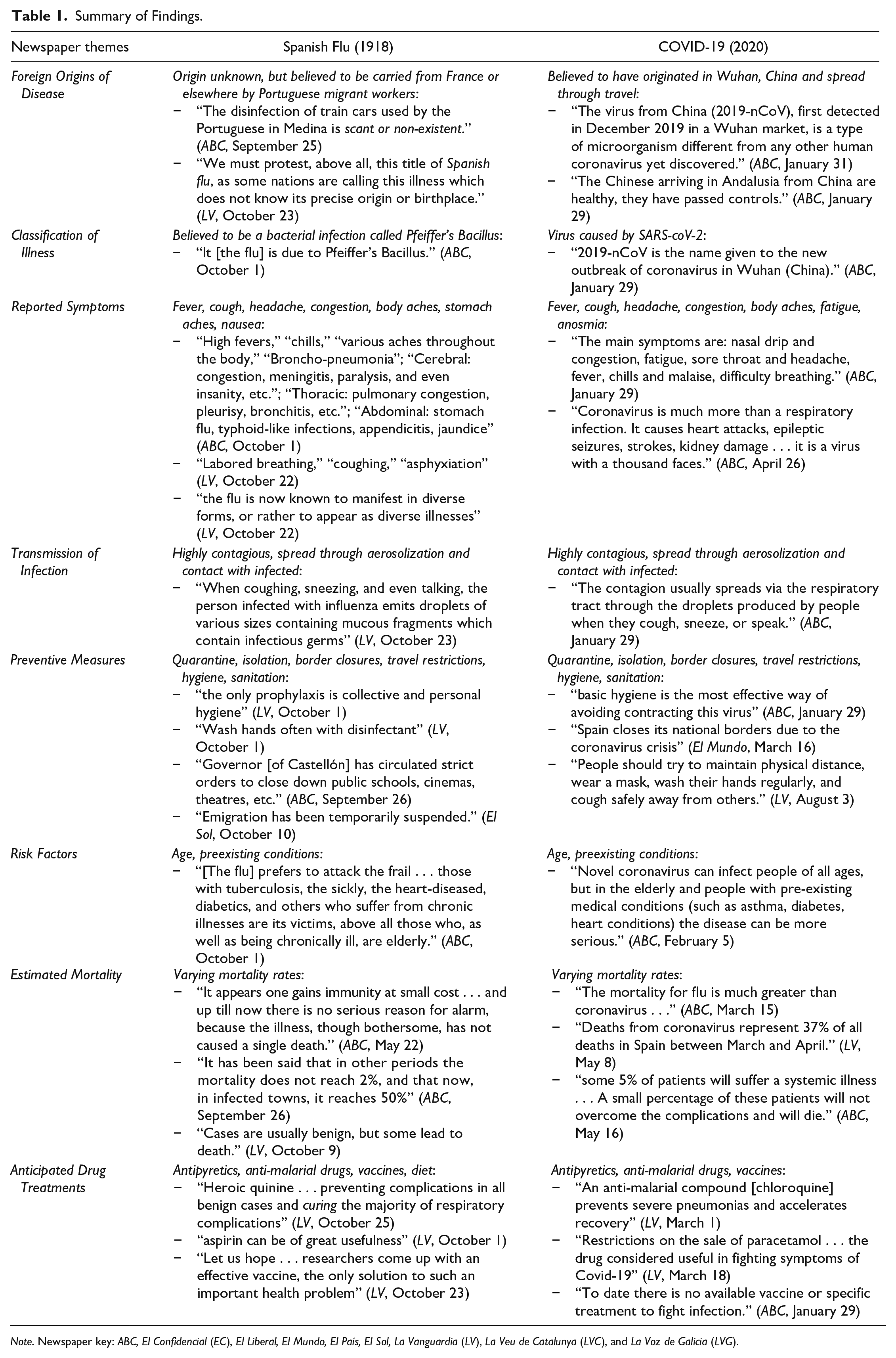
Note. Newspaper key: ABC, El Confidencial (EC), El Liberal, El Mundo, El País, El Sol, La Vanguardia (LV), La Veu de Catalunya (LVC), and La Voz de Galicia (LVG).
Despite this century of differences, the news framing of both disasters reveals a pattern in human reactions to contagion and the interrelated psychosocial epidemics they elicit. A study of their respective news coverages demonstrates that public (mis)perceptions of epidemiologic risks are as fundamental to the course of the pandemic as the infectious agent itself, as social behavior influences government policy and shapes collective responses to them. As Hutchinson (2019) argued,
Numerous social, political, economic, and ecological influences guide the possibility and the path of infection . . . In order to understand the influence of disease on human populations, we must understand the conditions under which infection occurs and endangers health. (p. xviii)
In the Spanish context, political fragility and economic crisis stifled early alarms. Parliamentary instability, critical subsistence shortages, and the ongoing uncertainty of World War I combined to hinder the response to pandemic influenza in 1918 while shifting party alliances and economic anxieties did the same in 2020. As strikes and riots erupted in the early 20th century from starvation, poor working conditions, stunted modernization programs, and a strong push for autonomy in Catalonia, deadlock formed among the already polarized factions of government. Headed by an assortment of military generals, liberals, monarchists, and church officials from opposing parties, they continuously failed to reach an agreement. In the case of Spanish flu, Davis (2013, p. 22) observed the use of the tale of two Spains trope, identified in 1918 as the mission to transform the current “epidemic Spain” into a “sanitary Spain.” Spaniards at the time proposed a kind of “health dictatorship” to cure the ills of a degraded national infrastructure (“La salud pública en España,” 1918a). A similar notion exists today with Spanish newspapers blaming an underfunded public health service and government ineptitude as Spain suffers one of the worst infection rates in Europe (“The Guardian’ critica,” 2020; “La epidemia deja a la vista,” 2020; C. López, 2020a). PSOE’s Pedro Sánchez and his allies have been heavily criticized for their handling of the coronavirus pandemic over the country’s comparatively high death rate, rise in unemployment, continued demonstrations for Catalan independence, draconian lockdowns, and political scandals involving fraud and party nepotism. It has since been revealed that in 2020 Spain recorded its highest number of fatalities since the Spanish Civil War (Sánchez Hidalgo, 2021).
Researchers, politicians, and newspapers have frequently made reference to the apparent similarities between Spanish flu and novel coronavirus since March 2020, when WHO officially declared the COVID-19 pandemic. Debates persist as to the impact and efficacy of measures, medications, health care systems, and mortality rates of the two eras. Perhaps the most notable characteristic shared by the news coverage of 1918 and 2020 is the initial reporting that diseases like coronavirus and flu are “benign” because of their relatively low mortality rates. A matter we continue to overlook is that of contagion: These viruses are so infectious that they spread with extraordinary rapidity, causing explosive outbreaks that are impossible to control if not immediately locked down. In the case of COVID-19, complications and hospitalizations of “just” 1% to 3% of the infected population can overwhelm health care systems internationally and cause massive death tolls. The precise mortality rate for Spanish flu is unknown but is estimated at anywhere from 2.5% to 7% (Porras Gallo, 1997; Taubenberger & Morens, 2006). Moreover, we still do not understand the extent of the damage resulting from these viruses in the form of chronic health conditions affecting the heart, lung, kidneys, and central nervous system, which have been documented in COVID-19. It is impossible to surmise such occurrences in 1918, but subsequent flu epidemics have proven equally variable.
Both pandemics brought to the forefront Europe’s long-standing prejudices against Spain as backward and unreliable. The Dutch finance minister was not alone in his accusation that Spain was unable to cope with its 2020 coronavirus outbreak, thereby endangering the rest of the European Union. Spain’s press coverage reflects continued sensitivity to this charge, especially as it is again blamed for a deadly virus it did not create. Spanish officials responded to this development at home and abroad, in part, by minimizing accountability for their delayed response and magnifying the role of foreign groups, namely, the Italians and the Chinese, in its spread. While the newspapers condemned government inaction, they also continued to highlight the non-Spanish origin of the virus via detailed reporting on China’s suppression of its emergence in 2019. Only when the seriousness of the virus became popular knowledge with the daily reporting of thousands of infected and mounting deaths, did newspaper coverage shift from cautiously downplaying the epidemic to charges of criminal government neglect. In this way, news framing is not a one-way process, but a reciprocal relationship between news media and their readership as both are influenced by the social, political, and ecological contexts they inhabit. Public perceptions are partly informed by news framing, as newspapers are, in turn, shaped by their consumers’ ideologies and concerns. In communicating pandemics, newspapers simultaneously facilitate and reflect contemporary public opinion of infectious diseases which, despite major technological and medical advances, has remained strikingly similar over the past 100 years. Indeed, the novel coronavirus pandemic of 2020 has exposed many of the same failures apparent in the pandemic of 1918 as newspapers expose the same deficiencies in facing the present crisis.
Footnotes
Declaration of Conflicting Interests
The author(s) declared no potential conflicts of interest with respect to the research, authorship, and/or publication of this article.
Funding
The author(s) received no financial support for the research, authorship, and/or publication of this article.