




Abstract
This article contributes to the study of legitimate authority and symbolic power in the media field by analyzing what I call the “validation repertoires” of audiences, that is, the various ways individuals combine in a single set of beliefs separate judgments of how valid or worthwhile they regard the opinions of a media worker with a specific institutionalized background. The empirical analysis focuses on cultural mediators and has three aspects: (a) mapping repertoires via latent class analysis, (b) explaining adherence to repertoires by links to positions in the field, and (c) predicting how repertoires affect the concrete use of recommendation systems. The results show that, currently, validation repertoires are mainly organized according to the degree of validation, not the degree of institutionalization; the validation of mediators appears to be multifaceted, influenced by cultural and media-related resources and generalized institutional trust; and repertoires have an impact on choice behavior.
Keywords
Introduction
The “symbolic power” of media—broadly defined as the way the media are able to shape and influence social realities by agenda-setting, legitimizing viewpoints, and accentuating cultural norms—has been an ongoing topic of research and debate in recent decades (Benson, 1999, 2006; Couldry, 2003; Thompson, 1995). How information and knowledge is produced and legitimated through media is often perceived as being contingent on wider economic and cultural forces that affect the making of media content. Previous studies, however, have mainly focused on the production side (e.g., Benson & Neveu, 2005; Carlson, 2017; Gitlin, 1980; McChesney, 2003; Schudson, 1978). And while there is a huge literature on how audiences perceive the credibility of media content (e.g., Metzger et al., 2010; Tandoc, 2018), that research is more specifically concerned with trust in whether media do their particular tasks adequately (Pingree et al., 2013). Yet, the focus on media credibility (and adjacent concepts such as gatekeeper trust) leaves mostly unattended the symbolic and social aspects of legitimate authority (Carlson, 2017).
This article contributes to the study of legitimate authority of media workers in the digital age by examining the patterns of how media workers of various status are valued by audiences. It builds on three insights from (media) field theory, organizational theory, and studies on user-generated content (UGC) and media repertoires. First, symbolic power depends on audiences whose “beliefs” are required for any legitimacy claim, particularly those that rely on expertise (Bourdieu, 1993; Vos et al., 2019). Audiences can thus be conceptualized as “legitimating agents” and the process of accepting the legitimate authority of experts as a form of “validation” (Johnson et al., 2006; see also Jucks & Thon, 2017). Second, there is a social congruence between audiences and media outlets: individuals who have similar social status tend to resemble one another in lifestyle patterns and resources (e.g., cultural capital), yet differ from other social groups. Even in the digital age there are large differences between social classes in which media they use and how they value styles of news reporting (Lindell, 2018). Third, digitalization has spurred an increase in media outlets, many of which rely on UGC and lack authority and symbolic capital in the traditional sense (Siapera & Spyridou, 2012). Recognizing this new media ecology, scholars have started to analyze how various types of media (e.g., legacy media and blogs) are patterned into single individual configurations (media repertoires) and showed that a large portion of media users mix media of various institutional standings (Edgerly et al., 2018; Webster, 2014).
These premises inform riveting the attention on audience perceptions. More specifically, the article examines the “validation repertoires” of audiences, that is, the various ways they show recognition or affirmation that an individual or his or her opinions are valid or worthwhile. Whereas research into opinion leaders and electronic Word-of-Mouth (eWOM) generally emphasizes production or consultation of evaluations (or other types of information) on products or services (e.g., Hu & Ha, 2015), the concept of validation repertoires contributes to this work by (a) focusing on how evaluations of others are received, (b) incorporating the symbolic value of the source, and (c) considering the patterns when various sources are used. The empirical analysis is threefold: mapping repertoires, examining which social background characteristics predict adherence to these repertoires, and analyzing to which degree repertoires, in turn, serve as predictors for specific forms of recommendation in purchase decisions.
The focus is on one specific case of media workers, that is, cultural mediators involved in gate-keeping and evaluating cultural goods in the media, such as cultural journalists, media personalities, and also by less institutionalized critics who publish on websites (e.g., Debenedetti, 2006; Janssen & Verboord, 2015; Kristensen & From, 2015). These cultural mediators represent a relevant case for studying the process of validation, as they produce recommendations of cultural goods 1 that can be purchased by audiences, and as such are quintessential when it comes to the idea of “symbolic production” (Bourdieu, 1993; Debenedetti, 2006). The study uses representative survey data on Dutch individuals, but is nevertheless explorative in that not the full array of the field is covered. The core analysis concerns mediators for books and music; two genres which traditionally receive large media coverage, yet also contain notable differentiation in symbolic value. Furthermore, the cultural mediators studied are not exhaustive, but represent different degrees of institutionalization, and concern persons who can recommend products (e.g., in a review). Only in the last part of the analysis cultural mediators are compared with other types of quality cue that audiences may use as recommendation.
Media Audiences, Cultural Mediators, and Validation Mechanisms
Bourdieu’s field theory has been influential in the analysis of legitimation both in the domains of journalism and cultural production (Lowrey & Sherill, 2019; Siapera & Spyridou, 2012). The journalistic field is often perceived as being part of a wider field of cultural production, which can be defined as the institutional setting in which agents (consumers, producers, critics, etc.) and cultural capital interact in pursuit of preferred decision-making criteria (for what constitutes news, art, knowledge, etc.) and desirable social positions (Benson, 1999, 2006; Powers & Zambrano, 2016). Legitimation of the cultural content—knowledge, information, taste expressions—that is valuable or important (in other words, legitimate) has traditionally been linked to these having the “appropriate” cultural capital, and being able to acquire dominant positions in the field (Baumann, 2007; Bourdieu, 1984). Particularly journalists in the specialized beat of cultural journalism—a specific type of cultural mediator—are pushed to standards set by ancillary institutions such as academic criticism and award organizations (Hovden & Knapskog, 2015) which, in turn, need to consider what is valued among their constituency.
From a field-theoretical perspective, change is often explained by “disruption from the environment” (Lowrey & Sherill, 2019, p. 13): new entrants who try to overtake the establishment through innovation that is actually perceived by other agents in the field as a salient innovation. Legitimation is thus a social and dynamic process, since institutional agents rely heavily on having an audience that accepts their selections and evaluations, or in other words puts “belief” in them (Bourdieu, 1993; Verboord, 2010; Vos et al., 2019). Two of the key ingredients of the acceptance of widespread consensual beliefs—found in both social psychological and organizational studies—are diffusion and validation (Johnson et al., 2006). New cultural schemas or beliefs are first accepted among a limited group to meet local needs. They are then adopted in other contexts and, finally, if enough actors believe that the innovation is acceptable, it becomes generally validated. This mechanism fits with institutional approaches to cultural production that emphasize routinized “ways of doing” and “taken for granted” practices within organizations (see also studies of news production, for example, Gans, 1979/2004).
The relational nature of legitimate authority makes it imperative to further study how audiences contribute to this process. Tracking manifestations of legitimated culture in society is one, albeit limited, approach. Audience studies of cultural taste evince the rise of cultural omnivorousness in the past decades: combining cultural items of various degrees of legitimacy in one taste repertoire appears to have become more common (Peterson & Kern, 1996). There is debate, however, on whether this implies shifting beliefs with regards to which objects are culturally legitimate (e.g., no more snobbery), or rather a token of aesthetic adaptation in a field that remains very much the same (Lizardo & Skyles, 2012). Part of the problem is the neglecting of mediators who help diffusing beliefs.
More media-centered audience studies can be loosely distinguished in three—interrelated—perspectives. First, research on media trust and credibility highlights how individuals in an online environment often rely on heuristics, social information pooling, and (still) reputation to assess credibility (Metzger et al., 2010), and, at the societal level, that trust in media and other institutions tends to decrease in more prosperous and democratic societies (Tsfati & Ariely, 2014). For the purpose of this study, these works have the disadvantage that the institutional embedding of media remains largely out of sight (Carlson, 2017). Second, research into media repertoires emphasizes behavior rather than perception, but illustrates how audiences routinely combine media outlets of various institutional standing and ideological positioning (Diehl et al., 2019; Edgerly et al., 2018; Webster, 2014). The notion of “repertoires” thus accords with shifting beliefs regarding legitimacy, and could be applied to the study of validation.
A third perspective focuses on the increasing agency of audiences in the digital age. Particularly the rise of UGC, enabling lay persons to become mediators themselves, has been crucial for the cultural field. Existing monopolies of legacy media have been broken down (Kristensen & From, 2015) and this has been followed by the dominance of online platforms where audiences flock together to exchange both selections from institutionalized media and UGC. Yet, although social media have become important information channels in the broader journalistic sense (Nechushtai, 2018), in the cultural field mediators often still seek out formats that resemble traditional ways of expression; for example, cultural websites (e.g., Pitchfork and Popmatters) or platforms on which lay users can post reviews (e.g., GoodReads and IMDb) (Beaudouin & Pasquier, 2016). In addition, content distribution platforms such as Amazon, YouTube, and Netflix not only offer content, but also new recommendation systems based on user comments, ratings, likes, and algorithms (Smith & Telang, 2016). While these developments suggest a power shift in the field of cultural production (Dolbec & Fischer, 2015), reputations of individual mediators and status markers continue to play a role in online fields (Levina & Arriaga, 2014; Verboord, 2014). Validation, however, has not often been addressed in these online environments with the exception of Jucks and Thon (2017) who—in the context of health expertise—specify social validation as seeking opinions of other people through online cues.
Given these considerations I pose the following research question:
Explaining Validation Repertoires and Their Application
How belief in evaluations among media audiences is created at the individual level remains relatively unclear. In Bourdieu’s original account, strong emphasis is placed on the homology between the mediators’ position in the field and their recipients’ position within the larger social space. Still, as argued in the previous section, mediators are connected to (at least) three sources of status: (a) the media outlets or platforms they belong to representing different degrees of institutionalization (e.g., newspaper vs. blog), (b) the ancillary organizations in the cultural field which influence what is viewed as culturally worthy (e.g., what types of books or music receive awards?), and thus what mediators evaluate, and (c) the more generalized attitude toward institutional expertise within society, regardless of what content or form of mediation is at stake.
Validation repertoires can be shaped by how audiences view the position of mediators themselves. Given the considerations outlined before, two aspects seem important here: on one hand, the degree to which traditional ideas about journalistic authority are recognized (e.g., importance of hard news and exemplifying the core values of legacy media) (Boczkowski, 2009), and on the other hand, the degree to which affordances of new media are incorporated into individuals’ mind sets. Acknowledgment of traditional journalistic authority ties in with the idea of hierarchy (Shoemaker & Reese, 2014), for example, a critic of the New York Times is esteemed based on the connection to this outlet which is considered knowledgeable and prestigious. Media users tend to seek out the media outlets they consult based on various attributes that ultimately reflect congruent ideas on the quality of information (e.g., Webster, 2014). At the same time, the rise of digital media has brought alternative voices to the process of symbolic production, including new types of professional mediators (e.g., critic on Pitchfork) as well as amateurs reviewing on open platforms (e.g., on Metacritic or Amazon). This may generate new affordances among audiences (Sundar & Limperos, 2013). Hard news interest is perhaps replaced by a broader range of news interests. Mixing various types of sources not only implies adding alternatives to assessing evaluation based on traditional credentials (e.g., through “believability”) (Hennig-Thurau & Walsh, 2004), but, in leveraging contrasting viewpoints, sees the diversity of opinions as an asset (King et al., 2014). Despite the theoretical emphasis on deeply embedded values (about culture, news, etc.), less hierarchical repertoires may also follow from more situational decision-making practices. Preference for consulting user-generated information, such as consumer reviews, can also results from the will to minimize temporal and/or financial costs (Parikh et al., 2014).
Second, validation repertoires can be shaped by cultural capital: content-specific resources and dispositions that signal whether audience members search for mediated opinions that reflect their own taste patterns (Prieur & Savage, 2011; Van Eijck & Van Rees, 2000). Bourdieu’s field theory predicts a high correlation between the dispositions of mediators and their audiences, as both are organized around the distribution of cultural and economic capital. At the same time, the rise of cultural omnivorousness (see previous section) implies that cultural capital has perhaps become less important. As validation also concerns consensual beliefs, it can be argued that if someone does not believe in value differences in certain content, he or she may also not believe in the mediators associated with this hierarchy. In other words, individuals with more negative attitudes toward cultural hierarchies may adhere to validation repertoires containing less hierarchical items.
Finally, validation repertoires may be formed under pressure from broader societal developments. Given the extensive literature on decreasing trust in various forms of institutional authority (e.g., Ladd, 2012), audience members perhaps have a generalized attitude toward institutional expertise, regardless of what content or form of mediation is at stake. It thus seems pivotal to analyze how trust in media and other institutions affects the shaping of repertoires (cf. Tsfati & Ariely, 2014). Given the inductive nature of the analysis of repertoires, I formulate the following research question:
In the final part of the analysis, it is examined whether and how specific repertoires are put into action. That is, I assess whether adherence to repertoires is associated with reported uses of selected sources of recommendation when purchasing cultural goods. Decision-making in consumer markets—also in cultural markets—is increasingly influenced by eWOM, a specific type of UGC which can be described as the evaluations that consumers share online with other lay users (Basuroy et al., 2020). Despite the claim that peer reviews offer the advantage of disinterestedness, and taking a nonelitist perspective (Hennig-Thurau & Walsh, 2004; see also previous section), comparisons between consumer and institutionalized cultural critics yield inconsistent results (Basuroy et al., 2020; Tsao, 2014). Decision-making has not often been studied in relation to repertoires of how mediators are assessed or valued (but see Hu & Ha, 2015).
eWOM studies have distinguished between evaluations or recommendations by individual mediators, and more anonymous aggregated average ratings (echoing the notions of social information pooling and social validation, discussed earlier). Therefore, variety is sought here regarding recommendation types: mediators as discussed earlier (newspaper reviewers, online reviewers, and lay users) are compared with alternative quality cues, ranging from traditional ones with high legitimacy (wining an award) and low legitimacy (hit parades) to more algorithmic-based forms of evaluation (aggregated ratings and personalized recommendations based on previous online behavior, see also Smith & Telang, 2016).
Note that in this third part the focus is extended to cultural products in general (thus not only books and music) for two reasons. Because the study is aimed at the general population and not just music and book consumers, the goal is how audiences in general employ different types of recommendations for cultural decision-making. Furthermore, there is only a relatively small group of people using such recommendations, implying that further specification would lead to a highly skewed distribution.
Method
Research Setting and Data Collection
The study is conducted in the Netherlands, which, compared with other European countries, has relatively high levels of both online and offline media usage: in 2016 they rank third, first, and third among European Union (EU) countries in reading the written press, using the internet, and using online social networks, respectively (European Commission, 2016). There is also demand for culture: book reading and concert-going lie far above the EU average (respectively 86% and 51% of citizens participate at least once a year) (European Commission, 2013). Being a frontrunner on all relevant activities, makes the Netherlands a relevant case to study how repertoires are shaped.
In May and June 2015, an online survey was conducted involving 858 individuals in the Netherlands. The survey was part of the Longitudinal Internet Studies for the Social Studies (LISS) panel of the research agency, CenterData. This online panel is based on a true probability sample of households drawn from the population register by Statistics Netherlands and can be considered representative for the Dutch population also because individuals without computer or internet are facilitated to participate (https://www.lissdata.nl/lissdata/). 1,095 persons from the panel were invited to participate, implying that the response rate was 78.4%. Of the 858 respondents, 10 persons did not fill out the complete survey.
Dependent Variables
We asked the following question to assess how individuals value cultural mediators of various degrees of institutional embeddedness: “There are several types of people who could recommend a particular book. How much value would you attribute to a recommendation when one of the following recommends a book to you?” The same question was asked for music. The respondents answered these questions for both more institutionalized mediators (reviewer in a quality newspaper, 2 member of a jury for a literary award [books only], literature professor [books only], and reviewer in a music magazine [music only]) and three less institutionalized mediators (reviewer on a book [music] website, another reader [listener] who gives his or her opinion online, and someone on a TV talk show). 3
The categories were selected based upon their importance according to previous studies (Debenedetti, 2006; Verboord, 2010). Note that these categories differ slightly between the genres, due to differences between the fields. Initially, the respondents could answer using a 5-point scale (1 = no value, 2 = hardly any value, 3 = a little bit of value, 4 = quite a lot of value, and 5 = a lot of value), but Categories 2 and 3 and Categories 4 and 5 were combined for the cluster analyses (see below) to prevent the model fit from dropping dramatically due to the sparsity of the data. More pragmatically, Category 5 was not used by many respondents (19 persons).
Independent Variables for the Explanatory Analysis
Media-related resources
The extent to which respondents acknowledge the authority of newspapers was measured via the following statement “Newspaper employees have more authority than bloggers” on a 5-point scale from 0 (strongly disagree) to 4 (strongly agree) (M = 2.07, SD = 0.89).
Regarding news interests, respondents were asked how important it was for them to kept being informed on 11 topics (e.g., traveling, fashion, and science), with response categories ranging from 0 (very unimportant) to 4 (very important). A factor analysis (available upon request) showed that one category could be distinguished as the importance of hard news. This factor contained the items: political backgrounds, foreign news, and the economy. The reliability was good (Cronbach’s α = .823, M = 2.35, SD = 0.79) and the variable was rescaled between 0 and 10. To measure the diversity of news interests, the number of items that respondents considered important or very important was counted. The sum of this count constitutes the variable diversity of news interests (M = 3.87, SD = 2.43).
Perceived affordances of the internet were measured via statements that asked to what degree the respondents saw the (a) advantages and disadvantages of internet usage in terms of the speed of finding information, (b) the ease of finding information and buying products, (c) the reliability of information, (d) the (low) cost of finding products, and (e) the diversity of information and products. I consulted previous indicators (Hennig-Thurau & Walsh, 2004; Morse et al., 2011), but adapted and updated the final statements to take into account the current research context of news consumption and cultural products. The answer categories ranged from 0 (strongly disagree) to 4 (strongly agree).
A factor analysis (with oblimin rotation) 4 showed that convenience was the first factor to emerge (eigenvalue = 4.609; explained variance = 20.95%). Five items loaded higher than 0.50 on this dimension and were averaged and rescaled between 0 and 10 (Cronbach’s α = .782, M = 4.90, SD = 1.87). An exemplary item is: “I am much better up to date on the news via social media and blogs than via traditional media.” The fourth factor that emerged was the importance of diversity. 5 Here, three variables had factor loadings higher than 0.50. An exemplary item is: “The big advantage of the internet is that you can compare many opinions on products.” I calculated the mean score of these items and rescaled them between 0 and 10 (Cronbach’s α = .743, M = 6.08, SD = 1.62).
Cultural resources
Cultural capital was measured by combining information on a range of highbrow cultural activities in line with previous research on cultural capital (DiMaggio & Mukhtar, 2004; Kraaykamp & Van Eijck, 2010). Seven items were used: visiting theater plays, dance performances, cabaret performances, art museums and galleries; and watching art house films, domestic quality TV drama, foreign quality TV drama (items on music and books were not used). Examples of films and TV series were provided (e.g., Grand Budapest Hotel and Breaking Bad). The answer categories all ranged from 0 to 4. I calculated the average score and rescaled it between 0 and 10 (Cronbach’s α = .725; M = 4.78; SD = 2.01).
The degree to which respondents acknowledge the idea of a cultural hierarchy was determined by two items based on the work of Van den Haak (2014): “Some cultural expressions are more valuable than others” and “Even if tastes differ, one can make a distinction between culture with a lot of value versus culture of little value.” These items were on a scale ranging from 0 (strongly disagree) to 4 (strongly agree). I calculated the average score (Cronbach’s α = .769, M = 2.53, SD = 0.70).
General resources
Institutional trust was measured by asking of seven institutions, three of which are media-related, how much trust the respondents have in them on a scale from 0 (no trust) to 3 (lot of trust). This question was adapted from Tsfati and Ariely (2014). The institutions were written press, radio, television, political parties, government, health system, and science. The mean score was calculated and then rescaled between 0 and 10 (Cronbach’s α = .811, M = 4.76, SD = 1.52).
Control variables
Various control variables are taken into account. First of all, participation in book reading (for all analyses on book mediators), respectively music listening (for all analyses on music mediators) are included. Both are dummy variables. Second, the analyses take into account the usage of print media, television and internet for information purposes, to ensure that attitudes cannot be attributed to specific usages. Finally, the analyses control for demographic variables as possible confounding factors. Age was measured in absolute years; sex was coded as male = 0 and female = 1; and educational level was measured as the highest attained level coded in the six categories distinguished by the Dutch Central Statistics Bureau (1 = primary education to 6 = university).
Variables on Decision-Making
All respondents were also asked how often in the past 12 months their choice for a particular cultural product (including buying, downloading of a product, visiting a film, show or exhibition) was influenced by seven types of recommendations or other types of mediated quality cues: (a) positive review by newspaper critic, (b) positive review by other internet users, (c) recommendation by someone in a TV talk show, (d) personalized recommendation on a webstore, (e) having won an award or prize, (f) listing in a hit parade or chart, and (g) high rating or score by other internet users. The answer categories ranged from 0 (never) to 3 (more than 5 times).
Analytical Strategy for Mapping Validation Repertoires
I used a latent class analysis (LCA) to determine whether broader patterns could be distinguished among the 11 items that measured the value that individuals attribute to mediators. More generally, LCA is a statistical technique that enables researchers to find underlying dimensions in a larger set of manifest variables. In contrast to other statistical techniques that aim for dimension reduction, such as factor analysis, LCA allows for attributing cases to one particular class (in a probabilistic way). Thus, based upon the overall patterns in how answers to questions (variables) are distributed among individuals, the technique estimates (a) which concrete groups of patterns (clusters or classes) can be distinguished, (b) the degree to which variables contribute to these clusters, and (c) in which clusters individuals are most likely to fall based upon their individual patterns (Magidson & Vermunt, 2004). Also, unlike a factor analysis, an LCA does not presuppose a linear relationship, but is able to discern groups of people who, for instance, combine moderately positive (but not negative or very positive) evaluations on one item, and very positive evaluations on another. Consequently, the LCA approach seems to be particularly well suited to answering the first research question.
The LCA was conducted using the cluster option in LatentGold 5.1. In line with the theory described earlier, validation repertoires are considered to be less hierarchical if (a) appreciation is mainly expressed for less institutionalized mediators or (b) the appreciation of mediators with a dissimilar institutional status is combined in single repertoires. For the second part of the analysis the Step3 procedure in LatentGold is used to adequately estimate how clusters are predicted by covariates (Vermunt & Magidson, 2016). Then, for the third part, a distal outcome analysis with control variables is conducted. This specific function within an LCA is equivalent to a regression analysis, but, once again, corrects for the classification error to prevent bias.
Results
Mapping the Validation Repertoires Using LCA
The variables included in the LCA models each had three response categories, resulting in relatively “sparse data.” Assessing model fit where there is sparse data often involves inspecting information criteria that weigh both the fit and the parsimony of the estimated models (Bayesian information criterion [BIC] and Akaike Information Criterion [AIC]) and considering the interpretability of the results (Magidson & Vermunt, 2004). The six cluster solution had the lowest BIC scores for both cluster analyses (for books: 7,238.1630, with L2 = 634.865, df = 681, Npar = 47, p = .90; and for music: 5,696.4345, with L2 = 304.629, df = 202, Npar = 40, p = 4.0e−6).
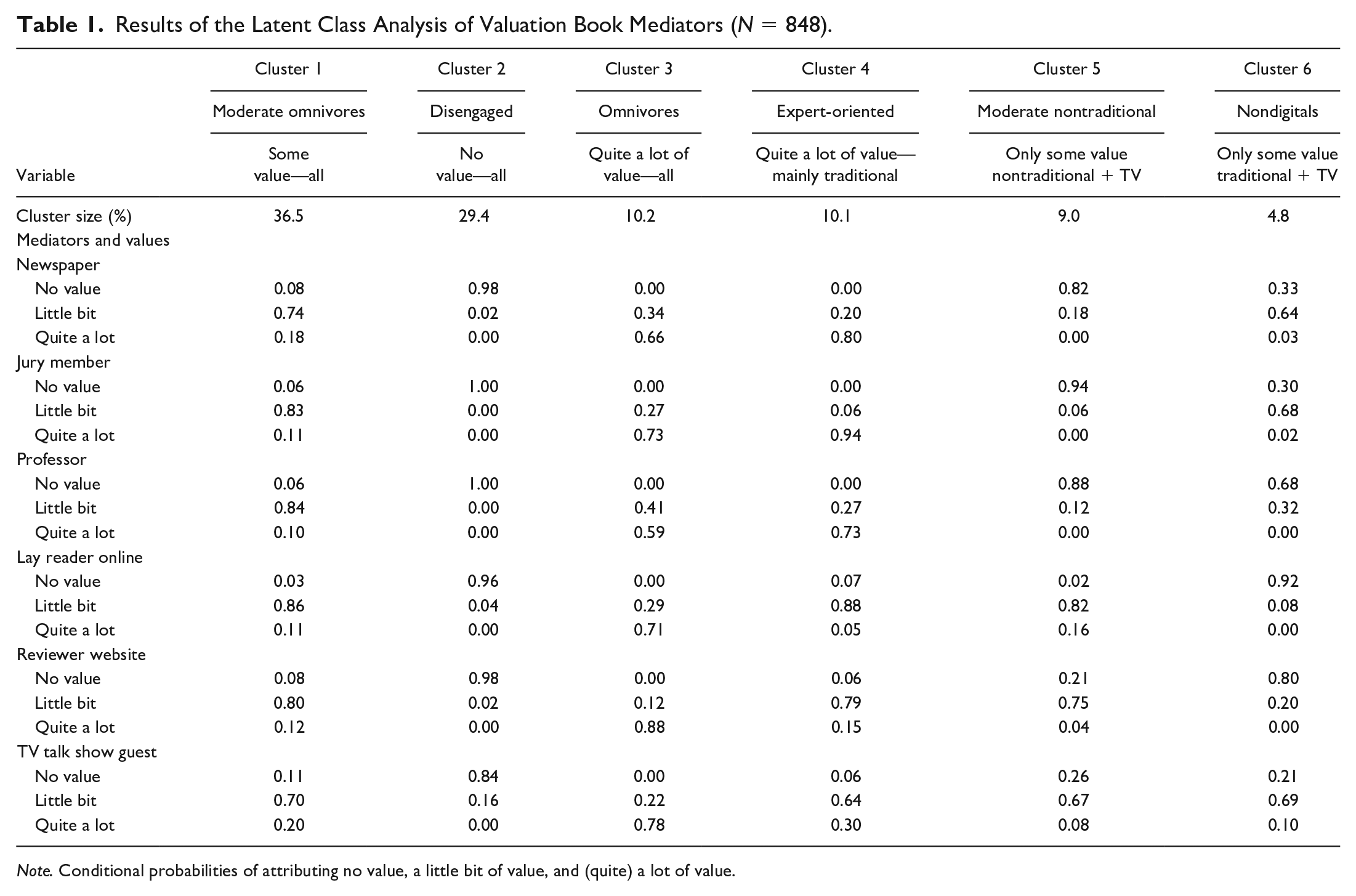
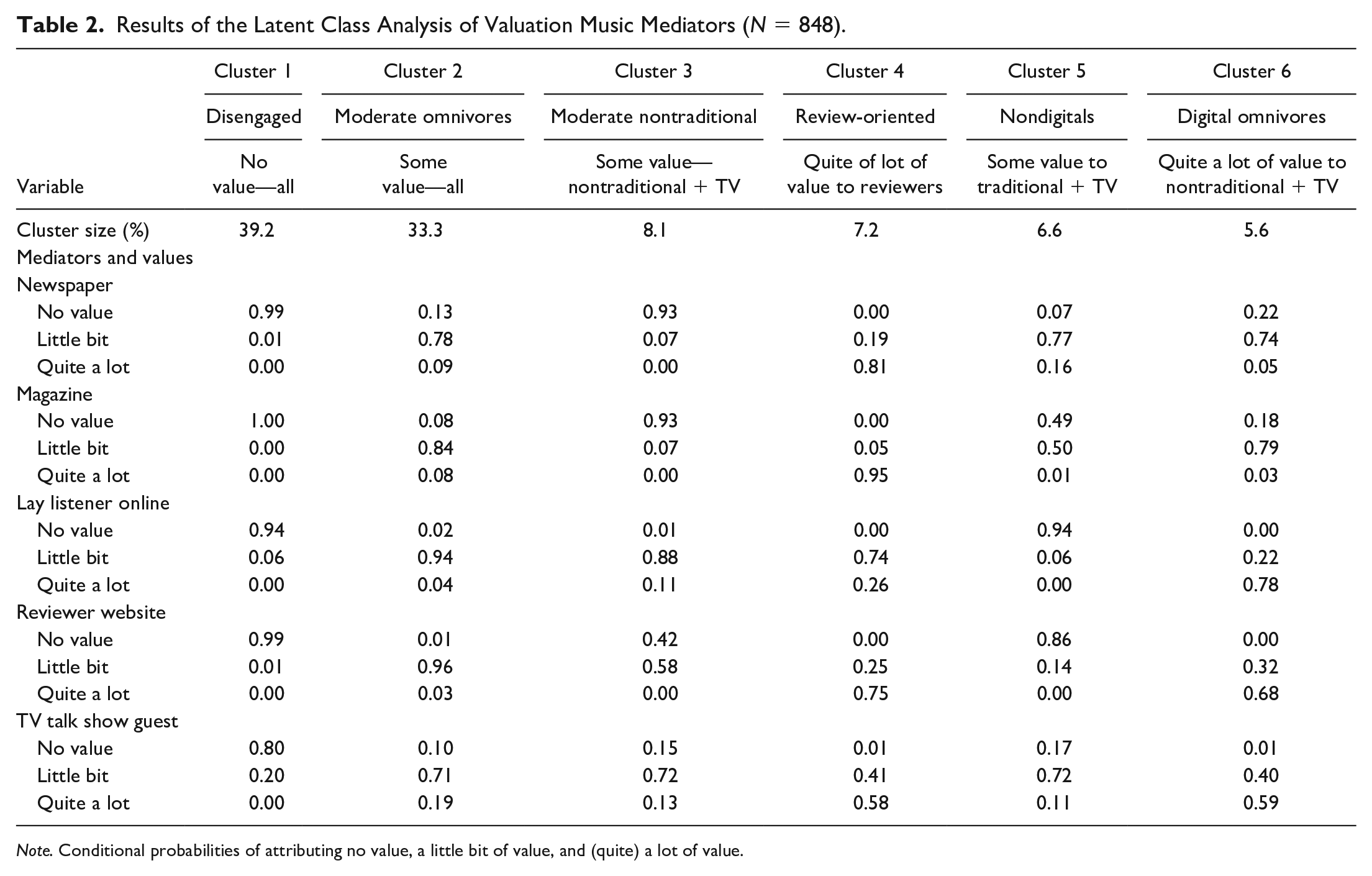
The first research question addressed which validation repertoires can be distinguished in the domains of books and music, and to what extent they show hierarchical patterns. Tables 1 and 2 show the results of the LCA for the book mediators and music mediators, respectively. For both domains, six classes—and thus repertoires—can be distinguished.
Results of the Latent Class Analysis of Valuation Book Mediators (N = 848).
Note. Conditional probabilities of attributing no value, a little bit of value, and (quite) a lot of value.
Results of the Latent Class Analysis of Valuation Music Mediators (N = 848).
Note. Conditional probabilities of attributing no value, a little bit of value, and (quite) a lot of value.
For book mediators, the three largest clusters (repertoires) do not disclose clear hierarchical patterns. Moderate omnivores (Cluster 1, 36.5%) predominantly attribute “a little bit of value” to all items, disengaged (Cluster 2, 29.4%) attribute mostly “no value,” and omnivores (Cluster 3, 10.2%) tend to attribute “quite a lot of value” across the board. Only the smaller clusters (together comprising 24%) combine different evaluations of cultural mediators into single repertoires. Some mainly appreciate traditional institutionalized mediators (expert-oriented: Cluster 4, 10.1%), others do not value these at all (moderate nontraditional: Cluster 5, 9.0%) or do not value mediators in the digital realm (nondigitals: Cluster 6, 4.8%).
For music mediators, a similar pattern emerges. Here, the first two clusters—representing 72% of the respondents—do not distinguish between types of mediators. The group of disengaged is the largest cluster (Cluster 1, 39.2%), followed by moderate omnivores (Cluster 2, 33.3%). Again, the former attribute mostly “no value” to all items, whereas the latter mostly attribute “a little bit of value” to all items. The other clusters resemble those of the book mediators, as we again find individuals valuing traditional mediators (review-oriented: Cluster 4, 7.2%) and not valuing them (moderate nontraditional: Cluster 3, 8.1%). There is also a cluster of nondigitals (Cluster 5, 6.6%), and, more digitally oriented than the omnivores of book mediators, a cluster of digital omnivores (Cluster 6, 5.6%).
In sum, these outcomes show that repertoires are mainly organized according to a degree of validation. For book mediators, the first three clusters, representing about three quarters of the sample, categorize people according to their level of engagement, but not according to the mediators’ degree of institutionalization. Only a quarter of our—representative—sample of Dutch media audiences distinguishes across media types. There is a similar pattern when it comes to validating music mediators. More than 70% of our studied sample barely distinguishes between mediators with a different institutional status. Current validation repertoires do not therefore have strong hierarchical trademarks and suggest that the legitimacy of cultural mediators is currently not very high.
Explaining the Adherence to Validation Repertoires
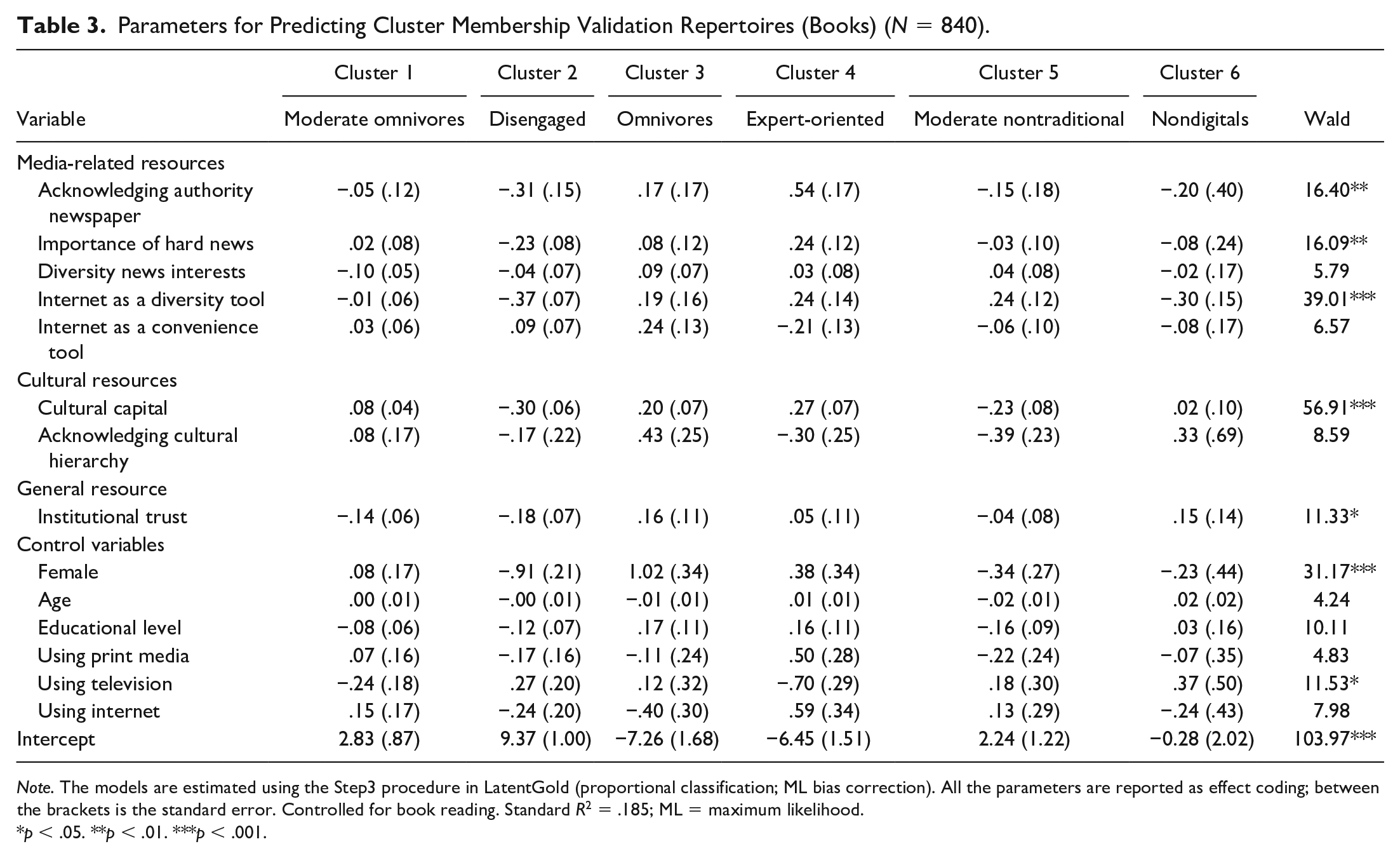
Parameters for Predicting Cluster Membership Validation Repertoires (Books) (N = 840).
Note. The models are estimated using the Step3 procedure in LatentGold (proportional classification; ML bias correction). All the parameters are reported as effect coding; between the brackets is the standard error. Controlled for book reading. Standard R2 = .185; ML = maximum likelihood.
p < .05. **p < .01. ***p < .001.
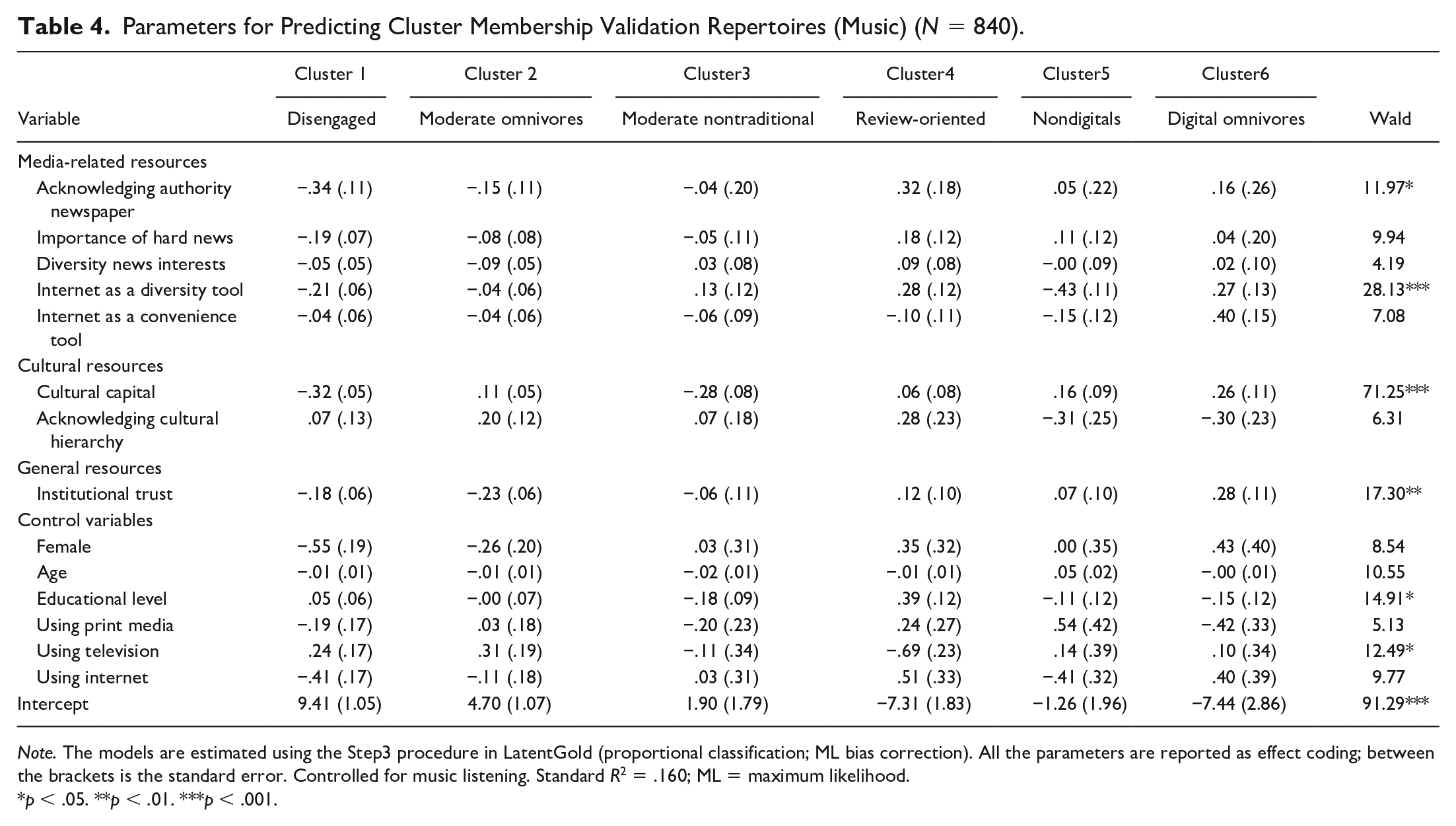
Parameters for Predicting Cluster Membership Validation Repertoires (Music) (N = 840).
Note. The models are estimated using the Step3 procedure in LatentGold (proportional classification; ML bias correction). All the parameters are reported as effect coding; between the brackets is the standard error. Controlled for music listening. Standard R2 = .160; ML = maximum likelihood.
p < .05. **p < .01. ***p < .001.
The results for both types of mediator are very similar and indicate that adherence to validation repertoires is a multilayered process. There are strong effects for media-related resources. For both books and music, individuals who acknowledge the authority of newspaper staff tend to have different validation repertoires: they are more likely to be expert-oriented (books) and review-oriented (music), and are less likely to be disengaged (both). News interests matter for book mediators: the importance of being informed about hard news is positively associated with the expert-oriented cluster.
Internet affordances only matter in terms of perceptions of diversity. Individuals who regard the diversity of online opinions as positive are more likely to be a member of the expert-oriented or moderate nontraditional (books) and review-oriented and digital omnivores (music) classes, and are less likely to be disengaged or nondigital (both books and music). I found no significant differences according to the importance that individuals assign to the convenience of the internet. As a consequence, getting information for free and/or faster than from regular media does not seem to explain why Dutch media users have a certain validation repertoire.
Cultural resources have a strong impact on cluster membership via cultural capital: it increases the chances that someone is omnivorous or expert-oriented (books), but decreases the likelihood that an individual belongs to the disengaged or moderate nontraditional category. For music mediators, digital omnivores also tend to have more cultural capital. There is no evidence that acknowledging a cultural hierarchy affects their adherence to specific repertoires.
The third type of resource—institutional trust—also shapes cluster membership. The more institutional trust individuals have, the less probable it is that they have a disengaged repertoire (both), and the more likely they are to be digital omnivore (music). Finally, no differences between age categories are found—suggesting that existing differences are fully explained by the resources individuals have. Gender differences are only found for book mediators: women are less likely to be disengaged and more likely to be omnivore.
In conclusion, the results suggest that a belief in mediators of various institutional standings is the result of a range of underlying mechanisms. Cultural resources (that signal a taste congruence between audience member and mediator) remain important, but the shaping of validation repertoires is also influenced by how individuals view the role of media in society and by more general conceptions of institutions (institutional trust).
Predicting Outcomes of Repertoires
Distal Outcomes for Usage Recommendations for Book and Music Validation Repertoires (N = 840).
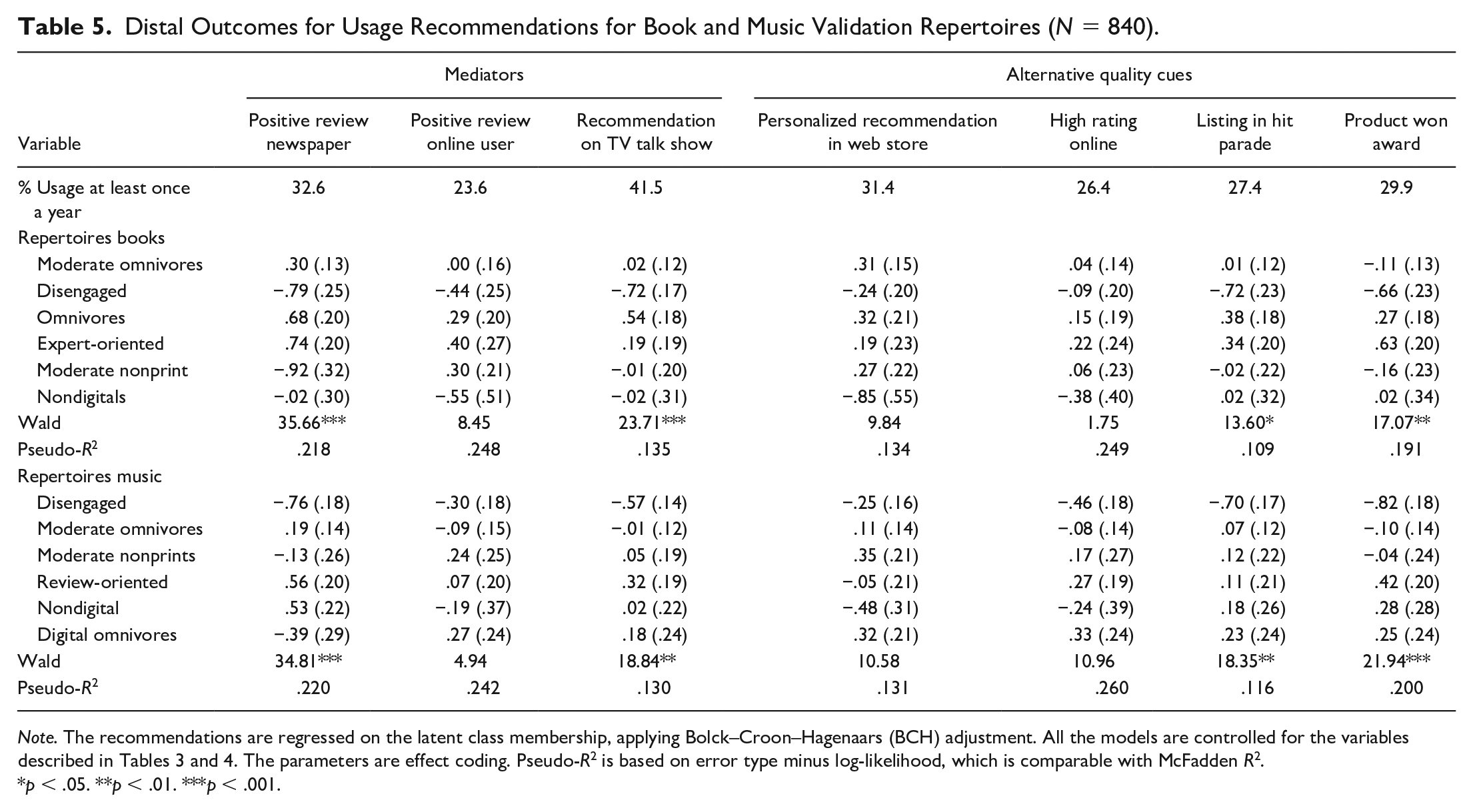
Note. The recommendations are regressed on the latent class membership, applying Bolck–Croon–Hagenaars (BCH) adjustment. All the models are controlled for the variables described in Tables 3 and 4. The parameters are effect coding. Pseudo-R2 is based on error type minus log-likelihood, which is comparable with McFadden R2.
p < .05. **p < .01. ***p < .001.
First of all, the validation repertoires which follow the Bourdieusian hierarchy most closely use the expected decision rules. Belonging to the disengaged class lowers the probability of using most forms of recommendation, but more for the traditional forms than for online ratings and web store suggestions. The most traditional forms of recommendation (newspaper reviews and awards) are associated with repertoires that show most hierarchical overtones (expert-oriented and review-oriented). Second, repertoires that highlight digital sources seem to have limited added value. This also explains why for online formats (high ratings online, positive review by online users, and personalized recommendation in web store), it does not seem to matter which repertoire one has. Finally, individuals who do not make clear hierarchical differences within their repertoire—(moderate) omnivores—tend to rely on various types of recommendations, but this applies more to book readers than music listeners.
Conclusion
This article contributes to the study of legitimate authority and symbolic power in the media field by analyzing how much weight people give to more and less institutionalized media workers. Drawing on survey data from a representative sample of the Dutch population, I have mapped the validation repertoires of general audiences with regard to book reading and music listening. The results show that, relatively, many different repertoires (six per genre) can be distinguished. For book mediators: disengaged, moderate omnivores, omnivores, expert-oriented, moderate nonprint, and nondigitals. For music mediators: disengaged, moderate omnivores, moderate nonprint, review-oriented, nondigitals, and digital omnivores. Importantly, most validation repertoires appear to be about the degree of validation rather than the type of mediator. That is, many individuals value all mediators alike, whether or not it is favorable, a little bit favorable, or quite favorable. Only about 25%–30% of the respondents (still) made distinctions across institutional embeddedness. Not only does this imply that digital media have become an integral part of the media landscape, but also that having an institutional base is becoming less important for the perception that audiences have of media workers.
The second important finding of this study is that the validation of mediators is a multifaceted process, influenced by media-related resources, cultural resources, and generalized institutional trust. This is an important finding for several reasons, adding nuance to the alleged decline of homology between consumers and producers: cultural capital still matters in how audiences perceive media content, as do viewpoints on what is relevant (hard) news (see also Lindell, 2018). At the same time, the effects of institutional trust point to additional, more overarching, explanatory mechanisms, and show how audience-based studies into media trust (Tsfati & Ariely, 2014) can be connected to the analysis of media power. The impact of perceived internet affordances seems to be particularly important, as it signals a positive effect: it is not so much that the use of internet-based media and platforms to more cheaply and/or more quickly collect information had an impact, but rather that there is recognition that a wider variety of opinions and viewpoints is available (Parikh et al., 2014). That these established validation repertoires can actually have an impact on what people say they do was shown in the last part of the analysis. Controlled for all demographic and explanatory variables, various repertoires were significantly associated with the reported use of recommendation systems for concrete choices in cultural purchase.
Some limitations of this study must be noted. First, the study relies on cross-sectional survey data which implies that the full range of how individuals attribute value to mediators may not be found. Second, certain measures relied on a limited number of items. Future research could extend the number and the type of items that measure validation (for instance, by more explicitly distinguishing between different types of newspapers and websites) and study different cultural fields. A relevant step forward would be to analyze in more detail how social media (and other digital platforms) shape validation. Whereas social media platforms arguably increase the presence of lay persons, digital platforms such as Google and Facebook are increasingly involved in publishing and distributing news stories from traditional media (Nechushtai, 2018). One challenge will be how to deal empirically with the intertwining of voices with different status (lay persons and traditional experts) on single platforms. Clearly, follow-up research is needed.
An important question concerns the extent to which the results of this study can be extrapolated to other types of media worker and journalist. One of the advantages of studying cultural mediators is the rich theoretical and empirical tradition of the symbolic production of culture and the role that audiences play through their active appropriation of values. For news media, it remains to be seen whether news values work in similar ways. One can argue that news audiences are not encouraged to purchase products, but news consumption also taps into the beliefs that individuals hold (e.g., Shoemaker & Reese, 2014) and digitalization and marketization also affect the everyday practice of news journalists (Benson, 1999; Deuze, 2007; Lindner & Larson, 2017). Nevertheless, more research is needed to test whether the results of this study also apply to other domains.
In conclusion, the symbolic power of media appears to be shaped in the current media landscape by various types of resource and disposition. Audiences draw on beliefs regarding what is evaluated, what evaluators can or should do, and what counts as authority in a broader sense. Yet, importantly, most media audiences do not distinguish between more or less institutionalized mediators in their validation repertoires, suggesting that digitalization has, to a large extent, functioned as a leveler of status hierarchies in the media field.
Footnotes
Acknowledgements
I thank Bart Bonikowski for his methodological advice on LatentGold, Amanda Brandellero for reading a previous version, and the anonymous reviewers for the helpful and constructive feedback.
Declaration of Conflicting Interests
The author(s) declared no potential conflicts of interest with respect to the research, authorship, and/or publication of this article.
Funding
The author(s) received no financial support for the research, authorship, and/or publication of this article.
