




Abstract
Credible journalism is a vital component of a successful democracy, but enrollment in journalism programs has been declining for years. We surveyed 288 students in 24 different majors from 14 California State University campuses to predict the likelihood of them pursuing a career in journalism. Using regression analysis, for journalism students, social justice concerns were the best predictor, for other majors, perceptions regarding fairness and accuracy of the media were the best predictors. Educators focusing on the contribution journalism makes to social justice and mitigating skepticism about the media are recommended to increase recruitment and retention of journalism majors.
Credible journalism is perhaps the most important component of establishing and maintaining a successful democracy (Fenton, 2010; Gibbs, 2022; McNair, 2008; Sulzberger, 2023). Credible journalism is also essential in reducing inequity and promoting social justice within a democratic society by making citizens aware of injustice when it occurs (Dzur, 2002; Gibbs, 2022; Ryan et al., 1998; Sulzberger, 2023). However, credible journalism cannot exist without honest, devoted, and ethical journalists. As the Washington Post states, “Democracy Dies in Darkness” (Concha, 2017). Yet, in the United States, the profession of principled journalism and journalists themselves have been under a sustained and continued attack that began during the Nixon administration and reached new levels of intensity during the presidency of Donald Trump (Kellner, 2018; Sulzberger, 2019). The attacks continue to this day (Egelhofer, 2023; Meeks, 2022) and may be contributing to distrust in the media and declining interest in the profession of journalism.
In 2022, there were approximately 58,500 employed journalists in the United States (U.S. Bureau of Labor Statistics, 2023b). As journalists retire or leave the profession, they need to be replaced, in many cases, by college graduates. “Newsroom employees are more than twice as likely as other U.S. workers to be college graduates” (Grieco, 2018), and professional journalists “typically need a bachelor’s degree in journalism, communications, or related field” (U.S. Bureau of Labor Statistics, 2023a). This relationship between one’s major and becoming a journalist emphasizes the importance of the college student-to-journalist pipeline.
To estimate the future health of the profession, we looked at enrollment trends in The California State University system (CSU), the largest 4-year public university in the United States (CSU, 2023). The CSU consists of 23 individual campuses throughout the state. In 2007, with 417,000 students in the CSU system (CSU, 2021b), there were 4,322 students enrolled in journalism programs (CSU, 2021a). Two years later, in 2009, there were only 3,756 students enrolled in a journalism program (CSU, 2021a). In 2021, enrollment across the CSU system had increased to 486,000 (CSU, 2021b). Despite this 14% increase in overall enrollment by fall of 2021, enrollment in journalism programs systemwide decreased to 2,460 students, a 43% decline from 2007 (CSU, 2021a).
Given the diversity of its students, the size, and geographic diversity of the CSU system, the trend is significant as it portends a future crisis for the profession of journalism. Recent data from universities across the United States show similar trends. Between 2017 and 2022, the number of communication, journalism, and related majors dropped an average of 4% every year (Institute of Educational Sciences, 2022). Cummins et al. (2023) reported that in 2021, there were 53,665 undergraduates majoring in journalism and mass communication compared to 59,561 in 2018.
To better understand the current decline, this study compares the attitudes and motivations of students in journalism and complementary majors (such as communication, speech or rhetoric, and political science). Similar studies have been done before (Carpenter et al., 2018; Coleman et al., 2018; Cummins et al., 2023; Jackson et al., 2020), but these were not focused specifically on journalism and other related majors and did not include the range of questions included here. Also, many previous studies were conducted prior to the recent trends in the industry described earlier (Bowers, 1974; Carpenter et al., 2016; Carpenter et al., 2015).
The degrees that students in general choose to pursue have previously been linked to various life motivations, such as intrinsic interest, helping behaviors, and the level of curriculum difficulty (Skatova & Ferguson, 2014). More specifically, journalism students in the past have been motivated by life goals such as social prestige, career versatility, and social responsibility (Carpenter et al., 2016). However, after a thorough search of the literature, we have yet to find a recently published study that has addressed these topics with a detailed survey of journalism and non-journalism majors in the United States. This is important because recent, highly publicized societal events (e.g., the #MeToo movement, the Black Lives Matter movement, the January 6th insurrection, and so on) may affect these motivations. Thus, it is necessary to determine what motivations predict students’ expressed likelihood of choosing a journalism career in the current cultural climate to ascertain what may attract students to the major.
Previous research has found that students in general find expected future financial success to be a motivator in choosing a major (Malgwi et al., 2005; Wiswall & Zafar, 2015; Xia, 2016; Zainuba et al., 2023) and career (Baker et al., 2018; Reuben et al., 2017; Xia, 2016). However, journalism students are not students in general. We hypothesize, as previously identified (Carpenter et al., 2016), that other intrinsic factors, such as a passion for social justice, will differentiate journalism majors from other majors regarding their expressed likelihood of pursuing a journalism career. We also hypothesize that the unrelenting attack on the profession of journalism is contributing to distrust in media, leading to a decline in students’ expressed likelihood of pursuing a journalism career.
Purpose of the Present Study
By determining components of their intentions and impressions of the field, as well as life motivations in relation to their major and career, we can better understand what motivates journalism majors, and other majors, in relation to their expressed likelihood of pursuing journalism. This will help to better understand why there has been such a significant drop in journalism majors. Educators can use these findings to help adapt programs, curricula, and recruitment efforts to reverse the downward trend in enrollment. This knowledge will inform educators at the K-12 and college levels when students may be forming opinions about what they want in a future career. It will also help those who are teaching courses in journalism to retain students in the major and potentially attract to the major candidates who are taking journalism classes to fulfill a general education requirement.
Method
Participants
Participants were primarily recruited via email outreach and were offered a chance to win one of three $100 gift cards for participating in the study. Responses were solicited by contacting journalism departments and academic departments most closely related to journalism—communication, English, history, and political science. The solicitation of responses occurred through direct email, providing information about the study and a link to the survey, sent to department chairs at all 23 CSU campuses (14 CSUs responded, with the majority of respondents coming from one CSU at 38.9%, and 20.5% from another). In addition, a follow-up email was sent to the department chairs to ensure the departments were familiar with the study. No history departments or students chose to participate, and only 10 English majors participated. While these departments were the only ones contacted, responses from 25 other majors (e.g., criminal justice n = 21) were also captured in the survey. Additional participants were recruited at the Associated Collegiate Press National College Media Conference 2023 in San Francisco.
Those who failed the attention check or reported that they were under the age of 18 were screened out of the study, leaving 288 participants. These tended to be young, female, Caucasian or Latino/a, and mostly liberal (See Tables 1 and 2).
Demographic Characteristics of Participants.
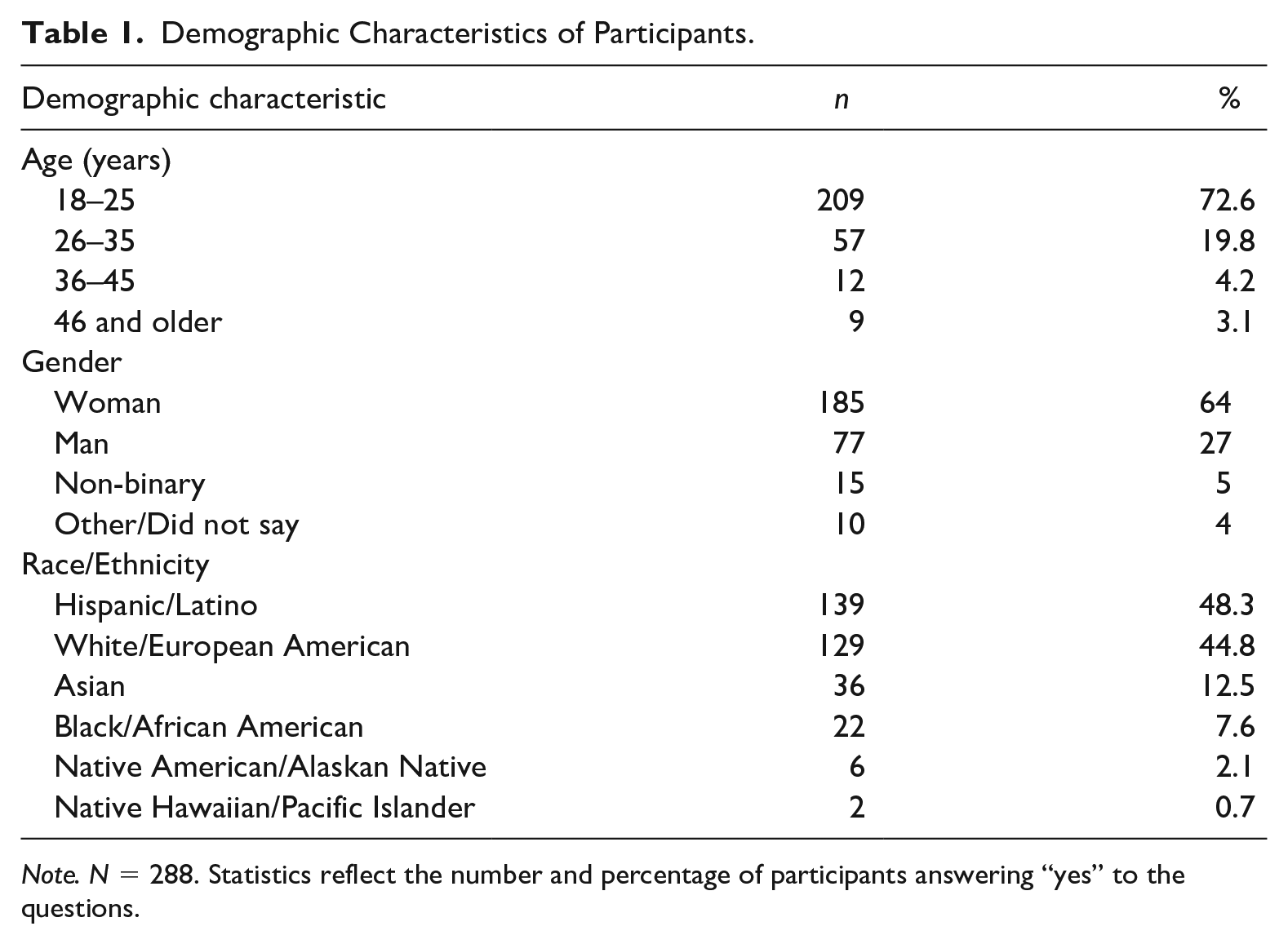
Note. N = 288. Statistics reflect the number and percentage of participants answering “yes” to the questions.
Political Orientation and Year in School.
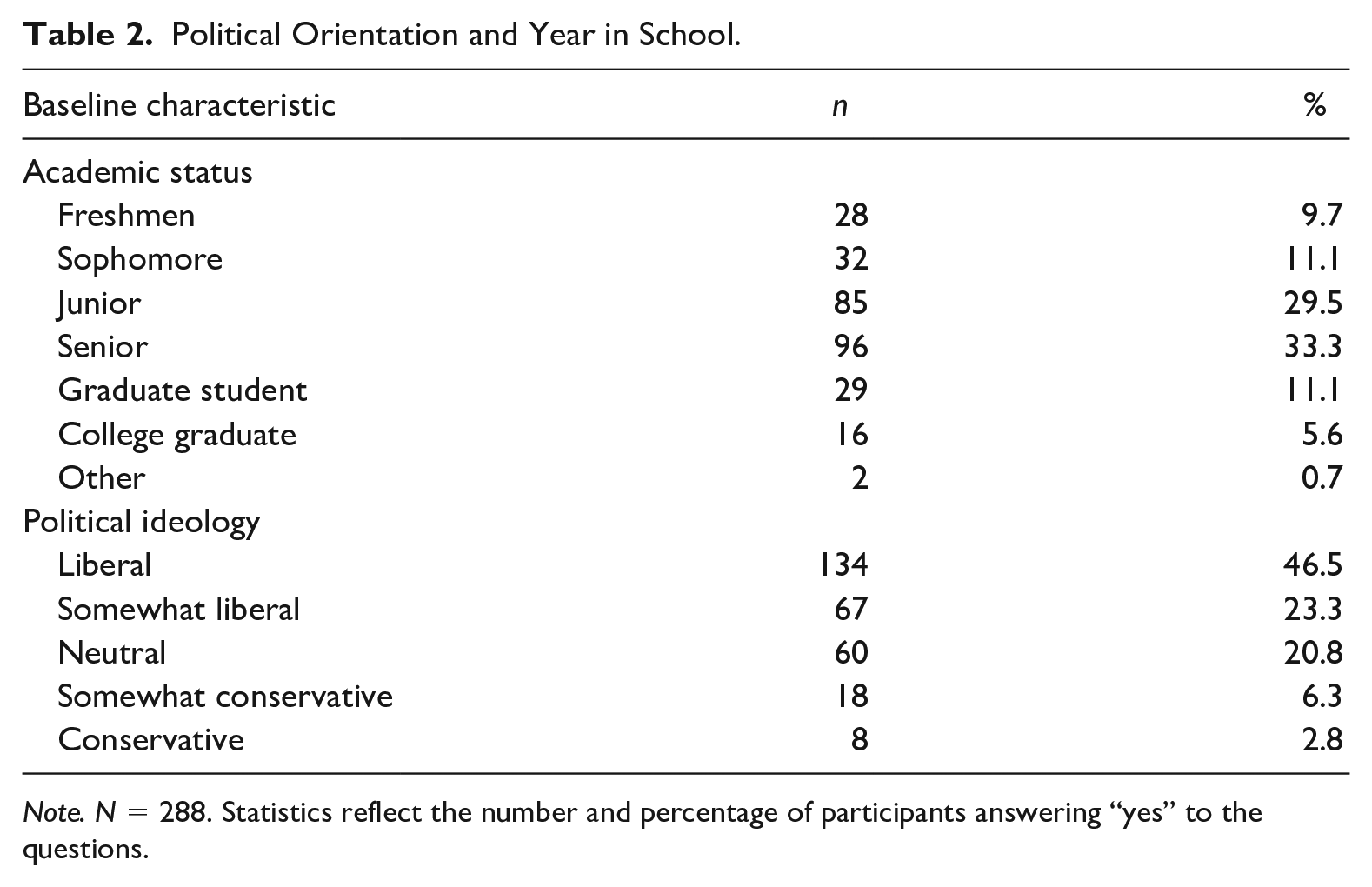
Note. N = 288. Statistics reflect the number and percentage of participants answering “yes” to the questions.
Materials and Design
In the Spring of 2022, an initial focus group of four full-time CSU students helped develop appropriate questions and provide feedback on the initial drafts of the survey. This preliminary questionnaire was then given to 27 university students and five journalism faculty for their feedback and suggestions. Their input was incorporated into the final questionnaire in Qualtrics, approved by the institutional review board (IRB), and distributed online.
Many of the survey questions were borrowed from the Journalism Degree Motivations scale (Carpenter et al., 2016), the News Media Skepticism measure (Maksl et al., 2015), Career Goals Scale of Seibert et al. (2013), and the findings of Mishra et al. (2017). Further details on these scales are described in the Analysis section. In addition, a question asking “Who is the legitimate winner of the 2020 Presidential election?” was given to participants to gauge their political beliefs. Two yes/no attention check questions were also included: (a) “When getting dressed, do you put your pants on head first?” (b) “Do you tie your shoes with chopsticks?” Participants who answered “yes” to either were removed from the analysis.
Analysis
Survey responses were collected from October 31, 2022, through April 20, 2023. Once the survey closed, it was analyzed using IBM’s Statistical Package for the Social Sciences (SPSS) 28. Data were cleaned and checked for normality, and combined scales were created (when appropriate) using factor analysis and checked for reliability using Cronbach’s alpha analysis. The analysis looked at all participants (n = 288), all majors except journalism majors (n = 217), and did separate analyses for journalism majors (n = 70), communication, speech, or rhetoric (Comm) majors (n = 49), political science (Poly Sci) majors (n = 35), and all other majors minus journalism, Comm, & Poly Sci (n = 134). There was one participant who did not indicate a major.
Results
For the question “How likely are you to choose a career as a reporter or journalist?” on a one to five Likert-type scale with 1 = extremely unlikely and 5 = extremely likely, journalism (n = 70) majors (M = 4.06, SD = 1.25) were significantly more likely to choose a career in journalism than those who identified as Comm (n = 49) majors (M = 2.47, SD = 1.26) with t (117) = 6.79, p < .001, d = 1.66, 95% CI [1.12, 2.052], and thus all other majors combined (n = 217, M = 2.29, SD = 1.09), and separately, Poly Sci (n = 35) (M = 2.09, SD = 1.01). There was no significant difference between Comm and Poly Sci.
Next, the three scales were independently analyzed to determine if questions could be grouped within each scale using a principal components factor analysis with a varimax rotation followed by a Cronbach’s alpha reliability analysis. The first one contained 10 questions related to Opinions of the Media. Three distinct factors emerged: Factor 1, 28%; Factor 2, 22.4%; and Factor 3, 16.3%, explaining 66.7% of the variance. A Cronbach’s alpha reliability analysis was performed on these factors. A reliability of .65 or above was considered adequate (Goforth, 2023). Factor 1 (α = .88), Media is Fair and Accurate comprised four items: “I think the news media: is fair, tell the whole story, are accurate, and I trust to report news fairly.” Factor 2, (α = .66), Distrust the Media has five items: “I don’t think news media can be trusted,” “News media prioritize being first to report a story over accuracy,” “News media get in the way of society solving its problems,” “Anti-media messages have made me distrust mainstream media,” and “Mainstream media is out of touch with my generation.” Factor 3, (α = .89), Journalism Important for Democracy, has two items: “Journalism is needed for democracy,” and “Journalism is important to society.”
The same process was followed for the 22 Life Motivations Questions. Six distinct factors emerged: Factor 1, 13.4%; Factor 2, 13.2%; Factor 3, 12.4%; Factor 4, 12.3%, Factor 5, 7.8%; and Factor 6, 6.7%, explaining 66% of the variance. A Cronbach’s alpha reliability analysis was performed on these factors. Factor 1, Social Justice (α = .77), comprised four items: “I want to: work against injustice; point people toward possible solutions to society’s problems; and inform the public about political events and consequences” and “I enjoy informing people of what they might not have known before.” Factor 2, Personal Recognition (α = .79), has three items: “I want: to be a local or national celebrity; special access to events” and “I enjoy public recognition for my work.” Factor 3, Life of a Journalist (α = .76), had six items, “I enjoy: asking questions; frequent interaction with new people; informing people of what they might not have known before; telling stories; writing; photography.” Factor 4, Enjoy Creating Digital Media (α = .89), had three items, “I enjoy: creating content and using media tools for digital platforms; collecting and sharing information on social media; and creating digital media content.” Factor 5, Avoid Math and Science (α = .69), had two items: “I want to AVOID a major that emphasizes: math; science.” Factor 6, Want Routine Schedule (α = .44), had three items: “I want: a career that has a routine schedule; to have a varied (nonroutine) daily lifestyle; and to travel for my job.” Because of Factor 6’s unacceptable reliability, it was not used in the subsequent analysis.
The same process was followed for the 10 How Much Did Each Influence Your Choice of Major questions. Four distinct factors emerged: Factor 1, 19.7%; Factor 2, 18.5%; Factor 3, 15.9%; and Factor 4, 15%, explaining 69% of the variance. Factor 1, Like My Major (α = .81), had two items: “I enjoy the work in my major” and “I am good at the work I do for my major.” Note that “I find the work in my major easy” was removed to raise the Cronbach’s alpha from .67 to .81. Factor 2, Advice From Others (α = .69), had three components: “Advice from: my family; a teacher or advisor; from a peer.” Factor 3, Admiration for People in the Field (α = .74), had two components: “Admiration for people in my field of study” and “Exposure to positive representations of people in my field.” Factor 4 (α = .63), Past Experience, had two components: “past experience: participating in classes or activities in high school that are directly related to your current major” and “working in your field of study.” Because of the unacceptable reliability of Factor 4, it was not used in the subsequent analysis.
To assess who/what influenced journalism majors’ expressed likelihood of choosing a journalism career, a regression analysis was performed on Factors 1–3 from “How Much Did Each Influence Your Choice of Major,” along with “It is important to achieve financial success in my career,” with the dependent variable (DV) “How likely are you to choose a career as a reporter or journalist?” The overall regression was significant with F(4, 65) = 5.48, p < .001, r2 = .253. Only the Like My Major factor was significant (t = 4.20, b* = .488). Thus, enjoying and being good at the major itself was significantly more important than Advice From Others, Admiration For People In The Field, or wanting financial success in the expressed likelihood of choosing a journalism career.
To determine what motivates journalism majors’ attitudes regarding their expressed likelihood of choosing a career in the field, Factors 1–5 from the Life Motivations Questions scale were regressed on the DV “How likely are you to choose a career as a reporter or journalist?” The overall regression was significant with F(4, 65) = 5.31, p < .001, r2 = .293. Only the Motivated by Social Justice factor was significant (t = 3.54, b* = .465).
Journalism majors (M = 4.2, SD = .81) and Poly Sci majors (M = 4.49, SD = .75) cared highly about social justice with no significant difference between them. For Poly Sci majors, however, when regressing the Life Motivations Factors 1–5 on the DV “How likely are you to choose a career as a reporter or journalist?,” the regression was not significant.
This regression was repeated for all other majors combined, minus journalism. The overall regression was significant with F(5, 211) = 10.49, p < .001, r2 = .202. Only Want Life of a Journalist was significant (t = 2.90, b* = .218). Means of journalism majors (M = 4.37, SD = .50) and all other majors (M = 3.97, SD = .74) were compared on that factor (higher numbers on the 1–5 Likert-type scale indicating wanting the life more) using a t-test where equal variances were not assumed. The difference was significant with t (171.87) = 5.06, p < .001, d = .69.
With the midpoint of the Life of a Journalist scale being 3, the entire sample enjoyed asking questions, frequent interaction with new people, informing people of what they might not have known before, telling stories, writing, and photography. Although journalism majors enjoy these kinds of things significantly more than other majors, Social Justice was their significant predictor in their expressed likelihood of choosing a journalism career. The more they want to “work against injustice; point people toward possible solutions to society’s problems; inform the public about political events and consequences; and enjoy informing people of what they might not have known before,” the higher their expressed likelihood of choosing a journalism career.
To determine how opinions of the media might affect attitudes toward the expressed likelihood of choosing a career in journalism, Factors 1–3 from the Opinions of the Media scale were regressed on the DV “How likely are you to choose a career as a reporter or journalist?” For journalism majors, the overall regression was not significant as these factors were not a deciding component in their expressed likelihood of choosing a journalism career.
Looking at all other majors except journalism (n = 217), the overall regression was significant with F(3, 213) = 16.23, p < .001, r2 = .188. Only Media is Fair and Accurate (t = 6.04, b* = .423) was significant. The more they thought the media to be fair and accurate, the higher their expressed likelihood of choosing a career in journalism, with r(217) = .413, p < .001. For journalism majors, these factors did not play a significant role in their expressed likelihood of choosing a career as a reporter or journalist, but for all other majors, how fair and accurate they believed the media to be was significant.
We repeated this analysis for those majors closest to journalism (Comm and Poly Sci) and also for those who were not journalism, Comm, or Poly Sci majors to get a more nuanced understanding. For Comm majors, the overall regression was significant with F(3, 45) = 11.60, p < .001, r2 = .436. Only Media is Fair and Accurate (t = 5.26, b* = .635) was significant. For Poly Sci majors, the regression was not significant.
We repeated the analysis for the 22 majors (n = 134) other than Journalism, Comm, or Poly Sci. The overall regression was significant with F(3,130) = 8.56, p < .001, r2 = .165. Media is Fair and Accurate (t = 4.27, b* = .408) was significant, as was Journalism is Important for Democracy (t = 2.69, b* = .180). Because the standardized beta for Media is Fair and Accurate was more than twice that of Journalism is Important for Democracy, it was clearly the most important factor.
Note that journalism majors’ means (M = 2.76, SD = .97) were significantly higher with t(285) = 4.40, p < .001, d = .605, than those of all other majors (M = 2.23, SD = .84) for Media is Fair and Accurate. Yet despite our liberal sample, everyone’s means were below the midpoint of 3, and the participants neither agree nor disagree with whether the news media was fair, tell the whole story, or are accurate and whether they trust them to report news fairly.
Discussion
This study examines the interests, motivations, and factors that may affect the expressed likelihood of college students pursuing a career, and potentially a degree, in journalism. We found that journalism majors expressed twice the likelihood of choosing a career as a reporter or a journalist compared to other majors, even those most closely related to journalism. Journalism majors’ expressed likelihood was above 4 on the 5-point Likert-type scale, with everyone else in the 2 range, indicating that students in other fields do have some level of interest in pursuing a career in journalism. This leaves considerable room for recruiting outside of the journalism major, with Comm majors being the most likely prospects.
Journalism majors wanted the life of a professional journalist significantly more than other participants, and they believed that Media is Fair and Accurate more than others, yet other factors were more important for them. For journalism majors, the most important factors are whether or not they enjoy the work and the major itself (Like my Major) and their interest in social justice (Motivated by Social Justice).
Consistent with our hypothesis, the results of this study indicate that many journalism majors want to engage in social justice and help inform the public of social and political issues. This motivation aligns with one of the most valuable societal benefits of journalism—making citizens aware of injustice when it occurs. Incorporating a focus on social justice into journalism programs, curricula, and recruitment may be an effective way to engage students and help mitigate the decline in journalism enrollment.
For everyone else, the appeal of living the Life of a Journalist and views of how fair and accurate the media is (Media is Fair and Accurate) were significant in these majors’ expressed likelihood of choosing a career as a reporter or journalist. Notably, for Media is Fair and Accurate, the difference between journalism and non-journalism majors could be because journalism majors’ belief in the credibility of the media is significantly higher. Consistent with our hypothesis, it appears that a belief in the credibility of the media is important in considering a career as a journalist, and it is this credibility that has been under sustained attack.
While understanding what motivates students to major in journalism is crucial to the profession, it is also important to understand what may deter students from the major. Our results indicate that the less students believe the news media are fair and accurate, the less likely they are to consider a career in journalism. This is concerning since media skepticism is currently rampant across the country and throughout society (Park et al., 2020). This may be due to an increase in public attacks, and amplification of those attacks through both traditional and social media, on specific news media outlets, individual journalists, and journalism in general by political officials (Egelhofer, 2023; Kellner, 2018; Meeks, 2022) and members of the public.
Because media skepticism could drive students away from a major in journalism that they otherwise may have pursued, mitigating media skepticism among students could aid in motivating them to potentially pursue a career, and degree, in journalism. K-12 learning institutions might consider incorporating media literacy in the curriculum to mitigate these effects. In addition, universities could develop and implement courses focused on media literacy into the core general education requirements.
Limitations
This study was a survey, subject to the limitations of survey research. In addition, the sample came from the CSU system; therefore, findings may not generalize to other universities. Only 70 journalism students met the criteria for analysis. Future research may benefit from expanding on these findings by researching a larger population from other universities in other states.
Conclusion
By including a diverse sample from across different disciplines, this study highlights why a variety of students enjoy their majors, what they enjoy about journalism, what they find problematic about the journalism profession, and their expressed likelihood of pursuing a career in journalism. While various factors (e.g., Life of a Journalist, Like my Major, Journalism is important for Democracy) may influence students’ expressed likelihood of pursuing or not pursuing a degree in journalism, social justice and media skepticism are the most significant. Incorporating a focus on social justice in curricula and courses may draw students to journalism. Also, by mitigating the skepticism students hold about the profession, as demonstrated by their overall low scores on the Media is Fair and Accurate factor, educators may be able to help expand journalism programs across CSU campuses and beyond and contribute to future growth of the journalism profession and the protection of our democracy.
Footnotes
Declaration of Conflicting Interests
The author(s) declared no potential conflicts of interest with respect to the research, authorship, and/or publication of this article.
Funding
The author(s) disclosed receipt of the following financial support for the research, authorship, and/or publication of this article: The first author received partial funding from Cal Poly Humboldt Sponsored Programs Foundation for the research and authorship of this article.
