




Abstract
Through a qualitative textual analysis using written work from 17 high school journalism publications over a six-semester span, this research explores the types of controversy scholastic journalists covered during the COVID-19 global pandemic. The analysis focuses on which controversial topics were covered, differences in coverage as related to school demographics, the genres and styles of writing used to cover the topics, concerns based on journalistic standards, and a summary of quality student journalism work. Framed within the context of the importance of exploring controversial issues and normative journalism roles in a functioning democracy, recommendations relevant to journalism education concerning students’ reporting on controversy follow analysis.
Introduction
Reporting on controversial issues has been recognized as one of the most significant challenges in journalism (Cramer, 2011; Wihbey, 2014). Controversy certainly exists in high school students’ worlds, and many scholastic journalists cover controversy in their publications. Definitions of controversy differ across areas of study; for this research, the researchers use a definition based on a social sciences epistemology, which explains controversy as a public argument and/or discussion about a topic that has supporters, along with people who strongly disagree with those supporters or are somehow shocked by this issue (Zielinski et al., 2018). Although controversy has always existed across all cultures, the COVID-19 era introduced unprecedented challenges to all groups and is relevant for research into news coverage and controversy across all levels of journalism, from scholastic to professional, especially set in the context of the normative roles of journalism in a functional democracy (Siebert et al., 1963). The central research question is, “What controversies did high school journalists cover in a time of heightened controversy during the COVID-19 pandemic?” Furthermore, the researchers were interested in what types of controversial topics students covered, the forms that coverage took, what types of schools covered more or less controversy, and the quality of the work concerning journalism standards.
Aside from journalism students covering controversy, discussion of controversial issues as part of scholastic curriculum was valuable in shaping this study. In her work showcasing the importance of curricula and teaching strategies that address and encourage discussion of controversial political issues in scholastic education, Diana Hess (2009) suggests that without discussion of important issues, democracy does not exist (p. 15) and that when schools do not teach students how to engage in discussion of controversial topics they are sending messages that matters of politics are not important and that controversial issues are taboo and dangerous for young people to discuss (p. 6). Scholastic students have long been met with resistance when trying to cover controversial topics in their school publications (Bobkowski & Belmas, 2017; Dean v. Utica Community Schools, 2004; Hazelwood School District v. Kuhlmeier, 1988), and this trend continues currently (Guzman-Lopez, 2022; Liu, 2023; Renkl, 2022; Student Press Law Center, 2020). If both journalism and discussion of controversial issues are integral to a functioning democracy, then studies involving scholastic journalists covering controversial topics in their school publications are valuable to the overall body of knowledge concerning both normative journalism roles and young citizens’ roles in a democracy.
In addition, studies in scholastic journalism are of value to both scholastic and collegiate educators. Understanding more about scholastic journalism helps in making pedagogical and curricula suggestions for scholastic and potentially collegiate journalism educators. Given the nature of covering controversy as an important area of journalism, the heightened level of controversy present during the COVID-19 pandemic, scholastic students’ historical problems in addressing controversy, and the importance of addressing and discussing controversial issues as part of a healthy democracy, this research examines how high school journalists covered controversial topics during the COVID-19 era in their student publications using a qualitative textual analysis of their written work to explore the nature of the controversy and to attempt suggestions relevant to scholastic and collegiate educators who teach these young journalists.
Literature Review
Further Defining Controversy in the Journalistic Context
Along with the definition in the introduction, Zielinski et al. (2018) further describe controversy as “characterized by the fact that no agreement or consensus is reached on the subject for a prolonged period of time” and that “controversy, by its very nature, is related to conflict.” A controversial issue, therefore, taps the public’s “moral, legal, and civic imagination” (Lambeth, 2000, p. 1033) making it a contender to create public cynicism toward many social practices in a democracy, including journalism. Dascal (2003) indicates the institution of the press creates space for controversy. Thus, the news provides a venue for modern public controversy to flourish; therefore, researchers need to pay attention to controversy as news discourse (Goodnight, 1992).
Media scholars and critics have long pointed out that journalists employ journalistic norms such as objectivity and balance to mitigate the problem of controversy and appear trustworthy to the public (Hiles & Hinnant, 2014; Wihbey, 2014). However, additional literature suggests that norms such as objectivity and balance did not do justice when covering issues such as racial equity and climate change, two topics ripe with controversy (Antilla, 2005; Boykoff & Boykoff, 2004; Corbett & Durfee, 2004; Meyer, 2004; Mindich, 2000). Through their interviews with environmental journalists, Hiles and Hinnant (2014) suggest journalists have opted for redefining the concept of objectivity. The component of objectivity known as “balance” was replaced by “weight-of-evidence” as journalists reported controversial environmental issues such as climate change. Scholars have also paid attention to the notion of “subjectivity” in news reports of controversial issues. Harbers and Broersma (2014), in their study of the coverage of the Middle East conflict, show the presence of overt subjectivity in the writers’ news reports, which can cause some readers to question the legitimacy of the reporting. The roles that subjectivity and objectivity play in journalism have rarely if ever been absolute and require continued study as culture shifts.
Specifically, to high school journalists and subjectivity in their news writing, Wilderman and Nasrin (2020) categorized various problems in students’ news reporting ranging from simple to complex issues, with the complex issues including young reporters making inferences and assumptions, including in-depth subjectivity as well as blurring endorsement and reporting (Wilderman & Nasrin, 2020). This current research adds additional depth to types of problems present in students’ coverage of controversial issues, which in addition to basic subjectivity include lack of sourcing, weak sourcing, and uninformed opinion presented as fact, which are detailed further in the findings.
Previous Studies of Scholastic Journalists and Controversy
Research into scholastic journalism and controversy is steeped in legal, social, and pedagogical contexts. Though not a journalism issue, rather a symbolic speech issue of wearing armbands at school to protest the Vietnam War, the Tinker v. Des Moines Independent Community School Dist (1969) case established that students in public schools do have rights concerning free speech, and this case has been used as precedent for numerous free speech issues in public schools, including student publication content (Calvert et al., 2023). However, the free speech rights of students in public schools are not as extensive as the rights of adults outside of the school environment, as shown in the outcome of the Hazelwood decision (1983) in which the Supreme Court decided that public school administrators do have the right to censor journalism work that is part of curriculum (Calvert et al., 2023).
Often, the extent to which student journalists can cover controversial topics is left up to school boards, principals, or journalism teachers. In their 2017 study, Bobkowski and Belmas found that more than a third of the student journalists they surveyed had been told by a school employee to not cover a particular topic for their school media; this happened to the female students at a significantly higher rate than the male students, with 41% of female students and 28% of male students experiencing this. The difference concerning gender here is particularly concerning, as females are currently dominating in numbers in scholastic journalism classes and publications as well as the journalism major in college. Bobkowski and Belmas (2017) also indicate a list of controversial topics that students were asked to not report on, and this current study’s list of student-covered topics in our data overlap significantly, with some of those topics including drug use, LGBTQ+ issues, religion, local and national politics, mental health, gun control, and race issues, indicating that students in various part of the country are interested in writing about similar controversial topics. Hess (2009) would suggest that allowing discussion of these types of controversial issues is an obligation of public schools “to create an atmosphere of intellectual and political freedom that uses genuine public controversies to help students discuss and envision political possibilities” (p. 6).
With coverage of controversial issues also come risks to journalists. A 2020 study of the affordances and constraints student journalists’ experience with digital publication indicated a variety of positive and potentially negative outcomes associated with this type of work, and when covering controversial topics, the students expressed concerns about their work being out in the digital world opening them up to hateful criticism (Dzula et al., 2020). The authors cited an example of a student’s opinion piece concerning international political protests that “received considerable blow-back from students and even inflamed tensions within our staff,” and how the staff “had to pause and invoke our mission and consider how we could build discussion after provoking angry responses. Since digital participation extends journalists’ reach, it also opens them up to new vulnerabilities” (Dzula et al., 2020). Professional journalists must be aware of potential risks and dangers associated with their work, and for scholastic journalists, their educators and mentors are charged with helping them understand this side of journalism.
Student journalism work concerning controversial matters can also grab the attention of and inspire professional journalists, as was the case in the 2017 study by Hendricks and Thomas which details the 2013 instance of a high school newspaper choosing to stop using the name of the high school’s mascot, which they noted had “racist connotations.” The researchers looked at the way professional journalists responded to the high school journalists’ decision and subsequent work and found that the professionals (a) referenced the professionalism of the students’ work as parallel to professionals covering the same topic, (b) highlighted specific noteworthy practices of the student staff, and (c) addressed the rights of those students in alignment with First Amendment standards and legal precedents, which the authors noted indicated a “discourse of inclusion” as the student publication “was legitimized as operating within the rubric of the ‘legitimate’ press’” (p. 459).
As previously mentioned, research concerning controversial coverage and scholastic journalists spans legal, social, and pedagogical contexts. The current study seeks to add to the body of knowledge in both social and pedagogical realms by framing the study in the context of scholastic students’ coverage and discussion of controversial issues as it relates to a functioning democracy and with suggestions for journalism educators pertaining to their students covering controversy within the guidelines of normative journalism roles.
Method
The data consist of high school student journalists’ contest submissions in writing categories for both print and online high school news publications from 17 schools that enter Oklahoma’s premiere state scholastic journalism contest. Of the 17 schools, seven are smaller (800 or fewer enrolled) and 10 are larger (more than 800 up to several thousand enrolled). Eight of the 17 schools submitted online publications to contest, four schools submitted print publications, and the remaining five submitted a mixture of print and online content. Two schools are private, one is an in-person public charter school, one is an online public charter school, and the remaining 13 are traditional public schools. Only four schools in this set have a majority of non-white students, although an additional five have a close White majority to non-white minority enrollment (within five percentage points or less), leaving eight schools in the set with a white majority enrollment of 56% or more. Data were collected from entries submitted between September 2019, the semester when COVID-19 first started making news as a potential health concern, through April 2022. Because the research focuses on written work and content that includes controversy, the following contest categories were selected to pull data: news reporting, feature writing, opinion column, editorials, critical reviews, sports columns, and sports reporting, resulting in 247 usable pieces of written work out of 1,340 contest submissions in these categories, or 18.4% of the submissions, that contained an element of controversy as defined by Zielinski et al. (2018). Due to a constraint of the platform used to collect the entries, of these 247 entries only 126 of the entries were available in totality for the researchers to analyze the full written work; the other remaining 121 entries were used in a more surface nature, as the researchers only had access to headlines and a brief summary of those pieces. The researchers chose to leave in these 121 entries, as they were useful for a count of the types of controversial topics students were covering. This is discussed further in the later explanation of our three levels of coding.
Analysis followed Kuckartz’s (2014) description of qualitative text analysis. Specifically, qualitative text analysis should be used when there is a high level of importance on understanding and interpreting textual documents (Kuckartz, 2014), making it appropriate for the analysis of written work. Steps for this style of qualitative text analysis include careful reading of data, developing case summaries, constructing categories, coding data into categories, developing sub-categories, secondary coding to solidify themes within the findings, and analysis and presentation of findings (Kuckartz, 2014). After the initial collection of data from the appropriate contest categories, we began the analytic process by reading each sample and making notes or memos relating to the students’ writing that covered any aspect of a controversial topic. This step works best when starting with simple analytical descriptions such as “political controversy—national” or “school controversy—uniforms” and working toward more in-depth case summaries. After several read-throughs and the initial notes and memos, Level 1 categories started emerging inductively, but we also decided on certain thematic categories deductively based on previous literature and the researchers’ professional and scholastic journalism knowledge and experiences.
At this stage, the researchers must note that for the 121 print media submissions of 247 total in the dataset, we only had access to the headlines and a brief description of the work. However, due to the nature of the digital publications and the submission process for this state contest, links to the full digital pieces on the student publication websites were available. Therefore, the 126 digital publication entries of the overall 247 entries were available for a deeper analysis, and those are the focus of Step 3 in analysis. Since the headlines and descriptions of the print entries provided enough valuable details for basic sorting and categorizing, we chose to keep those entries in the data set, and they are included in the first two steps of coding and analysis below.
For the broadest set of categories, the Level 1 coding, 12 categories remained after several rounds of sorting and consolidating—these follow in alphabetical order: Community, COVID-19, Crime, Diversity/Inclusion, Education, Entertainment, Environment/Climate, Health (other than COVID-19), Politics, Social Media, Sports, and Student Life. Although some of these could be seen as overlapping, each of these broadest categories maintains a particular set of boundaries. For example, while COVID-19 coverage could be part of Heath, the students wrote so much about COVID-19 during the pandemic era that it needed its own category, but they also wrote about enough non-COVID-19 health issues, that Health needed to remain a Level 1 category as well. In addition, at this level, all stories were coded as local, state, national, or international (or a combination of these) depending on how students focused their stories.
Step 2 of coding, using Excel as a coding and sorting mechanism, involved labeling and sorting data into a variety of subcategories in Level 2 and Level 3 coding. For example, a story about crimes against transgender individuals could fit into both Crime and Diversity/Inclusion categories. A story’s Level 1 code was based on how a story was framed, and what was covered most in the story. In the aforementioned example of a story about crimes against transgender people, if the story focused more on transgender history with some mention of crimes in smaller proportion, then the story’s Level 1 code was Diversity/Inclusion, and the Level 2 code was Crime. Level 2 coding included all 12 of the Level 1 broadest categories with a variety of additional categories to further identify the topics students were writing about. Level 3 coding was used if the story could not be categorized using only two descriptors. For example, a story about the issue of cheating while students were in online (at-home) school during a lockdown phase could be a Level 1 code of Education, a Level 2 code of COVID-19, and a Level 3 code of Cheating. The process of creating subcategories can allow for the differentiation of the data within the broader, original categories, which can add important nuance to the findings. All 247 pieces of writing in the data set were used in Steps 1 and 2 of coding; however, only 126 pieces of writing, just over 50%, were used for the more in-depth analysis in Step 3, as previously explained.
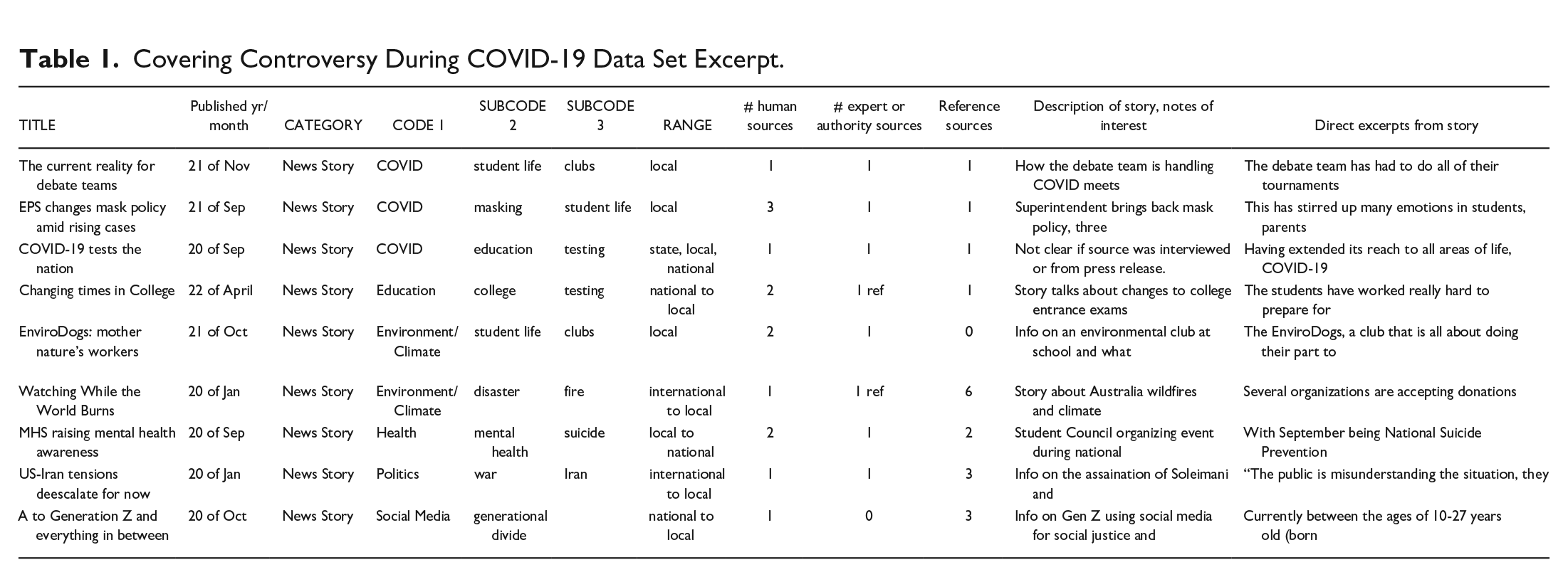
For the third step of analysis, we moved to a more in-depth look at particular passages within each story. We focused on phrases, sentences, or paragraphs of text in which students most specifically wrote about or used sources to describe elements of controversy. The subcategory coding, along with analysis of these pieces of stories, allowed for more meaningful and developed themes to emerge from the data, which we synthesized in the findings. At this stage of coding, we also kept track of how many sources and the types of sources students used in their work: firsthand human sources, reference sources, expert sources, and nonexpert sources. The table shows a small portion of the categorized data set (Table 1). School name, publication name, and URL for digital stories are also in the set but are not published here for the privacy of the scholastic journalists. Also note, not all content is in view for notes and excerpts columns, as many of those cells contain numerous passages.
Covering Controversy During COVID-19 Data Set Excerpt.
Findings and Discussion
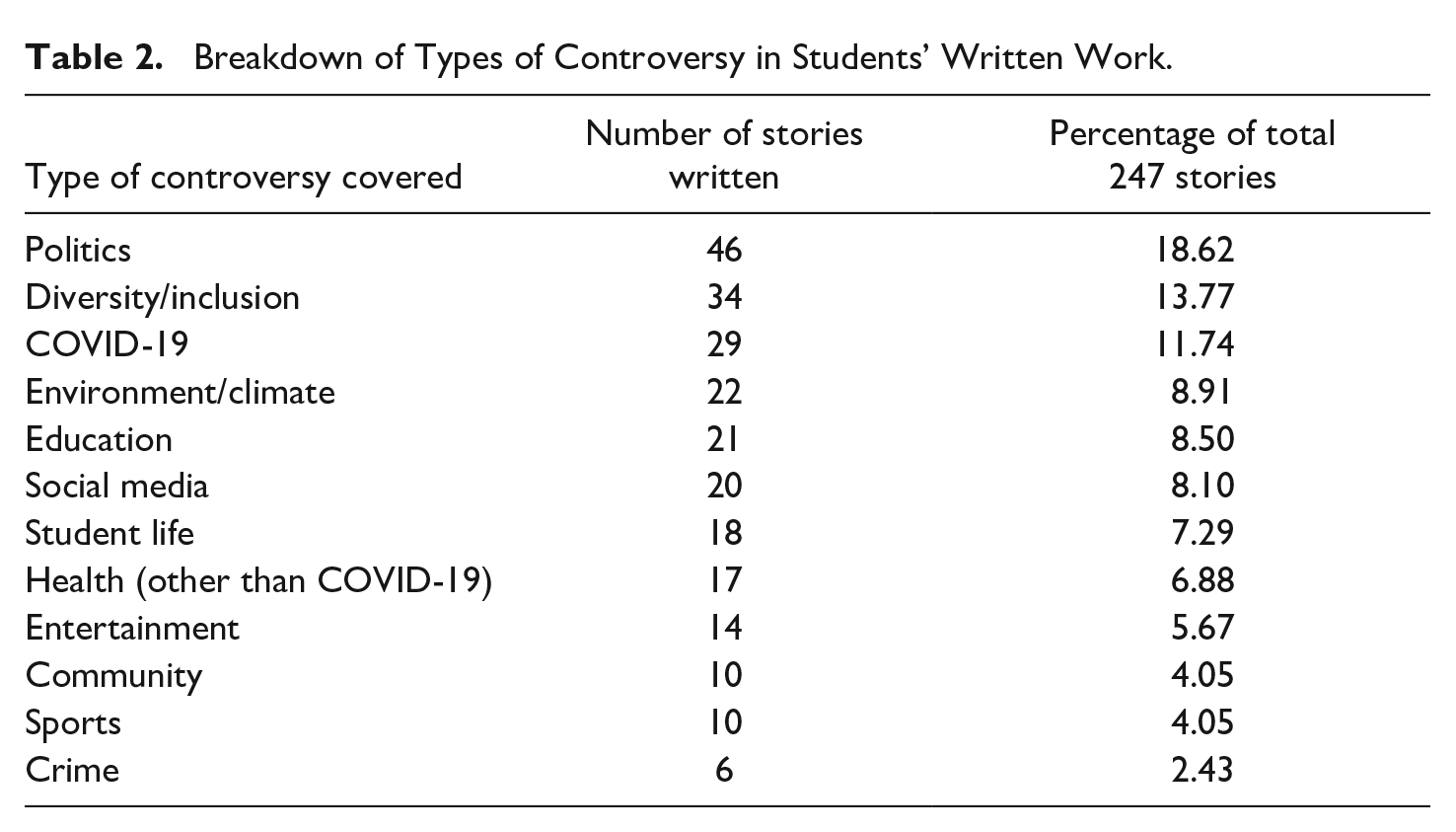
Results, in the broadest terms of Level 1 coding into the 12 types of controversial topics that students covered, are below.
Findings Based on Differences in the Schools
Although all schools in this study submitted journalism work that covered a controversial topic, the amount of controversial work they submitted ranged greatly, with the school submitting the most entries in this six-semester span coming in at 81 entries and two schools in the sample submitting one entry each that included controversy. Interesting findings based on the differences in the schools follow: The two private schools submitted 36 qualifying entries, or just less than 15% of the overall entries in the sample. (Of note, private schools are not under the same obligation as public schools concerning upholding the free speech rights of their students.) Breaking down the submissions based on the racial demographics of each school, the four schools with majority non-white enrollment made up 50/247 entries, or just over 20%, while schools with a white majority made up 80% of entries. When looking at the six schools with the highest enrollments of white students, ranging from 62% to 80%, they make up 169/247 entries, or 68%, even though they make up only 35% of the schools in the sample. Previous research from Bobkowski et al. (2012) showed that affluent suburban schools [which tend to have more white students enrolled] support high school journalism to a greater degree than their urban and rural counterparts. The findings in this research indicate that the six schools with the most white students enrolled (five of which are in affluent suburban areas with one being rural), are heavily supported in covering controversial issues in their high school publications. When narrowing to the three rural schools in the study, they made up 11% of the entries, although they were 17% of the overall schools in the sample.
Thematic Findings
Beyond the Level 1 coding in Table 2, in analyzing the additional Level 2 and Level 3 coding, along with the deeper textual analysis of the written work, themes arose that provide more insight into this data. The findings are arranged into the following four thematic topics: (a) Breakdown of COVID-19 coverage, (b) Controversial coverage aside from COVID-19, (c) Journalistic Concerns, (d) Solid Student Journalism.
Breakdown of Types of Controversy in Students’ Written Work.
Theme 1: Breakdown of COVID-19 Coverage
Writing about COVID-19 came in third of the 12 Level 1 categories of controversy. Political controversy was a clear first, which is no surprise, as the period of data collection includes the end of the 2020 election cycle and the beginning of a new presidency in 2021—a contentious election that included the January 6th insurrection. If this timespan had not included a presidential election, it’s likely COVID-19 coverage would have come in second, just behind coverage of Diversity/Inclusivity topics. As previously mentioned, this research was invested in both what student journalists were writing about during the COVID-19 era and how they were writing about it. Concerning the what of COVID-19-specific coverage, it is no surprise students wrote about it most concerning how it affected their education and student life. In breaking down the Level 2 and 3 coding of the COVID-19 coverage, the subtopics that students wrote about most frequently include (a) education issues, (b) masking and other policies or procedures, and (c) student life issues outside of education, like clubs and sports.
Of these subtopics, education issues most frequently focused on issues of distance or hybrid learning or discussion of returning to in-person classes as well as the impact COVID-19 might have on college, like applications, entrance exams, or recruitment. Concerning the subtopic of masking and other COVID-19 policies and procedures, stories focused most on informing the audience of policy and policy updates, debates on masking, and concerns with various other policies related to the pandemic like attendance and safe distances. Vaccines were not discussed as much as other COVID-19 policies and procedures, and that may be due to students being too young for vaccines during much of this coverage period. For the third subtopic, student life (outside of education-specific issues), coverage focused most on how COVID-19 affected various sports and club activities.
Theme 2: Controversial Coverage Aside From COVID-19
This theme captures controversy outside of COVID-19 issues that students covered during the pandemic. As shown previously in Table 2, issues of politics and diversity/inclusion topped the list of controversial coverage for the students’ writing in this data set. Table 3 shows the Level 1 categories of controversy (minus COVID-19 in third place, of which subtopics were previously discussed) with the additional subtopics that showed up most in Level 2 and 3 coding. The subtopics listed are not exhaustive–only the most prominent subtopics for each category are listed.
Additional Frequent Subtopics in Level 1 Categories of Controversy.
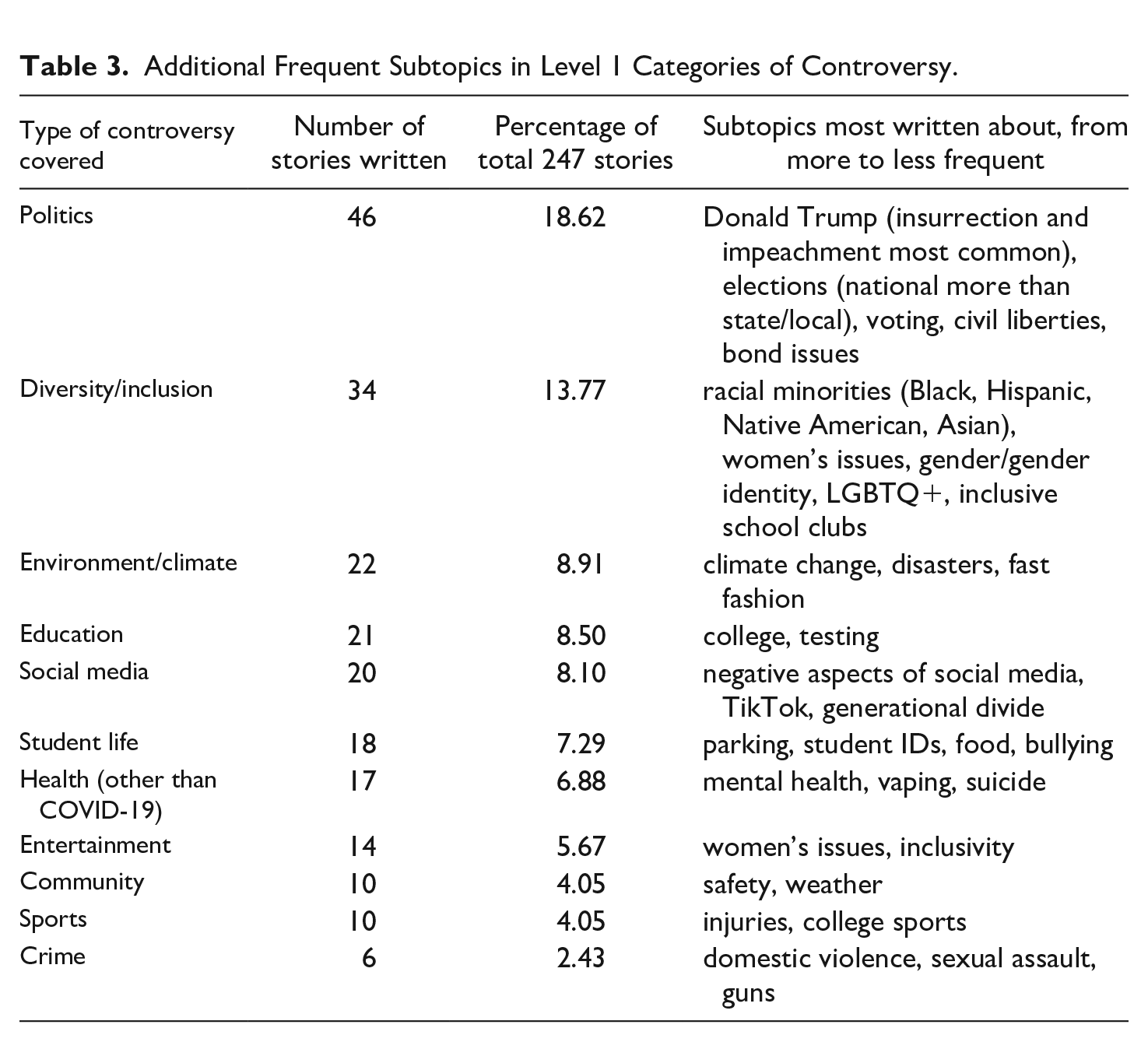
This generation of scholastic journalists is clearly interested in issues of diversity and inclusivity. Even during a global pandemic, this data set shows they wrote more about those topics than the pandemic. They also appear to be concerned for the future in a variety of ways, including soon being able to vote, getting into college, potential college debt, and issues stemming from climate change. Many student writers voiced informed concerns about climate change issues, and many of their sources in news and feature stories indicated acting on climate change is important to them, as showcased in this quote from a source in a story about trends in environmentalism: “I don’t want to die,” junior [name removed] said. “I hate when people litter or waste paper and plastic. Global warming/climate change is REAL.” In an opinion column, another student opens with these words in a piece about water shortages: “Despite the obvious changes in weather and urgency among activists, if people still refuse to believe that the events of severe climate change aren’t of human cause, we won’t be able to fix the issues we currently face. The truth is we are losing water and consequences may arise as soon as 2025, according to the World Wildlife Fund, but with proper education on the culprits of water scarcity and how to prevent a devastating future, we can overcome these adversities and continue using water freely.” As for topics we thought would be in the data more, the researchers were surprised that the issue of gun violence in schools did not show up in many stories.
Theme 3: Journalistic Concerns
As journalism educators ourselves with a specific interest in scholastic journalism education, this theme incorporates the problems observed in the students’ writing that may be of concern to scholastic journalism educators, and we offer suggestions for combatting these problems in the classroom. This theme is further broken down into three areas: subjectivity, problems with sourcing/attribution, and uninformed opinion.
Subjectivity
As found in the researchers’ 2020 study on subjectivity in student journalists’ reporting, this data set also produced concerning patterns of subjectivity inserted where it does not belong in news reporting. For example, student writers often made subjective, opinionated statements from their point of view in news and feature stories. For example, in a feature story about traveling during the pandemic, a student wrote, “As the Corona virus continues to spread, the protocols need to be taken even more seriously. Wear a mask, be socially distant and stay sanitized.” This language would be fine for an opinion column, but not coming from the writer’s point of view in this particular style of feature. It is even more concerning when it happens in news stories, which should remain the most objective of all journalistic styles. Often this subjectivity is concentrated in the final paragraph or sentence of a story, indicating students struggle to end a news piece without opining. For example, in a news story about clubs trying to meet during the lockdown, a student journalist wrote, “There are many uncertainties about what is going to happen this year, but fortunately, many clubs, such as book club and FCCLA, have still decided to meet.” And another concluded in a news story about a hybrid school schedule, [Name of School] went the safest route possible while still being able to go to in-person school for two days a week and online the rest (minimizing exposure). They made this decision in the best interest of its students and staff and so far, it seems to be working.
Since these are high school student journalists early in the stages of learning the standards and ethics of journalism, of course, they make mistakes. However, due to the growing problem of misinformation spreading in the digital age and contentious relationships between journalists and audiences, efforts should be made even at the scholastic level to combat the problem. Media literacy should start as early as possible, and lessons that help students understand the difference between objective and subjective language can be part of that education, along with lessons that focus on the differences in a reporter’s opinion being in a news story and a source’s opinion being attributed in a news story.
Lack of Sourcing/Confusion in Sourcing
Of the 125 stories that were digitally available for the researchers to fully analyze the complete story, 33 were news stories and 38 were feature stories—the two genres in the data set we were most concerned with using appropriate firsthand human sourcing—meaning the students interviewed the sources themselves. So, concerning the human sources of these 71 stories, 11, or 15%, used no firsthand interviewed human sources. In addition, we counted the number of stories that included the use of expert or authority sources. Of the 71 news and feature stories, 15, or 21% did not use any expert or authority human sources, while an additional 13, or 18%, included a secondary expert or authority source—meaning quoting and citing a person from another publication. Although it is better to find secondary or reference sources to use as authority/expert sources than having none, it is still not ideal concerning quality journalism standards to rely on sources from other publications as the only method of authority or expertise in a story.
As for confusion in sourcing, clear attribution of secondary sourcing was a frequent issue. It was often unclear if a writer had interviewed a source or gathered the content from another publication or reference source. Many stories included direct quotes from high-ranking state or national officials, and it is not likely students directly interviewed these people. In addition, many of these quotes read like language from a news release. Although there is nothing wrong with using content from news releases, it needs to be attributed accordingly. An additional sourcing issue was vague attribution, as in the following example of a story about the environmental concerns the pandemic brought on, in which the student mentions a study, but does not tell the audience which study: “Another study has found an interesting link to the sanitation of public spaces and the death of urban animals.” And a final issue in this area of concern is the lack of attributing important facts, as in this example of a student writing about the first few weeks that many teachers were able to receive the first COVID-19 vaccine: “As of this week, more than 630,000 Oklahomans, or 16% of the population, have received the first dose of a COVID-19 vaccine.” Lack of attribution of key facts can decrease the trustworthiness of a news story.
Uninformed/Lacking Opinion Columns
Opinions columns accounted for the most written work in this data set, with 86 opinion columns out of the 247 pieces of writing, which makes sense, as opinion columns are often used in journalism as discourse for controversial topics. Adding in the smaller numbers of sports columns (4), editorials (8), and critical reviews (10), this means 108/247 entries, or 44%, were from genres that call for opinionated writing, and a standard of journalistic opinion writing is that is be informed by solid reference sources and facts. Several issues for concern arose in the students’ opinion writing, the first being vague sourcing of important information. One student wrote in a column about how the amount of testing in high school takes away from actual learning, “Studies have shown that students would benefit from an extra hour of sleep way more than struggling through four projects, reading five chapters and studying for two exams.” However, the writer does not list or link the source of the study. Similar issues were frequent among student columns, and in digital publications, this can be easily remedied by linking directly to a source. In print publications, enough information should be given in the attribution for a reader to find the source if they desire.
The second most frequent problem in the opinion writing data was writers stopping short of offering solutions or calls to action in opinion columns, leaving the column to be more of a rant than a fully-formed column. In one example, a student wrote a well-sourced opinion about equal pay in professional women’s sports, but in the end, she misses the opportunity to suggest how people can push for more change. The writer concludes, “The growth in women’s sports is increasing due to women helping each other out and taking a stand. The U.S. women’s soccer lawsuit has inspired women and girls around the world that one has to fight for what she wants and to be patient for whatever the outcome may be,” which is a nice sentiment but does not cross into solutions, even small ones, for action or change.
Basing opinions on factually incorrect statements was problematic, but less frequent than the other issues mentioned with opinion writing. For example, concerning President Trump’s potential impeachment, a student wrote, “The impeachment will disqualify him from any future office and leave a stain on his record that, frankly, is much deserved,” which is factually incorrect, as impeachment does not automatically disqualify in this situation. Impeachment is frequently misunderstood in U.S. politics, and professional media outlets have also made incorrect statements about the process, but this can be a concern when students tackle complicated issues in their opinion pieces. Journalism teachers may need to address that while opinion pieces may seem to require less effort than reporting, as no interviewed sources are required, the research that goes into writing an effective and well-informed column can be equally time-consuming.
Theme 4: Solid Student Journalism
As collegiate journalism educators who also have experience in the realm of scholastic journalism education, we conclude by focusing on areas of quality student journalism observed in this data set. Students’ work in this dataset often showed professional or adult-level understanding of controversial issues, as was showcased in Hendricks and Thomas (2018). For example, in an opinion column about the need to raise the minimum wage in Oklahoma, a student wrote, Many teenagers and single parents working for minimum wage are struggling, as rent, cars and basic everyday needs go up in price. In 2017, apartment rent rose 2.22%, according to The Oklahoman. If Oklahoma raised the minimum wage this would help offset the increase in the cost of living.
In another opinion column filled with data from the CDC, a student eloquently explains the differences in teachers and students being back to in-person school: However, because of the vaccine and having fewer cases, many of those schools have decided to change instruction to match more of what was done before the pandemic. While this does have benefits of more face-to-face instruction and more interaction between peers, it could have unforeseen consequences as social distancing is no longer possible. This used to be a health concern for the teachers, but now most teachers are vaccinated. The problem is, however, the students are not.
And this example shows a student writer understanding free speech better than many adults: Although there are many freedoms in America that the people hold close to themselves, there are places where those freedoms do not fully apply. The freedom of speech and other civil liberties are important to protect, but once entering a private company or logging onto a social media platform, individuals must acknowledge that those rights can be restricted due to regulations that those companies use to protect themselves and others.
Another area that deserves praise is this generation of writers’ attention to topics of diversity and inclusivity. For example, in an opinion piece about not using culture for Halloween costumes, a student wrote, “We binge horror movies of ghosts and demons and shudder when we hear the smallest creak in the floorboards behind us, and yet we forget the biggest horror that arrives with the holiday, the costumes that culturally appropriate.” Another student tackled the highly controversial topic of Critical Race Theory, citing a variety of education research experts in his opinion piece to offer a variety of definitions, and he offers empathy to others who may think differently than him: As an African-American student, I didn’t fully understand critical race theory, but having researched it more I understand why people feel personally conflicted. The past is full of horrific incidents between races. While some would choose to forget and move on, others see it as an opportunity to learn and grow. This is where education is key.
In a well-sourced news article about Oklahoma’s sex education protocols for K-12 schools as it related to the “Don’t Say Gay” bills, a student reporter wrote about a fellow student who felt overlooked: Sophomore ** is a transgender male and is bisexual. He shared concerns about the talk he received this past January. ‘The Healthy Lifestyles talk made me feel excluded,’ ** said. ‘I felt like not a lot of the information was pertinent to me.’ Due to Oklahoma’s ‘No Promo Homo’ laws public schools are not allowed to talk about same-sex relationships in a positive connotation.
Another opinion column recapped JoJo Siwa’s coming out and how it is important for other young people to help them come out. The writer included 10 reputable resources and links intended to be helpful to those struggling with their own or their children’s sexual identity. This generation of scholastic journalists appears to not shy away from attempts to help underrepresented voices be heard in their publications.
Finally, in this last theme of solid student journalism, the researchers would like to call attention to the breadth and depth of political topics the student journalists covered. Although younger generations tend to have a reputation of engaging with their phones and social media more than with reality, these students frequently covered important political discourse including: the 2020 presidential election, the January 6th insurrection, Donald Trump’s impeachment, local and state elections, voting, civil liberties, local bond issues, international elections, war, social justice, the death penalty, diversity and inclusivity matters, and abortion.
Final Thoughts on Findings
As stated in the introduction, the central research question was, “What controversies did high school journalists cover in a time of heightened controversy during the COVID-19 pandemic?” And additionally, we were concerned with what types of controversial topics students covered, the forms that coverage took, what types of schools covered more or less controversy, and the quality of the work concerning journalism standards. The findings based on the demographics as well as the thematic findings have addressed each of these areas, and the main takeaways we offer follow.
Students in predominantly white schools wrote more about controversial topics than those in predominately minority schools, suggesting students in the predominately white schools have more support to do so. In addition, students in private schools contributed a smaller percentage of writing on controversy compared their public school counterparts, which aligns with private schools not adhering to free speech standards at the same level of public schools.
In this sample of 17 schools, students wrote more about politics, namely issues surrounding the 2020 presidential election and diversity/inclusivity issues than they did about the unprecedented pandemic they were living through, indicating this group of students cares a lot about certain political matters and matters of diversity. Although it is not surprising this younger generation is more vocal and supportive of diversity and inclusivity, the younger generations are often accused of not being interested in or taking politics seriously, which was not the case with our data. We were surprised students did not write more about gun control or gun violence in schools, seeing as these are leading topics in professional news that do affect high school students.
Concerning the takeaways for journalism curricula and journalism educators, our summary of suggestions for helping to correct the breeches of normative journalism standards we saw in the students’ work include (a) focus on media literacy early and often in the curricula. Even adults have difficulty understanding where media messages are generated and who may be behind a message with an agenda. Being taught to question the people or entities behind a message is crucial to living in a media-dominated society; (b) frequently drill matters of objectivity v. subjectivity into the lessons. Although the basic differences between objectivity and subjectivity may seem simple, it is a lesson the researchers note their college students still struggle with during the first years of the major. With students spending so much time online and in social media apps where echo chambering is common, it is not surprising many may have a blurred idea concerning the line between objectivity and subjectivity; (c) focus on sourcing as both matters of credibility and transparency. Go beyond telling students they need to have X number of sources. The quality of sources we saw at times was lacking. Based on the writing samples in this data set, many students did not commonly understand the need for an expert source over a secondary source or understand how to fully cite a reference source. They also seemed to struggle with finding credible reference sources and frequently relied on questionable reference sources. (d) Work in exercises that help students detect when someone is attempting to present opinion as fact. Although this can be viewed as an extension of the above suggestion concerning media literacy, we thought it important enough for a closer focus. Students in this sample clearly enjoyed writing opinion pieces, as opinion pieces made up the largest chunk of their written work, but many wrote opinion based on false information or simply presented opinions as fact. Journalistic opinion writing should be based on informed and rationale thinking and start from a premise of factual information.
Limitations and Future Research
Limitations in this study include the data being drawn from only one state’s scholastic journalism students as well as that data are limited to only the contest submissions, not the entirety of a student publication. We think it is reasonable to assume students and journalism teachers are entering what they consider to be the best work in contests; however, focusing only on the “best of” students’ work could be limiting in a variety of ways.
Concerning future study, we are interested in comparing this state’s scholastic journalism work with others across the country. Also, we are interested in possibly building more on the findings about levels of support for scholastic journalism based on types of schools from Bobkowski et al. (2012) in conjunction with our own findings concerning the variation in support for covering controversy based on demographics and other differences in schools.
Footnotes
Declaration of Conflicting Interests
The author(s) declared no potential conflicts of interest with respect to the research, authorship, and/or publication of this article.
Funding
The author(s) received no financial support for the research, authorship, and/or publication of this article.