




Abstract
This study compared the group characteristics and reoffending outcomes of 254 females processed by police for online or offline child sexual offending (n = 116 known for online offenses, 45.7%). A binary logistic regression revealed that females known for online child sexual abuse (CSA) were more likely to be aged under 18 years at the time of their index offense (p < .001), more likely to have co-perpetrated a child sexual offense (p < .001), and less likely to have a history of sexual victimization (p < .05) than females known for offline CSA. However, a two-step Cox regression survival analysis identified no group differences for risk of further police contact for any, violent, and non-violent offenses after controlling for relevant risk factors. These findings indicate that females who perpetrate online versus offline CSA may require specific management targets despite their similar likelihood of coming to future police attention.
Keywords
Females constitute a small but meaningful proportion of individuals who perpetrate sexual offenses against children (Augarde & Rydon-Grange, 2022; Cortoni et al., 2017). Despite advancements in research on individuals who engage in online child sexual exploitation (OCSE; i.e., sexual abuse facilitated via the internet or other technology), research has largely focused on males who engage in child sexual abuse material (CSAM) offenses. This has left a gap in knowledge about criminogenic differences between females who engage in online, offline (the direct, in-person sexual victimization of children), and dual (both online and offline) forms of child sexual abuse (CSA). The current study therefore aimed to investigate the extent to which group characteristics and recidivism differ between females known to police for online compared to offline or dual child sexual offending.
Group Characteristics
In previous research, conducted almost exclusively on males, individuals who engage in OCSE tend to differ from those who engage in offline or dual child sexual offending on several characteristics (Babchishin et al., 2015). One of the most consistent findings to date is that individuals who engage in OCSE tend to have fewer markers of antisociality. For example, they tend to have a limited offending history and have an older age at first offense compared to those who engage in offline or dual offending (Babchishin et al., 2015; Henshaw et al., 2018). Similarly, among females who engage in sexual offending (FwSO), rates of offending prior to sexual crimes tend to be small, at least as compared to males who sexually offend (Augarde & Rydon-Grange, 2022). This trend also holds for females convicted of CSAM offending, with Bickart et al. (2019) reporting that, of 98 females, 71% had no criminal history prior to their recorded sexual offense. These findings raise the possibility that rates of offending prior to sexual offending (and possibly characteristics of antisociality more broadly) are more similar between females who engage in online and offline or dual child sexual offending than what is typically evidenced in existing literature comparing male cohorts. To the authors’ knowledge however, this comparison of prior offending has not been formally conducted in extant research.
Index offending characteristics (i.e., characteristics of key offenses of interest from which time to recidivism is measured) may also help to distinguish individuals who engage in online compared to offline or dual forms of CSA. This includes factors such as age and number of sexual offenses. For example, individuals who perpetrate OCSE tend to be younger, including at the time of the index offense, than those who engage in offline child sexual offending (Babchishin et al., 2015; Henshaw et al., 2018). Similar findings have been found among females specifically. In a sample of individuals who had come to police attention for sexual offending in Australia (i.e., may or may not have been formally arrested), Hull et al. (2024) found that adult females came to police attention for offline child sexual offenses more than juvenile females, while juvenile females came to police attention for online child sexual offenses more than adult females. Collectively, these results raise the possibility that juvenile age at the time of offending may be particularly important to consider when examining females who engage in OCSE compared to offline or dual CSA. Individuals who engage in online offending also tend to have more markers of atypical sexuality than those who engage in offline offending, such as higher rates of paraphilic disorders (Babchishin et al., 2015). Despite this, recent Australian research by Henshaw et al. (2018) reported that males charged with CSAM offending had fewer overall sexual offenses compared to males convicted of both child contact offending and dual child sexual offending. The applicability of these findings to females, and thus the ability for index offending characteristics to distinguish females who perpetrate online compared to offline or dual CSA, remains largely unexplored.
Co-offending (i.e., offending alongside one or more other individuals) also demonstrates strong etiological relevance in models of female sexual offending (Gannon et al., 2014). Females who co-offend are more likely to have recorded victims under the age of 12 years compared to those who offend on their own (i.e., solo offend; Wijkman & da Silva, 2021), highlighting an essential role for co-offending when conceptualizing child sexual offenses perpetrated by females. Descriptive findings from broader research also suggest that females who engage in sexual co-offending engage more often in computer-related and non-contact offenses, including those relating to the possession of pornography and distribution of indecent images 1 , compared to solo offending females (Budd et al., 2017; Gillespie et al., 2015; Vandiver, 2006; Williams et al., 2019). Despite research identifying a prominent role for co-offending among FwSO, no published study has investigated whether co-offending distinguishes females who engage in online and offline or duals forms of CSA. This is important to address to determine whether knowledge generated by examining female sexual offending broadly can be applied to females who engage in OCSE.
Finally, the victimization history of those who engage in child sexual offending may be useful for distinguishing individuals who engage in online compared to offline CSA. Males who perpetrate OCSE are less likely to have a history of victimization than those who engage in offline and dual offending (Babchishin et al., 2015; Faust et al., 2015). In contrast, research on females who perpetrate broader sexual offending as well as CSA specifically raise the likelihood of extensive victimization histories (Augarde & Rydon-Grange, 2022; Levenson et al., 2015). This is further founded among females convicted of CSAM offenses, with approximately 60% having recorded prior sexual victimization and approximately 45% having recorded prior physical victimization (N = 98; Bickart et al., 2019). Therefore, while a history of victimization may be less marked among males who perpetrate OCSE, whether similar patterns emerge for females who engage in online compared to offline or dual CSA remains largely unexplored.
Recidivism
Evidence of divergent risk profiles among males who engage in OCSE compared to those who perpetrate offline or dual offending is supported by the growing body of work establishing risk of recidivism among these cohorts. Risk factors for recidivism tend to be similar across those who engage in online and offline offending, including a history of offending prior to the sexual offenses, younger age, and a higher number of index child sexual offenses (Dowling et al., 2021; Phenix et al., 2016; Rice & Harris, 2014; Seto & Eke, 2015). Despite this, males who perpetrate OCSE are a lower risk population than males who perpetrate offline or dual offenses, driven by lower levels of antisociality and more internal inhibitions against contact offending (Babchishin et al., 2018). In contrast, individuals who perpetrate dual offenses tend to have a combination of risk factors observed in both online and offline offending cohorts (i.e., antisociality and atypical sexuality/sexual deviance), indicating that those who perpetrate dual offenses have the highest degree of criminogenic needs (and thus risk; Babchishin et al., 2018).
Among FwSO broadly, some established patterns of recidivism have also emerged. For example, consistent with the broader sexual offending literature, rates of non-sexual recidivism tend to be higher than rates of sexual recidivism (e.g., 51.6% compared to 7.2%, respectively; Vandiver et al., 2019). Risk factors for recidivism have also been examined, with a history of prior offending, engaging in solo sexual offending, and a history of victimization all found to be related to reoffending (Fortunato et al., 2024; Freeman & Sandler, 2008; Marshall & Miller, 2019; Miller & Marshall, 2019; Sandler & Freeman, 2009; Vandiver et al., 2019). In contrast, being convicted of multiple index sexual offenses (arguably a proxy for sexual deviance among males) may not predict sexual or non-sexual recidivism among females (Marshall & Miller, 2020), though it may predict non-violent recidivism (Fortunato et al., 2024).
The research discussed thus far highlights some important characteristics in relation to the reoffending rates and notable risk factors of FwSO. However, little research has specifically contrasted recidivism among females who perpetrate OCSE and females who commit contact child sexual offenses. Ghossoub and El Harake (2023) found that sexual recidivism rates were at or near zero among both females convicted of CSAM and females convicted of contact sexual offenses (0% and 0.6% over at least 16 years, respectively). However, the offenses committed by the latter group were not restricted specifically to child sexual offenses, and the descriptive findings do not account for the possible influence of other relevant risk factors. Therefore, to the authors’ knowledge, no study has compared risk of recidivism among females who engage in online compared to offline or dual child sexual offending.
The Current Study
The current study had two related aims. First, it explored whether factors across four theoretically relevant domains (prior offending history, index offending, co-offending, and offender victimization history) predicted offense type among females known to police for suspected 2 child sexual offending. Second, it explored whether offense type predicted risk of reoffending after controlling for risk factors with existing empirical research support among online and/or offline sexual offending populations.
Method
This study was part of an Australian Research Council (ARC) Linkage Project (ARC LP180100090) that was led by Swinburne University of Technology in collaboration with Victoria Police, Corrections Victoria, the Australian Institute of Criminology, and Monash University. The sample pool and study variables were extracted from the Victoria Police Law Enforcement Assistance Program (LEAP) database, which holds information on offenses and victimization formally reported to police in Victoria, Australia (Victoria Police, 2022). Extracted data included each individual’s offending history, the nature of their offending, and whether they had come to police attention for being the victim of an offense.
Sample Selection
Data were initially extracted from LEAP for 7,414 males and females who had been formally processed by police for a broad range of child sexual offenses between 2004 and 2019 inclusive. Formal police processing in Victoria can involve a range of actions, including interview, arrest, and/or charge. The time frame for data capture (i.e., 2004 to 2019) was selected to align with the enactment of federal legislation which criminalized a broad range of CSAM offenses (Classification (Publications, Films and Computer Games) Act 1995 (Cth) (Austl.); Criminal Code Act 1995 (Cth) (Austl.)) and to allow a minimum follow-up period of approximately three years from December 2019 to the data extraction date of 19th September 2022.
Individuals were included in the final sample if they met criteria to be categorized into one of three groups – online, offline, or dual child sexual offending. Their eligibility for inclusion in one of these groups was based on whether they had come to police attention for specific online and/or offline child sexual offenses (‘target charges’) between 2004 and 2019 inclusive (group descriptions are provided in more detail below). Non-target charges were also considered. These represented offenses which were neither inclusionary nor exclusionary. This means that an individual who contained non-target charges was eligible for inclusion in the final sample, but only if they had coinciding target charges. In and of themselves, non-target charges did not result in an individual’s inclusion in the study. 3 There were two additional inclusion criteria. First, the individual must have been 10 years old or older (i.e., the minimum age of criminal responsibility at the time this research was conducted) at the time of police processing for the online and/or offline target offense. The inclusion of individuals aged between 10 and 18 years (i.e., juveniles) in part assisted with maintaining statistical power but was also a decision based on growing evidence that a substantive portion of juveniles come to police attention for OCSE offenses (e.g., Dowling et al., 2021; Hull et al., 2024). Second, they must not have been processed for a coinciding and/or prior exclusionary charge. Exclusionary charges were those which could not be classified as clearly online or offline in nature or were not clearly perpetrated against a child. A list of inclusionary target and non-target charges, and exclusionary charges for each group, can be found in the Appendix.
Three hundred and ninety-nine females were initially identified. Of these females, 87 (21.8%) were excluded as they had no recorded target sexual offense between 2004 and 2019 inclusive. A further 47 (11.8%) were excluded because they had come to police attention for exclusionary charges at the time of and/or prior to their index offense. The final sample therefore comprised 265 females who had come to police attention for online and/or offline child sexual offenses at the time of and/or prior to their index offense. Of note is that due to constraints associated with the composition of the LEAP database, gender was coded binarily based on the perception of police members at the time of data entry as opposed to offender self-report.
Group Definitions and Categorization
The online group (n = 116, 43.8%) had perpetrated one or more of three types of online offending: the access, possession, distribution, or requesting of online/digital CSAM (actioned or attempted) with no direct contact with children (‘CSAM Offending’); online/digital communication with a child for sexual purposes (actioned or attempted), whether preparatory (e.g., grooming for later sexual contact) or enacted online (e.g., sexual chat; ‘Online Grooming and Sexual Solicitation’); and the digitally facilitated creation of CSAM (actioned or attempted) in which creation of material may occur online or in-person and may or may not involve real children (‘CSAM Production’). Although CSAM Production may have occurred in the offline realm, the defining feature was that offending occurred via technological means without the individual having perpetrated direct, contact CSA.
The offline group (n = 138, 52.1%) consisted of individuals whose history of CSA offending only involved physical contact with a child and/or close physical proximity to a child (i.e., contact or non-contact sexual offending in which the perpetrator and child were in the same physical location during the offense).
The dual group (n = 11, 4.2%) consisted of individuals who had a history of documented offenses that reflected both online and offline definitions of offending behavior, as described above. To be included in the dual group, individuals must have had at least one charge categorized as an online offense and one charge categorized as an offline offense throughout their prior and/or index offending. The dual offending group could therefore have any combination of online and offline charges.
Index Offense
If an individual was processed for a target offense which met the above criteria, this offense was defined as the index offense. In this instance, ‘processed’ is linked to the date police carried out an action in relation to the target offense, not the date the offense occurred. In keeping with the methodology utilized by Seto and Eke (2015), if an individual was processed for more than one eligible target offense, their index offense was randomly selected. Additionally, multiple illegal behaviors may have been known to police that occurred at the same time as the index offense (the ‘index event’). The index event therefore consisted of all offenses processed and/or perpetrated on the date of the index offense. These design decisions helped to reduce potential inflation of prior and recidivistic offending given the absence of conviction data.
Offense Classification
Due to the wide variety of offenses present across offending histories, offenses were categorized into two higher-order categories (Violent offending and Non-Violent offending) based on a classification system devised by the research team. Violent offenses involved the actual or immediate threat of physical or sexual harm against a human victim(s), or induced fear in a person or a group of people. This included sub-categories of Sexual Violence (including all target sexual offenses) and Non-Sexual Violence (e.g., stalking, assault). Non-Violent offending included all remaining offenses and was sub-categorized into Breach offenses (e.g., failure to answer bail) and Other offenses (e.g., drug and property offenses). ‘Any’ offending was used to encapsulate all types of offending.
Variables of Interest
Predictor Variables
Operationalization of Predictor Variables Included in Analyses

aVariables were utilized as predictors in multivariate analyses to answer Research Question 1.
bVariables were utilized as predictors in multivariate analyses to answer Research Question 2.
Further Police Contact
A primary outcome of interest was reoffending, operationalized as first formal police contact for a new offending event (Any, Violent, or Non-Violent) following the index offense. It is important to emphasize that in the current study, prior, index, and reoffending events all relate exclusively to police involvement. The authors acknowledge that this operationalization does not align with traditional conceptualizations of recidivism – first formal criminal justice action following release from imprisonment. Therefore, it is possible that formal (i.e., substantiated) offending rates are inflated in the current study. To minimize this potential inflation, pseudo-recidivistic offenses (i.e., offenses processed by police after the index offense, but perpetrated prior to the index offense) were excluded as outcome events and thus from final analyses. Twenty-four individuals (9.1%) had pseudo-recidivistic offenses.
Time at risk was calculated from the index offense processing date to the date of first further police contact, the date of death, or the end of the included time frame (19th September 2022), with time incarcerated removed. Data from Corrections Victoria were used to determine time incarcerated while data from Births, Deaths and Marriages Victoria were used to determine any individuals who had died during the study time frame. Due to changes in Corrections Victoria data management processes, some imprisonment data may have been missing for records between 2004 and 2005, and thus time at risk may have been overestimated for these cases. This limitation only potentially impacted a very small portion of the final sample (i.e., those with index offenses prior to 2005; n = 7) and as such is not expected to substantively alter final outcomes.
Approach to Analysis
Descriptive Information on Females Known for Online, Offline, or Dual Child Sexual Offending

Note. All data were derived from the Victoria Police LEAP database. For continuous variables, the M and SD are reported and flagged in the Variable column. Demographics were measured based on the last known status to Victoria Police prior to the index offending date. Offending history pertained to factors prior to the index offense. Co-offending and Victimization were measured at the time of and/or prior to the index offense.
aVariables were utilized as predictors in multivariate analyses to answer Research Question 1.
bVariables were utilized as predictors in multivariate analyses to answer Research Question 2.
To address the first research question, we ran a binary logistic regression to predict offense type (online or offline) from seven variables that summarized offending history (Prior Contact for Violent Offenses and Prior Contact for Non-Violent Offenses), index offending (Juvenile at Index and Total Index Sexual Offenses), offending with another person/s during a target sexual offense (Any Co-offending) and history of victimization (Lifetime Sexual Victimization and Lifetime Violent Non-Sexual Victimization). The age at which individuals became known to police for illegal activity (Age at First Contact) was removed from the analysis due to problematic multicollinearity indicated by high variance inflation factors and low tolerance values.
The ability of the regression to distinguish individuals known for online or offline offending was established using a Receiver Operating Characteristic (ROC) and Area Under the ROC Curve (AUC) analysis. A statistically significant AUC greater than 0.5 suggests that the model performs better than chance at distinguishing groups (Ozkan et al., 2020). In line with recent research (e.g., Holper et al., 2024), cut-offs proposed by Rice and Harris (2005) were utilized to determine the performance of the model: >.56 was considered a small effect, >.64 a moderate or fair effect, and >.71 a large or strong effect.
To address the second research question, three sequential Cox regression analyses were run to examine if offense type (online or offline) predicted risk of further police contact for (1) Any, (2) Violent, and (3) Non-Violent offenses while controlling for five risk factors. Due to power constraints and violations of statistical assumptions, sub-types of prior offending and victimization could not be included as covariates. Instead, higher-order risk factors were entered into the first block for each Cox regression: Any Prior Police Contact, Juvenile at Index, Multiple Index Sexual Offenses 4 , Any Co-Offending, and Lifetime Violent Victimization. Offense type was entered into the second block.
Suitability of all analyses were confirmed via the testing of assumptions, including linearity, multicollinearity, and the proportional hazards assumption – specifically, log minus log plots and time-dependent Cox regression analyses were examined to ensure the proportional hazards assumption was not violated (Field, 2013; Stoltzfus, 2011; Su et al., 2022; Tabachnick & Fidell, 2019).
Harrell’s C-index was used to determine the ability of each model to distinguish females who did and did not come to further police attention. This index is equivalent to the AUC but is more appropriate for use in the context of survival analysis because it accounts for varying times at risk (Hartman et al., 2023). Unlike AUC, no thresholds for discriminatory strength have been established (Longato et al., 2020), though an index of 0.5 suggests a model is performing no better than chance while an index greater than 0.7 indicates suitable discriminatory strength (Hartman et al., 2023).
Sample Description
Table 2 presents descriptive information on females known for online, offline, or dual offenses. Females with online offenses tended to be younger than those with offline and dual offenses, with the online group having the most students and juveniles at their index offense. This pattern is also reflected in age at first contact with police for any type of offense, with the online group trending youngest. All three groups had similar rates of prior police contact, though those in the dual group had the highest rate of prior contact for sexual offenses. Females in the offline group appeared the least likely to be known to police for co-perpetrating a target sexual offense and females in the online group tended to have the lowest rates of sexual victimization.
Ethical Approval
The ARC OCSE Data Linkage Project received oversight and approval from the Department of Justice and Community Safety Human Research Ethics Committee (CF/20/17580) and the Swinburne University of Technology Human Research Ethics Committee (20225770-11015).
Results
Research Question 1: Which Factors Predict Offense Type (Online or Offline) Among Females Processed by Police for Child Sexual Offending?
Outcome of Binary Regression Predicting Online Versus Offline Child Sexual Offending

Note. OR = odds ratio. CI = confidence interval. AUC = area under the curve. The reference group was females known to police for Offline child sexual offenses. *p < .05 ***p < .001.
Research Question 2: Does Offense Type (Online or Offline) Predict Further Police Contact Among Females Processed by Police for Child Sexual Offending?
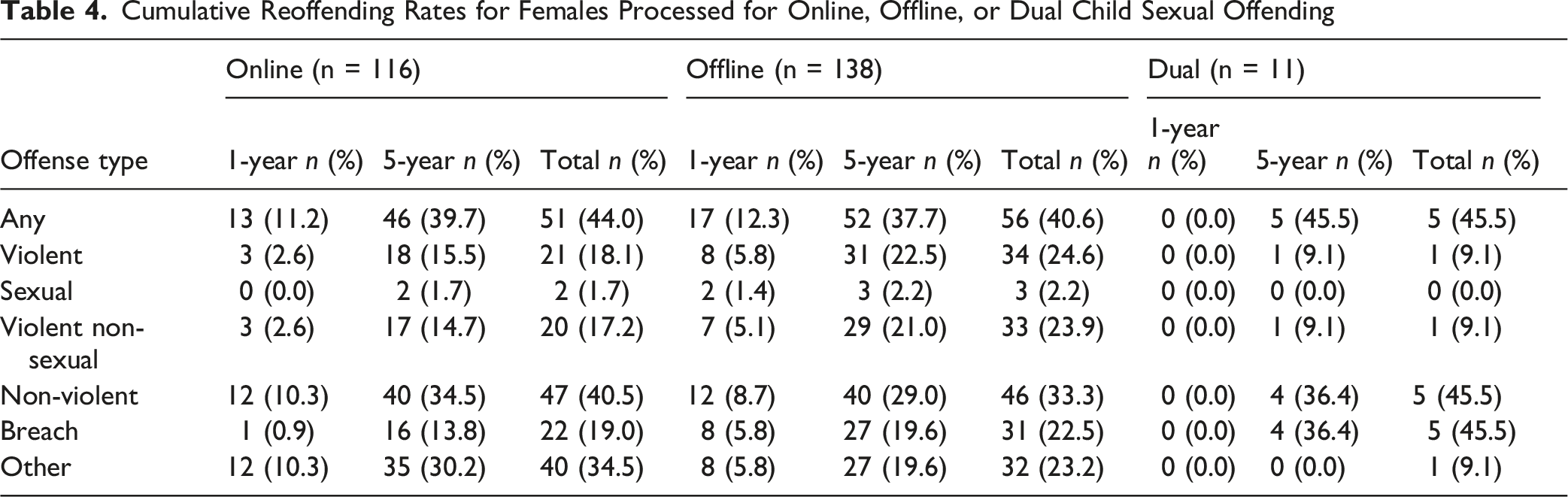
Cumulative Reoffending Rates for Females Processed for Online, Offline, or Dual Child Sexual Offending
Outcomes of Cox Regression Analyses for Any, Violent, and Non-Violent Offending
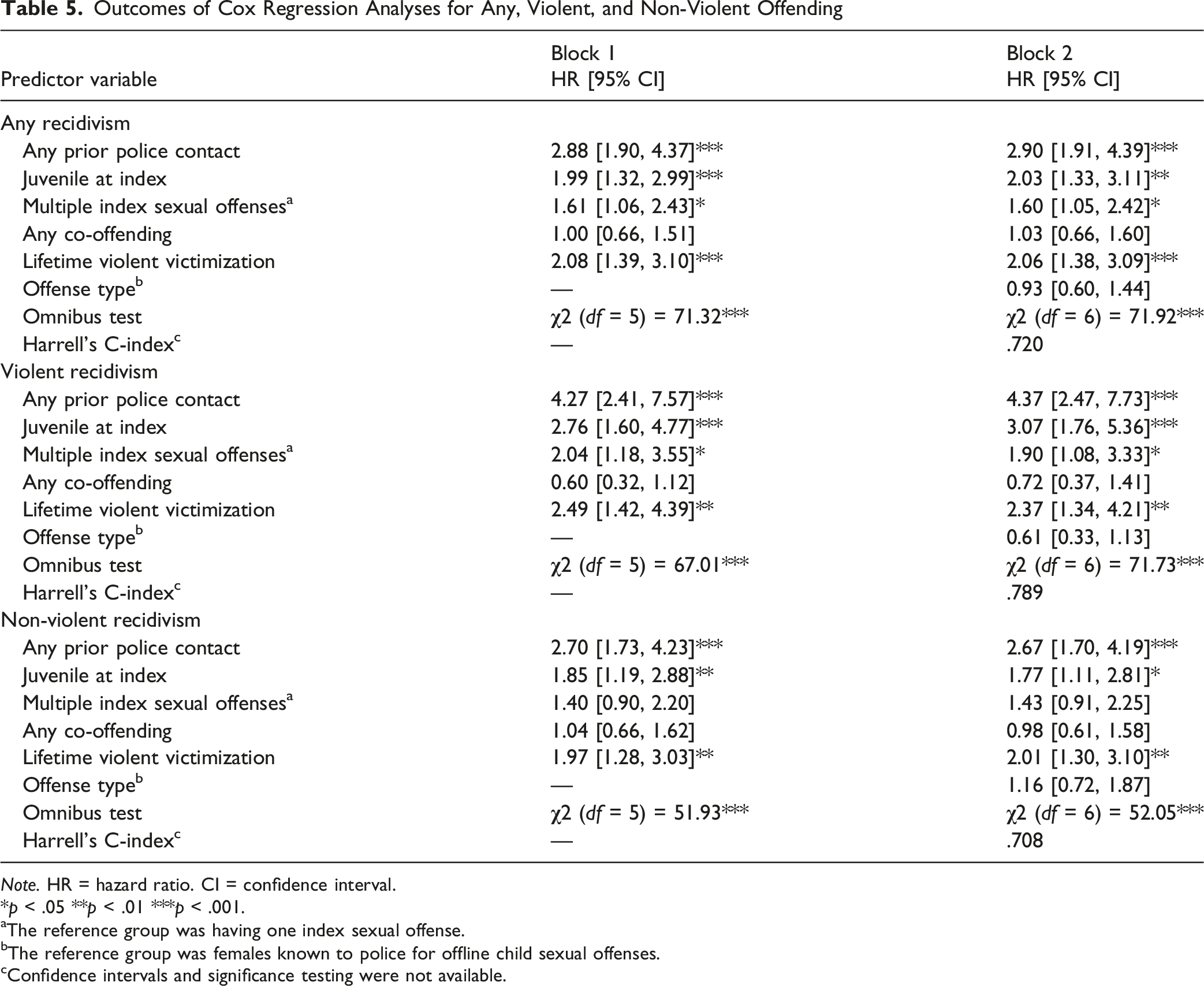
Note. HR = hazard ratio. CI = confidence interval.
*p < .05 **p < .01 ***p < .001.
aThe reference group was having one index sexual offense.
bThe reference group was females known to police for offline child sexual offenses.
cConfidence intervals and significance testing were not available.

Cox regression survival curves for all types of offending, stratified by offense type
Any Offending
Block 1 revealed that all covariates, except for co-offending status (p = .99), significantly predicted risk of Any further police contact at any time. Individuals with a history of prior police contact had a hazard rate nearly three times higher than individuals without such a history when controlling for all other covariates, indicating females with a history of police contact took less time to come to, and were thus at higher risk of, further police attention for Any offense. Furthermore, individuals who were aged under 18 years at the time of index offending and individuals with a history of violent victimization had a hazard rate approximately double that of those aged 18 years or older and those without a history of violent victimization, respectively. Individuals with multiple index sexual offenses also demonstrated faster time to further police contact for Any reoffense, with their hazard rate 60.8% larger compared to those with only one index sexual offense. The addition of offense type in Block 2 did not significantly contribute to the model (i.e., no significant change from Block 1;
Violent Offending
In Block 1, all covariates apart from Any Co-Offending (p = .106) reached statistical significance. Females with a history of prior police contact, who were juveniles at time of index offending, who had more than one index sexual offense, and who had a history of violent victimization, came to police attention for Violent offenses faster than females without these characteristics. When controlling for all other covariates, individuals with a history of any prior police contact had a hazard rate over four times larger than individuals without a history of prior police contact. The hazard rate was over two times larger for those aged under 18 years at the index offense, those with multiple index sexual offenses, and those with a history of violent victimization, compared to those aged 18 years or older, those with only one index sexual offense, and those without a history of violent victimization, respectively. Offense type did not significantly contribute to the model when added in Block 2 (
Non-Violent Offending
Block 1 revealed that a history of prior police contact, being a juvenile at the time of index offending, and having a history of lifetime violent victimization predicted risk of further police contact for Non-Violent offenses at any time, when controlling for all other covariates. Specifically, those with a history of any prior police contact had a hazard rate nearly three times higher than those without such a history, while those aged under 18 years at the time of index offending and those who had experienced violent victimization had hazard rates nearly two times higher than those who were aged 18 years or older at the index offense and those who did not have a history of violent victimization, respectively. Co-perpetrating target sexual offenses (p = .876) and having multiple index sexual offenses (p = .14) did not significantly contribute to the model, suggesting females who co-perpetrated compared to those who offended on their own, and females with more than one index sexual offense compared to only one index sexual offense, came to police attention for further Non-Violent offenses at a similar speed over time and were thus at a similar risk of police contact for Non-Violent offending. All significant covariates remained in Block 2, and offense type did not significantly contribute to the model (
Discussion
The aims of this study were to explore the group characteristics and risk of further police contact among females known for online compared to offline child sexual offending. Females with online offenses were more likely than those with offline offenses to be aged under 18 years at the time of index offending and to have co-perpetrated target sexual offenses. However, they were less likely to have a history of sexual victimization. Despite these group differences, offense type did not predict risk of further police contact, with a history of prior police contact, being a juvenile at the time of the index offense and having a history of violent victimization constituting the most influential predictors across all outcomes for all females in the sample.
Females with online offenses in the current study differed from those with offline offenses on some similar characteristics identified among male OCSE samples, including younger age and being less likely to have experienced sexual victimization (Babchishin et al., 2015; Faust et al., 2015). This raises the possibility that a common set of characteristics may distinguish individuals who engage in online compared to offline CSA irrespective of gender, highlighting factors such as older age and a history of (sexual) victimization as important targets for contact CSA prevention efforts. The current findings also support a growing body of evidence that a substantial number of juveniles may come to police attention for OCSE, and that females who engage in OCSE may be younger than females who perpetrate offline CSA, at least at the level of police charge/contact (Hull et al., 2024). At this stage, it is not possible to determine whether these young people are being inappropriately criminalized for developmentally ‘normal’ behaviors (e.g., sexting) and/or whether their criminal justice pathways differ from adult females following their initial police contact. Preliminary findings from Hull et al. (2024) do indicate however that juvenile females known to police for online or offline CSA may be the least likely to face formal arrest and the most likely to receive police diversion compared to adult females and males. Therefore, the results of the current study may over-estimate juvenile females who receive formal criminal sanctioning for OCSE in Victoria. Nonetheless, establishing the underpinnings of youth-perpetrated OCSE will have important implications for prevention efforts for online CSA, such as education programs on safe internet/technology use among underage females.
The results also expand descriptive findings on FwSO in broader research which suggest that co-offending females are more likely to engage in online or image-based forms of sexual abuse (Budd et al., 2017; Gillespie et al., 2015; Vandiver, 2006; Williams et al., 2019). This highlights a potential intervention pathway for females who perpetrate OCSE – namely, to target intimacy deficits and/or intervene in abusive relationships characteristic of females who co-perpetrate sexual offenses (Gannon et al., 2014). However, a substantially smaller proportion of the offline offending group co-perpetrated their offenses (9.4%) than what has been observed in a recent review of the literature (approximately 50%, typically measured via self-report or coding of case files; see Augarde & Rydon-Grange, 2022). The discrepancy between the current findings and broader research may be attributed to methodological differences in how co-offending data were defined and recorded within police records for this study, which looked beyond male-female dyads and rather captured co-offending irrespective of group size or gender of co-perpetrators.
Offense type did not predict risk of further police contact over and above risk factors relevant within the broader sexual offending literature. This indicates that females may be at a similar risk of offending regardless of whether they are initially known to police for online or offline offenses. This is a contrast to research on males who perpetrate OCSE, who are generally at a lower risk of recidivism than males who engage in offline offending (e.g., Faust et al., 2015). The difference in risk among males may be driven by well-established group differences in important criminogenic domains, such as antisociality (e.g., prior offending history) and internal inhibitions against offending (Babchishin et al., 2015, 2018). Preliminary findings from the current study suggest that such baseline characteristics (e.g., prior contact with police) are similar among females irrespective of offending type, potentially explaining their similar risk of further police contact in the current study. It is important to note however that FwSO may have higher rates of mental health, personality, and intimacy concerns than males (Augarde & Rydon-Grange, 2022; Marshall & Miller, 2019). Future research should therefore investigate whether these domains increase recidivism risk for females who engage in online compared to offline CSA.
Risk factors that did predict further police contact, such as a history of prior offending and violent victimization, largely align with research on FwSO and males who perpetrate OCSE (e.g., Marshall & Miller, 2019). An exception to this was co-offending – extant evidence suggests that solo sexual offending among females increases the risk of non-sexual recidivism compared to co-offending (Marshall & Miller, 2019; Miller & Marshall, 2019), which was not found in the current study. Prior studies have been undertaken with convicted and/or adult samples, not focused exclusively on child sexual offending, and utilized different operationalizations of recidivism compared to the current study, all of which may help to explain the discrepant findings.
Implications
Although females in the current study shared a similar risk of reoffending, several group differences emerged between females known for online compared to offline offenses. At this stage, it is not possible to determine whether these differences represent differences in criminogenic needs and/or risk factors for recidivism. This is therefore an imperative direction for future research. However, the findings of this study are an important first step in determining early identification, prevention, and responsivity targets for females who perpetrate OCSE. For example, given young people were more likely to be known for online compared to offline offenses, advancements in technology may continue to put young people at increasing risk of coming to the attention of police for online offending. It is therefore important to ensure that appropriate educational, rehabilitative and diversionary pathways are in place, and that relevant treatment opportunities are amended to suit the unique developmental needs of young people who engage in technology-based sexually abusive behaviors. Similarly, although a history of violent victimization predicted further police contact equally among females with online and offline offenses, females who perpetrate offline offenses may have a higher likelihood of sexual victimization overall and thus may be in higher need of trauma-informed care. More broadly, the findings of this study support the need for primary prevention frameworks which aim to mitigate cycles of violence, thus targeting the possibility of abusive behaviors prior to their onset or before the behaviors become entrenched. This would not only reduce the burden on policing bodies as technology-based offending becomes increasingly prevalent but will serve an inherent protective function via reducing the extent of child sexual offending.
Limitations
The results of the study should be considered in light of several limitations. First, females known to police for dual offending were unable to be analyzed. Given that males who perpetrate dual offenses are a particularly concerning group with higher levels of criminogenic needs than men with online or offline offenses (Babchishin et al., 2015, 2018), future research should investigate whether similar patterns exist for females who engage in dual CSA. This would enable intervention and management strategies to be targeted towards females with the highest level of risk and need. Second, data were drawn from a single statewide policing database, in which conviction data and information on interstate and/or federal offending were not available. This likely limited the characterization of offending patterns, particularly given that OCSE offenses may be prosecuted under state or federal legislation within Australia. Future research would benefit from analyzing comprehensive national criminal records and comparing females who have been formally convicted of either online and/or offline child sexual offenses. Third, research has demonstrated that males who engage in CSAM offenses may differ somewhat from males who engage in other types of online CSA, such as solicitation (Seto et al., 2012). This within-group heterogeneity was not accounted for in the current study and to the authors’ knowledge is yet to be investigated amongst females who perpetrate OCSE. This is therefore a promising avenue for future research to pursue. Finally, due to restrictions on available data, it was not possible to establish whether other areas relevant to female sexual offending, such as mental health difficulties, distinguish females known to police for online compared to offline CSA. Analysis of such data would help to confirm whether extant research on FwSO is generalizable to those who engage in online child sexual offenses, and what other (if any) unique treatment targets may exist among females who engage in different sub-types of child sexual offending (i.e., online or offline).
Conclusions
The current study expands research on females who perpetrate CSA by identifying similar risk of further police contact among females known to police for online or offline child sexual offenses, irrespective of baseline differences in group characteristics. This has important implications for the prevention and management of child sexual offending perpetrated by females. In particular, the notable number of young people known to police for OCSE is becoming increasingly recognized in the literature, necessitating clear policy and management frameworks to respond to these cases in a trauma-informed and developmentally appropriate way. It is imperative that future research replicates and extends the current findings in larger, correctional, and geographically diverse samples. Not only will this consolidate existing knowledge but will contribute to the prevention of harm to children in ever-increasing technological societies.
Supplemental Material
Supplemental Material - Beyond the Male Lens: A Comparison of Females Processed by Police for Online and Offline Child Sexual Abuse
Supplemental Material for Beyond the Male Lens: A Comparison of Females Processed by Police for Online and Offline Child Sexual Abuse by Erika Fortunato, Reneta Slikboer, Marie Henshaw, Denny Meyer and James R. P. Ogloff in Child Maltreatment
Footnotes
Acknowledgements
The current study forms part of an Australian Research Council Linkage Project (LP180100090) in partnership with Victoria Police, Corrections Victoria, the Australian Institute of Criminology, and Monash University. The authors wish to thank the partner organizations for their assistance with data collection.

Ethical Considerations
The ARC OCSE Data Linkage Project received oversight and approval from The Department of Justice and Community Safety Human Research Ethics Committee (CF/20/17580) and the Swinburne University Human Research Ethics Committee (20225770-11015).
Consent to Participate
Due to the retrospective nature of this work, the large volume of data analyzed, and the need to protect the confidentiality and privacy of individuals who have come to police attention, all data were supplied to the researchers in a deidentified manner and the requirement for informed consent was waived by the ethics committee.
Funding
The authors disclosed receipt of the following financial support for the research, authorship, and/or publication of this article: The Online Child Sexual Exploitation study was funded by the Australian Research Council (ARC LP180100090). Erika Fortunato was supported through an Australian Government Research Training Program Scholarship.
Declaration of Conflicting Interests
The authors declared no potential conflicts of interest with respect to the research, authorship, and/or publication of this article.
Data Availability Statement
Legal agreements with data providers and ethics approvals prohibit the wider sharing of the data analyzed in this study.
Disclaimer
The views expressed herein are solely those of the authors, and do not necessarily reflect the views or policies of Victoria Police, Corrections Victoria and the Australian Institute of Criminology.
Supplemental Material
Supplemental material for this article is available online.
Notes
References
Supplementary Material
Please find the following supplemental material available below.
For Open Access articles published under a Creative Commons License, all supplemental material carries the same license as the article it is associated with.
For non-Open Access articles published, all supplemental material carries a non-exclusive license, and permission requests for re-use of supplemental material or any part of supplemental material shall be sent directly to the copyright owner as specified in the copyright notice associated with the article.
