




Abstract
Sexual grooming strategies are common in cases of child sexual abuse and may hinder the likelihood of abuse disclosures. The current study analyzed the effects of known sexual grooming strategies on the duration of experienced child sexual abuse. Canadian judicial decisions of sexual abuse cases involving in-person sexual grooming (N = 153) were coded for grooming strategies and duration of abuse. Six grooming strategies were assessed: identify a vulnerable victim, build trust, enticements and control, sexual desensitization, physical isolation, and concealment of abuse. The number of grooming strategies used with a child did not influence abuse duration. Only grooming behaviors related to concealing abuse significantly predicted longer durations of abuse. These findings indicate that grooming strategies used to conceal child sexual abuse not only hinder disclosure but may also prolong the duration of abuse by enabling its continuation.
Predictors of Abuse Duration in Cases of In-Person Child Sexual Grooming
Over the past decade, sexual grooming has become a frequently discussed topic in both research and public discourse due, in part, to high-profile sexual abuse cases highlighting its prevalence and wide-reaching consequences. Grooming, or behaviours used to gain and maintain access to individuals for the purpose of perpetuating abuse (Winters et al., 2022), has been publicly identified and empirically assessed in various settings, including the Catholic church (Terry, 2008; Winters et al., 2022) and competitive sports (Kim, 2024; Wellman et al., 2021). However, those who experience grooming tactics alongside childhood sexual abuse often delay disclosing the abuse, if they disclose it at all (Cashmore et al., 2017). Disclosure of childhood sexual abuse is rare with only 7.7% of estimated cases being reported (Heidinger, 2022) and only 36% of all reported sexual violence cases being tried at court (Cotter, 2024). Alaggia and colleagues (2019) highlight systemic barriers to disclosure such as a lack of discussion about abuse, family structure and beliefs, isolation from common community reporters, and cultural contexts. Further, younger child age and a close relationship to the perpetrator (Wallis & Woodworth, 2020) contribute to likelihood of disclosure with younger children being less likely to spontaneously disclose abuse (Alaggia et al., 2019).
Overall, delays in abuse disclosure are often due to fear of negative consequences, shame, and self-blame (Lemaigre et al., 2017). These barriers to disclosure are often characteristic of in-person grooming, including perpetrators being related to or known by the child and their family, blaming the victim or confusing them about the inappropriateness of the abuse, and using physical or psychological threats to prevent disclosure (Berens et al., 2023). Delays in disclosure impact opportunities for both legal intervention and psychological support for the child, as well as the likelihood of continued abuse. The current study examines the impact of grooming strategies on abuse duration to better understand avenues for intervention.
A recent study revealed that sexual grooming is extremely prevalent within experiences of sexual abuse with 99% of survivors indicating at least one experience of grooming (Winters et al., 2024). While sexual grooming has been widely discussed in the literature (e.g., Berliner & Conte, 1990; Canter et al., 1998; Craven et al., 2007; Gallagher, 2000; van Gijn-Grosvenor & Lamb, 2021), an operationalized definition consolidating this research was only recently proposed by Winters and colleagues in 2022. Scholars have long described grooming as a systematic process of gaining access to a child for the purposes of abuse and preventing disclosure of abuse (Craven et al., 2007); however, a key component of Winters et al.'s (2022) definition is the abuser’s use of targeted strategies that take place after abuse has occurred. This involves a continuation of grooming after the first instance of abuse to prevent detection and potentially create opportunities for the abuse to continue. While the general presence of grooming strategies in child sexual abuse cases may reduce disclosures, less is known about which strategies may be the most influential in increasing the duration of abuse and therefore providing more opportunities for repeated abuse to occur. Experiences of repeated abuse have been found to negatively impact a child’s development; for instance, Li and Godinet (2014) found that repeated abuse was associated with increased experiences of internalizing (e.g., anxiety, depression, somatization) and externalizing (e.g., outbursts, physical aggression) behaviours in children over time. Understanding what increases abuse duration may allow for earlier interventions that protect long-term mental health while supporting healthy development.
Broadly, grooming strategies are represented by six encompassing domains (see Berens et al., 2023) that can be grouped as either pre-abuse or post-abuse maintenance strategies (Winters et al., 2022). Pre-abuse strategies are commonly used to facilitate the occurrence of abuse, primarily through increasing the perpetrator’s proximity and access to the child physically, emotionally, or psychologically. Therefore, pre-abuse grooming strategies can include: (1) Identifying that a child is uniquely vulnerable to abuse (e.g., lacks supportive or consistent family structure, basic needs such as housing or food are inconsistently met, psychological or developmental vulnerabilities); (2) Building trust or a relationship with the child (e.g., parental, friend, ‘romantic’); and (3) Enticing and controlling the child by fulfilling or withholding needs (e.g., shelter or food; alcohol or drugs; Berens et al., 2023).
Post abuse maintenance strategies are used following an abusive event to maintain the perpetrator’s relationship with the victim, potentially facilitating future abuse while specifically targeting opportunities for abuse detection (Winters et al., 2022). These strategies can include: (4) Desensitizing the child to sexual abuse by gradually exposing them to sexually related materials or activities until it becomes normalized (e.g., sexual conversations, exposure to pornography, playing games that involve increasingly sexual touch); (5) Physically isolating the child from potential support systems (e.g., inviting the child to the offender’s home, vacations alone, taking them to an isolated room); and (6) Concealment of the abuse by asking for secrecy, blaming or confusing the child about the abuse, or threatening the child (e.g., threats to harm the child or the people they care about, stating the child will be taken away from their family, telling the child they will get in trouble for the abuse if it is disclosed). Pre- and post-abuse strategies are commonly used together (Berens et al., 2023) in an attempt to increase continued opportunities for abuse while remaining undetected by those who might take legal action. However, the actual impact of these strategies on duration of abuse is underexplored.
Current Study
While the body of research has identified key grooming strategies employed by perpetrators, less is known about the effectiveness of these strategies in prolonging abuse. Understanding the impact of different grooming strategies allows for more targeted and effective interventions to both prevent abuse from continuing and to encourage early disclosures. Therefore, the current study aimed to explore the relationship between identified grooming strategies and abuse duration using Canadian judicial decisions of child sexual grooming cases.
Hypotheses
There were two areas of investigation in the current study. First, we explored if the number of grooming strategies used in a single case was related to abuse duration. Second, we assessed if any particular grooming strategies were related to longer abuse durations. The first research question was exploratory; however, for the second research question, it was hypothesized that behaviors categorized as maintenance strategies (e.g., those related to desensitization, physical isolation, and reducing disclosures; Berens et al., 2023; Winters et al., 2022) would be most strongly related to longer abuse duration as they specifically aim to minimize the likelihood of detection.
Method
The Canadian Legal Information Institute (CANLII), a public database of written decisions from all levels of Canadian courts, was used to identify cases of child sexual abuse for this study. Court decisions were chosen for analysis as they often include child reported information that is difficult to obtain directly, incorporate multiple points of view, and provide a timeline of events preceding abuse and leading to abuse disclosure. Thus, the present sample includes only police-reported instances of abuse that met the standard for criminal charges and were ultimately tried in court. As these documents are accessible to the public, Research Ethics Board approval was not required for this study. Details on case selection are described below.
Procedure
From an initial 1500 judicial decisions (i.e., written reasoning provided by the judge outlining the details of the case which led to the judge’s decision), only 153 separate cases met all inclusion criteria, described below. Cases were identified using the search term “child abuse grooming’ and the date parameter 2017-mid 2020 (the search date); the date range was chosen to mirror the relatively recent increase in grooming research and conceptualization in the literature, giving judges an opportunity to access this information when making decisions. Further, to identify how courts perceive potential instances of grooming, only judicial decisions that mentioned grooming were considered. Judicial sentencing decisions were included in this study if the case was heard in a provincial level court, involved allegations of child sexual abuse, involved victims under the age of 18 at the time of the alleged abuse, and contained sufficient indications of sexual grooming (e.g., enough data to examine variables of interest, including grooming strategies). If a sentencing decision meeting all study criteria had a trial decision published prior to 2017, the relevant trial decision was also reviewed to ensure all relevant data were coded (for additional details on the screening process, see Berens et al., 2023). For this study, only cases identified to have instances of in-person grooming where a duration of abuse could be calculated were used; therefore, any cases where grooming occurred only online were excluded. In-person grooming was the focus of this study as these cases often have longer abuse durations and are more likely to require a disclosure for abuse to be detected compared to cases of online grooming, where corroborative evidence may be more available (Berens et al., 2023).
Abuse duration was calculated in months (M = 35.86, SD = 37.27) and was extrapolated by the coders from the age at start and end of abuse when not explicitly stated. This resulted in a total sample size of 114 cases comprising case verdict, sentencing, and dangerous or long-term offender decisions. 1 The majority of cases were a judge’s written reasoning and decision for sentencing (60; 52.6%), followed by bench trial decisions where judges provided a verdict on guilt (24; 21.1%), combined bench trial and sentencing decisions (22; 19.3), Dangerous or Long-Term Offender decisions which include discussion of present and past criminal behaviour (6; 5.3%), or Other (2, 1.8%). Cases were included from all 13 Canadian provinces and territories, excluding Nunavut and Northwest Territories, with most cases coming from Ontario (57; 50.0%) followed by British Columbia (21; 18.4%), Alberta (15; 13.2%), Manitoba (6, 5.3%), Saskatchewan (4, 3.5%), Quebec (3; 2.6%), Newfoundland and Labrador (3; 2.6%), and Nova Scotia (2, 1.9%). New Brunswick, Prince Edward Island, and Yukon each contributed one case (1.0%). Across the 114 cases, there were allegations involving a total of 218 children, with the age at first instance of abuse ranging from 1 – 17 years (M age = 10.6, SD age = 3.60). The number of charges per case ranged from 1 – 34 (M = 4.62). Cases primarily involved charges of sexual interference (75; 67.0%), sexual assault (70; 62.5%), invitation to sexual touching (35; 31.3%), and sexual exploitation (19; 17.0%). Most trial cases (81.5%) resulted in a conviction on at least one charge.
Coding & Grooming Strategies
To develop the coding scheme, most codes were based on theoretical findings already existing within the literature (e.g., established grooming strategies) and previous coding guides used to examine judicial decisions of child sexual abuse (e.g., variables related to offence type, victim, and offender demographics; Connolly & Read, 2006). Additional codes specific to our data set were proposed, added, and refined as needed. It is important to note the limitations of detecting the presence of grooming strategies within this data set, as the only information provided is that which was deemed relevant by the judge in their written decision. Therefore, the absence of a code reflects its absence from the written decision-making process of the judge or evidence presented at trial rather than assurance that the strategy was absent from the abuse itself. Judicial decisions were coded by the first and third authors with an intercoder percent agreement of 83% to 100% or Kappa values ranging from 0.80 to 1.00, calculated based on coding 52% of decisions. Percent agreement was used for variables where either Kappa could not be statistically computed or where it was not an appropriate reflection of the data due to low frequency of occurrence.
In-person grooming strategies established in the literature were combined into the six overarching categories of identifying a vulnerable victim, building trust, enticements and control, sexual desensitization, physical isolation, and concealment of abuse. Behaviors specific to identifying a vulnerable victim required descriptions of vulnerability beyond age (e.g., lack of family support). Building trust included behaviors such as learning about the child’s interests and adopting the role of a parent, friend, or 'romantic' partner. Enticements and control described methods of fulfilling or withholding needs (e.g., housing, money), offering substances, or bribing the child. Sexual desensitization included violating the child’s privacy, engaging in inappropriate (but not sexual) conversations or touching, and exposing the child to sexual conversations, games, materials, or touch until it becomes normalized for the child. Physical isolation encompassed any attempts to temporarily remove the child from potential support networks such as family and friends. Lastly, concealment included requests for secrecy, victim blaming, attempts to confuse the child about the inappropriateness of the abuse event, and physical or psychological threats. Pre-abuse strategies intended to increase access to the child included: identifying a vulnerable victim, building trust, and enticement and control. Maintenance strategies used to reduce the likelihood of detection and continue abusive behaviors included: desensitization, physical isolation, and concealment.
Results
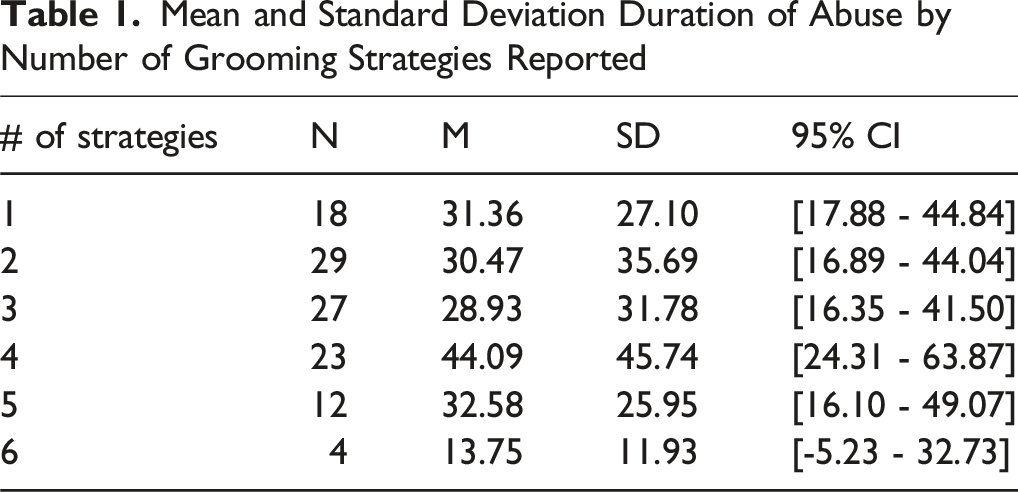
Due to the ambiguity of case versus child-specific events reported in judicial decisions, grooming strategies were case-specific (e.g., related to all charges under evaluation, not specific to a single child). When cases included multiple complainants, the average duration of abuse across complainants was used. A one-way analysis of variance (ANOVA) examined group differences between the number of strategies used and abuse duration while regression analysis was used to identify which grooming strategies predicted duration of abuse.
Number of Grooming Strategies on Abuse Duration
Mean and Standard Deviation Duration of Abuse by Number of Grooming Strategies Reported
Relationship Between Strategy Type and Abuse Duration
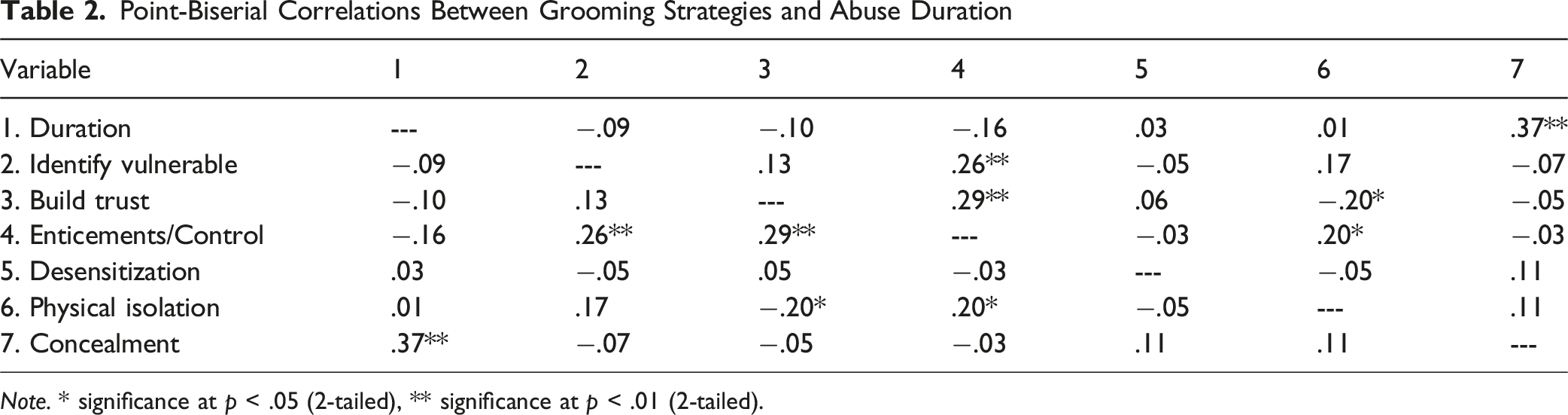
A two-step hierarchical regression was used to determine if the addition of post-abuse grooming strategies (Physical Isolation, Concealment, and Sexual Desensitization) explained additional variance in abuse duration (months) beyond the presence of pre-abuse grooming strategies (Identify Vulnerable, Build Trust, Enticement/Control). All statistical assumptions were tested, finding independence of observations (Durbin-Watson statistic of 2.02), homoscedasticity, and linearity (using scatterplot). Multicollinearity was not detected (all tolerance values were greater than 0.1; Hair et al., 2014), and the data were approximately normally distributed. During assumption testing, one outlier was identified but retained for analysis as it represents a true experienced duration of abuse.
Point-Biserial Correlations Between Grooming Strategies and Abuse Duration
Note. * significance at p < .05 (2-tailed), ** significance at p < .01 (2-tailed).
Discussion
Using Canadian judicial decisions, the current study explored the impact of established in-person sexual grooming strategies on the duration of abuse. A lack of significant difference in abuse duration based on the number of judicially reported strategies suggests that the type of strategy may be more impactful than the number used, regarding abuse duration. Looking at the six overarching strategies of identifying vulnerable victims, building trust, using enticements and methods of control, physical isolation, and attempting to conceal abuse, the current study suggests that abuse duration is most influenced by reported concealment. Therefore, attempts to conceal abusive events may facilitate more experiences of abuse. This is an important finding because, although intuitive, the establishment of the relationship between attempts to conceal and its actual effectiveness conveys urgency in education about the ongoing nature of this strategy.
Attempting to conceal abuse (e.g., requesting secrecy, physical or emotional threats) is a common grooming strategy recently reported to occur in approximately 60% of in-person grooming cases (Berens et al., 2023). While it is not the most prevalently used strategy by in-person groomers (compared to sexual desensitization, physical isolation, and building trust; Berens et al., 2023), it was the only strategy in the present study to be significantly associated with increased abuse duration above and beyond all other variables, making it perhaps the most impactful strategy related to maintaining victim compliance following abuse. While the assertion that grooming occurs both pre- and post-abuse is relatively new (Winters et al., 2022), the prevalence of repeated instances of abuse in grooming cases further indicates the use of post-abuse strategies to maintain abusive behaviour against the child (Berens et al., 2023). This study further supports this area of thought, suggesting that concealment, a post-abuse grooming strategy, does not only conceal previous abuse from being detected but may contribute to the likelihood of future abuse occurring.
These findings offer insight to guide interventions for child sexual abuse involving grooming. While it is never the responsibility of children to prevent abuse, interventions and initiatives may benefit from including education for children related to combatting secret keeping in the face of being physically or psychologically threatened (e.g., told that they will be taken away from their families for disclosing abuse). While parents and other adults require training on recognizing grooming (Steedman et al., 2024), concealment specifically targets a child’s likelihood to disclose anything related to the abuse. Therefore, ensuring initiatives exist specifically for children and adolescents may be of particular importance. Further, future research should continue to explore the impact of post-abuse strategies across settings (e.g., cases of online and mixed grooming) on abuse duration as online environments continue to facilitate opportunities for grooming while potentially reducing the likelihood of disclosure, at times leading to in-person abuse (see Berliner & Conte, 1990). Therefore, further exploration of the impact, and interaction, of in-person and online grooming strategies is needed.
Limitations
While examining judicial decisions provided a breadth of information, it does limit the sample to only instances of child sexual abuse where legal action was sought and the evidence was deemed substantial and credible enough to proceed to trial. Therefore, the current sample likely excludes instances of abuse that were reported but not investigated or where the child was deemed too young or unable to testify in court. Information regarding the strategies used and abuse durations of survivors who experience barriers to trial may differ from the current sample. Further, information on the use of grooming strategies could only be extrapolated from the information presented during the trial and subsequently deemed relevant by the judge to include in the written decision. This includes the use of the word grooming, which was a requirement of our search criteria and therefore may have excluded relevant cases that were not identified as such in the courts. Therefore, information indicative of grooming may not be included in this study sample. Lastly, this study included all court decisions meeting study criteria regardless of verdict. Thus, the sample also includes cases in which the abuse may not have taken place the way in which it was described at trial. Future research assessing other sources of information (e.g., court transcripts, self-reports) will provide valuable insight into the research questions under study.
Conclusion
Overall, the present study emphasizes the influence of reported abuse concealment attempts on abuse duration in child sexual abuse cases involving grooming. This finding suggests that this post-abuse grooming maintenance strategy may not only prevent the detection of previous abuse but may also facilitate opportunities to commit additional abuse. Therefore, interventions and initiatives must include targeted education around disclosing abuse in the face of these concealment attempts such as secrecy and physical or psychological threats.
Footnotes

Ethical Considerations
Given that this research relies only on publicly available information that is legally accessible, it was exempt from review by the Research Ethics Board.
Funding
The authors disclosed receipt of the following financial support for the research, authorship, and/or publication of this article: This research was supported by the Social Sciences and Humanities Research Council of Canada to H.L.P. and by the Canada Research Chairs Program to H.L.P.
Declaration of Conflicting Interests
The author(s) declared no potential conflicts of interest with respect to the research, authorship, and/or publication of this article.
Data Availability Statements
AI Use Statement
Grammarly was used to improve the grammar and clarity of the manuscript. All analytical decisions, interpretations, and written content were generated and written by the authors.