



Abstract
Child maltreatment and problematic alcohol use in adolescence represent significant public health concerns with interrelated risks. We examined relationships between maltreatment exposure, non-maltreatment adversities, and problematic alcohol use in a representative sample of Australian youth aged 16–24 (n = 3,500). Structural equation models revealed that youth experiencing multiple maltreatment types reported greater levels of problematic alcohol use, even after controlling for non-maltreatment adversities, mental health, and gender. When accounting for co-occurrence, only sexual abuse was independently associated with alcohol problems. Household substance use was most strongly associated with youth problematic alcohol use among non-maltreatment adversities, while self-perceived racial bias showed an inverse relationship. Duration of maltreatment was directly associated with alcohol outcomes, though neither age of onset nor duration moderated the relationship between maltreatment exposure and alcohol use. These findings highlight the need for comprehensive prevention and intervention strategies addressing both maltreatment and family-level risk factors for problematic alcohol use.
Introduction
Youth alcohol use remains a significant public health concern, creating substantial implications across multiple domains. Beyond impacts on mental health, neurodevelopment, and long-term wellbeing (Ryan et al., 2019; Squeglia, 2020; WHO, 2024), problematic alcohol use in youth contributes significantly to interpersonal violence, sexual assault, and self-inflicted and accidental injuries including motor vehicle crashes (Brauer et al., 2024; Hingson et al., 2017; White & Hingson, 2014). Alcohol misuse often disrupts educational trajectories, being associated with poor academic performance, reduced educational attainment, and subsequent employment difficulties (Kelly et al., 2015; Townsend et al., 2007). The economic burden associated with these outcomes is substantial in both amount and scope, encompassing healthcare costs, lost productivity, and involvement in the criminal justice system (Rehm et al., 2019).
Understanding youth as a uniquely vulnerable developmental period is essential, given that these varied harms are concentrated during adolescence and early adulthood. The extended youth period (ages 10–24) represents a convergence of rapid brain maturation, social-role transitions, and biological growth that heightens neurological susceptibility to alcohol’s effects (Arain et al., 2013). Among the various forms of childhood adversity, maltreatment and other adverse childhood experiences (ACEs) warrant particular attention due to their pervasive developmental associations and strong associations with later alcohol problems (Hughes et al., 2017; Leza et al., 2021; Scott et al., 2023). Child maltreatment encompasses behaviours involving substantial risk of causing physical or emotional harm to children through acts of omission or commission (Mehta et al., 2021), typically categorised into five types: physical abuse, sexual abuse, emotional abuse, neglect, and exposure to domestic violence (Mathews et al., 2020; UNICEF, 2006).
The scope of maltreatment among Australian youth is substantial. The Australian Child Maltreatment Study (ACMS) revealed widespread prevalence rates among young Australians aged 16–24, including exposure to domestic violence (43.8%), emotional abuse (34.6%), physical abuse (28.2%), sexual abuse (25.7%), and neglect (10.3%) (Mathews, Pacella, et al., 2023). These experiences rarely occur in isolation, with approximately 66% of maltreated young Australians reporting multiple forms of maltreatment (Higgins et al., 2023). The relationship between maltreatment and alcohol use is robust and dose-dependent, with maltreated individuals demonstrating 1.6 times higher likelihood of engaging in binge drinking behaviours (Lawrence et al., 2023) and other problematic alcohol use patterns (Leza et al., 2021). Research by Scott et al. (2023) further demonstrated that youth aged 16–24 with maltreatment histories—particularly those experiencing multi-type maltreatment—faced substantially elevated odds of developing severe alcohol use disorder compared to non-maltreated youth, both before adjustment (OR = 4.96) and after controlling for sociodemographic factors (OR = 4.05).
Multiple studies have documented that recurring adversities can compound over time, potentially having a greater impact than isolated incidents (Anda et al., 2006; Bryce, 2024; Finkelhor et al., 2011). Further, poly-victimisation theory poses that children experiencing multiple types of victimisation are more likely to show negative mental health outcomes than those with repeated episodes of the same type (Finkelhor et al., 2007). However, while research has established that multi-type maltreatment is associated with problematic alcohol use, this work has primarily examined maltreatment in isolation, and there is a need to identify how different types of maltreatment combine and interact with other non-maltreatment adversities to shape alcohol-related risk profiles. This work is particularly important given the higher prevalence of individuals experiencing multi-type maltreatment in this age group (i.e., 40.2%) compared to older age groups (Higgins et al., 2023), and the established relationship between multi-type maltreatment, mental health problems, and health risk behaviours across the lifespan (Lawrence et al., 2023; Scott et al., 2023). Therefore, we focused our analyses on multi-type maltreatment as a key variable of interest while simultaneously examining how it relates to other non-maltreatment adversities and its association with problematic alcohol use in youth. To provide a comprehensive understanding of these relationships, we also examined individual maltreatment types separately, recognising that additive approaches in ACEs research (which simply sum different adversities together) have limitations in capturing the distinct effects of different experiences (Lacey & Minnis, 2020; McLennan et al., 2020), while also considering the role of non-maltreatment adversities in shaping alcohol-related risk.
Non-maltreatment adversities are circumstances that are generally systematic, situational, or external to the direct caregiving relationship. They can affect the family or household environment, even if they do not directly impact the caregiving relationship. These adversities may include (but are not limited to) parental substance misuse, parental mental illness, parental incarceration, and socioeconomic disadvantage (Felitti et al., 1998; Kessler, 2000; Zhen-Duan et al., 2023). Previous studies indicate that adverse childhood experiences (ACEs), including maltreatment and non-maltreatment types, have differential impacts on development and health outcomes, rather than equivalent effects (Negriff, 2020; Putnam et al., 2013). This distinction is particularly relevant in this developing field of research, where conceptualisations, measurements and approaches to childhood adversities continue to evolve (Dube, 2024; McLaughlin, 2016).
There is a significant gap in how research approaches these adversity-alcohol relationships. Whilst extensive literature has established broad associations between maltreatment and non-maltreatment adversities and alcohol use, most studies do not examine the effects of specific adversity types or adequately account for the co-occurring nature of childhood adversities (Busso et al., 2017; McLaughlin & Lambert, 2017; Miller et al., 2018). This limitation is problematic because it overlooks how distinct types of adversities may uniquely contribute to alcohol-related risk, particularly given that these adversities frequently co-occur. For instance, in the ACMS study, between 14.8% and 16.4% of young Australians aged 16–24 reported experiencing both multi-type child maltreatment and at least one other family-related adversity (Higgins et al., 2023). These overlapping patterns are particularly pronounced in certain contexts, as youth living with someone who has substance use issues demonstrated one of the strongest associations; they were 2.6 times more likely to experience multi-type maltreatment than those who did not grow up in such environments. This pattern reflects the broader tendency for non-maltreatment adversities to cluster with multiple forms of maltreatment rather than occurring independently, which has important implications for understanding alcohol-related risk. Indeed, extensive research has established robust associations between ACEs (including maltreatment and non-maltreatment adversities) and alcohol use, with evidence suggesting a dose-response relationship where greater adversity exposure is associated with increased risk for problematic drinking (Hoffmann & Jones, 2022).
The present study extends previous research by accounting for the complex interplay and intercorrelated relationships between child maltreatment and other non-maltreatment adversities, characterised by both direct and interactive relationships, in association with problematic alcohol use in youth. This comprehensive analytical approach is theoretically grounded in developmental psychopathology principles, which emphasise that adverse experiences rarely occur in isolation (Higgins et al., 2023) and that their associations with youth outcomes depend on both individual and cumulative influence (Schilling et al., 2008). This study addresses critical gaps in understanding how interconnected risk factors are associated with alcohol use behaviours in youth by examining direct, cumulative, and interactive associations across different adversity types. Such an integrated approach is essential for advancing theoretical models of adversity-related alcohol risk, moving beyond simplistic additive models toward more nuanced frameworks that capture the complex reality of how multiple adversities interact within youth developmental contexts.
Understanding the temporal dimensions of adversity exposure adds complexity to these relationships. Research demonstrates that adversities occurring during sensitive periods of childhood and youth are more strongly associated with later drinking behaviours compared to similar experiences in adulthood (Moustafa et al., 2021). Early childhood emerges as especially critical, characterised by rapid neurodevelopment and increased neuroplasticity that enables the biological embedding of adverse experiences (Berens et al., 2017). These physiological alterations can persist across the lifespan (Friedman et al., 2015; Taylor et al., 2011), underscoring the importance of examining how the timing and type of childhood adversity are associated with problematic alcohol use.
Present Study
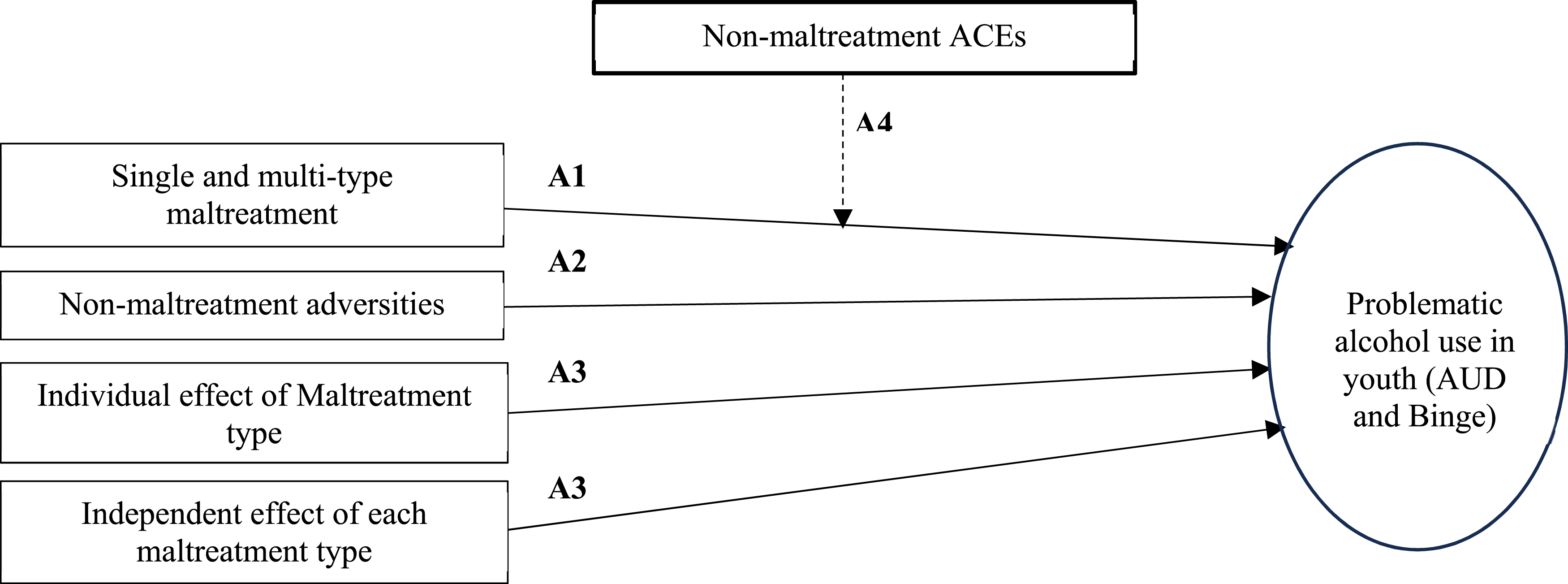
In this study, we aimed to examine the relationships between child maltreatment (i.e., ‘maltreatment’), broader environmental adversities (i.e., non-maltreatment ACEs), and the level of problematic alcohol use (binge drinking and alcohol use disorders) in youth. Our first aim was to examine the relationship between child maltreatment exposure (categorised as none, one type, or multiple types) and the level of problematic alcohol use (A1). Our second aim was to investigate this relationship after controlling for the presence of any of the non-maltreatment adversities (A2). Our third aim was to understand if experiencing any single child maltreatment type (physical, sexual, emotional, neglect, or exposure to domestic violence) was associated with the level of problematic alcohol use (A3a), and to understand if the relationship remained significant after controlling for the occurrence of other maltreatment types (A3b). Our fourth aim was to examine the direct associations of individual non-maltreatment adversities on problematic alcohol use to understand which specific adversities independently contribute to alcohol use risk (A4). Our fifth aim was to examine whether experiencing any non-maltreatment adversity moderated the relationship between maltreatment exposure (none, one type, or multiple types) and the level of problematic alcohol use in youth (A5). Finally, given some suggestions that there may be sensitive periods for the effects of adversity on the brain (Berens et al., 2017; Moustafa et al., 2021), we conducted exploratory analyses examining how both the timing and duration of maltreatment exposure were associated with youth alcohol use behaviours, including their direct associations and potential interactions.
Methods
The Australian Child Maltreatment Study (ACMS) is a cross-sectional study of 8,503 Australians aged 16 years and older, with data collected via computer-assisted telephone interviewing. For this study, we analysed the youth subsample (n = 3,500; 41.1%) aged 16–24 years. To ensure representativeness, participants were weighted statistically to match Australian census demographics. They retrospectively reported their childhood experiences of maltreatment, as well as other childhood and adulthood experiences. Detailed information on the complete study methodology, including the survey instrument used to capture retrospective self-reported data on childhood maltreatment experiences, non-maltreatment adverse childhood experiences, diagnostic screening of mental health disorders, physical health conditions, and health risk behaviours, is available in Mathews et al. (2021, pp. 3–5).
Measures
Problematic Alcohol Use
The ACMS assessed alcohol-related outcomes using two key measures. Binge drinking was measured using the same approach as the National Survey of Mental Health and Wellbeing (2007) criteria using a two-step process: participants first reported their alcohol consumption frequency (1–3 times per month, 1–4 times per week, or daily), followed by quantity assessment (for those who reported drinking weekly). Binge drinking was defined using gender-specific thresholds. For males, the definition was consumption of ≥ 6 drinks in a single session at least once a week over 12 months, and for females, the definition was consumption of ≥ 5 drinks in a single session at least once a week over 12 months. This was coded as a binary variable (yes/no). Alcohol use disorder (AUD) was assessed using the Mini-International Neuropsychiatric Interview (MINI), which classified severity into none (0), mild (1), moderate (2), and severe (3) levels based on DSM-5 criteria (American Psychiatric Association & American Psychiatric Association, 2013). Complementary measures were integrated into a latent variable structure that captured both binge drinking behaviours and AUD severity. A latent variable is an unobserved construct that cannot be directly measured but is inferred through a mathematical model from multiple observable variables (Cai, 2012). In this context, the latent variable represents the underlying construct of “problematic alcohol use” that we estimated from the observed indicators of binge drinking frequency and AUD severity. Higher scores on this latent variable indicated higher levels of problematic alcohol use. This approach aligns with contemporary frameworks conceptualising problematic alcohol use as a spectrum, emphasising the dimensional nature of alcohol involvement, where severity exists along a continuum rather than discrete categories (Chassin et al., 2013; Jackson & Sher, 2005). The measurement model was estimated using diagonally weighted least squares (DWLS) with a mean- and variance-adjusted test statistic and robust standard errors. To identify the model, we fixed the latent factor variance to 1.0 and used AUD severity as the reference indicator. The details of the measurement model and fit indices are provided in Supplemental Material S1.
Child Maltreatment Measures
Maltreatment Type and Subtype
The Juvenile Victimization Questionnaire – R2: Adapted Version (Australian Child Maltreatment Study) was used to capture self-reported experiences of child maltreatment for this sample (Mathews, Meinck, et al., 2023). The ACMS assessed five maltreatment types – physical abuse (PA), two subdomains; sexual abuse (SA), four subdomains; emotional abuse (EA), three subdomains; neglect (NEG), three subdomains; and exposure to domestic violence (EDV), four subdomains. For details on the items used to define each maltreatment type, please see Table S1.
Affirmative responses to any type led to follow-up questions to gather more details, including the number of times the experience occurred (or its duration over time), and the age of onset (i.e., age first experienced). Participants were classified as having experienced physical abuse, sexual abuse, or exposure to domestic violence based on conceptual models of these maltreatment types. They were classified if they endorsed any of its associated subtypes and if it had occurred once or more. Furthermore, because conceptual models recognise emotional abuse (Slep et al., 2022), and neglect (Dubowitz et al., 2005) as experiences characterised by prolonged exposure, we classified participants as having experienced emotional abuse, and neglect, only if they both endorsed an associated subtype, and if that experience continued over a period of weeks, months, or years (Mathews, Meinck, et al., 2023).
Maltreatment Exposure
This variable was operationalised as a categorical measure representing exposure to childhood maltreatment. Participants were asked to indicate whether they had experienced any of the five maltreatment types: physical abuse, sexual abuse, emotional abuse, neglect, or exposure to domestic violence. Participants were coded into three categories based on their responses: 0 = no maltreatment experienced; 1 = any single type of maltreatment experienced (“single type”); and 2 = two or more types of maltreatment experienced (“multi-type”). We then dummy-coded this categorical variable with no maltreatment (0) as the reference category, creating two binary variables that represented single-type and multi-type maltreatment in our analyses.
In examining maltreatment types, we distinguished between two key measurement approaches. For each of the five maltreatment types, participants were dichotomously coded as having experienced or not experienced that specific type of maltreatment, regardless of whether they had experienced other types. Second, we examined these relationships while statistically controlling for the presence of any of the other four maltreatment types. For example, when examining sexual abuse, we first assessed its individual association with problematic alcohol use. We then created a score (0–4) by summing the presence of any other maltreatment types, including emotional abuse, physical abuse, neglect, and exposure to domestic violence, as a control variable. This process was repeated for each type of maltreatment separately.
Non-Maltreatment Childhood Adversities
In addition to the child maltreatment variables, ACMS measured the presence of eight non-maltreatment adverse childhood experiences (ACEs) using items from the US National Child Health Survey on Adverse Childhood Experiences to obtain information on parental divorce or separation; parental death; parental imprisonment; neighbourhood violence; familial mental illness; familial problematic alcohol or drug use; familial economic hardship and racial victimisation (Felitti et al., 1998). Notably, we did not control for respondent race/ethnicity alongside perceived racial discrimination to avoid multicollinearity, as experiences of racial discrimination are highly correlated with minority racial/ethnic status. This is because our measure captures subjective experiences of perceived discrimination rather than objective racial/ethnic category membership.
Participants reported whether they experienced any of the eight non-maltreatment adversities. Each item was recorded as yes or no, except for economic hardship, which was collected as a categorical variable, but re-coded into a binary variable to ensure consistency with other ACE indicators (Haslam et al., 2023). Responses of “Never” or “Not very often” were coded as 0, while responses of “Somewhat often” or “Very often” were coded as 1. This binary classification aligned with our analytical approach, which focused on examining how the presence versus absence of each ACE, rather than its severity, related to the relationship between multi-type maltreatment and alcohol outcomes.
Control Variables
Mental Health
The mental disorder status of participants was assessed using the MINI diagnostic criteria, which align with the DSM-5 diagnostic criteria. The mental disorders included in the study were major depressive disorder (MDD), generalised anxiety disorder (GAD), and post-traumatic stress disorder (PTSD). These disorders were selected due to their strong associations with both child maltreatment (Scott et al., 2023) and alcohol use. We coded mental health disorder status as a binary variable (0 = absent, 1 = present).
Gender Identity
Based on self-reported gender identity by participants (Higgins et al., 2023), gender was categorised as male or female, and due to small cell sizes, all people with other identities were grouped as ‘diverse genders’ in the ACMS sample. In this study, we dummy-coded gender identity (male as reference) by creating two binary variables: female (1 = female, 0 = otherwise) and diverse (1 = any diverse gender, 0 = otherwise).
Statistical Analysis
Analyses were conducted using R (Version 2024.09.0 R Core Team, 2024) for Mac with the following packages: lavaan (Rosseel, 2012), psych (Revelle, 2023), dplyr (Wickham, 2023), semTools (Jorgensen, 2021), and stats (R Core Team, 2024). We first established the independent significance of individual maltreatment types and their associations with problematic alcohol use using Spearman’s rank correlations (See Supplemental Material S2 for correlation matrices).
Analytical Model Specifications
To examine the complex interplay between maltreatment characteristics and problematic alcohol use, we developed a systematic sequence of structural equation models (SEMs) incorporating both categorical maltreatment variables (single-type vs. multi-type) and temporal dimensions (maximum duration and earliest age of onset). We centred the continuous temporal variables prior to analysis, allowing us to assess their independent associations, while accounting for their natural association with maltreatment type (see Supplemental Material S1). Each model addresses distinct research questions regarding maltreatment-alcohol relationships (see Figure 1). • Model 1: Examined direct associations of categorical maltreatment exposure (single-type, multi-type vs. no maltreatment) with the level of problematic alcohol use among youth, controlling for gender identity and mental health disorders. • Model 2: Extended Model 1 by simultaneously incorporating all eight non-maltreatment ACEs as covariates to assess whether maltreatment associations persist after controlling for broader childhood adversity exposure. • Model 3a: Examined whether experiencing any of the five maltreatment types was independently associated with problematic alcohol use, without controlling for the co-occurrence of other maltreatment types. Each maltreatment domain was tested separately, controlling only for gender identity and mental health disorders. • Model 3b: Re-examined individual maltreatment types whilst statistically controlling for co-occurrence of other maltreatment experiences using a summative control variable (0–4 scale) to isolate the unique contribution of each specific maltreatment domain. • Model 4: Tested interactions between each non-maltreatment ACE and maltreatment exposure categories (single-type, multi-type) in separate models whilst controlling for all eight ACEs. The Conceptual Model of the Relationships Examined. Examining the Complex Interplay Between Maltreatment Types and Non-Maltreatment Adversities in Relation to Problematic Alcohol Use in Youth. Note. Study Variables and Moderators are Represented by Rectangles, and Problematic Alcohol Use in Youth is the Latent Outcome Variable and Represented by an Oval. Solid Arrows Depict Direct Relationships Between Study Variables and the Outcome, While Dashed Arrows Represent Moderation Effects Between Maltreatment Types and Problematic Alcohol Use. Interactions and Direct Effects of the Temporal Characteristics (Earliest Age of Maltreatment Exposure and Duration of Maltreatment) are Provided in the Supplemental Material S4
Supplementary Temporal Analysis
Additionally, we assessed associations between the earliest age of exposure and maximum duration, as well as their potential interactions with maltreatment type, and problematic alcohol use, to provide a comprehensive understanding of how temporal characteristics influence problematic alcohol use trajectories (see Supplemental Material, Table S3).
Statistical Procedures and Model Evaluation
The model fit was evaluated using standard indices, including the Comparative Fit Index (CFI), Tucker-Lewis Index (TLI), Root Mean Square Error of Approximation (RMSEA), and Standardised Root Mean Square Residual (SRMR). We calculated the proportion of variance explained (r2) and semi-partial correlations squared (sr2) to determine the unique contribution of each independent variable (see Supplemental Material S4). The difference between the total variance explained and the sum of unique contributions revealed the shared variance among independent variables. Missing data were managed using Full Information Maximum Likelihood (FIML). Benjamini-Hochberg correction was applied to adjust for multiple testing in two specific analytical contexts: (1) when examining each of the five maltreatment types separately in Models 3a and 3b, and (2) when testing whether each of the eight non-maltreatment ACEs moderated the relationship between maltreatment exposure and problematic alcohol use in Model 4. Finally, all models included mental health disorders and gender identity as covariates.
Results
Demographic Characteristics
Descriptive Statistics for Youth Sample (n = 3500)
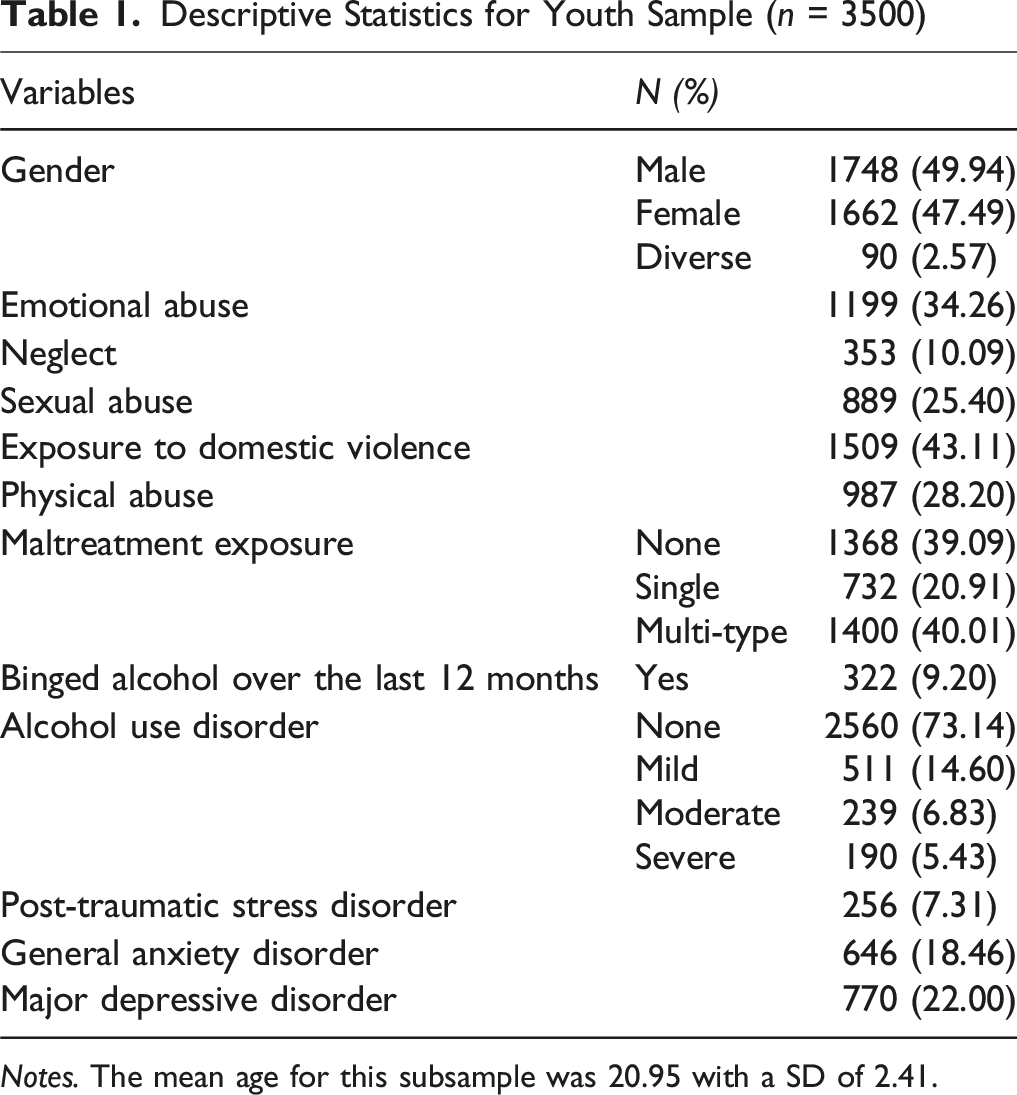
Notes. The mean age for this subsample was 20.95 with a SD of 2.41.
Maltreatment Exposure and Problematic Alcohol Use (Aims 1–2)
The relationship between maltreatment exposure and problematic alcohol use was significant in both the maltreatment-only model and the model that included non-maltreatment ACEs. In the maltreatment-only model, single-type maltreatment (β = 0.19, p = .004) and multi-type maltreatment (β = 0.35, p < .001) were both associated with problematic alcohol use. However, when controlling for non-maltreatment ACEs, the associations of multi-type maltreatment were attenuated, with a reduced effect size (β = 0.12, p = .040) and single-type maltreatment becoming non-significant (β = 0.12, p = .070). Both models demonstrated excellent fit (CFI > .94, RMSEA = .03). Wald tests confirmed that the reduction in the effect for multi-type maltreatment was significant (z = 2.71, p = .007). In contrast, the single-type maltreatment effect was not significantly reduced (
Individual Maltreatment Types and Problematic Alcohol Use (Aims 3a–3b)
Direct Individual Associations and Independent Associations (Controlling for Co-occurrence) of Maltreatment Types on Problematic Alcohol Use
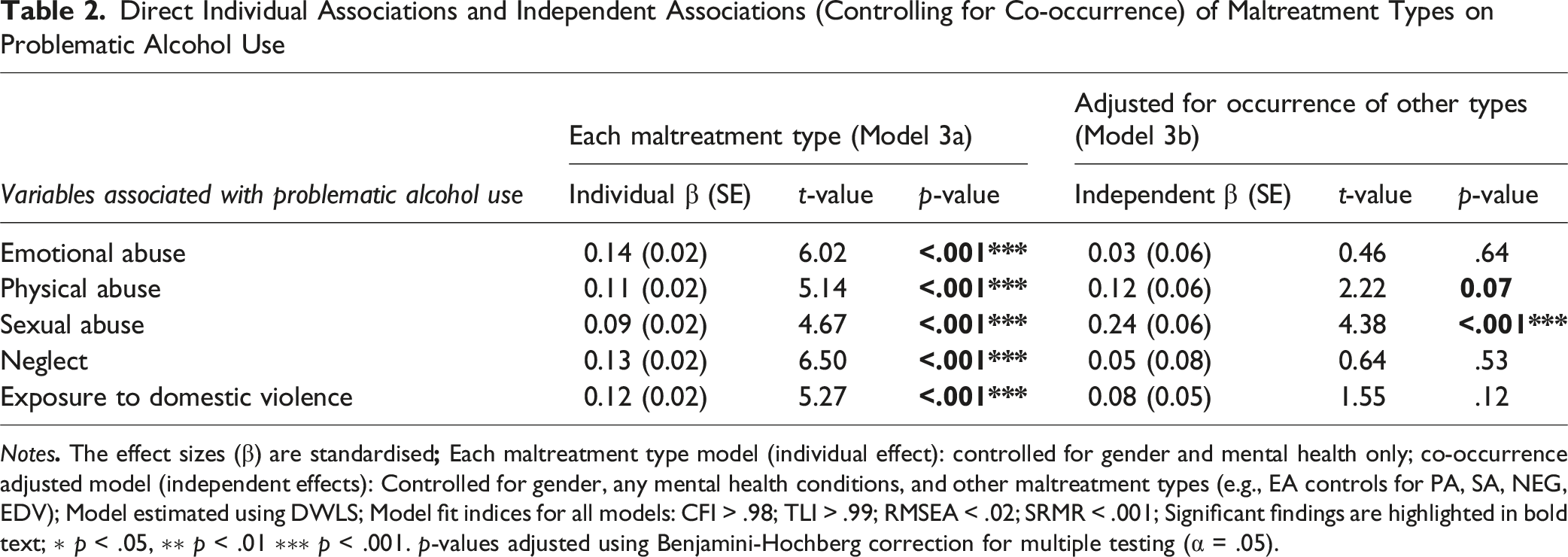
Notes
Direct Effects of Non-maltreatment ACEs on Problematic Alcohol Use (Aim 4)
Direct Effects of Maltreatment Types and Non-maltreatment ACEs on Problematic Alcohol use: comparison of Maltreatment-Only and Maltreatment + ACEs Models
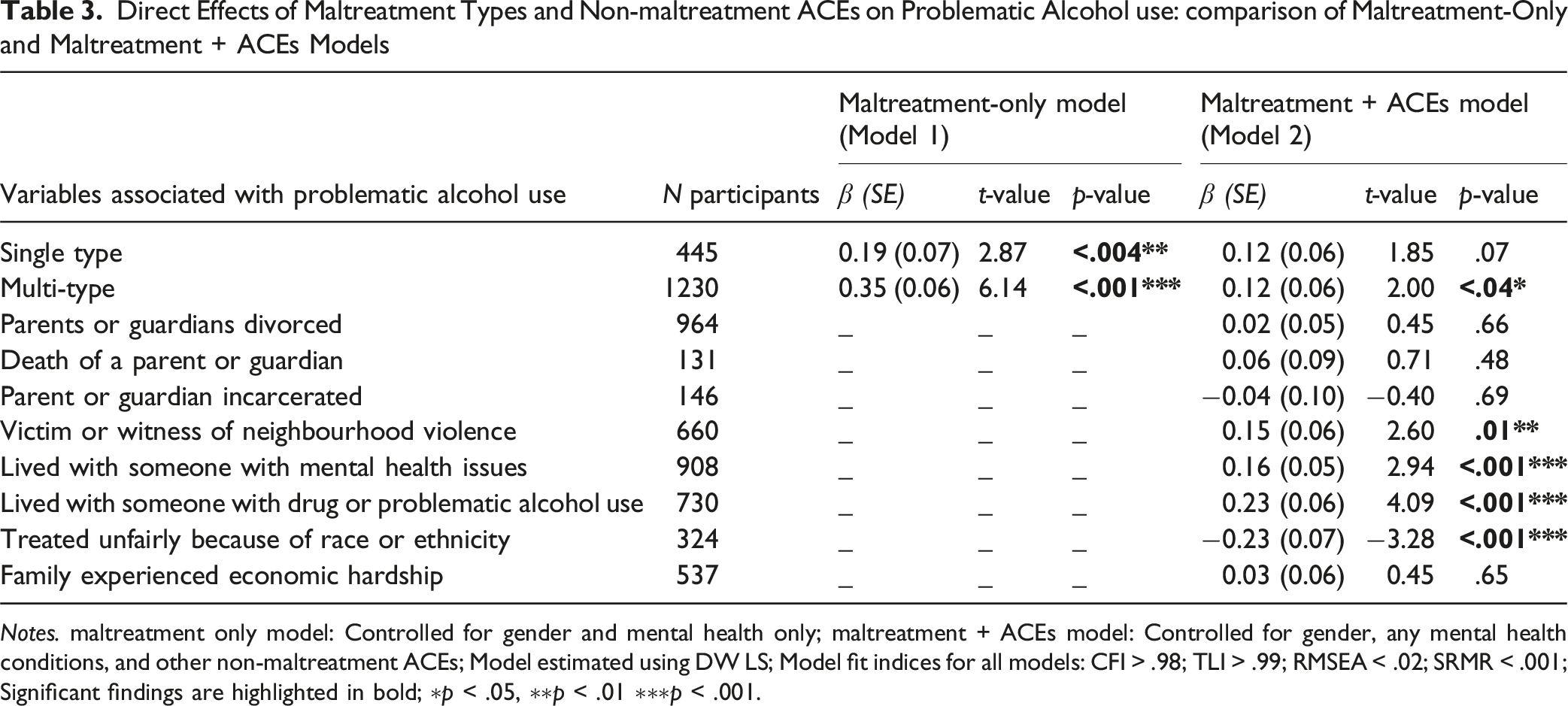
Notes. maltreatment only model: Controlled for gender and mental health only; maltreatment + ACEs model: Controlled for gender, any mental health conditions, and other non-maltreatment ACEs; Model estimated using DW LS; Model fit indices for all models: CFI > .98; TLI > .99; RMSEA < .02; SRMR < .001; Significant findings are highlighted in bold; ∗p < .05, ∗∗p < .01 ∗∗∗p < .001.
Moderation Effects of Non-Maltreatment ACEs (Aim 5)
Moderation Analysis of Non-maltreatment ACEs (Model 4) on the Relationship Between Maltreatment Exposure and Problematic Alcohol Use
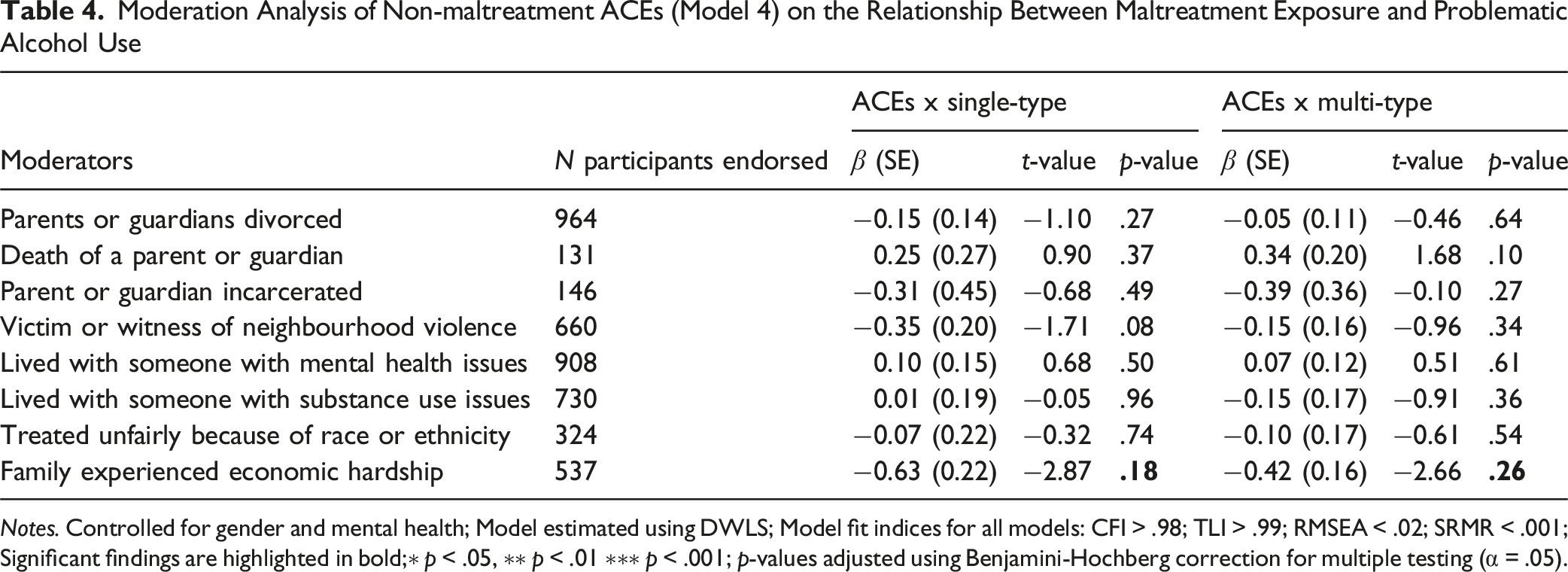
Notes. Controlled for gender and mental health; Model estimated using DWLS; Model fit indices for all models: CFI > .98; TLI > .99; RMSEA < .02; SRMR < .001; Significant findings are highlighted in bold;∗ p < .05, ∗∗ p < .01 ∗∗∗ p < .001; p-values adjusted using Benjamini-Hochberg correction for multiple testing (α = .05).
Finally, exploratory analyses examining timing and duration effects are detailed in Supplemental Material S3. Duration of maltreatment showed a small but significant direct effect on problematic alcohol use. In contrast, neither earliest age of exposure nor duration significantly moderated the relationship between maltreatment exposure and alcohol outcomes.
Discussion
We used a nationally representative data set to explore the relationships between child maltreatment, non-maltreatment adversities (ACEs), and the level of problematic alcohol use in youth aged 16–24. Firstly, we investigated how exposure to single-type and multi-type maltreatment, compared to no maltreatment, was associated with problematic alcohol use level among youth. We also examined whether specific maltreatment types (physical abuse, sexual abuse, emotional abuse, neglect, and exposure to domestic violence) were uniquely associated with the level of problematic alcohol use. We also examined how these relationships changed when accounting for co-occurring maltreatment types and non-maltreatment adversities.
The Importance of Considering Multiple Types of Maltreatment
In this study, multi-type maltreatment was strongly associated with more severe problematic alcohol use in youth, even after accounting for non-maltreatment ACEs, mental health, and gender. Notably, single-type maltreatment initially showed a significant association with alcohol outcomes. However, this relationship became non-significant after adding non-maltreatment ACEs to the model. This finding aligns with prior research demonstrating the cumulative impact of multiple maltreatment types on substance use outcomes (Bryce, 2024; Greene et al., 2020; Halpern et al., 2018; Kirsch & Lippard, 2022). Our study contributes to this literature by specifically examining whether these relationships persist after accounting for non-maltreatment ACEs. For example, Scott et al. (2023) found that individuals who experienced multi-type maltreatment had 2.62 times higher odds of severe alcohol use disorder compared to those with no maltreatment history, demonstrating a clear dose-response relationship. Similarly, Lawrence et al. (2023) reported significantly higher rates of health risk behaviours (e.g., binge drinking, cannabis dependence and cigarette smoking) among those who experienced multi-type maltreatment compared to single-type exposure. We extend these findings by demonstrating that multi-type maltreatment experienced by young adults remains robustly associated with greater levels of problematic alcohol use, even after accounting for non-maltreatment ACEs, mental health disorders, and gender. We also examined temporal characteristics of maltreatment as an exploratory analysis (Supplemental Material S4) to understand the potential effect that timing and duration of maltreatment may have on the development of problematic alcohol use in youth. In this analysis, multi-type maltreatment continued to show a significant relationship with problematic alcohol use in youth. However, neither the earliest age of exposure nor the duration of maltreatment moderated this relationship. These non-significant moderation effects align with cumulative risk models, which propose that the association between adversity accumulation and outcomes remains consistent regardless of when adversities occur or how long they last. According to this framework, experiencing multiple types of maltreatment confers risk in a relatively uniform manner, with timing and duration characteristics not amplifying or diminishing this core relationship (Hoffmann & Jones, 2022). However, our analysis revealed a more nuanced pattern when examining direct associations. When examining direct associations of these temporal characteristics, we found that duration of maltreatment had a small but statistically significant association with problematic alcohol use, even after accounting for shared variance with maltreatment types. This suggests that while timing and duration do not modify the strength of the multi-type maltreatment effect (supporting cumulative risk theory), duration of exposure may contribute additional risk beyond the mere presence of multiple maltreatment types. The small effect size likely reflects the high correlation between multi-type maltreatment and longer duration of exposure, indicating that multi-type maltreatment may partially serve as a proxy for duration.
This dose-response relationship between maltreatment exposure and level of alcohol use problems can be understood through developmental trauma frameworks (Van der Kolk et al., 2005), which suggest that exposure to multiple forms of maltreatment can overwhelm the adaptive coping mechanisms of youths. Each additional type of maltreatment may compound difficulties in emotional regulation and stress response (Nelson et al., 2020), potentially leading to more severe alcohol use as a maladaptive coping strategy. These neuro-adaptations may heighten vulnerability to alcohol use as youth attempt to modulate stress responses and emotional states. Given that multi-type maltreatment is more prevalent among youth than single-type maltreatment exposure, its strong association with problematic alcohol use represents a significant public health concern.
Associations Between Individual Maltreatment Types and Problematic Alcohol Use
When examined individually, each type of maltreatment was significantly associated with increased problematic alcohol use, though these associations changed substantially when accounting for co-occurrence. However, maltreatment types naturally co-occur, with youth commonly experiencing multiple forms simultaneously. Once we controlled for the co-occurrence of other maltreatment types, only sexual abuse remained independently associated with problematic alcohol use. Physical abuse showed a marginal association with problematic alcohol use, but did not survive correction for multiple comparisons. These findings expand those of Lawrence et al. (2023) and Scott et al. (2023), who similarly found that sexual abuse maintained significant associations with problematic drinking even after accounting for other maltreatment types. Notably, they reported particularly strong associations between maltreatment and severe alcohol use disorders among youth aged 16–24, with high proportions of sexual abuse history among both young males (80.8%) and females (72.6%) with severe AUD. Our study extends these findings by using a latent variable approach that recognises problematic alcohol use as a continuous dimension. The substantial reduction in effect sizes for emotional abuse, physical abuse, neglect, and domestic violence when controlling for co-occurring maltreatment suggests that these types may not contribute unique explanatory power beyond their co-occurrence with other maltreatment types, while sexual abuse maintained independent associations.
The unique vulnerability associated with sexual abuse may be understood through its distinctive traumagenic consequences, including betrayal, stigmatisation, and traumatic sexualisation that fundamentally alter a young person’s sense of self and relationships (Noll, 2021). Sexual abuse survivors may develop particularly strong coping-related alcohol expectancies (i.e., beliefs that alcohol will help manage trauma-related symptoms and provide emotional relief), which play a more problematic role in maintaining alcohol use than enhancement expectancies (Jester et al., 2015; Moustafa et al., 2021; Zaso et al., 2023). Fletcher (2021) conducted a systematic review of 47 studies and concluded that childhood sexual abuse creates distinctive pathways to psychological difficulties. The review identified that survivors exhibit elevated rates of both internalising symptoms (depression, anxiety, PTSD) and externalising behaviours (aggression, substance use), supporting a dual-pathway model of trauma-related psychopathology.
The absence of significant associations for neglect, emotional abuse, and domestic violence exposure after controlling for co-occurrence appears to contradict prior research showing these maltreatment types are associated with alcohol outcomes (Debowska et al., 2017; Shin et al., 2013). However, this difference in outcomes may reflect methodological differences: many previous studies have examined individual maltreatment types without comprehensive co-occurrence modelling, potentially overestimating the unique effects due to shared variance (Kim et al., 2017). The high intercorrelations between experiences of each maltreatment type in our sample may result in other maltreatment types losing their explanatory power when co-occurring maltreatment is accounted for, while sexual abuse retains unique associations beyond co-occurring maltreatment experiences. These findings suggest that sexual abuse survivors may require trauma-informed approaches that address both internalising and externalising symptoms and provide alternative coping strategies for trauma-related difficulties, as traditional substance use interventions may be insufficient.
The Direct and Moderating Effects of Non-Maltreatment ACEs
Our moderation analyses revealed that the presence or absence of non-maltreatment ACEs did not significantly alter the relationship between maltreatment exposure and problematic alcohol use in youth. The overall pattern in the findings from the moderation analysis suggests that the ways that child maltreatment is associated with problematic alcohol use in adulthood operates through independent pathways, maintaining its association, regardless of other adversities such as parental divorce, death of a parent, parental incarceration, exposure to neighbourhood violence, living with someone with mental health or substance use issues, self-perceived racial bias, or economic hardship. These findings challenge assumptions about cumulative or multiplicative effects of adversities, indicating instead that maltreatment and non-maltreatment adversities may contribute to problematic alcohol use through distinct mechanisms.
In examining the direct assocations between non-maltreatment ACEs and alcohol misuse, living with someone who has substance use problems showed the strongest association with problematic alcohol use level in youth, followed by living with someone with mental health issues. These findings align with Social Learning Theory (Bandura & Adams, 1977; Kruis et al., 2020), suggesting children model caregiver behaviours in environments where maladaptive coping strategies are prevalent. Additionally, being a victim or witness to neighbourhood violence was significantly associated with problematic alcohol use, consistent with research showing that exposure to violence is associated with increased alcohol use through both direct trauma effects and indirect pathways, such as peer influence and reduced parental monitoring (Hamburger et al., 2008; Vermeiren et al., 2003). Although this study did not examine the familial aggregation of alcohol use problems through genetic and shared environmental pathways (Hatoum et al., 2023; Verhulst et al., 2015), these mechanisms likely also play important roles in the intergenerational transmission of risk. These patterns underscore the importance of integrated family-based interventions addressing parental and youth mental health and substance use issues, while implementing appropriate safeguarding measures.
Our analysis also revealed an inverse relationship between being treated or judged unfairly because of race or ethnic group and the level of problematic alcohol use in youth, challenging traditional stress-coping frameworks (González-Roz et al., 2024). This inverse relationship between perceived racial/ethnic discrimination and problematic alcohol use was unexpected, although discrimination-substance use associations vary across populations (AIHW, 2020; Donato-Hunt et al., 2012). Our study was not designed to examine underlying mechanisms. This finding may reflect unmeasured factors and requires further investigation to elucidate the underlying pathways.
Future Research Directions
Our findings highlight the complex interplay among maltreatment, non-maltreatment adversities, and problematic alcohol use in youth, with important implications for future research and multiple policy domains. Critically, once we controlled for the occurrence of other maltreatment types, as well as for mental health disorders and gender, only sexual abuse remained independently associated with problematic alcohol use. This finding carries significant implications for policy and practice, suggesting that targeted prevention and intervention efforts should prioritise addressing these specific forms of maltreatment while still recognising the cumulative nature of maltreatment exposure and its association with problematic alcohol use.
In the realm of alcohol prevention and intervention among youth, our results identify independent associations of both maltreatment and specific family-level adversities, which suggest the need for integrated approaches. Future research should evaluate early intervention strategies that address both family-level risk factors and youth substance use. Screening tools and intervention protocols could be refined to identify and respond to maltreatment and non-maltreatment adversities, considering their independent and combined associations with problematic alcohol use and other potential health risk behaviours.
From a public health perspective, our findings that living with someone with substance use and mental health issues are independently associated with youth problematic alcohol use alongside maltreatment suggest that child protection frameworks globally must evolve to address these co-occurring household and youth risks. Although existing risk assessment tools for child maltreatment have provided foundational insights, they often fall short in capturing the interconnected nature of risk pathways across health, education, and social services (Vaithianathan et al., 2021). Our identification of multiple independent risk factors suggests that future research should examine how risk modelling can integrate these diverse factors, enabling the early identification of high-risk families while maintaining ethical safeguards (Dare & Gambrill, 2017) and cultural sensitivity. To translate this evidence into practice, implementation research should focus on developing tools for clinicians and policymakers that emphasise trauma-informed care and cross-sector collaboration (AIFS, 2021). This integration should evaluate universal prevention strategies that target shared risk factors while remaining responsive to cultural contexts (Foundation, 2024).
Finally, our finding that maltreatment duration showed a small direct association with problematic alcohol use warrants further exploration through longitudinal research. Such studies could more precisely examine how the timing, chronicity, and developmental staging of adversities relate to alcohol use trajectories, particularly during sensitive developmental periods (Dube et al., 2006; Pilowsky et al., 2009). Cross-sectional data like ours can identify associations between adversities and problematic alcohol use; however, longitudinal designs would better capture the dynamic interplay between maltreatment duration and alcohol outcomes over time. Additionally, understanding how prolonged exposure to maltreatment and other adversities relates to problematic alcohol use, along with identifying protective factors within social and cultural contexts, will help explain why some youth develop maladaptive coping responses, whereas others demonstrate resilience. Furthermore, since problematic alcohol use is also a risk factor for mental health outcomes, self-harm, and suicide, it would be important to understand if the association of child maltreatment on these outcomes is mediated through alcohol use. Such a comprehensive understanding of human adaptation to adversity will reveal why some youth develop maladaptive coping responses while others demonstrate resilience.
Limitations
This study has several methodological limitations that should be considered when interpreting the findings. First, while we measured the temporal characteristics of maltreatment (age of onset and duration), the cross-sectional design still limits causal inference regarding the relationship between maltreatment experiences and the development of problematic alcohol use among youth. Without prospective data collection, we cannot definitively establish whether problematic alcohol use emerged after maltreatment or whether other unmeasured factors influenced both outcomes. Although the ACMS collected data on the age of exposure and duration of exposure to each type of maltreatment, the frequent co-occurrence of multiple maltreatment types—often within the same event or proximate time periods—complicated efforts to disentangle the sequential timing and directionality of these experiences (Haslam et al., 2023). Additionally, participants aged 16 or 17 may have still been experiencing ongoing or subsequently to the data collection have experienced child maltreatment before turning 18, limiting the ability to capture these temporal dimensions of maltreatment fully.
Second, this study relies on retrospective self-report measures, which may introduce recall bias. Participants may overestimate or underestimate their maltreatment experiences or alcohol use when reporting these experiences retrospectively, potentially affecting the accuracy of prevalence estimates and associations between variables.
Third, our focus on a non-clinical, general population sample of Australian youth provides important insights into patterns of problematic alcohol use (AIHW, 2020); however, this may limit its generalisability to clinical populations.
Fourth, our classification of exposure to domestic violence as a form of child maltreatment, following Australian conceptual frameworks, deviates from traditional US ACE research, where it is categorised as household dysfunction. While this classification reflects a growing international consensus (Mathews et al., 2020), this methodological difference may affect the comparability of our estimates with those from studies using standard ACE operationalisation. It should be considered when interpreting findings across different research contexts.
Finally, although this study examined the moderating role of family-related risk factors, it did not explore their possible mediating effects on the relationship between maltreatment and alcohol outcomes. These factors are well-documented contributors to maltreatment risk through their impact on caregiving capacity and increased likelihood of neglect or abuse (McLaughlin & Lambert, 2017; Renner & Boel-Studt, 2017).
Conclusion
Using the ACMS data, we examined associations between childhood adversities and the level of problematic alcohol use in youth, specifically focusing on the level of maltreatment experienced, the types of maltreatment and non-maltreatment ACEs experienced. This study highlights that multi-type maltreatment is an important determinant of greater levels of problematic alcohol use among youth. Building on the multifactorial pathways introduced here, our findings reveal that although disparate adversities such as caregiver mental health issues and non-maltreatment environmental factors also contribute to problematic alcohol use in youth, the compounding effect of multiple maltreatment experiences plays a dominant role. This reinforces the need to move beyond traditional, isolated risk assessments by developing comprehensive assessment tools that integrate information from health, education, and social services. Such an approach would enable the early identification of families likely to face multiple adversities and inform the development of tailored interventions. Moreover, we suggest the need for longitudinal research further to explore the impact of maltreatment duration on alcohol outcomes and to elucidate intergenerational pathways, thus bridging existing gaps in our understanding. Ultimately, these findings support the need for comprehensive, family- and community-focused strategies that address the layered impact of adverse childhood experiences on youth alcohol use, aligning with broader public health imperatives and evidence-based policy development.
Supplemental Material
Supplemental Material - The Impact of Child Maltreatment and Adverse Childhood Experiences on Problematic Alcohol Use in a Nationally Representative Survey of Youth
Supplemental Material for The Impact of Child Maltreatment and Adverse Childhood Experiences on Problematic Alcohol Use in a Nationally Representative Survey of Youth by Dhatsayini Rattambige, Daryl J. Higgins, Sarah Whittle, Michael H. Cole, Ben Matthews, James G. Scott, Holly Erskine, Franziska Meinck, Rosana Pacella, David Lawrence, and Divna M. Haslam in Child Maltreatment
Footnotes

Funding
The authors received no financial support for the research, authorship, and/or publication of this article. The author(s) disclosed receipt of the following financial support for the research, authorship, and/or publication of this article: The ACMS is supported by a National Health and Medical Research Council Project Grant (APP1158750). The ACMS receives additional funding and contributions from the Australian Government Department of the Prime Minister and Cabinet; the Department of Social Services; and the Australian Institute of Criminology. FM was supported by the European Research Council (ERC) under the European Union's Horizon 2020 research and innovation programme [Grant Agreement Number 852787] and the UK Research and Innovation Global Challenges Research Fund [ES/S008101/1]. HT is funded by the Queensland Centre for Mental Health Research which receives its funding from the Queensland Department of Health.
Declaration of Conflicting Interests
The authors declared no potential conflicts of interest with respect to the research, authorship, and/or publication of this article.
Supplemental Material
Supplemental material for this article is available online.
References
Supplementary Material
Please find the following supplemental material available below.
For Open Access articles published under a Creative Commons License, all supplemental material carries the same license as the article it is associated with.
For non-Open Access articles published, all supplemental material carries a non-exclusive license, and permission requests for re-use of supplemental material or any part of supplemental material shall be sent directly to the copyright owner as specified in the copyright notice associated with the article.
