




Abstract
Although adolescents are at elevated risk of sexual victimisation, very limited research has focused on how best to interview suspected adolescent victims. The current study was conducted to lay the groundwork for the development of best-practice interviewing approaches with adolescents when sexual victimisation is suspected. Expert interviewers with experience and knowledge in interviewing suspected adolescent victims were asked about common challenges they encounter with adolescent interviewees and how they tailor their interviews for this population. The findings indicated that adolescents are often reluctant to disclose, and the strategies the interviewers use to meet the unique needs of adolescents hinge on respecting each adolescent as a relatively autonomous and independent person. Identifying which strategies expert interviewers use is a fruitful starting point for future experimental research that can test and ultimately develop evidence-based practices for this population, which is necessary to help interviewers interact with suspected adolescent victims in ways that align with their psychosocial and cognitive maturity.
Introduction
When evaluating rates of sexual victimisation across the lifespan, including who is at greatest risk, multiple studies suggest that adolescents, that is, youth roughly between the ages of 13 and 17, comprise one of the age groups most likely to experience such victimisation (Basile et al., 2022; Cotter & Beaupré, 2014). In order to intervene, identify victims, and appropriately direct interventions, it is imperative that the adolescents, like their counterparts in other age groups, are questioned in a way that elicits clear, accurate and comprehensive disclosures about their experiences (Henderson et al., 2021). Unfortunately, and in contrast to knowledge concerning best-practice interviewing techniques for younger children (aged 3–12 years), which is underpinned by a substantial body of high-quality research (Lamb et al., 2018), very limited research has focused on how best to question adolescents (e.g., Dianiska et al., 2024). This dearth in research is significant given not only the sizeable number of potential victims that fall into this age group, but also the unique context of adolescence, including developmental characteristics which are normative of this stage, all of which suggest specialised considerations in forensic interviews are warranted (Wyman et al., 2023). In the current study, we sought to understand the key needs of adolescents in interview settings, and to identify strategies that would be worth examining as effective tools for addressing those needs. To do so, we explored the perspectives of practitioners with expertise in interviewing adolescents about sexual victimisation. Before turning to our research, we explain why adolescents might warrant specialised considerations in interviews and review relevant research on this topic.
To understand adolescents’ needs in forensic interviews, it is first important to consider the hallmark characteristics of adolescent development. Adolescence is characterised by unique neurological architectural changes, as well as significant psychosocial and cognitive advances (e.g., Steinberg & Icenogle, 2019). One of the most striking areas of change concerns how adolescents understand themselves and connect to their surrounding social world (Blakemore & Mills, 2014; Crone & Dahl, 2012). Adolescents often re-navigate their personal identity and relationships; processes that entail gradual increases in independence and autonomy, combined with a shift away from reliance on parental relationships and towards reliance on peers (Meeus, 2011; Sebastian et al., 2008). This normative shift in social dynamics and drive towards independence affects both the behaviours in which adolescents engage and how they share information about these experiences. For instance, adolescents have increasing control over how they spend their time (Lam et al., 2014), and are often attracted to higher risk activities (Steinberg, 2010). At the same time, adolescents’ tendency to tell adults, such as their parents, about these experiences decreases (Lavoie et al., 2019). This decision to withhold information is associated with feelings of enhanced emotional autonomy (Finkenauer et al., 2002), and can even function as an attempt to restore autonomy when it has been threatened or lost (Dietvorst et al., 2018). Thus, adolescents share non-abuse related information in different ways from children.
The way and to whom adolescents disclose experiences of victimisation also follow distinct developmental patterns. In general, adolescents take longer to disclose than do children (Goodman-Brown et al., 2003), and when adolescents do tell, they disclose intentionally, which reflects various underlying cognitive and psychosocial advancements (Manay & Collin-Vézina, 2021), including increased awareness and sensitivity to how they are perceived by others (Kilford et al., 2016). Adolescents also consider the consequences of disclosing in more extensive ways than children, due to the former’s greater awareness of the possible outcomes of reporting (e.g., the intervention of the legal process and child protective services), alongside advancements in hypothetical reasoning abilities, which enable adolescents to make and compare possible outcome states in a more sophisticated way (Amsel & Moshman, 2015; Goodman-Brown et al., 2003). Further, compared to children, who perceive adults as omniscient figures, adolescents are typically more sceptical of adults’ motives, in part due to their advanced capacity to understand the perspective of others and improved reasoning (Fine et al., 2022; Laupa et al., 1995). Such distrust is especially likely when adults are in positions of authority (e.g., law enforcement: Fine et al., 2022) and when adolescents have a history of maltreatment (Hepp et al., 2021). Given that adolescents share experiences of victimisation, and non-abuse related information in different ways than children, it is likely that adolescents’ needs in forensic interviews will also differ.
Limited work has focused on adolescents in forensic interview settings. Instead, research on interviewing has largely focused on interrogations with adolescent suspects. This latter body of work has revealed that, although adolescent suspects are interrogated in similar ways to adults in practice, adolescents exhibit higher interrogative suggestibility and poor comprehension of their rights, both of which necessitate specialised developmental considerations in legal settings (e.g., Cleary & Crane, 2023; Malloy et al., 2014). In contrast to suspect interrogations, there is consensus in the child witness literature, and in the field, that interviewing practices tailored to minors are essential (Lamb et al., 2018). Accordingly, various evidence-based child forensic interviewing protocols have been developed and are widely adopted and used; for example, the American Professional Society on the Abuse of Children (APSAC) (Klika & Conte, 2017), and the National Institute of Child Health and Human Development (NICHD) protocol (Lamb et al., 2018). These protocols, however, lack developmental modifications necessary for adolescents (Wyman et al., 2023); a gap in guidance that is reflective of the broader scarcity of research on the topic. Most forensic interviewing research has focused on children (aged ∼3–10 years) (e.g., Brubacher et al., 2015), and while young adolescents are occasionally included in these studies (e.g., Blasbalg et al., 2021), the research has yet to explore whether adolescents need any specialised interviewing considerations and if so, what those may be.
The limited research specifically on interviewing adolescents yields a few key points. First, adolescents can provide detailed and accurate accounts: when participants are questioned about a simulated crime video or medical examination, adolescents provide more accurate information than children (Chapman & Perry, 1995; Eisen et al., 2007; Jack et al., 2014; Sauerland et al., 2018). However, when questioned about sensitive topics, adolescents may be particularly reluctant to share information. Indeed, when specialist child forensic interviewers were asked about the key challenges in interviews with minors of various age groups (i.e., preschoolers, school-aged children, and adolescents), the challenges identified with adolescent interviewees were confined to motivational issues including reluctance to disclose, concern about consequences of disclosure, and difficulty building rapport (Magnusson et al., 2020). These perceptions are supported by the high levels of reluctance that have recently been documented when adolescents are interviewed about sexual victimisation initiated or facilitated via the internet (Katz, 2013), and in more extreme cases, such as when adolescents are interviewed about suspected commercial sexual exploitation (Henderson et al., 2021; Nogalska et al., 2023). Thus, the results of previous research indicate that it may be adolescents’ willingness to share information, rather than their ability to so, that is important to address through specialised considerations in forensic interviews.
A recent study found support for the need for a tailored approach for interviews with adolescents, at least in remote interview settings. Adolescents engaged in a rapport building stage with the interviewer over an online platform and were then asked about prior negative experiences. Those who had engaged in a specialised rapport building stage that included mutual self-disclosure, in which both the interviewer and interviewee shared personal details about themselves (e.g., explaining what adjectives describe them best and why), were more willing to share personal information than those who experienced traditional rapport building activities (Dianiska et al., 2024). These results, considered with the broader research on the developmental characteristics of adolescence, their disclosure patterns, and the additional (limited) research on adolescents in interviewing settings, all suggest that adolescents require specialised interviewing considerations. What those special considerations are, however, and how interviewers can best meet these needs is not clear.
The current study was conducted to meet this gap and involved a qualitative analysis of interviews with practitioners identified as experts in interviewing suspected adolescent victims. A primary value of qualitative work is its capacity to provide comprehensive insight into a given topic, including detailed understanding of relevant issues and how they may be best addressed (e.g., Jones et al., 2010). Thus, exploring the perspectives and practices of experts is a fruitful starting point for future work. In this study, practitioners with experience in interviewing adolescents took part in semi-structured interviews focused on how they catered their interviews to adolescents, what challenges they encounter, and how they address these challenges. The interviewers’ responses were subjected to qualitative analyses both to identify common themes in responses and highlight important directions for research aimed at developing guidelines to improve interviews with these victims.
Method
Participants
Investigative interviewers with expertise in interviewing adolescent complainants of sexual assault were identified via purposive sampling. A senior supervisor of child advocacy centres across the United States responsible for overseeing training and supervision of forensic interviewers nominated practitioners who met inclusion criteria and could be invited to take part. Criteria were as follows: (1) a minimum of five years of interviewing experience, especially in interviewing adolescents (aged 12–18 years), (2) completed training in best-practice interviewing and involved in ongoing supervision, and (3) had conducted interviews that had been observed by the nominating senior supervisor. Sampling was discontinued once data saturation on the primary research questions occurred (i.e., the data became repetitive and further novel information relevant to the research questions was not obtained). A total of 21 interviewers (n = 20 female, n = 1 male) provided informed consent and participated in the study. The practitioners were based throughout the United States, including the West (n = 3), Midwest (n = 6), Northeast (n = 2), and Southwest (n = 9). 1 On average, these practitioners had been conducting interviews for 14.35 years (SD = 7.47, range = 5 – 30), with a mean of 16.57 interviews per month (SD = 15.04, range = 5 – 67). Of these, 10.38 were with adolescents (SD = 10.38, range = 2 – 40). Practitioners who conducted fewer interviews per month were mostly those in a position of management and supervision. The practitioners had completed forensic interviewing training in a diverse range of child interviewing protocols. Across the 18 different forms of training that were completed, the most common were National Child Advocacy Centre training (n = 16), Child-First Interviewing (n = 8), and the American Professional Society on the Abuse of Children (n = 6). All practitioners had also been awarded an undergraduate university degree, and 15 had an advanced degree (master’s degree: n = 14, PhD: n = 1). Ethics approval was granted by Griffith University’s human research ethics committee. The methodology for this study is described in accordance with the consolidated criteria for reporting qualitative studies (COREQ; Tong et al., 2007)
Procedure
The practitioners were told that the purpose of the study was to better understand the dynamics of interviews with suspected victims of sexual abuse. Following consent, they answered a small set of demographic and work experience questions (e.g., highest degree, number of interviews per month), and were then questioned about their experiences and perceptions. Interviews were conducted by one of two researchers with backgrounds in best-practice interviewing. Neither researcher had previous contact with the participating practitioners. The interview included three pre-planned prompts for the practitioners: (1) give an overview of their impressions and experiences interviewing adolescents about suspected sexual victimisation, (2) describe the support strategies they used with adolescents and how these differed from those used with younger children and (3) describe common challenges they encountered with adolescents in forensic interviews, as well as how they approached these challenges. Given the simplicity of these prompts, they were not piloted. The open-ended prompts were intentionally broad so the practitioners could comprehensively explain their previous experiences and approach to interviewing adolescents. The interview was also conducted in a semi-structured format, which allowed the researchers to flexibly follow-up on topics raised by each practitioner to encourage elaboration and further discussion. At the end of the interview, the practitioners were thanked and debriefed. Interviews were conducted individually over an online platform and lasted an average of 59.9 minutes (SD = 8.36, range 46–77). They were audio recorded and transcribed verbatim.
Data Analysis
Data analysis was informed by grounded theory methodology (Strauss & Corbin, 1990). This approach was selected to enable themes to emerge from the raw data, rather than from predetermined categories. Initially, three researchers familiarised themselves with the data and noted common response categories. Following a discussion of these categories, two researchers independently subjected the transcripts to open coding, performing a line-by-line analysis of the transcripts and identifying concepts within statements. To facilitate data management and analysis, Microsoft Excel was used (Brookfield, 2021). The coding process also involved organising codes into subthemes and overarching themes (Braun & Clarke, 2006). This process involved comparative analysis, wherein identification of similarities and differences across themes resulted in the identification of more abstract, overarching themes. For instance, codes which referenced the need to use ground rules flexibility, pre-empt interview components that adolescents may be sceptical of, and considerations for narrative practice all pertain to adaptations to the preparatory interview stages, and they were thus hierarchically organised under this overarching theme.
The coding process was also collaborative, with coders meeting regularly to discuss codes, emerging themes, and the hierarchical structure of themes and subthemes. Disagreements between coders, which were rare, were discussed, resolved, and used to refined coding frames and themes (Barbour, 2001). At the end of this process, a description of each theme and subtheme was generated: all researchers agreed on the final list. To denote the frequency of each theme, a count variable, representing the frequency of each theme across participants was created. Inter-rater reliability was high, with Cohen’s kappa (K) ranging from .77-1.0, ps ≤ .002, for each theme. 2
A considerable volume of themes emerged from this process. This study details those that specifically concern considerations for adolescent interviewees, and themes not relevant to this topic are not considered further. Quotes have been included in the results to ground the data. Minor edits (e.g., correcting grammatical errors) were made to improve clarity and readability or to remove potentially identifying details.
Results
Thematic Framework and Frequency Count.
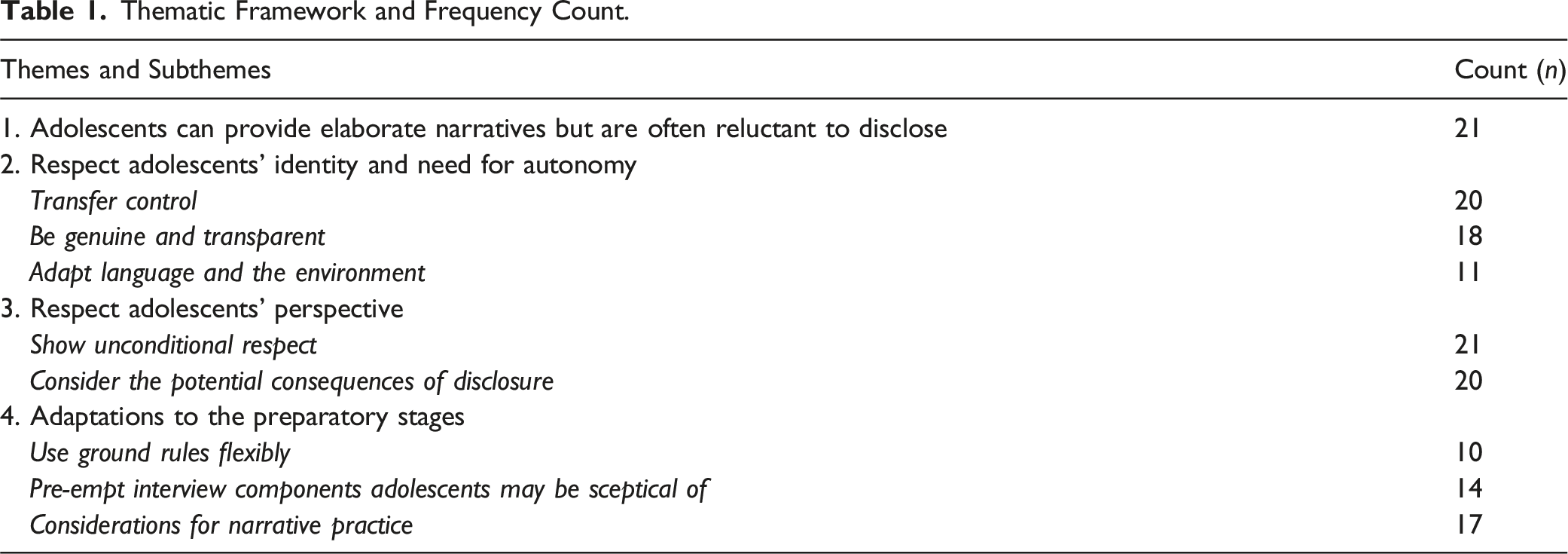
Adolescents Can Provide Elaborate Narratives But are Often Reluctant to Disclose
The practitioners perceived that the advanced developmental capabilities of adolescents meant that interviews could be longer and more complex compared to those with younger children. Adolescents were perceived to be more capable of providing an elaborate narrative: they have longer attention spans, are more adept at narrative sequencing, and tend to provide richer details about their experiences. For example, adolescents are better able than children to articulate key details about the offense due to enhanced understanding of their own body and recognition of the act as abuse. The practitioners also considered that their approach to questioning adolescents and younger children differed to a degree. For instance, adolescents have the capacity to respond to broad open-ended prompts, whereas younger children need more scaffolding. Indeed, several practitioners noted that adolescents’ ability to respond to questions was comparable to that of adults. [Adolescents’] capabilities are more like adults. They can answer questions abstractly, they can handle questions about peripheral details, they’re much, much better at sequential narrative, so they can put things in order. So memory retrieval, reconstructing events in their minds and putting them in order, paying attention, remembering peripheral information. They’re just better at all of those skills. (Participant 16) With adolescents, I’m much more likely to ask really broad questions like, “tell me about yourself”, whereas with younger children, it’s typically too big. It’s too broad. It doesn’t have enough scaffolding, and so they won’t necessarily know how to answer it, whereas with adolescence, I find it to be really well received. (Participant 2)
The practitioners perceived that, while adolescents are more capable of providing an elaborate narrative than children, adolescents are also less willing to do so. Many adolescents recognise that their experience constitutes an offense and are hesitant to disclose given their awareness of the significance of that experience and the implications of telling. Even when adolescents are willing to disclose, interviews were considered to be complex on account of the adolescent interviewee’s attempt to understand and process their experience. In particular, the practitioners noted that compared to children, adolescents are often more emotional and more resistant to describing aspects of the sexual offense in detail. Teenagers are obviously much better equipped to articulate their experiences than the younger kids. But in my experience, teenagers generally take longer to build rapport with and are just more sceptical of the process. With teenagers, I feel like we have to work harder to get their trust…They obviously can be really challenging because they can be very resistant. (Participant 8) Adolescents realise the gravity of what happened more, whereas younger kids may not really understand all the ramifications that are associated with a victim of sexual abuse or that stigma... I mean, they may think it’s normal and it’s kind of novel that somebody wants to talk about it. ...So sometimes younger children are not as emotional when they’re describing it compared to adolescents. (Participant 18)
Respect Adolescents’ Identity and Need for Autonomy
Transfer Control
The practitioners utilised strategies that transferred control to the adolescent, recognising that their developmental stage typically entails a desire for independence and autonomy. The practitioners noted that the adolescents who are being interviewed have often experienced a loss of control in significant ways. In addition to loss of control emerging as a result of the victimisation, once adolescents disclose, adults take charge and intrude in their lives in various ways (e.g., via child protection responses, law enforcement). At times, engagement with the offender may have felt like personal choice (e.g., the relationship is perceived of as mutual and consensual). When adults intervene to end the victimisation in these cases, adolescents feel that their choices, autonomy, and control have been infringed upon. In response, the practitioners indicated that fostering adolescents’ sense of control in the interview is high priority. To do so, the practitioners reported a need to put the adolescent in the ‘driver’s seat’ from the outset of the interview process. According to the practitioners, imparting a sense of control involves explaining the roadmap (i.e., what would happen), but then letting adolescents make decisions about the route (i.e., throughout the interview process).
With respect to the roadmap, the practitioners spoke of the importance of ensuring that adolescents understand how the interview process would unfold. Explanations about what is going to happen were also considered to be important with children, yet with adolescents, it was stressed that interviewers need to be more comprehensive and direct. The practitioners explained that, because children tend to trust adults, children are often happy with relatively simple explanations to their questions (e.g., C: ‘Why am I here?’ I: ‘Because it’s my job to talk to kids’). In comparison, overly simple or indirect answers could frustrate adolescents and lead to the perception that the interviewer was being dishonest, which could cause adolescents to disengage. The practitioners were clear that appropriate explanations for adolescents were those that were detailed, direct, and tailored to their level of maturity. Providing developmentally appropriate explanations regarding the interview process was regarded as an effective way to show respect, demonstrating that adolescents are sufficiently responsible to warrant such explanations. The practitioners also spoke of the importance of answering adolescents’ questions directly and letting them participate in decisions throughout the interview process. The practitioners gave an array of examples about how they would elicit adolescents’ preferences, such as scheduling preferences for the interview, interviewer gender, and whether they would like to meet the other professionals observing the interview. Sometimes [adolescents] react because of the lack of control. When you show them respect and let them know what the process is, keep them engaged in what you’re doing and why you’re doing it, then a lot of times they are more willing to go along with the process. (Participant 17) Their sense of control really is critical as to whether they're going to disclose or not. If their sense of control has been taken away, either by the alleged abuse that happened or by other things in their life that they feel like are out of control, particularly if they are mad at a bunch of adults who have taken their control away and are making them do things, like taking their phone away. I think they really need that sense of control during that interview in order to trust me and be able to talk about what’s happened. (Participant 20) What I see helps when I’m talking with teenagers, is giving as much control as I can to them. So for instance, ‘do you prefer earlier in the day or later in the day for the interview?’… I try to give as much power to them as possible‘. I feel that the more control, we give back to them, the more respected they’ll feel. (Participant 13)
Be Genuine and Transparent
The need to be genuine and transparent was a clear priority. The practitioners noted that adolescents have a general tendency to mistrust adults and are good at discerning when someone is not being authentic. Indeed, several practitioners mentioned that adolescents often figure out when they have been given information that is not entirely honest, which undermines their trust even further. Honesty was thus paramount in the practitioners’ approach, which also included avoiding sugar-coating of explanations. A variety of examples were provided of how interviewers could exhibit transparency, such as admitting when they didn’t know answers to a question and verbally committing to find out the answer. Adolescents are smart and they can find you if you’re not being truthful and they will call you out on it. (Participant 1) Teens are good bulls**** metres. They can just figure it out. They can sense disingenuousness and there’s nothing that pisses them off more than somebody who’s not genuine. I really think that that’s what they’re looking for in their relationships. Even though this interview might only last for an hour, it’s a relationship. So we just need to be really transparent with them because they will not cooperate if they feel that you’re disingenuous. (Participant 19)
The practitioners also referred to the need to be authentic in how they presented themselves to adolescents, since adolescents can sense when someone is being phoney or trying too hard. The practitioners noted that interviewers should not try and act like an adolescent or a peer, but instead express a genuine sense of care, while also stressing the importance of demonstrating interest in the adolescent as a person, rather than just in information about a specific incident. Adolescents were perceived as being capable of discerning when an interviewer was just going through the motions rather than being sincere. In every interview, I want to feel, within the first 5 minutes, that I personally like this kid in front of me. I’ve got to find something I like about them because they’re going to know if I'm not genuine - teenagers especially, they pick up if you’re not. You have to be genuine and transparent with them or they will get oppositional and won’t talk to you. (Participant 6). Teens are smart. So if you go in and you don't actually care, like you’re in rapport building and you’re asking them about themselves, and you don’t actually care about that - It’s just like a checklist that you need to get done for your protocol - they are going to be able to tell if you’re being fake. (Participant 10)
Adapt Language and the Environment
The practitioners referred to the need to adapt their language and tone to adolescents’ maturity level. For example, when introducing their role, some interviewers would state, “it’s my job to talk with teenagers [and/or] people” rather than “it’s my job to talk with kids,” as adolescents rarely identify with being a child and may react negatively to such a label. Additionally, the practitioners highlighted the importance of creating an appropriate physical environment. They avoided decorations and tools that catered for younger children (e.g., children’s toys or artwork) and instead opted for items more suitable for adolescents, such as sophisticated colouring in sheets (e.g., Mandela drawings) and comfortable adult chairs. We had an interview once at my centre where the interviewer said, it’s my job to talk to kids, and the adolescent, I think she was 13, she went, “I'm not a kid”. And it set the tone for the entire interview. Just being aware of our words is really important. (Participant 21) We don’t want them to feel like they are in a kids place. We’re not a centre that has kid toys everywhere and kid handprints on stuff…I want the centre to look more adult friendly for teens, I want them to feel like this is the place for them… If the room is too childish they feel like this place is for babies and this isn't the place for me. (Participant 3)
Respect Adolescents’ Perspective
Show Unconditional Respect
The practitioners’ interpretations of and responses to adolescents were predicated on the value they placed on unconditional respect: that interviewees should feel respected, regardless of the information they disclose or their behaviour. The practitioners noted that adolescents’ heightened preoccupation with how they are perceived by others extends to the interview room. In response, the practitioners noted that interviewers need to be non-reactive, especially to challenging behaviours and expressions of strong emotions. This non-reactivity was regarded as a supportive behaviour because it shapes the adolescent’s expectation that, no matter what they share or do, the interviewer will respond neutrally, and thus allows the adolescent to be themselves in the interview process. The practitioners stressed the importance of letting adolescents express emotions and behaviours without being corrected (within the confines of not harming anyone or property). To emphasise this tolerance, several practitioners noted that they would occasionally repeat curse words to ameliorate perceptions of themself as an adult with authority, and to maintain a positive rapport necessary for adolescents to trust the interviewer with their story. I think that teenagers in particular are trying to assert their dominance, their freedom, and what they can and can’t say. I think sometimes, teenagers try to do things to get the shock value, they’ll see what they can get away with. So if they say to an adult, “I’m not going to talk to you, go f*** yourself”, they want to see what you’re going to do. If they say that to a teacher, or to a parent, there’s some pretty clear repercussions. But if they say that to me, I’m not going to do anything. I’m not going to get mad at them. I give them that choice to then say, oh well, she’s not pissed off, she’s not mad that I’m not talking to her. Maybe I could talk to her. What would happen if I did talk to her? (Participant 12) I’m going to give them the same respect that they give me. Even if they don’t give me respect I’ll respect them. We certainly have combative, angry teenagers come in, but I just sit there and take it. I don’t respond. I don’t give it back to them. I just let them take it out on me because that’s fine. I totally get where they're coming from. I understand why they’re so angry. (Participant 14)
The high value that the practitioners placed on ensuring that adolescents felt respected throughout the interview process contrasted with how they perceived adolescents to be treated by other adults. The practitioners mentioned that there was a general tendency among adults to distrust the allegations of adolescents, with their challenging behaviours (e.g., running away, substance use) sometimes being judged and taken as evidence of this position. The practitioners’ desire to stand out and be an adult who listened to the adolescent, with unconditional respect and without expectation, was apparent. I'm someone to listen to them, which is not normal because people don’t listen to some of these adolescents…I’ll give you an example, I had a past case, I interviewed her twice and it was both sexual abuse by Dad. At the first interview, everyone was looking at her behaviour - she’s a liar, she lies at school. No one wanted to listen to her. Well, she came back again and disclosed the same thing plus more and explained to me why she had to act like she was lying before, why she had to do these behaviours and how no one wants to listen. In this case, they found out it was true. That she had been sexually abused, but everybody was looking at her behaviours, not what she was saying out of her mouth. (Participant 6)
Consider the Potential Consequences of Disclosure
The practitioners were aware of the need to be attentive to adolescents’ perceptions of what it means for them to disclose and how it may affect their life. The practitioners commented, for example, that adolescents are typically aware of child protection services, the legal process, and how disclosure could result in removal from their home and/or imprisonment of the offender. Additionally, adolescents are often concerned about the impact of disclosure on their social world. In the practitioners’ experiences, adolescents had particular difficulty disclosing offenses committed by a fellow student.
The practitioners noted the importance of addressing adolescents’ concerns about the implications of telling, given that these concerns affect their ability to engage in the interview. How the practitioners described their process for doing so varied depending on the specific concerns being raised. In some situations, information could be provided to help dispel concerns (e.g., whether the adolescent would get in trouble for anything they said). Other concerns however, could not be addressed in this way (e.g., whether the offender would go to prison). Indeed, due to adolescents’ deeper awareness of the consequences of disclosure, the practitioners perceived that some techniques, such as surface level reassurance which can be effective with children, are not suitable for adolescents. The practitioners emphasised that interviewers’ approach to addressing concerns with adolescents should be underpinned by a desire to understand their individualised perspective, empowering them to voice that perspective and ensuring that they feel their concerns are being heard. Adolescents have more awareness of the consequences of talking and the investigation. They’re aware that there is jail and prison, and a court system. They are aware that people can have pretty major consequences for these types of acts. They’re thinking, what is this going to mean for my family? What is it going to mean for my peers? Who is going to find out about this and what are they going to say about me. They are mature to that point that they can think through and weigh out all of those consequences before they come in…So I try to approach them as people who have more awareness of what has happened and is going on than some of the little ones that we work with. (Participant 4) Teens tend to have a greater awareness of what child protection is and how much power they might have. So they understand that if they say something they may be taken out of the home, whereas a 5 year old doesn't have that recognition. Because of that, some of the techniques that might work with a younger child, where I’m providing reassurance or I’m addressing some of the barriers to disclose, those techniques aren’t necessarily going to work with a teen because they know the reality in a way that younger kids don’t... I think again it comes back to treating them more like an equal (Participant 11)
Adaptations to the Preparatory Stages
Use Ground Rules Flexibly
The practitioners adapted the preparatory stages for adolescents in various ways, including delivering ground rules flexibly rather than methodically following the structure prescribed in protocols developed for children. That is, although following prescribed structure and wording was often considered acceptable with children, the practitioners noted that adolescents can interpret this approach as disingenuous and perceive the interviewer to have an agenda. Instead, the practitioners spoke of the need to incorporate ground rules into the flow of conversation with adolescents. Several practitioners also mentioned that they do not ask adolescents to practice ground rules, as this practice would be regarded as childish. Sometimes we get stuck in this idea that our protocol is very concrete, and there’s these different elements, but it’s not, it’s a conversation. I think that with the younger kids, it’s easier to have these more discrete stages and go through it, but with a teen you want it to feel like a conversation. It’s just that feeling that you get, you want it to flow, you want it to feel like a dance with that teen, that there's a back and forth. (Participant 11) If … you’re methodical and you’re going through the protocol but you’re not engaging that adolescent in any way, it’s going to be difficult for you to get any leeway in terms of the disclosure. (Participant 5) If I’ve got a teen that’s super resistant, I’m going to not throw my protocol completely out the window, but I’m going to be more flexible .. , I don’t want to be the one controlling the whole conversation and going through my protocol. I’ll just take their lead and build off of what they’re sharing with me rather than sticking to kind of our structure…I think when it appears to the kid that you have this sort of agenda that you’re going to walk through your protocol, they’re like I’m over this. But it’s different when you show that genuine investment in them and indicate that I want to know about you. (Participant 3)
Pre-Empt Interview Components Adolescents may be Sceptical of
The practitioners referred to an ‘adolescent-specific’ ground rule: comments that explain the reasons behind questions that adolescents are likely to be sceptical of or perceive as childish. For example, the practitioners commonly used a variation of ‘I can’t assume anything in this room’ to provide context for questions with seemingly obvious answers. In particular, the practitioners described adolescents as being sceptical when prompted for more detailed explanations of sexual experiences, noting that interviews flowed better when these prompts were couched in explanations of why they were being asked. The practitioners similarly mentioned that they would pre-empt narrative practise, as adolescents sometimes found this exercise childish. When these explanations were provided, the practitioners commented that adolescents tended to be more willing to participate. Sometimes with teens, I feel like my explanation of the process and the room and the setting can make them feel a little like, what is this lady talking about? This is ridiculous. I know this stuff. So one thing I specifically do with teens, is say things like, I know this seems kind of strange or silly, but I need to practise how we talk, so I’d like us to talk about your day. (Participant 1) We had one interviewer who was obviously pregnant, and she was talking to a teenager about sex. The interviewer was trying to get very specific and she asked, “what does sex mean?” And the teen looked at the interviewer and was like, “are you kidding me? Like, why would you be asking me that? You obviously know what sex is because you’re pregnant”… I think the way that I’ve been able to get around it is to say something like, I think I know what you mean when you say sex, but I don’t want to make any assumptions. I don’t want to think you mean one thing when you mean something else. Your words are important, and I want to know exactly what you’re talking about. (Participant 12).
Considerations for Narrative Practice
Finally, the practitioners spoke of unique considerations for narrative practice with adolescents, including the way they introduced this interview stage. Rather than directing adolescents to this stage (as they would with children), the practitioners provided an opportunity for adolescents to control the direction of the interview by explicitly requesting their permission to get to know them better. Although some adolescents expressed a preference to ‘get the interview over with’, the practitioners noted that most were willing to engage in narrative practice when given the choice. Those who expressed a preference to skip this stage were described as forthcoming.
Second, the practitioners stated that the purpose of narrative practice with adolescents varies from that with younger children: the primary benefit of narrative practice for adolescents is the opportunity to foster rapport, whereas the primary benefit for younger children is giving them the opportunity to learn how to respond to open-ended prompts. The practitioners noted that building rapport and trust takes considerably longer with adolescents than with children, yet taking this time is paramount because rapport is a primary factor that determines a successful interview with adolescents. Underlying the focus of narrative practise was the desire to engage the adolescent in free-flowing communication to facilitate effective rapport. To do so, the practitioners spoke of the importance of choosing a topic that excites individual adolescents, that is, a topic that makes them ‘light up’ when discussing, and a topic they are the expert in, that they can ‘teach’ the interviewer about. The professionals gave a number of valuable suggestions for narrative practice topics in which adolescents likely had some expertise (e.g., a hobby such as make-up when teenagers regularly watched tutorials on YouTube) or an activity they enjoyed (e.g., “Tell me about TikTok”). Rapport building is it’s important with all age groups, but it is especially important with adolescents… you have to build trust with them much more. You have to lay that foundation of rapport and trust. If you don’t do that, you may not be speaking to them for very long. (Participant 15) When a child is 7 8 9 years old, [narrative practice is helpful because] it shapes their expectations about the structure of the interview. With the adolescents, narrative practice may not be as helpful in terms of them needing to practice how to give us information. They don’t necessarily need that because they have a better understanding of social norms and expectations for communicating. But it gives them an opportunity to talk about themselves.... It tells them I want to hear everything (Participant 7)
Discussion
Adolescents, who represent a particularly common victim population and who are developmentally distinct from children, need to be interviewed in a manner that is supportive and facilitates the elicitation of valuable and sensitive information (Wyman et al., 2023). Given that this topic - that is, best-practice interviewing of adolescents - has been largely overlooked in previous research, professionals with expertise questioning adolescents are in a valuable position to provide information directly relevant to this need. The current study was conducted with this in mind. The overriding message from our set of highly skilled practitioners is that motivational issues are a key challenge in interviews with adolescents; at the forefront of the way the expert interviewers approached interviewing adolescents was by connecting with them in a respectful way that catered to their developmental stage. In the following section, we consider the various ways that the expert practitioners mentioned making this connection, linking these ways to empirical literature on adolescent development and forensic interviewing.
The notion that interviews with adolescents are marked by motivational challenges, particularly those tied to many adolescents’ unwillingness to disclose, has been hinted at by a growing body of evidence in recent years. For example, our findings resonate with the primary challenges noted by Swedish practitioners in interviews with adolescents, as reluctance to disclose and difficulty establishing rapport were identified as key challenges (Magnusson et al., 2020). Current best-practice interviewing recommendations build on basic cognitive and mnemonic principles, such as the effect of question phrasing on response completeness and accuracy, and on cognitive and social factors relating to social acquiescence and suggestibility (e.g., Powell & Snow, 2007). In recent years, best-practice recommendations explicitly mention the need to establish rapport with interviewees, and provide appropriate support to improve interviewees’ level of comfort (e.g., Hershkowitz et al., 2014; Hershkowitz & Lamb, 2020). The results of the current study are consistent in suggesting that the need to establish effective rapport and provide support are equally if not more important with adolescents. Yet, what diverges is that the means to build rapport and provide support with adolescents vary from the means suitable for children.
The practitioners’ approach to interviews with adolescents hinged on connecting with them in a way that respected them as autonomous and independent persons. This approach is consistent with research which suggests that adolescence is a period of heightened sensitivity to social signals, especially those relevant to social status (Blakemore & Mills, 2014; Kilford et al., 2016). Adolescents often perceive of themselves as adult-like, increasingly taking responsibility for their actions, and believing that they are autonomous decision makers (Yeager et al., 2018). They respond well to others who endorse those perceptions and are sensitive to behaviours or statements that undermine those perceptions (see Yeager et al., 2018, for a review). With interventions designed to promote positive behaviour change (e.g., healthier eating) in adolescents, for example, campaigns that emphasise adolescents’ potential as actors with agency appear to be particularly effective at inducing change (Bryan et al., 2016, 2019; Vansteenkiste et al., 2004). Conversely, intervention campaigns which focus on delivering content and knowledge (e.g., bullying is harmful to others) often fail to induce change in adolescents, who perceive these messages as challenges to their autonomy, independence, and existing knowledge (Yeager et al., 2015, 2018). Thus, interviewing techniques characterised by respecting adolescents as persons nearing adulthood has considerable potential to establish the rapport necessary to work through motivational challenges.
The expert practitioners identified several specialised support strategies appropriate for adolescents. These included those that afforded adolescents a sense of control, which is aligned with the shift towards autonomy and independence normative in adolescence (e.g., Meeus, 2011). The idea that interviewees need some control is not confined to adolescents, but is an issue that has been considered extensively in the child and adult interviewing literature where it is emphasised that interviewees should have control over the content and flow of information they share about an experienced event, primarily through open-ended questioning (Fisher & Geiselman, 2010; Walsh & Bull, 2010). With adolescents, practitioners’ conceptions of control went beyond flexibility about how to report the event and extended throughout the interview process, with many examples concentrating on activities that occurred prior to the discussion of allegation (e.g., whether the adolescent would like to engage in narrative practice) and even prior to the interview itself (e.g., eliciting preferences about scheduling or interviewer gender). In addition to eliciting adolescents’ preferences to instil a sense of control, practitioners considered that adolescents have a stronger sense of control when they know what to expect, and thus benefit from detailed explanations about the process. Given that sexual victimisation violates one’s sense of control, and adolescents are known to withhold information in attempt to restore autonomy that has been lost (Dietvorst et al., 2018; Ullman & Peter-Hagene, 2014), an interviewing approach that maximises adolescents’ experience of control is promising. Future research could build on the viewpoints expressed in this study by experimentally exploring whether adolescents benefit from the inclusion of explanations which are more akin to those typically provided to adults (Snook et al., 2014; Walsh & Bull, 2010), as well as practices which give adolescents the opportunity to exercise autonomy during the entire interview process. These strategies are likely to be particularly important for adolescents, though other interviewees, such as children and adults, who have experienced victimisation, may also benefit from these considerations.
Being genuine and transparent was another principle underlying how the practitioners supported adolescents during the interview. Compared to children, adolescents are more adept at abstract reasoning, have enhanced capacity to understand the perspectives of others, and are more likely to question adults’ authority (Fine et al., 2022; Laupa et al., 1995). These factors make adolescents, especially those with a history of maltreatment (e.g., Hepp et al., 2021), prone to scepticism concerning adults’ motives. In the context of forensic interviews wherein adolescents are considering their decision to disclose, interviewers need to earn adolescents’ trust. How can interviewers build trust? The results of this study suggest that practices which demonstrate the genuineness and transparency of the interviewer are likely quite promising. Complementing the perspectives of practitioners, results of a recent study suggests that interviewer transparency, made salient through mutual self-disclosure during the rapport building phase, can enhance adolescents’ later willingness to share details of prior negative experiences in remote interview settings (Dianiska et al., 2024). By sharing personal details, interviewers appear to signal that they trust the adolescent as recipients of personal information, prompting the adolescent to do the same later. As the practitioners here suggested, approaches that enhance perceptions of genuineness, transparency, and mutual respect may have similar potential to improve adolescents’ trust and hence willingness to share information. These possibilities could be systematically examined, directly and in conjunction with the type of mutual disclosure employed by Dianiska et al. (2024) to ascertain which exerts the most powerful positive effect on adolescents’ reporting.
As alluded to above, a sizeable number of the recommendations focused on the preparatory stages of the interview. The practitioners described several common preparatory activities with children (i.e., ground rules and narrative practice activities), which they believed could be effective with adolescents with modification. The effects of preparatory activities on children, who are accustomed to adults guiding their responses and perceive them as knowledgeable interaction partners, have been documented (Fivush, 2011; Roberts et al., 2011). For adolescents, the primary benefit of these activities may be in building trust rather than setting expectations for the interview dynamics (Dianiska et al., 2024), Without modification (e.g., explanations about why these activities are needed), activities formulated for children (e.g., ground rules such as ‘you should tell me if you don’t understand’), are likely to appear authoritative or childish to adolescents, potentially hindering rapport and heightening resistance (Brehm, 1966; Miron & Brehm, 2006). It is notable that the practitioners modified the preparatory activities to facilitate connection and flow of the interview, and to respect the adolescents’ maturity. For example, they avoided practising ground rules, and explained why certain questions had to be asked when the answers seemed obvious. Future research should prioritise exploring different explanatory approaches to maximise their potential to establish effective rapport in the early stages of the interview.
Limitations, Future Directions, and Conclusions
While our investigation is unique and provides much-needed insight into how expert practitioners approach interviewing adolescents, there are also limitations to our design and findings that need to be noted. For one, only one practitioner in the sample was male. Although the heavy proportion of females in our sample appears to be representative of the broader composition of forensic interviewers in the United States (e.g., Fessinger & McAuliff, 2020), it will be of interest to ascertain whether perceptions of interviews with adolescents vary across practitioners of different genders. Second, the strategies cited in these findings are based on the perceptions of a selected cohort of interviewer practitioners who, while identified as experts in interviewing adolescents, are influenced by their previous experiences and personal biases (Ochieng, 2009). It is thus essential that recommendations for interviewing adolescents are based on additional empirical research.
Going forward, we propose two main directions for this work. First, research needs to establish the degree to which interviewers who question suspected child victims are knowledgeable about the developmental characteristics of adolescence, and how these characteristics affect their experiences, perceptions, and reporting tendencies. The expert practitioners in our study expressed perspectives that are congruent with what is known about the hallmarks of adolescent development (e.g., desire for autonomy: Meeus, 2011). It will be important to examine whether this knowledge is understood by forensic interviewers more generally. Surveys of practitioners could illuminate the prevalence of this knowledge (e.g., Winks et al., 2023), but it will also be important to determine how well practitioners apply this knowledge in their interviews. Second, there is a clear need for experimental testing of techniques to improve adolescents’ reporting. Some such experimental testing is beginning to emerge, with researchers assessing methods of establishing rapport with adolescent interviewees (Dianiska et al., 2024). However, other methods that address issues raised by the practitioners here, including respect, affording control, and genuineness, which address adolescents’ specific social and emotional needs (e.g., their scepticism of adults and need for autonomy: Fine et al., 2022; Sebastian et al., 2008) should be rigorously evaluated as well.
Adolescence is a period of transition. Children enter at the onset of puberty and emerge as adults; an array of neurobiological, psychosocial, and cognitive changes occur throughout this time (Blakemore & Mills, 2014). In forensic interviews with adolescents, it is important to address their unique cognitive, social, and emotional needs (Dianiska et al., 2024). The present findings provide insight into how this may be achieved, indicating that interviewing approaches which convey respect, build trust with the interviewer, and prioritise adolescents’ need for control, may be particularly effective. It is important that future empirical research tests the that best support adolescents, enabling the development of an evidence-based toolkit to help interviewers connect with adolescents in a manner that aligns with their psychosocial and cognitive maturity.
Footnotes
Acknowledgments
We would like to thank Dirkje Gerryts for her assistance conducting and transcribing interviews, as well as her assistance with data analysis.
Declaration of Conflicting Interests
The author(s) declared no potential conflicts of interest with respect to the research, authorship, and/or publication of this article.
Funding
The author(s) received no financial support for the research, authorship, and/or publication of this article.
