



Abstract
This longitudinal population-based study examines the association between maltreatment victimization experiences and the likelihood of intergenerational (dis)continuity of maltreatment. Our data include all individuals born in 1983/1984 in Queensland (QLD), Australia who are registered as parents via birth records and who experienced system contacts for maltreatment victimization in childhood (n = 2906). Child safety data on system contacts as a child victim and person responsible for harm to a child were obtained from the Department of Children, Youth Justice and Multicultural Affairs. Out-of-home care experiences and maltreatment frequency, timing, and type were examined. Results indicated that childhood maltreatment experiences significantly differed between parents who were not subsequently responsible for harm to a child (cycle breakers) and parents who were subsequently responsible for harm to a child (cycle maintainers). Different patterns of association were observed across sex. These findings highlight the importance of recognizing the heterogeneity of victim maltreatment experiences and associated risk of maltreatment for their children, and can inform effective and targeted interventions by tailoring these by sex and developmental period.
Keywords
Continuity of child maltreatment across generations is preventable. Despite having a higher risk than parents without a maltreatment history, many parents who were maltreated in childhood do not subsequently have a child who experiences maltreatment (Langevin et al., 2019). At present, we lack clear understanding of the relationship between maltreatment victimization and intergenerational (dis)continuity. Rates of continuity reported in the literature differ considerably (i.e., 6.7–88.0%), and research remains generally plagued by methodological limitations (e.g., small sample size, retrospective, self-report data) (Langevin et al., 2019). Most research has targeted females, which means any differences between males and females remain unclear. Moreover, while numerous well-documented risk factors, such as negative interpersonal relationships, mental health concerns, and lower socioeconomic status, have been examined (and provide important contributions) (e.g., Ben-David et al., 2015; Jaffee et al., 2013; St-Laurent et al., 2019), the literature has not yet provided clarity on how maltreatment victimization characteristics might differ across families where the intergenerational cycle is broken or maintained. This study focuses on maltreatment victimization characteristics (i.e., frequency, timing, and type), as well as out-of-home care placements, to provide additional insight into intergenerational (dis)continuity, and associated prevention and intervention opportunities. Utilizing two-generational population-based administrative data from Queensland (QLD), Australia, we explore associations between characteristics of parents’ maltreatment experiences in childhood and subsequent (dis)continuity of maltreatment for their children.
Experiencing childhood maltreatment has been associated with a myriad of adverse outcomes, such as the development of psychopathology, cognitive and academic dysfunction, and problems with social, emotional, and physical wellbeing (Widom, 2014). Maltreatment victimization has also been linked with an increased risk of intergenerational continuity (Madigan et al., 2019). Numerous theories have been utilized in an attempt to understand the occurrence/continuity of child maltreatment. We acknowledge that some theoretical models, such as social learning theory (Bandura, 1977), posit that experiencing victimization is a key risk factor for subsequent perpetration because behavior is learned through imitation, so if a child experiences maladaptive parenting (i.e., maltreatment) that child is more likely to adopt those behaviors. However, we know that the majority of individuals with a victimization history do not subsequently perpetrate maltreatment (Augustyn et al., 2019). Likewise, continuity of maltreatment across generations is not dependent upon the initial victim becoming a perpetrator, as harms to subsequent generations can be perpetrated by other parties. As such, guided by a developmental psychopathology perspective on child maltreatment (Toth & Cicchetti, 2013) we also accept heterogeneity in experiences and outcomes. Intergenerational maltreatment is dependent on numerous risk factors, and the interactions between these factors at the individual, family, and community levels. For example, young parenting, domestic and family violence (DFV), social isolation, financial hardship, and poverty have been consistently associated with an increased risk of child maltreatment occurring (Langevin et al., 2019). There is also variability in children’s maltreatment experiences and therefore variation in how these experiences might shape their development over the life course (Toth & Cicchetti, 2013). As such, the context of maltreatment victimization (e.g., timing, chronicity, multi-type maltreatment, co-occurrence with other vulnerabilities) is recognised as crucial for understanding individuals’ subsequent life pathways (Russotti et al., 2021).
Existing research does provide insight into the importance of childhood victimization experiences for later adult involvement in child maltreatment. For example, studies that have focused on frequency of maltreatment suggest that children whose parents experienced a higher number of victimization events were more likely to experience maltreatment than children whose parents experienced fewer victimization events (e.g., Ben-David et al., 2015). In a study examining the developmental timing (i.e., childhood, adolescence) of maltreatment victimization and subsequent maltreatment perpetration, Thornberry and Henry (2013) reported that victimization occurring in adolescence significantly impacted the likelihood of engaging in child maltreatment behaviors, whereas childhood-limited victimization did not. Researchers examining severity of maltreatment have generally reported that severe maltreatment victimization increases the risk of intergenerational continuity (Capaldi et al., 2019; St-Laurent et al., 2019), although nuances exist within and across studies (i.e., by sex or type of maltreatment). Finally, one study identified that out-of-home care experiences were significantly associated with maltreatment continuity (Font et al., 2020).
Findings on maltreatment types are complex, as the types included across studies varied, as have the outcomes of interest. Some studies have considered childhood victimization as present if any maltreatment type was experienced (i.e., physical, sexual, emotional abuse, or physical and emotional neglect) and explored the subsequent perpetration of a single maltreatment type (i.e., physical abuse) (Jaffee et al., 2013). Others examined homotypic transmission (i.e., perpetrating the same maltreatment type experienced during childhood victimization) (Capaldi et al., 2019), or heterotypic transmission (i.e., perpetrating a different maltreatment type than experienced during childhood victimization) (Yang et al., 2018). Moreover, studies examining multi-type maltreatment (i.e., more than one type of maltreatment victimization) suggest that experiencing multi-type maltreatment elevates the risk of maltreatment occurring in subsequent generations (St-Laurent et al., 2019).
Taken together, the literature highlights a number of important findings regarding various maltreatment characteristics; however, we need further consideration of a range of maltreatment characteristics in the same large representative sample to strengthen our understanding of the heterogeneous nature of maltreatment and subsequent intergenerational pathways. Existing studies that have integrated various combinations of maltreatment characteristics provide evidence of the interplay between characteristics (e.g., St-Laurent et al., 2019). For instance, in addition to identifying the importance of developmental timing for risk of maltreatment continuity, Thornberry and Henry (2013) also highlighted that the severity, chronicity, and types of maltreatment experienced varied between childhood-limited victims and adolescent victims of maltreatment. Thus, existing research reiterates the need to draw clearer conclusions regarding the unique and shared impacts of these factors.
Sex and Maltreatment (Dis)continuity
The majority of the literature on intergenerational child maltreatment has focused on female samples (Font et al., 2020), which is perhaps unsurprising given that mothers have historically been held disproportionately accountable for maltreatment towards their child. This may be because mothers have typically been considered the primary caregivers/guardians and thus perceived as responsible for “failing to protect” their child (ren) from harm perpetrated by others, or in cases where both parents may be responsible for perpetrating harms, the child protection focus has generally still been placed on the mother (Strega et al., 2008). It is well established that fathers are underrepresented in child protection data/research, which can make it difficult to draw firm conclusions about sex differences (Brandon et al., 2019). The limitation with studies that examine females only is that findings regarding maltreatment victimization and (dis)continuity cannot necessarily be extended to males. Likewise, studies merging male and female samples may mask possible differences.
The limited findings in the literature suggest it may be important to consider sex when examining intergenerational maltreatment. For instance, though continuity of maltreatment was evident for males and females, Capaldi et al. (2019) found different patterns of association for severity of maltreatment victimization and subsequent maltreatment (dis)continuity depending on parental sex. Similarly, Font et al. (2020) highlighted differences in the strength of association between out-of-home care and maltreatment perpetration for males and females. More generally, Dixon et al. (2007) found that over half of the mothers who maltreated in their sample had childhood victimization histories (physical or sexual abuse), compared to less than a quarter of fathers who maltreated, indicating maltreatment victimization may be a more salient risk factor for females, compared to males. From a life-course perspective, there is recognition that males and females may experience, and respond to, child maltreatment victimization differently, which may result in different life-course trajectories, such as psychopathology, antisocial behavior and other negative life outcomes (Doom & Cicchetti, 2020). Some studies suggest a stronger association between childhood victimization and subsequent mental health concerns for females compared to males (Thompson et al., 2004). Moreover, while general engagement in crime is higher among males, some evidence indicates that maltreatment victimization may be a particularly prominent risk factor for females who engage in offending and antisocial behavior, compared to males who engage in offending and antisocial behavior (Broidy & Thompson, 2018).
Current Study
Our study utilizes population-based, prospective, longitudinal, linked administrative data. Although not without limitations, administrative data are recognized as a valuable resource in child maltreatment research (Soneson et al., 2022), and allow us to address several common methodological weaknesses evident in the intergenerational child maltreatment literature, such as cross-sectional designs, retrospective reporting, and non-generalizable samples (Madigan et al., 2019). Moreover, our research expands the existing literature base in two key ways. First, in recognition of the heterogeneous nature of maltreatment, we examine the association between maltreatment victimization experiences and the likelihood of intergenerational (dis)continuity of maltreatment. Due in part to the nature of our data, and also due to our interest in heterogeneous development, we do not restrict our investigation to maltreatment perpetration stemming from victimization; instead, our focus remains on the occurrence of maltreatment across two generations, regardless of perpetrator identity. Maltreatment characteristics examined include: frequency, timing (childhood-limited, adolescent-limited, and persistent maltreatment), and type (including multi-type maltreatment), as well as out-of-home care placements, as part of our examination of (dis)continuity pathways. Second, we explore sex variations in the relationship between a history of maltreatment victimization (including heterogeneity in the maltreatment experiences themselves) and (dis)continuity outcomes.
Method
Sample
Our sample was derived from the larger QLD Cross-sector Research Collaboration (QCRC) data repository. Queensland is the third most populated state in Australia (approximately 5.2 million residents), reflecting 20% of the total Australian population (Australian Bureau of Statistics, 2022). Queensland is geographically diverse, with large metropolitan and rural/remote areas, with the majority of the population residing along the coastal regions (Australian Bureau of Statistics, 2022). Australia’s First Nations people, Aboriginal and Torres Strait Islander people, represent 4.0% of the QLD population (Australian Bureau of Statistics, 2022). The QCRC repository consists of de-identified linked population-based administrative data from multiple QLD government agencies (e.g., QLD Health, criminal justice system, child protection system (CPS), and the QLD Registry of Births, Deaths, and Marriages (RBDM)) (see Stewart et al., 2015; Stewart et al., 2020). This study focused on CPS and QLD RBDM data. Ethical clearance for the current project was obtained from the University’s Human Research Ethics Committee (2020/058). The management and use of the data are also governed by a Data Transfer and Usage Agreement with the QLD Government Statistician’s Office.
The current study included individuals born in QLD in 1983 and 1984 who were identified as parents via birth records and who had at least one childhood contact with the CPS as a victim. At the time of data extraction, individuals were 31 and 30 years old, respectively. The data was cut at 30 years of age to ensure we examined equal periods of the life course across the two cohorts. There were no missing data for the variables used in this study. Overall, there were 2906 individuals (63.1% females, 36.9% males; 25.2% Aboriginal or Torres Strait Islander peoples). Cohort individuals were on average 21.4 years old when they had their first child. Acknowledging the observation period required for strong methodological studies examining intergenerational maltreatment (i.e., minimum 5 years as a caregiver; see Thornberry et al., 2012), we examined the age of the first-born child of each cohort individual at time of data extraction as a crude measure of ‘opportunity to maltreat’. Approximately 81.3% of cohort individuals’ first-born children were at or over 5 years of age (M = 8.6, SD = 3.9, Md = 9.0, IQR: 6, 12).
Measures
Child maltreatment
All contacts as a victim of childhood maltreatment and a person responsible for harm to a child were obtained from the QLD CPS. The number of children involved with CPS in QLD tends to be approximately 25 per 1000 per annum (Australian Institute of Health and Welfare, 2020). The victim data includes each notification received by QLD CPS (and final substantiation status), the date and the alleged harm types for each event, and any out-of-home care placements. The person responsible data includes substantiated events only, the date and type of each event, and all people identified as responsible for harm to a child (i.e., if an event involved more than one individual from the 1983/1984 cohorts, all individuals would be captured). Severity of maltreatment was unable to be examined using the CPS data.
First generation maltreatment was operationalized as any CPS notification of harm and/or risk of harm identifying the cohort individual as the subject child (0–17 years of age). In line with prior research, both unsubstantiated and substantiated cases of maltreatment were included (Font et al., 2020). All individuals in the current study experienced at least one reported victimization event.
Second generation maltreatment was operationalized as any CPS record identifying the cohort individual as the person responsible for substantiated harm and/or risk of harm to a child when aged ≤ 30 years old. The CPS data provide information on the person who is deemed to be responsible for commissions, omissions, and failure to protect, and thus includes those responsible for protecting the child from harm (i.e., parent/guardian) but not necessarily the person who is responsible for inflicting the harm. Therefore, this data reflects CPS contact across two generations, without being limited to perpetration stemming from victimization. Data were only available for substantiated events for persons responsible. The first contact as a person responsible for harm to a child must have occurred after the individual’s first childhood contact with the CPS as a victim. The average age of cohort individuals at first substantiated maltreatment event as a person responsible was 22.7 years. Although the minimum age of responsibility for child maltreatment in QLD is 10 years old, the youngest cohort individual identified as a person responsible was 13 years of age, and 98.8% of cohort individuals were aged 16 years or older at time of first substantiated maltreatment. At the time of birth of their first child, individuals were aged between 13 and 30 years (M = 21.4). Second generation maltreatment was computed as a binary variable (yes; no).
Intergenerational group
Individuals’ life course (0–30 years) experiences of maltreatment were assigned to one of two groups. In line with intergenerational maltreatment literature (e.g., Madigan et al., 2019), these groups were named cycle maintainers (contact with CPS as a child victim and person responsible for harm to a child) and cycle breakers (contact with CPS as a child victim only). All cycle maintainers had their first contact with CPS as a person responsible for harm to a child subsequent to their first contact with CPS as a victim. The difference in time between the first victimization event and the first event as a person responsible ranged from 6 months to 29.6 years (M = 15.7, SD = 6.5).
Child Maltreatment Victimization Characteristics
Frequency
Frequency of victimization was derived by summing the number of CPS notifications for each cohort individual.
Timing
Using the individual’s birth date and CPS notification date, the timing of each maltreatment victimization event was computed and categorized as childhood (0–11 years) or adolescence (12–17 years). These categories were consistent with prior research by Thornberry and Henry (2013). A final categorical variable was created for each cohort individual reflecting the timing of their entire victimization experience to age 17; (1) childhood only, (2) adolescence only, or (3) persistent maltreatment (maltreatment events across both childhood and adolescence).
Type
There are four commonly accepted harm subtypes: physical abuse, neglect, emotional abuse, and sexual abuse. When a notification is made to QLD CPS the most severe harm type, as identified by the departmental worker, is recorded as the primary harm type. For this study, primary harm type was coded as (1) physical abuse, (2) neglect, (3) emotional abuse, and (4) sexual abuse. To identify each individual’s experience of multi-type maltreatment we counted the number of different primary harm types recorded across events (1–4). This operationalization is consistent with prior research by St-Laurent et al. (2019) and provides a more comprehensive conceptualization of multi-type experiences of victims.
Out-of-home care
The QLD CPS data records any out-of-home care placements experienced by children aged between 0 and 17 years. In line with the Australian Institute of Health and Welfare (2020) definition of out-of-home care, and much of the out-of-home care literature, we included foster care, kinship care, residential homes, and independent living placements, while excluding placement types considered temporary by design (i.e., justice-based and medical-based). A binary variable was created reflecting whether the individual was ever placed in out-of-home care (yes; no).
Demographic Variables
A binary variable was created for sex (male; female). In Australia, Aboriginal and Torres Strait Islander peoples are disproportionately over-represented in the CPS (Australian Institute of Health and Welfare, 2020). Aboriginal and/or Torres Strait Islander status is the only race variable available within this dataset. Therefore, a binary variable was created for Aboriginal and/or Torres Strait Islander status (yes; no). If an individual was ever recorded as an Aboriginal and/or Torres Strait Islander person in the larger QCRC data repository, they were classified as Aboriginal and/or Torres Strait Islander, however, if information on Aboriginal and/or Torres Strait Islander status was not available, the individual was classified as non-Aboriginal and/or Torres Strait Islander (Broidy et al., 2015). This is consistent with Australian best practice guidelines when using administrative data (Australian Institute of Health and Welfare, 2012).
Analytic Strategy
Analyses were performed using SPSS Version 28.0. Bivariate and multivariate analyses were conducted to explore the associations between maltreatment victimization characteristics and subsequent intergenerational (dis)continuity. Analyses were conducted for the whole sample and then disaggregated by sex to examine patterns of association.
Results
Life-Course Maltreatment Experiences
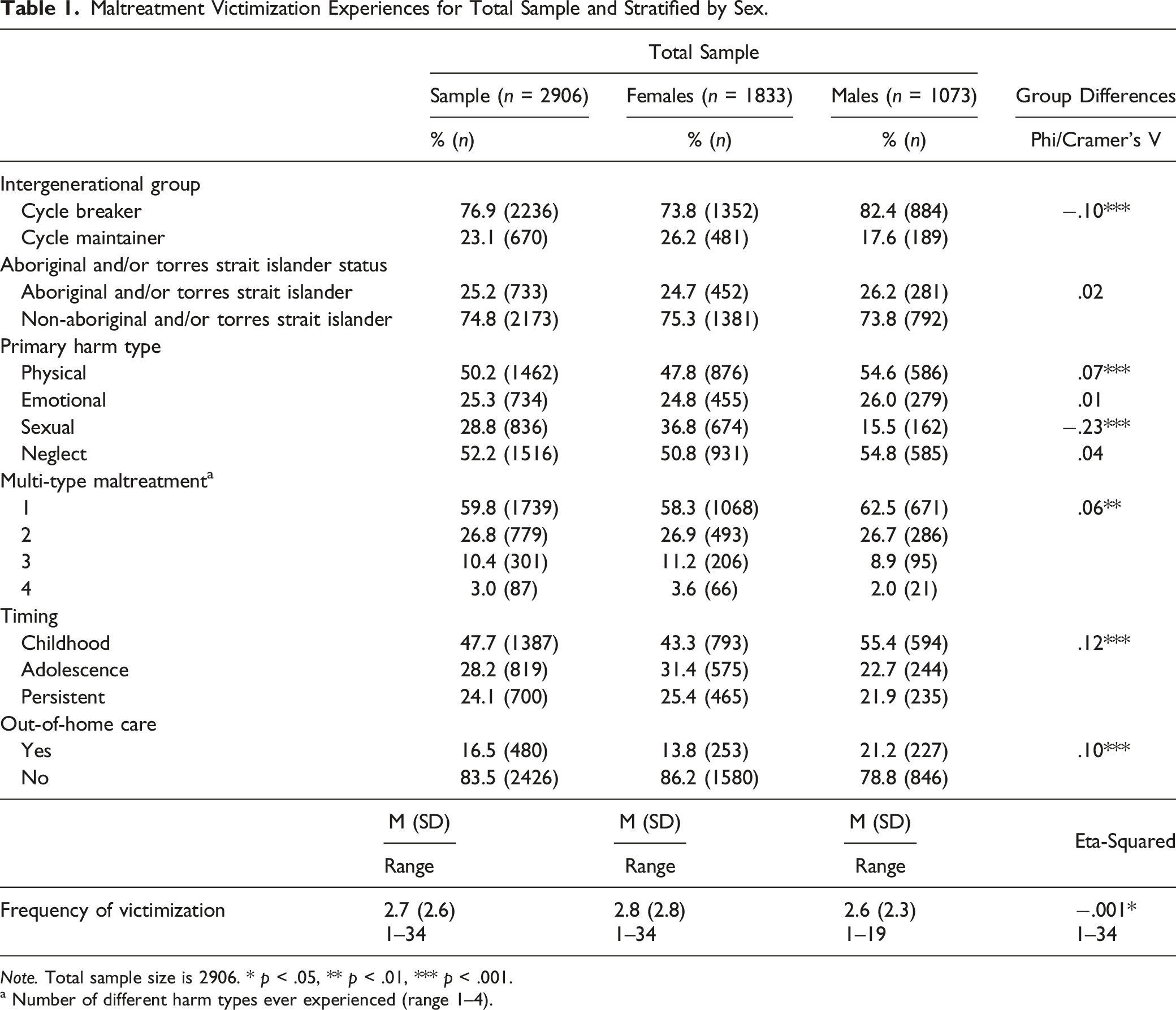
Maltreatment Victimization Experiences for Total Sample and Stratified by Sex.
Note. Total sample size is 2906. * p < .05, ** p < .01, *** p < .001.
a Number of different harm types ever experienced (range 1–4).
Comparisons of victimization experiences across sex revealed that, while effect sizes were small, most characteristics (excluding frequency, emotional abuse and neglect) significantly differed for males and females. Of note, compared to males, females had a higher prevalence of sexual abuse, and victimization in adolescence only. In contrast, experiencing out-of-home care was more prevalent in males than females.
When considering intergenerational (dis)continuity in our sample, 23.1% were subsequently identified as the person responsible for harm to a child by age 30. This means that, by age 30, approximately three quarters of victimized individuals could be considered cycle breakers. Compared to males, more females were subsequently identified as responsible for harm to a child by age 30, although the effect size was small,
What Childhood Victimization Experiences are Associated with Intergenerational Continuity?
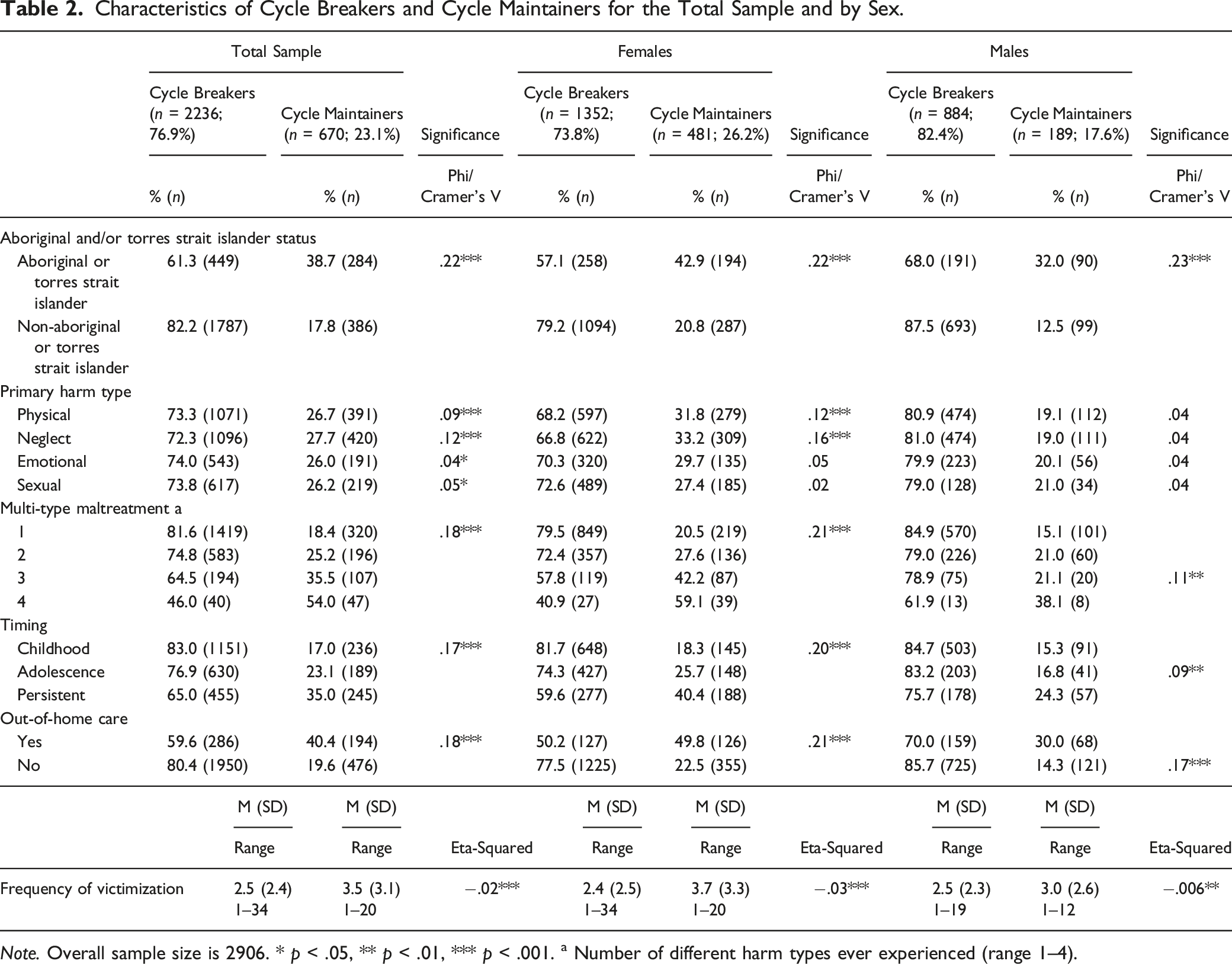
Characteristics of Cycle Breakers and Cycle Maintainers for the Total Sample and by Sex.
Note. Overall sample size is 2906. * p < .05, ** p < .01, *** p < .001. a Number of different harm types ever experienced (range 1–4).
All primary harm types were also significant in the total sample, though with reasonably small effect sizes. There were interesting differences across sex; no harm types were significant for males, while physical abuse and neglect were significant for females. However, despite being significant, the effect sizes were small and were lower than all the other maltreatment characteristics. Likewise, frequency was also significant for the total sample and across sex, but the effect sizes were small.
Before exploring multivariate patterns, we examined intercorrelations between all variables (see supplementary Tables 1 and 2), and the majority of intercorrelations were small. We excluded maltreatment frequency from the multivariate models for two reasons: (1) frequency was highly correlated with multi-type maltreatment (total sample rs = .80; female rs = .82; male rs = .77); and (2) frequency had a lower magnitude of association with maltreatment continuity than multi-type maltreatment (see Table 2). Moreover, we included multi-type maltreatment in the final model rather than primary harm types, since many maltreatment victims experience multiple types of maltreatment, either in a single event or across the life course (Berzenski & Yates, 2011), with 40.2% experiencing multiple primary harm types in our sample. Multi-type maltreatment also had a stronger association with continuity than any of the individual primary harm types, but as this multi-type variable was derived from these individual harm type variables, we could not include both variables in the same model.
We computed the analyses with all other variables (e.g., timing, out-of-home care, sex, and Aboriginal or Torres Strait Islander status) including primary harm types and excluding multi-type maltreatment for comparison purposes (see supplementary Table 3). All primary harm types, excluding emotional harm, were significantly related to intergenerational continuity for the total sample. Disaggregated by sex, physical harm and neglect were significantly related to intergenerational continuity for females, however, no primary harm types were significant in the model limited to males. Hence, the final variables included in the logistic regressions were: timing, multi-type maltreatment, out-of-home care, sex (for total sample model only), and Aboriginal and/or Torres Strait Islander status.
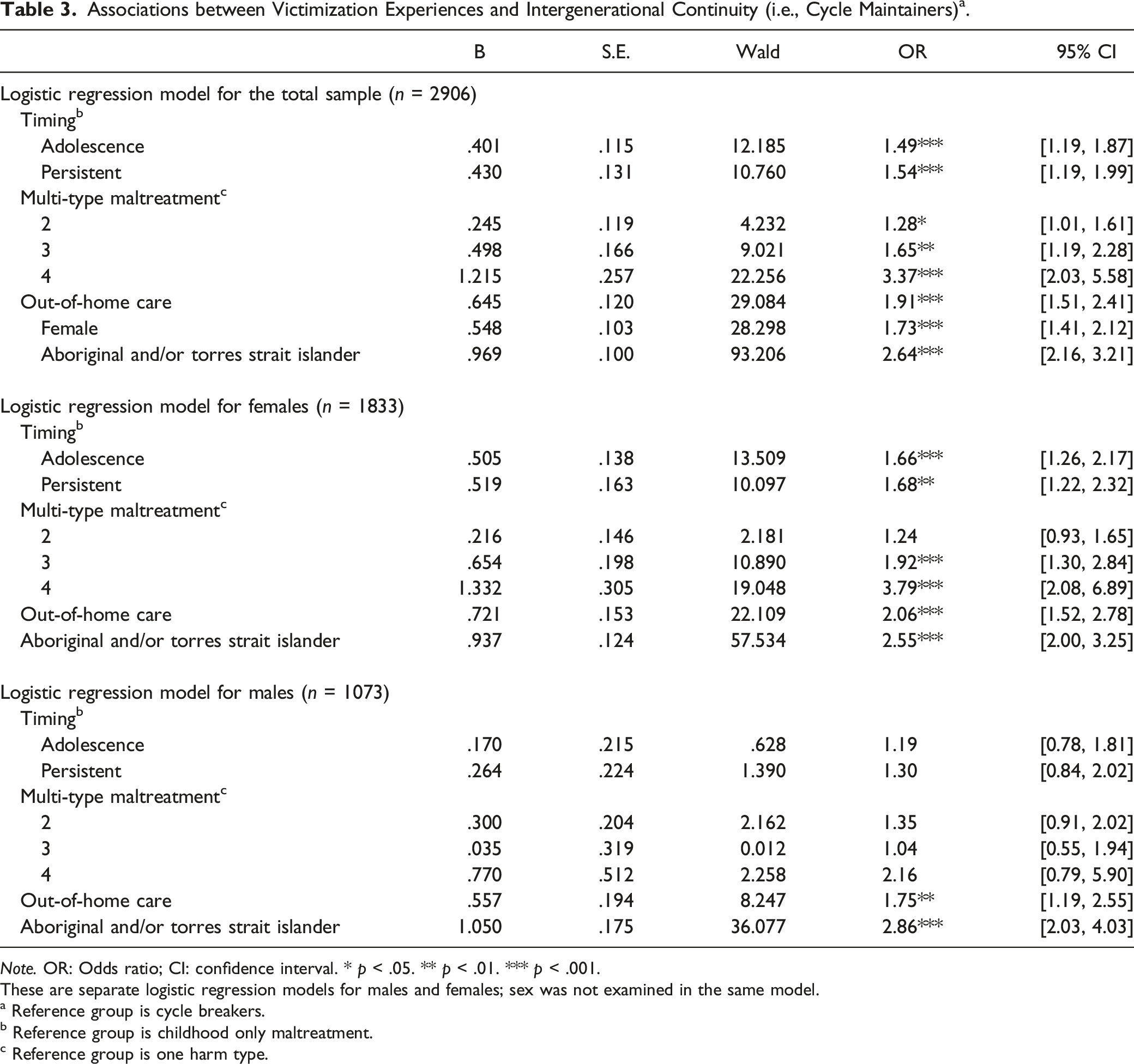
Associations between Victimization Experiences and Intergenerational Continuity (i.e., Cycle Maintainers) a .
Note. OR: Odds ratio; CI: confidence interval. * p < .05. ** p < .01. *** p < .001.
These are separate logistic regression models for males and females; sex was not examined in the same model.
a Reference group is cycle breakers.
b Reference group is childhood only maltreatment.
c Reference group is one harm type.
Logistic regression models were also computed stratified by sex to determine whether there were any differences in the patterns of association for cycle breakers and maintainers (see Table 3). For females, the full model containing all predictors was statistically significant,
For males, the full model containing all predictors was also statistically significant,
Discussion
The aim of this study was to examine the association between childhood maltreatment victimization experiences and intergenerational (dis)continuity of maltreatment. Using a large population-based study of almost 3000 individuals, we explored several important maltreatment characteristics together, rather than examining individual characteristics of maltreatment victimization and continuity separately. Our findings reiterate that child maltreatment is not a homogeneous experience, nor does it result in an inevitable cycle of intergenerational maltreatment. Even among those families where the cycle of maltreatment continued, the victimization experiences of individuals were not uniform. However, certain maltreatment victimization characteristics did increase vulnerability towards intergenerational maltreatment. There is increased risk associated with persistent maltreatment, multi-type maltreatment, and experiencing an out-of-home care placement, as well as magnified vulnerability among Aboriginal and Torres Strait Islander peoples. Some important disparities underlying intergenerational maltreatment continuity for females compared to males were observed.
In our data, a dose dependent relationship was observed for victims who experienced multiple harm types. As the number of harm types experienced increased, so did risk of intergenerational continuity. This suggests that the most common research approach (Jackson et al., 2019) of focusing specifically on the type of maltreatment experienced, may be meaningfully supplemented by consideration of multi-type maltreatment experiences. Many children experience multiple types of maltreatment, either in a single event or multiple events across the life course (Berzenski & Yates, 2011). Our findings are consistent with other studies that have found that multi-type maltreatment victimization is linked to an increased likelihood of intergenerational maltreatment (e.g., St-Laurent et al., 2019), with increasing risk with each additional harm type experienced.
Our findings suggest that the risk for maltreatment continuity is somewhat shaped by the developmental timing of maltreatment victimization experiences. Specifically, victims subjected to persistent maltreatment across both childhood and adolescence were at heightened risk of being held responsible for harm to a child compared to childhood-only victims of maltreatment. Adolescent-only victimization was also significantly linked to maltreatment continuity; however, this finding appears to be potentially linked to female maltreatment experiences. Prior research has highlighted the significance of adolescent victimization for maltreatment continuity, however, adolescent victimization included persistent victimization, which clouded conclusions about the specific impact of timing (Thornberry & Henry, 2013). Their study also predominantly included males (ratio 3:1) and separate analyses by sex could not be conducted. Given these findings, and recognising other literature that argues that age of onset is less important than whether victimization occurred during adolescence (Smith et al., 2005), it is important that the timing of maltreatment victimization experiences for males and females is explored in future research.
Due to the nature of our data, we cannot elucidate the mechanisms underlying the role of developmental timing. However, there are many developmental changes unique to adolescence that can render this age group increasingly vulnerable to trauma, and thus may provide explanation for the increased risk of continuity. Previous developmental research points to a range of potential explanatory factors from physiological (e.g., impacts on brain development), through to social and psychological (e.g., caregiver attachment, personal and interpersonal competence, and learned behaviours), as well as their variations and intersections across different developmental periods (Toth & Manly, 2019). Therefore, from a developmental psychopathology perspective, it is not surprising that the consequences of maltreatment victimization may differ depending on the developmental period of exposure (Cicchetti & Toth, 1995). Taken together with our results, the need for targeted interventions for distinct age groups, as well as interventions aimed at preventing childhood maltreatment continuing into adolescence, seems clear.
The link between an out-of-home care placement and maltreatment continuity is perhaps unsurprising given that out-of-home care is often suggestive of a high level of risk within the family. Some researchers have speculated that the severity of maltreatment experienced by those entering out-of-home care may provide partial explanation for the findings (Font et al., 2020). Experiences during out-of-home care may also influence subsequent outcomes; many children experience significant placement instability (Osborn et al., 2008), while others are exposed to further maltreatment (Uliando & Mellor, 2012). These experiences may also vary based on the age of the child when they enter out-of-home care. Some research suggests that adolescence is increasingly linked to disrupted placements and placement moves, which may be a result of the adolescents’ cumulative trauma or developmental needs, or a carer’s decreased tolerance for disruptive/aggressive behavior, when compared to younger children (Farrugia & Joss, 2021). Moreover, the out-of-home care literature places strong emphasis on possible difficulties with transitioning post-care. Some out-of-home care services cease relatively abruptly at age 18, and common themes emerge in the out-of-home care literature regarding lack of support and resources in housing, education and employment that are linked to poorer outcomes (Gypen et al., 2017).
In contrast, receiving support in education or employment (i.e., work experience, training, and apprenticeships), placement stability when in out-of-home care, and positive mentorships, have been associated with successful transition to adulthood (Gypen et al., 2017). Moreover, there is recognition that these vulnerable young people would benefit from support past the age of 18 years. Research indicates an association between age at leaving care and post-care wellbeing, such that the younger the individual the worse the outcome (Dixon, 2008). Importantly, of those victims in our sample who experienced an out-of-home care placement, almost 60% did break the cycle of maltreatment to age 30 years. Future interventions directed towards those in out-of-home care would benefit from gaining a more nuanced understanding of the conditions under which out-of-home care increases or decreases the likelihood of adverse outcomes, including intergenerational maltreatment risk.
With few exceptions, child maltreatment research has focused on female samples of “maltreaters”. Even in studies that include both males and females, they are typically merged, preventing comparison between them. Our findings identified observable differences in patterns of association by sex. Individually, most of the maltreatment characteristics examined were significantly related to continuity of maltreatment for both males and females. However, the effect sizes were stronger among females compared to males, especially for multi-type maltreatment and timing. In our multivariate models, the maltreatment characteristics all retained significance for females, whereas only an out-of-home care placement retained significance for males. It is important to highlight that although females were more likely to be categorized as cycle maintainers, one in five male victims in our sample were subsequently responsible for harm to a child (cycle maintainers), thus reiterating the need for more examination of (dis)continuity amongst males.
Our sex-related findings regarding timing of maltreatment are particularly interesting. Approximately one quarter of both males and females who were maltreated experienced persistent maltreatment. However, there was a higher prevalence of childhood-only maltreatment among males, whereas there was a higher prevalence of adolescent-only maltreatment among females. Adolescent-only maltreatment was also significantly linked to continuity for females, which suggests that experiencing adolescent maltreatment may be a particularly pertinent risk factor for females, compared to males. These preliminary findings suggest it may be important to continue exploring possible differences in the mechanisms underlying continuity for males and females.
People who identified as Aboriginal and/or Torres Strait Islander had higher odds of being categorized as cycle maintainers than non-Aboriginal and/or Torres Strait Islander people, a finding that held across sex. These results are in line with the known over-representation of Aboriginal and Torres Strait Islander people in CPS. Aboriginal and Torres Strait Islander people are almost seven times as likely as non-Indigenous people to have contact with the CPS (Australian Institute of Health and Welfare, 2020). This disproportionate over-representation stems from a myriad of reasons. Historically, Aboriginal and Torres Strait Islander people have experienced extreme trauma and discrimination, including dispossession, cultural assimilation, and forced child removals (Newton, 2019). Many Aboriginal and Torres Strait Islander people and communities disproportionately experience extreme social disadvantage, including substance abuse, unemployment, family and community violence, and poverty as residual impacts of colonization (Price-Robertson & McDonald, 2011). Inappropriate statutory decision-making has also been highlighted as contributing to their ongoing over-representation (Harnett & Featherstone, 2020). For example, concerns have been raised about the use of standardized risk assessments that inflate the scored level of risk among these families (Harnett & Featherstone, 2020), and that cultural differences in child rearing practices are not being recognized on a widespread basis (Newton, 2019). To address these complex issues there are increasingly more government-funded services that are led by Aboriginal and Torres Strait Islander people and designed to work closely with communities to achieve long-term, preventative, community-led strategies (Jongen et al., 2020). However, it is recognized that further measures are required to continue improving the health and welfare of our Aboriginal and Torres Strait Islander communities.
Strengths and Limitations
The use of population-based, longitudinal, prospective, administrative data is a key strength of this study. Administrative data do not rely on individual recall and are therefore not impacted by memory and recall bias. Furthermore, this study was able to explore patterns of association across males and females, where most studies are not sufficiently powered to do so. On the other hand, administrative data provide an under-representation of the true occurrence of maltreatment among families and suffer from the same biases that influence who comes into contact with these systems. This is particularly the case for fathers who are underrepresented in child protection (Brandon et al., 2019); as such, it is likely that the number of men who have harmed children is much higher than the fathers who have been identified as a person responsible for harm to a child in our study. Despite this, our findings provide an opportunity to respond to victimization known to services, and target preventative interventions towards those individuals most at risk of system contact for maltreatment continuity.
In our data, it is unknown whether the person identified as responsible for harm perpetrated the maltreatment or “failed to protect” the child from maltreatment perpetrated by another person. This is a measurement issue that is unavoidable due to the nature of administrative data. Therefore, our measurement of cycle maintainers reflects whether the parent experienced victimization as a child, and that the parent subsequently had CPS contact because they were identified as the person responsible for an omission, commission or failure to protect. This does not mean that they were necessarily responsible for perpetrating the maltreatment. The maltreatment victimization characteristics we explored may be linked to maltreatment continuity by increasing the vulnerability of the individual in different ways. For example, the victim does subsequently perpetrate maltreatment, or the victim is subsequently held responsible for failing to protect a child harmed by DFV perpetrated by his/her intimate partner, which may reflect his/her ongoing victimization (Jaffee et al., 2013). This is an important point deserving of additional research utilizing both qualitative and quantitative data.
We were able to examine life course experiences of maltreatment until age 30 years, however, some individuals in the cohort may have their first contact after this time, thus shifting from cycle breaker to cycle maintainer. At time of data extraction, we did not have the entire childhood period (0–17 years) of all second-generation children (i.e., the child/ren of the individuals identified as person responsible for harm), with 72% of first-born children aged ≤ 11 years old. Moreover, although all individuals in our sample were registered as a biological parent in the QLD RBDM data, we cannot determine the time spent with their biological children and therefore the “opportunity to maltreat”. Lastly, due to data constraints we were unable to measure environmental risk or other socio-demographic characteristics, such as socio-economic status, poverty, or geographical location of families, which we acknowledge are important in the context of child maltreatment. These factors should be considered in future research.
Implications for Policy, Practice, and Future Research
Our findings show that it is critical that maltreatment victimization is not viewed as a homogeneous experience, and that we identify those individuals who experience maltreatment victimization characteristics that increase vulnerability towards intergenerational maltreatment. Individuals subjected to adolescent maltreatment (whether it has persisted from childhood or commenced in adolescence), appear to be at heightened risk of maltreatment continuity, which provides important information regarding the need for targeted timing of intervention strategies. However, services can face increased challenges in engaging with adolescent victims. For example, adolescents can be at heightened risk of contact with the criminal justice system as a result of other behaviors (i.e., delinquency) (Thornberry et al., 2001), and are more likely to leave home following incidents of family violence (Hail-Jares et al., 2020), which directly impedes opportunities for intervention during a crucial developmental period. Adolescent maltreatment has also been associated with outcomes such as teenage pregnancy and school dropout (factors also linked to maltreatment continuity) (Thornberry et al., 2001).
Nonetheless, our emphasis on adolescent-specific interventions does not negate the importance of early interventions. Younger children have generally been considered the most vulnerable and therefore in need of interventions (Australian Institute of Health and Welfare, 2020). Our findings also highlighted that persistent maltreatment was significantly associated with risk of maltreatment continuity. Therefore, targeted early interventions to prevent/minimise maltreatment persisting into adolescence continue to be crucial, as are targeted interventions for adolescents to address developmental outcomes.
We recognize that our findings for sex must be considered in the context of time and CPS practices. Child maltreatment involves both commissions (abuse) and omissions (failure to protect/neglect). Traditionally, mothers were often identified as the “person responsible” for harm due to their role as the primary caregiver, irrespective of who perpetrated the maltreatment (Strega et al., 2008). Moreover, in families where DFV was present, CPS historically focused on the mother and her “failure to protect” her child from domestic violence, while the father’s maltreatment towards the child and parental impact remained invisible (Humphreys & Absler, 2011). This resulted in mothers being more likely to be represented in CPS data. Presently, there has been some shift towards father-inclusive work within child protection, as evidenced by the global implementation of practice models such as the Safe and Together model (Safe & Together Institute, 2020). Nonetheless, differences between mothers and fathers in the CPS should receive ongoing exploration in contemporary data alongside careful consideration of sex roles in society.
While maltreatment victimization experiences are important to understand, we recognize that an individual has multiple experiences across their life course and that development is determined by a complex interaction of individual, environmental, and contextual factors. Therefore, it is crucial to also consider other experiences that have occurred across the life course that influence outcomes. Future research should examine additional risk factors (e.g., mental health issues, DFV, delinquency), as well as protective factors that increase the resilience of some parents/caregivers (e.g., safe and stable relationships, social supports), to continue to improve our understanding of the intergenerational (dis)continuity of maltreatment.
Conclusions
The majority of individuals in our study that were subjected to childhood maltreatment victimization were not subsequently identified as responsible for harm to a child. Moreover, our study highlighted the heterogeneity of maltreatment experiences among those families where the cycle was broken or maintained, which provides an opportunity to target supports towards those vulnerable families most at-risk of subsequent maltreatment. Despite their increased risk profiles, however, many individuals who experienced persistent maltreatment, multi-type maltreatment, or an out-of-home care placement were not categorized as cycle maintainers. These findings highlight the importance of also exploring factors that promote resilience among some individuals despite their adversities. Likewise, our preliminary findings for sex suggest that it is important for studies to consider sex differences when examining intergenerational child maltreatment.
Supplemental Material
Supplemental Material - Intergenerational (Dis)continuity of Child Maltreatment: Variation by Parents’ Childhood Victimization Experiences and Sex
Supplemental Material for Intergenerational (Dis)continuity of Child Maltreatment: Variation by Parents’ Childhood Victimization Experiences and Sex by Emma F. McKenzie, Carleen M. Thompson, Emily Hurren, Stacy Tzoumakis, and Anna Stewart in Child Maltreatment
Footnotes
Acknowledgments
We sincerely thank the representatives from the Queensland Government Statistician’s Office, Queensland Department of Children, Youth Justice and Multicultural Affairs, and Queensland Registry of Births, Deaths, and Marriages. The views expressed are not necessarily those of the departments or agencies, and any errors of omission or commission are the responsibility of the authors. The authors also gratefully acknowledge use of the services and facilities of the Griffith Criminology Institute’s Social Analytics Lab at Griffith University.
Declaration of conflicting interests
The author(s) declared no potential conflicts of interest with respect to the research, authorship, and/or publication of this article.
Funding
The author(s) disclosed receipt of the following financial support for the research, authorship, and/or publication of this article: This research was conducted with financial support from an Australian Commonwealth Government scholarship, awarded to EM and an Australian Research Council Discovery Early Career Researcher Award (DE210100113) awarded to ST. The research leading to the creation of the QCRC linked database received funding from the Australian Research Council (grant no. LP100200469). This project was supported by the Queensland Government Statistician’s Office; Queensland Department of Children, Youth Justice and Multicultural Affairs; and Queensland Registry of Births, Deaths, and Marriages.

Supplemental Material
Supplemental material for this article is available online
References
Supplementary Material
Please find the following supplemental material available below.
For Open Access articles published under a Creative Commons License, all supplemental material carries the same license as the article it is associated with.
For non-Open Access articles published, all supplemental material carries a non-exclusive license, and permission requests for re-use of supplemental material or any part of supplemental material shall be sent directly to the copyright owner as specified in the copyright notice associated with the article.
