




Abstract
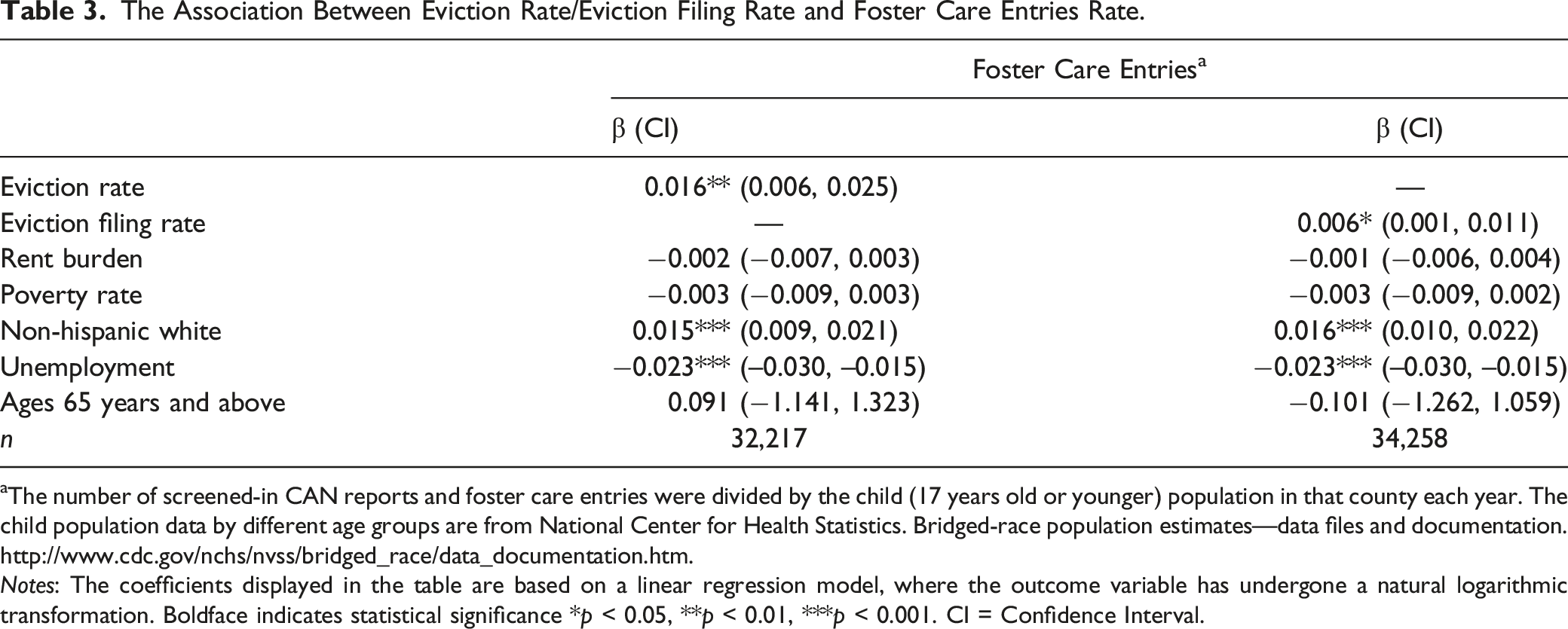
This study aimed to understand the relationship between home eviction and child welfare system involvement at the county level. Using administrative data, we examined associations of home eviction and eviction filing rates with child abuse and neglect (CAN) reports and foster care entries. We found one additional eviction per 100 renter-occupied homes in a county was associated with a 1.3% increase in the rate of CAN reports and a 1.6% increase in foster care entries. The association between eviction and foster care entries was strongest among Hispanic children with an 8.1% increase. Assisting parents in providing stable housing may reduce the risk of child welfare system involvement, including out-of-home child placement. Primary and secondary prevention strategies could include housing assistance, increasing access to affordable and safe housing, as well as providing economic support for families (e.g., tax credits, childcare subsidies) that reduce parental financial burden to access stable housing.
Introduction
Child abuse and neglect (CAN) is a serious public health issue. In 2018, the rate of reported CAN was 9.2 per 1,000 children in the U.S. (Children’s Bureau, 2020). Though the child physical abuse victimization rate as reported to child protective services (CPS) agencies has declined since 2000, child neglect has remained stable (Finkelhor et al., 2020). Poverty is an important risk factor for CAN as it could contribute to both child neglect (acts of omission to meet a child’s basic needs) and abuse (acts of commission by caregiver that results in harm) through multiple mechanisms. For instance, poverty or low income may limit caregiver’s ability to provide adequate food, housing, clothing and medical care that usually leads to neglect; it may also increase parental stress or depression and thus result in harsh parenting that may lead to abuse (Berger & Waldfogel, 2011). Insecure housing associated with poverty could pose a serious threat to child’s well-being. Housing insecurity, such as frequent moves, homelessness, and unaffordable housing, is linked to negative health outcomes for children (Leventhal & Newman, 2010; Sandel et al., 2018). Furthermore, parents without stable housing may experience stress, depression, and family conflict (Jocson & McLoyd, 2015; Pavao et al., 2007), which may increase the risk for CAN (Centers for Disease Control and Prevention, 2019). For instance, parental stress associated with unstable housing may increase the likelihood of harsh and punitive parenting behaviors (Leventhal & Newman, 2010). In addition, parents living in unaffordable housing may work long hours to pay housing costs and may be less available to their children, (Leventhal & Newman, 2010) which could increase the risk for child neglect. Previous research has found that housing insecurity is associated with increased risk for CAN and related child welfare system involvement (Chandler et al., 2020).
Home eviction, a form of housing insecurity, has disproportionally impacted low-income households, non-White populations, and children (Desmond, 2012; Desmond et al., 2013; Hepburn et al., 2020). Between 2000 and 2016, approximately 1 in 17 renter households were served an eviction notice and 1 in 40 renter households were evicted in the United States (The Eviction Lab, 2018). Home eviction increases the likelihood of homelessness (Crane & Warnes, 2000), perpetuates poverty, and exacerbates the negative effects of poverty on families (Desmond, 2012). It is especially detrimental for low-income families who may not have a safety net (e.g., no other place to live or no income resources to support basic living expenses) when evicted. Furthermore, the incidence of home eviction is not homogenous across different racial and ethnic groups. A study using national data showed that Black renters received the highest rates of eviction filing and eviction judgement 1 and Black and Latinx renters were more likely to be repeatedly filed against for eviction at the same address (Hepburn et al., 2020). Prior research suggests that home eviction is associated with a higher risk of negative physical and mental health outcomes including depression, anxiety, and even suicide for parents (Fowler et al., 2015; Vásquez-Vera et al., 2017).
There are several possible pathways that might indicate a possible connection between home evictions and CAN as well as the subsequent child welfare system involvements and the potential racial disparities of these associations. First, the family stress model considers economic disadvantage as triggers of feelings of economic pressure, which then may lead to psychological distress in parents that ultimately contributes to negative parenting (Barnett, 2008) or even abusive parenting (Cadzow et al., 1999; Chan, 1994; Crouch & Behl, 2001). Parents subject to home eviction may experience tremendous distress in parenting, which may increase the likelihood of CAN. Second, a related but different pathway is that parents living in unaffordable housing that may result in eviction may work long hours, have multiple jobs to pay for the rent, be unable to afford childcare, and, as a result, may leave children with unprepared providers or unattended. Previous research has found that maternal nonstandard work schedule (or shift work) is positively associated with CPS involvement (Han et al., 2013). Third, the eviction process may increase the visibility of children experiencing CAN to law enforcement and social services workers, who are mandatory reporters to CPS (Font & Warren, 2013). A prior study discussed the importance of paying attention to not only the actual eviction but also the eviction filing as the eviction filing was found to be used as a threat by landlords that could create emotional insecurity in addition to the potential residential instability (Garboden & Rosen, 2019). Both eviction and eviction filing could lead to parental stress and thus CAN and child welfare system involvements. Fourth, people from racial and ethnic minority groups in the U.S. are more likely to experience poverty (Shrider et al., 2021), have higher unemployment (U.S. Bureau of Labor Statistics, 2021), be cost burdened by housing (Joint Center for Housing Studies, 2014), and have lower postsecondary graduation rates (National Center for Education Statistics, 2019) than their white counterparts. Those existing disparities in socio-economic status (Dettlaff & Boyd, 2020; Fluke et al., 2011; Zambrana & Dorrington, 1998), racial bias in child welfare system (Rivaux et al., 2008) and eviction (Greenberg et al., 2016), and systemic racism (Dettlaff & Boyd, 2020; Fluke et al., 2011) make racial and ethnic minority populations more vulnerable after eviction and expose them to higher risk of child welfare system involvement.
Previous studies utilized a comprehensive housing stress indicator that included home eviction, homelessness, residential moves, and other metrics to examine the impact of housing instability on CAN and child welfare system involvement (Marcal, 2018; Warren & Font, 2015; Yang, 2015) and results are mixed. There are only a few studies that have directly discussed the relationship between evictions and child welfare system involvement. One U.S. study used administrative eviction data to examine the relationship between eviction and CAN (Bullinger & Fong, 2021) and found that when eviction notices rose in a neighborhood, reports of maltreatment also increased. However, the data examined in that study was restricted to one state. Another study utilized the individual-level data from Sweden to investigate whether the eviction is associated with placement in out-of-home care (Berg & Brännström, 2018). The authors found that children who experienced eviction had higher odds of being placed in out-of-home care. Compared with that study, in addition to using two comprehensive and multi-year U.S. child welfare dataset, we added to the literature by examining this topic within a U.S. context with a particular focus on the racial and ethnic disparity of child welfare system involvement in the U.S. It is critical to understand this relationship through the lens of health equity as the racial and ethnic disparities are embedded in both child welfare system and housing market of this country, and the causes for them are complex and unique compared with other countries. To the best of our knowledge, there has not been a national study that has directly examined the relationship between home eviction and child welfare system involvement within a U.S. context. The present study aims to address this research gap and provide evidence of the relationship between home evictions and child welfare system involvement using national data.
Child welfare system involvement is often indicative of CAN though they are not equivalent. Being investigated by CPS does not mean CAN occurred and CAN occurring does not mean the parents will be investigated. Despite that, child welfare system involvement has been used as a proxy for CAN. In this study, we will use screened-in CAN (i.e., CPS screened-in reports as “appropriate” for response from initial referrals involving the alleged child maltreatment) reports and foster care entries to serve as indicators of CAN. Specifically, this study tests the following hypotheses: 1) county-level prevalence of home eviction indicators is positively associated with screened-in CAN reporting rates, during the same year; 2) county-level prevalence of home eviction indicators is positively associated with child foster care entry rates, during the same year; 3) non-White children will experience a stronger relationship between county-level prevalence of eviction indicators and child welfare system involvement.
Background
Child Welfare System Involvement and Poverty
A large body of literature has documented that poverty and insufficient material conditions increase the likelihood of CAN (Berger, 2004; Farrell et al., 2017; Hussey et al., 2006; Merritt, 2009) and subsequent child welfare system involvement (Coulton et al., 1995; Drake & Pandey, 1996; Ernst, 2000; Sedlak et al., 2010; Yang, 2015). Prior studies have also discussed the potential mechanism and how poverty could directly and indirectly affect child welfare system involvement. Poverty or low income may limit a parent’s ability to provide adequate care to meet children’s basic needs and lead to physical neglect of children and child welfare investigation (Berger, 2004; Drake & Pandey, 1996; Fong, 2017; Pelton, 1978; Yang, 2015). Poverty may also increase parental stress and depression that could lead to harsh parenting and temporary withdrawal from the parental role and eventually lead to child welfare system involvement (Fong, 2017; Kim & Drake, 2018; Pelton, 2015; Yang, 2015). The depression and hopelessness suffered by those parents may make it even more difficult to cope with poverty (Pelton, 2015) resulting in more potential abuse and neglect. Household challenges or parental adversities such as domestic violence, parental mental health issues, substance use disorder, and criminal justice involvement that are associated with poverty could also increase the likelihood of CAN and child welfare system involvement. Those parental adversities might impact parenting and then lead to CAN, and they also could expose the parents to a higher risk of being reported to CPS by medical professionals and police officers who are mandated to do so if they identify any suspected CAN (Fong, 2017). In addition, parents living in a neighborhood with high poverty may be less likely to receive support from their neighbor to help with their basic needs and have less access to formal and institutional resources to support positive parenting, which might contribute to more CAN and subsequent child welfare system involvement (Fong, 2019; Landers et al., 2019; Maguire-Jack & Font, 2017).
Child Welfare System Involvement and Race
In the child welfare system, racial and ethnic minority children overrepresented the reported CAN cases and foster care entries (U.S. Department of Health & Human Services., 2021, U.S. Department of Health & Human Services., 2022). It has also been found that there is a racial disproportionality in child welfare system involvement in non-White neighborhoods (Fong, 2019) and the neighborhood inequality has negatively impacted residents’ social relationship such as distrust among neighbors and interference with parental authority (Roberts, 2008). The underlying causes of the racial disparity and disproportionality have been discussed by researchers. Some researchers have attributed the disproportionality to poverty and contended that the racial and ethnic minority are at higher risk of poverty compared to non-Hispanic White and the racial disparity in the poverty risk and economic well-being largely drove the disproportionality (Drake et al., 2011; Kim & Drake, 2018; Laskey et al., 2012; Pelton, 2015; Putnam-Hornstein et al., 2013; Sedlak et al., 2010). Other researchers argued that the racial bias in the child welfare system specifically in the decision making such as whether to substantiate a case and to remove a child from the home might be attributable to the disproportionality (Dettlaff et al., 2011; Maguire-Jack et al., 2020; Merritt, 2021; Rivaux et al., 2008; Roberts, 2003). It is also recognized that the racial disparity in poverty risk and racial bias are not mutually exclusive and should be understood within a bigger context that the systemic racism (e.g., redlining, discrimination in labor market) in the society disadvantages the racial and ethnic minorities and it is the fundamental underlying root causes for the existing racial disparity in poverty and racial bias in CPS system (Dettlaff et al., 2021; Dettlaff & Boyd, 2020; Roberts, 2003).
Child Welfare, Housing Insecurity, and Home Evictions
Housing plays a critical role in providing stability to a family. Housing insecurity, a form of material hardship and closely related to poverty, may impede parents from providing basic needs to their children to ensure their well-being. Housing insecurity has been linked to more child welfare system involvement (Bassuk et al., 1997; Courtney et al., 2004; Culhane et al., 2003; Cunningham et al., 2015; Warren & Font, 2015). Homelessness or insecure housing conditions such as excessive temperature, lack of clean water, and pest infestation could threaten children’s health and safety and lead to more child welfare system involvement (Cohen et al., 2004; Hirsch et al., 2015). Parents at risk of being evicted, homeless or living doubled-up may face significant stress or anxiety that could lead to harsh or poor parenting and subsequently lead to CAN (Cowal et al., 2002; Desmond & Kimbro, 2015; Font & Warren, 2013) and the stress associated with them could also cause household challenges such as domestic violence, parental mental health issues, and substance use disorder which may pose significant risk to a child and result in subsequent child welfare system involvement (Brook & McDonald, 2009; Cowal et al., 2002; De Bellis et al., 2001; Font & Warren, 2013; Marsh et al., 2006; Warren & Font, 2015). It is also possible that parents experiencing homelessness may voluntarily place their children in foster care while searching for housing due to shelter policies (Cunningham et al., 2015). Further, parents at risk of housing insecurity such as being in a shelter or in the process of being evicted could be subject to more scrutiny from service provider or eviction officials who are mandated to report any CAN to CPS (Park et al., 2004). Housing insecurities manifest itself in multiple ways, and home eviction is one of them and could lead to frequent moves, living in hazardous home environment, and homelessness, which could threaten children’s health and safety. In the United States, eviction happens when a landlord forcibly expels a tenant from a residence and a formal eviction occurs when a landlord carries out an eviction through the court system (Desmond et al., 2018). To start an eviction process, a landlord needs to file an eviction case in a civil court at the county-level and then eviction notice will be sent to the tenant. The judge will decide whether to grant the landlord an eviction order during the hearings. Once the eviction order is granted by the judge, the tenant must vacate the residence by a specific date and the eviction court will execute the eviction order including changing the locks and removing any possessions if the tenant doesn’t voluntarily leave (Desmond et al., 2018; Humphries et al., 2019). Most evictions in this country are attributed to non-payment of rent and it does not take a major life event to miss a rent payment and for families who live paycheck to paycheck, any sudden disturbance of income such as reduction of work hours or public benefit sanction could cause non-payment of rent and eventual eviction (Desmond & Kimbro, 2015). Evicted families may end up living in a house with substandard living conditions or even being homeless. Although housing insecurity, such as inadequate housing, can be the basis of child neglect, state policy changes on the criteria for removing children from their parents could impact the child welfare system involvement. For instance, Washington state recently passed a bill that would prevent the state from removing children because of certain conditions in the home such as inadequate housing (Shapiro, 2021). It is possible that child welfare system involvement related to housing in those states or counties that enacted similar policies decreased compared to those jurisdictions that had not enacted similar policies.
Method
Data
The unit of analysis is county-year. Data on screened-in CAN reports were captured using data from the 2010-2016 National Child Abuse and Neglect Data System (NCANDS) Child File (Children’s Bureau, 2016), a federally-sponsored, voluntary, administrative and case-level data set that collects screened-in reports of alleged CAN that received CPS response in all 50 states and the District of Columbia. Importantly, NCANDS does not have data on reports that were not screened-in by CPS caseworkers. Data on foster care entries came from the 2000-2016 Adoption and Foster Care Analysis and Reporting System (AFCARS) Foster Care File (Children’s Bureau, 2016). AFCARS is a federally-sponsored administrative data system that collects case-level information on all children in foster care from all 50 states and the District of Columbia to capture foster care entries. States are required to submit data to AFCARS to receive federal reimbursement. Both data from NCANDS and AFCARS contain the demographic information of the child involved in each case reported to the CPS such as age, sex, and race and ethnicity. They also include the reasons for each CAN investigation case and removal from child’s parents such as physical abuse, neglect, sexual abuse, inadequate housing, domestic violence, substance use disorder, etc. (Children’s Bureau, 2016). The data from NCANDS and AFCARS used in this study include all counties in the U.S. for which states submit data to the federal government. We used restricted-use data provided directly by the Children’s Bureau, and as such they have no suppression, unlike data available through the National Data Archive on Child Abuse and Neglect, which suppress counties with fewer than 1,000. The home eviction data come from the Eviction Lab at Princeton University (Desmond et al., 2018b), which publicly provides annual county-level eviction records. During 2000 to 2016, the number of states from which the Eviction Lab was able to collect records varied by year from 41 to all 50 states and the District of Columbia. The Eviction Lab data are compiled from multiple sources that include county court records and purchased eviction records from LexisNexis Risk Solutions and American Information Research Services Inc (Desmond et al., 2018a). The NCANDS and AFCARS data were merged with the Eviction Lab data using county FIPS code.
Measures
Dependent Variable
Children with Screened-In Child Abuse or Neglect Reports
The primary dependent variables for CAN reporting are the incidence of children with a screened-in report per 100,000 children per federal fiscal year in each county. Screened-in reports are cases CPS deemed as appropriate for response and received either an investigation or alternate response (Child Welfare Information Gateway, 2020). Importantly, a CAN report can include multiple children, and children can have multiple reports over time. We focus on the unique number of children reported in a fiscal year, not the unique number of reports. While NCANDS contains information on whether reports were substantiated, we included all reports regardless of substantiation because prior research suggests that screened-in reports have shown some level of consistency across states despite changes in response (Klevens et al., 2015) and thus can reduce inaccuracy due to the inconsistency in the process of determining if a case is substantiated or not at each state. Additionally, research finds that substantiation after an investigation may not be predictive of worse child and family outcomes compared to unsubstantiated reports (Kohl et al., 2009; Kugler et al., 2019).
Foster Care Placement
The primary dependent variable for foster care placement is the incidence of foster care entries per 100,000 children per federal fiscal year in each county.
Independent Variable
Home Eviction Filing Rate
The home eviction filing rate is the number of home eviction filings per 100 renter-occupied homes within a county during each calendar year. 2
Home Eviction Rate
The home eviction rate is the number of home evictions enforced by a judgment from a court per 100 renter-occupied homes within a county during each calendar year.
Covariates
The following county-level variables were included because they potentially confound the relationship between the independent variables and the dependent variables. We included the poverty rate and the rent burden, defined as percent of the population in a county with income in the past 12 months below the federal poverty level and a ratio of median monthly gross rent to median monthly household income in a county respectively, as they are both predictors of evictions and child welfare system involvement (Bai et al., 2022; Yang, 2015). We included the percentage of a county’s population that is non-Hispanic White, to account for the higher risk that non-White families face in being evicted and being involved in child welfare systems. These three variables were from the American Community Survey and compiled by Eviction Lab. We also included the percentage of a county that was age 65 years and older, to account for the fact that younger populations are more likely to have children and be involved in child welfare systems (Dworsky, 2015; Leventhal, 1981). This variable was drawn from the American Community Survey. Finally, we included the unemployment rate that was defined as the percent of unemployed persons of the civilian labor force in a county (U.S. Bureau of Labor Statistics, 2020) drawn from the U.S. Bureau of Labor Statistics Local Area Unemployment Statistics program as unemployment is likely predictive of both evictions and child welfare system involvement.
Bivariate Choropleth Mapping
To better understand the joint geographic distribution of home eviction and CPS involvement, we produced county-level bivariate choropleth maps. These maps were produced using R version 3.6.3.
Statistical Analysis
We employed fixed-effect linear regression models, controlling for both year- and county-fixed effects, to examine the association between home evictions and child welfare system involvement. The county effects account for unmeasurable factors unique to each county that are stable over the sample, such as institutional culture. Year effects account for large-scale annual factors that affect all counties, such as federal policies or macroeconomic changes. We estimated models for all children, and then separate models for children of specific racial/ethnic groups that were well-identified in NCANDS and AFCARS, including non-Hispanic White, non-Hispanic Black, and Hispanic (of any race). We took the natural log transformation for all dependent variables to correct for the skewness of the distribution. Standard errors of the coefficient estimates were clustered at the county level (Bertrand et al., 2004). We used case-wise deletion to remove cases missing covariates. In addition, to account for the undue influence of outlying observations, we calculated Cook’s distance and studentized residuals for each observation, using commonly applied criteria. Cook’s distance measures the influence of an observation on the model estimates, and studentized residuals detect observations with high leverage (Cook & Weisberg, 1982; Stevens, 1984). We removed observations with both Cook’s distance greater than 4/N (with N being the model sample size), and studentized residuals above the alpha level of 0.05 (Cook & Weisberg, 1982). This led to minor changes in the model sample size but gave us greater confidence in the model estimates. In the primary model of screened-in reports and evictions, we identified 754 observations as outliers, with the median Cook’s distance metric double the criteria of 4/N, and median studentized residual 1.3 times the alpha level. In the primary model of foster care entries and evictions, we identified 1,778 observations as outliers, with the median Cook’s distance metric 3.4 times the criteria of 4/N, and median studentized residual 1.7 times the alpha level.
Descriptive Statistics of the Samples from 2010-2016 National Child Abuse and Neglect Data System and 2000-2016 Adoption and Foster Care Analysis and Reporting System.
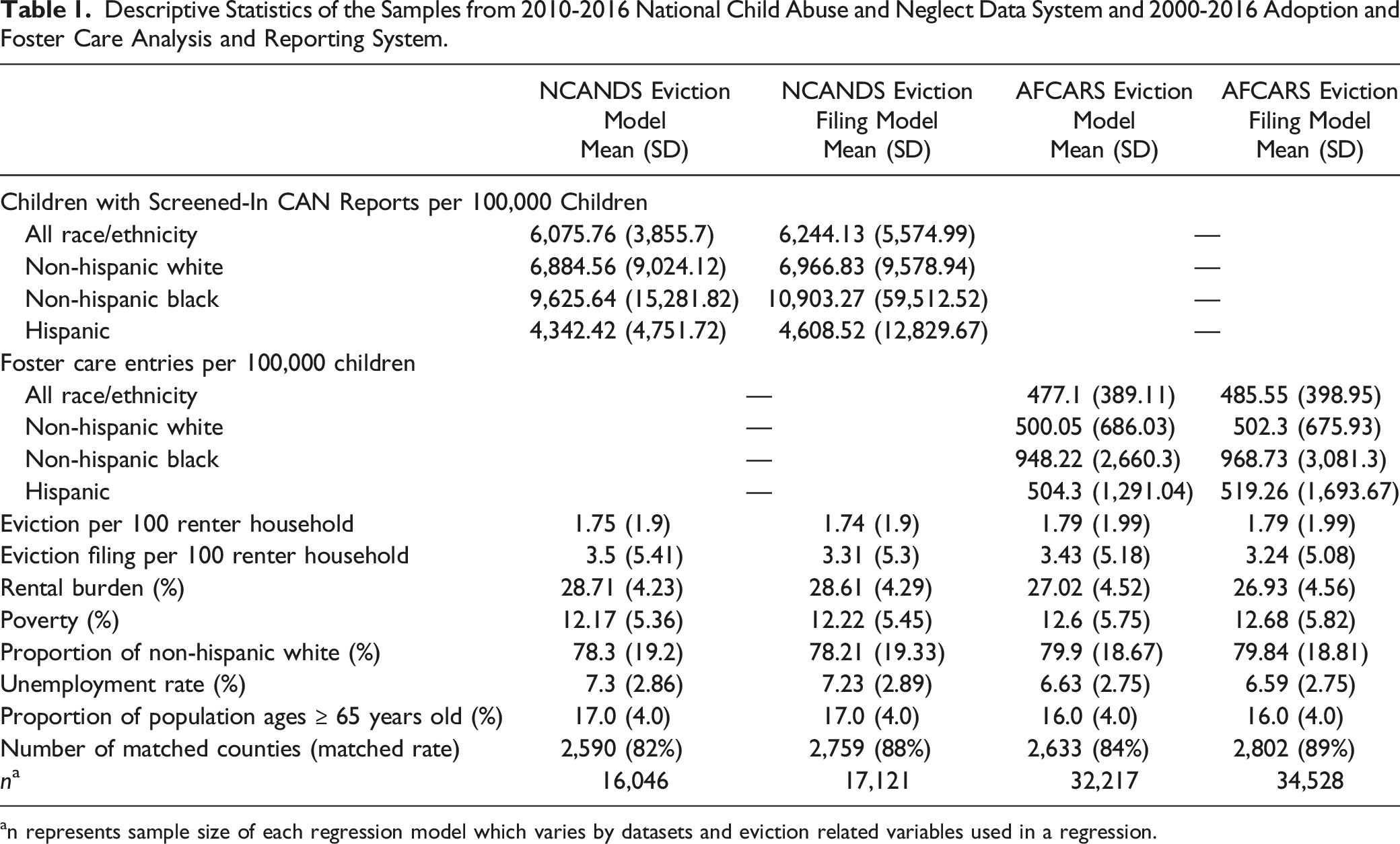
an represents sample size of each regression model which varies by datasets and eviction related variables used in a regression.
Statistical analyses were conducted using Stata15. As home eviction disproportionally affects different racial/ethnic groups, we investigated the aforementioned associations for three racial/ethnic groups: Non-Hispanic White (White), Non-Hispanic Black (Black), and Hispanic of any race. Sample sizes for other groups, such as Asian or American Indian/Alaskan Native, were too small to permit robust analysis.
It is possible that evictions and filings have a lagged effect on child welfare cases. At the individual level, an eviction may take time to subsequently lead to a CAN report and foster care case. At the community level, incidence of evictions may be indicative of housing instability in a community, which may take time to manifest itself as greater risk of CAN. To test for the potential lag, we ran our main models with eviction rates at a 1 year lag and compared the estimate with the same-year estimate.
Results
Bivariate Choropleth Map
Figure 1 and Figure 2 show the geographic distribution of home eviction rates and CPS involvement over time. Counties in dark violet are counties where screened-in CAN reports or foster care entries and the home eviction rate were above the median county values. Counties in red are areas with above median home eviction rates but below median screened-in CAN reports or foster care entries. Counties in blue were areas with above median screened-in CAN reports or foster care entries but below median home eviction rates. Counties in purple are areas with below median screened-in CAN reports or foster care entries and below median home eviction rates. Geographic distribution of screened-in child abuse and neglect reports and home eviction rates, 2010 and 2016. Geographic distribution of foster care entries and home eviction rates, 2000, 2010, and 2016.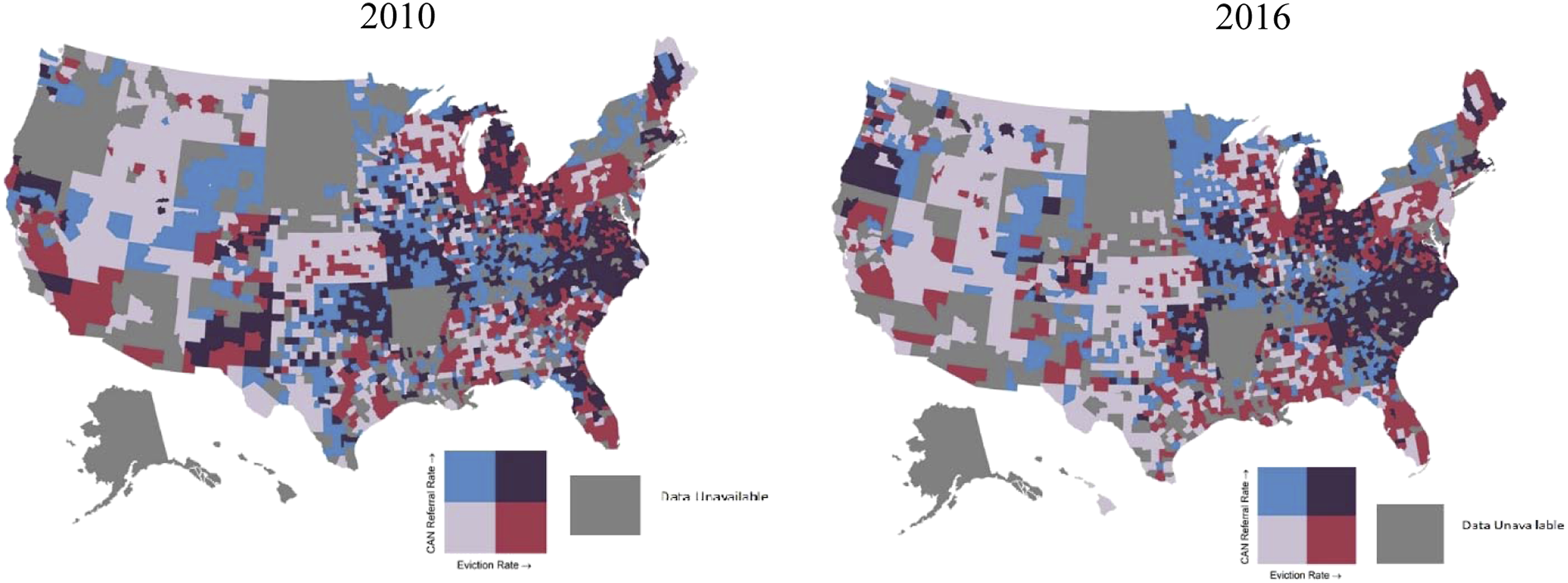
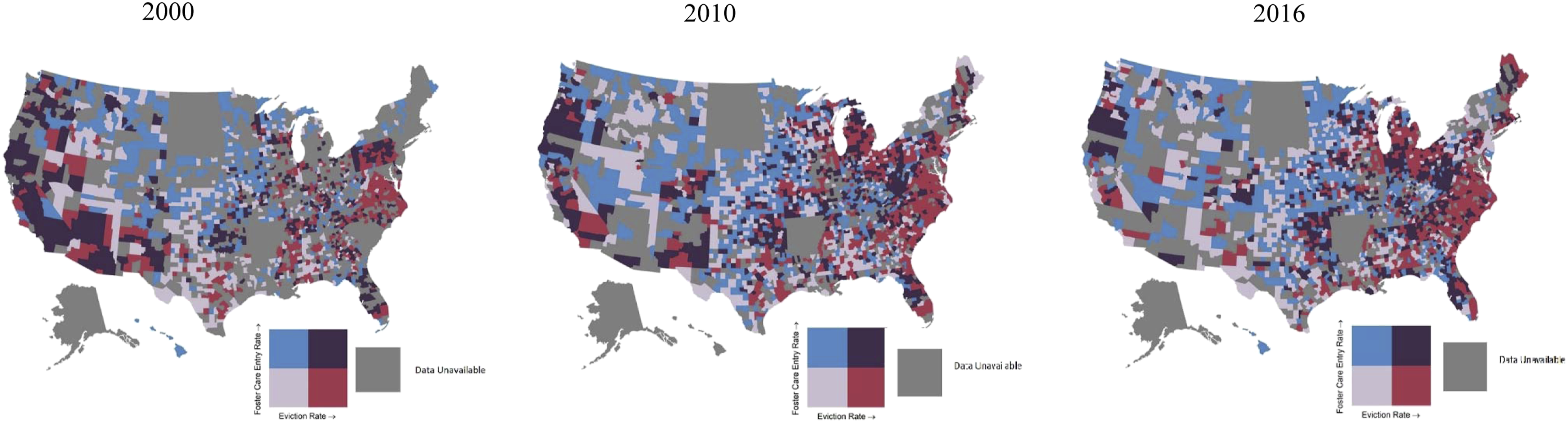
Figure 1 shows that the number of counties with above median home eviction rates and screened-in CAN reports rates expanded from 2010 to 2016. The increase mostly happened in the Southeastern and Midwestern United States. Figure 2 shows changes in the geographic distribution of counties with high home eviction rate and high foster care entries rate from 2000 to 2016. In 2000, counties with above median eviction and high foster care placement were mainly located at the west coast areas. In 2010 and 2016, more such counties were in the Midwest. If we compare Figure 1 with Figure 2 from 2010 to 2016, the common trend was that the Midwest saw a growing number of counties with both above-median eviction rates and high CPS involvement.
Main Results
The Association Between Eviction Rate/Eviction Filing Rate and Screened-in Child Abuse and Neglect Report Rate.
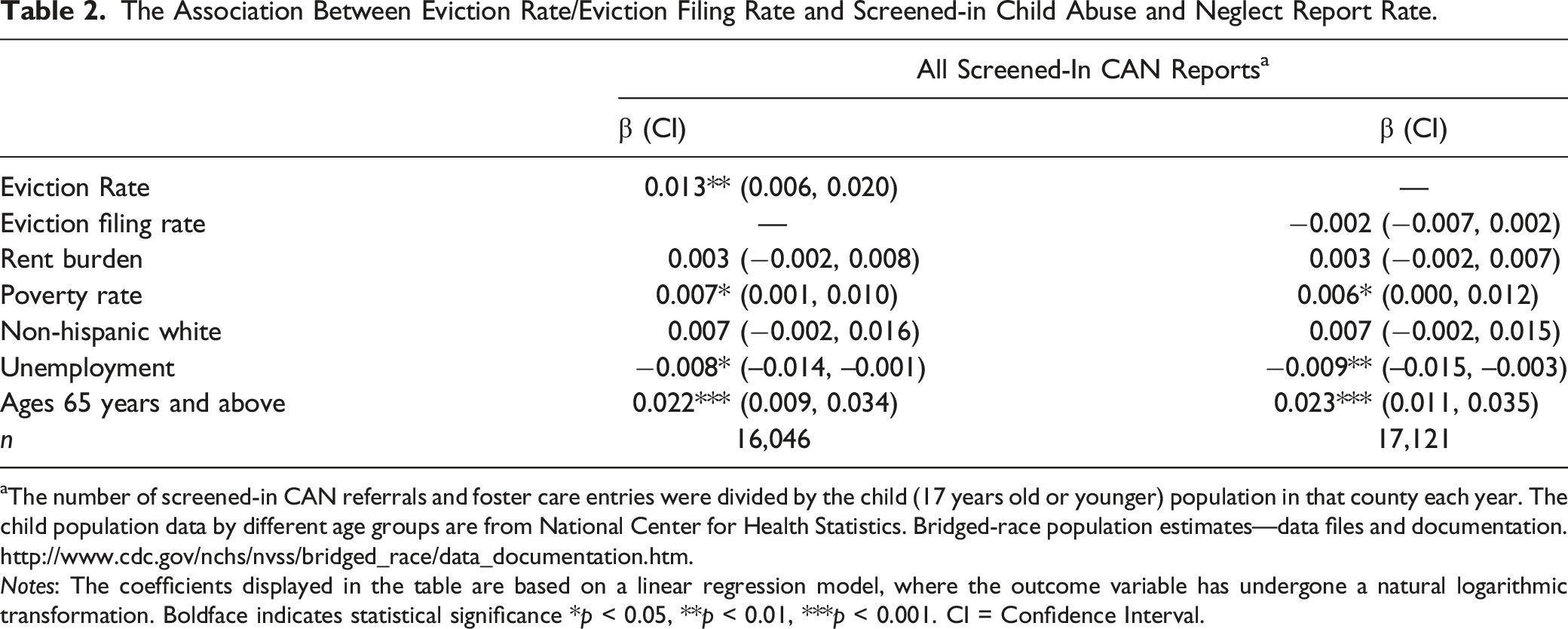
aThe number of screened-in CAN referrals and foster care entries were divided by the child (17 years old or younger) population in that county each year. The child population data by different age groups are from National Center for Health Statistics. Bridged-race population estimates—data files and documentation. http://www.cdc.gov/nchs/nvss/bridged_race/data_documentation.htm.
Notes: The coefficients displayed in the table are based on a linear regression model, where the outcome variable has undergone a natural logarithmic transformation. Boldface indicates statistical significance *p < 0.05, **p < 0.01, ***p < 0.001. CI = Confidence Interval.
The Association Between Eviction Rate/Eviction Filing Rate and Foster Care Entries Rate.
aThe number of screened-in CAN reports and foster care entries were divided by the child (17 years old or younger) population in that county each year. The child population data by different age groups are from National Center for Health Statistics. Bridged-race population estimates—data files and documentation. http://www.cdc.gov/nchs/nvss/bridged_race/data_documentation.htm.
Notes: The coefficients displayed in the table are based on a linear regression model, where the outcome variable has undergone a natural logarithmic transformation. Boldface indicates statistical significance *p < 0.05, **p < 0.01, ***p < 0.001. CI = Confidence Interval.
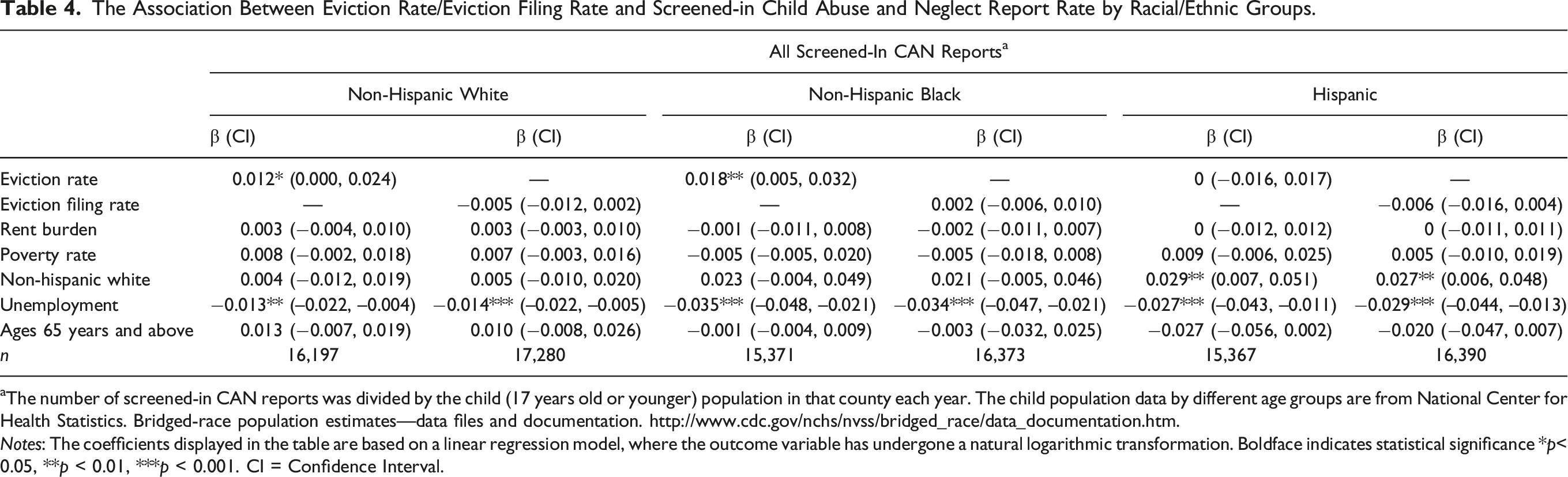
The Association Between Eviction Rate/Eviction Filing Rate and Screened-in Child Abuse and Neglect Report Rate by Racial/Ethnic Groups.
aThe number of screened-in CAN reports was divided by the child (17 years old or younger) population in that county each year. The child population data by different age groups are from National Center for Health Statistics. Bridged-race population estimates—data files and documentation. http://www.cdc.gov/nchs/nvss/bridged_race/data_documentation.htm.
Notes: The coefficients displayed in the table are based on a linear regression model, where the outcome variable has undergone a natural logarithmic transformation. Boldface indicates statistical significance *p< 0.05, **p < 0.01, ***p < 0.001. CI = Confidence Interval.
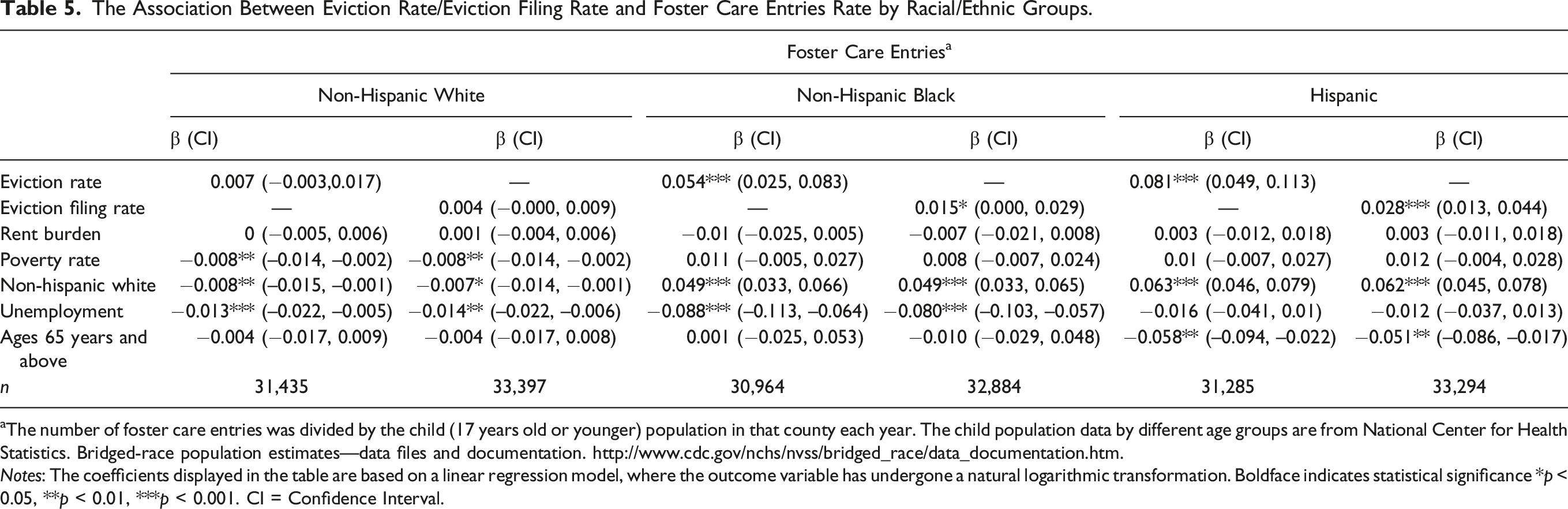
The Association Between Eviction Rate/Eviction Filing Rate and Foster Care Entries Rate by Racial/Ethnic Groups.
aThe number of foster care entries was divided by the child (17 years old or younger) population in that county each year. The child population data by different age groups are from National Center for Health Statistics. Bridged-race population estimates—data files and documentation. http://www.cdc.gov/nchs/nvss/bridged_race/data_documentation.htm.
Notes: The coefficients displayed in the table are based on a linear regression model, where the outcome variable has undergone a natural logarithmic transformation. Boldface indicates statistical significance *p < 0.05, **p < 0.01, ***p < 0.001. CI = Confidence Interval.
To test if there is any lagged effect of eviction on the child welfare system involvement, we ran lagged effect models. For models of both CAN report and foster care entries rates, neither did the estimates show a statistically significant difference, nor were the estimates substantively different. Using lagged coefficients slightly improved model fit, based on the Aikake information criterion, but we did not think the minor improvement to warrant the added complexity of interpreting lagged coefficients and the potential interaction with other variables in the model.
Discussion
Overall, we found that increases in evictions in a county were associated with increased incidence of screened-in reports to CPS and children being placed in out-of-home care. We found important differences by race/ethnicity, with foster care entries involving Black and Hispanic children having significant associations with eviction measures while cases involving White children not having a significant association. We also found that among White and Black children the eviction rate is associated with CAN reports while there is no such significant relation among Hispanic children. Our study advances research in understanding the link between housing insecurity and child welfare system involvement by providing a comprehensive county-level analysis of child welfare indicators and eviction using data that included counties with fewer than 1,000 child welfare system involvement cases. Our study also contributed to the literature by examining this topic through the health equity lens and provided new insight on the racial and ethnic disparities of child welfare system involvement.
We examined the association of home eviction and home eviction filing with child welfare system involvement separately. Specifically, we examined two child welfare system involvement indicators: screened-in CAN reports and foster care entries. As hypothesized, we found that increases in eviction rates were associated with increases in screened-in reports of CAN. However, eviction filings did not have a significant relationship. Compared with eviction filings, the actual evictions may result in families living in unstable or unsafe housing, or unhoused, increasing stress and the risk for CAN by a family member or others. In addition, the eviction process with involvement from the court and law enforcement also may increase the visibility of children experiencing CAN to CPS. As hypothesized, both evictions and eviction filings had a positive relationship with foster care entries. In general, the findings of this study suggest that home eviction is a risk factor for CAN and foster care placement. These findings are consistent with previous findings that experiencing eviction or homelessness was associated with CAN reports/child removal (Berg & Brännström, 2018; Courtney et al., 2004; Jones, 2004; Warren & Font, 2015). Our findings underscore the importance and the needs of having safe, stable, and affordable housing in families with children. Policy efforts should be made to provide housing assistance (e.g., housing vouchers, inclusionary zoning, emergency rental assistance, low-income housing tax credit) to families with children who cannot afford housing by themselves or face imminent eviction risk. More general economic support (e.g., earned income tax credit, child tax credit, childcare subsidies) should also be provided to low-income families to help them reduce their financial burden and prevent housing insecurity as well as related child welfare system involvement.
Our findings also provide preliminary evidence on the racial/ethnic disparities in how evictions relate to child welfare system involvement. We found important differences that were not consistent across reporting CAN rates and foster care entry rates. Increases in evictions were associated with increases in CAN reports for White and Black children (at comparable levels) but were not associated with increases in Hispanic children being reported. In contrast, higher eviction rates were associated with large increases in foster care entries for Black and Hispanic children but were not significant for White children. These differences by race and ethnicity suggest that evictions – and housing stability more broadly – have differential consequences on the degree of child welfare system involvement for children of different backgrounds. This study suggests that eviction – and housing insecurity more generally – may be a risk factor for White and Black children being involved with child welfare systems; eviction may not be a risk factor for Hispanic children. However, when turning to foster care placement, eviction appears to have a greater impact on Black and Hispanic children than White children. Taken together, our finding shows that eviction is a significant risk factor for child welfare system involvement among racial and ethnic minorities. Further research is needed to validate this finding, and if validated, identify the reasons. There are several possible explanations for the racial and ethnic differences observed in this study and they warrant further exploration. First, the children from the racial and ethnic minority groups particularly the Black and Hispanic children disproportionately represent the population in the child welfare system (U.S. Department of Health & Human Services., 2021, U.S. Department of Health & Human Services., 2022), and they are also at higher risk of being in poverty and experiencing material hardship than non-Hispanic White children (Drake et al., 2011; Kim & Drake, 2018; Laskey et al., 2012; Pelton, 2015; Putnam-Hornstein et al., 2013; Sedlak et al., 2010), which leads them to be more likely to experience housing insecurity such as eviction (Hepburn et al., 2020; Raymond et al., 2018; Shelton, 2017; Teresa, 2018; Thomas et al., 2019) and end up staying in housing with much worse living condition than their previous residence (Desmond, 2012), moving into a neighborhood with higher poverty and crime (Desmond, 2012; Desmond & Shollenberger, 2015; Shelton, 2017), and being homeless (Desmond, 2012). Those consequences associated with the disproportionate eviction risk facing racial and ethnic minorities may lead to more child welfare system involvement among them. Second, the racial and ethnic minorities may experience more racial bias in the child welfare system (Dettlaff et al., 2011; Maguire-Jack et al., 2020; Merritt, 2021; Rivaux et al., 2008; Roberts, 2003) and evictions (Greenberg et al., 2016) than their non-Hispanic White counterparts, which could also lead to the racial disparities observed in our findings. Third, it is important to note that the systemic racism facing the racial and ethnic minorities such as redlining, discrimination in labor market, unequal access to quality education, and other institutional barriers (Dettlaff & Boyd, 2020; Dettlaff et al., 2021) could have led to the racial disparities in both housing market and child welfare system and contributed to the differences observed in our findings. For example, discriminatory housing policies in history have resulted in significant homeownership gap between Black and non-Hispanic White families (Cutler et al., 1999; Marçal & Maguire-Jack, 2021; McIntosh et al., 2020; Ports et al., 2021).
Nevertheless, it is unclear why no significant association was found between eviction rate and CAN reports among Hispanic children. Although prior studies have documented a relatively weaker gradient between poverty and CAN reports among Hispanic children compared with the other race and ethnicity (Drake et al., 2011; Kim & Drake, 2018), the underlying mechanism is inclusive and future investigations are warranted.
In addition to policy implications discussed above, these results also point to directions for caseworkers and service providers. Caseworkers generally recognize that housing is a risk factor for CAN. The fact that we find that evictions are predictive of system involvement does not mean that they are predictive of CAN, or that eviction on its own should require system involvement. Families facing eviction may benefit from casework that disentangles the eviction from other risk factors, and a service array that specifically targets housing risk may be sufficient in some cases to avoid system involvement. The racial and ethnic differences found in this study suggest that caseworkers and providers may want to ensure that risk is appropriately identified and services are provided in ways that recognize systemic and possible personal biases.
One interesting finding worth noting is that a consistent negative correlation between unemployment and CAN reports/foster care entries were found across different models. Although it seems to be against the conventional wisdom that unemployment is a risk factor for child welfare system involvement, meaning that higher unemployment is associated with more CAN reports/child removals from parents, the negative association found in this study is not surprising and this is consistent with the findings of several prior studies that also utilized aggregate-level data (Paxson & Waldfogel, 1999; Raissian, 2015). Scholars contended that children are more likely to be abused and neglected if their parents have fewer resources and resources should encompasses not only income but also parental time and the quality of parental time (Paxson & Waldfogel, 1999). Being unemployed would free up a parent’s time to provide care to a child (Paxson & Waldfogel, 1999; Raissian, 2015), so county-level unemployment may be a protective factor.
Limitations
There are several limitations in this study. First, this study is not causal. While we find that increase in eviction was associated with increases in certain types of child welfare cases, we cannot draw a causal conclusion that increase in eviction caused increases in child welfare cases. There may be factors to account for associated with both home eviction and child welfare system involvement that were not included as covariates. For instance, state or county level policy changes over time that are related to both eviction and child welfare involvement may not be captured in the fixed-effect model and thus cause potential bias of the estimates. Second, our study does not identify the specific pathways by which eviction may influence child welfare system involvement. It is possible that eviction may affect visibility to reporters and maltreatment risk in different ways at different stages of involvement, and not always in the same way. This could be due to different perceptions of reporters, caseworkers and other stakeholders; different state and local policies and practices with regards to maltreatment; availability of community resources to support families with housing vulnerability; or other factors. The data available for this analysis are unable to disentangle these factors. For example, we conducted ancillary analysis looking at how eviction relates to substantiation rates, and the results were inconclusive, particularly relative to reporting and foster care placement. This is in part due to the challenges with interpreting substantiation decisions in the NCANDS system, given the wide variation in state and local jurisdictional policies and practices. Further research should seek to disentangle the role of eviction at different stages of a family’s involvement in the child welfare system. Third, there are limitations to the data sets. Since our data are at county-level, we do not know whether the same families experienced eviction and CPS involvement. While both NCANDS and AFCARS have indicators for housing issues as a factor associated with system involvement, we had limited confidence in the quality of those indicators and chose not to use them. Using 2017 data, we find that inadequate housing was an issue with 2.1% of all screened-in reports in NCANDS and 11.2% of foster care entries in AFCARS. In NCANDS, only 12 states reported greater than 5% of reports with housing issues. These percentages are lower than research suggests should be the case. For example, using a 1999–2000 cohort of the National Survey of Child and Adolescent Well-Being (NSCAW), Fowler et al. (2013) found that 16% of families under investigation for maltreatment with children who remained in the home experienced inadequate housing as a significant risk for out-of-home placement (Fowler et al., 2013). Improving the quality of the housing variables in NCANDS and AFCARS could be a priority for states interested in understanding more about housing risk’s role in child welfare cases. Such improvement may be challenging for federally regulated administrative data sets that rely on different state systems, each of which has its own data infrastructure capacities and standards, caseworker practices, rules around reporting maltreatment, and definitions of maltreatment. We also did not have data for all counties of the United States for our analysis. It is possible that the counties for which we did not have data (around 15%) were systematically different than those in the study, and that the relationships we identified are not generalizable to the excluded counties. Additionally, while the Eviction Lab data set has the most comprehensive national eviction data to date (Desmond et al., 2018b), not all evictions were captured. In particular, the data set does not include evictions wherein landlords evict tenants without notice and court proceedings. Further work could be done to better understand the characteristics of those who are evicted without court proceedings. Fourth, the child welfare data were collected by fiscal year so there may be mismatching between the eviction data and child welfare data. However, we were not able to determine the extent to which the data were mismatched because although Eviction Lab reported their data by calendar year there might be still some states reporting cases by fiscal year but they still coded the reporting year as calendar year (Desmond et al., 2018a). Fifth, our analyses did not fully account for the potential lagged effect of home eviction on the child welfare system involvement. We did conduct robustness checks including lagged eviction rates and found it did not have a significant impact on the estimates of interest, nor sufficiently improve model fit to warrant the added complexity. These results are in line with a prior study has shown that the eviction effect is relatively immediate and the lagged effect is limited (Bullinger & Fong, 2021).
Conclusion
This study found a significant association between home evictions and screened-in CAN reports among White and Black children but no significant associations among Hispanic children. In addition, this study also found that home eviction was associated with higher number of foster care entries, and this association was strongest among Hispanic children.
Assisting parents in providing stable housing may reduce the risk of child welfare system involvement, including out-of-home placement. Primary and secondary prevention strategies could include housing assistance, increasing access to affordable and safe housing, as well as providing economic support for families (e.g., tax credits, childcare subsidies) (Centers for Disease Control and Prevention, 2019) that reduce parents’ financial barriers to stable housing. In addition, prevention strategies aimed to reduce the poverty rate among racial and ethnic minority families and neighborhoods and improve their material circumstances may help to reduce the racial disparities of the child welfare system involvement associated with home evictions.
Footnotes
Acknowledgments
The authors would like to thank the discussant and participants of the 42nd Association for Public Policy Analysis and Management (APPAM) Fall Research Conference and the Allied Social Science Associations (ASSA)/American Economic Association 2021 Annual Meeting for providing comments.
Declaration of Conflicting Interests
The author(s) declared no potential conflicts of interest with respect to the research, authorship, and/or publication of this article.
Funding
The author(s) received no financial support for the research, authorship, and/or publication of this article.
Disclaimer
The findings and conclusions in this report are those of the authors and do not necessarily represent the official position of the Centers for Disease Control and Prevention.
